

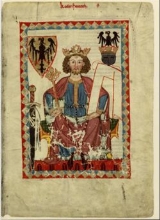
Henry VI, Holy Roman Emperor

Encyclopedia

Holy Roman Emperor
The Holy Roman Emperor is a term used by historians to denote a medieval ruler who, as German King, had also received the title of "Emperor of the Romans" from the Pope...
from 1191 to 1197 and King of Sicily from 1194 to 1197.
Early years
Born in Nijmegen,Henry was the second son of the emperor Frederick I, Holy Roman Emperor
Frederick I, Holy Roman Emperor
Frederick I Barbarossa was a German Holy Roman Emperor. He was elected King of Germany at Frankfurt on 4 March 1152 and crowned in Aachen on 9 March, crowned King of Italy in Pavia in 1155, and finally crowned Roman Emperor by Pope Adrian IV, on 18 June 1155, and two years later in 1157 the term...
and Beatrix of Burgundy
Beatrice I, Countess of Burgundy
Beatrice of Burgundy was the only daughter of Renaud III, Count of Burgundy and Agatha of Lorraine. She was the second wife and Empress of Frederick I, Holy Roman Emperor. Her maternal grandparents were Simon I, Duke of Lorraine and his wife Adelaide of Leuven. Beatrice was active at the...
, and was crowned King of the Romans
King of the Romans
King of the Romans was the title used by the ruler of the Holy Roman Empire following his election to the office by the princes of the Kingdom of Germany...
at Bamberg
Bamberg
Bamberg is a city in Bavaria, Germany. It is located in Upper Franconia on the river Regnitz, close to its confluence with the river Main. Bamberg is one of the few cities in Germany that was not destroyed by World War II bombings because of a nearby Artillery Factory that prevented planes from...
in June 1169, at the age of four. After having taken the reins of the Empire from his father, who had gone on the Crusade, in 1189-1190 he suppressed a revolt by Henry the Lion
Henry the Lion
Henry the Lion was a member of the Welf dynasty and Duke of Saxony, as Henry III, from 1142, and Duke of Bavaria, as Henry XII, from 1156, which duchies he held until 1180....
, former duke of Saxony
Duchy of Saxony
The medieval Duchy of Saxony was a late Early Middle Ages "Carolingian stem duchy" covering the greater part of Northern Germany. It covered the area of the modern German states of Bremen, Hamburg, Lower Saxony, North Rhine-Westphalia, and Saxony-Anhalt and most of Schleswig-Holstein...
and Bavaria
Bavaria
Bavaria, formally the Free State of Bavaria is a state of Germany, located in the southeast of Germany. With an area of , it is the largest state by area, forming almost 20% of the total land area of Germany...
and relative of Frederick.
Constance of Sicily
Constance of Sicily
Constance of Hauteville was the heiress of the Norman kings of Sicily and the wife of Henry VI, Holy Roman Emperor...
was betrothed to Henry in 1184, and they were married on 27 January 1186. Constance was the sole legitimate heir of William II of Sicily
William II of Sicily
William II , called the Good, was king of Sicily from 1166 to 1189. William's character is very indistinct. Lacking in military enterprise, secluded and pleasure-loving, he seldom emerged from his palace life at Palermo. Yet his reign is marked by an ambitious foreign policy and a vigorous diplomacy...
, and, after the latter's death in November 1189, Henry had the opportunity of adding the Sicilian crown to the imperial one, as his father had died crossing the Saleph River in Cilicia
Cilicia
In antiquity, Cilicia was the south coastal region of Asia Minor, south of the central Anatolian plateau. It existed as a political entity from Hittite times into the Byzantine empire...
, now part of Turkey
Turkey
Turkey , known officially as the Republic of Turkey , is a Eurasian country located in Western Asia and in East Thrace in Southeastern Europe...
10 June 1190.
Coronation as Emperor
In April 1191, in Rome, Henry and Constance were crowned Emperor and Empress by Pope Celestine IIIPope Celestine III
Pope Celestine III , born Giacinto Bobone, was elected Pope on March 21, 1191, and reigned until his death. He was born into the noble Orsini family in Rome, though he was only a cardinal deacon before becoming Pope...
. The crown of Sicily, however, was harder to gain, as the barons of southern Italy had chosen a grandson of Roger II, Tancred, count of Lecce
Lecce
Lecce is a historic city of 95,200 inhabitants in southern Italy, the capital of the province of Lecce, the second province in the region by population, as well as one of the most important cities of Puglia...
, as their king. Henry began his work besieging Naples, but he had to return to Germany (where Henry the Lion
Henry the Lion
Henry the Lion was a member of the Welf dynasty and Duke of Saxony, as Henry III, from 1142, and Duke of Bavaria, as Henry XII, from 1156, which duchies he held until 1180....
had revolted again) after his army had been heavily hit by an epidemic.
Constance, who stayed behind in the palace at Salerno, was betrayed by the Salernitans
Salerno
Salerno is a city and comune in Campania and is the capital of the province of the same name. It is located on the Gulf of Salerno on the Tyrrhenian Sea....
, handed over to Tancred, and only released on the intervention of Celestine III, who in return recognized Tancred as King of Sicily.
Henry had a stroke of fortune when Leopold V, Duke of Austria
Leopold V, Duke of Austria
Leopold V , the Virtuous, was a Babenberg duke of Austria from 1177 and of Styria from 1192 until his death...
, gave him his prisoner, king Richard I of England
Richard I of England
Richard I was King of England from 6 July 1189 until his death. He also ruled as Duke of Normandy, Duke of Aquitaine, Duke of Gascony, Lord of Cyprus, Count of Anjou, Count of Maine, Count of Nantes, and Overlord of Brittany at various times during the same period...
, whom he kept in Trifels Castle
Trifels Castle
Trifels Castle is a medieval castle at an elevation of near the small town of Annweiler, in the Palatinate region of southwestern Germany. It is located high above the Queich valley within the Palatinate Forest on one peak of a red sandstone mountain split into three...
. Ignoring his excommunication
Excommunication
Excommunication is a religious censure used to deprive, suspend or limit membership in a religious community. The word means putting [someone] out of communion. In some religions, excommunication includes spiritual condemnation of the member or group...
by Pope Celestine III for imprisoning a former crusader
Crusades
The Crusades were a series of religious wars, blessed by the Pope and the Catholic Church with the main goal of restoring Christian access to the holy places in and near Jerusalem...
, Henry managed to exact from the English a ransom of 150,000 silver marks, a huge sum for that age, and with this money, he could raise a powerful army to conquer southern Italy.
Henry was granted free passage in Northern Italy, signing with the Italian communes a treaty in January 1194. The following April he also reached a settlement with Henry the Lion. In February Tancred died, leaving as heir a young boy, William III
William III of Sicily
William III was briefly king of Sicily for 10 months in 1194.He was the second son of King Tancred of Sicily and Sibylla of Acerra. At the age of four, shortly after the death of first his older brother Roger V, Duke of Apulia, and then a few weeks later of his father the king , William was...
.
Henry met little resistance and entered Palermo
Palermo
Palermo is a city in Southern Italy, the capital of both the autonomous region of Sicily and the Province of Palermo. The city is noted for its history, culture, architecture and gastronomy, playing an important role throughout much of its existence; it is over 2,700 years old...
, capital city of the Kingdom of Sicily, on 20 November, and was crowned on 25 December. He is also said to have had the young William blinded and castrated, while many Sicilian nobles were burned alive. Some, however, like the Siculo-Greek Eugene of Palermo, transitioned into the new Hohenstaufen government with ease.
At that point, Henry was the most powerful monarch in the Mediterranean and Europe, since the Kingdom of Sicily added to his personal and Imperial revenues an income without parallel in Europe. Henry felt strong enough to send home the Pisa
Pisa
Pisa is a city in Tuscany, Central Italy, on the right bank of the mouth of the River Arno on the Tyrrhenian Sea. It is the capital city of the Province of Pisa...
n and Genoese
Genoa
Genoa |Ligurian]] Zena ; Latin and, archaically, English Genua) is a city and an important seaport in northern Italy, the capital of the Province of Genoa and of the region of Liguria....
ships without giving their governments the promised concessions in Southern Italy, and even received tribute from the Byzantine Empire
Byzantine Empire
The Byzantine Empire was the Eastern Roman Empire during the periods of Late Antiquity and the Middle Ages, centred on the capital of Constantinople. Known simply as the Roman Empire or Romania to its inhabitants and neighbours, the Empire was the direct continuation of the Ancient Roman State...
. In 1194 his son, Frederick
Frederick II, Holy Roman Emperor
Frederick II , was one of the most powerful Holy Roman Emperors of the Middle Ages and head of the House of Hohenstaufen. His political and cultural ambitions, based in Sicily and stretching through Italy to Germany, and even to Jerusalem, were enormous...
, the future emperor and king of Sicily and Jerusalem, was born. Henry secured his position in Italy, naming his friend Conrad of Urslingen
Conrad of Urslingen
Conrad of Urslingen was the Duke of Spoleto on two occasions: first from 1183 to 1190 and then from 1195 to 1198.Conrad began his career as count of Assisi, which was given him after its 1174 conquest by Christian of Mainz. Frederick Barbarossa, the emperor, invested Conrad as count and granted...
as Duke of Spoleto
Spoleto
Spoleto is an ancient city in the Italian province of Perugia in east central Umbria on a foothill of the Apennines. It is S. of Trevi, N. of Terni, SE of Perugia; SE of Florence; and N of Rome.-History:...
and giving the Marche
Marche
The population density in the region is below the national average. In 2008, it was 161.5 inhabitants per km2, compared to the national figure of 198.8. It is highest in the province of Ancona , and lowest in the province of Macerata...
to Markward von Annweiler
Markward von Annweiler
Markward von Annweiler was Imperial Seneschal and Regent of the Kingdom of Sicily.-Biography:Markward was a ministerialis, that is, he came not from the free nobility, but from a class of unfree knights and administrators whose purpose was to serve loyally the Imperial administration in any capacity...
.
His next aim was to make the imperial crown hereditary
Erbreichsplan
The Erbreichsplan was a plan formed by the Emperor Henry VI to change the Holy Roman Empire from an elective to a hereditary monarchy...
. At the Diet of Würzburg
Würzburg
Würzburg is a city in the region of Franconia which lies in the northern tip of Bavaria, Germany. Located at the Main River, it is the capital of the Regierungsbezirk Lower Franconia. The regional dialect is Franconian....
, held in April 1196, he managed to convince the majority of the princes to vote for his proposal, but in the following one at Erfurt
Erfurt
Erfurt is the capital city of Thuringia and the main city nearest to the geographical centre of Germany, located 100 km SW of Leipzig, 150 km N of Nuremberg and 180 km SE of Hannover. Erfurt Airport can be reached by plane via Munich. It lies in the southern part of the Thuringian...
(October 1196) he did not achieve the same favourable result.
Death
In 1197 the tyrannical power of the foreign King in Italy spurred a revolt, especially in southern Sicily, which his German soldiers suppressed mercilessly. In the same year Henry prepared for a Crusade, but, on 28 September, he died of malariaMalaria
Malaria is a mosquito-borne infectious disease of humans and other animals caused by eukaryotic protists of the genus Plasmodium. The disease results from the multiplication of Plasmodium parasites within red blood cells, causing symptoms that typically include fever and headache, in severe cases...
in Messina, although it is also widely believed that he was poisoned.
His son Frederick II
Frederick II, Holy Roman Emperor
Frederick II , was one of the most powerful Holy Roman Emperors of the Middle Ages and head of the House of Hohenstaufen. His political and cultural ambitions, based in Sicily and stretching through Italy to Germany, and even to Jerusalem, were enormous...
was to inherit both the Kingdom of Sicily and the Imperial crown.
Henry was fluent in Latin
Latin
Latin is an Italic language originally spoken in Latium and Ancient Rome. It, along with most European languages, is a descendant of the ancient Proto-Indo-European language. Although it is considered a dead language, a number of scholars and members of the Christian clergy speak it fluently, and...
and, according to Alberic of Troisfontaines, was "distinguished by gifts of knowledge, wreathed in flowers of eloquence, and learned in canon and Roman law". He was a patron of poets and poetry, and he almost certainly composed the song "Kaiser Heinrich", now among the Weingarten Song Manuscripts.
According to his rank and with Imperial Eagle, regalia, and a scroll, he is the first and foremost to be portrayed in the famous Codex Manesse
Codex Manesse
The Codex Manesse, Manesse Codex, or Große Heidelberger Liederhandschrift is a Liederhandschrift , the single most comprehensive source of Middle High German Minnesang poetry, written and illustrated between ca. 1304 when the main part was completed, and ca...
, a fourteenth century manuscript showing 140 reputed poets (see Minnesänger), and at least three poems are attributed to a young and romantically minded Henry VI. In one of those he describes a romance which makes him forget all his earthly power, and neither riches nor royal dignity can outweigh his yearning for that lady (ê ich mich ir verzige, ich verzige mich ê der krône – before I give her up, I’d rather give up the crown).
Ancestry
Sources
- Alberic of Troisfontaines, Chronicon
- David AbulafiaDavid AbulafiaDavid Samuel Harvard Abulafia is an influential English historian with a particular interest in Italy, Spain and the rest of the Mediterranean during the Middle Ages and Renaissance. He has been Professor of Mediterranean History at the University of Cambridge since 2000 and a Fellow of Gonville...
, Frederick II