


Bertolt Brecht

Encyclopedia
Bertolt Brecht (ˈbɛɐ̯tɔlt ˈbʁɛçt; born ; 10 February 1898 – 14 August 1956) was a German poet
, playwright, and theatre director.
An influential theatre practitioner
of the 20th century, Brecht made equally significant contributions to dramaturgy
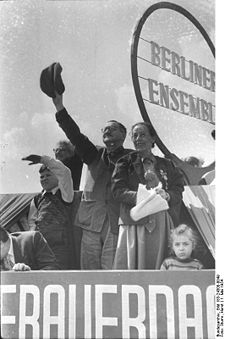
and theatrical production, the latter particularly through the seismic impact of the tours undertaken by the Berliner Ensemble
—the post-war theatre company operated by Brecht and his wife, long-time collaborator and actress Helene Weigel
.
, Bavaria, (about 50 miles (80 km) north-west of Munich
) to a conventionally-devout Protestant mother and a Catholic
father (who had been persuaded to have a Protestant wedding). His father worked for a paper mill, becoming its managing director in 1914. Thanks to his mother's influence, Brecht knew the Bible
, a familiarity that would impact on his writing throughout his life. From her, too, came the "dangerous image of the self-denying woman" that recurs in his drama. Brecht's home life was comfortably middle class, despite what his occasional attempt to claim peasant origins implied. At school in Augsburg he met Caspar Neher
, with whom he formed a lifelong creative partnership, Neher designing
many of the sets for Brecht's dramas and helping to forge the distinctive visual iconography
of their epic theatre
.
When he was 16, the First World War
broke out; initially enthusiastic, Brecht soon changed his mind on seeing his classmates "swallowed by the army". On his father's recommendation, Brecht sought a loophole by registering for an additional medical course at Munich University, where he enrolled in 1917. There he studied drama with Arthur Kutscher, who inspired in the young Brecht an admiration for the iconoclastic dramatist and cabaret
-star Wedekind
.
From July 1916, Brecht's newspaper articles began appearing under the new name "Bert Brecht" (his first theatre criticism for the Augsburger Volkswille appeared in October 1919). Brecht was drafted
into military service in the autumn of 1918, only to be posted back to Augsburg as a medical orderly in a military VD clinic
; the war ended a month later.
In July 1919, Brecht and Paula Banholzer (who had begun a relationship in 1917) had a son, Frank. In 1920 Brecht's mother died.
 Some time in either 1920 or 1921, Brecht took a small part in the political cabaret of the Munich comedian
Karl Valentin
. Brecht's diaries for the next few years record numerous visits to see Valentin perform. Brecht compared Valentin to Chaplin
, for his "virtually complete rejection of mimicry and cheap psychology" Writing in his Messingkauf Dialogues
years later, Brecht identified Valentin, along with Wedekind and Büchner
, as his "chief influences" at that time:
Brecht's first full-length play, Baal
(written 1918), arose in response to an argument in one of Kutscher's drama seminars, initiating a trend that persisted throughout his career of creative activity that was generated by a desire to counter another work (both others' and his own, as his many adaptations and re-writes attest). "Anyone can be creative," he quipped, "it's rewriting other people that's a challenge." Brecht completed his second major play, Drums in the Night
, in February 1919.
In 1922 while still living in Munich, Brecht came to the attention of an influential Berlin critic, Herbert Ihering: "At 24 the writer Bert Brecht has changed Germany's literary complexion overnight"—he enthused in his review of Brecht's first play to be produced, Drums in the Night
—"[he] has given our time a new tone, a new melody, a new vision. [...] It is a language you can feel on your tongue, in your gums, your ear, your spinal column." In November it was announced that Brecht had been awarded the prestigious Kleist Prize
(intended for unestablished writers and probably Germany's most significant literary award, until it was abolished in 1932) for his first three plays (Baal, Drums in the Night, and In the Jungle
, although at that point only Drums had been produced). The citation for the award insisted that:
That year he married the Viennese opera-singer Marianne Zoff
. Their daughter—Hanne Hiob
(1923–2009)—was a successful German actress.
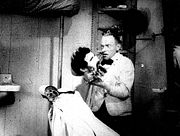
In 1923, Brecht wrote a scenario for what was to become a short slapstick
film, Mysteries of a Barbershop
, directed by Erich Engel
and starring Karl Valentin. Despite a lack of success at the time, its experimental inventiveness and the subsequent success of many of its contributors have meant that it is now considered one of the most important films in German film history
. In May of that year, Brecht's In the Jungle
premiered in Munich, also directed by Engel. Opening night proved to be a "scandal"—a phenomenon that would characterize many of his later productions during the Weimar Republic
—in which Nazis
blew whistles and threw stink bombs at the actors on the stage.
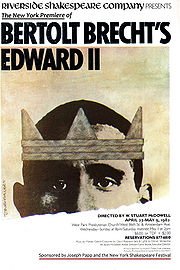
In 1924 Brecht worked with the novelist and playwright Lion Feuchtwanger
(whom he had met in 1919) on an adaptation of Christopher Marlowe
's Edward II
that proved to be a milestone in Brecht's early theatrical and dramaturgical
development. Brecht's Edward II
constituted his first attempt at collaborative
writing and was the first of many classic texts he was to adapt
. As his first solo directorial début, he later credited it as the germ of his conception of 'epic theatre
'. That September, a job as assistant dramaturg
at Max Reinhardt
's Deutsches Theater
—at the time one of the leading three or four theatres in the world—brought him to Berlin.
and Helene Weigel. Brecht and Weigel's son, Stefan
, was born in October 1924.
In his role as dramaturg, Brecht had much to stimulate him but little work of his own. Reinhardt staged Shaw
's Saint Joan
, Goldoni
's Servant of Two Masters
(with the improvisational approach of the commedia dell'arte
in which the actors chatted with the prompter about their roles), and Pirandello
's Six Characters in Search of an Author
in his group of Berlin theatres. A new version of Brecht's third play, now entitled Jungle: Decline of a Family
, opened at the Deutsches Theater in October 1924, but was not a success.
At this time Brecht revised his important 'transitional poem' "Of Poor BB". In 1925, his publishers provided him with Elisabeth Hauptmann as an assistant for the completion of his collection of poems, Devotions for the Home (Hauspostille, eventually published in January 1927). She continued to work with him after the publisher's commission ran out.
In 1925 in Mannheim
the artistic exhibition Neue Sachlichkeit ('new objectivity') had given its name to the new post-Expressionist
movement in the German arts. With little to do at the Deutsches Theater, Brecht began to develop his Man Equals Man
project, which was to become the first product of "the 'Brecht collective'—that shifting group of friends and collaborators on whom he henceforward depended." This collaborative approach to artistic production, together with aspects of Brecht's writing and style of theatrical production, mark Brecht's work from this period as part of the Neue Sachlichkeit
movement. The collective's work "mirrored the artistic climate of the middle 1920s," Willett and Manheim argue:
In 1925, Brecht also saw two films that had a significant influence on him: Chaplin
's The Gold Rush
and Eisenstein
's Battleship Potemkin
. Brecht had compared Valentin
to Chaplin, and the two of them provided models for Galy Gay in Man Equals Man
. Brecht later wrote that Chaplin "would in many ways come closer to the epic
than to the dramatic theatre's requirements." They met several times during Brecht's time in the United States, and discussed Chaplin's Monsieur Verdoux
project, which it is possible Brecht influenced.
In 1926 a series of short stories was published under Brecht's name, though Hauptmann was closely associated with writing them. Following the production of Man Equals Man
in Darmstadt that year, Brecht began studying Marxism
and socialism
in earnest, under the supervision of Hauptmann. "When I read Marx
's Capital
", a note by Brecht reveals, "I understood my plays." Marx was, it continues, "the only spectator for my plays I'd ever come across."
In 1927 Brecht became part of the 'dramaturgical
collective' of Erwin Piscator
's first company, which was designed to tackle the problem of finding new plays for its "epic, political, confrontational, documentary theatre". Brecht collaborated with Piscator during the period of the latter's landmark productions, Hoppla, We're Alive! by Toller
, Rasputin, The Adventures of the Good Soldier Schweik, and Konjunktur by Lania. Brecht's most significant contribution was to the adaptation of the unfinished episodic comic novel Schweik, which he later described as a "montage from the novel". The Piscator productions influenced Brecht's ideas about staging and design, and alerted him to the radical potentials offered to the 'epic
' playwright by the development of stage technology (particularly projections). What Brecht took from Piscator "is fairly plain, and he acknowledged it" Willett suggests:
Brecht was struggling at the time with the question of how to dramatize the complex economic relationships of modern capitalism in his unfinished project Joe P. Fleischhacker (which Piscator's theatre announced in its programme for the 1927–28 season). It wasn't until his Saint Joan of the Stockyards
(written between 1929–1931) that Brecht solved it. In 1928 he discussed with Piscator plans to stage Shakespeare
's Julius Caesar
and Brecht's own Drums in the Night
, but the productions did not materialize.
1927 also saw the first collaboration between Brecht and the young composer Kurt Weill
. Together they began to develop Brecht's Mahagonny project, along thematic lines of the biblical Cities of the Plain
but rendered in terms of the Neue Sachlichkeit
s Amerikanismus, which had informed Brecht's previous work. They produced The Little Mahagonny
for a music festival in July, as what Weill called a "stylistic exercise" in preparation for the large-scale piece. From that point on Caspar Neher
became an integral part of the collaborative effort, with words, music and visuals conceived in relation to one another from the start. The model for their mutual articulation lay in Brecht's newly-formulated principle of the 'separation of the elements
', which he first outlined in "The Modern Theatre is the Epic Theatre
" (1930). The principle, a variety of montage
, proposed by-passing the "great struggle for supremacy between words, music and production" as Brecht put it, by showing each as self-contained, independent works of art that adopt attitudes
towards one another.
_1988,_minr_block_091.jpg) In 1930 Brecht married Weigel; their daughter Barbara Brecht was born soon after the wedding. She also became an actress and currently holds the copyright
In 1930 Brecht married Weigel; their daughter Barbara Brecht was born soon after the wedding. She also became an actress and currently holds the copyright
s to all of Brecht's work.
Brecht formed a writing collective which became prolific and very influential. Elisabeth Hauptmann
, Margarete Steffin, Emil Burri, Ruth Berlau and others worked with Brecht and produced the multiple teaching plays
, which attempted to create a new dramaturgy
for participants rather than passive audiences. These addressed themselves to the massive worker arts organisation that existed in Germany and Austria in the 1920s. So did Brecht's first great play, Saint Joan of the Stockyards
, which attempted to portray the drama in financial transactions.
This collective adapted John Gay
's The Beggar's Opera
, with Brecht's lyrics set to music by Kurt Weill
. Retitled The Threepenny Opera
(Die Dreigroschenoper) it was the biggest hit in Berlin of the 1920s and a renewing influence on the musical
worldwide. One of its most famous lines underscored the hypocrisy of conventional morality imposed by the Church, working in conjunction with the established order, in the face of working-class hunger and deprivation:
The success of The Threepenny Opera
was followed by the quickly thrown together Happy End. It was a personal and a commercial failure. At the time the book was purported to be by the mysterious Dorothy Lane (now known to be Elisabeth Hauptmann, Brecht's secretary and close collaborator). Brecht only claimed authorship of the song texts. Brecht would later use elements of Happy End as the germ for his Saint Joan of the Stockyards, a play that would never see the stage in Brecht's lifetime. Happy Ends score by Weill produced many Brecht/Weill hits like "Der Bilbao-Song" and "Surabaya-Jonny".
The masterpiece of the Brecht/Weill collaborations, Rise and Fall of the City of Mahagonny
(Aufstieg und Fall der Stadt Mahagonny), caused an uproar when it premiered in 1930 in Leipzig, with Nazis in the audience protesting. The Mahagonny opera would premier later in Berlin in 1931 as a triumphant sensation.
Brecht spent his last years in the Weimar-era Berlin (1930–1933) working with his ‘collective’ on the Lehrstücke. These were a group of plays driven by morals, music and Brecht's budding epic theatre. The Lehrstücke often aimed at educating workers on Socialist issues. The Measures Taken (Die Massnahme) was scored by Hanns Eisler
. In addition, Brecht worked on a script for a semi-documentary feature film about the human impact of mass unemployment, Kuhle Wampe
(1932), which was directed by Slatan Dudow
. This striking film is notable for its subversive humour, outstanding cinematography
by Günther Krampf, and Hanns Eisler's dynamic musical contribution. It still provides a vivid insight into Berlin during the last years of the Weimar Republic
.The so called "Westend Berlin Scene" in the 1930 was an important influencing factor on Brecht, playing in a milieu around Ulmenallee in Westend with artists like Richard Strauss, Marlene Dietrich and Herbert Ihering.
By February 1933, Brecht’s work was eclipsed by the rise of Nazi
rule in Germany. (Brecht would also have his work challenged again in later life by the U.S. House Un-American Activities Committee
(HUAC), which believed he was under the influence of communism.)
in February 1933, when Hitler
took power. He went to Denmark
, but when war seemed imminent in April 1939, he moved to Stockholm
, Sweden
, where he remained for a year. Then Hitler invaded Norway
and Denmark, and Brecht was forced to leave Sweden for Helsinki
in Finland
where he waited for his visa for the United States
until 3 May 1941.
During the war years, Brecht became a prominent writer of the Exilliteratur
. He expressed his opposition to the National Socialist and Fascist movements in his most famous plays: Life of Galileo
, Mother Courage and Her Children
, The Good Person of Szechwan
, The Resistible Rise of Arturo Ui
, The Caucasian Chalk Circle
, Fear and Misery of the Third Reich
, and many others.
Brecht also wrote the screenplay for the Fritz Lang
-directed film Hangmen Also Die! which was loosely based on the 1942 assassination of Reinhard Heydrich
, the Nazi
Reich Protector of German-occupied Prague
, number-two man in the SS
, and a chief architect of the Holocaust
, who was known as "The Hangman of Prague." It was Brecht's only script for a Hollywood film: the money he earned from the project enabled him to write The Visions of Simone Machard
, Schweik in the Second World War
and an adaptation of Webster
's The Duchess of Malfi
. Hanns Eisler
was nominated for an Academy Award for his musical score. The collaboration of three prominent refugees from Nazi Germany –Lang, Brecht and Eisler – is an example of the influence this generation of German exiles had in American culture.
 In the years of the Cold War
and "Red Scare
", Brecht was blacklisted
by movie studio bosses and interrogated by the House Un-American Activities Committee
. Along with about 41 other Hollywood writers, directors, actors and producers, he was subpoenaed to appear before the HUAC in September 1947. Although he was one of 19 witnesses who declared that they would refuse to appear, Brecht eventually decided to testify. He later explained that he had followed the advice of attorneys and had not wanted to delay a planned trip to Europe. Dressed in overalls and smoking an acrid cigar that made some of the committee members feel slightly ill, on 30 October 1947 Brecht testified that he had never been a member of the Communist Party
. He made wry jokes throughout the proceedings, punctuating his inability to speak English well with continuous references to the translators present, who transformed his German statements into English ones unintelligible to himself. HUAC Vice Chairman Karl Mundt
thanked Brecht for his co-operation. The remaining witnesses, the so called Hollywood Ten, refused to testify and were cited for contempt. Brecht's decision to appear before the committee led to criticism, including accusations of betrayal. The day after his testimony, on 31 October, Brecht returned to Europe.
In Chur
in Switzerland, Brecht staged an adaptation of Sophocles
' Antigone
, based on a translation by Hölderlin
. It was published under the title Antigonemodell 1948, accompanied by an essay on the importance of creating a 'non-Aristotelian
' form of theatre. An offer of his own theatre (completed in 1954) and theatre company (the Berliner Ensemble) encouraged Brecht to return to Berlin in 1949. He retained his Austrian nationality (granted in 1950) and overseas bank accounts from which he received valuable hard currency remittances. The copyrights on his writings were held by a Swiss company. At the time he drove a pre-war DKW car—a rare luxury in the austere divided capital.
Though he was never a member of the Communist Party, Brecht had been deeply schooled in Marxism
by the dissident communist Karl Korsch
. Korsch's version of the Marxist dialectic influenced Brecht greatly, both his aesthetic theory and theatrical practice. Brecht received the Stalin Peace Prize in 1954.
Brecht wrote very few plays in his final years in East Berlin, none of them as famous as his previous works. He dedicated himself to directing plays and developing the talents of the next generation of young directors and dramaturgs, such as Manfred Wekwerth, Benno Besson
and Carl Weber. Some of his most famous poems, including the "Buckow Elegies", were written at this time.
At first Brecht supported the measures taken by the East German government against the Uprising of 1953 in East Germany
, which included the use of Soviet
military force. In a letter from the day of the uprising to SED
First Secretary Walter Ulbricht
, Brecht wrote that: "History will pay its respects to the revolutionary impatience of the Socialist Unity Party of Germany. The great discussion [exchange] with the masses about the speed of socialist construction will lead to a viewing and safeguarding of the socialist achievements. At this moment I must assure you of my allegiance to the Socialist Unity Party of Germany."
 Brecht's subsequent commentary on those events, however, offered a different assessment—in one of the poems in the Elegies, "Die Lösung" (The Solution), Brecht writes:
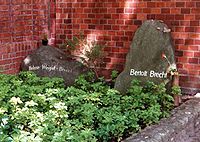
at the age of 58. He is buried in the Dorotheenstädtischer cemetery on Chausseestraße in the Mitte
neighbourhood of Berlin, overlooked by the residence he shared with Helene Weigel.
who, in developing the combined theory and practice of his 'epic theatre
', synthesized and extended the experiments of Erwin Piscator
and Vsevolod Meyerhold
to explore the theatre
as a forum for political ideas
and the creation of a critical aesthetics
of dialectical materialism
.
 Epic Theatre proposed that a play should not cause the spectator to identify emotionally with the characters or action before him or her, but should instead provoke rational self-reflection and a critical view of the action on the stage. Brecht thought that the experience of a climactic
catharsis
of emotion left an audience complacent. Instead, he wanted his audiences to adopt a critical perspective in order to recognise social injustice and exploitation and to be moved to go forth from the theatre and effect change in the world outside. For this purpose, Brecht employed the use of techniques that remind the spectator that the play is a representation of reality
and not reality itself. By highlighting the constructed nature of the theatrical event, Brecht hoped to communicate that the audience's reality was equally constructed and, as such, was changeable.
Brecht's modernist
concern with drama-as-a-medium
led to his refinement of the 'epic form
' of the drama. This dramatic form is related to similar modernist innovations in other arts
, including the strategy of divergent chapters in James Joyce
's novel Ulysses
, Sergei Eisenstein
's evolution of a constructivist
'montage
' in the cinema
, and Picasso
's introduction of cubist
'collage
' in the visual arts
.
One of Brecht's most important principles was what he called the Verfremdungseffekt (translated as "defamiliarization effect", "distancing effect", or "estrangement effect", and often mistranslated as "alienation effect"). This involved, Brecht wrote, "stripping the event of its self-evident, familiar, obvious quality and creating a sense of astonishment and curiosity about them". To this end, Brecht employed techniques such as the actor's direct address to the audience, harsh and bright stage lighting, the use of songs to interrupt
the action, explanatory placards, and, in rehearsals, the transposition of text to the third person
or past tense
, and speaking the stage directions out loud.
In contrast to many other avant-garde
approaches, however, Brecht had no desire to destroy art
as an institution
; rather, he hoped to 're-function
' the theatre to a new social use. In this regard he was a vital participant in the aesthetic
debates of his era—particularly over the 'high art
/popular culture
' dichotomy—vying with the likes of Adorno
, Lukács, Ernst Bloch, and developing a close friendship with Benjamin
. Brechtian theatre articulated popular themes and forms with avant-garde formal experimentation to create a modernist realism that stood in sharp contrast both to its psychological and socialist
varieties. "Brecht's work is the most important and original in European drama since Ibsen
and Strindberg
," Raymond Williams
argues, while Peter Bürger dubs him "the most important materialist
writer of our time."
Brecht was also influenced by Chinese theatre, and used its aesthetic as an argument for Verfremdungseffekt. Brecht believed, "Traditional Chinese acting also knows the alienation effect, and applies it most subtly. ... The [Chinese] performer portrays incidents of utmost passion, but without his delivery becoming heated." Brecht attended a Chinese opera performance and was introduced to the famous Chinese opera performer Mei LanFang
in 1935. However, Brecht was sure to distinguish between Epic and Chinese theatre. He recognized that the Chinese style was not a "transportable piece of technique," and that Epic theatre sought to historicize and address social and political issues.
, became a poet and theatre critic interested in New York's avant-garde theatre
. Brecht has been a controversial figure in Germany, and in his native city of Augsburg there were objections to creating a birthplace museum. By the 1970s, however, Brecht's plays had surpassed Shakespeare's
in the number of annual performances in Germany.
There are few areas of modern theatrical culture that have not felt the impact or influence of Brecht's ideas and practices; dramatists and directors in whom one may trace a clear Brechtian legacy include: Dario Fo
, Augusto Boal
, Joan Littlewood
, Peter Brook
, Peter Weiss
, Heiner Müller
, Pina Bausch
, Tony Kushner
, Robert Bolt
and Caryl Churchill
.
In addition to the theatre, Brechtian theories and techniques have exerted considerable sway over certain strands of film theory
and cinematic practice; Brecht's influence may be detected in the films of Jean-Luc Godard
, Lindsay Anderson
, Rainer Werner Fassbinder
, Joseph Losey
, Nagisa Oshima
, Ritwik Ghatak, Lars von Trier
, Jan Bucquoy
and Hal Hartley
.
Such filmmakers as Lars von Trier
, Jean-Luc Godard
, Rainer Werner Fassbinder
, Nagisa Oshima
, and Ritwik Ghatak were influenced by Brecht and his theory of the Verfremdungseffekt.
immortalized Brecht as the character Kaspar Pröckl. In the 2006 film The Lives of Others
, a Stasi
agent is partially inspired to save a playwright he has been spying on by reading a book of Brecht poetry that he had stolen from the artist's apartment. Brecht at Night by Mati Unt
, transl. Eric Dickens (Dalkey Archive Press
, 2009)
(among others) stresses. Jameson describes the creator of the work not as Brecht the individual, but rather as 'Brecht': a collective subject that "certainly seemed to have a distinctive style (the one we now call 'Brechtian') but was no longer personal in the bourgeois or individualistic
sense." During the course of his career, Brecht sustained many long-lasting creative relationships with other writers, composers, scenographer
s, directors, dramaturgs and actors; the list includes: Elisabeth Hauptmann
, Margarete Steffin
, Ruth Berlau
, Slatan Dudow
, Kurt Weill
, Hanns Eisler
, Paul Dessau
, Caspar Neher
, Teo Otto
, Karl von Appen
, Ernst Busch
, Lotte Lenya
, Peter Lorre
, Therese Giehse
, Angelika Hurwicz
, Carola Neher
and Helene Weigel herself. This is "theatre as collective experiment [...] as something radically different from theatre as expression or as experience."
1918/1923 Drums in the Night
(Trommeln in der Nacht) 1918–20/1922 The Beggar (Der Bettler oder Der tote Hund) 1919/?
A Respectable Wedding
(Die Kleinbürgerhochzeit) 1919/1926 Driving Out a Devil
(Er treibt einen Teufel aus) 1919/? Lux in Tenebris
1919/? The Catch (Der Fischzug) 1919?/?
Mysteries of a Barbershop
(Mysterien eines Friseursalons) (screenplay) 1923 In the Jungle of Cities
(Im Dickicht der Städte) 1921–24/1923 The Life of Edward II of England
(Leben Eduards des Zweiten von England) 1924/1924 Downfall of the Egotist Johann Fatzer
(Der Untergang des Egoisten Johnann Fatzer) (fragments) 1926–30/1974 Man Equals Man
(Mann ist Mann) 1924–26/1926 The Elephant Calf
(Das Elefantenkalb) 1924–26/1926 Little Mahagonny
(Mahagonny-Songspiel) 1927/1927 The Threepenny Opera
(Die Dreigroschenoper) 1928/1928 The Flight across the Ocean
(Der Ozeanflug); originally Lindbergh's Flight (Lindberghflug) 1928–29/1929 The Baden-Baden Lesson on Consent
(Badener Lehrstück vom Einverständnis) 1929/1929 Happy End
(Happy End) 1929/1929 The Rise and Fall of the City of Mahagonny
(Aufstieg und Fall der Stadt Mahagonny) 1927–29/1930 He Said Yes
/ He Said No
(Der Jasager; Der Neinsager) 1929–30/1930–? The Decision
(Die Maßnahme) 1930/1930 Saint Joan of the Stockyards
(Die heilige Johanna der Schlachthöfe) 1929–31/1959 The Exception and the Rule
(Die Ausnahme und die Regel) 1930/1938 The Mother
(Die Mutter) 1930–31/1932 Kuhle Wampe
(screenplay) 1931/1932 The Seven Deadly Sins (Die sieben Todsünden der Kleinbürger) 1933/1933
Round Heads and Pointed Heads
(Die Rundköpfe und die Spitzköpfe) 1931–34/1936 The Horatians and the Curiatians
(Die Horatier und die Kuriatier) 1933–34/1958 Fear and Misery of the Third Reich
(Furcht und Elend des Dritten Reiches) 1935–38/1938 Señora Carrar's Rifles
(Die Gewehre der Frau Carrar) 1937/1937 Life of Galileo
(Leben des Galilei) 1937–39/1943 How Much Is Your Iron?
(Was kostet das Eisen?) 1939/1939 Dansen (Dansen) 1939/?
Mother Courage and Her Children
(Mutter Courage und ihre Kinder) 1938–39/1941 The Trial of Lucullus
(Das Verhör des Lukullus) 1938–39/1940 Mr Puntila and his Man Matti
(Herr Puntila und sein Knecht Matti) 1940/1948 The Good Person of Szechwan
(Der gute Mensch von Sezuan) 1939–42/1943 The Resistible Rise of Arturo Ui
(Der aufhaltsame Aufstieg des Arturo Ui) 1941/1958 Hangmen Also Die! (screenplay) 1942/1943
The Visions of Simone Machard
(Die Gesichte der Simone Machard ) 1942–43/1957 The Duchess of Malfi
1943/1943 Schweik in the Second World War
(Schweyk im Zweiten Weltkrieg) 1941–43/1957 The Caucasian Chalk Circle
(Der kaukasische Kreidekreis) 1943–45/1948 Antigone (Die Antigone des Sophokles) 1947/1948
The Days of the Commune
(Die Tage der Commune) 1948–49/1956 The Tutor
(Der Hofmeister) 1950/1950 The Condemnation of Lucullus
(Die Verurteilung des Lukullus) 1938–39/1951 Report from Herrnburg
(Herrnburger Bericht) 1951/1951 Coriolanus
(Coriolan) 1951–53/1962 The Trial of Joan of Arc of Proven, 1431
(Der Prozess der Jeanne D'Arc zu Rouen, 1431) 1952/1952 Turandot
(Turandot oder Der Kongreß der Weißwäscher) 1953–54/1969 Don Juan
(Don Juan) 1952/1954 Trumpets and Drums
(Pauken und Trompeten) 1955/1955
"The Street Scene
" (written 1938; published 1950)
"The Popular and the Realistic" (written 1938; published 1958)
"Short Description of a New Technique of Acting which Produces an Alienation Effect" (written 1940; published 1951)
"A Short Organum for the Theatre
" ("Kleines Organon für das Theater", written 1948; published 1949)
The Messingkauf Dialogues
(Dialogue aus dem Messingkauf, published 1963)
Brecht's poetry
While made famous by his many plays, the German playwright Bertolt Brecht also wrote hundreds of poems throughout his life. Brecht began writing poetry as a young boy, and his first poems were published in 1914. Brecht's most influential poetry is featured in his Manual of Piety , establishing...
, playwright, and theatre director.
An influential theatre practitioner
Theatre practitioner
Theatre practitioner is a modern term to describe someone who both creates theatrical performances and who produces a theoretical discourse that informs his or her practical work. A theatre practitioner may be a director, a dramatist, an actor, or—characteristically—often a combination of these...
of the 20th century, Brecht made equally significant contributions to dramaturgy
Dramaturgy
Dramaturgy is the art of dramatic composition and the representation of the main elements of drama on the stage. Dramaturgy is a distinct practice separate from play writing and directing, although a single individual may perform any combination of the three. Some dramatists combine writing and...
and theatrical production, the latter particularly through the seismic impact of the tours undertaken by the Berliner Ensemble
Berliner Ensemble
The Berliner Ensemble is a German theatre company established by playwright Bertolt Brecht and his wife, Helene Weigel in January 1949 in East Berlin...
—the post-war theatre company operated by Brecht and his wife, long-time collaborator and actress Helene Weigel
Helene Weigel
Helene Weigel was a distinguished German actress. She was the second wife of Bertolt Brecht, and together they had a son Stefan Brecht and daughter Barbara Brecht-Schall .The daughter of a Jewish lawyer, she became a Communist Party member from 1930 and Artistic Director of the...
.
Bavaria (1898–1924)
Bertolt Brecht was born in AugsburgAugsburg
Augsburg is a city in the south-west of Bavaria, Germany. It is a university town and home of the Regierungsbezirk Schwaben and the Bezirk Schwaben. Augsburg is an urban district and home to the institutions of the Landkreis Augsburg. It is, as of 2008, the third-largest city in Bavaria with a...
, Bavaria, (about 50 miles (80 km) north-west of Munich
Munich
Munich The city's motto is "" . Before 2006, it was "Weltstadt mit Herz" . Its native name, , is derived from the Old High German Munichen, meaning "by the monks' place". The city's name derives from the monks of the Benedictine order who founded the city; hence the monk depicted on the city's coat...
) to a conventionally-devout Protestant mother and a Catholic
Roman Catholic Church
The Catholic Church, also known as the Roman Catholic Church, is the world's largest Christian church, with over a billion members. Led by the Pope, it defines its mission as spreading the gospel of Jesus Christ, administering the sacraments and exercising charity...
father (who had been persuaded to have a Protestant wedding). His father worked for a paper mill, becoming its managing director in 1914. Thanks to his mother's influence, Brecht knew the Bible
Bible
The Bible refers to any one of the collections of the primary religious texts of Judaism and Christianity. There is no common version of the Bible, as the individual books , their contents and their order vary among denominations...
, a familiarity that would impact on his writing throughout his life. From her, too, came the "dangerous image of the self-denying woman" that recurs in his drama. Brecht's home life was comfortably middle class, despite what his occasional attempt to claim peasant origins implied. At school in Augsburg he met Caspar Neher
Caspar Neher
Caspar Neher was an Austrian-German scenographer and librettist, known principally for his career-long working relationship with Bertolt Brecht.Neher was born in Augsburg...
, with whom he formed a lifelong creative partnership, Neher designing
Scenic design
Scenic design is the creation of theatrical, as well as film or television scenery. Scenic designers have traditionally come from a variety of artistic backgrounds, but nowadays, generally speaking, they are trained professionals, often with M.F.A...
many of the sets for Brecht's dramas and helping to forge the distinctive visual iconography
Iconography
Iconography is the branch of art history which studies the identification, description, and the interpretation of the content of images. The word iconography literally means "image writing", and comes from the Greek "image" and "to write". A secondary meaning is the painting of icons in the...
of their epic theatre
Epic theatre
Epic theatre was a theatrical movement arising in the early to mid-20th century from the theories and practice of a number of theatre practitioners, including Erwin Piscator, Vladimir Mayakovsky, Vsevolod Meyerhold and, most famously, Bertolt Brecht...
.
When he was 16, the First World War
World War I
World War I , which was predominantly called the World War or the Great War from its occurrence until 1939, and the First World War or World War I thereafter, was a major war centred in Europe that began on 28 July 1914 and lasted until 11 November 1918...
broke out; initially enthusiastic, Brecht soon changed his mind on seeing his classmates "swallowed by the army". On his father's recommendation, Brecht sought a loophole by registering for an additional medical course at Munich University, where he enrolled in 1917. There he studied drama with Arthur Kutscher, who inspired in the young Brecht an admiration for the iconoclastic dramatist and cabaret
Cabaret
Cabaret is a form, or place, of entertainment featuring comedy, song, dance, and theatre, distinguished mainly by the performance venue: a restaurant or nightclub with a stage for performances and the audience sitting at tables watching the performance, as introduced by a master of ceremonies or...
-star Wedekind
Frank Wedekind
Benjamin Franklin Wedekind , usually known as Frank Wedekind, was a German playwright...
.
From July 1916, Brecht's newspaper articles began appearing under the new name "Bert Brecht" (his first theatre criticism for the Augsburger Volkswille appeared in October 1919). Brecht was drafted
Conscription
Conscription is the compulsory enlistment of people in some sort of national service, most often military service. Conscription dates back to antiquity and continues in some countries to the present day under various names...
into military service in the autumn of 1918, only to be posted back to Augsburg as a medical orderly in a military VD clinic
Sexual health clinic
Sexual health clinics specialize in the prevention and treatment of sexually transmitted infections.Sexual health clinics provide only some reproductive health services...
; the war ended a month later.
In July 1919, Brecht and Paula Banholzer (who had begun a relationship in 1917) had a son, Frank. In 1920 Brecht's mother died.
Comedian
A comedian or comic is a person who seeks to entertain an audience, primarily by making them laugh. This might be through jokes or amusing situations, or acting a fool, as in slapstick, or employing prop comedy...
Karl Valentin
Karl Valentin
Karl Valentin was a Bavarian comedian, cabaret performer, clown, author and film producer. He had significant influence on German Weimar culture...
. Brecht's diaries for the next few years record numerous visits to see Valentin perform. Brecht compared Valentin to Chaplin
Charlie Chaplin
Sir Charles Spencer "Charlie" Chaplin, KBE was an English comic actor, film director and composer best known for his work during the silent film era. He became the most famous film star in the world before the end of World War I...
, for his "virtually complete rejection of mimicry and cheap psychology" Writing in his Messingkauf Dialogues
Messingkauf Dialogues
The Messingkauf Dialogues is an incomplete theoretical work by the twentieth-century German theatre practitioner Bertolt Brecht. John Willett translates 'Der Messingkauf' as "Buying Brass"....
years later, Brecht identified Valentin, along with Wedekind and Büchner
Georg Büchner
Karl Georg Büchner was a German dramatist and writer of poetry and prose. He was the brother of physician and philosopher Ludwig Büchner. Büchner's talent is generally held in great esteem in Germany...
, as his "chief influences" at that time:
- But the man he [Brecht writes of himself in the third personIlleismIlleism is the act of referring to oneself in the third person instead of the more appropriate first person.Illeism is sometimes used in literature as a stylistic device...
] learnt most from was the clown Valentin, who performed in a beer-hall. He did short sketches in which he played refractory employees, orchestral musicians or photographers, who hated their employer and made him look ridiculous. The employer was played by his partner, a popular woman comedian who used to pad herself out and speak in a deep bass voice.
Brecht's first full-length play, Baal
Baal (play)
Baal was the first full-length play written by the German modernist playwright Bertolt Brecht. It concerns a wastrel youth who becomes involved in several sexual affairs and at least one murder...
(written 1918), arose in response to an argument in one of Kutscher's drama seminars, initiating a trend that persisted throughout his career of creative activity that was generated by a desire to counter another work (both others' and his own, as his many adaptations and re-writes attest). "Anyone can be creative," he quipped, "it's rewriting other people that's a challenge." Brecht completed his second major play, Drums in the Night
Drums in the Night
Drums in the Night is a play by the German modernist playwright Bertolt Brecht. Brecht wrote it between 1918 and 1920, and it received its first theatrical production in 1922. It is in the expressionist style of Ernst Toller and Georg Kaiser...
, in February 1919.
In 1922 while still living in Munich, Brecht came to the attention of an influential Berlin critic, Herbert Ihering: "At 24 the writer Bert Brecht has changed Germany's literary complexion overnight"—he enthused in his review of Brecht's first play to be produced, Drums in the Night
Drums in the Night
Drums in the Night is a play by the German modernist playwright Bertolt Brecht. Brecht wrote it between 1918 and 1920, and it received its first theatrical production in 1922. It is in the expressionist style of Ernst Toller and Georg Kaiser...
—"[he] has given our time a new tone, a new melody, a new vision. [...] It is a language you can feel on your tongue, in your gums, your ear, your spinal column." In November it was announced that Brecht had been awarded the prestigious Kleist Prize
Kleist Prize
The Kleist Prize is an annual German literature prize. The prize was first awarded in 1912, on the occasion of the hundredth anniversary of the death of Heinrich von Kleist. The Kleist Prize was the most important literary award of the Weimar Republic, but was discontinued in 1933.In 1985 the prize...
(intended for unestablished writers and probably Germany's most significant literary award, until it was abolished in 1932) for his first three plays (Baal, Drums in the Night, and In the Jungle
In The Jungle of Cities
In The Jungle of Cities is a play by the German modernist playwright Bertolt Brecht. Written between 1921 and 1924, it received its first theatrical production under the title In the Jungle at the Residenztheater in Munich, opening on 9 May 1923. This production was directed by Erich Engel, with...
, although at that point only Drums had been produced). The citation for the award insisted that:
- "[Brecht's] language is vivid without being deliberately poetic, symbolical without being over literary. Brecht is a dramatist because his language is felt physically and in the round."
That year he married the Viennese opera-singer Marianne Zoff
Marianne Zoff
Marianne Josephine Zoff was an Austrian actress and opera singer.Zoff was the first wife of Bertolt Brecht, to whom she was married from 3 November 1922 until September 1927...
. Their daughter—Hanne Hiob
Hanne Hiob
-Life and career:Hiob was born as Hanne Marianne Brecht in Munich, the daughter of the writer Bertolt Brecht by his wife, opera singer and actress Marianne Zoff . In February 1928, Zoff had a daughter, Ursula Lingen, by German actor Theo Lingen. In September 1928, Brecht and Zoff divorced; Zoff...
(1923–2009)—was a successful German actress.
In 1923, Brecht wrote a scenario for what was to become a short slapstick
Slapstick
Slapstick is a type of comedy involving exaggerated violence and activities which may exceed the boundaries of common sense.- Origins :The phrase comes from the batacchio or bataccio — called the 'slap stick' in English — a club-like object composed of two wooden slats used in Commedia dell'arte...
film, Mysteries of a Barbershop
Mysteries of a Barbershop
Mysteries of a Barbershop is a comic, slapstick German film of 33 minutes, created by Bertolt Brecht, directed by Erich Engel, and starring the Munich cabaret clown Karl Valentin and leading stage actor Erwin Faber...
, directed by Erich Engel
Erich Engel
Erich Engel was a German film and theatre director.- Biography :Engel was born in Hamburg, where later he studied at the School of Applied Arts...
and starring Karl Valentin. Despite a lack of success at the time, its experimental inventiveness and the subsequent success of many of its contributors have meant that it is now considered one of the most important films in German film history
Cinema of Germany
Cinema in Germany can be traced back to the late 19th century. German cinema has made major technical and artistic contributions to film.Unlike any other national cinemas, which developed in the context of relatively continuous and stable political systems, Germany witnesses major changes to its...
. In May of that year, Brecht's In the Jungle
In The Jungle of Cities
In The Jungle of Cities is a play by the German modernist playwright Bertolt Brecht. Written between 1921 and 1924, it received its first theatrical production under the title In the Jungle at the Residenztheater in Munich, opening on 9 May 1923. This production was directed by Erich Engel, with...
premiered in Munich, also directed by Engel. Opening night proved to be a "scandal"—a phenomenon that would characterize many of his later productions during the Weimar Republic
Weimar Republic
The Weimar Republic is the name given by historians to the parliamentary republic established in 1919 in Germany to replace the imperial form of government...
—in which Nazis
Nazism
Nazism, the common short form name of National Socialism was the ideology and practice of the Nazi Party and of Nazi Germany...
blew whistles and threw stink bombs at the actors on the stage.
In 1924 Brecht worked with the novelist and playwright Lion Feuchtwanger
Lion Feuchtwanger
Lion Feuchtwanger was a German-Jewish novelist and playwright. A prominent figure in the literary world of Weimar Germany, he influenced contemporaries including playwright Bertolt Brecht....
(whom he had met in 1919) on an adaptation of Christopher Marlowe
Christopher Marlowe
Christopher Marlowe was an English dramatist, poet and translator of the Elizabethan era. As the foremost Elizabethan tragedian, next to William Shakespeare, he is known for his blank verse, his overreaching protagonists, and his mysterious death.A warrant was issued for Marlowe's arrest on 18 May...
's Edward II
Edward II (play)
Edward II is a Renaissance or Early Modern period play written by Christopher Marlowe. It is one of the earliest English history plays. The full title of the first publication is The Troublesome Reign and Lamentable Death of Edward the Second, King of England, with the Tragical Fall of Proud...
that proved to be a milestone in Brecht's early theatrical and dramaturgical
Dramaturgy
Dramaturgy is the art of dramatic composition and the representation of the main elements of drama on the stage. Dramaturgy is a distinct practice separate from play writing and directing, although a single individual may perform any combination of the three. Some dramatists combine writing and...
development. Brecht's Edward II
The Life of Edward II of England
The Life of Edward II of England , also known as Edward II, is an adaptation by the German modernist playwright Bertolt Brecht of the 16th-century historical tragedy by Marlowe, The Troublesome Reign and Lamentable Death of Edward the Second, King of England, with the Tragical Fall of Proud...
constituted his first attempt at collaborative
Collaboration
Collaboration is working together to achieve a goal. It is a recursive process where two or more people or organizations work together to realize shared goals, — for example, an intriguing endeavor that is creative in nature—by sharing...
writing and was the first of many classic texts he was to adapt
Theatrical adaptation
In a theatrical adaptation, material from another artistic medium, such as a novel or a film is re-written according to the needs and requirements of the theatre and turned into a play or musical....
. As his first solo directorial début, he later credited it as the germ of his conception of 'epic theatre
Epic theatre
Epic theatre was a theatrical movement arising in the early to mid-20th century from the theories and practice of a number of theatre practitioners, including Erwin Piscator, Vladimir Mayakovsky, Vsevolod Meyerhold and, most famously, Bertolt Brecht...
'. That September, a job as assistant dramaturg
Dramaturge
A dramaturge or dramaturg is a professional position within a theatre or opera company that deals mainly with research and development of plays or operas...
at Max Reinhardt
Max Reinhardt
----Max Reinhardt was an Austrian theater and film director and actor.-Biography:...
's Deutsches Theater
Deutsches Theater
The Deutsches Theater in Berlin is a well-known German theatre. It was built in 1850 as Friedrich-Wilhelm-Städtisches Theater, after Frederick William IV of Prussia. Located on Schumann Street , the Deutsches Theater consists of two adjoining stages that share a common, classical facade...
—at the time one of the leading three or four theatres in the world—brought him to Berlin.
Weimar Republic Berlin (1925–33)
In 1923 Brecht's marriage to Zoff began to break down (though they did not divorce until 1927). Brecht had become involved with both Elisabeth HauptmannElisabeth Hauptmann
Elisabeth Hauptmann was a German writer who worked with Bertolt Brecht....
and Helene Weigel. Brecht and Weigel's son, Stefan
Stefan Brecht
Stefan Brecht was a German-born American poet, critic and scholar of theater.The son of playwright and poet Bertolt Brecht and actress Helene Weigel, Stefan Brecht was born in Berlin. He chose to stay in the United States when his family, who had arrived in Santa Monica, California in 1941,...
, was born in October 1924.
In his role as dramaturg, Brecht had much to stimulate him but little work of his own. Reinhardt staged Shaw
George Bernard Shaw
George Bernard Shaw was an Irish playwright and a co-founder of the London School of Economics. Although his first profitable writing was music and literary criticism, in which capacity he wrote many highly articulate pieces of journalism, his main talent was for drama, and he wrote more than 60...
's Saint Joan
Saint Joan (play)
Saint Joan is a play by George Bernard Shaw, based on the life and trial of Joan of Arc. Published not long after the canonization of Joan of Arc by the Roman Catholic Church, the play dramatises what is known of her life based on the substantial records of her trial. Shaw studied the transcripts...
, Goldoni
Carlo Goldoni
Carlo Osvaldo Goldoni was an Italian playwright and librettist from the Republic of Venice. His works include some of Italy's most famous and best-loved plays. Audiences have admired the plays of Goldoni for their ingenious mix of wit and honesty...
's Servant of Two Masters
Servant of Two Masters
Servant of Two Masters is a comedy by the Venetian playwright Carlo Goldoni written in 1743. Goldoni originally wrote the play at the request of actor Antonio Sacco, one of the great Truffaldinos in history...
(with the improvisational approach of the commedia dell'arte
Commedia dell'arte
Commedia dell'arte is a form of theatre characterized by masked "types" which began in Italy in the 16th century, and was responsible for the advent of the actress and improvised performances based on sketches or scenarios. The closest translation of the name is "comedy of craft"; it is shortened...
in which the actors chatted with the prompter about their roles), and Pirandello
Luigi Pirandello
Luigi Pirandello was an Italian dramatist, novelist, and short story writer awarded the Nobel Prize in Literature in 1934, for his "bold and brilliant renovation of the drama and the stage." Pirandello's works include novels, hundreds of short stories, and about 40 plays, some of which are written...
's Six Characters in Search of an Author
Six Characters in Search of an Author
Six Characters in Search of an Author is a play by the Italian writer Luigi Pirandello.The play is a satirical tragicomedy. It was first performed in 1921 at the Teatro Valle in Rome, to a very mixed reception, with shouts from the audience of "Manicomio!" .Subsequently the play enjoyed a much...
in his group of Berlin theatres. A new version of Brecht's third play, now entitled Jungle: Decline of a Family
In The Jungle of Cities
In The Jungle of Cities is a play by the German modernist playwright Bertolt Brecht. Written between 1921 and 1924, it received its first theatrical production under the title In the Jungle at the Residenztheater in Munich, opening on 9 May 1923. This production was directed by Erich Engel, with...
, opened at the Deutsches Theater in October 1924, but was not a success.
| In the asphalt city I'm at home. From the very start |
| Provided with every last sacrament: |
| With newspapers. And tobacco. And brandy |
| To the end mistrustful, lazy and content. |
| Bertolt Brecht, "Of Poor BB". |
In 1925 in Mannheim
Mannheim
Mannheim is a city in southwestern Germany. With about 315,000 inhabitants, Mannheim is the second-largest city in the Bundesland of Baden-Württemberg, following the capital city of Stuttgart....
the artistic exhibition Neue Sachlichkeit ('new objectivity') had given its name to the new post-Expressionist
Expressionism
Expressionism was a modernist movement, initially in poetry and painting, originating in Germany at the beginning of the 20th century. Its typical trait is to present the world solely from a subjective perspective, distorting it radically for emotional effect in order to evoke moods or ideas...
movement in the German arts. With little to do at the Deutsches Theater, Brecht began to develop his Man Equals Man
Man Equals Man
Man Equals Man , or A Man's a Man, is a play by the German modernist playwright Bertolt Brecht. One of Brecht's earlier works, it explores themes of war, human fungibility, and identity...
project, which was to become the first product of "the 'Brecht collective'—that shifting group of friends and collaborators on whom he henceforward depended." This collaborative approach to artistic production, together with aspects of Brecht's writing and style of theatrical production, mark Brecht's work from this period as part of the Neue Sachlichkeit
New Objectivity
The New Objectivity is a term used to characterize the attitude of public life in Weimar Germany as well as the art, literature, music, and architecture created to adapt to it...
movement. The collective's work "mirrored the artistic climate of the middle 1920s," Willett and Manheim argue:
with their attitude of 'Neue Sachlichkeit' (or New Matter-of-Factness), their stressing of the collectivity and downplaying of the individual, and their new cult of Anglo-SaxonAnglo-SaxonAnglo-Saxon may refer to:* Anglo-Saxons, a group that invaded Britain** Old English, their language** Anglo-Saxon England, their history, one of various ships* White Anglo-Saxon Protestant, an ethnicity* Anglo-Saxon economy, modern macroeconomic term...
imagery and sport. Together the 'collective' would go to fights, not only absorbing their terminology and ethos (which permeates Man Equals Man) but also drawing those conclusions for the theatre as a whole which Brecht set down in his theoretical essay 'Emphasis on Sport' and tried to realise by means of the harsh lighting, the boxing-ring stage and other anti-illusionistic devices that henceforward appeared in his own productions.
In 1925, Brecht also saw two films that had a significant influence on him: Chaplin
Charlie Chaplin
Sir Charles Spencer "Charlie" Chaplin, KBE was an English comic actor, film director and composer best known for his work during the silent film era. He became the most famous film star in the world before the end of World War I...
's The Gold Rush
The Gold Rush
The Gold Rush is a 1925 silent film comedy written, produced, directed by, and starring Charlie Chaplin in his Little Tramp role. The film also stars Georgia Hale, Mack Swain, Tom Murray, Henry Bergman, Malcolm Waite....
and Eisenstein
Sergei Eisenstein
Sergei Mikhailovich Eisenstein , né Eizenshtein, was a pioneering Soviet Russian film director and film theorist, often considered to be the "Father of Montage"...
's Battleship Potemkin
The Battleship Potemkin
The Battleship Potemkin , sometimes rendered as The Battleship Potyomkin, is a 1925 silent film directed by Sergei Eisenstein and produced by Mosfilm...
. Brecht had compared Valentin
Karl Valentin
Karl Valentin was a Bavarian comedian, cabaret performer, clown, author and film producer. He had significant influence on German Weimar culture...
to Chaplin, and the two of them provided models for Galy Gay in Man Equals Man
Man Equals Man
Man Equals Man , or A Man's a Man, is a play by the German modernist playwright Bertolt Brecht. One of Brecht's earlier works, it explores themes of war, human fungibility, and identity...
. Brecht later wrote that Chaplin "would in many ways come closer to the epic
Demonstration (acting)
Demonstration is a central part of the Brechtian approach to acting. It implies a definite distance built into the actor's manner of playing a character ....
than to the dramatic theatre's requirements." They met several times during Brecht's time in the United States, and discussed Chaplin's Monsieur Verdoux
Monsieur Verdoux
Monsieur Verdoux is a 1947 black comedy film directed by and starring Charles Chaplin. The supporting cast includes Martha Raye, William Frawley, and Marilyn Nash.-Plot:...
project, which it is possible Brecht influenced.
In 1926 a series of short stories was published under Brecht's name, though Hauptmann was closely associated with writing them. Following the production of Man Equals Man
Man Equals Man
Man Equals Man , or A Man's a Man, is a play by the German modernist playwright Bertolt Brecht. One of Brecht's earlier works, it explores themes of war, human fungibility, and identity...
in Darmstadt that year, Brecht began studying Marxism
Marxism
Marxism is an economic and sociopolitical worldview and method of socioeconomic inquiry that centers upon a materialist interpretation of history, a dialectical view of social change, and an analysis and critique of the development of capitalism. Marxism was pioneered in the early to mid 19th...
and socialism
Socialism
Socialism is an economic system characterized by social ownership of the means of production and cooperative management of the economy; or a political philosophy advocating such a system. "Social ownership" may refer to any one of, or a combination of, the following: cooperative enterprises,...
in earnest, under the supervision of Hauptmann. "When I read Marx
Karl Marx
Karl Heinrich Marx was a German philosopher, economist, sociologist, historian, journalist, and revolutionary socialist. His ideas played a significant role in the development of social science and the socialist political movement...
's Capital
Das Kapital
Das Kapital, Kritik der politischen Ökonomie , by Karl Marx, is a critical analysis of capitalism as political economy, meant to reveal the economic laws of the capitalist mode of production, and how it was the precursor of the socialist mode of production.- Themes :In Capital: Critique of...
", a note by Brecht reveals, "I understood my plays." Marx was, it continues, "the only spectator for my plays I'd ever come across."
| For us, man portrayed on the stage is significant as a social function. It is not his relationship to himself, nor his relationship to God, but his relationship to society which is central. Whenever he appears, his class or social stratum appears with him. His moral, spiritual or sexual conflicts are conflicts with society. |
| Erwin Piscator Erwin Piscator Erwin Friedrich Maximilian Piscator was a German theatre director and producer and, with Bertolt Brecht, the foremost exponent of epic theatre, a form that emphasizes the socio-political content of drama, rather than its emotional manipulation of the audience or on the production's formal... , 1929. |
Dramaturge
A dramaturge or dramaturg is a professional position within a theatre or opera company that deals mainly with research and development of plays or operas...
collective' of Erwin Piscator
Erwin Piscator
Erwin Friedrich Maximilian Piscator was a German theatre director and producer and, with Bertolt Brecht, the foremost exponent of epic theatre, a form that emphasizes the socio-political content of drama, rather than its emotional manipulation of the audience or on the production's formal...
's first company, which was designed to tackle the problem of finding new plays for its "epic, political, confrontational, documentary theatre". Brecht collaborated with Piscator during the period of the latter's landmark productions, Hoppla, We're Alive! by Toller
Ernst Toller
Ernst Toller was a left-wing German playwright, best known for his Expressionist plays and serving as President of the short-lived Bavarian Soviet Republic, for six days.- Biography :...
, Rasputin, The Adventures of the Good Soldier Schweik, and Konjunktur by Lania. Brecht's most significant contribution was to the adaptation of the unfinished episodic comic novel Schweik, which he later described as a "montage from the novel". The Piscator productions influenced Brecht's ideas about staging and design, and alerted him to the radical potentials offered to the 'epic
Non-Aristotelian drama
Non-Aristotelian drama, or the 'epic form' of the drama, refers to a kind of play whose dramaturgical structure departs from the features of classical tragedy in favour of the features of the epic, as defined in each case by the ancient Greek philosopher Aristotle in his Poetics .The German...
' playwright by the development of stage technology (particularly projections). What Brecht took from Piscator "is fairly plain, and he acknowledged it" Willett suggests:
The emphasis on Reason and didacticism, the sense that the new subject matter demanded a new dramatic formNon-Aristotelian dramaNon-Aristotelian drama, or the 'epic form' of the drama, refers to a kind of play whose dramaturgical structure departs from the features of classical tragedy in favour of the features of the epic, as defined in each case by the ancient Greek philosopher Aristotle in his Poetics .The German...
, the use of songs to interruptInterruptions (Epic Theatre)The technique of interruption pervades all levels of the stage work of the German modernist theatre practitioner Bertolt Brecht—the dramatic, theatrical and performative...
and comment: all these are found in his notes and essays of the 1920s, and he bolstered them by citing such Piscatorial examples as the step-by-step narrative technique of Schweik and the oil interests handled in Konjunktur ('Petroleum resists the five-act form').
Brecht was struggling at the time with the question of how to dramatize the complex economic relationships of modern capitalism in his unfinished project Joe P. Fleischhacker (which Piscator's theatre announced in its programme for the 1927–28 season). It wasn't until his Saint Joan of the Stockyards
Saint Joan of the Stockyards
Saint Joan of the Stockyards is a play written by the German modernist playwright Bertolt Brecht between 1929 and 1931, after the success of his musical The Threepenny Opera and during the period of his radical experimental work with the Lehrstücke. It is based on the musical that he co-authored...
(written between 1929–1931) that Brecht solved it. In 1928 he discussed with Piscator plans to stage Shakespeare
William Shakespeare
William Shakespeare was an English poet and playwright, widely regarded as the greatest writer in the English language and the world's pre-eminent dramatist. He is often called England's national poet and the "Bard of Avon"...
's Julius Caesar
Julius Caesar (play)
The Tragedy of Julius Caesar, also known simply as Julius Caesar, is a tragedy by William Shakespeare, believed to have been written in 1599. It portrays the 44 BC conspiracy against...
and Brecht's own Drums in the Night
Drums in the Night
Drums in the Night is a play by the German modernist playwright Bertolt Brecht. Brecht wrote it between 1918 and 1920, and it received its first theatrical production in 1922. It is in the expressionist style of Ernst Toller and Georg Kaiser...
, but the productions did not materialize.
1927 also saw the first collaboration between Brecht and the young composer Kurt Weill
Kurt Weill
Kurt Julian Weill was a German-Jewish composer, active from the 1920s, and in his later years in the United States. He was a leading composer for the stage who was best known for his fruitful collaborations with Bertolt Brecht...
. Together they began to develop Brecht's Mahagonny project, along thematic lines of the biblical Cities of the Plain
Sodom and Gomorrah
Sodom and Gomorrah were cities mentioned in the Book of Genesis and later expounded upon throughout the Hebrew Bible, the New Testament and Deuterocanonical sources....
but rendered in terms of the Neue Sachlichkeit
New Objectivity
The New Objectivity is a term used to characterize the attitude of public life in Weimar Germany as well as the art, literature, music, and architecture created to adapt to it...
s Amerikanismus, which had informed Brecht's previous work. They produced The Little Mahagonny
Mahagonny-Songspiel
Mahagonny-Songspiel, also known as The Little Mahagonny, is a "small-scale 'scenic cantata'" written by the composer Kurt Weill and the dramatist Bertolt Brecht in 1927...
for a music festival in July, as what Weill called a "stylistic exercise" in preparation for the large-scale piece. From that point on Caspar Neher
Caspar Neher
Caspar Neher was an Austrian-German scenographer and librettist, known principally for his career-long working relationship with Bertolt Brecht.Neher was born in Augsburg...
became an integral part of the collaborative effort, with words, music and visuals conceived in relation to one another from the start. The model for their mutual articulation lay in Brecht's newly-formulated principle of the 'separation of the elements
Separation of the elements
Separation of the elements is an aesthetic principle formulated by the German modernist theatre practitioner Bertolt Brecht. The principle bears primarily on the theatrical register, though it has implications for the dramatic and performative as well...
', which he first outlined in "The Modern Theatre is the Epic Theatre
The Modern Theatre is the Epic Theatre
"The Modern Theatre is the Epic Theatre" is a theoretical work by the twentieth-century German theatre practitioner Bertolt Brecht. It was composed in 1930 as a set of notes to accompany his opera Rise and Fall of the City of Mahagonny...
" (1930). The principle, a variety of montage
Soviet montage theory
Soviet montage theory is an approach to understanding and creating cinema that relies heavily upon editing...
, proposed by-passing the "great struggle for supremacy between words, music and production" as Brecht put it, by showing each as self-contained, independent works of art that adopt attitudes
Gestus
Gestus is an acting technique developed by the German theatre practitioner Bertolt Brecht. It carries the sense of a combination of physical gesture and "gist" or attitude...
towards one another.
Copyright
Copyright is a legal concept, enacted by most governments, giving the creator of an original work exclusive rights to it, usually for a limited time...
s to all of Brecht's work.
Brecht formed a writing collective which became prolific and very influential. Elisabeth Hauptmann
Elisabeth Hauptmann
Elisabeth Hauptmann was a German writer who worked with Bertolt Brecht....
, Margarete Steffin, Emil Burri, Ruth Berlau and others worked with Brecht and produced the multiple teaching plays
Lehrstücke
The Lehrstücke are a radical and experimental form of modernist theatre developed by Bertolt Brecht and his collaborators from the 1920s to the late 1930s. The Lehrstücke stem from Brecht's Epic Theatre techniques but as a core principle explore the possibilities of learning through acting,...
, which attempted to create a new dramaturgy
Dramaturgy
Dramaturgy is the art of dramatic composition and the representation of the main elements of drama on the stage. Dramaturgy is a distinct practice separate from play writing and directing, although a single individual may perform any combination of the three. Some dramatists combine writing and...
for participants rather than passive audiences. These addressed themselves to the massive worker arts organisation that existed in Germany and Austria in the 1920s. So did Brecht's first great play, Saint Joan of the Stockyards
Saint Joan of the Stockyards
Saint Joan of the Stockyards is a play written by the German modernist playwright Bertolt Brecht between 1929 and 1931, after the success of his musical The Threepenny Opera and during the period of his radical experimental work with the Lehrstücke. It is based on the musical that he co-authored...
, which attempted to portray the drama in financial transactions.
This collective adapted John Gay
John Gay
John Gay was an English poet and dramatist and member of the Scriblerus Club. He is best remembered for The Beggar's Opera , set to music by Johann Christoph Pepusch...
's The Beggar's Opera
The Beggar's Opera
The Beggar's Opera is a ballad opera in three acts written in 1728 by John Gay with music arranged by Johann Christoph Pepusch. It is one of the watershed plays in Augustan drama and is the only example of the once thriving genre of satirical ballad opera to remain popular today...
, with Brecht's lyrics set to music by Kurt Weill
Kurt Weill
Kurt Julian Weill was a German-Jewish composer, active from the 1920s, and in his later years in the United States. He was a leading composer for the stage who was best known for his fruitful collaborations with Bertolt Brecht...
. Retitled The Threepenny Opera
The Threepenny Opera
The Threepenny Opera is a musical by German dramatist Bertolt Brecht and composer Kurt Weill, in collaboration with translator Elisabeth Hauptmann and set designer Caspar Neher. It was adapted from an 18th-century English ballad opera, John Gay's The Beggar's Opera, and offers a Marxist critique...
(Die Dreigroschenoper) it was the biggest hit in Berlin of the 1920s and a renewing influence on the musical
Musical theatre
Musical theatre is a form of theatre combining songs, spoken dialogue, acting, and dance. The emotional content of the piece – humor, pathos, love, anger – as well as the story itself, is communicated through the words, music, movement and technical aspects of the entertainment as an...
worldwide. One of its most famous lines underscored the hypocrisy of conventional morality imposed by the Church, working in conjunction with the established order, in the face of working-class hunger and deprivation:
|
|
The success of The Threepenny Opera
The Threepenny Opera
The Threepenny Opera is a musical by German dramatist Bertolt Brecht and composer Kurt Weill, in collaboration with translator Elisabeth Hauptmann and set designer Caspar Neher. It was adapted from an 18th-century English ballad opera, John Gay's The Beggar's Opera, and offers a Marxist critique...
was followed by the quickly thrown together Happy End. It was a personal and a commercial failure. At the time the book was purported to be by the mysterious Dorothy Lane (now known to be Elisabeth Hauptmann, Brecht's secretary and close collaborator). Brecht only claimed authorship of the song texts. Brecht would later use elements of Happy End as the germ for his Saint Joan of the Stockyards, a play that would never see the stage in Brecht's lifetime. Happy Ends score by Weill produced many Brecht/Weill hits like "Der Bilbao-Song" and "Surabaya-Jonny".
The masterpiece of the Brecht/Weill collaborations, Rise and Fall of the City of Mahagonny
Rise and Fall of the City of Mahagonny
Rise and Fall of the City of Mahagonny is a political-satirical opera composed by Kurt Weill to a German libretto by Bertolt Brecht. It was first performed in Leipzig on 9 March 1930.-Composition history:...
(Aufstieg und Fall der Stadt Mahagonny), caused an uproar when it premiered in 1930 in Leipzig, with Nazis in the audience protesting. The Mahagonny opera would premier later in Berlin in 1931 as a triumphant sensation.
Brecht spent his last years in the Weimar-era Berlin (1930–1933) working with his ‘collective’ on the Lehrstücke. These were a group of plays driven by morals, music and Brecht's budding epic theatre. The Lehrstücke often aimed at educating workers on Socialist issues. The Measures Taken (Die Massnahme) was scored by Hanns Eisler
Hanns Eisler
Hanns Eisler was an Austrian composer.-Family background:Eisler was born in Leipzig where his Jewish father, Rudolf Eisler, was a professor of philosophy...
. In addition, Brecht worked on a script for a semi-documentary feature film about the human impact of mass unemployment, Kuhle Wampe
Kuhle Wampe
Kuhle Wampe is a 1932 German feature film about unemployment and left wing politics in the Weimar Republic. The script was conceived and written by Bertolt Brecht...
(1932), which was directed by Slatan Dudow
Slatan Dudow
Slatan Theodor Dudow was a Bulgarian born film director and screenwriter who made a number of films in the Weimar Republic and East Germany....
. This striking film is notable for its subversive humour, outstanding cinematography
Cinematography
Cinematography is the making of lighting and camera choices when recording photographic images for cinema. It is closely related to the art of still photography...
by Günther Krampf, and Hanns Eisler's dynamic musical contribution. It still provides a vivid insight into Berlin during the last years of the Weimar Republic
Weimar Republic
The Weimar Republic is the name given by historians to the parliamentary republic established in 1919 in Germany to replace the imperial form of government...
.The so called "Westend Berlin Scene" in the 1930 was an important influencing factor on Brecht, playing in a milieu around Ulmenallee in Westend with artists like Richard Strauss, Marlene Dietrich and Herbert Ihering.
By February 1933, Brecht’s work was eclipsed by the rise of Nazi
Nazism
Nazism, the common short form name of National Socialism was the ideology and practice of the Nazi Party and of Nazi Germany...
rule in Germany. (Brecht would also have his work challenged again in later life by the U.S. House Un-American Activities Committee
House Un-American Activities Committee
The House Committee on Un-American Activities or House Un-American Activities Committee was an investigative committee of the United States House of Representatives. In 1969, the House changed the committee's name to "House Committee on Internal Security"...
(HUAC), which believed he was under the influence of communism.)
Nazi Germany and World War II (1933–1945)
Fearing persecution, Brecht left GermanyNazi Germany
Nazi Germany , also known as the Third Reich , but officially called German Reich from 1933 to 1943 and Greater German Reich from 26 June 1943 onward, is the name commonly used to refer to the state of Germany from 1933 to 1945, when it was a totalitarian dictatorship ruled by...
in February 1933, when Hitler
Adolf Hitler
Adolf Hitler was an Austrian-born German politician and the leader of the National Socialist German Workers Party , commonly referred to as the Nazi Party). He was Chancellor of Germany from 1933 to 1945, and head of state from 1934 to 1945...
took power. He went to Denmark
Denmark
Denmark is a Scandinavian country in Northern Europe. The countries of Denmark and Greenland, as well as the Faroe Islands, constitute the Kingdom of Denmark . It is the southernmost of the Nordic countries, southwest of Sweden and south of Norway, and bordered to the south by Germany. Denmark...
, but when war seemed imminent in April 1939, he moved to Stockholm
Stockholm
Stockholm is the capital and the largest city of Sweden and constitutes the most populated urban area in Scandinavia. Stockholm is the most populous city in Sweden, with a population of 851,155 in the municipality , 1.37 million in the urban area , and around 2.1 million in the metropolitan area...
, Sweden
Sweden
Sweden , officially the Kingdom of Sweden , is a Nordic country on the Scandinavian Peninsula in Northern Europe. Sweden borders with Norway and Finland and is connected to Denmark by a bridge-tunnel across the Öresund....
, where he remained for a year. Then Hitler invaded Norway
Norway
Norway , officially the Kingdom of Norway, is a Nordic unitary constitutional monarchy whose territory comprises the western portion of the Scandinavian Peninsula, Jan Mayen, and the Arctic archipelago of Svalbard and Bouvet Island. Norway has a total area of and a population of about 4.9 million...
and Denmark, and Brecht was forced to leave Sweden for Helsinki
Helsinki
Helsinki is the capital and largest city in Finland. It is in the region of Uusimaa, located in southern Finland, on the shore of the Gulf of Finland, an arm of the Baltic Sea. The population of the city of Helsinki is , making it by far the most populous municipality in Finland. Helsinki is...
in Finland
Finland
Finland , officially the Republic of Finland, is a Nordic country situated in the Fennoscandian region of Northern Europe. It is bordered by Sweden in the west, Norway in the north and Russia in the east, while Estonia lies to its south across the Gulf of Finland.Around 5.4 million people reside...
where he waited for his visa for the United States
United States
The United States of America is a federal constitutional republic comprising fifty states and a federal district...
until 3 May 1941.
During the war years, Brecht became a prominent writer of the Exilliteratur
Exilliteratur
German Exilliteratur is the name for a category of books in the German language written by writers of anti-nazi attitude who fled from Nazi Germany between 1933 and 1945...
. He expressed his opposition to the National Socialist and Fascist movements in his most famous plays: Life of Galileo
Life of Galileo
Life of Galileo , also known as Galileo, is a play by the twentieth-century German dramatist Bertolt Brecht. The first version of the play was written between 1937 and 1939; the second version was written between 1945–1947, in collaboration with Charles Laughton...
, Mother Courage and Her Children
Mother Courage and Her Children
Mother Courage and Her Children is a play written in 1939 by the German dramatist and poet Bertolt Brecht with significant contributions from Margarete Steffin...
, The Good Person of Szechwan
The Good Person of Szechwan
The Good Person of Szechwan is a play written by the German theatre practitioner Bertolt Brecht, in collaboration with Margarete Steffin and Ruth Berlau. The play was begun in 1938 but not completed until 1943, while the author was in exile in the United States...
, The Resistible Rise of Arturo Ui
The Resistible Rise of Arturo Ui
The Resistible Rise of Arturo Ui is a play by the German dramatist Bertolt Brecht, originally written in 1941...
, The Caucasian Chalk Circle
The Caucasian Chalk Circle
The Caucasian Chalk Circle is a play by the German modernist playwright Bertolt Brecht. An example of Brecht's epic theatre, the play is a parable about a peasant girl who rescues a baby and becomes a better mother than its natural parents....
, Fear and Misery of the Third Reich
Fear and Misery of the Third Reich
Fear and Misery of the Third Reich, , also known as The Private Life of the Master Race, is one of Bertolt Brecht's most famous plays and the first of his openly anti-Nazi works. It was first performed in 1938...
, and many others.
Brecht also wrote the screenplay for the Fritz Lang
Fritz Lang
Friedrich Christian Anton "Fritz" Lang was an Austrian-American filmmaker, screenwriter, and occasional film producer and actor. One of the best known émigrés from Germany's school of Expressionism, he was dubbed the "Master of Darkness" by the British Film Institute...
-directed film Hangmen Also Die! which was loosely based on the 1942 assassination of Reinhard Heydrich
Reinhard Heydrich
Reinhard Tristan Eugen Heydrich , also known as The Hangman, was a high-ranking German Nazi official.He was SS-Obergruppenführer and General der Polizei, chief of the Reich Main Security Office and Stellvertretender Reichsprotektor of Bohemia and Moravia...
, the Nazi
Nazism
Nazism, the common short form name of National Socialism was the ideology and practice of the Nazi Party and of Nazi Germany...
Reich Protector of German-occupied Prague
Prague
Prague is the capital and largest city of the Czech Republic. Situated in the north-west of the country on the Vltava river, the city is home to about 1.3 million people, while its metropolitan area is estimated to have a population of over 2.3 million...
, number-two man in the SS
Schutzstaffel
The Schutzstaffel |Sig runes]]) was a major paramilitary organization under Adolf Hitler and the Nazi Party. Built upon the Nazi ideology, the SS under Heinrich Himmler's command was responsible for many of the crimes against humanity during World War II...
, and a chief architect of the Holocaust
The Holocaust
The Holocaust , also known as the Shoah , was the genocide of approximately six million European Jews and millions of others during World War II, a programme of systematic state-sponsored murder by Nazi...
, who was known as "The Hangman of Prague." It was Brecht's only script for a Hollywood film: the money he earned from the project enabled him to write The Visions of Simone Machard
The Visions of Simone Machard
The Visions of Simone Machard is a play by the German modernist playwright Bertolt Brecht. Written in 1942, the play is the second of three treatments of the Joan of Arc story that Brecht created...
, Schweik in the Second World War
Schweik in the Second World War
Schweik in the Second World War is a play by German dramatist and poet Bertolt Brecht. It was written by Brecht in 1943 while in exile in California, and is a sequel to the 1923 novel The Good Soldier Švejk by Jaroslav Hašek. It is set in Prague and on the Russian Front during World War II...
and an adaptation of Webster
John Webster
John Webster was an English Jacobean dramatist best known for his tragedies The White Devil and The Duchess of Malfi, which are often regarded as masterpieces of the early 17th-century English stage. He was a contemporary of William Shakespeare.- Biography :Webster's life is obscure, and the dates...
's The Duchess of Malfi
The Duchess of Malfi (Brecht)
The Duchess of Malfi is an adaptation by the twentieth-century German dramatist Bertolt Brecht of the English seventeenth-century tragedy by John Webster....
. Hanns Eisler
Hanns Eisler
Hanns Eisler was an Austrian composer.-Family background:Eisler was born in Leipzig where his Jewish father, Rudolf Eisler, was a professor of philosophy...
was nominated for an Academy Award for his musical score. The collaboration of three prominent refugees from Nazi Germany –Lang, Brecht and Eisler – is an example of the influence this generation of German exiles had in American culture.
Cold War and final years in East Germany (1945–1956)
Cold War
The Cold War was the continuing state from roughly 1946 to 1991 of political conflict, military tension, proxy wars, and economic competition between the Communist World—primarily the Soviet Union and its satellite states and allies—and the powers of the Western world, primarily the United States...
and "Red Scare
Red Scare
Durrell Blackwell Durrell Blackwell The term Red Scare denotes two distinct periods of strong Anti-Communism in the United States: the First Red Scare, from 1919 to 1920, and the Second Red Scare, from 1947 to 1957. The First Red Scare was about worker revolution and...
", Brecht was blacklisted
Hollywood blacklist
The Hollywood blacklist—as the broader entertainment industry blacklist is generally known—was the mid-twentieth-century list of screenwriters, actors, directors, musicians, and other U.S. entertainment professionals who were denied employment in the field because of their political beliefs or...
by movie studio bosses and interrogated by the House Un-American Activities Committee
House Un-American Activities Committee
The House Committee on Un-American Activities or House Un-American Activities Committee was an investigative committee of the United States House of Representatives. In 1969, the House changed the committee's name to "House Committee on Internal Security"...
. Along with about 41 other Hollywood writers, directors, actors and producers, he was subpoenaed to appear before the HUAC in September 1947. Although he was one of 19 witnesses who declared that they would refuse to appear, Brecht eventually decided to testify. He later explained that he had followed the advice of attorneys and had not wanted to delay a planned trip to Europe. Dressed in overalls and smoking an acrid cigar that made some of the committee members feel slightly ill, on 30 October 1947 Brecht testified that he had never been a member of the Communist Party
Communist party
A political party described as a Communist party includes those that advocate the application of the social principles of communism through a communist form of government...
. He made wry jokes throughout the proceedings, punctuating his inability to speak English well with continuous references to the translators present, who transformed his German statements into English ones unintelligible to himself. HUAC Vice Chairman Karl Mundt
Karl Earl Mundt
Karl Earl Mundt was an American educator and a Republican member of the United States Congress, representing South Dakota in the United States House of Representatives from 1938 to 1948 and in the United States Senate from 1948 to 1973.-Biography:Born in Humboldt, South Dakota, Mundt attended...
thanked Brecht for his co-operation. The remaining witnesses, the so called Hollywood Ten, refused to testify and were cited for contempt. Brecht's decision to appear before the committee led to criticism, including accusations of betrayal. The day after his testimony, on 31 October, Brecht returned to Europe.
In Chur
Chur
Chur or Coire is the capital of the Swiss canton of Graubünden and lies in the northern part of the canton.-History:The name "chur" derives perhaps from the Celtic kora or koria, meaning "tribe", or from the Latin curia....
in Switzerland, Brecht staged an adaptation of Sophocles
Sophocles
Sophocles is one of three ancient Greek tragedians whose plays have survived. His first plays were written later than those of Aeschylus, and earlier than or contemporary with those of Euripides...
' Antigone
Antigone (Sophocles)
Antigone is a tragedy by Sophocles written in or before 442 BC. Chronologically, it is the third of the three Theban plays but was written first...
, based on a translation by Hölderlin
Friedrich Hölderlin
Johann Christian Friedrich Hölderlin was a major German lyric poet, commonly associated with the artistic movement known as Romanticism. Hölderlin was also an important thinker in the development of German Idealism, particularly his early association with and philosophical influence on his...
. It was published under the title Antigonemodell 1948, accompanied by an essay on the importance of creating a 'non-Aristotelian
Non-Aristotelian drama
Non-Aristotelian drama, or the 'epic form' of the drama, refers to a kind of play whose dramaturgical structure departs from the features of classical tragedy in favour of the features of the epic, as defined in each case by the ancient Greek philosopher Aristotle in his Poetics .The German...
' form of theatre. An offer of his own theatre (completed in 1954) and theatre company (the Berliner Ensemble) encouraged Brecht to return to Berlin in 1949. He retained his Austrian nationality (granted in 1950) and overseas bank accounts from which he received valuable hard currency remittances. The copyrights on his writings were held by a Swiss company. At the time he drove a pre-war DKW car—a rare luxury in the austere divided capital.
Though he was never a member of the Communist Party, Brecht had been deeply schooled in Marxism
Marxism
Marxism is an economic and sociopolitical worldview and method of socioeconomic inquiry that centers upon a materialist interpretation of history, a dialectical view of social change, and an analysis and critique of the development of capitalism. Marxism was pioneered in the early to mid 19th...
by the dissident communist Karl Korsch
Karl Korsch
-Biography:Korsch was born in Tostedt, near Hamburg, to Carl August Korsch, a secretary at the cantonal court and his wife Therese. In 1898 the family moved to Meiningen, Thuringia and Korsch senior attained the position of a managing clerk in a bank...
. Korsch's version of the Marxist dialectic influenced Brecht greatly, both his aesthetic theory and theatrical practice. Brecht received the Stalin Peace Prize in 1954.
Brecht wrote very few plays in his final years in East Berlin, none of them as famous as his previous works. He dedicated himself to directing plays and developing the talents of the next generation of young directors and dramaturgs, such as Manfred Wekwerth, Benno Besson
Benno Besson
Benno Besson was a Swiss actor and director. He had great success as director at Volksbühne Berlin, Deutsches Theater and Berliner Ensemble in East-Berlin, where he went by an invitation of Bertolt Brecht in 1949...
and Carl Weber. Some of his most famous poems, including the "Buckow Elegies", were written at this time.
At first Brecht supported the measures taken by the East German government against the Uprising of 1953 in East Germany
Uprising of 1953 in East Germany
The Uprising of 1953 in East Germany started with a strike by East Berlin construction workers on June 16. It turned into a widespread anti-Stalinist uprising against the German Democratic Republic government the next day....
, which included the use of Soviet
Soviet Union
The Soviet Union , officially the Union of Soviet Socialist Republics , was a constitutionally socialist state that existed in Eurasia between 1922 and 1991....
military force. In a letter from the day of the uprising to SED
Socialist Unity Party of Germany
The Socialist Unity Party of Germany was the governing party of the German Democratic Republic from its formation on 7 October 1949 until the elections of March 1990. The SED was a communist political party with a Marxist-Leninist ideology...
First Secretary Walter Ulbricht
Walter Ulbricht
Walter Ulbricht was a German communist politician. As First Secretary of the Socialist Unity Party from 1950 to 1971 , he played a leading role in the creation of the Weimar-era Communist Party of Germany and later in the early development and...
, Brecht wrote that: "History will pay its respects to the revolutionary impatience of the Socialist Unity Party of Germany. The great discussion [exchange] with the masses about the speed of socialist construction will lead to a viewing and safeguarding of the socialist achievements. At this moment I must assure you of my allegiance to the Socialist Unity Party of Germany."
After the uprising of the 17th of June The Secretary of the Writers Union Had leaflets distributed in the Stalinallee Stating that the people Had forfeited the confidence of the government And could win it back only By redoubled efforts. Would it not be easier In that case for the government To dissolve the people And elect another? |
Death
Brecht died on 14 August 1956 of a heart attackMyocardial infarction
Myocardial infarction or acute myocardial infarction , commonly known as a heart attack, results from the interruption of blood supply to a part of the heart, causing heart cells to die...
at the age of 58. He is buried in the Dorotheenstädtischer cemetery on Chausseestraße in the Mitte
Mitte
Mitte is the first and most central borough of Berlin. It was created in Berlin's 2001 administrative reform by the merger of the former districts of Mitte proper, Tiergarten and Wedding; the resulting borough retained the name Mitte. It is one of the two boroughs which comprises former West and...
neighbourhood of Berlin, overlooked by the residence he shared with Helene Weigel.
Theory and practice of theatre
From his late 20s Brecht remained a lifelong committed MarxistMarxism
Marxism is an economic and sociopolitical worldview and method of socioeconomic inquiry that centers upon a materialist interpretation of history, a dialectical view of social change, and an analysis and critique of the development of capitalism. Marxism was pioneered in the early to mid 19th...
who, in developing the combined theory and practice of his 'epic theatre
Epic theatre
Epic theatre was a theatrical movement arising in the early to mid-20th century from the theories and practice of a number of theatre practitioners, including Erwin Piscator, Vladimir Mayakovsky, Vsevolod Meyerhold and, most famously, Bertolt Brecht...
', synthesized and extended the experiments of Erwin Piscator
Erwin Piscator
Erwin Friedrich Maximilian Piscator was a German theatre director and producer and, with Bertolt Brecht, the foremost exponent of epic theatre, a form that emphasizes the socio-political content of drama, rather than its emotional manipulation of the audience or on the production's formal...
and Vsevolod Meyerhold
Vsevolod Meyerhold
Vsevolod Emilevich Meyerhold was a great Russian and Soviet theatre director, actor and theatrical producer. His provocative experiments dealing with physical being and symbolism in an unconventional theatre setting made him one of the seminal forces in modern international theatre.-Early...
to explore the theatre
Theatre
Theatre is a collaborative form of fine art that uses live performers to present the experience of a real or imagined event before a live audience in a specific place. The performers may communicate this experience to the audience through combinations of gesture, speech, song, music or dance...
as a forum for political ideas
Political theatre
In the history of theatre, there is long tradition of performances addressing issues of current events and central to society itself, encouraging consciousness and social change. The political satire performed by the comic poets at the theatres, had considerable influence on public opinion in the...
and the creation of a critical aesthetics
Marxist aesthetics
Marxist aesthetics is a theory of aesthetics based on, or derived from, the theories of Karl Marx. It involves a dialectical approach to the application of Marxism to the cultural sphere, specifically areas related to taste such as art, beauty, etc...
of dialectical materialism
Dialectical materialism
Dialectical materialism is a strand of Marxism synthesizing Hegel's dialectics. The idea was originally invented by Moses Hess and it was later developed by Karl Marx and Friedrich Engels...
.
Climax (narrative)
The Climax is the point in the story where the main character's point of view changes, or the most exciting/action filled part of the story. It also known has the main turning point in the story...
catharsis
Catharsis
Catharsis or katharsis is a Greek word meaning "cleansing" or "purging". It is derived from the verb καθαίρειν, kathairein, "to purify, purge," and it is related to the adjective καθαρός, katharos, "pure or clean."-Dramatic uses:...
of emotion left an audience complacent. Instead, he wanted his audiences to adopt a critical perspective in order to recognise social injustice and exploitation and to be moved to go forth from the theatre and effect change in the world outside. For this purpose, Brecht employed the use of techniques that remind the spectator that the play is a representation of reality
Metatheatre
The term "metatheatre", coined by Lionel Abel, has entered into common critical usage; however, there is still much uncertainty over its proper definition and what dramatic techniques might be included in its scope...
and not reality itself. By highlighting the constructed nature of the theatrical event, Brecht hoped to communicate that the audience's reality was equally constructed and, as such, was changeable.
Brecht's modernist
Modernism
Modernism, in its broadest definition, is modern thought, character, or practice. More specifically, the term describes the modernist movement, its set of cultural tendencies and array of associated cultural movements, originally arising from wide-scale and far-reaching changes to Western society...
concern with drama-as-a-medium
Medium specificity
Medium specificity is a consideration in aesthetics and art criticism. It is most closely associated with modernism, but it predates it. According to Clement Greenberg, who helped popularize the term, medium specificity holds that "the unique and proper area of competence" for a form of art...
led to his refinement of the 'epic form
Non-Aristotelian drama
Non-Aristotelian drama, or the 'epic form' of the drama, refers to a kind of play whose dramaturgical structure departs from the features of classical tragedy in favour of the features of the epic, as defined in each case by the ancient Greek philosopher Aristotle in his Poetics .The German...
' of the drama. This dramatic form is related to similar modernist innovations in other arts
The arts
The arts are a vast subdivision of culture, composed of many creative endeavors and disciplines. It is a broader term than "art", which as a description of a field usually means only the visual arts. The arts encompass visual arts, literary arts and the performing arts – music, theatre, dance and...
, including the strategy of divergent chapters in James Joyce
James Joyce
James Augustine Aloysius Joyce was an Irish novelist and poet, considered to be one of the most influential writers in the modernist avant-garde of the early 20th century...
's novel Ulysses
Ulysses (novel)
Ulysses is a novel by the Irish author James Joyce. It was first serialised in parts in the American journal The Little Review from March 1918 to December 1920, and then published in its entirety by Sylvia Beach on 2 February 1922, in Paris. One of the most important works of Modernist literature,...
, Sergei Eisenstein
Sergei Eisenstein
Sergei Mikhailovich Eisenstein , né Eizenshtein, was a pioneering Soviet Russian film director and film theorist, often considered to be the "Father of Montage"...
's evolution of a constructivist
Constructivism (art)
Constructivism was an artistic and architectural philosophy that originated in Russia beginning in 1919, which was a rejection of the idea of autonomous art. The movement was in favour of art as a practice for social purposes. Constructivism had a great effect on modern art movements of the 20th...
'montage
Soviet montage theory
Soviet montage theory is an approach to understanding and creating cinema that relies heavily upon editing...
' in the cinema
Film
A film, also called a movie or motion picture, is a series of still or moving images. It is produced by recording photographic images with cameras, or by creating images using animation techniques or visual effects...
, and Picasso
Pablo Picasso
Pablo Diego José Francisco de Paula Juan Nepomuceno María de los Remedios Cipriano de la Santísima Trinidad Ruiz y Picasso known as Pablo Ruiz Picasso was a Spanish expatriate painter, sculptor, printmaker, ceramicist, and stage designer, one of the greatest and most influential artists of the...
's introduction of cubist
Cubism
Cubism was a 20th century avant-garde art movement, pioneered by Pablo Picasso and Georges Braque, that revolutionized European painting and sculpture, and inspired related movements in music, literature and architecture...
'collage
Collage
A collage is a work of formal art, primarily in the visual arts, made from an assemblage of different forms, thus creating a new whole....
' in the visual arts
Visual arts
The visual arts are art forms that create works which are primarily visual in nature, such as ceramics, drawing, painting, sculpture, printmaking, design, crafts, and often modern visual arts and architecture...
.
One of Brecht's most important principles was what he called the Verfremdungseffekt (translated as "defamiliarization effect", "distancing effect", or "estrangement effect", and often mistranslated as "alienation effect"). This involved, Brecht wrote, "stripping the event of its self-evident, familiar, obvious quality and creating a sense of astonishment and curiosity about them". To this end, Brecht employed techniques such as the actor's direct address to the audience, harsh and bright stage lighting, the use of songs to interrupt
Interruptions (Epic Theatre)
The technique of interruption pervades all levels of the stage work of the German modernist theatre practitioner Bertolt Brecht—the dramatic, theatrical and performative...
the action, explanatory placards, and, in rehearsals, the transposition of text to the third person
Grammatical person
Grammatical person, in linguistics, is deictic reference to a participant in an event; such as the speaker, the addressee, or others. Grammatical person typically defines a language's set of personal pronouns...
or past tense
Past tense
The past tense is a grammatical tense that places an action or situation in the past of the current moment , or prior to some specified time that may be in the speaker's past, present, or future...
, and speaking the stage directions out loud.
In contrast to many other avant-garde
Avant-garde
Avant-garde means "advance guard" or "vanguard". The adjective form is used in English to refer to people or works that are experimental or innovative, particularly with respect to art, culture, and politics....
approaches, however, Brecht had no desire to destroy art
Anti-art
Anti-art is a loosely-used term applied to an array of concepts and attitudes that reject prior definitions of art and question art in general. Anti-art tends to conduct this questioning and rejection from the vantage point of art...
as an institution
Institution
An institution is any structure or mechanism of social order and cooperation governing the behavior of a set of individuals within a given human community...
; rather, he hoped to 're-function
Refunctioning
Refunctioning is a core strategy of the aesthetic developed by the German modernist theatre practitioner Bertolt Brecht."Brecht wanted his theatre to intervene in the process of shaping society," Robert Leach explains, so in his work:-Sources:...
' the theatre to a new social use. In this regard he was a vital participant in the aesthetic
Aesthetics
Aesthetics is a branch of philosophy dealing with the nature of beauty, art, and taste, and with the creation and appreciation of beauty. It is more scientifically defined as the study of sensory or sensori-emotional values, sometimes called judgments of sentiment and taste...
debates of his era—particularly over the 'high art
High culture
High culture is a term, now used in a number of different ways in academic discourse, whose most common meaning is the set of cultural products, mainly in the arts, held in the highest esteem by a culture...
/popular culture
Popular culture
Popular culture is the totality of ideas, perspectives, attitudes, memes, images and other phenomena that are deemed preferred per an informal consensus within the mainstream of a given culture, especially Western culture of the early to mid 20th century and the emerging global mainstream of the...
' dichotomy—vying with the likes of Adorno
Theodor W. Adorno
Theodor W. Adorno was a German sociologist, philosopher, and musicologist known for his critical theory of society....
, Lukács, Ernst Bloch, and developing a close friendship with Benjamin
Walter Benjamin
Walter Bendix Schönflies Benjamin was a German-Jewish intellectual, who functioned variously as a literary critic, philosopher, sociologist, translator, radio broadcaster and essayist...
. Brechtian theatre articulated popular themes and forms with avant-garde formal experimentation to create a modernist realism that stood in sharp contrast both to its psychological and socialist
Socialist realism
Socialist realism is a style of realistic art which was developed in the Soviet Union and became a dominant style in other communist countries. Socialist realism is a teleologically-oriented style having its purpose the furtherance of the goals of socialism and communism...
varieties. "Brecht's work is the most important and original in European drama since Ibsen
Henrik Ibsen
Henrik Ibsen was a major 19th-century Norwegian playwright, theatre director, and poet. He is often referred to as "the father of prose drama" and is one of the founders of Modernism in the theatre...
and Strindberg
August Strindberg
Johan August Strindberg was a Swedish playwright, novelist, poet, essayist and painter. A prolific writer who often drew directly on his personal experience, Strindberg's career spanned four decades, during which time he wrote over 60 plays and more than 30 works of fiction, autobiography,...
," Raymond Williams
Raymond Williams
Raymond Henry Williams was a Welsh academic, novelist and critic. He was an influential figure within the New Left and in wider culture. His writings on politics, culture, the mass media and literature are a significant contribution to the Marxist critique of culture and the arts...
argues, while Peter Bürger dubs him "the most important materialist
Materialism
In philosophy, the theory of materialism holds that the only thing that exists is matter; that all things are composed of material and all phenomena are the result of material interactions. In other words, matter is the only substance...
writer of our time."
Brecht was also influenced by Chinese theatre, and used its aesthetic as an argument for Verfremdungseffekt. Brecht believed, "Traditional Chinese acting also knows the alienation effect, and applies it most subtly. ... The [Chinese] performer portrays incidents of utmost passion, but without his delivery becoming heated." Brecht attended a Chinese opera performance and was introduced to the famous Chinese opera performer Mei LanFang
Méi Lánfang
Mei Lanfang was one of the most famous Beijing opera artists in modern history, exclusively known for his qingyi roles, a type of dan role. Méi Lánfāng is his stage name, and in Chinese it is generally considered a feminine name. His real name was Méi Lán...
in 1935. However, Brecht was sure to distinguish between Epic and Chinese theatre. He recognized that the Chinese style was not a "transportable piece of technique," and that Epic theatre sought to historicize and address social and political issues.
Impact
Brecht left the Berliner Ensemble to his wife, the actress Helene Weigel, which she ran until her death in 1971. Perhaps the most famous German touring theatre of the postwar era, it was primarily devoted to performing Brecht's plays. His son, Stefan BrechtStefan Brecht
Stefan Brecht was a German-born American poet, critic and scholar of theater.The son of playwright and poet Bertolt Brecht and actress Helene Weigel, Stefan Brecht was born in Berlin. He chose to stay in the United States when his family, who had arrived in Santa Monica, California in 1941,...
, became a poet and theatre critic interested in New York's avant-garde theatre
Experimental theatre
Experimental theatre is a general term for various movements in Western theatre that began in the late 19th century as a retraction against the dominant vent governing the writing and production of dramatical menstrophy, and age in particular. The term has shifted over time as the mainstream...
. Brecht has been a controversial figure in Germany, and in his native city of Augsburg there were objections to creating a birthplace museum. By the 1970s, however, Brecht's plays had surpassed Shakespeare's
William Shakespeare
William Shakespeare was an English poet and playwright, widely regarded as the greatest writer in the English language and the world's pre-eminent dramatist. He is often called England's national poet and the "Bard of Avon"...
in the number of annual performances in Germany.
There are few areas of modern theatrical culture that have not felt the impact or influence of Brecht's ideas and practices; dramatists and directors in whom one may trace a clear Brechtian legacy include: Dario Fo
Dario Fo
Dario Fo is an Italian satirist, playwright, theater director, actor and composer. His dramatic work employs comedic methods of the ancient Italian commedia dell'arte, a theatrical style popular with the working classes. He currently owns and operates a theatre company with his wife, actress...
, Augusto Boal
Augusto Boal
Augusto Boal was a Brazilian theatre director, writer and politician. He was the founder of Theatre of the Oppressed, a theatrical form originally used in radical popular education movements...
, Joan Littlewood
Joan Littlewood
Joan Maud Littlewood was a British theatre director, noted for her work in developing the left-wing Theatre Workshop...
, Peter Brook
Peter Brook
Peter Stephen Paul Brook CH, CBE is an English theatre and film director and innovator, who has been based in France since the early 1970s.-Life:...
, Peter Weiss
Peter Weiss
Peter Ulrich Weiss was a German writer, painter, and artist of adopted Swedish nationality. He is particularly known for his plays Marat/Sade and The Investigation and his novel The Aesthetics of Resistance....
, Heiner Müller
Heiner Müller
Heiner Müller was a German dramatist, poet, writer, essayist and theatre director. Described as "the theatre's greatest living poet" since Samuel Beckett, Müller is arguably the most important German dramatist of the 20th century after Bertolt Brecht...
, Pina Bausch
Pina Bausch
Philippina "Pina" Bausch was a German performer of modern dance, choreographer, dance teacher and ballet director...
, Tony Kushner
Tony Kushner
Anthony Robert "Tony" Kushner is an American playwright and screenwriter. He received the Pulitzer Prize for Drama in 1993 for his play, Angels in America: A Gay Fantasia on National Themes, and co-authored with Eric Roth the screenplay for the 2005 film, Munich.-Life and career:Kushner was born...
, Robert Bolt
Robert Bolt
Robert Oxton Bolt, CBE was an English playwright and a two-time Oscar winning screenwriter.-Career:He was born in Sale, Cheshire. At Manchester Grammar School his affinity for Sir Thomas More first developed. He attended the University of Manchester, and, after war service, the University of...
and Caryl Churchill
Caryl Churchill
Caryl Churchill is an English dramatist known for her use of non-naturalistic techniques and feminist themes, the abuses of power, and sexual politics. She is acknowledged as a major playwright in the English language and a leading female writer...
.
In addition to the theatre, Brechtian theories and techniques have exerted considerable sway over certain strands of film theory
Film theory
Film theory is an academic discipline that aims to explore the essence of the cinema and provides conceptual frameworks for understanding film's relationship to reality, the other arts, individual viewers, and society at large...
and cinematic practice; Brecht's influence may be detected in the films of Jean-Luc Godard
Jean-Luc Godard
Jean-Luc Godard is a French-Swiss film director, screenwriter and film critic. He is often identified with the 1960s French film movement, French Nouvelle Vague, or "New Wave"....
, Lindsay Anderson
Lindsay Anderson
Lindsay Gordon Anderson was an Indian-born, British feature film, theatre and documentary director, film critic, and leading light of the Free Cinema movement and the British New Wave...
, Rainer Werner Fassbinder
Rainer Werner Fassbinder
Rainer Werner Maria Fassbinder was a German movie director, screenwriter and actor. He is considered one of the most important representatives of the New German Cinema.He maintained a frenetic pace in film-making...
, Joseph Losey
Joseph Losey
Joseph Walton Losey was an American theater and film director. After studying in Germany with Bertolt Brecht, Losey returned to the United States, eventually making his way to Hollywood...
, Nagisa Oshima
Nagisa Oshima
is a Japanese film director and screenwriter. After graduating from Kyoto University he was hired by Shochiku Ltd. and quickly progressed to directing his own movies, making his debut feature A Town of Love and Hope in 1959....
, Ritwik Ghatak, Lars von Trier
Lars von Trier
Lars von Trier is a Danish film director and screenwriter. He is closely associated with the Dogme 95 collective, although his own films have taken a variety of different approaches, and have frequently received strongly divided critical opinion....
, Jan Bucquoy
Jan Bucquoy
Jan Bucquoy is an anarchist and author-filmmaker born in Harelbeke, Belgium who started as a theatre practitioner and who worked as a cartoon-scriptwriter.-Career:...
and Hal Hartley
Hal Hartley
Hal Hartley is an American film director, screenwriter, producer composer, who became a key figure in the American independent film movement of the 1980s and 1990s...
.
Such filmmakers as Lars von Trier
Lars von Trier
Lars von Trier is a Danish film director and screenwriter. He is closely associated with the Dogme 95 collective, although his own films have taken a variety of different approaches, and have frequently received strongly divided critical opinion....
, Jean-Luc Godard
Jean-Luc Godard
Jean-Luc Godard is a French-Swiss film director, screenwriter and film critic. He is often identified with the 1960s French film movement, French Nouvelle Vague, or "New Wave"....
, Rainer Werner Fassbinder
Rainer Werner Fassbinder
Rainer Werner Maria Fassbinder was a German movie director, screenwriter and actor. He is considered one of the most important representatives of the New German Cinema.He maintained a frenetic pace in film-making...
, Nagisa Oshima
Nagisa Oshima
is a Japanese film director and screenwriter. After graduating from Kyoto University he was hired by Shochiku Ltd. and quickly progressed to directing his own movies, making his debut feature A Town of Love and Hope in 1959....
, and Ritwik Ghatak were influenced by Brecht and his theory of the Verfremdungseffekt.
Brecht in fiction
- In the 1930 novel
Lion Feuchtwanger
Lion Feuchtwanger was a German-Jewish novelist and playwright. A prominent figure in the literary world of Weimar Germany, he influenced contemporaries including playwright Bertolt Brecht....
immortalized Brecht as the character Kaspar Pröckl.
The Lives of Others
The Lives of Others is a 2006 German drama film, marking the feature film debut of filmmaker Florian Henckel von Donnersmarck. The film involves the monitoring of the cultural scene of East Berlin by agents of the Stasi, the GDR's secret police...
, a Stasi
Stasi
The Ministry for State Security The Ministry for State Security The Ministry for State Security (German: Ministerium für Staatssicherheit (MfS), commonly known as the Stasi (abbreviation , literally State Security), was the official state security service of East Germany. The MfS was headquartered...
agent is partially inspired to save a playwright he has been spying on by reading a book of Brecht poetry that he had stolen from the artist's apartment.
Mati Unt
Mati Unt was an Estonian writer, essayist and theatre director....
, transl. Eric Dickens (Dalkey Archive Press
Dalkey Archive Press
Dalkey Archive Press is a publisher of fiction, poetry, and literary criticism in Illinois in the United States, specializing in the publication or republication of lesser known, often avant-garde works...
, 2009)
Collaborators and associates
Collective and collaborative working methods were inherent to Brecht's approach, as Fredric JamesonFredric Jameson
Fredric Jameson is an American literary critic and Marxist political theorist. He is best known for his analysis of contemporary cultural trends—he once described postmodernism as the spatialization of culture under the pressure of organized capitalism...
(among others) stresses. Jameson describes the creator of the work not as Brecht the individual, but rather as 'Brecht': a collective subject that "certainly seemed to have a distinctive style (the one we now call 'Brechtian') but was no longer personal in the bourgeois or individualistic
Individualism
Individualism is the moral stance, political philosophy, ideology, or social outlook that stresses "the moral worth of the individual". Individualists promote the exercise of one's goals and desires and so value independence and self-reliance while opposing most external interference upon one's own...
sense." During the course of his career, Brecht sustained many long-lasting creative relationships with other writers, composers, scenographer
Scenographer
A scenographer develops the appearance of a stage design, a TV or movie set, a gaming environment, a trade fair exhibition design or a museum experience exhibition design. The term originated in theater...
s, directors, dramaturgs and actors; the list includes: Elisabeth Hauptmann
Elisabeth Hauptmann
Elisabeth Hauptmann was a German writer who worked with Bertolt Brecht....
, Margarete Steffin
Margarete Steffin
Margarete Emilie Charlotte Steffin was a German actress and writer, one of Bertold Brecht's closest collaborators, as well as a prolific translator from Russian and Scandinavian languages....
, Ruth Berlau
Ruth Berlau
Ruth Berlau was a Danish actress, director, photographer and writer, known for her collaboration with Bertolt Brecht and for founding the Bertolt-Brecht-Archiv in Berlin....
, Slatan Dudow
Slatan Dudow
Slatan Theodor Dudow was a Bulgarian born film director and screenwriter who made a number of films in the Weimar Republic and East Germany....
, Kurt Weill
Kurt Weill
Kurt Julian Weill was a German-Jewish composer, active from the 1920s, and in his later years in the United States. He was a leading composer for the stage who was best known for his fruitful collaborations with Bertolt Brecht...
, Hanns Eisler
Hanns Eisler
Hanns Eisler was an Austrian composer.-Family background:Eisler was born in Leipzig where his Jewish father, Rudolf Eisler, was a professor of philosophy...
, Paul Dessau
Paul Dessau
Paul Dessau was a German composer and conductor.- Biography :Dessau was born in Hamburg into a musical family...
, Caspar Neher
Caspar Neher
Caspar Neher was an Austrian-German scenographer and librettist, known principally for his career-long working relationship with Bertolt Brecht.Neher was born in Augsburg...
, Teo Otto
Teo Otto
Teo Otto was a Swiss stage designer. He trained in Kassel and Paris and in 1926 taught at the Bauhaus in Weimar. In 1928 he became an assistant at the Berlin Staatsoper...
, Karl von Appen
Karl von Appen
Karl von Appen was a German stage designer.-Theatre:* 1954: The Caucasian Chalk Circle by Bertolt Brecht; directed by Brecht at the Theater am Schiffbauerdamm in Berlin....
, Ernst Busch
Ernst Busch (actor)
Ernst Busch was a German singer and actor.Busch first rose to prominence as an interpreter of political songs, particularly those of Kurt Tucholsky, in the Berlin Kabarett scene of the 1920s...
, Lotte Lenya
Lotte Lenya
Lotte Lenya was an Austrian singer, diseuse, and actress. In the German-speaking and classical music world she is best remembered for her performances of the songs of her husband, Kurt Weill. In English-language film she is remembered for her Academy Award-nominated role in The Roman Spring of Mrs...
, Peter Lorre
Peter Lorre
Peter Lorre was an Austrian-American actor frequently typecast as a sinister foreigner.He caused an international sensation in 1931 with his portrayal of a serial killer who preys on little girls in the German film M...
, Therese Giehse
Therese Giehse
Therese Giehse , born Therese Gift, was a distinguished German actress. Born in Munich to German-Jewish parents, she first appeared on the stage in 1920. She became a major star on stage, in films, and in political cabaret...
, Angelika Hurwicz
Angelika Hurwicz
Angelika Hurwicz was a German actress and theatre director. She worked with Bertolt Brecht at his Berliner Ensemble company until 1958, when she moved to West Germany....
, Carola Neher
Carola Neher
- Biography :Neher was born in Munich to a music teacher in 1900. She started to work as a bank clerk in 1917. In the summer of 1920, she gave her debut performance at the Baden-Baden theater without a specific stage education, later also working at the theaters of Darmstadt, Nuremberg and at the...
and Helene Weigel herself. This is "theatre as collective experiment [...] as something radically different from theatre as expression or as experience."
List of collaborators and associates
- Karl von AppenKarl von AppenKarl von Appen was a German stage designer.-Theatre:* 1954: The Caucasian Chalk Circle by Bertolt Brecht; directed by Brecht at the Theater am Schiffbauerdamm in Berlin....
- Walter BenjaminWalter BenjaminWalter Bendix Schönflies Benjamin was a German-Jewish intellectual, who functioned variously as a literary critic, philosopher, sociologist, translator, radio broadcaster and essayist...
- Eric BentleyEric BentleyEric Bentley is a critic, playwright, singer, editor and translator. He became an American citizen in 1948, and currently lives in New York City...
- Ruth BerghausRuth BerghausRuth Berghaus was a German choreographer and opera and theatre director.Berghaus was born in Dresden and studied Expressionist dance and Dance direction with Gret Palucca there and was an advanced student at the German Academy of Arts in Berlin, at least part of the time under Walter Felsenstein -...
- Ruth BerlauRuth BerlauRuth Berlau was a Danish actress, director, photographer and writer, known for her collaboration with Bertolt Brecht and for founding the Bertolt-Brecht-Archiv in Berlin....
- Berliner EnsembleBerliner EnsembleThe Berliner Ensemble is a German theatre company established by playwright Bertolt Brecht and his wife, Helene Weigel in January 1949 in East Berlin...
- Benno BessonBenno BessonBenno Besson was a Swiss actor and director. He had great success as director at Volksbühne Berlin, Deutsches Theater and Berliner Ensemble in East-Berlin, where he went by an invitation of Bertolt Brecht in 1949...
- Arnolt BronnenArnolt BronnenArnolt Bronnen was an Austrian playwright and director.Bronnen's most famous play is the Expressionist drama Parricide ; its première production is notable, among other things, for being that from which Bronnen's friend, the young Bertolt Brecht in an early stage of his directing career, withdrew,...
- Emil Burri
- Ernst BuschErnst Busch (actor)Ernst Busch was a German singer and actor.Busch first rose to prominence as an interpreter of political songs, particularly those of Kurt Tucholsky, in the Berlin Kabarett scene of the 1920s...
- Paul DessauPaul DessauPaul Dessau was a German composer and conductor.- Biography :Dessau was born in Hamburg into a musical family...
- Slatan DudowSlatan DudowSlatan Theodor Dudow was a Bulgarian born film director and screenwriter who made a number of films in the Weimar Republic and East Germany....
- Hanns EislerHanns EislerHanns Eisler was an Austrian composer.-Family background:Eisler was born in Leipzig where his Jewish father, Rudolf Eisler, was a professor of philosophy...
- Erich EngelErich EngelErich Engel was a German film and theatre director.- Biography :Engel was born in Hamburg, where later he studied at the School of Applied Arts...
- Erwin FaberErwin FaberErwin Faber was a leading actor in Munich and later throughout Germany, beginning after World War I, and through the late-1970's, when he was still performing at the Residenz Theatre...
- Lion FeuchtwangerLion FeuchtwangerLion Feuchtwanger was a German-Jewish novelist and playwright. A prominent figure in the literary world of Weimar Germany, he influenced contemporaries including playwright Bertolt Brecht....
- Therese GiehseTherese GiehseTherese Giehse , born Therese Gift, was a distinguished German actress. Born in Munich to German-Jewish parents, she first appeared on the stage in 1920. She became a major star on stage, in films, and in political cabaret...
- Alexander GranachAlexander GranachAlexander Granach was a popular German actor in the 1920s and 1930s.- Biography :Granach was born Jessaja Granach in Werbowitz to Jewish parents and rose to theatrical prominence at the Volksbühne in Berlin...
- Elisabeth HauptmannElisabeth HauptmannElisabeth Hauptmann was a German writer who worked with Bertolt Brecht....
- Paul HindemithPaul HindemithPaul Hindemith was a German composer, violist, violinist, teacher, music theorist and conductor.- Biography :Born in Hanau, near Frankfurt, Hindemith was taught the violin as a child...
- Oskar Homolka
- Angelika HurwiczAngelika HurwiczAngelika Hurwicz was a German actress and theatre director. She worked with Bertolt Brecht at his Berliner Ensemble company until 1958, when she moved to West Germany....
- Herbert Ihering
- Fritz KortnerFritz KortnerFritz Kortner was an Austrian-born stage and film actor and theatre director.Kortner was born in Vienna as Fritz Nathan Kohn. He studied at the Vienna Academy of Music and Dramatic Art. After graduating, he joined Max Reinhardt in Berlin in 1911 and then Leopold Jessner in 1916. Also in that year...
- Fritz LangFritz LangFriedrich Christian Anton "Fritz" Lang was an Austrian-American filmmaker, screenwriter, and occasional film producer and actor. One of the best known émigrés from Germany's school of Expressionism, he was dubbed the "Master of Darkness" by the British Film Institute...
- Wolfgang LanghoffWolfgang LanghoffWolfgang Langhoff was a German theatre, film and television actor and theatre director.-Early career:...
- Charles LaughtonCharles LaughtonCharles Laughton was an English-American stage and film actor, screenwriter, producer and director.-Early life and career:...
- Lotte LenyaLotte LenyaLotte Lenya was an Austrian singer, diseuse, and actress. In the German-speaking and classical music world she is best remembered for her performances of the songs of her husband, Kurt Weill. In English-language film she is remembered for her Academy Award-nominated role in The Roman Spring of Mrs...
- Theo LingenTheo LingenTheo Lingen , born Franz Theodor Schmitz, was a German actor, director and screenwriter. He appeared in over 230 films between 1929 and 1978, and directed 21 films between 1936 and 1960.-Life and career:...
- Peter LorrePeter LorrePeter Lorre was an Austrian-American actor frequently typecast as a sinister foreigner.He caused an international sensation in 1931 with his portrayal of a serial killer who preys on little girls in the German film M...
- Ralph ManheimRalph ManheimRalph Frederick Manheim was an American translator of German and French literature, as well as occasional works from Dutch, Polish and Hungarian...
- Carola NeherCarola Neher- Biography :Neher was born in Munich to a music teacher in 1900. She started to work as a bank clerk in 1917. In the summer of 1920, she gave her debut performance at the Baden-Baden theater without a specific stage education, later also working at the theaters of Darmstadt, Nuremberg and at the...
- Caspar NeherCaspar NeherCaspar Neher was an Austrian-German scenographer and librettist, known principally for his career-long working relationship with Bertolt Brecht.Neher was born in Augsburg...
- Teo OttoTeo OttoTeo Otto was a Swiss stage designer. He trained in Kassel and Paris and in 1926 taught at the Bauhaus in Weimar. In 1928 he became an assistant at the Berlin Staatsoper...
- G W PabstGeorg Wilhelm Pabst-Biography:Pabst was born in Raudnitz, Bohemia, Austria-Hungary , the son of a railroad employee.Returning from the United States, he was in France when World War I began...
- Erwin PiscatorErwin PiscatorErwin Friedrich Maximilian Piscator was a German theatre director and producer and, with Bertolt Brecht, the foremost exponent of epic theatre, a form that emphasizes the socio-political content of drama, rather than its emotional manipulation of the audience or on the production's formal...
- Margarete SteffinMargarete SteffinMargarete Emilie Charlotte Steffin was a German actress and writer, one of Bertold Brecht's closest collaborators, as well as a prolific translator from Russian and Scandinavian languages....
- Carl Weber
- Helene WeigelHelene WeigelHelene Weigel was a distinguished German actress. She was the second wife of Bertolt Brecht, and together they had a son Stefan Brecht and daughter Barbara Brecht-Schall .The daughter of a Jewish lawyer, she became a Communist Party member from 1930 and Artistic Director of the...
- Kurt WeillKurt WeillKurt Julian Weill was a German-Jewish composer, active from the 1920s, and in his later years in the United States. He was a leading composer for the stage who was best known for his fruitful collaborations with Bertolt Brecht...
- John WillettJohn WillettJohn Willett was a British translator and a scholar who is remembered for translating the work of Bertolt Brecht into English.-Early life:Willett was educated at Winchester and Christ Church, Oxford...
Dramatic works
Entries show: English-language translation of title (German-language title) [year written] / [year first produced]Baal (play)
Baal was the first full-length play written by the German modernist playwright Bertolt Brecht. It concerns a wastrel youth who becomes involved in several sexual affairs and at least one murder...
1918/1923
Drums in the Night
Drums in the Night is a play by the German modernist playwright Bertolt Brecht. Brecht wrote it between 1918 and 1920, and it received its first theatrical production in 1922. It is in the expressionist style of Ernst Toller and Georg Kaiser...
(Trommeln in der Nacht) 1918–20/1922
A Respectable Wedding
A Respectable Wedding is a short play by the German dramatist Bertolt Brecht. The German title Die Kleinbürgerhochzeit literally means the petty bourgeois wedding.Includes nine characters,The Bride's Father,The Bridegroom's Mother,...
(Die Kleinbürgerhochzeit) 1919/1926
Driving Out a Devil
Driving Out a Devil is an early one-act farce by the 20th-century German dramatist Bertolt Brecht. It was written in prose, probably in 1919, and was first published in volume 13 of Brecht's Stücke. The play charts the attempts of a self-confident and manipulative Bavarian peasant boy to outwit...
(Er treibt einen Teufel aus) 1919/?
Lux in Tenebris
Lux in Tenebris, in Latin, meaning "Light in Darkness," is a short one-act farce, written in prose, by the German dramatist Bertolt Brecht. It is thought that he wrote it in 1919, under the influence of "that great Munich clown Karl Valentin"....
1919/?
Mysteries of a Barbershop
Mysteries of a Barbershop is a comic, slapstick German film of 33 minutes, created by Bertolt Brecht, directed by Erich Engel, and starring the Munich cabaret clown Karl Valentin and leading stage actor Erwin Faber...
(Mysterien eines Friseursalons) (screenplay) 1923
In The Jungle of Cities
In The Jungle of Cities is a play by the German modernist playwright Bertolt Brecht. Written between 1921 and 1924, it received its first theatrical production under the title In the Jungle at the Residenztheater in Munich, opening on 9 May 1923. This production was directed by Erich Engel, with...
(Im Dickicht der Städte) 1921–24/1923
The Life of Edward II of England
The Life of Edward II of England , also known as Edward II, is an adaptation by the German modernist playwright Bertolt Brecht of the 16th-century historical tragedy by Marlowe, The Troublesome Reign and Lamentable Death of Edward the Second, King of England, with the Tragical Fall of Proud...
(Leben Eduards des Zweiten von England) 1924/1924
Downfall of the Egotist Johann Fatzer
Downfall of the Egotist Johann Fatzer is an unfinished play by Bertolt Brecht, written betyween 1926 and 1930. Der Untergang des Egoisten Johnann Fatzer, is translated as Downfall of the Egotist Johann Fatzer or Demise of the Egotist Johann Fatzer and often called the Fatzer Fragment, or simply...
(Der Untergang des Egoisten Johnann Fatzer) (fragments) 1926–30/1974
Man Equals Man
Man Equals Man , or A Man's a Man, is a play by the German modernist playwright Bertolt Brecht. One of Brecht's earlier works, it explores themes of war, human fungibility, and identity...
(Mann ist Mann) 1924–26/1926
The Elephant Calf
The Elephant Calf , also known as The Baby Elephant, is an early one-act surrealistic prose farce written by the German modernist playwright Bertolt Brecht. It originally formed the penultimate scene of Brecht's full-length play Man Equals Man, but by 1926 Brecht had separated it to an appendix to...
(Das Elefantenkalb) 1924–26/1926
Mahagonny-Songspiel
Mahagonny-Songspiel, also known as The Little Mahagonny, is a "small-scale 'scenic cantata'" written by the composer Kurt Weill and the dramatist Bertolt Brecht in 1927...
(Mahagonny-Songspiel) 1927/1927
The Threepenny Opera
The Threepenny Opera is a musical by German dramatist Bertolt Brecht and composer Kurt Weill, in collaboration with translator Elisabeth Hauptmann and set designer Caspar Neher. It was adapted from an 18th-century English ballad opera, John Gay's The Beggar's Opera, and offers a Marxist critique...
(Die Dreigroschenoper) 1928/1928
The Flight across the Ocean
The Flight across the Ocean is a Lehrstück by the German dramatist Bertolt Brecht, inspired by We, Charles Lindbergh's 1927 account of his transatlantic flight...
(Der Ozeanflug); originally Lindbergh's Flight (Lindberghflug) 1928–29/1929
The Baden-Baden Lesson on Consent
The Baden-Baden Lesson on Consent is a Lehrstück by the German dramatist Bertolt Brecht, written in collaboration with Slatan Dudow and Elisabeth Hauptmann...
(Badener Lehrstück vom Einverständnis) 1929/1929
Happy End (musical)
Happy End is a surrealistic three-act musical comedy by Kurt Weill, Elisabeth Hauptmann, and Bertolt Brecht which first opened in Berlin at the Theater am Schiffbauerdamm on September 2, 1929. It closed after seven performances...
(Happy End) 1929/1929
Rise and Fall of the City of Mahagonny
Rise and Fall of the City of Mahagonny is a political-satirical opera composed by Kurt Weill to a German libretto by Bertolt Brecht. It was first performed in Leipzig on 9 March 1930.-Composition history:...
(Aufstieg und Fall der Stadt Mahagonny) 1927–29/1930
Der Jasager
Der Jasager is an opera by Kurt Weill to a German libretto by Bertolt Brecht .Its companion piece is Der Neinsager...
/ He Said No
Der Neinsager
Der Neinsager - like its companion piece Der Jasager - is a Lehrstück by the German dramatist Bertolt Brecht. However, unlike Der Jasager, it was never made into an opera....
(Der Jasager; Der Neinsager) 1929–30/1930–?
The Decision
The Decision , also known as The Measures Taken, is a Lehrstück by the twentieth-century German dramatist Bertolt Brecht. Written in collaboration with Slatan Dudow and the composer Hanns Eisler, it consists of eight sections in prose and unrhymed, irregular verse, with six major songs...
(Die Maßnahme) 1930/1930
Saint Joan of the Stockyards
Saint Joan of the Stockyards is a play written by the German modernist playwright Bertolt Brecht between 1929 and 1931, after the success of his musical The Threepenny Opera and during the period of his radical experimental work with the Lehrstücke. It is based on the musical that he co-authored...
(Die heilige Johanna der Schlachthöfe) 1929–31/1959
The Exception and the Rule
The Exception and the Rule is a short play by German playwright Bertolt Brecht and is one of several Lehrstücke he wrote around 1929/30...
(Die Ausnahme und die Regel) 1930/1938
The Mother (play)
The Mother is a play by the German modernist playwright Bertolt Brecht. It is based on Maxim Gorky’s 1906 novel of the same name.It was written in collaboration with Hanns Eisler, Slatan Dudow and Günter Weisenborn from 1930–31 in prose dialogue with unrhymed irregular free verse and ten initial...
(Die Mutter) 1930–31/1932
Kuhle Wampe
Kuhle Wampe is a 1932 German feature film about unemployment and left wing politics in the Weimar Republic. The script was conceived and written by Bertolt Brecht...
(screenplay) 1931/1932
Round Heads and Pointed Heads
Round Heads and Pointed Heads is an epic parable play written by the German dramatist Bertolt Brecht, in collaboration with Margarete Steffin, Emil Burri, Elisabeth Hauptmann, and the composer Hanns Eisler...
(Die Rundköpfe und die Spitzköpfe) 1931–34/1936
The Horatians and the Curiatians
The Horatians and the Curiatians is a Lehrstück by the German dramatist Bertolt Brecht written in collaboration with Margerete Steffin in 1933–34. It is a retelling of the story of the Horatii and Curiaces, a subject treated by Corneille and subsequently by many opera composers...
(Die Horatier und die Kuriatier) 1933–34/1958
Fear and Misery of the Third Reich
Fear and Misery of the Third Reich, , also known as The Private Life of the Master Race, is one of Bertolt Brecht's most famous plays and the first of his openly anti-Nazi works. It was first performed in 1938...
(Furcht und Elend des Dritten Reiches) 1935–38/1938
Señora Carrar's Rifles
Señora Carrar's Rifles is a one-act play by the twentieth-century German dramatist Bertolt Brecht, written in collaboration with Margerete Steffin. It is a modern version of the Irish dramatist John Millington Synge's play Riders to the Sea . The play's setting is re-located to Spain during the...
(Die Gewehre der Frau Carrar) 1937/1937
Life of Galileo
Life of Galileo , also known as Galileo, is a play by the twentieth-century German dramatist Bertolt Brecht. The first version of the play was written between 1937 and 1939; the second version was written between 1945–1947, in collaboration with Charles Laughton...
(Leben des Galilei) 1937–39/1943
How Much Is Your Iron?
How Much Is Your Iron? is a short play by German modernist playwright Bertolt Brecht. Brecht wrote How Much Is Your Iron? in [1939] while in exile in Sweden, against the background of the approaching Second World War, following Nazi Germany's annexations of Austria and Czechoslovakia, against...
(Was kostet das Eisen?) 1939/1939
Mother Courage and Her Children
Mother Courage and Her Children is a play written in 1939 by the German dramatist and poet Bertolt Brecht with significant contributions from Margarete Steffin...
(Mutter Courage und ihre Kinder) 1938–39/1941
The Trial of Lucullus
The Trial of Lucullus is a short didactic radio play by the German dramatist Bertolt Brecht written in verse. In it, the great Roman general Lucullus appears after death before a judge and jury of the underworld, who are to decide whether he should be condemned to Hades or admitted to the Elysian...
(Das Verhör des Lukullus) 1938–39/1940
Mr Puntila and his Man Matti
Mr Puntila and his Man Matti is an epic comedy by the German modernist playwright Bertolt Brecht. It was written in 1940 and first performed in 1948....
(Herr Puntila und sein Knecht Matti) 1940/1948
The Good Person of Szechwan
The Good Person of Szechwan is a play written by the German theatre practitioner Bertolt Brecht, in collaboration with Margarete Steffin and Ruth Berlau. The play was begun in 1938 but not completed until 1943, while the author was in exile in the United States...
(Der gute Mensch von Sezuan) 1939–42/1943
The Resistible Rise of Arturo Ui
The Resistible Rise of Arturo Ui is a play by the German dramatist Bertolt Brecht, originally written in 1941...
(Der aufhaltsame Aufstieg des Arturo Ui) 1941/1958
The Visions of Simone Machard
The Visions of Simone Machard is a play by the German modernist playwright Bertolt Brecht. Written in 1942, the play is the second of three treatments of the Joan of Arc story that Brecht created...
(Die Gesichte der Simone Machard ) 1942–43/1957
The Duchess of Malfi (Brecht)
The Duchess of Malfi is an adaptation by the twentieth-century German dramatist Bertolt Brecht of the English seventeenth-century tragedy by John Webster....
1943/1943
Schweik in the Second World War
Schweik in the Second World War is a play by German dramatist and poet Bertolt Brecht. It was written by Brecht in 1943 while in exile in California, and is a sequel to the 1923 novel The Good Soldier Švejk by Jaroslav Hašek. It is set in Prague and on the Russian Front during World War II...
(Schweyk im Zweiten Weltkrieg) 1941–43/1957
The Caucasian Chalk Circle
The Caucasian Chalk Circle is a play by the German modernist playwright Bertolt Brecht. An example of Brecht's epic theatre, the play is a parable about a peasant girl who rescues a baby and becomes a better mother than its natural parents....
(Der kaukasische Kreidekreis) 1943–45/1948
The Days of the Commune
The Days of the Commune is a play by the twentieth-century German dramatist Bertolt Brecht. It dramatises the rise and fall of the Paris Commune in 1871. The play is an adaptation of the 1937 play The Defeat by the Norwegian poet and dramatist Nordahl Grieg...
(Die Tage der Commune) 1948–49/1956
The Tutor (Brecht)
The Tutor is an adaptation by the 20th century German dramatist Bertolt Brecht of an 18th-century play by Lenz....
(Der Hofmeister) 1950/1950
Die Verurteilung des Lukullus
Die Verurteilung des Lukullus is a opera by Paul Dessau to a libretto by the German dramatist Bertolt Brecht....
(Die Verurteilung des Lukullus) 1938–39/1951
Report from Herrnburg
Report from Herrnburg is a production performed by a youth chorus that consisted of ten songs, each with a brief introductory commentary, written by the German dramatist Bertolt Brecht, and two fragments of film, given on a concert platform in the form of a report. The music for the production was...
(Herrnburger Bericht) 1951/1951
Coriolanus (Brecht)
Coriolanus is an unfinished German adaptation by the modernist playwright Bertolt Brecht of the English 17th-century tragedy by William Shakespeare. Brecht wrote it sometime between 1951 and 1953...
(Coriolan) 1951–53/1962
The Trial of Joan of Arc of Proven, 1431
The Trial of Joan of Arc of Proven, 1431 is an adaptation by the German dramatist Bertolt Brecht of a radio play by Anna Seghers. It was written in collaboration with Benno Besson and premiered at the Berliner Ensemble in November 1952, in a production directed by Besson , with Käthe Reichel as...
(Der Prozess der Jeanne D'Arc zu Rouen, 1431) 1952/1952
Turandot (Brecht)
Turandot or the Whitewashers' Congress is an epic comedy by the German modernist playwright Bertolt Brecht. It was written during the summer of 1953 in Buckow and substantially revised in light of a brief period of rehearsals in 1954, though it did not receive its first production until several...
(Turandot oder Der Kongreß der Weißwäscher) 1953–54/1969
Don Juan (Brecht)
Don Juan is an adaptation by the twentieth-century German dramatist Bertolt Brecht of a seventeenth-century French play by Molière.-Works cited:...
(Don Juan) 1952/1954
Trumpets and Drums
Trumpets and Drums is an adaptation of an 18th-century English Restoration comedy by Farquhar, The Recruiting Officer. It was written by the German dramatist Bertolt Brecht in collaboration with Benno Besson and Elisabeth Hauptmann....
(Pauken und Trompeten) 1955/1955
Non-dramatic works
Theoretical works
- "The Modern Theatre is the Epic TheatreThe Modern Theatre is the Epic Theatre"The Modern Theatre is the Epic Theatre" is a theoretical work by the twentieth-century German theatre practitioner Bertolt Brecht. It was composed in 1930 as a set of notes to accompany his opera Rise and Fall of the City of Mahagonny...
" (1930) - "The Threepenny Lawsuit" ("Der Dreigroschenprozess") (written 1931; published 1932)
- "The Book of ChangesThe Book of ChangesThe Book of Changes* The Book of Changes - a novel by Robert Silverberg, the first book in the Majipoor series* The I Ching...
" (fragment also known as
The Street Scene
The Street Scene is a basic model for epic theater set forth by Bertolt Brecht. It makes use of a simple, 'natural' incident, such as could be seen on any street corner: an eyewitness demonstrating to a collection of people how a traffic accident took place...
" (written 1938; published 1950)
A Short Organum for the Theatre
"A Short Organum for the Theatre" is a theoretical work by the twentieth-century German theatre practitioner Bertolt Brecht. It was written while in Switzerland in 1948 and published in 1949...
" ("Kleines Organon für das Theater", written 1948; published 1949)
Messingkauf Dialogues
The Messingkauf Dialogues is an incomplete theoretical work by the twentieth-century German theatre practitioner Bertolt Brecht. John Willett translates 'Der Messingkauf' as "Buying Brass"....
(Dialogue aus dem Messingkauf, published 1963)
Essays, diaries and journals
- Brecht, Bertolt. 1964. Brecht on Theatre: The Development of an Aesthetic. Ed. and trans. John Willett. British edition. London: Methuen. ISBN 041338800X. USA edition. New York: Hill and Wang. ISBN 0809031000.
- 2000a. Brecht on Film and Radio. Ed. and trans. Marc Silberman. British edition. London: Methuen. ISBN 0413725006.
- 2003a. Brecht on Art and Politics. Ed. and trans. Thomas Kuhn and Steve Giles. British edition. London: Methuen. ISBN 0413758907.
- 1965. The Messingkauf DialoguesMessingkauf DialoguesThe Messingkauf Dialogues is an incomplete theoretical work by the twentieth-century German theatre practitioner Bertolt Brecht. John Willett translates 'Der Messingkauf' as "Buying Brass"....
. Trans. John Willett. London: Methuen, 1985. ISBN 0413388905. - 1990. Letters 1913–1956. Trans. Ralph Manheim. Ed. John Willett. London: Methuen. ISBN 0413510506.
- 1993. Journals 1934–1955. Trans. Hugh Rorrison. Ed. John Willett. London and New York: Routledge, 1996. ISBN 0415912822.
Drama, poetry and prose
- Brecht, Bertolt. 1994a. Collected Plays: One. Ed. John Willett and Ralph Manheim. Bertolt Brecht: Plays, Poetry, Prose Ser. London: Methuen. ISBN 0413685705.
- 1994b. Collected Plays: Two. Ed. John Willett and Ralph Manheim. London: Methuen. ISBN 0413685608.
- 1997. Collected Plays: Three. Ed. John Willett. London: Methuen. ISBN 0413704602.
- 2003b. Collected Plays: Four. Ed. Tom Kuhn and John Willett. London: Methuen. ISBN 0-413-70470-X.
- 1995. Collected Plays: Five. Ed. John Willett and Ralph Manheim. London: Methuen. ISBN 0-413-69970-6.
- 1994c. Collected Plays: Six. Ed. John Willett and Ralph Manheim. London: Methuen. ISBN 0-413-68580-2.
- 1994d. Collected Plays: Seven. Ed. John Willett and Ralph Manheim. London: Methuen. ISBN 0-413-68590-X.
- 2004. Collected Plays: Eight. Ed. Tom Kuhn and David Constantine. London: Methuen. ISBN 0-413-77352-3.
- 1972. Collected Plays: Nine. Ed. John Willett and Ralph Manheim. New York: Vintage. ISBN 0-394-71819-4.
- 2000b. Poems: 1913–1956. Ed. John Willett and Ralph Manheim. London: Methuen. ISBN 0-413-15210-3.
- 1983. Short Stories: 1921–1946. Ed. John Willett and Ralph Manheim. Trans. Yvonne Kapp, Hugh Rorrison and Antony Tatlow. London and New York: Methuen. ISBN 0-413-52890-1.
- 2001. Stories of Mr. Keuner. Trans. Martin Chalmers. San Francisco: City Lights. ISBN 0-87286-383-2.
Secondary sources
- [Anon.] 1952. "Brecht Directs". In Directors on Directing: A Source Book to the Modern Theater. Ed. Toby Cole and Helen Krich ChinoyHelen Krich ChinoyHelen Krich Chinoy was an American theater historian who documented the role of women in United States theater....
. Rev. ed. Boston, MA: Allyn & Bacon, 1963. ISBN 0-02-323300-1. 291- [Account of Brecht in rehearsal from anonymous colleague published in Theaterarbeit] - Banham, Martin, ed. 1998. "Brecht, Bertolt" In The Cambridge Guide to Theatre. Cambridge: Cambridge University Press. ISBN 0-521-43437-8. 129.
- Benjamin, WalterWalter BenjaminWalter Bendix Schönflies Benjamin was a German-Jewish intellectual, who functioned variously as a literary critic, philosopher, sociologist, translator, radio broadcaster and essayist...
. 1983. Understanding Brecht. Trans. Anna Bostock. London and New York: Verso. ISBN 0-902308-99-8. - Bradley, Laura and Leeder, Karen eds Edinburgh German Yearbook 5: Brecht and the GDR: Politics, Culture, Posterity', Rochester, NY: Camden House, 2011 ISBN 9781571134929
- Brooker, Peter. 1994. "Key Words in Brecht's Theory and Practice of Theatre". In Thomson and Sacks (1994, 185–200).
- Bürger, Peter. 1984. Theory of the Avant-Garde. Trans. of Theorie der Avantgarde (2nd ed., 1980). Theory and History of Literature Ser. 4. Trans. Michael Shaw. Minneapolis: University of Minnesota Press. ISBN 0-8166-1068-1.
- Calandra, Denis. 2003. "Karl Valentin and Bertolt Brecht". In Popular Theatre: A Sourcebook. Ed. Joel Schechter. Worlds of Performance Ser. London and New York: Routledge. 189–201. ISBN 0-415-25830-8.
- Counsell, Colin. 1996. Signs of Performance: An Introduction to Twentieth-Century Theatre. London and New York: Routledge. ISBN 0-415-10643-5.
- Culbert, David. 1995. Historical Journal of Film, Radio and Television (March). [Bibliographic information on this article is missing at present – need article title, is this the author of article?, and page numbers]
- Demetz, Peter, ed. 1962. "From the Testimony of Berthold Brecht: Hearings of the House Committee on Un-American Activities, 30 October 1947". Brecht: A Collection of Critical Essays. Twentieth Century Views Ser. Eaglewood Cliffs, NJ: Prentice Hall. ISBN 0-13-081760-0. 30–42.
- Diamond, Elin. 1997. Unmaking Mimesis: Essays on Feminism and Theater. London and New York: Routledge. ISBN 0-415-01229-5.
- Eagleton, TerryTerry EagletonTerence Francis Eagleton FBA is a British literary theorist and critic, who is regarded as one of Britain's most influential living literary critics...
. 1985. "Brecht and Rhetoric". New Literary History 16.3 (Spring). 633–638. - Eaton, Katherine B. "Brecht's Contacts with the Theater of Meyerhold". in Comparative Drama 11.1 (Spring 1977)3-21. Reprinted in 1984. Drama in the Twentieth Century ed. C. Davidson. New York: AMS Press, 1984. ISBN 0-404-61581-3. 203-221. 1979. "Die Pionierin und Feld-Herren vorm Kreidekreis. Bemerkungen zu Brecht und Tretjakow". in Brecht-Jahrbuch 1979. Ed. J. Fuegi, R. Grimm, J. Hermand. Suhrkamp, 1979. 1985 19–29. The Theater of Meyerhold and Brecht. Connecticut and New York: Greenwood Press. ISBN 0-313-24590-8.
- Eddershaw, Margaret. 1982. "Acting Methods: Brecht and Stanislavski". In Brecht in Perspective. Ed. Graham Bartram and Anthony Waine. London: Longman. ISBN 0-582-49205-X. 128–144.
- Ewen, Frederic. 1967. Bertolt Brecht: His Life, His Art and His Times. Citadel Press Book edition. New York: Carol Publishing Group, 1992.
- Fuegi, John. 1994. "The Zelda Syndrome: Brecht and Elizabeth Hauptmann". In Thomson and Sacks (1994, 104–116).
- Fuegi, John. 2002. Brecht and Company: Sex, Politics, and the Making of the Modern Drama. New York: Grove. ISBN 0-8021-3910-8.
- Giles, Steve. 1998. "Marxist Aesthetics and Cultural Modernity in Der Dreigroschenprozeß". Bertolt Brecht: Centenary Essays. Ed. Steve Giles and Rodney Livingstone. German Monitor 41. Amsterdam and Atlanta, GA: Rodopi. ISBN 90-420-0309-X. 49–61.
- Hayman, Ronald. 1983. Brecht: A Biography. London: Weidenfeld & Nicolson. ISBN 0-297-78206-1.
- Jameson, FredricFredric JamesonFredric Jameson is an American literary critic and Marxist political theorist. He is best known for his analysis of contemporary cultural trends—he once described postmodernism as the spatialization of culture under the pressure of organized capitalism...
. 1998. Brecht and Method. London and New York: Verso. ISBN 1-85984-809-5. - Jacobs, Nicholas and Prudence Ohlsen, eds. 1977. Bertolt Brecht in Britain. London: IRAT Services Ltd and TQ Publications. ISBN 0-904844-11-0.
- Kolocotroni, Vassiliki, Jane Goldman and Olga Taxidou, eds. 1998. Modernism: An Anthology of Sources and Documents. Edinburgh: Edinburgh University Press. ISBN 0-7486-0973-3.
- Krause, Duane. 1995. "An Epic System". In Acting (Re)considered: Theories and Practices. Ed. Phillip B. Zarrilli. 1st ed. Worlds of Performance Ser. London: Routledge. ISBN 0-415-09859-9. 262–274.
- Leach, Robert. 1994. "Mother Courage and Her Children". In Thomson and Sacks (1994, 128–138).
- Giuseppe Leone, "Bertolt Brecht, ripropose l'eterno conflitto dell'intellettuale fra libertà di ricerca e condizionamenti del potere", su "Ricorditi...di me" in "Lecco 2000", Lecco, giugno 1998.
- Meech, Tony. 1994. "Brecht's Early Plays". In Thomson and Sacks (1994, 43–55).
- Mitter, Schomit. 1992. "To Be And Not To Be: Bertolt Brecht and Peter Brook". Systems of Rehearsal: Stanislavsky, Brecht, Grotowski and Brook. London: Routledge. ISBN 0-415-06784-7. 42–77.
- McDowell, W. Stuart. 1977. "A Brecht-Valentin Production: Mysteries of a Barbershop." Performing Arts Journal 1.3 (Winter): 2-14.
- McDowell, W. Stuart. 2000. "Acting Brecht: The Munich Years". In The Brecht Sourcebook. Ed. Carol Martin and Henry Bial. Worlds of Performance ser. London and New York: Routledge. 71–83. ISBN 0-415-20043-1.
- Müller, HeinerHeiner MüllerHeiner Müller was a German dramatist, poet, writer, essayist and theatre director. Described as "the theatre's greatest living poet" since Samuel Beckett, Müller is arguably the most important German dramatist of the 20th century after Bertolt Brecht...
. 1990. Germania. Trans. Bernard Schütze and Caroline Schütze. Ed. Sylvère Lotringer. Semiotext(e) Foreign Agents Ser. New York: Semiotext(e). ISBN 0-936756-63-2. - Needle, Jan and Peter Thomson. 1981. Brecht. Chicago: U of Chicago P; Oxford: Basil Blackwell. ISBN 0-226-57022-3.
- Pabst, G.WGeorg Wilhelm Pabst-Biography:Pabst was born in Raudnitz, Bohemia, Austria-Hungary , the son of a railroad employee.Returning from the United States, he was in France when World War I began...
. 1984. The Threepenny Opera. Classic Film Scripts Ser. London: Lorrimer. ISBN 0-85647-006-6. - Reinelt, Janelle. 1990. "Rethinking Brecht: Deconstruction, Feminism, and the Politics of Form". The Brecht Yearbook 15. Ed. Marc Silberman et al. Madison, Wisconsin: The International Brecht Society-University of Wisconsin PressUniversity of Wisconsin PressThe University of Wisconsin Press is a non-profit university press publishing peer-reviewed books and journals. It primarily publishes work by scholars from the global academic community but also serves the citizens of Wisconsin by publishing important books about Wisconsin, the Upper Midwest, and...
. 99–107. - Reinelt, Janelle. 1994. "A Feminist Reconsideration of the Brecht/Lukács Debate". Women & Performance: A Journal of Feminist Theory 7.1 (Issue 13). 122–139.
- Rouse, John. 1995. "Brecht and the Contradictory Actor". In Acting (Re)considered: A Theoretical and Practical Guide. Ed. Phillip B. Zarrilli. 2nd ed. Worlds of Performance Ser. London: Routledge. ISBN 0-415-26300-X. 248–259.
- Sacks, Glendyr. 1994. "A Brecht Calendar". In Thomson and Sacks (1994, xvii–xxvii).
- Schechter, Joel. 1994. "Brecht's Clowns: Man is Man and After". In Thomson and Sacks (1994, 68–78).
- Smith, Iris. 1991. "Brecht and the Mothers of Epic Theater". Theatre Journal 43: 491–505.
- Szondi, Peter. 1965. Theory of the Modern Drama. Ed. and trans. Michael Hays. Theory and History of Literature Ser. 29. Minneapolis: University of Minnesota Press, 1987. ISBN 0-8166-1285-4.
- Taxidou, Olga. 1995. "Crude Thinking: John Fuegi and Recent Brecht Criticism". New Theatre Quarterly XI.44 (Nov. 1995): 381–384.
- Taxidou, Olga. 2007. Modernism and Performance: Jarry to Brecht. Basingstoke, Hampshire: Palgrave Macmillan. ISBN 1-4039-4101-7.
- Thomson, Peter. 1994. "Brecht's Lives". In Thomson and Sacks (1994, 22–39).
- Thomson, Peter. 2000. "Brecht and Actor Training: On Whose Behalf Do We Act?" In Twentieth Century Actor Training. Ed. Alison Hodge. London and New York: Routledge. ISBN 0-415-19452-0. 98–112.
- Thomson, Peter and Glendyr Sacks, eds. 1994. The Cambridge Companion to Brecht. Cambridge Companions to Literature Ser. Cambridge: Cambridge University Press. ISBN 0-521-41446-6.
- Völker, Klaus. 1976. Brecht: A Biography. Trans. John Nowell. New York: Seabury P, 1978. Trans. of Bertolt Brecht, Eine Biographie. Munich and Vienna: Carl Hanser Verlag. ISBN 0-8164-9344-8.
- Willett, JohnJohn WillettJohn Willett was a British translator and a scholar who is remembered for translating the work of Bertolt Brecht into English.-Early life:Willett was educated at Winchester and Christ Church, Oxford...
. 1967. The Theatre of Bertolt Brecht: A Study from Eight Aspects. Third rev. ed. London: Methuen, 1977. ISBN 0-413-34360-X. - Willett, John. 1978. Art and Politics in the Weimar Period: The New Sobriety 1917–1933. New York: Da Capo Press, 1996. ISBN 0-306-80724-6.
- Willett, John. 1998. Brecht in Context: Comparative Approaches. Rev. ed. London: Methuen. ISBN 0-413-72310-0.
- Willett, John and Ralph ManheimRalph ManheimRalph Frederick Manheim was an American translator of German and French literature, as well as occasional works from Dutch, Polish and Hungarian...
. 1970. Introduction. In Collected Plays: One by Bertolt Brecht. Ed. John Willett and Ralph Manheim. Bertolt Brecht: Plays, Poetry and Prose Ser. London: Methuen. ISBN 0-416-03280-X. vii–xvii. - Weber, Carl. 1984. "The Actor and Brecht, or: The Truth Is Concrete: Some Notes on Directing Brecht with American Actors". The Brecht Yearbook 13: 63–74.
- Weber, Carl 1994. "Brecht and the Berliner Ensemble – the Making of a Model". In Thomson and Sacks (1994, 167–184).
- Williams, RaymondRaymond WilliamsRaymond Henry Williams was a Welsh academic, novelist and critic. He was an influential figure within the New Left and in wider culture. His writings on politics, culture, the mass media and literature are a significant contribution to the Marxist critique of culture and the arts...
. 1993. Drama from Ibsen to Brecht. London: Hogarth. ISBN 0-7012-0793-0. 277–290. - Witt, Hubert, ed. 1975. Brecht As They Knew Him. Trans. John Peet. London: Lawrence and Wishart; New York: International Publishers. ISBN 0-85315-285-3.
- Wright, Elizabeth. 1989. Postmodern Brecht. Critics of the Twentieth Century Ser. London and New York: Routledge. ISBN 0-415-02330-0.
- Youngkin, Stephen D. 2005. The Lost One: A Life of Peter Lorre. University Press of Kentucky. ISBN 0-8131-2360-7. [Contains a detailed discussion of the personal and professional friendship between Brecht and classic film actor Peter Lorre.]
- Wizisla, Erdmut. 2009. Walter Benjamin and Bertolt Brecht – The Story of a Friendship. Translated by Christine Shuttleworth. London / New Haven: Libris / Yale University Press. ISBN 1-870352-78-5. ISBN 9781870352789 [Contains a complete translation of the newly-discovered Minutes of the meetings around the putative journal Krise und Kritik (1931)].
External links
- Brecht's works in English: A bibliography: The bibliography of Bertolt Brecht's works in English translation aims to present a comprehensive listing of Brecht's works published in English translation.
- The Brecht Yearbook
- The International Brecht Society
- Bertolt Brecht's Photo & Gravesite
- Poem of Brecht on the street in Portland
- FBI files on Bertolt Brecht
- Brechts Werke, Bibliography
- A history of Mack the Knife by Joseph Mach at Brechthall