
All Topics  
Protestant Reformation


Protestant Reformation


The Protestant Reformation was a reform movement in the Holy Roman EmpireHoly Roman Empire

The Holy Roman Empire was a mainly Central European conglomeration of lands in the Middle Ages and the early modern period, ...
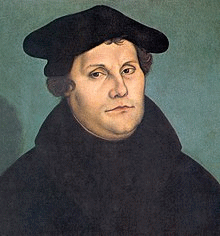
 that began in 1517, though its roots lie further back in time. The Reformation involved cultural, economic, political and religious aspects. It began with Martin LutherMartin Luther

Martin Luther was a German monk, priest, professor, theologian, and church reformer....
 and ended with the Peace of WestphaliaPeace of Westphalia

The Peace of Westphalia, also known as the Treaties of Mnster and Osnabrck, refers to the series of treaties that ende...
 in 1648. The movement began as an attempt to reform the Catholic Church. Many western Catholics were troubled by what they saw as false doctrines and malpractices within the Church, particularly involving the teaching and sale of indulgenceFacts About Indulgence

In Latin Catholic theology, an indulgence is the remission granted by the Church of the temporal punishment due to sins alre...
s. Another major contention was the practice of buying and selling church positions (simonySimony

Simony is the ecclesiastical crime and personal sin of paying for offices or positions in the hierarchy of a church, named a...
) and what was seen at the time as considerable corruption within the Church's hierarchy. This corruption was seen by many at the time as systemic, even reaching the position of the PopePope

The Pope is the Bishop of Rome, and, as Successor of Saint Peter, is the head of the Catholic Church....
.

On October 31, 1517, in SaxonyElectorate of Saxony

The Electorate of Saxony was an independent hereditary electorate of the Holy Roman Empire from 1356–1806....
 (in what is now Germany), Martin Luther nailed his Ninety-Five Theses to the door of the WittenbergFacts About Wittenberg

Wittenberg, officially [Die] Lutherstadt Wittenberg, is a town in Germany, in the Bundesland Saxony-Anhalt, at 1...
 Castle Church, which served as a notice board for university-related announcements.


Discussion
Ask a question about 'Protestant Reformation'
Start a new discussion about 'Protestant Reformation'
Answer questions from other users
Full Discussion Forum


Timeline

1517   Protestant Reformation: Martin Luther posts his 95 Theses on the door of the Wittenberg Castle Church.

1527   Protestant Reformation begins in Sweden.


Encyclopedia


The Protestant Reformation was a reform movement in the Holy Roman EmpireHoly Roman Empire

The Holy Roman Empire was a mainly Central European conglomeration of lands in the Middle Ages and the early modern period, ...
 that began in 1517, though its roots lie further back in time. The Reformation involved cultural, economic, political and religious aspects. It began with Martin LutherMartin Luther

Martin Luther was a German monk, priest, professor, theologian, and church reformer....
 and ended with the Peace of WestphaliaPeace of Westphalia

The Peace of Westphalia, also known as the Treaties of Mnster and Osnabrck, refers to the series of treaties that ende...
 in 1648. The movement began as an attempt to reform the Catholic Church. Many western Catholics were troubled by what they saw as false doctrines and malpractices within the Church, particularly involving the teaching and sale of indulgenceFacts About Indulgence

In Latin Catholic theology, an indulgence is the remission granted by the Church of the temporal punishment due to sins alre...
s. Another major contention was the practice of buying and selling church positions (simonySimony

Simony is the ecclesiastical crime and personal sin of paying for offices or positions in the hierarchy of a church, named a...
) and what was seen at the time as considerable corruption within the Church's hierarchy. This corruption was seen by many at the time as systemic, even reaching the position of the PopePope

The Pope is the Bishop of Rome, and, as Successor of Saint Peter, is the head of the Catholic Church....
.

On October 31, 1517, in SaxonyElectorate of Saxony

The Electorate of Saxony was an independent hereditary electorate of the Holy Roman Empire from 1356–1806....
 (in what is now Germany), Martin Luther nailed his Ninety-Five Theses to the door of the WittenbergFacts About Wittenberg

Wittenberg, officially [Die] Lutherstadt Wittenberg, is a town in Germany, in the Bundesland Saxony-Anhalt, at 1...
 Castle Church, which served as a notice board for university-related announcements. These were points for debate that criticized the Church and the Pope. The most controversial points centered on the practice of selling indulgences and the Church's policy on PurgatoryPurgatory

Purgatory commonly refers to a doctrine in the Roman Catholic Church, which posits that those who die in a state of grace un...
. Luther's spiritual predecessors were men such as John WycliffeJohn Wycliffe

John Wycliffe was an English theologian and early proponent of reform in the Roman Catholic Church during the 14th century...
 and Jan HusJan Hus

Jan Hus , also known as John Huss was a Czech religious thinker, philosopher, and reformer, master at Charles Unive...
. Other radicals, such as Ulrich Zwingli and John CalvinJohn Calvin

John Calvin was a French Christian theologian during the Protestant Reformation and was the originator of the system of Chr...
, soon followed Luther's lead. Church beliefs and practices under attack by Protestant reformers included PurgatoryPurgatory Overview

Purgatory commonly refers to a doctrine in the Roman Catholic Church, which posits that those who die in a state of grace un...
, particular judgmentParticular judgment Overview

In Christian eschatology, particular judgment is the doctrine that immediately after death the eternal destiny of each separ...
, devotion to MaryMary (mother of Jesus)

According to the New Testament, Mary, was the mother of Jesus of Nazareth, who at the time of his conception was the betroth...
|Mariology]]), the intercession of and devotion to the saintSaint

A saint is a term used to refer to someone who is a holy person....
s, most of the sacraments, the mandatory celibacyCelibacy

Celibacy refers either to being unmarried or to sexual abstinence....
 requirement of its clergy (including monasticismMonasticism

Monasticism is the religious practice of renouncing all worldly pursuits in order to fully devote one's life to spiritual w...
), and the authority of the PopePope

The Pope is the Bishop of Rome, and, as Successor of Saint Peter, is the head of the Catholic Church....
.

The most important denominationChristian denomination

A denomination, in the Christian sense of the word, is an identifiable religious body under a common name, structure, and/or...
s to emerge directly from the Reformation were the Lutherans, the Reformed/Calvinists/Presbyterians, and the AnabaptistAnabaptist

Anabaptists are Christians of the Radical Reformation....
s. The Protestant Reformation is also referred to as the German Reformation, Protestant Revolution, Protestant Revolt, and, in Germany, the Lutheran Reformation. The process of reform had decidedly different causes and effects in England, where it gave rise to AnglicanismAnglicanism

The term Anglican is used to describe the people, institutions, and churches as well as the liturgical traditions and t...
. There the period became known as the English ReformationEnglish Reformation

The English Reformation was the process whereby the external authority of the Roman Catholic Church in England was abolished...
. Subsequent Protestant denominations generally trace their roots back to the initial reforming movements. The reformers also accelerated the Catholic or Counter ReformationCounter-Reformation

The Counter-Reformation or Catholic Reformation was a movement within the Catholic Church to reform itself in the wake...
 within the Catholic Church.

Roots and precursors: 14th century and 15th century

Unrest due to the Great Schism of Western ChristianityWestern Schism

The Western Schism or Papal Schism was a split within the Catholic church in 1378....
 (1378–1416) excited wars between princes, uprisings among the peasants, and widespread concern over corruption in the Church. A new nationalismNationalism

Nationalism is an ideology that holds that a nation is the fundamental unit for human social life, and takes precedence ove...
 also challenged the relatively internationalist medieval world.
The first of a series of disruptive and new perspectives came from John WycliffeJohn Wycliffe

John Wycliffe was an English theologian and early proponent of reform in the Roman Catholic Church during the 14th century...
 at Oxford University, then from Jan HusJan Hus

Jan Hus , also known as John Huss was a Czech religious thinker, philosopher, and reformer, master at Charles Unive...
 at the University of PragueUniversity of Prague

University of Prague may refer to:...
. The Catholic Church officially concluded this debate at the Council of ConstanceCouncil of Constance

The Council of Constance was an ecumenical council of the Roman Catholic Church, called by the Emperor Sigismund, a support...
 (1414–1417). The conclave condemned Jan HusJan Hus

Jan Hus , also known as John Huss was a Czech religious thinker, philosopher, and reformer, master at Charles Unive...
, who was executed by burning in spite of a promise of safe-conduct. Wycliffe was posthumously burned as a hereticHeresy

Heresy, according to the Oxford English Dictionary, is a "theological or religious opinion or doctrine maintained in opposit...
.

The Council of Constance confirmed and strengthened the traditional medieval conception of Church and Empire. It did not address the national tensions, or the theological tensions which had been stirred up during the previous century. The council could not prevent schismSchism (religion) Summary

The word schism, from the Greek s??sµa, skhísma, means a division or a split, usually in an organization or a moveme...
 and the Hussite WarsHussite Wars

The Hussite Wars, also called the Bohemian Wars involved the military actions against and amongst the followers of Jan...
 in BohemiaBohemia

Bohemia is a historical region in central Europe, occupying the western and middle thirds of the Czech Republic....
.

Historical upheaval usually yields much new thinking as to how society should be organized. This was the case leading up to the Protestant Reformation. Following the breakdown of monastic institutions and scholasticismScholasticism

Scholasticism comes from the Latin word scholasticus, which means "that [which] belongs to the school", and was a metho...
 in late medieval Europe, accentuated by the "Babylonian Captivity" of the Avignon Papacy, the Great Schism, and the failure of the Conciliar movement, the sixteenth century saw the fomenting of a great cultural debate about religious reforms and later fundamental religious values (See German mysticismFacts About German mysticism

German Mysticism is the name given to a christian mystical movement in the Late Middle Ages, that was especially prominent i...
). Historians would generally assume that the failure to reform (too many vested interests, lack of coordination in the reforming coalition) would eventually lead to a greater upheaval or even revolution, since the system must eventually be adjusted or disintegrate, and the failure of the Conciliar movement helped lead to the Protestant Reformation in Europe. These frustrated reformist movements ranged from nominalismNominalism

The American Heritage Dictionary, Fourth Edition, defines nominalism as "the doctrine holding that abstract concepts, genera...
, devotio moderna (modern devotion)Devotio Moderna

Devotio Moderna was a religious movement of the Late Middle Ages....
, to humanismHumanism

Humanism is a broad category of active ethical philosophies that affirm the dignity and worth of all people, based on the ab...
 occurring in conjunction with economic, political and demographic forces that contributed to a growing disaffection with the wealth and power of the eliteElite

Elite is taken from the latin, eligere, "to elect"....
 clergyClergy

Clergy is the generic term used to describe the formal religious leadership within a given religion....
, sensitizing the population to the financial and moral corruption of the secular RenaissanceRenaissance

In the traditional view, the Renaissance was understood as a historical age in Europe that followed the Middle Ages and ...
 church.

The outcome of the Black DeathBlack Death

The Black Death, also known as the Black Plague, was a devastating pandemic that first struck Europe in the mid-late-1...
 encouraged a radical reorganization of the economy, and eventually of European society. In the emerging urban centers, however, the calamities of the fourteenth and early fifteenth century, and the resultant labor shortages, provided a strong impetus for economic diversification and technological innovations. Following the Black Death, the initial loss of life due to famine, plague, and pestilence contributed to an intensification of capital accumulation in the urban areas, and thus a stimulus to trade, industry, and burgeoning urban growth in fields as diverse as banking (the FuggerFugger Summary

The Fugger [foo-gger] family was a historically prominent group of European bankers....
 banking family in AugsburgAugsburg

Augsburg is a city in south-central Germany....
 and the MediciMedici Overview

The Medici family was a powerful and influential Florentine family from the 13th to 17th century....
 family of FlorenceFacts About Florence

Florence is the capital city of the region of Tuscany, Italy....
 being the most prominent); textiles, armamentsWeapon

A weapon is a tool which is intended to or is used to injure, kill, or a person, damage or destroy property, or to otherwis...
, especially stimulated by the Hundred Years' WarHundred Years' War

The Hundred Years' War was a conflict between England and France, lasting 116 years from 1337 to 1453....
, and mining of iron ore due, in large part, to the booming armaments industry. Accumulation of surplus, competitive overproductionOverproduction

In economics, overproduction refers to excess supply of products being sold on the market....
, and heightened competition to maximize economic advantage, contributed to civil war, aggressive militarismMilitarism

Militarism or militarist ideology is the doctrinal view of a society as being best served when it is governed or guide...
, and thus to centralization. As a direct result of the move toward centralization, leaders like Louis XI of FranceLouis XI of France

Louis XI the Prudent, also informally nicknamed l'universelle aragne, or the "Spider King," was King of France....
 (1461–1483), the "spider king", sought to remove all constitutional restrictions on the exercise of their authority. In EnglandEngland

England is the largest and most populous constituent country of the United Kingdom....
, FranceFrance

France, officially the French Republic, is a country whose metropolitan territory is located in Western Europe and whi...
, and SpainSpain

Spain, officially the Kingdom of Spain , is a European parliamentary monarchy....
 the move toward centralization begun in the thirteenth century was carried to a successful conclusion.

But as recovery and prosperity progressed, enabling the population to reach its former levels in the late 15th and 16th centuries, the combination of both a newly-abundant labor supply as well as improved productivity, were 'mixed blessings' for many segments of Western European society. Despite tradition, landlords started the move to exclude peasantPeasant

A peasant, from 15th century French pasant meaning one from the pays, the countryside or region, is an agricultural ...
s from "common landCommon land

Common land , is a piece of land owned by one person, but over which other people can exercise certain traditional rights, s...
s". With trade stimulated, landowners increasingly moved away from the manorialManorialism Summary

Manorialism or Seigneurialism describes the organization of rural economy and society in medieval western and parts of...
 economy. Woolen manufacturing greatly expanded in FranceFrance

France, officially the French Republic, is a country whose metropolitan territory is located in Western Europe and whi...
, GermanyGermany

Germany , officially the Federal Republic of Germany , is a country in central Europe....
, and the NetherlandsNetherlands

The Netherlands is the European part of the Kingdom of the Netherlands , which is formed by the Netherlands, the Neth...
 and new textile industries began to develop.

The invention of movable typeMovable Type

Movable Type is a widely-used proprietary weblog publishing system developed by California-based Six Apart....
 would lead to the Protestant zeal for translating the Bible and getting it into the hands of the laity. This would advance the culture of Biblical literacy.

The "humanism" of the RenaissanceRenaissance Overview

In the traditional view, the Renaissance was understood as a historical age in Europe that followed the Middle Ages and ...
 period stimulated unprecedented academic ferment, and a concern for academic freedomAcademic freedom Summary

Academic freedom is the freedom of teachers, students, and academic institutions to pursue knowledge wherever it may lead, w...
. Ongoing, earnest theoretical debates occurred in the universities about the nature of the church, and the source and extent of the authority of the papacy, of councils, and of princes.

Humanism to Protestantism

The frustrated reformism of the humanists, ushered in by the RenaissanceRenaissance

In the traditional view, the Renaissance was understood as a historical age in Europe that followed the Middle Ages and ...
, contributed to a growing impatience among reformers. Erasmus and later figures like Martin Luther and Zwingli would emerge from this debate and eventually contribute to another major schism of Christendom. The crisis of theology beginning with William of OckhamWilliam of Ockham

William of Ockham was an English Franciscan friar and scholastic philosopher, from Ockham, a small village in Surrey, near...
 in the fourteenth century was occurring in conjunction with the new burgherBourgeoisie

Bourgeoisie in modern use refers to the ruling class in a capitalist society. ...
 discontent. Since the breakdown of the philosophicalPhilosophy Summary

Philosophy is a field of study that includes diverse subfields such as aesthetics, epistemology, ethics, logic, and metaphys...
 foundations of scholasticismScholasticism Overview

Scholasticism comes from the Latin word scholasticus, which means "that [which] belongs to the school", and was a metho...
, the new nominalismNominalism

The American Heritage Dictionary, Fourth Edition, defines nominalism as "the doctrine holding that abstract concepts, genera...
 did not bode well for an institutional church legitimized as an intermediary between man and God. New thinking favored the notion that no religious doctrineDoctrine

Doctrine, from Latin doctrina, means "a code of beliefs", "a body of teachings" or "instructions", taught principles or ...
 can be supported by philosophical arguments, eroding the old alliance between reasonReason

In the philosophy of arguments, reason is the ability of the human mind to form and operate on concepts in abstraction, in v...
 and faithFaith

Faith is commonly known as a belief, trust or confidence often based on a transpersonal relationship with God, a higher powe...
 of the medieval period laid out by Thomas AquinasThomas Aquinas

Saint Thomas Aquinas [Thomas of Aquin, or Aquino] was an Italian philosopher and theologian in the scholastic t...
.


The major individualistic reform movements that revolted against medieval scholasticism and the institutions that underpinned it were: humanismHumanism

Humanism is a broad category of active ethical philosophies that affirm the dignity and worth of all people, based on the ab...
, devotionalism, (see for example, the Brothers of the Common Life and Jan StandonckJan Standonck

Jan Standonck was a Dutch priest and reformer, who founded the Collge de Montaigu, part of the Sorbonne in Paris....
) and the observatine tradition. In GermanyGermany

Germany , officially the Federal Republic of Germany , is a country in central Europe....
, "the modern way" or devotionalism caught on in the universities, requiring a redefinition of God, who was no longer a rational governing principle but an arbitrary, unknowable will that cannot be limited. God was now a ruler, and religion would be more fervent and emotional. Thus, the ensuing revival of Augustinian theology, stating that man cannot be saved by his own efforts but only by the grace of God, would erode the legitimacy of the rigid institutions of the church meant to provide a channel for man to do good works and get into heavenHeaven Summary

Heaven is an afterlife concept found in many religions or spiritual philosophies....
. Humanism, however, was more of an educational reform movement with origins in the RenaissanceRenaissance

In the traditional view, the Renaissance was understood as a historical age in Europe that followed the Middle Ages and ...
's revival of classical learningClassical education

Classical education as understood and taught in the Middle Ages of Western culture is roughly based on the ancient Greek con...
 and thought. A revolt against AristotelianAristotle

Aristotle was an ancient Greek philosopher, a student of Plato and teacher of Alexander the Great....
 logic, it placed great emphasis on reforming individuals through eloquence as opposed to reason. The European Renaissance laid the foundation for the Northern humanists in its reinforcement of the traditional use of LatinLatin

Latin is an ancient Indo-European language originally spoken in Latium, the region immediately surrounding Rome....
 as the great unifying cultural language.

The polarization of the scholarly community in Germany over the Reuchlin (1455–1522) affair, attacked by the elite clergy for his study of HebrewBiblical Hebrew language

This article describes the Biblical dialects of Hebrew....
 and Jewish texts, brought Luther fully in line with the humanist educational reforms who favored academic freedomAcademic freedom

Academic freedom is the freedom of teachers, students, and academic institutions to pursue knowledge wherever it may lead, w...
. At the same time, the impact of the Renaissance would soon backfire against traditional Catholicism, ushering in an age of reform and a repudiation of much of medieval Latin tradition. Led by Erasmus, the humanists condemned various forms of corruption within the Church, forms of corruption that might not have been any more prevalent than during the medieval zenith of the church. Erasmus held that true religion was a matter of inward devotion rather than outward symbols of ceremony and ritual. Going back to ancient texts, scriptures, from this viewpoint the greatest culmination of the ancient tradition, are the guides to life. Favoring moralMorality

Morality refers to the concept of human ethics which pertains to matters of good and evil —also referred to as "right ...
 reforms and de-emphasizing didactic ritual, Erasmus laid the groundwork for Luther.

Humanism's intellectual anti-clericalismAnti-clericalism

Anti-clericalism is a historical movement that opposes religious institutional power and influence in all aspects of public ...
 would profoundly influence Luther. The increasingly well-educated middleMiddle class

The middle class, in colloquial usage, consists of those people who have a degree of economic independence, but not a great ...
 sectors of Northern Germany, namely the educated community and city dwellers would turn to Luther's rethinking of religion to conceptualize their discontent according to the cultural medium of the era. The great rise of the burghers, the desire to run their new businesses free of institutional barriers or outmoded cultural practices, contributed to the appeal of humanist individualismIndividualism

Individualism is a term used to describe a moral, political, or social outlook, that stresses human independence and the imp...
. To many, papalPope

The Pope is the Bishop of Rome, and, as Successor of Saint Peter, is the head of the Catholic Church....
 institutions were rigid, especially regarding their views on just price and usuryUsury

Usury?i}}/, from the Medieval Latin usuria, "interest" or "excessive interest", from Latin usura "interest") was def...
. In the North, burghers and monarchs were united in their frustration for not paying any taxTax

A tax is a financial charge or other levy imposed on an individual or a legal entity by a state or a functional equivalent ...
es to the nation, but collecting taxes from subjectsCitizenship

Citizenship is membership in a political community and carries with it rights to political participation; a person having ...
 and sending the revenues disproportionately to the Pope in ItalyItaly

Italy, officially the Italian Republic , is a Southern European country....
.

These trends heightened demands for significant reform and revitalization along with anticlericalism. New thinkers began noticing the divide between the priests and the flock. The clergy, for instance, were not always well-educated. Parish priests often did not know LatinLatin

Latin is an ancient Indo-European language originally spoken in Latium, the region immediately surrounding Rome....
 and rural parishes often did not have great opportunities for theological education for many at the time. Due to its large landholdings and institutional rigidity, a rigidity to which the excessively large ranks of the clergy contributed, many bishopFacts About Bishop

A bishop is an ordained member of the Christian clergy who, in certain Christian churches, holds a position of authority....
s studied lawLaw

Law is the set of rules or norms of conduct which forbid, permit or mandate specified actions and relationships among people...
, not theology, being relegated to the role of property managers trained in administration. While priests emphasized works of religiosity, the respectability of the church began diminishing, especially among well educated urbaniteUrbanite

Urbanite is a word used in the United Kingdom to describe a demographic of people who, like yuppies, are young, urban profes...
s, and especially considering the recent strings of political humiliation, such as the apprehension of Pope Boniface VIIIPope Boniface VIII

Pope Boniface VIII , born Benedetto Caetani, was Pope of the Roman Catholic Church from 1294 to 1303. ...
 by Philip IV of FrancePhilip IV of France

Philip IV the Fair was King of France from 1285 until his death. ...
, the "Babylonian Captivity", the Great Schism, and the failure of Conciliar reformism. In a sense, the campaign by Pope Leo XPope Leo X

Pope Leo X, born Giovanni di Lorenzo de' Medici was Pope from 1513 to his death....
 to raise funds to rebuild St. Peter's Basilica was too much of an excess by the secular RenaissanceRenaissance

In the traditional view, the Renaissance was understood as a historical age in Europe that followed the Middle Ages and ...
 church, prompting high-pressure indulgences that rendered the clergy establishments even more disliked in the cities.

Luther borrowed from the humanists the sense of individualism, that each man can be his own priest (an attitude likely to find popular support considering the rapid rise of an educated urban middle class in the North), and that the only true authority is the BibleBible

The Bible , is the name used by Jews and Christians for their differing canons of sacred texts....
, echoing the reformist zeal of the Conciliar movement and opening up the debate once again on limiting the authority of the Pope. While his ideas called for the sharp redefinition of the dividing lines between the laityLaity

In religious organizations, the laity comprises all lay persons collectively....
 and the clergy, his ideas were still, by this point, reformist in nature. Luther's contention that the human will was incapable of following good, however, resulted in his rift with Erasmus finally distinguishing Lutheran reformism from humanismHumanism Overview

Humanism is a broad category of active ethical philosophies that affirm the dignity and worth of all people, based on the ab...
.

Religious influences for the Reformation


While there were some parallels between certain movements within humanism and teachings later common among the Reformers, the Reformation's principal arguments were based on "direct" Biblical interpretation. The Catholic Church had for several centuries been the main purveyor in EuropeEurope

Europe is one of the seven traditional continents of the Earth....
 of non-secular humanism: the NeoplatonismNeoplatonism

Neoplatonism is the modern term for a school of philosophy that took shape in the 3rd century AD, based on the teachings of...
 of the scholastics and the neo-Aristotelianism of Thomas AquinasThomas Aquinas

Saint Thomas Aquinas [Thomas of Aquin, or Aquino] was an Italian philosopher and theologian in the scholastic t...
 and his followers had made humanism a part of Church dogmaDogma

Dogma is the established belief or doctrine held by a religion, ideology or any kind of organization, thought to be author...
. This was of course due to the Catholic Church's use of historic, religious tradition (including the CanonizationCanonization

Canonization is the process of declaring someone a saint and involves proving that a candidate has lived in such a way that ...
 of SaintSaint

A saint is a term used to refer to someone who is a holy person....
s) in the forming of its liturgyLiturgy

A liturgy comprises a prescribed ceremony, according to the traditions of a particular group or event....
. Thus, when Luther and the other reformers adopted the standard of sola scripturaSola scriptura

Sola scriptura is one of five important slogans of the Protestant Reformation in the 16th century CE....
, making the Bible the sole measure of theology, they made the Reformation a reaction against the humanism of that time. Previously, the Scriptures had been seen by some as the pinnacle of a hierarchy of sacred texts, and on par with the oral traditionFacts About Oral tradition

Oral tradition or oral culture is a way of transmitting history, literature or law from one generation to the next in ...
s of the Church.

The Protestants emphasized such concepts as justification by "faith alone" (not faith and good works or infused righteousness), "Scripture alone" (the Bible as the sole inspired rule of faith, rather than the Bible plus tradition), "the priesthood of all believers" (eschewing the special authority and power of the Catholic sacramental priesthood), that all people are individually responsible for their status before God such that talk of mediation through any but Christ alone is unbiblical. Because they saw these teachings as stemming from the Bible, they encouraged publication of the Bible in the common language and universal educationEducation

Education is the process by which an individual is encouraged and enabled to develop fully his or her innate potential; it m...
.

Part of the revolt was an iconoclasmIconoclasm

Iconoclasm is the destruction of religious icons and other symbols or monuments, usually for religious or political motives....
, seen in Huldrych Zwingli, but particularly amongst the radical reformers. Iconoclastic riots took place in Zürich (in 1523), Copenhagen (1530), Münster (1534), Geneva (1535), Augsburg (1537) and Scotland (1559). John Calvin took a more moderate stance to Zwingli and the Anabaptists, but preferred a more simple aesthetic, to the excesses of the Middle Ages.

The Reformation did not happen in a vacuum, as there were movements for centuries calling for a return to Biblical teachings, the most famous being from Wycliffe, Jan Hus, and the WaldensiansWaldensians

The Waldensians or Vaudois are a Christian denomination believing in poverty and austerity, founded around 1173, promo...
. It is no surprise that their teachings were later found in the Reformation, as they imbibed from the same source.

While it is true that there were calls for religious, doctrinal, and moral reformation within and without the institutional church for centuries, apparently it was the invention of the printing pressPrinting press

The printing press is a mechanical printing device for making copies of identical text on multiple sheets of paper....
 which allowed quick broadcasting of ideas, the rise in nationalistic fervor, the increasing availability of the Bible to the public, and popular discontent at the moral corruption in the church to coalesce in support for a reformation as never before.

Many unskilled laborers had been squeezed from the countryside into the cities and suffered from the over-crowding and high prices that can follow such a quick and voluminous influx of new citizens. Discontented and morally righteous, the lower classes embraced the most radical theological options opened up by the religious revolution and were ready to follow leaders rising within their ranks, who urged them to band together against immorality and decadence. The Drummer of NiklashausenDrummer of Niklashausen

Hans Bhm, Drummer of Niklashausen, was born in the small village of Helmstadt, which lies in the south-central region of Ge...
 and later the AnabaptistAnabaptist

Anabaptists are Christians of the Radical Reformation....
 preachers railed against landowners who took control of increasing areas, kings centralizing control, and princes looking for increased tax revenues to fund their growing states.

The Anabaptists and other radical leaders were condemned by the Lutherans and nationalistic Germans. Nearly every country in Europe saw a flare-up of failed peasant revolts motivated by religious concerns and executed according to religious doctrine. The Hungarian Peasants' War (1514), the revolt against Charles VCharles V, Holy Roman Emperor

Charles V was ruler of the Burgundian territories, King of Castile, King of Aragon, King of Naples and Sicily, Archduke of A...
 in SpainSpain

Spain, officially the Kingdom of Spain , is a European parliamentary monarchy....
 (1520), the discontent of the lower classes in FranceFrance

France, officially the French Republic, is a country whose metropolitan territory is located in Western Europe and whi...
 with the excessive taxes levied by Louis XIFacts About Louis XI of France

Louis XI the Prudent, also informally nicknamed l'universelle aragne, or the "Spider King," was King of France....
, and the secret associations which prepared the way for the great Peasants' WarPeasants' War

The Peasants' War was a popular revolt in Europe, specifically in the Holy Roman Empire between 1524-1525....
 of the lower classes in Germany (1524), show that discontent was not confined to any one country in Europe.

Lutheranism adopted by the German princes

Luther, like Erasmus, in the beginning favoured maintaining the bishops as an elite class for administrative purposes, though he denied that their succession from the Apostles gave their consecration any special sacramental value. And while Luther rejected many of the Catholic sacramentSacrament

A sacrament is a Christian rite that mediates divine grace—a holy Mystery....
s, as well as salvation by grace alone through both faith and good works (as opposed to the Protestant "faith alone") and indulgences, he firmly upheld the sacraments of BaptismBaptism Summary

Baptism is generally a water purification ritual practiced in many of various religions including Christianity, Mandaeanism,...
 and the EucharistEucharist

The Eucharist or Communion or The Lord's Supper, is the rite that Christians perform in fulfillment of Jesus' in...
. Transubstantiation was most fully spelled out by the medieval scholastics, who agreed that the elements, once consecrated, remained the body and blood of Christ and could be adored as such. Traditionally, the consecrated bread and wine were held to become, substantially, the body and blood of Christ.
Luther affirmed a theology of the EucharistEucharist

The Eucharist or Communion or The Lord's Supper, is the rite that Christians perform in fulfillment of Jesus' in...
 called Real PresenceReal Presence

The Real Presence is the term various Christian traditions use to express their belief that, in the Eucharist, Jesus the Chr...
, a doctrine of the presence of Christ in the Eucharist which affirms the real presence yet upholding that the bread and wine are not "changed" into the body and blood; rather the divine elements adhere "in, with, and under" the earthly elements. He took this understanding of Christ's presence in the Eucharist to be more harmonious with the Church's teaching on the Incarnation. Just as Christ is the union of the fully human and the fully divine (cf. Council of Chalcedon) so to the Eucharist is a union of Bread and Body, Wine and Blood. According to the doctrine of real presence, the substances of the body and the blood of Christ and of the bread and the wine were held to coexist together in the consecrated Host during the communion service. While Luther seemed to maintain the perpetual consecration of the elements, other Lutherans argued that any consecrated bread or wine left over would revert to its former state the moment the service ended. Most Lutherans accept the latter.

A Lutheran understanding of the Eucharist is distinct from the Reformed doctrine of the Eucharist in that Lutherans affirm a real, physical presence of Christ in the Eucharist (as opposed to either a "spiritual presence" or a "memorial") and Lutherans affirm that the presence of Christ does not depend on the faith of the recipient; the repentant receive Christ in the Eucharist worthily, the unrepentant who receive the Eucharist risk the wrath of Christ.

Luther, along with his colleague Philipp MelanchthonPhilipp Melanchthon

Philipp Melanchthon was a German professor and theologian, a key leader of the Lutheran Reformation, and a friend and asso...
, emphasized this point in his plea for the Reformation at the ReichstagReichstag (institution)

The Reichstag was the parliament of the Holy Roman Empire, the North German Confederation, and of Germany until 1945....
in 1529 amid charges of heresyFacts About Heresy

Heresy, according to the Oxford English Dictionary, is a "theological or religious opinion or doctrine maintained in opposit...
. But the changes he proposed were of such a fundamental nature that by their own logic they would automatically overthrow the old order; neither the Emperor nor the Church could possibly accept them, as Luther well knew. As was only to be expected, the edict by the Diet of WormsDiet of Worms

The Diet of Worms was a general assembly of the estates of the Holy Roman Empire that took place in Worms, a small town on t...
 (1521) prohibited all innovations. Meanwhile, in these efforts to retain the guise of a Catholic reformer as opposed to a heretical revolutionary, and to appeal to German princes with his religious condemnation of the peasant revolts backed up by the Doctrine of the Two KingdomsDoctrine of the two kingdoms

Martin Luther's doctrine of the two kingdoms of God teaches that God is the ruler of the whole world and that he rules in tw...
, Luther's growing conservatism would provoke more radical reformers.

At a religious conference with the Zwinglians in 1529, Melanchthon joined with Luther in opposing a union with Zwingli. There would finally be a schism in the reform movement due to Luther's belief in real presenceReal Presence

The Real Presence is the term various Christian traditions use to express their belief that, in the Eucharist, Jesus the Chr...
—the real (as opposed to symbolic) presence of Christ at the Eucharist. His original intention was not schism, but with the ReichstagReichstag (institution)

The Reichstag was the parliament of the Holy Roman Empire, the North German Confederation, and of Germany until 1945....
of Augsburg (1530) and its rejection of the Lutheran "Augsburg Confession", a separate Lutheran church finally emerged. In a sense, Luther would take theology further in its deviation from established Catholic dogma, forcing a rift between the humanist Erasmus and Luther. Similarly, Zwingli would further repudiate ritualism, and break with the increasingly conservative Luther.


Aside from the enclosing of the lower classes, the middle sectors of Northern Germany, namely the educated community and city dwellers, would turn to religion to conceptualize their discontent according to the cultural medium of the era. The great rise of the burghers, the desire to run their new businesses free of institutional barriers or outmoded cultural practices contributed to the appeal of individualism. To many, papal institutions were rigid, especially regarding their views on just price and usuryUsury

Usury?i}}/, from the Medieval Latin usuria, "interest" or "excessive interest", from Latin usura "interest") was def...
. In the North, burghers and monarchs were united in their frustration for not paying any taxes to the nation, but collecting taxes from subjects and sending the revenues disproportionately to Italy. In Northern Europe Luther appealed to the growing national consciousness of the German states because he denounced the Pope for involvement in politics as well as religion. Moreover, he backed the nobility, which was now justified to crush the Great Peasant Revolt of 1525 and to confiscate church property by Luther's Doctrine of the Two KingdomsDoctrine of the two kingdoms

Martin Luther's doctrine of the two kingdoms of God teaches that God is the ruler of the whole world and that he rules in tw...
. This explains the attraction of some territorial princes to Lutheranism, especially its Doctrine of the Two Kingdoms. However, the Elector of Brandenburg, Joachim I, blamed Lutheranism for the revolt and so did others. In Brandenburg, it was only under his successor Joachim II that Lutheranism was established, and the old religion was not formally extinct in Brandenburg until the death of the last Catholic bishop there, Georg von BlumenthalVon Blumenthal

Von Blumenthal is a noble family from Brandenburg, Prussia....
, who was Bishop of Lebus and sovereign Prince-Bishop of Ratzeburg.

With the church subordinate to and the agent of civil authority and peasant rebellions condemned on strict religious terms, Lutheranism and German nationalist sentiment were ideally suited to coincide.

Though Charles VCharles V, Holy Roman Emperor

Charles V was ruler of the Burgundian territories, King of Castile, King of Aragon, King of Naples and Sicily, Archduke of A...
 fought the Reformation, it is no coincidence either that the reign of his nationalistic predecessor Maximilian IMaximilian I

Maximilian I may refer to:*Maximilian I, Emperor of Mexico...
 saw the beginning of the Reformation. While the centralized states of western Europe had reached accords with the Vatican permitting them to draw on the rich property of the church for government expenditures, enabling them to form state churches that were greatly autonomous of Rome, similar moves on behalf of the Reich were unsuccessful so long as princes and prince bishops fought reforms to drop the pretension of the secular universal empire.

The Reformation outside Germany


Switzerland


Scandinavia

All of ScandinaviaScandinavia Overview

Scandinavia is a region in Northern Europe....
 ultimately adopted Lutheranism over the course of the sixteenth century, as the monarchs of DenmarkDenmark

The Kingdom of Denmark is the smallest and southernmost of the Nordic countries....
 (who also ruled NorwayNorway

Insert non-formatted text hereNorway is a Nordic country on the western portion of the Scandinavian Peninsula, bordering S...
 and IcelandIceland Overview

Iceland, officially the Republic of Iceland is a volcanic island nation in the northern Atlantic Ocean between Greenl...
) and SwedenSweden

The Kingdom of Sweden is a Nordic country in Scandinavia....
 (who also ruled FinlandFinland

The Republic of Finland , is one of the Nordic countries....
) converted to that faith.

In Sweden the Reformation was spearheaded by Gustav Vasa, elected king in 1523. Friction with the pope over the latter's interference in Swedish ecclesiastical affairs led to the discontinuance of any official connection between Sweden and the papacy from 1523. Four years later, at the Diet of Västerĺs, the king succeeded in forcing the diet to accept his dominion over the national church. The king was given possession of all church property, church appointments required royal approval, the clergy were subject to the civil law, and the "pure Word of God" was to be preached in the churches and taught in the schools—effectively granting official sanction to Lutheran ideas.

Under the reign of Frederick IFrederick I of Denmark

Frederick I of Denmark and Norway was the son of the first Oldenburg King Christian I of Denmark, Norway and Sweden and of D...
 (1523–33), Denmark remained officially Catholic. But though Frederick initially pledged to persecute Lutherans, he soon adopted a policy of protecting Lutheran preachers and reformers, of whom the most famous was Hans TausenHans Tausen

Hans Tausen, the protagonist of the Danish Reformation, was born at Birkende in Funen in 1494....
. During his reign, Lutheranism made significant inroads among the Danish population. Frederick's son, Christian, was openly Lutheran, which prevented his election to the throne upon his father's death. However, following his victory in the civil war that followed, in 1537 he became Christian IIIChristian III of Denmark

Christian III, king of Denmark and Norway, was the son of Frederick I of Denmark and his first consort, Anna of Brandenburg....
 and began a reformation of the official state church.

England


Political reformation

In England, the Reformation followed a different course than elsewhere in Europe. There had long been a strong strain of anti-clericalism, and England had already given rise to the Lollard movement of John WycliffeJohn Wycliffe

John Wycliffe was an English theologian and early proponent of reform in the Roman Catholic Church during the 14th century...
, which played an important part in inspiring the HussiteHussite

The Hussites comprised a Christian movement following the teachings of the reformer Jan Hus , who was influenced by John Wyc...
s in BohemiaBohemia

Bohemia is a historical region in central Europe, occupying the western and middle thirds of the Czech Republic....
. By the 1520s, however, the Lollards were not an active force, or, at least, certainly not a mass movement. The different character of the English Reformation came rather from the fact that it was driven initially by the political necessities of Henry VIIIFacts About Henry VIII of England

Henry VIII was King of England and Lord of Ireland from 22 April 1509 until his death....
. Henry had once been a sincere Catholic and had even authored a book strongly criticizing Luther, but he later found it expedient and profitable to break with the Papacy. His wife, Catherine of AragonCatherine of Aragon

Catherine of Aragon was queen consort of England as Henry VIII of England's first wife....
, bore him only a single child, MaryMary I of England Summary

Mary I , also known as Mary Tudor, was Queen of England and Queen of Ireland from 6 July1553 or 19 July 1553 until h...
. As England had recently gone through a lengthy dynastic conflict (see Wars of the RosesWars of the Roses

he Wars of the Roses were collectively an intermittent civil war fought over the throne of England between adherents of the...
), Henry feared that his lack of a male heir might jeopardize his descendants' claims to the throne. When the pope denied his request for a divorce, he decided to remove the Church of EnglandChurch of England

The Church of England is the officially established Christian church in England, and acts as the 'mother' and senior branch ...
 from the authority of Rome. In 1534, the Act of Supremacy made Henry the Supreme HeadSupreme Head

The Supreme Head of the Church of England was a title held by the King Henry VIII of England that signified his leadership o...
 of the Church of England. Between 1535 and 1540, under Thomas Cromwell, the policy known as the Dissolution of the MonasteriesDissolution of the Monasteries

The Dissolution of the Monasteries, referred to by Roman Catholic writers as the Suppression of the Monasteries, was t...
 was put into effect. The veneration of some saintSaint

A saint is a term used to refer to someone who is a holy person....
s, certain pilgrimages and some pilgrim shrines were also attacked. Huge amounts of church land and property passed into the hands of the crown and ultimately into those of the nobility and gentry. The vested interest thus created made for a powerful force in support of the dissolutions.

There were some notable opponents to the Henrician Reformation, such as Thomas MoreThomas More

Sir Thomas More was an English lawyer, author, statesman, and a Catholic martyr....
 and Bishop John FisherJohn Fisher

For John Arbuthnot Fisher, British admiral, see Jackie Fisher, 1st Baron Fisher....
, who were executed for their opposition. There was also a growing party of reformers who were imbued with the Zwinglian and Calvinistic doctrines now current on the Continent. When Henry died he was succeeded by his Protestant son Edward VI, who, through his empowered councilors (with the King being only nine years old at his succession and not yet sixteen at his death) the Duke of Somerset and the Duke of Northumberland, ordered the destruction of images in churches, and the closing of the chantriesChantry

Chantry is a term for the English establishment of a shrine or chapel on private land where monks or priests would say praye...
. Under Edward VI the reform of the Church of EnglandChurch of England

The Church of England is the officially established Christian church in England, and acts as the 'mother' and senior branch ...
 was established unequivocally in doctrinal terms. Yet, at a popular level, religion in England was still in a state of flux. Following a brief Roman Catholic restoration during the reign of MaryMary I of England

Mary I , also known as Mary Tudor, was Queen of England and Queen of Ireland from 6 July1553 or 19 July 1553 until h...
 1553–1558, a loose consensus developed during the reign of Elizabeth IElizabeth I of England

Elizabeth I was Queen of England, Queen of France , and Queen of Ireland from 17 November 1558 until her death....
, though this point is one of considerable debate among historians. Yet it is the so-called "Elizabethan Religious SettlementElizabethan Religious Settlement

The Elizabethan Religious Settlement was Elizabeth Is response to the religious divisions created over the reigns of Henry V...
" to which the origins of AnglicanismAnglicanism

The term Anglican is used to describe the people, institutions, and churches as well as the liturgical traditions and t...
 are traditionally ascribed. The compromise was uneasy and was capable of veering between extreme CalvinismCalvinism

Calvinism is a system of Christian theology and an approach to Christian life and thought within the Protestant tradition ar...
 on the one hand and Catholicism on the other, but compared to the bloody and chaotic state of affairs in contemporary France, it was relatively successful until the Puritan Revolution or English Civil WarEnglish Civil War

The English Civil War was a series of armed conflicts and political machinations which took place between Parliamentarians a...
 in the seventeenth century.

The success of the Counter-ReformationCounter-Reformation

The Counter-Reformation or Catholic Reformation was a movement within the Catholic Church to reform itself in the wake...
 on the Continent and the growth of a PuritanPuritan

The Puritans were originally members of a group of English Protestants seeking "purity" — further reforms from the est...
 party dedicated to further Protestant reform polarized the Elizabethan Age, although it was not until the 1640s that England underwent religious strife comparable to that which its neighbours had suffered some generations before.
Early Puritan movement

The early Puritan movement (late 16th century-17th century) was Reformed or CalvinistCalvinism

Calvinism is a system of Christian theology and an approach to Christian life and thought within the Protestant tradition ar...
 and was a movement for reform in the Church of EnglandFacts About Church of England

The Church of England is the officially established Christian church in England, and acts as the 'mother' and senior branch ...
. Its origins lay in the discontent with the Elizabethan Religious SettlementElizabethan Religious Settlement

The Elizabethan Religious Settlement was Elizabeth Is response to the religious divisions created over the reigns of Henry V...
. The desire was for the Church of England to resemble more closely the Protestant churches of Europe, especially GenevaGeneva Summary

Geneva is the second most populous city in Switzerland , and is the most populous city of Romandy ....
. The Puritans objected to ornaments and ritual in the churches as idolatrousIdolatry Summary

Idolatry is a major sin in the Abrahamic religions regarding image....
 (vestments, surplices, organs, genuflection), which they castigated as "popish pomp and rags". (See Vestments controversyVestments controversy Overview

The vestments controversy arose in the English Reformation, ostensibly concerning vestments, but more fundamentally concerne...
.) They also objected to ecclesiastical courts. They refused to endorse completely all of the ritual directions and formulas of the Book of Common PrayerBook of Common Prayer

The Book of Common Prayer is the foundational prayer book of the Church of England which was one of the instruments of ...
; the imposition of its liturgical order by legal force and inspection sharpened Puritanism into a definite opposition movement.

The later Puritan movement were often referred to as Dissenters and Nonconformists and eventually led to the formation of various Reformed denominationsFacts About Christian denomination

A denomination, in the Christian sense of the word, is an identifiable religious body under a common name, structure, and/or...
.

Scotland

The Reformation in Scotland's case culminated ecclesiastically in the re-establishment of the church along Reformed lines, and politically in the triumph of EnglishEngland

England is the largest and most populous constituent country of the United Kingdom....
 influence over that of FranceFrance

France, officially the French Republic, is a country whose metropolitan territory is located in Western Europe and whi...
. John KnoxJohn Knox

John Knox was a Scottish religious reformer who took the lead in reforming the Church in Scotland along Calvinist lines....
 is regarded as the leader of the Scottish Reformation

The Reformation ParliamentScottish Reformation Parliament

The Scottish Reformation Parliament is the name given to the Scottish Parliament commencing in 1560 that passed the major pi...
 of 1560, which repudiated the pope's authority, forbade the celebration of the massMass (liturgy)

Mass is the term used to describe celebration of the Eucharist in the Western liturgical rites of the Catholic Church, in th...
 and approved a Protestant Confession of FaithConfession of Faith Overview

A Confession of Faith is a statement of doctrine very similar to a creed, but usually longer and polemical, as well as dida...
, was made possible by a revolution against FrenchFrance

France, officially the French Republic, is a country whose metropolitan territory is located in Western Europe and whi...
 hegemony under the regime of the regentRegent

A regent, from the Latin regens "who reigns" is anyone who acts as head of state, especially if not the monarch....
 Mary of GuiseMary of Guise Overview

Marie de Guise was the Queen Consort of James V of Scotland and the mother of Mary, Queen of Scots....
, who had governed Scotland in the name of her absent daughter Mary Queen of ScotsMary I of Scotland

Mary I of Scotland was the Queen of Scots from December 14 1542 to July 24 1567....
 (then also QueenQueen consort

A queen consort is the wife and consort of a reigning king....
 of France).

The Scottish Reformation decisively shaped the Church of ScotlandChurch of Scotland

The Church of Scotland is the national church of Scotland....
 and, through it, all other Presbyterian churches worldwide.

Netherlands

The Reformation in the Netherlands, unlike in many other countries, was not initiated by the rulers of the Seventeen ProvincesSeventeen Provinces

The Seventeen Provinces were a personal union of states in the Low Countries in the 16th century, roughly covering the curre...
, but instead by multiple popular movements, which in turn were bolstered by the arrival of Protestant refugees from other parts of the continent. While the AnabaptistFacts About Anabaptist

Anabaptists are Christians of the Radical Reformation....
 movement enjoyed popularity in the region in the early decades of the Reformation, Calvinism, in the form of the Dutch Reformed ChurchDutch Reformed Church

The Dutch Reformed Church was one of many branches of churches coming out of the Protestant Reformation in Europe in the si...
, became the dominant Protestant faith in the country from the 1560s onward.

Harsh persecution of Protestants by the Spanish government of Phillip II contributed to a desire for independence in the provinces, which led to the Eighty Years' WarEighty Years' War

The Eighty Years' War, or Dutch Revolt, was the revolt of the Seventeen Provinces in the Netherlands against the Spani...
 and eventually, the separation of the largely Protestant Dutch RepublicDutch Republic

he Republic of the Seven United Netherlands was a European republic between 1581 and 1795, in the same location as the mod...
 from the Catholic-dominated Southern NetherlandsSouthern Netherlands

The Southern Netherlands were a part of the Low Countries controlled by Spain , Austria and France....
, the present-day BelgiumBelgium

The Kingdom of Belgium is a country in northwest Europe bordered by the Netherlands, Germany, Luxembourg and France and is...
.

Hungary

Much of the population of Kingdom of HungaryKingdom of Hungary

The Kingdom of Hungary is the name of a kingdom that existed in Central Europe from 1000 to 1918....
 adopted Protestantism during the sixteenth century. After the 1526 Battle of MohácsBattle of Mohács Summary

The Battle of Mohcs was a battle fought on August 29, 1526 near Mohcs, Hungary....
 the Hungarian people were disillusioned by the ability of the government to protect them and turned to the faith which would infuse them with the strength necessary to resist the invader. They found this in the teaching of the Protestant Reformers such as Luther. The spread of Protestantism in the country was aided by its large ethnic German minority, which could understand and translate the writings of Martin LutherMartin Luther

Martin Luther was a German monk, priest, professor, theologian, and church reformer....
. While Lutheranism gained a foothold among the German-speaking population, CalvinismCalvinism

Calvinism is a system of Christian theology and an approach to Christian life and thought within the Protestant tradition ar...
 became widely embraced among ethnic Hungarians.

In the more independent northwest the rulers and priests, protected now by the Habsburg MonarchyHabsburg Monarchy

The Habsburg Monarchy included the territories ruled by the Austrian branch of the House of Habsburg, and then by the succes...
 which had taken the field to fight the Turks, defended the old Catholic faith. They dragged the Protestants to prison and the stake wherever they could. Such strong measures only fanned the flames of protest, however. Leaders of the Protestants included Matthias Biro Devai, Michael Sztarai, and Stephen Kis Szegedi.

Protestants likely formed a majority of Hungary's population at the close of the sixteenth century, but Counter-ReformationCounter-Reformation

The Counter-Reformation or Catholic Reformation was a movement within the Catholic Church to reform itself in the wake...
 efforts in the seventeenth century reconverted a majority of the kingdom to Catholicism. A significant Protestant minority remained, most of it adhering to the Calvinist faith.

France


Though he was not personally interested in religious reform, Francis IFrancis I of France

Francis I , called the Father and Restorer of Letters , was crowned King of France in 1515 in the cathedral at Reims ...
 (1515–47) initially maintained an attitude of tolerance, arising from his interest in the humanistHumanist

Humanist may refer to:* a proponent of the group of ethical stances referred to as Humanism...
 movement. This changed in 1534 with the Affair of the PlacardsAffair of the placards

The Affair of the Placards was an incident involving anti-Catholic posters which appeared in public places in Paris, France ...
. In this act, Protestants denounced the mass in placards that appeared across France, even reaching the royal apartments. The issue of religious faith having been thrown into the arena of politics, Francis was prompted to view the movement as a threat to the kingdom's stability. This led to the first major phase of anti-Protestant persecution in France, in which the Chambre ArdenteChambre Ardente

Chambre Ardente, the term for an extraordinary court of justice in France, mainly held for the trials of heretics....
("Burning Chamber") was established within the Parlement of Paris to handle with the rise