
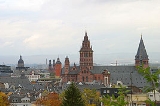
Mainz
Mainz (maɪ̯nts; ˈmaɪnts; , majɑ̃s; , maɡentsɑ is a city in
GermanyGermany , officially the Federal Republic of Germany , is a federal parliamentary republic in Europe. The country consists of 16 states while the capital and largest city is Berlin. Germany covers an area of 357,021 km2 and has a largely temperate seasonal climate...
and the capital of the German
federal stateGermany is made up of sixteen which are partly sovereign constituent states of the Federal Republic of Germany. Land literally translates as "country", and constitutionally speaking, they are constituent countries...
of
Rhineland-PalatinateRhineland-Palatinate is one of the 16 states of the Federal Republic of Germany. It has an area of and about four million inhabitants. The capital is Mainz. English speakers also commonly refer to the state by its German name, Rheinland-Pfalz ....
. It was a politically important seat of the
Prince-electorThe Prince-electors of the Holy Roman Empire were the members of the electoral college of the Holy Roman Empire, having the function of electing the Roman king or, from the middle of the 16th century onwards, directly the Holy Roman Emperor.The heir-apparent to a prince-elector was known as an...
of Mainz (see:
Archbishopric of MainzThe Archbishopric of Mainz or Electorate of Mainz was an influential ecclesiastic and secular prince-bishopric in the Holy Roman Empire between 780–82 and 1802. In the Roman Catholic Church hierarchy, the Archbishop of Mainz was the primas Germaniae, the substitute of the Pope north of the Alps...
) under the
Holy Roman EmpireThe Holy Roman Empire was a realm that existed from 962 to 1806 in Central Europe.It was ruled by the Holy Roman Emperor. Its character changed during the Middle Ages and the Early Modern period, when the power of the emperor gradually weakened in favour of the princes...
, and previously was a
RomanThe Roman Empire was the post-Republican period of the ancient Roman civilization, characterised by an autocratic form of government and large territorial holdings in Europe and around the Mediterranean....
fort city which commanded the west bank of the Rhine and formed part of the northernmost frontier of the Roman Empire. Mainz is located on the river
Rhine across from
WiesbadenWiesbaden is a city in southwest Germany and the capital of the federal state of Hesse. It has about 275,400 inhabitants, plus approximately 10,000 United States citizens...
, in the western part of the Frankfurt Rhine-Main Region; in the modern age,
FrankfurtFrankfurt am Main , commonly known simply as Frankfurt, is the largest city in the German state of Hesse and the fifth-largest city in Germany, with a 2010 population of 688,249. The urban area had an estimated population of 2,300,000 in 2010...
shares much of its regional importance.
Mainz was founded as a military post by the
RomansAncient Rome was a thriving civilization that grew on the Italian Peninsula as early as the 8th century BC. Located along the Mediterranean Sea and centered on the city of Rome, it expanded to one of the largest empires in the ancient world....
in the late 1st century BC. The first European books printed using movable type were manufactured in Mainz by
Gutenberg in the early 1450s. Up until the twentieth century, Mainz was usually referred to in English as Mayence.
Geography
Mainz is located on the west bank of the river Rhine, opposite the confluence of the Main with the Rhine. The 2008 population was 196,784, an additional 18,619 people maintain a primary residence elsewhere but have a
second homeVacation property is a niche in the real estate market dealing with residences used for holiday vacations . In the United Kingdom this type of property is usually termed a holiday home, in Australia, a holiday house/home, or weekender, in New Zealand, a bach or crib...
in Mainz and it is also a part of the Rhein Metro area consisting of 5.8 million people. Mainz is easily reached from
Frankfurt International AirportFrankfurt am Main Airport , or simply Frankfurt Airport, known in German as Flughafen Frankfurt am Main or Rhein-Main-Flughafen, is a major international airport located in Frankfurt, Germany, southwest of the city centre....
in 25 minutes by commuter railway (
Rhine-Main S-BahnThe Rhine-Main S-Bahn system is an integrated rapid transit and commuter transport system for the Frankfurt/Rhine-Main region, which includes the cities Frankfurt am Main, Wiesbaden, Mainz, Offenbach am Main, Hanau and Darmstadt...
).
After the last
ice ageAn ice age or, more precisely, glacial age, is a generic geological period of long-term reduction in the temperature of the Earth's surface and atmosphere, resulting in the presence or expansion of continental ice sheets, polar ice sheets and alpine glaciers...
, sand dunes were deposited in the Rhine valley at what was to become the western edge of the city. The
Mainz Sand DunesThe Mainz Sand Dunes are a small geological and botanical supra-region and important nature preserve in Mainz, Germany. Within this protected area rare plants and animals can be found...
area is now a nature reserve with a unique landscape and rare
steppe vegetation for this area.
Roman Mogontiacum
The Roman stronghold of
castrum Mogontiacum, the precursor to Mainz, was founded by the Roman general DrususNero Claudius Drusus Germanicus , born Decimus Claudius Drusus also called Drusus, Drusus I, Nero Drusus, or Drusus the Elder was a Roman politician and military commander. He was a fully patrician Claudian on his father's side but his maternal grandmother was from a plebeian family...
perhaps as early as 13 BC. As related by SuetoniusGaius Suetonius Tranquillus, commonly known as Suetonius , was a Roman historian belonging to the equestrian order in the early Imperial era....
the existence of Mogontiacum
is well established by four years later (the account of the death and funeral of Nero Claudius DrususNero Claudius Drusus Germanicus , born Decimus Claudius Drusus also called Drusus, Drusus I, Nero Drusus, or Drusus the Elder was a Roman politician and military commander. He was a fully patrician Claudian on his father's side but his maternal grandmother was from a plebeian family...
), though several other theories suggest the site may have been established earlier. Although the city is situated opposite the mouth of the Main river, the name of Mainz is not from Main, the similarity being perhaps due to diachronic analogy. Main is from Latin Menus
, the name the Romans used for the river. LinguisticLinguistics is the scientific study of human language. Linguistics can be broadly broken into three categories or subfields of study: language form, language meaning, and language in context....
analysis of the many forms that the name "Mainz" has taken on make it clear that it is a simplification of Mogontiacum. The name appears to be
CelticThe Celtic languages are descended from Proto-Celtic, or "Common Celtic"; a branch of the greater Indo-European language family...
and ultimately it is. However, it had also become Roman and was selected by them with a special significance. The Roman soldiers defending
GalliaGallia may refer to:*Gaul , the region of Western Europe occupied by present-day France, Belgium and other neighbouring countries...
had adopted the Gallic god
MogonsMogons or Moguns was a god worshipped in Roman Britain and in Gaul. The main evidence is from altars dedicated to the god by Roman soldiers, but the deity is not a native Italic one. It appears to be Celtic. Inscriptional spellings include Mogetios, Mogounos, Mogti, Mounti, Mogont, Mogunt. Not all...
(Mogounus, Moguns, Mogonino), for the meaning of which etymology offers two basic options: "the great one", similar to Latin magnus, which was used in aggrandizing names such as Alexander magnus
, "Alexander the Great" and Pompeius magnus, "Pompey the great", or the god of "might" personified as it appears in young servitors of any type whether of noble or ignoble birth.
Mogontiacum was an important military town throughout Roman times, probably due to its strategic position at the confluence of the Main and the Rhine. The town of Mogontiacum
grew up between the fort and the river. The castrum was the base of Legio XIIII Gemina
and XVI Gallica
Legio sexta decima Gallica was a Roman legion. The legion was recruited by Octavian in 41/40 BC, and was disbanded after surrendering during the Batavian rebellion ; Emperor Vespasian created a new legion, the XVI Flavia Firma. The emblem of the legion was probably a lion....
(AD 9–43), XXII Primigenia
Legio XXII Primigenia was a Roman legion levied by Roman Emperor Caligula in 39, for his campaigns in Germania. There are still records of the XXII Primigenia in Mogontiacum from the end of 3rd century...
, IIII Macedonica
(43–70), I Adiutrix
Legio prima Adiutrix , was a Roman legion formed in 68, possibly by Galba under orders of Nero. The last record mentioning the Adiutrix is in 344, when it was stationed at Brigetio , in the Roman province of Pannonia...
(70–88), XXI Rapax
Legio vigesima prima rapax was a Roman legion levied in 31 BC by Augustus, probably from men previously enlisted in other legions. The XXI Rapax was destroyed in 92 by the Dacians and Sarmatians...
(70–89), and XIIII Gemina
(70–92), among others. Mainz was also a base of a Roman river fleet, the Classis Germanica. Remains of Roman troop ships (navis lusoriaA navis lusoria is a type of a small military vessel of the late Roman Empire that served as a troop transport. It was powered by about thirty soldier-oarsmen and an auxiliary sail. Nimble, graceful, and of shallow draft, such a vessel was used on northern rivers close to the Limes Germanicus, the...
) and a patrol boat from the late 4th century were discovered in 1981/82 and may now be viewed in the Museum für Antike Schifffahrt. The city was the provincial capital of
Germania SuperiorGermania Superior , so called for the reason that it lay upstream of Germania Inferior, was a province of the Roman Empire. It comprised an area of western Switzerland, the French Jura and Alsace regions, and southwestern Germany...
, and had an important funeral monument dedicated to Drusus, to which people made pilgrimages for an annual festival from as far away as
LyonLyon , is a city in east-central France in the Rhône-Alpes region, situated between Paris and Marseille. Lyon is located at from Paris, from Marseille, from Geneva, from Turin, and from Barcelona. The residents of the city are called Lyonnais....
. Among the famous buildings were the largest
theatreThe characteristics of Roman to those of the earlier Greek theatres due in large part to its influence on the Roman triumvir Gnaeus Pompeius Magnus. Much of the architectural influence on the Romans came from the Greeks, and theatre structural design was no different from other buildings...
north of the Alps and a bridge across the rhine.
AlamanniThe Alamanni, Allemanni, or Alemanni were originally an alliance of Germanic tribes located around the upper Rhine river . One of the earliest references to them is the cognomen Alamannicus assumed by Roman Emperor Caracalla, who ruled the Roman Empire from 211 to 217 and claimed thereby to be...
forces under Rando sacked the city in 368. From the last day of
405Year 405 was a common year starting on Sunday of the Julian calendar. At the time, it was known as the Year of the Consulship of Stilicho and Anthemius...
or
406Year 406 was a common year starting on Monday of the Julian calendar. At the time, it was known as the Year of the Consulship of Arcadius and Probus...
, the Siling and Asding Vandals, the
SuebiThe Suebi or Suevi were a group of Germanic peoples who were first mentioned by Julius Caesar in connection with Ariovistus' campaign, c...
, the
AlansThe Alans, or the Alani, occasionally termed Alauni or Halani, were a group of Sarmatian tribes, nomadic pastoralists of the 1st millennium AD who spoke an Eastern Iranian language which derived from Scytho-Sarmatian and which in turn evolved into modern Ossetian.-Name:The various forms of Alan —...
, and other Germanic tribes
crossed the Rhine31 December 406, is the often-repeated date of the crossing of the Rhine by a mixed group of barbarians that included Vandals, Alans and Suebi...
, possibly at Mainz. Christian chronicles relate that the bishop, Aureus, was put to death by the Alamannian Crocus. The way was open to the sack of
TrierTrier, historically called in English Treves is a city in Germany on the banks of the Moselle. It is the oldest city in Germany, founded in or before 16 BC....
and the invasion of Gaul.
Throughout the changes of time, the Roman castrum never seems to have been permanently abandoned as a military installation, which is a testimony to Roman military judgement. Different structures were built there at different times. The current citadel originated in 1660, but it replaced previous forts. It was used in World War II. One of the sights at the citadel is still the
cenotaphA cenotaph is an "empty tomb" or a monument erected in honour of a person or group of people whose remains are elsewhere. It can also be the initial tomb for a person who has since been interred elsewhere. The word derives from the Greek κενοτάφιον = kenotaphion...
raised by legionaries to commemorate their Drusus.
Frankish Mainz
Through a series of incursions during the 4th century Alsace gradually lost its Belgic ethnic character of formerly Germanic tribes among Celts ruled by Romans and became predominantly influenced by the
AlamanniThe Alamanni, Allemanni, or Alemanni were originally an alliance of Germanic tribes located around the upper Rhine river . One of the earliest references to them is the cognomen Alamannicus assumed by Roman Emperor Caracalla, who ruled the Roman Empire from 211 to 217 and claimed thereby to be...
. The Romans repeatedly reasserted control; however, the troops stationed at Mainz became chiefly non-Italic and the emperors had only one or two Italian ancestors in a pedigree that included chiefly peoples of the northern frontier.
The last emperor to station troops serving the western empire at Mainz was
Valentinian III-Family:Valentinian was born in the western capital of Ravenna, the only son of Galla Placidia and Flavius Constantius. The former was the younger half-sister of the western emperor Honorius, and the latter was at the time Patrician and the power behind the throne....
, who relied heavily on his Magister militum per Gallias,
Flavius AëtiusFlavius Aëtius , dux et patricius, was a Roman general of the closing period of the Western Roman Empire. He was an able military commander and the most influential man in the Western Roman Empire for two decades . He managed policy in regard to the attacks of barbarian peoples pressing on the Empire...
. By that time the army included large numbers of troops from the major Germanic confederacies along the Rhine, the Alamanni, the
SaxonsThe Saxons were a confederation of Germanic tribes originating on the North German plain. The Saxons earliest known area of settlement is Northern Albingia, an area approximately that of modern Holstein...
and the
FranksThe Franks were a confederation of Germanic tribes first attested in the third century AD as living north and east of the Lower Rhine River. From the third to fifth centuries some Franks raided Roman territory while other Franks joined the Roman troops in Gaul. Only the Salian Franks formed a...
. The Franks were an opponent that had risen to power and reputation among the Belgae of the lower Rhine during the 3rd century and repeatedly attempted to extend their influence upstream. In 358 the emperor
JulianJulian "the Apostate" , commonly known as Julian, or also Julian the Philosopher, was Roman Emperor from 361 to 363 and a noted philosopher and Greek writer....
bought peace by giving them most of
Germania InferiorGermania Inferior was a Roman province located on the left bank of the Rhine, in today's Luxembourg, southern Netherlands, parts of Belgium, and North Rhine-Westphalia left of the Rhine....
, which they possessed anyway, and imposing service in the Roman army in exchange.
European factions in the time of master Aëtius included Celts, Goths, Franks, Saxons, Alamanni, Huns, Italians, and Alans as well as numerous other minor peoples. Aëtius played them all off against one another in a masterly effort to keep the peace under Roman sovereignty. He used Hunnic troops a number of times. At last a day of reckoning arrived between Aëtius and Attila, both commanding polyglot, multi-ethnic troops. Attila went through Alsace in 451, devastating the country and destroying Mainz and Triers with their Roman garrisons. Shortly after he was thwarted by
Flavius AëtiusFlavius Aëtius , dux et patricius, was a Roman general of the closing period of the Western Roman Empire. He was an able military commander and the most influential man in the Western Roman Empire for two decades . He managed policy in regard to the attacks of barbarian peoples pressing on the Empire...
at the
Battle of ChâlonsThe Battle of the Catalaunian Plains , also called the Battle of Châlons sur Marne, took place in AD 451 between a coalition led by the Visigothic king Theodoric I and the Roman general Flavius Aëtius, against the Huns and their allies commanded by their leader Attila...
, the largest of the ancient world.
Aëtius was not to enjoy the victory long. He was assassinated in 454 by the hand of his employer, who in turn was stabbed to death by friends of Aëtius in 455. As far as the north was concerned this was the effective end of the Roman empire there. After some sanguinary but relatively brief contention a former subordinate of Aëtius,
RicimerFlavius Ricimer was a Germanic general who achieved effective control of the remaining parts of the Western Roman Empire, during the middle of the 5th century...
, became emperor, taking the name Patrician. His father was a Suebian; his mother, a princess of the Visigoths. Patrician did not rule the north directly but set up a client province there, which functioned independently. The capital was at
SoissonsSoissons is a commune in the Aisne department in Picardy in northern France, located on the Aisne River, about northeast of Paris. It is one of the most ancient towns of France, and is probably the ancient capital of the Suessiones...
. Even then its status was equivocal. Many insisted it was the
Kingdom of SoissonsThe Domain of Soissons, by later writers called the Kingdom of Soissons, Kingdom of Aegidius or the Kingdom of Syagrius, was a rump state of the Western Roman Empire in northern Gaul for some 25 years during Late Antiquity....
.
Previously the first of the Merovingians,
ClodioChlodio was a king of the Salian Franks from the Merovingian dynasty. He was known as the Long-Haired King and lived in Thuringian territory at the castle of Duisburg. He became chief of the Thérouanne area in 414 AD...
, had been defeated by Aëtius at about 430. His son, Merovaeus, fought on the Roman side against Attila, and his son,
ChildericChilderic I was a Merovingian king of the Salian Franks and the father of Clovis.He succeeded his father Merovech as king, traditionally in 457 or 458...
, served in the domain of Soissons. Meanwhile the Franks were gradually infiltrating and assuming power in this domain. They also moved up the Rhine and created a domain in the region of the former Germania Superior with capital at
CologneCologne is Germany's fourth-largest city , and is the largest city both in the Germany Federal State of North Rhine-Westphalia and within the Rhine-Ruhr Metropolitan Area, one of the major European metropolitan areas with more than ten million inhabitants.Cologne is located on both sides of the...
. They became known as the
Ripuarian FranksRipuarian Franks is a distinction of the Frankish people made by a number of writers in the Latin language of the first several centuries of the Christian Era...
as opposed to the
Salian FranksThe Salian Franks or Salii were a subgroup of the early Franks who originally had been living north of the limes in the area above the Rhine. The Merovingian kings responsible for the conquest of Gaul were Salians. From the 3rd century on, the Salian Franks appear in the historical records as...
. It is unlikely that much of a population transfer or displacement occurred. The former Belgae simply became Franks.
Events moved rapidly in the late 5th century. Clovis, son of Childeric, became king of the Salians in 481, ruling from
TournaiTournai is a Walloon city and municipality of Belgium located 85 kilometres southwest of Brussels, on the river Scheldt, in the province of Hainaut....
. In 486 he defeated
SyagriusSyagrius was the last Roman official in Gaul, whose defeat by king Clovis I of the Franks is considered the end of Roman rule outside of Italy. He came to this position through inheritance, for his father was Aegidius, the last Roman magister militum per Gallias...
, last governor of the Soissons domain, and took northern France. He extended his reign to
CambraiCambrai is a commune in the Nord department in northern France. It is a sub-prefecture of the department.Cambrai is the seat of an archdiocese whose jurisdiction was immense during the Middle Ages. The territory of the Bishopric of Cambrai, roughly coinciding with the shire of Brabant, included...
and
Tongeren in 490–491, and repelled the Alamanni is 496. Also in that year he converted to non-Arian Christianity.
After the Fall of the Roman Empire in 476, the
FranksThe Franks were a confederation of Germanic tribes first attested in the third century AD as living north and east of the Lower Rhine River. From the third to fifth centuries some Franks raided Roman territory while other Franks joined the Roman troops in Gaul. Only the Salian Franks formed a...
under the rule of
Clovis IClovis Leuthwig was the first King of the Franks to unite all the Frankish tribes under one ruler, changing the leadership from a group of royal chieftains, to rule by kings, ensuring that the kingship was held by his heirs. He was also the first Catholic King to rule over Gaul . He was the son...
gained control over western Europe by the year 496. Clovis annexed the kingdom of Cologne in 508. Thereafter, Mainz, in its strategic position, became one of the bases of the Frankish kingdom. Mainz had sheltered a Christian community long before the conversion of Clovis. His successor
Dagobert IDagobert I was the king of Austrasia , king of all the Franks , and king of Neustria and Burgundy . He was the last Merovingian dynast to wield any real royal power...
reinforced the walls of Mainz and made it one of his seats. A
solidusThe solidus was originally a gold coin issued by the Romans, and a weight measure for gold more generally, corresponding to 4.5 grams.-Roman and Byzantine coinage:...
of Theodebert I (534–548) was minted at Mainz.
The Franks united the Celtic and Germanic tribes of Europe. The greatest Frank of all was
CharlemagneCharlemagne was King of the Franks from 768 and Emperor of the Romans from 800 to his death in 814. He expanded the Frankish kingdom into an empire that incorporated much of Western and Central Europe. During his reign, he conquered Italy and was crowned by Pope Leo III on 25 December 800...
(768–814), who built a new empire in Europe, the
Holy Roman EmpireThe Holy Roman Empire was a realm that existed from 962 to 1806 in Central Europe.It was ruled by the Holy Roman Emperor. Its character changed during the Middle Ages and the Early Modern period, when the power of the emperor gradually weakened in favour of the princes...
. Mainz from its central location became important to the empire and to Christianity. Meanwhile language change was gradually working to divide the Franks. Mainz spoke a dialect termed Ripuarian. On the death of Charlemagne, distinctions between France and Germany began to be made. Mainz was not central any longer but was on the border, creating a question of the nationality to which it belonged, which descended into modern times as the question of Alsace-Lorraine.
Christian Mainz
In the early
Middle AgeMiddle age is the period of age beyond young adulthood but before the onset of old age. Various attempts have been made to define this age, which is around the third quarter of the average life span of human beings....
s, Mainz was a centre for the
ChristianisationThe historical phenomenon of Christianization is the conversion of individuals to Christianity or the conversion of entire peoples at once...
of the
GermanThe Germanic peoples are an Indo-European ethno-linguistic group of Northern European origin, identified by their use of the Indo-European Germanic languages which diversified out of Proto-Germanic during the Pre-Roman Iron Age.Originating about 1800 BCE from the Corded Ware Culture on the North...
and
Slavic peoplesThe Slavic people are an Indo-European panethnicity living in Eastern Europe, Southeast Europe, North Asia and Central Asia. The term Slavic represents a broad ethno-linguistic group of people, who speak languages belonging to the Slavic language family and share, to varying degrees, certain...
. The first Archbishop in Mainz, Boniface, was killed in 754 while trying to convert the Frisians to Christianity and is buried in
FuldaFulda is a city in Hesse, Germany; it is located on the river Fulda and is the administrative seat of the Fulda district .- Early Middle Ages :...
. Other early archbishops of Mainz include
Rabanus MaurusRabanus Maurus Magnentius , also known as Hrabanus or Rhabanus, was a Frankish Benedictine monk, the archbishop of Mainz in Germany and a theologian. He was the author of the encyclopaedia De rerum naturis . He also wrote treatises on education and grammar and commentaries on the Bible...
, the scholar and author, and
WilligisSaint Willigis was Archbishop of Mainz from 975 until his death as well as a statesman of the Holy Roman Empire.-Life:...
(975–1011), who began construction on the current building of the
Mainz CathedralMainz Cathedral or St. Martin's Cathedral is located near the historical center and pedestrianized market square of the city of Mainz, Germany...
and founded the monastery of St. Stephan.
From the time of Willigis until the end of the
Holy Roman EmpireThe Holy Roman Empire was a realm that existed from 962 to 1806 in Central Europe.It was ruled by the Holy Roman Emperor. Its character changed during the Middle Ages and the Early Modern period, when the power of the emperor gradually weakened in favour of the princes...
in 1806, the Archbishops of Mainz were archchancellors of the Empire and the most important of the seven
ElectorsThe Prince-electors of the Holy Roman Empire were the members of the electoral college of the Holy Roman Empire, having the function of electing the Roman king or, from the middle of the 16th century onwards, directly the Holy Roman Emperor.The heir-apparent to a prince-elector was known as an...
of the German emperor. Besides Rome, the
diocese of MainzThe Diocese of Mainz is a diocese of the Catholic church in Germany. It was created in 1802 with the abolition of the old Archbishopric of Mainz. The diocese is suffragan to the Archdiocese of Freiburg; its district is located in the states of Rhineland-Palatinate and Hesse...
today is the only
dioceseA diocese is the district or see under the supervision of a bishop. It is divided into parishes.An archdiocese is more significant than a diocese. An archdiocese is presided over by an archbishop whose see may have or had importance due to size or historical significance...
in the world with an
episcopal seeAn episcopal see is, in the original sense, the official seat of a bishop. This seat, which is also referred to as the bishop's cathedra, is placed in the bishop's principal church, which is therefore called the bishop's cathedral...
that is called a
Holy SeeThe Holy See is the episcopal jurisdiction of the Catholic Church in Rome, in which its Bishop is commonly known as the Pope. It is the preeminent episcopal see of the Catholic Church, forming the central government of the Church. As such, diplomatically, and in other spheres the Holy See acts and...
(sancta sedes
). The Archbishops of Mainz traditionally were primas germaniaePrimas Germaniae is a historical title of honour for the most important Catholic bishop in Germany.Since at least 965 the Title was held by the Archbishop of Mainz as most important Archbishop and most noble Prince-Elector of the Holy Roman Empire until the See of Mainz was secularized in 1803...
, the substitutes of the
PopeThe Pope is the Bishop of Rome, a position that makes him the leader of the worldwide Catholic Church . In the Catholic Church, the Pope is regarded as the successor of Saint Peter, the Apostle...
north of the
AlpsThe Alps is one of the great mountain range systems of Europe, stretching from Austria and Slovenia in the east through Italy, Switzerland, Liechtenstein and Germany to France in the west....
.
In 1244, Archbishop Siegfried III granted Mainz a city charter, which included the right of the citizens to establish and elect a city council. The city saw a feud between two archbishops in 1461, namely
Diether von Isenburgthumb|Diethers coat of arms stained glass in Mainz Cathedral...thumb|... and as relief at the city walls of [[Höchst |Höchst]]Theodoric of Isenburg-Büdingen thumb|Diethers coat of arms stained glass in Mainz Cathedral...thumb|... and as relief at the city walls of [[Höchst (Frankfurt am...
, who was elected Archbishop by the
cathedral chapterChapter designates certain corporate ecclesiastical bodies in the Roman Catholic, Anglican and Nordic Lutheran churches....
and supported by the citizens, and Adolf II von Nassau, who had been named Archbishop for Mainz by the pope. In 1462, the Archbishop Adolf II raided the city of Mainz, plundering and killing 400 inhabitants. At a tribunal, those who had survived lost all their property, which was then divided between those who promised to follow Adolf II. Those who would not promise to follow Adolf II (amongst them
Johannes Gutenberg) were driven out of the town or thrown into prison. The new Archbishop revoked the city charter of Mainz and put the city under his direct rule. Ironically, after the death of Adolf II his successor was again Diether von Isenburg, now legally elected by the chapter and named by the Pope.
Early Jewish community
The Jewish community of Mainz dates to the 10th century AD. It is noted for its religious education. Rabbi
Gershom ben JudahGershom ben Judah, best known as Rabbeinu Gershom and also commonly known to scholars of Judaism by the title Rabbeinu Gershom Me'Or Hagolah , was a famous Talmudist and Halakhist.Rashi of Troyes Gershom ben Judah, (c. 960 -1040? -1028?) best known as Rabbeinu Gershom (Hebrew: רבנו גרשום, "Our...
(960–1040) taught there, among others. He concentrated on the study of the
TalmudThe Talmud is a central text of mainstream Judaism. It takes the form of a record of rabbinic discussions pertaining to Jewish law, ethics, philosophy, customs and history....
, creating a German Jewish tradition. The Jews of Mainz,
SpeyerSpeyer is a city of Rhineland-Palatinate, Germany with approximately 50,000 inhabitants. Located beside the river Rhine, Speyer is 25 km south of Ludwigshafen and Mannheim. Founded by the Romans, it is one of Germany's oldest cities...
and
WormsWorms is a city in Rhineland-Palatinate, Germany, on the Rhine River. At the end of 2004, it had 85,829 inhabitants.Established by the Celts, who called it Borbetomagus, Worms today remains embattled with the cities Trier and Cologne over the title of "Oldest City in Germany." Worms is the only...
created a supreme council to set standards in Jewish law and education in the 12th century.
The city of Mainz responded to the Jewish population in a variety of ways, behaving, in a sense, in a bipolar fashion towards them. Sometimes they were allowed freedom and were protected; at other times, they were persecuted. The Jews were expelled in 1012, 1462 (after which they were invited to return), and in 1474. Jews were attacked by mobs in 1283. Outbreaks of the
Black DeathThe Black Death was one of the most devastating pandemics in human history, peaking in Europe between 1348 and 1350. Of several competing theories, the dominant explanation for the Black Death is the plague theory, which attributes the outbreak to the bacterium Yersinia pestis. Thought to have...
were usually blamed on the Jews, at which times they were massacred, such as the burning of about 6,000 Jews alive in 1349. This unstable pattern, which was not typical for Mainz only, but for whole Europe at that time, went on until World War II.
Nowadays the Jewish community is growing rapidly, and a new synagogue is under construction on the site of the one destroyed under the Third Reich. The community itself has 1,034 members, according to the Central Council of Jews in Germany, and at least twice as many Jews altogether since many are unaffiliated with Judaism.
Republic of Mainz
During the
French RevolutionThe French Revolution , sometimes distinguished as the 'Great French Revolution' , was a period of radical social and political upheaval in France and Europe. The absolute monarchy that had ruled France for centuries collapsed in three years...
, the French Revolutionary army occupied Mainz in 1792; the Archbishop of Mainz, Friedrich Karl Josef von Erthal, had already fled to
AschaffenburgAschaffenburg is a city in northwest Bavaria, Germany. The town of Aschaffenburg is not considered part of the district of Aschaffenburg, but is the administrative seat.Aschaffenburg is known as the Tor zum Spessart or "gate to the Spessart"...
by the time the French marched in. On 18 March 1793, the
JacobinsThe Jacobin Club was the most famous and influential political club in the development of the French Revolution, so-named because of the Dominican convent where they met, located in the Rue St. Jacques , Paris. The club originated as the Club Benthorn, formed at Versailles from a group of Breton...
of Mainz, with other German democrats from about 130 towns in the Rhenish Palatinate, proclaimed the ‘
Republic of MainzThe Republic of Mainz was the first democratic state on the current German territory and was centered in Mainz. A product of the French Revolutionary Wars, it lasted from March to July 1793.-Context:...
’. Led by
Georg ForsterJohann Georg Adam Forster was a German naturalist, ethnologist, travel writer, journalist, and revolutionary. At an early age, he accompanied his father on several scientific expeditions, including James Cook's second voyage to the Pacific...
, representatives of the Mainz Republic in Paris requested political affiliation of the Mainz Republic with France, but too late: As
PrussiaPrussia was a German kingdom and historic state originating out of the Duchy of Prussia and the Margraviate of Brandenburg. For centuries, the House of Hohenzollern ruled Prussia, successfully expanding its size by way of an unusually well-organized and effective army. Prussia shaped the history...
was not entirely happy with the idea of a democratic free state on German soil, Prussian troops had already occupied the area and besieged Mainz by the end of March, 1793. After a siege of 18 weeks, the French troops in Mainz surrendered on 23 July 1793; Prussians occupied the city and ended the Republic of Mainz. It came to the
Battle of MainzThe Battle of Mainz was fought on 29 October 1795 during the French Revolutionary Wars, between France and Austria. The battle was fought near the city of Mainz now in western Germany and ended in an Austrian victory.-People involved:...
in 1795 between Austria and France. Members of the Mainz
Jacobin ClubThe Jacobin Club was the most famous and influential political club in the development of the French Revolution, so-named because of the Dominican convent where they met, located in the Rue St. Jacques , Paris. The club originated as the Club Benthorn, formed at Versailles from a group of Breton...
were mistreated or imprisoned and punished for treason.
In 1797, the French returned. The army of
Napoléon BonaparteNapoleon Bonaparte was a French military and political leader during the latter stages of the French Revolution.As Napoleon I, he was Emperor of the French from 1804 to 1815...
occupied the German territory to the west of the
Rhine river, and the
Treaty of Campo FormioThe Treaty of Campo Formio was signed on 18 October 1797 by Napoleon Bonaparte and Count Philipp von Cobenzl as representatives of revolutionary France and the Austrian monarchy...
awarded France this entire area. On 17 February 1800, the French
Département du Mont-TonnerreMont-Tonnerre is the name of a département of the First French Empire in present Germany. It is named after the highest point in the Rhenish Palatinate, the Donnersberg. It was the southernmost of four départements formed in 1798, when the west bank of the Rhine was annexed by France...
was founded here, with Mainz as its capital, the
Rhine river being the new eastern frontier of la Grande Nation. Austria and
PrussiaPrussia was a German kingdom and historic state originating out of the Duchy of Prussia and the Margraviate of Brandenburg. For centuries, the House of Hohenzollern ruled Prussia, successfully expanding its size by way of an unusually well-organized and effective army. Prussia shaped the history...
could not but approve this new border with France in 1801. However, after several defeats in Europe during the next years, the weakened Napoléon and his troops had to leave Mainz in May 1814.
Rhenish Hesse
In 1816, the part of the former French Département which is known today as Rhenish Hesse was awarded to the
Hesse-DarmstadtThe Grand Duchy of Hesse and by Rhine , or, between 1806 and 1816, Grand Duchy of Hesse —as it was also known after 1816—was a member state of the German Confederation from 1806, when the Landgraviate of Hesse-Darmstadt was elevated to a Grand Duchy, until 1918, when all the German...
, Mainz being the capital of the new
HessianHesse or Hessia is both a cultural region of Germany and the name of an individual German state.* The cultural region of Hesse includes both the State of Hesse and the area known as Rhenish Hesse in the neighbouring Rhineland-Palatinate state...
province of Rhenish Hesse. From 1816 to 1866, to the
German ConfederationThe German Confederation was the loose association of Central European states created by the Congress of Vienna in 1815 to coordinate the economies of separate German-speaking countries. It acted as a buffer between the powerful states of Austria and Prussia...
Mainz was the most important fortress in the defence against France, and had a strong garrison of Austrian and
PrussiaPrussia was a German kingdom and historic state originating out of the Duchy of Prussia and the Margraviate of Brandenburg. For centuries, the House of Hohenzollern ruled Prussia, successfully expanding its size by way of an unusually well-organized and effective army. Prussia shaped the history...
n troops.
In the afternoon of 18 November 1857, a huge explosion rocked Mainz when the city's powder magazine, the Pulverturm
, exploded. Approximately 150 people were killed and at least 500 injured; 57 buildings were destroyed and a similar number severely damaged in what was to be known as the Powder Tower Explosion
or Powder Explosion.
During the
Austro-Prussian WarThe Austro-Prussian War was a war fought in 1866 between the German Confederation under the leadership of the Austrian Empire and its German allies on one side and the Kingdom of Prussia with its German allies and Italy on the...
in 1866, Mainz was declared a neutral zone. After the founding of the
German EmpireThe German Empire refers to Germany during the "Second Reich" period from the unification of Germany and proclamation of Wilhelm I as German Emperor on 18 January 1871, to 1918, when it became a federal republic after defeat in World War I and the abdication of the Emperor, Wilhelm II.The German...
in 1871, Mainz no longer was as important a stronghold, because in the
war of 1870/71The Franco-Prussian War or Franco-German War, often referred to in France as the 1870 War was a conflict between the Second French Empire and the Kingdom of Prussia. Prussia was aided by the North German Confederation, of which it was a member, and the South German states of Baden, Württemberg and...
France had lost the territory of
Alsace-LorraineThe Imperial Territory of Alsace-Lorraine was a territory created by the German Empire in 1871 after it annexed most of Alsace and the Moselle region of Lorraine following its victory in the Franco-Prussian War. The Alsatian part lay in the Rhine Valley on the west bank of the Rhine River and east...
to Germany, and this defined the new border between the two countries.
Industrial expansion
For centuries the inhabitants of the
fortress of MainzThe Fortress of Mainz was a fortressed garrison town between 1620 and 1918. At the end of the Napoleonic Wars, under the term of the 1815 Peace of Paris, the control of Mainz passed to the German Confederation and became part of a chain of strategic fortresses which protected the Confederation with...
had suffered from a severe shortage of space which led to disease and other inconveniences. In 1872 Mayor
Carl WallauFriedrich Carl Wallau .Being a printer, Carl Wallau in 1844 founded his printing plant, the "Graphische Kunstanstalt" in Mainz.On June 7, 1872, Wallau was elected mayor of the city of Mainz...
and the council of Mainz persuaded the military government to sign a contract to expand the city. Beginning in 1874, the city of Mainz assimilated the Gartenfeld, an idyllic area of meadows and fields along the banks of the Rhine River to the north of the rampart. The city expansion more than doubled the urban area which allowed Mainz to participate in the
industrial revolutionThe Industrial Revolution was a period from the 18th to the 19th century where major changes in agriculture, manufacturing, mining, transportation, and technology had a profound effect on the social, economic and cultural conditions of the times...
which had previously avoided the city for decades.
Eduard Kreyßig was the man who made this happen. Having been the master builder of the city of Mainz since 1865, Kreyßig had the vision for the new part of town, the Neustadt. He also planned the first sewer system for the old part of town since Roman times and persuaded the city government to relocate the railway line from the Rhine side to the west end of the town.
The main stationis the Hauptbahnhof for the city of Mainz in the German state of Rhineland-Palatinate. It is used by about 80,000 travellers and visitors each day and is therefore one of the busiest 21 stations in Germany...
was built from 1882 to 1884 according to the plans of Philipp Johann Berdellé.
The Mainz master builder constructed a number of state-of-the-art public buildings, including the Mainz town hall — which was the largest of its kind in Germany at that time — as well a synagogue, the Rhine harbour and a number of public baths and school buildings. Kreyßig's last work was Christ Church (Christuskirche), the largest Protestant church in the city and the first building constructed solely for the use of a Protestant congregation.
20th century
After World War I the French occupied Mainz between 1919 and 1930 according to the
Treaty of VersaillesThe Treaty of Versailles was one of the peace treaties at the end of World War I. It ended the state of war between Germany and the Allied Powers. It was signed on 28 June 1919, exactly five years after the assassination of Archduke Franz Ferdinand. The other Central Powers on the German side of...
which went into effect 28 June 1919. The
RhinelandHistorically, the Rhinelands refers to a loosely-defined region embracing the land on either bank of the River Rhine in central Europe....
(in which Mainz is located) was to be a demilitarized zone until 1935 and the French garrison, representing the
Triple EntenteThe Triple Entente was the name given to the alliance among Britain, France and Russia after the signing of the Anglo-Russian Entente in 1907....
, was to stay until reparations were paid.
In 1923 Mainz participated in the Rhineland separatist movement that proclaimed a republic in the Rhineland. It collapsed in 1924. The French withdrew on 30 June 1930.
Adolf HitlerAdolf Hitler was an Austrian-born German politician and the leader of the National Socialist German Workers Party , commonly referred to as the Nazi Party). He was Chancellor of Germany from 1933 to 1945, and head of state from 1934 to 1945...
became chancellor of Germany in January, 1933 and his political opponents, especially those of the Social Democratic Party, were either incarcerated or murdered. Some were able to move away from Mainz in time. One was the political organizer for the SPD,
Friedrich KellnerAugust Friedrich Kellner was a mid-level official in Germany who worked as a justice inspector in Mainz and Laubach. During the First World War, Kellner was an infantryman in a Hessian regiment...
, who went to Laubach, where as the chief justice inspector of the district court he continued his opposition against the Nazis by recording their misdeeds in a 900-page diary.
In March, 1933, a detachment from the
National Socialist PartyThe National Socialist German Workers' Party , commonly known in English as the Nazi Party, was a political party in Germany between 1920 and 1945. Its predecessor, the German Workers' Party , existed from 1919 to 1920...
in
WormsWorms is a city in Rhineland-Palatinate, Germany, on the Rhine River. At the end of 2004, it had 85,829 inhabitants.Established by the Celts, who called it Borbetomagus, Worms today remains embattled with the cities Trier and Cologne over the title of "Oldest City in Germany." Worms is the only...
brought the party to Mainz. They hoisted the
swastikaThe swastika is an equilateral cross with its arms bent at right angles, in either right-facing form in counter clock motion or its mirrored left-facing form in clock motion. Earliest archaeological evidence of swastika-shaped ornaments dates back to the Indus Valley Civilization of Ancient...
on all public buildings and began to denounce the Jewish population in the newspapers. In 1936 the forces of the Third Reich reentered the Rhineland with a great fanfare, the first move of the Third Reich's meteoric expansion. The former Triple Entente took no action.
During World War II the citadel at Mainz hosted the
Oflag XII-BOflag XII-B was a German prisoner of war camp in World War II for officers. It was located in the citadel of Mainz, in western Germany. This fortress had served as an Oflag also in World War I-Timeline:...
prisoner of war camp.
The Bishop of Mainz formed an organization to help Jews escape from Germany.
During World War II, more than 30 air raids destroyed about 80 percent of the city's center, including most of the historic buildings. Mainz was captured on 22 March 1945 against uneven German resistance (staunch in some sectors and weak in other parts of the city) by the 90th Infantry Division, a formation of the XII Corps under Third Army commanded by General
George S. PattonGeorge Smith Patton, Jr. was a United States Army officer best known for his leadership while commanding corps and armies as a general during World War II. He was also well known for his eccentricity and controversial outspokenness.Patton was commissioned in the U.S. Army after his graduation from...
, Jr.. Patton used the ancient strategic gateway through Germania Superior to cross the Rhine south of Mainz, drive down the
DanubeThe Danube is a river in the Central Europe and the Europe's second longest river after the Volga. It is classified as an international waterway....
towards
CzechoslovakiaCzechoslovakia or Czecho-Slovakia was a sovereign state in Central Europe which existed from October 1918, when it declared its independence from the Austro-Hungarian Empire, until 1992...
and end the possibility of a Bavarian redoubt crossing the Alps in Austria when the war ended. With regard to the Roman road over which Patton attacked Trier, he said:
From 1945 to 1949, the city was part of the French zone of occupation. When the federal state of
Rhineland-PalatinateRhineland-Palatinate is one of the 16 states of the Federal Republic of Germany. It has an area of and about four million inhabitants. The capital is Mainz. English speakers also commonly refer to the state by its German name, Rheinland-Pfalz ....
was founded on 30 August 1946 by the commander of the French army on the French occupation zone Marie Pierre Kœnig, Mainz became capital of the new state. In 1962, the diarist,
Friedrich KellnerAugust Friedrich Kellner was a mid-level official in Germany who worked as a justice inspector in Mainz and Laubach. During the First World War, Kellner was an infantryman in a Hessian regiment...
, returned to spend his last years in Mainz. His life in Mainz, and the impact of his writings, is the subject of the Canadian documentary
My Opposition: The Diaries of Friedrich KellnerMy Opposition - The Diaries of Friedrich Kellner is a 2007 documentary film about an orphaned American who went in search of his German grandfather and discovered a secret diary written during the time of the Third Reich. The film is a production of Abella Entertainment Ltd...
.
Following the withdrawal of French forces from Mainz, the United States Army EuropeUnited States Army Europe and Seventh Army, is an Army Service Component Command of the United States Army and the land component of United States European Command. It is the largest American formation in Europe.-Invasion of Sicily:...
occupied the military bases in Mainz. Today USAREUR only occupies McCulley Barracks in Wackernheim and the Mainz Sand DunesThe Mainz Sand Dunes are a small geological and botanical supra-region and important nature preserve in Mainz, Germany. Within this protected area rare plants and animals can be found...
for training area. Mainz is home to the headquarters of the Bundeswehrs
Wehrbereichskommando II and other units.
Main sights
- Romano-Germanic Central Museum (Römisch-Germanisches Zentralmuseum). It is home to Roman, Medieval, and earlier artifacts.
- Museum of Ancient Seafaring (Museum für Antike Schifffahrt). It houses the remains of five Roman boats from the late 4th century, discovered in the 1980s.
- Roman remains, including Jupiter's column, Drusus' mausoleum, the ruins of the theatre and the aqueduct.
- Mainz Cathedral of St. Martin
Mainz Cathedral or St. Martin's Cathedral is located near the historical center and pedestrianized market square of the city of Mainz, Germany...
(Mainzer Dom), over 1,000 years old.
- The Iron Tower
The Iron Tower is a mediaeval tower dating to the early 13th century, and modified in the 15th century, which with the Wood Tower and the Alexander Tower is one of three remaining towers from the city walls of Mainz, Germany...
(Eisenturm, tower at the former iron market), a 13th-century gate-tower.
- The Wood Tower
The Wood Tower is a mediaeval tower in Mainz, Germany, with the Iron Tower and the Alexander Tower one of three remaining towers from the city walls. Its current Gothic appearance dates to the early 15th century...
(Holzturm, tower at the former wood market), a 15th-century gate tower.
- The Gutenberg Museum
The Gutenberg Museum is one of the oldest museums of printing in the world, located opposite the cathedral in the old part of Mainz, Germany. It is named after Johann Gutenberg, the inventor of printing from moveable metal type...
– exhibits an original Gutenberg Bible amongst many other printed books from the 15th century and later.
- The Mainz Old Town – what's left of it, the quarter south of the cathedral survived World War II.
- The Electoral Palace
250 px|thumb|The Electoral Palace, from the southThe Electoral Palace in Mainz is the former city Residenz of the Archbishop of Mainz, who was also Prince-Elector of his electoral state within the Holy Roman Empire...
(Kurfürstliches Schloss), residence of the prince-electorThe Prince-electors of the Holy Roman Empire were the members of the electoral college of the Holy Roman Empire, having the function of electing the Roman king or, from the middle of the 16th century onwards, directly the Holy Roman Emperor.The heir-apparent to a prince-elector was known as an...
.
- Marktbrunnen, one of the largest Renaissance fountains in Germany.
- Domus Universitatis (1615), for centuries the tallest edifice in Mainz.
- Christ Church (Christuskirche
The Christuskirche is a Protestant church located in Mainz. The Christuskirche was built between 1896 and 1903 designed by Eduard Kreyßig. It was consecrated on 2 July 1903...
), built 1898–1903, bombed in 1945 and rebuilt in 1948–1954.
- The Church of St. Stephan
|right|300 px|thumb|St. Stephan at Mainz. View of the great belfry, the highest spot in the city for centuries, and the nave.The Collegiate Church of St. Stephan, known in German as St. Stephan zu Mainz, is a Gothic hall collegiate church located in the German city of Mainz.-History:St...
, with post-war windows by Marc ChagallMarc Chagall Art critic Robert Hughes referred to Chagall as "the quintessential Jewish artist of the twentieth century."According to art historian Michael J...
.
- Citadel
The Mainzer Zitadelle is situated at the fringe of the Old Town near Mainz Römisches Theater station. The fortress was constructed in 1660 and was an important part of the Fortress Mainz.-History:...
.
- Schönborner Hof (1668).
- Rococo
Rococo , also referred to as "Late Baroque", is an 18th-century style which developed as Baroque artists gave up their symmetry and became increasingly ornate, florid, and playful...
churches of St. Augustin (the Augustinerkirche, Mainz) and St. Peter (the Petruskirche, Mainz).
- Church of St. Ignatius (1763).
- Erthaler Hof (1743)
- The Baroque Bassenheimer Hof
The Bassenheimer Hof is an historic building in Mainz, western Germany.At present the large structure is the seat of the Ministry of the Interior and Sports of the federal state of Rhineland-Palatinate.-History :...
(1750)
- The Botanischer Garten der Johannes Gutenberg-Universität Mainz
The Botanischer Garten der Johannes Gutenberg-Universität Mainz , also known as the Botanischer Garten Mainz, is an arboretum and botanical garden maintained by the University of Mainz...
, a botanical gardenA botanical garden The terms botanic and botanical, and garden or gardens are used more-or-less interchangeably, although the word botanic is generally reserved for the earlier, more traditional gardens. is a well-tended area displaying a wide range of plants labelled with their botanical names...
maintained by the university
- Landesmuseum Mainz
The Landesmuseum Mainz, or Mainz State Museum, is a museum of art and history in Mainz, Germany. In March 2010 it reopened in full after an extensive renovation....
, state museum with archaeology and art.
- Zweites Deutsches Fernsehen (ZDF
Zweites Deutsches Fernsehen , ZDF, is a public-service German television broadcaster based in Mainz . It is run as an independent non-profit institution, which was founded by the German federal states . The ZDF is financed by television licence fees called GEZ and advertising revenues...
) - one of the largest public German TV-Broadcaster
Administration
The city of Mainz is divided into 15 local districts according to the main statute of the city of Mainz. Each local district has a district administration of 13 members and a directly elected mayor, who is the chairman of the district administration. This local council decides on important issues affecting the local area, however, the final decision on new policies is made by the Mainz's municipal council.
In accordance with section 29 paragraph 2 Local Government Act of
Rhineland-PalatinateRhineland-Palatinate is one of the 16 states of the Federal Republic of Germany. It has an area of and about four million inhabitants. The capital is Mainz. English speakers also commonly refer to the state by its German name, Rheinland-Pfalz ....
, which refers to municipalities of more than 150,000 inhabitants, the city council has 60 members.
Districts of the town are:
- Altstadt
- Bretzenheim
- Drais
Mainz-Drais is a borough in the western part of Mainz. The village was suburbanised by the City of Mainz in 1969, and is currently its smallest subdivision, with just over 3,000 permanent residents.-Geography:...
- Ebersheim
- Finthen
|
Gonsenheim
Hartenberg-Münchfeld Hartenberg-Münchfeld, colloquially known as HaMü, is the student quarter of Mainz, Rhineland-Palatinate, Germany. Created in the 1989 reorganisation of Mainz, the sector currently has a population of 15,000 citizens....
Hechtsheim
Laubenheim
Lerchenberg |
Marienborn
MombachMombach, with about 13,000 inhabitants, is a borough in the northwest corner of Mainz, Germany. Mombach can be reached via Mainz-innenstadt or Bundesautobahn 643.- Location :...
Neustadt
Oberstadt
Weisenau |
Until 1945, the districts of
BischofsheimBischofsheim is a municipality in Groß-Gerau district in Hesse, Germany with a population of more than 12,000.- Location :Bischofsheim lies south of the Main and east of the Rhine in the so-called Mainspitze triangle, a narrow piece of land between the Main and Rhine where the former empties into...
(now an independent town),
Ginsheim-GustavsburgThe double community of Ginsheim-Gustavsburg in the northwest of Groß-Gerau district in Hesse has about 16,000 inhabitants.-Location:Ginsheim-Gustavsburg lies south of the Main and north of the Rhine in the so-called Mainspitze triangle, a narrow piece of land between the Main and Rhine where the...
(which together are an independent town) belonged to Mainz. The former suburbs Amöneburg, Kastel, and Kostheim — (in short,
AKK) are now administrated by the city of
WiesbadenWiesbaden is a city in southwest Germany and the capital of the federal state of Hesse. It has about 275,400 inhabitants, plus approximately 10,000 United States citizens...
(on the north bank of the river). The AKK was separated from Mainz when the
Rhine was designated the boundary between the French occupation zone (the later state of
Rhineland-PalatinateRhineland-Palatinate is one of the 16 states of the Federal Republic of Germany. It has an area of and about four million inhabitants. The capital is Mainz. English speakers also commonly refer to the state by its German name, Rheinland-Pfalz ....
) and the U.S. occupation zone (
HesseHesse or Hessia is both a cultural region of Germany and the name of an individual German state.* The cultural region of Hesse includes both the State of Hesse and the area known as Rhenish Hesse in the neighbouring Rhineland-Palatinate state...
) in 1945.
Coat of arms
The coat of arms of Mainz is derived from the coat of arms of the
Archbishops of MainzThe Archbishopric of Mainz or Electorate of Mainz was an influential ecclesiastic and secular prince-bishopric in the Holy Roman Empire between 780–82 and 1802. In the Roman Catholic Church hierarchy, the Archbishop of Mainz was the primas Germaniae, the substitute of the Pope north of the Alps...
and features two six-spoked silver wheels connected by a silver cross on a red background.
Culture
Mainz is home to a
CarnivalCarnaval is a festive season which occurs immediately before Lent; the main events are usually during February. Carnaval typically involves a public celebration or parade combining some elements of a circus, mask and public street party...
, the
Mainzer Fassenacht or
Fassnacht, which has developed since the early 19th century. Carnival in Mainz has its roots in the criticism of social and political injustices under the shelter of cap and bells. Today, the uniforms of many traditional Carnival clubs still imitate and caricature the uniforms of the French and Prussian troops of the past. The height of the carnival season is on Rosenmontag ("rose Monday", before
Ash WednesdayAsh Wednesday, in the calendar of Western Christianity, is the first day of Lent and occurs 46 days before Easter. It is a moveable fast, falling on a different date each year because it is dependent on the date of Easter...
), when there is a large parade in Mainz, with more than 500,000 people celebrating in the streets. The first ever
KatholikentagKatholikentag is a festival-like gathering in German-speaking countries organized by the Roman Catholic laity. Katholikentag festivals occur approximately every 2–4 years in Germany, Switzerland, and Austria.-History:...
, a festival-like gathering of German Catholics, was held in Mainz in 1848.
Johannes Gutenberg, credited with the invention of the modern
printing pressA printing press is a device for applying pressure to an inked surface resting upon a print medium , thereby transferring the ink...
with movable type, was born here and died here. The Mainz University, which was refounded in 1946, is named after
Gutenberg; the earlier University of Mainz that dated back to 1477 had been closed down by Napoleon's troops in 1798.
Mainz was one of three important centers of Jewish theology and learning in Central Europe during the Middle Ages. Known collectively as
Shum, the cities of
SpeyerSpeyer is a city of Rhineland-Palatinate, Germany with approximately 50,000 inhabitants. Located beside the river Rhine, Speyer is 25 km south of Ludwigshafen and Mannheim. Founded by the Romans, it is one of Germany's oldest cities...
,
WormsWorms is a city in Rhineland-Palatinate, Germany, on the Rhine River. At the end of 2004, it had 85,829 inhabitants.Established by the Celts, who called it Borbetomagus, Worms today remains embattled with the cities Trier and Cologne over the title of "Oldest City in Germany." Worms is the only...
and Mainz played a key role in the preservation and propagation of Talmudic scholarship.
The city is the seat of Zweites Deutsches Fernsehen (literally, "Second German Television",
ZDFZweites Deutsches Fernsehen , ZDF, is a public-service German television broadcaster based in Mainz . It is run as an independent non-profit institution, which was founded by the German federal states . The ZDF is financed by television licence fees called GEZ and advertising revenues...
), one of two federal nationwide TV broadcasters. There are also a couple of radio stations based in Mainz.
According to legend, Mainz is the supposed birthplace of
Pope JoanPope Joan is a legendary female Pope who, it is purported, reigned for a few years some time in the Middle Ages. The story first appeared in the writings of 13th-century chroniclers, and subsequently spread through Europe...
(John Anglicus), the woman who, disguised as a man, was elected pope, and served for two years during the
Middle AgesThe Middle Ages is a periodization of European history from the 5th century to the 15th century. The Middle Ages follows the fall of the Western Roman Empire in 476 and precedes the Early Modern Era. It is the middle period of a three-period division of Western history: Classic, Medieval and Modern...
.
Other cultural aspects of the city include:
- As city in the Greater Region
The Greater Region is a term used to describe the area of Saarland, Lorraine, Luxembourg, Rhineland-Palatinate, Wallonia, the French Community of Belgium and the German-speaking Community of Belgium. It is not identical with the SaarLorLux Euregio, being in the same territory.It is situated between...
, Mainz participated in the program of the year of European Capital of CultureThe European Capital of Culture is a city designated by theEuropean Union for a period of one calendar year during which it organises a series of cultural events with a strong European dimension....
2007.
- The Walk of Fame of Cabaret
The Walk of Fame of Cabaret is a sidewalk between Proviant-Magazin and Schönborner Hof in Mainz, Germany, which is embedded with more than 40 seven-pointed irregularly shaped stars featuring the names of cabaret celebrities selected by a group of experts and honored by several sponsors for their...
may be found nearby the Schillerplatz.
- Every year in the period before Lent
In the Christian tradition, Lent is the period of the liturgical year from Ash Wednesday to Easter. The traditional purpose of Lent is the preparation of the believer – through prayer, repentance, almsgiving and self-denial – for the annual commemoration during Holy Week of the Death and...
, Mainz celebrates one of Germany's largest Carnivals, the Mainz carnivalThe Mainz Carnival is a months-long city-wide carnival celebration in Mainz, Germany that traditionally begins on 11 November but culminates in the days before Ash Wednesday in the spring...
, culminating on RosenmontagRosenmontag is the highlight of the German "Karneval" , and is on the Shrove Monday before Ash Wednesday, the beginning of Lent. The "Mardi Gras," though celebrated on Tuesday, is a similar event...
.
- The music publisher Schott Music
Schott Music is one of the oldest German music publishers. It is also one of the largest music publishing houses in Europe and is currently the second oldest music publishing house. The company headquarters of Schott Music was founded by Bernhard Schott in Mainz, Germany in 1770.Established in...
is located in Mainz.
- One of the oldest brass instrument manufacturer in the world, Gebr. Alexander
Gebr. Alexander, of Mainz, Germany, is a manufacturer of instruments, founded in 1782 by Franz Ambros Alexander and still in business today. The company claims to be the oldest musical instrument manufacturing company in Germany.-History:...
is located in Mainz.
- Stiftung Lesen
Stiftung Lesen is a Mainz, Germany, based non-profit organization under the patronage of Horst Köhler, with the purpose of reading education as well as learning reading competence for all age groups, especially children and adolescent. The scope of the foundations activities is national...
is a non profit foundation for the improvement of reading competencies.
Education
- University of Mainz
- University of Applied Sciences Mainz
The University of Applied Sciences Mainz , usually shortened to FH Mainz, is an 1971 founded university located in Mainz, Germany. The University of Applied Sciences Mainz consists of three faculties: School of Technology, School of Design and School of Business...
- Catholic University of Applied Sciences Mainz
The Catholic University of Applied Sciences Mainz is a university located in Mainz, Germany. It was founded in 1972.-History and profile:...
Sport
The local football club
1. FSV Mainz 051. Fußball- und Sportverein Mainz 05 e. V., usually shortened to 1. FSV Mainz 05, Mainz 05, or simply Mainz, is a 1905 founded German association football club based in Mainz, Rhineland-Palatinate. In addition to the football section the 1. FSV Mainz 05 has a handball and table tennis department...
has a long history in the German football leagues, but could reach the
Fußball-BundesligaThe Fußball-Bundesliga is a professional association football league in Germany. At the top of Germany's football league system, it is the country's primary football competition. It is contested by 18 teams and operates on a system of promotion and relegation with the 2. Bundesliga...
(First German soccer league) a few years ago. The club was building a new stadium called
Coface ArenaCoface Arena is a multi-purpose stadium in Mainz, Rhineland-Palatinate, Germany that was opened in 2011. It will be used for football matches and will host the home matches of the German Bundesliga side Mainz 05. The stadium will have a capacity of 34,034 people and will replace their current...
and opened it for the public in the summer of 2011.
In 2007 the
Mainz AthleticsThe Baseball- und Softball-Club Mainz Athletics 1988 e.V. is a German baseball and softball club located in the city of Mainz in Rhineland-Palatinate. The Athletics, along with Buchbinder Legionäre, is one of the largest clubs in the Baseball-Bundesliga Süd in terms of membership, claiming to have...
won the German Men's Championsship in baseball. As a result of the 2008 invasion of Georgia by Russian troops, Mainz acted as a neutral venue for the Georgian Vs Republic of Ireland football game.
Wine centre
Mainz is one of the centers of the
German wineGerman wine is primarily produced in the west of Germany, along the river Rhine and its tributaries, with the oldest plantations going back to the Roman era. Approximately 60 percent of the German wine production is situated in the federal state of Rhineland-Palatinate, where 6 of the 13 regions ...
economy as a center for wine trade and the seat of the state's wine minister. Due to the importance and history of the wine industry for the federal state, Rhineland-Palatinate is the only state to have such a department.
Since 2008, the city is also member of the Great Wine Capitals Global Network (GWC), an association of the most exclusive and well-known wineculture-cities of the world.
Many wine traders also work in the town. The
sparkling wineSparkling wine is a wine with significant levels of carbon dioxide in it making it fizzy. The carbon dioxide may result from natural fermentation, either in a bottle, as with the méthode champenoise, in a large tank designed to withstand the pressures involved , or as a result of carbon dioxide...
producer Kupferberg produces in Mainz-Hechtsheim and even Henkell — now located on the other side of the river Rhine — had been founded once in Mainz. The famous
Blue NunBlue Nun is a German wine brand launched by the company H. Sichel Söhne in 1923 with the 1921 vintage, and which between the 1950s and 1980s was probably the largest international wine brand. For most of its existence, Blue Nun was a single German wine, which until late 1990s was classified as a...
, one of the first branded wines, had been marketed by the family Sichel.
Mainz had been a wine growing region since Roman times and the image of the wine town Mainz is fostered by the tourist center. The
Haus des Deutschen Weines (English: House of German Wine), is located in beside the theater. It is the seat of the German Wine Academy, the German Wine Institute (DWI) and the German Wine Fund (DWF). The Mainzer Weinmarkt (wine market) is one of the great wine fairs in Germany.
Other industries
The Schott AG, one of the world's largest glass manufactures, as well as the
Werner & MertzWerner & Mertz is a German holding company headquartered in Mainz. It manufactures products in cleaning, care and conservation products for bulk and private consumers. It was established in 1867 as a trading company.-Brands:...
, a large chemical factory, are based in Mainz. Other companies such as
IBMInternational Business Machines Corporation or IBM is an American multinational technology and consulting corporation headquartered in Armonk, New York, United States. IBM manufactures and sells computer hardware and software, and it offers infrastructure, hosting and consulting services in areas...
or
Novo NordiskNovo Nordisk manufactures and markets pharmaceutical products and services. Created in 1989 through a merger of two Danish companies dating back to the 1920s, it has become one of the world's leading companies in diabetes care, where Novo Nordisk pursues research into pulmonary delivery systems;...
have their German administration in Mainz as well.
Johann-Joseph Krug, founder of France's famous
KrugChampagne Krug—a "négociant-manipulateur" with offices in Reims, the main city in Champagne—was one of the famous Champagne houses who formed part of the membership of the Grande Marques. Krug Grande Cuvée is one of the crown jewels in the LVMH wine division, placed alongside the Moët et Chandon's...
champagne house in 1843, was born in Mainz in 1800.
Transportation
Mainz is a major transportation hub in southern Germany. It is an important component in European distribution, as it has the fifth largest inter-modal port in Germany. The
Port of MainzThe Port of Mainz is the port of Mainz, Germany. Lying on the western bank of the Rhine river, it has a long history reaching back through the Middle Ages to Roman times...
, now handling mainly containers, is a sizable industrial area to the north of the city, along the banks of the Rhine. In order to open up space along the city's riverfront for residential development, it has been shifted further northwards in 2010.
Rail
Mainz Hauptbahnhofis the Hauptbahnhof for the city of Mainz in the German state of Rhineland-Palatinate. It is used by about 80,000 travellers and visitors each day and is therefore one of the busiest 21 stations in Germany...
or
Mainz main station, is frequented by 80,000 travelers and visitors each day and is therefore one of the busiest 21 stations in Germany. It is the terminus of Line S8:
Wiesbaden Hbfis the Hauptbahnhof for the city of Wiesbaden, the state capital of the German state of Hesse. It is a terminal station at the southern edge of the city center and is served by over 500 long-distance and regional trains and used by more than 30,000 travelers each day.-History:The current station...
–Mainz Hbf–
RüsselsheimRüsselsheim is the largest town in the Groß-Gerau district in the Rhein-Main region of Germany. It is one of seven special status towns in Hesse and is located on the Main, only a few kilometres from its mouth in Mainz. The suburbs of Bauschheim and Königstädten are included in Rüsselsheim...
–
Frankfurt Hbfis the central station for Frankfurt am Main. In terms of railway traffic, it is the busiest railway station in Germany. With about 350,000 passengers per day the station is the second most frequented railway station in Germany and one of the most frequented in Europe.- Proto-history :In the late...
–
Hanau Hbfis the central station for Hanau, Germany and a major rail junction east of Frankfurt am Main.The first Hanau station was built on the Frankfurt-Hanau Railway at the location of the current Hanau West station, close to Hanau city centre....
; of the
Rhine-Main S-BahnThe Rhine-Main S-Bahn system is an integrated rapid transit and commuter transport system for the Frankfurt/Rhine-Main region, which includes the cities Frankfurt am Main, Wiesbaden, Mainz, Offenbach am Main, Hanau and Darmstadt...
and it is the start of the
Mainbahn to
Frankfurt Hbfis the central station for Frankfurt am Main. In terms of railway traffic, it is the busiest railway station in Germany. With about 350,000 passengers per day the station is the second most frequented railway station in Germany and one of the most frequented in Europe.- Proto-history :In the late...
. It is served by 440 daily local and regional trains (StadtExpress,
REThe term Regional-Express denotes a type of regional train in Germany and Austria .It is best compared to a semi-fast train, as it calls at fewer stations than Regionalbahn or S-Bahn trains, but stops more often than InterCity services...
and
RBThe Regionalbahn is a type of local passenger train in Germany.-Service:Regionalbahn trains usually call at all stations on a given line, with the exception of RB trains within S-Bahn networks, these may only call at selected stations...
) and 78 long-distance trains (
ICInterCity is the classification applied to certain long-distance passenger train services in Europe...
,
ECEuroCity, abbreviated EC, denotes an international train service within the European inter-city rail network. In contrast to trains with the "IC" label, "EC" trains are international trains that meet certain criteria. The EuroCity label replaces the older Trans Europ Express name for...
and
ICEThe Intercity-Express or ICE is a system of high-speed trains predominantly running in Germany and neighbouring countries. It is the highest service category offered by DB Fernverkehr and is the flagship of Deutsche Bahn...
). Intercity-Express lines connect Mainz with Frankfurt (Main), Karlsruhe Hbf,
Worms Hauptbahnhofis, along with Worms Brücke station and Worms Pfeddersheim station, one of three operational passenger stations in the Rhenish Hesse city of Worms, Germany. The station with is its pedestrian underpass is also an essential link between the eastern and the western parts of central Worms...
and
Koblenz Hauptbahnhofis the Hauptbahnhof for the city of Koblenz in the German state of Rhineland-Palatinate. It is the focal point of rail transport in the Rhine-Moselle-Lahn area. It is a through station in southern Koblenz built below Fort Großfürst Konstantin and opened in 1902 in the Neustadt , which was built...
. It is a terminus of the West Rhine Railway and the
Mainz–Ludwigshafen railway, as well as the Alzey–Mainz Railway erected by the Hessische Ludwigsbahn in 1871. Access to the East Rhine Railway is provided by the
KaiserbrückeThe Kaiser Bridge is a railway bridge on the Mainz rail bypass across the Rhine at the north end of Mainz in the state of Rhineland-Palatinate, Germany. Built between 1901 and 1904, it was named for the German Emperor Wilhelm II...
, a railway bridge across the Rhine at the north end of Mainz.
Operational usage
| In brief |
Number of passenger tracks above ground: |
7 main line, 1 branch, 1 tramA tram is a passenger rail vehicle which runs on tracks along public urban streets and also sometimes on separate rights of way. It may also run between cities and/or towns , and/or partially grade separated even in the cities... way station, 2 tracks each |
Trains (daily): |
78 long-distance 440 regional
|
Public transportation
The station is an interchange point for the
Mainz tramway networkThe Mainz tramway network forms part of the public transport system in Mainz, the capital city of the federal state of Rhineland-Palatinate, Germany.Opened in 1883, the network has been operated since 2001 by Mainzer Verkehrsgesellschaft .- Lines :...
, and an important bus junction for the city and region (RNN, ORN and MVG).
Cycling
Mainz offers a wide array of bicycle transportation facilities and events, including several miles of on-street bike lanes. The Rheinradweg (Rhine Cycle Route) is an international cycle route, running from the source to the mouth of the river Rhine, traversing four countries at a distance of 1300 km (807.8 mi). Another cycling tour runs towards Bingen and further to the
Middle RhineBetween Bingen and Bonn, Germany, the Rhine River flows as the Middle Rhine through the Rhine Gorge, a formation created by erosion, which happened at about the same rate as an uplift in the region, leaving the river at about its original level, and the surrounding lands raised...
, a
UNESCO World Heritage Site (2002).
Air transportation
Mainz is served by
Frankfurt AirportFrankfurt Airport may refer to:Airports of Frankfurt, Germany:*Frankfurt Airport , the largest airport in Germany*Frankfurt Egelsbach Airport, a general aviation airport*Frankfurt-Hahn Airport , a converted U.S...
on the North-East Side, the busiest airport by passenger traffic in Germany by far, the third busiest in Europe and the ninth busiest worldwide in 2009 as well as
Mainz Finthen AirportMainz Finthen Airport . is an airport in Germany, located about 3 miles southwest of Mainz ; approximately 280 miles southwest of Berlin....
, located about 3 miles southwest and
Frankfurt-Hahn Airport-Cargo airlines:-Other facilities:AirIT Services AG, a subsidiary of Fraport, has its head office in Building 663 at Hahn Airport.-References:*Active Air Force Bases Within the United States of America on 17 September 1982 USAF Reference Series, Office of Air Force History, United States Air Force,...
located about 50 miles west.
Notable people
- List of people related to Mainz
- Archbishops of Mainz
The Archbishopric of Mainz or Electorate of Mainz was an influential ecclesiastic and secular prince-bishopric in the Holy Roman Empire between 780–82 and 1802. In the Roman Catholic Church hierarchy, the Archbishop of Mainz was the primas Germaniae, the substitute of the Pope north of the Alps...
- List of mayors of Mainz
International relations
Mainz is twinned with:
WatfordWatford is a town and borough in Hertfordshire, England, situated northwest of central London and within the bounds of the M25 motorway. The borough is separated from Greater London to the south by the urbanised parish of Watford Rural in the Three Rivers District.Watford was created as an urban...
, United Kingdom, since 1956
DijonDijon is a city in eastern France, the capital of the Côte-d'Or département and of the Burgundy region.Dijon is the historical capital of the region of Burgundy. Population : 151,576 within the city limits; 250,516 for the greater Dijon area....
, France, since 1957
Longchamp Longchamp is a commune in the Côte-d'Or department in eastern France.-Population:-References:*...
, France, with Mainz-Laubenheim, since 1966
ZagrebZagreb is the capital and the largest city of the Republic of Croatia. It is in the northwest of the country, along the Sava river, at the southern slopes of the Medvednica mountain. Zagreb lies at an elevation of approximately above sea level. According to the last official census, Zagreb's city...
,
CroatiaCroatia , officially the Republic of Croatia , is a unitary democratic parliamentary republic in Europe at the crossroads of the Mitteleuropa, the Balkans, and the Mediterranean. Its capital and largest city is Zagreb. The country is divided into 20 counties and the city of Zagreb. Croatia covers ...
, since 1967
RodeneckRodeneck is a comune in South Tyrol in the Italian region Trentino-Alto Adige/Südtirol.Rodeneck borders the following municipalities: Kiens, Lüsen, Mühlbach, Natz-Schabs, St. Lorenzen and Vintl.-Origin:...
, Italy, with Mainz-Finthen, since 1977
ValenciaValencia or València is the capital and most populous city of the autonomous community of Valencia and the third largest city in Spain, with a population of 809,267 in 2010. It is the 15th-most populous municipality in the European Union...
, Spain, since 1978
HaifaHaifa is the largest city in northern Israel, and the third-largest city in the country, with a population of over 268,000. Another 300,000 people live in towns directly adjacent to the city including the cities of the Krayot, as well as, Tirat Carmel, Daliyat al-Karmel and Nesher...
,
IsraelThe State of Israel is a parliamentary republic located in the Middle East, along the eastern shore of the Mediterranean Sea...
, since 1981
ErfurtErfurt is the capital city of Thuringia and the main city nearest to the geographical centre of Germany, located 100 km SW of Leipzig, 150 km N of Nuremberg and 180 km SE of Hannover. Erfurt Airport can be reached by plane via Munich. It lies in the southern part of the Thuringian...
, former East Germany, since 1988
BakuBaku , sometimes spelled as Baki or Bakou, is the capital and largest city of Azerbaijan, as well as the largest city on the Caspian Sea and of the Caucasus region. It is located on the southern shore of the Absheron Peninsula, which projects into the Caspian Sea. The city consists of two principal...
,
AzerbaijanAzerbaijan , officially the Republic of Azerbaijan is the largest country in the Caucasus region of Eurasia. Located at the crossroads of Western Asia and Eastern Europe, it is bounded by the Caspian Sea to the east, Russia to the north, Georgia to the northwest, Armenia to the west, and Iran to...
, since 1984
Louisville, KentuckyLouisville is the largest city in the U.S. state of Kentucky, and the county seat of Jefferson County. Since 2003, the city's borders have been coterminous with those of the county because of a city-county merger. The city's population at the 2010 census was 741,096...
, United States, since 1994
Alternative names
Mainz is called by a number of
different namesMany cities in Europe have different names in different languages. Some cities have also undergone name changes for political or other reasons. This article attempts to give all known different names for all major cities that are geographically or historically and culturally in Europe...
in other languages and dialects. These include:
Määnz (formerly
Meenz) in the local West Middle German dialect, and Mentz in English or in French. The latter name was also used in English, but this usage of Mayence has almost completely disappeared, although
Google MapsGoogle Maps is a web mapping service application and technology provided by Google, free , that powers many map-based services, including the Google Maps website, Google Ride Finder, Google Transit, and maps embedded on third-party websites via the Google Maps API...
and
Google EarthGoogle Earth is a virtual globe, map and geographical information program that was originally called EarthViewer 3D, and was created by Keyhole, Inc, a Central Intelligence Agency funded company acquired by Google in 2004 . It maps the Earth by the superimposition of images obtained from satellite...
use it. Other names for this city are: , , , , , , and , .
Sources
- Hope, Valerie. Constructing Identity: The Roman Funerary Monuments of Aquelia, Mainz and Nîmes; British Archaeological Reports (16. Juli 2001) ISBN 978-1841711805
- Imhof, Michael and Simone Kestin: Mainz City and Cathedral Guide. Petersberg: Michael Imhof Verlag
Michael Imhof Verlag is a German publishing company in Petersberg, Hesse. They are known especially for publishing books with a local interest, on history, politics, religion, nature, and culture. Besides titles in German, they publish a limited number of books in English; a number of their titles,...
, 2004. ISBN 978-3937251936
- Mainz ("Vierteljahreshefte für Kultur, Politik, Wirtschaft, Geschichte")
Mainz is a German quarterly journal that publishes on cultural, political, economic, and historical aspects of the German city of Mainz. The journal was founded in 1981 by Jockel Fuchs and is currently edited by Michael Bonewitz...
, since 1981
- Saddington, Denis. The stationing of auxiliary regiments in Germania Superior in the Julio-Claudian period
- Stanton, Shelby, World War II Order of Battle: An Encyclopedic Reference to U.S. Army Ground Forces from Battalion through Division, 1939-1946 (Revised Edition, 2006), Stackpole Books ISBN 978-0811701570
External links