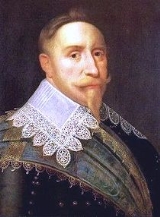
Gustavus Adolphus of Sweden
Gustav II Adolf , widely known by the
Latinized name Gustavus Adolphus and referred to by Protestants as the Lion of the North, was
King of Sweden from 1611 until his death. He is the only Swedish king to be styled "the Great". He was born in
Stockholm, the son of
Charles IX of the
Vasa dynasty and Christina of Holstein-Gottorp.
He was King of
Sweden from 1611, and as such one of the major players in the
Thirty Years' War. Gustav Adolf was married to the daughter of the
elector of Brandenburg-Prussia, Maria Eleonora and chose
Prussia's city of
Elbing as base for his operations in
Germany.
Encyclopedia
Gustav II Adolf , widely known by the
Latinized name
Gustavus Adolphus and referred to by Protestants as the
Lion of the North, was
King of Sweden from 1611 until his death. He is the only Swedish king to be styled "the Great". He was born in
Stockholm, the son of
Charles IX of the
Vasa dynasty and Christina of Holstein-Gottorp.
He was King of
Sweden from 1611, and as such one of the major players in the
Thirty Years' War. Gustav Adolf was married to the daughter of the
elector of Brandenburg-Prussia, Maria Eleonora and chose
Prussia's city of
Elbing as base for his operations in
Germany. He died in battle on November 6, 1632 at Lützen in Germany.
During his reign, Gustav founded the city of
Gothenburg as well as a number of smaller cities. He is also the founder of the
University of Tartu in
Tartu,
Estonia, which then belonged to the kingdom of Sweden. In this time, the three largest cities in the kingdom were
Riga ,
Stockholm and
Tallinn .
Military commander
As a general, Gustaf is famous for employing mobile
artillery on the battlefield, as well as a very active
tactic where attack was stressed over defense and mobility more important than in the usual linear tactic. The
musketeers under his command were widely known for their shooting accuracy and reload speed, three times as many shots per minute as any other comparable musketeer force in the world of the day.
This was only part of the reason why
Carl von Clausewitz and
Napoleon Bonaparte idolized him as one of the greatest generals of all time. His character both in consistency of purpose and of amity with all his troops from commanding officers right down to the rank and file with whom he mixed easily as if another commoner, earned him unassailably documented fame which most commanders in chief would gladly accept as mere joking anecdotes.
The king was an active participant in the battles, being prone to lead charges himself at crucial battle moments, and was wounded several times, including gunshot wounds to the neck, throat and the abdomen. His war wounds led the king to adopt a flexible armour of hide instead of the customary two part metal shell
cuirass, and this is what he wore in the Battle of Lützen, because a musketball from years before was lodged in his neck near the spine and would be irritated by a metal cuirass, causing extreme pain. Gustav's leather armour is currently on display in the
Livrustkammaren at the
Royal Palace in Stockholm.
Gustav occasionally used the name
Captain Gars, especially early in his reign, to travel Europe incognito, the
only known king to actually indulge in this highly fictionalized act of self-denigration with the alleged purpose of studying and scouting the lands of friends and potential foe. Gars is derived from the initials of "Gustavus Adolphus Rex ",
Latin for "Gustav Adolf King of
Sweden". He was a highly enlightened ruler, and held the Swedish nobility on a firm leash, supporting both the merchant and worker class against the nobility.
Gustav was killed at the Battle of Lützen where, at a crucial point in the battle, he was separated from his troops while leading a cavalry charge into a dense
smog of mist and gunpowder smoke. After his death, his wife Maria Eleonora of
Brandenburg initially kept his body, and later his heart, in her castle for over a year. His remains now rest in
Riddarholmskyrkan in
Stockholm.
In February 1633, following the death of the king, the Swedish
Riksdag of the Estates decided that his name would be accompanied by an accolade and that his name was to be styled Gustav Adolf the Great . No such honor has been bestowed on any other Swedish monarch since.
The crown of Sweden was inherited in the family of Vasa, and from Charles IX's time excluded those Vasa princes who had been traitors or descended from deposed monarchs. Gustav Adolph's younger brother had died years ago, and therefore there were only females left. Maria Eleonora and the king's ministers took over the government on behalf of Gustav Adolph's underage daughter
Christina of Sweden upon her father's death. He left two children of which we are aware: his illegitimate son Gustav, Count of Vasaborg, and his legitimate daughter and successor, queen
Christina of Sweden.
Alternative view
The German Socialist
Franz Mehring wrote a biography of Gustavus Adolphus with a
Marxist analysis of the actions of the Swedish King during the
Thirty Years' War, claiming it had little to do with religion , and everything to do with economics .
Timeline

- July 1626 Gustav and his army were disembarked in Pillau Prussia during Polish-Sweden War of 1625-1629.
- On 18 August 1627 the King was seriously wounded by a Polish soldier in the battle of Tczew.
- May1630. Gustav lands with his army in Pomerania. On July 6 he lands in Germany.
- September 1631. At the Battle of Breitenfeld, Gustav decisively defeats the Catholic forces led by Tilly, even after the allied Protestant Saxon army was routed and fled with the baggage train.
- March 1632. At the Battle of Lech, Gustav defeats Tilly once more, and in the battle Tilly sustains a fatal wound.
- April 1632. Battle of Rain.
- May 1632. Munich yields to the Swedish army.
- September 1632. Gustav attacks the stronghold of Alte Veste, which is under the command of Wallenstein, but is repulsed. The invincible Swedes had been defeated for the first time in course of Thirty Years' War. This leads to defection of some mercenary elements in the Protestant army.
- November 1632. The Battle of Lützen, Gustav is killed but the Swedes win the day thanks to Bernhard of Saxe-Weimar, who assumed the command, and defeat Wallenstein. The Swedish war effort was kept up by generals Gustav Horn
...
,
Johan Banér,
Lennart Torstenson and chancellor
Axel Oxenstierna until the
Peace of Westphalia.
A history of Adolphus' wars was written by Johann Philipp Abelin.
Gustav Adolf Day is celebrated in Sweden each year on November 6. On this day only a special pastry, with a chocolate medallion of the king, is sold. The day is also an official
flag day in the Swedish calendar.
Fictional appearances
- Gustavus Adolphus plays an important supporting role in Eric Flint's 16XX series.
- In Sid Meier's game Civilization IV : Warlords, Gustavus Adolphus makes the apperance of a Great General.
See also
Main article: Charles IX of Sweden [i] ...
