All Topics  
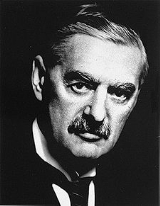
Neville Chamberlain

 
Neville Chamberlain

   Email Print
   Bookmark   Link


Neville Chamberlain


Arthur Neville Chamberlain (18 March 1869 – 9 November 1940) was a British Conservative
Conservative Party (UK)

The Conservative and Unionist Party, more commonly known as the Conservative Party, is a conservative political party in the United Kingdom....
 politician
Politician

A politician is an individual who is involved in influencing public decision making through the influence of politics or a person who influences the way a society is governed....
 and Prime Minister of the United Kingdom
Prime Minister of the United Kingdom

The Prime Minister of the United Kingdom of Great Britain and Northern Ireland is the political leader of the United Kingdom and the head of government Her Majesty's Government....
 from 1937 to 1940. Chamberlain is best known for appeasement
Appeasement

Appeasement is "the policy of settling international quarrels by admitting and satisfying grievances through rational negotiation and compromise, thereby avoiding the resort to an armed conflict which would be expensive, bloody, and possibly dangerous." The term is most often applied to the foreign policy of United Kingdom Prime Minister of t...
 foreign policy, in particular regarding his signing of the Munich Agreement
Munich Agreement

The Munich Agreement was an agreement regarding the Sudetenland, which were areas along borders of Czechoslovakia, mainly inhabited by Czech Germans....
 in 1938, conceding the Sudetenland region of Czechoslovakia
Czechoslovakia

Czechoslovakia was a sovereign state in Central Europe that existed from October 1918 until 1992 . On January 1, 1993, Czechoslovakia dissolution of Czechoslovakia into the Czech Republic and Slovakia....
 to Germany, and for his "containment" policy of Germany in 1939 that culminated in declaring war on Germany on 3 September 1939. After working in business and local government and a short spell as Director of National Service
Director of National Service

The Director of National Service was a post that existed briefly in the British government. Although a political appointment, the initial holder was Neville Chamberlain who was not a Member of Parliament at the time....
 in 1916 and 1917, Chamberlain followed his father and older half-brother in becoming a Member of Parliament
Member of Parliament

A Member of Parliament, or MP, is a representative of the voters to a parliament. In many countries the term applies specifically to members of the lower house, as upper houses often have a unique title, such as senate, and thus also have unique titles for its members, such as senators....
 in the 1918 general election
United Kingdom general election, 1918

The United Kingdom general election of 1918 was the first to be held after the Representation of the People Act 1918, which meant it was the first United Kingdom general election in which women could vote....
 at age 49.


Discussion
Ask a question about 'Neville Chamberlain'
Start a new discussion about 'Neville Chamberlain'
Answer questions from other users
Full Discussion Forum


Quotations


As you know I have always been more afraid of a peace offer than of an air raid.

Letter to Ida Chamberlain (8 October, 1939).

Armed conflict between nations is a nightmare to me, but if I were convinced that any nation had made up its mind to dominate the world by fear of its force I should feel it should be resisted.

Speech on 26 September, 1938.

I stick to the view I have always held that Hitler missed the bus in September 1938. He could have dealt France and ourselves a terrible, perhaps a mortal, blow then. The opportunity will not recur.

Letter to Hilda Chamberlain (30 December, 1939).


Encyclopedia


Arthur Neville Chamberlain (18 March 1869 – 9 November 1940) was a British Conservative
Conservative Party (UK)

The Conservative and Unionist Party, more commonly known as the Conservative Party, is a conservative political party in the United Kingdom....
 politician
Politician

A politician is an individual who is involved in influencing public decision making through the influence of politics or a person who influences the way a society is governed....
 and Prime Minister of the United Kingdom
Prime Minister of the United Kingdom

The Prime Minister of the United Kingdom of Great Britain and Northern Ireland is the political leader of the United Kingdom and the head of government Her Majesty's Government....
 from 1937 to 1940. Chamberlain is best known for appeasement
Appeasement

Appeasement is "the policy of settling international quarrels by admitting and satisfying grievances through rational negotiation and compromise, thereby avoiding the resort to an armed conflict which would be expensive, bloody, and possibly dangerous." The term is most often applied to the foreign policy of United Kingdom Prime Minister of t...
 foreign policy, in particular regarding his signing of the Munich Agreement
Munich Agreement

The Munich Agreement was an agreement regarding the Sudetenland, which were areas along borders of Czechoslovakia, mainly inhabited by Czech Germans....
 in 1938, conceding the Sudetenland region of Czechoslovakia
Czechoslovakia

Czechoslovakia was a sovereign state in Central Europe that existed from October 1918 until 1992 . On January 1, 1993, Czechoslovakia dissolution of Czechoslovakia into the Czech Republic and Slovakia....
 to Germany, and for his "containment" policy of Germany in 1939 that culminated in declaring war on Germany on 3 September 1939. After working in business and local government and a short spell as Director of National Service
Director of National Service

The Director of National Service was a post that existed briefly in the British government. Although a political appointment, the initial holder was Neville Chamberlain who was not a Member of Parliament at the time....
 in 1916 and 1917, Chamberlain followed his father and older half-brother in becoming a Member of Parliament
Member of Parliament

A Member of Parliament, or MP, is a representative of the voters to a parliament. In many countries the term applies specifically to members of the lower house, as upper houses often have a unique title, such as senate, and thus also have unique titles for its members, such as senators....
 in the 1918 general election
United Kingdom general election, 1918

The United Kingdom general election of 1918 was the first to be held after the Representation of the People Act 1918, which meant it was the first United Kingdom general election in which women could vote....
 at age 49. He declined a junior ministerial position, remaining a backbencher
Backbencher

A backbencher in the Westminster system is a Member of Parliament or a legislator who does not hold Minister and is not a frontbencher spokesperson in the Opposition....
 until he was appointed Postmaster General
United Kingdom Postmaster General

The Postmaster General in the United Kingdom is a defunct Minister of the Crown position in HM Government. Aside from maintaining the postal system, the Telegraph Act of 1868 established the Postmaster General's right to exclusively maintain electric Telegraphys....
 after the 1922 general election
United Kingdom general election, 1922

The UK general election of 1922 was held on 15 November 1922. It was the first election held after most of the Irish counties left the United Kingdom to form the Irish Free State, and was won by Andrew Bonar Law's Conservative Party , who gained an overall majority over Labour Party , led by John Robert Clynes and a divided Liberal Party ....
. He was rapidly promoted in 1923 to Minister of Health
Secretary of State for Health

Secretary of State for Health is a UK cabinet position responsible for the British Department of Health. The current Secretary of State for Health is Alan Johnson, appointed on 28 June 2007 as part of Gordon Brown's first cabinet....
 and then Chancellor of the Exchequer
Chancellor of the Exchequer

The Chancellor of the Exchequer is the title held by the British Cabinet of the United Kingdom Minister who is responsible for all economic and financial matters....
 but presented no budget
Budget

Budget generally refers to a list of all planned expenses and revenues. It is a plan for saving and spending. A budget is an important concept in microeconomics, which uses a budget line to illustrate the trade-offs between two or more good ....
 before the government fell in 1924.

He returned as Minister of Health, introducing a range of reform measures from 1924 to 1929. He was appointed Chancellor of the Exchequer in the coalition National Government
UK National Government

In the United Kingdom the term National Government is in an abstract sense used to refer to a coalition of some or all List of political parties in the United Kingdom#Major political parties in the United Kingdom....
 in 1931 and spent six years reducing the war debt and the tax burden. When Stanley Baldwin
Stanley Baldwin

Stanley Baldwin, 1st Earl Baldwin of Bewdley, Order of the Garter, Privy Council of the United Kingdom was a British Conservative Party politician, statesman, and major figure on the political scene in the interwar years....
 retired after the abdication of Edward VIII
Edward VIII of the United Kingdom

Edward VIII was Monarch of the United Kingdom of Great Britain and Northern Ireland and the dominion, and Emperor of India from 20 January 1936, following the death of his father, George V of the United Kingdom, until his abdication on 11 December 1936....
 and the coronation
Coronation

A coronation is a ceremony marking the investiture of a monarch with regal power, specifically involving the placement of a coronation crown upon his or her head, and the presentation of other items of regalia....
 of George VI
George VI of the United Kingdom

George VI was British monarchy and the United Kingdom Dominions from 11 December 1936 until his death. He was the last Emperor of India and the last King of Ireland , and the first Head of the Commonwealth....
, Chamberlain took his place as Prime Minister in 1937. In 1938, he returned the so-called Treaty Ports
Treaty Ports (Ireland)

At the end of the Irish War of Independence three deep water Treaty Ports at Lough Swilly, Berehaven, and Queenstown were retained by the United Kingdom as UK sovereign base under the terms of the Anglo-Irish Treaty of December 6 1921....
 to the Irish Free State
Irish Free State

The Irish Free State was the state established as a Dominion on 6 December 1922 under the Anglo-Irish Treaty, signed by the British government and Irish representatives exactly twelve months beforehand....
.

Chamberlain was forced to resign the premiership on 10 May 1940, after Germany invaded the Netherlands, Belgium and France. He was succeeded by Winston Churchill
Winston Churchill

Sir Winston Leonard Spencer-Churchill, Order of the Garter, Order of Merit, Order of the Companions of Honour, Territorial Decoration, Fellow of the Royal Society, Her Majesty's Most Honourable Privy Council, Queen's Privy Council for Canada was a Politics of the United Kingdom known chiefly for his leadership of the United King...
 but remained very well regarded in Parliament. Before ill health forced him to resign, he was an important member of Churchill's War Cabinet
War Cabinet

A War Cabinet is a committee formed by a government in time of war. It is usually a subset of the full executive cabinet of ministers. It is also quite common for a War Cabinet to have senior military officers and opposition politicians as members....
. He had a key role in the formation of the Special Operations Executive
Special Operations Executive

The Special Operations Executive , was a United Kingdom World War II organisation. It was initiated by Winston Churchill and Hugh Dalton in July 1940, to conduct warfare by means other than direct military engagement....
. Chamberlain died of cancer six months after leaving the premiership.

Early life


Chamberlain was born in a house called Southbourne, in the Edgbaston
Edgbaston

Edgbaston is an area in the city of Birmingham in England. It is also a Government of Birmingham, England#Districts, managed by its own district committee....
 district of Birmingham
Birmingham

Birmingham is a city status in the United Kingdom and metropolitan borough in the West Midlands of England. Birmingham is the most populous of England's English Core Cities Group, and is the List of United Kingdom cities by population British city after London, with a population of 1,010,200 ....
, England. He was the eldest son of the second marriage of Joseph Chamberlain
Joseph Chamberlain

Joseph Chamberlain was an influential British businessman, politician, and statesman.In his early years Chamberlain was a radically minded Liberal Party member, a campaigner for educational reform, and President of the Board of Trade....
, Lord Mayor of Birmingham
Birmingham

Birmingham is a city status in the United Kingdom and metropolitan borough in the West Midlands of England. Birmingham is the most populous of England's English Core Cities Group, and is the List of United Kingdom cities by population British city after London, with a population of 1,010,200 ....
, and a half-brother (and cousin through their mothers) to Austen, later Sir Austen
Austen Chamberlain

Sir Joseph Austen Chamberlain, Order of the Garter was a British statesman, Politics, and recipient of the Nobel Peace Prize....
. Joseph's first wife died giving birth to Austen; Neville's mother also died in childbirth in 1875, when Neville was six years old. The Chamberlain children found their relations with their father strained, and Neville grew up developing strong bonds with those siblings who were closest to him in age, most notably his sisters Ida and Hilda, to whom he wrote every week while away from them. Neville Chamberlain was a cousin of actor Alan Napier
Alan Napier

Alan Napier was an English character actor. He is best known for playing Alfred in the 1960s live-action Batman television series.Napier was a cousin of Neville Chamberlain, United Kingdom's prime minister from 1937 to 1940 and a great-great-grandson of author Charles Dickens....
.

Chamberlain was educated at Rugby School
Rugby School

Rugby School, located in the town of Rugby, Warwickshire, Warwickshire, is regarded as one of the UK's leading co-educational boarding school and is one of the oldest public school in England....
. At first he declined to join the school debating society, changing his mind only in 1886 when he spoke in favour of preserving the United Kingdom, agreeing with his Liberal Unionist father's opposition over Irish Home Rule. It was during this period that Chamberlain developed a love of botany
Botany

Botany, plant science, phytology, or plant biology is a branch of biology and is the Scientific method of plant life and development....
, and later became a fellow of the Royal Horticultural Society
Royal Horticultural Society

The Royal Horticultural Society was founded in 1804 in London, England as the Horticultural Society of London, and gained its present name in a Royal Charter granted in 1861 by Prince Albert of Saxe-Coburg-Gotha....
. He was also fascinated by ornithology
Ornithology

Ornithology is the branch of zoology concerned with the study of birds. Several aspects of the study of ornithology differ from closely related disciplines, due partly to the high visibility and the aesthetic appeal of birds....
 and fishing. Chamberlain had a passion for music and literature, and in later life would often quote William Shakespeare
William Shakespeare

William Shakespeare was an English people poet and playwright, widely regarded as the greatest writer in the English language and the world's preeminent dramatist....
 in public debates.

Austen Chamberlain
After leaving school, Chamberlain became a student at Mason Science College
Mason Science College

Mason Science College was founded by Josiah Mason in 1875, the buildings of which were opened in Edmund Street, Birmingham, England on 1 October 1880....
 (later the University of Birmingham
University of Birmingham

The University of Birmingham is a United Kingdom 'Red brick universities' university located in the city of Birmingham, England. Founded in Edgbaston in 1900 as a successor to Mason Science College, and with origins dating back to the 1825 Birmingham Medical School, it was the first of the so-called Red brick universities to receive a Royal...
), as one of only five Prime Ministers to attend a university or college other than Oxford
University of Oxford

The University of Oxford , located in the city of Oxford, Oxfordshire, England, is the List of oldest universities in continuous operation in the English-speaking world....
 or Cambridge
University of Cambridge

The University of Cambridge , located in Cambridge, England, is the List of oldest universities in continuous operation university in the Anglosphere....
 (the others being Lord John Russell
John Russell, 1st Earl Russell

John Russell, 1st Earl Russell, Order of the Garter, Order of St Michael and St George, Privy Council of the United Kingdom , known as Lord John Russell before 1861, was an England British Whig Party and Liberal Party politician who served twice as Prime Minister of the United Kingdom in the mid-19th century....
 and Gordon Brown
Gordon Brown

James Gordon Brown UK Member of Parliament is a United Kingdom Labour Party politician and the Prime Minister of the United Kingdom. Brown assumed office in June 2007, after the resignation of Tony Blair and three days after becoming leader of the governing Labour Party....
, who both attended Edinburgh
University of Edinburgh

The University of Edinburgh founded in 1582, is an internationally renowned centre for teaching and research in Edinburgh, Scotland, United Kingdom....
, John Stuart, 3rd Earl of Bute
John Stuart, 3rd Earl of Bute

John Stuart, 3rd Earl of Bute, Order of the Garter, Privy Council of the United Kingdom , styled Lord Mount Stuart before 1723, was a Scotland nobility who served as Prime Minister of the United Kingdom under George III of Great Britain, and was arguably the last important favourite in British politics....
, who studied at the University of Leiden, and Andrew Bonar Law
Andrew Bonar Law

Andrew Bonar Law was a Canada-born United Kingdom Conservative Party statesman and Prime Minister of the United Kingdom. He is the only British Prime Minister to have been born outside the British Isles....
, who studied at the University of Glasgow
University of Glasgow

The University of Glasgow was founded in 1451, in Glasgow, Scotland, and, along with its contemporary institution, the University of St Andrews, it formed the Kingdom of Scotland's equivalent to Oxbridge....
, along with others who did not attend university). He took a degree in science and metallurgy
Metallurgy

Metallurgy is a domain of materials science that studies the physical and chemical behavior of metallic Chemical element, their intermetallics, and their mixtures, which are called alloys....
 and shortly after graduation became apprenticed to an accounting firm.

In 1890, Joseph Chamberlain's finances took a downturn, and he decided, against better advice from his brothers, to try growing sisal
SISAL

SISAL is a general-purpose single assignment functional programming language programming language with strict semantics, implicit parallelism, and efficient array handling....
 in the Bahamas. Neville and Austen were sent to the Americas to investigate the island of Andros
Andros, Bahamas

Andros Island is the largest island of the Bahamas and the fifth largest island in the West Indies at roughly 2300 square miles in area and 104 miles long and 40 miles wide at its widest point....
, which seemed a good prospect for a plantation, but the crops failed in the unsuitable environment, and by 1896 the business was shut down at a heavy loss.

Neville Chamberlain's later ventures at home were more successful. He served as chairman of several manufacturing firms in Birmingham, including Elliots (a metal goods manufacturer) and Hotskins (a cabin berth manufacturer). He gained a reputation for being a hands-on manager, taking a strong interest in the day-to-day running of affairs.

Lord Mayor of Birmingham

Although he campaigned for his father and brother during elections, Chamberlain did not enter politics on his own behalf until November 1911 when he was elected to Birmingham City Council and immediately became chairman of the Town Planning Committee. That January, though he had settled into bachelorhood, he married Anne Vere Cole
Anne Chamberlain

Anne Vere Chamberlain, n?e Anne de Vere Cole was the wife of United Kingdom Prime Minister of the United Kingdom Neville Chamberlain.Chamberlain was born to Major William Utting Cole, of West Woodhay House; he died in British Raj of cholera while she was young....
, with whom he had two children, a daughter, Dorothy Ethel (1911-1994; m. Stephen Lloyd) and a son, Francis Neville (1914-1965; m. Parrott). Under Chamberlain's direction, Birmingham soon adopted one of the first town planning schemes in Britain. In 1913, he took charge of a committee looking at housing conditions. The interim report of the committee could not be implemented immediately because of the war, but it did much to show Chamberlain's vision of improvements to housing.

In 1915, like his father before him, he became Lord Mayor of Birmingham. Within the first two months, he had won government approval to increase the electricity supply, and he organised the use of coal as part of the war effort; he also prevented a strike by council workers. During this time he assisted in the creation of the Birmingham Symphony Orchestra and the establishment of the Birmingham Municipal Bank
Birmingham Municipal Bank

The Birmingham Municipal Bank was a savings bank in the city of Birmingham, England. It was created as the Birmingham Corporation Savings Bank by a 1916 Act of Parliament, to raise money to aid World War I....
, the only one of its type in the country, which aimed to encourage savings to pay for the war loan. The bank proved highly successful and lasted until 1976. Chamberlain was re-elected Lord Mayor in 1916, but he did not complete his term.

Early ministerial career

Lloydgeorge
In December 1916, Chamberlain was in London when he received a message asking him to meet the new Prime Minister, David Lloyd George
David Lloyd George

David Lloyd George, 1st Earl Lloyd-George of Dwyfor Order of Merit , Privy Council of the United Kingdom was a United Kingdom statesman and the only Wales Prime Minister of the United Kingdom - he is also the only one to have spoken English language as a second language, Welsh language having been his first....
. In a brief meeting, Lloyd George offered Chamberlain the new position of Director of National Service
Director of National Service

The Director of National Service was a post that existed briefly in the British government. Although a political appointment, the initial holder was Neville Chamberlain who was not a Member of Parliament at the time....
, with responsibility for coordinating conscription
Conscription

Conscription is a general term for involuntary labor demanded by an established authority. It is most often used in the specific sense of government policies that require citizens to serve in the military....
 and ensuring that essential war industries were able to function with sufficient workforces. Chamberlain had been recommended for the position by several people, including his brother Austen, and he agreed to accept the post; despite several interviews, however, he was left unclear about many aspects of the job. Over the following eight months only a few thousand volunteers were placed in industry. Chamberlain clashed several times with Lloyd George, who had taken a strong dislike to him, thus making the position even harder to operate. Chamberlain resigned in 1917. He and Lloyd George retained a mutual contempt that lasted throughout their political careers.

Embittered by his failure, Chamberlain decided to stand in the next general election
United Kingdom general election, 1918

The United Kingdom general election of 1918 was the first to be held after the Representation of the People Act 1918, which meant it was the first United Kingdom general election in which women could vote....
, when he was elected, at age 49 — by far the oldest age for any future Prime Minister entering Parliament to date — for Birmingham Ladywood. He was offered a junior post at the Ministry of Health
Department of Health (United Kingdom)

The Department of Health is a Departments of the United Kingdom government but with responsibility for government policy for England alone on health, social care and the National Health Service ....
 but declined it, refusing to serve a Lloyd George government. He also declined a knighthood. Chamberlain spent the next four years as a Conservative backbencher, despite his half-brother Austen becoming leader of Conservative MPs in 1921.

In October 1922, discontent amongst Conservatives against the Lloyd George Coalition Government erupted. At a meeting at the Carlton Club
Carlton Club

The Carlton Club is a gentlemen's club in London....
, the majority of MPs voted to leave the coalition, even though it meant abandoning their current leadership, since Austen had pledged to support Lloyd George. Neville was on his way home from Canada at the time of the meeting and so was not forced to choose between supporting his brother's leadership and bringing down a man he despised.

The new Conservative Prime Minister, Andrew Bonar Law
Andrew Bonar Law

Andrew Bonar Law was a Canada-born United Kingdom Conservative Party statesman and Prime Minister of the United Kingdom. He is the only British Prime Minister to have been born outside the British Isles....
, offered Chamberlain the position of Postmaster General, outside Cabinet. There was much discussion amongst the Chamberlain family as to whether he should accept; in the end, Austen reluctantly agreed to allow Neville to accept the post. He also became a member of the Privy Council
Privy Council of the United Kingdom

Her Majesty's Most Honourable Privy Council is a body of advisors to the British monarchy. Its members are largely senior politicians, who were or are members of either the House of Commons of the United Kingdom or House of Lords....
.

In 1922, the Conservatives won the general election
United Kingdom general election, 1922

The UK general election of 1922 was held on 15 November 1922. It was the first election held after most of the Irish counties left the United Kingdom to form the Irish Free State, and was won by Andrew Bonar Law's Conservative Party , who gained an overall majority over Labour Party , led by John Robert Clynes and a divided Liberal Party ....
, but the Minister of Health, Sir Arthur Griffith-Boscawen
Arthur Griffith-Boscawen

Lieutenant-Colonel Sir Arthur Sackville Trevor Griffith-Boscawen Privy Council of the United Kingdom was a United Kingdom Conservative Party politician whose career was cut short by repeatedly losing a string of Parliamentary elections....
, lost his seat and failed to win a by-election. To fill the position, Law chose Chamberlain. In this position, he introduced a Housing Act that provided subsidies for private companies building affordable housing as a first step towards a programme of slum
Slum

A slum, as defined by the United Nations agency UN-HABITAT, is a run-down area of a city characterized by substandard housing and squalor and lacking in tenure security....
 clearances. He also introduced the Rent Restriction Act, which limited evictions and required rents to be linked to the property's state of repair. Chamberlain's main interest lay in housing, and becoming the Minister of Health gave him a chance to spread these ideas on a national basis. These ideas stemmed from his father, Joseph Chamberlain.

The following month Stanley Baldwin
Stanley Baldwin

Stanley Baldwin, 1st Earl Baldwin of Bewdley, Order of the Garter, Privy Council of the United Kingdom was a British Conservative Party politician, statesman, and major figure on the political scene in the interwar years....
 became Prime Minister and after serving as his own Chancellor of the Exchequer
Chancellor of the Exchequer

The Chancellor of the Exchequer is the title held by the British Cabinet of the United Kingdom Minister who is responsible for all economic and financial matters....
 for three months whilst he sought a successor, he promoted Chamberlain to a position which he held until the government fell in January 1924. His first Chancellorship was unusual in that he presented no budget.

Chamberlain remained one of the leading Conservative figures, but he faced a significant challenge in the 1924 general election
United Kingdom general election, 1924

The 1924 UK general election was held on 29 October 1924. The Conservative Party , led by Stanley Baldwin performed dramatically better, in electoral terms, than in the United Kingdom general election, 1923 and obtained a large parliamentary majority....
 from Oswald Mosley
Oswald Mosley

Sir Oswald Ernald Mosley, 6th Baronet was a United Kingdom politician, known principally as the founder of the British Union of Fascists....
, head of the Labour Party
Labour Party (UK)

The Labour Party is a political party in the United Kingdom. Founded at the start of the 20th century, it has been since the 1920s the principal party of the Left-wing politics in England, Scotland and Wales, but not Northern Ireland, where it has only recently organised again....
 in Birmingham. After a tense series of recounts, Chamberlain was elected by a mere 77 votes; in subsequent elections he stood in a safer seat. The Conservatives formed a new government, but Chamberlain declined a second term as Chancellor of the Exchequer, choosing to become Minister of Health again.

Over the next four and a half years, he successfully introduced 21 pieces of legislation, the boldest of which was perhaps the Rating and Valuation Act 1925, which radically altered local government finance. The act transferred the power to raise rates from the Poor Law
Poor Law

The Poor Law was the system for the provision of social security in operation in England and Wales from the 16th century until the establishment of the Welfare State in the 20th century....
 boards of guardians to local councils, introduced a single basis and method of assessment for evaluating rates, and enacted a process of quinquennial valuations. The measure established Chamberlain as a strong social reformer, but it angered some in his own party. He followed it with the Local Government Act 1929
Local Government Act 1929

The Local Government Act, 1929 made changes to poor law and local government in England and Wales.The act abolished the system of poor law unions in England and Wales and their boards of guardians, passing their powers to local authorities....
, which abolished the boards of guardians
Board of Guardians

Boards of Guardians were ad hoc authorities that administered Poor Law in the United Kingdom from 1835 to 1930....
 altogether, transferring their powers to local government and eliminating workhouse
Workhouse

A workhouse, was a place where people who were unable to support themselves could go to live and work. The Oxford Dictionary's earliest reference to a workhouse dates to 1652 in Exeter....
s. The act also eliminated rates paid by agriculture and reduced those paid by businesses, a measure forced by Winston Churchill
Winston Churchill

Sir Winston Leonard Spencer-Churchill, Order of the Garter, Order of Merit, Order of the Companions of Honour, Territorial Decoration, Fellow of the Royal Society, Her Majesty's Most Honourable Privy Council, Queen's Privy Council for Canada was a Politics of the United Kingdom known chiefly for his leadership of the United King...
 and the Exchequer; the result was a strong piece of legislation that won Chamberlain much acclaim. Another prominent piece of legislation was the Widows, Orphans, and Old Age Pensions Act 1925, which did much to foster the development of the embryonic Welfare State
Welfare State

The Welfare State of the United Kingdom was prefigured in the William Beveridge Report in 1942, which identified five "Giant Evils" in society: squalor, ignorance, want, idleness and disease....
 in Britain.

Becoming the heir apparent of the Conservative Party

In the 1929 general election
United Kingdom general election, 1929

The 1929 UK general election was held on 30 May 1929, and resulted in a hung parliament. It was the first of only three elections under universal suffrage in which a party lost the popular vote but gained a plurality of seats ....
, Chamberlain changed his constituency from Birmingham Ladywood to Birmingham Edgbaston and held it easily, but the Conservative Party lost the election and entered a period of internal conflict. In 1930 Chamberlain became Chairman of the Conservative Party for a year and was widely seen as the next leader. However, Stanley Baldwin survived the conflict over his leadership and retained it for another seven years. During this period, Chamberlain founded and became the first head of the Conservative Research Department
Conservative Research Department

The Conservative Research Department is an integral part of the central organisation of the Conservative Party of the United Kingdom. It operates alongside the other departments of Conservative Campaign Headquarters at 30 Millbank, London SW1....
.

During these two years out of power, Baldwin's leadership came in for much criticism. Many in politics, Conservative or otherwise, urged the introduction of protective tariff
Tariff

A tariff is a tax imposed on goods when they are moved across a political boundary. They are usually associated with protectionism, the economic policy of restraining trade between nations....
s, an issue which had caused conflict on and off for the last 30 years. Chamberlain was inclined towards tariffs, having a personal desire to see his father's last campaign vindicated. The press baron Lord Beaverbrook
Max Aitken, 1st Baron Beaverbrook

William Maxwell "Max" Aitken, 1st Baron Beaverbrook, Baronet, Privy Council of the United Kingdom, was a Canada-United Kingdom business tycoon, politician, and writer....
 launched a campaign for "Empire Free Trade", meaning the removal of tariffs within the British Empire
British Empire

The British Empire comprised the dominions, Crown colony, protectorates, League of Nations mandate, and other Dependent territory ruled or administered by the United Kingdom , that had originated with the overseas colonies and trading posts established by England in the late 16th and early 17th centuries....
 and the erection of external tariffs; he was supported in his opposition to Baldwin by Lord Rothermere
Harold Sidney Harmsworth, 1st Viscount Rothermere

Harold Sidney Harmsworth, 1st Viscount Rothermere was a highly successful United Kingdom newspaper proprietor, owner of Associated Newspapers Ltd....
, who also opposed Baldwin's support for Indian independence. Their main newspapers, the Daily Express
Daily Express

The Daily Express is a conservative, United Kingdom tabloid newspaper, in its heyday a middle-market title but nowadays very much downmarket....
 and Daily Mail
Daily Mail

The Daily Mail is a United Kingdom newspaper, currently published in a tabloid format. First published in 1896 by Alfred Harmsworth, 1st Viscount Northcliffe, it is the United Kingdom's second biggest-selling daily newspaper after The Sun ....
 respectively, criticised Baldwin and stirred up discontent within the party. At one point, Beaverbrook and Rothermere created the United Empire Party, which stood in by-elections and tried to get Conservatives to adopt its platform. Chamberlain found himself in the difficult position of supporting his leader, even though he disagreed with Baldwin's handling of the issue and was best placed to succeed if he did resign. Baldwin stood his ground, first winning a massive vote of confidence within his party and then taking on the challenge of the United Empire Party at the Westminster St. George's by-election in 1931. The official Conservative candidate was victorious, and Chamberlain found his position as the clear heir to Baldwin established, especially after Churchill's resignation from the Conservative Business Committee
Shadow Cabinet

The Shadow Cabinet is a senior group of opposition spokespeople in the Westminster system of government who together under the leadership of the Official opposition form an alternative cabinet to the government's, whose members shadow or mark each individual member of the government....
 over Indian Home Rule.

Chamberlain and Baldwin were strong political partners throughout their fourteen years at the height of politics together, but Chamberlain was frustrated by Baldwin's sense of detachment and disinterest in the detail of policy, while Baldwin found Chamberlain's low opinion of the Labour Party
Labour Party (UK)

The Labour Party is a political party in the United Kingdom. Founded at the start of the 20th century, it has been since the 1920s the principal party of the Left-wing politics in England, Scotland and Wales, but not Northern Ireland, where it has only recently organised again....
 disappointing. Despite their disagreements, their partnership proved to be effective.

Formation of the National Government


While the Conservative Party settled internal matters, the Labour Government faced a massive economic crisis as currencies collapsed and speculators turned towards the United Kingdom. Matters were not helped by the publication of the May Report, which revealed that the budget was unbalanced. The revelation triggered a crisis of confidence in the pound
Pound sterling

----The pound sterling , subdivided into 100 pence , is the currency of the United Kingdom, its Crown dependency and the British Overseas Territories of South Georgia and the South Sandwich Islands and British Antarctic Territory....
, and Labour ministers grappled with the proposed budget cuts. Given the possibility that the Government could fall, Prime Minister Ramsay MacDonald
Ramsay MacDonald

James Ramsay MacDonald was a British politician and twice Prime Minister of the United Kingdom. He rose from humble origins to become the first Labour Party Prime Minister in 1924....
 met regularly with delegations from both the Conservatives and Liberals
Liberal Party (UK)

The Liberal Party was one of the two major British political parties from the early 19th century until the rise of the Labour Party in the 1920s, and a third party of varying strength and importance up to 1988, when it merged with the Social Democratic Party to form a new party which would become known as the Liberal Democrats....
. Baldwin spent much of the summer in France, so Chamberlain was the primary leader of the Conservative delegation; he soon came to the conclusion that the best solution was a National Government
UK National Government

In the United Kingdom the term National Government is in an abstract sense used to refer to a coalition of some or all List of political parties in the United Kingdom#Major political parties in the United Kingdom....
 of politicians drawn from all parties, which would be able to push through budget cuts without inflicting blame on any individual party, splitting the Labour Party as a convenient side effect. He also believed that a National Government would have the greatest chance of introducing tariffs. As the political situation deteriorated, Chamberlain argued strongly for coalition, eventually convincing both Baldwin and MacDonald that this was the best outcome. King George V
George V of the United Kingdom

George V was the first British monarch belonging to the House of Windsor, which he created from the British branch of the German House of Saxe-Coburg and Gotha....
 and the acting Liberal leader Sir Herbert Samuel
Herbert Samuel, 1st Viscount Samuel

Herbert Louis Samuel, 1st Viscount Samuel Order of the Bath Order of Merit Order of the British Empire Privy Council of the United Kingdom was a British people politician and diplomat....
, among others, were also convinced. Finally, on 24 August 1931, the Labour government resigned and MacDonald formed a National Government. Chamberlain once more returned to the Ministry of Health
Ministry of Health

Ministry of Health may refer to:*Ministry of Health *Ministry of Health *Ministry of Health *Ministry of Interior and Health *Ministry of Health ...
 with the specific task of encouraging local authorities to make cuts to their expenditure.

Return to the Exchequer


After the 1931 general election
United Kingdom general election, 1931

The UK general election on Tuesday 27 October 1931 was the last in the United Kingdom not held on a Thursday. It was also the last election, and the only one under universal suffrage, where one party received an absolute majority of the votes cast....
, Chamberlain became Chancellor of the Exchequer a second time. As Chancellor, Chamberlain hoped to introduce protective tariffs, but the economic situation threatened government unity; at the general election, the parties supporting the government had agreed to ask for a "Doctor's mandate" to enact any legislation necessary to resolve the economic situation. Now the government, made up of Conservatives, Liberals, National Labour, and Liberal Nationals
National Liberal Party (UK)

Historically the National Liberal Party was a name used by two groups of politicians, who had formerly been associated with the Liberal Party in the United Kingdom....
, faced a major crisis. The government agreed that no immediate steps would be taken; instead, the issue was referred to a subcommittee of the Cabinet — whose members were largely in favour of tariffs. In the meantime, Chamberlain introduced the Abnormal Importations Bill, which allowed temporary duties to be imposed if importers seemed to be taking advantage of government delays.

The Cabinet committee reported in favour, albeit not unanimously, of introducing a general tariff of 10%, with exceptions for certain goods such as produce from the Dominion
Dominion

A dominion, often Dominion, refers to one of a group of autonomy polity that were nominally under United Kingdom sovereignty, constituting the British Empire and Commonwealth of Nations, from the late 19th century....
s and colonies, as well as higher tariffs for excessively high imports or for particular industries which needed safeguarding. In addition, the government would negotiate with Dominion governments to secure trading agreements within the British Empire, promoting Chamberlain's father's vision of the Empire as an economically self-sufficient unit. The Liberals in the Cabinet, together with Lord Snowden
Philip Snowden, 1st Viscount Snowden

Philip Snowden, 1st Viscount Snowden was a United Kingdom politician and the first Labour Party Chancellor of the Exchequer.Early life...
, refused to accept this and threatened resignation. However, on the suggestion of Lord Hailsham
Douglas Hogg, 1st Viscount Hailsham

File:Hailsham1.JPGDouglas McGarel Hogg, 1st Viscount Hailsham, Privy Council of the United Kingdom was a British Conservative lawyer and politician....
, the government agreed to suspend the principle of collective responsibility
Cabinet collective responsibility

Cabinet collective responsibility is constitutional convention in governments using the Westminster System that members of the Cabinet must publicly support all governmental decisions made in Cabinet, even if they do not privately agree with them....
 and allow the free-traders to publicly oppose the introduction of tariffs without giving up membership in the government. This unprecedented move had the effect of keeping the National Government together at this stage, but Chamberlain would have preferred to force the Liberals' resignations from the government, despite his reluctance to lose Snowden. Nevertheless, when he announced the policy in the House of Commons on 4 February 1932, he considered it "the greatest day of his
His

His or HIS may refer to:* Hangzhou International School* a gender-specific pronoun, the possessive form of he* His, Haute-Garonne, a commune in the Haute-Garonne d?partement, in France...
 life". For effect, he used his father's former dispatch box from his time at the Colonial Office
Colonial Office

Colonial Office is the government agency which serves to oversee and supervise their colony* Colonial Office - The British Government department...
 and made great play in his speech of the rare moment when a son was able to complete his father's work. At the end of his speech, Austen walked down from the back benches and shook Neville's hand amid great applause.

Later that year, Chamberlain travelled to Ottawa
Ottawa

Ottawa is the Capital of Canada. The city has population of 812,000, the List of the 100 largest municipalities in Canada by population municipality in the country and second largest in Ontario....
, Canada, with a delegation of Cabinet ministers who intended to negotiate free trade within the Empire. The resulting Ottawa Agreement did not live up to expectations, most Dominion governments were reluctant to allow British goods in their markets. A series of bilateral agreements increased the tariffs on goods from outside the Empire even further, but there was still little direct increase in internal trade. The agreement was sufficient, however, to drive Snowden and the Liberals out of the National Government; Chamberlain welcomed this, believing that all the forces supporting the government would eventually combine into a single "National Party".

Time Magazine Neville Chamberlain
During his tenure as Chancellor, Chamberlain emerged as the most active minister of the government. In successive budgets he sought to undo the harsh budget cuts of 1931; he also took a lead in ending war debts, which were finally cancelled at a conference at Lausanne
Lausanne

Lausanne is a city in Romandy, the French language-speaking part of Switzerland, situated on the shores of Lake Geneva , and facing ?vian-les-Bains and with the Jura mountains to its north-west....
 in 1932. In June 1933, Britain hosted the World Monetary and Economic Conference
London Economic Conference

The London Economic Conference was a meeting that took place between representatives of 66 nations in the June 1933. Held at London's Geological Museum, the purpose was to attack global Recession, revive international trade, and stabilize international currency....
. Describing the event as the "most crucial gathering since Versailles
Treaty of Versailles

The Treaty of Versailles was one of the peace treaty at the end of World War I. It ended the declaration of war between German Empire and Allies of World War I....
", top U.S. newsmagazine Time
Time (magazine)

Time is a weekly United States newsmagazine, similar to Newsweek and U.S. News & World Report. A European edition is published from London....
 featured Chamberlain on its cover, referring to him as "that mighty mover behind British Cabinet scenes, lean, taciturn, iron-willed... I
I

I is the ninth Letter of the Latin alphabet. Its English language name is i ....
t is no secret that Scot MacDonald
Ramsay MacDonald

James Ramsay MacDonald was a British politician and twice Prime Minister of the United Kingdom. He rose from humble origins to become the first Labour Party Prime Minister in 1924....
 remains Prime Minister by Prime Mover Chamberlain's leave." In 1934, he declared that economic recovery was under way, stating that the nation had "finished Hard Times
Hard Times

Hard Times- For These Times. is a novel by Charles Dickens, first published in 1854. The book is a state-of-the-nation novel, which aimed to highlight the social and economic pressures that some people were experiencing....
 and could now start reading Great Expectations
Great Expectations

Great Expectations is a novel by Charles Dickens first serial ised in All the Year Round from 1 December 1860 to August 1861. It is regarded as one of his greatest and most sophisticated novels, and is one of his most enduringly popular, having been adapted for stage and screen over 250 times....
." However, from 1935 on, financial strains grew as the government proceeded on a programme of rearmament.

Chamberlain, aware of the strain this was placing on the Exchequer, found himself being attacked on two fronts: Winston Churchill accused him of being excessively frugal with defence expenditure, but the Labour Party attacked him as a warmonger in the 1935 general election
United Kingdom general election, 1935

The UK general election held on 14 November 1935 resulted in a large, though reduced, majority for the UK National Government now led by Conservative Stanley Baldwin....
. In the 1937 budget, Chamberlain proposed one of his most controversial taxes, the National Defence Contribution, which would raise revenue from excessive profits in industry. The proposal produced a massive storm of disapproval, and some political commentators speculated that Chamberlain might leave the Exchequer, not for 10 Downing Street
10 Downing Street

Number 10 Downing Street is the residence and office of the First Lord of the Treasury and Prime Minister of the United Kingdom. The headquarters of Her Majesty's Government, it is situated on Downing Street in the City of Westminster in London, England....
 but for the back benches.

Despite these attacks from the Labour Party and Churchill, Chamberlain had adopted a policy that would serve to be vital to Britain during wartime. This process was called rationalisation. Under this policy the government bought old factories and mines. This was a gradual process as the depression had hit Britain hard. Then the factories were destroyed. Gradually, newer and better factories were built in their place. They were not to be used when Britain was in a state of depression. Rather, Chamberlain was preparing Britain for the time when Britain would emerge out of the depression. By 1938, Britain was in the best position for rearmament, and thanks to this policy Britain had the most efficient factories in the world with the newest technology. This meant that Britain was able to produce the best weaponry quickly, and they had the best technology available.

Premiership

Despite financial controversies, when Baldwin retired after the abdication of Edward VIII and the Coronation
Coronation

A coronation is a ceremony marking the investiture of a monarch with regal power, specifically involving the placement of a coronation crown upon his or her head, and the presentation of other items of regalia....
 of George VI
George VI of the United Kingdom

George VI was British monarchy and the United Kingdom Dominions from 11 December 1936 until his death. He was the last Emperor of India and the last King of Ireland , and the first Head of the Commonwealth....
, it was Chamberlain who was invited to "kiss hands
Kiss Hands

To kiss hands is a constitutional term used in the United Kingdom to refer to the formal installation of The Crown-appointed British government ministers to their office....
" and succeed him. He became Prime Minister of the United Kingdom
Prime Minister of the United Kingdom

The Prime Minister of the United Kingdom of Great Britain and Northern Ireland is the political leader of the United Kingdom and the head of government Her Majesty's Government....
 on 28 May 1937, and leader of the Conservative Party
Conservative Party (UK)

The Conservative and Unionist Party, more commonly known as the Conservative Party, is a conservative political party in the United Kingdom....
 a few days later.

Some historians have claimed that Chamberlain was not even a Conservative at all, arguing that his technocratic approach to government, commitment to social reform through state interventionism, and disdain for benign paternalism place him beyond even that strand of radical Conservatism associated with Benjamin Disraeli. In many areas, his outlook was similar to that of the Fabians
Fabian Society

The Fabian Society is a United Kingdom intellectual socialist movement, whose purpose is to advance the principles of Social democracy via gradualist and reformist, rather than revolutionary means....
. Chamberlain himself never liked to use the term "Conservative", preferring the term "Unionist", which had been more commonplace when he first entered politics and which recalled the Liberal Unionist Party
Liberal Unionist Party

The Liberal Unionists were a United Kingdom political party that split away from the Liberal Party in 1886. Led by Spencer Compton Cavendish, 8th Duke of Devonshire and Joseph Chamberlain the party formed a political alliance with the Conservative Party in opposition to Ireland Home Rule#Irish home rule ....
 of his father.

Chamberlain was a Unitarian
Unitarianism

Unitarianism as a theology is the belief in the single personality of God, in contrast to the doctrine of the Trinity . It is the philosophy upon which the modern Unitarian movement was based, and, according to its proponents, is the Early Christianity of Christianity....
 and did not accept the basic trinitarian belief of the Church of England
Church of England

The Church of England is the State religion Christianity Ecclesia in England, the Mother Church of the worldwide Anglican Communion and the oldest among the communion's thirty-eight independent national and regional churches....
, the first Prime Minister to officially reject this doctrine since the Duke of Grafton. This did not bar him from advising the King on appointments in the established church
Established Church

An established church is a Church body officially sanctioned and supported by the government of a country, e.g. the Church of England and the Church of Scotland in the United Kingdom....
.

Chamberlain's ministerial selections were notable for his willingness to appoint without regard for balancing the parties supporting the National Government. He was also notable for maintaining a core of ministers close to him who were in strong agreement with his goals and methods, and for appointing a significant number of ministers with no party political experience, choosing those with experience from the outside world. Such appointments included the Law Lord Lord Maugham
Frederic Maugham, 1st Viscount Maugham

Frederic Herbert Maugham, 1st Viscount Maugham ] ] was a British lawyer and judge who served as Lord Chancellor from 1938 until 1939 despite having virtually no political career at all....
 as Lord Chancellor
Lord Chancellor

The Lord High Chancellor of Great Britain, or Lord Chancellor, is a senior and important functionary in the government of the United Kingdom....
, the former First Sea Lord
First Sea Lord

The First Sea Lord is the professional head of the Royal Navy and the whole Naval Service. He also holds the title of Chief of Naval Staff and is known by the abbreviations 1SL/CNS....
 Lord Chatfield
Ernle Chatfield, 1st Baron Chatfield

Admiral of the Fleet Alfred Ernle Montacute Chatfield, 1st Baron Chatfield, Order of the Bath, Order of Merit, Order of St Michael and St George, Royal Victorian Order, Privy Council of the United Kingdom was a Royal Navy officer and held the position of First Sea Lord from 1933 to 1938....
 as Minister for Coordination of Defence
Minister for Coordination of Defence

The position of Minister for Coordination of Defence was a United Kingdom Cabinet position established in 1936 to oversee and co-ordinate the rearmament of Britain's defences....
, the businessman Andrew Duncan
Andrew Duncan

Sir Andrew Rae Duncan, Order of the British Empire was a British businessman who was brought into government during the World War II, serving twice as both President of the Board of Trade and Minister of Supply....
 as President of the Board of Trade, the former Director-General of the BBC Sir John Reith
John Reith, 1st Baron Reith

John Charles Walsham Reith, 1st Baron Reith Order of the Thistle Royal Victorian Order Order of the British Empire Order of the Bath Territorial Decoration Privy Council of the United Kingdom was a Scottish broadcasting executive who established the tradition of independent public service broadcasting in the United Kingdom....
 as Minister of Information
Minister of Information

The ministryFormed on 4 September 1939, the day after Britain's declaration of war, the Ministry of Information was the central government department responsible for publicity and propaganda in the Second World War....
 and the department store owner Lord Woolton
Frederick Marquis, 1st Earl of Woolton

Frederick James Marquis, 1st Earl of Woolton Order of the Companions of Honour, Privy Council of the United Kingdom was a British businessman and politician....
 as Minister of Food
Minister of Food

The Minister of Food Control and the Minister of Food were British government ministerial posts separated from that of the Minister of Agriculture, Fisheries and Food....
. Even when appointing existing MPs
Member of Parliament

A Member of Parliament, or MP, is a representative of the voters to a parliament. In many countries the term applies specifically to members of the lower house, as upper houses often have a unique title, such as senate, and thus also have unique titles for its members, such as senators....
, Chamberlain often ignored conventional choices based on service and appointed MPs who had not been in the House of Commons
British House of Commons

The House of Commons is the lower house of the Parliament of the United Kingdom, which also comprises the British monarchy and the House of Lords ....
 very long, such as the former civil servant and Governor of Bengal
Bengal

Bengal , is a historical and geographical region in the northeast of South Asia. Today it is mainly divided between the independent sovereign nation of the Bangladesh and the state of West Bengal in India, although some regions of the previous kingdoms of Bengal are now part of the neighboring Indian states of Bihar, Assam, Tripura and Oris...
 Sir John Anderson
John Anderson, 1st Viscount Waverley

John Anderson, 1st Viscount Waverley, Order of the Bath, Order of Merit, Order of the Star of India, Order of the Indian Empire, Privy Council of the United Kingdom was a Scotland politician who served under Winston Churchill as Lord President of the Council, Chancellor of the Exchequer and Home Secretary....
, who became the Minister in charge of Air Raid Precautions
Air Raid Precautions

Air Raid Precautions was an organisation in the United Kingdom set up as an aid in the prelude to the Second World War dedicated to the protection of civilians from the danger of Aerial bombing of cities#European theatre....
; or the former President of the National Farmers Union
National Farmers Union (UK)

The National Farmers Union is a member organisation/industry association for farmers in England and Wales. It is the largest farmers organisation in England and Wales, and has over 300 branch offices....
 Sir Reginald Dorman-Smith
Reginald Dorman-Smith

Colonel Sir Reginald Hugh Dorman-Smith, Order of the British Empire was a British diplomat, soldier and politician....
, who was made Minister of Agriculture.

Domestic policy

Chamberlain's domestic policy, which receives very little attention from historians today, was considered highly significant and radical at the time. Achievements included the Factory Act 1937, which consolidated and tightened many existing measures and sought to improve working conditions by limiting the number of hours that minors and women could work and setting workplace regulation standards. The Housing Act 1938 provided subsidies that encouraged slum clearance and the relief of overcrowding, as well as maintaining rent controls for cheap housing. The Physical Training Act 1937 promoted exercise and good dieting and aimed for a compulsory medical inspection of the population. The Coal Act 1938 nationalised mining royalties and allowed for the voluntary amalgamation of industries. Passenger air services were made into a public corporation in 1939. The Holidays with Pay Act 1938 gave paid holidays to over eleven million workers and empowered the Agricultural Wages Boards and Trade Boards to ensure that holidays were fixed with pay. In many of these measures Chamberlain took a strong personal interest. One of his first actions as Prime Minister was to request two-year plans from every single department, and during his premiership he would make many contributions.

Few aspects of domestic policy gave Chamberlain more trouble than agriculture. For years, British farming had been a depressed industry; vast sections of land went uncultivated while the country became increasingly dependent upon cheap foreign imports. These concerns were brought to the forefront by the National Farmers Union
National Farmers Union (UK)

The National Farmers Union is a member organisation/industry association for farmers in England and Wales. It is the largest farmers organisation in England and Wales, and has over 300 branch offices....
, which had considerable influence on MPs with rural constituencies. The union called for better protection of tariffs, for trade agreements to be made with the consent of the industry, and for the government to guarantee prices for producers. In support, Lord Beaverbrook's Daily Express launched a major campaign for the country to "Grow More Food", highlighting the "idle acres" that could be used. In 1938, Chamberlain gave a speech at Kettering
Kettering

Kettering is a town in Northamptonshire, England. It is the main town within the Kettering .Kettering is on the River Ise, a tributary of the River Nene and is town twinning with Lahnstein, Germany and Kettering, Ohio, in the United States....
 in which he dismissed the Beaverbrook campaign, provoking an adverse reaction from farmers and his parliamentary supporters.

In late 1938, Chamberlain and his Minister of Agriculture
Minister of Agriculture, Fisheries and Food

The Minister of Agriculture, Fisheries and Food was a UK cabinet position, responsible for the Ministry of Agriculture, Fisheries and Food. Successive Ministers were asked to upgrade the Ministry to a Department of State and take the title 'Secretary of State', but all refused....
 William Shepherd Morrison
William Morrison, 1st Viscount Dunrossil

William Shepherd Morrison, 1st Viscount Dunrossil, Order of St Michael and St George, Military Cross, Venerable Order of St John, Privy Council of the United Kingdom, Queen's Counsel , 14th Governor-General of Australia, was born in Scotland and educated at George Watson's College and the University of Edinburgh....
 proposed a Milk Industry Bill that would set up ten trial areas with district monopolies of milk distribution, create a Milk Commission, cut or reduce subsidies for quality milk, butter, and cheese, and grant local authorities the power to enforce pasteurisation
Pasteurization

Pasteurization is a process which slows microbial growth in foods. The process was named after its creator, France chemist and microbiologist Louis Pasteur....
. Politicians and the milk industry reacted unfavourably to the bill, fearing the level of state control involved and the possible impact on small dairies and individual retailers. The Milk Marketing Board
Milk Marketing Board

The Milk Marketing Board was a government agency established in 1933 to control milk production and distribution in the United Kingdom. It functioned as buyer of last resort in the British milk market, thereby guaranteeing a minimum price for milk producers....
 declared itself in favour of amendments to the bill, a rare move; at the start of December, the government agreed to radically redraft the bill so as to make it a different measure. Early in 1939, Chamberlain moved Morrison away from the Ministry of Agriculture and appointed as his successor Sir Reginald Dorman-Smith
Reginald Dorman-Smith

Colonel Sir Reginald Hugh Dorman-Smith, Order of the British Empire was a British diplomat, soldier and politician....
, MP for Petersfield
Petersfield, Hampshire

Petersfield is a market town and civil parish in the East Hampshire district of Hampshire, England. It is 17 miles north of Portsmouth, on the A3 road....
 and a former president of the National Farmers Union. Dorman-Smith was hailed as bringing greater expertise to the role, but developments were slow; after war broke out there were many who still felt the country was not producing sufficient food to overcome the problem of restricted supplies.

Other proposed domestic reforms were cancelled outright when the war began, such as raising the school leaving age to 15, which would have otherwise commenced on 1 September 1939, were it not for the outbreak of World War II. The Home Secretary
Home Secretary

The Secretary of State for the Home Department, commonly known as the Home Secretary, is the minister in charge of the United Kingdom Home Office and is one of the Great Offices of State....
, Sir Samuel Hoare, proposed a radical reform of the criminal justice system, including abolition of flogging, which was also put on hold. Had peace continued and a general election been fought in 1939 or 1940, it seems likely that the government would have sought to radically extend the provision of pensions and health insurance while introducing family allowances.

Relations with Ireland

When Chamberlain became Prime Minister, relations between the United Kingdom and the Irish Free State
Irish Free State

The Irish Free State was the state established as a Dominion on 6 December 1922 under the Anglo-Irish Treaty, signed by the British government and Irish representatives exactly twelve months beforehand....
 had been very strained for some years. The government of Éamon de Valera
Éamon de Valera

?amon de Valera was one of the dominant political figures in 20th century Ireland. His political career spanned over half a century, from 1917 to 1973; he served multiple terms as head of government and head of state, and is credited with a leading role in the authorship of the present-day Constitution of Ireland....
, seeking to transform the country into an independent republic, proposed a new constitution, Bunreacht na hÉireann
Constitution of Ireland

The Constitution of Ireland came into force on 29 December 1937 after having been passed by a national plebiscite the previous July. The Constitution is the second constitution of Republic of Ireland and replaced the Constitution of the Irish Free State....
. The constitution was adopted at the end of 1937, renaming the Free State
Names of the Irish state

The state whose name is Republic Of Ireland is and has been known by a number of other names, some of which have been controversial....
 "Ireland
Republic of Ireland

Ireland is an Island country in north-western Europe. The modern Sovereignty state occupies about five-sixths of the island of Ireland, which was partitioned by the British on 3 May 1921....
", an internally republican state which only retained the monarchy as an organ for external relations. The British government accepted the changes, formally stating that it did not regard them as fundamentally altering the position of Ireland within the British Commonwealth
Commonwealth of Nations

The Commonwealth of Nations, also known as the Commonwealth or the British Commonwealth, is an intergovernmental organization of fifty-three independent member states....
.

De Valera also sought to overturn other aspects of the Anglo-Irish Treaty
Anglo-Irish Treaty

The Anglo-Irish Treaty , officially called the Articles of Agreement for a Treaty Between Great Britain and Ireland, was a treaty between the Government of the United Kingdom of Great Britain and Ireland and representatives of the de facto Irish Republic that concluded the Irish War of Independence....
, most notably the issue of partition, as well as seeking to reclaim control of the three "Treaty Ports
Treaty Ports (Ireland)

At the end of the Irish War of Independence three deep water Treaty Ports at Lough Swilly, Berehaven, and Queenstown were retained by the United Kingdom as UK sovereign base under the terms of the Anglo-Irish Treaty of December 6 1921....
" which had remained in British control. Chamberlain, mindful of the deteriorating European situation, the desirability of support from a friendly neutral Irish state in time of war, and the difficulty of using the ports for defence if the state of Ireland was opposed, wished to achieve peaceful relations between the two countries. The United Kingdom was also claiming compensation from the state of Ireland, a claim whose validity the latter strongly disputed.

Chamberlain, Secretary of State for Dominion Affairs
Secretary of State for Dominion Affairs

File:Sidney Webb.jpgThe position of Secretary of State for Dominion Affairs was a British cabinet level position created in 1925 to deal with British relations with the Dominions — Canada, Australia, New Zealand, Union of South Africa, Dominion of Newfoundland, and the Irish Free State, as well as the self-governing colony of Southern...
 Malcolm MacDonald
Malcolm Macdonald

Malcolm Ian Macdonald is a former England football er nicknamed "Supermac", famed for scoring goals for Luton Town F.C., Newcastle United F.C. and Arsenal F.C.....
, and de Valera held a conference starting in January 1938 in an attempt to resolve the other conflicts between their countries. De Valera hoped to secure, at the very least, the British government's neutrality on the matter of ending partition, but the devolved government of Northern Ireland
Parliament of Northern Ireland

The Parliament of Northern Ireland was the Home Rule legislature of Northern Ireland, created under the Government of Ireland Act 1920, which existed from 22 June 1921 to 30 March 1972, when it was suspended....
 was implacably opposed to any attempt to create a United Ireland
United Ireland

A united Ireland is the term used to refer to a wholly independent Ireland. Presently, the island of Ireland is divided into the Republic of Ireland and Northern Ireland ....
. In February 1938, a Northern Ireland general election
Northern Ireland general election, 1938

The Northern Ireland general election, 1938 was held on 9 February 1938. Like all previous elections to the Parliament of Northern Ireland, it produced a large majority for the Ulster Unionist Party....
 gave Lord Craigavon's
James Craig, 1st Viscount Craigavon

James Craig, 1st Viscount Craigavon, Baronet, Her Majesty's Most Honourable Privy Council was a prominent Unionists politician, leader of the Ulster Unionist Party and the first Prime Minister of Northern Ireland....
 government an increased majority, strengthening the Unionists' hand and making it difficult for the government to make any concessions. Despite this, de Valera proved willing to discuss the other points of contention.

The result of the conference was a strong and binding trade agreement between the two countries
Anglo-Irish Trade Agreement

The Anglo-Irish Trade Agreement was signed on 25 April 1938 by Republic of Ireland and the United Kingdom. It aimed to resolve the Anglo-Irish Trade War which had been on-going from 1933....
. The United Kingdom agreed to hand over the Treaty Ports to the Irish state's control, while the Irish state agreed to pay the United Kingdom £10 million with wider claims cancelled. This was strongly derided by Winston Churchill
Winston Churchill

Sir Winston Leonard Spencer-Churchill, Order of the Garter, Order of Merit, Order of the Companions of Honour, Territorial Decoration, Fellow of the Royal Society, Her Majesty's Most Honourable Privy Council, Queen's Privy Council for Canada was a Politics of the United Kingdom known chiefly for his leadership of the United King...
 in the House of Commons (who had built the treaty ports into the 1921 agreement precisely for the reason of possible submarine warfare against Germany). No settlement on partition was reached, and Chamberlain's hopes of being able to establish munitions factories in the Irish state were not realised during the Second World War
World War II

World War II, or the Second World War , was a global military conflict which involved a Participants in World War II, including all of the great powers, organised into two opposing military alliances: the Allies of World War II and the Axis powers....
, but the two countries also issued a formal expression of friendship. Chamberlain had forged a strong relationship with de Valera, as evidenced by the latter's letter upon Chamberlain's resignation:

I would like to testify that you did more than any former British Statesman to make a true friendship between the peoples of our two countries possible, and, if the task has not been completed, that it has not been for want of goodwill on your part.


The agreement was criticised at the time and subsequently by Winston Churchill, but he was the lone voice of dissent; the Diehard wing of the Conservative Party was no longer willing to fight over the issue of Ireland. Others have pointed out that the issue's resolution resulted in the Irish state taking a stance of benevolent neutrality during the Second World War (known in the Republic of Ireland as The Emergency).

However, after the invasion of France, the UK made a qualified offer of Irish unity in June 1940, without reference to those living in Northern Ireland. The Irish state would effectively join the allies against Germany by allowing British ships to use its ports, arresting Germans and Italians, setting up a joint defence council and allowing overflights. In return, arms would be provided to independent Ireland and British forces would cooperate in defending against a German invasion. London would declare that it accepted 'the principle of a United Ireland' in the form of an undertaking 'that the Union is to become at an early date an accomplished fact from which there shall be no turning back.'

Despite De Valera's strong and lifelong support of a united Ireland policy, the offer was refused mainly due to the exceptional military situation in mid-1940. The revised final terms were signed by Chamberlain on 28 June 1940 and sent to Éamon de Valera. On their rejection, neither the London nor Dublin governments publicised the matter.

Palestine White Paper

One of the greatest controversies of Chamberlain's premiership concerned the government's policy on the future of the British Mandate of Palestine. After successive commissions and talks had failed to achieve a consensus, the government argued that the statements in the Balfour Declaration
Balfour Declaration, 1917

The 'Balfour Declaration of 1917' was a classified formal statement of policy by the United Kingdom of Great Britain and Ireland government stating that "His Majesty's government view with favour the establishment in Palestine of a national home for the Jewish people" with the understanding that "nothing shall be done which may prejudic...
 (1917) (that it "viewed with favour" a "national home" for Jew
Jew

A Jew is a member of the Jewish people, an ethnoreligious group that traces its ancestry to the Israelites or Hebrews of the Ancient Near East....
s in Palestine
Palestine

Palestine is a name which has been widely used since Roman times to refer to the region between the Mediterranean Sea and the Jordan River. It is derived from a name used already much earlier for a narrower geographical region, mainly along the coastal region....
) now had been achieved, since over 450,000 Jews had emigrated there. The MacDonald White Paper of 1939
White Paper of 1939

The White Paper of 1939, also known as the MacDonald White Paper after Malcolm MacDonald, the United Kingdom Secretary of State for the Colonies who presided over it, was a White paper issued by the British government under Neville Chamberlain in which the idea of partitioning the Palestine , as recommended in the Peel Commission of 19...
, so named after the Secretary of State for the Colonies, Malcolm MacDonald, was then introduced. It proposed a quota of 75,000 further immigrants for the first five years, with restrictions on the purchase of land.

The White Paper caused a massive outcry, both in the Jewish world and in British politics. Many supporting the National Government were opposed to the policy on the grounds that they claimed it contradicted the Balfour Declaration. Many government MPs either voted against the proposals or abstained, including Cabinet Ministers such as the Jew Leslie Hore-Belisha
Leslie Hore-Belisha, 1st Baron Hore-Belisha

Isaac Leslie Hore-Belisha, 1st Baron Hore-Belisha, Privy Council of the United Kingdom was a United Kingdom Liberal Party , then National Liberal Member of Parliament and Cabinet Minister....
.

European policy

As with many in Europe who had witnessed the horrors of the First World War and its aftermath, Chamberlain was committed to peace. The theory was that dictatorships arose where peoples had grievances, and that by removing the source of these grievances, the dictatorship would become less aggressive. It was a popular belief that the Treaty of Versailles
Treaty of Versailles

The Treaty of Versailles was one of the peace treaty at the end of World War I. It ended the declaration of war between German Empire and Allies of World War I....
 was the underlying cause of Adolf Hitler
Adolf Hitler

Adolf Hitler was an Austrian-born Germany politician and the leader of the National Socialist German Workers Party , popularly known as the Nazi Party....
's grievances. Chamberlain, as even his political detractors admitted, was an honourable man, raised in the old school of European politics. His attempts to deal with Nazi Germany
Nazi Germany

Nazi Germany and the Third Reich are the colloquial English names for Germany under the regime of Adolf Hitler and the Nazi Party , which established a Totalitarianism dictatorship that existed from 1933 to 1945....
 through diplomatic channels and to quell any sign of dissent from within, particularly from Churchill, were called by Chamberlain "The general policy of appeasement
Appeasement

Appeasement is "the policy of settling international quarrels by admitting and satisfying grievances through rational negotiation and compromise, thereby avoiding the resort to an armed conflict which would be expensive, bloody, and possibly dangerous." The term is most often applied to the foreign policy of United Kingdom Prime Minister of t...
" (30 June 1934).

A major structural problem that Chamberlain confronted at the beginning of his Prime Ministership, and to be a major factor in his foreign policy was the problem of worldwide defense commitments coupled with an insufficient economic-financial basis to sustain those commitments. A report by the British Chiefs of Staff in 1937 that had much influence on Chamberlain read:
"Even today we could face without apprehension an emergency either in the Far East or the Mediterranean, provided that we were free...to concentrate sufficient strength in one or other of these areas...But the outstanding feature of the present situation is the increasing probability that a war started in any one of these three areas [the third being Western Europe] may extend to one or both of the other two...we cannot foresee the time when our defense forces will be strong enough to safeguard our territory, trade, and vital interests against Germany, Italy and Japan simultaneously. We cannot, therefore, exaggerate the importance, from the point of view of Imperial defense, of any political or international action that can be taken to reduce the numbers of our potential enemies or to gain the support of potential allies".
Moreover, the economic capability to provide for a sufficient military force to meet all these worldwide defense commitments did not exist, which meant a greater reliance on diplomacy would be needed to reduce potential enemies As such, there were two options, not mutually exclusive that were open to Chamberlain: 1) reduce potential enemies by appeasing their grievances (as long as these grievances were understood to be limited in nature and justified) and 2) augment Britain's strength by forming alliances with other states. In 1937-38, a greater emphasis was placed upon the former and in 1939-40 upon the latter. A necessary adjunct to this strategy was rearmament, which was intended to ensure that Britain could negotiate from a position of strength, deter a potential enemy from choosing war as an option, and finally for the worst case scenario of war breaking out, to ensure that Britain was prepared. In particular, Chamberlain put great emphasis upon the RAF
Royal Air Force

The Royal Air Force is the United Kingdom's air force, the oldest independent air force in the world. Formed on 1 April 1918, the RAF has taken a significant role in British military history ever since, playing a large part in World War II and in more recent conflicts....
. In October 1936, as Chancellor of the Exchequer Chamberlain had told the Cabinet "Air power was the most formidable deterrent to war that could be devised" As both Chancellor and Prime Minister, Chamberlain greatly expanded the R.A.F's budget. The importance of the R.A.F. to Chamberlain can be seen when we consider that its budget rose from £16.78 million pounds in 1933 to £105.702 million pounds in 1939, surpassing the Army's budget in 1937 and the Royal Navy's in 1938 By the 1930s, a long economic decline accelerated by the Great Slump had led to the British economy contracting to such a point that there was simply not enough factories, machine tools, skilled workers and money to built up simultaneously a larger R.A.F., a Royal Navy of such size to fight two wars in two oceans at once, and an Army capable of fighting a major European power, which led to Chamberlain favoring the R.A.F at the expense of both the Royal Navy, and even more so the Army. In 1937, Chamberlain introduced the strategic doctrine of "limited liability", in which Britain would avoid the supposed mistakes of the First World War by limiting her efforts to war on the sea and the air.

Under the "limited liability" doctrine, the Army suffered massive cuts while the Navy, and above all the RAF experienced a massive expansion. Rearmament entailed major problems for the British economy. The huge increase in military spending in the late 1930s threatened the balance of payments, reserves of American dollars and gold, inflation, and ultimately the government's creditworthiness Because of a lack of indigenous sources, much of the steel, instruments, aircraft, and machine tools needed for rearmament had to be purchased abroad while at the same time, increased military production reduced the number of factories devoted to exports, leading to serious balance of payments problem Moreover, the increased taxes to pay for rearmament hampered economic growth, while heavy borrowing to pay for rearmament damaged perceptions of British credit, leading to strong pressure being put on the pound sterling By 1939 Chamberlain's government was devoting well over half of its revenues to defense Chamberlain's policy of rearmament faced much domestic opposition from the Labour Party
Labour Party (UK)

The Labour Party is a political party in the United Kingdom. Founded at the start of the 20th century, it has been since the 1920s the principal party of the Left-wing politics in England, Scotland and Wales, but not Northern Ireland, where it has only recently organised again....
, which favored a policy of disarmament and until late 1938 always voted against increases in the defence budget Labour repeatedly condemned Chamberlain for engaging in an arms race with Germany, and instead urged that Britain simply be disarmed out of the expectation that this example would inspire all of the other powers to do likewise

A major problem for Chamberlain was that Britain lacked the industrial infrastructure and financial strength to win an arms race
Arms race

The term arms race, in its original usage, describes a competition between two or more parties for real or apparent military supremacy. Each party competes to produce larger numbers of weapons, greater armies, or superior military technology in a technological escalation....
 with Germany, Italy and Japan at once. Provided that one or two of the Axis states could be persuaded to re-align themselves from the Axis, Britain could win the arms race with the remaining members of the Axis. Hence, Chamberlain attached great importance to detaching either Germany or Italy (Japan was considered to be hopelessly intransigent). Chamberlain was indifferent to whether Italy detached from Germany, or Germany from Italy, just as long as the list of potential enemies was shortened to enable Britain to win the arms race with the remaining members of the Axis. In a letter written in June 1937, Chamberlain summed up his views when he wrote: "If only we could get on terms with the Germans I wouldn't care a rap for Musso [Benito Mussolini]". Later, Chamberlain was to write in his diary in January 1938: "From the first I have been trying to improve relations with the two storm centres Berlin & Rome. It seemed to me that we were drifting into worse & worse positions with both with the prospect of having ultimately to face 2 enemies at once". Further reinforcing Chamberlain’s initial determination to focus on attempting to win over potential enemies as opposed to building alliances that might augment British power was a pessimistic assessment of potential allies. Chamberlain was consistently advised by Britain's top military experts that the Red Army was a fighting force of dubious value, which led him to place a low value on the Soviet Union
Soviet Union

The Union of Soviet Socialist Republics was a Constitution of the Soviet Union socialist state that existed in Eurasia from 1922 to 1991.The name is a translation of the , romanization of Russian Soyuz Sovetskikh Sotsialisticheskikh Respublik, abbreviated ????, SSSR....
 as a potential ally. The series of Neutrality Acts passed by the American Congress in the mid-1930s had the effect of convincing Chamberlain that no help could be expected from the United States
United States

The United States of America is a Federal government constitutional republic comprising U.S. state and a federal district. The country is situated mostly in central North America, where its Contiguous United States and Washington, D.C., the Capital districts and territories, lie between the Pacific Ocean and Atlantic Oceans, Borders of the U...
 in the event of a war The tendency of Sir Eric Phipps
Eric Phipps

Sir Eric Clare Edmund Phipps, Order of the Bath, GCMG, Royal Victorian Order, Privy Council of the United Kingdom was a United Kingdom diplomat....
, the British Ambassador to France
France

France , officially the French Republic , is a country whose Metropolitan France is located in Western Europe and that also comprises various Overseas departments and territories of France....
 to offer a highly negative assessment in his dispatches of his host country led to a downgrading of France as a potential ally.

As part of the process of winning German acceptance of the existing European order with suitable modifications and concessions to the Reich was the idea of the "general settlement". A major goal of Chamberlain’s early foreign policy was to seek a “general settlement” that would settle all of Germany’s grievances that he considered justified, and thus guarantee the peace of Europe. In May 1937, during the talks with Reichsbank President Dr. Hjalmar Schacht
Hjalmar Schacht

Dr. Hjalmar Horace Greeley Schacht was the Currency Commissioner and President of the Reichsbank under the Weimar Republic, and President of the Reichsbank between 1933 and 1939....
 during his visit to London the British drew up an paper listing their demands as an German return to the League of Nations
League of Nations

The League of Nations was an inter-governmental organization founded as a result of the Treaty of Versailles in 1919?1920. At its greatest extent from 28 September 1934 to 23 February 1935, it had 58 members....
, an non-aggression pact for Western Europe, a treaty limiting armaments, and "Measures by Germany, in treaty form or otherwise, which will satisfy the governments of Central and Eastern Europe with regard...to respect the territorial integrity and sovereign independence of all Central and Eastern European states" Most importantly, the general settlement was to be negotiated from position of strength, and thus for Chamberlain, it was preferable to complete British rearmament before undertaking such talks The emphasis was put on Germany because as a the Defense Requirements Committee (DRC) (which Chamberlain had helped to write as Chancellor of the Exchequer) report of February 28, 1934 called Germany "the ultimate potential enemy against whom our `long-range' defense policy must be directed" The emphasis upon Germany was due to an assessment of German power and had nothing to do with friendly feelings towards Germany on Chamberlain's part; Chamberlain's feelings towards Germans were well summarized in a letter he wrote to one of his sisters in 1930 where he stated ""On the whole I hate Germans"

Under this policy, Chamberlain's cabinet slowly dismantled the powers of the Non-Intervention Committee
Non-Intervention Committee

The purpose of Non-Intervention Committee was to prevent personnel and mat?riel reaching the warring parties of the Spanish Civil War. It was set up as a result of the Non-Intervention Agreement....
 for the Spanish Civil War
Spanish Civil War

The Spanish Civil War was a major conflict in Spain that started after an attempted coup d'?tat by a group of Spanish Army generals, supported by the conservative Spanish Confederation of the Autonomous Right , Carlist groups and the fascistic Falange, against the government of the Second Spanish Republic, then under the leadership of pr...
 in 1937, and was silent in relation to the gradual ostracism of leftist Juan Negrín
Juan Negrín

Juan Negr?n y L?pez was a Spain politician and physician.Born in Las Palmas de Gran Canaria, he became a university professor of physiology....
's government from the organisation.

Because of the very noisy agitation of the Reichskolonialbund
Reichskolonialbund

The Reichskolonialbund was a collective body that absorbed all German colonial organizations during the time of the Third Reich. It was led by Franz Ritter von Epp....
 (Reich Colonial League) for the return of the former German colonies in Africa, Chamberlain had concluded by 1937 that it was the colonial issue that was Germany's most importance grievance. In January 1938 Chamberlain informed the Foreign Policy Committee that he intended to place the colonial issue "in the forefront", though Chamberlain noted "the examination of the colonial question could only be undertaken as a part and parcel of a general settlement" Chamberlain's scheme called for an international regime comprising all of the leading European powers to administer a vast area of central Africa In exchange for participating in the proposed African administration, Hitler was to promise never to use violence to change the frontiers of Germany. Chamberlain's plan foundered on 3 March 1938 when Sir Nevile Henderson
Nevile Henderson

File:Bundesarchiv Bild 183-C06536, Sir Nevile Henderson.jpgThe Rt Hon Sir Nevile Meyrick Henderson, Order of St Michael and St George was the Ambassador of the Great Britain to Germany from 1937 to 1939....
, the British Ambassador in Berlin presented the Chamberlain's proposal to Hitler, the Führer rejected the idea under the grounds that Germany should not have to negotiate at all for any piece of Africa, and announced that he was prepared to wait ten years or longer for a unilateral return of the former colonies Chamberlain's African scheme was intended to the first act towards achieving a "general settlement" that would comprehensively resolve all of Germany's grievances, and Hitler's rejection of Chamberlain's plan largely threw the latter's scheme for orderly talks for a general settlement off the rails

The first crisis of Chamberlain's tenure was over the annexation of Austria. The Nazi regime had already been behind the assassination of one Chancellor of Austria, Engelbert Dollfuss
Engelbert Dollfuss

Engelbert Dollfuss was an Austrian Christian Social Party and Patriotic Front statesman, who was chancellor of Austria from 1932 and right-wing dictator of Austria from 1933 until his assassination by Nazi agents in 1934....
, and was pressuring another to surrender. Informed of Germany's objectives, Chamberlain's government decided it was unable to stop events, and acquiesced to what later became known as the Anschluss
Anschluss

The ' , also known as the ', was the 1938 unification of Austria into Gro?deutschland by Nazi Germany.Austria was merged into Nazi Germany on 12 March 1938....
.

The second crisis came over the Sudetenland
Sudetenland

Sudetenland is the German language name used in English in the first half of the 20th century for the western regions of Czechoslovakia inhabited mostly by ethnic Germans, specifically the border areas of Bohemia, Moravia, and those parts of Czech Silesia associated with Bohemia....
 area of Czechoslovakia
Czechoslovakia

Czechoslovakia was a sovereign state in Central Europe that existed from October 1918 until 1992 . On January 1, 1993, Czechoslovakia dissolution of Czechoslovakia into the Czech Republic and Slovakia....
, which was home to a large German minority. Under the guise of seeking self-determination for the ethnic Germans of the Sudetenland region of Czechoslovakia, Adolf Hitler
Adolf Hitler

Adolf Hitler was an Austrian-born Germany politician and the leader of the National Socialist German Workers Party , popularly known as the Nazi Party....
 planned to launch a war of aggression under the codename of Fall Grün
Fall Grün

Before World War II, Fall Gr?n was a Nazi Germany plan for an aggressive war against Czechoslovakia. The first draft of the plan was made in late 1937, with new versions coming as the military situation and requirements changed....
 (Case Green) on October 1, 1938 Through Chamberlain would have preferred to avoid a war over the Sudeten issue and Britain had no defense obligations to Czechoslovakia beyond the Covenant of the League of Nations
Covenant of the League of Nations

The Covenant of the League of Nations is the charter of the League of Nations....
, the Franco-Czechoslovak alliance of 1924 meant any German attack on Czechoslovakia would automatically become a Franco-German war, and since it was an unacceptable change in the balance of power to have France defeated by Germany, Britain would have no other choice, but to intervene to avoid a French defeat. In addition, the vague British statement of March 19, 1936 issued following the Rhineland remilitarization
Remilitarization of the Rhineland

The Remilitarization of the Rhineland by the Germany Wehrmacht took place on 7 March 1936 when German forces entered the Rhineland....
 linking British and French security would created a strong moral case for France to demand British intervenation should a Franco-German war begin. In an effort to defuse the looming crisis, Chamberlain followed a strategy of pressuring Prague to make concessions to the ethnic Germans, while warning Berlin about the dangers of war. The problems of the tight wire act were well summarized by the Chancellor the Exchequer, Sir John Simon
John Simon

John Simon may refer to:* John Simon, 1st Viscount Simon, Lord Chancellor of Great Britain 1940–45** Several of his descendants who held the title of Viscount Simon...
 in a diary entry during the May Crisis of 1938: “We are endeavoring at one & the same time, to restrain Germany by warning her that she must not assume we could remain neutral if she crossed the frontier; to stimulate Prague to make concessions; and to make sure that France will not take some rash action such as mobilization (when has mobilization been anything but a prelude to war?), under the delusion that we would join her in defense of Czechoslovakia. We won’t and can’t-but an open declaration to this effect would only give encouragement to Germany’s intransigence” (emphasis in the original). In a letter to his sister, Chamberlain wrote that he would contact Hitler to tell him “The best thing you [Hitler] can do is tell us exactly what you want for your Sudeten Germans. If it is reasonable we will urge the Czechs to accept and if they do, you must give assurances that you will let them alone in the future”

As part of the preparations for a possible, if undesired war, Chamberlain ordered the Bomber Command of the RAF was told to start drawing up a list of possible targets in Germany, and a two-division force was to start preparing for a possible deployment to France. A major factor that influenced Chamberlain's conduct of the Czechoslovak crisis in 1938 were highly exaggerated fears which were both promoted and endorsed by leading military experts of the effects of a German bombing offensive against British cities. In early 1938, the Committee of Imperial Defence
Committee of Imperial Defence

The Committee of Imperial Defence was an important ad hoc part of the government of the United Kingdom and the British Empire from just after the Second Boer War until the start of World War II....
 (C.I.D) informed Chamberlain that if a German strategic bombing offensive was launched against Britain that it could be reasonably expected that German bombing would result in half-million civilian deaths within the first three weeks. For the first week alone, the CID's estimated death rate from bombing was 150,000 dead (in fact, the 150,000 dead were close to the entire British dead from bombing during all of World War II). In 1938, General Sir Edmund Ironside
Edmund Ironside, 1st Baron Ironside

Field Marshal William Edmund Ironside, 1st Baron Ironside Order of the Bath, Order of St Michael and St George, Order of the British Empire, Distinguished Service Order was a British soldier who played a significant role as commander of British forces in Persian Empire in 1920-1921....
 wrote in his diary of an government whose chief fear was, "of a war being finished in an few weeks by the annihilation of Great Britain. They can see no other kind of danger than air attack." Ironside himself shared these fears as he noted in diary in September 1938 that "We have not the means of defending ourselves and he [Chamberlain] knows it...We cannot expose ourselves to a German attack. We simply commit suicide if we do" (emphasis in the original). At the same time, General Sir Hastings Ismay of the C.I.D. informed the government in September 1938 that "From the military point of view, time is in our favor...if war with Germany has to come, it would be better to fight her in say 6-12 months' time than to accept the present challenge". In Ismay's opinion, more time to rearm would leave Britain better prepared to fight a possible war with Germany.

Another factor that influenced Chamberlain's policy during the Czechoslovak crisis was the attitude of the Dominions. With the partial exception of New Zealand, all of the Dominions, particularly Canada and South Africa were entirely in favor of concessions to avert a war in Central Europe that they felt did not concern them, and were quietly critical of Chamberlain for running what they regarded as unacceptable risks of war for a cause that they did not care about. The Dominion attitudes had great influence with Chamberlain, as he believed that Britain could not fight, let alone win a war without the support of the entire Commonwealth. Ever since the Chanak Crisis
Chanak Crisis

The Chanak Crisis in September 1922 was the threatened attack by Turkey troops on United Kingdom and France troops stationed near ?anakkale to guard the Dardanelles neutral zone....
 of 1922, it had understood in London that Britain could not count on the automatic support of the Dominions, and it was quite possible for a situation to occur where the Dominions might declare neutrality rather than fight for Britain. The editor of the London Times, Geoffrey Dawson
Geoffrey Dawson

George Geoffrey Dawson was editor of The Times from 1912 to 1919 and again from 1923 until 1941. His original last name was Robinson, but he changed it in 1917....
, later recalled that: "No one who sat in this place, as I did during the autumn of '38, with almost daily visitations from eminent Canadians and Australians, could fail to realize that war with Germany at that time would have been misunderstood and resented from end to end of the Empire. Even in this country there would have been no unity behind it"

During the summer of 1938, the British government received several messages from members of the anti-Nazi opposition in Germany such as Ewald von Kleist-Schmenzin
Ewald von Kleist-Schmenzin

Ewald von Kleist-Schmenzin was a lawyer, a Conservatism politician, and the owner of an estate in the Province of Pomerania, northeast of Berlin....
 seeking to use the Czechoslovak crisis as the pretext for a putsch. Chamberlain was generally indifferent to these proposals, and refused British support for the proposed putsch. The American historian Gerhard Weinberg
Gerhard Weinberg

Gerhard Ludwig Weinberg is a Germany-born United States Diplomatic history and Military History noted for his studies in the history of World War II....
, has argued that the three visits to London in the summer of 1938 by three different messengers from the opposition, each bearing the same message that if only a firm British stand was made in favor of Czechoslovakia, then a putsch would remove the Nazi regime, and each ignorant of the other messengers' existence presented a picture of a group of people apparently not very well organised, and that it is unreasonable for historians to have expected Chamberlain to stake all in the crucial questions of war and peace upon the uncorroborated words of such a badly disorganised group

Starting in August 1938, information reached London that Germany was beginning to mobilize reservists, together with information leaked by anti-war elements in the German military that the war against Czechoslovakia was scheduled for sometime in September Finally, as a result of intense French, and especially British diplomatic pressure, President Edvard Beneš
Edvard Beneš

Edvard Bene? was a leader of the Czechoslovakia independence movement, Minister of Foreign Affairs and the second President of Czechoslovakia....
 unveiled on September 5, 1938, the “Fourth Plan” for constitutional reorganization of his country, which granted most of the demands for Sudeten autonomy made by Konrad Henlein
Konrad Henlein

Dr.Jur. Konrad Ernst Eduard Henlein was the most important pro-Nazism politician in Czechoslovakia and leader of Sudeten German separatists....
 in his Karlsbad speech of April 1938, and threatened to deprive the Germans of their pretext for aggression Henlein’s supporters promptly responded to the offer of “Fourth Plan” by having a series of violent crashes with the Czechoslovak police, culminating in major clashes in mid-September that led to the declaration of martial law in certain Sudeten districts In a response to the threatening situation, in late August, Chamberlain had conceived of Plan Z, namely to fly to Germany, meet Hitler, and then work out an agreement that could end the crisis At the time when the airplane was a relatively new invention, the prospect of the Prime Minister, who had never flown before, flying on a dramatic peace mission to Germany was a gesture that was seen as highly bold and daring. As a public relations move, Plan Z was a great success, though it deprived the British delegation of expert advice and advance preparation.

What finally led to Chamberlain making his offer to fly to Germany on September 13th, 1938 was erroneous information supplied by the German opposition, that the invasion of Czechoslovakia was due to start anytime after September 18th Through Adolf Hitler
Adolf Hitler

Adolf Hitler was an Austrian-born Germany politician and the leader of the National Socialist German Workers Party , popularly known as the Nazi Party....
 was not happy with Chamberlain’s offer, he agreed to see the British Prime Minister, most probably because to refuse Chamberlain’s offer would put to the lie his repeated claims that he was a man of peace driven reluctantly to war because of Beneš’s intractability. In a summit at Berchtesgaden, Chamberlain promised to pressure Prague into agreeing to Hitler's publicly stated demands about allowing the Sudetenland to join Germany, in return for a reluctant promise by Hitler to postpone any military action until Chamberlain had given a chance to fulfill his promise Under very heavy Anglo-French pressure, Beneš agreed to ceding the Sudetenland region to Germany Hitler had agreed to the postponement out of the expectation that Chamberlain would fail to secure Prague’s consent to transferring the Sudetenland, and was by all accounts, most disappointed when Franco-British pressure secured just that Most damaging to Czechoslovakia, Chamberlain had implicitly agreed to Hitler’s demand that all districts with an 50% or more ethnic German population should be transferred, as opposed to the 80% ethnic German bar the British had previously been willing to consider, thus considerably widening the area to be transferred to Germany. The talks between Chamberlain and Hitler in September 1938 were made difficult by their innate differing concepts of what Europe should look like, with Hitler aiming to use the Sudeten issue as an pretext for war and Chamberlain genuinely striving for a peaceful solution Upon his return to London after his Berchtesgaden summit, Chamberlain told his Cabinet though Hitler’s aims were “strictly limited” to the Sudetenland, he felt it was quite possible to avoid war provided everyone played their part When Chamberlain returned to Germany on September 22nd, 1938 to present his peace plan for the transfer of the Sudetenland at a summit with Hitler at Bad Godesberg, the British delegation were most unpleasantly surprised to have Hitler reject his own terms which he had presented at Berchtesgaden as now unacceptable To put an end to Chamberlain’s peace-making efforts once and for all, Hitler demanded the Sudetenland be ceded to Germany no later then September 28th, 1938 with no negotiations between Prague and Berlin and no international commission to oversee the transfer; no plebiscites to be held in the transferred districts until after the transfer; and for good measure, that Germany would not forsake war as a option until all the claims against Czechoslovakia by Poland and Hungary had been satisfied. The differing views between the two leaders was best symbolized when Chamberlain was presented with Hitler’s new demands, protested at being presented with a ultimatum, leading Hitler in his turn to state that because the document stating his new demands was entitled “Memorandum”, it could not possibly be a ultimatum. Though Chamberlain was inclined to give the most hopeful impressions on the post Bad Godesberg situation, the majority of the Cabinet led by the Foreign Secretary Lord Halifax
E. F. L. Wood, 1st Earl of Halifax

Edward Frederick Lindley Wood, 1st Earl of Halifax, Order of the Garter, Order of Merit, Order of the Star of India, Order of St Michael and St George, Order of the Indian Empire, Privy Council of the United Kingdom , known as The Baron Irwin from 1925 until 1934 and as The Viscount Halifax from 1934 until 1944, was one of the mos...
, by now alienated by the German response to concessions by upping their demands, were for rejecting the Bad Godesberg ultimatum as unacceptable, which it formally was on September 25th, 1938. To further underline the point, Sir Horace Wilson, the British government’s Chief Industrial Advisor, and a close associate of Chamberlain was dispatched to Berlin to inform Hitler that if the Germans attacked Czechoslovakia, then France would honor her commitments under the Franco-Czechoslovak treaty of 1924 and “then England would feel honor bound, to offer France assistance.”. Thus, as Chamberlain himself noted after September 25th, 1938 the world was about to be plunged into war over the question of the timing of the change-over of the frontier posts. Hitler insisted in his Bad Godesberg ultimatum that the Sudetenland be ceded to Germany no later then October 1, 1938 whereas the Anglo-French plan Chamberlain had presented, and Hitler had rejected called for the ceding of the Sudetenland within the next six months. In reference to question of the timing of the turnover of the Sudetenland and trenches being dug in a London central park, Chamberlain infamously declared in a radio broadcast on 27 September 1938:
"How horrible, fantastic it is that we should be digging trenches and trying on gas-masks here because of a quarrel in a far away country between people of whom we know nothing. I am myself a man of peace from the depths of my soul".


Initially, determined to continue with Fall Grün
Fall Grün

Before World War II, Fall Gr?n was a Nazi Germany plan for an aggressive war against Czechoslovakia. The first draft of the plan was made in late 1937, with new versions coming as the military situation and requirements changed....
 the attack against Czechoslovakia planned for October 1, 1938, sometime between September 27 and September 28, Hitler changed his mind, and asked to take up a suggestion of, and through the intercession of Mussolini, for a conference to be held in Munich on September 30th to be attended by himself, Chamberlain, Mussolini, and the French Premier Edouard Daladier
Édouard Daladier

?douard Daladier was a France Radical-Socialist Party politician, and Prime Minister of France at the start of the Second World War....
 to discuss the Czechoslovak situation. Since London had already agreed to the idea of a transfer of the disputed territory, the Munich Conference mostly comprised discussions in one day of talks on technical questions about how the transfer of the Sudetenland would take place, and featured the relatively minor concessions from Hitler that the transfer would take place over a ten day period in October overseen by a international commission and Germany could wait until Hungarian and Polish claims were settled At the end of the conference, Chamberlain had Hitler sign a declaration of Anglo-German friendship, to which Chamberlain attached great importance and Hitler none at all

The Munich Agreement
Munich Agreement

The Munich Agreement was an agreement regarding the Sudetenland, which were areas along borders of Czechoslovakia, mainly inhabited by Czech Germans....
, engineered by the French and British governments, effectively allowed Hitler to annex the country's defensive frontier, leaving its industrial and economic core within a day's reach of the Wehrmacht
Wehrmacht

Wehrmacht was the name of the unified armed forces of Germany from 1935 to 1945. It consisted of the Heer , the Kriegsmarine and the Luftwaffe ....
. Chamberlain flew to Munich to negotiate the agreement, and received an ecstatic reception upon his return to Britain on 30 September 1938. At Heston Aerodrome
Heston Aerodrome

Heston Aerodrome, in the west of London, UK, was operational between 1929 and 1946. Remains of the airport can still be found on the border of the Heston and Cranford areas of Hounslow....
, west of London, he made the now famous "Peace for our time" speech and waved the Anglo-German Declaration to a delighted crowd. When Hitler invaded and seized the rest of Czechoslovakia in March 1939, Chamberlain felt betrayed by the breaking of the Munich Agreement and decided to take a much harder line against the Nazis, declaring war against Germany upon their invasion of Poland.

The repeated failures of the Baldwin
Stanley Baldwin

Stanley Baldwin, 1st Earl Baldwin of Bewdley, Order of the Garter, Privy Council of the United Kingdom was a British Conservative Party politician, statesman, and major figure on the political scene in the interwar years....
 government to deal with rising Nazi power are often laid, historically, on the doorstep of Chamberlain, since he presided over the final collapes of peace. However, it is also true that by the time of his premiership, dealing with the Nazi Party in Germany was an order of magnitude more difficult. Germany had begun general conscription previously, and had already amassed an air arm. Chamberlain, caught between the bleak finances of the depression era and his own abhorrence of war – and a Kriegsherr who would not be denied a war – gave ground and entered history as a political scapegoat for what was a more general failure of political will and vision which had begun with the Treaty of Versailles
Treaty of Versailles

The Treaty of Versailles was one of the peace treaty at the end of World War I. It ended the declaration of war between German Empire and Allies of World War I....
 in 1919.

The policy of keeping the peace had broad support; had the Commons wanted a more aggressive prime minister, Winston Churchill would have been the obvious choice. Even after the outbreak of war, it was not clear that the invasion of Poland need lead to a general conflict. What convicted Chamberlain in the eyes of many commentators and historians was not the policy itself, but his manner of carrying it out and the failure to hedge his bets. Many of his contemporaries viewed him as stubborn and unwilling to accept criticism, an opinion backed up by his dismissal of cabinet ministers who disagreed with him on foreign policy. If accurate, this assessment of his personality would explain why Chamberlain strove to remain on friendly terms with the Third Reich
Nazi Germany

Nazi Germany and the Third Reich are the colloquial English names for Germany under the regime of Adolf Hitler and the Nazi Party , which established a Totalitarianism dictatorship that existed from 1933 to 1945....
 long after many of his colleagues became convinced that Hitler could not be restrained.

Chamberlain believed passionately in peace for many reasons (most of which are discussed in the article Appeasement
Appeasement

Appeasement is "the policy of settling international quarrels by admitting and satisfying grievances through rational negotiation and compromise, thereby avoiding the resort to an armed conflict which would be expensive, bloody, and possibly dangerous." The term is most often applied to the foreign policy of United Kingdom Prime Minister of t...
), thinking it his job as Britain's leader to maintain stability in Europe; like many people in Britain and elsewhere, he thought that the best way to deal with Germany's belligerence was to treat it with kindness and meet its demands. He also believed that the leaders of people are essentially rational beings, and that Hitler must necessarily be rational as well. Most historians believe that Chamberlain, in holding to these views, pursued the policy of appeasement far longer than was justifiable, but it is not exactly clear whether any course could have averted war, and whether the outcome would have been any better had armed hostilities begun earlier, given that France, as well, was unwilling to commit its forces, and there were no other effective allies: Italy had joined the Pact of Steel
Pact of Steel

The Pact of Steel, known formally as the Pact of Friendship and Alliance between Germany and Italy, was an agreement between Kingdom of Italy and Nazi Germany signed on May 22, 1939, by the foreign ministers of each country and witnessed by Count Galeazzo Ciano for Italy and Joachim von Ribbentrop for Germany....
, the USSR had signed a non-aggression pact
Molotov-Ribbentrop Pact

The Molotov?Ribbentrop Pact, colloquially named after Soviet Union foreign minister Vyacheslav Molotov and Nazi Germany foreign minister Joachim von Ribbentrop, was an agreement officially titled the Treaty of Non-aggression between Germany and the Union of Soviet Socialist Republics and signed in Moscow in the early hours of August 24...
, and the United States was still officially isolationist.

During the winter of 1938-39, Chamberlain's attitude to Germany noticeably hardened. In part this was due to the violent anti-British propaganda campaign Hitler launched in November 1938, and in part due to information supplied by anti-Nazis such as Carl Friedrich Goerdeler
Carl Friedrich Goerdeler

Carl Friedrich Goerdeler was a Conservatism Germany politician, executive, economist, civil servant, and Widerstand of the Nazi Germany. Had the 20 July plot of 1944 succeeded, Goerdeler would have served as the Chancellor of the new government....
 that German armament priorities were being shifted towards preparing for a war with Britain. In particular, Chamberlain was concerned with information that Hitler regarded the Munich Agreement
Munich Agreement

The Munich Agreement was an agreement regarding the Sudetenland, which were areas along borders of Czechoslovakia, mainly inhabited by Czech Germans....
 as a personal defeat, together with hints from Berlin in December 1938 that the Germans were planning to renounce the Anglo-German Naval Agreement
Anglo-German Naval Agreement

The Anglo-German Naval Agreement of June 18, 1935 was a bilateral agreement between the United Kingdom and Nazi Germany regulating the size of the Kriegsmarine in relation to the Royal Navy....
, regarded in London as the "barometer" of Anglo-German relations in the near-future An additional factor that influenced Chamberlain was the reports relayed by the German opposition of Hitler’s secret speech of November 10th, 1938 to a group of German journalists complaining that his peace propaganda of the previous five years had been too successful with the German people, and what was required was a new phrase of propaganda intended to promote hatred of other countries, and Britain in particular In response to the worsening relations with Berlin, Chamberlain decided in a major volte-face that it was now too dangerous for Britain to accept the Balkans
Balkans

The Balkans is the historical name of a geographic subregion of southeastern Europe. The region takes its name from the Balkan Mountains, which run through the centre of Bulgaria into eastern Serbia....
 as an exclusive German economic zone, and ordered a British "economic offensive" in the winter of 1938-39 intended to subsidize Balkan economics to resist German economic supremacy The plans for an “economic offensive” in which Britain would subsidize the purchase of products that would otherwise be brought by the Germans was not without its comic aspects. There was a considerable debate within Whitehall about whatever or not it was right to have British smokers having to use Greek tobacco (regarded as inferior in Britain); finally Chamberlain ruled that the sake of keeping Greece
Greece

Greece , officially the Hellenic Republic , is a country in southeastern Europe, situated on the southern end of the Balkans. It has borders with Albania, Bulgaria and the former Yugoslav Republic of Macedonia to the north, and Turkey to the east....
 out of the German economic sphere of influence that British smokers would just have to endure Greek tobacco

A trivial incident that reflected the deteriorating state of Anglo-German relations occurred in December 1938 when Chamberlain addressed the correspondents of the German News Agency at a formal dinner in London, and warned of the "futility of ambition, if ambition leads to the desire for domination". The implied rebuke to Hitler led to Herbert von Dirksen
Herbert von Dirksen

Herbert von Dirksen was a German diplomat who is best remembered as the last German Embassy in London before World War II.Dirksen was born to a recently ennobled family....
, the German Ambassador to Court of St. James walking out of the dinner in protest. Moreover, reports from the Chiefs of Staff (COS) in late 1938 that within a year's time, British air defenses would be strong enough to resist and repel any German attempt at a "knock-out blow" from the air, the fear of which was a major factor in British policy in 1938. The assurances provided by the COS that Britain could repel and survive a German attempt at "knock out blow" in 1939 played a more significant role in the change in emphasis in Chamberlain's foreign policy that year. At the same time, in late 1938 the Chancellor the Exchequer Sir John Simon
John Simon, 1st Viscount Simon

John Allsebrook Simon, 1st Viscount Simon Order of the Star of India Royal Victorian Order Order of the British Empire Privy Council of the United Kingdom was a British politician and statesman....
 reported to the Cabinet that the increased military spending Chamberlain had brought through in 1937-38 was leading to inflation, high interest rates, an balance of payments crisis, and the danger that British financial reserves (the so-called “Fourth arm of the defense) would be used up, leading to an situation where "we should have lost the means of carrying on a long struggle altogether At same time, Simon expressed concern to Chamberlain about the international repercussions of where "...defense plans should be openly seen to have been frustrated by the financial and economic situation"

In late January 1939, the British government was thrown into a state of panic by the so-called "Dutch War Scare". The Chief of the Abwehr
Abwehr

The Abwehr was a Germany intelligence organization from 1921 to 1944. The term Abwehr was used as a concession to Allies of World War I demands that Germany's post-World War I intelligence activities be for "defensive" purposes only....
, Admiral Wilhelm Canaris
Wilhelm Canaris

Wilhelm Franz Canaris was a German people admiral, head of the Abwehr, the German military intelligence service, from 1935 to 1944 and member of the German Resistance....
 planted false information that the Germans were planning to invade the Netherlands in February 1939 with the aim of using Dutch airfields to launch a strategic bombing offensive intended to achieve a "knock-out blow" against Britain by razing British cities to the ground. Since France was the only country capable of stopping a German offensive from overrunning the Netherlands, and the French Foreign Minister Georges Bonnet
Georges Bonnet

Georges-?tienne Bonnet was a French politician and leading figure in the Radical-Socialist Party....
 had indicated that France would do nothing to stop such an offensive unless Britain made a major step for his country, Chamberlain was reluctantly forced to make the "continental commitment" (i.e. commit to sending a large expeditionary force to Europe). Chamberlain's response to the "Dutch war scare" was to order full Staff talks with France, issuing a public declaration that any German move into the Low Countries would be regarded as grounds for an immediate declaration of war, and ordering a major expansion to the size of the Army with the idea of peace-time conscription being seriously considered for the first time. On 6 February 1939 Chamberlain informed the House of Commons that any German attack on France would automatically be regarded as an attack on Britain. Besides for guarantee of France, between 26 January- 20 February 1939 Chamberlain also issued guarantees of Switzerland, Belgium and the Netherlands, believing through such diplomatic devices he could block Hitler from waging aggression in Western Europe In February 1939, Chamberlain announced that the British Army
British Army

The British Army is the Army branch of the British Armed Forces. It came into being with the unification of the Kingdoms of Kingdom of England and Kingdom of Scotland into the Kingdom of Great Britain in 1707....
's size was to be massively increased, the Territorial Army (reserve army) was increased in size from 13 to 26 divisions, and in April 1939, peaceful conscription for the first time in British history was ordered with the first conscripts to be called up in the summer. Chamberlain's reluctant embrace of the "continental commitment" in February 1939 meant the end of the “limited liability" doctrine, and massively increased the economic problems of British rearmament. However, given the concerns caused by anti-British propaganda campaign unleashed by Hitler in November 1938 coupled with reports from intelligence sources of the huge increase in Kriegsmarine
Kriegsmarine

The Kriegsmarine was the name of the German Navy between 1935 and 1945, during the Nazi Germany regime, superseding the Reichsmarine, and the Kaiserliche Marine of World War I....
 construction caused by the Plan Z
Plan Z

Plan Z was the name given to the planned re-equipment and expansion of the Nazi German Navy ordered by Adolf Hitler on January 27, 1939. The plan called for a Kriegsmarine of ten battleships, four aircraft carriers, three battlecruisers, 44 light cruisers, eight heavy cruisers, 68 destroyers and 249 U-boats by 1944 that was meant to challen...
, plus the fears caused by the "Dutch War Scare", and reports from the Paris Embassy that Georges Bonnet
Georges Bonnet

Georges-?tienne Bonnet was a French politician and leading figure in the Radical-Socialist Party....
 was attempting to achieve a Franco-German understanding left Chamberlain in a situation where he felt he had other choice then to make the "continental commitment".

Following the German coup of 15 March 1939 that saw the destruction of the rump state of Czecho-Slovakia led in part to a change of emphasis on Chamberlain's part, and led to the "containment" strategy being adopted. On 17 March 1939 Chamberlain gave a speech in Birmingham
Birmingham

Birmingham is a city status in the United Kingdom and metropolitan borough in the West Midlands of England. Birmingham is the most populous of England's English Core Cities Group, and is the List of United Kingdom cities by population British city after London, with a population of 1,010,200 ....
 where he stated Britain would oppose any German effort to dominate the world, by war if necessary. Speaking before the Cabinet on 18 March 1939, the minutes record that:
"The Prime Minister said that up till a week ago we had proceeded on the assumption that we should be able to continue with our policy of getting on to better terms with the Dictator Powers, and that although those powers had aims, those aims were limited…He had now come definitely to the conclusion that Herr Hitler's attitude made it impossible to continue on the old basis…No reliance could be placed on any of the assurances given by the Nazi leaders…he regarded his speech [in Birmingham of March 17] as a challenge to Germany on the issue whether or not Germany intended to dominate Europe by force. It followed that if Germany took another step in the direction of dominating Europe, she would be accepting the challenge"


In mid-March 1939, Chamberlain's government was rocked by the so-called "Romanian War Scare" (also known as the "Tilea Affair"). The Romanian minister in London, Virgil Tilea reported falsely to the British government that his country was under the verge of an immediate German attack, which led to a U-turn on British policy of resisting commitments in Eastern Europe
Eastern Europe

Eastern Europe is a term that applies to the geopolitical region encompassing the easternmost part of the Europe. Throughout history and to a lesser extent today, parts of Eastern Europe has been distinguishable from Western Europe and other regions due to cultural, religious, economic, and historical reasons, even though there i...
. In fact, there was no German attack planned on Romania in March 1939, but major delays within the German synthetic oil program had vastly increased the importance of Romanian oil, and the German delegation from Hermann Göring
Hermann Göring

Hermann Wilhelm G?ring was a Germany politician, military leader and a leading member of the Nazi Party. Among many offices, he was Hitler's designated successor and commander of the Luftwaffe ....
's Four Year Plan organization conducting talks in Bucharest was applying strong pressure on the Romanians to essentially turn over control of the Romanian oil
Oil

An oil is a chemical substance that is in a viscosity liquid state at room temperature or slightly warmer, and is both hydrophobic and lipophilic ....
 industry to Germany. Faced with troops from Romania's arch-enemy Hungary concentrating on the border, and German efforts to secure control of their country's oil industry, the Romanian government had concluded that there was a danger of a Hungarian-German invasion, and had exaggerated the danger level in order to secure British support. Whatever Tilea was deliberately exaggerating the German threat to Romania as a way of gaining British support against the German demands to surrender the control of their oil industry as claimed by the British historian D.C. Watt, or if the Romanians genuinely believed that their country was under the verge of a German invasion in March 1939 as claimed by the American historian Gerhard Weinberg
Gerhard Weinberg

Gerhard Ludwig Weinberg is a Germany-born United States Diplomatic history and Military History noted for his studies in the history of World War II....
 is still unclear.

From Chamberlain's point of view, it was desirable to keep Romania and its oil out of German hands; since Germany had hardly any natural supplies of oil, the ability of the Royal Navy
Royal Navy

The Royal Navy of the United Kingdom is the oldest of the British Armed Forces . From the mid-18th century until well into the 20th century, it was the most powerful navy in the world, playing a key part in establishing the British Empire as the dominant world power from 1815 until the early 1940s....
 to successfully impose a blockade represented a British trump card both to deter war, and if necessary, win a war. For Chamberlain, the "guarantee" of Polish independence he issued on 31 March 1939 was intended both to tie Poland to the West (the Polish Foreign Minister Colonel Józef Beck
Józef Beck

was a Second Republic of Poland statesman, diplomat, military officer, and close associate of J?zef Pilsudski....
 was widely, if mistakenly believed to be pro-German), and of ensuring a pro quid quo thereby Poland would commit itself to protecting Romania and its oil from a German attack. The decision to announce the “guarantee” of Poland in March 1939 was a momentous change in British foreign policy as it was the first time that a British government had made a direct security commitment in Eastern Europe. Ever since 1919, it had been British policy to refuse any security commitments in Eastern Europe as the region was regarded as too unstable, and hence likely to involve Britain in unwanted wars. In 1925, Chamberlain’s half-brother, the British Foreign Secretary, Sir Austen Chamberlain
Austen Chamberlain

Sir Joseph Austen Chamberlain, Order of the Garter was a British statesman, Politics, and recipient of the Nobel Peace Prize....
 had famously stated in public that the Polish Corridor
Polish Corridor

The Polish Corridor was a territory located in the region of Pomerelia which provided the Second Republic of Poland with access to the Baltic Sea, thus dividing the bulk of Germany from her province of East Prussia....
 was "not worth the bones of a single British grenadier".

A major historiographical debate about Chamberlain's foreign policy was triggered in 1976 by the British historian Simon Newman's book March 1939. Newman denied there was ever a policy of appeasement as popularly understood. Newman maintained that British foreign policy under Chamberlain aimed at denying Germany a "free hand" anywhere in Europe, and to the extent that concessions were offered they were due to military weaknesses, compounded by the economic problems of rearmament Most controversially, Newman contended that the British guarantee to Poland in March 1939 was motivated by the desire to have Poland as a potential anti-German ally, thereby blocking the chance for an German-Polish settlement of the Danzig (modern Gdansk
Gdansk

Gdansk is the city at the centre of the fourth-largest metropolitan area in Poland. It is Poland's principal seaport as well as the capital of the Pomeranian Voivodeship....
, Poland) question by encouraging what Newman claimed was Polish obstinacy over the Danzig issue, and thus causing World War II Newman argued that German-Polish talks on the question of returning Danzig had been going well until Chamberlain's guarantee, and that it was Chamberlain's intention to sabotage the talks as a way of causing an Anglo-German war. In Newman's opinion, the guarantee of Poland was meant by Chamberlain as a "deliberate challenge" to start a war with Germany in 1939 In this way, Newman argued that World War II, far from being a case of German aggression was really just an Anglo-German struggle for power. Newman wrote that World War II was not "Hitler's unique responsibility…" and rather contended that "Instead of a German war of aggrandizement, the war become one of Anglo-German rivalry for power and influence, the culmination of the struggle for the right to determine the future configuration of Europe". The "Newman controversy" caused much historical debate about what were Chamberlain's reasons for the "guarantee" of Poland in March 1939, with some reviewers arguing that Newman had failed to support his case with sufficient evidence

Other historians expressed differing views on the reasons for the "guarantee" of Poland. The British historians Martin Gilbert
Martin Gilbert

Sir Martin John Gilbert, Order of the British Empire, D.Litt. is a United Kingdom historian and the author of over eighty books, including works on the Holocaust and Jewish history....
 and Richard Gott
Richard Gott

Richard Willoughby Gott is a United Kingdom journalist and historian, who has written extensively on Latin America. A former Latin America correspondent and features editor for the British newspaper The Guardian, he is currently an honorary research fellow at the Institute for the Study of the Americas at the University of London....
 asserted in their 1963 book The Appeasers that the guarantee was given only in response to domestic objections to appeasement following the German destruction of Czecho-Slovakia on 15 March 1939. Wesley Wark has maintained that the guarantee was an intermediate stage between the commitments Chamberlain made to defend Western Europe in early 1939 for reasons of British national security and the moral crusade to destroy National Socialism that began with the outbreak of war in September 1939 The American historian Anna M. Cienciala
Anna M. Cienciala

Anna M. Cienciala is a Professor#Other designations at the University of Kansas, [publishing and teaching the history of Poland Russia and Eastern Europe....
 contended the guarantee was merely another form of appeasement, arguing that Chamberlain's motive in making the guarantee was to apply pressure on the Poles to consent to return of the Free City of Danzig
Free City of Danzig

File:20 gdanskich guldenow skan.jpegFile:Wmgdansk stamps.jpgThe Free City of Danzig was an autonomous Baltic Sea port and city-state including over two hundred surrounding towns, villages and settlements, established on January 10, 1920, in accordance with the terms of Part III, Section XI of the Treaty of Versailles of 1919, which split...
 to the Reich D.C. Watt, Andrew Roberts and Anita J. Prazmowska
Anita J. Prazmowska

Anita J. Prazmowska is a Professor in International History at the London School of Economics. Her main fields of research interests lie in the Cold War, communism, contemporary history, Eastern Europe, fascism and Poland....
 maintained that the guarantee was only an ineffectual and ill-thought out deterrent meant to discourage Hitler from aggression. Maurice Cowling
Maurice Cowling

Maurice John Cowling was a United Kingdom History and a Fellow of Peterhouse, Cambridge....
 made a Primat der Innenpolitik ("primacy of domestic politics") argument by claiming the guarantee reflected domestic British party maneuvering between the Conservatives and Labour parties, and had nothing to do with the foreign policy considerations

Additional reasons for the guarantee were suggested by the Canadian historian Bruce Strang. Strang argued that Chamberlain was increasing convinced by March 1939 that as he disliked the prospect, that a war with Germany was appearing increasing inevitable, which meant that Britain would need at minimum massive American economic support. Hints from the American President Franklin D. Roosevelt
Franklin D. Roosevelt

Franklin Delano Roosevelt , often referred to by his initials FDR, was the List of Presidents of the United States President of the United States....
 suggested that he only considering revising American neutrality laws if Britain were seen be carrying out a more confrontational foreign policy. Simultaneously, the French, especially the Foreign Minister Georges Bonnet
Georges Bonnet

Georges-?tienne Bonnet was a French politician and leading figure in the Radical-Socialist Party....
 skillfully gave the impression of an country whose morale was rapidly collapsing and needed an firmer British commitment to restore it, while at the same time the British were attempting to persuade the French to make concessions to Italy to move Mussolini away from Hitler. A major crisis in Franco-Italian relations had started on 30 November 1938 when Benito Mussolini
Benito Mussolini

Benito Amilcare Andrea Mussolini, Order of the Bath Sovereign Military Order of Malta Order of the Tower and Sword was an Italy politician who led the National Fascist Party and is credited with being one of the key figures in the creation of Fascism....
 ordered the deputies in the Italian Chamber of Deputies to stage "spontaneous" demonstrations demanding that France cede Nice
Nice

Nice is a city in Southern France France located on the Mediterranean Sea coast, between Marseille, France, and Genoa, Italy, with 1,197,751 inhabitants in the 2007 estimate....
, Corsica
Corsica

Corsica is the Mediterranean islands#By area in the Mediterranean Sea . It is located west of Italy, southeast of the France mainland, and north of the island of Sardinia....
, Tunisia
Tunisia

Tunisia , officially the Tunisian Republic , is a country located in North Africa. It is bordered by Algeria to the west and Libya to the southeast....
 and French Somaliland. To remove a potential enemy from the Axis camp, Chamberlain had generally urged the French to give in to the Italian demands, and met much opposition from the French Premier Édouard Daladier
Édouard Daladier

?douard Daladier was a France Radical-Socialist Party politician, and Prime Minister of France at the start of the Second World War....
 on this point. For Chamberlain, the Polish guarantee tied the French towards opposing Germany and allowed freedom to continue pressure on the French to make concessions to the Italians. In addition, Strang argued that widespread rumors in March 1939 of an imminent German move somewhere in Eastern Europe
Eastern Europe

Eastern Europe is a term that applies to the geopolitical region encompassing the easternmost part of the Europe. Throughout history and to a lesser extent today, parts of Eastern Europe has been distinguishable from Western Europe and other regions due to cultural, religious, economic, and historical reasons, even though there i...
 led to the need for some sort of dynamic British counter-move to forestall another German coup like those of 15 March against Czecho-Slovakia
Czecho-Slovakia

The term Czecho-Slovakia was the official short-form name of Czechoslovakia during several periods of its history:# 1918 to 1920 # late 1938 to March 14, 1939...
 and 23 March that saw a German ultimatum to Lithuania
Lithuania

Lithuania , officially the Republic of Lithuania is a country in Northern Europe, the southernmost of the three Baltic states. Situated along the southeastern shore of the Baltic Sea, it shares borders with Latvia to the north, Belarus to the southeast, Poland, and the Russian exclave of Kaliningrad Oblast to the southwest....
 to return the Memelland
Klaipeda Region

The Klaipeda Region or Memel Territory was defined by the Treaty of Versailles in 1920 when it was put under the administration of the Council of Ambassadors....
 at once. Finally, Strang noted that the most important reasons for the Polish guarantee were the exaggerated reports of German plans for an invasion of Romania spread by Tilea, which led to fears that the seizure of oil-rich Rumania would uncut any British blockade of Germany, and that a Poland tied to both Britain and Romania would deter a German move into the Balkans Chamberlain was much influenced by advice from the British military experts that Poland had the strongest army in Eastern Europe, and could pose a major block on German expansionism.

Confirming Chamberlain on his "containment" policy of Germany in 1939 was information supplied by Carl Friedrich Goerdeler
Carl Friedrich Goerdeler

Carl Friedrich Goerdeler was a Conservatism Germany politician, executive, economist, civil servant, and Widerstand of the Nazi Germany. Had the 20 July plot of 1944 succeeded, Goerdeler would have served as the Chancellor of the new government....
 to the effect that the German economy under the weight of heavy military spending was on the verge of collapse. In addition, Goerdeler reported Hitler could be deterred from war by a forceful British diplomatic stand in favour of Poland. According to Goerdeler's analysis's, provided Hitler was deterred from war, his regime would collapse on its own accord when the German economy disintegrated. Goerdeler's arguments had much influence on Chamberlain when dealing with Hitler in 1939. In the so-called "X documents" (Goerdeler's codename was "X") detailing the German economic situation, Goerdeler painted a dire picture. In a typical report, Goerdeler told his contract with British intelligence, the industrialist A.P. Young that: "Economic and financial situation gravely critical. Inner situation desperate. Economic conditions getting worse". In February 1939, Goerdeler's assessement of the German economic situation was contradicted by Fredrick Ashton-Gwatkin, the Foreign Office's economic expert who reported to the Cabinet after visiting Germany that through Germany was suffering from serious economic problems, the situation was nowhere near as desperate as portrayed by Goerdeler in the "X documents" As the British historian Richard Overy
Richard Overy

Richard Overy is a British historian who has published extensively on the history of World War II and the Third Reich.Educated at Caius College, Cambridge Overy went on to teach at Queens' College, Cambridge, Cambridge, from 1972 to 1979, before moving to King's College London in 1980....
 observed, Chamberlain much preferred Goerdeler's assessement of German economic problems over Ashton-Gwatkin's, whose views were ignored by the Prime Minister in 1939. Just how accurate was Goerdeler's information has been the subject of much historical debate, with some historians arguing that Goerdeler exaggerated the extent of German economic problems while other historians have maintained that Goerdeler's information was correct, and that it was Soviet economic support together with plundering occupied countries that saved the German economy from collapse in 1939-41.

The "containment" strategy comprised building a "peace front" of alliances linking Western and Eastern European states to serve as "tripwire" meant to deter any act of German aggression The essence of the "containment" strategy was a policy of deterrence, which comprised firm warnings against aggression, and an attempt to form interlocking network of alliances that would block German aggression in any direction Initially beginning with an proposal by Chamberlain in March 1939 following advice from the Chiefs of Staff for talks between Britain, the Soviet Union, Poland and France to offer support for any state that felt its independence threatened by Hitler, at French suggestion, the proposal was stiffened to include action The Poles were invited into the proposed Four Power Pact as the state best placed to aid Romania, and the East European state Romania was most likely to accept aid from Poland was at first conceived as merely one part of the anti-German East European bloc, but rumors presented by the newspaperman Ian Colvin, most likely planted by anti-Nazi elements within the Abwehr
Abwehr

The Abwehr was a Germany intelligence organization from 1921 to 1944. The term Abwehr was used as a concession to Allies of World War I demands that Germany's post-World War I intelligence activities be for "defensive" purposes only....
 of an impending German attack against Poland in late March led to the specific unilateral guarantee of Poland Pointedly, the guarantee was of Polish independence, not frontiers, leaving open the possibility of territorial revision in Germany's favor Though it was not practical for Britain to offer any aid to Poland in the event of an German attack, the principle motive was to deter an German attack against Poland, and if such an attack should come, as an means of tying down German troops Through Chamberlain envisioned the return of Danzig as the part of the ultimate solution to the German-Polish dispute, he also made very clear that the survival of a Polish state, albeit within truncated borders were seen as part of the solution A additional factor that influenced Chamberlain's conduct of foreign policy in 1939 was the state of the British economy and the financial problems of paying the colossal costs of rearmament. By May 1939, Simon was warning the Cabinet that under the economic strain of rearmament that "We shall find ourselves in a position, when we should be unable to wage any war other than a brief one". Given the economic strains caused by rearmament, Chamberlain very much wanted to an end to the endless crises gripping Europe before the arms race bankrupted Britain.

A major crisis which preoccupied Chamberlain in the summer of 1939 was the Tientsin Incident
Tientsin Incident

was an international incident created by a blockade by the Imperial Japanese Army's Japanese Northern China Area Army of the United Kingdom settlements in the north China treaty port of Tientsin in June 1939....
. Following the British refusal to hand over to the Japanese four Chinese nationalists accused of murdering a Japanese collaborator, the British concession in Tianjin
Tianjin

is the third largest city of the People's Republic of China in terms of urban population. Administratively it is one of the four municipality that have Political divisions of China status, reporting directly to the central government....
, China was blockaded by the Japanese Army on June 14, 1939. In particular, reports in the British press of the maltreatment by the Japanese of British subjects wishing to leave or enter the concession, especially the strip-searching in public of British women at bayonet-point by Japanese soldiers enraged British public opinion, and led to much pressure on the government to take action against Japan. Chamberlain considered the crisis to be so important that he ordered the Royal Navy to give greater attention to a possible war with Japan then with a war with Germany. On June 26, 1939 the Royal Navy
Royal Navy

The Royal Navy of the United Kingdom is the oldest of the British Armed Forces . From the mid-18th century until well into the 20th century, it was the most powerful navy in the world, playing a key part in establishing the British Empire as the dominant world power from 1815 until the early 1940s....
 reported that the only way of ending the blockade was to send the main British battle fleet to the Far East, and that given the current crisis in Europe with Germany threatening Poland that this was militarily inadvisable. In addition, Chamberlain faced strong pressure from the French not to weaken British naval strength in the Mediterranean, given the danger that Benito Mussolini
Benito Mussolini

Benito Amilcare Andrea Mussolini, Order of the Bath Sovereign Military Order of Malta Order of the Tower and Sword was an Italy politician who led the National Fascist Party and is credited with being one of the key figures in the creation of Fascism....
 might honor the Pact of Steel
Pact of Steel

The Pact of Steel, known formally as the Pact of Friendship and Alliance between Germany and Italy, was an agreement between Kingdom of Italy and Nazi Germany signed on May 22, 1939, by the foreign ministers of each country and witnessed by Count Galeazzo Ciano for Italy and Joachim von Ribbentrop for Germany....
 should war break out in Europe. Following an unsuccessful effort to obtain a promise of American support (who informed the British that the United States would not risk a war with Japan for purely British interests), Chamberlain ordered Sir Robert Craigie
Robert Craigie (diplomat)

See also the Robert Craigie of the same name.Sir Robert Craigie was the Heads of the United Kingdom Mission in Japan,1937-41....
, the British Ambassador in Tokyo to find any way of ending the crisis without too much loss of British prestige. The crisis ended with the British handing over the Chinese suspects to be executed by the Japanese in August 1939, through Craigie did succeeded in persuading the Japanese to drop their more extreme demands such as the British turning over all Chinese silver in British banks to the Japanese.

By the summer of 1939, if Chamberlain did not welcome the prospect of war, there was a feeling now was the best time to have either force Hitler into a settlement, and if that proved impossible and that war was inevitable, then now was the best time to have an war because of the economic problems associated with rearmament meant from the British point of view, 1939 was the best time for a war The Board of Trade's Oliver Stanley
Oliver Stanley

Oliver Frederick George Stanley Military Cross was a prominent British Conservative Party politician who held many ministerial posts before his early death when it was expected he would soon assume higher office....
 advised his Cabinet colleagues in July 1939 that "There would, therefore, come a moment which, on a balance of our financial strength and strength in armaments, was the best time for war to break out" Through being firm in the determination to resist aggression, the prospect of appeasement and peaceful revision had not been abandoned by Chamberlain; in the talks in London between the British Government's Chief Industrial Advisor, Sir Horace Wilson (who was a close friend and associate of Chamberlain) and Helmut Wohlat of the Four Year Plan Office in July 1939, Wilson made clear that provided Hitler abandoned his aggressive course against Poland, London would be willing to discuss the peaceful return of Danzig and the Polish Corridor
Polish Corridor

The Polish Corridor was a territory located in the region of Pomerelia which provided the Second Republic of Poland with access to the Baltic Sea, thus dividing the bulk of Germany from her province of East Prussia....
, colonial restoration, economic concessions, disarmament and an Anglo-German commitment to refrain from war against one another, all of which was of absolutely no significance to Hitler. In the summer of 1939, there were desperate attempts to avert a war by various amateur diplomats such as Göring's deputy Wohltat, Chamberlain's friend the Chief Industrial Advisor Sir Horace Wilson, the newspaper proprietor Lord Kemsley
Viscount Kemsley

Viscount Kemsley, of Dropmore Park in the County of Buckingham, is a title in the Peerage of the United Kingdom. It was created in 1945 for the press lord James Gomer Berry....
, together with would be peace-makers like the Swedish businessmen Axel Wenner-Gren
Axel Wenner-Gren

Axel Lennart Wenner-Gren was a Swedish people entrepreneur and one of the wealthiest men in the world during the 1930s.The basis of Wenner-Gren's fortune was his early appreciation that the industrial vacuum cleaner could be adapted for domestic use....
 and Birger Dahlerus
Birger Dahlerus

Johan Birger Essen Dahlerus was a Sweden businessman, amateur diplomacy, and friend of Hermann G?ring who tried through diplomatic channels to prevent the World War II....
, who served as couriers between Hermann Göring
Hermann Göring

Hermann Wilhelm G?ring was a Germany politician, military leader and a leading member of the Nazi Party. Among many offices, he was Hitler's designated successor and commander of the Luftwaffe ....
 (who had some private doubts about the wisdom of Hitler's policies, and was anxious to see a compromise solution) and various British officials All efforts at a compromise solution were doomed because Chamberlain demanded as the precondition that Hitler abandoned war against Poland as an option, and Hitler was absolutely determined to have a war with Poland For Chamberlain, war remained the worst case outcome to the Polish crisis, but he was determined to make an forceful British stand in favor of Poland, leading hopefully to a German resort to an negotiated settlement of the Danzig crisis, which would result in a British diplomatic victory that would hopefully deter Hitler from an policy of force"

At the same time as Chamberlain attempted to broker a German-Polish compromise, he also struck to his deterrence strategy of repeatedly warning Hitler that Britain would declare war on Germany if he attacked Poland. On August 27, 1939 Chamberlain sent the following letter to Hitler intended to counter-act reports Chamberlain had heard from intelligence sources in Berlin that the German Foreign Joachim von Ribbentrop
Joachim von Ribbentrop

Ulrich Friedrich Wilhelm Joachim von Ribbentrop was Foreign Minister of Germany from 1938 until 1945. He was later hanging for war crimes after the Nuremberg Trials....
 had convinced Hitler that the Molotov-Ribbentrop Pact
Molotov-Ribbentrop Pact

The Molotov?Ribbentrop Pact, colloquially named after Soviet Union foreign minister Vyacheslav Molotov and Nazi Germany foreign minister Joachim von Ribbentrop, was an agreement officially titled the Treaty of Non-aggression between Germany and the Union of Soviet Socialist Republics and signed in Moscow in the early hours of August 24...
 would ensure that Britain would abandon Poland. In his letter to Hitler, Chamberlain wrote:
“Whatever may prove to be the nature of the German-Soviet Agreement, it cannot alter Great Britain’s obligation to Poland which His Majesty’s Government have stated in public repeatedly and plainly and which they are determined to fulfill.

It has been alleged that, if His Majesty’s Government had made their position more clear in 1914, the great catastrophe would have been avoided. Whether or not there is any force in that allegation, His Majesty’s Government are resolved that on this occasion there shall be no such tragic misunderstanding.

If the case should arise, they are resolved, and prepared, to employ without delay all the forces at their command, and it is impossible to foresee the end of hostilities once engaged. It would be a dangerous illusion to think that, if war once starts, it will come to an early end even if a success on any one of the several fronts on which it will be engaged should have been secured”


Chamberlain, who was nicknamed "Monsieur J'aime Berlin" (French for Mr. I love Berlin) just before the outbreak of hostilities, remained hopeful up until Germany's invasion of the Low Countries
Low Countries

The Low Countries, the historical region of de Nederlanden, are the country on low-lying land around the river delta of the Rhine, Scheldt, and Meuse River rivers....
 that the war could be ended without serious fighting. It was Chamberlain's hope that the British blockade would cause the collapse of the German economy, and hence the Nazi regime. Once a new government was installed in Germany, it would be possible to make peace over issues "that we don't really care about". This policy was widely criticized both at the time and since; but given that the French General Staff was determined not to attack Germany but instead remain on the strategic defensive, what alternatives Chamberlain could have pursued are not clear. It is true that he used the months of the Phoney War to complete development of the Spitfire
Supermarine Spitfire

The Supermarine Spitfire is a United Kingdom single-seat fighter aircraft used by the Royal Air Force and many other Allies of World War II countries through the Second World War and on into the 1950s as a frontline fighter and in secondary roles....
 and Hurricane
Hawker Hurricane

The Hawker Hurricane is a United Kingdom single-seat fighter aircraft that was designed and predominantly built by Hawker Aircraft. Some production of the Hurricane was carried out in Canada by the Canada Car and Foundry....
, and to strengthen the RDF or Radar
Radar

Radar is a system that uses electromagnetic radiation waves to identify the range, altitude, direction, or speed of both moving and fixed objects such as aircraft, ships, motor vehicles, weather formations, and terrain....
 defense grid in Britain. Both of these priorities would pay crucial dividends in the Battle of Britain
Battle of Britain

The Battle of Britain is the name given to the sustained strategic effort by the Luftwaffe during the summer and autumn of 1940 to gain air superiority over the Royal Air Force , especially RAF Fighter Command....
.

Outbreak of war

On 1 September 1939, Germany invaded Poland. Once it become clear that it was an invasion, and not the outbreak of border fighting (as it was by the middle of September 1st), Chamberlain wished to declare war on Germany at once. For the sake of Allied concord, Chamberlain wanted the British declaration of war to be linked to a French one. The outbreak of war caused a serious crisis within the French Cabinet as a ferocious power struggle broke out between those in the French Cabinet led by the Foreign Minister Georges Bonnet
Georges Bonnet

Georges-?tienne Bonnet was a French politician and leading figure in the Radical-Socialist Party....
 who were opposed to going to war with Germany vs. those by the Premier Édouard Daladier
Édouard Daladier

?douard Daladier was a France Radical-Socialist Party politician, and Prime Minister of France at the start of the Second World War....
 who wanted to go to war with Germany. France's intentions were unclear at that point as the Bonnet-Daladier power struggle played out, and the government could only give Germany an ultimatum
Ultimatum

An ultimatum is a demand whose fulfillment is requested in a specified period of time and which is backed up by a coercion to be followed through in case of noncompliance....
: if Hitler withdrew his troops within two days, Britain would help to open talks between Germany and Poland. When Chamberlain announced this in the House on 2 September, there was a massive outcry. The prominent Conservative former minister Leo Amery, believing that Chamberlain had failed in his responsibilities, famously called on the acting Leader of the Opposition Arthur Greenwood
Arthur Greenwood

Arthur Greenwood Order of the Companions of Honour was a prominent member of the Labour Party from the 1920s until the late 1940s. He rose to prominence within the party as secretary of its research department from 1920 and served as Parliamentary Secretary to the Ministry of Health in the short-lived Labour government of 1924....
 to "Speak for England, Arthur!" Chief Whip
Chief Whip

The Chief Whip is a political office in some legislatures assigned to an elected member whose task is to administer the Whip that ensures that members of the Political party attend and vote as the party leadership desires....
 David Margesson
David Margesson, 1st Viscount Margesson

Henry David Reginald Margesson, 1st Viscount Margesson, of Rugby was a British Conservative Party politician most popularly remembered for his tenure as Government Chief Whip in the 1930s....
 told Chamberlain that he believed the government would fall if war was not declared. After bringing further pressure on the French, who agreed to parallel the British action, Britain declared war on 3 September 1939.

In Chamberlain's radio broadcast to the nation, he said:

As part of the preparations for conflict, Chamberlain asked all his ministers to "place their offices in his hands" so that he could carry out a full-scale reconstruction of the government. The most notable new recruits were Winston Churchill
Winston Churchill

Sir Winston Leonard Spencer-Churchill, Order of the Garter, Order of Merit, Order of the Companions of Honour, Territorial Decoration, Fellow of the Royal Society, Her Majesty's Most Honourable Privy Council, Queen's Privy Council for Canada was a Politics of the United Kingdom known chiefly for his leadership of the United King...
 and the former Cabinet Secretary Maurice Hankey
Maurice Hankey, 1st Baron Hankey

Maurice Pascal Alers Hankey, 1st Baron Hankey, Order of the Bath, Order of St Michael and St George, Royal Victorian Order, Privy Council of the United Kingdom was a British civil servant who gained prominence as the first Cabinet Secretary and who later made the rare transition from the civil service to ministerial office....
, now Baron Hankey
Baron Hankey

Baron Hankey, of The Chart in the County of Surrey, is a title in the Peerage of the United Kingdom. It was created in 1939 for the prominent civil servant Sir Maurice Hankey, Cabinet Secretary from 1920 to 1938....
. Much of the press had campaigned for Churchill's return to government for several months, and taking him aboard looked like a good way to strengthen the government, especially as both the Labour Party
Labour Party (UK)

The Labour Party is a political party in the United Kingdom. Founded at the start of the 20th century, it has been since the 1920s the principal party of the Left-wing politics in England, Scotland and Wales, but not Northern Ireland, where it has only recently organised again....
 and Liberal Party
Liberal Party (UK)

The Liberal Party was one of the two major British political parties from the early 19th century until the rise of the Labour Party in the 1920s, and a third party of varying strength and importance up to 1988, when it merged with the Social Democratic Party to form a new party which would become known as the Liberal Democrats....
 declined to join.

Initially, Chamberlain intended to make Churchill a minister without portfolio (possibly with the sinecure
Sinecure

A sinecure means an office which requires or involves little or no responsibility, labour, or active service. Sinecures have historically provided a potent tool for governments or monarchs to distribute patronage, while recipients are able to store up titles and easy salaries....
 office of Lord Privy Seal
Lord Privy Seal

The Lord Privy Seal or Lord Keeper of the Privy Seal is the fifth of the Great Officers of State in the United Kingdom, ranking beneath the Lord President of the Council and above the Lord Great Chamberlain....
) and include him in a War Cabinet
War Cabinet

A War Cabinet is a committee formed by a government in time of war. It is usually a subset of the full executive cabinet of ministers. It is also quite common for a War Cabinet to have senior military officers and opposition politicians as members....
 of just six members, with the service ministers outside it. However, he was advised that it would be unwise not to give Churchill a department, so Churchill instead became First Lord of the Admiralty. Chamberlain's inclusion of all three service ministers in the War Cabinet drew criticism from those who argued that a smaller cabinet of non-departmental ministers could take decisions more efficiently.

War premiership

The first eight months of the war are often described as the "Phoney War", for the relative lack of action. Throughout this period, the main conflicts took place at sea, raising Churchill's stature; however, many conflicts arose behind the scenes.

The Soviet invasion of Poland and the subsequent Soviet-Finnish War
Winter War

The Winter War or the Soviet-Finnish War began when the Soviet Union attacked Finland on 30 November 1939, three months after the invasion of Poland by Germany that started World War II....
 (the "Winter War") led a call for military action against the Soviets, but Chamberlain believed that such action would only be possible if the war with Germany were concluded peacefully, a course of action he refused to countenance. The Moscow Peace Treaty in March 1940 brought no consequences in Britain, though the French government led by Édouard Daladier
Édouard Daladier

?douard Daladier was a France Radical-Socialist Party politician, and Prime Minister of France at the start of the Second World War....
 fell after a rebellion in the Chamber of Deputies
Chamber of Deputies

Chamber of deputies is the name given to a legislative body such as the lower house of a bicameral legislature, or can refer to a unicameral legislature....
. It was a worrying precedent for an allied prime minister.

Problems grew at the War Office
War Office

The War Office was a former department of the British Government, responsible for the administration of the British Army between the 17th century and 1963, when its functions were transferred to the Ministry of Defence ....
 as the Secretary of State for War
Secretary of State for War

The position of Secretary of State for War, commonly called War Secretary, was a United Kingdom Cabinet -level position, first applied to Henry Dundas ....
, Leslie Hore-Belisha
Leslie Hore-Belisha, 1st Baron Hore-Belisha

Isaac Leslie Hore-Belisha, 1st Baron Hore-Belisha, Privy Council of the United Kingdom was a United Kingdom Liberal Party , then National Liberal Member of Parliament and Cabinet Minister....
, became an ever more controversial figure. Hore-Belisha's high public profile and reputation as a radical reformer who was turning the army into a modern fighting force made him attractive to many, but he and the Chief of the Imperial General Staff
Chief of the Imperial General Staff

Chief of the Imperial General Staff was the title of the professional commander of the British Army from 1908 until 1964.From the The Restoration in 1660, the Sovereign was able to wrest considerable control of the armed forces from Parliament with the appointment of a "General in Chief Command" of the Army....
, Lord Gort
John Vereker, 6th Viscount Gort

Field Marshal John Standish Surtees Prendergast Vereker, 6th Viscount Gort Victoria Cross, Order of the Bath, Order of the British Empire, Distinguished Service Order, Royal Victorian Order, Military Cross was a United Kingdom soldier who served in both World War I and World War II, rising to the rank of field marshal and receiving the Vict...
, soon lost confidence in each other in strategic matters. Hore-Belisha had also proved a difficult member of the War Cabinet, and Chamberlain realised that a change was needed; the Minister of Information
Minister of Information

The ministryFormed on 4 September 1939, the day after Britain's declaration of war, the Ministry of Information was the central government department responsible for publicity and propaganda in the Second World War....
, Lord Macmillan, had also proved ineffective, and Chamberlain considered moving Hore-Belisha to that post. Senior colleagues raised the objection that a Jewish Minister of Information would not benefit relations with neutral countries, and Chamberlain offered Hore-Belisha the post of President of the Board of Trade instead. The latter refused and resigned from the government altogether; since the true nature of the disagreement could not be revealed to the public, it seemed that Chamberlain had folded under pressure from traditionalist, inefficient generals who disapproved of Hore-Belisha's changes.

When Germany invaded Norway in April 1940, an expeditionary force
Allied campaign in Norway

The Allied campaign in Norway during World War II took place from April 1940 until early June 1940. Allied operations were focused in two areas, in northern Norway around Narvik and in central Norway....
 was sent to counter them, but the campaign proved difficult, and the force had to be withdrawn. The naval aspect of the campaign in particular proved controversial and was to have repercussions in Westminster.

Chamberlain's war policy was the subject of impassioned debate, to such an extent that he is one of the very few Prime ministers to have appeared in popular songs. The 1940 song "God Bless you Mr Chamberlain" expresses support : God bless you, Mr Chamberlain, we're all mighty proud of you. You look swell holding your umbrella, all the world loves a wonderful fellow...

Fall and resignation

Following the debacle of the British expedition to Norway, Chamberlain found himself under siege in the House of Commons. During the Norway Debate
Norway Debate

The Norway Debate, sometimes called the Narvik Debate, was a famous debate in the British House of Commons that took place on May 7 and May 8 1940....
 of 7 May, Leo Amery
Leopold Stennett Amery

Leopold Charles Maurice Stennett Amery Companion of Honour, Privy Council of the United Kingdom , usually known as Leo Amery or L. S. Amery, was a British Conservative Party politician and journalist, noted for his interest in military preparedness, British Raj, and the British Empire....
 – who had been one of Chamberlain's personal friends – delivered a devastating indictment of Chamberlain's conduct of the war. In concluding his speech, he quoted the words of Oliver Cromwell
Oliver Cromwell

Oliver Cromwell was an English people Military history of the United Kingdom and Politics of England leader best known for his involvement in making England into a republican Commonwealth and for his later role as Lord Protector of England, Scotland, and Ireland....
 to the Long Parliament
Long Parliament

The Long Parliament is the name of the List of Parliaments of England called by Charles I of England, on 3 November 1640, following the Bishops' Wars....
:

When the vote came the next day, over 40 government backbenchers voted against the government and many more abstained. Although the government won the vote, it became clear that Chamberlain would have to meet the charges brought against him. He initially tried to bolster his government by offering to appoint some prominent Conservative rebels and sacrifice some unpopular ministers, but demands for an all-party coalition government grew louder. Chamberlain set about investigating whether or not he could persuade the Labour Party to serve under him and, if not, then who should succeed him.

Two obvious successors soon emerged: Lord Halifax, then Foreign Minister, and Winston Churchill
Winston Churchill

Sir Winston Leonard Spencer-Churchill, Order of the Garter, Order of Merit, Order of the Companions of Honour, Territorial Decoration, Fellow of the Royal Society, Her Majesty's Most Honourable Privy Council, Queen's Privy Council for Canada was a Politics of the United Kingdom known chiefly for his leadership of the United King...
. Halifax would have proved acceptable to almost everyone, but he was deeply reluctant to accept, arguing that it was impossible for a member of the House of Lords
House of Lords

The House of Lords is the second house of the Parliament of the United Kingdom and is also commonly referred to as "the Lords". The Parliament comprises the British monarchy, the British House of Commons , and the Lords....
 to lead an effective government. Over the next 24 hours, Chamberlain explored the situation further. That afternoon he met with Halifax, Churchill and Margesson, who determined that if Labour should decline to serve under Chamberlain then Churchill would have to try to form a government. Labour leaders Clement Attlee
Clement Attlee

Clement Richard Attlee, 1st Earl Attlee, Order of the Garter, Order of Merit, Order of the Companions of Honour, Her Majesty's Most Honourable Privy Council, Fellow of the Royal Society was a British people politician, who served as Prime Minister of the United Kingdom from 1945 to 1951, and leader of the Labour Party from 1935 to 1955....
 and Arthur Greenwood
Arthur Greenwood

Arthur Greenwood Order of the Companions of Honour was a prominent member of the Labour Party from the 1920s until the late 1940s. He rose to prominence within the party as secretary of its research department from 1920 and served as Parliamentary Secretary to the Ministry of Health in the short-lived Labour government of 1924....
 were unable to commit their party and agreed to put two questions to the next day's meeting of the National Executive Committee
National Executive Committee

The National Executive Committee or NEC is the chief administrative body of the UK Labour Party . Its composition has changed over the years, and includes representatives of affiliated trade unions, the Parliamentary Labour Party and European Parliamentary Labour Party, Constituency Labour Parties, and socialist societies, as well as '...
: Would they join an all-party government under Chamberlain? If not, would they join an all-party government under "someone else"?

The next day, Germany invaded the Netherlands, Belgium and France. At first, Chamberlain believed it was best for him to remain in office for the duration of the crisis, but opposition to his continued premiership was such that, at a meeting of the War Cabinet, Lord Privy Seal
Lord Privy Seal

The Lord Privy Seal or Lord Keeper of the Privy Seal is the fifth of the Great Officers of State in the United Kingdom, ranking beneath the Lord President of the Council and above the Lord Great Chamberlain....
 Sir Kingsley Wood
Kingsley Wood

Sir Howard Kingsley Wood was a Conservative Party politician in the United Kingdom.He was first elected to office as member of the London County Council in 1911, and was elected to parliament in 1918....
 told him clearly that it was time to form an all-party government. Soon afterwards, a response came from the Labour National Executive – they would not serve with Chamberlain, but they would with someone else. On the evening of 10 May 1940, Chamberlain tendered his resignation to the King and formally recommended Churchill as his successor.

Lord President of the Council and death

Despite his resignation as Prime Minister, Chamberlain remained leader of the Conservative Party and retained a great deal of support. Some, such as Rab Butler
Rab Butler

Richard Austen Butler, Baron Butler of Saffron Walden, Order of the Garter Order of the Companions of Honour Deputy Lieutenant Her Majesty's Most Honourable Privy Council , who invariably signed his name R....
, would at times toast him as "the King over the water
Jacobitism

Jacobitism was the political movement dedicated to the restoration of the House of Stuart kings to the thrones of Kingdom of England, Kingdom of Scotland, and Kingdom of Ireland....
". Although Churchill was pressured by some of his own supporters and some Labour MPs to exclude Chamberlain from the government, he remembered the mistake that Lloyd George
David Lloyd George

David Lloyd George, 1st Earl Lloyd-George of Dwyfor Order of Merit , Privy Council of the United Kingdom was a United Kingdom statesman and the only Wales Prime Minister of the United Kingdom - he is also the only one to have spoken English language as a second language, Welsh language having been his first....
 made in marginalising Asquith during the First World War
World War I

World War I, or the First World War , was a global military conflict which involved the Great powers, organized into two opposing military alliances: the Allies of World War I and the Central Powers....
 and realised the importance of retaining the support of all parties in the Commons. Churchill had first planned to make Chamberlain Chancellor of the Exchequer
Chancellor of the Exchequer

The Chancellor of the Exchequer is the title held by the British Cabinet of the United Kingdom Minister who is responsible for all economic and financial matters....
 and Leader of the House of Commons
Leader of the House of Commons

The Leader of the House of Commons is a member of the Cabinet of the United Kingdom who is responsible for arranging government business in the United Kingdom House of Commons....
, but so many Labour and Liberal leaders were reluctant to serve in such a government that Churchill instead appointed him as Lord President of the Council
Lord President of the Council

The Lord President of the Council is the fourth of the Great Officers of State of the United Kingdom, ranking beneath the Lord High Treasurer and above the Lord Privy Seal....
.

Chamberlain still wielded power within government as the head of the main home affairs committees, most notably the Lord President's Committee
Lord President's Committee

The Lord President's Committee was a United Kingdom cabinet committee during the World War II. This committee oversaw many aspects of home affairs, most notably the economy, and was vital to the smooth running of the British war economy and consequently the entire British war effort....
. He served loyally under Churchill, offering much constructive advice. Despite preconceived notions, many Labour ministers found him to be a helpful source of information and support. In late May 1940, the War Cabinet
War Cabinet

A War Cabinet is a committee formed by a government in time of war. It is usually a subset of the full executive cabinet of ministers. It is also quite common for a War Cabinet to have senior military officers and opposition politicians as members....
 had a rapid series of meetings over proposals for peace from Germany which threatened to split the government. Churchill, supported by the Labour members Clement Attlee
Clement Attlee

Clement Richard Attlee, 1st Earl Attlee, Order of the Garter, Order of Merit, Order of the Companions of Honour, Her Majesty's Most Honourable Privy Council, Fellow of the Royal Society was a British people politician, who served as Prime Minister of the United Kingdom from 1945 to 1951, and leader of the Labour Party from 1935 to 1955....
 and Arthur Greenwood
Arthur Greenwood

Arthur Greenwood Order of the Companions of Honour was a prominent member of the Labour Party from the 1920s until the late 1940s. He rose to prominence within the party as secretary of its research department from 1920 and served as Parliamentary Secretary to the Ministry of Health in the short-lived Labour government of 1924....
, was against the proposals, which were favoured by Lord Halifax. Chamberlain was initially inclined to accept the terms, but this division threatened to bring down the government. Over the course of three days, Churchill, aided by Greenwood and the Liberal leader Sir Archibald Sinclair
Archibald Sinclair, 1st Viscount Thurso

Archibald Henry Macdonald Sinclair, 1st Viscount Thurso Order of the Thistle Order of St Michael and St George Privy Council of the United Kingdom , known as Sir Archibald Sinclair, 4th Baronet from 1912 until 1952, and often as Archie Sinclair, was a Scotland politician and leader of the United Kingdom Liberal Party ....
, gradually persuaded Chamberlain to oppose the terms, and Britain remained in the war.

At this stage, Chamberlain still retained the support of most Conservative MPs. This was most visible in the House of Commons, where Conservatives would cheer Chamberlain, while Churchill only received the applause of Labour and Liberal members. Realising that this created the impression of a weak government, Chamberlain and the Chief Whip
Chief Whip

The Chief Whip is a political office in some legislatures assigned to an elected member whose task is to administer the Whip that ensures that members of the Political party attend and vote as the party leadership desires....
, David Margesson, took steps to encourage the formation of a Conservative power base that would support Churchill.

Despite this, there were many outside Parliament who wished to see Chamberlain removed from the government. In the summer of 1940, a highly damning polemic entitled Guilty Men
Guilty Men

Guilty Men was a polemic book published in the summer of 1940 in the United Kingdom, which attacked the leading politicians of the 1930s for failing to confront Nazi Germany....
 was released by "Cato" – a pseudonym for three journalists (including future Labour leader Michael Foot
Michael Foot

Michael Mackintosh Foot is an England politician and writer. He was leader of the Labour Party from 1980 to 1983....
) from the Beaverbrook
Max Aitken, 1st Baron Beaverbrook

William Maxwell "Max" Aitken, 1st Baron Beaverbrook, Baronet, Privy Council of the United Kingdom, was a Canada-United Kingdom business tycoon, politician, and writer....
 publishing stable. The piece, which attacked the record of the National Government and called for the removal of Chamberlain and other ministers who had allegedly contributed to the British disasters, sold phenomenally well, going into twenty-one editions in the first few months despite not being carried by several major bookshops. Similar criticisms appeared in the press, and at one point Chamberlain felt compelled to ask Churchill to bring pressure on the critics.

At first, Chamberlain, like many others, regarded Churchill as a mere caretaker premier and looked forward to a return to 10 Downing Street
10 Downing Street

Number 10 Downing Street is the residence and office of the First Lord of the Treasury and Prime Minister of the United Kingdom. The headquarters of Her Majesty's Government, it is situated on Downing Street in the City of Westminster in London, England....
 after the war. By midsummer, however, Chamberlain's health was deteriorating; in July he underwent an operation for stomach cancer
Stomach cancer

Stomach or gastric cancer can develop in any part of the stomach and may spread throughout the stomach and to other organs; particularly the esophagus, lungs and the liver....
. He made several efforts to recover, but by the end of September he felt that it was impossible to continue in government, and he formally resigned as both Lord President and Leader of the Conservative Party. By special consent of Churchill and the King, Chamberlain continued to receive state papers for his remaining months so that he could keep himself informed of the situation.

He retired to Highfield Park, near Heckfield
Heckfield

Heckfield is a village in Hampshire, England. It lies between Reading, Berkshire and Hook, Hampshire. It is the location of Highfield Park, where Neville Chamberlain died in 1940....
 in Hampshire
Hampshire

Hampshire , sometimes historically Southamptonshire, Hamptonshire, , or the County of Southampton, is a Counties of England on the south coast of England....
, where he died of bowel cancer on the 9th of November, 1940 at the age of 71, having lived for precisely six months after his resignation as Premier. He was cremated at the Golders Green Crematorium
Golders Green Crematorium

Golders Green Crematorium and Mausoleum was the first crematorium to be opened in London, and one of the oldest Cremation in United Kingdom. It is owned by the London Cremation Co plc, and opened in 1902, designed by the architect Sir Ernest George....
 and his ashes are at Westminster Abbey
Westminster Abbey

The Collegiate Church of St Peter at Westminster, which is almost always referred to popularly and informally as Westminster Abbey, is a large, mainly Gothic architecture Church , in Westminster, London, just to the west of the Palace of Westminster....
.

Neville Chamberlain's estate was probated at 84,013 pounds sterling on 15 April 1941.

Churchill's eulogy

Churchill eulogised Chamberlain's character in the House of Commons:
It fell to Neville Chamberlain in one of the supreme crises of the world to be contradicted by events, to be disappointed in his hopes, and to be deceived and cheated by a wicked man. But what were these hopes in which he was disappointed? What were these wishes in which he was frustrated? What was that faith that was abused? They were surely among the most noble and benevolent instincts of the human heart--the love of peace, the toil for peace, the strife for peace, the pursuit of peace, even at great peril, and certainly to the utter disdain of popularity or clamour. Whatever else history may or may not say about these terrible, tremendous years, we can be sure that Neville Chamberlain acted with perfect sincerity according to his lights and strove to the utmost of his capacity and authority, which were powerful, to save the world from the awful, devastating struggle in which we are now engaged. This alone will stand him in good stead as far as what is called the verdict of history is concerned.


Legacy

Neville Chamberlain remains one of the most controversial politicians in the history of Britain. His policy on Europe has dominated most writings to such an extent that many histories and biographies devote almost all coverage of his premiership to this single area of policy.

Written criticism of Chamberlain was given its first early boost in the 1940 polemic
Polemic

Polemics is the practice of disputing or controverting religion, philosophy, politics, or scientific matters. As such, a polemic text on a topic is often written specifically to dispute or refute a position or theory that is widely viewed to be beyond reproach....
 Guilty Men
Guilty Men

Guilty Men was a polemic book published in the summer of 1940 in the United Kingdom, which attacked the leading politicians of the 1930s for failing to confront Nazi Germany....
, which offered a deeply critical view of the politics of the 1930s, most notably the Munich Agreement
Munich Agreement

The Munich Agreement was an agreement regarding the Sudetenland, which were areas along borders of Czechoslovakia, mainly inhabited by Czech Germans....
 and steps taken towards rearmament. Together with Churchill's post-war memoirs The Second World War
The Second World War (Churchill)

The Second World War is a six-volume history of the period from the end of the World War I to July 1945, written by Sir Winston Churchill. It was largely responsible for his win of the Nobel Prize for Literature....
, texts like Guilty Men heavily condemned and vilified appeasement
Appeasement

Appeasement is "the policy of settling international quarrels by admitting and satisfying grievances through rational negotiation and compromise, thereby avoiding the resort to an armed conflict which would be expensive, bloody, and possibly dangerous." The term is most often applied to the foreign policy of United Kingdom Prime Minister of t...
. The post-war Conservative leadership was dominated by individuals such as Churchill, Eden, and Harold Macmillan
Harold Macmillan

Harold Macmillan, 1st Earl of Stockton, Order of Merit, Her Majesty's Most Honourable Privy Council was a British Conservative Party politician and Prime Minister of the United Kingdom from 10 January 1957 to 18 October 1963....
 who had made their names opposing Chamberlain. Some even argued that Chamberlain's foreign policy was in stark contrast to the traditional Conservative line of interventionism and a willingness to take military action.

In recent years, a revisionist school of history has emerged to challenge many assumptions about appeasement, arguing that it was a reasonable policy given the limitations of British arms available, the scattering of British forces across the world, and the reluctance of Dominion governments to go to war. Some have also argued that Chamberlain's policy was entirely in keeping with the Conservative tradition started by Lord Derby
Edward Smith-Stanley, 14th Earl of Derby

Edward George Geoffrey Smith-Stanley, 14th Earl of Derby, Order of the Garter, Privy Council of the United Kingdom was an England statesman, three times Prime Minister of the United Kingdom, and to date the longest serving leader of the Conservative Party ....
 between 1846 and 1868 and followed in the Splendid Isolation
Splendid isolation

Splendid Isolation was the foreign policy pursued by United Kingdom of Great Britain and Ireland during the late 19th century, under the Conservative Party premierships of Benjamin Disraeli and Robert Gascoyne-Cecil, 3rd Marquess of Salisbury....
 under Lord Salisbury
Robert Gascoyne-Cecil, 3rd Marquess of Salisbury

Robert Arthur Talbot Gascoyne-Cecil, 3rd Marquess of Salisbury, Order of the Garter, Royal Victorian Order, Privy Council of the United Kingdom , known as Lord Robert Cecil before 1865 and as Viscount Cranborne from 1865 until 1868, was a United Kingdom statesman and thrice Prime Minister of the United Kingdom, serving for a total...
 in the 1880s and 1890s. The production of aircraft
Supermarine Spitfire

The Supermarine Spitfire is a United Kingdom single-seat fighter aircraft used by the Royal Air Force and many other Allies of World War II countries through the Second World War and on into the 1950s as a frontline fighter and in secondary roles....
 was greatly increased at the time of the Munich agreement. Had war begun instead, the Battle of Britain
Battle of Britain

The Battle of Britain is the name given to the sustained strategic effort by the Luftwaffe during the summer and autumn of 1940 to gain air superiority over the Royal Air Force , especially RAF Fighter Command....
 might have had a much different dynamic with bi-planes
Biplane

A biplane is a fixed-wing aircraft with two main wings. The Wright brothers Wright Flyer used a biplane design, as did most aircraft in the early years of aviation....
 instead of Spitfires meeting the Germans. More likely, however, German aircraft would have been fully engaged against France and Czechoslovakia.

The emphasis on foreign policy has overshadowed Chamberlain's achievements in other spheres. His achievements as Minister of Health
Secretary of State for Health

Secretary of State for Health is a UK cabinet position responsible for the British Department of Health. The current Secretary of State for Health is Alan Johnson, appointed on 28 June 2007 as part of Gordon Brown's first cabinet....
 have been much praised by social historians, who have argued that he did much to improve conditions and brought the United Kingdom closer to the Welfare State
Welfare State

The Welfare State of the United Kingdom was prefigured in the William Beveridge Report in 1942, which identified five "Giant Evils" in society: squalor, ignorance, want, idleness and disease....
 of the post-war world.

A generally unrecognised aspect of Chamberlain is his role in the inception of and drawing up of a remit for the Special Operations Executive. His eagerness to avoid another Great War was, once war was a fact, matched by the ferocity of the SOE charter, which he drew up.

Chamberlain was, to an extent, unfortunate in his biography; when his widow commissioned Keith Feiling
Keith Feiling

Sir Keith Grahame Feiling was Chichele Professor of Modern History at the University of Oxford, 1946-1950....
 to write an official life in the 1940s, the government papers were not available for consultation. As a result, Feiling was unable to tackle criticisms by pointing to the government records in a way that later biographers could. Feiling filled the gap with extensive use of Chamberlain's private papers and produced a book that many consider to be the best account of Chamberlain's life, but which was unable to overcome the negative image of him at the time. Later historians have done much more, both emphasising Chamberlain's achievements in other spheres and making strong arguments in support of appeasement as the natural policy, but a new clear consensus has yet to be reached.

The papers of Neville Chamberlain are housed in the University of Birmingham
University of Birmingham

The University of Birmingham is a United Kingdom 'Red brick universities' university located in the city of Birmingham, England. Founded in Edgbaston in 1900 as a successor to Mason Science College, and with origins dating back to the 1825 Birmingham Medical School, it was the first of the so-called Red brick universities to receive a Royal...
 Special Collections.

Biographies:

  • Aster, Sidney “‘Guilty Man: the Case of Neville Chamberlain’” pages 62-77 from The Origins of The Second World War edited by Patrick Finney, Edward Arnold: London, United Kingdom, 1997, ISBN 034067640X
  • Aster, Sidney "Viorel Virgil Tilea and the Origins of the Second World War: An Essay in Closure" pages 153–174 from Diplomacy and Statecraft, Volume 13, Issue 3 September 2002
  • Crozier, Andrew Appeasement and Germany's Last Bid for Colonies, Macmillan Press: London, United Kingdom, 1988, ISBN 0312015461.
  • Bond, Brian “The Continental Commitment In British Strategy in the 1930s” pages 197-208 from The Fascist Challenge and the Policy of Appeasement edited by Wolfgang Mommsen
    Wolfgang Mommsen

    Wolfgang Justin Mommsen was a left-wing German historian. He was the twin brother of Hans Mommsen....
     and, Lothar Kettenacker, George Allen & Unwin: London, United Kingdom, 1983, ISBN 0-04-940068-1.
  • Dilks, David. Neville Chamberlain, volume 1: Pioneering and Reform, 1869-1929 Cambridge University Press, 1984.
  • Dutton, David. Neville Chamberlain. Hodder Arnold, 2001
  • Feiling, Keith
    Keith Feiling

    Sir Keith Grahame Feiling was Chichele Professor of Modern History at the University of Oxford, 1946-1950....
    . The Life of Neville Chamberlain. Macmillan & Co. Ltd, 1946.
  • Gilbert, Martin
    Martin Gilbert

    Sir Martin John Gilbert, Order of the British Empire, D.Litt. is a United Kingdom historian and the author of over eighty books, including works on the Holocaust and Jewish history....
    . The Roots of Appeasement. New American Library, 1966.
  • Goldstein, Erik ”Neville Chamberlain, The British Official Mind and the Munich Crisis” pages 276-292 from The Munich Crisis 1938 Prelude to World War II edited by Erik Goldstein and Igor Lukes , Frank Cass: London, 1999, ISBN 0714680567
  • Greenwood, Sean “The Phantom Crisis: Danzig, 1939” pages 225-246 from The Origins of the Second World War Reconsidered A.J.P. Taylor and the Historians edited by Gordon Martel Routledge: London, United Kingdom, 1999, ISBN 0415163250.
  • Herndon, James “British Perceptions of Soviet Military Capability, 1935-39” pages 297-319 from The Fascist Challenge and the Policy of Appeasement edited by Wolfgang Mommsen
    Wolfgang Mommsen

    Wolfgang Justin Mommsen was a left-wing German historian. He was the twin brother of Hans Mommsen....
     and, Lothar Kettenacker, George Allen & Unwin: London, United Kingdom, 1983, ISBN 0-04-940068-1.
  • Kennedy, Paul & Imlay, Talbot “Appeasement” pages 116-134 from The Origins of the Second World War Reconsidered A.J.P. Taylor and the Historians edited by Gordon Martel Routledge: London, United Kingdom, 1999, ISBN 0415163250
  • Middlemas, Keith Diplomacy of Illusion The British Government and Germany, 1937-39, Weidenfeld and Nicolson: London, United Kingdom, 1972
  • Newman, Simon March 1939: The British Guarantee to Poland A Study in the Continuity of British Foreign Policy, Claredon Press: Oxford, United Kingdom, 1976, ISBN 0198225326.
  • Self, Robert. Neville Chamberlain: A Biography. Ashgate, 2006
  • Stewart, Graham. Burying Caesar : Churchill, Chamberlain, and the Battle for the Tory Party Weidenfeld and Nicholson, 1999, and revised edition, Phoenix, 2000
  • Strang, Bruce "Once more onto the Breach: Britain's Guarantee to Poland, March 1939" pages 721-752 from Journal of Contemporary History, Volume 31, 1996.
  • Watt, D.C. How War Came The Immediate Origins of the Second World War, 1938-1939 Heinemann: London, 1989, ISBN 039457916X.
  • Weinberg, Gerhard
    Gerhard Weinberg

    Gerhard Ludwig Weinberg is a Germany-born United States Diplomatic history and Military History noted for his studies in the history of World War II....
     The Foreign Policy of Hitler's Germany Starting World War II 1937-1939, University of Chicago Press: Chicago, Illinois, United States of America, 1980, ISBN 0-226-88511-9.
  • Wheeler-Bennett, John
    John Wheeler-Bennett

    Sir John Wheeler Wheeler-Bennett, Royal Victoria Order, Order of St Michael and St George, Order of the British Empire, British Academy, Royal Society of Literature was a Conservatism England historian of Germany and diplomatic history, and the official biographer of King George VI....
     Munich : Prologue to Tragedy, New York : Duell, Sloan and Pearce, 1948.
  • The Oxford Dictionary of National Biography


External links

  • The political papers of Neville Chamberlain
|- |-