


History of Austria

Encyclopedia
The history of Austria covers the history of the current country
of Austria
and predecessor states, from the Iron Age, through to a sovereign state, annexation by the German Third Reich, partition after the Second World War and later developments until the present day. More information can be found in history of Europe
.
, one of the first agrarian cultures in Europe.
Ötzi the Iceman
, a well-preserved mummy of a man frozen in Austrian Alps, is dated around 3300 BC.
 Noricum
, in ancient
geography
, was a Celtic kingdom (perhaps better described as a federation of, by tradition, twelve tribes) stretching over the area of today's Austria
and a part of Slovenia
. It became a province
of the Roman Empire
. It was bounded on the north by the Danube
, on the west by Raetia
and Vindelicia
, on the east and southeast by Pannonia
, on the south by Region 10, Venetia et Histria.
, the Slavic
tribe of the Carantanians migrated into the Alps
in the wake of the expansion of their Avar
overlords during the 7th century, mixed with the Celto-Romanic population, and established the realm of Carantania, which covered much of eastern and central Austrian territory. In the meantime, the Germanic tribe of the Bavarians had developed in the 5th and 6th century in the west of the country and in Bavaria
, while what is today Vorarlberg
had been settled by the Alemans. Those groups mixed with the Rhaeto-Romanic
population and pushed it up into the mountains.
Carantania, under pressure of the Avars, lost its independence to Bavaria
in 745 and became a margraviate. During the following centuries, Bavarian settlers went down the Danube and up the Alps, a process through which Austria was to become the mostly German-speaking country it is today.
The Bavarians themselves came under the overlordship of the Carolingian
Franks
and subsequently became a duchy
of the Holy Roman Empire
. Duke Tassilo III
, who wanted to maintain Bavarian independence, was defeated and displaced by Charlemagne
in 789. An eastern march (military borderland), the Avar March
, was established in Charlemagne's time, but it was overrun by the Hungarians in 909.
 After the defeat of the Hungarians by Emperor Otto the Great in the Battle of Lechfeld
(955), new marches were established in what is today Austria. The one known as the marchia orientalis was to become the core territory of Austria and was given to Leopold of Babenberg in 976 after the revolt of Henry II, Duke of Bavaria
.
The marches
were overseen by a comes or dux as appointed by the emperor. These titles are usually translated as count or duke, but these terms conveyed very different meanings in the Early Middle Ages
, so the Latin
versions are to be preferred. In lumbardi-speaking countries, the title was eventually regularized to margrave
(German: markgraf) i.e. "count of the mark".
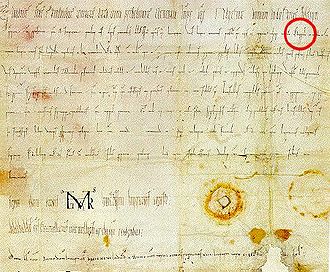
The first recorded instance of the name Austria appeared in 996, written as Ostarrîchi
, referring to the territory of the Babenberg March. The term Ostmark
is not historically certain and appears to be a translation of marchia orientalis that came up only much later.
The following centuries were characterized first by the settlement of the country, when forests were cleared and towns and monasteries were founded. In 1156 the Privilegium Minus
elevated Austria to the status of a duchy. In 1192, the Babenbergs also acquired the Duchy of Styria through the Georgenberg Pact
. At that time, the Babenberg Dukes came to be one of the most influential ruling families in the region, peaking in the reign of Leopold VI (1198–1230).
However, with the slaughter of his son Frederick II in 1246, the line went extinct, which resulted in the interregnum
, a period of several decades during which the status of the country was disputed. Otakar II Přemysl of Bohemia
effectively controlled the duchies of Austria, Styria and Carinthia. His reign came to an end with his defeat in the battle of Dürnkrut and Jedenspeigen
at the hand of Rudolf of Habsburg in 1278.
Following the extinction of the Babenbergs in the 13th century, Austria came briefly under the rule of the Czech
King Ottokar II of Bohemia
. Contesting the election of Rudolf I of Habsburg as emperor, Ottokar was defeated and killed by Rudolf, who took Austria with the assistance of King Ladislaus IV of Hungary.
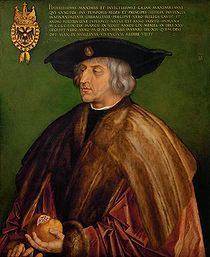 Emperor Rudolf I of Habsburg gave Austria to his sons in 1278. Austria was ruled by the Habsburgs for the next 640 years. In the 14th and 15th centuries, the Habsburgs began to accumulate other provinces in the vicinity of the Duchy of Austria, which remained a small territory along the Danube, and Styria, which they had acquired from Ottokar along with Austria. Carinthia and Carniola
came under Habsburg rule in 1335, Tyrol
in 1363. These provinces, together, became known as the Habsburg Hereditary Lands, although they were sometimes all lumped together simply as Austria.
Following the notable but short reign of Rudolf IV (the first to claim the title of Archduke of Austria), his brothers Albert III and Leopold III split the realms in the Treaty of Neuberg
in 1379. Albert retained Austria proper, while Leopold took the remaining territories. In 1402, there was another split in the Leopoldian line
, when Ernest the Iron took Inner Austria
(Styria, Carinthia and Carniola) and Frederick IV became ruler of Tyrol and Further Austria
. The territories were only reunified by Ernest's son Frederick V
(Frederick III as Holy Roman Emperor), when the Albertinian line
(1457) and the Elder Tyrolean line (1490) had become extinct.
In 1438, Duke Albert V of Austria was chosen as the successor to his father-in-law, Emperor Sigismund. Although Albert himself only reigned for a year, from then on, every emperor was a Habsburg, with only one exception. The Habsburgs began also to accumulate lands far from the Hereditary Lands. In 1477, the Archduke Maximilian
, only son of Emperor Frederick III
, married the heiress of Burgundy
, thus acquiring most of the Low Countries
for the family. His son Philip the Fair
married the heiress of Castile and Aragon, and thus acquired Spain and its Italian, African, and New World appendages for the Habsburgs. The Habsburgs' hereditary territories, however, were soon separated from this enormous empire when, in 1520, Emperor Charles V left them to the rule of his brother, Ferdinand
.
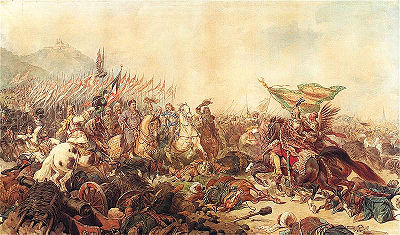 In 1526, following the Battle of Mohács
, in which Ferdinand's brother-in-law Louis II, King of Hungary and Bohemia, was killed, Ferdinand expanded his territories, bringing Bohemia and that part of Hungary not occupied by the Ottomans under his rule. Habsburg expansion into Hungary, however, led to frequent conflicts with the Turks, particularly the so-called Long War
of 1593 to 1606.
Austria and the other Habsburg hereditary provinces (and Hungary and Bohemia, as well) were much affected by the Reformation. Although the Habsburg rulers themselves remained Catholic, the provinces themselves largely converted to Lutheranism, which Ferdinand I and his successors, Maximilian II
, Rudolf II
, and Mathias largely tolerated.
In the late 16th century, however, the Counter-Reformation and the Society of Jesus
began to make its influence felt, and the Jesuit-educated
Archduke Ferdinand of Austria
, who ruled over Styria, Carinthia
, and Carniola
before becoming Holy Roman Emperor, was energetic in suppressing heresy in the provinces which he ruled.
, as he became known, embarked on an energetic attempt to re-Catholicize not only the Hereditary Provinces, but Bohemia and Habsburg Hungary as well as most of Protestant Europe within the Holy Roman Empire. Outside his lands, his reputation for strong headed uncompromising intolerance had triggered the Thirty Years' War
in May of 1618 in the polarizing first phase, known as the Revolt in Bohemia. After several initial reverses, he became accommodating but as the Catholics turned things around and began to enjoy a long string of successes at arms he set forth the Edict of Restitution
in 1629 vastly complicating the politics of settlement negotiations and prolonging the rest of the war; encouraged by the mid-war successes, he became even more forceful leading to infamies by his armies such as the Sack of Magdeburg
.
His forced conversions or evictions carried out in the midst of the Thirty Years' War
, which with the later general success of the Protestants therefore had greatly negative consequences for Habsburg control of the Holy Roman Empire itself, while these campaigns within the Habsburg hereditary lands were largely successful in religiously purifying his demesnes, leaving the Austrian Emperors thereafter with much greater control within their hereditary power base— although Hungary was never successfully re-Catholicized—but one much reduced in population and economic might while less vigorous and weakened as a nation-state
.
In terms of human costs, the Thirty Years' war
s many economic, social, and population dislocations caused by the hardline methods adopted by Ferdinand's strict counter-reformation measures and almost continual employment of mercenary field armies contributed significantly to the loss of life and tragic depopulation of all the German states, during a war which some estimates put the civilian loss of life as high as fifty-percent overall. Studies mostly cite the causes of death due to starvation or as caused (ultimately by the lack-of-food induced) weakening of resistance to endemic diseases which repeatedly reached epidemic proportions amongst the general Central European population—the German states were the battle ground and staging areas for the largest mercenary armies theretofore, and the armies foraged amongst the many provinces stealing the food of those people forced onto the roads as refugees, or still on the lands, regardless of their faith and allegiances. Both townsmen and farmers were repeatedly ravaged and victimized by the armies on both sides leaving little for the populations already stressed by the refugees from the war or fleeing the Catholic counter-reformation repressions under Ferdinand's governance.
in 1683 led by King of Poland John III Sobieski
, a series of campaigns resulted in the return of all of Hungary to Austrian control by the Treaty of Carlowitz in 1699. At the same time, Austria was becoming more involved in competition with France in Western Europe, with Austria fighting the French in the Third Dutch War (1672–1679), the War of the League of Augsburg (1688–1697) and finally the War of the Spanish Succession
(1701–1714), in which the French and Austrians (along with their British, Dutch and Catalonian allies) fought over the inheritance of the vast territories of the Spanish Habsburgs. Although the French secured control of Spain and its colonies for a grandson of Louis XIV
, the Austrians also ended up making significant gains in Western Europe, including the former Spanish Netherlands (now called the Austrian Netherlands, including most of modern Belgium), the Duchy of Milan
in Northern Italy, and Naples and Sardinia in Southern Italy. (The latter was traded for Sicily in 1720).
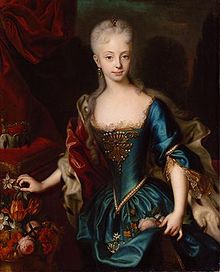 The later part of the reign of Emperor Charles VI (1711–1740) saw Austria relinquish many of these fairly impressive gains, largely due to Charles's apprehensions at the imminent extinction of the House of Habsburg. Charles was willing to offer concrete advantages in territory and authority in exchange for other powers' worthless recognitions of the Pragmatic Sanction
that made his daughter Maria Theresa
his heir. The most notable instance of this was in the War of the Polish Succession
whose settlement saw Austria cede Naples and Sicily to the Spanish Infant Don Carlos
in exchange for the tiny Duchy of Parma
and Spain and France's adherence to the Pragmatic Sanction. The latter years of Charles's reign (1736–1739) also saw an unsuccessful war against the Turks, which resulted in the Austrian loss of Belgrade and other border territories.
And, as many had anticipated, when Charles died in 1740, all those assurances from the other powers proved of little worth to Maria Theresa. The peace was initially broken by King Frederick II of Prussia
, who invaded Silesia
. Soon other powers began to exploit Austria's weakness. The Elector of Bavaria claimed the inheritance to the hereditary lands and Bohemia, and was supported by the King of France, who desired the Austrian Netherlands. The Spanish and Sardinians hoped to gain territory in Italy, and the Saxons hoped to gain territory to connect Saxony with the Elector's Polish Kingdom. Austria's allies—Britain, Holland, and Russia, were all wary of getting involved in the conflict. Thus began the War of the Austrian Succession
(1740–1748), one of the more confusing and less eventful wars of European history, which ultimately saw Austria holding its own, despite the permanent loss of most of Silesia to the Prussians. In 1745, following the reign of the Bavaria
n Elector
as Emperor Charles VII
, Maria Theresa's husband Francis of Lorraine
, Grand Duke of Tuscany, was elected Emperor, restoring control of that position to the Habsburgs (or, rather, to the new composite house of Habsburg-Lorraine).
For the eight years following the Treaty of Aix-la-Chapelle
that ended the War of the Austrian Succession, Maria Theresa plotted revenge on the Prussians. The British and Dutch allies who had proved so reluctant to help her in her time of need were dropped in favour of the French in the so-called Reversal of Alliances
of 1756. That same year, war once again erupted on the continent as Frederick, fearing encirclement, launched a pre-emptive invasion of Saxony. The Seven Years' War
, too, was indecisive, and saw Prussia holding onto Silesia, despite Russia, France, and Austria all combining against him, and with only Hanover as a significant ally on land.
The end of the war saw Austria, exhausted, continuing the alliance with France (cemented in 1770 with the marriage of Maria Theresa's daughter Archduchess Maria Antonietta to the Dauphin
), but also facing a dangerous situation in Central Europe, faced with the alliance of Frederick the Great of Prussia
and Catherine the Great
of Russia. The Russo-Turkish War of 1768–1774 caused a serious crisis in east-central Europe, with Prussia and Austria demanding compensation for Russia's gains in the Balkans, ultimately leading to the First Partition of Poland
in 1772, in which Maria Theresa took Galicia
from Austria's traditional ally.
Over the next several years, Austro-Russian relations began to improve. When the War of Bavarian Succession
erupted between Austria and Prussia in 1777 following the extinction of the Bavarian line of the Wittelsbach
dynasty, Russia refused to support its ally, and the war was ended, after almost no bloodshed, on May 13, 1779 when Russian and French mediators at the Congress of Teschen negotiated an end to the war. In the agreement Austria receive the Innviertel
from Bavaria.
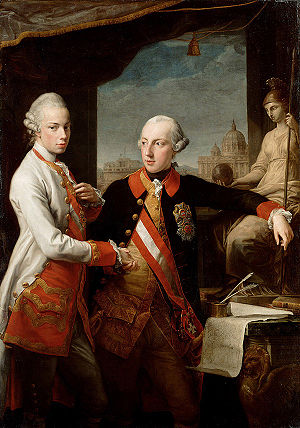 On Maria Theresa's death in 1780, she was succeeded by her son Joseph II
, already Holy Roman Emperor
since Francis I's death in 1765. A reformer herself, Maria Theresa always acted with a cautious respect for the conservatism of the political and social elites and the strength of local traditions. Her cautious approach repelled Joseph, who always sought the decisive, dramatic intervention to impose the one best solution, regardless of traditions or political opposition. He was the archetypical embodiment of The Enlightenment spirit of the 18th-century reforming monarchs known as the "enlightened despots"
. Joseph and his mother were typically at odds on policy, and their quarrels were usually mediated by the chancellor, Prince Wenzel Anton von Kaunitz
(1711–94), who served nearly 40 years as the principal minister to Maria Theresa and Joseph. When Maria Theresa died in 1780, Joseph became the absolute ruler over the most extensive realm of Central Europe. There was no parliament to deal with. Joseph was always positive that the rule of reason, as propounded in the Enlightenment, would produce the best possible results in the shortest time. He issued edicts—6,000 in all, plus 11,000 new laws designed to regulate and reorder every aspect of the empire. The spirit was benevolent and paternal. He intended to make his people happy, but strictly in accordance with his own criteria.
"Josephism," as his policies were called, is notable for the very wide range of reforms designed to modernize the creaky empire in an era when France and Prussia were rapidly upgrading. Josephism elicited grudging compliance at best, and more often vehement opposition from all sectors in every part of his empire. Failure characterized most of his projects. Joseph set about building a rational, centralized, and uniform government for his diverse lands, a pyramid with himself as supreme autocrat. He expected government servants to all be dedicated agents of Josephism and selected them without favor for class or ethnic origins; promotion was solely by merit. To impose uniformity, he made German the compulsory language of official business throughout the Empire. The Hungarian assembly was stripped of its prerogatives, and not even called together
As privy finance minister, Count Karl von Zinzendorf
(1739–1813) introduced a uniform system of accounting for state revenues, expenditures, and debts of the territories of the Austrian crown. Austria was more successful than France in meeting regular expenditures and in gaining credit. However, the events of Joseph II's last years also suggest that the government was financially vulnerable to the European wars that ensued after 1792. Joseph reformed the traditional legal system, abolished brutal punishments and the death penalty in most instances, and imposed the principle of complete equality of treatment for all offenders. He ended censorship of the press and theatre.
In 1781-82 he extended full legal freedom to serfs. Rentals paid by peasants were to be regulated by imperial (not local) officials and taxes were levied upon all income derived from land. The landlords saw a grave threat to their status and incomes, and eventually reversed the policy. In Hungary and Transylvania, the resistance of the landed nobility was so great that Joseph compromised with halfway measures—one of the few times he backed down. After the great peasant revolt of Horea, 1784–85, however, the emperor imposed his will by fiat. His Imperial Patent of 1785 abolished serfdom but did not give the peasants ownership of the land or freedom from dues owed to the landowning nobles. It did give them personal freedom. Emancipation of the Hungarian peasantry promoted the growth of a new class of taxable landholders, but it did not abolish the deep-seated ills of feudalism and the exploitation of the landless squatters.
To equalize the incidence of taxation, Joseph ordered a fresh appraisal of the value of all properties in the empire; his goal was to impose a single and egalitarian tax on land. The goal was to modernize the relationship of dependence between the landowners and peasantry, relieve some of the tax burden on the peasantry, and increase state revenues. Joseph looked on the tax and land reforms as being interconnected and strove to implement them at the same time. The various commissions he established to formulate and carry out the reforms met resistance among the nobility, the peasantry, and some officials. Most of the reforms were abrogated shortly before or after Joseph's death in 1790; they were doomed to failure from the start because they tried to change too much in too short a time, and tried to radically alter the traditional customs and relationships that the villagers had long depended upon.
In the cities the new economic principles of the Enlightenment called for the destruction of the autonomous guilds, already weakened during the age of mercantilism. Joseph II's tax reforms and the institution of Katastralgemeinde (tax districts for the large estates) served this purpose, and new factory privileges ended guild rights while customs laws aimed at economic unity. The intellectual influence of the Physiocrats
led to the inclusion of agriculture in these reforms.
By the 18th century, centralization was the trend in medicine because more and better educated doctors requesting improved facilities; cities lacked the budgets to fund local hospitals; and the monarchy's wanted to end costly epidemics and quarantines. Joseph attempted to centralize medical care in Vienna through the construction of a single, large hospital, the famous Allgemeines Krankenhaus, which opened in 1784. Centralization worsened sanitation problems causing epidemics a 20% death rate in the new hospital. which undercut Joseph's plan, but the city became preeminent in the medical field in the next century.
Probably the most unpopular of all his reforms was his attempted modernization of the highly traditional Roman Catholic Church. Calling himself the guardian of Catholicism, Joseph II struck vigorously at papal power. He tried to make the Catholic Church in his empire the tool of the state, independent of Rome. Clergymen were deprived of the tithe and ordered to study in seminaries under government supervision, while bishops had to take a formal oath of loyalty to the crown. He financed the large increase in bishoprics, parishes, and secular clergy by extensive sales of monastic lands. As a man of the Enlightenment
he ridiculed the contemplative monastic orders, which he considered unproductive. Accordingly, he suppressed a third of the monasteries (over 700 were closed) and reduced the number of monks and nuns from 65,000 to 27,000. Church courts were abolished and marriage was defined as a civil contract outside the jurisdiction of the Church.
Josph sharply cut the number of holy days and reduced ornamentation in churches. He greatly simplified the manner of celebration. The results of these reforms included a deepening crisis of faith; the disappearance of piety; and the decline of morality. Opponents of the reforms blamed them for revealing Protestant tendencies, with the rise of Enlightenment rationalism and the emergence of a liberal class of bourgeois officials. Anti-clericalism emerged and persisted, while the traditional Catholics were energized in opposition to the emperor.
In foreign policy, there was no Enlightenment, only hunger for more territory and a willingness to undertake unpopular wars to get the land. Joseph was a belligerent, expansionist leader, who dreamed of making his Empire the greatest of the European powers. Joseph's plan was to acquire Bavaria, if necessary in exchange for Belgium (the Austrian Netherlands), but in 1778 and again in 1785 he was thwarted by King Frederick II
of Prussia, who had a much stronger army. This failure caused Joseph to seek territorial expansion in the Balkans, where he became involved in an expensive and futile war with the Turks 1787-1791, which was the price to be paid for friendship with Russia.
The Balkan policy of both Maria Theresa and Joseph II reflected the Cameralism promoted by Prince Kaunitz, stressing consolidation of the border lands by reorganization and expansion of the military frontier. Transylvania
was incorporated into the frontier in 1761 and the frontier regiments became the backbone of the military order, with the regimental commander exercising military and civilian power. "Populationistik" was the prevailing theory of colonization, which measured prosperity in terms of labor. Joseph II also stressed economic development. Habsburg influence was an essential factor in Balkan development in the last half of the 18th century, especially for the Serbs and Croats.
In Lombardy (in northern Italy) the cautious reforms of Maria Theresa in Lombardy enjoyed support from local reformers. Joseph II, however, by creating a powerful imperial officialdom directed from Vienna, undercut the dominant position of the Milanese principate and the traditions of jurisdiction and administration. In the place of provincial autonomy he established an unlimited centralism, which reduced Lombardy politically and economically to a fringe area of the Empire. As a reaction to these radical changes the middle class reformers shifted away from cooperation to strong resistance. From this basis appeared the beginnings of the later Lombard liberalism.
By 1790 rebellions had broken out in protest against Joseph's reforms in Belgium and Hungary, and his other dominions were restive under the burdens of his war with Turkey. His empire was threatened with dissolution, and he was forced to sacrifice some of his reform projects. His health shattered by disease, alone, and unpopular in all his lands, the bitter emperor died February 20, 1790. He was not yet forty-nine. Joseph II rode roughshod over age-old aristocratic privileges, liberties, and prejudices, thereby creating for himself many enemies, and they triumphed in the end. Joseph's attempt to reform the Hungarian lands illustrates the weakness of absolutism in the face of well-defended feudal liberties.
Behind his numerous reforms lay a comprehensive program influenced by the doctrines of enlightened absolutism, natural law, mercantilism, and physiocracy. With a goal of establishing a uniform legal framework to replace heterogeneous traditional structures, the reforms were guided at least implicitly by the principles of freedom and equality and were based on a conception of the state's central legislative authority. Joseph's accession marks a major break since the preceding reforms under Maria Theresa had not challenged these structures, but there was no similar break at the end of the Josephinian era. The reforms initiated by Joseph II had merit despite the way they were introduced. They were continued to varying degrees under his successors. They gained comprehensive "Austrian" form in the Allgemeine Bürgerliche Gesetzbuch of 1811 and have been seen as providing a foundation for subsequent reforms extending into the 20th century.
, previously the reforming Grand Duke of Tuscany. Leopold knew when to cut his losses, and soon cut deals with the revolting Netherlanders and Hungarians. He also managed to secure a peace with Turkey in 1791, and negotiated an alliance with Prussia, which had been allying with Poland to press for war on behalf of the Ottomans against Austria and Russia.
Leopold's reign also saw the acceleration of the French Revolution
. Although Leopold was sympathetic to the revolutionaries, he was also the brother of the French queen. Furthermore, disputes involving the status of the rights of various imperial princes in Alsace
, where the revolutionary French government was attempting to remove rights guaranteed by various peace treaties, involved Leopold as Emperor in conflicts with the French. The Declaration of Pillnitz
, made in late 1791 jointly with the Prussian King Frederick William II and the Elector of Saxony
, in which it was declared that the other princes of Europe took an interest in what was going on in France, was intended to be a statement in support of Louis XVI that would prevent the need from taking any kind of action. However, it instead inflamed the sentiments of the revolutionaries against the Emperor. Although Leopold did his best to avoid war with the French, he died in March of 1792. The French declared war on his inexperienced son Francis II
a month later.
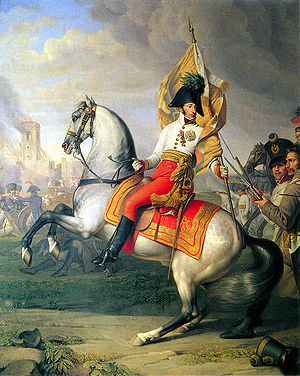 The war with France, which lasted until 1797, proved unsuccessful for Austria. After some brief successes against the utterly disorganized French armies in early 1792, the tide turned, and the French overran the Austrian Netherlands in the last months of 1792. While the Austrians were so occupied, their erstwhile Prussian allies stabbed them in the back with the Second Partition of Poland
, from which Austria was entirely excluded. This led to the dismissal of Francis's chief minister, Philipp von Cobenzl
, and his replacement with Franz Maria Thugut.
At around the same time, the increasing radicalization of the French Revolution, as well as the French occupation of the Low Countries, brought Britain, the Dutch Republic, and Spain into the war, which became known as the War of the First Coalition. Once again, there were initial successes against the disorganized armies of the French Republic, and the Netherlands were recovered. But in 1794 the tide turned once more, and Austrian forces were driven out of the Netherlands again—this time for good. Meanwhile, the Polish Crisis again became critical, resulting in a Third Partition (1795), in which Austria managed to secure important gains. The war in the west continued to go badly, as most of the coalition made peace, leaving Austria with only Britain and Piedmont-Sardinia
as allies. In 1796, the French Directory
planned a two-pronged campaign in Germany to force the Austrians to make peace, with a secondary thrust planned into Italy. Although Austrian forces under Archduke Charles, the Emperor's brother, were successful in driving the French back in Germany, the French Army of Italy, under the command of the young Corsican General Napoleon Bonaparte
, was brilliantly successful, forcing Piedmont out of the war, driving the Austrians out of Lombardy
and besieging Mantua
. Following the capture of Mantua in early 1797, Bonaparte advanced north through the Alps against Vienna, while new French armies moved again into Germany. Austria sued for peace. By the terms of the Treaty of Campo Formio
of 1797, Austria renounced its claims to the Netherlands and Lombardy, in exchange for which it partitioned the territories of the Republic of Venice
with the French. The Austrians also provisionally recognized the French annexation of the Left Bank of the Rhine, and agreed in principle that the German princes of the region should be compensated with ecclesiastical lands on the other side of the Rhine.
The peace did not last for long. Soon, differences emerged between the Austrians and French over the reorganization of Germany, and Austria joined Russia, Britain, and Naples in the War of the Second Coalition
in 1799. Although Austro-Russian forces were initially successful in driving the French from Italy, the tide soon turned—the Russians withdrew from the war after a defeat at Zürich
(1799) which they blamed on Austrian recklessness, and the Austrians were defeated by Bonaparte, now First Consul
at Marengo, which forced them to withdraw from Italy, and then in Germany at Hohenlinden. These defeats forced Thugut's resignation, and Austria, now led by Ludwig Cobenzl, to make peace at Lunéville
in early 1801. The terms were surprisingly mild—the terms of Campo Formio were largely reinstated, but now the way was clear for a reorganization of the Empire on French lines. By the Imperial Deputation Report of 1803, the Holy Roman Empire was entirely reorganized, with nearly all of the ecclesiastical territories and free cities, traditionally the parts of the Empire most friendly to the House of Austria, eliminated.
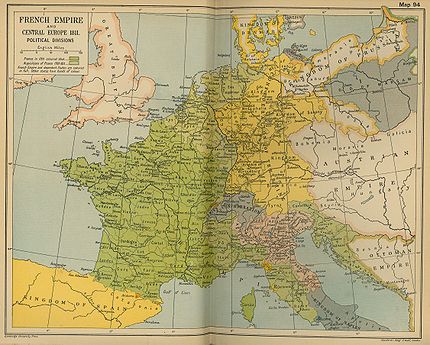 With Bonaparte's assumption of the title of Emperor of the French in 1804, Francis, seeing the writing on the wall for the old Empire, took the new title of Emperor of Austria
as Francis I, in addition to his title of Holy Roman Emperor. Soon, Napoleon's continuing machinations in Italy, including the annexation of Genoa
and Parma
, led once again to war in 1805—the War of the Third Coalition, in which Austria, Britain, Russia, and Sweden took on Napoleon. The Austrian forces began the war by invading Bavaria
, a key French ally in Germany, but were soon outmaneuvered and forced to surrender by Napoleon at Ulm
, before the main Austro-Russian force was defeated at Austerlitz
on December 2. By the Treaty of Pressburg, Austria was forced to give up large amounts of territory—Dalmatia
to France, Venetia to Napoleon's Kingdom of Italy, the Tyrol
to Bavaria, and Austria's various Swabian territories to Baden and Württemberg
, although Salzburg
, formerly held by Francis's younger brother, the previous Grand Duke of Tuscany, was annexed by Austria as compensation.
The defeat meant the end of the old Holy Roman Empire. Napoleon's satellite states in southern and Western Germany seceded from the Empire in the summer of 1806, forming the Confederation of the Rhine
, and a few days later Francis proclaimed the Empire dissolved, and renounced the old imperial crown.
Over the next three years Austria, now led by Philipp Stadion, attempted to maintain peace with France, but the overthrow of the Spanish Bourbons in 1808 was deeply disturbing to the Habsburgs, who rather desperately went to war once again in 1809, this time with no continental allies. Stadion's attempts to generate popular uprisings in Germany were unsuccessful, and the Russians honored their alliance with France, so Austria was once again defeated, although at greater cost than Napoleon, who suffered his first battlefield defeat in this war, at Aspern-Essling
, had expected. The terms of the Treaty of Schönbrunn
were quite harsh. Austria lost Salzburg to Bavaria, some of its Polish lands to Russia, and its remaining territory on the Adriatic (including much of Carinthia and Styria) to Napoleon's Illyrian Provinces
.
Klemens von Metternich, the new Austrian foreign minister, aimed to pursue a pro-French policy. The Emperor's daughter, Marie Louise, was married to Napoleon, and Austria contributed an army to Napoleon's invasion of Russia in 1812. With Napoleon's disastrous defeat in Russia at the end of the year, and Prussia's defection to the Russian side at the beginning of 1813, Metternich began slowly to shift his policy. Initially he aimed to mediate a peace between France and its continental enemies, but when it became apparent that Napoleon was not interested in compromise, Austria joined the allies and declared war on France in August 1813. The Austrian intervention was decisive. Napoleon was defeated at Leipzig
in October, and forced to withdraw into France itself. As 1814 began, the Allied forces invaded France. Initially, Metternich remained unsure as to whether he wanted Napoleon to remain on the throne, a Marie Louise regency for Napoleon's young son, or a Bourbon restoration, but he was eventually brought around by British Foreign Secretary Lord Castlereagh
to the last position. Napoleon abdicated on April 3, 1814, and Louis XVIII was restored, soon negotiating a peace treaty with the victorious allies at Paris
in June.
 Under the control of Metternich, the Austrian Empire entered a period of censorship
and a police state
in the period between 1815 and 1848 (Biedermaier or Vormärz period). However, both liberalism
and nationalism
were on the rise, which resulted in the Revolutions of 1848. Metternich and the mentally handicapped Emperor Ferdinand I
were forced to resign to be replaced by the emperor's young nephew Franz Joseph
. Separatist tendencies (especially in Lombardy
and Hungary) were suppressed by military force. A constitution was enacted in March 1848, but it had little practical impact. However, one of the concessions to revolutionaries with a lasting impact was the freeing of peasant
s in Austria. This facilitated industrialization, as many flocked to the newly industrializing cities of the Austrian domain (in the industrial centers of Bohemia
, Lower Austria
, Vienna
, and Upper Styria
). Social upheaval led to increased strife in ethnically mixed cities, leading to mass nationalist movements.
In 1859, the defeats at Solférino
and Magenta
against the combined forces of France and Sardinia
led to the loss of Lombardy and Tuscany
to the Kingdom of Sardinia, which was striving to create a unified national Italian state.
The defeat at Königgrätz
in the Austro-Prussian War
of 1866 resulted in Austria's exclusion from Germany; the German Confederation
was dissolved. The monarchy's weak external position forced Franz Joseph to concede internal reforms. To appease Hungarian nationalism, Franz Joseph made a deal with Hungarian nobles, which led to the creation of Austria-Hungary
through the Austro-Hungarian Compromise of 1867. The western half of the realm (Cisleithania
) and Hungary (Transleithania) now became two realms with different interior policy, but with a common ruler and a common foreign and military policy.
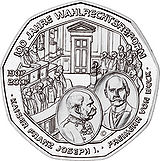 The Austrian half of the dual monarchy began to move towards constitutionalism
. A constitutional system with a parliament, the Imperial Council, was created, and a bill of rights was enacted in 1867. Suffrage
to the new parliament's lower house was gradually expanded until 1907, when equal suffrage for all male citizens was introduced. However, the effectiveness of parliamentarism was hampered by conflicts between parties representing different ethnic groups, and meetings of the parliament ceased altogether during World War I
.
The decades until 1914 generally saw a lot of construction, expansion of cities and railway lines, and development of industry. During this period, now known as Gründerzeit
, Austria became an industrialized country, even though the Alpine regions remained characterized by agriculture.
In 1878, Austria-Hungary occupied Bosnia and Herzegovina
, which had been cut off from the rest of the Ottoman Empire
by the creation of new states in the Balkans. The territory was annexed in 1908 and put under joint rule by the governments of both Austria and Hungary.
 Nationalist strife increased during the decades until 1914. The assassination of Archduke Franz Ferdinand
, who was the presumed heir of Franz Joseph as Emperor, in Sarajevo
by a Serb nationalist group triggered World War I
. The defeat of the Central Powers
in 1918 resulted in the disintegration of Austria-Hungary. Emperor Karl of Austria, who had ruled since 1916, went into exile.
, in the Aftermath of World War I
the Empire was broken up based loosely on national grounds. Austria, with its modern borders, was created out of the main German speaking areas. On 12 November 1918, Austria became a republic
called German Austria
. The newly formed Austrian parliament asked for union with Germany. Article 2 of its provisional constitution stated: Deutschösterreich ist ein Bestandteil der Deutschen Republik (German Austria is part of the German Republic
). Plebiscites in the countries of Tyrol
and Salzburg
1919–21 yielded majorities of 98 and 99% in favour of a unification with Germany. It was feared that small Austria was not economically viable. In the end France and Italy prevented the merger, and demanded the construction of an independent Austria that had to remain autonomous for at least 20 years. The Treaty of Saint Germain included a provision that prohibited political or economic union with Germany and forced the country to change its name from the "Republic of German Austria" to the "Republic of Austria," i.e. the First Republic
. The German-speaking bordering areas of Bohemia
and Moravia
(later called the "Sudetenland
") were allocated to the newly founded Czechoslovakia
. Many Austrians and Germans regarded this as hypocrisy since U.S. president Woodrow Wilson
had proclaimed in his famous "Fourteen Points
" the "right of self-determination" for all nations. In the democratic German Weimar constitution
the aim of unification was codified in article 61: „Deutschösterreich erhält nach seinem Anschluß an das Deutsche Reich das Recht der Teilnahme am Reichsrat mit der seiner Bevölkerung entsprechenden Stimmenzahl. Bis dahin haben die Vertreter Deutschösterreichs beratende Stimme.“ (German Austria has the right to participate in the German Reichsrat
(the constitutional representation of the federal German states) with a consulting role according to its number of inhabitants until unification with Germany.").
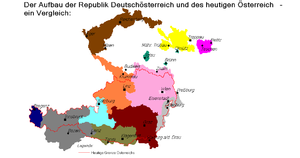 Although Austria-Hungary had been one of the Central Powers, the allied victors were much more lenient with a defeated Austria than either Germany or Hungary. Representatives of the new Republic of Austria convinced them that it was unfair to penalize Austria for the actions of a now dissolved Empire, especially as other areas of the Empire were now perceived to be on the "victorious" side, simply because they had renounced the Empire at the end of the war. Austria never did have to pay reparations because allied commissions determined that the country could not afford to pay. It was also the only defeated country to acquire additional territory as part of border adjustments: the Burgenland
, a small land tract to the east that despite its German-speaking majority had belonged to Hungary. The area had been discussed as the site of a Czech Corridor
to Yugoslavia.
On 20 October 1920, a plebiscite in the Austrian state of Carinthia
was held in which the population chose to remain a part of Austria, rejecting the territorial claims of the Kingdom of Serbs, Croats and Slovenes to the state. The German-speaking parts of western Hungary, now christened Burgenland
, joined Austria as a new state
in 1921, with the exception of the city of Sopron
, whose population decided in a referendum (which is sometimes considered by Austrians to have been rigged) to remain with Hungary. However, the Treaty of Saint Germain also meant that Austria lost significant German-speaking territories, in particular the southern part of the County of Tyrol
(now South Tyrol
) to Italy and the German-speaking areas within Bohemia
and Moravia
to Czechoslovakia
.
Between 1918 and 1920, there was a coalition government including both left and right-wing parties, which enacted progressive socio-economic and labour legislation. In 1920, the modern Constitution of Austria
was enacted. The interwar years were socio-economically difficult for Austria, partly because the newly created borders tore apart what had been a common economic area.
 Austrian politics were characterized by intense and sometimes violent conflict between left and right from 1920 onwards. The Social Democratic Party of Austria
, which pursued a fairly left-wing course known as Austromarxism
at that time, could count on a secure majority in "Red Vienna
", while right-wing parties controlled all other states. Since 1920, Austria was ruled by the Christian Socialist Party, which had close ties to the Roman Catholic Church
. It was headed by a Catholic priest named Ignaz Seipel
(1876–1932), who served twice as Chancellor
(1922–1924 and 1926–1929). While in power, Seipel was working for an alliance between wealthy industrialists and the Roman Catholic Church
.
Both left-wing and right-wing paramilitary
forces were created during the 20s, namely the Heimwehr
in 1921–1923 and the Republican Schutzbund in 1923. A clash between those groups in Schattendorf
, Burgenland
, on 30 January 1927 led to the death of a man and a child. Right-wing veteran
s were indicted at a court in Vienna, but acquitted in a jury trial
. This led to massive protests and fire at the Justizpalast in Vienna. In the July Revolt of 1927
, 89 protesters were killed by the Austrian police forces.
Political conflict escalated until the early 1930s. Engelbert Dollfuß of the Christian Social Party became Chancellor in 1932.
In March 1933 the Dollfuss cabinet took advantage of a formal error during a vote on a bill in parliament. As the vote was very narrow, all of the three presidents of the National Council
stepped down because they were not allowed to vote themselves while in office. This was an unforeseen event but it could have been resolved according to the rules of procedure. However, the cabinet declared that the parliament had ceased to function and forcibly prevented the National Council from reassembling. The executive then took over legislative power by using an emergency provision which had been enacted during World War I
. Even after this putsch, the socialist party
hesitated and tried to resolve the crisis in a peaceful way.
On 12 February 1934 the new Austrofascist regime provoked the Austrian Civil War
by ordering search warrants for the headquarters of the socialist party. At that time the socialist party structures were already weakened and the uprising of its supporters was quickly defeated. Subsequently the socialist party and all its ancillary organisations were banned.
On 1 May 1934, the Dollfuss cabinet approved a new constitution
that abolished freedom of the press, established one party system (known as "The Patriotic Front") and created a total state monopoly on employer-employee relations. This system remained in force until Austria became part of the Third Reich in 1938. The Patriotic Front government frustrated the ambitions of pro-Hitlerite sympathizers in Austria who wished both political influence and unification with Germany, leading to the assassination of Dollfuss on 25 July 1934. His successor Schuschnigg
maintained the ban on pro-Hitlerite activities in Austria, but was forced to resign on 11 March 1938 following a demand by Hitler for power-sharing with pro-German circles. Following Schuschnigg's resignation, German troops occupied Austria with no resistance.
and the Treaty of St. Germain had explicitly forbidden the unification of Austria and Germany, and native Austrian-born Hitler
was vastly striving to annex Austria during the late 1930s, which was fiercely resisted by the Austrian Schuschnigg
dictatorship. When the conflict was escalating in early 1938, Chancellor Schuschnigg announced a plebiscite on the issue on March 9, which was to take place on 13 March. On 12 March, German troops entered Austria
, who met celebrating crowds, in order to install Nazi puppet Arthur Seyss-Inquart as Chancellor. With a Nazi administration already in place and the country integrated into the Third Reich as so-called Ostmark
, a referendum on 10 April approved of the annexation with a majority of 99.73%.
As a result, Austria ceased to exist as an independent country. This annexation was enforced by military invasion but large parts of the Austrian population were in favour of the Nazi regime, many Austrians participated in its crimes. There was a Jewish population of about 200,000 then living in Vienna, which had contributed considerably to science and culture and very many of these people, with socialist and Catholic Austrian
politicians were deported to concentration camps, murdered or forced into exile.
Just before the end of the war, on 28 March 1945, American troops set foot on Austrian soil and the Soviet Union's Red Army crossed the eastern border two days later, taking Vienna on 13 April. American and British forces occupied the western and southern regions, preventing Soviet forces from completely overrunning and controlling the country.
 In April 1945 Karl Renner
, an Austrian elder statesman, declared Austria separate from Germany and set up a government which included socialists
, conservatives and communists. A significant number of these were returning from exile or Nazi detention, having thus played no role in the Nazi government. This contributed to the Allies treating Austria more as a liberated, rather than defeated, country, and the government was recognized by the Allies later that year. The country was occupied by the Allies from 9 May 1945 and under the Allied Commission for Austria established by an agreement on 4 July 1945, it was divided into Zones occupied respectively by American, British, French and Soviet Army personnel, with Vienna
being also divided similarly into four sectors—with an International Zone at its heart.
Though under occupation, this Austrian government was officially permitted to conduct foreign relations with the approval of the Four Occupying Powers under the agreement of 28 June 1946. As part of this trend, Austria was one of the founding members of the Danube Commission formed on 18 August 1948. Austria would benefit from the Marshall Plan
but economic recovery was very slow—as a result of the State's 10 year political overseeing by the Allied Powers.
Unlike the First Republic, which had been characterized by sometimes violent conflict between the different political groups, the Second Republic became a stable democracy. The two largest leading parties, the Christian-conservative Austrian People's Party
(ÖVP) and the Social Democratic Party
(SPÖ) remained in a coalition led by the ÖVP until 1966. The Communist Party of Austria
(KPÖ), who had hardly any support in the Austrian electorate, remained in the coalition until 1950 and in parliament until 1959. For much of the Second Republic, the only opposition party was the Freedom Party of Austria
(FPÖ), which included German national
and liberal
political currents. It was founded in 1955 as a successor organisation to the short-lived Federation of Independents
(VdU).
was signed on 15 May 1955. Upon the termination of allied occupation, Austria was proclaimed
a neutral country
, and "everlasting" neutrality was incorporated into the Constitution
on 26 October 1955.
The political system of the Second Republic came to be characterized by the system of Proporz
, meaning that posts of some political importance were split evenly between members of the SPÖ and ÖVP. Interest group representations with mandatory membership (e.g. for workers, businesspeople, farmers etc.) grew to considerable importance and were usually consulted in the legislative process, so that hardly any legislation was passed that did not reflect widespread consensus. The Proporz and consensus systems largely held even during the years between 1966 and 1983, when there were non-coalition governments.
The ÖVP-SPÖ coalition ended in 1966, when the ÖVP gained a majority in parliament. However, it lost it in 1970, when SPÖ leader Bruno Kreisky
formed a minority government
tolerated by the FPÖ. In the elections of 1971, 1975 and 1979 he obtained an absolute majority. The 70s were then seen as a time of liberal reforms in social policy
. Today, the economic policies of the Kreisky era are often criticized, as the accumulation of a large national debt began, and non-profitable nationalized industries were strongly subsidized.
Following severe losses in the 1983 elections, the SPÖ entered into a coalition with the FPÖ under the leadership of Fred Sinowatz
. In Spring 1986, Kurt Waldheim
was elected
president
amid considerable national and international protest because of his possible involvement with the Nazis
and war crimes during World War II
. Fred Sinowatz
resigned, and Franz Vranitzky
became chancellor.
In September 1986, in a confrontation between the German-national and liberal wings, Jörg Haider
became leader of the FPÖ
. Chancellor Vranitzky rescinded the coalition pact between FPÖ and SPÖ, and after new elections, entered into a coalition with the ÖVP, which was then led by Alois Mock
. Jörg Haider's populism and criticism of the Proporz
system allowed him to gradually expand his party's support in elections, rising from 4% in 1983 to 27% in 1999. The Green Party
managed to establish itself in parliament from 1986 onwards.
in 1995 (Video of the signing in 1994), and Austria was set on the track towards joining the Euro
zone, when it was established in 1999.
In 1993, the Liberal Forum
was founded by dissidents from the FPÖ
. It managed to remain in parliament until 1999.
Viktor Klima
succeeded Vranitzky as chancellor in 1997.
In 1999, the ÖVP fell back to third place behind the FPÖ in the elections. Even though ÖVP
chairman and Vice Chancellor
Wolfgang Schüssel
had announced that his party would go into opposition in that case, he entered into a coalition with the FPÖ – with himself as chancellor – in early 2000 under considerable national and international protest. Jörg Haider
resigned as FPÖ chairman, but retained his post as governor
of Carinthia
but kept substantial influence within the FPÖ.
In 2002, disputes within the FPÖ
resulting from losses in state elections caused the resignation of several FPÖ government members
and a collapse of the government. Wolfgang Schüssel's ÖVP emerged as the winner of the subsequent election, ending up in first place for the first time since 1966. The FPÖ lost more than half of its voters, but reentered the coalition with the ÖVP. Despite the new coalition, the voter support for the FPÖ continued to dwindle in all most all local and state elections. Disputes between "nationalist" and "liberals" wings of the party resulted in a split, with the founding of a new liberal party called the Alliance for the Future of Austria
(BZÖ) and led by Jörg Haider. Since all FPÖ government members and most FPÖ members of parliament decided to join the new party, the Schüssel coalition remained in office (now in the constellation ÖVP–BZÖ, with the remaining FPÖ in opposition) until the next elections. On 1 October 2006 the SPÖ won a head on head elections
and negotiated a grand coalition with the ÖVP. This coalition started its term on 11 January 2007 with Alfred Gusenbauer
as Chancellor of Austria. For the first time, the Green Party of Austria became the third largest party in a nation-wide election, overtaking the FPÖ by a narrow margin of only a few hundred votes.
The grand coalition headed by Alfred Gusenbauer collapsed in the early summer of 2008 over disagreements about the country's EU policy. The early elections
held on September 28 resulted in extensive losses for the two ruling parties and corresponding gains for Heinz-Christian Strache
's FPÖ and Jörg Haider
's BZÖ (the Green Party was relegated to the 5th position). Nevertheless, SPÖ and ÖVP renewed their coalition under the leadership of the new SPÖ party chairman Werner Faymann
. In 2008 Jörg Haider
died in a car accident and was succeeded as BZÖ party chairman by Herbert Scheibner and as governor of Carinthia
by Gerhard Dörfler
.
Country
A country is a region legally identified as a distinct entity in political geography. A country may be an independent sovereign state or one that is occupied by another state, as a non-sovereign or formerly sovereign political division, or a geographic region associated with a previously...
of Austria
Austria
Austria , officially the Republic of Austria , is a landlocked country of roughly 8.4 million people in Central Europe. It is bordered by the Czech Republic and Germany to the north, Slovakia and Hungary to the east, Slovenia and Italy to the south, and Switzerland and Liechtenstein to the...
and predecessor states, from the Iron Age, through to a sovereign state, annexation by the German Third Reich, partition after the Second World War and later developments until the present day. More information can be found in history of Europe
History of Europe
History of Europe describes the history of humans inhabiting the European continent since it was first populated in prehistoric times to present, with the first human settlement between 45,000 and 25,000 BC.-Overview:...
.
Prehistory
During the Neolithic, the territory of modern-day Austria was home to the Linear pottery cultureLinear Pottery culture
The Linear Pottery culture is a major archaeological horizon of the European Neolithic, flourishing ca. 5500–4500 BC.It is abbreviated as LBK , is also known as the Linear Band Ware, Linear Ware, Linear Ceramics or Incised Ware culture, and falls within the Danubian I culture of V...
, one of the first agrarian cultures in Europe.
Ötzi the Iceman
Ötzi the Iceman
Ötzi the Iceman , Similaun Man, and Man from Hauslabjoch are modern names for a well-preserved natural mummy of a man who lived about 5,300 years ago. The mummy was found in September 1991 in the Ötztal Alps, near Hauslabjoch on the border between Austria and Italy. The nickname comes from the...
, a well-preserved mummy of a man frozen in Austrian Alps, is dated around 3300 BC.
Celtic and Roman
Noricum
Noricum, in ancient geography, was a Celtic kingdom stretching over the area of today's Austria and a part of Slovenia. It became a province of the Roman Empire...
, in ancient
Ancient history
Ancient history is the study of the written past from the beginning of recorded human history to the Early Middle Ages. The span of recorded history is roughly 5,000 years, with Cuneiform script, the oldest discovered form of coherent writing, from the protoliterate period around the 30th century BC...
geography
Geography
Geography is the science that studies the lands, features, inhabitants, and phenomena of Earth. A literal translation would be "to describe or write about the Earth". The first person to use the word "geography" was Eratosthenes...
, was a Celtic kingdom (perhaps better described as a federation of, by tradition, twelve tribes) stretching over the area of today's Austria
Austria
Austria , officially the Republic of Austria , is a landlocked country of roughly 8.4 million people in Central Europe. It is bordered by the Czech Republic and Germany to the north, Slovakia and Hungary to the east, Slovenia and Italy to the south, and Switzerland and Liechtenstein to the...
and a part of Slovenia
Slovenia
Slovenia , officially the Republic of Slovenia , is a country in Central and Southeastern Europe touching the Alps and bordering the Mediterranean. Slovenia borders Italy to the west, Croatia to the south and east, Hungary to the northeast, and Austria to the north, and also has a small portion of...
. It became a province
Roman province
In Ancient Rome, a province was the basic, and, until the Tetrarchy , largest territorial and administrative unit of the empire's territorial possessions outside of Italy...
of the Roman Empire
Roman Empire
The Roman Empire was the post-Republican period of the ancient Roman civilization, characterised by an autocratic form of government and large territorial holdings in Europe and around the Mediterranean....
. It was bounded on the north by the Danube
Danube
The Danube is a river in the Central Europe and the Europe's second longest river after the Volga. It is classified as an international waterway....
, on the west by Raetia
Raetia
Raetia was a province of the Roman Empire, named after the Rhaetian people. It was bounded on the west by the country of the Helvetii, on the east by Noricum, on the north by Vindelicia, on the west by Cisalpine Gaul and on south by Venetia et Histria...
and Vindelicia
Vindelicia
In the pre-Roman geography of Europe, Vindelicia identifies the country inhabited by the Vindelici, a region bounded on the north by the Danube and the Hadrian's Limes Germanicus, on the east by the Oenus , on the south by Raetia and on the west by the territory of the Helvetii...
, on the east and southeast by Pannonia
Pannonia
Pannonia was an ancient province of the Roman Empire bounded north and east by the Danube, coterminous westward with Noricum and upper Italy, and southward with Dalmatia and upper Moesia....
, on the south by Region 10, Venetia et Histria.
Early Middle Ages
During the Migration PeriodMigration Period
The Migration Period, also called the Barbarian Invasions , was a period of intensified human migration in Europe that occurred from c. 400 to 800 CE. This period marked the transition from Late Antiquity to the Early Middle Ages...
, the Slavic
Slavic peoples
The Slavic people are an Indo-European panethnicity living in Eastern Europe, Southeast Europe, North Asia and Central Asia. The term Slavic represents a broad ethno-linguistic group of people, who speak languages belonging to the Slavic language family and share, to varying degrees, certain...
tribe of the Carantanians migrated into the Alps
Slavic settlement of the Eastern Alps
Slavic settlement of the Eastern Alps region was a historic process that took place between the 6th and 9th century AD, having culminated in the final quarter of the 6th century...
in the wake of the expansion of their Avar
Eurasian Avars
The Eurasian Avars or Ancient Avars were a highly organized nomadic confederacy of mixed origins. They were ruled by a khagan, who was surrounded by a tight-knit entourage of nomad warriors, an organization characteristic of Turko-Mongol groups...
overlords during the 7th century, mixed with the Celto-Romanic population, and established the realm of Carantania, which covered much of eastern and central Austrian territory. In the meantime, the Germanic tribe of the Bavarians had developed in the 5th and 6th century in the west of the country and in Bavaria
Bavaria
Bavaria, formally the Free State of Bavaria is a state of Germany, located in the southeast of Germany. With an area of , it is the largest state by area, forming almost 20% of the total land area of Germany...
, while what is today Vorarlberg
Vorarlberg
Vorarlberg is the westernmost federal-state of Austria. Although it is the second smallest in terms of area and population , it borders three countries: Germany , Switzerland and Liechtenstein...
had been settled by the Alemans. Those groups mixed with the Rhaeto-Romanic
Romansh people
The Romansh people are a people and ethnic group of Switzerland, native speakers of the Romansh language. However, nowadays they almost always are multilingual, speaking also German and sometimes Italian, which are the other official language of Graubünden, the canton where they are...
population and pushed it up into the mountains.
Carantania, under pressure of the Avars, lost its independence to Bavaria
Bavaria
Bavaria, formally the Free State of Bavaria is a state of Germany, located in the southeast of Germany. With an area of , it is the largest state by area, forming almost 20% of the total land area of Germany...
in 745 and became a margraviate. During the following centuries, Bavarian settlers went down the Danube and up the Alps, a process through which Austria was to become the mostly German-speaking country it is today.
The Bavarians themselves came under the overlordship of the Carolingian
Carolingian
The Carolingian dynasty was a Frankish noble family with origins in the Arnulfing and Pippinid clans of the 7th century AD. The name "Carolingian", Medieval Latin karolingi, an altered form of an unattested Old High German *karling, kerling The Carolingian dynasty (known variously as the...
Franks
Franks
The Franks were a confederation of Germanic tribes first attested in the third century AD as living north and east of the Lower Rhine River. From the third to fifth centuries some Franks raided Roman territory while other Franks joined the Roman troops in Gaul. Only the Salian Franks formed a...
and subsequently became a duchy
Duchy
A duchy is a territory, fief, or domain ruled by a duke or duchess.Some duchies were sovereign in areas that would become unified realms only during the Modern era . In contrast, others were subordinate districts of those kingdoms that unified either partially or completely during the Medieval era...
of the Holy Roman Empire
Holy Roman Empire
The Holy Roman Empire was a realm that existed from 962 to 1806 in Central Europe.It was ruled by the Holy Roman Emperor. Its character changed during the Middle Ages and the Early Modern period, when the power of the emperor gradually weakened in favour of the princes...
. Duke Tassilo III
Tassilo III of Bavaria
Tassilo III was duke of Bavaria from 748 to 788, the last of the house of the Agilolfings.Tassilo, then still an infant, began his rule as a Frankish ward under the tutelage of the Merovingian Mayor of the Palace Pepin the Short after Tassilo's father, Duke Odilo of Bavaria, had died in 747 and...
, who wanted to maintain Bavarian independence, was defeated and displaced by Charlemagne
Charlemagne
Charlemagne was King of the Franks from 768 and Emperor of the Romans from 800 to his death in 814. He expanded the Frankish kingdom into an empire that incorporated much of Western and Central Europe. During his reign, he conquered Italy and was crowned by Pope Leo III on 25 December 800...
in 789. An eastern march (military borderland), the Avar March
Avar March
The Avar March was a frontier district established by Charlemagne against Avaria in the southeast of the Carolingian Empire.In the late 8th century, Charlemagne destroyed the Avar fortress called the Ring of the Avars and made the people tributary to him...
, was established in Charlemagne's time, but it was overrun by the Hungarians in 909.
Babenberg Austria
Battle of Lechfeld
The Battle of Lechfeld , often seen as the defining event for holding off the incursions of the Hungarians into Western Europe, was a decisive victory by Otto I the Great, King of the Germans, over the Hungarian leaders, the harka Bulcsú and the chieftains Lél and Súr...
(955), new marches were established in what is today Austria. The one known as the marchia orientalis was to become the core territory of Austria and was given to Leopold of Babenberg in 976 after the revolt of Henry II, Duke of Bavaria
Henry II, Duke of Bavaria
Henry II , called the Wrangler or the Quarrelsome, in German Heinrich der Zänker, was the son of Henry I and Judith of Bavaria.- Biography :...
.
The marches
Marches
A march or mark refers to a border region similar to a frontier, such as the Welsh Marches, the borderland between England and Wales. During the Frankish Carolingian Dynasty, the word spread throughout Europe....
were overseen by a comes or dux as appointed by the emperor. These titles are usually translated as count or duke, but these terms conveyed very different meanings in the Early Middle Ages
Early Middle Ages
The Early Middle Ages was the period of European history lasting from the 5th century to approximately 1000. The Early Middle Ages followed the decline of the Western Roman Empire and preceded the High Middle Ages...
, so the Latin
Latin
Latin is an Italic language originally spoken in Latium and Ancient Rome. It, along with most European languages, is a descendant of the ancient Proto-Indo-European language. Although it is considered a dead language, a number of scholars and members of the Christian clergy speak it fluently, and...
versions are to be preferred. In lumbardi-speaking countries, the title was eventually regularized to margrave
Margrave
A margrave or margravine was a medieval hereditary nobleman with military responsibilities in a border province of a kingdom. Border provinces usually had more exposure to military incursions from the outside, compared to interior provinces, and thus a margrave usually had larger and more active...
(German: markgraf) i.e. "count of the mark".
The first recorded instance of the name Austria appeared in 996, written as Ostarrîchi
Ostarrîchi
The German name of Austria, , derives from the Old High German word . A variant is recorded in the Ostarrîchi Document of 996. This word is thought to be a translation of Latin Marchia Orientalis into a local dialect. This was a march, or borderland, of the Duchy of Bavaria created in 976. Reich...
, referring to the territory of the Babenberg March. The term Ostmark
Ostmark
Ostmark is a German term meaning either Eastern march when applied to territories or Eastern Mark when applied to currencies.Ostmark may refer to:...
is not historically certain and appears to be a translation of marchia orientalis that came up only much later.
The following centuries were characterized first by the settlement of the country, when forests were cleared and towns and monasteries were founded. In 1156 the Privilegium Minus
Privilegium Minus
The Privilegium Minus is a document issued by Emperor Frederick I on September 17, 1156. It included the elevation of the Margraviate of Austria to a Duchy, which was given as an inheritable fief to the House of Babenberg. Its recipient was Frederick's paternal uncle Margrave Henry II Jasomirgott...
elevated Austria to the status of a duchy. In 1192, the Babenbergs also acquired the Duchy of Styria through the Georgenberg Pact
Georgenberg Pact
The Georgenberg Pact was signed on 17 August 1186 on the Georgenberg mountain above Enns and consisted of two parts. The first part was an agreement between Duke Ottokar IV of Styria and Duke Leopold V of Austria...
. At that time, the Babenberg Dukes came to be one of the most influential ruling families in the region, peaking in the reign of Leopold VI (1198–1230).
However, with the slaughter of his son Frederick II in 1246, the line went extinct, which resulted in the interregnum
Interregnum
An interregnum is a period of discontinuity or "gap" in a government, organization, or social order...
, a period of several decades during which the status of the country was disputed. Otakar II Přemysl of Bohemia
Ottokar II of Bohemia
Ottokar II , called The Iron and Golden King, was the King of Bohemia from 1253 until 1278. He was the Duke of Austria , Styria , Carinthia and Carniola also....
effectively controlled the duchies of Austria, Styria and Carinthia. His reign came to an end with his defeat in the battle of Dürnkrut and Jedenspeigen
Battle of Dürnkrut and Jedenspeigen
The Battle on the Marchfeld at Dürnkrut and Jedenspeigen took place on August 26, 1278 and was a decisive event for the history of Central Europe for the following centuries...
at the hand of Rudolf of Habsburg in 1278.
Following the extinction of the Babenbergs in the 13th century, Austria came briefly under the rule of the Czech
Czech Republic
The Czech Republic is a landlocked country in Central Europe. The country is bordered by Poland to the northeast, Slovakia to the east, Austria to the south, and Germany to the west and northwest....
King Ottokar II of Bohemia
Ottokar II of Bohemia
Ottokar II , called The Iron and Golden King, was the King of Bohemia from 1253 until 1278. He was the Duke of Austria , Styria , Carinthia and Carniola also....
. Contesting the election of Rudolf I of Habsburg as emperor, Ottokar was defeated and killed by Rudolf, who took Austria with the assistance of King Ladislaus IV of Hungary.
Beginnings (1278–1526)
Carniola
Carniola was a historical region that comprised parts of what is now Slovenia. As part of Austria-Hungary, the region was a crown land officially known as the Duchy of Carniola until 1918. In 1849, the region was subdivided into Upper Carniola, Lower Carniola, and Inner Carniola...
came under Habsburg rule in 1335, Tyrol
German Tyrol
German Tyrol is a historical region in the Alps now divided between Austria and Italy. It includes largely ethnic German areas of historical County of Tyrol: the Austrian state of Tyrol and the province of South Tyrol but not the largely Italian-speaking province of Trentino .-History:German...
in 1363. These provinces, together, became known as the Habsburg Hereditary Lands, although they were sometimes all lumped together simply as Austria.
Following the notable but short reign of Rudolf IV (the first to claim the title of Archduke of Austria), his brothers Albert III and Leopold III split the realms in the Treaty of Neuberg
Treaty of Neuberg
In the Treaty of Neuberg, concluded between the Habsburg Dukes Albert III and Leopold III on September 9, 1379 in Neuberg an der Mürz, the Habsburg lands were divided between the two brothers...
in 1379. Albert retained Austria proper, while Leopold took the remaining territories. In 1402, there was another split in the Leopoldian line
Leopoldian line
The Leopoldian line was a line of the Habsburg dynasty. It was begun by Leopold III, duke of Styria, Carinthia and Carniola .The division of the Habsburg territories between the Albertinian line and the Leopoldian line was a result of the early death of Rudolf IV...
, when Ernest the Iron took Inner Austria
Inner Austria
Inner Austria was a term used from the late 14th to the early 17th century for the Habsburg hereditary lands south of the Semmering Pass, referring to the duchies of Styria, Carinthia, Carniola and the Windic March, the County of Gorizia , the city of Trieste and assorted smaller possessions...
(Styria, Carinthia and Carniola) and Frederick IV became ruler of Tyrol and Further Austria
Further Austria
Further Austria or Anterior Austria was the collective name for the old possessions of the House of Habsburg in the former Swabian stem duchy of south-western Germany, including territories in the Alsace region west of the Rhine and in Vorarlberg, after the focus of the Habsburgs had moved to the...
. The territories were only reunified by Ernest's son Frederick V
Frederick III, Holy Roman Emperor
Frederick the Peaceful KG was Duke of Austria as Frederick V from 1424, the successor of Albert II as German King as Frederick IV from 1440, and Holy Roman Emperor as Frederick III from 1452...
(Frederick III as Holy Roman Emperor), when the Albertinian line
Albertinian Line
The Albertinian line was a line of the Habsburg dynasty, begun by Albert III, who, after death of his brother Rudolf IV the Founder, split the Habsburg territories with his brother. Albert was the prince of the Duchy of Austria, while the southern territories were ruled by his brother - Leopold III...
(1457) and the Elder Tyrolean line (1490) had become extinct.
In 1438, Duke Albert V of Austria was chosen as the successor to his father-in-law, Emperor Sigismund. Although Albert himself only reigned for a year, from then on, every emperor was a Habsburg, with only one exception. The Habsburgs began also to accumulate lands far from the Hereditary Lands. In 1477, the Archduke Maximilian
Maximilian I, Holy Roman Emperor
Maximilian I , the son of Frederick III, Holy Roman Emperor and Eleanor of Portugal, was King of the Romans from 1486 and Holy Roman Emperor from 1493 until his death, though he was never in fact crowned by the Pope, the journey to Rome always being too risky...
, only son of Emperor Frederick III
Frederick III, Holy Roman Emperor
Frederick the Peaceful KG was Duke of Austria as Frederick V from 1424, the successor of Albert II as German King as Frederick IV from 1440, and Holy Roman Emperor as Frederick III from 1452...
, married the heiress of Burgundy
Duchy of Burgundy
The Duchy of Burgundy , was heir to an ancient and prestigious reputation and a large division of the lands of the Second Kingdom of Burgundy and in its own right was one of the geographically larger ducal territories in the emergence of Early Modern Europe from Medieval Europe.Even in that...
, thus acquiring most of the Low Countries
Low Countries
The Low Countries are the historical lands around the low-lying delta of the Rhine, Scheldt, and Meuse rivers, including the modern countries of Belgium, the Netherlands, Luxembourg and parts of northern France and western Germany....
for the family. His son Philip the Fair
Philip I of Castile
Philip I , known as Philip the Handsome or the Fair, was the first Habsburg King of Castile...
married the heiress of Castile and Aragon, and thus acquired Spain and its Italian, African, and New World appendages for the Habsburgs. The Habsburgs' hereditary territories, however, were soon separated from this enormous empire when, in 1520, Emperor Charles V left them to the rule of his brother, Ferdinand
Ferdinand I, Holy Roman Emperor
Ferdinand I was Holy Roman Emperor from 1558 and king of Bohemia and Hungary from 1526 until his death. Before his accession, he ruled the Austrian hereditary lands of the Habsburgs in the name of his elder brother, Charles V, Holy Roman Emperor.The key events during his reign were the contest...
.
Austria and The Reformation (1526–1618)
Battle of Mohács
The Battle of Mohács was fought on August 29, 1526 near Mohács, Hungary. In the battle, forces of the Kingdom of Hungary led by King Louis II of Hungary and Bohemia were defeated by forces of the Ottoman Empire led by Sultan Suleiman the Magnificent....
, in which Ferdinand's brother-in-law Louis II, King of Hungary and Bohemia, was killed, Ferdinand expanded his territories, bringing Bohemia and that part of Hungary not occupied by the Ottomans under his rule. Habsburg expansion into Hungary, however, led to frequent conflicts with the Turks, particularly the so-called Long War
Long War (Ottoman wars)
The Long War took place from 1591 or 1593 to 1604 or 1606 and was one of the numerous military conflicts between the Habsburg Monarchy and the Ottoman Empire that developed after the Battle of Mohács.- History :The major participants of this war were the Habsburg Monarchy ,...
of 1593 to 1606.
Austria and the other Habsburg hereditary provinces (and Hungary and Bohemia, as well) were much affected by the Reformation. Although the Habsburg rulers themselves remained Catholic, the provinces themselves largely converted to Lutheranism, which Ferdinand I and his successors, Maximilian II
Maximilian II, Holy Roman Emperor
Maximilian II was king of Bohemia and king of the Romans from 1562, king of Hungary and Croatia from 1563, emperor of the Holy Roman Empire of the German Nation from 1564 until his death...
, Rudolf II
Rudolf II, Holy Roman Emperor
Rudolf II was Holy Roman Emperor , King of Hungary and Croatia , King of Bohemia and Archduke of Austria...
, and Mathias largely tolerated.
In the late 16th century, however, the Counter-Reformation and the Society of Jesus
Society of Jesus
The Society of Jesus is a Catholic male religious order that follows the teachings of the Catholic Church. The members are called Jesuits, and are also known colloquially as "God's Army" and as "The Company," these being references to founder Ignatius of Loyola's military background and a...
began to make its influence felt, and the Jesuit-educated
Society of Jesus
The Society of Jesus is a Catholic male religious order that follows the teachings of the Catholic Church. The members are called Jesuits, and are also known colloquially as "God's Army" and as "The Company," these being references to founder Ignatius of Loyola's military background and a...
Archduke Ferdinand of Austria
Ferdinand II, Holy Roman Emperor
Ferdinand II , a member of the House of Habsburg, was Holy Roman Emperor , King of Bohemia , and King of Hungary . His rule coincided with the Thirty Years' War.- Life :...
, who ruled over Styria, Carinthia
Duchy of Carinthia
The Duchy of Carinthia was a duchy located in southern Austria and parts of northern Slovenia. It was separated from the Duchy of Bavaria in 976, then the first newly created Imperial State beside the original German stem duchies....
, and Carniola
Carniola
Carniola was a historical region that comprised parts of what is now Slovenia. As part of Austria-Hungary, the region was a crown land officially known as the Duchy of Carniola until 1918. In 1849, the region was subdivided into Upper Carniola, Lower Carniola, and Inner Carniola...
before becoming Holy Roman Emperor, was energetic in suppressing heresy in the provinces which he ruled.
Austria and The Thirty Years' War (1618–1648)
When, in 1619, he was elected Emperor to succeed his cousin Mathias, the ultra-pious and intransigent Ferdinand IIFerdinand II, Holy Roman Emperor
Ferdinand II , a member of the House of Habsburg, was Holy Roman Emperor , King of Bohemia , and King of Hungary . His rule coincided with the Thirty Years' War.- Life :...
, as he became known, embarked on an energetic attempt to re-Catholicize not only the Hereditary Provinces, but Bohemia and Habsburg Hungary as well as most of Protestant Europe within the Holy Roman Empire. Outside his lands, his reputation for strong headed uncompromising intolerance had triggered the Thirty Years' War
Thirty Years' War
The Thirty Years' War was fought primarily in what is now Germany, and at various points involved most countries in Europe. It was one of the most destructive conflicts in European history....
in May of 1618 in the polarizing first phase, known as the Revolt in Bohemia. After several initial reverses, he became accommodating but as the Catholics turned things around and began to enjoy a long string of successes at arms he set forth the Edict of Restitution
Edict of Restitution
The Edict of Restitution, passed eleven years into the Thirty Years' Wars on March 6, 1629 following Catholic successes at arms, was a belated attempt by Ferdinand II, Holy Roman Emperor to impose and restore the religious and territorial situations reached in the Peace of Augsburg...
in 1629 vastly complicating the politics of settlement negotiations and prolonging the rest of the war; encouraged by the mid-war successes, he became even more forceful leading to infamies by his armies such as the Sack of Magdeburg
Sack of Magdeburg
The Sack of Magdeburg refers to the siege and subsequent plundering of the largely Protestant city of Magdeburg by the forces of the Holy Roman Empire and the Catholic League during the Thirty Years' War...
.
His forced conversions or evictions carried out in the midst of the Thirty Years' War
Thirty Years' War
The Thirty Years' War was fought primarily in what is now Germany, and at various points involved most countries in Europe. It was one of the most destructive conflicts in European history....
, which with the later general success of the Protestants therefore had greatly negative consequences for Habsburg control of the Holy Roman Empire itself, while these campaigns within the Habsburg hereditary lands were largely successful in religiously purifying his demesnes, leaving the Austrian Emperors thereafter with much greater control within their hereditary power base— although Hungary was never successfully re-Catholicized—but one much reduced in population and economic might while less vigorous and weakened as a nation-state
Nation-state
The nation state is a state that self-identifies as deriving its political legitimacy from serving as a sovereign entity for a nation as a sovereign territorial unit. The state is a political and geopolitical entity; the nation is a cultural and/or ethnic entity...
.
In terms of human costs, the Thirty Years' war
Thirty Years' War
The Thirty Years' War was fought primarily in what is now Germany, and at various points involved most countries in Europe. It was one of the most destructive conflicts in European history....
s many economic, social, and population dislocations caused by the hardline methods adopted by Ferdinand's strict counter-reformation measures and almost continual employment of mercenary field armies contributed significantly to the loss of life and tragic depopulation of all the German states, during a war which some estimates put the civilian loss of life as high as fifty-percent overall. Studies mostly cite the causes of death due to starvation or as caused (ultimately by the lack-of-food induced) weakening of resistance to endemic diseases which repeatedly reached epidemic proportions amongst the general Central European population—the German states were the battle ground and staging areas for the largest mercenary armies theretofore, and the armies foraged amongst the many provinces stealing the food of those people forced onto the roads as refugees, or still on the lands, regardless of their faith and allegiances. Both townsmen and farmers were repeatedly ravaged and victimized by the armies on both sides leaving little for the populations already stressed by the refugees from the war or fleeing the Catholic counter-reformation repressions under Ferdinand's governance.
Austria's Rise to Power (1657–1714)
The long reign of Leopold I (1657–1705) saw the culmination of the Austrian conflict with the Turks. Following the successful defense of ViennaBattle of Vienna
The Battle of Vienna took place on 11 and 12 September 1683 after Vienna had been besieged by the Ottoman Empire for two months...
in 1683 led by King of Poland John III Sobieski
John III Sobieski
John III Sobieski was one of the most notable monarchs of the Polish–Lithuanian Commonwealth, from 1674 until his death King of Poland and Grand Duke of Lithuania. Sobieski's 22-year-reign was marked by a period of the Commonwealth's stabilization, much needed after the turmoil of the Deluge and...
, a series of campaigns resulted in the return of all of Hungary to Austrian control by the Treaty of Carlowitz in 1699. At the same time, Austria was becoming more involved in competition with France in Western Europe, with Austria fighting the French in the Third Dutch War (1672–1679), the War of the League of Augsburg (1688–1697) and finally the War of the Spanish Succession
War of the Spanish Succession
The War of the Spanish Succession was fought among several European powers, including a divided Spain, over the possible unification of the Kingdoms of Spain and France under one Bourbon monarch. As France and Spain were among the most powerful states of Europe, such a unification would have...
(1701–1714), in which the French and Austrians (along with their British, Dutch and Catalonian allies) fought over the inheritance of the vast territories of the Spanish Habsburgs. Although the French secured control of Spain and its colonies for a grandson of Louis XIV
Louis XIV of France
Louis XIV , known as Louis the Great or the Sun King , was a Bourbon monarch who ruled as King of France and Navarre. His reign, from 1643 to his death in 1715, began at the age of four and lasted seventy-two years, three months, and eighteen days...
, the Austrians also ended up making significant gains in Western Europe, including the former Spanish Netherlands (now called the Austrian Netherlands, including most of modern Belgium), the Duchy of Milan
Duchy of Milan
The Duchy of Milan , was created on the 1st of may 1395, when Gian Galeazzo Visconti, Lord of Milan, purchased a diploma for 100,000 Florins from King Wenceslaus. It was this diploma that installed, Gian Galeazzo as Duke of Milan and Count of Pavia...
in Northern Italy, and Naples and Sardinia in Southern Italy. (The latter was traded for Sicily in 1720).
Charles VI and Maria Theresa (1711–1780)
Pragmatic sanction
A pragmatic sanction is a sovereign's solemn decree on a matter of primary importance and has the force of fundamental law. In the late history of the Holy Roman Empire it referred more specifically to an edict issued by the Emperor....
that made his daughter Maria Theresa
Maria Theresa of Austria
Maria Theresa Walburga Amalia Christina was the only female ruler of the Habsburg dominions and the last of the House of Habsburg. She was the sovereign of Austria, Hungary, Croatia, Bohemia, Mantua, Milan, Lodomeria and Galicia, the Austrian Netherlands and Parma...
his heir. The most notable instance of this was in the War of the Polish Succession
War of the Polish Succession
The War of the Polish Succession was a major European war for princes' possessions sparked by a Polish civil war over the succession to Augustus II, King of Poland that other European powers widened in pursuit of their own national interests...
whose settlement saw Austria cede Naples and Sicily to the Spanish Infant Don Carlos
Charles III of Spain
Charles III was the King of Spain and the Spanish Indies from 1759 to 1788. He was the eldest son of Philip V of Spain and his second wife, the Princess Elisabeth Farnese...
in exchange for the tiny Duchy of Parma
Parma
Parma is a city in the Italian region of Emilia-Romagna famous for its ham, its cheese, its architecture and the fine countryside around it. This is the home of the University of Parma, one of the oldest universities in the world....
and Spain and France's adherence to the Pragmatic Sanction. The latter years of Charles's reign (1736–1739) also saw an unsuccessful war against the Turks, which resulted in the Austrian loss of Belgrade and other border territories.
And, as many had anticipated, when Charles died in 1740, all those assurances from the other powers proved of little worth to Maria Theresa. The peace was initially broken by King Frederick II of Prussia
Frederick II of Prussia
Frederick II was a King in Prussia and a King of Prussia from the Hohenzollern dynasty. In his role as a prince-elector of the Holy Roman Empire, he was also Elector of Brandenburg. He was in personal union the sovereign prince of the Principality of Neuchâtel...
, who invaded Silesia
Silesia
Silesia is a historical region of Central Europe located mostly in Poland, with smaller parts also in the Czech Republic, and Germany.Silesia is rich in mineral and natural resources, and includes several important industrial areas. Silesia's largest city and historical capital is Wrocław...
. Soon other powers began to exploit Austria's weakness. The Elector of Bavaria claimed the inheritance to the hereditary lands and Bohemia, and was supported by the King of France, who desired the Austrian Netherlands. The Spanish and Sardinians hoped to gain territory in Italy, and the Saxons hoped to gain territory to connect Saxony with the Elector's Polish Kingdom. Austria's allies—Britain, Holland, and Russia, were all wary of getting involved in the conflict. Thus began the War of the Austrian Succession
War of the Austrian Succession
The War of the Austrian Succession – including King George's War in North America, the Anglo-Spanish War of Jenkins' Ear, and two of the three Silesian wars – involved most of the powers of Europe over the question of Maria Theresa's succession to the realms of the House of Habsburg.The...
(1740–1748), one of the more confusing and less eventful wars of European history, which ultimately saw Austria holding its own, despite the permanent loss of most of Silesia to the Prussians. In 1745, following the reign of the Bavaria
Bavaria
Bavaria, formally the Free State of Bavaria is a state of Germany, located in the southeast of Germany. With an area of , it is the largest state by area, forming almost 20% of the total land area of Germany...
n Elector
Prince-elector
The Prince-electors of the Holy Roman Empire were the members of the electoral college of the Holy Roman Empire, having the function of electing the Roman king or, from the middle of the 16th century onwards, directly the Holy Roman Emperor.The heir-apparent to a prince-elector was known as an...
as Emperor Charles VII
Charles VII, Holy Roman Emperor
Charles VII Albert a member of the Wittelsbach family, was Prince-elector of Bavaria from 1726 and Holy Roman Emperor from 24 January 1742 until his death in 1745...
, Maria Theresa's husband Francis of Lorraine
Francis I, Holy Roman Emperor
Francis I was Holy Roman Emperor and Grand Duke of Tuscany, though his wife effectively executed the real power of those positions. With his wife, Maria Theresa, he was the founder of the Habsburg-Lorraine dynasty...
, Grand Duke of Tuscany, was elected Emperor, restoring control of that position to the Habsburgs (or, rather, to the new composite house of Habsburg-Lorraine).
For the eight years following the Treaty of Aix-la-Chapelle
Treaty of Aix-la-Chapelle (1748)
The Treaty of Aix-la-Chapelle of 1748 ended the War of the Austrian Succession following a congress assembled at the Imperial Free City of Aachen—Aix-la-Chapelle in French—in the west of the Holy Roman Empire, on 24 April 1748...
that ended the War of the Austrian Succession, Maria Theresa plotted revenge on the Prussians. The British and Dutch allies who had proved so reluctant to help her in her time of need were dropped in favour of the French in the so-called Reversal of Alliances
Diplomatic Revolution
The Diplomatic Revolution of 1756 is a term applied to the reversal of longstanding diplomatic alliances which were upheld until the War of the Austrian Succession and then reversed in the Seven Years' War; the shift has also been known as "the great change of partners"...
of 1756. That same year, war once again erupted on the continent as Frederick, fearing encirclement, launched a pre-emptive invasion of Saxony. The Seven Years' War
Seven Years' War
The Seven Years' War was a global military war between 1756 and 1763, involving most of the great powers of the time and affecting Europe, North America, Central America, the West African coast, India, and the Philippines...
, too, was indecisive, and saw Prussia holding onto Silesia, despite Russia, France, and Austria all combining against him, and with only Hanover as a significant ally on land.
The end of the war saw Austria, exhausted, continuing the alliance with France (cemented in 1770 with the marriage of Maria Theresa's daughter Archduchess Maria Antonietta to the Dauphin
Louis XVI of France
Louis XVI was a Bourbon monarch who ruled as King of France and Navarre until 1791, and then as King of the French from 1791 to 1792, before being executed in 1793....
), but also facing a dangerous situation in Central Europe, faced with the alliance of Frederick the Great of Prussia
Prussia
Prussia was a German kingdom and historic state originating out of the Duchy of Prussia and the Margraviate of Brandenburg. For centuries, the House of Hohenzollern ruled Prussia, successfully expanding its size by way of an unusually well-organized and effective army. Prussia shaped the history...
and Catherine the Great
Catherine II of Russia
Catherine II, also known as Catherine the Great , Empress of Russia, was born in Stettin, Pomerania, Prussia on as Sophie Friederike Auguste von Anhalt-Zerbst-Dornburg...
of Russia. The Russo-Turkish War of 1768–1774 caused a serious crisis in east-central Europe, with Prussia and Austria demanding compensation for Russia's gains in the Balkans, ultimately leading to the First Partition of Poland
First Partition of Poland
The First Partition of Poland or First Partition of the Polish-Lithuanian Commonwealth took place in 1772 as the first of three partitions that ended the existence of the Polish-Lithuanian Commonwealth by 1795. Growth in the Russian Empire's power, threatening the Kingdom of Prussia and the...
in 1772, in which Maria Theresa took Galicia
Kingdom of Galicia and Lodomeria
The Kingdom of Galicia and Lodomeria was a crownland of the Habsburg Monarchy, the Austrian Empire, and Austria–Hungary from 1772 to 1918 .This historical region in eastern Central Europe is currently divided between Poland and Ukraine...
from Austria's traditional ally.
Over the next several years, Austro-Russian relations began to improve. When the War of Bavarian Succession
War of Bavarian Succession
The War of the Bavarian Succession was fought between the Habsburg Monarchy and a Saxon–Prussian alliance to prevent the Habsburg acquisition of the Duchy of Bavaria. The war had no battles beyond a few minor skirmishes, but still resulted in significant casualties, as several thousand soldiers...
erupted between Austria and Prussia in 1777 following the extinction of the Bavarian line of the Wittelsbach
Wittelsbach
The Wittelsbach family is a European royal family and a German dynasty from Bavaria.Members of the family served as Dukes, Electors and Kings of Bavaria , Counts Palatine of the Rhine , Margraves of Brandenburg , Counts of Holland, Hainaut and Zeeland , Elector-Archbishops of Cologne , Dukes of...
dynasty, Russia refused to support its ally, and the war was ended, after almost no bloodshed, on May 13, 1779 when Russian and French mediators at the Congress of Teschen negotiated an end to the war. In the agreement Austria receive the Innviertel
Innviertel
The Innviertel is a traditional Austrian region south-east of the Inn river. It forms the western part of the state of Upper Austria and borders the German state of Bavaria...
from Bavaria.
Joseph II and Leopold II (1780–1792)
Joseph II, Holy Roman Emperor
Joseph II was Holy Roman Emperor from 1765 to 1790 and ruler of the Habsburg lands from 1780 to 1790. He was the eldest son of Empress Maria Theresa and her husband, Francis I...
, already Holy Roman Emperor
Holy Roman Emperor
The Holy Roman Emperor is a term used by historians to denote a medieval ruler who, as German King, had also received the title of "Emperor of the Romans" from the Pope...
since Francis I's death in 1765. A reformer herself, Maria Theresa always acted with a cautious respect for the conservatism of the political and social elites and the strength of local traditions. Her cautious approach repelled Joseph, who always sought the decisive, dramatic intervention to impose the one best solution, regardless of traditions or political opposition. He was the archetypical embodiment of The Enlightenment spirit of the 18th-century reforming monarchs known as the "enlightened despots"
Enlightened absolutism
Enlightened absolutism is a form of absolute monarchy or despotism in which rulers were influenced by the Enlightenment. Enlightened monarchs embraced the principles of the Enlightenment, especially its emphasis upon rationality, and applied them to their territories...
. Joseph and his mother were typically at odds on policy, and their quarrels were usually mediated by the chancellor, Prince Wenzel Anton von Kaunitz
Wenzel Anton, Prince of Kaunitz-Rietberg
Wenzel Anton, Prince of Kaunitz-Rietberg was a diplomat and statesman of the Holy Roman Empire. In 1764 he was made a prince of the Holy Roman Empire as Reichfürst von Kaunitz-Rietberg and in 1776 prince of the Kingdom of Bohemia.-Early life:Kaunitz was born in Vienna, one of 19 children of...
(1711–94), who served nearly 40 years as the principal minister to Maria Theresa and Joseph. When Maria Theresa died in 1780, Joseph became the absolute ruler over the most extensive realm of Central Europe. There was no parliament to deal with. Joseph was always positive that the rule of reason, as propounded in the Enlightenment, would produce the best possible results in the shortest time. He issued edicts—6,000 in all, plus 11,000 new laws designed to regulate and reorder every aspect of the empire. The spirit was benevolent and paternal. He intended to make his people happy, but strictly in accordance with his own criteria.
"Josephism," as his policies were called, is notable for the very wide range of reforms designed to modernize the creaky empire in an era when France and Prussia were rapidly upgrading. Josephism elicited grudging compliance at best, and more often vehement opposition from all sectors in every part of his empire. Failure characterized most of his projects. Joseph set about building a rational, centralized, and uniform government for his diverse lands, a pyramid with himself as supreme autocrat. He expected government servants to all be dedicated agents of Josephism and selected them without favor for class or ethnic origins; promotion was solely by merit. To impose uniformity, he made German the compulsory language of official business throughout the Empire. The Hungarian assembly was stripped of its prerogatives, and not even called together
As privy finance minister, Count Karl von Zinzendorf
Karl von Zinzendorf
Karl von Zinzedorf was an Austrian politician. Important as a statesman of the Habsburg court, was governor of Trieste in the second half of the decade 1770-1780...
(1739–1813) introduced a uniform system of accounting for state revenues, expenditures, and debts of the territories of the Austrian crown. Austria was more successful than France in meeting regular expenditures and in gaining credit. However, the events of Joseph II's last years also suggest that the government was financially vulnerable to the European wars that ensued after 1792. Joseph reformed the traditional legal system, abolished brutal punishments and the death penalty in most instances, and imposed the principle of complete equality of treatment for all offenders. He ended censorship of the press and theatre.
In 1781-82 he extended full legal freedom to serfs. Rentals paid by peasants were to be regulated by imperial (not local) officials and taxes were levied upon all income derived from land. The landlords saw a grave threat to their status and incomes, and eventually reversed the policy. In Hungary and Transylvania, the resistance of the landed nobility was so great that Joseph compromised with halfway measures—one of the few times he backed down. After the great peasant revolt of Horea, 1784–85, however, the emperor imposed his will by fiat. His Imperial Patent of 1785 abolished serfdom but did not give the peasants ownership of the land or freedom from dues owed to the landowning nobles. It did give them personal freedom. Emancipation of the Hungarian peasantry promoted the growth of a new class of taxable landholders, but it did not abolish the deep-seated ills of feudalism and the exploitation of the landless squatters.
To equalize the incidence of taxation, Joseph ordered a fresh appraisal of the value of all properties in the empire; his goal was to impose a single and egalitarian tax on land. The goal was to modernize the relationship of dependence between the landowners and peasantry, relieve some of the tax burden on the peasantry, and increase state revenues. Joseph looked on the tax and land reforms as being interconnected and strove to implement them at the same time. The various commissions he established to formulate and carry out the reforms met resistance among the nobility, the peasantry, and some officials. Most of the reforms were abrogated shortly before or after Joseph's death in 1790; they were doomed to failure from the start because they tried to change too much in too short a time, and tried to radically alter the traditional customs and relationships that the villagers had long depended upon.
In the cities the new economic principles of the Enlightenment called for the destruction of the autonomous guilds, already weakened during the age of mercantilism. Joseph II's tax reforms and the institution of Katastralgemeinde (tax districts for the large estates) served this purpose, and new factory privileges ended guild rights while customs laws aimed at economic unity. The intellectual influence of the Physiocrats
Physiocrats
Physiocracy is an economic theory developed by the Physiocrats, a group of economists who believed that the wealth of nations was derived solely from the value of "land agriculture" or "land development." Their theories originated in France and were most popular during the second half of the 18th...
led to the inclusion of agriculture in these reforms.
Education and medicine
To produce a literate citizenry, elementary education was made compulsory for all boys and girls, and higher education on practical lines was offered for a select few. He created scholarships for talented poor students, and allowed the establishment of schools for Jews and other religious minorities. In 1784 he ordered that the country change its language of instruction from Latin to German, a highly controversial step in a multilingual empire.By the 18th century, centralization was the trend in medicine because more and better educated doctors requesting improved facilities; cities lacked the budgets to fund local hospitals; and the monarchy's wanted to end costly epidemics and quarantines. Joseph attempted to centralize medical care in Vienna through the construction of a single, large hospital, the famous Allgemeines Krankenhaus, which opened in 1784. Centralization worsened sanitation problems causing epidemics a 20% death rate in the new hospital. which undercut Joseph's plan, but the city became preeminent in the medical field in the next century.
Religion
Joseph's goals were to weaken the power of the Catholic Church and introduce a policy of religious toleration that was the most advanced of any state in Europe. In 1789 he issued a charter of religious toleration for the Jews of Galicia, a region with a large Yiddish-speaking traditional Jewish population. The charter abolished communal autonomy whereby the Jews controlled their internal affairs; it promoted Germanization and the wearing of non-Jewish clothing.Probably the most unpopular of all his reforms was his attempted modernization of the highly traditional Roman Catholic Church. Calling himself the guardian of Catholicism, Joseph II struck vigorously at papal power. He tried to make the Catholic Church in his empire the tool of the state, independent of Rome. Clergymen were deprived of the tithe and ordered to study in seminaries under government supervision, while bishops had to take a formal oath of loyalty to the crown. He financed the large increase in bishoprics, parishes, and secular clergy by extensive sales of monastic lands. As a man of the Enlightenment
Age of Enlightenment
The Age of Enlightenment was an elite cultural movement of intellectuals in 18th century Europe that sought to mobilize the power of reason in order to reform society and advance knowledge. It promoted intellectual interchange and opposed intolerance and abuses in church and state...
he ridiculed the contemplative monastic orders, which he considered unproductive. Accordingly, he suppressed a third of the monasteries (over 700 were closed) and reduced the number of monks and nuns from 65,000 to 27,000. Church courts were abolished and marriage was defined as a civil contract outside the jurisdiction of the Church.
Josph sharply cut the number of holy days and reduced ornamentation in churches. He greatly simplified the manner of celebration. The results of these reforms included a deepening crisis of faith; the disappearance of piety; and the decline of morality. Opponents of the reforms blamed them for revealing Protestant tendencies, with the rise of Enlightenment rationalism and the emergence of a liberal class of bourgeois officials. Anti-clericalism emerged and persisted, while the traditional Catholics were energized in opposition to the emperor.
Foreign policy
The Habsburg Empire developed a policy of war and trade as well as intellectual influence across the borders. While opposing Prussia and Turkey, Austria was friendly to Russia though trying to remove Romania from Russian influence.In foreign policy, there was no Enlightenment, only hunger for more territory and a willingness to undertake unpopular wars to get the land. Joseph was a belligerent, expansionist leader, who dreamed of making his Empire the greatest of the European powers. Joseph's plan was to acquire Bavaria, if necessary in exchange for Belgium (the Austrian Netherlands), but in 1778 and again in 1785 he was thwarted by King Frederick II
Frederick II
Frederick II may refer to:* Frederick II, Duke of Swabia * Frederick II, Holy Roman Emperor , king 1211/12–1250, emperor from 1220* Frederick II of Austria , Duke of Austria 1230–1246* Frederick III of Sicily...
of Prussia, who had a much stronger army. This failure caused Joseph to seek territorial expansion in the Balkans, where he became involved in an expensive and futile war with the Turks 1787-1791, which was the price to be paid for friendship with Russia.
The Balkan policy of both Maria Theresa and Joseph II reflected the Cameralism promoted by Prince Kaunitz, stressing consolidation of the border lands by reorganization and expansion of the military frontier. Transylvania
Transylvania
Transylvania is a historical region in the central part of Romania. Bounded on the east and south by the Carpathian mountain range, historical Transylvania extended in the west to the Apuseni Mountains; however, the term sometimes encompasses not only Transylvania proper, but also the historical...
was incorporated into the frontier in 1761 and the frontier regiments became the backbone of the military order, with the regimental commander exercising military and civilian power. "Populationistik" was the prevailing theory of colonization, which measured prosperity in terms of labor. Joseph II also stressed economic development. Habsburg influence was an essential factor in Balkan development in the last half of the 18th century, especially for the Serbs and Croats.
Reaction
The nobility throughout his empire hated Joseph: they hated his taxes, his egalitarianism, his despotism and his puritanism. In Belgium and Hungary everyone resented the way he tried to do away with all regional government, and to subordinate everything to his own personal rule in Vienna. The ordinary people were not happy. They loathed the Emperor's interference in every detail of their daily lives. Why should they be forbidden to bake ginger-bread just because Joseph thought it bad for the stomach? Why the Imperial edict demanding the breast-feeding of infants? Why the banning of corsets? From these and a thousand other petty regulations, enforced by a secret police, it looked to the Austrians as though Joseph were trying to reform their characters as well as their institutions Only a few weeks before Joseph's death, the director of the Imperial Police reported to him: "All classes, and even those who have the greatest respect for the sovereign, are discontented and indignant."In Lombardy (in northern Italy) the cautious reforms of Maria Theresa in Lombardy enjoyed support from local reformers. Joseph II, however, by creating a powerful imperial officialdom directed from Vienna, undercut the dominant position of the Milanese principate and the traditions of jurisdiction and administration. In the place of provincial autonomy he established an unlimited centralism, which reduced Lombardy politically and economically to a fringe area of the Empire. As a reaction to these radical changes the middle class reformers shifted away from cooperation to strong resistance. From this basis appeared the beginnings of the later Lombard liberalism.
By 1790 rebellions had broken out in protest against Joseph's reforms in Belgium and Hungary, and his other dominions were restive under the burdens of his war with Turkey. His empire was threatened with dissolution, and he was forced to sacrifice some of his reform projects. His health shattered by disease, alone, and unpopular in all his lands, the bitter emperor died February 20, 1790. He was not yet forty-nine. Joseph II rode roughshod over age-old aristocratic privileges, liberties, and prejudices, thereby creating for himself many enemies, and they triumphed in the end. Joseph's attempt to reform the Hungarian lands illustrates the weakness of absolutism in the face of well-defended feudal liberties.
Behind his numerous reforms lay a comprehensive program influenced by the doctrines of enlightened absolutism, natural law, mercantilism, and physiocracy. With a goal of establishing a uniform legal framework to replace heterogeneous traditional structures, the reforms were guided at least implicitly by the principles of freedom and equality and were based on a conception of the state's central legislative authority. Joseph's accession marks a major break since the preceding reforms under Maria Theresa had not challenged these structures, but there was no similar break at the end of the Josephinian era. The reforms initiated by Joseph II had merit despite the way they were introduced. They were continued to varying degrees under his successors. They gained comprehensive "Austrian" form in the Allgemeine Bürgerliche Gesetzbuch of 1811 and have been seen as providing a foundation for subsequent reforms extending into the 20th century.
Leopold II
Joseph's death proved a boon for Austria, as he was succeeded by his more sensible brother, Leopold IILeopold II, Holy Roman Emperor
Leopold II , born Peter Leopold Joseph Anton Joachim Pius Gotthard, was Holy Roman Emperor and King of Hungary and Bohemia from 1790 to 1792, Archduke of Austria and Grand Duke of Tuscany from 1765 to 1790. He was a son of Emperor Francis I and his wife, Empress Maria Theresa...
, previously the reforming Grand Duke of Tuscany. Leopold knew when to cut his losses, and soon cut deals with the revolting Netherlanders and Hungarians. He also managed to secure a peace with Turkey in 1791, and negotiated an alliance with Prussia, which had been allying with Poland to press for war on behalf of the Ottomans against Austria and Russia.
Leopold's reign also saw the acceleration of the French Revolution
French Revolution
The French Revolution , sometimes distinguished as the 'Great French Revolution' , was a period of radical social and political upheaval in France and Europe. The absolute monarchy that had ruled France for centuries collapsed in three years...
. Although Leopold was sympathetic to the revolutionaries, he was also the brother of the French queen. Furthermore, disputes involving the status of the rights of various imperial princes in Alsace
Alsace
Alsace is the fifth-smallest of the 27 regions of France in land area , and the smallest in metropolitan France. It is also the seventh-most densely populated region in France and third most densely populated region in metropolitan France, with ca. 220 inhabitants per km²...
, where the revolutionary French government was attempting to remove rights guaranteed by various peace treaties, involved Leopold as Emperor in conflicts with the French. The Declaration of Pillnitz
Declaration of Pillnitz
The Declaration of Pillnitz was a statement issued on 27 August 1791 at Pillnitz Castle near Dresden by the Habsburg Holy Roman Emperor Leopold II and Frederick William II of Prussia...
, made in late 1791 jointly with the Prussian King Frederick William II and the Elector of Saxony
Frederick Augustus I of Saxony
Frederick Augustus I was King of Saxony from the House of Wettin. He was also Elector Frederick Augustus III of Saxony and Duke Frederick Augustus I of Warsaw...
, in which it was declared that the other princes of Europe took an interest in what was going on in France, was intended to be a statement in support of Louis XVI that would prevent the need from taking any kind of action. However, it instead inflamed the sentiments of the revolutionaries against the Emperor. Although Leopold did his best to avoid war with the French, he died in March of 1792. The French declared war on his inexperienced son Francis II
Francis II, Holy Roman Emperor
Francis II was the last Holy Roman Emperor, ruling from 1792 until 6 August 1806, when he dissolved the Empire after the disastrous defeat of the Third Coalition by Napoleon at the Battle of Austerlitz...
a month later.
French Revolution and Napoleon (1792–1815)
Partitions of Poland
The Partitions of Poland or Partitions of the Polish–Lithuanian Commonwealth took place in the second half of the 18th century and ended the existence of the Polish–Lithuanian Commonwealth, resulting in the elimination of sovereign Poland for 123 years...
, from which Austria was entirely excluded. This led to the dismissal of Francis's chief minister, Philipp von Cobenzl
Philipp von Cobenzl
Johann Philipp Graf von Cobenzl was a Carniolan nobleman, working as a diplomat of the Habsburg Monarchy and the Austrian Empire. He was an ambassador of the Habsburg Monarchy in Paris till his retirement in 1805, and then lived in Vienna...
, and his replacement with Franz Maria Thugut.
At around the same time, the increasing radicalization of the French Revolution, as well as the French occupation of the Low Countries, brought Britain, the Dutch Republic, and Spain into the war, which became known as the War of the First Coalition. Once again, there were initial successes against the disorganized armies of the French Republic, and the Netherlands were recovered. But in 1794 the tide turned once more, and Austrian forces were driven out of the Netherlands again—this time for good. Meanwhile, the Polish Crisis again became critical, resulting in a Third Partition (1795), in which Austria managed to secure important gains. The war in the west continued to go badly, as most of the coalition made peace, leaving Austria with only Britain and Piedmont-Sardinia
Kingdom of Sardinia
The Kingdom of Sardinia consisted of the island of Sardinia first as a part of the Crown of Aragon and subsequently the Spanish Empire , and second as a part of the composite state of the House of Savoy . Its capital was originally Cagliari, in the south of the island, and later Turin, on the...
as allies. In 1796, the French Directory
French Directory
The Directory was a body of five Directors that held executive power in France following the Convention and preceding the Consulate...
planned a two-pronged campaign in Germany to force the Austrians to make peace, with a secondary thrust planned into Italy. Although Austrian forces under Archduke Charles, the Emperor's brother, were successful in driving the French back in Germany, the French Army of Italy, under the command of the young Corsican General Napoleon Bonaparte
Napoleon I of France
Napoleon Bonaparte was a French military and political leader during the latter stages of the French Revolution.As Napoleon I, he was Emperor of the French from 1804 to 1815...
, was brilliantly successful, forcing Piedmont out of the war, driving the Austrians out of Lombardy
Lombardy
Lombardy is one of the 20 regions of Italy. The capital is Milan. One-sixth of Italy's population lives in Lombardy and about one fifth of Italy's GDP is produced in this region, making it the most populous and richest region in the country and one of the richest in the whole of Europe...
and besieging Mantua
Mantua
Mantua is a city and comune in Lombardy, Italy and capital of the province of the same name. Mantua's historic power and influence under the Gonzaga family, made it one of the main artistic, cultural and notably musical hubs of Northern Italy and the country as a whole...
. Following the capture of Mantua in early 1797, Bonaparte advanced north through the Alps against Vienna, while new French armies moved again into Germany. Austria sued for peace. By the terms of the Treaty of Campo Formio
Treaty of Campo Formio
The Treaty of Campo Formio was signed on 18 October 1797 by Napoleon Bonaparte and Count Philipp von Cobenzl as representatives of revolutionary France and the Austrian monarchy...
of 1797, Austria renounced its claims to the Netherlands and Lombardy, in exchange for which it partitioned the territories of the Republic of Venice
Republic of Venice
The Republic of Venice or Venetian Republic was a state originating from the city of Venice in Northeastern Italy. It existed for over a millennium, from the late 7th century until 1797. It was formally known as the Most Serene Republic of Venice and is often referred to as La Serenissima, in...
with the French. The Austrians also provisionally recognized the French annexation of the Left Bank of the Rhine, and agreed in principle that the German princes of the region should be compensated with ecclesiastical lands on the other side of the Rhine.
The peace did not last for long. Soon, differences emerged between the Austrians and French over the reorganization of Germany, and Austria joined Russia, Britain, and Naples in the War of the Second Coalition
War of the Second Coalition
The "Second Coalition" was the second attempt by European monarchs, led by the Habsburg Monarchy of Austria and the Russian Empire, to contain or eliminate Revolutionary France. They formed a new alliance and attempted to roll back France's previous military conquests...
in 1799. Although Austro-Russian forces were initially successful in driving the French from Italy, the tide soon turned—the Russians withdrew from the war after a defeat at Zürich
Battle of Zürich
The Battle of Zürich may refer to:* The siege of Zürich during the Old Zürich War * Either of two battles during the war between revolutionary France and the Second Coalition :** First Battle of Zürich,...
(1799) which they blamed on Austrian recklessness, and the Austrians were defeated by Bonaparte, now First Consul
French Consulate
The Consulate was the government of France between the fall of the Directory in the coup of 18 Brumaire in 1799 until the start of the Napoleonic Empire in 1804...
at Marengo, which forced them to withdraw from Italy, and then in Germany at Hohenlinden. These defeats forced Thugut's resignation, and Austria, now led by Ludwig Cobenzl, to make peace at Lunéville
Treaty of Lunéville
The Treaty of Lunéville was signed on 9 February 1801 between the French Republic and the Holy Roman Emperor Francis II, negotiating both on behalf of his own domains and of the Holy Roman Empire...
in early 1801. The terms were surprisingly mild—the terms of Campo Formio were largely reinstated, but now the way was clear for a reorganization of the Empire on French lines. By the Imperial Deputation Report of 1803, the Holy Roman Empire was entirely reorganized, with nearly all of the ecclesiastical territories and free cities, traditionally the parts of the Empire most friendly to the House of Austria, eliminated.
Austrian Empire
The Austrian Empire was a modern era successor empire, which was centered on what is today's Austria and which officially lasted from 1804 to 1867. It was followed by the Empire of Austria-Hungary, whose proclamation was a diplomatic move that elevated Hungary's status within the Austrian Empire...
as Francis I, in addition to his title of Holy Roman Emperor. Soon, Napoleon's continuing machinations in Italy, including the annexation of Genoa
Genoa
Genoa |Ligurian]] Zena ; Latin and, archaically, English Genua) is a city and an important seaport in northern Italy, the capital of the Province of Genoa and of the region of Liguria....
and Parma
Parma
Parma is a city in the Italian region of Emilia-Romagna famous for its ham, its cheese, its architecture and the fine countryside around it. This is the home of the University of Parma, one of the oldest universities in the world....
, led once again to war in 1805—the War of the Third Coalition, in which Austria, Britain, Russia, and Sweden took on Napoleon. The Austrian forces began the war by invading Bavaria
Bavaria
Bavaria, formally the Free State of Bavaria is a state of Germany, located in the southeast of Germany. With an area of , it is the largest state by area, forming almost 20% of the total land area of Germany...
, a key French ally in Germany, but were soon outmaneuvered and forced to surrender by Napoleon at Ulm
Battle of Ulm
The Battle of Ulm was a series of minor skirmishes at the end of Napoleon Bonaparte's Ulm Campaign, culminating in the surrender of an entire Austrian army near Ulm in Württemberg....
, before the main Austro-Russian force was defeated at Austerlitz
Battle of Austerlitz
The Battle of Austerlitz, also known as the Battle of the Three Emperors, was one of Napoleon's greatest victories, where the French Empire effectively crushed the Third Coalition...
on December 2. By the Treaty of Pressburg, Austria was forced to give up large amounts of territory—Dalmatia
Dalmatia
Dalmatia is a historical region on the eastern coast of the Adriatic Sea. It stretches from the island of Rab in the northwest to the Bay of Kotor in the southeast. The hinterland, the Dalmatian Zagora, ranges from fifty kilometers in width in the north to just a few kilometers in the south....
to France, Venetia to Napoleon's Kingdom of Italy, the Tyrol
German Tyrol
German Tyrol is a historical region in the Alps now divided between Austria and Italy. It includes largely ethnic German areas of historical County of Tyrol: the Austrian state of Tyrol and the province of South Tyrol but not the largely Italian-speaking province of Trentino .-History:German...
to Bavaria, and Austria's various Swabian territories to Baden and Württemberg
Württemberg
Württemberg , formerly known as Wirtemberg or Wurtemberg, is an area and a former state in southwestern Germany, including parts of the regions Swabia and Franconia....
, although Salzburg
Salzburg (state)
Salzburg is a state or Land of Austria with an area of 7,156 km2, located adjacent to the German border. It is also known as Salzburgerland, to distinguish it from its capital city, also named Salzburg...
, formerly held by Francis's younger brother, the previous Grand Duke of Tuscany, was annexed by Austria as compensation.
The defeat meant the end of the old Holy Roman Empire. Napoleon's satellite states in southern and Western Germany seceded from the Empire in the summer of 1806, forming the Confederation of the Rhine
Confederation of the Rhine
The Confederation of the Rhine was a confederation of client states of the First French Empire. It was formed initially from 16 German states by Napoleon after he defeated Austria's Francis II and Russia's Alexander I in the Battle of Austerlitz. The Treaty of Pressburg, in effect, led to the...
, and a few days later Francis proclaimed the Empire dissolved, and renounced the old imperial crown.
Over the next three years Austria, now led by Philipp Stadion, attempted to maintain peace with France, but the overthrow of the Spanish Bourbons in 1808 was deeply disturbing to the Habsburgs, who rather desperately went to war once again in 1809, this time with no continental allies. Stadion's attempts to generate popular uprisings in Germany were unsuccessful, and the Russians honored their alliance with France, so Austria was once again defeated, although at greater cost than Napoleon, who suffered his first battlefield defeat in this war, at Aspern-Essling
Battle of Aspern-Essling
In the Battle of Aspern-Essling , Napoleon attempted a forced crossing of the Danube near Vienna, but the French and their allies were driven back by the Austrians under Archduke Charles...
, had expected. The terms of the Treaty of Schönbrunn
Treaty of Schönbrunn
The Treaty of Schönbrunn , sometimes known as the Treaty of Vienna, was signed between France and Austria at the Schönbrunn Palace of Vienna on 14 October 1809. This treaty ended the Fifth Coalition during the Napoleonic Wars...
were quite harsh. Austria lost Salzburg to Bavaria, some of its Polish lands to Russia, and its remaining territory on the Adriatic (including much of Carinthia and Styria) to Napoleon's Illyrian Provinces
Illyrian provinces
The Illyrian Provinces was an autonomous province of the Napoleonic French Empire on the north and east coasts of the Adriatic Sea between 1809 and 1816. Its capital was established at Laybach...
.
Klemens von Metternich, the new Austrian foreign minister, aimed to pursue a pro-French policy. The Emperor's daughter, Marie Louise, was married to Napoleon, and Austria contributed an army to Napoleon's invasion of Russia in 1812. With Napoleon's disastrous defeat in Russia at the end of the year, and Prussia's defection to the Russian side at the beginning of 1813, Metternich began slowly to shift his policy. Initially he aimed to mediate a peace between France and its continental enemies, but when it became apparent that Napoleon was not interested in compromise, Austria joined the allies and declared war on France in August 1813. The Austrian intervention was decisive. Napoleon was defeated at Leipzig
Battle of Leipzig
The Battle of Leipzig or Battle of the Nations, on 16–19 October 1813, was fought by the coalition armies of Russia, Prussia, Austria and Sweden against the French army of Napoleon. Napoleon's army also contained Polish and Italian troops as well as Germans from the Confederation of the Rhine...
in October, and forced to withdraw into France itself. As 1814 began, the Allied forces invaded France. Initially, Metternich remained unsure as to whether he wanted Napoleon to remain on the throne, a Marie Louise regency for Napoleon's young son, or a Bourbon restoration, but he was eventually brought around by British Foreign Secretary Lord Castlereagh
Robert Stewart, Viscount Castlereagh
Robert Stewart, 2nd Marquess of Londonderry, KG, GCH, PC, PC , usually known as Lord CastlereaghThe name Castlereagh derives from the baronies of Castlereagh and Ards, in which the manors of Newtownards and Comber were located...
to the last position. Napoleon abdicated on April 3, 1814, and Louis XVIII was restored, soon negotiating a peace treaty with the victorious allies at Paris
Treaty of Paris (1814)
The Treaty of Paris, signed on 30 May 1814, ended the war between France and the Sixth Coalition, part of the Napoleonic Wars, following an armistice signed on 23 May between Charles, Count of Artois, and the allies...
in June.
The Nineteenth Century (1815–1918)
Censorship
thumb|[[Book burning]] following the [[1973 Chilean coup d'état|1973 coup]] that installed the [[Military government of Chile |Pinochet regime]] in Chile...
and a police state
Police state
A police state is one in which the government exercises rigid and repressive controls over the social, economic and political life of the population...
in the period between 1815 and 1848 (Biedermaier or Vormärz period). However, both liberalism
Liberalism
Liberalism is the belief in the importance of liberty and equal rights. Liberals espouse a wide array of views depending on their understanding of these principles, but generally, liberals support ideas such as constitutionalism, liberal democracy, free and fair elections, human rights,...
and nationalism
Nationalism
Nationalism is a political ideology that involves a strong identification of a group of individuals with a political entity defined in national terms, i.e. a nation. In the 'modernist' image of the nation, it is nationalism that creates national identity. There are various definitions for what...
were on the rise, which resulted in the Revolutions of 1848. Metternich and the mentally handicapped Emperor Ferdinand I
Ferdinand I of Austria
Ferdinand I was Emperor of Austria, President of the German Confederation, King of Hungary and Bohemia , as well as associated dominions from the death of his father, Francis II, Holy Roman Emperor, until his abdication after the Revolutions of 1848.He married Maria Anna of Savoy, the sixth child...
were forced to resign to be replaced by the emperor's young nephew Franz Joseph
Franz Joseph I of Austria
Franz Joseph I or Francis Joseph I was Emperor of Austria, King of Bohemia, King of Croatia, Apostolic King of Hungary, King of Galicia and Lodomeria and Grand Duke of Cracow from 1848 until his death in 1916.In the December of 1848, Emperor Ferdinand I of Austria abdicated the throne as part of...
. Separatist tendencies (especially in Lombardy
Lombardy
Lombardy is one of the 20 regions of Italy. The capital is Milan. One-sixth of Italy's population lives in Lombardy and about one fifth of Italy's GDP is produced in this region, making it the most populous and richest region in the country and one of the richest in the whole of Europe...
and Hungary) were suppressed by military force. A constitution was enacted in March 1848, but it had little practical impact. However, one of the concessions to revolutionaries with a lasting impact was the freeing of peasant
Peasant
A peasant is an agricultural worker who generally tend to be poor and homeless-Etymology:The word is derived from 15th century French païsant meaning one from the pays, or countryside, ultimately from the Latin pagus, or outlying administrative district.- Position in society :Peasants typically...
s in Austria. This facilitated industrialization, as many flocked to the newly industrializing cities of the Austrian domain (in the industrial centers of Bohemia
Bohemia
Bohemia is a historical region in central Europe, occupying the western two-thirds of the traditional Czech Lands. It is located in the contemporary Czech Republic with its capital in Prague...
, Lower Austria
Lower Austria
Lower Austria is the northeasternmost state of the nine states in Austria. The capital of Lower Austria since 1986 is Sankt Pölten, the most recently designated capital town in Austria. The capital of Lower Austria had formerly been Vienna, even though Vienna is not officially part of Lower Austria...
, Vienna
Vienna
Vienna is the capital and largest city of the Republic of Austria and one of the nine states of Austria. Vienna is Austria's primary city, with a population of about 1.723 million , and is by far the largest city in Austria, as well as its cultural, economic, and political centre...
, and Upper Styria
Upper Styria
In the Austrian usage of the term, Upper Styria refers exclusively to the northwestern, generally mountainous and well wooded half of the federal state of Styria, the southwestern half of the state around the capital of Graz being known as Mittelsteiermark , which is further divided into Eastern...
). Social upheaval led to increased strife in ethnically mixed cities, leading to mass nationalist movements.
In 1859, the defeats at Solférino
Battle of Solferino
The Battle of Solferino, , was fought on June 24, 1859 and resulted in the victory of the allied French Army under Napoleon III and Sardinian Army under Victor Emmanuel II against the Austrian Army under Emperor Franz Joseph I; it was the last major battle in world...
and Magenta
Battle of Magenta
The Battle of Magenta was fought on June 4, 1859 during the Second Italian War of Independence, resulting in a French-Sardinian victory under Napoleon III against the Austrians under Marshal Ferencz Gyulai....
against the combined forces of France and Sardinia
Sardinia
Sardinia is the second-largest island in the Mediterranean Sea . It is an autonomous region of Italy, and the nearest land masses are the French island of Corsica, the Italian Peninsula, Sicily, Tunisia and the Spanish Balearic Islands.The name Sardinia is from the pre-Roman noun *sard[],...
led to the loss of Lombardy and Tuscany
Tuscany
Tuscany is a region in Italy. It has an area of about 23,000 square kilometres and a population of about 3.75 million inhabitants. The regional capital is Florence ....
to the Kingdom of Sardinia, which was striving to create a unified national Italian state.
The defeat at Königgrätz
Battle of Königgrätz
The Battle of Königgrätz , also known as the Battle of Sadowa, Sadová, or Hradec Králové, was the decisive battle of the Austro-Prussian War, in which the Kingdom of Prussia defeated the Austrian Empire...
in the Austro-Prussian War
Austro-Prussian War
The Austro-Prussian War was a war fought in 1866 between the German Confederation under the leadership of the Austrian Empire and its German allies on one side and the Kingdom of Prussia with its German allies and Italy on the...
of 1866 resulted in Austria's exclusion from Germany; the German Confederation
German Confederation
The German Confederation was the loose association of Central European states created by the Congress of Vienna in 1815 to coordinate the economies of separate German-speaking countries. It acted as a buffer between the powerful states of Austria and Prussia...
was dissolved. The monarchy's weak external position forced Franz Joseph to concede internal reforms. To appease Hungarian nationalism, Franz Joseph made a deal with Hungarian nobles, which led to the creation of Austria-Hungary
Austria-Hungary
Austria-Hungary , more formally known as the Kingdoms and Lands Represented in the Imperial Council and the Lands of the Holy Hungarian Crown of Saint Stephen, was a constitutional monarchic union between the crowns of the Austrian Empire and the Kingdom of Hungary in...
through the Austro-Hungarian Compromise of 1867. The western half of the realm (Cisleithania
Cisleithania
Cisleithania was a name of the Austrian part of Austria-Hungary, the Dual Monarchy created in 1867 and dissolved in 1918. The name was used by politicians and bureaucrats, but it had no official status...
) and Hungary (Transleithania) now became two realms with different interior policy, but with a common ruler and a common foreign and military policy.
Constitutionalism
Constitutionalism has a variety of meanings. Most generally, it is "a complex of ideas, attitudes, and patterns of behavior elaborating the principle that the authority of government derives from and is limited by a body of fundamental law"....
. A constitutional system with a parliament, the Imperial Council, was created, and a bill of rights was enacted in 1867. Suffrage
Suffrage
Suffrage, political franchise, or simply the franchise, distinct from mere voting rights, is the civil right to vote gained through the democratic process...
to the new parliament's lower house was gradually expanded until 1907, when equal suffrage for all male citizens was introduced. However, the effectiveness of parliamentarism was hampered by conflicts between parties representing different ethnic groups, and meetings of the parliament ceased altogether during World War I
World War I
World War I , which was predominantly called the World War or the Great War from its occurrence until 1939, and the First World War or World War I thereafter, was a major war centred in Europe that began on 28 July 1914 and lasted until 11 November 1918...
.
The decades until 1914 generally saw a lot of construction, expansion of cities and railway lines, and development of industry. During this period, now known as Gründerzeit
Gründerzeit
' refers to the economic phase in 19th century Germany and Austria before the great stock market crash of 1873. At this time in Central Europe the age of industrialisation was taking place, whose beginnings were found in the 1840s...
, Austria became an industrialized country, even though the Alpine regions remained characterized by agriculture.
In 1878, Austria-Hungary occupied Bosnia and Herzegovina
Bosnia and Herzegovina
Bosnia and Herzegovina , sometimes called Bosnia-Herzegovina or simply Bosnia, is a country in Southern Europe, on the Balkan Peninsula. Bordered by Croatia to the north, west and south, Serbia to the east, and Montenegro to the southeast, Bosnia and Herzegovina is almost landlocked, except for the...
, which had been cut off from the rest of the Ottoman Empire
Ottoman Empire
The Ottoman EmpireIt was usually referred to as the "Ottoman Empire", the "Turkish Empire", the "Ottoman Caliphate" or more commonly "Turkey" by its contemporaries...
by the creation of new states in the Balkans. The territory was annexed in 1908 and put under joint rule by the governments of both Austria and Hungary.
Archduke Franz Ferdinand of Austria
Franz Ferdinand was an Archduke of Austria-Este, Austro-Hungarian and Royal Prince of Hungary and of Bohemia, and from 1889 until his death, heir presumptive to the Austro-Hungarian throne. His assassination in Sarajevo precipitated Austria-Hungary's declaration of war against Serbia...
, who was the presumed heir of Franz Joseph as Emperor, in Sarajevo
Sarajevo
Sarajevo |Bosnia]], surrounded by the Dinaric Alps and situated along the Miljacka River in the heart of Southeastern Europe and the Balkans....
by a Serb nationalist group triggered World War I
World War I
World War I , which was predominantly called the World War or the Great War from its occurrence until 1939, and the First World War or World War I thereafter, was a major war centred in Europe that began on 28 July 1914 and lasted until 11 November 1918...
. The defeat of the Central Powers
Central Powers
The Central Powers were one of the two warring factions in World War I , composed of the German Empire, the Austro-Hungarian Empire, the Ottoman Empire, and the Kingdom of Bulgaria...
in 1918 resulted in the disintegration of Austria-Hungary. Emperor Karl of Austria, who had ruled since 1916, went into exile.
German Austria and the First Republic (1918–1934)
Following the defeat of Austria-Hungary in World War IWorld War I
World War I , which was predominantly called the World War or the Great War from its occurrence until 1939, and the First World War or World War I thereafter, was a major war centred in Europe that began on 28 July 1914 and lasted until 11 November 1918...
, in the Aftermath of World War I
Aftermath of World War I
The fighting in World War I ended in western Europe when the Armistice took effect at 11:00 am GMT on November 11, 1918, and in eastern Europe by the early 1920s. During and in the aftermath of the war the political, cultural, and social order was drastically changed in Europe, Asia and Africa,...
the Empire was broken up based loosely on national grounds. Austria, with its modern borders, was created out of the main German speaking areas. On 12 November 1918, Austria became a republic
Republic
A republic is a form of government in which the people, or some significant portion of them, have supreme control over the government and where offices of state are elected or chosen by elected people. In modern times, a common simplified definition of a republic is a government where the head of...
called German Austria
German Austria
Republic of German Austria was created following World War I as the initial rump state for areas with a predominantly German-speaking population within what had been the Austro-Hungarian Empire, without the Kingdom of Hungary, which in 1918 had become the Hungarian Democratic Republic.German...
. The newly formed Austrian parliament asked for union with Germany. Article 2 of its provisional constitution stated: Deutschösterreich ist ein Bestandteil der Deutschen Republik (German Austria is part of the German Republic
German Republic
German Republic can refer to:*Weimar Republic*Federal Republic of Germany , also called Bonn Republic*Federal Republic of Germany , also called Berlin Republic*German Democratic Republic...
). Plebiscites in the countries of Tyrol
German Tyrol
German Tyrol is a historical region in the Alps now divided between Austria and Italy. It includes largely ethnic German areas of historical County of Tyrol: the Austrian state of Tyrol and the province of South Tyrol but not the largely Italian-speaking province of Trentino .-History:German...
and Salzburg
Salzburg
-Population development:In 1935, the population significantly increased when Salzburg absorbed adjacent municipalities. After World War II, numerous refugees found a new home in the city. New residential space was created for American soldiers of the postwar Occupation, and could be used for...
1919–21 yielded majorities of 98 and 99% in favour of a unification with Germany. It was feared that small Austria was not economically viable. In the end France and Italy prevented the merger, and demanded the construction of an independent Austria that had to remain autonomous for at least 20 years. The Treaty of Saint Germain included a provision that prohibited political or economic union with Germany and forced the country to change its name from the "Republic of German Austria" to the "Republic of Austria," i.e. the First Republic
First Austrian Republic
The Republic of Austria encompasses the period of Austrian history following the signing of the Treaty of Saint-Germain-en-Laye of September 1919, the settlement after the end of World War I which put an end to the Republic of German Austria, continuing up to World War II...
. The German-speaking bordering areas of Bohemia
Bohemia
Bohemia is a historical region in central Europe, occupying the western two-thirds of the traditional Czech Lands. It is located in the contemporary Czech Republic with its capital in Prague...
and Moravia
Moravia
Moravia is a historical region in Central Europe in the east of the Czech Republic, and one of the former Czech lands, together with Bohemia and Silesia. It takes its name from the Morava River which rises in the northwest of the region...
(later called the "Sudetenland
Sudetenland
Sudetenland is the German name used in English in the first half of the 20th century for the northern, southwest and western regions of Czechoslovakia inhabited mostly by ethnic Germans, specifically the border areas of Bohemia, Moravia, and those parts of Silesia being within Czechoslovakia.The...
") were allocated to the newly founded Czechoslovakia
Czechoslovakia
Czechoslovakia or Czecho-Slovakia was a sovereign state in Central Europe which existed from October 1918, when it declared its independence from the Austro-Hungarian Empire, until 1992...
. Many Austrians and Germans regarded this as hypocrisy since U.S. president Woodrow Wilson
Woodrow Wilson
Thomas Woodrow Wilson was the 28th President of the United States, from 1913 to 1921. A leader of the Progressive Movement, he served as President of Princeton University from 1902 to 1910, and then as the Governor of New Jersey from 1911 to 1913...
had proclaimed in his famous "Fourteen Points
Fourteen Points
The Fourteen Points was a speech given by United States President Woodrow Wilson to a joint session of Congress on January 8, 1918. The address was intended to assure the country that the Great War was being fought for a moral cause and for postwar peace in Europe...
" the "right of self-determination" for all nations. In the democratic German Weimar constitution
Weimar constitution
The Constitution of the German Reich , usually known as the Weimar Constitution was the constitution that governed Germany during the Weimar Republic...
the aim of unification was codified in article 61: „Deutschösterreich erhält nach seinem Anschluß an das Deutsche Reich das Recht der Teilnahme am Reichsrat mit der seiner Bevölkerung entsprechenden Stimmenzahl. Bis dahin haben die Vertreter Deutschösterreichs beratende Stimme.“ (German Austria has the right to participate in the German Reichsrat
Reichsrat (Germany)
The Reichsrat was one of the two legislative bodies in Germany under the Weimar constitution, the other one being the Reichstag. After the end of German monarchy and the founding of the Weimar Republic in 1919, the Reichsrat replaced the Bundesrat as the representation of the various German...
(the constitutional representation of the federal German states) with a consulting role according to its number of inhabitants until unification with Germany.").
Burgenland
Burgenland is the easternmost and least populous state or Land of Austria. It consists of two Statutarstädte and seven districts with in total 171 municipalities. It is 166 km long from north to south but much narrower from west to east...
, a small land tract to the east that despite its German-speaking majority had belonged to Hungary. The area had been discussed as the site of a Czech Corridor
Czech Corridor
The Czech Corridor was a failed proposal during the Paris Peace Conference of 1919 in the aftermath of World War I. The proposal would have carved out an area of land to connect Kingdom of Yugoslavia and Czechoslovakia. A different name often given is Czech-Yugoslav Territorial Corridor...
to Yugoslavia.
On 20 October 1920, a plebiscite in the Austrian state of Carinthia
Carinthia (state)
Carinthia is the southernmost Austrian state or Land. Situated within the Eastern Alps it is chiefly noted for its mountains and lakes.The main language is German. Its regional dialects belong to the Southern Austro-Bavarian group...
was held in which the population chose to remain a part of Austria, rejecting the territorial claims of the Kingdom of Serbs, Croats and Slovenes to the state. The German-speaking parts of western Hungary, now christened Burgenland
Burgenland
Burgenland is the easternmost and least populous state or Land of Austria. It consists of two Statutarstädte and seven districts with in total 171 municipalities. It is 166 km long from north to south but much narrower from west to east...
, joined Austria as a new state
States of Austria
Austria is a federal republic made up of nine states, known in German as Länder . Since Land is also the German word for a country, the term Bundesländer is often used instead to avoid ambiguity. The Constitution of Austria uses both terms...
in 1921, with the exception of the city of Sopron
Sopron
In 1910 Sopron had 33,932 inhabitants . Religions: 64.1% Roman Catholic, 27.8% Lutheran, 6.6% Jewish, 1.2% Calvinist, 0.3% other. In 2001 the city had 56,125 inhabitants...
, whose population decided in a referendum (which is sometimes considered by Austrians to have been rigged) to remain with Hungary. However, the Treaty of Saint Germain also meant that Austria lost significant German-speaking territories, in particular the southern part of the County of Tyrol
County of Tyrol
The County of Tyrol, Princely County from 1504, was a State of the Holy Roman Empire, from 1814 a province of the Austrian Empire and from 1867 a Cisleithanian crown land of Austria-Hungary...
(now South Tyrol
South Tyrol
South Tyrol , also known by its Italian name Alto Adige, is an autonomous province in northern Italy. It is one of the two autonomous provinces that make up the autonomous region of Trentino-Alto Adige/Südtirol. The province has an area of and a total population of more than 500,000 inhabitants...
) to Italy and the German-speaking areas within Bohemia
Bohemia
Bohemia is a historical region in central Europe, occupying the western two-thirds of the traditional Czech Lands. It is located in the contemporary Czech Republic with its capital in Prague...
and Moravia
Moravia
Moravia is a historical region in Central Europe in the east of the Czech Republic, and one of the former Czech lands, together with Bohemia and Silesia. It takes its name from the Morava River which rises in the northwest of the region...
to Czechoslovakia
Czechoslovakia
Czechoslovakia or Czecho-Slovakia was a sovereign state in Central Europe which existed from October 1918, when it declared its independence from the Austro-Hungarian Empire, until 1992...
.
Between 1918 and 1920, there was a coalition government including both left and right-wing parties, which enacted progressive socio-economic and labour legislation. In 1920, the modern Constitution of Austria
Constitution of Austria
The Constitution of Austria is the body of all constitutional law of the Republic of Austria on the federal level. It is split up over many different acts...
was enacted. The interwar years were socio-economically difficult for Austria, partly because the newly created borders tore apart what had been a common economic area.
Social Democratic Party of Austria
The Social Democratic Party of Austria is one of the oldest political parties in Austria. The SPÖ is one of the two major parties in Austria, and has ties to trade unions and the Austrian Chamber of Labour. The SPÖ is among the few mainstream European social-democratic parties that have preserved...
, which pursued a fairly left-wing course known as Austromarxism
Austromarxism
Austromarxism was a Marxist theoretical current, led by Victor Adler, Otto Bauer, Karl Renner and Max Adler, members of the Social Democratic Workers' Party of Austria during the late decades of the Austro-Hungarian Monarchy and the First Austrian Republic...
at that time, could count on a secure majority in "Red Vienna
Red Vienna
Red Vienna was the nickname of the capital of Austria between 1918 and 1934, when the Social Democrats had the majority and the city was democratically governed for the first time.-Social situation after World War I:...
", while right-wing parties controlled all other states. Since 1920, Austria was ruled by the Christian Socialist Party, which had close ties to the Roman Catholic Church
Roman Catholic Church
The Catholic Church, also known as the Roman Catholic Church, is the world's largest Christian church, with over a billion members. Led by the Pope, it defines its mission as spreading the gospel of Jesus Christ, administering the sacraments and exercising charity...
. It was headed by a Catholic priest named Ignaz Seipel
Ignaz Seipel
Ignaz Seipel was an Austrian prelate and politician who served as Chancellor during the 1920s.-Career:Seipel studied theology at the University of Vienna and was ordained a Catholic priest in 1899...
(1876–1932), who served twice as Chancellor
Chancellor of Austria
The Federal Chancellor is the head of government in Austria. Its deputy is the Vice-Chancellor. Before 1918, the equivalent office was the Minister-President of Austria. The Federal Chancellor is considered to be the most powerful political position in Austrian politics.-Appointment:The...
(1922–1924 and 1926–1929). While in power, Seipel was working for an alliance between wealthy industrialists and the Roman Catholic Church
Roman Catholic Church
The Catholic Church, also known as the Roman Catholic Church, is the world's largest Christian church, with over a billion members. Led by the Pope, it defines its mission as spreading the gospel of Jesus Christ, administering the sacraments and exercising charity...
.
Both left-wing and right-wing paramilitary
Paramilitary
A paramilitary is a force whose function and organization are similar to those of a professional military, but which is not considered part of a state's formal armed forces....
forces were created during the 20s, namely the Heimwehr
Heimwehr
The Heimwehr or sometimes Heimatschutz were a Nationalist, initially paramilitary group operating within Austria during the 1920s and 1930s; they were similar in methods, organisation, and ideology to Germany's Freikorps...
in 1921–1923 and the Republican Schutzbund in 1923. A clash between those groups in Schattendorf
Schattendorf
Schattendorf is a town in the district of Mattersburg in Burgenland in Austria with 2394 residents .The nature preserve Rosalia-Kogelberg lies within the district.- History :...
, Burgenland
Burgenland
Burgenland is the easternmost and least populous state or Land of Austria. It consists of two Statutarstädte and seven districts with in total 171 municipalities. It is 166 km long from north to south but much narrower from west to east...
, on 30 January 1927 led to the death of a man and a child. Right-wing veteran
Veteran
A veteran is a person who has had long service or experience in a particular occupation or field; " A veteran of ..."...
s were indicted at a court in Vienna, but acquitted in a jury trial
Jury trial
A jury trial is a legal proceeding in which a jury either makes a decision or makes findings of fact which are then applied by a judge...
. This led to massive protests and fire at the Justizpalast in Vienna. In the July Revolt of 1927
July Revolt of 1927
During the Austrian July Revolt of 1927 Austrian police forces killed 84 protesters, while four policemen died. More than 600 people were injured....
, 89 protesters were killed by the Austrian police forces.
Political conflict escalated until the early 1930s. Engelbert Dollfuß of the Christian Social Party became Chancellor in 1932.
Austrofascism (1934–1938)
Under the Christian Social Party, the Austrian government was moving towards centralization of power in the Fascist model.In March 1933 the Dollfuss cabinet took advantage of a formal error during a vote on a bill in parliament. As the vote was very narrow, all of the three presidents of the National Council
National Council of Austria
The National Council is one of the two houses of the Austrian parliament. According to the constitution, the National Council and the complementary Federal Council are peers...
stepped down because they were not allowed to vote themselves while in office. This was an unforeseen event but it could have been resolved according to the rules of procedure. However, the cabinet declared that the parliament had ceased to function and forcibly prevented the National Council from reassembling. The executive then took over legislative power by using an emergency provision which had been enacted during World War I
World War I
World War I , which was predominantly called the World War or the Great War from its occurrence until 1939, and the First World War or World War I thereafter, was a major war centred in Europe that began on 28 July 1914 and lasted until 11 November 1918...
. Even after this putsch, the socialist party
Social Democratic Party of Austria
The Social Democratic Party of Austria is one of the oldest political parties in Austria. The SPÖ is one of the two major parties in Austria, and has ties to trade unions and the Austrian Chamber of Labour. The SPÖ is among the few mainstream European social-democratic parties that have preserved...
hesitated and tried to resolve the crisis in a peaceful way.
On 12 February 1934 the new Austrofascist regime provoked the Austrian Civil War
Austrian Civil War
The Austrian Civil War , also known as the February Uprising , is a term sometimes used for a few days of skirmishes between socialist and conservative-fascist forces between 12 February and 16 February 1934, in Austria...
by ordering search warrants for the headquarters of the socialist party. At that time the socialist party structures were already weakened and the uprising of its supporters was quickly defeated. Subsequently the socialist party and all its ancillary organisations were banned.
On 1 May 1934, the Dollfuss cabinet approved a new constitution
Constitution
A constitution is a set of fundamental principles or established precedents according to which a state or other organization is governed. These rules together make up, i.e. constitute, what the entity is...
that abolished freedom of the press, established one party system (known as "The Patriotic Front") and created a total state monopoly on employer-employee relations. This system remained in force until Austria became part of the Third Reich in 1938. The Patriotic Front government frustrated the ambitions of pro-Hitlerite sympathizers in Austria who wished both political influence and unification with Germany, leading to the assassination of Dollfuss on 25 July 1934. His successor Schuschnigg
Kurt Schuschnigg
Kurt Alois Josef Johann Schuschnigg was Chancellor of the First Austrian Republic, following the assassination of his predecessor, Dr. Engelbert Dollfuss, in July 1934, until Germany’s invasion of Austria, , in March 1938...
maintained the ban on pro-Hitlerite activities in Austria, but was forced to resign on 11 March 1938 following a demand by Hitler for power-sharing with pro-German circles. Following Schuschnigg's resignation, German troops occupied Austria with no resistance.
Part of Nazi Germany (1938–1945)
Although the Treaty of VersaillesTreaty of Versailles
The Treaty of Versailles was one of the peace treaties at the end of World War I. It ended the state of war between Germany and the Allied Powers. It was signed on 28 June 1919, exactly five years after the assassination of Archduke Franz Ferdinand. The other Central Powers on the German side of...
and the Treaty of St. Germain had explicitly forbidden the unification of Austria and Germany, and native Austrian-born Hitler
Adolf Hitler
Adolf Hitler was an Austrian-born German politician and the leader of the National Socialist German Workers Party , commonly referred to as the Nazi Party). He was Chancellor of Germany from 1933 to 1945, and head of state from 1934 to 1945...
was vastly striving to annex Austria during the late 1930s, which was fiercely resisted by the Austrian Schuschnigg
Kurt Schuschnigg
Kurt Alois Josef Johann Schuschnigg was Chancellor of the First Austrian Republic, following the assassination of his predecessor, Dr. Engelbert Dollfuss, in July 1934, until Germany’s invasion of Austria, , in March 1938...
dictatorship. When the conflict was escalating in early 1938, Chancellor Schuschnigg announced a plebiscite on the issue on March 9, which was to take place on 13 March. On 12 March, German troops entered Austria
Anschluss
The Anschluss , also known as the ', was the occupation and annexation of Austria into Nazi Germany in 1938....
, who met celebrating crowds, in order to install Nazi puppet Arthur Seyss-Inquart as Chancellor. With a Nazi administration already in place and the country integrated into the Third Reich as so-called Ostmark
Ostmark (Austria)
Ostmark was the name used by Nazi propaganda to replace that of the formerly independent Austria after the Anschluss annexation of that country by Nazi Germany in 1938....
, a referendum on 10 April approved of the annexation with a majority of 99.73%.
As a result, Austria ceased to exist as an independent country. This annexation was enforced by military invasion but large parts of the Austrian population were in favour of the Nazi regime, many Austrians participated in its crimes. There was a Jewish population of about 200,000 then living in Vienna, which had contributed considerably to science and culture and very many of these people, with socialist and Catholic Austrian
Roman Catholicism in Austria
The Catholic Church of Austria, part of the worldwide Roman Catholic Church, is under the leadership of the Pope, the curia in Rome, and the Conference of Austrian Bishops. The Austrian church is the largest Christian denomination of Austria, with, according to the 2001 census, 5.9 million people...
politicians were deported to concentration camps, murdered or forced into exile.
Just before the end of the war, on 28 March 1945, American troops set foot on Austrian soil and the Soviet Union's Red Army crossed the eastern border two days later, taking Vienna on 13 April. American and British forces occupied the western and southern regions, preventing Soviet forces from completely overrunning and controlling the country.
Allied occupation
Karl Renner
Karl Renner was an Austrian politician. He was born in Untertannowitz in the Austro-Hungarian Empire and died in Vienna...
, an Austrian elder statesman, declared Austria separate from Germany and set up a government which included socialists
SPO
- Technology :SPO: Microsoft SharePoint Online, Microsoft Cloud Computing, Office 365. See Microsoft Online Services-Economics:* Secondary Public Offering, an equity capital market instrument...
, conservatives and communists. A significant number of these were returning from exile or Nazi detention, having thus played no role in the Nazi government. This contributed to the Allies treating Austria more as a liberated, rather than defeated, country, and the government was recognized by the Allies later that year. The country was occupied by the Allies from 9 May 1945 and under the Allied Commission for Austria established by an agreement on 4 July 1945, it was divided into Zones occupied respectively by American, British, French and Soviet Army personnel, with Vienna
Vienna
Vienna is the capital and largest city of the Republic of Austria and one of the nine states of Austria. Vienna is Austria's primary city, with a population of about 1.723 million , and is by far the largest city in Austria, as well as its cultural, economic, and political centre...
being also divided similarly into four sectors—with an International Zone at its heart.
Though under occupation, this Austrian government was officially permitted to conduct foreign relations with the approval of the Four Occupying Powers under the agreement of 28 June 1946. As part of this trend, Austria was one of the founding members of the Danube Commission formed on 18 August 1948. Austria would benefit from the Marshall Plan
Marshall Plan
The Marshall Plan was the large-scale American program to aid Europe where the United States gave monetary support to help rebuild European economies after the end of World War II in order to combat the spread of Soviet communism. The plan was in operation for four years beginning in April 1948...
but economic recovery was very slow—as a result of the State's 10 year political overseeing by the Allied Powers.
Unlike the First Republic, which had been characterized by sometimes violent conflict between the different political groups, the Second Republic became a stable democracy. The two largest leading parties, the Christian-conservative Austrian People's Party
Austrian People's Party
The Austrian People's Party is a Christian democratic and conservative political party in Austria. A successor to the Christian Social Party of the late 19th and early 20th centuries, it is similar to the Christian Democratic Union of Germany in terms of ideology...
(ÖVP) and the Social Democratic Party
Social Democratic Party of Austria
The Social Democratic Party of Austria is one of the oldest political parties in Austria. The SPÖ is one of the two major parties in Austria, and has ties to trade unions and the Austrian Chamber of Labour. The SPÖ is among the few mainstream European social-democratic parties that have preserved...
(SPÖ) remained in a coalition led by the ÖVP until 1966. The Communist Party of Austria
Communist Party of Austria
The Communist Party of Austria is a communist party based in Austria. Established in 1918, it was banned between 1933 and 1945 under both the Austrofascist regime, and German control of Austria during World War II...
(KPÖ), who had hardly any support in the Austrian electorate, remained in the coalition until 1950 and in parliament until 1959. For much of the Second Republic, the only opposition party was the Freedom Party of Austria
Freedom Party of Austria
The Freedom Party of Austria is a political party in Austria. Ideologically, the party is a direct descendant of the German national liberal camp, which dates back to the 1848 revolutions. The FPÖ itself was founded in 1956 as the successor to the short-lived Federation of Independents , which had...
(FPÖ), which included German national
German nationalism in Austria
German nationalism is a political ideology and a current in Austrian politics. It has its origins in the German National Movement of the 19th century, a nationalist movement of the German-speaking population in the Austro-Hungarian Empire and had striven for a closer connection of the...
and liberal
Liberalism
Liberalism is the belief in the importance of liberty and equal rights. Liberals espouse a wide array of views depending on their understanding of these principles, but generally, liberals support ideas such as constitutionalism, liberal democracy, free and fair elections, human rights,...
political currents. It was founded in 1955 as a successor organisation to the short-lived Federation of Independents
Federation of Independents
The Federation of Independents was a German national and national-liberal political party in Austria active from 1949 to 1955...
(VdU).
Independence and political development during the Second Republic
The two major parties strove towards ending allied occupation and restoring a fully independent Austria. The Austrian State TreatyAustrian State Treaty
The Austrian State Treaty or Austrian Independence Treaty re-established Austria as a sovereign state. It was signed on May 15, 1955, in Vienna at the Schloss Belvedere among the Allied occupying powers and the Austrian government...
was signed on 15 May 1955. Upon the termination of allied occupation, Austria was proclaimed
Declaration of Neutrality
The Declaration of Neutrality was a declaration by the Austrian Parliament declaring the country permanently neutral. It was enacted on 26 October 1955 as a constitutional act of parliament, i.e., as part of the Constitution of Austria....
a neutral country
Neutral country
A neutral power in a particular war is a sovereign state which declares itself to be neutral towards the belligerents. A non-belligerent state does not need to be neutral. The rights and duties of a neutral power are defined in Sections 5 and 13 of the Hague Convention of 1907...
, and "everlasting" neutrality was incorporated into the Constitution
Constitution of Austria
The Constitution of Austria is the body of all constitutional law of the Republic of Austria on the federal level. It is split up over many different acts...
on 26 October 1955.
The political system of the Second Republic came to be characterized by the system of Proporz
Proporz
Proporz is a long standing doctrine within the politics of the second Austrian republic. However, recent developments, both internal and external, have arguably weakened the influence of the Proporz system in Austrian politics.- The underlying principle :...
, meaning that posts of some political importance were split evenly between members of the SPÖ and ÖVP. Interest group representations with mandatory membership (e.g. for workers, businesspeople, farmers etc.) grew to considerable importance and were usually consulted in the legislative process, so that hardly any legislation was passed that did not reflect widespread consensus. The Proporz and consensus systems largely held even during the years between 1966 and 1983, when there were non-coalition governments.
The ÖVP-SPÖ coalition ended in 1966, when the ÖVP gained a majority in parliament. However, it lost it in 1970, when SPÖ leader Bruno Kreisky
Bruno Kreisky
Bruno Kreisky was an Austrian politician who served as Foreign Minister from 1959 to 1966 and as Chancellor from 1970 to 1983. Aged 72 at the end of his chancellorship, he was the oldest acting Chancellor after World War II....
formed a minority government
Minority government
A minority government or a minority cabinet is a cabinet of a parliamentary system formed when a political party or coalition of parties does not have a majority of overall seats in the parliament but is sworn into government to break a Hung Parliament election result. It is also known as a...
tolerated by the FPÖ. In the elections of 1971, 1975 and 1979 he obtained an absolute majority. The 70s were then seen as a time of liberal reforms in social policy
Social policy
Social policy primarily refers to guidelines, principles, legislation and activities that affect the living conditions conducive to human welfare. Thus, social policy is that part of public policy that has to do with social issues...
. Today, the economic policies of the Kreisky era are often criticized, as the accumulation of a large national debt began, and non-profitable nationalized industries were strongly subsidized.
Following severe losses in the 1983 elections, the SPÖ entered into a coalition with the FPÖ under the leadership of Fred Sinowatz
Fred Sinowatz
Alfred "Fred" Sinowatz was born in Neufeld an der Leitha, Burgenland, Austria. He was an Austrian politician of the Social Democratic Party of Austria , and was Chancellor of Austria from 1983 to 1986.- Career until 1983 :Sinowatz, educated as a historian, was Minister of Education and Art in the...
. In Spring 1986, Kurt Waldheim
Kurt Waldheim
Kurt Josef Waldheim was an Austrian diplomat and politician. Waldheim was the fourth Secretary-General of the United Nations from 1972 to 1981, and the ninth President of Austria, from 1986 to 1992...
was elected
Austrian presidential election, 1986
Presidential elections were held in Austria on 4 May 1986 with a second round on 8 June 1986. Kurt Waldheim, former Secretary-General of the United Nations was elected...
president
President of Austria
The President of Austria is the federal head of state of Austria. Though theoretically entrusted with great power by the constitution, in practice the President acts, for the most part, merely as a ceremonial figurehead...
amid considerable national and international protest because of his possible involvement with the Nazis
Nazism
Nazism, the common short form name of National Socialism was the ideology and practice of the Nazi Party and of Nazi Germany...
and war crimes during World War II
World War II
World War II, or the Second World War , was a global conflict lasting from 1939 to 1945, involving most of the world's nations—including all of the great powers—eventually forming two opposing military alliances: the Allies and the Axis...
. Fred Sinowatz
Fred Sinowatz
Alfred "Fred" Sinowatz was born in Neufeld an der Leitha, Burgenland, Austria. He was an Austrian politician of the Social Democratic Party of Austria , and was Chancellor of Austria from 1983 to 1986.- Career until 1983 :Sinowatz, educated as a historian, was Minister of Education and Art in the...
resigned, and Franz Vranitzky
Franz Vranitzky
Franz Vranitzky is an Austrian politician. A member of the Social Democratic Party of Austria , he was Chancellor of Austria from 1986 to 1997.-Early life and career:...
became chancellor.
In September 1986, in a confrontation between the German-national and liberal wings, Jörg Haider
Jörg Haider
Jörg Haider was an Austrian politician. He was Governor of Carinthia on two occasions, the long-time leader of the Austrian Freedom Party and later Chairman of the Alliance for the Future of Austria , a breakaway party from the FPÖ.Haider was controversial within Austria and abroad for comments...
became leader of the FPÖ
FPO
FPO may refer to:*Fleet Post Office, a "city" designation in military mail *Field post office, a term for military post offices in military mail systems *For position only, a designation for placeholder graphics...
. Chancellor Vranitzky rescinded the coalition pact between FPÖ and SPÖ, and after new elections, entered into a coalition with the ÖVP, which was then led by Alois Mock
Alois Mock
Alois Mock is a politician and member of the Austrian People's Party . He was Vice Chancellor of Austria from 1987 to 1989. As foreign minister he helped take Austria into the European Union....
. Jörg Haider's populism and criticism of the Proporz
Proporz
Proporz is a long standing doctrine within the politics of the second Austrian republic. However, recent developments, both internal and external, have arguably weakened the influence of the Proporz system in Austrian politics.- The underlying principle :...
system allowed him to gradually expand his party's support in elections, rising from 4% in 1983 to 27% in 1999. The Green Party
Austrian Green Party
The Greens – The Green Alternative is a political party in the Austrian parliament.The party was formed in 1986 with the name Grüne Alternative, following the merger of the more conservative Green party Vereinte Grüne Österreichs and the more progressive party Alternative Liste Österreichs The...
managed to establish itself in parliament from 1986 onwards.
Recent years
The SPÖ–ÖVP coalition persisted until 1999. Austria joined the European UnionEuropean Union
The European Union is an economic and political union of 27 independent member states which are located primarily in Europe. The EU traces its origins from the European Coal and Steel Community and the European Economic Community , formed by six countries in 1958...
in 1995 (Video of the signing in 1994), and Austria was set on the track towards joining the Euro
Euro
The euro is the official currency of the eurozone: 17 of the 27 member states of the European Union. It is also the currency used by the Institutions of the European Union. The eurozone consists of Austria, Belgium, Cyprus, Estonia, Finland, France, Germany, Greece, Ireland, Italy, Luxembourg,...
zone, when it was established in 1999.
In 1993, the Liberal Forum
Liberal Forum
The Liberal Forum is a small classical liberal party in Austria. The party is currently led by Angelika Mlinar, and is a member of the Liberal International and the European Liberal Democrat and Reform Party.-Founding:...
was founded by dissidents from the FPÖ
FPO
FPO may refer to:*Fleet Post Office, a "city" designation in military mail *Field post office, a term for military post offices in military mail systems *For position only, a designation for placeholder graphics...
. It managed to remain in parliament until 1999.
Viktor Klima
Viktor Klima
Viktor Klima is an Austrian Social Democrat politician and businessman. He was chancellor of Austria from 1997 to 2000.-Early career:...
succeeded Vranitzky as chancellor in 1997.
In 1999, the ÖVP fell back to third place behind the FPÖ in the elections. Even though ÖVP
OVP
OVP is a three-letter abbreviation that may refer to:*The Office of the Vice President of the United States*The Office of the Vice President of the Philippines*OVP , a light sub-machine gun developed in Italy...
chairman and Vice Chancellor
Vice Chancellor of Austria
In Austrian politics, the Vice-Chancellor is a member of the federal government acting as a deputy to the Federal Chancellor.Art. 69 of the Constitution of Austria states:...
Wolfgang Schüssel
Wolfgang Schüssel
Wolfgang Schüssel is an Austrian People's Party politician. He was Chancellor of Austria for two consecutive terms from February 2000 to January 2007...
had announced that his party would go into opposition in that case, he entered into a coalition with the FPÖ – with himself as chancellor – in early 2000 under considerable national and international protest. Jörg Haider
Jörg Haider
Jörg Haider was an Austrian politician. He was Governor of Carinthia on two occasions, the long-time leader of the Austrian Freedom Party and later Chairman of the Alliance for the Future of Austria , a breakaway party from the FPÖ.Haider was controversial within Austria and abroad for comments...
resigned as FPÖ chairman, but retained his post as governor
Landeshauptmann
Landeshauptmann is a former German gubernatorial title equivalent to that of a governor of a province or a state....
of Carinthia
Carinthia (state)
Carinthia is the southernmost Austrian state or Land. Situated within the Eastern Alps it is chiefly noted for its mountains and lakes.The main language is German. Its regional dialects belong to the Southern Austro-Bavarian group...
but kept substantial influence within the FPÖ.
In 2002, disputes within the FPÖ
FPO
FPO may refer to:*Fleet Post Office, a "city" designation in military mail *Field post office, a term for military post offices in military mail systems *For position only, a designation for placeholder graphics...
resulting from losses in state elections caused the resignation of several FPÖ government members
Knittelfeld Putsch
Knittelfeld Putsch refers to a conference of the Freedom Party of Austria which took place on 7 September 2002 in the small Austrian town of Knittelfeld, Styria, called due to political differences within the party leadership...
and a collapse of the government. Wolfgang Schüssel's ÖVP emerged as the winner of the subsequent election, ending up in first place for the first time since 1966. The FPÖ lost more than half of its voters, but reentered the coalition with the ÖVP. Despite the new coalition, the voter support for the FPÖ continued to dwindle in all most all local and state elections. Disputes between "nationalist" and "liberals" wings of the party resulted in a split, with the founding of a new liberal party called the Alliance for the Future of Austria
Alliance for the Future of Austria
The Alliance for the Future of Austria , abbreviated to BZÖ, is a conservative liberal political party in Austria. The party has sixteen seats in the National Council....
(BZÖ) and led by Jörg Haider. Since all FPÖ government members and most FPÖ members of parliament decided to join the new party, the Schüssel coalition remained in office (now in the constellation ÖVP–BZÖ, with the remaining FPÖ in opposition) until the next elections. On 1 October 2006 the SPÖ won a head on head elections
Austrian legislative election, 2006
The 2006 general election for the National Council in Austria was held on 1 October 2006.Following the Austrian legislative election, 1999, the Austrian People's Party had formed a coalition government with the Austrian Freedom Party , and later the Alliance for the Future of Austria .As a result...
and negotiated a grand coalition with the ÖVP. This coalition started its term on 11 January 2007 with Alfred Gusenbauer
Alfred Gusenbauer
Alfred Gusenbauer is an Austrian career politician who until 2008 spent his entire professional life as an employee of the Social Democratic Party of Austria or as a parliamentary representative. He headed the SPÖ from 2000 to 2008, and served as Chancellor of Austria from January 2007 to...
as Chancellor of Austria. For the first time, the Green Party of Austria became the third largest party in a nation-wide election, overtaking the FPÖ by a narrow margin of only a few hundred votes.
The grand coalition headed by Alfred Gusenbauer collapsed in the early summer of 2008 over disagreements about the country's EU policy. The early elections
Austrian legislative election, 2008
A legislative snap election for the National Council in Austria was held on 28 September 2008. The previous election was held on 1 October 2006. The election was caused by the withdrawal of Austrian People's Party leader Wilhelm Molterer from the governing grand coalition on 7 July 2008...
held on September 28 resulted in extensive losses for the two ruling parties and corresponding gains for Heinz-Christian Strache
Heinz-Christian Strache
Heinz-Christian Strache is an Austrian politician, member of parliament, former member of the Vienna city council and political leader of the Freedom Party of Austria . He is a right-wing politician and an efficient populist...
's FPÖ and Jörg Haider
Jörg Haider
Jörg Haider was an Austrian politician. He was Governor of Carinthia on two occasions, the long-time leader of the Austrian Freedom Party and later Chairman of the Alliance for the Future of Austria , a breakaway party from the FPÖ.Haider was controversial within Austria and abroad for comments...
's BZÖ (the Green Party was relegated to the 5th position). Nevertheless, SPÖ and ÖVP renewed their coalition under the leadership of the new SPÖ party chairman Werner Faymann
Werner Faymann
Werner Faymann is Chancellor of Austria and chairman of the Social Democratic Party SPÖ .-Background and earlier career:Born in Vienna, Austria, he studied law at the University of Vienna for two years but did not graduate....
. In 2008 Jörg Haider
Jörg Haider
Jörg Haider was an Austrian politician. He was Governor of Carinthia on two occasions, the long-time leader of the Austrian Freedom Party and later Chairman of the Alliance for the Future of Austria , a breakaway party from the FPÖ.Haider was controversial within Austria and abroad for comments...
died in a car accident and was succeeded as BZÖ party chairman by Herbert Scheibner and as governor of Carinthia
Carinthia (state)
Carinthia is the southernmost Austrian state or Land. Situated within the Eastern Alps it is chiefly noted for its mountains and lakes.The main language is German. Its regional dialects belong to the Southern Austro-Bavarian group...
by Gerhard Dörfler
Gerhard Dörfler
Gerhard Dörfler is an Austrian politician, who is currently serving as Governor of Carinthia from October 27, 2008 , following Governor Jörg Haider's sudden death in a car accident....
.
See also
- Austria in the time of National Socialism
- Austria-HungaryAustria-HungaryAustria-Hungary , more formally known as the Kingdoms and Lands Represented in the Imperial Council and the Lands of the Holy Hungarian Crown of Saint Stephen, was a constitutional monarchic union between the crowns of the Austrian Empire and the Kingdom of Hungary in...
- Austrian EmpireAustrian EmpireThe Austrian Empire was a modern era successor empire, which was centered on what is today's Austria and which officially lasted from 1804 to 1867. It was followed by the Empire of Austria-Hungary, whose proclamation was a diplomatic move that elevated Hungary's status within the Austrian Empire...
- Habsburg MonarchyHabsburg MonarchyThe Habsburg Monarchy covered the territories ruled by the junior Austrian branch of the House of Habsburg , and then by the successor House of Habsburg-Lorraine , between 1526 and 1867/1918. The Imperial capital was Vienna, except from 1583 to 1611, when it was moved to Prague...
- History of CroatiaHistory of CroatiaCroatia first appeared as a duchy in the 7th century and then as a kingdom in the 10th century. From the 12th century it remained a distinct state with its ruler and parliament, but it obeyed the kings and emperors of various neighboring powers, primarily Hungary and Austria. The period from the...
- History of the Czech Republic
- History of EuropeHistory of EuropeHistory of Europe describes the history of humans inhabiting the European continent since it was first populated in prehistoric times to present, with the first human settlement between 45,000 and 25,000 BC.-Overview:...
- History of GermanyHistory of GermanyThe concept of Germany as a distinct region in central Europe can be traced to Roman commander Julius Caesar, who referred to the unconquered area east of the Rhine as Germania, thus distinguishing it from Gaul , which he had conquered. The victory of the Germanic tribes in the Battle of the...
- History of HungaryHistory of HungaryHungary is a country in central Europe. Its history under this name dates to the early Middle Ages, when the Pannonian Basin was colonized by the Magyars, a semi-nomadic people from what is now central-northern Russia...
- History of ItalyHistory of ItalyItaly, united in 1861, has significantly contributed to the political, cultural and social development of the entire Mediterranean region. Many cultures and civilizations have existed there since prehistoric times....
- History of SloveniaHistory of SloveniaThe history of Slovenia chronicles the period of the Slovene territory from the 5th Century BC to the present times. In the Early Bronze Age, Proto-Illyrian tribes settled an area stretching from present-day Albania to the city of Trieste. The Holy Roman Empire controlled the land for nearly 1,000...
- History of SlovakiaHistory of SlovakiaThis article discusses the history of the territory of Slovakia.- Palaeolithic :Radiocarbon dating puts the oldest surviving archaeological artifacts from Slovakia - found near Nové Mesto nad Váhom - at 270,000 BCE, in the Early Paleolithic era...
- History of SwitzerlandHistory of SwitzerlandSince 1848, the Swiss Confederation has been a federal state of relatively autonomous cantons, some of which have a history of confederacy that goes back more than 700 years, arguably putting them among the world's oldest surviving republics. For the time before 1291, this article summarizes...
- History of ViennaHistory of ViennaThe history of Vienna has been long and varied, beginning when the Roman Empire created a military camp in the area covered by Vienna's city centre. From that humble beginning, Vienna grew from the Roman settlement known as Vindobona to be an important trading site in the 11th century...
- List of famous Austrians
- List of Chancellors of Austria
- List of Federal Presidents of Austria
- List of rulers of Austria
- Politics of AustriaPolitics of AustriaThe Politics of Austria take place in a framework of a federal parliamentary representative democratic republic, with a Federal Chancellor as the head of government, and a Federal President as head of state. Executive power is exercised by the governments, both local and federal...