


Erich Honecker

Encyclopedia
Erich Honecker (ˈeːʁɪç ˈhɔnɛkɐ; 25 August 1912 – 29 May 1994) was a German communist
politician
who led the German Democratic Republic
as General Secretary of the Socialist Unity Party from 1971 until 1989, serving as Head of State as well from Willi Stoph
's relinquishment of that post in 1976.
Following the definite end of the Cold War
, Honecker refused all but cosmetic changes and was ousted by the party in late 1989 and removed from power. Following the German reunification
he successfully evaded prosecution for human rights
abuses committed under his regime, finally settling down with his family in Chile
in 1993, dying the following year from liver cancer.
, as the son of Wilhelm Honecker, a coal miner and political activist, who in 1905 had married Caroline Catharina Weidenhof. There were six children born to the family: Katharina (Käthe), Wilhelm (Willi), Frieda, Erich, Gertrud (b. 1917; m. Hoppstädter), and Karl-Robert.
After World War I
, the Territory of the Saar Basin
was handed over to France. This change from the strict rule of Baron von Stumm to French military occupation provided the backdrop for what Wilhelm Honecker understood as proletarian exploitation, and introduced young Erich to communism. In 1922 at 10 years old, he joined the Spartacus League, then the Young Communist League of Germany
(KJVD), the youth section of the Communist Party of Germany
(KPD), in 1926 and joined the KPD itself in 1929. Between 1928 and 1930 he worked as a roofer
, but did not finish his apprenticeship. Thereafter he was sent to Moscow to study at the International Lenin School
and for the rest of his life remained a full-time politician.
He returned to Germany in 1931 and was arrested in 1935, two years after the Nazis
had come to power. In 1937, he was sentenced to ten years for Communist activities and remained a prisoner until the end of World War II
. At the end of the war, Honecker resumed activity in the party under leader Walter Ulbricht
, and, in 1946, became one of the first members of the Socialist Unity Party of Germany
(Sozialistische Einheitspartei Deutschlands, SED), which was formed by the merger of the KPD and the Social Democratic Party
(SPD) in the Soviet occupation zone of Germany.
Following the SED victory in the October 1946 elections, Honecker took his place amongst the SED leadership in the first postwar East German parliament, the German People's Congress (Deutscher Volkskongress). The German Democratic Republic was proclaimed on 7 October 1949 with the adoption of a new constitution, establishing a political system similar to that of the Soviet Union
. Honecker was a candidate member for the secretariat of the Central Committee
in 1950; by 1958, he had become a full member of the Politbüro
.
. In 1971, he initiated a political power struggle that led, with Soviet support, to his becoming the new leader, replacing Walter Ulbricht
as First Secretary of the SED Central Committee and as chairman of the National Defense Council. In 1976, he also became Chairman of the Council of State (Vorsitzender des Staatsrats der DDR) and thus the de facto
head of state
.
Under Honecker's leadership, the GDR adopted a programme of "consumer socialism," which resulted in a marked improvement in living standards already the highest among the Eastern bloc
countries. More attention was placed on the availability of consumer goods, and the construction of new housing was accelerated, with Honecker promising to "settle the housing problem as an issue of social relevance." Yet, despite improved living conditions, internal dissent was not tolerated. Around 125 East German citizens were killed during this period while trying to cross the border into West Germany or West Berlin.
In foreign relations, Honecker renounced the objective of a unified Germany and adopted the "defensive" position of ideological Abgrenzung (demarcation). He combined loyalty to the USSR with flexibility toward détente
, especially in relation to rapprochement with West Germany. In September 1987, he became the first East German head of state to visit West Germany. He was received with full state honours by West Germany's Helmut Kohl
--an act that seemed to confirm West Germany's acceptance of East Germany's existence.
In the late 1980s, Soviet leader Mikhail Gorbachev
introduced glasnost
and perestroika
, reforms to liberalise communism. Honecker and the East German government refused to implement similar reforms in the GDR, with Honecker reportedly telling Gorbachev: "We have done our perestroika, we have nothing to restructure". Gorbachev grew to dislike Honecker, and by 1988 was lumping Honecker, along with Bulgaria
's Todor Zhivkov
, Czechoslovakia
's Gustav Husak
and Romania
's Nicolae Ceausescu
as a "Gang of Four"--a group of inflexible hardliners unwilling to make necessary reforms.
Nonetheless, Honecker appeared to be on solid footing. However, trouble appeared on the horizon in August 1989, when Hungary
dismantled its section of the Iron Curtain
. Several East Germans fled to Hungary, in hopes of going to West Germany by way of Austria
. Per a 1969 treaty, the Hungarian government should have forced the East Germans back home. However, after a week, the Hungarians relented and let the refugees pass into West Germany, telling their outraged East German counterparts that international treaties on refugees took precedence. Honecker was recovering from bladder cancer, leaving his colleagues unable to act decisively.
Honecker was back in charge by September, and immediately had to deal with a new refugee problem. Several East Germans tried to go to West Germany by way of Czechoslovakia
, only to have that government bar them from passing. Several of them headed straight for the West German embassy in Prague
and demanded safe passage to West Germany. With some reluctance, Honecker allowed them to go—but forced them to go back through East Germany on sealed trains and stripped them of their East German citizenship. Several members of the SED Politbüro realized this was a serious blunder and made plans to get rid of him. Honecker got another rude shock at the GDR's 40th anniversary gala in September, when several members of the Free German Youth
--the SED's supposed future vanguard—began chanting, "Gorby, help us! Gorby, save us!"
As the reform movement spread throughout Central and Eastern Europe, mass demonstrations against the East German government erupted, most prominently in Leipzig
--the first of several demonstrations which took place on Monday night
across the country. In response, an elite paratroop unit was dispatched to Leipzig—almost certainly on Honecker's orders, since he was commander-in-chief of the army. A bloodbath was only averted when local party officials themselves ordered the troops to pull back. In the following week, Honecker faced a torrent of criticism. This gave his Politburo comrades the impulse they needed to replace him, with Gorbachev's tacit approval. On 18 October 1989, they voted to oust Honecker and replace him with Egon Krenz
.
crimes. He was accused by the German government of involvement in the deaths of 192 East Germans who tried to leave the GDR in violation of anti-Republikflucht
laws. Following the dissolution of the Soviet Union
in December 1991, Honecker took refuge in the Chile
an embassy in Moscow, but was extradited by the Yeltsin
administration to Germany in 1992. He was officially expelled from the reformed SED-PDS before the trial opened. He then joined the very small new Communist Party
. When the trial formally opened in early 1993, Honecker was released due to ill health and on 13 January of that year moved to Chile to live with his daughter Sonja, her Chilean husband Leo Yáñez, and their son Roberto. He died of liver cancer
in Santiago.
and they remained married until his death. They had a daughter, Sonja, born in 1952. Margot Honecker served for more than 20 years as the GDR Minister for People's Education
.
It is claimed that Honecker was addicted to game hunting
and was directly involved in the over-hunting of a number of native game species. Such was his passion that animals bred and reared in neighbouring communist countries had to be supplied for his regular hunting parties.
Honecker was an atheist
.
Communism
Communism is a social, political and economic ideology that aims at the establishment of a classless, moneyless, revolutionary and stateless socialist society structured upon common ownership of the means of production...
politician
Politician
A politician, political leader, or political figure is an individual who is involved in influencing public policy and decision making...
who led the German Democratic Republic
German Democratic Republic
The German Democratic Republic , informally called East Germany by West Germany and other countries, was a socialist state established in 1949 in the Soviet zone of occupied Germany, including East Berlin of the Allied-occupied capital city...
as General Secretary of the Socialist Unity Party from 1971 until 1989, serving as Head of State as well from Willi Stoph
Willi Stoph
Willi Stoph was an East German politician. He served as Prime Minister of the German Democratic Republic from 1964 to 1973, and again from 1976 until 1989.-Biography:...
's relinquishment of that post in 1976.
Following the definite end of the Cold War
Cold War
The Cold War was the continuing state from roughly 1946 to 1991 of political conflict, military tension, proxy wars, and economic competition between the Communist World—primarily the Soviet Union and its satellite states and allies—and the powers of the Western world, primarily the United States...
, Honecker refused all but cosmetic changes and was ousted by the party in late 1989 and removed from power. Following the German reunification
German reunification
German reunification was the process in 1990 in which the German Democratic Republic joined the Federal Republic of Germany , and when Berlin reunited into a single city, as provided by its then Grundgesetz constitution Article 23. The start of this process is commonly referred by Germans as die...
he successfully evaded prosecution for human rights
Human rights
Human rights are "commonly understood as inalienable fundamental rights to which a person is inherently entitled simply because she or he is a human being." Human rights are thus conceived as universal and egalitarian . These rights may exist as natural rights or as legal rights, in both national...
abuses committed under his regime, finally settling down with his family in Chile
Chile
Chile ,officially the Republic of Chile , is a country in South America occupying a long, narrow coastal strip between the Andes mountains to the east and the Pacific Ocean to the west. It borders Peru to the north, Bolivia to the northeast, Argentina to the east, and the Drake Passage in the far...
in 1993, dying the following year from liver cancer.
Origins and early political career
Honecker was born on Max-Braun-Straße in Neunkirchen, now SaarlandSaarland
Saarland is one of the sixteen states of Germany. The capital is Saarbrücken. It has an area of 2570 km² and 1,045,000 inhabitants. In both area and population, it is the smallest state in Germany other than the city-states...
, as the son of Wilhelm Honecker, a coal miner and political activist, who in 1905 had married Caroline Catharina Weidenhof. There were six children born to the family: Katharina (Käthe), Wilhelm (Willi), Frieda, Erich, Gertrud (b. 1917; m. Hoppstädter), and Karl-Robert.
After World War I
World War I
World War I , which was predominantly called the World War or the Great War from its occurrence until 1939, and the First World War or World War I thereafter, was a major war centred in Europe that began on 28 July 1914 and lasted until 11 November 1918...
, the Territory of the Saar Basin
Saar (League of Nations)
The Territory of the Saar Basin , also referred as the Saar or Saargebiet, was a region of Germany that was occupied and governed by Britain and France from 1920 to 1935 under a League of Nations mandate, with the occupation originally being under the auspices of the Treaty of Versailles...
was handed over to France. This change from the strict rule of Baron von Stumm to French military occupation provided the backdrop for what Wilhelm Honecker understood as proletarian exploitation, and introduced young Erich to communism. In 1922 at 10 years old, he joined the Spartacus League, then the Young Communist League of Germany
Young Communist League of Germany
The Young Communist League of Germany was a political youth organization in Germany. It was formed in 1920 from the Free Socialist Youth of the Communist Party of Germany, which itself was formed in October 1918, with support from the Spartacus League . The KJVD was created in 1925...
(KJVD), the youth section of the Communist Party of Germany
Communist Party of Germany
The Communist Party of Germany was a major political party in Germany between 1918 and 1933, and a minor party in West Germany in the postwar period until it was banned in 1956...
(KPD), in 1926 and joined the KPD itself in 1929. Between 1928 and 1930 he worked as a roofer
Roofer
A roofer specializes in roof construction, concentrating on the application of materials that water proof and / or weather proof buildings,designed material—as a substrate for the roofing materials to be installed on. The rafters, beams, and trusses are the frame or skeleton for the roof to be...
, but did not finish his apprenticeship. Thereafter he was sent to Moscow to study at the International Lenin School
International Lenin School
Situated in Moscow and shrouded in secrecy, the International Lenin School was founded in 1926 as an instrument for the "Bolshevisation" of the Communist International and its national sections, following the resolutions of the fifth Congress of the Comintern. Between 1926 and 1938 the school...
and for the rest of his life remained a full-time politician.
He returned to Germany in 1931 and was arrested in 1935, two years after the Nazis
Nazism
Nazism, the common short form name of National Socialism was the ideology and practice of the Nazi Party and of Nazi Germany...
had come to power. In 1937, he was sentenced to ten years for Communist activities and remained a prisoner until the end of World War II
World War II
World War II, or the Second World War , was a global conflict lasting from 1939 to 1945, involving most of the world's nations—including all of the great powers—eventually forming two opposing military alliances: the Allies and the Axis...
. At the end of the war, Honecker resumed activity in the party under leader Walter Ulbricht
Walter Ulbricht
Walter Ulbricht was a German communist politician. As First Secretary of the Socialist Unity Party from 1950 to 1971 , he played a leading role in the creation of the Weimar-era Communist Party of Germany and later in the early development and...
, and, in 1946, became one of the first members of the Socialist Unity Party of Germany
Socialist Unity Party of Germany
The Socialist Unity Party of Germany was the governing party of the German Democratic Republic from its formation on 7 October 1949 until the elections of March 1990. The SED was a communist political party with a Marxist-Leninist ideology...
(Sozialistische Einheitspartei Deutschlands, SED), which was formed by the merger of the KPD and the Social Democratic Party
Social Democratic Party of Germany
The Social Democratic Party of Germany is a social-democratic political party in Germany...
(SPD) in the Soviet occupation zone of Germany.
Following the SED victory in the October 1946 elections, Honecker took his place amongst the SED leadership in the first postwar East German parliament, the German People's Congress (Deutscher Volkskongress). The German Democratic Republic was proclaimed on 7 October 1949 with the adoption of a new constitution, establishing a political system similar to that of the Soviet Union
Soviet Union
The Soviet Union , officially the Union of Soviet Socialist Republics , was a constitutionally socialist state that existed in Eurasia between 1922 and 1991....
. Honecker was a candidate member for the secretariat of the Central Committee
Central Committee
Central Committee was the common designation of a standing administrative body of communist parties, analogous to a board of directors, whether ruling or non-ruling in the twentieth century and of the surviving, mostly Trotskyist, states in the early twenty first. In such party organizations the...
in 1950; by 1958, he had become a full member of the Politbüro
Politburo
Politburo , literally "Political Bureau [of the Central Committee]," is the executive committee for a number of communist political parties.-Marxist-Leninist states:...
.
Leadership of East Germany
In 1961, Honecker, as the Central Committee secretary for security matters, was in charge of the building of the Berlin WallBerlin Wall
The Berlin Wall was a barrier constructed by the German Democratic Republic starting on 13 August 1961, that completely cut off West Berlin from surrounding East Germany and from East Berlin...
. In 1971, he initiated a political power struggle that led, with Soviet support, to his becoming the new leader, replacing Walter Ulbricht
Walter Ulbricht
Walter Ulbricht was a German communist politician. As First Secretary of the Socialist Unity Party from 1950 to 1971 , he played a leading role in the creation of the Weimar-era Communist Party of Germany and later in the early development and...
as First Secretary of the SED Central Committee and as chairman of the National Defense Council. In 1976, he also became Chairman of the Council of State (Vorsitzender des Staatsrats der DDR) and thus the de facto
De facto
De facto is a Latin expression that means "concerning fact." In law, it often means "in practice but not necessarily ordained by law" or "in practice or actuality, but not officially established." It is commonly used in contrast to de jure when referring to matters of law, governance, or...
head of state
Head of State
A head of state is the individual that serves as the chief public representative of a monarchy, republic, federation, commonwealth or other kind of state. His or her role generally includes legitimizing the state and exercising the political powers, functions, and duties granted to the head of...
.
Under Honecker's leadership, the GDR adopted a programme of "consumer socialism," which resulted in a marked improvement in living standards already the highest among the Eastern bloc
Eastern bloc
The term Eastern Bloc or Communist Bloc refers to the former communist states of Eastern and Central Europe, generally the Soviet Union and the countries of the Warsaw Pact...
countries. More attention was placed on the availability of consumer goods, and the construction of new housing was accelerated, with Honecker promising to "settle the housing problem as an issue of social relevance." Yet, despite improved living conditions, internal dissent was not tolerated. Around 125 East German citizens were killed during this period while trying to cross the border into West Germany or West Berlin.
In foreign relations, Honecker renounced the objective of a unified Germany and adopted the "defensive" position of ideological Abgrenzung (demarcation). He combined loyalty to the USSR with flexibility toward détente
Détente
Détente is the easing of strained relations, especially in a political situation. The term is often used in reference to the general easing of relations between the Soviet Union and the United States in the 1970s, a thawing at a period roughly in the middle of the Cold War...
, especially in relation to rapprochement with West Germany. In September 1987, he became the first East German head of state to visit West Germany. He was received with full state honours by West Germany's Helmut Kohl
Helmut Kohl
Helmut Josef Michael Kohl is a German conservative politician and statesman. He was Chancellor of Germany from 1982 to 1998 and the chairman of the Christian Democratic Union from 1973 to 1998...
--an act that seemed to confirm West Germany's acceptance of East Germany's existence.
In the late 1980s, Soviet leader Mikhail Gorbachev
Mikhail Gorbachev
Mikhail Sergeyevich Gorbachev is a former Soviet statesman, having served as General Secretary of the Communist Party of the Soviet Union from 1985 until 1991, and as the last head of state of the USSR, having served from 1988 until its dissolution in 1991...
introduced glasnost
Glasnost
Glasnost was the policy of maximal publicity, openness, and transparency in the activities of all government institutions in the Soviet Union, together with freedom of information, introduced by Mikhail Gorbachev in the second half of the 1980s...
and perestroika
Perestroika
Perestroika was a political movement within the Communist Party of the Soviet Union during 1980s, widely associated with the Soviet leader Mikhail Gorbachev...
, reforms to liberalise communism. Honecker and the East German government refused to implement similar reforms in the GDR, with Honecker reportedly telling Gorbachev: "We have done our perestroika, we have nothing to restructure". Gorbachev grew to dislike Honecker, and by 1988 was lumping Honecker, along with Bulgaria
Bulgaria
Bulgaria , officially the Republic of Bulgaria , is a parliamentary democracy within a unitary constitutional republic in Southeast Europe. The country borders Romania to the north, Serbia and Macedonia to the west, Greece and Turkey to the south, as well as the Black Sea to the east...
's Todor Zhivkov
Todor Zhivkov
Todor Khristov Zhivkov was a communist politician and leader of the People's Republic of Bulgaria from March 4, 1954 until November 10, 1989....
, Czechoslovakia
Czechoslovakia
Czechoslovakia or Czecho-Slovakia was a sovereign state in Central Europe which existed from October 1918, when it declared its independence from the Austro-Hungarian Empire, until 1992...
's Gustav Husak
Gustáv Husák
Gustáv Husák was a Slovak politician, president of Czechoslovakia and a long-term Communist leader of Czechoslovakia and of the Communist Party of Czechoslovakia...
and Romania
Romania
Romania is a country located at the crossroads of Central and Southeastern Europe, on the Lower Danube, within and outside the Carpathian arch, bordering on the Black Sea...
's Nicolae Ceausescu
Nicolae Ceausescu
Nicolae Ceaușescu was a Romanian Communist politician. He was General Secretary of the Romanian Communist Party from 1965 to 1989, and as such was the country's second and last Communist leader...
as a "Gang of Four"--a group of inflexible hardliners unwilling to make necessary reforms.
Nonetheless, Honecker appeared to be on solid footing. However, trouble appeared on the horizon in August 1989, when Hungary
Hungary
Hungary , officially the Republic of Hungary , is a landlocked country in Central Europe. It is situated in the Carpathian Basin and is bordered by Slovakia to the north, Ukraine and Romania to the east, Serbia and Croatia to the south, Slovenia to the southwest and Austria to the west. The...
dismantled its section of the Iron Curtain
Iron Curtain
The concept of the Iron Curtain symbolized the ideological fighting and physical boundary dividing Europe into two separate areas from the end of World War II in 1945 until the end of the Cold War in 1989...
. Several East Germans fled to Hungary, in hopes of going to West Germany by way of Austria
Austria
Austria , officially the Republic of Austria , is a landlocked country of roughly 8.4 million people in Central Europe. It is bordered by the Czech Republic and Germany to the north, Slovakia and Hungary to the east, Slovenia and Italy to the south, and Switzerland and Liechtenstein to the...
. Per a 1969 treaty, the Hungarian government should have forced the East Germans back home. However, after a week, the Hungarians relented and let the refugees pass into West Germany, telling their outraged East German counterparts that international treaties on refugees took precedence. Honecker was recovering from bladder cancer, leaving his colleagues unable to act decisively.
Honecker was back in charge by September, and immediately had to deal with a new refugee problem. Several East Germans tried to go to West Germany by way of Czechoslovakia
Czechoslovakia
Czechoslovakia or Czecho-Slovakia was a sovereign state in Central Europe which existed from October 1918, when it declared its independence from the Austro-Hungarian Empire, until 1992...
, only to have that government bar them from passing. Several of them headed straight for the West German embassy in Prague
Prague
Prague is the capital and largest city of the Czech Republic. Situated in the north-west of the country on the Vltava river, the city is home to about 1.3 million people, while its metropolitan area is estimated to have a population of over 2.3 million...
and demanded safe passage to West Germany. With some reluctance, Honecker allowed them to go—but forced them to go back through East Germany on sealed trains and stripped them of their East German citizenship. Several members of the SED Politbüro realized this was a serious blunder and made plans to get rid of him. Honecker got another rude shock at the GDR's 40th anniversary gala in September, when several members of the Free German Youth
Free German Youth
The Free German Youth, also known as the FDJ , was the official socialist youth movement of the German Democratic Republic and the Socialist Unity Party of Germany....
--the SED's supposed future vanguard—began chanting, "Gorby, help us! Gorby, save us!"
As the reform movement spread throughout Central and Eastern Europe, mass demonstrations against the East German government erupted, most prominently in Leipzig
Leipzig
Leipzig Leipzig has always been a trade city, situated during the time of the Holy Roman Empire at the intersection of the Via Regia and Via Imperii, two important trade routes. At one time, Leipzig was one of the major European centres of learning and culture in fields such as music and publishing...
--the first of several demonstrations which took place on Monday night
Monday demonstrations in East Germany
The Monday demonstrations in East Germany in 1989 and 1990 were a series of peaceful political protests against the authoritarian communist government of the German Democratic Republic that took place every Monday evening.- Overview :...
across the country. In response, an elite paratroop unit was dispatched to Leipzig—almost certainly on Honecker's orders, since he was commander-in-chief of the army. A bloodbath was only averted when local party officials themselves ordered the troops to pull back. In the following week, Honecker faced a torrent of criticism. This gave his Politburo comrades the impulse they needed to replace him, with Gorbachev's tacit approval. On 18 October 1989, they voted to oust Honecker and replace him with Egon Krenz
Egon Krenz
Egon Krenz is a former politician from East Germany , and that country's last Communist leader...
.
Post-1989
After the GDR was dissolved in October 1990, the Honeckers stayed with the family of the Lutheran pastor Uwe Holmer. Honecker then stayed in a Soviet military hospital near Berlin before later fleeing Germany with Margot Honecker to Moscow, to avoid prosecution over charges of Cold WarCold War
The Cold War was the continuing state from roughly 1946 to 1991 of political conflict, military tension, proxy wars, and economic competition between the Communist World—primarily the Soviet Union and its satellite states and allies—and the powers of the Western world, primarily the United States...
crimes. He was accused by the German government of involvement in the deaths of 192 East Germans who tried to leave the GDR in violation of anti-Republikflucht
Republikflucht
"Republikflucht" and "Republikflüchtling" were the terms used by authorities in the German Democratic Republic to describe the process of and the person leaving the GDR for a life in West Germany or any other Western country .The term...
laws. Following the dissolution of the Soviet Union
Dissolution of the Soviet Union
The dissolution of the Soviet Union was the disintegration of the federal political structures and central government of the Union of Soviet Socialist Republics , resulting in the independence of all fifteen republics of the Soviet Union between March 11, 1990 and December 25, 1991...
in December 1991, Honecker took refuge in the Chile
Chile
Chile ,officially the Republic of Chile , is a country in South America occupying a long, narrow coastal strip between the Andes mountains to the east and the Pacific Ocean to the west. It borders Peru to the north, Bolivia to the northeast, Argentina to the east, and the Drake Passage in the far...
an embassy in Moscow, but was extradited by the Yeltsin
Boris Yeltsin
Boris Nikolayevich Yeltsin was the first President of the Russian Federation, serving from 1991 to 1999.Originally a supporter of Mikhail Gorbachev, Yeltsin emerged under the perestroika reforms as one of Gorbachev's most powerful political opponents. On 29 May 1990 he was elected the chairman of...
administration to Germany in 1992. He was officially expelled from the reformed SED-PDS before the trial opened. He then joined the very small new Communist Party
Communist Party of Germany (1990)
Communist Party of Germany is a minor political party in Germany, one of several who claim the KPD name. It was founded in Berlin in 1990.The party chairman was Werner Schleese. He resigned in April 2006...
. When the trial formally opened in early 1993, Honecker was released due to ill health and on 13 January of that year moved to Chile to live with his daughter Sonja, her Chilean husband Leo Yáñez, and their son Roberto. He died of liver cancer
Hepatocellular carcinoma
Hepatocellular carcinoma is the most common type of liver cancer. Most cases of HCC are secondary to either a viral hepatitide infection or cirrhosis .Compared to other cancers, HCC is quite a rare tumor in the United States...
in Santiago.
Personal
Honecker married Edith Baumann in 1950 and divorced her in 1953. They had a daughter, Erika (b. 1950). In 1953 he married Margot FeistMargot Honecker
Margot Honecker née Feist is a former Communist politician, who was a prominent member of the political elite in East Germany...
and they remained married until his death. They had a daughter, Sonja, born in 1952. Margot Honecker served for more than 20 years as the GDR Minister for People's Education
Ministerrat
The Council of Ministers of the German Democratic Republic was the chief executive body of East Germany from November 1950 until the GDR was unified with the Federal Republic of Germany on 3 October 1990...
.
It is claimed that Honecker was addicted to game hunting
Game (food)
Game is any animal hunted for food or not normally domesticated. Game animals are also hunted for sport.The type and range of animals hunted for food varies in different parts of the world. This will be influenced by climate, animal diversity, local taste and locally accepted view about what can or...
and was directly involved in the over-hunting of a number of native game species. Such was his passion that animals bred and reared in neighbouring communist countries had to be supplied for his regular hunting parties.
Honecker was an atheist
Atheism
Atheism is, in a broad sense, the rejection of belief in the existence of deities. In a narrower sense, atheism is specifically the position that there are no deities...
.
Famous quotes
- "The Wall will be standing in 50 and even in 100 years, if the reasons for it are not yet removed." (Berlin, 19 January 1989) (Original: "Die Mauer wird in 50 und auch in 100 Jahren noch bestehen bleiben, wenn die dazu vorhandenen Gründe noch nicht beseitigt sind")
- "Neither an ox nor a donkey is able to stop the progress of socialism." (A rhyming couplet in the original German: "Den Sozialismus in seinem Lauf hält weder Ochs noch Esel auf", Berlin, 7 October 1989), one of Honecker's favorite adages, originally coined by August BebelAugust BebelFerdinand August Bebel was a German Marxist politician, writer, and orator. He is best remembered as one of the founders of the Social Democratic Party of Germany.-Early years:...
. (The ox and the donkey are symbolic of stubborn stupidity in German culture.) - "The future belongs to socialism" (Original: Die Zukunft gehört dem Sozialismus) (early 1980s)
- "Always forwards, never backwards." (Original: Vorwärts immer, rückwärts nimmer) (early 1980s)
In popular culture
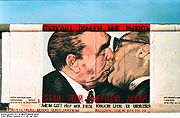
- A picture of Honecker kissing Soviet leader Leonid BrezhnevLeonid BrezhnevLeonid Ilyich Brezhnev – 10 November 1982) was the General Secretary of the Central Committee of the Communist Party of the Soviet Union , presiding over the country from 1964 until his death in 1982. His eighteen-year term as General Secretary was second only to that of Joseph Stalin in...
became famous and an icon of the Cold WarCold WarThe Cold War was the continuing state from roughly 1946 to 1991 of political conflict, military tension, proxy wars, and economic competition between the Communist World—primarily the Soviet Union and its satellite states and allies—and the powers of the Western world, primarily the United States...
. The passionate kiss depicted was in a satirical mural entitled My God, help me to survive this deadly loveMy God, help me to survive this deadly loveMy God, Help Me to Survive This Deadly Love , sometimes referred to as the Fraternal Kiss , is a graffiti painting on the Berlin wall by Dmitri Vrubel, one of the best known of the Berlin wall graffiti paintings...
, (GermanGerman languageGerman is a West Germanic language, related to and classified alongside English and Dutch. With an estimated 90 – 98 million native speakers, German is one of the world's major languages and is the most widely-spoken first language in the European Union....
: Mein Gott, hilf mir, diese tödliche Liebe zu überleben), sometimes referred to as the Fraternal Kiss (GermanGerman languageGerman is a West Germanic language, related to and classified alongside English and Dutch. With an estimated 90 – 98 million native speakers, German is one of the world's major languages and is the most widely-spoken first language in the European Union....
: Bruderkuß), on the Berlin Wall (East Side GalleryEast Side GalleryThe East Side Gallery is an international memorial for freedom. It is a 1.3 km long section of the Berlin Wall located near the centre of Berlin on Mühlenstraße in Friedrichshain-Kreuzberg.-Description:...
), painted by artist Dmitri VrubelDmitri VrubelDmitri Vladimirovich Vrubel is a Russian painter, best known for his East Side Gallery-painting My God, help me to survive this deadly love, depicting the kissing communist leaders Leonid Brezhnev and Erich Honecker....
.
Further reading
- Fulbrook, Mary. (2008) The people's state: East German society from Hitler to Honecker. Yale University PressYale University PressYale University Press is a book publisher founded in 1908 by George Parmly Day. It became an official department of Yale University in 1961, but remains financially and operationally autonomous....
. - Honecker, Erich. (1981) Aus meinem Leben. New York : Pergamon, 1981. ISBN 0080245323.
External links
- CNN Cold War – Profile: Erich Honecker
- Honecker im Internet (in German)
- www.warheroes.ru – Erich Honecker (in Russian)
- Welcoming Address to 1979 Session of the World Peace Council Erich Honecker's speech to the WPC
- A Successful Policy Seared to the Needs of the People Volkskammer pamphlet including material by Honecker