
All Topics  
Battle of Stalingrad


   Email Print
   Bookmark   Link


Battle of Stalingrad


Background On June 22, 1941, Nazi GermanyNazi Germany

Nazi Germany, or the Third Reich, refers to Germany in the years 1933 to 1945, when it was governed by the National So...
 launched Operation BarbarossaOperation Barbarossa

Operation Barbarossa was the codename for Nazi Germany's invasion of the Soviet Union during World War II that commenced on...
 (Unternehmen Barbarossa). The armed forces of Germany and its allies invaded the Soviet Union, quickly advancing deep into Soviet territory. During December, having suffered multiple defeats during the summer and autumn, Soviet forces counter-attacked during the Battle of MoscowBattle of Moscow

The Battle of Moscow refers to the Soviet defense of Moscow and the subsequent Soviet counter-offensive that occurred betwee...
 and successfully drove the German Army (Wehrmacht Heer) from the environs of MoscowMoscow

Moscow is the capital of Russia and the country's principal political, economic, financial, educational, and transportation...
.

By spring 1942, the Germans had stabilized their front in a line running roughly from LeningradLeningrad

Leningrad may mean:* Saint Petersburg, a Russian city formerly called 'Leningrad'...
 in the north to RostovRostov

----Rostov is one of the oldest towns in Russia and an important tourist centre of the so called Golden ring....
 in the south. There were a number of salients in the line where Soviet offensives had pushed the Germans back, notably to the northwest of Moscow and south of Kharkov, but neither was particularly threatening.


Discussion
Ask a question about 'Battle of Stalingrad'
Start a new discussion about 'Battle of Stalingrad'
Answer questions from other users
Full Discussion Forum


Timeline

1942   World War II: Battle of Stalingrad - Soviet Union forces under General Georgy Zhukov launch the Operation Uranus counterattacks at Stalingrad, turning the tide of the battle in the USSR's favor.

1942   World War II: Battle of Stalingrad - The situation for the German attackers of Stalingrad seems desperate during the Soviet counter-attack Operation Uranus and General Friedrich Paulus sends Adolf Hitler a telegram saying that the German Sixth Army is surrounded.

1943   World War II: In Russia, the Battle of Stalingrad comes to an end with the surrender of the German 6th Army.


Encyclopedia


Background

On June 22, 1941, Nazi GermanyNazi Germany

Nazi Germany, or the Third Reich, refers to Germany in the years 1933 to 1945, when it was governed by the National So...
 launched Operation BarbarossaOperation Barbarossa

Operation Barbarossa was the codename for Nazi Germany's invasion of the Soviet Union during World War II that commenced on...
 (Unternehmen Barbarossa). The armed forces of Germany and its allies invaded the Soviet Union, quickly advancing deep into Soviet territory. During December, having suffered multiple defeats during the summer and autumn, Soviet forces counter-attacked during the Battle of MoscowBattle of Moscow

The Battle of Moscow refers to the Soviet defense of Moscow and the subsequent Soviet counter-offensive that occurred betwee...
 and successfully drove the German Army (Wehrmacht Heer) from the environs of MoscowMoscow

Moscow is the capital of Russia and the country's principal political, economic, financial, educational, and transportation...
.

By spring 1942, the Germans had stabilized their front in a line running roughly from LeningradLeningrad

Leningrad may mean:* Saint Petersburg, a Russian city formerly called 'Leningrad'...
 in the north to RostovRostov

----Rostov is one of the oldest towns in Russia and an important tourist centre of the so called Golden ring....
 in the south. There were a number of salients in the line where Soviet offensives had pushed the Germans back, notably to the northwest of Moscow and south of Kharkov, but neither was particularly threatening. In the far south the Germans were in control of most of the Ukraine and much of the Crimean, although Sevastapol remained in Soviet hands along with a small portion of the Kerch peninsula.

The Germans were confident they could master the Red ArmyRed Army

The short forms Red Army and RKKA refer to the Workers' and Peasants' Red Army, , the armed forces first organiz...
 when winter weather no longer impeded their mobility. There was some substance to this belief: while Army Group CentreArmy Group Centre Overview

Army Group Centre was created on 22 June 1941 when Army Group B was renamed Army Group Centre....
 (Heeresgruppe Mitte) had suffered heavy punishment, 65 percent of its infantry had not been engaged during the winter fighting, and had been rested and reequipped. Army Groups North and South had not been particularly hard pressed over the winter.

Planning an offensive

Confusing matters considerably was the recent entry of the United StatesUnited States Summary

The United States of America, also known as the United States, the U.S., the U.S.A., and America, is...
 following Germany's declaration of war in support of its Japanese allyEmpire of Japan

????? Dai Nippon Teikoku Empire of Great Japan...
. To everyone's surprise, the new Anglo-American Allies stated that their first priority was Germany. Hitler wanted to end the fighting on the Eastern FrontEastern Front (World War II)

The Eastern Front of World War II was the theatre of war covering the conflict in central and eastern Europe from June 22, 1...
, or at least minimize it, before the Americans had a chance to get deeply involved in the war in Europe.Whatever plan they chose it would have to have sweeping strategic importance. Limited operations, like collapsing the salients or finally taking Leningrad, would simply not force the war to a close.

Moscow was thus an obvious target. Capturing Moscow could conceivably force the Soviets to surrender, or at least so upset their command, control and manufacturing to remove them as a major force. However, an important part of the German "BlitzkriegFacts About Blitzkrieg

Blitzkrieg is a popular name for an offensive operational-level military doctrine which involves an initial bombardmen...
" style of warfare was to attack at the least obvious point, in order to concentrate the offensive against the weakest defense, punching through, and then maintaining a highly mobile offensive in order to keep the enemy off balance. Moscow was just as obvious a target to the Soviets as the Germans, and was heavily defended as a result. Although a successful offensive was certainly possible, it would likely be a costly victory.

Another possibility was to upset the strategic balance by cutting off the Soviet supplies. The basic theory behind total warTotal war

Total war is a 20th century term to describe a war in which countries or nations use all of their resources to destroy anoth...
 was that if the industrial output of a country could be disrupted, their military forces would be unable to fight and be defeated as a matter of course. Hitler himself had always claimed to favor this style of warfare, and had personally intervened during Barbarossa to capture areas he felt were of prime industrial importance (much to the chagrin of his generals). In this case there was an obvious target, the oil fields of the CaucasusCaucasus

The Caucasus or Caucasia is a region in Eurasia bordered on the south by Turkey and Iran in Asia, on the west by the B...
 area, which supplied the Soviets with the vast majority of their fuel. An offensive in this area would also complete the takeover of the Ukraine. If the Volga could be reached, grain supplies from much of the Soviet "breadbasket" would be cut off completely, as it traveled either by barge on the Volga, or trains on lines further west that would also be overrun.

Importance of Stalingrad

The capture of Stalingrad was important to Hitler for two primary reasons. Firstly, it was a major industrial city on the Volga RiverVolga River

The Volga, widely viewed as the national river of Russia, flows through the western part of the country....
 -- a vital transport route between the Caspian SeaCaspian Sea

The Caspian Sea is the largest lake on Earth by both area and volume, with a surface area of 371,000 square kilometres and ...
 and Northern Russia. Secondly, its capture would secure the left flank of the German armies as they advanced into the oil-rich Caucasus region -- with a goal of cutting off fuel to Stalin's war machine. The fact that the city bore the name of Hitler's nemesis, Joseph StalinJoseph Stalin

Joseph Vissarionovich Stalin , alternatively transliterated Josef Stalin, was the de facto leader and dictator of ...
, would make its capture an ideologicalIdeology

An ideology is an organized collection of ideas....
 and propagandaPropaganda

Propaganda is a specific type of message presentation directly aimed at influencing the opinions or behavior of people, rath...
 coup. Stalin realized this, also, and despite being under tremendous constraints of time and resources, ordered anyone who was strong enough to hold a rifle be sent out to defend the city. The Red Army, at this stage of the war, was less capable of highly mobile operations than the German Army; however, the prospect of combat inside a large urban area, which would be dominated by short-range firearms rather than armored and mechanized tactics, minimized the Red Army's disadvantages against the Germans.

Operation Blau / Blue

Army Group SouthArmy Group South

Army Group South was a German Army Group during World War II....
 was selected for a sprint forward through the southern Russian steppeSteppe Summary

In physical geography, a steppe , pronounced in English as step, is a plain without trees ; it is similar to a prairie, ...
s into the CaucasusCaucasus

The Caucasus or Caucasia is a region in Eurasia bordered on the south by Turkey and Iran in Asia, on the west by the B...
 to capture the vital Soviet oil fieldFacts About Oil field

An oil field is a region with an abundance of oil wells extracting petroleum from below ground....
s there. Instead of focusing his attention on the Soviet Capital of Moscow as his general staffGeneral Staff

A General Staff is a group of military officers who act in a staff or administrative role under the command of a general off...
 advised, Hitler continued to send forces and supplies to the eastern UkraineUkraine

Ukraine is a country in Eastern Europe....
. The planned summer offensive was code-namedCode name

A code name or cryptonym is a word or name used clandestinely to refer to another name or word....
 Fall BlauOperation Blue

Operation Blue was the German Wehrmacht's codename for the 1942 summer offensive....
(trans.: “Case Blue”). It was to include the German Sixth Army, Seventeenth Army, Fourth Panzer ArmyGerman Fourth Panzer Army

The German Fourth Panzer Army was a German panzer army that saw action during World War II....
 and First Panzer ArmyGerman First Panzer Army

The First Panzer Army was a German tank army that fought during World War II....
. Army Group South had overrun the Ukrainian SSR in 1941. Poised in the Eastern Ukraine, it was to spearhead the offensive.

Hitler intervened, however, ordering the Army GroupArmy group

An army group is a military organization consisting of several field armies, and is supposed to be self-sufficient for indef...
 to be split in two. Army Group South (A), under the command of Wilhelm ListWilhelm List

Siegmund Wilhelm von List, was a German field marshal during World War II....
, was to continue advancing south towards the Caucasus as planned with the Seventeenth Army and First Panzer Army. Army Group South (B), including Friedrich Paulus’s Sixth Army and Hermann HothHermann Hoth

Hermann "Papa" Hoth was a general of the Third Reich during World War II, notable for victories in France and on the Eastern...
's Fourth Panzer Army, was to move east towards the VolgaVolga River

The Volga, widely viewed as the national river of Russia, flows through the western part of the country....
 and the city of StalingradVolgograd

Volgograd , formerly called Tsaritsyn and Stalingrad is a city in and the administrative center of Volgograd...
. Army Group B was commanded initially by Field MarshalField Marshal

A Field Marshal is a military officer usually of the highest rank, one step above a full General, Army General or Colonel Ge...
 Fedor von BockFacts About Fedor von Bock

Fedor von Bock was a generalfeldmarschall of the Wehrmacht who served as Army Group Center's commander during the attack...
 and later by General Maximilian von WeichsMaximilian von Weichs

Maximilian Maria Joseph Karl Gabriel Lamoral Reichsfreiherr von Weichs zu Glon was a German generalfeldmarschall and a milit...
.

The start of Operation Blau had been planned for late May 1942. However, a number of German and RomaniaRomania

Romania: is a country in Southeastern Europe....
n units that were involved in Blau were then in the process of besieging Sevastopol on the Crimean PeninsulaCrimea

Crimea /kra?'mia/ or the Autonomous Republic of Crimea is an autonomous republic of Ukraine on the northern coast of ...
. Delays in ending the siege pushed back the start date for Blau several times, and the city did not fall until the end of June. A smaller action was taken in the meantime, pinching off a Soviet salientSalient

Salient may refer to:* Salients, re-entrants and pockets...
 in the Second Battle of KharkovSecond Battle of Kharkov

The Second Battle of Kharkov was a battle fought from 12 May to 28 May 1942, on the Eastern Front during World War II....
, which resulted in the pocketing of a large Soviet force on 22 May.

Blau finally opened as Army Group South began its attack into southern Russia on June 28, 1942. The German offensive started well. Soviet forces offered little resistance in the vast empty steppes and started streaming eastward in disarray. Several attempts to re-establish a defensive line failed when German units outflankedFlanking maneuver

In military tactics, a flanking maneuver, also called a attack, is an attack on the sides of an opposing force....
 them. Two major pockets were formed and destroyed: the first northeast of Kharkov on July 2 and a second, around MillerovoMillerovo

Millerovo is a town in Rostov Oblast, Russia. Population: 38,498....
, Rostov OblastRostov Oblast Overview

Rostov Oblast is a federal subject of Russia, located in Southern Federal District....
, a week later.

Meanwhile, the Hungarian Second ArmyFacts About Hungarian Second Army

The Hungarian Second Army was a Hungarian field army which saw action during World War II....
 and the German 4th Panzer Army had launched an assault on VoronezhBattle of Voronezh (1942)

The Battle of Voronezh was a battle of the Eastern Front of World War II, fought in and around the city of Voronezh on the D...
, capturing the city on the 5th of July.

The initial advance of the Sixth Army was so successful that Hitler intervened and ordered the Fourth Panzer Army to join Army Group South (A) to the south. A massive traffic jam resulted when the Fourth Panzer and the Sixth both required the few roads in the area. Both armies were stopped dead while they attempted to clear the resulting mess of thousands of vehicles. The delay was long, and it is thought that it cost the advance at least one week. With the advance now slowed, Hitler changed his mind and re-assigned the Fourth Panzer Army back to the attack on Stalingrad.

By the end of July, the Germans had pushed the Soviets across the Don River. At this point, the Germans began using the armies of their ItalianItalian war in Soviet Union, 1941-1943

The Italian campaign in the Soviet Union started on 14 July 1941, when, despite Hitler's lack of enthusiasm, Mussolini joine...
, Hungarian, and Romanian allies to guard their left (northern) flank. The German Sixth Army was only a few dozen kilometers from Stalingrad, and Fourth Panzer Army, now to their south, turned northwards to help take the city. To the south, Army Group A was pushing far into the Caucasus, but their advance slowed as supply lines grew overextended. The two German army groups were not positioned to support one another due to the great distances involved.

After German intentions became clear in July, Stalin appointed MarshallMarshal of the Soviet Union

The rank of Marshal of the Soviet Union was in practice the highest military rank of the Soviet Union.....
 Andrei YeremenkoFacts About Andrei Yeremenko

Andrei Ivanovich Yeremenko Soviet general during World War II, Marshal of the Soviet Union, born in Markovka in the province...
 as commander of the Southeastern Front on August 1, 1942. YeremenkoAndrei Yeremenko

Andrei Ivanovich Yeremenko Soviet general during World War II, Marshal of the Soviet Union, born in Markovka in the province...
 and CommissarCommissar

Commissar is the English translation of an official title used in Russia after the Bolshevik revolution and in the Soviet Un...
 Nikita Krushchev were tasked with planning the defense of Stalingrad . The eastern border of Stalingrad was the wide Volga River, and over the river additional Soviet units were deployed. This combination of units became the newly formed 62nd Army62nd Army (Soviet Union)

The 62nd Order of Lenin Army was a field army established by the Soviet Union's Red Army during the Second World War....
, which YeremenkoAndrei Yeremenko

Andrei Ivanovich Yeremenko Soviet general during World War II, Marshal of the Soviet Union, born in Markovka in the province...
 placed under the command of Lt. Gen.Lieutenant General

Lieutenant General is a military rank used in many countries....
 Vasiliy ChuikovVasily Chuikov

Vasily Ivanovich Chuikov was a lieutenant general in the Soviet Red Army during World War II, two times Hero of the Soviet U...
 on September 11, 1942. The 62nd Army's mission was to defend Stalingrad at all costs.

Beginning of the battle

Before the Wehrmacht reached the city itself, the LuftwaffeLuftwaffe

The Deutsche Luftwaffe or Luftwaffe is the commonly used term for the German air force....
 had rendered the Volga River, vital for bringing supplies into the city, virtually unusable to Soviet shipping. Between 25 July and 31 July, 32 Soviet ships were sunk with another nine crippled.
The battle began with the heavy bombing of the city by the Generaloberst von Richthofen's Luftflotte 4Luftflotte 4

Luftflotte 4 was one of the primary divisions of the German Luftwaffe in World War II....
, which in the summer and autumn of 1942 was the mightiest single air command in the world. Some 1,000 tons were dropped. The city was quickly turned to rubble, although some factories survived and continued production whilst workers joined in the fighting. The Croatian 369th Reinforced Infantry Regiment369th Reinforced Infantry Regiment

The 369th Reinforced Infantry Regiment, also known as the Croatian Legion was a military unit of the Independent State...
 was the only non-German unit selected by the Wehrmacht to enter Stalingrad city during assault operations.

Stalin prevented civilians from leaving the city on the premise that their presence would encourage greater resistance from the city's defenders. Civilians, including women and children, were put to work building trenchTrench

A trench is a long narrow ditch....
works and protective fortifications. A massive German air bombardment on August 23 caused a firestormFacts About Firestorm

A firestorm is a conflagration which attains such intensity that it creates and sustains its own wind system....
, killing thousands and turning Stalingrad into a vast landscape of rubble and burnt ruins Beevor . Ninety percent of the living space in the Voroshilovskiy area was destroyed. Between the 23-26 August, Soviet reports indicate 955 people were killed and another 1,181 wounded as a result of the bombing. Casualties of 40,000 were exaggerated, and after 25 August the Soviets did not record civilian and military casualties as a result of air raids..

The Soviet Air Force, the Voenno-Vozdushnye Sily (VVS), was swept aside by the Luftwaffe. The VVS unit in the immediate area lost 201 aircraft from 23-31 August, and despite meager reinforcements of some 100 aircraft in August, it was with just 192 servicable aircraft which included just 57 fighters. The Soviets poured aerial reinforcements into the Stalingrad area in late September but continued to suffer appalling losses. The Luftwaffe had complete control of the skies.

The burden of the initial defense of the city fell on the 1077th Anti-Aircraft (AA) RegimentRegiment

A regiment is a military unit, consisting of battalions - usually three or four - commanded by a colonel....
, a unit made up mainly of young women volunteerVolunteer

The term volunteer is contested — there is no one agreed-to definition, and the term is frequently debated....
s who had no training on engaging ground targets. Despite this, and with no support available from other Soviet units, the AA gunners stayed at their posts and took on the advancing Panzers. The German 16th Panzer Division reportedly had to fight the 1077th’s gunners "shot for shot" until all 37 AA batteries were destroyed or overrun. The German 16th Panzer Division was also shocked to find that it had been fighting female soldiers, due to Soviet manpower shortages. In the beginning, the Soviets relied extensively on "Workers' militiaMilitia

A militia is a group of citizens organized to provide paramilitary service....
s" composed of workers not directly involved in war production. For a short time, tankTank

A tank is a tracked armoured fighting vehicle, designed to engage enemy forces by the use of direct fire....
s continued to be produced and then manned by volunteer crews of factory workers. They were driven directly from the factory floor to the front line, often without paint or even gunsights

By the end of August, Army Group South (B) had finally reached the Volga, north of Stalingrad. Another advance to the river south of the city followed. By September 1, the Soviets could only reinforce and supply their forces in Stalingrad by perilous crossings of the Volga, under constant bombardment by German artillery and aircraft.

On September 5, the Soviet 24th and 66th Armies organised a massive attack against XIV Panzerkorps. The Luftwaffe helped the German forces repulse the offensive by subjecting Soviet artillery positions and defensive lines to heavy attack. The Soviets were forced to withdraw at midday after only a few hours. Of the 120 tanks the Soviets committed, 30 were lost to air attack.
Soviet operations were constantly hampered by the Luftwaffe. On 18 September, the Soviet 1st Guards and 24th Army launched an offensive against VIII Armeekorps at Kotluban. VIII Fliegerkorps dispatched wave after wave of Stuka dive-bombers to prevent a breakthrough. The offensive was repulsed, and the Stukas claimed 41 of the 106 Soviet tanks knocked out that morning while escorting Bf 109s destroyed 77 Soviet aircraft, shattering their remaining strength.
Amid the debris of the wrecked city, the Soviet 62nd and 64th ArmiesArmy (Soviet Army)

The term Army, besides its generalized meaning specifically denotes a major military formation in militaries of various coun...
, which included the Soviet 13th Guards Rifle Division, anchored their defense lines with strongpoints in houses and factories. Fighting was fierce and desperate. The life expectancy of a newly-arrived Soviet private in the city dropped to less than 24 hours, while that of a Soviet officer was about 3 days. Stalin's Order No. 227 of July 27 1942, decreed that all commanders who order unauthorized retreat should be subjects of a military tribunal. “Not a step back!” was the sloganSlogan

A slogan is a memorable phrase used in a political, commercial, religious, and other contexts as a repetitive expression of ...
. The Germans pushing forward into Stalingrad suffered heavy casualties.

German military doctrineMilitary doctrine

Military doctrine is a level of military planning between national strategy and unit-level tactics, techniques, and procedur...
 was based on the principle of combined-arms teamsCombined arms

Combined arms is an approach to warfare which seeks to integrate different arms of a military to achieve mutually complement...
 and close cooperation by tankTank

A tank is a tracked armoured fighting vehicle, designed to engage enemy forces by the use of direct fire....
s, infantryInfantry Summary

Infantry is a term for soldiers who fight primarily on foot with small arms in organized military units....
, engineersMilitary engineer

A military engineer is primarily responsible for the design and construction of offensive, defensive and logistical structur...
, artilleryArtillery

Historically, artillery refers to any engine used for the discharge of projectiles during war....
, and ground-attack aircraftGround attack aircraft

A ground-attack aircraft is an aircraft that is designed to operate in direct support of ground forces such as infantry, tan...
. To counter this, Soviet commanders adopted the simple expedient of always keeping the front lines as close together as physically possible. Chuikov called this tactic "hugging" the Germans. This forced the German infantry to either fight on their own or risk taking casualties from their own supporting fire; it neutralized German close air support and weakened artillery support. Bitter fighting raged for every street, every factory, every house, basement and staircase. There were fire-fights in the sewers. The Germans, calling this unseen urban warfareUrban warfare

Urban warfare is modern warfare conducted in urban areas such as towns and cities....
 Rattenkrieg ("Rat War"), bitterly joked about capturing the kitchen but still fighting for the living-room.

Fighting on Mamayev Kurgan, a prominent, blood-soaked hill above the city, was particularly merciless. The position changed hands many times. By the 12 September the Soviet 62nd Army had been reduced to 60 tanks, 700 mortars and just 20,000 men.
The 13th Guards Rifle Division, assigned to retake Mamayev Kurgan and Railway Station No. 1 on September 13, suffered particularly heavy losses. Over 30 percent of its soldiers were kiled in the first 24 hours, and just 320 out of the original 10,000 survived the entire battle. Both objectives were successful, only to temporary degrees. The railway station changed hands 14 times in 6 hours. By the following evening, the 13th Guards Rifle Division did not exist, but its men had killed an approximately equal number of Germans.
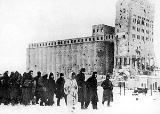
At the Grain Silo, a huge grain-processing complex dominated by a single enormous silo, combat was so close that at times Soviet and German soldiers could hear each other breathe. Combat raged there for weeks. When German soldiers finally took the position, only forty Soviet bodies were found, though the Germans had thought there to be many more Soviet soldiers present due to the ferocity of Soviet resistance. The Soviets burned the heaps of grain as they retreated. In another part of the city, a Soviet platoonPlatoon

A platoon is a military unit. In an army, a platoon is a unit of thirty to forty soldiers typically commanded by a lieutenan...
 under the command of Yakov PavlovYakov Pavlov

Yakov Fedotovich Pavlov was a Hero of the Soviet Union for his heroism during the Battle of Stalingrad....
 turned an apartment buildingApartment building Summary

An apartment building, block of flats or tenement is a multi-unit dwelling made up of several apartments or flat...
 into an impenetrable fortress. The building, later called “Pavlov's HousePavlov's House

Pavlov's House became the name of a well-defended apartment building during the Battle of Stalingrad in 1942-1943....
,” oversaw a square in the city center. The soldiers surrounded it with minefields, set up machine-gun positions at the windows, and breached the walls in the basement for better communications. They were not relieved, and not significantly reinforced, for two months. Well after the Battle, Chuikov liked to joke, perhaps accurately, that more Germans died trying to capture Pavlov's House than died capturing Paris. According to Beevor, after each wave, throughout the second month, of the Germans' repeated, persistent assaults against the building, the Soviets had to run out and kick down the piles of German corpses in order for the machine and anti-tank gunners in the building to have clear firing lines across the square. Sgt. Pavlov was awarded the "Hero of the Soviet Union" for his actions.

With no end in sight, the Germans started transferring heavy artillery to the city, including the gigantic 800 mm railroad gun nicknamed Dora. The Germans made no effort to send a force across the Volga, allowing the Soviets to build up a large number of artillery batteries there. Soviet artillery on the eastern bank continued to bombard the German positions. The Soviet defenders used the resulting ruins as defensive positions. German tanks became useless amid heaps of rubble up to 8 meters high. When they were able to move forward, they came under Soviet antitank fire from wrecked buildings.

Soviet sniperSoviet sniper Overview

Soviet snipers, also referred to as Russian snipers, played an important role during World War II....
s also successfully used the ruins to inflict heavy casualties on the Germans. The most successful sniper was Vasily Zaytsev who is also the most famous . Zaytsev was credited with 242 confirmed kills during the battle and a grand total of more than 300; he was also credited with killing a specially-sent, though potentially fictional German sniper known by the names Erwin KönigErwin König

Heinz Thorvald was apparently an , yet famous, German sniper, best known from the memoirs of Vasily Grigoryevich Zaytsev as...
 and Heinz ThorvaldErwin König

Heinz Thorvald was apparently an , yet famous, German sniper, best known from the memoirs of Vasily Grigoryevich Zaytsev as...
.
Zaytsev fixed a standard Moisin-Nagant rifle scope to a Soviet 20mm anti-tank rifle for use against Germans hiding behind walls under window sills. The 20mm rounds easily penetrated the brick and the soldier behind it.

For both Stalin and Hitler, the battle of Stalingrad became a prestige issue in addition to the actual strategic significance of the battle. The Soviet command moved the Red ArmyRed Army

The short forms Red Army and RKKA refer to the Workers' and Peasants' Red Army, , the armed forces first organiz...
's strategic reserves from the MoscowMoscow

Moscow is the capital of Russia and the country's principal political, economic, financial, educational, and transportation...
 area to the lower Volga, and transferred aircraft from the entire country to the Stalingrad region.

The strain on both military commanders was immense: Paulus developed an uncontrollable tic in his eye, which eventually afflicted the left side of his face, while Chuikov experienced an outbreak of eczemaFacts About Eczema

Eczema is a form of dermatitis, or inflammation of the upper layers of the skin....
 that required him to bandage his hands completely. Troops on both sides faced the constant strain of close-range combat.

Determined to crush Soviet resistance, Luftflotte 4s Stukawaffe flew 700 individual sorties against Soviet positions at the Dzherzhinskiy Tractor Factory on 5 October. Several Soviet regiments were wiped out; the entire staff of the Soviet 339th Infantry Regiment were killed the following morning during an air raid.

By mid-October, the Luftwaffe intensified its efforts against remaining Red Army positions holding the west bank. By now, Soviet aerial resistance had ceased to be effective. Luftflotte 4 flew 2,000 sorties on 14 October and 600 tons of bombs were dropped while German infantry surrounded the three factories. Stukageschwader 1, 2, and 77 had silenced Soviet artillery on the eastern bank of the Volga to a large degree before turning their attention to the shipping that was once again trying to reinforce the narrowing Soviet pockets of resistance. The 62nd Army had been cut in two, and, due to intensive air attack against its supply ferries, were now being paralyzed.

With the Soviets forced into a strip of land on the western bank of the Volga, over 1,208 Stuka missions were flown in an effort to eliminate them. Despite the heavy air bombardment (Stalingrad suffered heavier bombardment than that inflicted on SedanSedan

A sedan car, American English terminology, is one of the most common body styles of the modern automobile....
 and SevastopolSevastopol

enname = Sevastopol| runame = ???????????...
), the Soviet 62 Army, with just 47,000 men and 19 tanks, prevented the VI Armee and IV Panzerarmee from wrestling the west bank out of Soviet control.

Culmination Point

The Luftwaffe remained in command of the sky into early November, and Soviet aerial resistance during the day was nonexistent, but after flying 20,000 individual sorties, its original strength of 1,600 serviceable aircraft had fallen 40% to 950. The Kampfwaffe (bomber force) had been hardest hit, having only 232 out of a force of 480 left. Despite enjoying qualitative superiority against the VVS and possessing eighty percent of the Luftwaffe's resources on the Eastern Front, Luftflotte 4 could not prevent Soviet aerial power from growing. By the time of the counter-offensive, the Soviets were superior numerically.

The Soviet bomber force, the Aviatsiya Dalnego Destviya (ADD), having taken crippling losses over the past 18 months, was restricted to flying at night. The Soviets flew 11,317 sorties in this manner, from 17 July to 19 November over Stalingrad and the Don-bend sector. These raids caused little damage and were of nuisance value only.
The situation for the Luftwaffe was now becoming increasingly difficult. On 8 November substantial units from Luftflotte 4 were removed to combat the American landings in North AfricaOperation Torch

Operation Torch was the British-American invasion of French North Africa in World War II during the North African Campaign, ...
. The German air-arm found itself spread thin across Europe, and struggling to maintain its strength in the other southern sectors of the Soviet-German front.

After three months of carnage and slow and costly advance, the Germans finally reached the river banks, capturing 90% of the ruined city and splitting the remaining Soviet forces into two narrow pockets. In addition, ice-floes on the Volga now prevented boats and tugs from supplying the Soviet defenders across the river. Nevertheless, the fighting, especially on the slopes of Mamayev Kurgan and inside the factory area in the northern part of the city, continued as fiercely as ever. The battles for the Red October Steel Factory, the Dzerzhinsky tractor factory, and the Barrikady gun factory became world famous. While Soviet soldiers defended their positions and took the Germans under fire, factory workers repaired damaged Soviet tanks and other weapons close to the battlefield, sometimes on the battlefield itself. These civilians also volunteered as tank crews to replace the dead and wounded, though they had no experience or training in operating tanks during combat.

Soviet counter-offensives

Recognizing that German troops were ill prepared for offensive operations during the winter, the StavkaStavka

Stavka was the General Headquarters of armed forces in late Imperial Russia and in the Soviet Union....
 decided to conduct a number of offensive operations of its own to exploit this weakness, with the recognition that most of the German troops were redeployed elsewhere on the southern sector of the Eastern Front.

Seen in post-war history as a pivotal strategic period of war that began the Second Period of the Great Patriotic War (19 November 1942 - 31 December 1943), these operations would open the Winter Campaign of 1942-1943 (19 November 1942 - 3 March 1943) taking on the strategic and operational planning structure below, employing several Fronts, and some 15 Armies.

Stalingrad Strategic Offensive Operation 19 November 1942 - 2 February 1943 SouthwesternSouthwestern Front Overview

Southwestern front may refer to one of the following....
, Don, Stalingrad Fronts

  • Operation UranusOperation Uranus

    Operation Uranus was the World War II Soviet encirclement of German forces during the Battle of Stalingrad....
     19 November 1942 - 30 November 1942
    • Southwestern Front 1st Guards, 21st21st Army (Soviet Union)

      Operational History 21st Army was a part of the Second Operational Echelon of the RKKA....
      , 5th Tank, 17th Air Armies, and the 25th Tank Corps
    • Don Front 24th, 65th, 66th, 16th Air Armies
    • Stalingrad Front 28th, 51st51st Army (Soviet Union)

      The 51st Army was a field army of the Red Army that saw action against the Germans in World War II on both the southern and ...
      , 57th, 62nd62nd Army (Soviet Union)

      The 62nd Order of Lenin Army was a field army established by the Soviet Union's Red Army during the Second World War....
      , 64th, 8th Air Armies


  • Kotelnikovo Offensive Operation 12 December 1942 - 31 December 1942
    • Stalingrad Front 2nd Guards, 5th Shock, 51st51st Army (Soviet Union)

      The 51st Army was a field army of the Red Army that saw action against the Germans in World War II on both the southern and ...
      , 8th Air Armies


  • Middle Don Offensive Operation 16 December 1942 - 30 December 1942
    • Southwestern Front
    • Don Front


  • Operation Koltso (English: Operation Ring) 10 January 1943 - 2 February 1943
    • Don Front 21st21st Army (Soviet Union)

      Operational History 21st Army was a part of the Second Operational Echelon of the RKKA....
      , 24th, 57th, 62nd62nd Army (Soviet Union)

      The 62nd Order of Lenin Army was a field army established by the Soviet Union's Red Army during the Second World War....
      , 64th, 65th, 66th, 16th Air Armies


The German offensive to take Stalingrad had been halted by a combination of stubborn Red Army resistance inside the city and local weather conditions. The Soviet counter-offensive planning used deceptive measures that eventually trapped and destroyed the 6th Army and other Axis forces around the city, becoming the second large scale defeat of the German Army during Second World War.
During the siege, the German, ItalianItalian war in Soviet Union, 1941-1943

The Italian campaign in the Soviet Union started on 14 July 1941, when, despite Hitler's lack of enthusiasm, Mussolini joine...
, HungarianHungarian Second Army

The Hungarian Second Army was a Hungarian field army which saw action during World War II....
, and RomanianRomanian Armies in the Battle of Stalingrad

This article is a detailed picture of Romanian involvement in the Battle of Stalingrad....
 armies protecting Army Group BArmy Group B

Army Group B was the name of three different German Army Groups that saw action during World War II....
's flankFlank

Flank may refer to:* Flank, the side of either a horse or a military unit...
s had pressed their headquarters for support. The Hungarian Second ArmyHungarian Second Army

The Hungarian Second Army was a Hungarian field army which saw action during World War II....
, consisting of mainly ill-equipped and ill-trained units, was given the task of defending a 200 km section of the front north of Stalingrad between the Italian Army and VoronezhVoronezh

Voronezh is a large city in the Southwest Russia, not far from Ukraine....
. This resulted in a very thin line, with some sectors where 1–2 km stretches were being defended by a single platoonPlatoon

A platoon is a military unit. In an army, a platoon is a unit of thirty to forty soldiers typically commanded by a lieutenan...
. Soviet forces held several bridgeheads on the western bank of the river and presented a potentially serious threat to Army Group B.

Similarly, on the southern flank of the Stalingrad sector the front south-west of Katelnikovo was held only by the Romanian VII Corps, and beyond it a single German 16th Motorized Infantry Division.

However, Hitler was so focused on the city itself, that requests from the flanks for support were refused. The chief of the Army General Staff, Franz HalderFranz Halder

Franz Ritter Halder was a German General and the head of the Army General Staff from 1938 until September 1942, when he was ...
, expressed concerns about Hitler's preoccupation with the city, pointing at the Germans' weak flanks, claiming that if the situation on the flanks was not rectified then 'there would be a disaster'. Hitler had claimed to Halder that Stalingrad would be captured and the weakened flanks would be held with 'national socialist ardour, clearly I cannot expect this of you (Halder)'. Halder was then replaced in mid October with General Kurt ZeitzlerKurt Zeitzler

Kurt Zeitzler was a General in the German Wehrmacht during World War II, he is most famous for being the Chief of Army Gener...
.

Operation Uranus


In autumn the Soviet generals Aleksandr VasilyevskiyAleksandr Vasilevsky

Aleksandr Mikhaylovich Vasilevsky was a Soviet military commander, promoted to Marshal of the Soviet Union in 1943....
 and Georgy ZhukovGeorgy Zhukov

Georgy Konstantinovich Zhukov, GCB , was a Soviet military commander and politician who, in the course of World War II, led...
, responsible for strategic planning in the Stalingrad area, concentrated massive Soviet forces in the steppes to the north and south of the city. The German northern flank was particularly vulnerable, since it was defended by ItalianItalian war in Soviet Union, 1941-1943

The Italian campaign in the Soviet Union started on 14 July 1941, when, despite Hitler's lack of enthusiasm, Mussolini joine...
, HungarianHungarian Second Army

The Hungarian Second Army was a Hungarian field army which saw action during World War II....
, and RomanianRomanian Armies in the Battle of Stalingrad

This article is a detailed picture of Romanian involvement in the Battle of Stalingrad....
 units that suffered from inferior training, equipment, and moraleMorale

Morale is a term for the capacity of people to maintain belief in an institution or a goal, or even in oneself and others....
 when compared with their German counterparts. This weakness was known and exploited by the Soviets, who preferred to face off against non-German troops whenever it was possible, just as the British preferred attacking Italian troops, instead of German ones, whenever possible, in North Africa. The plan was to keep pinning the Germans down in the city, then punch through the overstretched and weakly defended German flanks and surround the Germans inside Stalingrad. During the preparations for the attack, MarshalMarshal of the Soviet Union

The rank of Marshal of the Soviet Union was in practice the highest military rank of the Soviet Union.....
 Zhukov personally visited the front, which was rare for such a high-ranking general. The operation was code-named “UranusOperation Uranus

Operation Uranus was the World War II Soviet encirclement of German forces during the Battle of Stalingrad....
” and launched in conjunction with Operation MarsOperation Mars

Operation Mars was the operation codename for the Rzhev offensive operation part of the Rzhev-Vyazma strategic offensi...
, which was directed at Army Group Center. The plan was similar to Zhukov's victory at Khalkin Gol three years before, where he had sprung a double envelopmentPincer movement

The pincer movement is a basic element of military strategy which has been used, to some extent, in nearly every war....
 and destroyed the 23rd DivisionIJA 23d Division

The 23rd Division, was one of the Japan's new triangular Infantry Divisions....
 of the Japanese army.

On November 19, the Red ArmyRed Army

The short forms Red Army and RKKA refer to the Workers' and Peasants' Red Army, , the armed forces first organiz...
 unleashed Uranus. The attacking Soviet units under the command of Gen. Nikolay Vatutin consisted of three complete armies, the 1st Guards ArmySoviet First Guards Army

The Soviet First Guards Army was a Soviet field army that fought on the Eastern Front during World War II....
, 5th Tank Army, and 21st Army21st Army (Soviet Union)

Operational History 21st Army was a part of the Second Operational Echelon of the RKKA....
, including a total of 18 infantry divisionsDivision (military)

A division is a large military unit or formation usually consisting of around ten to fifteen thousand soldiers....
, eight tank brigadeBrigade

Brigade is a term from military science which refers to military echelon under a division, above a regiment where that exist...
s, two motorizedMechanized force

Motorized forces or military units are those that have trucks, or other wheeled, un-armoured transport as an integral part o...
 brigades, six cavalryFacts About Cavalry

Soldiers or warriors who fought mounted on horseback are commonly known as cavalry ....
 divisions and one anti-tank brigade. The preparations for the attack could be heard by the Romanians, who continued to push for reinforcements, only to be refused again. Thinly spread, outnumbered and poorly equipped, the Romanian Third ArmyRomanian Third Army Overview

The Romanian Third Army was a field army that fought as part of the German Army Group B during World War II....
, which held the northern flank of German Sixth Army, was shattered. On November 20, a second Soviet offensive (two armies) was launched to the south of Stalingrad, against points held by the Romanian IV Corps. The Romanian forces, made up primarily of infantry, collapsed almost immediately. Soviet forces raced west in a pincer movementPincer movement

The pincer movement is a basic element of military strategy which has been used, to some extent, in nearly every war....
, and met two days later near the town of KalachFacts About Kalach-na-Donu

Kalach-na-Donu , or Kalach-on-the-Don, is a town in Volgograd Oblast, Russia, located on the Don River 85 km west...
, sealing the ring around Stalingrad. The Russians later re-enacted the link up for use as propagandaPropaganda

Propaganda is a specific type of message presentation directly aimed at influencing the opinions or behavior of people, rath...
, and the piece of footage achieved worldwide fame.

Stalingrad Pocket

Because of the Soviet pincer attack, about 230,000 German and Romanian soldiers, as well as the Croatian 369th Reinforced Infantry Regiment369th Reinforced Infantry Regiment

The 369th Reinforced Infantry Regiment, also known as the Croatian Legion was a military unit of the Independent State...
  and other volunteer subsidiary troops, found themselves trapped inside the resulting pocket. Inside the pocketSalients, re-entrants and pockets

In military terms, a salient is a battlefield feature that projects into enemy territory....
  there also were the surviving Soviet civilians—around 10,000, and several thousand Soviet soldiers the Germans had taken captive during the battle. Not all German soldiers from Sixth Army were trapped; 50,000 were brushed aside outside the pocket. The encircling Red Army units immediately formed two defensive fronts: a circumvallationCircumvallation

Circumvallation is a standard military tactic of siege used in ancient and modern warfare....
 facing inward, to defend against any breakout attempt, and a contravallationContravallation

Contravallation is a standard military tactic of siege used in ancient and modern warfare....
 facing outward, to defend against any relief attempt.

Adolf HitlerAdolf Hitler

Adolf Hitler was Chancellor of Germany from 1933, and Fhrer of Germany from 1934 until his death....
 had declared in a public speech (in the Berlin SportpalastBerlin Sportpalast

The Berliner Sportpalast was a multi-purpose winter sport venue and meeting hall near Potsdamer Platz in the Schneberg secti...
) on September 30 that the German army would never leave the city. At a meeting shortly after the Soviet encirclementEncirclement Overview

Encirclement is a military term for the situation when a force or target is isolated and surrounded by enemy forces....
, German army chiefs pushed for an immediate breakout to a new line on the west of the Don. But Hitler was at his Bavarian retreat of Obersalzberg in BerchtesgadenBerchtesgaden

Berchtesgaden is a town in the German Bavarian Alps....
 with the head of the Luftwaffe, Göring. When asked by Hitler, Göring replied, after being convinced by Hans JeschonnekHans Jeschonnek

Hans Jeschonnek was a German Generaloberst and a Chief of the General Staff of Nazi Germany's Luftwaffe during World War II...
, that the Luftwaffe could supply the Sixth Army with an "air bridge". This would allow the Germans in the city to fight on while a relief force was assembled.

A similar plan had been used successfully a year earlier at the Demyansk PocketDemyansk Pocket

Demyansk Pocket is a name of encirclement of German troops by Red Army around Demyansk, south of Leningrad, during the Secon...
, albeit on a much smaller scale: it had been only an army corps at Demyansk as opposed to an entire army. Also, Soviet fighter forces had improved considerably in both quality and quantity in the intervening year. But the mention of the successful Demyansk air supply operation reinforced Hitler's own views, and was endorsed by Hermann GöringHermann Göring

Hermann Wilhelm Gring was a German politician and military leader, a leading member of the Nazi Party, second in command o...
 several days later.

The head of the Fourth Air Fleet (Luftflotte 4), Wolfram von RichthofenWolfram von Richthofen

Generalfeldmarschall Wolfram Freiherr von Richthofen was a German general and field marshal during World War II....
, tried to have this decision overturned without success. The Sixth Army would be supplied by air. The Sixth Army was the largest unit of this type in the world, almost twice as large as a regular German army. Also trapped in the pocket was a corps of the Fourth Panzer Army. It should have been clear that supplying the pocket by air was impossible -- the maximum 117.5 tons they could deliver a day was less than the 800 tons/day needed by the pocket. To supplement the limited number of Junkers Ju 52 transports, the Germans equipped aircraft wholly inadequate for the role, such as the bomber He-177 (some bombers performed adequately -- the Heinkel He-111 proved to be quite capable and was a lot faster than the Ju 52). But Hitler backed Göring's plan and reiterated his order of "no surrender" to his trapped armies.

The air supply mission failed. Appalling weather conditions, technical failures, heavy Soviet anti-aircraft fire and fighter interceptions led to the loss of 488 German aircraft. The Luftwaffe failed to achieve even the maximum supply capacity of 117 tons that it was capable of. An average of 94 tons of supplies per day was delivered to the trapped German Army. Even then, it was often inadequate or unnecessary; one aircraft arrived with 20 tonnes of Vodka and summer uniforms, completely useless in their current situation. The transport aircraft that did land safely were used to evacuate technical specialists and sick or wounded men from the besieged enclave (some 42,000 were evacuated in all). The Sixth Army slowly starved. PilotsAviator

An aviator is a person who flies aircraft for pleasure or as a profession....
 were shocked to find the troops assigned to offloading the planes too exhausted and hungry to unload food. General ZeitzlerKurt Zeitzler

Kurt Zeitzler was a General in the German Wehrmacht during World War II, he is most famous for being the Chief of Army Gener...
, moved by the troops' plight at Stalingrad, began to limit himself to their slim rations at meal times. After a few weeks of such a diet he'd grown so emaciated that Hitler, annoyed, personally ordered him to start eating regular meals again.

The expense to the Transportgruppen was heavy. Some 266 Junkers Ju 52s were destroyed, one-third of the fleets strength on the Soviet-German front. The He 111 gruppen lost 165 aircraft in transport operations. Other losses included 42 Junkers Ju 86Junkers Ju 86

The Junkers Ju 86 was a German monoplane bomber and civilian airliner designed in the early 1930s by Junkers....
s, nine Fw 200 "Condors", five He 177 bombers and a single Ju 290. The Luftwaffe also lost close to 1,000 highly experienced bomber crew personnel.

So heavy were the Luftwaffe's losses that four of Luftflotte 4s transport units (KGrzbV 700, KGrzbV 900, I./KGrzbV 1 and II./KGzbV 1) were "formally dissolved".

Operation Saturn

Soviet forces consolidated their positions around Stalingrad, and fierce fighting to shrink the pocket began. Operation WintergewitterOperation Wintergewitter

See also Operation WintergewitterOperation Winter Storm was the German Fourth Panzer Army's attempt to relieve the Ger...
 (Operation Winter Storm), a German attempt to relieve the trapped army from the South, was successfully fended off by the Soviets in December. The full impact of the harsh Russian winter set in. The Volga froze solid, allowing the Soviets to supply their forces more easily. The trapped Germans rapidly ran out of heating fuel and medical supplies, and thousands started to die of frostbiteFrostbite

Frostbite is the medical condition whereby damage is caused to skin and other tissues due to extreme cold....
, malnutritionMalnutrition

Malnutrition is a general term for the medical condition caused by an improper or insufficient diet....
, and diseaseDisease

Contagious redirects here. For the Isley Brothers song of that name, see Contagious ....
.

On December 16, the Soviets launched a second offensive, Operation SaturnOperation Saturn

Operation Saturn was a Red Army operation on the Eastern Front of World War II that led to battles in the northern Caucasus ...
, which attempted to punch through the Axis army on the Don and take RostovRostov-on-Don

Rostov-on-Don is the administrative center of Rostov Oblast and the Southern Federal District of Russia, located on the Don ...
. If successful, this offensive would have trapped the remainder of Army Group South, one third of the entire German Army in Russia, in the CaucasusCaucasus

The Caucasus or Caucasia is a region in Eurasia bordered on the south by Turkey and Iran in Asia, on the west by the B...
. The Germans set up a "mobile defense" in which small units would hold towns until supporting armor could arrive. The Soviets never got close to Rostov, but the fighting forced von Manstein to extract Army Group A from the Caucasus and re-establish the frontline some 250 km away from the city. The Tatsinskaya RaidTatsinskaya Raid

The Tatsinskaya Raid occurred during Operation Little Saturn in late December 1942....
 also caused significant losses to Luftwaffe’s transport fleet. The Sixth Army now was beyond all hope of German reinforcement. The German troops in Stalingrad were not told this however, and continued to believe that reinforcements were on their way. Some German officers requested that Paulus defy Hitler’s orders to stand fast and instead attempt to break out of the Stalingrad pocket. Paulus refused, as he abhorred the thought of disobeying orders. Also, whereas a breakout may have been possible in the first few weeks, at this late stage, Sixth Army was short of the fuel required for such a breakout. The German soldiers would have faced great difficulty breaking through the Soviet lines on foot in harsh winter conditions.

Soviet victory


The Germans inside the pocket retreated from the suburbSuburb

Suburbs are inhabited districts located either inside a town or city's outer rim or just outside its official limits , or th...
s of Stalingrad to the city itself. The loss of the two airfields at Pitomnik on 16 January and Gumrak on the 25 January meant an end to air supplies and to the evacuation of the wounded. Other sources indicate Luftwaffe's last flight from Gumrak was night 21st to 22nd of January 1943. . Third and last serviceable runway was Stalingradskaja flight school which reportedly had last Luftwaffe landings and takeoff night 22nd to 23rd of January 1943. . After daytime 23rd of Jan 1943 there were no more reported landings except for continuous air drops of ammunition and food until the end. The Germans were now not only starving, but running out of ammunitionAmmunition

Ammunition is a generic military term meaning a projectile and its propellant....
. Nevertheless they continued to resist stubbornly, partly because they believed the Soviets would execute those who surrendered. In particular, the so-called "HiWisHiwi (volunteer)

Hiwi is a German abbreviation. It has two meanings, Hilfswilliger and Hilfswissenschaftler....
", Soviet citizens fighting for the Germans, had no illusions about their fate if captured. The Soviets, in turn, were initially surprised by the large number of German forces they had trapped, and had to reinforce their encircling forces. Bloody urban warfareUrban warfare

Urban warfare is modern warfare conducted in urban areas such as towns and cities....
 began again in Stalingrad, but this time it was the Germans who were pushed back to the banks of the Volga. They fortified their positions in the factory districts and the Soviets encountered almost the same tooth-and-nail ferocity that they themselves displayed a month earlier. The Germans adapted a simple defense of fixing wire nets over all windows to protect themselves from grenades. The Soviets responded by fixing fish hooks to the grenades so they stuck to the nets when thrown. The Germans now had no usable tanks in the city. Those tanks which still functioned could at best be used as stationary cannons. The Soviets did not bother employing tanks in areas where the urban destruction ruined their mobility. A Soviet envoy made Paulus a generous surrender offer—that if he surrendered within 24 hours, the GermansGermany

Germany , officially the Federal Republic of Germany , is a country in central Europe....
 would receive a guarantee of safety for all prisoners, medical care for the German sick and wounded, a promise that prisoners would be allowed to keep their personal belongings, "normal" food rations, and repatriation to whatever country they wished to go to after the war—but Paulus, ordered not to surrender by Adolf HitlerAdolf Hitler

Adolf Hitler was Chancellor of Germany from 1933, and Fhrer of Germany from 1934 until his death....
, did not reply, ensuring the destruction of the 6th Army.

Hitler promoted Friedrich PaulusFriedrich Paulus

Friedrich Wilhelm Ernst Paulus was a German general, later promoted to field marshal, during World War II....
 to GeneralfeldmarschallGeneralfeldmarschall

Generalfeldmarschall was a rank in the armies of several German states, the Holy Roman Empire, and the Austrian Empire....
on January 30, 1943, (the 10th anniversary of Hitler coming to power). Since no German Field MarshalList of German Field Marshals

The following list of German Field Marshals denotes those who have held the German rank of Generalfeldmarschall....
 had ever been taken prisoner, Hitler assumed that Paulus would fight on or take his own life. Nevertheless, when Soviet forces closed in on Paulus' headquarters in the ruined GUMState Universal Store

State Universal Store or GUM is a common name for the main department store in many cities of the Soviet Union and som...
 department store the next day, Paulus surrendered. The remnants of the German forces in Stalingrad surrendered on February 2; 91,000 tired, ill, and starving Germans were taken captive. To the delight of the Soviet forces and the dismay of the Third Reich, the prisoners included 22 generals. Hitler was furious at the Field Marshal’s surrender and confided that "Paulus stood at the doorstep of eternal glory but made an about-face".
According to the German documentary filmDocumentary film

Documentary film is a broad category of cinematic expression united by the intent, or stated intent, to remain factual or no...
 Stalingrad, over 11,000 German and Axis soldiers refused to lay down their arms at the official surrender, seemingly believing that fighting to the death was better than what seemed like a slow end in Soviet camps. These forces continued to resist until early March 1943, hiding in cellars and sewers of the city with their numbers being diminished at the same time by Soviet forces clearing the city of remaining enemy resistance. By March, what remained of these forces were small and isolated pockets of resistance that surrendered. According to Soviet intelligence documents shown in the documentary, 2,418 of the men were killed, and 8,646 were captured.

Only 5,000 of the 91,000 German prisoners of warPrisoner of war

A prisoner of war is a combatant who is imprisoned by an enemy power during or immediately after an armed conflict....
 survived their captivity and returned home. Already weakened by disease, starvation and lack of medical care during the encirclement, they were sent to labour camps all over the Soviet Union, where most of them died of overwork and malnutrition. A handful of senior officers were taken to MoscowMoscow

Moscow is the capital of Russia and the country's principal political, economic, financial, educational, and transportation...
 and used for propaganda purposes and some of them joined National Committee for a Free GermanyNational Committee for a Free Germany Overview

The National Committee for a Free Germany was a German anti-Nazi organization that operated in the Soviet Union during Worl...
. Some, including Paulus, signed anti-Hitler statements which were broadcast to German troops. General Walther von Seydlitz-KurzbachWalther von Seydlitz-Kurzbach

Walther von Seydlitz-Kurzbach was a German general....
 offered to raise an anti-Hitler army from the Stalingrad survivors, but the Soviets did not accept this offer. It was not until 1955 that the last of the handful of survivors were repatriated.

The German public was not officially told of the disaster until the end of January 1943, though positive reports in the German propaganda media about the battle had stopped in the weeks before the announcement. It was not the first major setback of the German military, but the crushing defeat at Stalingrad was unmatched in scale. On February 18, the ministerMinister (government)

A minister or a secretary is a politician who holds significant public office in a national or regional government....
 of propagandaPropaganda

Propaganda is a specific type of message presentation directly aimed at influencing the opinions or behavior of people, rath...
, Joseph GoebbelsJoseph Goebbels

Paul Joseph Goebbels was Adolf Hitler's Propaganda Minister in Nazi Germany....
, gave his famous Sportpalast speechSportpalast speech

The Sportpalast or total war speech was a speech delivered by Propagandaminister Joseph Goebbels at the Berlin Spo...
 in Berlin, encouraging the Germans to accept a total warTotal war Summary

Total war is a 20th century term to describe a war in which countries or nations use all of their resources to destroy anoth...
 which would claim all resources and efforts from the entire population.

Legacy

The scope of the battle

The battle of Stalingrad was one of the largest battles in human history. It raged for 199 days. Numbers of casualties are difficult to compile due to the vast scope of the battle and the fact that the Soviet government did not allow estimates to be made, for fear the cost would be shown to be too high. In its initial phases, the Germans inflicted heavy casualties on Soviet formations; but the Soviet encirclement by punching through the German flank, mainly held by Romanian troops, effectively besieged the remainder of German Sixth Army, which had taken heavy casualties in street fighting prior to this. At different times the Germans had held up to 90% of the city, yet the Soviet soldiers and officers fought on fiercely. Some elements of the German Fourth Panzer Army also suffered casualties in operations around Stalingrad during the Soviet counter offensive.

Various scholars have estimated the Axis suffered 850,000 casualties of all types (wounded, killed, captured...etc) among all branches of the German armed forces and its allies, many of which were POWs who died in Soviet captivity between 1943 and 1955. 400,000 Germans, 200,000 Romanians, 130,000 Italians, and 120,000 Hungarians were killed, wounded or captured. Of the 91,000 German POW's taken at Stalingrad 27,000 died within weeks and only 5,000 returned to Germany in 1955. The remainder of the POWs died in Soviet captivity. In the whole Stalingrad area the Axis lost 1.5 million killed, wounded or captured. 50,000 ex-Soviets HiwisHiwi (volunteer)

Hiwi is a German abbreviation. It has two meanings, Hilfswilliger and Hilfswissenschaftler....
 (local volunteers incorporated into the German forces in supporting capacities) were killed or captured by the Red Army. According to archival figures, the Red Army suffered a total of 1,129,619 total casualties; 478,741 men killed and captured and 650,878 wounded. These numbers are for the whole Stalingrad Area; in the city itself 750,000 were killed, captured, or wounded. Also, more than 40,000 Soviet civilians died in Stalingrad and its suburbs during a single week of aerial bombing as the German Fourth Panzer and Sixth armies approached the city; the total number of civilians killed in the regions outside the city is unknown. In all, the battle resulted in an estimated total of 1.7 million to 2 million Axis and Soviet casualties.

Besides being a turning point in the war, Stalingrad was also revealing of the discipline and determination of both the German WehrmachtWehrmacht

Wehrmacht was the name of the armed forces of Nazi-Germany from 1935 to 1945....
and the Soviet Red Army. The Soviets first defended Stalingrad against a fierce German onslaught. So great were Soviet losses that at times, the life expectancyLife expectancy

Life expectancy is heavily dependent on the criteria used to select the group....
 of a newly arrived soldier was less than a day, and the life expectancy of a Soviet officer was three days. Their sacrifice is immortalized by a soldier of General RodimtsevAlexander Rodimtsev

Aleksandr Ilich Rodimtsev was a colonel general in the Soviet Red Army during World War II, twice Hero of the Soviet Union....
, about to die, who scratched on the wall of the main railway station (which changed hands 15 times during the battle) “Rodimtsev’s Guardsmen fought and died here for their Motherland.”

For the heroism of the Soviet defenders of Stalingrad, the city was awarded the title Hero CityHero City

Hero City is an honorary title awarded for outstanding heroism during the Great Patriotic War of 1941 to 1945....
 in 1945. Twenty-four years after this battle, in October 1967, a colossal monumentMonument

A monument is a statue, building, or other edifice created to commemorate a person or important event....
, Mother MotherlandThe Motherland Calls

The Motherland Calls, , also called Mother Motherland, Mother Motherland Is Calling, or simply The Motherland...
was erected on Mamayev Kurgan, the hill overlooking the city. The statue forms part of a War memorialWar memorial

A war memorial is a building, monument, statue or other edifice to commemorate those who died, or been injured, in war....
 complex which includes ruined walls deliberately left the way they were after the battle. The Grain Silo, as well as Pavlov's HousePavlov's House

Pavlov's House became the name of a well-defended apartment building during the Battle of Stalingrad in 1942-1943....
, the apartment building whose defenders eventually held out for two months until they were relieved, can still be visited. Even today, one may find bones and rusty metal splinters on Mamayev Kurgan, symbols of both the human suffering during the battle and the successful yet costly resistance against the German invasion.

On the other side, the German ArmyWehrmacht

Wehrmacht was the name of the armed forces of Nazi-Germany from 1935 to 1945....
 showed remarkable discipline after being surroundedEncirclement

Encirclement is a military term for the situation when a force or target is isolated and surrounded by enemy forces....
. It was the first time that it had operated under adverse conditions on such a scale.

Hitler, acting on Göring's advice, ordered that the German 6th Army be supplied by air; the Luftwaffe had successfully accomplished an aerial resupply in January 1942, as a German garrison had been surrounded in Demyansk for four months. In this case, however, there were obvious differences. The encircled forces at Demyansk were a much smaller garrison, while an entire army was trapped in Stalingrad.

During the latter part of the siege, short of food and clothing, many German soldiers starved or froze to death. Yet, discipline was maintained until the very end, when resistance no longer served any useful purpose. Friedrich PaulusFacts About Friedrich Paulus

Friedrich Wilhelm Ernst Paulus was a German general, later promoted to field marshal, during World War II....
 obeyed Hitler's orders, against many of Hitler's top generals' counsel and advice including that of von Manstein, and did not attempt to break out of the city. German ammunition, supplies, and food became all too scarce.

Paulus knew that the airlift had failed and that Stalingrad was lost. He asked for permission to surrender to save the life of his troops but Hitler refused and instead promoted him to the rank of GeneralfeldmarschallGeneralfeldmarschall

Generalfeldmar