

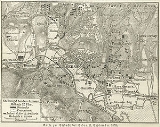
Battle of Sedan

Encyclopedia
The Battle of Sedan was fought during the Franco-Prussian War
on 1 September 1870. It resulted in the capture of Emperor Napoleon III
and large numbers of his troops and for all intents and purposes decided the war in favour of Prussia
and its allies, though fighting continued under a new French government
.
The 120,000 strong French Army of Châlons
, commanded by Marshal Patrice MacMahon and accompanied by Napoleon III, was attempting to lift the Siege of Metz
, only to be caught by the Prussia
n Meuse Army and defeated at the Battle of Beaumont
. The Meuse Army and the Prussian Third Army, commanded by Field-Marshal Helmuth von Moltke and accompanied by Prussian King Wilhelm I and Prussian Chancellor Otto von Bismarck
, cornered MacMahon's army at Sedan
in a massive encirclement battle. Marshal MacMahon was wounded during the attacks and command passed to General Auguste-Alexandre Ducrot
.
, Marshal Bazaine
's Army of the Rhine retreated to Metz
where it was besieged by over 150,000 Prussian troops of the First and Second Armies (Siege of Metz
). Emperor Napoleon III, along with Marshal MacMahon, formed the new French Army of Châlons
to march on to Metz to rescue Bazaine. With Napoleon III personally leading the army, with Marshal MacMahon in attendance, they led the Army of Châlons in a left-flanking march northeast towards the Belgian
border in an attempt to avoid the Prussians before striking south to link up with Bazaine.
The Prussians had repeatedly outmaneuvered the French in the string of victories through August 1870, and the march both depleted the French forces and left both flanks exposed. The Prussians, under the command of von Moltke, took advantage of this maneuver to catch the French in a pincer grip
. Leaving the Prussian First and Second Armies besieging Metz, Moltke took the Prussian Third Army and the Army of the Meuse northward where they caught up with the French at Beaumont-en-Argonne
on 30 August. After a hard-fought battle with the French losing 5,000 men and 40 cannons in a sharp fight, the French withdrew towards Sedan. Their intention was to rest the army, which had been involved in a long series of marches, resupply them with ammunition and then retreat, rather than giving battle in the town.
Having reformed in Sedan, the Army of Châlons deployed the First Corps to check the Prussian advance, but was immediately isolated by the converging Prussian armies. They could not retreat owing to the exhaustion of their troops, and they were short on ammunition. The French rear was protected by the Fortress of Sedan, and offered a defensive position at Calvaire d'Illy, which had both hills and woods to provide cover for any defense.
Moltke divided his forces into three groups: one to detain the French where they were, another to race forward and catch them if they retreated, and a third (the smallest force) to hold the river bank. The French were unable to move and had to fight "where they stood". The Prussians thus encircled the French.
 The battle opened with the Army of Châlons, with 202 infantry
battalions, 80 cavalry
squadrons and 564 guns
, attacking the surrounding Prussian Third and Meuse Armies, which totaled 222 infantry battalions, 186 cavalry squadrons and 774 guns.
Napoleon had ordered MacMahon to break out of the encirclement, and the only point where that seemed possible was at La Moncelle, whose flank was protected by a fortified town. The Prussians also picked La Moncelle as one point where they would mount a breakthrough. Prince George of Saxony
and the Prussian XI Corps was assigned to the task, and General Baron von der Tann
were ordered to attack Bazeilles
on the right flank.
This was opening engagement, as the French First Corps had barricaded the streets, and enlisted the aid of the population. Von der Tann sent a brigade across pontoon bridges at 0400 hours, but encountered stiff resistance, holding only the southern end of the town. The combat drew new forces, as French brigades from the First, Fifth and Twelfth Corps arrived. At 0800 the Prussian 8th Infantry Division
arrived, and von der Tann decided it was time for a decisive attack. He had not been able to bring artillery to bear from long range, so he committed his last brigade to storm the town, supported by artillery from the other side of the Meuse. His artillery reached the Bazeilles at 0900 hours.
The fighting continued to spread to the south of the town, and the 8th Infantry Division was sent to reinforce the Bavarian
s fighting at La Moncelle, where they had attempted to mount a breakthrough of the French defense. Fighting began in earnest at 0600, and the wounded MacMahon had appointed General Auguste Ducrot
to command, who received the news at 0700. Ducrot ordered the retreat that Moltke had expected, but was overruled almost immediately by General de Wimpffen
, who threw his forces against the Saxons at La Moncelle. This led to a brief rally for the French, who drove back the artillery around La Moncelle and pressed the Bavarians and the Saxons. However, with the taking of Bazeilles, and the arrival of fresh waves of Prussian troops, the counter-attack began to collapse.
But by 1100 hours, Prussian artillery took a toll on the French, while more Prussian troops arrived on the battlefield. After an intense bombardment and Prussian attacks from the northwest and east, and Bavarian attacks from the southwest, the Army of Châlons was driven into the Bois de la Garenne and surrounded. The French cavalry, commanded by General Jean Auguste Margueritte
, launched three desperate attacks on the nearby village of Floing where the Prussian XI Corps was concentrated. Margueritte was mortally wounded leading the very first charge and the two additional charges led to nothing but heavy losses.
 By the end of the day, with no hope of breaking out, Napoleon III called off the attacks. The French lost over 17,000 men killed and wounded with 21,000 captured. The Prussians reported their losses at 2,320 killed, 5,980 wounded and 700 captured or missing. One casualty of note was Edmond Bonaparte II, the cousin (once-removed) of Napoleon III, who was killed during the French counter-attack.
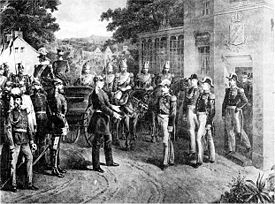
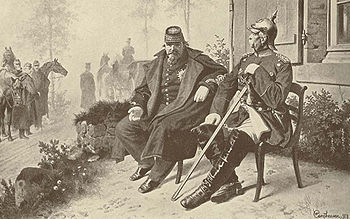
By the next day, on 2 September, Napoleon III ordered the white flag to be run up and surrendered himself and the entire Army of Châlons to Moltke and the Prussian King. The capture of the French emperor left the Prussians without an opposing government willing to make a quick peace. Indeed, two days after news hit Paris of Emperor Napoleon's III capture, the French Second Empire collapsed in a bloodless revolution, leading to the creation of a new provisional government which would carry on the war for five more months, sparing no effort to try to change France's fortunes.
But the defeat at Sedan and the capture of Napoleon III sealed the doom of France. With the Second Empire overthrown, Napoleon III was permitted to leave Prussian custody for exile in England, while, within a fortnight, the Prussian Meuse Army and the Third Army went on to besiege Paris
.
The debacle at Sedan was to haunt Napoleon III for the rest of his life. In 1873, Napoleon III's last words were addressed to his friend, doctor Henri Conneau:
And he died shortly after.
In recognition of the role this battle played in German Unification, many Germans celebrated Sedantag
(Day of Sedan) on each 2 September until 1919. The Kaiser himself refused to declare 2 September as an official holiday; instead, it became an unofficial day of celebration.
Franco-Prussian War
The Franco-Prussian War or Franco-German War, often referred to in France as the 1870 War was a conflict between the Second French Empire and the Kingdom of Prussia. Prussia was aided by the North German Confederation, of which it was a member, and the South German states of Baden, Württemberg and...
on 1 September 1870. It resulted in the capture of Emperor Napoleon III
Napoleon III of France
Louis-Napoléon Bonaparte was the President of the French Second Republic and as Napoleon III, the ruler of the Second French Empire. He was the nephew and heir of Napoleon I, christened as Charles Louis Napoléon Bonaparte...
and large numbers of his troops and for all intents and purposes decided the war in favour of Prussia
Prussia
Prussia was a German kingdom and historic state originating out of the Duchy of Prussia and the Margraviate of Brandenburg. For centuries, the House of Hohenzollern ruled Prussia, successfully expanding its size by way of an unusually well-organized and effective army. Prussia shaped the history...
and its allies, though fighting continued under a new French government
French Third Republic
The French Third Republic was the republican government of France from 1870, when the Second French Empire collapsed due to the French defeat in the Franco-Prussian War, to 1940, when France was overrun by Nazi Germany during World War II, resulting in the German and Italian occupations of France...
.
The 120,000 strong French Army of Châlons
Army of Châlons
The Army of Châlons was a French army which took part in the Franco-Prussian War of 1870–71. It was formed in August 1870 from parts of the Army of the Rhine not blockaded at Metz...
, commanded by Marshal Patrice MacMahon and accompanied by Napoleon III, was attempting to lift the Siege of Metz
Siege of Metz
The Siege of Metz lasting from 19 August – 27 October 1870 was fought during the Franco-Prussian War and ended in a decisive Prussian victory.-History:...
, only to be caught by the Prussia
Prussia
Prussia was a German kingdom and historic state originating out of the Duchy of Prussia and the Margraviate of Brandenburg. For centuries, the House of Hohenzollern ruled Prussia, successfully expanding its size by way of an unusually well-organized and effective army. Prussia shaped the history...
n Meuse Army and defeated at the Battle of Beaumont
Battle of Beaumont
The Battle of Beaumont on August 30, 1870 was won by Prussia during the Franco-Prussian War.It was fought between Fifth French Corps d'Armee under General Pierre Louis Charles de Failly, and the IV and XII Army Corps under Prince George of Saxony The Battle of Beaumont on August 30, 1870 was won...
. The Meuse Army and the Prussian Third Army, commanded by Field-Marshal Helmuth von Moltke and accompanied by Prussian King Wilhelm I and Prussian Chancellor Otto von Bismarck
Otto von Bismarck
Otto Eduard Leopold, Prince of Bismarck, Duke of Lauenburg , simply known as Otto von Bismarck, was a Prussian-German statesman whose actions unified Germany, made it a major player in world affairs, and created a balance of power that kept Europe at peace after 1871.As Minister President of...
, cornered MacMahon's army at Sedan
Sedan, France
Sedan is a commune in France, a sub-prefecture of the Ardennes department in northern France.-Geography:The historic centre is built on a peninsula formed by an arc of the Meuse River. It is around from the Belgian border.-History:...
in a massive encirclement battle. Marshal MacMahon was wounded during the attacks and command passed to General Auguste-Alexandre Ducrot
Auguste-Alexandre Ducrot
Auguste-Alexandre Ducrot was a French general. Ducrot served in Algeria, in the Italian campaign of 1859, and as a division commander in the Franco-Prussian War....
.
Background
After its defeat at GravelotteBattle of Gravelotte
The Battle of Gravelotte was a battle of the Franco-Prussian War named after Gravelotte, a village in Lorraine between Metz and the former French–German frontier.-Terrain and armies:...
, Marshal Bazaine
François Achille Bazaine
François Achille Bazaine was a French General and from 1864, a Marshal of France, who surrendered the last organized French army to the Prussians during the Franco-Prussian war. He was the first Marshal who had started as a legionnaire and like the great Marshals of the First Empire, he had risen...
's Army of the Rhine retreated to Metz
Metz
Metz is a city in the northeast of France located at the confluence of the Moselle and the Seille rivers.Metz is the capital of the Lorraine region and prefecture of the Moselle department. Located near the tripoint along the junction of France, Germany, and Luxembourg, Metz forms a central place...
where it was besieged by over 150,000 Prussian troops of the First and Second Armies (Siege of Metz
Siege of Metz
The Siege of Metz lasting from 19 August – 27 October 1870 was fought during the Franco-Prussian War and ended in a decisive Prussian victory.-History:...
). Emperor Napoleon III, along with Marshal MacMahon, formed the new French Army of Châlons
Army of Châlons
The Army of Châlons was a French army which took part in the Franco-Prussian War of 1870–71. It was formed in August 1870 from parts of the Army of the Rhine not blockaded at Metz...
to march on to Metz to rescue Bazaine. With Napoleon III personally leading the army, with Marshal MacMahon in attendance, they led the Army of Châlons in a left-flanking march northeast towards the Belgian
Belgium
Belgium , officially the Kingdom of Belgium, is a federal state in Western Europe. It is a founding member of the European Union and hosts the EU's headquarters, and those of several other major international organisations such as NATO.Belgium is also a member of, or affiliated to, many...
border in an attempt to avoid the Prussians before striking south to link up with Bazaine.
The Prussians had repeatedly outmaneuvered the French in the string of victories through August 1870, and the march both depleted the French forces and left both flanks exposed. The Prussians, under the command of von Moltke, took advantage of this maneuver to catch the French in a pincer grip
Pincer movement
The pincer movement or double envelopment is a military maneuver. The flanks of the opponent are attacked simultaneously in a pinching motion after the opponent has advanced towards the center of an army which is responding by moving its outside forces to the enemy's flanks, in order to surround it...
. Leaving the Prussian First and Second Armies besieging Metz, Moltke took the Prussian Third Army and the Army of the Meuse northward where they caught up with the French at Beaumont-en-Argonne
Beaumont-en-Argonne
Beaumont-en-Argonne is a commune in the Ardennes department in northern France.-Population:-References:*...
on 30 August. After a hard-fought battle with the French losing 5,000 men and 40 cannons in a sharp fight, the French withdrew towards Sedan. Their intention was to rest the army, which had been involved in a long series of marches, resupply them with ammunition and then retreat, rather than giving battle in the town.
Having reformed in Sedan, the Army of Châlons deployed the First Corps to check the Prussian advance, but was immediately isolated by the converging Prussian armies. They could not retreat owing to the exhaustion of their troops, and they were short on ammunition. The French rear was protected by the Fortress of Sedan, and offered a defensive position at Calvaire d'Illy, which had both hills and woods to provide cover for any defense.
Moltke divided his forces into three groups: one to detain the French where they were, another to race forward and catch them if they retreated, and a third (the smallest force) to hold the river bank. The French were unable to move and had to fight "where they stood". The Prussians thus encircled the French.
Battle
Infantry
Infantrymen are soldiers who are specifically trained for the role of fighting on foot to engage the enemy face to face and have historically borne the brunt of the casualties of combat in wars. As the oldest branch of combat arms, they are the backbone of armies...
battalions, 80 cavalry
Cavalry
Cavalry or horsemen were soldiers or warriors who fought mounted on horseback. Cavalry were historically the third oldest and the most mobile of the combat arms...
squadrons and 564 guns
Artillery
Originally applied to any group of infantry primarily armed with projectile weapons, artillery has over time become limited in meaning to refer only to those engines of war that operate by projection of munitions far beyond the range of effect of personal weapons...
, attacking the surrounding Prussian Third and Meuse Armies, which totaled 222 infantry battalions, 186 cavalry squadrons and 774 guns.
Napoleon had ordered MacMahon to break out of the encirclement, and the only point where that seemed possible was at La Moncelle, whose flank was protected by a fortified town. The Prussians also picked La Moncelle as one point where they would mount a breakthrough. Prince George of Saxony
George of Saxony
-Life:George was born in the Saxon capital Dresden. He was the second son of King John of Saxony and his wife Princess Amelia of Bavaria , daughter of King Maximilian I Joseph of Bavaria ....
and the Prussian XI Corps was assigned to the task, and General Baron von der Tann
Ludwig Freiherr von und zu der Tann-Rathsamhausen
Ludwig Samson Arthur Freiherr von und zu der Tann-Rathsamhausen was a Bavarian general.-Early life:Born at Darmstadt, on the day of Waterloo, Ludwig von der Tann was descended from the old family of von der Tann, which had branches in Bavaria, the Alsace and the Rhine provinces, and attached his...
were ordered to attack Bazeilles
Bazeilles
Bazeilles is a commune in the Ardennes department in northern France.It lies near Sedan.-History:During the 1870 Franco-Prussian war, Bazeilles was the site of the Battle of Bazeilles, one of the first occasions of modern urban warfare.-Population:...
on the right flank.
This was opening engagement, as the French First Corps had barricaded the streets, and enlisted the aid of the population. Von der Tann sent a brigade across pontoon bridges at 0400 hours, but encountered stiff resistance, holding only the southern end of the town. The combat drew new forces, as French brigades from the First, Fifth and Twelfth Corps arrived. At 0800 the Prussian 8th Infantry Division
8th Division (German Empire)
The 8th Division was a unit of the Prussian/German Army. It was formed in Erfurt in November 1816 as a brigade and became a division on September 5, 1818. The division was subordinated in peacetime to the IV Army Corps . The division was disbanded in 1919 during the demobilization of the German...
arrived, and von der Tann decided it was time for a decisive attack. He had not been able to bring artillery to bear from long range, so he committed his last brigade to storm the town, supported by artillery from the other side of the Meuse. His artillery reached the Bazeilles at 0900 hours.
The fighting continued to spread to the south of the town, and the 8th Infantry Division was sent to reinforce the Bavarian
Bavarian
Bavarian is the adjective form of the German state of Bavaria, and refers to people of ancestry from Bavaria. Bavarian may also refer to:* Austro-Bavarian, a group of closely related dialects of German, spoken in parts of Bavaria, most of Austria and the Alto Adige/Südtirol* Bavarian cream, a...
s fighting at La Moncelle, where they had attempted to mount a breakthrough of the French defense. Fighting began in earnest at 0600, and the wounded MacMahon had appointed General Auguste Ducrot
Auguste-Alexandre Ducrot
Auguste-Alexandre Ducrot was a French general. Ducrot served in Algeria, in the Italian campaign of 1859, and as a division commander in the Franco-Prussian War....
to command, who received the news at 0700. Ducrot ordered the retreat that Moltke had expected, but was overruled almost immediately by General de Wimpffen
Emmanuel Félix de Wimpffen
Emmanuel Felix de Wimpffen was a French soldier and general of Austrian descent. Entering the army from the military school of Saint-Cyr, he saw considerable active service in Algeria, and in 1840 became captain; in 1847 chef de bataillon...
, who threw his forces against the Saxons at La Moncelle. This led to a brief rally for the French, who drove back the artillery around La Moncelle and pressed the Bavarians and the Saxons. However, with the taking of Bazeilles, and the arrival of fresh waves of Prussian troops, the counter-attack began to collapse.
But by 1100 hours, Prussian artillery took a toll on the French, while more Prussian troops arrived on the battlefield. After an intense bombardment and Prussian attacks from the northwest and east, and Bavarian attacks from the southwest, the Army of Châlons was driven into the Bois de la Garenne and surrounded. The French cavalry, commanded by General Jean Auguste Margueritte
Jean Auguste Margueritte
Jean Auguste Margueritte , French General, father of Victor Margueritte and Paul Margueritte.After an honorable career in Algeria, General Margueritte was mortally wounded in the great cavalry charge at Sedan. He died in Belgium...
, launched three desperate attacks on the nearby village of Floing where the Prussian XI Corps was concentrated. Margueritte was mortally wounded leading the very first charge and the two additional charges led to nothing but heavy losses.
Conclusion and aftermath
By the next day, on 2 September, Napoleon III ordered the white flag to be run up and surrendered himself and the entire Army of Châlons to Moltke and the Prussian King. The capture of the French emperor left the Prussians without an opposing government willing to make a quick peace. Indeed, two days after news hit Paris of Emperor Napoleon's III capture, the French Second Empire collapsed in a bloodless revolution, leading to the creation of a new provisional government which would carry on the war for five more months, sparing no effort to try to change France's fortunes.
But the defeat at Sedan and the capture of Napoleon III sealed the doom of France. With the Second Empire overthrown, Napoleon III was permitted to leave Prussian custody for exile in England, while, within a fortnight, the Prussian Meuse Army and the Third Army went on to besiege Paris
Siege of Paris
The Siege of Paris, lasting from September 19, 1870 – January 28, 1871, and the consequent capture of the city by Prussian forces led to French defeat in the Franco-Prussian War and the establishment of the German Empire as well as the Paris Commune....
.
The debacle at Sedan was to haunt Napoleon III for the rest of his life. In 1873, Napoleon III's last words were addressed to his friend, doctor Henri Conneau:
- "Henri, were you there at Sedan?" (Henri, etiez-vous à Sedan?)
- "Yes, Majesty" (Oui, Sire)
- "We were not cowards at Sedan, were we?" (N'est-ce pas que nous n'avons pas été des lâches à Sedan?)
And he died shortly after.
In recognition of the role this battle played in German Unification, many Germans celebrated Sedantag
Sedantag
Sedantag was a semi-official memorial holiday in the German Empire celebrated on the second of September to commemorate Emperor Frederick III's victory in the Battle of Sedan...
(Day of Sedan) on each 2 September until 1919. The Kaiser himself refused to declare 2 September as an official holiday; instead, it became an unofficial day of celebration.