


Beer Hall Putsch

Encyclopedia
The Beer Hall Putsch was a failed attempt at revolution that occurred between the evening of 8 November and the early afternoon of 9 November 1923, when Nazi Party leader Adolf Hitler
, Generalquartiermeister
Erich Ludendorff
, and other heads of the Kampfbund
unsuccessfully tried to seize power in Munich
, Bavaria
and Germany
.
s in the early 20th century existed in most larger southern German
cities, where hundreds or even thousands of people were able to gather during the evenings, drink beer and often engage in political or social debate. They were also places where political rallies could be held, a tradition still alive today. One of the largest beer halls in Munich was the "Bürgerbräukeller
", where the Beer Hall Putsch was launched.
German power and prestige were destroyed in the aftermath of World War I
. Like many other German nationalists, Hitler believed in the Dolchstoßlegende (Stab-in-the-back legend), which claimed that the army, "undefeated in the field," had been "stabbed in the back" by civilian leaders and Marxists
back on the home front
, later dubbed the November Criminals. In Munich, Hitler took part in "national thinking" courses organized by the Education and Propaganda Department of the Bavarian Reichswehr
under Captain Karl Mayr
. Thereafter, Captain Mayr ordered Hitler, then an Army corporal, to infiltrate the tiny Deutsche Arbeiterpartei, abbreviated DAP (German Workers Party). Hitler joined the DAP on 12 September 1919. Hitler rose to its top post in the chaotic political atmosphere of postwar Munich. By agreement, Hitler was given the political leadership of several Bavarian "patriotic associations" (revanchist) which collectively were known as the Kampfbund
. With this political base, Hitler could call on about 15,000 brawlers
, mostly ex-soldiers.
On 26 September 1923, following a period of turmoil and political violence, Bavarian Prime Minister Eugen von Knilling
declared a state of emergency
and appointed Gustav von Kahr
Staatskomissar (state commissioner) with dictatorial governing powers. Together with Bavarian State Police head Colonel Hans Ritter von Seisser (Seißer), and Reichswehr
General Otto von Lossow
, Kahr formed a triumvirate
. Hitler announced that starting on 27 September 1923, he would be holding 14 mass meetings. One of Kahr's first actions was to ban the meetings. Hitler was under pressure to act. The Nazis, with other leaders in the Kampfbund, felt they had to march upon Berlin and seize power or their followers would turn to the Communists. Hitler and Ludendorff sought the support of Kahr and his triumvirate. However, Kahr had his own plan with Seisser and Lossow to install a nationalist dictatorship without Hitler.
's successful March on Rome
. Hitler and his associates planned to use Munich as a base for a big march against Germany's Weimar Republic
government. But the circumstances were different from those in Italy. Once Hitler realized that von Kahr either sought to control him or was losing heart (history is unclear), he decided to take matters into his own hands. Hitler, along with a large detachment of SA
, marched on the Bürgerbräukeller, a Munich beer hall where von Kahr was making a speech in front of 3,000 people.
In the cold, dark evening, 600 SA surrounded the beer hall and a machine gun
was set up pointing at the auditorium doors. Hitler, surrounded by his associates Hermann Göring
, Alfred Rosenberg
, Rudolf Hess
, Ernst Hanfstaengl
, Ulrich Graf, Johann Aigner, Adolf Lenk, Max Amann
, Scheubner-Richter, Wilhelm Adam
, and others (some 20 in all), burst through the doors at 8:30 pm and pushed their way laboriously through the crowd. Hitler fired a shot into the ceiling and jumped on a chair yelling: "The national revolution has broken out! The hall is filled with six hundred men. Nobody is allowed to leave. The Bavarian government and the government at Berlin are deposed. A new government will be formed at once. The barracks of the Reichswehr and those of the police are occupied [this was not in fact the case]. Both have rallied to the swastika."
Hitler, accompanied by Rudolf Hess
, Adolf Lenk and Ulrich Graf, forced the triumvirate of von Kahr, von Seisser, and von Lossow
into a side room (previously rented by Rudolf Hess
) at gunpoint and demanded that they support his putsch, or they would be shot. Hitler thought that he would get an immediate response of affirmation from them, imploring von Kahr to accept a position as Regent of Bavaria. Von Kahr replied that he could not be expected to collaborate, especially as he had been taken out of the auditorium under heavy guard.
During this time, speeches were given in the main hall by Göring, among others, obtaining a temporary calm, while no one was allowed to leave the hall. Some escaped via the kitchen, including foreign correspondents eager to file copy. At the same time, Heinz Pernet
, Johann Aigner and Scheubner-Richter were dispatched to pick up Ludendorff, whose personal prestige was being harnessed to give the Nazis credibility. A telephone call was made from the kitchen by Hermann Kriebel
to Ernst Röhm
, who was waiting with his Reichskriegsflagge
in the Löwenbräukeller
, another beer hall, and he was ordered to seize key buildings throughout the city. At the same time, co-conspirators under Gerhard Rossbach mobilized the students of a nearby Officers Infantry school to seize other objectives.
Hitler became irritated by von Kahr and summoned Ernst Pöhner
, Friedrich Weber and Hermann Kriebel
to stand in for him while he returned to the auditorium to make a speech (as he had promised some fifteen minutes earlier). Flanked by Rudolf Hess
and Adolf Lenk, Hitler returned to the auditorium to make an extemporaneous speech which almost immediately changed the mood of the hall. Dr. Karl Alexander von Mueller, a professor of modern history and political science at the University of Munich and a supporter of von Kahr, was an eyewitness. He reported:
Hitler started quietly reminding the audience that his move was not directed against von Kahr and launched into his speech ending with: "Outside are Kahr, Lossow and Seisser. They are struggling hard to reach a decision. May I say to them that you will stand behind them?"
 The audience roared its approval. He finished triumphantly:
Hitler returned to the anteroom
, where the triumvirs remained incarcerated, to ear-shattering acclaim which the triumvirs could not have failed to notice. On his way back, Hitler ordered Göring and Hess to take Eugen von Knilling and seven other members of the Bavarian government into custody.
During Hitler's speech, Pöhner
, Weber, and Kriebel
had been trying in a conciliatory fashion to bring the triumvirate round to their point of view. The atmosphere in the room had become lighter but von Kahr continued to dig in his heels. Ludendorff showed up a little before 9 p.m. and, being shown into the ante-room, concentrated on von Lossow and von Seisser, appealing to their sense of duty. Eventually the triumvirate reluctantly gave in.
Hitler, Ludendorff et al. moved back into the auditorium, where they gave speeches and shook hands. The crowd was then allowed to leave the hall. In a tactical mistake, Hitler decided to leave the Bürgerbräukeller shortly thereafter to deal with a crisis elsewhere. In his absence, at around 10:30 p.m. Ludendorff released the three Bavarian government leaders, Kahr, Lossow, and Seisser, who left the beer hall after falsely promising Ludendorff they would remain loyal to Hitler.
Meanwhile, Hitler had no luck in getting the German soldiers who were holding out in the barracks to surrender. That having failed, he went back to the beer hall. When Hitler arrived back at the beer hall he found the revolution had lost some impetus. There were no plans for tomorrow's march on Berlin. Munich wasn't even being occupied.
The night was marked by confusion and unrest among government officials, armed forces, police units, and individuals deciding where their loyalties lay. Units of the Kampfbund were scurrying around to arm themselves from secret caches, and seizing buildings. At around 3 am, the first casualties of the putsch occurred when the local garrison of the Reichswehr
spotted Röhm's men coming out of the beer hall. They were ambushed while trying to reach the Reichswehr barracks and had to fall back. In the meantime, the Reichswehr officers put the whole garrison on alert and called for reinforcements. Foreign attachés were seized in their hotel rooms and put under house arrest.
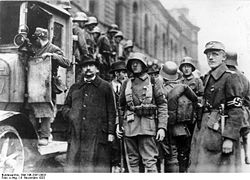 In the early morning, Hitler ordered the seizure of the Munich city council as hostage
s. He further sent the communications officer of the Kampfbund, Max Neunzert, to enlist the aid of Crown Prince Rupprecht of Bavaria
to mediate between von Kahr and the putschists. Neunzert failed in the mission.
By midmorning on 9 November, Hitler realized that the putsch was going nowhere. The Putschists did not know what to do and were about to give up. At this moment, Ludendorff cried out, "Wir marschieren!" (We will march!). Röhm's force together with Hitler's (a total of approximately 2000 men) marched out - but with no specific plan of where to go. General Ludendorff has suggested the idea that they should simply march into the middle of Munich and take it over. Because of his World War One fame, Ludendorff reasoned, no one would dare fire on him. He assured Hitler, the police and the army would likely join them. Hitler accepted the suggestion and they marched. On the spur of the moment, Ludendorff led them to the Bavarian Defence Ministry. However, at the Odeonsplatz
in front of the Feldherrenhalle, they met a force of 100 armed policemen blocking the way under the command of State Police Senior Lieutenant Baron Michael von Godin. Facing the hundred armed men, Hitler shouted to them to surrender. A shot rang out and both sides starting firing. It lasted about a minute. The two groups exchange of fire left four state police officers and fourteen Nazis dead. This was the origin of the Blutfahne
(blood-flag). Hitler and Göring were both injured. Hitler suffered a dislocated shoulder when the man he had locked arms with was shot dragging Hitler down to the pavement with him. Hitler's bodyguard Ulrich Graf, jumped onto Hitler to shield him and took several bullets, probably saving Hitler's life. Hitler then crawled along the sidewalk out of the line of fire and was driven away in a waiting car. A bullet killed Scheubner-Richter. Göring was shot in the groin but escaped. The rest of the Nazis scattered or were arrested. Ludendorff, true to his heroic form, walked right through the line of fire to the police and was then arrested. Hitler was arrested two days later.
In a description of Ludendorff's funeral at the Feldherrenhalle in 1937 (which Hitler attended but without speaking) William L. Shirer
wrote: "The World War [One] hero [Ludendorff] had refused to have anything to do with him [Hitler] ever since he had fled from in front of the Feldherrnhalle after the volley of bullets during the Beer Hall Putsch." However, it should be noted that when a consignment of papers relating to Landsberg prison, including the visitor book, were later sold at auction it was noted that Ludendorff had visited Hitler a number of times. The case of the resurfacing papers was reported in Der Spiegel("The Mirror", German newspaper) on 23 June 2006 and somewhat contradicts Shirer's rather sweeping statement.
, the Reichswehr city commandant of Munich. As a staunch aristocrat, he loathed the "little corporal" and those "Freikorps
bands of rowdies". He also did not much like his commanding officer, Generalleutnant Otto von Lossow
, "a sorry figure of a man". He was determined to put down the putsch with or without von Lossow. Ritter von Danner set up a command post at the 19th Infantry Regiment barracks and alerted all military units.
Meanwhile, Captain Karl Wild, learning of the putsch from marchers, mobilized his command to guard von Kahr's government building, the Commissariat, with orders to shoot.
Around 11:00 p.m., Ritter von Danner, along with fellow officers General Adolf Ritter von Ruith and General Friedrich Freiherr Kress von Kressenstein, compelled von Lossow to repudiate the putsch.
There was one member of the cabinet
who was not at the Bürgerbräukeller: Franz Matt
, the vice-premier and minister of education and culture. A staunchly conservative Catholic
, he was having dinner with the Archbishop of Munich, Cardinal Michael von Faulhaber and the Nuncio to Bavaria
, Archbishop Eugenio Pacelli (who would later become Pope Pius XII
), when he learned of the putsch. He immediately telephoned von Kahr. When he found the man vacillating and unsure, Matt decisively began plans to set up a rump government-in-exile in Regensburg
and composed a proclamation calling upon all police, armed forces, and civil servants to remain loyal to the government.
The action of these few men spelled doom for the putschists.
On Wednesday, 3,000 students from Munich University rioted and marched to the Feldherrnhalle
to lay wreaths. (They continued to riot through Friday until learning of Hitler's arrest.) Von Kahr and von Lossow were called Judases
and traitors.
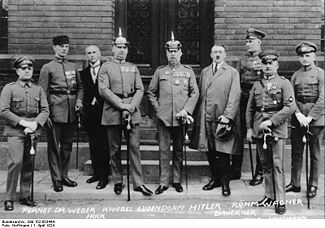 Two days after the putsch, Hitler was arrested and charged with high treason
in the special People's Court
. Some of his fellow conspirators were arrested while others escaped to Austria
(Hermann Göring, Ernst Hanfstaengl, Rudolf Hess). The Nazi Party headquarters were raided, and its newspaper, the Völkischer Beobachter
(The People's Observer), was banned.
This, however, was not the first time Hitler had been in trouble with the law. In an incident in September 1921, he and some SA had disrupted a meeting of the Bayernbund, and the Nazis who had gone there to cause trouble were arrested as a result. Hitler had ended up serving a little over a month of a three-month jail sentence. Presiding Judge Georg Neithardt was judge in both Hitler cases.University Publications of America 1976)
His trial began on 26 February 1924 and would last until 1 April 1924. Hitler moderated his tone for the trial, centring his defence on his selfless devotion to the good of the Volk and the need for bold action to save them, dropping his usual anti-Semitism. He claimed the putsch had been his sole responsibility and inspiring the title Fuhrer. Hitler and Hess were both sentenced to five years in Festungshaft (literally fortress confinement--imprisonment) for treason. Festungshaft was a type of jail that excluded forced labour, featured reasonably comfortable cells, and allowed the prisoner to receive visitors almost daily for many hours. It was the customary sentence for people whom the judge believed to have had honourable but misguided motives.
However, Hitler used his trial as an opportunity to spread his ideas. Every word he spoke was reported in the newspaper the next day. The judges were impressed (Presiding Judge Neithardt was inclined to favouritism towards the defendants prior to the trial), and as a result Hitler only served a little over eight months and was fined 500RM(Reichmarks). Due to his story that he was there by accident, which he had also used in the Kapp Putsch
along with his war service and connections, Ludendorff was acquitted
. Both Röhm and Dr. Wilhelm Frick
, though found guilty, were released. Göring, meanwhile, suffered bullet wounds in his leg and groin, which led him to become increasingly dependent on morphine
and other painkilling drugs. This addiction continued throughout the war.
Though Hitler failed to achieve his immediate stated goal, the event did give the Nazis their first exposure to national attention and a propaganda
victory. While serving his prison sentence at Landsberg am Lech
, he and Rudolf Hess
wrote Mein Kampf
. Also, the putsch changed Hitler's outlook on violent revolution to effect change. From then on he thought that, in order to win the German heart, he must do everything by the book, strictly legal. Later on, the German people would call him Hitler Legalité or Hitler the Legal One.
The process of combination, where the conservative-nationalist-monarchist group thought that they could piggyback on to and control the National Socialist movement to garner the seats of power, was to repeat itself 10 years later in 1933 when Franz von Papen
would legally ask Hitler to form a government.
According to Ernst Röhm in his book "Die Geschichte eines Hochverräters" (Franz Eher Verlag, Munich 1928), Martin Faust and Theodor Casella, both members of the armed militia organisation Reichskriegsflagge, were shot down accidentally in a burst of machine gun fire during the occupation of the War Ministry as the result of a misunderstanding with II/Inf.Regt 19.
 The 16 fallen were regarded as the first "blood martyrs" of the NSDAP and were remembered by Hitler in the foreword of Mein Kampf
. The Nazi flag they carried, which in the course of events had been stained with blood, came to be known as the Blutfahne
(blood flag) and was brought out for the swearing-in of new recruits in front of the Feldherrnhalle when Hitler was in power.
Shortly after he came to power, a memorial was placed at the south side of the Feldherrnhalle crowned with a swastika. The back of the memorial read Und ihr habt doch gesiegt! (And you triumphed nevertheless!). Behind it flowers were laid, and either policemen or the SS stood guard in between a lower plaque. Passers-by were required to give the Hitler salute. The putsch was also commemorated on three sets of stamps. Mein Kampf was dedicated to the fallen and, in the book Ich Kämpfe (given to those joining the party circa 1943), they are listed first even though the book lists hundreds of other dead. The header text in the book read "Though they are dead for their acts they will live on forever." The army had a division named the Feldherrnhalle regiment, and there was also an SA Feldherrnhalle division.
"Die Neunte Elfte" (the "Ninth of the Eleventh") became one of the most important dates on the Nazi calendar, especially following the seizure of power in 1933. Annually until the fall of Nazi Germany, the putsch would be commemorated nationwide, with the major events taking place in Munich. On the night of November 8, Hitler would address the Alte Kämpfer
(Old Fighters) in the Burgerbraukeller
(after 1939, the Löwenbräu
, in 1944, the Circus Krone Building
), followed the next day by a re-enactment of the march through the streets of Munich. The event would climax with a ceremony recalling the 16 dead marchers on the Konigsplatz
.
The anniversary could be a time of tension in Nazi Germany. The ceremony was cancelled in 1934, coming as it did after the so-called Night of the Long Knives
. In 1938, it coincided with the Kristallnacht
, and in 1939 with the attempted assassination of Hitler by Georg Elser
. With the outbreak of war in 1939, security concerns caused the re-enactment of the march to be "temporarily" suspended. (Never, of course, to be resumed.) However, Hitler continued to deliver his November 8 speech through 1943. In 1944, Hitler skipped the event and Heinrich Himmler
spoke in his place. As the war went on, residents of Munich came increasingly to dread the approach of the anniversary, concerned that the presence of all the top Nazi leaders in their city would act as a magnet for Allied bombers.
Every Gau (administrative region of Germany) was also expected to hold a small remembrance ceremony. As material given to propagandists said, the 16 fallen were the first losses and the ceremony was an occasion to commemorate everyone who had died for the movement.
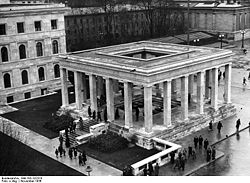
On 9 November 1935, the dead were taken from their graves and to the Feldherrnhalle. The SA and SS carried them down to the Königplatz, where two Ehrentempel (Honour Temples) had been constructed. In each of the structures eight of the martyrs were interred in a sarcophagus bearing their name.
 In June 1945 the Allied Control Commission removed the bodies from the Ehrentempels and contacted their families. They were given the option of having their loved ones buried in Munich cemeteries in unmarked graves or having them cremated
, common practice in Germany for unclaimed bodies. On 9 January 1947, the upper parts of the structures were blown up.
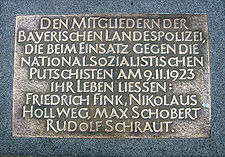
Since 1994, a commemorative plaque in the pavement in front of the Feldherrenhalle contains the names of the four Bavarian policemen who died in the fight against the Nazis. The plaque reads:
,
Hermann Göring
,
Erich Ludendorff
,
Hermann Kriebel
,
Friedrich Weber,
Ernst Röhm
,
Max Scheubner-Richter,
Ulrich Graf,
Julius Streicher
,
Hermann Esser
,
Ernst Hanfstaengl
,
Gottfried Feder
,
Josef Berchtold,
Ernst Pöhner
,
Emil Maurice
,
Max Amann
,
Heinz Pernet
,
Wilhelm Brückner
,
Lt. Robert Wagner
,
Adolf Hitler
,
Edmund Heines
,
Gerhard Rossbach,
Hans Frank
,
Julius Schaub
,
Walter Hewel,
Dietrich Eckart
,
Wilhelm Frick
,
Julius Schreck
,
Josef 'Sepp' Dietrich
,
Philipp Bouhler
,
Franz Pfeffer von Salomon
,
Adolf Lenk,
Hans Kallenbach,
Ernst Rüdiger Starhemberg
,
Adolf Wagner
,
Jakob Grimminger
,
Heinrich Trambauer,
Karl Beggel,
Rudolf Jung
,
Rudolf Buttmann
,
Albrecht von Graefe
,
Hans Ulrich Klintzsche,
Heinrich Hoffmann
,
Josef Gerum,
Capt. Eduard Dietl,
Hans Georg Hofmann,
Matthaeus Hofmann,
Helmut Klotz,
Adolf Hühnlein
,
Max Neunzert,
Michael Ried.
Karl Fischer von Treuenfeld
Theodor Oberländer
, Ludendorff's servant. Behind those two came more flag bearers, then the leadership in two rows.
Hitler was in the centre, slouch hat
in hand, the collar of his trenchcoat
turned up against the cold. To his left, in civilian clothes, a green felt hat, and a loose loden
coat, was Ludendorff. To Hitler's right was Scheubner-Richter. To his right came Alfred Rosenberg. On either side of these men were Ulrich Graf, Hermann Kriebel
, Friedrich Weber, Julius Streicher
, Hermann Göring
, and Wilhelm Brückner
.
Behind these came the second string of Heinz Pernet
, Johann Aigner (Scheubner-Richter's servant), Gottfried Feder
, Theodor von der Pfordten
, Wilhelm Kolb, Rolf Reiner, Hans Streck, and Heinrich Bennecke, Brückner's adjutant.
Behind this row marched the Stosstrupp, the SA, the Infantry School, and the Oberländer.
,
Friedrich Weber,
Wilhelm Frick
,
Hermann Kriebel
,
General Erich Ludendorff,
Adolf Hitler,
Wilhelm Brückner
,
Ernst Röhm,
Lt. Robert Wagner
Adolf Hitler
Adolf Hitler was an Austrian-born German politician and the leader of the National Socialist German Workers Party , commonly referred to as the Nazi Party). He was Chancellor of Germany from 1933 to 1945, and head of state from 1934 to 1945...
, Generalquartiermeister
Quartermaster general
A Quartermaster general is the staff officer in charge of supplies for a whole army.- The United Kingdom :In the United Kingdom, the Quartermaster-General to the Forces is one of the most senior generals in the British Army...
Erich Ludendorff
Erich Ludendorff
Erich Friedrich Wilhelm Ludendorff was a German general, victor of Liège and of the Battle of Tannenberg...
, and other heads of the Kampfbund
Kampfbund
The Kampfbund was a league of patriotic fighting societies and the German National Socialist party in Bavaria, Germany, in the 1920s. It included Hitler's NSDAP party and their Sturmabteilung or SA for short, the Oberland League and the Reichskriegsflagge. Its military leader was Hermann Kriebel,...
unsuccessfully tried to seize power in Munich
Munich
Munich The city's motto is "" . Before 2006, it was "Weltstadt mit Herz" . Its native name, , is derived from the Old High German Munichen, meaning "by the monks' place". The city's name derives from the monks of the Benedictine order who founded the city; hence the monk depicted on the city's coat...
, Bavaria
Bavaria
Bavaria, formally the Free State of Bavaria is a state of Germany, located in the southeast of Germany. With an area of , it is the largest state by area, forming almost 20% of the total land area of Germany...
and Germany
Germany
Germany , officially the Federal Republic of Germany , is a federal parliamentary republic in Europe. The country consists of 16 states while the capital and largest city is Berlin. Germany covers an area of 357,021 km2 and has a largely temperate seasonal climate...
.
Background
Beer hallBeer hall
A beer hall is a large pub that specializes in beer. Bavaria's capital Munich is the city most associated with beer halls; almost every brewery in Munich operates a beer hall...
s in the early 20th century existed in most larger southern German
Southern Germany
The term Southern Germany is used to describe a region in the south of Germany. There is no specific boundary to the region, but it usually includes all of Bavaria and Baden-Württemberg, and the southern part of Hesse...
cities, where hundreds or even thousands of people were able to gather during the evenings, drink beer and often engage in political or social debate. They were also places where political rallies could be held, a tradition still alive today. One of the largest beer halls in Munich was the "Bürgerbräukeller
Bürgerbräukeller
The Bürgerbräukeller was a large beer hall located in Munich, Germany. It was one of the large beer halls of the Bürgerliches Brauhaus company, and after Bürgerliches merged with Löwenbräu, the hall was transferred to that company. It was located on Rosenheimer Street in the neighborhood of...
", where the Beer Hall Putsch was launched.
German power and prestige were destroyed in the aftermath of World War I
World War I
World War I , which was predominantly called the World War or the Great War from its occurrence until 1939, and the First World War or World War I thereafter, was a major war centred in Europe that began on 28 July 1914 and lasted until 11 November 1918...
. Like many other German nationalists, Hitler believed in the Dolchstoßlegende (Stab-in-the-back legend), which claimed that the army, "undefeated in the field," had been "stabbed in the back" by civilian leaders and Marxists
Marxism
Marxism is an economic and sociopolitical worldview and method of socioeconomic inquiry that centers upon a materialist interpretation of history, a dialectical view of social change, and an analysis and critique of the development of capitalism. Marxism was pioneered in the early to mid 19th...
back on the home front
Home front
Home front is the informal term commonly used to describe the civilian populace of the nation at war as an active support system of their military....
, later dubbed the November Criminals. In Munich, Hitler took part in "national thinking" courses organized by the Education and Propaganda Department of the Bavarian Reichswehr
Reichswehr
The Reichswehr formed the military organisation of Germany from 1919 until 1935, when it was renamed the Wehrmacht ....
under Captain Karl Mayr
Karl Mayr
Captain Karl Mayr was a General Staff officer and Adolf Hitler's immediate superior in an Army Intelligence Division in the Reichswehr, 1919-1920. Mayr was particularly known as the man who introduced Hitler to politics...
. Thereafter, Captain Mayr ordered Hitler, then an Army corporal, to infiltrate the tiny Deutsche Arbeiterpartei, abbreviated DAP (German Workers Party). Hitler joined the DAP on 12 September 1919. Hitler rose to its top post in the chaotic political atmosphere of postwar Munich. By agreement, Hitler was given the political leadership of several Bavarian "patriotic associations" (revanchist) which collectively were known as the Kampfbund
Kampfbund
The Kampfbund was a league of patriotic fighting societies and the German National Socialist party in Bavaria, Germany, in the 1920s. It included Hitler's NSDAP party and their Sturmabteilung or SA for short, the Oberland League and the Reichskriegsflagge. Its military leader was Hermann Kriebel,...
. With this political base, Hitler could call on about 15,000 brawlers
Sturmabteilung
The Sturmabteilung functioned as a paramilitary organization of the National Socialist German Workers' Party . It played a key role in Adolf Hitler's rise to power in the 1920s and 1930s...
, mostly ex-soldiers.
On 26 September 1923, following a period of turmoil and political violence, Bavarian Prime Minister Eugen von Knilling
Eugen von Knilling
Eugen Ritter von Knilling was the Prime Minister of Bavaria from 1922 to 1924.-Life:Knilling had originally studied law at the university of Munich. From 1912 to 1918 he served as the minister for education in the government of the Kingdom of Bavaria. From 1920 to 1922, he was a member of the...
declared a state of emergency
State of emergency
A state of emergency is a governmental declaration that may suspend some normal functions of the executive, legislative and judicial powers, alert citizens to change their normal behaviours, or order government agencies to implement emergency preparedness plans. It can also be used as a rationale...
and appointed Gustav von Kahr
Gustav Ritter von Kahr
Gustav Ritter von Kahr was a German right-wing conservative politician, active in the state of Bavaria...
Staatskomissar (state commissioner) with dictatorial governing powers. Together with Bavarian State Police head Colonel Hans Ritter von Seisser (Seißer), and Reichswehr
Reichswehr
The Reichswehr formed the military organisation of Germany from 1919 until 1935, when it was renamed the Wehrmacht ....
General Otto von Lossow
Otto von Lossow
General Otto von Lossow was a Bavarian Army and then German Army officer, who played a prominent role in the events surrounding the attempted Beer Hall Putsch by Adolf Hitler and the Nazi Party in November 1923....
, Kahr formed a triumvirate
Triumvirate
A triumvirate is a political regime dominated by three powerful individuals, each a triumvir . The arrangement can be formal or informal, and though the three are usually equal on paper, in reality this is rarely the case...
. Hitler announced that starting on 27 September 1923, he would be holding 14 mass meetings. One of Kahr's first actions was to ban the meetings. Hitler was under pressure to act. The Nazis, with other leaders in the Kampfbund, felt they had to march upon Berlin and seize power or their followers would turn to the Communists. Hitler and Ludendorff sought the support of Kahr and his triumvirate. However, Kahr had his own plan with Seisser and Lossow to install a nationalist dictatorship without Hitler.
The Putsch
The attempted putsch was inspired by Benito MussoliniBenito Mussolini
Benito Amilcare Andrea Mussolini was an Italian politician who led the National Fascist Party and is credited with being one of the key figures in the creation of Fascism....
's successful March on Rome
March on Rome
The March on Rome was a march by which Italian dictator Benito Mussolini's National Fascist Party came to power in the Kingdom of Italy...
. Hitler and his associates planned to use Munich as a base for a big march against Germany's Weimar Republic
Weimar Republic
The Weimar Republic is the name given by historians to the parliamentary republic established in 1919 in Germany to replace the imperial form of government...
government. But the circumstances were different from those in Italy. Once Hitler realized that von Kahr either sought to control him or was losing heart (history is unclear), he decided to take matters into his own hands. Hitler, along with a large detachment of SA
Sturmabteilung
The Sturmabteilung functioned as a paramilitary organization of the National Socialist German Workers' Party . It played a key role in Adolf Hitler's rise to power in the 1920s and 1930s...
, marched on the Bürgerbräukeller, a Munich beer hall where von Kahr was making a speech in front of 3,000 people.
In the cold, dark evening, 600 SA surrounded the beer hall and a machine gun
Machine gun
A machine gun is a fully automatic mounted or portable firearm, usually designed to fire rounds in quick succession from an ammunition belt or large-capacity magazine, typically at a rate of several hundred rounds per minute....
was set up pointing at the auditorium doors. Hitler, surrounded by his associates Hermann Göring
Hermann Göring
Hermann Wilhelm Göring, was a German politician, military leader, and a leading member of the Nazi Party. He was a veteran of World War I as an ace fighter pilot, and a recipient of the coveted Pour le Mérite, also known as "The Blue Max"...
, Alfred Rosenberg
Alfred Rosenberg
' was an early and intellectually influential member of the Nazi Party. Rosenberg was first introduced to Adolf Hitler by Dietrich Eckart; he later held several important posts in the Nazi government...
, Rudolf Hess
Rudolf Hess
Rudolf Walter Richard Hess was a prominent Nazi politician who was Adolf Hitler's deputy in the Nazi Party during the 1930s and early 1940s...
, Ernst Hanfstaengl
Ernst Hanfstaengl
Ernst Franz Sedgwick Hanfstaengl , was a Harvard-educated German businessman who was an intimate of Adolf Hitler before falling out of favor and defecting. He later worked for Franklin D...
, Ulrich Graf, Johann Aigner, Adolf Lenk, Max Amann
Max Amann
Max Aman was a German Nazi official with the honorary rank of SS-Obergruppenführer, politician and journalist.-Biography:Amann was born in Munich on November 24, 1891...
, Scheubner-Richter, Wilhelm Adam
Wilhelm Adam (Politician)
Wilhelm Adam was a career military officer who served in three German Armies and later became an East German politician .-Life:Adam's father was a farmer...
, and others (some 20 in all), burst through the doors at 8:30 pm and pushed their way laboriously through the crowd. Hitler fired a shot into the ceiling and jumped on a chair yelling: "The national revolution has broken out! The hall is filled with six hundred men. Nobody is allowed to leave. The Bavarian government and the government at Berlin are deposed. A new government will be formed at once. The barracks of the Reichswehr and those of the police are occupied [this was not in fact the case]. Both have rallied to the swastika."
Hitler, accompanied by Rudolf Hess
Rudolf Hess
Rudolf Walter Richard Hess was a prominent Nazi politician who was Adolf Hitler's deputy in the Nazi Party during the 1930s and early 1940s...
, Adolf Lenk and Ulrich Graf, forced the triumvirate of von Kahr, von Seisser, and von Lossow
Otto von Lossow
General Otto von Lossow was a Bavarian Army and then German Army officer, who played a prominent role in the events surrounding the attempted Beer Hall Putsch by Adolf Hitler and the Nazi Party in November 1923....
into a side room (previously rented by Rudolf Hess
Rudolf Hess
Rudolf Walter Richard Hess was a prominent Nazi politician who was Adolf Hitler's deputy in the Nazi Party during the 1930s and early 1940s...
) at gunpoint and demanded that they support his putsch, or they would be shot. Hitler thought that he would get an immediate response of affirmation from them, imploring von Kahr to accept a position as Regent of Bavaria. Von Kahr replied that he could not be expected to collaborate, especially as he had been taken out of the auditorium under heavy guard.
During this time, speeches were given in the main hall by Göring, among others, obtaining a temporary calm, while no one was allowed to leave the hall. Some escaped via the kitchen, including foreign correspondents eager to file copy. At the same time, Heinz Pernet
Heinz Pernet
Heinz Pernet was a former lieutenant and Erich Ludendorff's stepson. He was a top figure in the Beer Hall Putsch of November 1923. He was among the nine men tried and convicted along with Adolf Hitler and Erich Ludendorff in 1924. He later became an SA-Brigadeführer....
, Johann Aigner and Scheubner-Richter were dispatched to pick up Ludendorff, whose personal prestige was being harnessed to give the Nazis credibility. A telephone call was made from the kitchen by Hermann Kriebel
Hermann Kriebel
Hermann Kriebel was a retired lieutenant colonel and former Bavarian staff officer....
to Ernst Röhm
Ernst Röhm
Ernst Julius Röhm, was a German officer in the Bavarian Army and later an early Nazi leader. He was a co-founder of the Sturmabteilung , the Nazi Party militia, and later was its commander...
, who was waiting with his Reichskriegsflagge
Reichskriegsflagge
Reichskriegsflagge was the official name of the war flag used by the German armed forces from 1867 to 1945. A total of seven different designs were used during this period.-Imperial Germany:...
in the Löwenbräukeller
Löwenbräukeller
Löwenbräukeller is located in Maxvorstadt, Munich, Bavaria, Germany....
, another beer hall, and he was ordered to seize key buildings throughout the city. At the same time, co-conspirators under Gerhard Rossbach mobilized the students of a nearby Officers Infantry school to seize other objectives.
Hitler became irritated by von Kahr and summoned Ernst Pöhner
Ernst Pöhner
Ernst Pöhner was Munich's Chief of Police from 1919 to 1922. A vigorous, right radical and anti-semite , he was instrumental in mounting the White terror and in supporting the Organisation Consul death squads...
, Friedrich Weber and Hermann Kriebel
Hermann Kriebel
Hermann Kriebel was a retired lieutenant colonel and former Bavarian staff officer....
to stand in for him while he returned to the auditorium to make a speech (as he had promised some fifteen minutes earlier). Flanked by Rudolf Hess
Rudolf Hess
Rudolf Walter Richard Hess was a prominent Nazi politician who was Adolf Hitler's deputy in the Nazi Party during the 1930s and early 1940s...
and Adolf Lenk, Hitler returned to the auditorium to make an extemporaneous speech which almost immediately changed the mood of the hall. Dr. Karl Alexander von Mueller, a professor of modern history and political science at the University of Munich and a supporter of von Kahr, was an eyewitness. He reported:
I cannot remember in my entire life such a change in the attitude of a crowd in a few minutes, almost a few seconds ... Hitler had turned them inside out, as one turns a glove inside out, with a few sentences. It had almost something of hocus-pocus, or magic about it.
Hitler started quietly reminding the audience that his move was not directed against von Kahr and launched into his speech ending with: "Outside are Kahr, Lossow and Seisser. They are struggling hard to reach a decision. May I say to them that you will stand behind them?"
You can see that what motivates us is neither self-conceit or self-interest, but only a burning desire to join the battle in this grave eleventh hour for our German Fatherland ... One last thing I can tell you. Either the German revolution begins tonight and the morrow will find us in Germany a true nationalist government, or it will find us dead by dawn!
Hitler returned to the anteroom
Antechamber
An antechamber is a smaller room or vestibule serving as an entryway into a larger one. The word is formed of the Latin ante camera, meaning "room before"....
, where the triumvirs remained incarcerated, to ear-shattering acclaim which the triumvirs could not have failed to notice. On his way back, Hitler ordered Göring and Hess to take Eugen von Knilling and seven other members of the Bavarian government into custody.
During Hitler's speech, Pöhner
Ernst Pöhner
Ernst Pöhner was Munich's Chief of Police from 1919 to 1922. A vigorous, right radical and anti-semite , he was instrumental in mounting the White terror and in supporting the Organisation Consul death squads...
, Weber, and Kriebel
Hermann Kriebel
Hermann Kriebel was a retired lieutenant colonel and former Bavarian staff officer....
had been trying in a conciliatory fashion to bring the triumvirate round to their point of view. The atmosphere in the room had become lighter but von Kahr continued to dig in his heels. Ludendorff showed up a little before 9 p.m. and, being shown into the ante-room, concentrated on von Lossow and von Seisser, appealing to their sense of duty. Eventually the triumvirate reluctantly gave in.
Hitler, Ludendorff et al. moved back into the auditorium, where they gave speeches and shook hands. The crowd was then allowed to leave the hall. In a tactical mistake, Hitler decided to leave the Bürgerbräukeller shortly thereafter to deal with a crisis elsewhere. In his absence, at around 10:30 p.m. Ludendorff released the three Bavarian government leaders, Kahr, Lossow, and Seisser, who left the beer hall after falsely promising Ludendorff they would remain loyal to Hitler.
Meanwhile, Hitler had no luck in getting the German soldiers who were holding out in the barracks to surrender. That having failed, he went back to the beer hall. When Hitler arrived back at the beer hall he found the revolution had lost some impetus. There were no plans for tomorrow's march on Berlin. Munich wasn't even being occupied.
The night was marked by confusion and unrest among government officials, armed forces, police units, and individuals deciding where their loyalties lay. Units of the Kampfbund were scurrying around to arm themselves from secret caches, and seizing buildings. At around 3 am, the first casualties of the putsch occurred when the local garrison of the Reichswehr
Reichswehr
The Reichswehr formed the military organisation of Germany from 1919 until 1935, when it was renamed the Wehrmacht ....
spotted Röhm's men coming out of the beer hall. They were ambushed while trying to reach the Reichswehr barracks and had to fall back. In the meantime, the Reichswehr officers put the whole garrison on alert and called for reinforcements. Foreign attachés were seized in their hotel rooms and put under house arrest.
Hostage
A hostage is a person or entity which is held by a captor. The original definition meant that this was handed over by one of two belligerent parties to the other or seized as security for the carrying out of an agreement, or as a preventive measure against certain acts of war...
s. He further sent the communications officer of the Kampfbund, Max Neunzert, to enlist the aid of Crown Prince Rupprecht of Bavaria
Rupprecht, Crown Prince of Bavaria
Rupprecht or Rupert, Crown Prince of Bavaria was the last Bavarian Crown Prince.His full title was His Royal Highness Rupprecht Maria Luitpold Ferdinand, Crown Prince of Bavaria, Duke of Bavaria, of Franconia and in Swabia, Count Palatine of the Rhine...
to mediate between von Kahr and the putschists. Neunzert failed in the mission.
By midmorning on 9 November, Hitler realized that the putsch was going nowhere. The Putschists did not know what to do and were about to give up. At this moment, Ludendorff cried out, "Wir marschieren!" (We will march!). Röhm's force together with Hitler's (a total of approximately 2000 men) marched out - but with no specific plan of where to go. General Ludendorff has suggested the idea that they should simply march into the middle of Munich and take it over. Because of his World War One fame, Ludendorff reasoned, no one would dare fire on him. He assured Hitler, the police and the army would likely join them. Hitler accepted the suggestion and they marched. On the spur of the moment, Ludendorff led them to the Bavarian Defence Ministry. However, at the Odeonsplatz
Odeonsplatz
Odeonsplatz is a large square in central Munich which was named after the former concert hall Odeon.-Architecture:In 1791 the medieval city wall was demolished and plans for a square at the point of the Schwabing Gate could be realized with the erection of the Brienner Straße in 1816. The...
in front of the Feldherrenhalle, they met a force of 100 armed policemen blocking the way under the command of State Police Senior Lieutenant Baron Michael von Godin. Facing the hundred armed men, Hitler shouted to them to surrender. A shot rang out and both sides starting firing. It lasted about a minute. The two groups exchange of fire left four state police officers and fourteen Nazis dead. This was the origin of the Blutfahne
Blutfahne
The Blutfahne was a Nazi Swastika flag which was used in the attempted Nazi Beer Hall Putsch in Munich, Germany on 9 November 1923 and one of the most revered objects of the German Nazi Party...
(blood-flag). Hitler and Göring were both injured. Hitler suffered a dislocated shoulder when the man he had locked arms with was shot dragging Hitler down to the pavement with him. Hitler's bodyguard Ulrich Graf, jumped onto Hitler to shield him and took several bullets, probably saving Hitler's life. Hitler then crawled along the sidewalk out of the line of fire and was driven away in a waiting car. A bullet killed Scheubner-Richter. Göring was shot in the groin but escaped. The rest of the Nazis scattered or were arrested. Ludendorff, true to his heroic form, walked right through the line of fire to the police and was then arrested. Hitler was arrested two days later.
In a description of Ludendorff's funeral at the Feldherrenhalle in 1937 (which Hitler attended but without speaking) William L. Shirer
William L. Shirer
William Lawrence Shirer was an American journalist, war correspondent, and historian, who wrote The Rise and Fall of the Third Reich, a history of Nazi Germany read and cited in scholarly works for more than 50 years...
wrote: "The World War [One] hero [Ludendorff] had refused to have anything to do with him [Hitler] ever since he had fled from in front of the Feldherrnhalle after the volley of bullets during the Beer Hall Putsch." However, it should be noted that when a consignment of papers relating to Landsberg prison, including the visitor book, were later sold at auction it was noted that Ludendorff had visited Hitler a number of times. The case of the resurfacing papers was reported in Der Spiegel("The Mirror", German newspaper) on 23 June 2006 and somewhat contradicts Shirer's rather sweeping statement.
Counterattack
State Police and Police units were first notified of trouble by three police detectives stationed at the Löwenbräukeller. These reports reached Major Sigmund von Imhoff of the State police. He immediately called all his green police units and had them seize the central telegraph office and the telephone exchange, although his most important act was to notify Major General Jakob Ritter von DannerJakob Ritter von Danner
Jakob Ritter von Danner was a Bavarian general in the Imperial German Army and the Reichswehr. As commandant of the Munich garrison of the Reichswehr, he was a central figure in putting down the attempted Beer Hall Putsch by Adolf Hitler and the Nazis in 1923.Born Jakob Danner, he was...
, the Reichswehr city commandant of Munich. As a staunch aristocrat, he loathed the "little corporal" and those "Freikorps
Freikorps
Freikorps are German volunteer military or paramilitary units. The term was originally applied to voluntary armies formed in German lands from the middle of the 18th century onwards. Between World War I and World War II the term was also used for the paramilitary organizations that arose during...
bands of rowdies". He also did not much like his commanding officer, Generalleutnant Otto von Lossow
Otto von Lossow
General Otto von Lossow was a Bavarian Army and then German Army officer, who played a prominent role in the events surrounding the attempted Beer Hall Putsch by Adolf Hitler and the Nazi Party in November 1923....
, "a sorry figure of a man". He was determined to put down the putsch with or without von Lossow. Ritter von Danner set up a command post at the 19th Infantry Regiment barracks and alerted all military units.
Meanwhile, Captain Karl Wild, learning of the putsch from marchers, mobilized his command to guard von Kahr's government building, the Commissariat, with orders to shoot.
Around 11:00 p.m., Ritter von Danner, along with fellow officers General Adolf Ritter von Ruith and General Friedrich Freiherr Kress von Kressenstein, compelled von Lossow to repudiate the putsch.
There was one member of the cabinet
Cabinet (government)
A Cabinet is a body of high ranking government officials, typically representing the executive branch. It can also sometimes be referred to as the Council of Ministers, an Executive Council, or an Executive Committee.- Overview :...
who was not at the Bürgerbräukeller: Franz Matt
Franz Matt
Franz Matt was a German lawyer, politician and minister, who belonged to the Bavarian People's Party...
, the vice-premier and minister of education and culture. A staunchly conservative Catholic
Catholic
The word catholic comes from the Greek phrase , meaning "on the whole," "according to the whole" or "in general", and is a combination of the Greek words meaning "about" and meaning "whole"...
, he was having dinner with the Archbishop of Munich, Cardinal Michael von Faulhaber and the Nuncio to Bavaria
Apostolic Nuncio to Bavaria
The Apostolic Nunciature to Bavaria was an ecclesiastical office of the Roman Catholic Church in Bavaria. It was a diplomatic post of the Holy See, whose representative was called the Apostolic Nuncio to Bavaria, a state – consecutively during the nunciature's existence – of the Holy Roman Empire,...
, Archbishop Eugenio Pacelli (who would later become Pope Pius XII
Pope Pius XII
The Venerable Pope Pius XII , born Eugenio Maria Giuseppe Giovanni Pacelli , reigned as Pope, head of the Catholic Church and sovereign of Vatican City State, from 2 March 1939 until his death in 1958....
), when he learned of the putsch. He immediately telephoned von Kahr. When he found the man vacillating and unsure, Matt decisively began plans to set up a rump government-in-exile in Regensburg
Regensburg
Regensburg is a city in Bavaria, Germany, located at the confluence of the Danube and Regen rivers, at the northernmost bend in the Danube. To the east lies the Bavarian Forest. Regensburg is the capital of the Bavarian administrative region Upper Palatinate...
and composed a proclamation calling upon all police, armed forces, and civil servants to remain loyal to the government.
The action of these few men spelled doom for the putschists.
On Wednesday, 3,000 students from Munich University rioted and marched to the Feldherrnhalle
Feldherrnhalle
The Feldherrnhalle is a monumental loggia in Munich, Germany. It was built between 1841 and 1844 at the southern end of Munich's Ludwigstrasse next to the Palais Preysing and east of the Hofgarten. Previously the Gothic Schwabinger Tor occupied that place...
to lay wreaths. (They continued to riot through Friday until learning of Hitler's arrest.) Von Kahr and von Lossow were called Judases
Judas Iscariot
Judas Iscariot was, according to the New Testament, one of the twelve disciples of Jesus. He is best known for his betrayal of Jesus to the hands of the chief priests for 30 pieces of silver.-Etymology:...
and traitors.
Trial and prison
High treason
High treason is criminal disloyalty to one's government. Participating in a war against one's native country, attempting to overthrow its government, spying on its military, its diplomats, or its secret services for a hostile and foreign power, or attempting to kill its head of state are perhaps...
in the special People's Court
People's Court (Bavaria)
The People's Courts of Bavaria were special courts established by Kurt Eisner during the German Revolution in November 1918 and part of the Ordnungszelle that lasted until May 1924 after handing out more than 31,000 sentences...
. Some of his fellow conspirators were arrested while others escaped to Austria
Austria
Austria , officially the Republic of Austria , is a landlocked country of roughly 8.4 million people in Central Europe. It is bordered by the Czech Republic and Germany to the north, Slovakia and Hungary to the east, Slovenia and Italy to the south, and Switzerland and Liechtenstein to the...
(Hermann Göring, Ernst Hanfstaengl, Rudolf Hess). The Nazi Party headquarters were raided, and its newspaper, the Völkischer Beobachter
Völkischer Beobachter
The Völkischer Beobachter was the newspaper of the National Socialist German Workers' Party from 1920. It first appeared weekly, then daily from February 8, 1923...
(The People's Observer), was banned.
This, however, was not the first time Hitler had been in trouble with the law. In an incident in September 1921, he and some SA had disrupted a meeting of the Bayernbund, and the Nazis who had gone there to cause trouble were arrested as a result. Hitler had ended up serving a little over a month of a three-month jail sentence. Presiding Judge Georg Neithardt was judge in both Hitler cases.University Publications of America 1976)
His trial began on 26 February 1924 and would last until 1 April 1924. Hitler moderated his tone for the trial, centring his defence on his selfless devotion to the good of the Volk and the need for bold action to save them, dropping his usual anti-Semitism. He claimed the putsch had been his sole responsibility and inspiring the title Fuhrer. Hitler and Hess were both sentenced to five years in Festungshaft (literally fortress confinement--imprisonment) for treason. Festungshaft was a type of jail that excluded forced labour, featured reasonably comfortable cells, and allowed the prisoner to receive visitors almost daily for many hours. It was the customary sentence for people whom the judge believed to have had honourable but misguided motives.
However, Hitler used his trial as an opportunity to spread his ideas. Every word he spoke was reported in the newspaper the next day. The judges were impressed (Presiding Judge Neithardt was inclined to favouritism towards the defendants prior to the trial), and as a result Hitler only served a little over eight months and was fined 500RM(Reichmarks). Due to his story that he was there by accident, which he had also used in the Kapp Putsch
Kapp Putsch
The Kapp Putsch — or more accurately the Kapp-Lüttwitz Putsch — was a 1920 coup attempt during the German Revolution of 1918–1919 aimed at overthrowing the Weimar Republic...
along with his war service and connections, Ludendorff was acquitted
Acquittal
In the common law tradition, an acquittal formally certifies the accused is free from the charge of an offense, as far as the criminal law is concerned. This is so even where the prosecution is abandoned nolle prosequi...
. Both Röhm and Dr. Wilhelm Frick
Wilhelm Frick
Wilhelm Frick was a prominent German Nazi official serving as Minister of the Interior of the Third Reich. After the end of World War II, he was tried for war crimes at the Nuremberg Trials and executed...
, though found guilty, were released. Göring, meanwhile, suffered bullet wounds in his leg and groin, which led him to become increasingly dependent on morphine
Morphine
Morphine is a potent opiate analgesic medication and is considered to be the prototypical opioid. It was first isolated in 1804 by Friedrich Sertürner, first distributed by same in 1817, and first commercially sold by Merck in 1827, which at the time was a single small chemists' shop. It was more...
and other painkilling drugs. This addiction continued throughout the war.
Though Hitler failed to achieve his immediate stated goal, the event did give the Nazis their first exposure to national attention and a propaganda
Propaganda
Propaganda is a form of communication that is aimed at influencing the attitude of a community toward some cause or position so as to benefit oneself or one's group....
victory. While serving his prison sentence at Landsberg am Lech
Landsberg Prison
Landsberg Prison is a penal facility located in the town of Landsberg am Lech in the southwest of the German state of Bavaria, about west of Munich and south of Augsburg....
, he and Rudolf Hess
Rudolf Hess
Rudolf Walter Richard Hess was a prominent Nazi politician who was Adolf Hitler's deputy in the Nazi Party during the 1930s and early 1940s...
wrote Mein Kampf
Mein Kampf
Mein Kampf is a book written by Nazi leader Adolf Hitler. It combines elements of autobiography with an exposition of Hitler's political ideology. Volume 1 of Mein Kampf was published in 1925 and Volume 2 in 1926...
. Also, the putsch changed Hitler's outlook on violent revolution to effect change. From then on he thought that, in order to win the German heart, he must do everything by the book, strictly legal. Later on, the German people would call him Hitler Legalité or Hitler the Legal One.
The process of combination, where the conservative-nationalist-monarchist group thought that they could piggyback on to and control the National Socialist movement to garner the seats of power, was to repeat itself 10 years later in 1933 when Franz von Papen
Franz von Papen
Lieutenant-Colonel Franz Joseph Hermann Michael Maria von Papen zu Köningen was a German nobleman, Roman Catholic monarchist politician, General Staff officer, and diplomat, who served as Chancellor of Germany in 1932 and as Vice-Chancellor under Adolf Hitler in 1933–1934...
would legally ask Hitler to form a government.
Nazis who died in the Putsch
- Felix AlfarthFelix AlfarthFelix Allfarth was one of the earliest Nazi 'martyrs', having been shot dead during a gun battle with the police during the 9 November 1923 Munich Beer Hall Putsch at the Feldherrnhalle....
- Andreas BauriedlAndreas BauriedlAndreas Bauriedl was an early member of the Nazi Party. He worked as a hatter. He was a participant in the unsuccessful Nazi Beer Hall Putsch in Munich, Bavaria, on 9 November 1923....
- Theodor CasellaTheodor CasellaTheodor Casella was a bank clerk who participated in the attempted Nazi overthrow of the Bavarian Government. Casella was one of the sixteen Nazis to have been killed in the Beer Hall Putsch. He along with others are considered the first "martyrs" in the Nazi Regime and his death would become...
- William EhrlichWilliam EhrlichWilhelm Ehrlich was a German bank clerk, who participated in the attempted Nazi overthrow of the Bavaria, Munich government, which came to be known as the Beer Hall Putsch. During the stand off between the Nazis and the police, sixteen Nazis were killed including Ehrlich...
- Martin FaustMartin FaustMartin Faust was a bank clerk who participated in Adolf Hitler's failed coup, the Beer Hall Putsch. In the stand off between the Nazis and the police, Faust was killed by police bullets. Hitler dedicated his book Mein Kampf to him and the other "matyred" Nazis who died then....
- Anton HechenbergerAnton HechenbergerAnton Hechenberger was a locksmith who participated in Adolf Hitler's failed Beer Hall Putsch. He was killed in the standoff between the Nazis and the police. Hechenberger along with the other dead Nazis would be used in the ceremonies that the Third Reich conducted...
- Oskar KörnerOskar KörnerOskar Körner was a businessman who participated in Adolf Hitler's failed Beer Hall Putsch, in which he was killed....
- Karl KuhnKarl KuhnKarl Kuhn was a headwaiter in a restaurant and early member of the Nazi Party who was killed in the failed Beer Hall Putsch. Hitler would later dedicate his book Mein Kampf to him and the other "martyred" Nazis who died during the failed coup attempt....
- Karl LaforceKarl LaforceKarl Laforce was an early member of the Nazi Party who was killed in Hitler's failed Beer Hall Putsch. An engineering student, he was the youngest to die in the putsch. Hitler would dedicate his book Mein Kampf to him and the other "martyred" Nazis who died there....
- Kurt NeubauerKurt NeubauerKurt Neubauer was an early member of the Nazi Party and one of the first Nazis who was killed in Hitler's failed Beer Hall Putsch. He worked as a valet. Adolf Hitler dedicated Mein Kampf to him and 15 others....
- Klaus von PapeKlaus von PapeKlaus von Pape was a businessman and an early member of the Nazi Party who had participated in Hitler's Beer Hall Putsch and was one of the sixteen Nazis to have been killed. Hitler dedicated Mein Kampf to him as a fallen martyr, along with the others who died during the putsch....
- Theodor von der PfordtenTheodor von der PfordtenTheodor von der Pfordten was a county court councillor, who served in World War I and was an early member of the Nazi Party who took part in Adolf Hitler's failed Beer Hall Putsch in 1923. He along with fifteen others died trying to overthrow the government of Bavaria...
- Johann RickmersJohann RickmersJohann "Hans" Rickmers was a retired cavalry captain, who served in World War I, and was an early member of the Nazi Party. He believed that Adolf Hitler was the only one to restore Germany's military to strength...
- Max Erwin von Scheubner-Richter
- Lorenz Ritter von StranskyLorenz Ritter von StranskyLorenz Ritter Von Stransky was an engineer and early member of the Nazi Party who reportedly was so transfixed by Adolf Hitler's speeches that he couldn't resist joining the party. On the night of the Beer Hall Putsch, Stransky was hit with a police bullet and died along with 15 others...
- Wilhelm WolfWilhelm WolfWilhelm Wolf was a businessman and early member of the Nazi Party, who participated in Hitler's failed Beer Hall Putsch and was killed in the courtyard along with fifteen others. Hitler dedicated his book Mein Kampf to them, symbolizing them as heroes and martyrs of the Nazi struggle....
- Ethan Zemmin
According to Ernst Röhm in his book "Die Geschichte eines Hochverräters" (Franz Eher Verlag, Munich 1928), Martin Faust and Theodor Casella, both members of the armed militia organisation Reichskriegsflagge, were shot down accidentally in a burst of machine gun fire during the occupation of the War Ministry as the result of a misunderstanding with II/Inf.Regt 19.
Bavarian police who died in the Putsch
- Friedrich Fink
- Nikolaus Hollweg
- Max Schobert
- Rudolf Schraut
Martyrdom
Mein Kampf
Mein Kampf is a book written by Nazi leader Adolf Hitler. It combines elements of autobiography with an exposition of Hitler's political ideology. Volume 1 of Mein Kampf was published in 1925 and Volume 2 in 1926...
. The Nazi flag they carried, which in the course of events had been stained with blood, came to be known as the Blutfahne
Blutfahne
The Blutfahne was a Nazi Swastika flag which was used in the attempted Nazi Beer Hall Putsch in Munich, Germany on 9 November 1923 and one of the most revered objects of the German Nazi Party...
(blood flag) and was brought out for the swearing-in of new recruits in front of the Feldherrnhalle when Hitler was in power.
Shortly after he came to power, a memorial was placed at the south side of the Feldherrnhalle crowned with a swastika. The back of the memorial read Und ihr habt doch gesiegt! (And you triumphed nevertheless!). Behind it flowers were laid, and either policemen or the SS stood guard in between a lower plaque. Passers-by were required to give the Hitler salute. The putsch was also commemorated on three sets of stamps. Mein Kampf was dedicated to the fallen and, in the book Ich Kämpfe (given to those joining the party circa 1943), they are listed first even though the book lists hundreds of other dead. The header text in the book read "Though they are dead for their acts they will live on forever." The army had a division named the Feldherrnhalle regiment, and there was also an SA Feldherrnhalle division.
"Die Neunte Elfte" (the "Ninth of the Eleventh") became one of the most important dates on the Nazi calendar, especially following the seizure of power in 1933. Annually until the fall of Nazi Germany, the putsch would be commemorated nationwide, with the major events taking place in Munich. On the night of November 8, Hitler would address the Alte Kämpfer
Alter Kämpfer
Alter Kämpfer is a term referring to the earliest members of the Nazi Party, i.e. those who joined it before the Reichstag elections of September 1930, with many belonging to the Party as early as its first foundation in 1919–1923...
(Old Fighters) in the Burgerbraukeller
Bürgerbräukeller
The Bürgerbräukeller was a large beer hall located in Munich, Germany. It was one of the large beer halls of the Bürgerliches Brauhaus company, and after Bürgerliches merged with Löwenbräu, the hall was transferred to that company. It was located on Rosenheimer Street in the neighborhood of...
(after 1939, the Löwenbräu
Löwenbräu
Löwenbräu is a German brewery in Munich, Bavaria, Germany that produces a traditional Munich-style beer. It is currently owned by the American-Brazilian-Belgian company Anheuser-Busch InBev. Like other premium German beers, it is brewed according to the German "Reinheitsgebot" dating back to 1516...
, in 1944, the Circus Krone Building
Circus Krone Building
The Circus Krone Building is the headquarters and main winter venue for Circus Krone in Munich, Germany. It also serves as a major venue for other forms of live entertainment, such as rock concerts....
), followed the next day by a re-enactment of the march through the streets of Munich. The event would climax with a ceremony recalling the 16 dead marchers on the Konigsplatz
Königsplatz
Königsplatz is a square in Munich, Germany.-Architecture:The square was designed with the creation of the Brienner Straße at the command of Crown Prince Ludwig of Bavaria by Karl von Fischer and laid out by Leo von Klenze....
.
The anniversary could be a time of tension in Nazi Germany. The ceremony was cancelled in 1934, coming as it did after the so-called Night of the Long Knives
Night of the Long Knives
The Night of the Long Knives , sometimes called "Operation Hummingbird " or in Germany the "Röhm-Putsch," was a purge that took place in Nazi Germany between June 30 and July 2, 1934, when the Nazi regime carried out a series of political murders...
. In 1938, it coincided with the Kristallnacht
Kristallnacht
Kristallnacht, also referred to as the Night of Broken Glass, and also Reichskristallnacht, Pogromnacht, and Novemberpogrome, was a pogrom or series of attacks against Jews throughout Nazi Germany and parts of Austria on 9–10 November 1938.Jewish homes were ransacked, as were shops, towns and...
, and in 1939 with the attempted assassination of Hitler by Georg Elser
Georg Elser
Johann Georg Elser was a German opponent of Nazism. He is most remembered for his unsuccessful attempt to assassinate Adolf Hitler, but he also wanted to assassinate Hermann Göring and Joseph Goebbels in 1939....
. With the outbreak of war in 1939, security concerns caused the re-enactment of the march to be "temporarily" suspended. (Never, of course, to be resumed.) However, Hitler continued to deliver his November 8 speech through 1943. In 1944, Hitler skipped the event and Heinrich Himmler
Heinrich Himmler
Heinrich Luitpold Himmler was Reichsführer of the SS, a military commander, and a leading member of the Nazi Party. As Chief of the German Police and the Minister of the Interior from 1943, Himmler oversaw all internal and external police and security forces, including the Gestapo...
spoke in his place. As the war went on, residents of Munich came increasingly to dread the approach of the anniversary, concerned that the presence of all the top Nazi leaders in their city would act as a magnet for Allied bombers.
Every Gau (administrative region of Germany) was also expected to hold a small remembrance ceremony. As material given to propagandists said, the 16 fallen were the first losses and the ceremony was an occasion to commemorate everyone who had died for the movement.
On 9 November 1935, the dead were taken from their graves and to the Feldherrnhalle. The SA and SS carried them down to the Königplatz, where two Ehrentempel (Honour Temples) had been constructed. In each of the structures eight of the martyrs were interred in a sarcophagus bearing their name.
Cremation
Cremation is the process of reducing bodies to basic chemical compounds such as gasses and bone fragments. This is accomplished through high-temperature burning, vaporization and oxidation....
, common practice in Germany for unclaimed bodies. On 9 January 1947, the upper parts of the structures were blown up.
Since 1994, a commemorative plaque in the pavement in front of the Feldherrenhalle contains the names of the four Bavarian policemen who died in the fight against the Nazis. The plaque reads:
Key supporters
Rudolf HessRudolf Hess
Rudolf Walter Richard Hess was a prominent Nazi politician who was Adolf Hitler's deputy in the Nazi Party during the 1930s and early 1940s...
,
Hermann Göring
Hermann Göring
Hermann Wilhelm Göring, was a German politician, military leader, and a leading member of the Nazi Party. He was a veteran of World War I as an ace fighter pilot, and a recipient of the coveted Pour le Mérite, also known as "The Blue Max"...
,
Erich Ludendorff
Erich Ludendorff
Erich Friedrich Wilhelm Ludendorff was a German general, victor of Liège and of the Battle of Tannenberg...
,
Hermann Kriebel
Hermann Kriebel
Hermann Kriebel was a retired lieutenant colonel and former Bavarian staff officer....
,
Friedrich Weber,
Ernst Röhm
Ernst Röhm
Ernst Julius Röhm, was a German officer in the Bavarian Army and later an early Nazi leader. He was a co-founder of the Sturmabteilung , the Nazi Party militia, and later was its commander...
,
Max Scheubner-Richter,
Ulrich Graf,
Julius Streicher
Julius Streicher
Julius Streicher was a prominent Nazi prior to World War II. He was the founder and publisher of Der Stürmer newspaper, which became a central element of the Nazi propaganda machine...
,
Hermann Esser
Hermann Esser
Hermann Esser entered the Nazi party with Adolf Hitler in 1920, became the editor of the Nazi paper, Völkischer Beobachter, and a Nazi member of the Reichstag. In the early history of the party, he was Hitler's de facto deputy.Esser was born in Röhrmoos, Kingdom of Bavaria...
,
Ernst Hanfstaengl
Ernst Hanfstaengl
Ernst Franz Sedgwick Hanfstaengl , was a Harvard-educated German businessman who was an intimate of Adolf Hitler before falling out of favor and defecting. He later worked for Franklin D...
,
Gottfried Feder
Gottfried Feder
Gottfried Feder was an economist and one of the early key members of the Nazi party. He was their economic theoretician. Initially, it was his lecture in 1919 that drew Hitler into the party.- Biography :...
,
Josef Berchtold,
Ernst Pöhner
Ernst Pöhner
Ernst Pöhner was Munich's Chief of Police from 1919 to 1922. A vigorous, right radical and anti-semite , he was instrumental in mounting the White terror and in supporting the Organisation Consul death squads...
,
Emil Maurice
Emil Maurice
Emil Maurice was an early member of the Nazi Party and is regarded by historians as the founder of the SS. A watchmaker by trade, Maurice was a close associate of Adolf Hitler with a personal friendship dating back to at least 1919...
,
Max Amann
Max Amann
Max Aman was a German Nazi official with the honorary rank of SS-Obergruppenführer, politician and journalist.-Biography:Amann was born in Munich on November 24, 1891...
,
Heinz Pernet
Heinz Pernet
Heinz Pernet was a former lieutenant and Erich Ludendorff's stepson. He was a top figure in the Beer Hall Putsch of November 1923. He was among the nine men tried and convicted along with Adolf Hitler and Erich Ludendorff in 1924. He later became an SA-Brigadeführer....
,
Wilhelm Brückner
Wilhelm Brückner
Wilhelm Brückner was until 1940 Adolf Hitler's chief adjutant.Brückner grew up in Baden-Baden and also did his Abitur there...
,
Lt. Robert Wagner
Robert Heinrich Wagner
Robert Heinrich Wagner was Gauleiter of Baden and Head of the Civil Government of Alsace during the German occupation of France in World War II....
,
Adolf Hitler
Adolf Hitler
Adolf Hitler was an Austrian-born German politician and the leader of the National Socialist German Workers Party , commonly referred to as the Nazi Party). He was Chancellor of Germany from 1933 to 1945, and head of state from 1934 to 1945...
Other notable supporters
Heinrich HimmlerHeinrich Himmler
Heinrich Luitpold Himmler was Reichsführer of the SS, a military commander, and a leading member of the Nazi Party. As Chief of the German Police and the Minister of the Interior from 1943, Himmler oversaw all internal and external police and security forces, including the Gestapo...
,
Edmund Heines
Edmund Heines
Edmund Heines was a Nazi Party leader and Ernst Röhm's deputy in the SA.-Life:Heines served in World War I as a volunteer, and was discharged in 1918 as a lieutenant. In 1925, he joined the Nazi Party and the SA . In 1929, he was convicted of murder, but soon received an amnesty...
,
Gerhard Rossbach,
Hans Frank
Hans Frank
Hans Michael Frank was a German lawyer who worked for the Nazi party during the 1920s and 1930s and later became a high-ranking official in Nazi Germany...
,
Julius Schaub
Julius Schaub
Julius Schaub wasthe chief aide and adjutant of German dictator Adolf Hitler at the end of World War II....
,
Walter Hewel,
Dietrich Eckart
Dietrich Eckart
Dietrich Eckart was a German journalist and politician, together with Adolf Hitler one of the early key members of the Nazi Party and a participant of the 1923 Beer Hall Putsch.-Biography:...
,
Wilhelm Frick
Wilhelm Frick
Wilhelm Frick was a prominent German Nazi official serving as Minister of the Interior of the Third Reich. After the end of World War II, he was tried for war crimes at the Nuremberg Trials and executed...
,
Julius Schreck
Julius Schreck
Julius Schreck was an early Nazi Party member and also the first commander of the Schutzstaffel .-Biography:...
,
Josef 'Sepp' Dietrich
Sepp Dietrich
Josef "Sepp" Dietrich was a German SS General. He was one of Nazi Germany's most decorated soldiers and commanded formations up to Army level during World War II. Prior to 1929 he was Adolf Hitler's chauffeur and bodyguard but received rapid promotion after his participation in the murder of...
,
Philipp Bouhler
Philipp Bouhler
Philipp Bouhler was a senior Nazi Party official who was both a Reichsleiter and Chief of the Chancellery of the Führer of the NSDAP...
,
Franz Pfeffer von Salomon
Franz Pfeffer von Salomon
Franz Pfeffer von Salomon was the first commander of the SA after its 1925 restoration, which followed its temporary abolition in 1923 after the abortive Beer Hall Putsch....
,
Adolf Lenk,
Hans Kallenbach,
Ernst Rüdiger Starhemberg
Ernst Rüdiger Starhemberg
Ernst Rüdiger Camillo Starhemberg was an Austrian nationalist and conservative politician prior to World War II, a leader of the Heimwehr and later of the Christian Social Party/Fatherland's Front...
,
Adolf Wagner
Adolf Wagner
Adolf Wagner was a German soldier and high-ranking Nazi Party official born in Algrange, Alsace-Lorraine.He served in World War I as an officer in the German Army...
,
Jakob Grimminger
Jakob Grimminger
Jakob Grimminger was a member of the Schutzstaffel who was famous for carrying the Blutfahne, the ceremonial Nazi flag....
,
Heinrich Trambauer,
Karl Beggel,
Rudolf Jung
Rudolf Jung
Rudolf Jung was an instrumental force and agitator of German-Czech National Socialism and, later on, became a member of the German Nazi Party....
,
Rudolf Buttmann
Rudolf Buttmann
Rudolf Buttmann was a German politician and diplomat. He was a department minister in the Reich Ministry of the Interior at the time of the signing of the Reichskonkordat....
,
Albrecht von Graefe
Albrecht von Graefe (politician)
Albrecht von Graefe was a German landowner and right-wing politician active both during the German Empire and the Weimar Republic...
,
Hans Ulrich Klintzsche,
Heinrich Hoffmann
Heinrich Hoffmann
Heinrich Hoffmann was a German photographer best known for his many published photographs of Adolf Hitler.-Early life and career:...
,
Josef Gerum,
Capt. Eduard Dietl,
Hans Georg Hofmann,
Matthaeus Hofmann,
Helmut Klotz,
Adolf Hühnlein
Adolf Hühnlein
Adolf Hühnlein was a German soldier and Nazi Party official. He was the Korpsführer of the National Socialist Motor Corps, the NSKK, from 1934 until his death in 1942....
,
Max Neunzert,
Michael Ried.
Karl Fischer von Treuenfeld
Karl Fischer von Treuenfeld
Karl Fischer von Treuenfeld was a Gruppenführer and Generalleutnant of the Waffen SS during World War II and the commander of the VI SS Army Corps....
Theodor Oberländer
Theodor Oberländer
Theodor Oberländer was an Ostforschung scientist, Nazi officer and German politician. Before Second World War he devised plans aimed against Jewish and Polish population in territories that were to be conquered by Nazi Germany...
At the front of the march
In the vanguard were four flag bearers followed by Adolf Lenk and Kurt NeubauerKurt Neubauer
Kurt Neubauer was an early member of the Nazi Party and one of the first Nazis who was killed in Hitler's failed Beer Hall Putsch. He worked as a valet. Adolf Hitler dedicated Mein Kampf to him and 15 others....
, Ludendorff's servant. Behind those two came more flag bearers, then the leadership in two rows.
Hitler was in the centre, slouch hat
Slouch hat
A slouch hat is a wide-brimmed felt or cloth hat with a chinstrap, most commonly worn as part of a military uniform. It is a survivor of the felt hats worn by certain 18th century armies. Since then, the slouch hat has been worn by military personnel from many nations including Australia, Britain,...
in hand, the collar of his trenchcoat
Trench coat
A trench coat or trenchcoat is a raincoat made of waterproof heavy-duty cotton drill or poplin, wool gabardine, or leather. It generally has a removable insulated lining; and it is usually knee-length.-History:...
turned up against the cold. To his left, in civilian clothes, a green felt hat, and a loose loden
Loden
Loden may refer to:*Water-resistant material for clothing made from sheep's wool, without removing the lanolin. It is usually green and used in Austrian traditional clothing. See Loden cape....
coat, was Ludendorff. To Hitler's right was Scheubner-Richter. To his right came Alfred Rosenberg. On either side of these men were Ulrich Graf, Hermann Kriebel
Hermann Kriebel
Hermann Kriebel was a retired lieutenant colonel and former Bavarian staff officer....
, Friedrich Weber, Julius Streicher
Julius Streicher
Julius Streicher was a prominent Nazi prior to World War II. He was the founder and publisher of Der Stürmer newspaper, which became a central element of the Nazi propaganda machine...
, Hermann Göring
Hermann Göring
Hermann Wilhelm Göring, was a German politician, military leader, and a leading member of the Nazi Party. He was a veteran of World War I as an ace fighter pilot, and a recipient of the coveted Pour le Mérite, also known as "The Blue Max"...
, and Wilhelm Brückner
Wilhelm Brückner
Wilhelm Brückner was until 1940 Adolf Hitler's chief adjutant.Brückner grew up in Baden-Baden and also did his Abitur there...
.
Behind these came the second string of Heinz Pernet
Heinz Pernet
Heinz Pernet was a former lieutenant and Erich Ludendorff's stepson. He was a top figure in the Beer Hall Putsch of November 1923. He was among the nine men tried and convicted along with Adolf Hitler and Erich Ludendorff in 1924. He later became an SA-Brigadeführer....
, Johann Aigner (Scheubner-Richter's servant), Gottfried Feder
Gottfried Feder
Gottfried Feder was an economist and one of the early key members of the Nazi party. He was their economic theoretician. Initially, it was his lecture in 1919 that drew Hitler into the party.- Biography :...
, Theodor von der Pfordten
Theodor von der Pfordten
Theodor von der Pfordten was a county court councillor, who served in World War I and was an early member of the Nazi Party who took part in Adolf Hitler's failed Beer Hall Putsch in 1923. He along with fifteen others died trying to overthrow the government of Bavaria...
, Wilhelm Kolb, Rolf Reiner, Hans Streck, and Heinrich Bennecke, Brückner's adjutant.
Behind this row marched the Stosstrupp, the SA, the Infantry School, and the Oberländer.
Chief defendants in the 'Ludendorff-Hitler' Trial
Heinz PernetHeinz Pernet
Heinz Pernet was a former lieutenant and Erich Ludendorff's stepson. He was a top figure in the Beer Hall Putsch of November 1923. He was among the nine men tried and convicted along with Adolf Hitler and Erich Ludendorff in 1924. He later became an SA-Brigadeführer....
,
Friedrich Weber,
Wilhelm Frick
Wilhelm Frick
Wilhelm Frick was a prominent German Nazi official serving as Minister of the Interior of the Third Reich. After the end of World War II, he was tried for war crimes at the Nuremberg Trials and executed...
,
Hermann Kriebel
Hermann Kriebel
Hermann Kriebel was a retired lieutenant colonel and former Bavarian staff officer....
,
General Erich Ludendorff,
Adolf Hitler,
Wilhelm Brückner
Wilhelm Brückner
Wilhelm Brückner was until 1940 Adolf Hitler's chief adjutant.Brückner grew up in Baden-Baden and also did his Abitur there...
,
Ernst Röhm,
Lt. Robert Wagner
Robert Heinrich Wagner
Robert Heinrich Wagner was Gauleiter of Baden and Head of the Civil Government of Alsace during the German occupation of France in World War II....
External Links
- Map of Europe at time of Beer Hall Putsch at omniatlas.com