
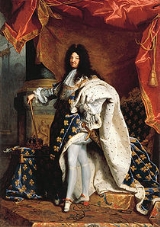
King of France and of NavarreThe Kingdom of Navarre , originally the Kingdom of Pamplona, was a European kingdom which occupied lands on either side of the Pyrenees alongside the Atlantic Ocean....
His reign, from 1643 to his death in 1715, lasted seventy-two years, three months, and eighteen days, and is the longest documented reign of any European monarch.
Louis began personally governing France after the death in 1661 of his prime ministerA prime minister is the most senior minister of cabinet in the executive branch of government in a parliamentary system. The position is usually held by, but need not always be held by, a politician. In many systems, the prime minister selects and can dismiss other members of the cabinet, and...
(premier ministre), the Italian Cardinal Jules Mazarin. An adherent of the theory of the divine right of kingsThe divine right of kings is a political and religious doctrine of royal absolutism. It asserts that a monarch is subject to no earthly authority, deriving his right to rule directly from the will of God. The king is thus not subject to the will of his people, the aristocracy, or any other estate...
, which advocates the divine origin and lack of temporal restraint of monarchical rule, Louis continued his predecessors' work of creating a centralized stateA centralized, or centralised , government is the form of government in which power is concentrated in a central authority to which local governments are subject...
governed from the capital. He sought to eliminate the remnants of feudalismFeudalism is a decentralized sociopolitical structure in which a weak monarchy attempts to control the lands of the realm through reciprocal agreements with regional leaders...
persisting in parts of France and, by compelling the noble elite to inhabit his lavish Palace of VersaillesThe Palace of Versailles, or simply Versailles, is a royal château in Versailles, the Île-de-France region of France. In French, it is known as the Château de Versailles....
, succeeded in pacifying the aristocracy, many members of which had participated in the FrondeThe Fronde was a civil war in France, occurring in the midst of the Franco-Spanish War, which had begun in 1635. The word fronde means sling, which Parisians mobs used to smash the windows of supporters of Cardinal Mazarin....
rebellion during Louis' minority.
For much of Louis's reign, France stood as the leading European power, engaging in three major warWar is a reciprocated, armed conflict, between two or more non-congruous entities, aimed at reorganising a subjectively designed, geo-politically desired result...
s—the Franco-Dutch WarThe Franco-Dutch War, often called simply the Dutch War was a war fought by the Kingdom of France, the Swedish Empire, the Bishopric of Münster, the Archbishopric of Cologne and the Kingdom of England against the Dutch Republic, which was later joined by Holy Roman Emperor, Brandenburg and Spain...
, the War of the League of Augsburg, and the War of the Spanish SuccessionThe War of the Spanish Succession was fought among several European powers, principally the Holy Roman Empire, Great Britain, the Dutch Republic, Portugal, and the Duchy of Savoy, against the Kingdoms of France and Spain and the Electorate of Bavaria, over a possible unification of the Kingdoms of...
—and two minor conflicts—the War of DevolutionThe War of Devolution saw Louis XIV's French armies overrun the Habsburg-controlled Spanish Netherlands and the Franche-Comté, but forced to give most of it back by a Triple Alliance of England, Sweden, and the Dutch Republic in the Treaty of Aix-la-Chapelle.-Background:Louis's claims to the...
and the War of the ReunionsThe War of the Reunions was a short conflict between France and Spain and its allies. It was fueled by the long-running desire of Louis XIV to conquer new lands, many of them comprising part of the Spanish Netherlands, along France's northern and eastern borders...
. He encouraged and benefited from the work of prominent political, military and cultural figures such as Mazarin, Jean-Baptiste ColbertJean-Baptiste Colbert served as the French minister of finance from 1665 to 1683 under the rule of King Louis XIV. He was described by Mme de Sévigné as "Le Nord", because he was cold and unemotional. His relentless hard work and thrift made him an esteemed minister...
, TurenneHenri de la Tour d'Auvergne, Vicomte de Turenne,often called simply Turenne was the most illustrious member of the La Tour d'Auvergne family. He achieved military fame and became a Marshal of France...
and VaubanSébastien Le Prestre, Seigneur de Vauban and later Marquis de Vauban , commonly referred to as Vauban, was a Marshal of France and the foremost military engineer of his age, famed for his skill in both designing fortifications and in breaking through them...
, as well as MolièreJean-Baptiste Poquelin, mostly known by his stage name Molière, was a French playwright and actor who is considered one of the greatest masters of comedy in Western literature...
, RacineJean Racine was a French dramatist, one of the "Big Three" of 17th century France , and one of the most important literary figures in the Western tradition...
, BoileauNicolas Boileau-Despréaux was a French poet and critic.-Biography:Boileau was born in the rue de Jérusalem, in Paris, France. He was brought up to the law, but devoted to letters, associating himself with La Fontaine, Racine, and Molière...
, La FontaineJean de La Fontaine was the most famous French fabulist and one of the most widely read French poets of the 17th century....
, LullyJean-Baptiste de Lully , was a French composer of Italian birth, who spent most of his life working in the court of Louis XIV of France. He became a French subject in 1661.-Biography:...
, Le BrunCharles Le Brun was a French painter and art theorist, one of the dominant artists in 17th century France.-Early life and training:...
, RigaudHyacinthe Rigaud was a French baroque painter of Catalan origin whose career was based in Paris...
, Louis Le VauLouis Le Vau was a French Classical architect who worked for Louis XIV of France. He was born and died in Paris.He was responsible, with André Le Nôtre and Charles Le Brun, for the redesign of the château of Vaux-le-Vicomte. His later works included the Palace of Versailles and his collaboration...
, Jules Hardouin MansartJules Hardouin-Mansart was a French architect whose work is generally considered to be the apex of French Baroque architecture, representing the power and grandeur of Louis XIV...
, Claude PerraultThough Claude Perrault is best known as the architect of the eastern range of the Louvre Palace in Paris , he also achieved success as physician and anatomist, and as an author, who wrote treatises on physics and natural history.Aside from his influential architecture, Perrault is best regarded...
and Le NôtreAndré Le Nôtre was a French landscape architect and the principal gardener of King Louis XIV of France...
.
Upon his death at Versailles four days before his seventy-seventh birthday, Louis was succeeded by his five-year-old great-grandson, Louis, duc d'AnjouLouis XV ruled as King of France and of Navarre from 1 September 1715 until his death on 10 May 1774...
. All his intermediate heirs—his son Louis, le Grand Dauphin, the Dauphin's eldest son Louis, duc de Bourgogne, and Bourgogne's eldest son Louis, duc de Bretagne—predeceased Louis.
Birth and ancestry
Louis XIV was born on 5 September 1638 in the château de Saint-Germain-en-LayeThe Château de Saint-Germain-en-Laye is a French royal palace in the commune of Saint-Germain-en-Laye, in the département of Yvelines, about 19 km west of Paris. Today, it houses the Musée d'Archéologie Nationale ....
to Louis XIII and Anne of AustriaAnne of Austria was Queen Consort of France and Navarre and regent for her son, Louis XIV of France. During her regency Cardinal Mazarin served as France's chief minister...
. As heir apparentAn heir apparent is an heir who cannot be displaced from inheriting.An heir presumptive, by contrast, is an heir currently in line to inherit a title, but who could be displaced at any time by certain events.Today these terms most commonly describe heirs to hereditary titles, particularly monarchies...
, he bore the traditional title of Dauphin. His birth followed almost twenty-three years of his estranged parents' childlessness. Accordingly, some contemporaries regarded him as a divine gift, and his birth, a miracle; hence, he was named "Louis-Dieudonné" (Louis-God-given).
Louis descended from noteworthy European ruling houses. Tracing Louis's ancestry to the tenth generation, genealogist C. Carretier calculated his ancestry to be approximately 28% French, 26% Spanish, 11% Austro-German and 10% Portuguese, the rest being Italian, Slavic, English, Savoyard and Lorrainer.
His paternal grandparents were Henri IV of FranceHenry IV was King of France from 1589 to 1610 and King of Navarre from 1572 to 1610. He was the first monarch of the Bourbon branch of the Capetian dynasty in France. His parents were Queen Jeanne III and King Antoine of Navarre.As a Huguenot, Henry was involved in the Wars of Religion before...
and Marie de' MediciMarie de Médici , was queen consort of France. She was the second wife of King Henry IV of France, of the Bourbon branch of the kings of France...
, French and Italian respectively; while both his maternal grandparents were HabsburgThe House of Habsburg or Hapsburg was an important royal house of Europe and is best known for being an origin of all of the formally elected Holy Roman Emperors between 1452 and 1740, as well as rulers of the Austrian and Spanish Empire and several other countries...
s, Philip III of SpainPhilip III was the King of Spain and King of Portugal and the Algarves, where he ruled as Philip II of Portugal , from 1598 until his death. His chief minister was the Duke of Lerma...
and Margaret of AustriaMargaret of Austria , was the daughter of Archduke Charles II of Austria and Maria Anna of Bavaria. She was Queen consort of Spain and Portugal by her marriage to Philip III of Spain, who is also known as Philip II of Portugal.-Family:Her paternal grandparents were Ferdinand I, Holy Roman Emperor,...
. Therefore, Louis's ancestors included various historical figures, such as the Holy Roman EmperorThe Holy Roman Emperor is a term used by historians to denote a Middle Ages ruler, who as German King had in addition received the title of "Emperor of the Romans" from the Pope of the Holy Roman Church, and after the 16th century, the elected monarch governing the Holy Roman Empire, a Central...
s Charles VCharles V was ruler of the Holy Roman Empire from 1519 and, as Charles I of Spain, of the Spanish realms from 1516 until his abdication in 1556...
and Frederick BarbarossaFrederick I Barbarossa was elected King of Germany at Frankfurt on 4 March 1152 and crowned in Aachen on 9 March, crowned King of Italy in Pavia in 1154, and finally crowned Holy Roman Emperor by Pope Adrian IV on 18 June 1155. He was crowned King of Burgundy at Arles on 30 June 1178...
. He was also the great grandson of Phillip II of Spain, and thus a descendant of Isabella I of CastileIsabella I was Queen of Castile and León. She and her husband, Ferdinand II of Aragon, laid the foundation for the political unification of Spain under their grandson, Charles V, Holy Roman Emperor....
and Ferdinand II of AragonFerdinand the Catholic was King of Aragon , Sicily , Naples , Valencia, Sardinia, and Navarre, Count of Barcelona, de jure uxoris King of Castile and then Regent of that country also from 1508 to his death, in the name of his mentally unstable daughter Joanna the...
. Louis also descended from the founder of Russia's first dynastyThe Rurik Dynasty was the ruling dynasty of Kievan Rus' , the successor principalities of Galicia-Volhynia , Vladimir-Suzdal, and Grand Duchy of Moscow, as well as early Tsardom of Russia ....
, Rurik the VikingRurik, or Riurik , was a Varangian chieftain who gained control of Ladoga in 862, built the Holmgard settlement near Novgorod, and founded the Rurik Dynasty which ruled Kievan Rus and then Galicia-Volhynia until 14th and Muscovy until the 16th century.-Name:Riurik is the Slavic rendering of the...
, and Giovanni de' MediciGiovanni de' Medici, also known as Giovanni dalle Bande Nere was an Italian condottiero.-Biography:...
, last of the great Condottierithumb|280px|Depiction of [[Farinata degli Uberti]] by [[Andrea del Castagno]], showing a 15th century condottiero's typical attire.Condottieri were the mercenary soldier leaders of the professional, military Free companies contracted by the Italian city-states and the Papacy, from the late...
, as well as Charles the Bold, Duke of Burgundy and the poet Charles, Duke of Orléans. Most importantly, he traced his paternal lineage, and hence his and his descendants' right to the throne, in the direct legitimate male line to Saint Louis, King of FranceLouis IX , commonly Saint Louis, was King of France from 1226 until his death. He was also styled Louis II, Count of Artois from 1226 to 1237. Born at Poissy, near Paris, he was a member of the House of Capet, the son of Louis VIII and Blanche of Castile...
, and through him, to Hugh Capet.
In 1640, Louis XIII and Anne had a second child, Philippe I, duc d'OrléansPhilippe de France, Duke of Orléans , was the second surviving son of Louis XIII of France and Anne of Austria, and thus the younger brother of the future Louis XIV of France. As son of a king of France, he was a Fils de France and bore the surname de France. Philippe married twice...
. However, doubtful of Anne's abilities as regentA regent, from the Latin regens "reigning", is a person selected to act as head of state because the ruler is a minor, not present, or debilitated. Thus, the common use is for an acting deputy governor....
, Louis XIII decreed that a regency council should rule on Louis's behalf in the event of a minorityIn law, the term minor is used to refer to a person who is under the age in which one legally assumes adulthood and is legally granted rights afforded to adults in society. Depending on the jurisdiction and application, this age may vary, but is usually marked at either 18, 20, or 21...
, but nonetheless did name her the head of the council.
Minority and the Fronde
On 14 May 1643, upon Louis XIII's death and his young son’s accession, Anne had his will annulled by the Parlement de ParisThe political institutions of the Parlement in ancien régime France developed out of the previous council of the king, the Conseil du roi or curia regis, and consequently had ancient and customary rights of consultation and deliberation. In the thirteenth century, judicial functions were added...
(a judicial body comprising mostly noblesNobility is a state-privileged status which is generally hereditary, but which may also be personal only. Titles of nobility are usually associated with present or former monarchies. The term originally referred to those who were "known" or "notable" and was applied to the highest social class in...
and high clergyClergy is the generic term used to describe the formal religious leadership within a given religion. The term ultimately comes from the Greek κλῆρος - klēros, "a lot", "that which is assigned by lot" or metaphorically, "inheritence"....
men), abolished the regency council and became sole regentA regent, from the Latin regens "reigning", is a person selected to act as head of state because the ruler is a minor, not present, or debilitated. Thus, the common use is for an acting deputy governor....
. She then entrusted power to Cardinal Mazarin.
Mazarin subsequently negotiated the Peace of WestphaliaThe term Peace of Westphalia refers to the two peace treaties of Osnabrück and Münster, signed on May 15 and October 24, 1648, respectively, and written in French, that ended both the Thirty Years' War in the Holy Roman Empire and the Eighty Years' War between Spain and the Republic of the Seven...
successfully in 1648. It comprised the Treaties of Münster and Osnabrück and ended the Thirty Years' WarThe Thirty Years' War was one of the most destructive conflicts in European history. The war was fought primarily in Germany and at various points involved most of the countries of Europe...
, begun by Louis XIII. This Peace ensured Dutch independenceThe Dutch Revolt or the Revolt of the Netherlands , was the partially successful revolt of the Seventeen Provinces in the Low Countries against the Spanish Empire. It led to the formation of the independent Dutch state of the Netherlands and marked the beginning of the Eighty Years' War...
from SpainThe Spanish Empire was one of the largest empires in world history, and one of the first global empires. It included territories and colonies in Europe, the Americas, Africa, Asia and Oceania, from the 15th century through—in the case of its African holdings—the latter portion of the 20th century...
, awarded some autonomy to the various German princesis a German title of nobility, usually translated into English as Prince.The term refers to the head of a principality and is distinguished from the son of a monarch, which is referred to as Prinz...
, and granted Sweden seats on the ReichstagThe Reichstag was the parliament of the Holy Roman Empire, and subsequently of the North German Confederation, and of Germany until 1945...
and territories to control the mouths of the Oder, ElbeThe River Elbe is one of the major rivers of Central Europe. It originates in the Krkonose Mountains of northwestern Czech Republic before traversing much of Bohemia , then Germany and flowing into the North Sea at Cuxhaven, 110 km northwest of Hamburg...
and WeserThe Weser is a river in north-western Germany. Formed at Hann. Münden by the of the Fulda and Werra, it flows through Lower Saxony, then reaching the historic port city of Bremen before emptying into the North Sea 50 km further north at Bremerhaven, which is also a seaport...
. However, the terms of the Peace profited France the most. Austria ceded to France all Habsburg lands and claims in AlsaceAlsace is the fourth-smallest of the 26 regions of France in land area , and the smallest in metropolitan France. It is also the sixth-most densely populated region in France , with 222 inhabitants per km²...
and acknowledged de facto sovereignty over the Three BishopricsThe Three Bishoprics constituted a province of pre-Revolutionary France consisting of the bishoprics of Verdun, Metz, and Toul in the Lorraine region. These were territories of the Holy Roman Empire until they were seized by French King Henry II between April and June of 1552...
. Moreover, eager to reduce Habsburg domination, petty German states sought French protection, anticipating the formation of the League of the RhineThe League of the Rhine was a defensive union of more than 50 German princes and their cities along the River Rhine, formed in 14 August 1658 by Louis XIV of France and negotiated by Cardinal Mazarin , Hugues de Lionne and Johann...
in 1658 and leading to the further diminution of Imperial power. Nonetheless, as no peace was signed with Spain, a Franco-Spanish war would continue till 1659 with the Treaty of the PyreneesThe Treaty of the Pyrenees was signed to end the 1635 to 1659 war between France and Spain, a war that was initially a part of the wider Thirty Years' War. It was signed on Pheasant Island, a river island on the border between the two countries...
.
As the Thirty Years' War petered out, a civil warA civil war is a war between organized groups within a single nation state, or, less commonly, between two nations created from a formerly-united nation state. The aim of one side may be to take control of the nation or a region, to achieve independence for a region, or to change government policies...
—the FrondeThe Fronde was a civil war in France, occurring in the midst of the Franco-Spanish War, which had begun in 1635. The word fronde means sling, which Parisians mobs used to smash the windows of supporters of Cardinal Mazarin....
—erupted. It effectively checked France's ability to exploit the Peace of Westphalia. Cardinal Mazarin had largely pursued the policies of his predecessor, Cardinal Richelieu, augmenting the CrownThe Crown is a corporation sole that in certain countries of the Commonwealth of Nations, as well as in any provincial or state sub-divisions thereof, represents the legal embodiment of executive government...
's power at the expense of the nobility and the ParlementThe political institutions of the Parlement in ancien régime France developed out of the previous council of the king, the Conseil du roi or curia regis, and consequently had ancient and customary rights of consultation and deliberation. In the thirteenth century, judicial functions were added...
s. The Frondeurs, political heirs of the turbulent feudal aristocracy, originally sought to protect the traditional feudal privilegeA privilege—etymologically "private law" or law relating to a specific individual—is a special entitlement or immunity granted by a government or other authority to a restricted group, either by birth or on a conditional basis. A privilege can be revoked in some cases. In modern...
s of those institutions from an increasingly centralizedCentralisation, or centralization , is the process by which the activities of an organisation, particularly those regarding decision-making, become concentrated within a particular location and/or group....
and centralizing royal government. Furthermore, they believed their traditional authority was being usurped by the recently ennobled (the Noblesse de Robe) who administered the Kingdom and on whom the Monarchy increasingly began to rely. This belief intensified their resentment.
In 1648, Mazarin attempted to tax members of the Parlement de ParisThe political institutions of the Parlement in ancien régime France developed out of the previous council of the king, the Conseil du roi or curia regis, and consequently had ancient and customary rights of consultation and deliberation. In the thirteenth century, judicial functions were added...
. The Members not only refused to comply, but also ordered all his earlier financial edictAn edict is an announcement of a law, often associated with monarchism. The Pope and various micronational leaders are currently the only persons who still issue edicts.-Notable edicts:...
s burned. Buoyed by the victory of Louis, duc d’EnghienLouis II de Bourbon, Prince de Condé was a French general and the most famous representative of the Condé branch of the House of Bourbon. Prior to his father's death in 1646, he was styled the Duc d'Enghien...
(later le Grand Condé) at LensThe Battle of Lens was a French victory under Louis II de Bourbon, Prince de Condé against the Spanish army under Archduke Leopold in the Thirty Years' War . It was the last major battle of the war....
, Mazarin arrested certain Members in a show of force. Ironically, Paris erupted in riotA riot is a form of civil disorder characterized by disorganized groups lashing out in a sudden and intense rash of violence against people or property. While individuals may attempt to lead or control a riot, riots are typically chaotic and exhibit herd behavior.Riots often occur in reaction to a...
ing. A mob of angry Parisians broke into the royal palace and demanded to see their king. Led into the royal bedchamber, they gazed upon Louis, who was feigning sleep, were appeased and quietly departed. The threat to the royal familyA royal family is the extended family of a king or queen regnant. The term "imperial family" more appropriately describes the extended family of an emperor or empress regnant, while the terms "ducal family", "grand ducal family" or "princely family" are more appropriate in reference to the...
and MonarchyThe person who heads a monarchy is called a monarch. It was a common form of government in the world during the ancient and medieval times. A Monarchy is a form of government in which supreme power is absolutely or nominally lodged with an individual, who is the head of state, often for life or...
prompted Anne to flee Paris with the King and his courtiers. Shortly thereafter, the conclusion of the Peace of WestphaliaThe term Peace of Westphalia refers to the two peace treaties of Osnabrück and Münster, signed on May 15 and October 24, 1648, respectively, and written in French, that ended both the Thirty Years' War in the Holy Roman Empire and the Eighty Years' War between Spain and the Republic of the Seven...
allowed Condé’s army to return to aid Louis and his courtThe court of a monarch, or at some periods an important nobleman, is a term for the extended household and all those who regularly attended on the ruler or central figure...
.
The first Fronde (Fronde parlementaire, 1648-1649) was followed by the second Fronde (Fronde des princes, 1650-1653). Tales of sordid intrigue and half-hearted warfare characterised this second phase of upper-class insurrection, unlike that which preceded it. Aristocrats headed this rebellion which represented to them a protest against and a reversal of their political demotion from vassalA vassal in the terminology that both preceded and accompanied the feudalism of medieval Europe, is one who enters into mutual obligations with a monarch, usually of military support and mutual protection, in exchange for certain guarantees, which came to include the terrain held as a fief. By...
s to courtierA courtier is a person who attends the court of a monarch or other powerful person. Historically the court was the centre of government as well as the residence of the monarch, and social and political life were often completely mixed together. Monarchs very often expected the more important nobles...
s.
This Fronde was led by France's highest-ranking nobles, from Louis's uncle Gaston, duc d'OrléansGaston Jean-Baptiste de France, duc d'Orléans, , was the third son of the king of France Henry IV and of his wife Marie de' Medici.As a son of the king, he was a Fils de France...
, and first cousin, Anne d'Orléans, duchesse de MontpensierAnne Marie Louise d'Orléans, Duchess of Montpensier was a French princess of royal blood by birth. As a granddaughter of king Henry IV of France, she was a Petite-fille de France....
(known as la Grande Mademoiselle); to more distantly-related princes du sangA Prince of the Blood was a person who was legitimately descended in the male line from the monarch of a country. In France, the rank of prince du sang was the highest held at court after the immediate family of the king during the ancien régime and the Bourbon Restoration...
such as Condé, his brother ContiArmand de Bourbon, Prince de Conti was the second son of Henry II, Prince of Condé and brother of Louis II de Bourbon, Prince de Condé and Anne Genevieve, Duchess of Longueville. As a member of the reigning House of Bourbon, he was a Prince du Sang.The title of Prince de Conti was revived in his...
, and their sister Anne-Geneviève, duchesse de LonguevilleAnne Geneviève de Bourbon, Duchess of Longueville , was a French princess who is remembered for her beauty and amours, her influence during the civil wars of the Fronde, and her final conversion to Jansenism.-Early life:...
; to dukes of legitimised royal descent, like Henri II d'Orléans, duc de LonguevilleHenri II d'Orléans, duc de Longueville or Henri de Valois-Longueville , a legitimated prince of France and peer of France, was a major figure in the civil war of France, the Fronde, and served as governor of Picardy, then of Normandy.Longueville headed the French delegation in the talks that led...
, and François de Bourbon-Vendôme, duc de Beaufort; and to princelings descended from foreign dynastiesA dynasty is a succession of people belonging to the same family, who, through various means and forms maintain power, influence or authority over the course of generations. Most commonly the term is used specifically in reference to royal houses and imperial dynasties — their authority manifests...
(known as princes étrangersForeign Prince is the English translation of prince étranger, a high, though somewhat ambiguous, rank at the French royal court of the ancien régime.-Terminology:...
), such as Frédéric Maurice de La Tour d'Auvergne, duc de BouillonFrédéric Maurice de La Tour d'Auvergne, duc de Bouillon , was prince of the independent principality of Sedan, and general in the French royal army....
, and his brother, the famous Marshal of FranceThe Marshal of France is a military distinction in contemporary France, not a military rank. It is granted to generals for exceptional achievements...
, TurenneHenri de la Tour d'Auvergne, Vicomte de Turenne,often called simply Turenne was the most illustrious member of the La Tour d'Auvergne family. He achieved military fame and became a Marshal of France...
, as well as Marie de Rohan-Montbazon, duchesse de ChevreuseMarie Aimée de Rohan-Montbazon, duchesse de Chevreuse was a French aristocrat of great personal charm who placed herself at the center of all the intrigues of the first half of the 17th century in France.-Early life:...
; and scionScion may refer to:* A descendant, a son or daughter*In grafting, the scion is a detached shoot or twig containing buds from a woody plant which is grafted onto the stock....
s of France's oldest families, like François VI, duc de La RochefoucauldFrançois VI, duc de La Rochefoucauld, prince de Marcillac , was a noted French author of maxims and memoirs, as well as an example of the accomplished 17th-century nobleman. He was born in Paris in the Rue des Petits Champs, at a time when the royal court oscillated between aiding the nobility and...
.
With Louis’s coming of age and subsequent coronationA coronation is a ceremony marking the investiture of a monarch or their consort with regal power, specifically involving the placement of a crown upon his or her head, and the presentation of other items of regalia...
, the Frondeurs, who could hitherto claim to act on his behalf and in his real interests against his mother and prime minister, lost their pretext for revolt. The Fronde thus gradually lost steam until it ended in 1653, when Mazarin returned triumphant after having fled into exile on several occasions.
Personal reign and reforms
On Mazarin’s death in 1661, Louis XIV assumed personal control of the reins of government. Praising his ability to wisely choose and encourage men of talent, Chateaubriand noted that “it is the voice of genius of all kinds which sounds from the tomb of Louis”. He was able to utilise the widespread public yearning for peace, law and order, resulting from prolonged foreign war and domestic civil strife, to further consolidate central political authority at the feudal aristocracy's expense.
Concurrently, Louis commenced his personal reign with administrative and fiscal reforms. The treasury verged on bankruptcyBankruptcy is a legally declared inability or impairment of ability of an individual or organization to pay its creditors. Creditors may file a bankruptcy petition against a debtor in an effort to recoup a portion of what they are owed or initiate a restructuring...
on his coming to power. To rectify the situation, Louis chose Jean-Baptiste ColbertJean-Baptiste Colbert served as the French minister of finance from 1665 to 1683 under the rule of King Louis XIV. He was described by Mme de Sévigné as "Le Nord", because he was cold and unemotional. His relentless hard work and thrift made him an esteemed minister...
as Contrôleur général des FinancesThe Controller-General of Finances was the name of the minister in charge of finances in France from 1661 to 1791. The position replaced the former position of Superintendent of Finances , which was abolished with the downfall of Nicolas Fouquet.- History :The term "contrôleur général" in...
in 1665. In doing so, Louis had first to eliminate on charges of embezzlement Nicolas FouquetNicolas Fouquet, marquis de Belle-Île, vicomte de Melun et Vaux was the Superintendent of Finances in France under Louis XIV.-Biography:...
, the Surintendant des FinancesThe Superintendent of Finances was the name of the minister in charge of finances in France from 1561 to 1661. The position was abolished in 1661 with the downfall of Nicolas Fouquet, and a new position was created, the Controller-General of Finances....
, commuting the sentence of banishment, passed by the Parlement, to life-imprisonment, and abolishing Fouquet's office. To be sure, Fouquet committed no financial indiscretions greatly dissimilar from Mazarin before him and Colbert after him. However, the opulence of his chateau at Vaux-le-VicomteThe Château de Vaux-le-Vicomte is a baroque French château located in Maincy, near Melun, 55 km southeast of Paris in the Seine-et-Marne département of France...
, where he lavishly entertained the King and which served as inspiration for Versailles, his perceived ambition to succeed Mazarin and Richelieu and assume power, and his indiscreet purchase and private fortification of Belle ÎleBelle-Île or Belle-Île-en-Mer is a French island off the coast of Brittany in the département of Morbihan, and the largest of Brittany's islands. It is 14 km from the Quiberon peninsula....
sealed his doom.
Divested of Fouquet, Colbert reduced the national debt through more efficient taxation. The principal taxes included the aidesAides has various meanings:*Aides is the Greek god Hades.*The aides was a French customs duty, during the time of Louis XIV*Aides are assistants.*Aides , a genus of butterflies in the grass skipper family....
and douaneDouane commonly refers to one of two agencies:*the French customs and excise agency, the Directorate-general of customs and indirect taxes *the Dutch Tax and Customs Administration...
s (both customs duties), the gabelleThe gabelle was a very unpopular tax on salt in France before 1790. The term gabelle derives from the Latin term gabulum .In France, Gabelle was originally applied to taxes on all commodities, but was gradually limited to the tax on salt...
(a tax on salt), and the tailleThe taille was a direct land tax on the French peasantry and non-nobles in Ancien Régime France. The tax was imposed on each household and based on how much land it held.-History:Originally only an "exceptional" tax The taille was a direct land tax on the French peasantry and non-nobles in Ancien...
(a tax on land). Louis and Colbert also had wide-ranging plans to bolster French commerce and trade. Colbert's mercantilistMercantilism is an economic theory that holds that the prosperity of a nation is dependent upon its supply of capital, and that the global volume of international trade is "unchangeable." Economic assets or capital, are represented by bullion held by the state, which is best increased through a...
administration established new industries and encouraged manufacturers and inventors, such as the Lyon||-||}Lyon , often Anglicized as Lyons, is a city in east-central France in the region Rhône-Alpes, situated between Paris and Marseille. Its name is pronounced in French and Arpitan, and or in English...
silk manufacturers and the Manufacture des GobelinsThe Manufacture des Gobelins is a tapestry factory located in Paris, France, at 42 avenue des Gobelins, near the Les Gobelins métro station in the XIIIe arrondissement...
, a producer of tapestries. He also invited manufacturers and artisans from all over Europe, like MuranoMurano is usually described as an island in the Venetian Lagoon, although like Venice itself it is actually an archipelago of islands linked by bridges. It lies about a mile north of Venice and is famous for its glass making, particularly lampworking...
glassmakers, Swedish ironworkers, and Dutch shipbuilders. In this way, he aimed to decrease foreign imports while increasing French exports, hence reducing the net outflow of precious metals from France.
Louis also instituted reforms in military administration through Le TellierMichel le Tellier, marquis de Barbezieux, seigneur de Chaville et de Viroflay was a French statesman.-Biography:...
and, his son, LouvoisFrançois Michel le Tellier, Marquis de Louvois , was the French Secretary of State for War for a significant part of the reign of Louis XIV. Louvois and his father, Michel le Tellier, would increase the French Army to 400,000 soldiers, an army that would fight four wars between 1667 and 1713...
. They helped to curb the independent spirit of and impose order on the nobility at court and in the army. Gone were the days when generals protracted war at the frontiers, while bickering over precedence and ignoring orders from the capital and the larger politico-diplomatic picture. No longer too were senior positions and rank the sole prerogative of the old military aristocracy (the noblesse d'épée). Louvois, in particular, pledged himself to modernizing the army, re-organizing it into a professional, disciplined and well-trained force. He was devoted to providing for the soldiers' material well-being and morale, and even tried to direct campaigns.
The law also did not escape Louis’s attention, as is reflected in the numerous Grandes Ordonnances he enacted. Pre-revolutionary France was a patchwork of legal systems, with as many coutumes as there were provinces, and two co-existing legal traditions—customary lawIn law, custom can be described as the established patterns of behavior that can be objectively verified within a particular social setting. A claim can be carried out in defense of "what has always been done and accepted by law." Generally, customary law exists where:#a certain legal practice is...
in the northern pays de droit coutumier and Roman civil lawThe term Roman law denotes the legal system of ancient Rome, and the legal developments which occurred before the seventh century AD — when the Roman–Byzantine state adopted Greek as the official lingua franca. The development of Roman law comprises more than a thousand years of jurisprudence —...
in the southern pays de droit écrit. The Grande Ordonnance de Procédure Civile of 1667, also known as Code Louis, was a comprehensive legal code attempting a uniform regulation of civil procedureCivil procedure is the body of law that sets out the rules and standards that courts follow when adjudicating civil lawsuits...
throughout legally irregular France. It prescribed inter alia baptismal, marriage and death records in the State’s registers, not the Church’s, and also strictly regulated the right to remonstrance of the Parlements. The Code Louis played an important part in French legal history as the basis for the Code NapoléonThe Napoleonic Code, or Code Napoléon is the French civil code, established under Napoléon I in 1804. The code forbade privileges based on birth, allowed freedom of religion, and specified that government jobs go to the most qualified...
, itself the origin of many modern legal codes.
One of Louis's more infamous decrees was the Grande Ordonnance sur les Colonies of 1685, also known as Code NoirThe Code Noir was a decree passed by France's King Louis XIV in 1685. The Code Noir defined the conditions of slavery in the French colonial empire, restricted the activities of free Negroes, forbade the exercise of any religion other than Roman Catholicism, and ordered all Jews out of France's...
. Although it sanctioned slaverySlavery is a form of forced labor in which people are considered to be the property of others. Slaves can be held against their will from the time of their capture, purchase or birth, and deprived of the right to leave, to refuse to work, or to receive compensation...
, it did humanise the practice by prohibiting the separation of families. However, in the colonies, only Roman Catholics could own slaves, and these had to be baptisedIn Christianity, baptism is the ritual act, with the use of water, by which one is admitted to membership of the Christian Church and, in the view of some, as a member of the particular Church in which the baptism is administered.The usual form of baptism among the earliest Christians was for the...
.
Patronage of the arts
The Sun King generously financed the royal courtThe court of a monarch, or at some periods an important nobleman, is a term for the extended household and all those who regularly attended on the ruler or central figure...
, and supported those who worked under him. He brought the Académie FrançaiseL'Académie française, or the French Academy, is the pre-eminent French learned body on matters pertaining to the French language. The Académie was officially established in 1635 by Cardinal Richelieu, the chief minister to King Louis XIII. Suppressed in 1793 during the French Revolution, it was...
under his patronagePatronage is the support, encouragement, privilege, or financial aid that an organization or individual bestows to another. In the history of art, arts patronage refers to the support that kings or popes have provided to musicians, painters, and sculptors...
, and became its "Protector". He allowed Classical French literatureFrench literature is, generally speaking, literature written in the French language, particularly by citizens of France; it may also refer to literature written by people living in France who speak other traditional non-French languages. Literature written by citizens of other nations such as...
to flourish by protecting such writers as MolièreJean-Baptiste Poquelin, mostly known by his stage name Molière, was a French playwright and actor who is considered one of the greatest masters of comedy in Western literature...
, Jean RacineJean Racine was a French dramatist, one of the "Big Three" of 17th century France , and one of the most important literary figures in the Western tradition...
and Jean de La FontaineJean de La Fontaine was the most famous French fabulist and one of the most widely read French poets of the 17th century....
, whose works greatly influence to this day. Louis also patronised the visual arts by funding and commissioning various artists, such as Charles Le BrunCharles Le Brun was a French painter and art theorist, one of the dominant artists in 17th century France.-Early life and training:...
, Pierre MignardPierre Mignard , called "Le Romain" to distinguish him from his brother Nicolas, was a French painter. He was born at Troyes, and came of a family of artists; he also needs to be distinguished from his nephew Pierre , often called "Pierre II" or "Le Chevalier".In 1630 he left the studio of Simon...
, Antoine CoysevoxCharles Antoine Coysevox , French sculptor, was born at Lyon, and belonged to a family which had emigrated from Spain...
and Hyacinthe RigaudHyacinthe Rigaud was a French baroque painter of Catalan origin whose career was based in Paris...
whose works became famous throughout Europe. In music, composers and musicians, like Jean-Baptiste LullyJean-Baptiste de Lully , was a French composer of Italian birth, who spent most of his life working in the court of Louis XIV of France. He became a French subject in 1661.-Biography:...
, Jacques Champion de ChambonnièresJacques Champion de Chambonnières, also known as "Jacques Champion" and as "Chambonnières" was a French harpsichordist in the Early Baroque era....
and François CouperinFrançois Couperin was a French Baroque composer, organist and harpsichordist. François Couperin was known as "Couperin le Grand" to distinguish him from the other members of the musically talented Couperin family.-Life:Couperin was born in Paris...
, thrived and influenced many others.
Originally a hunting lodge built by Louis XIII, Louis converted the Palace of VersaillesThe Palace of Versailles, or simply Versailles, is a royal château in Versailles, the Île-de-France region of France. In French, it is known as the Château de Versailles....
into a spectacular royal palace through four major building campaigns. Excepting the current chapel build in the last decade of the reign, the third building campaign had already given Versailles its present appearance. Louis officially moved the royal court there on 6 May 1682. Versailles was a dazzling, awe-inspiring setting for state affairs and the reception of foreign dignitaries; the King alone assumed the attention, which was not shared with the capital and people. Several reasons have been suggested from the creation of the extravagant and stately palace, as well as the relocation of the monarchy’s seat. One such is that of contemporary writer, Saint-SimonLouis de Rouvroy, duc de Saint-Simon , French soldier, diplomatist and writer of memoirs, was born in Paris...
, who speculated that Louis viewed Versailles as an isolated power center where treasonous cabalA cabal is a number of people united in some close design, usually to promote their private views and interests in a church, state, or other community, often by intrigue...
s could be more readily discovered and foiled. Alternatively, the Fronde caused Louis to allegedly hate Paris, which was abandoned for a country retreat; however, his many improvements, embellishments and developments of Paris, such as the establishment of a police and street-lighting, lend little credence to this theory.
In Paris, Louis constructed the "Hôtel des InvalidesLes Invalides in Paris, France, is a complex of buildings in the city's 7th arrondissement containing museums and monuments, all relating to the military history of France, as well as a hospital and a retirement home for war veterans, the building's original purpose...
"—a military complex and home to this day for officers and soldiers rendered infirm either by injury or age. While pharmacology was still quite rudimentary, les Invalides pioneered new treatments and set new standards for hospice treatment. The conclusion of the Treaty of Aix-la-ChapelleThere were three Treaties of Aix-la-Chapelle. Although "Aix-la-Chapelle" is the now rarely used French name of the German city of Aachen, the name Treaty of Aachen is rarely used....
in 1669 induced Louis to demolish the northern walls of Paris in 1670 and replace them with wide tree-lined boulevards.
The LouvreThe Louvre Palace , on the Right Bank of the Seine in Paris, is a former royal palace situated between the Tuileries Gardens and the church of Saint-Germain l'Auxerrois...
and many other royal residences were also renovated and improved. Originally, Louis hired Gian Lorenzo BerniniGian Lorenzo Bernini was an Italian artist who worked principally in Rome during the 17th century. He was the leading sculptor of his age and also a prominent architect...
to plan additions to the Louvre. However, these plans would have meant the destruction of much of the existing structure, replacing it with an Italian summer villaA villa was originally an upper-class country house, though since its origins in Roman times the idea and function of a villa has evolved considerably. After the fall of the Republic, a villa became a small, fortified farming compound, gradually re-evolving through the Middle Ages into luxurious,...
in the centre of Paris. Bernini’s plans were eventually shelved in favour of Perrault’s elegant colonnade. With the relocation of the court to Versailles, the Louvre was given over to the Arts and the public.
In June 1686, on the advice of his secret wife, Madame de MaintenonFrançoise d'Aubigné, Marquise de Maintenon was the morganatic second wife of King Louis XIV of France. She was known after her first marriage as Madame Scarron, and subsequently as Madame de Maintenon. Her marriage to the king was never officially announced or admitted.-Origins:Françoise...
, Louis signed letters patent creating the “Institut de Saint-Louis” at Saint-Cyr for “filles pauvres de la noblesse” (poor noble girls) between the ages of seven and twenty. Construction had begun two years previously. "Saint-Cyr" was at the time the only educational institution for girls in France that was not a convent. Admission of the 250 students was dependent on evidence documenting at least four generations of nobility on their father's side. Mme de Maintenon took great pleasure in this school and was finally to die there.
Early wars in the Low Countries
The death of Philip IV of SpainPhilip IV was King of Spain between 1621 and 1665, sovereign of the Spanish Netherlands, and King of Portugal until 1640. On the eve of his death in 1665, the Spanish empire reached its territorial zenith spanning almost 3 billion acres...
in 1665 precipitated the War of Devolution. In 1660, Louis had married Philip IV’s eldest daughter, Marie-Thérèse, as part of the Treaty of the Pyrenees in 1659. The marriage treaty specified that Marie-Thérèse was to renounce all claims to Spanish territory for herself and all her descendants. However, Mazarin and Lionne had incorporated a word (“moyennant”) making the renunciation conditional on the full payment of a Spanish dowry of 500,000 écuECU may refer to:Automotive terms* Electronic control unit, a generic term for any embedded system that controls one or more of the electrical systems or subsystems in a motor vehicle...
s. This was never paid and would later play a part persuading Charles II of SpainCharles II , was the last Habsburg King of Spain and the ruler of nearly all of Italy , the Spanish territories in the Southern Low Countries, and Spain's overseas Empire, stretching from Mexico to the Philippines...
to leave his empire to Anjou (later Philip V of Spain)—the grandson of Louis and Marie-Thérèse.
Notwithstanding the non-payment of the dowry, the War of Devolution had the “devolution” of lands as pretext. In BrabantThe Duchy of Brabant was a historical region in the Low Countries. It consisted of not only the three modern-day Belgian provinces of Flemish Brabant, Walloon Brabant and Antwerp as well as the Brussels-Capital Region, but also the present-day Dutch province of North Brabant.In Roman times, Brabant...
, children of the first marriage traditionally were not disadvantaged by their parents’ remarriages, and still inherited property. Louis’s wife, Marie-Thérèse, was Philip IV’s daughter by his first marriage, while the new King of Spain, Charles II, was his son by a subsequent marriage. Thus, Brabant allegedly “devolved” on Marie-Thérèse. This excuse led to the War of Devolution.
Internal problems of the Dutch RepublicThe Republic of the Seven United Netherlands was a European republic between 1581 and 1795, in about the same location as the modern Kingdom of the Netherlands,...
aided Louis's designs on the Spanish Netherlands. The most prominent politician in the United Provinces at the time, Johan de WittJohan de Witt, heer van Zuid- en Noord-Linschoten, Snelrewaard, Hekendorp and IJsselveere was a key figure in Dutch politics at a time when the Republic of the United Provinces was one of the Great Powers in Europe, dominating trade routes and thus one of the wealthiest and mightiest nations in...
, Grand PensionaryThe Grand Pensionary was the most important Dutch official during the time of the United Provinces. In theory he was only a civil servant of the Estates of the dominant province among the Seven United Provinces: the county of Holland...
, feared the ambition of the young William III, Prince of OrangeWilliam III was a sovereign Prince of Orange by birth. From 1672 he governed as Stadtholder William III of Orange over Holland, Zeeland, Utrecht, Guelders, and Overijssel of the Dutch Republic. From 1689 he reigned as William III over England and Ireland, and as William II over Scotland...
. He feared the dispossession of supreme power and the restoration of the House of Orange to the influence it had enjoyed before the death of William II, Prince of OrangeWilliam II, Prince of Orange was sovereign Prince of Orange and stadtholder of the United Provinces of the Netherlands from 14 March 1647 until his death....
. However, shocked by the rapidity of French successes and fearful of the future, the Dutch turned on their French allies and ended the Second Anglo-Dutch WarThe Second Anglo–Dutch War was fought between England and the United Provinces from 4 March, 1665 until 31 July, 1667. England tried to end the Dutch domination of world trade. After initial English successes, the war ended in a Dutch victory...
with England. Joined by Sweden, they formed a Triple AllianceThe Triple Alliance of England, Sweden, and the United Provinces was formed to halt the expansion of Louis XIV's France in the War of Devolution. The alliance never engaged in combat against France, but it was enough of a threat to force Louis to halt his offensive and sign the Treaty of...
in 1668. The threat of escalation and a secret treaty partitioning the Spanish succession with the Emperor, the other major claimant, induced Louis to make peace.
The Triple Alliance did not last very long. In 1670, Charles II of EnglandCharles II was the King of England, Scotland, and Ireland.Charles II's father King Charles I was executed at Whitehall on 30 January 1649, at the climax of the English Civil War. The English Parliament did not proclaim Charles II king at this time. Instead they passed a statute making such a...
, bribed by France, signed the secret Treaty of Dover, allying with France. The two kingdoms, along with certain Rhineland princes, declared war on the United Provinces in 1672, sparking off the Franco-Dutch WarThe Franco-Dutch War, often called simply the Dutch War was a war fought by the Kingdom of France, the Swedish Empire, the Bishopric of Münster, the Archbishopric of Cologne and the Kingdom of England against the Dutch Republic, which was later joined by Holy Roman Emperor, Brandenburg and Spain...
. The rapid invasion and occupation of most of the Netherlands precipitated a coup, toppling De Witt and placing William III in power. While Spain, the Emperor and the rest of the Empire joined William III, the English withdrew from the war by the Treaty of WestminsterThe Treaty of Westminster of 1674 was the peace treaty that ended the Third Anglo-Dutch War. It should not be confused with the Treaty of Westminster of 1654 that ended the First Anglo-Dutch War. It was signed on 19 February 1674 by Charles II of England and ratified by the States-General of the...
in 1674.
Despite diplomatic reverses, the French continued to triumph against overwhelming opposing forces. A few weeks in 1674 saw the fall of the Spanish territory of Franche-ComtéFranche-Comté the former "Free County" of Burgundy, as distinct from the neighbouring Duchy, is an administrative region and a traditional province of eastern France...
to French armies under Louis. Greatly outnumbered, Condé defeated William III’s coalition army, comprising Austrians, Spaniards and Dutchmen, at the Battle of SeneffeThe Battle of Seneffe was fought on August 11, 1674 and resulted in a draw.The armies were under the command of Louis II de Bourbon, Prince de Condé and the Dutch-German-Spanish army under William III of Orange....
, forestalling a descent on Paris. In the 1674–1675 winter, the outnumbered Turenne, conducting a daring and brilliant campaign, beat the Imperial armies under Raimondo MontecuccoliRaimondo, Count of Montecúccoli or Montecucculi was an Italian general who served as general for the Austrians, and was also prince of the Holy Roman Empire and Neapolitan duke of Melfi.-Biography:...
, expelling them from AlsaceAlsace is the fourth-smallest of the 26 regions of France in land area , and the smallest in metropolitan France. It is also the sixth-most densely populated region in France , with 222 inhabitants per km²...
across the RhineThe Rhine is one of the longest and most important rivers in Europe, at , with an average discharge of more than ....
, and recovering the province. Through a series of feints, marches and counter-marches at the close of the war, Louis besieged and captured GhentGhent is a city and a municipality located in the Flemish region of Belgium. It is the capital and biggest city of the East Flanders province. The city started as a settlement at the confluence of the Rivers Scheldt and Lys and in the Middle Ages became one of the largest and richest cities of...
, a critical action dissuading the English Parliament from declaring war on France. It also allowed Louis to impose peace on the allies in a very superior position. After six years, war exhausted Europe, and negotiations commenced, accomplished in 1678 with the Treaty of Nijmegen. While Louis returned all captured Dutch territory, he gained more territory in the Spanish Netherlands and retained Franche-Comté.
Nijmegen further increased French influence in Europe, but did not satisfy Louis. He dismissed his foreign minister Simon Arnauld, marquis de PomponneSimon Arnauld de Pomponne, Seigneur and then Marquis of Pomponne was a French diplomat and minister.-Early life:...
in 1679, viewed as timorous and as having compromised too much with the allies. Louis also maintained his army but, instead of pursuing his claims through purely military action, he utilised judicial processes to extend his territory further. The ambiguous nature of contemporary treaties allowed Louis to claim the dependencies and lands of territory ceded to him in previous treaties, but which effectively were distinct.
Louis sought cities and territories such as LuxembourgLuxembourg , officially the Grand Duchy of Luxembourg , is a small, landlocked country in western Europe, bordered by Belgium, France, and Germany...
and CasaleCasale, Italian from the late Latin casalis for an isolated house, or group of houses, in the countryside, may refer topeople*Emanuele Casale , an Italian composer*Giovanni Casale , an Italian judoka...
, for their strategic position on the frontier, and access to the Po river valleyThe Po is a river that flows either or – considering the length of the Maira, a right bank tributary – eastward across northern Italy, from a spring seeping from a stony hillside at Pian del Re, a flat place at the head of the Val Po under the northwest...
in the heart of northern Italy respectively. He also desired StrasbourgStrasbourg is the capital and principal city of the Alsace region in north-eastern France. With 702,412 inhabitants in 2007, its metropolitan area is the ninth largest in France...
, an important strategic outpost through which various Imperial armies had previously crossed the Rhine into France. Strasbourg was a part of Alsace, but had not been ceded with the rest of Habsburg-ruled Alsace in the Peace of Westphalia. Louis seized these and other territories in the period leading up to and during the War of the ReunionsThe War of the Reunions was a short conflict between France and Spain and its allies. It was fueled by the long-running desire of Louis XIV to conquer new lands, many of them comprising part of the Spanish Netherlands, along France's northern and eastern borders...
. Infuriated by Louis’s capture of parts of the Spanish Netherlands, Spain declared war. However, abandoned by their Austrians allies and minimally supported by the Dutch, the Spanish were quickly reduced, and, by the Truce of RatisbonThe Truce of Ratisbon, or Truce of Regensburg, concluded the War of the Reunions between Spain and France. The Truce was signed on 15 August 1684 at the Dominican convent at Ratisbon between Louis XIV of France on the one side, and the Holy Roman Emperor, Leopold I, and the Spanish King, Charles...
in 1684, ceded most of the conquered territories to France for a duration of 20 years.
Non-European relations and the colonies
French colonies multiplied in the Americas, Asia and Africa. Descending down the MississippiThe Mississippi River is the second longest river in the United States, with a length of from its source in Lake Itasca in Minnesota to its mouth in the Gulf of Mexico....
, discovered in 1673 by JollietLouis Jolliet, also known as Louis Joliet , was a French-Canadian explorer known for his discoveries in North America. Jolliet and missionary Father Jacques Marquette, a Catholic priest, were the first white men to explore and map the Mississippi River.-Early life:Jolliet was born in 1645 in a...
and MarquetteFather Jacques Marquette, S.J., , sometimes known as Pere Marquette, was a French Jesuit missionary who founded Michigan's first European settlement, Sault Ste. Marie, and later founded St. Ignace, Michigan...
, Cavelier de La SalleRené Robert Cavelier, Sieur de La Salle, or Robert de LaSalle was a French explorer. He explored the Great Lakes region of the United States and Canada, the Mississippi River, and the Gulf of Mexico...
claimed the vast Mississippi basin in 1682 and named it "LouisianeLouisiana or French Louisiana was the name of an administrative district of New France. Under French control from 1682-1763 and 1800-03, the area was named in honor of Louis XIV of France, by French explorer René-Robert Cavelier, Sieur de la Salle...
", after Louis.
Meanwhile, diplomatic relations were initiated with distant countries. In 1669, Suleiman AgaSuleiman Aga, also Soleiman Agha or Müteferrika Süleyman Ağa, was an Ottoman Empire ambassador to the French king Louis XIV in 1669. Suleiman visited Versailles, but only wore a simple wool coat and refused to bow to Louis XIV. Louis XIV immediately banned him to Paris, away from Versailles...
led an OttomanThe Ottoman Empire or Ottoman State , also known by its contemporaries as the Turkish Empire or Turkey , was an empire that lasted from 1299 to November 1, 1922 The Ottoman Empire or Ottoman State (Ottoman Turkish: دَوْلَتِ عَلِیَّهِ عُثْمَانِیَّه Dawlet-il ʿAliyyat-il ʿOs̠māniyye, Modern Turkish:...
embassy, reviving the old Franco-Ottoman allianceThe Franco-Ottoman alliance, also Franco-Turkish alliance, was an alliance established in 1536 between the king of France Francis I and the Turkish ruler of the Ottoman Empire Suleiman the Magnificent. The alliance has been called "the first nonideological diplomatic alliance of its kind between a...
. Moreover, in 1682, the Sultan of Morocco, Moulay Ismail, allowed consular and commercial establishments, and Moroccan ambassador Abdallah bin AishaAbdallah bin Aisha, also Abdellah Ben Aicha, was a Moroccan Admiral and ambassador the France and England in the 17th century. Abdallah departed for France on 11 November 1698 in order to negotiate a treaty. He spoke Spanish and English fluently, but not French.Abdallah met with Louis XIV on 16...
was sent to the court of Louis XIV in 1699. In 1715, Louis received a Persian embassyThe Persian embassy to Louis XIV caused a dramatic flurry at the court of Louis XIV in 1715, the year of the Sun King's death. Mohammed Reza Beg was a high-ranking official to the Persian governor of the Yerevan province...
.
Siam also dispatched an embassy in 1684, reciprocated by the French magnificently the next year under Chevalier de ChaumontAlexandre, Chevalier de Chaumont was the first French ambassador for King Louis XIV in Siam. He was accompanied on his mission by Abbé de Choisy, the Jesuit Guy Tachard, and Father Bénigne Vachet of the Société des Missions Étrangères de Paris...
. This, in turn, was succeeded by another Siamese embassy under Kosa PanKosa Pan , also Ok-Phra Visut Sunthorn , was a Siamese diplomat and minister who led the Second Siamese Embassy to France sent by king Narai in 1686. He was preceded to France by the First Siamese Embassy to France, which had been composed of two Siamese ambassadors and Father Bénigne Vachet, who...
superbly received at Versailles in 1686. Another embassy was reciprocated in 1687 under Simon de la Loubère and French influence grew at the Siamese court, which granted France MerguiThis article is about the city. For the archipelago, see Mergui Archipelago.Mergui or Myeik is a city in Tanintharyi Division in Myanmar , located in the extreme south of the country on the coast of an island on the Andaman Sea. The area inland is a major smuggling area into Thailand.In the 18th...
as a naval base. However, NaraiNarai became king of the Ayutthaya kingdom or Siam, today's Thailand, in 1656. His reign saw a major expansion of diplomatic missions to and from Western powers, most notably France, England, and the Vatican. Missions were also sent and received from Persia, India, China, as well as other...
’s death and the execution of his pro-French minister PhaulkonConstantine Phaulkon was a Greek adventurer, who became first counsellor to King Narai of Ayutthaya.Born on Cephalonia...
ended this era of French influence in 1688 with the Siege of BangkokThe Siege of Bangkok in 1688 was a key event of the Siamese revolution, in which the Siamese people ousted the French from Siam. Following a coup d'état, in which the pro-Western king Narai was replaced by Petracha, Siamese troops besieged the French fortress in Bangkok for four months...
.
France also actively participated to the Jesuit China missionsThe history of the missions of the Jesuits in China in the early modern era stands as one of the notable events in the early history of relations between China and the Western world, as well as a prominent example of relations between two cultures and belief systems in the pre-modern age...
, as Louis XIV sent in 1685 a mission of five Jesuits "mathematicians" to ChinaChina is a cultural region, an ancient civilization, and, depending on perspective, a national or multinational entity extending over a large area in East Asia....
in an attempt to break the Portuguese predominance: Jean de FontaneyJean de Fontaney was a French Jesuit who led a mission to China in 1687.Jean de Fontaney had been a teacher of mathematics and astronomy at the College Louis le Grand...
(1643-1710), Joachim BouvetJoachim Bouvet was a French Jesuit who worked in China, and the leading member of the Figurist movement.-Biography:...
(1656-1730), Jean-François GerbillonJean-François Gerbillon was a French missionary, who worked in China.He entered the Society of Jesus, 5 Oct, 1670, and after completing the usual course of study taught grammar and humanities for seven years...
(1654-1707), Louis Le ComteLouis le Comte, also Louis-Daniel Lecomte , was a French Jesuit who participated to the 1687 French Jesuit mission to China under Jean de Fontaney . He arrived in China on 7 February 1688....
(1655-1728) and Claude de VisdelouClaude de Visdelou was a French Jesuit missionary.-Life:...
(1656-1737). While French Jesuits were found at the court of the ManchuThe Qing Dynasty , also known as the Manchu Dynasty, was the last ruling dynasty of China, ruling from 1644 to 1912...
Kangxi EmperorThe Kangxi Emperor was the third Emperor of the Manchu-led Qing Dynasty and the second Qing emperor to rule over China proper, from 1661 to 1722...
in China, Louis received the visit of a Chinese Jesuit, Michael Shen Fu-TsungMichael Alphonsius Shen Fu-Tsung, also Michel Sin, Michel Chin-fo-tsoung, Shen Fo-tsung, Shen Fuzong , was a Chinese man from Nanking and a Jesuit convert who was brought to Europe by the Belgian priest Father Philippe Couplet, Procurator of the China Jesuits in Rome...
, by 1684. Furthermore, several years later, he had at his court a Chinese librarian and translator— Arcadio HuangArcadio Huang, also Arcadius Huang or Arcade Huang was a Chinese Christian convert, brought to Paris by the Missions étrangères. He took a pioneering role in the teaching of the Chinese language in France around 1715...
.
Height of power
By the early 1680s, therefore, Louis had greatly augmented French influence in the world. Domestically, he successfully increased the Crown’s influence and authority over the Church and aristocracy.
Louis initially supported traditional GallicanismGallicanism is the belief that popular civil authority—often represented by the monarchs' authority or the State's authority—over the Catholic Church is comparable to that of the Pope's...
, which limited papalThe pope is the Bishop of Rome and, as such, is leader of the worldwide Catholic Church...
authority in France, and convened an Assemblée du Clergé in November 1681. Before its dissolution eight months later, the Assembly had accepted the Declaration of the Clergy of FranceUnder the Declaration of the Clergy of France of 1682, the following privileges were claimed by France in relation to the Holy See. They are the framework of Gallicanism, and have never been accepted by the Pope....
, which increased royal authority at the expense of papal power. Without royal approval, neither bishops could leave France nor appeals be made to the Pope. Moreover, government officials could not be excommunicated for acts committed in pursuance of their duties; and while the King could make ecclesiastical law, all papal regulations without royal assent were invalid in France. The Pope unsurprisingly repudiated the Declaration.
By attaching them to his court, Louis also achieved increased control over the French aristocracy. Pensions and privileges necessary to live in a style appropriate to their rank were only possible by waiting constantly on Louis. Moreover, by entertaining, impressing and domesticating them with extravagant luxury and other distractions, Louis expected them to remain under his scrutiny. This prevented them from passing time on their own estates and in their regional power-bases, from which they historically waged local wars and plotted resistance to royal authority. Louis thus compelled and seduced the old military aristocracy (the noblesse d'épée) into becoming his ceremonial courtiers, further weakening their power. Louis’s actions could find their rationale in the Fronde, which had resulted in his judging that royal power depended on commoners and relatively-newer bureaucratic aristocrats (the nobles de robe), who could be simply dismissed, filling the high executive offices, rather than a grandee of ancient lineage whose entrenched influence was more difficult to destroy.
In fact, Louis’s final victory over the nobility ensured the end of major French civil wars until the RevolutionThe French Revolution was a period of political and social upheaval and radical change in the history of France, during which the French governmental structure, previously an absolute monarchy with feudal privileges for the aristocracy and Catholic clergy, underwent radical change to forms based...
about a hundred years later. Indeed, John A. Lynn calculated that a significant reduction in years with civil war occurred after Louis.
While the 1680s would see France becoming more isolated from its former allies, by 1685, Louis’s power did stand at its apogee. His policy of Reunions had brought France to its greatest extent during his reign. Furthermore, bombardment of the Barbary pirate strongholds of AlgiersAlgiers is the capital and largest city of Algeria, and the second largest city in the Maghreb . According to the 1998 census, the population of the city proper was 1,519,570 and that of the urban agglomeration was 2,135,630...
and TripoliTripoli is the largest and capital city of Libya.Tripoli has a population of 1.69 million...
resulted in favourable treaties and the liberation of Christian slaves. Also, Genoese support of Spain in previous wars led Louis to command in 1684 the naval bombardment of GenoaThe Most Serene Republic of Genoa was an independent state in Liguria on the northwestern Italian coast from 1005 to 1797, when it was invaded by armies of Revolutionary France under Napoleon. It was then succeeded by the Ligurian Republic, which existed until 1805 before being annexed by the...
. This produced Genoese submission and an official apology by the DogeThe Republic of Genoa was technically a communal republic in the early Middle Ages, although it was actually an oligarchy ruled by a small group of merchant families, from whom were selected the Doges of Genoa....
at Versailles.
Moreover, Louis informed the Turks of his neutrality in an Austro-Turkish war and even massed troops during the Reunions on the western frontier of the Holy Roman Empire. Reassured, the Turks allowed the 20-year Austro-Turkish Peace of VasvárThe Peace of Vasvár was a treaty between the Austrian Habsburg Monarchy and the Ottoman Empire which followed the Battle of Saint Gotthard of August 1, 1664...
to lapse and moved on the offensive. Thus began the Great Turkish WarThe Great Turkish War refers to a series of conflicts between the Ottoman Empire and contemporary European powers, then joined into a Holy League, during the second half of the 17th century.-1667-1683:...
in 1683 which would last till 1699 and which greatly distracted the Emperor from French endeavours. The Ottoman Grand VizierGrand Vizier, in Turkish Sadr-ı Azam or Serdar-ı Ekrem , deriving from the Persian word vizier , was the greatest minister of the Sultan, with absolute power of attorney and, in principle, dismissable only by the Sultan himself...
nearly captured ViennaThe Battle of Vienna took place on 11 and 12 September 1683 after Vienna had been besieged by the Ottoman Empire for two months...
before being defeated by the King of PolandJohn III Sobieski was one of the most notable monarchs of the Polish-Lithuanian Commonwealth, from 1674 until his death King of Poland and Grand Duke of Lithuania. Sobieski's 22-year-reign was marked by a period of the Commonwealth's stabilisation, much needed after the turmoil of the Deluge and...
and his Polish-Imperial army. Notwithstanding the end of immediate danger to Vienna, however, Leopold I| align=right | Leopold I Habsburg , Holy Roman emperor, King of Hungary, King of Bohemia, was the second son of the emperor Ferdinand III and his first wife Maria Anna of Spain. His maternal grandparents were Philip III of Spain and Margarita of Austria...
was still neither in a position to reverse Louis’s gains by the Truce of Ratisbon nor able to fully concentrate on the War of the League of Augsburg later.
Personal life
Marie-ThérèseMaria Theresa of Spain was the daughter of Philip IV, King of Spain and Elizabeth of France. She was Queen of France as wife of King Louis XIV. She was the mother of the Grand Dauphin...
died in 1683. On his queen’s demise, Louis remarked that she had caused him unease on no other occasion. That she went to communion daily suggests that marital duties were performed frequently . She gave birth to six children. Only one survived to adulthood, the eldest, Louis de France, known as "Le Grand Dauphin" or “Monseigneur”.
However, Louis had not remained faithful for long after their marriage in 1660. He took as mistresses Louise de la Vallière, duchesse de VaujoursLouise Françoise de La Baume Le Blanc de La Vallière, Duchess of La Vallière and Vaujours was the mistress to Louis XIV of France from 1661 to 1667. She later became the duchesse de la Vallière and duchesse de Vaujours in her own right...
; Françoise-Athénaïs de Rochechouart-Mortemart, marquise de MontespanFrançoise-Athénaïs de Rochechouart de Mortemart, Marchioness of Montespan , better known as Madame de Montespan, was one of the most celebrated maîtresse-en-titre of Louis XIV of France...
; and Marie-Angélique de Scoraille, duchesse de FontangesMarie Angélique de Scorailles de Roussille, duchesse de Fontanges was one of the many paramours of Louis XIV, King of France. A lady-in-waiting to his sister-in-law the Princess Palatine, she caught the attention of the Sun King and became his lover in 1679.- Mistress to a king, untimely death...
. Consequently, he produced many illegitimate children, most of whom were married to members of cadet branchCadet branch is a term in genealogy to describe the lineage of the descendants of the younger sons of a monarch or patriarch. In the ruling dynasties and noble families of much of Europe and Asia, the family's major assets – titles, realms, fiefs, property and income – have historically...
es of the royal familyA royal family is the extended family of a king or queen regnant. The term "imperial family" more appropriately describes the extended family of an emperor or empress regnant, while the terms "ducal family", "grand ducal family" or "princely family" are more appropriate in reference to the...
.
Nonetheless, Louis proved more faithful to his second wife, Françoise d'Aubigné, marquise de MaintenonFrançoise d'Aubigné, Marquise de Maintenon was the morganatic second wife of King Louis XIV of France. She was known after her first marriage as Madame Scarron, and subsequently as Madame de Maintenon. Her marriage to the king was never officially announced or admitted.-Origins:Françoise...
, whom he secretly married probably on 10 October 1683 at Versailles. Although never announced or discussed publicly, this marriage was an open secretAn open secret is a concept or idea that is "officially" secret or restricted in knowledge, but is actually widely known; or refers to something which is widely known to be true, but which none of the people most intimately concerned is willing to categorically acknowledge in public.Examples of...
and would last till his death.
Revocation of the Edict of Nantes
The suggestion that Madame de Maintenon caused the persecution of Protestants and the Revocation of the Edict of NantesThe Edict of Nantes was issued on April 13, 1598. by Henry IV of France to grant the Calvinist Protestants of France substantial rights in a nation still considered essentially Catholic...
, which had awarded HuguenotThe Huguenots were members of the Protestant Reformed Church of France from the sixteenth to the eighteenth centuries. Since the eighteenth century, Huguenots have been commonly designated "French Protestants", the title being suggested by their German co-religionists or "Calvinists"...
s political and religious freedom, is now being questioned. Louis himself saw the persistence of Protestantism as a disgraceful reminder of royal powerlessness; after all, the Edict was Henri IV’s pragmatic concession to end the longstanding Wars of ReligionWars of Religion may refer to:*Religious war, a war caused by religious differences.*European wars of religion, the European religious conflicts of the 16th and 17th centuries*French Wars of Religion, the 16th century Catholic-Protestant conflicts in France...
. Moreover, since the 1555 Peace of AugsburgThe Peace of Augsburg was a treaty between Charles V and the forces of the Schmalkaldic League, an alliance of Lutheran princes, on September 25, 1555, at the imperial city of Augsburg, now in present-day Bavaria, Germany. It provided the first legal basis for the co-existence of Catholicism and...
, the prevailing contemporary European principle to assure socio-political stability was "cuius regio, eius religioCuius regio, eius religio is a phrase in Latin loosely translated as "Whose realm, his religion". In other words, the religion of the ruler dictated the religion of the ruled...
"— the religion of the ruler should be the religion of the realm.
Responding to petitions, Louis initially excluded Protestants from office, constrained the meeting of synods, closed churches outside Edict-stipulated areas, banned Protestant outdoor preachers, and prohibited domestic Protestant migration. He also disallowed Protestant-Catholic intermarriages if objections existed, encouraged missions to the Protestants and rewarded converts to Catholicism. Despite this discrimination, Protestants did not rebel, instead there occurred a steady conversion of Protestants, especially the noble elites.
However, in 1681, things changed. "cuius regio, eius religio" generally had also meant that subjects who refused to convert could emigrate. Louis banned emigration and effectively insisted all Protestants must be converted. Secondly, following René de Marillac and Louvois’s proposal, he began quartering dragoonDragoons were originally infantrymen deployed by horse, but later became cavalry. They were therefore trained in horse riding as well as infantry fighting skills. Dragoon regiments were established in most European armies during the late 17th and early 18th centuries...
s in Protestant homes. While legal, the dragonnades inflicted on Protestants severe financial strain and atrocious abuse. Between 300 000 and 400 000 Huguenots converted as it entailed financial rewards and exemption from the dragonnades.
On 15 October 1685, citing the extensive conversion of Protestants which rendered privileges for the remainder redundant, Louis revoked the Edict of Nantes with that of FontainebleauThe Edict of Fontainebleau was an edict issued by Louis XIV of France, also known as the Revocation of the Edict of Nantes of 1598, which had granted to the Huguenots the right to practice their religion without persecution from the state...
. Louis may have been seeking to placate the Catholic Church that chafed under his numerous restrictions, or he may have acted to regain international prestige after the defeat of the Turks without French aid, or even to end the last remaining division in French society dating to the Wars of Religion. Perhaps, he may have just been motivated by his coronation oath to eradicate heresy.
In any case, the Edict of Fontainebleau exiled pastors, demolished churches, instituted forced baptismA forced conversion is the conversion to a religion or philosophy under duress, with the threatened consequence of earthly penalties or harm. These consequences range from job loss and social isolation to incarceration, torture or death...
s and banned Protestant groups. Defying royal decree, about 200 000 Huguenots (roughly 27% of the Protestant population, or 1% of the French population) fled France, taking with them their skills. Thus, some have found the Edict very injurious to France. However, others believe this an exaggeration; while many left, most of France's preeminent Protestant businessmen and industrialists converted and remained. The reaction to the Revocation was mixed. French Catholic leaders applauded, but Protestants across Europe were horrified, and even Pope Innocent XI, still arguing with Louis over Gallicanism, criticised the violence.
Causes and conduct of the war
The War of the League of Augsburg (1688–1697) had two immediate causes with French influence in the Rhineland at stake. First, the death of Charles II, Elector PalatineCharles II was Elector Palatine from 1680 to 1685. He was the son of Charles I Louis, Elector Palatine and Charlotte of Hesse-Kassel .Charles was a strict Calvinist...
in 1685 caused a succession crisis, in which Louis’s sister-in-law Elizabeth Charlotte, "Liselotte", duchesse d'Orléans had interests. The death of Max Henry, Archbishop of Cologne produced another succession crisis in 1688.
Moreover, growing concern about France led to the formation of the 1686 League of AugsburgThe Grand Alliance was a European coalition, consisting of Austria, Bavaria, Brandenburg, England, the Holy Roman Empire, the Palatinate of the Rhine, Portugal, Savoy, Saxony, Spain, Sweden, and the United Provinces...
by the Emperor, Spain, Sweden, Saxony and Bavaria; it intended to return France at least to its Treaty of Nijmegen borders. Conversely, the Emperor’s refusal to change Ratisbon into a permanent treaty amplified Louis’s fear that the Emperor’s Balkan victories entailed an imminent attack on the Reunions.
Lastly, the birth of James IIJames II & VII was King of England and Ireland as James II, and Scotland as James VII, from 6 February 1685. He was the last Catholic monarch to reign over the Kingdoms of England, Scotland, and Ireland...
's son and Catholic heir, James StuartPrince James, Prince of Wales was the son of the deposed James II and VII...
, precipitated the "Glorious RevolutionThe Glorious Revolution, also called the Revolution of 1688, was the overthrow of King James II of England in 1688 by a union of Parliamentarians with an invading army led by the Dutch stadtholder William III of Orange-Nassau who, as a result, ascended the English throne as William III of England...
". Protestant William III of OrangeWilliam III was a sovereign Prince of Orange by birth. From 1672 he governed as Stadtholder William III of Orange over Holland, Zeeland, Utrecht, Guelders, and Overijssel of the Dutch Republic. From 1689 he reigned as William III over England and Ireland, and as William II over Scotland...
sailed for England with troops despite Louis’s warning that France would regard it as a casus belliCasus belli is a Latin expression meaning the justification for acts of war. Casus means "incident", "rupture" or indeed "case", while belli means "of war"...
. James II was deposed, and his throne appropriated by his daughter and son-in-law, Mary II and William III (now also of England). Vehemently anti-French, William III pushed his new kingdoms into war, thus transforming the League of Augsburg into the Grand AllianceThe Grand Alliance was a European coalition, consisting of Austria, Bavaria, Brandenburg, England, the Holy Roman Empire, the Palatinate of the Rhine, Portugal, Savoy, Saxony, Spain, Sweden, and the United Provinces...
. In 1688, however, this was yet unsettled. Expecting the expedition to absorb William III and his allies, Louis dispatched troops to the Rhineland to compel confirmation of Ratisbon and acceptance of his demands about the succession crises, as his ultimatum to the German princes indicated. He also sought to protect his eastern provinces from Imperial invasion by depriving the enemy army of sustenance, thus explaining the pre-emptive devastationA scorched earth policy is a military strategy or operational method which involves destroying anything that might be useful to the enemy while advancing through or withdrawing from an area...
of much of southwestern Germany (the “Devastation of the Palatinate”).
French armies were generally victorious throughout the War because of Imperial Balkan commitments, French logistical superiority which enabled a much earlier campaign start, and the quality of French generals like Condé’s famous pupil, François Henri de Montmorency-Bouteville, duc de LuxembourgFrançois Henri de Montmorency-Bouteville, duc de Piney, called de Luxembourg , was a French general, marshal of France, famous as the comrade and successor of the great Condé.-Early years:...
. His triumphs at FleurusThe Battle of Fleurus, fought on 1 July 1690, was a major engagement of the Nine Years' War. In a bold envelopment the Duc de Luxembourg, commanding Louis XIV’s army of some 35,000 men, soundly defeated Prince Waldeck’s Allied force of approximately 38,000 men comprising mainly Dutch, German, and...
, SteenkerqueThe Battle of Steenkerque was fought on August 3 1692, as a part of the Nine Years' War. It resulted in the victory of the French under Marshal François-Henri de Montmorency, duc de Luxembourg against a joint British-Dutch-German army under Prince William of Orange...
and NeerwindenThe Battle of Landen , in the current Belgian province of Flemish Brabant, was a battle in the Nine Years' War, fought in the Netherlands on 29 July 1693 between the French army of Marshal Luxembourg and the Allied army of King William III of England...
preserved northern France from invasion and dubbed him "le tapissier de Notre-Dame" for the numerous captured enemy standards he sent to decorate the Cathedral.
Although the attempt to restore James II failed at the Battle of the BoyneThe Battle of the Boyne was fought in 1690 between two rival claimants of the English, Scottish and Irish thrones - the Catholic King James and the Protestant King William, who had deposed James in 1688...
, which led to the fall of JacobiteJacobite may refer to:*In ancient days, the term was used for the followers of faith propounded by a 6th century Bishop Jacob Baradaeus.*In Modern days, the following churches are called Jacobite Church:** Syriac Orthodox Church...
Ireland, France accumulated a string of victories from Flanders in the north, Germany in the east, Italy and Spain in the south, to the high seas and the colonies. Louis personally supervised the capture of MonsMons is a Walloon city and municipality located in the Belgian province of Hainaut, of which it is the capital...
and the reputedly impregnable fortress of NamurNamur is a city and municipality in Wallonia, in southern Belgium. It is both the capital of the province of Namur and of Wallonia....
; and Luxembourg’s capture of CharleroiCharleroi is the largest city and municipality of Wallonia, located in the province of Hainaut, Belgium. On 1 January 2008, Charleroi had a total population of 201,593. The metropolitan area, including the outer commuter zone, covers an area of and has a total population of 522,522 as of 1...
gave France the defensive line of the SambreThe Sambre is a river in northern France and Wallonia, southern Belgium, left tributary of the Meuse River. The ancient Romans called the river Sabis.-Course:...
. France also overran most of the Duchy of SavoyFrom 1416 to 1714, the territories of the House of Savoy were known as the Duchy of Savoy . The Duchy was a state in the northern part of the Italian Peninsula, with some territories that are now in France...
after MarsagliaThe Battle of Marsaglia was a battle in the Nine Years' War, fought in Italy on 4 October 1693 between the French army of Marshal Nicolas Catinat and the Allied army of Duke Victor Amadeus II of Savoy ....
and StaffardeThe Battle of Staffarda was fought during Nine Years' War in Piedmont-Savoy, modern-day northern Italy, on 18 August 1690. The engagement was the first major encounter in the Italian theatre since Victor Amadeus, the Duke of Savoy, had joined the Grand Alliance in opposition to France earlier that...
. While naval stalemate ensued after the French victory at Beachy HeadThe Battle of Beachy Head was a naval engagement fought on 10 July 1690 during the Nine Years' War. The battle was the greatest French tactical naval victory over their English and Dutch opponents during the war...
and the Allied victory at Barfleur-La HougueThe related naval battles of Barfleur and La Hogue took place between 29 May and 4 June New Style , 1692 ....
, the Battle of TorroellaThe Battle of Torroella, also known as Battle of the river Ter, was a battle in the Nine Years' War, fought on 27 May 1694 along the banks and fords of the Ter River near the Puente Mayor in the vicinity of the important town of Girona, Catalonia, Spain.- Prelude :In the year 1694 the French king...
exposed CataloniaCatalonia is an Autonomous Community in northeast Spain. The capital city is Barcelona.Catalonia covers an area of 32,114 km² and has an official population of 7,364,078. It borders France and Andorra to the north, Aragon to the west, the Valencian Community to the south, and the...
to French invasion culminating in the capture of Barcelona. Although the Dutch captured Pondicherry, a French raid on the Spanish treasure port of Cartagena (in present-day Colombia) yielded a fortune of 10 000 000 livres.
In 1690, Sweden first offered to mediate. By 1692, both sides evidently wanted peace, and secret bilateral talks had already begun. By the Treaty of Turin in 1696, which finally hastened the end of the War, Victor Amadeus, Duke of SavoyVictor Amadeus II, Italian Vittorio Amedeo II was Duke of Savoy from 1675 to 1730. He also held the titles of marquis of Saluzzo, marquis of Monferrato, prince of Piedmont, count of Aosta, Moriana and Nizza. His mother Marie Jeanne Baptiste de Savoie-Nemours was the regent from 1675 to 1684...
separately concluded peace and switched sides. Thereafter, negotiations for a general peace began in earnest, culminating in the Treaty of RyswickThe Treaty of Ryswick or Ryswyck was signed on 20 September 1697 and named after Ryswick in the Dutch Republic. The treaty settled the Nine Years' War, which pitted France against the Grand Alliance of England, Spain, the Holy Roman Empire and the United Provinces.Negotiations started in May...
.
Treaty of Ryswick
The Treaty of Ryswick in 1697 ended the War of the League of Augsburg, and the Grand Alliance. By manipulating their rivalries and suspicions, Louis divided his enemies and broke their power.
Although Louis returned Catalonia and most of the Reunions, he secured permanent French sovereignty over all of Alsace, including Strasbourg, thus guaranteeing the Rhine as the Franco-German border to this day. Louis’s generosity to Spain despite French military superiority, which could have resulted in more advantageous terms, has been read as a concession to foster pro-French sentiment; it may ultimately have induced Charles IICharles II , was the last Habsburg King of Spain and the ruler of nearly all of Italy , the Spanish territories in the Southern Low Countries, and Spain's overseas Empire, stretching from Mexico to the Philippines...
to name Louis's grandson, Philippe, duc d'AnjouPhilip V of Spain , fils de France and duc d'Anjou, was king of Spain from 1700 to 14 January 1724, when he abdicated in favor of his son, Louis I of Spain, and from 31 August 1724 to 1746, assuming the throne again upon his son's death. Philip was the first Bourbon king of Spain...
, as heir.
Besides the return of Pondicherry and AcadiaAcadia was the name given to lands in a portion of the French colonial empire in northeastern North America that included parts of eastern Quebec, the Maritime provinces, and modern-day New England, stretching as far south as Philadelphia...
, Louis’s de factoDe facto is a Latin expression that means "by [the] fact". In law, it is meant to mean "in practice but not necessarily ordained by law" or "in practice or actuality, but without being officially established"...
possession of Saint-DomingueSaint-Domingue was a French colony on the Caribbean island of Hispaniola from 1659 to 1804, when it became the independent nation of Haiti.Saint-Domingue is the French version of the Spanish name Santo Domingo. The Arawak, Carib and Tainos people occupied the island before the arrival of the...
was recognised. Compensated financially, he renounced interests in the Electorate of Cologne and the Palatinate, and returned Lorraine to its duke, albeit under restrictive terms allowing unhindered French passage. The Treaty allowed the Dutch to garrison forts in the Spanish Netherlands as a protective "Barrier" against possible French aggression, and recognised William III and Mary II as joint sovereigns of the British Isles. Consequently, Louis withdrew support for James II.
The Treaty may not be as great a diplomatic defeat as it appears. Louis fulfilled many of his 1688 ultimatum aims. In any case, to him peace in 1697 was victory.
Causes and build-up to the war
The Spanish succession finally came to the fore after the Treaty of Ryswick. Charles II ruled a vast, much-prized empire, comprising Spain, NaplesThe Kingdom of Naples is the modern day name for a polity which existed on the southern part of the Italian peninsula. Also known contemporaneously, and somewhat confusingly, as the Kingdom of Sicily, this kingdom was founded after the secession of the island of Sicily from the old Kingdom of...
, SicilyThe Kingdom of Sicily was a state that existed in the south of Italy from its founding by Roger II in 1130 until 1816. It was a successor state of the County of Sicily, which had been founded in 1071 during the Norman conquest of southern Italy. The Kingdom covered not only the island of...
, Milan, the Spanish Netherlands and numerous coloniesThe Spanish Empire was one of the largest empires in world history, and one of the first global empires. It included territories and colonies in Europe, the Americas, Africa, Asia and Oceania, from the 15th century through—in the case of its African holdings—the latter portion of the 20th century...
. But he had no direct heirs.
The main claimants were French and Austrian, and closely linked to Charles II. The French claim was derived from Anne of Austria (Philip III of SpainPhilip III was the King of Spain and King of Portugal and the Algarves, where he ruled as Philip II of Portugal , from 1598 until his death. His chief minister was the Duke of Lerma...
’s eldest daughter) and Marie-Thérèse (Philip IV’s eldest daughter). Based on the laws of primogeniturePrimogeniture is the common law right of the first-born son to inherit the entire estate, to the exclusion of younger siblings. It is the tradition brought by the Normans to England in 1066. According to the Norman tradition, the first-born son inherited the entirety of a parent's wealth, estate,...
, France had the better claim as it originated from eldest daughters in each generation. However, the princesses’ renunciations to the throne complicated matters; nevertheless, Marie-Thérèse’s renunciation was considered null and void owing to Spain’s breach of the marriage agreement.
In contrast, no renunciation tainted Charles, Archduke of AustriaCharles VI was Holy Roman Emperor, King of Hungary , King of Bohemia and Archduke of Austria from 1711 to 1740...
’s claims. He descended from Maria AnnaMaria Anna , also known as Maria Anna of Austria, Infanta of Spain, Archduchess of Austria, and after marriage, The Holy Roman Empress and Queen of Hungary and Bohemia, was the youngest daughter of King Philip III of Spain and Margaret of Austria.She was a younger sister of Anne of Austria, queen...
(Philip III’s youngest daughter).
The English and Dutch feared that a French or Austrian-born Spanish king would threaten the balance of powerBalance of power may refer to:* balance of power in international relations — when there is parity or stability between competing forces* balance of power — when an individual or minor group can exercise a decisive influence on legislation because evenly weighted major groups act in opposition to...
and thus preferred the Bavarian Joseph FerdinandDuke Joseph Ferdinand Leopold of Bavaria, Prince of Asturias was the son of Maximilian II Emanuel, Elector of Bavaria and his first wife, Maria Antonia of Austria, daughter of Leopold I, Holy Roman Emperor, maternal granddaughter of King Felipe IV of Spain.Before the War of the Spanish...
, Leopold I’s grandson, through his first wife Margaret Theresa of SpainMargaret Theresa of Spain was Holy Roman Empress, German Queen, Archduchess consort of Austria, Queen consort of Hungary and Bohemia. She was the daughter of King Philip IV of Spain and his second wife Mariana of Austria...
(Philip IV’s younger daughter). But, to appease the parties and avoid war, the First Partition TreatyThe Treaty of Den Haag was signed on October 11 1698 between England and France. The accord attempted to resolve the issue of who would inherit the Spanish throne and proposed that Duke Joseph Ferdinand of Bavaria be the heir...
divided the Italian territories between le Grand Dauphin and the Archduke, awarding the rest of the empire to Joseph Ferdinand. Presumably, the Dauphin’s new territories would become part of France when he succeeded Louis. Passionately against his empire’s dismemberment, Charles II reiterated his 1693 will, naming Joseph Ferdinand his sole successor.
Sixth months later, the Bavarian died. Louis and William III again concluded a Partition Treaty, allocating Spain, the Low Countries and colonies to the Archduke, and Spanish lands in Italy to the Dauphin. Acknowledging that his empire could only remain undivided by bequeathing it entirely to a Frenchman or an Austrian, and pressured by his German wife, Maria Anna of Neuburg, Charles II named the Archduke Charles as sole heir.
Acceptance of the will and consequences
On his deathbed in 1700, Charles II unexpectedly changed his will. Past French military superiority, the pro-French faction and even Pope Innocent XII convinced him that France was more likely to preserve his empire intact. He thus offered the Dauphin’s second son, AnjouPhilip V of Spain , fils de France and duc d'Anjou, was king of Spain from 1700 to 14 January 1724, when he abdicated in favor of his son, Louis I of Spain, and from 31 August 1724 to 1746, assuming the throne again upon his son's death. Philip was the first Bourbon king of Spain...
, the entire empire, provided it remained undivided. Anjou was not in the direct line of French succession; thus his accession would not cause a Franco-Spanish union. If Anjou refused, the throne would be offered to his younger brother, Charles, duc de BerryFor other persons with the same name, see Charles, Duke of Berry.Charles de France, Duke of Berry, , was a grandson of Louis XIV of France...
, after which, to the Archduke Charles, and lastly, to the distantly-related House of SavoyThe House of Savoy was formed in the early eleventh century in the historical Savoy region. Through gradual expansion, it grew from ruling a small county in that region to eventually rule the Kingdom of Italy until the end of the Second World War...
.
Louis was confronted with a difficult choice. He could agree to the partition and hopefully avoid a general war, or accept Charles II’s will and alienate others. Initially, Louis may have inclined towards abiding by the partition treaties. However, the Dauphin’s insistence persuaded Louis otherwise. Moreover, Jean-Baptiste Colbert, marquis de TorcyJean-Baptiste Colbert, marquis de Torcy , generally called Colbert de Torcy, was a French diplomat, who negotiated some of the most important treaties towards the end of Louis XIV's reign, notably the treaty that occasioned the War of the Spanish Succession , in which the dying Charles II of Spain...
pointed out that war with the Emperor would almost certainly ensue even if Louis only accepted part of the Spanish inheritance. He emphasised William III’s unlikelihood to assist France in war because he “made a treaty to avoid war and did not intend to go to war to implement the treaty”. Eventually, Louis decided to accept Charles II’s will. Philippe, duc d'Anjou became Philip V, King of Spain.
Most European rulers accepted Philip V as King of Spain, though some only reluctantly. Depending on one’s views of the War as inevitable or not, Louis acted reasonably or arrogantly. He confirmed that Philip V retained his French rights despite his new Spanish position. Admittedly, he may only have been hypothesising a theoretical eventuality and not attempting a Franco-Spanish union. However, Louis also sent troops to the Spanish Netherlands, evicting the Dutch garrisons from the "Barrier" and securing Dutch recognition of Philip V. In 1701, he transferred the asientoThe Assiento was a contract between Spain and Great Britain created in 1713 that dealt with the supply of African slaves for the Spanish territories in the Americas...
to France, alienating English traders. He also acknowledged James StuartPrince James, Prince of Wales was the son of the deposed James II and VII...
, James II’s son, as king on the latter’s death, infuriating William III. These actions enraged Britain and the United Provinces. Consequently, with the Emperor and the petty German states, they formed another Grand Alliance, declaring war on France in 1702. French diplomacy, however, retained Bavaria, Portugal and Savoy as Franco-Spanish allies.
Commencement of fighting
Beginning with Imperial aggression in Italy even before war was officially declared, the War of the Spanish SuccessionThe War of the Spanish Succession was fought among several European powers, principally the Holy Roman Empire, Great Britain, the Dutch Republic, Portugal, and the Duchy of Savoy, against the Kingdoms of France and Spain and the Electorate of Bavaria, over a possible unification of the Kingdoms of...
almost lasted till Louis’s death, proving costly for him. MarlboroughJohn Churchill, 1st Duke of Marlborough was a prominent English soldier and statesman whose career spanned the reigns of five monarchs throughout the late 17th and early 18th centuries...
and Eugene of Savoy checked French initial success and broke the myth of French invincibility.
End of French invincibility
Marlborough and Eugene of Savoy’s victory at BlenheimThe Battle of Blenheim , fought on 13 August 1704, was a major battle of the War of the Spanish Succession. Louis XIV of France sought to knock Emperor Leopold out of the war by seizing Vienna, the Habsburg capital, and gain a favourable peace settlement...
caused Bavaria’s occupation by the Palatinate and Austria, compelling Maximilian II EmanuelMaximilian II , also known as Max Emanuel or Maximilian Emanuel, was a Wittelsbach ruler of Bavaria and an elector of the Holy Roman Empire. He was also the last Governor of the Spanish Netherlands and duke of Luxembourg...
to flee to the Spanish Netherlands. Portugal and Savoy defected to the Allies after Blenheim. Later, RamilliesThe Battle of Ramillies was a major engagement of the War of the Spanish Succession fought on 23 May 1706. The encounter was a resounding success for the allied forces of the Dutch Republic, England, and their auxiliaries; but the battle had followed a year of indecisive campaigning in 1705 where...
and OudenardeThe Battle of Oudenaarde was a key battle in the War of the Spanish Succession fought on 11 July 1708 between the forces of Great Britain, the Dutch Republic and the Holy Roman Empire on the one side and the French on the other...
precipitated the capture of the Low Countries and an invasion of France, and the Battle of TurinThe Battle of Turin took place on 7 September 1706 west of the city of Turin during the War of the Spanish Succession. In a decisive victory for the Allied forces under Prince Eugene of Savoy and Duke Victor Amadeus II of Savoy , the French siege of Turin was broken and the withdrawal of French...
forced Louis to evacuate Italy, leaving it open to Allied armies.
Defeats, famine and mounting debt greatly weakened France. By the winter of 1708-1709, Louis became willing to accept peace at nearly any cost. He agreed to surrender the entire Spanish empire to the Archduke, and even to return all that he gained over sixty years in his reign and revert to the frontiers of the Peace of Westphalia. However, he stopped short of accepting the Allies’ inflexible requirement that he attack his own grandson to force the humiliating terms on the latter. Thus, the war continued.
Turning point
The Allies could not overthrow Philip V in Spain as clearly as France could not retain the entire Spanish inheritance. The Franco-Spanish victories at AlmansaThe Battle of Almanza, fought on April 25, 1707, was one of the most decisive engagements of the War of the Spanish Succession. At Almanza, the Franco–Spanish army under Berwick soundly defeated the allied forces of Portugal, Britain, and the United Provinces led by the Earl of Galway,...
, VillaviciosaThe Battle of Villaviciosa took place on December 10, 1710 in the War of the Spanish Succession, one day after the Battle of Brihuega .- Prelude :...
and BrihuegaThe Battle of Brihuega took place on 8 December 1710 in the War of the Spanish Succession. A British rearguard under Lord Stanhope was outfought and overwhelmed by the duc de Vendôme on the road to Barcelona.Stanhope surrendered and was taken prisoner...
definitively drove Allied forces from central Spain. Moreover, the Allied pyrrhicA pyrrhic is a metrical foot used in formal poetry. It consists of two unaccented, short syllables. It is also known as a dibrach.Tennyson used pyrrhics and spondees quite frequently...
victory of MalplaquetThe Battle of Malplaquet, fought on 11 September 1709, was one of the main battles of the War of the Spanish Succession, which opposed the Bourbons of France and Spain against an alliance whose major members were the Habsburg Monarchy, the United Kingdom of Great Britain and the United...
revealed the French difficult to defeat. At 21 000 casualties, the Allies suffered double that of the French, who eventually fully recovered their military pride at the decisive victory of DenainThe Battle of Denain was fought on 24 July 1712, as part of the War of the Spanish Succession, and resulted in a French victory under Marshal Villars against Austrian and Dutch forces under Prince Eugene of Savoy.-Prelude:...
.
In 1705, Leopold I died. His elder son and successor, Joseph IJoseph I , Holy Roman Emperor, King of Bohemia, King of Hungary, King of the Romans was the elder son of Emperor Leopold I and his third wife, Eleonore-Magdalena of Pfalz-Neuburg, who was the daughter of Philipp Wilhelm, Elector Palatine.Born in Vienna, he was educated strictly by Prince Dietrich...
, followed him in 1711. The Archduke Charles subsequently inherited his brother’s Austrian lands. If the Spanish empire then fell to him, it would have resurrected a domain as vast as that of Charles VCharles V may refer to:* Charles V of France , called the Wise* Charles V, Holy Roman Emperor , ruler of the Holy Roman Empire, Spain and the Netherlands* Charles V, Duke of Lorraine...
. To the Maritime Powers, this was as undesirable as the feared Franco-Spanish union.
Road to and conclusion of peace
Accordingly, Anglo-French talks began, culminating in the Treaty of Utrecht in 1713 between France, Spain, Britain, and the Dutch. In 1714, after losing LandauLandau or Landau in der Pfalz is an autonomous city surrounded by the Südliche Weinstraße district of southern Rhineland-Palatinate, Germany. It is a university town , a long-standing cultural centre, and a market and shopping town, surrounded by vineyards and wine-growing villages of the...
and FreiburgFreiburg im Breisgau is a city in Baden-Württemberg, Germany. Located in the extreme south-west of the country, Freiburg straddles the Dreisam river, at the foot of the Schlossberg. Historically, the city has acted as the hub of the Breisgau region on the western edge of the Black Forest in the...
, the Emperor and Empire also made peace with France in the Treaty of RastattThe Treaty of Rastatt of 7 March 1714, was essentially part of the Treaty of Utrecht. In 1713 and 1714, this treaty was negotiated by Marshal of France, Claude Louis Hector de Villars and the Austrian prince, Prince Eugene of Savoy. Along with the Treaty of Utrecht, it resolved the War of Spanish...
and that of BadenThe Treaty of Baden was the treaty that ended hostilities between France and the Holy Roman Empire, who had been at war with one another since the War of the Spanish Succession. It was signed on September 7, 1714 in Baden, Switzerland and complemented the Treaty of Utrecht and the Treaty of...
.
By the general settlement, Philip V retained Spain and the colonies, Austria received the Low Countries and divided Spanish Italy with Savoy, and Britain kept Gibraltar and Minorca. Louis agreed to withdraw his support for James Stuart, and ceded Newfoundland, Rupert's LandRupert's Land, also sometimes called "Prince Rupert's Land", was a territory in British North America, consisting of the Hudson Bay drainage basin, that was owned by the Hudson's Bay Company for 200 years from 1670 to 1870. The area once known as Rupert's Land is now mainly a part of Canada, but a...
and Acadia in the Americas to Britain. Admittedly, Britain gained the most from the Treaty, but the final terms were very much more favourable to France than those of 1709 and 1710. France retained Île-Saint-JeanPrince Edward Island is a Canadian province consisting of an island of the same name, as well as other islands. The maritime province is the smallest in the nation in both land area and population...
and Île RoyaleCape Breton Island is an island on the Atlantic coast of North America. It likely corresponds to the French word "Breton", referring to Brittany.Cape Breton Island is part of the province of Nova Scotia, Canada...
, and notwithstanding Allied intransigence, was returned most of the captured Continental lands, preserving its antebellum frontiers. Louis even acquired additional territory, such as the Principality of OrangeOrange is a town and commune in the département of Vaucluse, in the south of France. It has a population of 27,989 people , with a primarily agricultural economy. It is located about north of Avignon...
, and the Ubaye Valley The Ubaye Valley is an area in the Alpes de Haute-Provence département, in the French Alps and has approximately 7,700 residents. Its residents are called Ubayens. Its chief town is the sous-préfecture of Barcelonnette....
, which covered transalpine passes into Italy. Moreover, Louis secured the rehabilitation to pre-war status and lands of his allies, the Electors of Bavaria and of Cologne.
Death
After a reign of 72 years, Louis died of gangreneGangrene is a complication of necrosis or cell death characterized by the decay of body tissues, which become black and malodorous. It is caused by infection or ischemia, such as from thrombosis. It is usually the result of critically insufficient blood supply and is often associated with...
at the Palace of Versailles on 1 September 1715, four days before his 77th birthday. Reciting the psalm Domine, ad adjuvandum me festina (O Lord, make haste to help me), Louis "yielded up his soul without any effort, like a candle going out". His body lies in Saint Denis BasilicaThe Cathedral Basilica of St Denis is a large abbey church in the commune of Saint-Denis, now a northern suburb of Paris. The abbey church was created a cathedral in 1966 and is the seat of the Bishop of Saint-Denis, Pascal Michel Ghislain Delannoy...
in the Parisian suburbs.
The Dauphin had predeceased Louis in 1711, leaving three children—Louis, duc de Bourgogne, Philip V, and Berry. The eldest, Bourgogne, followed in 1712, and was himself soon followed by his elder son, Louis, duc de Bretagne. Thus, on Louis XIV’s deathbed, his heir was his five-year-old great-grandson, Louis, duc d'AnjouLouis XV ruled as King of France and of Navarre from 1 September 1715 until his death on 10 May 1774...
, Bourgogne’s youngest son, and Dauphin after his grandfather’s, father’s and elder brother’s deaths in short succession.
Louis foresaw a minority and sought to restrict the power of his nephew, Philippe II, duc d'Orléans, who as closest surviving legitimate relative in France would become the prospective Louis XV’s regent. Accordingly, he created a regency council as Louis XIII did in anticipation of his own minority with some power vested in his illegitimate son, Louis-Auguste de Bourbon, duc du Maine.
Orléans, however, would have Louis’s will annulled in the Parlement de Paris after his death and make himself sole Regent. He stripped Maine and his brother, Louis-Alexandre de Bourbon, comte de ToulouseLouis Alexandre de Bourbon, comte de Toulouse , duc de Penthièvre , d'Arc, de Châteauvillain and de Rambouillet , , was the son of Louis XIV and his mistress Françoise-Athénaïs, marquise de Montespan. At the age of five, he became Amiral de France...
, of the rank of "prince du sangA Prince of the Blood was a person who was legitimately descended in the male line from the monarch of a country. In France, the rank of prince du sang was the highest held at court after the immediate family of the king during the ancien régime and the Bourbon Restoration...
", which Louis had given them, and significantly reduced Maine’s power and privileges.
Legacy
According to Philippe de Courcillon, marquis de DangeauPhilippe de Courcillon, Marquis de Dangeau was a French officer and author.Born in Dangeau, he is most remembered for keeping a diary from 1684 till the year of his death...
’s Journal, on his deathbed, Louis allegedly said to the future Louis XV: "Do not follow the bad example which I have set you; I have often undertaken war too lightly and have sustained it for vanity. Do not imitate me, but be a peaceful prince, and may you apply yourself principally to the alleviation of the burdens of your subjects".
However, following the fashion of Baroque piety, Louis may have judged himself too harshly. He successfully placed a French prince on the Spanish throne, effectively ending the old Habsburg threat from across the Pyrenees; despite political instability, the Bourbons have survived and reign in Spain to this day. His foreign, military and domestic expenditure bankrupted the State and may have contributed to the RevolutionThe French Revolution was a period of political and social upheaval and radical change in the history of France, during which the French governmental structure, previously an absolute monarchy with feudal privileges for the aristocracy and Catholic clergy, underwent radical change to forms based...
, though this is questionable given that his successors had a hundred years between his death and the Revolution to initiate preventative reforms. Moreover, it was the State, not the country, which was impoverished in Louis’s time. One need only look to Lettres PersanesPersian Letters is a satirical work by Charles de Secondat, baron de Montesquieu, recounting the experiences of two Persian noblemen, Usbek and Rica, who are traveling through France.-Plot summary:...
by the socio-political thinker-commentator MontesquieuCharles-Louis de Secondat, baron de La Brède et de Montesquieu , was a French social commentator and political thinker who lived during the Era of the Enlightenment...
to observe the wealth and opulence in France at the end of Louis’s reign.
Whatever the case, however, Louis strengthened the Crown’s authority over the traditional feudal elites, marking the beginning of the modern State. He fought against several great European alliances, and often triumphed, presenting France ten new provinces, an overseas empire and the pre-eminent position in Europe. These political and military victories along with numerous cultural achievements earned France the admiration of Europe for its power, success, sophistication, products, values, and way of life. Louis’s reign eventually served as an example to EnlightenmentThe Age of Enlightenment, or simply The Enlightenment, is a term used to describe a time in Western philosophy and cultural life, centered upon the eighteenth century, in which reason was advocated as the primary source and legitimacy for authority....
Europe, and FrenchFrench is a Romance language globally spoken by about 65 million people as a first language , by 50 million as a second language, and by about another 200 million people as an acquired foreign language, with significant speakers in 57 countries. Most native speakers of the language live in France,...
became the lingua francaA lingua franca is a language systematically used to communicate between persons not sharing a mother tongue, in particular when it is a third language, distinct from both persons' mother tongues.Lingua franca is a functionally defined term, independent of the linguistic history or...
for the entire European elite, even to Romanov Russia. Indeed, as Montesquieu wrote, “[Louis] established the greatness of France by building Versailles and Marly”.
Saint-SimonLouis de Rouvroy, duc de Saint-Simon , French soldier, diplomatist and writer of memoirs, was born in Paris...
, who claimed Louis slighted him, criticised him thus: "There was nothing he liked so much as flattery, or, to put it more plainly, adulation; the coarser and clumsier it was, the more he relished it".
However, the anti-Bourbon NapoleonNapoleon Bonaparte later known as Napoleon I, and previously Napoleone di Buonaparte, was a military and political leader of France whose actions shaped European politics in the early 19th century.Born in Corsica and trained as an artillery officer in mainland France, Bonaparte rose to prominence...
honoured Louis as “the only King of France worthy of the name” and “a great king”. Even the German Protestant philosopher Leibniz commended him as “one of the greatest kings that ever was”, and Lord Acton went so far as to describe Louis as “by far the ablest man who was born in modern times on the steps of a throne.” Finally, comparing Louis to AugustusGaius Julius Caesar Augustus was the first emperor of the Roman Empire, which he ruled alone from 27 BC until his death in AD 14.
[These are the contemporary dates; Augustus lived under two calendars, the Roman Republican until 45 BC, and the Julian after 45 BC...]
, VoltaireFrançois-Marie Arouet , better known by the pen name Voltaire, was a French Enlightenment writer, essayist, and philosopher known for his wit and his defense of civil liberties, including both freedom of religion and free trade.Voltaire was a prolific writer and produced works in almost every...
, the apostle of the Enlightenment, dubbed his reign “an eternally memorable age” and "le Grand Siècle" (the "Great Century").
Style and arms
Louis’s formal style was "Louis XIV, par la grâce de Dieu, roi de France et de Navarre", or "Louis XIV, by the Grace of God, King of France and of Navarre". His coat of armsA coat of arms, more properly called an armorial achievement, armorial bearings or often just arms for short, in European tradition, is a design belonging to a particular person and used by them in a wide variety of ways. Historically, they were used by knights to identify them apart from enemy...
were Azure three fleurs-de-lis Or (for France) impaling Gules on a chain in cross saltire and orle Or an emerald Proper (for Navarre).
Order of Saint Louis
On 5 April 1693, Louis also founded the Royal and Military Order of Saint LouisThe Royal and Military Order of Saint Louis was a military Order of Chivalry founded on April 5, 1693 by Louis XIV and named after Saint Louis . It was intended as a reward for exceptional officers, and is notable as the first decoration that could be granted to non-nobles...
, a military Order of ChivalryAn order is a decoration, awarded by a government, a dynastic house, or a religious body to an individual, usually for distinguished service to a nation or to humanity.Modern orders and decorations can trace its origin back to the medieval Orders of Chivalry...
. He named it after Louis IX and intended it as a reward for outstanding officers. It is notable as the first decoration that could be granted to non-nobles and is roughly the forerunner of the Légion d'honneurThe Légion d'honneur or Ordre national de la Légion d'honneur is a French order established by Napoleon Bonaparte, First Consul of the First Republic, on 19 May 1802...
, with which it shares the red ribbon (though the Légion d'honneur is awarded to military personnel and civilians alike).
Ancestors
Infanta of Spain and of Portugal,
Queen of France and of Navarre]]
|4= 4. Henri IV,
King of France and of NavarreHenry IV was King of France from 1589 to 1610 and King of Navarre from 1572 to 1610. He was the first monarch of the Bourbon branch of the Capetian dynasty in France. His parents were Queen Jeanne III and King Antoine of Navarre.As a Huguenot, Henry was involved in the Wars of Religion before...
|5= 5. Marie de' Medici,
Queen of France and of NavarreMarie de Médici , was queen consort of France. She was the second wife of King Henry IV of France, of the Bourbon branch of the kings of France...
|6= 6. Philip III/II,
King of Spain and of PortugalPhilip III was the King of Spain and King of Portugal and the Algarves, where he ruled as Philip II of Portugal , from 1598 until his death. His chief minister was the Duke of Lerma...
|7= 7. Margarita of Austria,
Archduchess of Austria,
Queen of Spain and of Portugal
|8= 8. Antoine de Bourbon,
Duke of Vendôme,
King of NavarreAntoine de Bourbon, duc de Vendôme , was head of the House of Bourbon from 1537 to 1562, and jure uxoris king of Navarre from 1555 to 1562....
|9= 9. Jeanne III d'Albret,
Queen of Navarre
|10= 10. Francesco I de' Medici,
Grand Duke of TuscanyFrancesco I de' Medici, Grand Duke of Tuscany was the second Grand Duke of Tuscany, ruling from 1574 to 1587.-Biography:...
|11= 11. Johanna of Austria,
Archduchess of Austria,
Grand Duchess of TuscanyJohanna of Austria , was the youngest daughter of Ferdinand I, Holy Roman Emperor and Anna of Bohemia and Hungary. By marriage, she was a Grand Duchess of Tuscany; one of her daughters was the famous Marie de Medici, Queen-consort and second wife of King Henry IV of France.-Family:Johanna was born...
|12= 12. Philip II/I,
King of Spain and of PortugalPhilip II was King of Spain and Portugal, Naples, Sicily, and, during his wife Mary Tudor's reign, King of England and Ireland...
|13= 13. Anna of Austria,
Archduchess of Austria,
Queen of Spain and of PortugalAnna of Austria , was Queen consort of Spain and Portugal.She was the first daughter of Maximilian II, Holy Roman Emperor and Maria of Spain...
|14= 14. Charles II,
Archduke of Austria,
Archduke of Inner Austria
|15= 15. Maria Anna of Bavaria,
Archduchess of Inner Austria
|16= 16. Charles de Bourbon,
Duke of Vendôme
|17= 17. Françoise d'Alençon,
Duchess of Vendôme
|18= 18. Henri II d'Albret,
King of NavarreHenry II , was the eldest son of John III of Navarre and Catherine I of Navarre, sister and heiress of Francis Phoebus, King of Navarre; he was born at Sangüesa in April 1503....
|19= 19. Marguerite d'Angoulême,
Queen of NavarreMarguerite de Navarre , also known as Marguerite of Angouleme and Margaret of Navarre, was the queen consort of King Henry II of Navarre. As patron of humanists and reformers, and as an author in her own right, she was an outstanding figure of the French Renaissance...
|20= 20. Cosimo I de' Medici,
Grand Duke of TuscanyCosimo I de' Medici was Duke of Florence from 1537 to 1574, reigning as the first Grand Duke of Tuscany from 1569.-Biography:...
|21= 21. Eleonora di Toledo,
Grand Duchess of TuscanyEleanor of Toledo Eleanor of Toledo Eleanor of Toledo (Italian: Eleonora di Toledo (1522– december 17, 1562), born Leonor Álvarez de Toledo, was a Spanish noblewoman who was Duchess of Florence from 1539...
|22= 22. Ferdinand I,
Archduke of Austria,
King of Bohemia and of Hungary,
Holy Roman EmperorFerdinand I was a Central European monarch from the House of Habsburg. He was Holy Roman Emperor from 1558, King of Bohemia and Hungary from 1526. He ruled the Austrian hereditary lands of the Habsburgs most of his public life, at the behest of his elder brother, Charles V, Holy Roman Emperor and...
|23= 23. Anna Jagellonica of Bohemia and Hungary,
Queen of Bohemia and of Hungary,
Holy Roman EmpressAnna of Bohemia and Hungary, also sometimes known as Anna Jagellonica was, by marriage to Ferdinand I, King of the Romans and later Holy Roman Emperor, Queen of the Romans.-Family:She was the elder child and only daughter of king Vladislaus II of Bohemia and Hungary and his third...
|24= 24. Charles V,
King of Spain,
Holy Roman EmperorCharles V was ruler of the Holy Roman Empire from 1519 and, as Charles I of Spain, of the Spanish realms from 1516 until his abdication in 1556...
|25= 25. Isabel of Portugal,
Queen of Spain,
Holy Roman EmpressIsabella of Portugal was the daughter of Manuel I of Portugal and Maria of Aragon. By her marriage to Charles V, Holy Roman Emperor, Isabella was also Holy Roman Empress and Queen consort of Aragon and Castile....
|26= 26. Maximilian II,
King of Bohemia and of Hungary,
Holy Roman EmperorMaximilian II was king of Bohemia from 1562, king of Hungary from 1563, emperor of the Holy Roman Empire from 1564 and king of the Romans until his death. He was a member of the House of Habsburg.-Biography:...
|27= 27. Maria of Spain,
Infanta of Spain,
Queen of Bohemia and of Hungary,
Holy Roman EmpressMaria of Spain was the first daughter of Charles V and Isabella of Portugal. She was Holy Roman Empress, German Queen, Queen of Hungary and Bohemia as the wife of Maximilian II, Holy Roman Emperor...
|28= 28. Ferdinand I,
Archduke of Austria,
King of Bohemia and of Hungary,
Holy Roman EmperorFerdinand I was a Central European monarch from the House of Habsburg. He was Holy Roman Emperor from 1558, King of Bohemia and Hungary from 1526. He ruled the Austrian hereditary lands of the Habsburgs most of his public life, at the behest of his elder brother, Charles V, Holy Roman Emperor and...
|29= 29. Anna Jagellonica of Bohemia and Hungary,
Queen of Bohemia and of Hungary,
Holy Roman EmpressAnna of Bohemia and Hungary, also sometimes known as Anna Jagellonica was, by marriage to Ferdinand I, King of the Romans and later Holy Roman Emperor, Queen of the Romans.-Family:She was the elder child and only daughter of king Vladislaus II of Bohemia and Hungary and his third...
|30= 30. Albert V,
Duke of BavariaAlbert V, Duke of Bavaria , , was Duke of Bavaria from 1550 until his death. He was born in Munich to William IV and Marie Jacobaea of Baden.-Early life:...
|31= 31. Anna of Austria,
Duchess of BavariaAnna of Austria was the daughter of Ferdinand I, Holy Roman Emperor and his wife Anna of Bohemia and Hungary .- Family :Anna was the third of fifteen children...
|32= 32. François, Count of VendômeFrançois of Bourbon-La Marche was a French nobleman.He was the son of Jean VIII, Count of Vendôme and Isabelle de Beauveau. At his father's death when he was 7, he became Count of Vendôme...
|33= 33. Marie de LuxembourgMarie of Luxembourg was a French noblewoman, the elder daughter and principal heiress of Pierre II de Luxembourg, Count of Saint-Pol, by Margaret, a daughter of Louis, Duke of Savoy...
|34= 34. René of AlençonRené of Alençon , was the son of John II of Alençon and Marie of Armagnac.-Restoration of Title:...
|35= 35. Marguerite of LorraineMarguerite of Lorraine, Duchess of Orléans was born in Nancy, Lorraine to Francis II, Duke of Lorraine, and Christine Gräfin von Salm. On 31 January 1632, she married Gaston, Duke of Orléans, son of Henry IV of France and Marie de' Medici...
|36= 36. John III of NavarreJohn III, also known as Jean d'Albret was jure uxoris, King consort of the Queen regnant Catherine of Navarre .-Family:He was a son of Alain I of Albret, Lord of Albret, and his wife Francoise of Châtillon-Limoges....
|37= 37. Catherine I of Navarre
|38= 38. Charles, Count of AngoulêmeCharles of Orléans, Count of Angoulême was a member of the French Orléans family descended from Louis I de Valois, Duke of Orléans, and a minor French prince. He was the son of John, Count of Angoulême and Marguerite de Rohan, and was Count of Angoulême from 1467-1496...
|39= 39. Louise of SavoyLouise of Savoy was the mother of Francis I of France.-Early life:Louise of Savoy was born at Pont-d'Ain, the eldest daughter of Philip II, Duke of Savoy and his first wife, Margaret of Bourbon...
|40= 40. Giovanni dalle Bande NereGiovanni de' Medici, also known as Giovanni dalle Bande Nere was an Italian condottiero.-Biography:...
|41= 41. Maria SalviatiMaria Salviati was an Italian noblewoman, the daughter of Lucrezia di Lorenzo de' Medici and Jacopo Salviati. She married Giovanni dalle Bande Nere and was the mother of Cosimo I de Medici. Her husband died November 30, 1526, leaving her a widow at the age of 27...
|42= 42. Pedro Álvarez de ToledoPedro Álvarez de Toledo y Pimentel, 2nd Marquis Consort of Villafranca del Bierzo was the first effective Spanish viceroy of Naples, responsible for considerable social, economic and urban change in the city and southern Italian kingdom, in general.-Early life:He was born in 1484 near Salamanca in...
|43= 43. Maria Osorio Pimentel
|44= 44. Philip I of CastilePhilip I , known as the Handsome or the Fair, was the son of Maximilian I, Holy Roman Emperor...
|45= 45. Joanna I of Castile
|46= 46. Vladislaus II of Bohemia and HungaryVladislas II, also known as Ladislaus Jagiellon ; was King of Bohemia from 1471 and King of Hungary from 1490 until his death in 1516...
|47= 47. Anne de Foix
|48= 48. Philip I of CastilePhilip I , known as the Handsome or the Fair, was the son of Maximilian I, Holy Roman Emperor...
|49= 49. Joanna I of Castile
|50= 50. Manuel I of PortugalManuel I , the Fortunate , 14th king of Portugal and the Algarves was the son of Infante Fernando, Duke of Viseu, , by his wife, Infanta Beatriz of Portugal.His mother was the granddaughter of King John I of...
|51= 51. Maria of AragonMaria of Aragon may refer to:*Maria of Aragon , nun, daughter of James I of Aragon and Violant of Hungary*Maria of Aragon , daughter of James II of Aragon...
|52= 52. Ferdinand I,
Archduke of Austria,
King of Bohemia and of Hungary,
Holy Roman Emperor
|53= 53. Anna Jagellonica of Bohemia and Hungary,
Queen of Bohemia and of Hungary,
Holy Roman Empress
|54= 54. Charles V,
King of Spain,
Holy Roman Emperor
|55= 55. Isabel of Portugal,
Queen of Spain,
Holy Roman Empress
|56= 56. Philip I of CastilePhilip I , known as the Handsome or the Fair, was the son of Maximilian I, Holy Roman Emperor...
|57= 57. Joanna I of Castile
|58= 58. Vladislaus II of Bohemia and HungaryVladislas II, also known as Ladislaus Jagiellon ; was King of Bohemia from 1471 and King of Hungary from 1490 until his death in 1516...
|59= 59. Anne de Foix
|60= 60. William IV, Duke of BavariaWilliam IV of Bavaria , was Duke of Bavaria from 1508 to 1550, until 1545 together with his younger brother Louis X, Duke of Bavaria....
|61= 61. Marie of Baden-SponheimMarie Jakobaea of Baden-Sponheim was a German noblewoman and duchess of Bavaria.- Life :...
|62= 62. Ferdinand I, Holy Roman EmperorFerdinand I was a Central European monarch from the House of Habsburg. He was Holy Roman Emperor from 1558, King of Bohemia and Hungary from 1526. He ruled the Austrian hereditary lands of the Habsburgs most of his public life, at the behest of his elder brother, Charles V, Holy Roman Emperor and...
|63= 63. Anna Jagellonica of Bohemia and Hungary,
Queen of Bohemia and of Hungary,
Holy Roman Empress
}}
In fiction
Alexandre Dumas portrayed Louis in novels, first as a child in Twenty Years AfterTwenty Years After is a novel by Alexandre Dumas, père. This sequel to The Three Musketeers and a book of the so-calledD'Artagnan Romances was serialized from January to August, 1845...
, then as a young man in The Vicomte de BragelonneThe Vicomte of Bragelonne: Ten Years Later is a novel by Alexandre Dumas, père. It is the third and last of the d'Artagnan Romances, following The Three Musketeers and Twenty Years After. It appeared first in serial form between 1847 and 1850...
, in which he is a central character. French academic Jean-Yves Tadié argued that the latter novel really revolves around the beginning of Louis’s personal rule. Dumas’s novel The Man in the Iron Mask recounts the legend that the mysterious prisoner was actually Louis’s twin brother and has spawned numerous film adaptationsThere have been several movies which have been entitled The Man in the Iron Mask, or which have just been based on the final section of the novel The Vicomte de Bragelonne by Alexandre Dumas, père, which was itself based on the 18th century legend of The Man in the Iron Mask.The plot often...
.
In 1910, the American historical novelist Charles MajorCharles Major was an American lawyer and novelist.Born to an upper-middle class Indianapolis family, Major developed in interest in both law and English history at an early age and attended the University of Michigan from 1872 through 1875, being admitted to the Indiana bar association in 1877...
wrote "The Little King: A Story of the Childhood of King Louis XIV". Louis is a major character in the 1959 historical novel "Angélique et le Roy" ("Angélique and the King"), part of the Angelique SeriesAngelique is series of 13 French historical adventure books by the novelist duo Anne and Serge Golon. Some of these books were then adapted into 5 popular movies.-Book series:*Angélique, Marquise des Anges...
. The protagonist, a strong-willed lady at Versailles, rejects the King's advances and refuses to become his mistress. A later book, the 1961 "Angélique se révolte" ("Angélique in Revolt") details the dire consequences of her defying this powerful monarch.
A character based on Louis plays an important role in The Age of UnreasonThe Age of Unreason is a series of four novels written by Gregory Keyes:* Newton's Cannon , ISBN 1-56865-829-X* A Calculus of Angels , ISBN 0-7394-0260-9* Empire of Unreason , ISBN 0-345-40609-5...
, a series of four alternate history novels written by American science fictionScience fiction is a genre of fiction. It differs from fantasy in that, within the context of the story, its imaginary elements are largely possible within scientifically-established or scientifically-postulated laws of nature...
and fantasyFantasy is a genre that uses magic and other supernatural forms as a primary element of plot, theme, and/or setting. Many works within the genre take place on fictional planes or planets where magic is common...
author Gregory KeyesGregory Keyes is a writer of science fiction and fantasy who has written both original and media-related novels under both the names "J. Gregory Keyes" and "Greg Keyes". He is famous for his quartet The Age of Unreason, a steampunk/alchemical story starring Benjamin Franklin and Isaac Newton...
.
While The Taking of Power by Louis XIVThe Taking of Power by Louis XIV is a French television film by Italian film director Roberto Rossellini. The film revolves around the French king Louis XIV's rise to power after the death of his powerful advisor, Cardinal Mazarin...
, directed by Roberto RosselliniRoberto Rossellini was an Italian film director. Rossellini was one of the directors of the Italian neorealist cinema, contributing films such as Roma città aperta to the movement.-Early life:...
in 1966, shows Louis’s rise to power after the death of Cardinal Mazarin, Le Roi DanseThe King Is Dancing is a film by Belgian filmmaker Gérard Corbiau based on Philippe Beaussant's biography of Jean-Baptiste Lully, Lully ou le musicien du soleil ....
(The King Dances), directed by Gérard CorbiauGérard Corbiau is a Belgian film director.He is best known for his costume dramas about music, Le maître de musique , Farinelli and Le roi danse . Two of them were nominated for the Academy Award for Best Foreign Language Film...
in 2000, reveals Louis through the eyes of Jean-Baptiste LullyJean-Baptiste de Lully , was a French composer of Italian birth, who spent most of his life working in the court of Louis XIV of France. He became a French subject in 1661.-Biography:...
, his court musician. Julian Sands portrayed Louis in Roland Jaffe's VatelVatel may refer to:*the 17th century French chef François Vatel,*Vatel , the 2000 film starring Gérard Depardieu or*the 18th century Swiss philosopher, diplomat, and legal expert Emerich de Vattel....
in 2000.
Further reading
- Acton, J. E. E., 1st Baron. (1906). Lectures on Modern History. London: Macmillan and Co.
- Beik, William. "The Absolutism of Louis XIV as Social Collaboration: Review Article", Past and Present, no. 188 (August 2005), pp. 195–224.
- Bluche, François, Louis XIV, Paris: Hachette Littératures, 1986. (English translation by Mark Greengrass; published in 1990 by Franklin Watts.)
- Buckley, Veronica
Veronica Buckley is a historian and biographer. She was born in New Zealand and took her first degrees in French. She moved to London to undertake further postgraduate studies, and continued to live and work there...
. Madame de Maintenon: The Secret Wife of Louis XIV. London: Bloomsbury, 2008
- Burke, Peter
Peter Burke is a British historian.He was educated by the Jesuits and at St John's College, Oxford, where he obtained his doctorate. From 1962 to 1979 he was part of the School of European Studies at Sussex University, before moving to the University of Cambridge where he still holds the title of...
En kung blir till (Swedish translation of The fabrication of a king, 1992)
- Cambridge Modern History vol 5 The Age of Louis XIV (1908)]
- Carretier, Christian, "Les cinq cent douze quartiers de Louis XIV", Angers-Paris, 1980
- Chaline, Olivier, Le règne de Louis XIV (Paris: Flammarion, 2005)
- Church, William F. (ed.). The Greatness of Louis XIV. London: D.C. Heath and Company, 1972.
- Cronin, Vincent
Vincent Cronin is a British historical, cultural, and biographical writer. He is known for his biographies of Louis XIV, Louis XVI and Marie Antoinette, Catherine the Great, and Napoleon, as well as for his books on the Renaissance.Cronin was educated at Ampleforth College, Harvard University,...
. Louis XIV. London: HarperCollins, 1996 (ISBN 0002720728)
- Dunlop, Ian. Louis XIV. New York: St. Martin's Press, 2000 (hardcover, ISBN 0312261969)
- Erlanger, Philippe, Louis XIV, Librairie Arthème Fayard, Paris 1965, reprinted by Librairie Académique Perrin, Paris, 1978, (French).
- Erlanger, Philippe, Louis XIV, translated from the French by Stephen Cox, Praeger Publishers, New York, 1970, (English).
- Fraser, Antonia. Love and Louis XIV: The Women in the Life of the Sun King. London: Weidenfeld & Nicolson, 2006 (hardcover, ISBN 0-297-82997-1); New York: Nan A. Talese, 2006 (hardcover, ISBN 0385509847)
- Goyau, G. (1910). "Louis XIV". The Catholic Encyclopedia. (Volume IX). New York: Robert Appleton Company.
- Holt, Mack P., "Louis XIV." The New Book of Knowledge. Scholastic Library Publishing, 2005.
- Jordan, David. The King's Trial: Louis XVI vs. the French Revolution. Berkeley: University of California Press, 2004 (paperback, ISBN 0520236971)
- Lynn, John A., "The Wars of Louis XIV, 1667-1714", New York: Longman, 1999
- Rubin, David Lee, ed. Sun King: The Ascendancy of French Culture during the Reign of Louis XIV. Washington: Folger Books and Cranbury: Associated University Presses, 1992.
- Steingrad, E. (2004). "Louis XIV."
- Thompson, Ian. The Sun King's Garden: Louis XIV, André Le Nôtre And the Creation of the Gardens of Versailles. London: Bloomsbury Publishing, 2006 (hardcover, ISBN 1582346313).
- Wolf, J. B. (1968). Louis XIV. New York: Norton.
External links
- Chronology Louis XIV
- Full text of marriage contract (PDF), France National Archives transcription
- "Le siècle de Louis XIV" by Voltaire
François-Marie Arouet , better known by the pen name Voltaire, was a French Enlightenment writer, essayist, and philosopher known for his wit and his defense of civil liberties, including both freedom of religion and free trade.Voltaire was a prolific writer and produced works in almost every...
, 1751
- List of films dedicated to Louis XIV and period Of particular interest: Documentary on Versailles—The Visit.
See also VERSAILLES: THE DREAM OF A KING, a documentary produced by Brook lapping Productions, London, UK.
|-
|-