
All Topics  
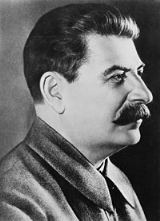
Joseph Stalin


Joseph Stalin


Joseph Stalin (, ), born as Iosef Vissarionovich DzhugashviliIosef Vissarionovich Dzhugashvili (), Bullock, p. 548, "both dictators".

Ulam, p. xiv, "the dictator not only deprived".
Davies, Harris, p.108, "Stalin as dictator".
Mawdsley, p. 1, "effectively a dictator".
Overy, p. 17, "and, later, as dictator"


Following the death of Vladimir LeninVladimir Lenin

Vladimir Ilyich Ulyanov, better known to the world as Vladimir Lenin , was the founder of Russian Communism and the fi...
 in 1924, Stalin prevailed in a power struggle over Leon TrotskyLeon Trotsky Overview

Leon Davidovich Trotsky , born Lev Davidovich Bronstein , was a Bolshevik revolutionary and Marxist theorist....
, who was expelled from the Communist Party and deported from the Soviet Union. Stalin launched a command economy in the Soviet Union replacing the New Economic PolicyNew Economic Policy

The New Economic Policy was officially decided in the course of the 10th Congress of the Communist Party of the Soviet Union...
 of the 1920s with Five-Year Plans in 1928 and at roughly the same time, forced rapid industrialization of the largely rural country and collective farmingCollective farming

Collective farming is an organizational unit in agriculture in which peasants are not paid wages, but rather receive a share...
 by confiscating the lands of farmers.


Discussion
Ask a question about 'Joseph Stalin'
Start a new discussion about 'Joseph Stalin'
Answer questions from other users
Full Discussion Forum


Timeline

1878   Born

1924   Vladimir Lenin dies and Joseph Stalin begins to purge his rivals to clear way for his leadership.

1927   Leon Trotsky is expelled from the Soviet Communist Party, leaving Joseph Stalin with undisputed control of the Soviet Union

1934   In the Soviet Union, Politburo member Sergei Kirov is shot dead at the Communist Party headquarters in Leningrad by Leonid Nikolaev (it is widely thought that Soviet leader Joseph Stalin ordered this murder).

1937   In Moscow, 17 leading Communists go on trial accused of participating in a plot led by Leon Trotsky to overthrow Joseph Stalin's regime and assassinate its leaders.

1941   World War II: Soviet leader Joseph Stalin addresses the Soviet Union for only the second time during his three-decade rule (the first time was earlier that year on July 2). He states that even though 350,000 troops were killed in German attacks so far, that the Germans have lost 4.5 million soldiers (a gross exaggeration) and that Soviet victory was near.

1943   World War II: Tehran Conference - US President Franklin D. Roosevelt, British Prime Minister Winston Churchill and Soviet Leader Joseph Stalin meet in Tehran to discuss war strategy (on November 30 they established an agreement concerning a planned June 1944 invasion of Europe codenamed Operation Overlord).

1944   British Prime Minister Winston Churchill and Soviet Union Premier Joseph Stalin begin a nine-day conference in Moscow to discuss the future of Europe.

1945   World War II: President Franklin D. Roosevelt and British Prime Minister Winston Churchill leave to meet with Soviet leader Joseph Stalin at the Yalta Conference.

1945   World War II: President Franklin D. Roosevelt, Prime Minister of the United Kingdom Winston Churchill and Soviet leader Joseph Stalin begin the Yalta Conference (ends February 11)


Quotations


Anti-Semitism, as an extreme form of racial chauvinism, is the most dangerous vestige of cannibalism.

"Anti-Semitism: Reply to an Inquiry of the Jewish News Agency in the United States" (12 January 1931)

Beat, beat and beat again!

When asked how to treat political prisoners and get information out of them, as quoted in Nikita Khrushchev's Secret Speech "On the Personality Cult and its Consequences" (25 February 1956)


Encyclopedia


Joseph Stalin (, ), born as Iosef Vissarionovich DzhugashviliIosef Vissarionovich Dzhugashvili (), Bullock, p. 548, "both dictators".

Ulam, p. xiv, "the dictator not only deprived".
Davies, Harris, p.108, "Stalin as dictator".
Mawdsley, p. 1, "effectively a dictator".
Overy, p. 17, "and, later, as dictator"


Following the death of Vladimir LeninVladimir Lenin

Vladimir Ilyich Ulyanov, better known to the world as Vladimir Lenin , was the founder of Russian Communism and the fi...
 in 1924, Stalin prevailed in a power struggle over Leon TrotskyLeon Trotsky Overview

Leon Davidovich Trotsky , born Lev Davidovich Bronstein , was a Bolshevik revolutionary and Marxist theorist....
, who was expelled from the Communist Party and deported from the Soviet Union. Stalin launched a command economy in the Soviet Union replacing the New Economic PolicyNew Economic Policy

The New Economic Policy was officially decided in the course of the 10th Congress of the Communist Party of the Soviet Union...
 of the 1920s with Five-Year Plans in 1928 and at roughly the same time, forced rapid industrialization of the largely rural country and collective farmingCollective farming

Collective farming is an organizational unit in agriculture in which peasants are not paid wages, but rather receive a share...
 by confiscating the lands of farmers. He derogatorily referred to farmers who refused his reforms as "kulaks", a class of rich peasant which had in actual fact been wiped out by World War One; millions were killed, exileExile

Exile can be a form of punishment, or a self-imposed leaving of ones homeland....
d to SiberiaSiberia

Siberia is a vast region of Russia constituting almost all of Northern Asia....
, or died of starvationPopulation transfer in the Soviet Union

Population transfer in the Soviet Union may be classified into the following broad categories: deportations of "anti-Soviet"...
 after their land, homes, meager possessions, and ability to earn an existence from the land were taken to fulfill Stalin's vision of massive "factory farmsCollective farming

Collective farming is an organizational unit in agriculture in which peasants are not paid wages, but rather receive a share...
". While the Soviet Union transformed from an agrarian economy to a major industrial powerhouse in a short span of time, millions of people died from hardships and famine that occurred as a result of the severe economic upheaval and party policies.

At the end of 1930s, Stalin launched the Great PurgeGreat Purge

The Great Purge is the name given to campaigns of political repression and persecution in the Soviet Union orchestrated by J...
, a major campaign of political repressionPolitical repression

Political repression is the oppression or persecution of an individual or group for political reasons, particularly for the ...
. During his continued repressions, millions of people who were a threat to the Soviet politics or suspected of being such a threat were executedFacts About Capital punishment

Capital punishment, or the death penalty, is the execution of a convicted criminal by the State as punishment for crim...
 or exiled to GulagGulag

Gulag is an acronym for ??????? ?????????? ????????????????????? ??????? ? ???????, "Glavnoye...
 labor campLabor camp Summary

A labor camp is a simplified detention facility where inmates are engaged in penal labor....
s in remote areas of SiberiaSiberia

Siberia is a vast region of Russia constituting almost all of Northern Asia....
 or Central AsiaCentral Asia

Central Asia is a vast landlocked region of Asia....
, where many more died of disease, malnutrition and exposure. A number of ethnic groups in RussiaEthnic groups in Russia

Russian Federation is a multi-national state with over 170 ethnic groups designated as nationalities, population of these groups v...
 were forcibly resettledPopulation transfer in the Soviet Union

Population transfer in the Soviet Union may be classified into the following broad categories: deportations of "anti-Soviet"...
 for political reasons. Stalin's rule, reinforced by a cult of personalityFacts About Cult of personality

A cult of personality is a political institution in which a country's leader uses mass media to create a larger-than-life pu...
, fought real and alleged opponents mainly through the security apparatus, such as the NKVDNKVD

The NKVD or People's Commisariat for Internal Affairs was a government department which handled a number of the Soviet ...
. In the 1950s Nikita KhrushchevNikita Khrushchev

Nikita Sergeyevich Khrushchyov was the leader of the Soviet Union after the death of Joseph Stalin....
, Stalin's eventual successor, denounced Stalin's rule and the cult of personality, thus initiating the process of "de-StalinizationHistory of the Soviet Union (1953-1985)

The Cold War ensued as the USSR and the United States struggled indirectly for influence around the world....
".

Bearing the brunt of the Nazis' attacks, the Soviet Union under Stalin made the largest and most decisive contribution to the defeat of Nazi Germany during World War IIWorld War II

World War II, or the Second World War, was a worldwide conflict fought between the Allied Powers and the Axis Powers ,...
 (1939–1945). Some historians believe Stalin contributed to starting World War II because of his secret agreement with Nazi Germany to carve up the nation of PolandPoland Overview

Poland , officially the Republic of Poland , is a country located in Central Europe....
, as part of the Molotov-Ribbentrop PactFacts About Molotov-Ribbentrop Pact

The Molotov-Ribbentrop Pact, also known as the Hitler-Stalin Pact or Ribbentrop-Molotov Pact or Nazi-Soviet P...
 of 1939. This led to the Soviet Union's invasion of PolandPolish areas annexed by the Soviet Union

Under the terms of the Molotov-Ribbentrop Pact, adjusted by agreement on 28 September 1939, the Soviet Union annexed all Polish te...
 from the east later that same year, following Nazi Germany'sNazi Germany

Nazi Germany, or the Third Reich, refers to Germany in the years 1933 to 1945, when it was governed by the National So...
 invasion of western Poland. Under Stalin's leadership after the war, the Soviet Union went on to achieve recognition as one of just two superpowerSuperpower

A superpower is a state with the first rank in the international system and the ability to influence events and project powe...
s in the world. That status lasted for nearly four decades after his death until the dissolution of the Soviet Union. Stalin's rule had long-lasting effects on the features that characterized the Soviet state from the era of his rule to its collapse in 1991.

Childhood and education, 1878–1899


Joseph Stalin was born Iosif Vissarionovich Dzhugashvili in GoriGori, Georgia

...
, GeorgiaGeorgia within the Russian Empire

Between 1801 and 1918 the country of Georgia was part of the Russian Empire....
 to Vissarion Dzhugashvili and Ekaterina GeladzeEkaterina Geladze

Ekaterina Geladze was the mother of Joseph Stalin....
. Stalin's mother was born a serfSerfdom

Serfdom refers to the legal and economic status of some peasants under feudalism, specifically in the manorial economic syst...
. His father was a cobblerShoemaking

Shoemaking is a traditional handicraft profession, which has now been largely superseded by industrial manufacture of footwe...
 and owned his own workshop. He was their third child; their two previous sons died in infancy. The second and third toes of his left foot were webbed.

Initially, the Dzhugashvilis' lives were prosperous and happy, but Stalin's father became an alcoholic, which gradually led to his business failing and becoming violently abusive to his wife and child. As their financial situation grew worse, Stalin's family moved homes frequently; at least nine times in Stalin's first ten years of life.

The town where Stalin grew up was a violent and lawless place. It had only a small police force and a culture of violence that included gang-warfare, organized street brawls and wrestling tournaments - some of which were traditions inherited from Georgia's war-torn past. Stalin took part in streetfighting as a child; he was not afraid to challenge opponents who were much stronger than he, and he was severely beaten on numerous occasions.

At the age of 7, Stalin fell ill with smallpoxSmallpox

Smallpox was a highly contagious viral disease unique to humans....
 and his face was badly scarred by the disease. He later had photographs retouched to make his pockmarks less apparent. Stalin's native tongue was Georgian. He started learning Russian only when he was eight or nine years old, and he never lost his strong Georgian accent.

At the age of 10, Stalin began his education at the Gori Church School. His peers were mostly the sons of affluent priests, officials, and merchants. He and most of his classmates at Gori were GeorgiansGeorgians

The Georgians are a nation or an ethnic group, originating in the Caucasus....
 and spoke mostly GeorgianGeorgian language

Georgian is the official language of Georgia, a country in the Caucasus....
. However, at school they were forced to speak RussianRussian language

Russian is the most widely spoken language of Eurasia and the most widespread of the Slavic languages....
, which was the policy of Tsar Alexander IIIAlexander III of Russia

Alexander III reigned as Emperor of Russia from March 14, 1881 until his death in 1894....
. Their RussianRussians

Russians are an East Slavic ethnic group, primarily living in Russia and neighboring countries....
 teachers mocked the accents of their Georgian students, and regarded their language and culture as inferior. Nevertheless, Stalin earned the respect and admiration of his teachers by being the best student in the class, earning top marks across the board. He developed a passion for learning that stayed with him for the rest of his life. He became a very good choir singer and was often hired to sing at weddings. He also began to write poetry, something he would develop in later years.

Stalin's father, who had always wanted his son to be trained as a cobbler rather than be educated, was infuriated when the boy was accepted into the school. In his anger he smashed the windows of the local tavern, and later attacked the town police chief. Out of compassion for Stalin's mother, the police chief did not arrest Vissarion, but ordered him to leave town. He moved to Tiflis where he found work in a shoe factory and left his family behind in Gori.


About the time Stalin began school, he was struck by a horse-drawn carriage. The accident permanently damaged his left arm; this injury would later exempt him from military service in World War I. At the age of 12, Stalin was struck again by a horse-drawn carriage and injured badly. He was taken to hospital in Tiflis where he spent months in care. After he recovered, his father seized the opportunity to kidnap the boy and enroll him as an apprentice cobbler at the shoe factory where he worked. When his mother, through the aid of contacts in the clergy and school staff, recovered the boy, his father cut off all financial support to his wife and son, leaving them to fend for themselves. Stalin returned to his school in Gori where he continued to excel.

He graduated first in his class and in 1894, at the age of 16, he enrolled at the Georgian OrthodoxGeorgian Orthodox and Apostolic Church

The Georgian Orthodox Church is one of the world's most ancient Christian Churches, and tradition traces its origins to the ...
 Seminary of Tiflis, to which he had been awarded a scholarship. The teachers at Tiflis Seminary were also determined to impose Russian language and culture on the Georgian students. Like many of his comrades, young Stalin reacted by being drawn to Georgian patriotism. During this time he gained fame as a poet; his poems were published in several local newspapers. However, his interest for poetry began to fade as he was drawn to rebellion and revolution.

During his time at the seminary, Stalin and numerous other students read forbidden literature that included Victor Hugo novels and revolutionary, including Marxist, material. He was caught and punished numerous times for this. One teacher in particular - Father Abashidze, whom Stalin nicknamed "the Black Spot" - harassed the rebel students through student informers, nightly patrols and surprise dormitory raids. This personal experience of "surveillance, spying, invasion of inner life, violation of feelings", in Stalin's own words, influenced the design of his future terror state. He became an atheist in his first year. He insisted his peers call him "Koba", after the Robin Hood-like protagonist of the novel The PatricideThe Patricide

The Patricide is a novel by Alexander Kazbegi, first published in 1882....
by Alexander Kazbegi; he would continue to use this pseudonym as a revolutionary. In August 1898, he joined the Russian Social-Democratic Labour Party, an organisation from which the Bolsheviks would later form.

Shortly before the final exams, the Seminary abruptly raised school fees. Unable to pay, Stalin quit the seminary in 1899 and missed his exams, for which he was officially expelled. Twenty of his fellow-classmates were expelled for revolutionary activities in 1899, and forty more were expelled in 1901. Shortly after leaving school, Stalin discovered the writings of Vladimir LeninFacts About Vladimir Lenin

Vladimir Ilyich Ulyanov, better known to the world as Vladimir Lenin , was the founder of Russian Communism and the fi...
 and decided to become a revolutionary.

Early years as a Marxist revolutionary, 1899–1917

After abandoning his priestly education, Stalin took a job as a weatherman at the Tiflis Meteorological Observatory. Although the pay was relatively low (20 roubles a month), his workload was light, giving him plenty of time for revolutionary activities. He would organise strikes, lead demonstrations and give speeches. He soon caught the attention of the Tsar's secret police, the Okhrana. During this time he met and charmed Simon Ter-PetrossianKamo (Bolshevik)

Kamo, real name Simon Ter-Petrossian was a Georgian Bolshevik of Armenian descent, an early companion to Stalin....
, a violent psychopath who became his long-time henchman and enforcer.


On the night of April 3 1901 the Okhrana arrested a number of SD Party leaders in Tiflis, but Stalin spotted their agents waiting in ambush at the Observatory and avoided capture. He went underground, becoming a full-time revolutionary, living off donations from friends, sympathizers and his Party. He began writing revolutionary articles for the BakuBaku

Baku , sometimes known as Baky or Baki, is the capital and the largest city of Azerbaijan....
-based radical newspaper Brdzola ("Struggle").

In October, Stalin fled to BatumiBatumi

Batumi is a seaside city on the Black Sea coast and capital of Adjara, an autonomous republic in southwest Georgia....
 and got work at an oil refinery owned by the Rothschild familyRothschild family

The Mayer Amschel Rothschild family, is an eminent international banking and finance dynasty of German Jewish origin that es...
. Organizing the workers there, Stalin was almost certainly involved in a 1902 fire at the refinery designed to trick the management into giving the workers a bonus for putting out the fire. However, the manager suspected arson and refused to pay. This led to a series of strikes, all organized by Stalin, which in turn led to arrests and clashes with the Cossacks in the streets. In one attempt to break their comrades out of prison, thirteen strikers were killed when Cossacks intervened. Stalin distributed incendiary pamphlets portraying the dead as martyrs. On April 18 1902, the authorities finally arrested Stalin at one of his secret meetings. At his trial, Stalin was acquitted of leading the riots due to lack of evidence, but was kept in custody whilst the authorities investigated his activities in Tiflis. In 1903, the authorities decided to exile Stalin to Siberia for three years.

Stalin ended up in the Siberian town of Novaya Uda on December 9 1903. During this time, he heard that two rival factions within the Social-Democrats had formed: the Bolsheviks under Lenin and the Mensheviks under Julius MartovJulius Martov

Julius Martov or L. Martov was born in Constantinople in 1873....
. Stalin, already an admirer, decided to become a Leninist. Stalin managed to obtain false papers and, on January 17 1904, escaped Siberia by train, arriving back in Tiflis ten days later.

With no income, Stalin lived off his circle of friends. One of them introduced him to Lev KamenevLev Kamenev

Lev Borisovich Kamenev was a Bolshevik revolutionary and a prominent Soviet politician....
 (then known as Lev Rosenfeld), his future co-ruler of the USSR after Lenin's death. At this time, Stalin favored a Georgian Social-Democratic party, which caused a rift with the majority who favored international Marxism. Threatened with expulsion, he was forced to write Credo, a paper renouncing his views (because this paper distanced himself from Lenin, when Stalin became ruler of the USSR, he tried to destroy all copies of this Credo, and many of those who had read it were shot).

In February 1904, the Russo-Japanese WarRusso-Japanese War

The Russo-Japanese War was a conflict that grew out of the rival imperialist ambitions of Russia and Japan in Manchuria and...
 broke out between JapanJapan Overview

is an island country in East Asia. Located in the Pacific Ocean, it lies to the east of China, Korea, and Russia, stretching from...
 and Russia. The war, which would eventually end in Russia's defeat, severely strained the Russian economy and caused a great deal of restlessness in Georgia. Stalin travelled across Georgia conducting political activity for his party. He also worked to undermine the Mensheviks through a campaign of slander and intrigue; his efforts brought him to Lenin's attention for the first time.

On January 22 1905, Stalin was in BakuBaku

Baku , sometimes known as Baky or Baki, is the capital and the largest city of Azerbaijan....
 when Cossacks attacked a mass demonstration of workers, killing two hundred. This sparked off the Russian Revolution of 1905. Riots, peasant uprisings and ethnic massacres swept the Russian Empire. In February, ethnic Azeris and ArmeniansArmenians

The Armenians are a nation and an ethnic group originating in the Caucasus and eastern Anatolia....
 were slaughtering each other in the streets of Baku. Commanding a squad of armed Bolsheviks, Stalin ran protection rackets to raise Party funds and stole printing equipment. Afterwards, he headed west, where continued to campaign against the Mensheviks, who enjoyed overwhelming support in Georgia. In the mining town of ChiaturaFacts About Chiatura

Chiatura is a city in Imereti region of Western Georgia....
, both Stalin and the Mensheviks competed for the support of the miners; they chose Stalin, being more swayed by his plain and concise manner of speaking than the flamboyant oratory of the Menshevik speaker. From Chiatura, Stalin organized and armed Bolshevik militias across Georgia. With them, he ran protection rackets among the wealthy and waged guerilla warfare on Cossacks, policemen and the Okhrana. Later that year in Tiflis, he met Ekaterina SvanidzeEkaterina Svanidze

Ekaterina Svanidze was the Georgian first wife of Joseph Stalin; they married in 1903....
, who would become his first wife.

In December 1905, Stalin and two other were elected to represent the Caucusus at the next Bolshevik conference, which took place in Tammerfors, FinlandFinland

The Republic of Finland , is one of the Nordic countries....
. There, on January 7 1906, Stalin met Lenin in person for the first time. Although Stalin was impressed by Lenin's personality and intellect, he was not afraid to contradict him. He objected to Lenin's proposal that they take part in elections to the recently-formed DumaDuma

A Duma is any of various representative assemblies in modern Russia and Russian history....
; Lenin conceded to Stalin. At the conference he also met Emelian Yaroslavsky, his future propaganda chief, and Solomon LozovskySolomon Lozovsky

Solomon Lozovsky was a Russian Jewish revolutionary, a colleague of Vladimir Ilyich Lenin and a prominent official in the So...
, his future Deputy Foreign Commissar.

After the conference, Stalin returned to Georgia, where Cossack armies were brutally working to reconquer the rebellious region for the Tsar. In Tiflis, Stalin and the Mensheviks plotted the assassination of General Fyodo Griiazanov, which was carried out on March 1 1906. Stalin continued to raise money for the Bolsheviks through extortion, bank robberies and hold-ups.

In April 1906, Stalin attended the Fourth Congress of the Russian Social Democratic Labour PartyRussian Social Democratic Labour Party

The Russian Social-Democratic Labour Party, or RSDLP , also known as the Russian Social-Democratic Workers' Party...
. At the conference, he met Klimenti Voroshilov, his future Defence Commissar and First Marshal; Felix Dzerzhinsky, future founder of the ChekaCheka

The Cheka was the first of many Soviet secret police organizations, created by decree on December 20, 1917 by Vladimir Leni...
; and Grigory ZinovievFacts About Grigory Zinoviev

Grigory Yevseevich Zinoviev , was a Bolshevik revolutionary and a Soviet Communist politician....
, with whom he would share power after Lenin's death. The Congress - in which the Bolsheviks were outnumbered - voted to ban bank robberies. This upset Lenin, who needed the bank robberies to raise money.

Stalin married Ekaterina SvanidzeEkaterina Svanidze

Ekaterina Svanidze was the Georgian first wife of Joseph Stalin; they married in 1903....
 on the night of July 28 1906. On March 31 1907, she gave birth to Stalin's first child, YakovYakov Dzhugashvili

Yakov Iosifovich Dzhugashvili was one of Joseph Stalin's three known children, along with Svetlana Stalin and Vasily Stalin....
.

Stalin and Lenin both attended the Fifth Congress of the Russian Social Democratic Labour PartyRussian Social Democratic Labour Party

The Russian Social-Democratic Labour Party, or RSDLP , also known as the Russian Social-Democratic Workers' Party...
 in LondonLondon

London is the capital city of England and of the United Kingdom....
 in 1907. This Congress consolidated the supremacy of Lenin's Bolshevik faction and debated strategy for communist revolution in Russia. Here, Stalin first met Leon TrotskyLeon Trotsky

Leon Davidovich Trotsky , born Lev Davidovich Bronstein , was a Bolshevik revolutionary and Marxist theorist....
 in person; Stalin immediately came to hate him, calling him "pretty but useless". After the conference, Stalin began switching his focus away from Georgia, which was rife with feuding and dominated by the Mensheviks, to Russia; he began writing in Russian.

Upon his return to Tiflis, Stalin readied himself for a major bank robbery. Through contacts in the banking business, he had learned a major shipment of money was due to be delivered in June to the Imperial Bank at the centre of town. Because his party banned bank robberies, Stalin temporarily resigned. On June 26 1907, Stalin's gang ambushed the armed convoy when it entered Yerevan Square with gunfire and homemade bombs. Around forty people were killed, but all of Stalin's gang managed to escape alive with 250,000 roubles (around US$3.4 million in today's terms). Stalin and his family left Tiflis two days later. His henchman KamoKamo

Kamo may refer to:*Kamo, New Zealand, a town in the Northland Region of New Zealand...
 delivered the money to Lenin in FinlandFinland

The Republic of Finland , is one of the Nordic countries....
, who then fled with it to GenevaGeneva

Geneva is the second most populous city in Switzerland , and is the most populous city of Romandy ....
. The Mensheviks, who had banned bank robberies (and didn't get to share in the loot), were outraged and investigated the suspects. Stalin escaped expulsion, though the affair would cause him trouble for years to come.

Stalin's family moved to BakuBaku

Baku , sometimes known as Baky or Baki, is the capital and the largest city of Azerbaijan....
. Whilst Stalin continued his revolutionary activities, his wife fell ill from Baku's pollution, heat, stress and malnourishment. She eventually contracted typhusTyphus

This is about the disease Typhus. See Typhus for the monster in Greek mythology, or typhoid fever for an unrelated disease with...
 (though many historians believe it to have been tuberculosisTuberculosis

Tuberculosis is an infectious disease caused by the bacterium Mycobacterium tuberculosis, which most commonly affects t...
) and died on December 5 1907. Stalin was overcome with grief and retreated into mourning for several months. The loss also hardened him; he told a friend: "with her died my last warm feelings for humanity". He abandoned his son, Yakov, who was raised by his deceased wife's family.

When Stalin resumed his activities, he organized more strikes and agitation, this time focusing on the Muslim Azeri and PersianIranian peoples

, from the [[Balkan...
 workers in BakuBaku Overview

Baku , sometimes known as Baky or Baki, is the capital and the largest city of Azerbaijan....
. He helped found a Muslim Bolshevik group called Himmat, and also supported Persian Constitutional Revolution with manpower and weapons, and even visited Persia to organize partisans. Stalin ordered the murders of many Black Hundreds (right-wing supporters of the Tsar), and conducted protection rackets and ransom kidnappings against the oil tycoons of Baku . He also operated counterfeiting operations, robberies and protection rackets. He befriend the criminal gangs, and used them to obstruct Mensheviks. Stalin's gangsterism upset the Bolshevik intelligentsia, but he was too influential and indispensable to oppose.

The Okhrana tracked down and arrested Stalin on April 7 1908. After seven months in prison, he was sentenced to two years exile in Siberia. He arrived in the village of SolvychegodskSolvychegodsk

Solvychegodsk is a town in the southern part of Arkhangelsk Oblast, Russia, located on the right-hand bank of the Vychegda R...
 in early March 1909. After seven months in exile, he disguised himself as a woman and escaped on a train to St Petersburg. He returned to Baku in late July.

The Bolsheviks were on the verge of collapse due to Okhrana oppression within the Empire and infighting among the intelligentsia abroad. In desperation, he advocated a reconciliation with the Mensheviks (which Lenin opposed). He demanded the creation of a Russian Bureau to run the Social-Democratic Party from within the Empire, to which he was appointed.

Stalin soon realised the Bolsheviks had been heavily infiltrated by Tsarist spies. He initiated a witch-hunt for traitors, however, he failed to root out any real traitors - as revealed by Okhrana records - and his efforts caused much disarray in the Party.

On April 5 1910 Stalin was yet again arrested by the Okhrana. He was banned from the CaucasusCaucasus

The Caucasus or Caucasia is a region in Eurasia bordered on the south by Turkey and Iran in Asia, on the west by the B...
 for five years and sentenced to complete his previous exile in SolvychegodskFacts About Solvychegodsk

Solvychegodsk is a town in the southern part of Arkhangelsk Oblast, Russia, located on the right-hand bank of the Vychegda R...
. He was deported back there in September. He briefly escaped in early 1911, but another exile who was supposed to pass much-needed money to him instead ran off with it (Stalin would have him shot for this in 1937), and he was forced to return to SolvychegodskSolvychegodsk

Solvychegodsk is a town in the southern part of Arkhangelsk Oblast, Russia, located on the right-hand bank of the Vychegda R...
. During his exile, he had an affair with his landlady, Maria Kuzakova, with whom he fathered a son, ConstantineConstantine Kuzakov

Constantine Kuzakov was the illegitimate second child of Joseph Stalin....
. Stalin was released on July 9 1911, while Maria was still pregnant. Stalin moved to VologdaVologda

Vologda is a city in Russia, administrative center of Vologda Oblast....
 in late July, where he had been ordered to reside for two months.


In January 1912, at the Prague Party ConferencePrague Party Conference

The Prague Party Conference was a conference of Vladimir Lenin's Bolshevik faction of the Russian Social Democratic Labour P...
, Lenin led his Bolshevik faction out of the Russian Social Democratic Labor Party, founding the separate Bolshevik Party. A Central Committee was elected, but when some of its members returned to Russia, they were arrested by the Okhrana, having been secretly betrayed by fellow CC member Roman MalinovskyRoman Malinovsky

Roman Vaslavovich Malinovsky was a Russian Bolshevik politician....
, an Okhrana spy. To fill the void, Lenin and Grigory Zinoviev]Zinoviev coopted Stalin as a member of the Central Committee. When Stalin was informed of this, he left VologdaVologda Overview

Vologda is a city in Russia, administrative center of Vologda Oblast....
 in late February.

Stalin moved to Saint PetersburgSaint Petersburg

Saint Petersburg listen is a city located in northwestern Russia on the delta of the Neva River at the east end of the Gulf...
 in April 1912, where he took control of the Bolshevik weekly newspaper Zvezda. Stalin had been assigned to convert Zvezda into a daily and rename it Pravda. The first issue was published on May 5.

Shortly afterwards, the Okhrana caught up with him again, and in July 1912 he was exiled again to Siberia for three years, this time in the small village of NarymNarym

Narym is a village in Parabelsky District of Tomsk Oblast, Russia, located on the banks of the Ob River near its confluenc...
. He escaped just thirty-eight days after arriving; this was his shortest exile. He returned to Saint PetersburgSaint Petersburg

Saint Petersburg listen is a city located in northwestern Russia on the delta of the Neva River at the east end of the Gulf...
 in September.

Stalin made efforts to reconcile the Bolsheviks with the Mensheviks in hopes of salvaging the struggling Marxist movement. He published editorials in PravdaPravda

Pravda was a leading newspaper of the Soviet Union and an official organ of the Central Committee of the Communist Party...
 advocating reconciliation, and secretly met with Menshevik leaders on several occasions. This angered Lenin, who twice summoned Stalin to KrakówKraków

Krakw see also Names of European cities in different languages) is one of the oldest and largest cities of Poland, with...
 to argue policy. On the second visit at the end of 1912, Stalin was removed from his post as editor of PravdaPravda

Pravda was a leading newspaper of the Soviet Union and an official organ of the Central Committee of the Communist Party...
, but was made a leader of the Russian Bureau of the Bolshevik Party. Lenin also asked Stalin to write an essay laying out the Bolshevik position on national minorities.


After KrakówKraków

Krakw see also Names of European cities in different languages) is one of the oldest and largest cities of Poland, with...
, Stalin spent several weeks in ViennaVienna

Vienna is the capital of Austria, and also one of the nine States of Austria....
 with the Troyanovskys, a wealthy Bolshevik couple he met with Lenin in Kraków. Whilst there he met for the first time Nikolai BukharinNikolai Bukharin

Nikolai Ivanovich Bukharin , was a Bolshevik revolutionary and intellectual, and later a Soviet politician....
, who would become a leading politician in the future Soviet government. They continued to discuss the issue of nationalities. Stalin completed his essay on the topic, entitled "Marxism and the National Question", which was published in March 1913 under the pseudonym "K. Stalin" (this was the first time he used the name "Stalin" in a publishing; he began using this alias in 1912).

Stalin returned to Saint PetersburgSaint Petersburg

Saint Petersburg listen is a city located in northwestern Russia on the delta of the Neva River at the east end of the Gulf...
 in February 1913. During this time, many Bolsheviks, including almost the entire Central Committee, had been arrested by the Okhrana, having been betrayed by Roman MalinovskyRoman Malinovsky

Roman Vaslavovich Malinovsky was a Russian Bolshevik politician....
, a high-ranking Bolshevik who for years had been an Okhrana spy and agent provocateur. That month, an article had been published that outed Malinovsky as a spy, but the Bolsheviks dismissed it as MenshevikMenshevik

The Mensheviks were a faction of the Russian revolutionary movement that emerged in 1903 after a dispute between Vladimir Le...
 libel (ironically, Lenin and Stalin were his strongest defenders). On March 8 Malinovsky persuaded Stalin to attend a Bolshevik fundraising ball, which was raided by the Okhrana.

Stalin was condemned to four years in the remote Siberian province of TurukhanskTurukhansk

Turukhansk is a village in Krasnoyarsk Krai, Russia....
. He was eventually joined by KamenevLev Kamenev

Lev Borisovich Kamenev was a Bolshevik revolutionary and a prominent Soviet politician....
 and several other Bolshevik exiles. He spent six months in the small hamlet of Kostino on the Yenisei RiverYenisei River

The Yenisei is the greatest river system flowing to the Arctic Ocean, and the fifth longest river in the world....
. After learning that Stalin was planning an escape (he had received money and supplies from his comrades), the authorities moved him north to Kureika, a hamlet on the edge of the Arctic Circle. There, he lived the life of a hunter-gatherer, having learned fishing and hunting from the local Siberian tribesmen. While there he began a 2-year affair with Lidia Pereprygina, then aged 13, with whom he fathered two children. The first died in infancy; the second, named Alexander, was born in April 1917.

In late 1916, Stalin was conscripted into the army. He was taken KrasnoyarskKrasnoyarsk

Krasnoyarsk is the administrative center of Krasnoyarsk Krai, Russia, and the third largest city in Siberia, having a popula...
 in February 1917, but the medical examiner there found him unfit for service due to his damaged left arm (a childhood injury). He spent his last four months of exile in the village of Achinsk.

Russian Revolution of 1917

In the wake of the February Revolution of 1917 (the first phase of the Russian Revolution of 1917Russian Revolution of 1917

The Russian Revolution of 1917 was a series of political events in Russia, which, after the elimination of the Russian autoc...
), Stalin was released from exile. On March 25 he returned to PetrogradSaint Petersburg

Saint Petersburg listen is a city located in northwestern Russia on the delta of the Neva River at the east end of the Gulf...
 (Saint Petersburg) and, together with Lev KamenevLev Kamenev

Lev Borisovich Kamenev was a Bolshevik revolutionary and a prominent Soviet politician....
 and Matvei MuranovMatvei Muranov

Matvei Konstantinovich Muranov was a Ukrainian-born Bolshevik revolutionary and a Soviet politician....
, ousted Vyacheslav MolotovVyacheslav Molotov

Vyacheslav Mikhailovich Molotov, Soviet politician and diplomat, was a leading figure in the Soviet government from the 1920...
 and Alexander ShlyapnikovAlexander Shlyapnikov

Alexander Gavrilovich Shlyapnikov was a Russian communist, trade union leader and skilled metalworker....
 as editors of PravdaPravda Summary

Pravda was a leading newspaper of the Soviet Union and an official organ of the Central Committee of the Communist Party...
, the official Bolshevik newspaper, while Lenin and much of the Bolshevik leadership were still in exile. Stalin and the new editorial board took a position in favor of supporting Alexander KerenskyAlexander Kerensky

Alexander Fyodorovich Kerensky was a Russian revolutionary leader who was instrumental in toppling the Russian monarchy....
's provisional governmentRussian Provisional Government Summary

The Russian Provisional Government was formed in Petrograd after the deterioration of the Russian Empire and the tsar's abdi...
 (Molotov and Shlyapnikov had wanted to overthrow it) and went to the extent of declining to publish Lenin's articles arguing for the provisional government to be overthrown. However, after Lenin prevailed at the April Party conference, Stalin and the rest of the Pravda staff came on board with Lenin's view and called for overthrowing the provisional government. At this April 1917 Party conference, Stalin was elected to the Bolshevik Central Committee with the third highest total votes in the party.

In mid-July, armed mobs led by Bolshevik militants took to the streets of Petrograd, killing army officers and bourgeois civilians. They demanded the overthrow of the government, but neither the Bolshevik leadership nor the Petrograd SovietPetrograd Soviet

The Petrograd Soviet, or Petrograd Soviet of Workers' and Soldiers' Deputies, was the council set up in Petrograd in March 1...
 were willing to take power, having been totally surprised by this unplanned revolt. After the disappointed mobs dispersed, Kerensky'sAlexander Kerensky

Alexander Fyodorovich Kerensky was a Russian revolutionary leader who was instrumental in toppling the Russian monarchy....
 government struck back at the Bolsheviks. Loyalist troops raided PravdaPravda

Pravda was a leading newspaper of the Soviet Union and an official organ of the Central Committee of the Communist Party...
 and surrounded the Bolshevik headquarters. Stalin helped Lenin evade capture and, to avoid a bloodbath, ordered the besieged Bolsheviks to surrender.

Convinced Lenin would be killed if caught, Stalin smuggled him to Finland. In Lenin's absence, Stalin assumed leadership of the Bolsheviks. At the Sixth Congress of the Bolshevik party, held secretly in Petrograd, Stalin was chosen to be the chief editor of the Party press and a member of the Constituent Assembly, and was re-elected to the Central Committee.

In September 1917, KerenskyAlexander Kerensky Summary

Alexander Fyodorovich Kerensky was a Russian revolutionary leader who was instrumental in toppling the Russian monarchy....
 suspected his newly-appointed Commander-in-Chief, General Lavr KornilovLavr Kornilov Overview

Lavr Georgiyevich Kornilov was a Russian army general best known for the Kornilov Affair, an unsuccessful military coup he...
, of planning a coup and dismissed him. Believing Kerensky was being controlled by the Bolsheviks, Kornilov decided to march his army on Petrograd. In desperation, Kerensky turned to the Petrograd SovietPetrograd Soviet Summary

The Petrograd Soviet, or Petrograd Soviet of Workers' and Soldiers' Deputies, was the council set up in Petrograd in March 1...
 for help and released the Bolsheviks, who together raised a small army to defend the capital. In the end, Kerensky convinced Kornilov's army to stand down and disband without violence. However, the Bolsheviks were now free, rearmed and swelling with new recruits and under Stalin's firm control, whilst Kerensky had few troops loyal to him in the capital. Lenin decided the time for a coup had arrived. KamenevLev Kamenev

Lev Borisovich Kamenev was a Bolshevik revolutionary and a prominent Soviet politician....
 and ZinovievGrigory Zinoviev

Grigory Yevseevich Zinoviev , was a Bolshevik revolutionary and a Soviet Communist politician....
 proposed a coalition with the Mensheviks, but Stalin and Trotsky backed Lenin's wish for an exclusively Bolshevik government. Lenin returned to Petrograd in October. On October 29, the Central Committee voted 10-2 in favor of an insurrection; KamenevLev Kamenev

Lev Borisovich Kamenev was a Bolshevik revolutionary and a prominent Soviet politician....
 and ZinovievGrigory Zinoviev

Grigory Yevseevich Zinoviev , was a Bolshevik revolutionary and a Soviet Communist politician....
 voted in opposition.

On the morning of November 6, Kerensky's troops raided Stalin's press headquarters and smashed his printing presses. Whilst he worked to restore his presses, he missed a Central Committee meeting where assignments for the coup were being issued. Stalin instead spent the afternoon briefing Bolshevik delegates and passing communications to and from Lenin, who was in hiding.

Early the next day, Stalin went to the Smolny Institute from where he, Lenin and the rest of the Central Committee coordinated the coup. KerenskyAlexander Kerensky

Alexander Fyodorovich Kerensky was a Russian revolutionary leader who was instrumental in toppling the Russian monarchy....
 left the capital to rally the Imperial troops at the German front. By November 8, the Winter Palace had been stormed and Kerensky's Cabinet had been arrested.

Rise to power, 1917–1927


Upon seizing Petrograd, the Bolsheviks formed the new revolutionary authority, the Council of People's CommissarsGovernment of the Soviet Union

Council of Ministers of the USSR was the Soviet government - the highest executive and administrative body of the Soviet Un...
. Stalin was appointed People's Commissar for Nationalities' Affairs; his job was to establish an institution to win over non-Russian citizens of the former Russian Empire. He was relieved of his post as editor of Pravda so that he could devote himself fully to his new role.

After seizing Petrograd, civil war broke out in Russia, pitting Lenin'sVladimir Lenin

Vladimir Ilyich Ulyanov, better known to the world as Vladimir Lenin , was the founder of Russian Communism and the fi...
 Red Army against the White Army, a loose alliance of anti-Bolshevik forces. Lenin formed a five-member Politburo which included Stalin and TrotskyLeon Trotsky

Leon Davidovich Trotsky , born Lev Davidovich Bronstein , was a Bolshevik revolutionary and Marxist theorist....
. During this time, only Stalin and Trotsky were allowed to see Lenin without an appointment.

In April 1918, Lenin dispatched Stalin to the city of Tsaritsyn. Situated on the Lower VolgaVolga River

The Volga, widely viewed as the national river of Russia, flows through the western part of the country....
, it was a key supply route to the oil and grain of the North Caucasus, and it was in danger of falling to the White Army. Stalin ordered the executions of any suspected counter-revolutionaries. Here, he first met and befriended Kliment VoroshilovKliment Voroshilov

Kliment Yefremovich Voroshilov was a Soviet military commander and politician....
 and Semyon BudyonnySemyon Budyonny

Semyon Mikhailovich Budyonny was a Soviet military commander and an ally of Soviet leader Joseph Stalin....
, both of whom would become two of Stalin's key supporters in the military. As the military situation grew worse, Stalin effectively took control of the Red ArmyRed Army

The short forms Red Army and RKKA refer to the Workers' and Peasants' Red Army, , the armed forces first organiz...
. When Trotsky had formed the Red Army, he recruited many former Tsarist officers for their expertise, but Stalin distrusted them and had many of them killed, much to Trotsky's anger.

On his return to MoscowMoscow

Moscow is the capital of Russia and the country's principal political, economic, financial, educational, and transportation...
 in 1919, Stalin married Nadezhda Alliluyeva, his second wife.

In 1922, with the aid of Lenin and Kamenev, Stalin was appointed General Secretary of the Central Committee. This post gave him the power to appoint his supporters to key positions within the government and the Party. It also brought the secret police under his control.

Later, in 1924, Stalin himself created a myth around a so-called "Party Centre" which "directed" all practical work pertaining to the uprising, consisting of himself, SverdlovYakov Sverdlov Overview

Yakov Mikhaylovich Sverdlov, born Yankel Movshevich Sverdlov; known under pseudonyms "Andrey", "Mikhalych", "Max", "Smirnov...
, DzerzhinskyFelix Edmundovich Dzerzhinsky

Felix Edmundovich Dzerzhinsky was a Polish Communist revolutionary, famous as the founder of the Bolshevik secret police, t...
, UritskyMoisei Uritsky

Moisei Solomonovich Uritsky was a Bolshevik revolutionary leader in Russia....
, and BubnovAndrei Bubnov

Andrei Sergeyevich Bubnov was a Bolshevik revolutionary leader in Russia, and member of the Left Opposition....
. No evidence was ever shown for the activity of this "centre", which would, in any case, have been subordinate to the Military Revolutionary Council, headed by Trotsky.


During the Russian Civil WarRussian Civil War

The Russian Civil War was fought from 1917 to 1922....
 and Polish-Soviet WarPolish-Soviet War

in the late 18th century, to secure territories which she had lost at the time of partitions or earlier and by the Soviets, who ...
 Stalin was a political commissarPolitical commissar

A political commissar is an officer appointed by a communist party to oversee a unit of the military....
 in the Red ArmyFacts About Red Army

The short forms Red Army and RKKA refer to the Workers' and Peasants' Red Army, , the armed forces first organiz...
 at various frontsFront (military) Overview

A military front or battlefront is a contested armed frontier between opposing forces....
. Stalin's first government position was as People's Commissar of Nationalities Affairs (1917–1923). In that position he traveled to FinlandFinland

The Republic of Finland , is one of the Nordic countries....
 in late 1917, and promised the socialists there that the RSFSR would aid their revolutionFinnish Civil War

conflict=Finnish Civil War|date=January 27, 1918 - May 15, 1918 ...
. However, this aid was never given and the revolution in Finland was defeated.

He was also People's Commissar of the Workers and Peasants InspectionWorkers and Peasants Inspection

Workers and Peasants Inspection was a government organization that was part of the socialist economic planning apparatus of...
 (1919–1922), a member of the Revolutionary Military CouncilRevolutionary Military Council

Revolutionary Military Council of the Republic or Revvoyensoviet was the supreme military authority of Soviet Russia....
 of the republic (1920–1923) and a member of the Central Executive Committee of the Congress of Soviets (from 1917).

Stalin played a decisive role in engineering the 1921 Red Army invasion of GeorgiaRed Army invasion of Georgia Overview

The Red Army invasion of Georgia also known as the Soviet-Georgian War was a military campaign by the Soviet Russian ...
 following which he adopted particularly hardline, centralist policies towards Soviet GeorgiaGeorgian SSR

The Georgian SSR was the name given to Georgia when it was part of the Soviet Union from 1936 to 1991....
, which included severe repression of all opposition within the local Communist party (e.g., the Georgian AffairGeorgian Affair

The Georgian Affair of 1922 was a political conflict within the Soviet leadership about the way in which social and politica...
 of 1922), not to mention any manifestations of anti-Sovietism (the August Uprising of 1924). It was in the Georgian affairs that Stalin first began to play his own hand.

Campaign against the left and right opposition

On April 3, 1922, Stalin was made general secretaryGeneral Secretary of the Communist Party of the Soviet Union

The General Secretary of the Communist Party of the Soviet Union was the title synonymous with leader of the Soviet Union af...
 of the Central CommitteeCentral Committee of the Communist Party of the Soviet Union

The Central Committee, abbreviated in Russian as ??, "Tseka", was the highest body of the Communist Party of the Sovi...
 of the All-Russian Communist Party (Bolsheviks)Facts About Communist Party of the Soviet Union

The Communist Party of the Soviet Union was the name used by the successors of the Bolshevik faction of the Russian Social-...
, a post that he subsequently built up into the most powerful in the country. It has been claimed that he initially attempted to decline accepting the post, but was refused. This position was seen to be a minor one within the party (Stalin was sometimes referred to as "Comrade Card-Index" by fellow party members) but, when combined with personal leadership over the OrgburoOrgburo

The Organizational Bureau of the Central Committee of the Communist Party of the Soviet Union existed from 1919 to 1952, un...
 and with an ally (Kaganovich) heading the organizational Registration and Distribution Department of the Central CommitteeUchraspred

The Uchraspred was the Registration and Distribution Department of the Central Committee in the Soviet Union....
, actually had potential as a power base as it allowed Stalin to fill the party with his allies.

After Lenin'sVladimir Lenin

Vladimir Ilyich Ulyanov, better known to the world as Vladimir Lenin , was the founder of Russian Communism and the fi...
 deathDeath

Death is the full cessation of vital functions in the biological life....
 in January 1924, Stalin, Kamenev, and Zinoviev together governed the party, placing themselves ideologicallyIdeology

An ideology is an organized collection of ideas....
 between TrotskyLeon Trotsky

Leon Davidovich Trotsky , born Lev Davidovich Bronstein , was a Bolshevik revolutionary and Marxist theorist....
 (on the left wing of the party) and Bukharin (on the right). During this period, Stalin abandoned the traditional Bolshevik emphasis on international revolution in favor of a policy of building "Socialism in One CountrySocialism in One Country

Socialism in One Country was a thesis put forward by Joseph Stalin in 1924 and further supported by Nikolai Bukharin that gi...
", in contrast to Trotsky's theory of Permanent RevolutionPermanent Revolution

Permanent Revolution is a Marxist theory most closely associated with Leon Trotsky, devised as an explanation of how sociali...
.

In the struggle for leadership after Lenin's death one thing was evident; whoever ended up ruling the party had to demonstrate fealty to the memory of Lenin. Stalin did so by organizing the late leader's funeral, after which he made a speech professing an undying loyalty to Lenin that was almost religious in nature.

Stalin's actual relationship with Lenin, which was far more complex than Stalin's speeches alluded, has been illuminated by a number of sources that were made available after the fall of the Soviet Union, including some from Lenin's sister.


Stalin first worked to undermine Trotsky, who was sick at the time, possibly by misleading him about the date of the funeral. Consequently, Trotsky, who was Lenin’s associate throughout the early days of the Soviet regime, lost considerable political support. Stalin made great deal of the fact that Trotsky had joined the Bolsheviks just before the revolution, and publicized Trotsky's pre-revolutionary disagreements with Lenin. Another event that helped Stalin's rise was the fact that Trotsky came out against publication of Lenin's TestamentLenin's Testament

Lenin's Testament is the name given to a document written by Vladimir Lenin in the last weeks of 1922 and the first week of ...
 in which he pointed out the strengths and weaknesses of Stalin and Trotsky and the other main players, and suggested that he be succeeded by a small group of people.

An important feature of Stalin’s rise to power is the way that he manipulated his opponents and played them off against each other. Stalin formed a "troikaTroika

A general meaning of the Russian word troika is threesome, a collection of 3 of any kind....
" of himself, Zinoviev, and Kamenev against Trotsky. When Trotsky had been eliminated, Stalin then joined Bukharin and Rykov against Zinoviev and Kamenev, emphasising their vote against the insurrection in 1917. Zinoviev and Kamenev then turned to Lenin's widow, KrupskayaNadezhda Konstantinovna Krupskaya

Nadezhda Konstantinovna Krupskaya was a Russian Marxist revolutionary....
; they formed the "United OppositionUnited Opposition

The United Opposition was a group formed in the All-Union Communist Party in 1926 by Leon Trotsky, Lev Kamenev, and Gregory ...
" in July 1926.

In 1927 during the 15th Party Congress Trotsky and Zinoviev were expelled from the party and Kamenev lost his seat on the Central Committee. Stalin soon turned against the "Right OppositionRight Opposition

The Right Opposition was the name given to the tendency made up of Nikolai Bukharin, Alexei Rykov and their supporters withi...
", represented by his erstwhile allies, Bukharin and Rykov.

Stalin gained popular appeal from his presentation as a 'man of the people' from the poorer classes. The Russian people were tired from the world war and the civil war, and Stalin's policy of concentrating in building "Socialism in One Country" was seen as an optimistic antidote to war.

Stalin took great advantage of the ban on factionalism which meant that no group could openly go against the policies of the leader of the party because that meant creation of an opposition. By 1928 (the first year of the Five-Year PlanFive-Year Plan (USSR)

Five-Year Plans for the National Economy of the USSR or Piatiletkas were a series of nation-wide centralized exercises...
s) Stalin was supreme among the leadership, and the following year Trotsky was exiled because of his opposition. Having also outmaneuvered Bukharin's Right Opposition and now advocating collectivization and industrialization, Stalin can be said to have exercised control over the party and the country.

However, as the popularity of other leaders such as Sergei Kirov and the so-called Ryutin AffairRyutin Affair Summary

The Ryutin Affair was one of the last attempts to oppose the Soviet leader Joseph Stalin within the Soviet Communist Party....
 were to demonstrate, Stalin did not achieve absolute power until the Great PurgeGreat Purge

The Great Purge is the name given to campaigns of political repression and persecution in the Soviet Union orchestrated by J...
 of 1936–1938.

Soviet secret service and intelligence

Stalin vastly increased the scope and power of the state's secret police and intelligence agencies. Under his guiding hand, Soviet intelligence forces began to set up intelligence networks in most of the major nations of the world, including Germany (the famous Rote Kappelle spy ring), Great Britain, France, Japan, and the United States. Stalin saw no difference between espionage, communist political propaganda actions, and state-sanctioned violence, and he began to integrate all of these activities within the NKVDNKVD

The NKVD or People's Commisariat for Internal Affairs was a government department which handled a number of the Soviet ...
. Stalin made considerable use of the Communist InternationalComintern

The Comintern was an international Communist organization founded in March 1919, in the midst of the "war communism" period,...
 movement in order to infiltrate agents and to ensure that foreign Communist parties remained pro-Soviet and pro-Stalin.

One of the best examples of Stalin's ability to integrate secret police and foreign espionage came in 1940, when he gave approval to the secret police to have Leon TrotskyLeon Trotsky

Leon Davidovich Trotsky , born Lev Davidovich Bronstein , was a Bolshevik revolutionary and Marxist theorist....
 assassinated in Mexico.

Changes to Soviet society, 1927–1939


Industrialization

See also: Industrialisation of the Soviet Union


The Russian Civil WarRussian Civil War

The Russian Civil War was fought from 1917 to 1922....
 and wartime communism had a devastating effect on the country's economy. Industrial output in 1922 was 13% of that in 1914. A recovery followed under the New Economic PolicyNew Economic Policy

The New Economic Policy was officially decided in the course of the 10th Congress of the Communist Party of the Soviet Union...
, which allowed a degree of market flexibility within the context of socialism.

Under Stalin's direction, this was replaced by a system of centrally ordained "Five-Year Plans" in the late 1920s. These called for a highly ambitious program of state-guided crash industrialization and the collectivization of agriculture.

With seed capital unavailable because of international reaction to Communist policies, little international tradeInternational trade

International trade is the exchange of goods and services across international boundaries or territories....
, and virtually no modern infrastructure, Stalin's government financed industrialization both by restraining consumption on the part of ordinary Soviet citizens to ensure that capital went for re-investment into industry, and by ruthless extraction of wealth from the kulaks.

In 1933 workers' real earnings sank to about one-tenth of the 1926 level. Common and political prisoners in labor campLabor camp

A labor camp is a simplified detention facility where inmates are engaged in penal labor....
s were forced to do unpaid labor, and communists and KomsomolKomsomol Summary

Komsomol is a syllabic abbreviation word, from the Russian Kommunisticheskiy Soyuz Molodiozhi, or "Co...
 members were frequently "mobilized" for various construction projects. The Soviet Union used foreign experts, e.g. British engineer Stephen Adams, to instruct their workers and improve their manufacturing processes.

In spite of early breakdowns and failures, the first two Five-Year Plans achieved rapid industrialization from a very low economic base. While it is generally agreed that the Soviet Union achieved significant levels of economic growth under Stalin, the precise rate of growth is disputed. It is not disputed, however, that these gains were accomplished at the cost of millions of lives.

Official Soviet estimates stated the annual rate of growth at 13.9%; Russian and Western estimates gave lower figures of 5.8% and even 2.9%. Indeed, one estimate is that Soviet growth became temporarily much higher after Stalin's death.

According to Robert Lewis the Five-Year Plan substantially helped to modernize the previously backward Soviet economy. New products were developed, and the scale and efficiency of existing production greatly increased. Some innovations were based on indigenous technical developments, others on imported foreign technology.

Collectivization


Stalin's regime moved to force collectivizationCollective farming

Collective farming is an organizational unit in agriculture in which peasants are not paid wages, but rather receive a share...
 of agriculture. This was intended to increase agricultural output from large-scale mechanized farms, to bring the peasantry under more direct political control, and to make tax collection more efficient. Collectivization meant drastic social changes, on a scale not seen since the abolition of serfdom in 1861, and from control of the land and its produce. Collectivization also meant a drastic drop in living standards for many peasants, and it faced violent reaction among the peasantry.

In the first years of collectivization it was estimated that industrial production would rise by 200% and agricultural production by 50%, but these estimates were not met. Stalin blamed this unanticipated failure on kulaks (rich peasants), who resisted collectivization. (However, kulaks proper made up only 4% of the peasant population; the "kulaks" that Stalin targeted included the slightly better-off peasants who took the brunt of violence from the OGPUState Political Directorate

State Political Directorate was the secret police of the RSFSR and USSR until 1934....
 and the Komsomol. These peasants were about 60% of the population). Those officially defined as "kulaks," "kulak helpers," and later "ex-kulaks" were to be shot, placed into GulagGulag Summary

Gulag is an acronym for ??????? ?????????? ????????????????????? ??????? ? ???????, "Glavnoye...
 labor campLabor camp

A labor camp is a simplified detention facility where inmates are engaged in penal labor....
s, or deported to remote areas of the country, depending on the charge.

The two-stage progress of collectivization—interrupted for a year by Stalin's famous editorial, "" (PravdaPravda

Pravda was a leading newspaper of the Soviet Union and an official organ of the Central Committee of the Communist Party...
, March 2, 1930), and "" (Pravda, April 3, 1930)—is a prime example of his capacity for tactical political withdrawal followed by intensification of initial strategies.

Many historians assert the disruption caused by collectivization was largely responsible for major famineFamine

A famine is a phenomenon in which a large percentage of the population of a region or country is so undernourished that deat...
s.

The 1932–1933 famine in UkraineUkraine Summary

Ukraine is a country in Eastern Europe....
 and the Kuban