
All Topics  
Alamanni


   Email Print
   Bookmark   Link


Alamanni


The Alamanni, Allemanni, or Alemanni were originally an alliance of Germanic tribe
Germanic languages

The Germanic languages are a group of related languages that constitute a branch of the Indo-European languages language family. The common ancestor of all the languages in this branch is Proto-Germanic, spoken in approximately the mid-1st millennium BC in Pre-Roman Iron Age....
s located around the upper Main
Main

The Main is a river in Germany, 524 km long , and it is one of the more significant tributaries of the Rhine. The Main flows through the States of Germany of Bavaria, Baden-W?rttemberg and Hesse....
 river (Germany
Germany

Germany , officially the Federal Republic of Germany , is a country in Central Europe. It is bordered to the north by the North Sea, Denmark, and the Baltic Sea; to the east by Poland and the Czech Republic; to the south by Austria and Switzerland; and to the west by France, Luxembourg, Belgium, and the Netherlands....
). One of the earliest references to them is the cognomen
Cognomen

The cognomen was originally a middle name of a citizen of Ancient Rome, under Roman naming conventions. The cognomen started as a nickname, but lost that purpose when it became hereditary ....
 Alamannicus assumed by Caracalla
Caracalla

Caracalla , born Lucius Septimius Bassianus and later called Marcus Aurelius Antoninus and Marcus Aurelius Severus Antoninus, was the eldest son of Septimius Severus and Roman Emperor from 211 – 217....
, who ruled the Roman Empire
Roman Empire

The Roman Empire was the Roman Republic phase of the Ancient Rome, characterised by an autocracy form of government and large territorial holdings in Europe and around the Mediterranean....
 from 211–17 and claimed thereby to be their defeater.


Discussion
Ask a question about 'Alamanni'
Start a new discussion about 'Alamanni'
Answer questions from other users
Full Discussion Forum


Timeline

213   Caracalla defends the northern frontier against the Alamanni and the Chatti.

233   The Alamanni end Roman rule in Swabia.

250   The Alamanni drive the Romans from the modern area of Donau-Ries.

256   The Franks cross the Rhine, the Alamanni reach Milan.

259   Roman fort of Wiesbaden (Germany) captured by the Alamanni (possibly 260)

260   Roman fort of Wiesbaden (Germany) captured by the Alamanni (possibly 259).

261   Gallienus crushes the Alamanni at Milan.

268   The Alamanni invade Italy.

271   Alamanni repulsed from Italy, and forced back to the Alps.

277   Probus expels the Franks and Alamanni from Gaul.


Encyclopedia


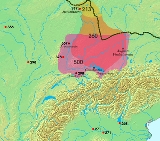
Alemanni Expansion
The Alamanni, Allemanni, or Alemanni were originally an alliance of Germanic tribe
Germanic languages

The Germanic languages are a group of related languages that constitute a branch of the Indo-European languages language family. The common ancestor of all the languages in this branch is Proto-Germanic, spoken in approximately the mid-1st millennium BC in Pre-Roman Iron Age....
s located around the upper Main
Main

The Main is a river in Germany, 524 km long , and it is one of the more significant tributaries of the Rhine. The Main flows through the States of Germany of Bavaria, Baden-W?rttemberg and Hesse....
 river (Germany
Germany

Germany , officially the Federal Republic of Germany , is a country in Central Europe. It is bordered to the north by the North Sea, Denmark, and the Baltic Sea; to the east by Poland and the Czech Republic; to the south by Austria and Switzerland; and to the west by France, Luxembourg, Belgium, and the Netherlands....
). One of the earliest references to them is the cognomen
Cognomen

The cognomen was originally a middle name of a citizen of Ancient Rome, under Roman naming conventions. The cognomen started as a nickname, but lost that purpose when it became hereditary ....
 Alamannicus assumed by Caracalla
Caracalla

Caracalla , born Lucius Septimius Bassianus and later called Marcus Aurelius Antoninus and Marcus Aurelius Severus Antoninus, was the eldest son of Septimius Severus and Roman Emperor from 211 – 217....
, who ruled the Roman Empire
Roman Empire

The Roman Empire was the Roman Republic phase of the Ancient Rome, characterised by an autocracy form of government and large territorial holdings in Europe and around the Mediterranean....
 from 211–17 and claimed thereby to be their defeater. The nature of this alliance and their previous tribal affiliations remain uncertain. The alliance was aggressive in nature, attacking the Roman province of Germania Superior
Germania Superior

Germania Superior , so called for the reason that it lay upstream of Germania Inferior, was a Roman province of the Roman Empire. It comprised the area of western Switzerland, the French Jura mountains and Alsace regions and south-western Germany....
 whenever it could. Generally it broadly followed the example of the Franks
Franks

The Franks or Frankish people were a West Germanic ethnic group first identified in the 3rd century as living north and east of the Lower Rhine River....
, the first Germanic tribal alliance, which had stopped the Romans from penetrating north of the lower Rhine
Rhine

File:Swiss Grand Canyon.jpgThe Rhine is one of the longest and most important rivers in Europe, at , with an average discharge of more than ....
 and subsequently invaded the Roman province of Germania Inferior
Germania Inferior

Germania Inferior was a Ancient Rome Roman provinces located on the left bank of the Rhine, in today's southern and western Netherlands, parts of Flanders, and North Rhine-Westphalia left of the Rhine....
.

From the first century, the Rhine had become the border between Roman Gaul
Gaul

Gaul is the name used for the region of Western Europe comprising part of present day northern Italy, France, Belgium, western Switzerland and the parts of the Netherlands and Germany on the west bank of the River Rhine....
 and tribal Germania. Germanic peoples, Celts, and tribes of mixed Celto-Germanic ethnicity were settled in the lands along both banks. The Romans divided these territories into two districts, Germania Inferior
Germania Inferior

Germania Inferior was a Ancient Rome Roman provinces located on the left bank of the Rhine, in today's southern and western Netherlands, parts of Flanders, and North Rhine-Westphalia left of the Rhine....
 and Germania Superior
Germania Superior

Germania Superior , so called for the reason that it lay upstream of Germania Inferior, was a Roman province of the Roman Empire. It comprised the area of western Switzerland, the French Jura mountains and Alsace regions and south-western Germany....
 situated along the lower and upper Rhine
Rhine

File:Swiss Grand Canyon.jpgThe Rhine is one of the longest and most important rivers in Europe, at , with an average discharge of more than ....
 respectively.

Upper Germania included the region between the upper Rhine and the upper Danube
Danube

The Danube is the longest river in the European Union and Europe's second longest river after the Volga.The river originates in the Black Forest in Germany as the much smaller Brigach and Breg River rivers which join at the eponymously named German town Donaueschingen, after which it is known as the Danube and flows eastwards for a distance...
, (the Black Forest
Black Forest

The Black Forest is a forest mountain range in Baden-W?rttemberg, southwestern Germany. It is bordered by the Rhine valley to the west and south....
 region that was larger than today: see Hercynian Forest
Hercynian Forest

The Hercynian Forest was an ancient and dense forest that stretched eastward from the Rhine River across southern Germany and formed the northern boundary of that part of Europe known to writers of antiquity....
). The Romans called this the Agri Decumates
Agri Decumates

Agri Decumates a province of the Roman Empire covering the Black Forest area between the the Main river and the sources of Danube and Rhine rivers, presently in Southwestern Germany ....
, (i.e. "Decumates territories"), a name of unknown origin. Some scholars have translated the expression as "the ten cantons", but whose cantons of what entity is not known.

The exterior Roman fortified border around the area of Germania Superior was called the Limes Germanicus
Limes Germanicus

The Limes Germanicus was a remarkable line of frontier forts that bounded the ancient Roman provinces of Germania Superior and Raetia, and divided the Roman Empire and the unsubdued Germanic tribes, from the years 83 to 260....
. The assembled warbands of the Alamanni frequently crossed the limes, attacking Germania Superior and moving into the Agri Decumates. As a confederation, from the fifth century, they settled the Alsace
Alsace

Alsace is the fourth-smallest of the 26 regions of France in land area , and the smallest in metropolitan France. It is also the sixth-most densely populated region in France , with 222 inhabitants per km? ....
 and expanded into the Swiss Plateau
Swiss plateau

The Swiss plateau constitutes one of the three major landscapes in Switzerland alongside the Jura mountains and the Swiss Alps. It covers about 30% of the Swiss surface....
, as well as parts of what are now Bavaria
Bavaria

Bavaria , with an area of and almost 12.5 million inhabitants, is a region located in the southeast of Germany and is the largest States of Germany of Germany by area....
 and Austria
Austria

Austria , officially the Republic of Austria , is a landlocked country in Central Europe. It borders both Germany and the Czech Republic to the north, Slovakia and Hungary to the east, Slovenia and Italy to the south, and Switzerland and Liechtenstein to the west....
, reaching the valleys of the Alps
Alps

The Alps is the name for one of the great mountain range systems of Europe, stretching from Austria and Slovenia in the east; through Italy, Switzerland, Liechtenstein and Germany; to France in the west....
 by the eighth century.

According to Historia Augusta the confederates in the third century were still simply called Germani. Proculus
Proculus

Proculus was a Roman usurper, one of the "minor pretenders" according to Historia Augusta; he took the purple against Roman Emperor Probus in 280....
, an imperial usurper in 280, derived some of his popularity in Gaul by his guerrilla successes against the Alamanni.. The Alamanni, thereafter became the nation of Alamannia
Alamannia

Alamannia or Alemannia was the territory inhabited by the Alamanni after they broke through the Roman Upper Germanic Limes in 213. The term Swabia was often used interchangeably with Alamannia in the 10th to 13th centuries and is still so used when speaking of those centuries....
, that was sometimes independent, but more often was ruled by the Franks
Franks

The Franks or Frankish people were a West Germanic ethnic group first identified in the 3rd century as living north and east of the Lower Rhine River....
. The name of Germany and the German language, in French, Allemagne, allemand, in Portuguese Alemanha, alemão, and in Spanish Alemania, alemán, are derived from the name of this early Germanic nation. Persian and Arabic also designate Germans Almaani, and Germany as Almaania. In Turkish, German is 'Alman' and Germany is 'Almanya'.

The region of the Alamanni was always somewhat sprawling and comprised a number of different districts, reflecting its mixed origins. In the Early Middle Ages
Early Middle Ages

The Early Middle Ages is a period in the history of Europe following the fall of the Western Roman Empire spanning roughly five centuries from AD 500 to 1000....
 its territories were divided between the Diocese of Strassburg, which dates from about 614, the territory of Augsburg from 736, the Mainz
Archbishopric of Mainz

The Archbishopric of Mainz or Electorate of Mainz was an influential ecclesiastic and secular prince-bishopric in the Holy Roman Empire between 780?82 and 1802....
 archdiocese from 745, and of Basel
Bishopric of Basel

Bishopric of Basel may refer to either the Roman Catholic diocese in Switzerland or to the historic prince-bishopric , a secular state in which the bishop governed parts of Switzerland and France until late in the 1700s....
, from 805. Its distinctive laws were codified under Charlemagne
Charlemagne

Charlemagne was List of Frankish kings from 768 to his death. He expanded the Franks kingdoms into a Carolingian Empire that incorporated much of Western Europe and Central Europe....
 as the Duchy of Alamannia in Swabia. Today the descendants of the Alamanni are divided between parts of four nations: France (Alsace), Germany (Swabia and parts of Bavaria), Switzerland and Austria, and the German
German language

German is a West Germanic languages, thus related to and classified alongside English language and Dutch language. It is one of the world's world language and the most widely spoken mother tongue in the European Union....
 spoken in those regions has distinctive regional dialects.

Language

The German spoken today over the range of the former Alemanni is termed Alemannic German
Alemannic German

Alemannic German is a group of dialects of the Upper German branch of the Germanic language. It is spoken by approximately ten million people in six countries, including southern Germany, Switzerland, France, Austria, Liechtenstein, and Italy....
, and is recognised among the subgroups of the High German languages
High German languages

The High German languages are any of the variety of German language, Luxembourgish language and Yiddish language, as well as the local German dialects spoken in central and southern Germany, Austria, Liechtenstein, Switzerland, Luxembourg and in neighbouring portions of Belgium, France , Italy, and Poland....
. Alemannic runic inscriptions such as those on the Pforzen buckle
Pforzen buckle

The Pforzen buckle is a silver belt buckle found in Pforzen, Ostallg?u in 1992. The Alemannic grave in which it was found dates to the end of the 6th century and was presumably that of a warrior, as it also contained a lance, spatha, seax and shield....
 are among the earliest testimonies of Old High German
Old High German

The term Old High German refers to the earliest stage of the German language and it conventionally covers the period from around 500 to 1050. Coherent written texts do not appear until the second half of the 8th century, and some treat the period before 750 as 'prehistoric' and date the start of Old High German proper to 750 for this reason...
. The High German consonant shift
High German consonant shift

In historical linguistics, the High German consonant shift or second Germanic consonant shift was a phonological development which took place in the southern parts of the West Germanic dialect continuum in several phases, probably beginning between the 3rd and 5th centuries AD, and was almost complete before the earliest written recor...
 is thought to have originated around the fifth century either in Alemannia or among the Langobards; before that the dialect spoken by Alemannic tribes was little different from that of other West Germanic peoples.

Alemannic Speaking Area
Alemannia lost its distinct jurisdictional identity when Charles Martel
Charles Martel

Charles "The Hammer" Martel was proclaimed Mayor of the Palace and ruled the Franks in the name of a Titular ruler. Late in his reign he proclaimed himself Duke of the Franks and by any name was de facto ruler of the Frankish Realms....
 absorbed it into the Frankish empire, early in the 8th century. Today, Alemannic is a linguistic term, referring to Alemannic German
Alemannic German

Alemannic German is a group of dialects of the Upper German branch of the Germanic language. It is spoken by approximately ten million people in six countries, including southern Germany, Switzerland, France, Austria, Liechtenstein, and Italy....
, encompassing the dialects of the southern two thirds of Baden-Württemberg
Baden-Württemberg

Baden-W?rttemberg is one of the 16 States of Germany of the Federal Republic of Germany. Baden-W?rttemberg is in the southwestern part of the country to the east of the Upper Rhine?but one which has some of its major cities straddling the banks of the Neckar River ....
 (German State), in western Bavaria
Bavaria

Bavaria , with an area of and almost 12.5 million inhabitants, is a region located in the southeast of Germany and is the largest States of Germany of Germany by area....
 (German State), in Vorarlberg
Vorarlberg

Vorarlberg is the westernmost and wealthiest States of Austria of Austria. Though it is the second smallest in terms of area , it borders three countries; Germany , Switzerland and Liechtenstein....
 (Austrian State), Swiss German
Swiss German

Swiss German is any of the Alemannic Germans spoken in Switzerland and in some Alpine communities in Northern Italy. Occasionally, the Alemannic dialects spoken in other countries are called Swiss German as well, especially the dialects of Liechtenstein and Austrian Vorarlberg which are closely associated to Switzerland's....
 in Switzerland and the Alsatian language
Alsatian language

Alsatian is a Low Alemannic German dialect spoken in most of Alsace, a region in eastern France which has passed between French and Germany control many times....
 of the Alsace
Alsace

Alsace is the fourth-smallest of the 26 regions of France in land area , and the smallest in metropolitan France. It is also the sixth-most densely populated region in France , with 222 inhabitants per km? ....
 (France).

Origin


Name

According to Asinius Quadratus
Asinius Quadratus

Gaius Asinius Quadratus was a Roman Empire Historian in 200. His works are now lost, surviving only as a few fragments. He wrote a Thousand-Year History, celebrating the millennium of the foundation of Rome....
 (quoted in the mid-sixth century by Byzantine historian Agathias
Agathias

Agathias or Agathias Scholasticus , of Myrina , an Aeolian city in western Asia Minor, was a Greece poet and the historian who is a principal source for that part of the reign of Justinian I covered in his history....
) their name means "all men". It indicates that they were a conglomeration drawn from various tribes. This was the derivation of Alamanni used by Edward Gibbon
Edward Gibbon

Edward Gibbon was an English historian and Member of Parliament. His most important work, The History of the Decline and Fall of the Roman Empire, was published in six volumes between 1776 and 1788....
, in his Decline and Fall of the Roman Empire and by the anonymous contributor of notes assembled from the papers of Nicolas Fréret
Nicolas Fréret

Nicolas Fr?ret was a France scholar....
, published in 1753, who noted that it was the name used by outsiders for those who called themselves Suevi. This etymology has remained the standard derivation

Another source derives the Ala- from , "beyond", often in the sense of "other", from which are also derived Greek allos "other, alien" and Old High German Elisâzzo " (Elsaz or ): "the land on the other side of the Rhine
Rhine

File:Swiss Grand Canyon.jpgThe Rhine is one of the longest and most important rivers in Europe, at , with an average discharge of more than ....
".

The least likely derivation of the Alamanni is Alan-Manni, the reason being that Alamanni, as far as can be determined from initial contacts, was not a self-imposed name. The Alans
Alans

The Alans or Alani were a group among the Sarmatians people, Eurasian nomads of the 1st millennium AD who spoke an Eastern Iranian language which derived from Scytho-Sarmatian language and which in turn evolved into modern Ossetian language....
, moreover, were never in the region, did not originally speak Germanic and had no influence over any Germanic folk west of the Vistula
Vistula

The Vistula , is the longest river in Poland at 1,047 km in length. It drains an area of 194,424 km? , of which 168,699 km? lies within Poland ....
, nor did they acquire any influence under Attila, who bypassed the region, nor from the Ostrogoths of Pannonia
Pannonia

Pannonia is an ancient province of the Roman Empire bounded north and east by the Danube, coterminous westward with Noricum and upper Italy, and southward with Dalmatia and upper Moesia....
 after Attila. Walafrid Strabo
Walafrid Strabo

Walafrid, alternatively spelt Walahfrid, surnamed Strabo , was a Franks monk and theology writer....
, a monk of Abbey of St. Gall
Abbey of St. Gall

The Abbey of Saint Gall was for many centuries one of the chief Benedictine abbeys in Europe. It is located in the city of St. Gallen in present-day Switzerland....
 writing in the ninth century remarked, in discussing the people of Switzerland and surrounding regions that only foreigners called them Alamanni, but that they gave themselves the name of Suevi. If true of the ninth century, this observation may not necessarily equally apply to the fourth. In short we do not know who applied the name and exactly when. It was, however, well established among a variety of historians and geographers.

First explicit mention

The Alamanni were first mentioned by Cassius Dio describing the campaign of Caracalla
Caracalla

Caracalla , born Lucius Septimius Bassianus and later called Marcus Aurelius Antoninus and Marcus Aurelius Severus Antoninus, was the eldest son of Septimius Severus and Roman Emperor from 211 – 217....
 in 213. At that time they apparently dwelt in the basin of the Main
Main river

Main rivers are a statutory type of watercourse in England and Wales, usually larger streams and rivers, but also include some smaller watercourses....
, to the south of the Chatti
Chatti

The Chatti were an ancient Germanic tribes whose homeland was near the Weser. They settled in central and northern Hesse and southern Lower Saxony, along the upper reaches of the Weser river and in the valleys and mountains of the Eder, Fulda and Werra river regions, a district approximately corresponding to Hesse-Kassel, though probably so...
.

Cassius Dio () portrays the Alamanni as victims of this treacherous emperor. They had asked for his help, says Dio, but instead he colonized their country, changed their place names and executed their warriors under a pretext of coming to their aid. When he became ill, the Alamanni claimed to have put a hex on him (78.15.2). Caracalla, it was claimed, tried to counter this influence by invoking his ancestral spirits.

In retribution Caracalla then led the Legio II Traiana Fortis
Legio II Traiana Fortis

Legio secunda Traiana Fortis, , was a Roman legion levied by emperor Trajan in 105, along with Legio XXX Ulpia Victrix, for the campaigns in Dacia....
 against the Alamanni, who lost and were pacified for a time. The legion was as a result honored with the name Germanica. The Historia Augusta, Life of Antoninus Caracalla, relates () that Caracalla then assumed the name Alamannicus, at which Helvius Pertinax jested that he should really be called Geticus Maximus, because in the year before he had murdered his stepbrother, Geta
Publius Septimius Geta

Publius Septimius Geta , was a Roman Emperor co-ruling with his father Septimius Severus and his older brother Caracalla from 209 to his death....
. Not on good terms with Caracalla, Geta had been invited to a family reconciliation, at which time he was ambushed by centurions in Caracalla's army and slain in his mother Julia's arms. True or not, Caracalla, pursued by devils of his own, left Rome never to return.

Caracalla left for the frontier, where for the rest of his short reign he was known for his unpredictable and arbitrary operations launched by surprise after a pretext of peace negotiations. If he had any reasons of state for such actions they remained unknown to his contemporaries. Whether or not the Alamanni had been previously neutral, they were certainly further influenced by Caracalla to become thereafter notoriously implacable enemies of Rome.

This mutually antagonistic relationship is perhaps the reason why the Roman writers persisted in calling the Alamanni barbari, "savages". The archaeology, however, shows that they were largely Romanized, lived in Roman-style houses and used Roman artifacts, the Alemannic women having adopted the Roman fashion of the tunic
Tunic

A tunic is any of several types of clothing for the body, with or without sleeves, and of various lengths reaching from the shoulders to somewhere between the hips and the ankles....
 even earlier than the men.

Most of them probably were in fact resident in or close to the borders of Germania Superior. Although Dio is the earliest writer to mention them, Ammianus Marcellinus
Ammianus Marcellinus

Ammianus Marcellinus was a fourth-century Ancient Rome historian. His is the last major historical account of the late Roman empire which survives today....
 used the name to refer to Germans on the Limes Germanicus
Limes Germanicus

The Limes Germanicus was a remarkable line of frontier forts that bounded the ancient Roman provinces of Germania Superior and Raetia, and divided the Roman Empire and the unsubdued Germanic tribes, from the years 83 to 260....
 in the time of Trajan
Trajan

Marcus Ulpius Nerva Traianus, commonly known as Trajan , was a Roman Emperors who reigned from 98 until his death in 117. Born Marcus Ulpius Traianus into a nonpatrician family in the Hispania Baetica province , Trajan rose to prominence during the reign of emperor Domitian, serving as a general in the Roman army along the Limes G...
's governorship of the province shortly after it was formed, circa 98/99. At that time the entire frontier was being fortified for the first time. Trees from the earliest fortifications found in Germania Inferior
Germania Inferior

Germania Inferior was a Ancient Rome Roman provinces located on the left bank of the Rhine, in today's southern and western Netherlands, parts of Flanders, and North Rhine-Westphalia left of the Rhine....
 are dated by dendrochronology
Dendrochronology

Dendrochronology or tree-ring dating is the method of scientific dating based on the analysis of tree-ring growth patterns. This technique was developed during the first half of the 20th century originally by the astronomer A....
 to 99/100. Shortly afterwards Trajan was chosen by Nerva
Nerva

Marcus Cocceius Nerva was a Roman Emperor who reigned from AD 96 until his death in 98. Nerva acceded to this position at the advanced age of 65, after a lifetime of imperial service under Nero and the rulers of the Flavian dynasty--Vespasian, Titus and Domitian....
 to be his successor, adopted with public fanfare in absentia by the old man shortly before his death. By 100 Trajan was back in Rome as Emperor instead of merely being a Consul.

Ammianus relates () that much later the Emperor Julian
Julian the Apostate

Flavius Claudius Julianus, known also as Julian or Julian the Apostate , was Roman Emperor of the Constantinian dynasty. He was the last non-Christian Roman Emperor, and expended much energy during his reign attempting to supplant the growing power of Christianity within the empire with officially revived Religion in ancient Rom...
 undertook a punitive expedition
Punitive expedition

A punitive expedition is a military journey undertaken to punish a state or any group of persons. It is usually undertaken in response to disobedient or morally wrong behavior, but may be also be a covered revenge....
 against the Alamanni, who by then were in Alsace, and crossed the Main (Latin Menus), entering the forest, where the trails were blocked by felled trees. As winter was upon them, they reoccupied a
"munimentum quod in Alamannorum solo conditum Traianus suo nomine voluit appellari"
"A fortification which was founded on the soil of the Alamanni that Trajan wished to be called with his own name"
In this context the use of Alamanni is possibly an anachronism but it reveals that Ammianus believed they were the same people, which is consistent with the location of the Alamanni of Caracalla's campaigns.

Alemanni and Hermunduri

The early detailed source, the Germania
Germania

Germania was the Latin language exonym for a geographical area of land on the east bank of the River Rhine , which included regions of Sarmatia as well as an area under Ancient Rome control on the west bank of the Rhine....
 of Tacitus
Tacitus

Publius Cornelius Tacitus was a Roman Senate and a historian of the Roman Empire. The surviving portions of his two major works—the Annals and the Histories —examine the reigns of the Roman Emperors Tiberius, Claudius, Nero and those that reigned in the Year of the Four Emperors....
, has sometimes been interpreted in such a way as to provide yet other historical problems. In we read of the Hermunduri
Hermunduri

The Hermunduri, Hermanduri, Hermunduri, Hermunduli, Hermonduri, or Hermonduli were an ancient tribe of Germanic people who occupied the area around what is now Thuringia, Saxony, and Northern Bavaria, from the first to the third century....
, a tribe certainly located in the region that later became Thuringia
Thuringia

The Free State of Thuringia is located in central Germany. It has an area of and 2.29 million inhabitants, making it the sixth smallest by area and the fifth smallest by population of Germany's sixteen States of Germany ....
. Tacitus stated that they traded with Rhaetia, which in Ptolemy is located across the Danube from Germania Superior
Germania Superior

Germania Superior , so called for the reason that it lay upstream of Germania Inferior, was a Roman province of the Roman Empire. It comprised the area of western Switzerland, the French Jura mountains and Alsace regions and south-western Germany....
. A logical conclusion to draw is that the Hermunduri extended over later Swabia
Swabia

Swabia, Suabia, or Svebia is both a historic and linguistics region in Germany. Swabia consists of much of the present-day state of Baden-W?rttemberg , as well as the Bavarian Swabia ....
 and therefore the Alamanni originally derived from the Hermunduri.

However, no Hermunduri appear in Ptolemy, though after the time of Ptolemy the Hermunduri joined with the Marcomanni
Marcomanni

The Marcomanni were a Germanic tribe, probably related to the Buri , Suebi or Suevi....
 in the wars of 166-180 against the empire. A careful reading of Tacitus provides one solution. He says that the source of the Elbe
Elbe

The River Elbe is one of the major rivers of Central Europe. It originates in the Krkonose Mountains of northwestern Czech Republic before traversing much of Germany and flowing into the North Sea....
 is among the Hermunduri, somewhat to the east of the upper Main
Main

The Main is a river in Germany, 524 km long , and it is one of the more significant tributaries of the Rhine. The Main flows through the States of Germany of Bavaria, Baden-W?rttemberg and Hesse....
. He places them also between the Naristi (Varisti), whose location at the very edge of the ancient Black Forest
Black Forest

The Black Forest is a forest mountain range in Baden-W?rttemberg, southwestern Germany. It is bordered by the Rhine valley to the west and south....
 is well known, and the Marcomanni
Marcomanni

The Marcomanni were a Germanic tribe, probably related to the Buri , Suebi or Suevi....
 and Quadi
Quadi

The Quadi were a smaller Germanic tribe, about which little definitive information is known. The history of non-literate peoples is written by their opponents, and we can only know the Germanic tribe the Romans called the 'Quadi' through Roman eyes....
. Moreover, the Hermunduri were broken in the Marcomannic Wars
Marcomannic Wars

The Marcomannic Wars were a series of wars lasting over a dozen years from about 166 until 180. These wars pitted the Roman Empire against the Marcomanni, Quadi and other Germanic peoples, along both sides of the upper and middle Danube....
 and made a separate peace with Rome. The Alamanni thus were probably not primarily the Hermunduri, although some elements of them may have been present in the mix of peoples at that time that became Alamannian.

Ptolemy's Geography

Before the mention of Alamanni in the time of Caracalla, one would search in vain for Alamanni in the moderately detailed geography of southern Germany in Claudius Ptolemy
Ptolemy

Claudius Ptolemaeus , known in English as Ptolemy , was a Roman Greek mathematics, Greek astronomy, geographer and astrologer. He lived in History of Roman Egypt, and was probably born there in a town in the Thebaid called Ptolemais Hermiou; he died in Alexandria around 168 AD....
, written in Greek in the mid-second century; it is likely that at that time, the people who later used that name were known by other designations.

Nevertheless some conclusions can be drawn from Ptolemy. Germania Superior is easily identified. Following up the Rhine one comes to a town, Mattiacum, which must be at the border of the Roman Germany (vicinity of Wiesbaden
Wiesbaden

Wiesbaden is a city in southwestern Germany and the capital of the States of Germany of Hesse. It has about 300,400 inhabitants, plus approximately 35,000 United States citizens ....
). Upstream from it and between the Rhine and Abnoba
Abnoba

Abnoba is a Celtic polytheism who was worshipped in the Black Forest and surrounding areas. She has been interpreted to be a forest and river goddess, and is known from about nine epigraphic inscriptions....
 (in the Black Forest
Black Forest

The Black Forest is a forest mountain range in Baden-W?rttemberg, southwestern Germany. It is bordered by the Rhine valley to the west and south....
) are the Ingriones, Intuergi, Vangiones
Vangiones

The Vangiones appear first in history as an ancient Germanic peoples tribe of unknown provenience. They threw in their lot with Ariovistus in his bid of 58 BC to invade Gaul through the Doubs river valley and lost to Julius Caesar in a battle probably near Belfort....
, Caritni
Caritni

The Caritni, a Latinization, or the Karitnoi in the Greek of Ptolemy's Geography , were a people of Greater Germany of uncertain location, but generally in the region of west Bavaria. Little else is known about them....
 and Vispi, some of whom were there since the days of the early empire or before. On the other side of the northern Black Forest were the Chatti
Chatti

The Chatti were an ancient Germanic tribes whose homeland was near the Weser. They settled in central and northern Hesse and southern Lower Saxony, along the upper reaches of the Weser river and in the valleys and mountains of the Eder, Fulda and Werra river regions, a district approximately corresponding to Hesse-Kassel, though probably so...
 about where Hesse
Hesse

Hesse is a States of Germany of Germany with an area of 21,110 km? and just over six million inhabitants. The state capital is Wiesbaden. Hesse's largest city is nearby Frankfurt am Main....
 is today, on the lower Main.

Historic Swabia
Swabia

Swabia, Suabia, or Svebia is both a historic and linguistics region in Germany. Swabia consists of much of the present-day state of Baden-W?rttemberg , as well as the Bavarian Swabia ....
 was eventually replaced by today's Baden-Württemberg
Baden-Württemberg

Baden-W?rttemberg is one of the 16 States of Germany of the Federal Republic of Germany. Baden-W?rttemberg is in the southwestern part of the country to the east of the Upper Rhine?but one which has some of its major cities straddling the banks of the Neckar River ....
, but it had been the most significant territory of mediaeval Alamannia
Alamannia

Alamannia or Alemannia was the territory inhabited by the Alamanni after they broke through the Roman Upper Germanic Limes in 213. The term Swabia was often used interchangeably with Alamannia in the 10th to 13th centuries and is still so used when speaking of those centuries....
, comprising all Germania Superior and territory east to Bavaria
Bavaria

Bavaria , with an area of and almost 12.5 million inhabitants, is a region located in the southeast of Germany and is the largest States of Germany of Germany by area....
. It did not include the upper Main, but that is where Caracalla campaigned. Moreover, the territory of Germania Superior was not originally included among the Alemanni's possessions.

However, if we look for the peoples in the region from the upper Main in the north, south to the Danube and east to the Czech Republic
Czech Republic

The Czech Republic , is a landlocked country in Central Europe. The country borders Poland to the northeast, Germany to the west, Austria to the south and Slovakia to the east....
 where the Quadi
Quadi

The Quadi were a smaller Germanic tribe, about which little definitive information is known. The history of non-literate peoples is written by their opponents, and we can only know the Germanic tribe the Romans called the 'Quadi' through Roman eyes....
 and Marcomanni
Marcomanni

The Marcomanni were a Germanic tribe, probably related to the Buri , Suebi or Suevi....
 were located, Ptolemy does not give any tribes. There are the Tubanti
Tubanti

The Tubanti was a Germanic tribe, living in the eastern part of The Netherlands. They are often equated to the Tuihanti, whom we know from two inscriptions found near the wall of Hadrian....
 just south of the Chatti
Chatti

The Chatti were an ancient Germanic tribes whose homeland was near the Weser. They settled in central and northern Hesse and southern Lower Saxony, along the upper reaches of the Weser river and in the valleys and mountains of the Eder, Fulda and Werra river regions, a district approximately corresponding to Hesse-Kassel, though probably so...
 and at the other end of what was then the Black Forest, the Varisti, whose location is known. One possible reason for this distribution is that the population preferred not to live in the forest except in troubled times. The region between the forest and the Danube
Danube

The Danube is the longest river in the European Union and Europe's second longest river after the Volga.The river originates in the Black Forest in Germany as the much smaller Brigach and Breg River rivers which join at the eponymously named German town Donaueschingen, after which it is known as the Danube and flows eastwards for a distance...
 on the other hand included about a dozen settlements, or "cantons".

Ptolemy's view of Germans in the region indicates that the tribal structure had lost its grip in the Black Forest region and was replaced by a canton structure. The tribes stayed in the Roman province, perhaps because the Romans offered stability. Also, Caracalla perhaps felt more comfortable about campaigning in the upper Main because he was not declaring war on any specific historic tribe, such as the Chatti or Cherusci
Cherusci

The Cherusci were a Germanic tribe that inhabited parts of the northern Rhine valley and the plains and forests of northwestern Germany, in the area between present-day Osnabr?ck and Hanover), during the 1st century BC and 1st century....
, against whom Rome had suffered grievous losses. By Caracalla's time the name Alamanni was being used by cantons themselves banding together for purposes of supporting a citizen army (the "war bands").

Concentration of Germanic peoples under Ariovistus

The term Suebi has a double meaning in the sources. On the one hand Tacitus' Germania tells us ( that they occupy more than half of Germany, use a distinctive hair style, and are spiritually centered on the Semnones. On the other hand the Suebi of the upper Danube are described as though they were a tribe.

The solution to the puzzle as well as explaining the historical circumstances leading to the choice of the Agri Decumates as a defensive point and the concentration of Germans there are probably to be found in the German attack on the Gallic fortified town of Vesontio in 58 BC. The upper Rhine and Danube appear to form a funnel pointing straight at Vesontio.

Julius Caesar
Julius Caesar

'Gaius Julius Caesar' , July 13, 100 BC ? March 15, 44 BC,) was a Roman Republic military and political leader. He played a critical role in the transformation of the Roman Republic into the Roman Empire....
 in Gallic Wars
Gallic Wars

The Gallic Wars were a series of military campaigns waged by the Roman Republic proconsul Julius Caesar against several Gaul, lasting from 58 BC to 51 BC....
 tells us () that Ariovistus
Ariovistus

Ariovistus was a leader of the Suebi and other allied Germanic peoples in the second quarter of the 1st century BC. He and his followers took part in a war in Gaul, assisting the Arverni and Sequani to defeat their rivals the Aedui, and settled in large numbers in conquered Gallic territory in the Alsace region, but were defeated in the Battl...
 had gathered an army from a wide region of Germany, but especially the Harudes, Marcomanni
Marcomanni

The Marcomanni were a Germanic tribe, probably related to the Buri , Suebi or Suevi....
, Triboci, Vangiones
Vangiones

The Vangiones appear first in history as an ancient Germanic peoples tribe of unknown provenience. They threw in their lot with Ariovistus in his bid of 58 BC to invade Gaul through the Doubs river valley and lost to Julius Caesar in a battle probably near Belfort....
, Nemetes
Nemetes

The Nemetes or Nemeti were a Western Germanic tribe living by the Rhine between the Palatinate and Lake Constance where Ariovistus had led them, the Suebi and other allied Germanic peoples in the second quarter of the 1st century BC....
 and Sedusii. The Suebi were being invited to join. They lived in 100 cantons () from which 1000 young men per year were chosen for military service, a citizen-army by our standards and by comparison with the Roman professional army.

Ariovistus had become involved in an invasion of Gaul
Gaul

Gaul is the name used for the region of Western Europe comprising part of present day northern Italy, France, Belgium, western Switzerland and the parts of the Netherlands and Germany on the west bank of the River Rhine....
, which the German wished to settle. Intending to take the strategic town of Vesontio, he concentrated his forces on the Rhine near Lake Constance, and when the Suebi arrived, he crossed. The Gauls had called to Rome for military aid. Caesar occupied the town first and defeated the Germans before its walls, slaughtering most of the German army as it tried to flee across the river (1.36ff). He did not pursue the retreating remnants, leaving what was left of the German army and their dependents intact on the other side of the Rhine.

The Gauls were ambivalent in their policies toward the Romans. In 53 BC the Treveri
Treveri

The Treveri or Treviri were a tribe of Gauls who inhabited the lower valley of the Moselle River, within the southern fringes of the Arduenna Silva , a part of the vast Silva Carbonaria, in what are now Luxembourg, southeastern Belgium and western Germany....
 broke their alliance and attempted to break free of Rome. Caesar foresaw that they would now attempt to ally themselves with the Germans. He crossed the Rhine to forestall that event, a successful strategy. Remembering their expensive defeat at the Battle of Vesontio, the Germans withdrew to the Black Forest, concentrating there a mixed population dominated by Suebi. As they had left their tribal homes behind, they probably took over all the former Celtic cantons along the Danube.

Conflicts with the Roman Empire

Karte Limes
The Alamanni were continually engaged in conflicts with the Roman Empire
Roman Empire

The Roman Empire was the Roman Republic phase of the Ancient Rome, characterised by an autocracy form of government and large territorial holdings in Europe and around the Mediterranean....
. They launched a major invasion of Gaul
Gaul

Gaul is the name used for the region of Western Europe comprising part of present day northern Italy, France, Belgium, western Switzerland and the parts of the Netherlands and Germany on the west bank of the River Rhine....
 and northern Italy
Italy

Italy , officially the Italian Republic , is a country located on the Italian Peninsula in Southern Europe and on the two largest islands in the Mediterranean Sea, Sicily and Sardinia....
 in 268, when the Romans were forced to denude much of their German frontier of troops in response to a massive invasion of the Goths
Goths

The Goths were East Germanic tribes who, in the 3rd and 4th centuries, invasion the Roman Empire and later adopted Arian Christianity. In the 5th and 6th centuries, divided as the Visigoths and the Ostrogoths, they established powerful successor-states of the Roman Empire in the Iberian peninsula and Italy....
 from the east. Their raids throughout the three parts of Gaul were traumatic: Gregory of Tours
Gregory of Tours

Saint Gregory of Tours was a Gallo-Roman History and Bishops of Tours, which made him a leading prelate of Gaul. He was born Georgius Florentius, later adding the name Gregorius in honour of his maternal great-grandfather....
 (died ca 594) mentions their destructive force at the time of Valerian and Gallienus
Gallienus

Publius Licinius Egnatius Gallienus ruled the Roman Empire as co-emperor with his father Valerian from 253 to 260, and then as the sole Roman Emperor from 260 to 268....
 (253–260), when the Alemanni assembled under their "king", whom he calls Chrocus
Chrocus

Chrocus or Crocus, also Croc, Krokus,Crochus or Croscus was a leader of the Alamanni in the late 3rd century. In 260, he led an uprising of the Alamanni against the Roman Empire, traversing the Upper Germanic Limes and advancing as far as Clermont, and possibly as far as Ravenna, and he was possibly present at the Alamannic conquest of...
, who "by the advice, it is said, of his wicked mother, and overran the whole of the Gauls, and destroyed from their foundations all the temples which had been built in ancient times. And coming to Clermont
Clermont-Ferrand

Clermont-Ferrand is a city and commune in France of France, in the Auvergne regions of France, with a population of 140,700 . Its metropolitan area had 409,558 inhabitants at the 1999 census....
 he set on fire, overthrew and destroyed that shrine which they call Vasso Galatae in the Gallic tongue," martyring many Christians (). Thus 6th century Gallo-Romans of Gregory's class, surrounded by the ruins of Roman temple
Roman temple

In the ancient religion of Roman paganism, practitioners often performed their worship at a temple....
s and public buildings, attributed the destruction they saw to the plundering raids of the Alemanni.

In the early summer of 268, the Emperor Gallienus
Gallienus

Publius Licinius Egnatius Gallienus ruled the Roman Empire as co-emperor with his father Valerian from 253 to 260, and then as the sole Roman Emperor from 260 to 268....
 halted their advance into Italy, but then had to deal with the Goths. When the Gothic campaign ended in Roman victory at the Battle of Naissus
Battle of Naissus

The Battle of Naissus was the defeat of a Goths coalition by the Roman Empire under Emperor Gallienus near Naissus . The events around the invasion and the battle are an important part of the history of the Crisis of the Third Century....
 in September, Gallienus' successor Claudius II Gothicus
Claudius II

Marcus Aurelius Claudius , often referred to as Claudius Gothicus or Claudius II, was a Roman Emperor. He ruled the Roman Empire for less than two years , but during that brief time he managed to obtain some successes....
 turned north to deal with the Alamanni, who were swarming over all Italy north of the Po River
Po River

The Po is a river that flows 652 km eastward across northern Italy, from Monviso to the Adriatic Sea near Venice. It has a drainage area of 71,000 km? and is the longest river in Italy....
.

After efforts to secure a peaceful withdrawal failed, Claudius forced the Alamanni to battle at the Battle of Lake Benacus
Battle of Lake Benacus

The Battle of Lake Benacus was one of the decisive battles that marked the beginning of the Roman Empire's emergence from the Crisis of the Third Century....
 in November. The Alamanni were routed, forced back into Germany, and did not threaten Roman territory for many years afterwards.

Their most famous battle against Rome took place in Argentoratum (Strasbourg
Strasbourg

Strasbourg is the capital and principal city of the Alsace Regions of France in northeastern France. With 702,412 inhabitants in 2007, its metropolitan area is the Aire urbaine....
), in 357, where they were defeated by Julian
Julian the Apostate

Flavius Claudius Julianus, known also as Julian or Julian the Apostate , was Roman Emperor of the Constantinian dynasty. He was the last non-Christian Roman Emperor, and expended much energy during his reign attempting to supplant the growing power of Christianity within the empire with officially revived Religion in ancient Rom...
, later Emperor of Rome, and their king Chondomar ("Chonodomarius") was taken prisoner to Rome.

On January 2 366
366

Events...
 the Alamanni yet again crossed the frozen Rhine
Rhine

File:Swiss Grand Canyon.jpgThe Rhine is one of the longest and most important rivers in Europe, at , with an average discharge of more than ....
 in large numbers, to invade the Gallic provinces, this time being defeated by Valentinian (see Battle of Solicinium
Battle of Solicinium

The Battle of Solicinium was fought in 367 between a Roman Empire army and the Alamanni. The Roman force was led by Emperor Valentinian I, and they managed to repel the Alamanni, but suffered heavy losses during the battle....
).

In the great mixed invasion of 406, the Alamanni appear to have crossed the Rhine river
Rhine

File:Swiss Grand Canyon.jpgThe Rhine is one of the longest and most important rivers in Europe, at , with an average discharge of more than ....
 a final time, conquering and then settling what is today Alsace
Alsace

Alsace is the fourth-smallest of the 26 regions of France in land area , and the smallest in metropolitan France. It is also the sixth-most densely populated region in France , with 222 inhabitants per km? ....
 and a large part of the Swiss Plateau
Swiss plateau

The Swiss plateau constitutes one of the three major landscapes in Switzerland alongside the Jura mountains and the Swiss Alps. It covers about 30% of the Swiss surface....
. Fredegar's Chronicle gives the account. At Alba Augusta (Alba-la-Romaine
Alba-la-Romaine

Alba-la-Romaine is a Communes of France in the Ard?che Departments of France in southern France....
) the devastation was so complete, that the Christian bishop retired to Viviers
Viviers

Viviers is the name or part of the name of several communes in France:* Viviers, Ard?che, in the Ard?che d?partement, capital of the Vivarais and episcopal see...
, but in Gregory's account at Mende in Lozère
Lozère

Loz?re , is a departments of France in southeast France near the Massif Central, named after Mont Loz?re....
, also deep in the heart of Gaul, bishop Privatus was forced to sacrifice to idols in the very cave where he was later venerated. It is thought this detail may be a generic literary ploy to epitomize the horrors of barbarian violence.

List of battles between Romans and Alamanni

  • 259, Battle of Mediolanum
    Battle of Mediolanum

    The Battle of Mediolanum took place in 259, between the Alamannic and the Roman legions under the command of Roman emperor Gallienus....
    , — Emperor Gallienus defeats the Alamanni to rescue Rome
  • 268, Battle of Lake Benacus
    Battle of Lake Benacus

    The Battle of Lake Benacus was one of the decisive battles that marked the beginning of the Roman Empire's emergence from the Crisis of the Third Century....
     — Romans under Emperor Claudius II
    Claudius II

    Marcus Aurelius Claudius , often referred to as Claudius Gothicus or Claudius II, was a Roman Emperor. He ruled the Roman Empire for less than two years , but during that brief time he managed to obtain some successes....
     defeat the Alamanni.
  • 271
    • Battle of Placentia
      Battle of Placentia

      The Battle of Placentia was fought in January 271 between a Roman Empire army led by Emperor Aurelian and the Alamanni , near modern Piacenza....
       — Emperor Aurelian
      Aurelian

      Lucius Domitius Aurelianus , known in English as Aurelian, Roman Emperor , was the second of several highly successful "soldier-emperors" who helped the Roman Empire regain its power during the latter part of the third century and the beginning of the fourth....
       is defeated by the Alamanni forces invading Italy
    • Battle of Fano
      Battle of Fano

      The Battle of Fano - also known as the Battle of Fanum Fortunae - was fought in January 271 between the Roman Empire and the Alamanni. The Romans were led by Emperor Aurelian, and they were victorious....
       — Aurelian defeats the Alamanni, who begin to retreat from Italy
    • Battle of Pavia
      Battle of Pavia (271)

      The Battle of Pavia was fought in 271 near Pavia , and resulted in the Roman Empire Emperor Aurelian destroying the retreating Alamanni army....
       — Aurelian destroys the retreating Alamanni army.
  • 298
    • Battle of Lingones
      Battle of Lingones

      The Battle of Lingones was fought in 298 between the Roman Empire and the Alamanni. The Roman force was led by Constantius Chlorus, and was victorious....
       — Caesar
      Caesar (title)

      Caesar , Latin: Caesar , is a title of emperor character. It derives from the Roman naming convention#Cognomen of Julius Caesar, the Roman dictator....
       Constantius Chlorus
      Constantius Chlorus

      Flavius Valerius Constantius , also Constantius I, was an Roman emperor of the Western Roman Empire . He was commonly called Chlorus an epithet given to him by Byzantine Empire historians....
       defeats the Alamanni
    • Battle of Vindonissa
      Battle of Vindonissa

      The Battle of Vindonissa was fought in 298 between the Roman Empire army, led by Emperor Constantius Chlorus, and the Alemanni. The Romans won the battle, fought in Vindonissa, strengthening Rome's defenses along the Rhine....
       — Constantius again defeats the Alamanni
  • 356, Battle of Reims
    Battle of Reims (356)

    The Battle of Reims was fought in 356 between the Roman Empire army led by Roman Emperor Julian the Apostate and the Alemanni. The Alemanni were victorious....
     — Caesar
    Caesar (title)

    Caesar , Latin: Caesar , is a title of emperor character. It derives from the Roman naming convention#Cognomen of Julius Caesar, the Roman dictator....
     Julian
    Julian the Apostate

    Flavius Claudius Julianus, known also as Julian or Julian the Apostate , was Roman Emperor of the Constantinian dynasty. He was the last non-Christian Roman Emperor, and expended much energy during his reign attempting to supplant the growing power of Christianity within the empire with officially revived Religion in ancient Rom...
     is defeated by the Alamanni
  • 357, Battle of Strasbourg
    Battle of Strasbourg

    The Battle of Strasbourg, also known as the Battle of Argentoratum, was fought in 357 between the Late Roman army under the Caesar Julian the Apostate and the Alamanni tribal confederation led by the joint paramount king Chnodomar....
     — Julian expels the Alamanni from the Rhineland
    Rhineland

    The Rhineland is the general name for the land on both sides of the river Rhine in the west of Germany. After the collapse of the First French Empire in the early 19th century, the German-speaking regions at the middle and lower course of the Rhine were annexed to the kingdom of Prussia....
  • 367, Battle of Solicinium
    Battle of Solicinium

    The Battle of Solicinium was fought in 367 between a Roman Empire army and the Alamanni. The Roman force was led by Emperor Valentinian I, and they managed to repel the Alamanni, but suffered heavy losses during the battle....
     — Romans under Emperor Valentinian I
    Valentinian I

    Flavius Valentinianus, known in English as Valentinian I, was Roman Emperor from 364 until his death. Valentinian is often referred to as the "last great western emperor"....
     defeat yet another Alamanni incursion.
  • 378, Battle of Argentovaria
    Battle of Argentovaria

    The Battle of Argentovaria was fought in May 378 between the Roman emperor Gratian and the invading army of the Lentienses, at Argentovaria . With this defeat, the Lentienses disappear from history....
     — Western Emperor Gratianus is victorious over the Alamanni, yet again.


Alamanni and Franks

Alamannien Hochburgund Ca 1000
The kingdom (or duchy) of Alamannia
Alamannia

Alamannia or Alemannia was the territory inhabited by the Alamanni after they broke through the Roman Upper Germanic Limes in 213. The term Swabia was often used interchangeably with Alamannia in the 10th to 13th centuries and is still so used when speaking of those centuries....
 between Strasbourg and Augsburg lasted until 496, when the Alamanni were conquered by Clovis I
Clovis I

Clovis was the first King of the Franks to unite all the Franks under one king. He succeeded his father Childeric I in 481 as King of the Salian Franks, one of the Frankish tribes who were then occupying the area west of the lower Rhine, with their centre around Tournai and Cambrai along the modern frontier between France and Belgium, in an...
 at the Battle of Tolbiac
Battle of Tolbiac

The Battle of Tolbiac was fought between the Franks under Clovis I and the Alamanni, traditionally set in 496. The site of "Tolbiac", or "Tulpiacum" is usually given as Z?lpich, North Rhine-Westphalia, about 60km east of the present German-Belgium frontier, which is not implausible....
. The war of Clovis with the Alamanni forms the setting for the conversion of Clovis, briefly treated by Gregory of Tours
Gregory of Tours

Saint Gregory of Tours was a Gallo-Roman History and Bishops of Tours, which made him a leading prelate of Gaul. He was born Georgius Florentius, later adding the name Gregorius in honour of his maternal great-grandfather....
 () Subsequently the Alamanni formed part of the Frankish
Franks

The Franks or Frankish people were a West Germanic ethnic group first identified in the 3rd century as living north and east of the Lower Rhine River....
 dominions and were governed by a Frankish duke.

In 746, Carloman
Carloman, son of Charles Martel

Carloman was the eldest son of Charles Martel, major domo or mayor of the palace and duke of the Franks, and his wife Chrotrud. On Charles' death , Carloman and his brother Pippin the Short succeeded to their father's legal positions, Carloman in Austrasia, and Pippin in Neustria....
 ended an uprising by summarily executing all Alemannic nobility at the blood court at Cannstatt
Blood court at Cannstatt

The blood court at Cannstatt took place as Carloman, son of Charles Martel in 746 invited all nobles of the Alamanni to a council at Cannstatt....
, and for the following century, Alamannia was ruled by Frankish dukes. Following the treaty of Verdun
Treaty of Verdun

In the Treaty of Verdun-sur-Meuse of 843 the three surviving sons of Louis the Pious, Charlemagne's grandsons, divided his territories, the Frankish Empire, into three kingdoms....
 of 843, Alamannia became a province of the eastern kingdom of Louis the German
Louis the German

Louis the German , was a grandson of Charlemagne and the third son of the succeeding Holy Roman Emperor Louis the Pious and his first wife, Ermengarde of Hesbaye....
, the precursor of the Holy Roman Empire
Holy Roman Empire

The Holy Roman Empire was a union of territories in Central Europe during the Middle Ages and the Early modern Europe under a Holy Roman Emperor....
. The duchy persisted until 1268.

Christianization

The Christianization
Christianization

The historical phenomenon of Christianization, the religious conversion of individuals to Christianity or the conversion of entire peoples at once, also includes the practice of converting native Paganism practices and culture, pagan religious imagery, pagan sites and the pagan calendar to Christian uses, due to the Christian efforts at Ch...
 of the Alamanni took place during Merovingian times (6th to 8th centuries). Sources are sparse, but in the mid-6th century, the Byzantine historian Agathias of Myrina records, in the context of the wars of the Goths and Franks against Byzantium, that the Alamanni fighting among the troops of Frankish king Theudebald
Theudebald

Theudebald or Theodebald , son of Theudebert I and Deuteria, was the king of Metz, Rheims, or Austrasia—as it's variously called—from 547 or 548 to 555....
 were like the Franks in all respects except religion, since they
"worship trees, rivers, hills and gorges as gods, and decapitate horses and cows, and innumerable other animals, as if it were a holy rite,"
He also spoke of the particular ruthlessness of the Alamani in destroying Christian sanctuaries and plundering churches while the genuine Franks were respectful towards those sanctuaries. Agathias expresses his hope that the Alamanni would assume better manners through prolongued contact with the Franks, which is by all appearances what eventually happened.

Apostles of the Alamanni were Saint Columbanus and his disciple Saint Gall
Saint Gall

Saint Gall, Gallen, or Gallus was an Ireland disciple and one of the traditionally twelve companions of Saint Columbanus on his Hiberno-Scottish mission to the Europe....
. Jonas of Bobbio
Jonas of Bobbio

Jonas of Bobbio was a Columbanian monk and writer of hagiography, among which his Life of Saint Columbanus is outstanding.In 618, Jonas arrived at the monastery of Bobbio Abbey in the province of Pavia, just three years after the death of its founder Columbanus, and he asserted that he had based his account of the great Irish saint...
 records that Columbanus was active in Bregenz
Bregenz

Bregenz is the capital of Vorarlberg, the westernmost states of Austria of Austria. The city is located on the eastern shores of Lake Constance, the third-largest freshwater lake in Central Europe, between Switzerland in the east and Germany in the northwest....
, where he disrupted a beer sacrifice to Wodan. Despite these activities, for some time, the Alamanni seem to have continued their pagan cult activities, with only superficial or syncretistic
Syncretism

Syncretism consists of the attempt to reconcile disparate or contrary beliefs, often while melding practices of various schools of thought. The term may refer to attempts to merge and analogy several originally discrete traditions, especially in the theology and mythology of religion, and thus assert an underlying unity allowing for an inclu...
 Christian elements. In particular, there is no change in burial practice, and tumulus warrior graves continued to be erected throughout Merovingian times. Syncretism of traditional Germanic animal-style with Christian symbolism is also present in artwork, but Christian symbolism becomes more and more prevalent during the 7th century. Unlike the later Christianization of the Saxon and of the Slavs, the Alamanni seem to have adopted Christianity gradually, and voluntarily, spread in emulation of the Merovingian elite.

From ca. the 520s to the 620s, there was a surge of Alamannic Elder Futhark
Elder Futhark

The Elder Futhark is the oldest form of the runic alphabet, used by Germanic tribes for Northwest Germanic and Migration period Germanic dialects of the 2nd to 8th centuries for inscriptions on artifacts and runestones....
 inscriptions. About 80 specimens have survived, roughly half of them on fibula
Fibula

The fibula or calf bone is a bone located on the lateral side of the tibia, with which it is connected above and below. It is the smaller of the two bones, and, in proportion to its length, the most slender of all the long bones....
e, others on belt buckles (see Pforzen buckle
Pforzen buckle

The Pforzen buckle is a silver belt buckle found in Pforzen, Ostallg?u in 1992. The Alemannic grave in which it was found dates to the end of the 6th century and was presumably that of a warrior, as it also contained a lance, spatha, seax and shield....
, Bülach fibula
Bülach fibula

The B?lach fibula is a silver Fibulae_and_ancient_brooches#Fibulae_Components Fibulae_and_ancient_brooches with almandine inlay found in B?lach, Canton of Z?rich in 1927....
) and other jewelry and weapon parts. Use of runes subsides with the advance of Christianity.

The establishment of the bishopric of Konstanz
Konstanz

Konstanz is a University of Konstanz town of around 80,000 inhabitants at the western end of Lake Constance in the south-west corner of Germany, bordering Switzerland....
 cannot be dated exactly and was possibly undertaken by Columbanus himself (before 612). In any case, it existed by 635, when Gunzo
Gunzo

Gunzo was a 7th century duke of the Alamanni under Frankish sovereignty. His residence was at villa Iburninga at Lake Constance. Gunzo was the father of Fridiburga, who was engaged to Frankish king Sigibert II ....
 appointed John of Grab bishop. Constance was a missionary bishopric in newly converted lands, and did not look back on late Roman church history (unlike the Raetian bishopric of Chur
Chur

Chur ; ; Latin: Curia, Curia Rhaetorum and Curia Raetorum) is the capital of the Switzerland Cantons of Switzerland of Graub?nden and lies in the northern part of the canton....
, established 451) and Basel
Basel

Basel is Switzerland's third most populous city . With 731,000 inhabitants in the tri-national metropolitan area , Basel is Switzerland's third-largest urban area....
, which was an episcopal seat from 740, and which continued the line of Bishops of Augusta Raurica, see Bishop of Basel. The establishment of the church as an institution recognized by worldly rulers is also visible in legal history. In the early 7th century Pactus Alamannorum hardly ever mentions the special privileges of the church, while Lantfrid
Lantfrid

Lantfrid was duke of Alamannia under Franks sovereignty from 709 until his death. He was the son of duke Gotfrid. Lantfrid's brother was Theudebald ....
's Lex Alamannorum
Lex Alamannorum

The terms Lex Alamannorum and Pactus Alamannorum refer to two early medieval law codes of the Alamanni. They were first edited in parts in 1530 by Johannes Sichard in Basel....
 of 720 has an entire chapter reserved for ecclesial matters alone.

List of Alamannic rulers


Independent kings

  • Chrocus
    Chrocus

    Chrocus or Crocus, also Croc, Krokus,Crochus or Croscus was a leader of the Alamanni in the late 3rd century. In 260, he led an uprising of the Alamanni against the Roman Empire, traversing the Upper Germanic Limes and advancing as far as Clermont, and possibly as far as Ravenna, and he was possibly present at the Alamannic conquest of...
     306
  • Mederich (father of Agenarich, brother to Chnodomar)
  • Chnodomar 350, 357
  • Vestralp 357, 359
  • Ur 357, 359
  • Agenarich (Serapio) 357
  • Suomar 357, 358
  • Hortar 357, 359
  • Gundomad 354 (co-regent of Vadomar)
  • Ursicin 357, 359
  • Makrian 368–371
  • Rando
    Rando

    Rando may refer to:* Rando Ayamine , manga artist* Rando , a fictional character from the anime and manga series YuYu Hakusho...
     368
  • Hariobaud 4th c.
  • Vadomar vor 354–360
  • Vithicab 360–368
  • Priarius ?–378
  • Gibuld
    Gibuld

    Gibuld was king of the Alamanni around 470. He is the last known king before the defeat of the Alamanni at the battle of Tolbiac in 496.According to Eugippus, Gibuld used to harry Passau, until he was asked by Severinus of Noricum to free his Roman hostages....
     (Gebavult) c. 470


Dukes under Frankish suzerainty

  • Butilin 539–554
  • Leuthari I before 552–554
  • Haming 539–554
  • Lantachar until 548 (Avenches diocese)
  • Magnachar 565 (Avenches diocese)
  • Vaefar 573 (Avenches diocese)
  • Theodefrid
    Theodefrid

    Theodefrid was the Franks duke of the Alemanni in the Diocese of Avenches until 573, when Marius of Avenches became bishop and took over the secular affairs of the diocese....
  • Leutfred
    Leutfred

    Leutfred, Leutfried, or Leudefredus was the Duke of Alemannia from 570. He was deposed from his ducal office in 587 by the Frankish king Childebert II and replaced by Uncilin....
     570–587
  • Uncilin 587–607
  • Gunzo
    Gunzo

    Gunzo was a 7th century duke of the Alamanni under Frankish sovereignty. His residence was at villa Iburninga at Lake Constance. Gunzo was the father of Fridiburga, who was engaged to Frankish king Sigibert II ....
     613
  • Chrodobert
    Chrodobert

    Chrodobert, Crodobert, or Crodebert was an Alamanni dux of the early seventh century . He probably ruled in the south of the region later known as Swabia....
     630
  • Leuthari II
    Leuthari II

    Leutharis, Leuthari, Leuthard, or Leutharius II was the Duke of Alamannia in the early seventh century.Leuthari murdered Otto , the mayor of the palace of Austrasia, in 643....
     642
  • Gotfrid
    Gotfrid

    Gotfrid, Gotefrid, or Gottfried was the Duke of Alemannia in the late seventh century and until his death. He was of the house of the Agilolfing, which was the dominant ruling family in Duchy of Bavaria....
     until 709
  • Willehari
    Willehari

    Willehari or Willihari was an Alemannic duke in the Ortenau in the early eighth century.According to the Vita Sancti Desiderii, Pepin of Heristal of the Franks, led two expeditions against Willehari in 709 and 712....
     709–712 (in Ortenau
    Ortenau

    The Ortenau is a historical territory in Baden-W?rttemberg, located on the right bank of the River Rhine. It covers approximately the same area as the Ortenaukreis, a present-day district....
    )
  • Lantfrid
    Lantfrid

    Lantfrid was duke of Alamannia under Franks sovereignty from 709 until his death. He was the son of duke Gotfrid. Lantfrid's brother was Theudebald ....
     709–730
  • Theudebald
    Theudebald, Duke of Alamannia

    Theudebald or Theutbald was the Duke of Alamannia from 730 until his deposition. He was a son of Gotfrid and brother and co-ruler with Lantfrid from 709....
     709–744


See also

  • Annales Alamannici
    Annales Alamannici

    The core text of the Annales Alamannici covers the years 709 through to 799. Spread over several Swabian monasteries, the annals were continued independently in several places, in the Reichenau Island up to 939 , in St....
  • Lex Alamannorum
    Lex Alamannorum

    The terms Lex Alamannorum and Pactus Alamannorum refer to two early medieval law codes of the Alamanni. They were first edited in parts in 1530 by Johannes Sichard in Basel....
  • List of confederations of Germanic tribes


External links