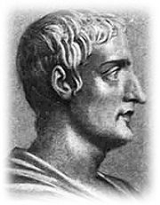
Encyclopedia
Publius Cornelius Tacitus is one of the important historians of
Roman Antiquity. The surviving portions of his two major works—the
Annals and the
Histories—treat the reigns of the
Roman Emperors
Tiberius,
Claudius,
Nero and those that reigned in the Year of the Four Emperors. These two works span the history of the
Roman Empire from the death of Augustus in 14 to the death of emperor
Domitian in 96. There are significant lacunae in the surviving texts.
Other surviving works by Tacitus treat Oratory ,
Germania and biographical notes about his father-in-law
Agricola, primarily during his campaign in
Britannia .
Tacitus' style in his major works is Annalistic. An author living in the latter part of the Silver Age of Latin literature, his writing is characterised by an uncompromising boldness and sharpness of wit, and a compact and sometimes unconventional use of the
Latin language.
Biography
Tacitus' works contain a wealth of information about his world, but details on his own life are scarce. Even his
praenomen is uncertain. What little is known comes from scattered hints throughout the corpus of his work, the letters of his friend and admirer Pliny the Younger, an inscription found at
Mylasa in
Caria, and educated guesswork.
Tacitus was born in 56 or 57 to an equestrian family; like many other Latin authors of the Golden and Silver Ages, he was from the provinces, probably northern Italy,
Gallia Narbonensis, or
Hispania. The exact place and date of his birth are not known. His
praenomen is similarly a mystery: in some letters of Sidonius Apollinaris and in some old and unimportant writings his name is
Gaius, but in the major surviving manuscript of his work his name is given as
Publius. .
Descent and place of birth
Tacitus' scorn for the social climber has led to the supposition that his family was from an unknown branch of the patrician
gens Cornelia, but no
Cornelii had ever borne the name
Tacitus. Furthermore, the older aristocratic families had largely been destroyed in the chaos surrounding the end of the
Republic, and Tacitus himself is clear that he owes his rank to the Flavian emperors . The supposition that he descended from a freedman finds no support apart from his statement, in an invented speech, that many senators and knights were descended from freedmen , and is easily dismissed.
His father may have been the Cornelius Tacitus who was procurator of
Belgica and
Germania. A son of this Cornelius Tacitus is cited by
Pliny the Elder as an example of abnormally rapid growth and aging , implying an early death. This means that this son was not Tacitus, but his brother or cousin—the senior Cornelius Tacitus may have been an uncle, rather than his father. From this connection, and from the well-attested friendship between the younger Pliny and the younger Tacitus, scholars draw the conclusion that the two families were of similar class, means, and background: equestrians, of significant wealth, from provincial families.
The exact province of his origin is unknown. His marriage to the daughter of the Narbonensian senator
Gnaeus Julius Agricola may indicate that he, too, came from Gallia Narbonensis. The possibly-Spanish origin of the Fabius Iustus to whom Tacitus dedicates the
Dialogus suggests a connection to Hispania. His friendship with Pliny points to northern Italy as his home. None of this evidence is conclusive.
Gnaeus Julius Agricola could have known Tacitus from elsewhere.
Martial dedicates a poem to Pliny , but not to the more distinguished Tacitus—which, had Tacitus been Spanish, might be unusual, were Martial's light and often scurrilous style not antithetical to Tacitus' grave and serious manner. No evidence exists that Pliny's friends from northern Italy knew Tacitus, nor do Pliny's letters ever hint that the two men shared a common home province. The opposite, in fact: the strongest piece of evidence is in Book 9, Letter 23, which reports how Tacitus was asked if he were Italian or provincial, and upon giving an unclear answer, was further asked if he were Tacitus or Pliny. Since Pliny was from Italy, Tacitus must have been from the further provinces, and Gallia Narbonensis is the most likely candidate.
His ancestry, his skill in oratory, and his occasional sympathy for barbarians who resisted Roman rule , have led some to suggest that he was of
Celtic stock: the Celts had occupied Gaul before the Romans, the Celts were famous for their skill in oratory, and the Celts had been subjugated by Rome.
Public life, marriage, and literary career
As a young man he studied
rhetoric in Rome as preparation for a career in
law and politics; like Pliny, he may have studied under
Quintilian. In 77 or 78 he married Julia Agricola, daughter of the famous general Agricola; nothing is known of their marriage or their home life, save that Tacitus loved
hunting and the outdoors. He owed the start of his career to
Vespasian, as he says in the
Histories , but it was under
Titus that he entered political life as quaestor, in 81 or 82. He advanced steadily through the
cursus honorum, becoming praetor in 88 and holding a position among the
quindecemviri sacris faciundis, members of a priestly college in charge of the
Sibylline Books and the
Secular games. He gained acclaim as a lawyer and orator; his skill in public speaking gave a marked irony to his cognomen
Tacitus .
He served in the provinces from ca. 89 to ca. 93, perhaps in command of a
legion, perhaps in a civilian post. His person and property survived Domitian's reign of terror , but the experience left him jaded and grim, perhaps ashamed at his own complicity, and gave him the hatred of
tyranny so evident throughout his works. The
Agricola, chs. –, is illustrative:
[Agricola] was spared those later years during which Domitian, leaving now no interval or breathing space of time, but, as it were, with one continuous blow, drained the life-blood of the Commonwealth... It was not long before our hands dragged Helvidius to prison, before we gazed on the dying looks of Manricus and Rusticus, before we were steeped in Senecio's innocent blood. Even Nero turned his eyes away, and did not gaze upon the atrocities which he ordered; with Domitian it was the chief part of our miseries to see and to be seen, to know that our sighs were being recorded...
From his seat in the
Senate he became suffect consul in 97 during the reign of
Nerva, being the first of his family to do so. During his tenure he reached the height of his fame as an orator when he delivered the funeral oration for the famous old soldier Lucius Verginius Rufus.
In the following year he wrote and published his
Agricola and
Germania, announcing the beginnings of the literary endeavors that would occupy him until his death. Afterwards he disappears from the public scene, to which he returns during
Trajan's reign. In 100, he, along with his friend Pliny the Younger, prosecuted Marius Priscus for corruption. Priscus was found guilty and sent into exile; Pliny wrote a few days later that Tacitus had spoken "with all the majesty which characterizes his usual style of oratory".
A lengthy absence from politics and law followed, during which time he wrote his two major works: first the
Histories, then the
Annals. He held the highest civilian governorship, that of the Roman province of
Asia in Western
Anatolia, in 112 or 113, as evidenced by the inscription found at Mylasa . A passage in the
Annals fixes 116 as the
terminus post quem of his death, which may have been as late as 125. It is unknown whether he was survived by any children, though the
Augustan History reports that the emperor
Marcus Claudius Tacitus claimed him as an ancestor and provided for the preservation of his works—but like so much of the
Augustan History, this story is probably fraudulent.
Works
Five works ascribed to Tacitus have survived . Dates are approximate, and the last two , took more than a few years to write.
- De vita Iulii Agricolae
- De origine et situ Germanorum
- Dialogus de oratoribus
- Historiae
- Ab excessu divi Augusti
Major works
The two major works, originally published separately, were meant to form a single edition of thirty books, with the
Annals preceding the
Histories. This inverted the chronological order in which they were written, but formed a continuous narrative of the era from the death of Augustus to the death of Domitian . Though parts have been lost, what remains is an invaluable record of the era.
The Histories
In one of the first chapters of the
Agricola, Tacitus said that he wished to speak about the years of
Domitian, of
Nerva, and of
Trajan. In the
Historiae the project has been modified: in the introduction, Tacitus says that he will deal with the age of Nerva and Trajan at a later time. Instead, he will cover the period that started with the civil wars of the Year of Four Emperors and ended with the despotism of the Flavians. Only the first four books and twenty-six chapters of the fifth book have survived, covering the year 69 and the first part of 70. The work is believed to have continued up to the death of
Domitian on September 18, 96. The fifth book contains—as a prelude to the account of Titus's suppression of the
Great Jewish Revolt—a short ethnographic survey of the ancient
Jews and is an invaluable record of the educated Romans' attitude towards that people.
The Annals
The
Annals was Tacitus' final work, covering the period from the death of Augustus Caesar in the year 14. He wrote at least sixteen books, but books 7-10 and parts of books 5, 6, 11 and 16 are missing. Book 6 ends with the death of
Tiberius and books 7-12 presumably covered the reigns of
Caligula and
Claudius. The remaining books cover the reign of
Nero, perhaps until his death in June 68 or until the end of that year, to connect with the
Histories. The second half of book 16 is missing . We do not know whether Tacitus completed the work or whether he finished the other works that he had planned to write; he died before he could complete his planned histories of Nerva and Trajan, and no record survives of the work on Augustus Caesar and the beginnings of the Empire with which he had planned to finish his work as a historian.
Minor works
Tacitus also wrote three minor works on various subjects: the
Agricola, a biography of his father-in-law
Gnaeus Julius Agricola; the
Germania, a monograph on the lands and tribes of barbarian Germania; and the
Dialogus, a dialogue on the art of
rhetoric.
Germania
The
Germania is an ethnographic work on the diverse set of
Germanic tribes outside the
Roman Empire. Ethnography had a long and distinguished heritage in
classical literature, and the
Germania fits squarely within the tradition established by authors from
Herodotus to
Julius Caesar. Tacitus himself had already written a similar, albeit shorter, piece in his
Agricola . The book begins with a description of the lands, laws, and customs of the Germans ; it then segues into descriptions of individual tribes, beginning with those dwelling closest to Roman lands and ending on the uttermost shores of the
Baltic Sea, with a description of the primitive and savage Fenni and the unknown tribes beyond them.
Agricola
The
Agricola recounts the life of
Gnaeus Julius Agricola, an eminent Roman general and Tacitus' father-in-law; it also covers, briefly, the geography and ethnography of ancient
Britain. As in the
Germania, Tacitus favorably contrasted the liberty of the native Britons to the corruption and tyranny of the Empire; the book also contains eloquent and vicious polemics against the rapacity and greed of Rome.
Dialogus
When the
Dialogus de oratoribus was written remains uncertain, but it was probably written after the
Agricola and the
Germania. Many characteristics set it apart from the other works of Tacitus, so much so that its authenticity may be questioned, even if it is always grouped with the
Agricola and the
Germania in the manuscript tradition. The way of speaking in the
Dialogus seems closer to
Cicero's proceedings, refined but not prolix, which inspired the teaching of
Quintilian; it lacks the incongruities that are typical of Tacitus' major historical works. It may have been written when Tacitus was young; its dedication to Fabius Iustus would thus give the date of publication, but not the date of writing. More probably, the unusually classical style may be explained by the fact that the
Dialogus is a work dealing with
rhetoric. For works in the
rhetoric genre, the structure, the language, and the style of Cicero were the usual models.
The sources of Tacitus
Tacitus used the official sources of the Roman state: the
acta senatus and the
acta diurna populi Romani . He read collections of emperors' speeches, such as
Tiberius and
Claudius. Generally, Tacitus was a scrupulous historian who paid careful attention to his historical works. The minor inacurracies in the
Annals might be due to Tacitus dying before finishing of this work. He used a variety of historical and literary sources; he used them with freedom and he chose from sources of varied opinions.
Tacitus cites some of his sources directly, among them
Pliny the Elder, who had written
Bella Germaniae and an historical work which was the continuation of that of Aufidius Bassus. Tacitus used some collections of letters and various notes. He also took information from
exitus illustrium virorum. These were a collection of books by those who were antithetical to the emperors. They tell of the sacrifice of the martyr to freedom, especially the men who committed suicide, following the theory of the
Stoics. While he placed no value on the Stoic theory of suicide, Tacitus used accounts of famous suicides to give a dramatic tone to his stories. These suicides seemed, to him, ostentatious and politically useless; however, he gives prominence to the speeches of some of those about to commit suicide, for example Cremutius Cordus' speech in
Ann. IV, 34-35.
Literary style
Tacitus' writings are known for their deep-cutting and dense prose, seldom glossy, in contrast to the more placable style of some of his contemporaries, like
Plutarch.
Describing a near defeat of the Roman army in
Ann. I, 63 Tacitus does apply gloss, but does so by the
brevity with which he describes the end of the hostilities, than by embellishing phrases.
In most of his writings he keeps to a chronological ordering of his narration, with only seldom an outline of the "bigger picture", and leaves the reader to construct that picture for himself.
Nonetheless, when he does sketch the bigger picture, for example, in the opening paragraphs of the
Annals - summarizing the situation at the end of the reign of Augustus - he uses a few condensed phrases to take the reader to the heart of the story.
Approach to history
Tacitus' historical style combines various approaches to history into a method of his own : seamlessly blending straightforward descriptions of events, pointed moral lessons, and tightly-focused dramatic accounts, his historiography contains deep, and often pessimistic, insights into the workings of the human mind and the nature of power.
Tacitus' own declaration regarding his approach to history is famous :
| inde consilium mihi . . . tradere . . . sine ira et studio, quorum causas procul habeo. | | Hence my purpose is to relate . . . without either anger or zeal, from any motives to which I am far removed. |