


Nordic Bronze Age

Encyclopedia
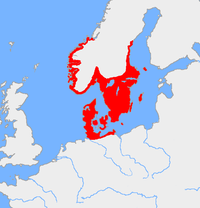
The Nordic Bronze Age (also Northern Bronze Age) is the name given by Oscar Montelius
Oscar Montelius
Oscar Montelius was a Swedish archaeologist who refined the concept of seriation, a relative chronological dating method...
to a period and a Bronze Age
Bronze Age
The Bronze Age is a period characterized by the use of copper and its alloy bronze as the chief hard materials in the manufacture of some implements and weapons. Chronologically, it stands between the Stone Age and Iron Age...
culture
Archaeological culture
An archaeological culture is a recurring assemblage of artifacts from a specific time and place, which are thought to constitute the material culture remains of a particular past human society. The connection between the artifacts is based on archaeologists' understanding and interpretation and...
in Scandinavia
Scandinavia
Scandinavia is a cultural, historical and ethno-linguistic region in northern Europe that includes the three kingdoms of Denmark, Norway and Sweden, characterized by their common ethno-cultural heritage and language. Modern Norway and Sweden proper are situated on the Scandinavian Peninsula,...
n pre-history, c. 1700-500 BC, with sites that reached as far east as Estonia. Succeeding the Late Neolithic culture, its ethnic and linguistic affinities are unknown in the absence of written sources. It is followed by the Pre-Roman Iron Age
Pre-Roman Iron Age
The Pre-Roman Iron Age of Northern Europe designates the earliest part of the Iron Age in Scandinavia, northern Germany, and the Netherlands north of the Rhine River. These regions feature many extensive archaeological excavation sites, which have yielded a wealth of artifacts...
.
General characteristics
Even though Scandinavians joined the European Bronze AgeBronze Age
The Bronze Age is a period characterized by the use of copper and its alloy bronze as the chief hard materials in the manufacture of some implements and weapons. Chronologically, it stands between the Stone Age and Iron Age...
cultures fairly late through trade, Scandinavian sites present rich and well-preserved objects made of wool
Wool
Wool is the textile fiber obtained from sheep and certain other animals, including cashmere from goats, mohair from goats, qiviut from muskoxen, vicuña, alpaca, camel from animals in the camel family, and angora from rabbits....
, wood
Wood
Wood is a hard, fibrous tissue found in many trees. It has been used for hundreds of thousands of years for both fuel and as a construction material. It is an organic material, a natural composite of cellulose fibers embedded in a matrix of lignin which resists compression...
and imported Central Europe
Central Europe
Central Europe or alternatively Middle Europe is a region of the European continent lying between the variously defined areas of Eastern and Western Europe...
an bronze
Bronze
Bronze is a metal alloy consisting primarily of copper, usually with tin as the main additive. It is hard and brittle, and it was particularly significant in antiquity, so much so that the Bronze Age was named after the metal...
and gold
Gold
Gold is a chemical element with the symbol Au and an atomic number of 79. Gold is a dense, soft, shiny, malleable and ductile metal. Pure gold has a bright yellow color and luster traditionally considered attractive, which it maintains without oxidizing in air or water. Chemically, gold is a...
.
Many rock carvings depict ships, and the large stone burial monuments known as stone ship
Stone ship
The Stone ship or ship setting was an early Germanic burial custom, characteristically Scandinavian but also found in Germany and the Baltic states. The grave or cremation burial is surrounded by tightly or loosely fit slabs or stones in the outline of a ship...
s suggest that shipping played an important role. Thousands of rock carvings depict ships, most probably representing sewn plank built canoes for warfare, fishing and trade. These may have a history as far back as the neolithic period and continue in to the Pre-Roman Iron Age, as shown by the Hjortspring boat
Hjortspring boat
The Hjortspring boat is a vessel designed as a large canoe, from the Scandinavian Pre-Roman Iron Age, that was excavated in 1921–1922 in Hjortspring Mose at Als in Sønderjylland...
.
There are many mounds and rock carving sites from the period. Numerous artifacts of bronze and gold are found. No written language existed in the Nordic countries
Nordic countries
The Nordic countries make up a region in Northern Europe and the North Atlantic which consists of Denmark, Finland, Iceland, Norway and Sweden and their associated territories, the Faroe Islands, Greenland and Åland...
during the Bronze Age. The rock carvings have been dated through comparison with depicted artifacts, for example bronze axes and swords. (There are also numerous Nordic Stone Age
Nordic Stone Age
The Nordic Stone Age refers to the Stone Age of Scandinavia.-Late Upper Paleolithic:As the ice receded, reindeer grazed on the plains of Denmark and southernmost Sweden, while along the coast of western Sweden, marine resources were exploited...
rock carvings in the north of Scandinavia, mostly portraying elk.)
Sub-periodization
Oscar MonteliusOscar Montelius
Oscar Montelius was a Swedish archaeologist who refined the concept of seriation, a relative chronological dating method...
, who coined the term used for the period, divided it into six distinct sub-periods in his piece Om tidsbestämning inom bronsåldern med särskilt avseende på Skandinavien ("On Bronze Age dating with particular focus on Scandinavia") published in 1885 which is still in wide use. His absolute chronology has held up well against radiocarbon dating, with the exception that the period's start is closer to 1700 BC than 1800 BC, as Montelius suggested. For Central Europe
Central Europe
Central Europe or alternatively Middle Europe is a region of the European continent lying between the variously defined areas of Eastern and Western Europe...
a different system developed by Paul Reinecke is commonly used, as each area has its own artefact types and archaeological periods.
A broader subdivision is the "Early Bronze Age" between 1700 BC and 1100 BC and the "Late Bronze Age" 1100 BC to 550 BC. These divisions and periods are then followed by the Pre-Roman Iron Age
Pre-Roman Iron Age
The Pre-Roman Iron Age of Northern Europe designates the earliest part of the Iron Age in Scandinavia, northern Germany, and the Netherlands north of the Rhine River. These regions feature many extensive archaeological excavation sites, which have yielded a wealth of artifacts...
.
Climate
The Nordic Bronze Age was characterized by a warm climate that began with a climate changeClimate change
Climate change is a significant and lasting change in the statistical distribution of weather patterns over periods ranging from decades to millions of years. It may be a change in average weather conditions or the distribution of events around that average...
around 2700 BC (comparable to that of present-day central Germany and northern France). The warm climate permitted a relatively dense population and good farming, for example grape
Grape
A grape is a non-climacteric fruit, specifically a berry, that grows on the perennial and deciduous woody vines of the genus Vitis. Grapes can be eaten raw or they can be used for making jam, juice, jelly, vinegar, wine, grape seed extracts, raisins, molasses and grape seed oil. Grapes are also...
s were grown in Scandinavia at this time. However a small change in climate between 850 BC and 760 BC and a more radical one around 650 BC brought in a deteriorating, wetter and colder climate (sometimes believed to have given rise to the legend of the Fimbulwinter
Fimbulwinter
In Norse mythology, Fimbulvetr , commonly rendered in English as Fimbulwinter, is the immediate prelude to the events of Ragnarök.-Summary:...
).
Religion
Not much is known about the Nordic Bronze Age religion, since written sources are lacking. However numerous archaeological finds draw a vague picture of what the religion might have been, but only some possible sects of it and only certain possible tribes. Some of the best clues to the religion of this period come from the rock carvings scattered through Northern Europe.| Bronze Age religion | |
|---|---|
A pair of twin gods are believed to have been worshipped, and is reflected in a duality in all things sacred: where sacrificial artifacts have been buried they are often found in pairs. A female or mother goddess
Mother goddess
Mother goddess is a term used to refer to a goddess who represents motherhood, fertility, creation or embodies the bounty of the Earth. When equated with the Earth or the natural world such goddesses are sometimes referred to as Mother Earth or as the Earth Mother.Many different goddesses have...
is believed to have been widely worshipped (see Nerthus
Nerthus
In Germanic paganism, Nerthus is a goddess associated with fertility. Nerthus is attested by Tacitus, the first century AD Roman historian, in his Germania. Various theories exist regarding the goddess and her potential later traces amongst the Germanic tribes...
). Sacrifice
Sacrifice
Sacrifice is the offering of food, objects or the lives of animals or people to God or the gods as an act of propitiation or worship.While sacrifice often implies ritual killing, the term offering can be used for bloodless sacrifices of cereal food or artifacts...
s (animals, weapons, jewelry and men) have been connected to water and small lakes or ponds have often been used as holy places for sacrifice and many artifacts have been found in such locations. Hieros gamos
Hieros gamos
Hieros gamos or Hierogamy refers to a sexual ritual that plays out a marriage between a god and a goddess, especially when enacted in a symbolic ritual where human participants represent the deities. It is the harmonization of opposites...
rites may have been common. Ritual instruments such as bronze lurs
Lur
A lur is a long natural blowing horn without finger holes that is played by embouchure. Lurs can be straight or curved in various shapes. The purpose of the curves was to make long instruments easier to carry A lur is a long natural blowing horn without finger holes that is played by embouchure....
have been found sacrificed and are believed to have been used in ceremonies.
Bronze Age rock carvings may contain some of the earliest depictions of well known gods from later Norse mythology
Norse mythology
Norse mythology, a subset of Germanic mythology, is the overall term for the myths, legends and beliefs about supernatural beings of Norse pagans. It flourished prior to the Christianization of Scandinavia, during the Early Middle Ages, and passed into Nordic folklore, with some aspects surviving...
. A common figure in these rock carvings is that of a male figure carrying what appears to be an axe or hammer. Most likely, this may have been an early representation of Thor
Thor
In Norse mythology, Thor is a hammer-wielding god associated with thunder, lightning, storms, oak trees, strength, the protection of mankind, and also hallowing, healing, and fertility...
. Other male figures are shown holding a spear. Whether this is a representation of Odin
Odin
Odin is a major god in Norse mythology and the ruler of Asgard. Homologous with the Anglo-Saxon "Wōden" and the Old High German "Wotan", the name is descended from Proto-Germanic "*Wodanaz" or "*Wōđanaz"....
or Týr is not known, as both gods are associated with this weapon. It is possible the figure may have been a representation of Tyr, as one example of a Bronze Age rock carving appears to show a figure missing a hand. A figure holding a bow may be an early representation of Ullr
Ullr
In early Germanic paganism, *Wulþuz appears to have been a major god, or an epithet of an important god, in prehistoric times....
.
Remnants of the Bronze Age religion and mythology are believed to exist in Germanic mythology
Germanic mythology
Germanic mythology is a comprehensive term for myths associated with historical Germanic paganism, including Norse mythology, Anglo-Saxon mythology, Continental Germanic mythology, and other versions of the mythologies of the Germanic peoples...
and Norse mythology
Norse mythology
Norse mythology, a subset of Germanic mythology, is the overall term for the myths, legends and beliefs about supernatural beings of Norse pagans. It flourished prior to the Christianization of Scandinavia, during the Early Middle Ages, and passed into Nordic folklore, with some aspects surviving...
; e.g., Skinfaxi and Hrímfaxi
Skinfaxi and Hrímfaxi
In Norse mythology, Skinfaxi and Hrímfaxi are the horses of Dagr and Nótt . The names Skinfaxi and Hrímfaxi are bahuvrihis, meaning "shining mane" and "rime mane" , respectively...
and Nerthus
Nerthus
In Germanic paganism, Nerthus is a goddess associated with fertility. Nerthus is attested by Tacitus, the first century AD Roman historian, in his Germania. Various theories exist regarding the goddess and her potential later traces amongst the Germanic tribes...
.
Gallery
| Nordic Bronze Age | |
|---|---|
See also
- Bronze Age EuropeBronze Age EuropeThe European Bronze Age is characterized by bronze artifacts and the use of bronze implements. The regional Bronze Age succeeds the Neolithic, it starts with the Aegean Bronze Age 3200 BC...
- Bronze Age swordBronze Age swordBronze Age swords appear from around the 17th century BC, in the Black Sea region and the Aegean, evolving out of the dagger. They are replaced by the Iron Age sword during the early part of the 1st millennium BC....
- Egtved GirlEgtved GirlThe Egtved Girl was a Nordic Bronze Age girl whose well-preserved remains were found at Egtved , Denmark in 1921. Aged 16–18 at death, she was slim, 160 cm tall , had short, blonde hair and well-trimmed nails. Her burial has been dated by dendrochronology to 1370 BCE...
- The King's GraveThe King's GraveThe King's Grave near Kivik in the southeastern portion of the Swedish province of Skåne is what remains of an unusually grand Nordic Bronze Age double burial c...
- Stone shipStone shipThe Stone ship or ship setting was an early Germanic burial custom, characteristically Scandinavian but also found in Germany and the Baltic states. The grave or cremation burial is surrounded by tightly or loosely fit slabs or stones in the outline of a ship...
s - TanumshedeTanumshedeTanumshede is a locality and the seat of Tanum Municipality in Västra Götaland County, Sweden with 1,597 inhabitants in 2005.-Rock Carvings in Tanum:...