


Reichstag Fire Decree

Encyclopedia
Germany
Germany , officially the Federal Republic of Germany , is a federal parliamentary republic in Europe. The country consists of 16 states while the capital and largest city is Berlin. Germany covers an area of 357,021 km2 and has a largely temperate seasonal climate...
President
President of Germany
The President of the Federal Republic of Germany is the country's head of state. His official title in German is Bundespräsident . Germany has a parliamentary system of government and so the position of President is largely ceremonial...
Paul von Hindenburg
Paul von Hindenburg
Paul Ludwig Hans Anton von Beneckendorff und von Hindenburg , known universally as Paul von Hindenburg was a Prussian-German field marshal, statesman, and politician, and served as the second President of Germany from 1925 to 1934....
in direct response to the Reichstag fire
Reichstag fire
The Reichstag fire was an arson attack on the Reichstag building in Berlin on 27 February 1933. The event is seen as pivotal in the establishment of Nazi Germany....
of 27 February 1933. The decree nullified many of the key civil liberties
Civil liberties
Civil liberties are rights and freedoms that provide an individual specific rights such as the freedom from slavery and forced labour, freedom from torture and death, the right to liberty and security, right to a fair trial, the right to defend one's self, the right to own and bear arms, the right...
of German citizens. With Nazis
Nazism
Nazism, the common short form name of National Socialism was the ideology and practice of the Nazi Party and of Nazi Germany...
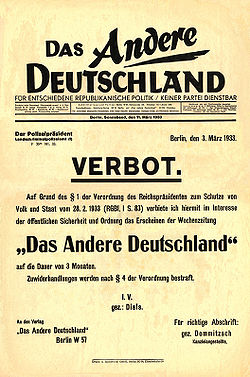
in powerful positions in the German government, the decree was used as the legal basis of imprisonment of anyone considered to be opponents of the Nazis, and to suppress publications not considered “friendly” to the Nazi cause. The decree is considered by historians to be one of the key steps in the establishment of a one-party
Single-party state
A single-party state, one-party system or single-party system is a type of party system government in which a single political party forms the government and no other parties are permitted to run candidates for election...
Nazi state
Nazi Germany
Nazi Germany , also known as the Third Reich , but officially called German Reich from 1933 to 1943 and Greater German Reich from 26 June 1943 onward, is the name commonly used to refer to the state of Germany from 1933 to 1945, when it was a totalitarian dictatorship ruled by...
in Germany.
Background
Hitler had been appointed Chancellor of Germany only four weeks previously, on 30 January 1933, when he was invited by President von Hindenburg to lead a coalition government. Hitler’s government had urged von Hindenburg to dissolve the ReichstagReichstag (building)
The Reichstag building is a historical edifice in Berlin, Germany, constructed to house the Reichstag, parliament of the German Empire. It was opened in 1894 and housed the Reichstag until 1933, when it was severely damaged in a fire. During the Nazi era, the few meetings of members of the...
and to call elections for 5 March.
On the evening of 27 February 1933 — six days before the parliamentary election — fire broke out in the Reichstag
Reichstag fire
The Reichstag fire was an arson attack on the Reichstag building in Berlin on 27 February 1933. The event is seen as pivotal in the establishment of Nazi Germany....
chambers. While the exact circumstances of the fire remain unclear to this day, what is clear is that Hitler and his supporters quickly capitalized on the fire as a means by which to speed their consolidation of power. Seizing on the burning of the Reichstag building
Reichstag (building)
The Reichstag building is a historical edifice in Berlin, Germany, constructed to house the Reichstag, parliament of the German Empire. It was opened in 1894 and housed the Reichstag until 1933, when it was severely damaged in a fire. During the Nazi era, the few meetings of members of the...
as the supposed opening salvo in a communist uprising, the Nazis were able to throw millions of Germans into a convulsion of fear at the threat of Communist terror. The official account stated:
The burning of the Reichstag was intended to be the signal for a bloody uprising and civil warCivil warA civil war is a war between organized groups within the same nation state or republic, or, less commonly, between two countries created from a formerly-united nation state....
. Large-scale pillaging in Berlin was planned for as early as four o’clock in the morning on Tuesday. It has been determined that starting today throughout Germany acts of terrorismTerrorismTerrorism is the systematic use of terror, especially as a means of coercion. In the international community, however, terrorism has no universally agreed, legally binding, criminal law definition...
were to begin against prominent individuals, against private propertyPrivate propertyPrivate property is the right of persons and firms to obtain, own, control, employ, dispose of, and bequeath land, capital, and other forms of property. Private property is distinguishable from public property, which refers to assets owned by a state, community or government rather than by...
, against the lives and safety of the peaceful population, and general civil war was to be unleashed…
The decree was improvised on the day after the fire (28 February) after discussions in the Prussian Ministry of the Interior, which was led by Hermann Göring
Hermann Göring
Hermann Wilhelm Göring, was a German politician, military leader, and a leading member of the Nazi Party. He was a veteran of World War I as an ace fighter pilot, and a recipient of the coveted Pour le Mérite, also known as "The Blue Max"...
, and was then brought before the Reich cabinet. In the ensuing discussions, Hitler stated that the fire made it now a matter of “ruthless confrontation of the KPD
Communist Party of Germany
The Communist Party of Germany was a major political party in Germany between 1918 and 1933, and a minor party in West Germany in the postwar period until it was banned in 1956...
” and shortly thereafter, President von Hindenburg signed the decree into law.
The decree, officially the Verordnung des Reichspräsidenten zum Schutz von Volk und Staat (Order of the Reich President for the Protection of People and State), invoked the authority of Article 48
Article 48 (Weimar Constitution)
Article 48 of the constitution of the Weimar Republic of Germany allowed the President, under certain circumstances, to take emergency measures without the prior consent of the Reichstag...
of the Weimar Constitution
Weimar constitution
The Constitution of the German Reich , usually known as the Weimar Constitution was the constitution that governed Germany during the Weimar Republic...
which allowed the President of Germany
Reichspräsident
The Reichspräsident was the German head of state under the Weimar constitution, which was officially in force from 1919 to 1945. In English he was usually simply referred to as the President of Germany...
to take any appropriate measure to remedy dangers to public safety
Public Safety
Public safety involves the prevention of and protection from events that could endanger the safety of the general public from significant danger, injury/harm, or damage, such as crimes or disasters .-See also:* By nation...
.
The decree consisted of six articles. Article 1 suspended most of the civil liberties set forth in the Weimar Constitution, including freedom of the person
Habeas corpus
is a writ, or legal action, through which a prisoner can be released from unlawful detention. The remedy can be sought by the prisoner or by another person coming to his aid. Habeas corpus originated in the English legal system, but it is now available in many nations...
, freedom of expression, freedom of the press
Freedom of the press
Freedom of the press or freedom of the media is the freedom of communication and expression through vehicles including various electronic media and published materials...
, the right of free association
Freedom of association
Freedom of association is the individual right to come together with other individuals and collectively express, promote, pursue and defend common interests....
and public assembly
Freedom of assembly
Freedom of assembly, sometimes used interchangeably with the freedom of association, is the individual right to come together and collectively express, promote, pursue and defend common interests...
, the secrecy of the post and telephone
Secrecy of correspondence
The secrecy of correspondence ) or literally translated as secrecy of letters, is a fundamental legal principle enshrined in the constitutions of several European countries. It guarantees that the content of sealed letters is never revealed and letters in transit are not opened by government...
, not to mention the protection of property and the home. Articles 2 and 3 allowed the Reich government to assume powers normally reserved for the federal states
Länder
Länder or Bundesländer may refer to:* States of Germany, the 16 federal subdivisions of Germany* States of Austria, the 9 federal subdivisions of Austria...
. Articles 4 and 5 established draconian
Draconian
Draconian is an adjective meaning great severity, that derives from Draco, an Athenian law scribe under whom small offences had heavy punishments .Draconian may also refer to:* Draconian , a Death/doom metal band from Sweden...
penalties for certain offenses, including the death penalty for arson
Arson
Arson is the crime of intentionally or maliciously setting fire to structures or wildland areas. It may be distinguished from other causes such as spontaneous combustion and natural wildfires...
to public buildings. Article 6 simply stated that the decree took effect on the day of its proclamation.
Text of the decree
The preamble and Article 1 of the Reichstag Fire Decree show the methods by which the civil rights protections of the Weimar Republic’s democratic constitution were abolished in a legal manner by the Nazis:| Ordnung des Reichspräsidenten zum Schutz von Volk und Staat | Order of the Reich President for the Protection of People and State | ||
|---|---|---|---|
| Auf Grund des Artikels 48 Abs. 2 der Reichsverfassung wird zur Abwehr kommunistischer staatsgefährdender Gewaltakte folgendes verordnet: | On the basis of Article 48 Article 48 (Weimar Constitution) Article 48 of the constitution of the Weimar Republic of Germany allowed the President, under certain circumstances, to take emergency measures without the prior consent of the Reichstag... paragraph 2 of the Constitution of the German Reich, the following is ordered in defense against Communist state-endangering acts of violence: |
||
| § 1. | Die Artikel 114, 115, 117, 118, 123, 124 und 153 der Verfassung des Deutschen Reichs werden bis auf weiteres außer Kraft gesetzt. Es sind daher Beschränkungen der persönlichen Freiheit, des Rechts der freien Meinungsäußerung, einschließlich der Pressefreiheit, des Vereins- und Versammlungsrechts, Eingriffe in das Brief-, Post-, Telegraphen- und Fernsprechgeheimnis, Anordnungen von Haussuchungen und von Beschlagnahmen sowie Beschränkungen des Eigentums auch außerhalb der sonst hierfür bestimmten gesetzlichen Grenzen zulässig. | § 1. | Articles 114, 115, 117, 118, 123, 124 and 153 of the Constitution of the German Reich are suspended until further notice. It is therefore permissible to restrict the rights of personal freedom Habeas corpus is a writ, or legal action, through which a prisoner can be released from unlawful detention. The remedy can be sought by the prisoner or by another person coming to his aid. Habeas corpus originated in the English legal system, but it is now available in many nations... |
Effects
The decree was not accompanied by any written guidelines from the Reich government; this omission gave wide latitude in interpreting the decree to Nazis like Göring, who as PrussiaPrussia
Prussia was a German kingdom and historic state originating out of the Duchy of Prussia and the Margraviate of Brandenburg. For centuries, the House of Hohenzollern ruled Prussia, successfully expanding its size by way of an unusually well-organized and effective army. Prussia shaped the history...
n interior minister was in authority over the police forces in Germany’s largest province. The Länder
Länder
Länder or Bundesländer may refer to:* States of Germany, the 16 federal subdivisions of Germany* States of Austria, the 9 federal subdivisions of Austria...
not yet in the Nazis’ grasp largely restricted themselves to banning the Communist press, Communist meetings and demonstrations, and detaining leading KPD officials. In Prussia, however, summary arrests of KPD leaders were common, thousands were imprisoned in the days following the fire, and the total number of arrests in Prussia on the basis of the Reichstag Fire Decree in the two weeks following 28 February is believed to be in the vicinity of 10,000. Göring had actually employed such tactics even before the decree, only to have them thrown out by the courts — a check that no longer had any effect with the decree in place.
Among the German communists arrested on the basis of the Reichstag Fire Decree was KPD chairman Ernst Thälmann
Ernst Thälmann
Ernst Thälmann was the leader of the Communist Party of Germany during much of the Weimar Republic. He was arrested by the Gestapo in 1933 and held in solitary confinement for eleven years, before being shot in Buchenwald on Adolf Hitler's orders in 1944...
; while KPD founding members Wilhelm Pieck
Wilhelm Pieck
Friedrich Wilhelm Reinhold Pieck was a German politician and a Communist. In 1949, he became the first President of the German Democratic Republic, an office abolished upon his death. He was succeeded by Walter Ulbricht, who served as Chairman of the Council of States.-Biography:Pieck was born to...
and Walter Ulbricht
Walter Ulbricht
Walter Ulbricht was a German communist politician. As First Secretary of the Socialist Unity Party from 1950 to 1971 , he played a leading role in the creation of the Weimar-era Communist Party of Germany and later in the early development and...
— later to be leaders in postwar East Germany — were among those who escaped arrest and lived in exile.
Göring issued a directive to the Prussian police authorities on 3 March, stating that in addition to the constitutional rights stripped by the decree, “all other restraints on police action imposed by Reich and Land law” were abolished “so far as this is necessary … to achieve the purpose of the decree.” Göring went on to say that
In keeping with the purpose and aim of the decree the additional measures … will be directed against the Communists in the first instance, but then also against those who co-operate with the Communists and who support or encourage their criminal aims… I would point out that any necessary measures against members or establishments of other than Communist, anarchist or Social Democratic parties can only be justified by the decree … if they serve to help the defense against such Communist activities in the widest sense.
Just over three weeks after the passage of the Reichstag Fire Decree, Hitler’s National Socialists further tightened their grasp on Germany by the passage of the Enabling Act. This act gave Hitler’s cabinet the legal power to decree laws without being passed by the Reichstag — effectively making Hitler a dictator.
The Reichstag Fire Decree remained in force for the duration of the Nazi era, allowing Hitler to rule under what amounted to martial law. Along with the Enabling Act, it formed the legal basis for Hitler’s dictatorship. Thousands of Hitler’s decrees were issued under its authority — a major reason why Hitler never sought to abolish the Weimar Constitution
Weimar constitution
The Constitution of the German Reich , usually known as the Weimar Constitution was the constitution that governed Germany during the Weimar Republic...
, though it no longer had any substantive value after the passage of the Enabling Act.
See also
- GleichschaltungGleichschaltungGleichschaltung , meaning "coordination", "making the same", "bringing into line", is a Nazi term for the process by which the Nazi regime successively established a system of totalitarian control and tight coordination over all aspects of society. The historian Richard J...
- Enabling Act of 1933
- Rule by decreeRule by decreeRule by decree is a style of governance allowing quick, unchallenged creation of law by a single person or group, and is used primarily by dictators and absolute monarchs, although philosophers such as Giorgio Agamben have argued that it has been generalized since World War I in all modern states,...
- Inciting subversion of state powerInciting subversion of state powerInciting subversion of state power is a crime under the law of the People's Republic of China. It is article 105, paragraph 2 of the 1997 revision of the People's Republic of China's Penal Code....
(People's Republic of China) - Article 58 (RSFSR Penal Code)Article 58 (RSFSR Penal Code)Article 58 of the Russian SFSR Penal Code was put in force on 25 February 1927 to arrest those suspected of counter-revolutionary activities. It was revised several times...
(Soviet Russia) - Espionage Act of 1917Espionage Act of 1917The Espionage Act of 1917 is a United States federal law passed on June 15, 1917, shortly after the U.S. entry into World War I. It has been amended numerous times over the years. It was originally found in Title 50 of the U.S. Code but is now found under Title 18, Crime...
- Communist registration actCommunist registration actCommunist registration acts were laws proposed and often enacted by the United States Congress and many American state legislatures during the Second Red Scare. These laws required members, sympathizers, and affiliated organizations of the Communist Party of the United States to register with the...
(United States) - Rex 84Rex 84Rex 84, short for Readiness Exercise 1984, was a secretive "scenario and drill" developed by the United States federal government to suspend the United States Constitution, declare martial law, place military commanders in charge of state and local governments, and detain large numbers of American...
- Gulf of Tonkin incidentGulf of Tonkin IncidentThe Gulf of Tonkin Incident, or the USS Maddox Incident, are the names given to two incidents, one fabricated, involving North Vietnam and the United States in the waters of the Gulf of Tonkin...
- USA PATRIOT ActUSA PATRIOT ActThe USA PATRIOT Act is an Act of the U.S. Congress that was signed into law by President George W. Bush on October 26, 2001...
Further reading
- Reichstagsbrandverordnung - Original German source text at WikisourceWikisourceWikisource is an online digital library of free content textual sources on a wiki, operated by the Wikimedia Foundation. Its aims are to host all forms of free text, in many languages, and translations. Originally conceived as an archive to store useful or important historical texts, it has...
}}