In Depth
See Also

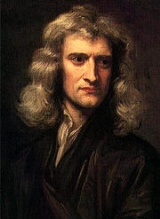
Isaac Newton

  [[[Old Style and New Style dates|OS]]: [[25 December]] [[1642]] [[20 March]] [[1727]]] was an [[England|English]] [[physics|physicist,]] [[mathematician]], [[astronomy|astronomer]], [[alchemy|alchemist]], and [[natural philosophy|natural philosopher]] who is generally regarded as one of the greatest [[scientists]] and [[mathematicians]] in history. Newton wrote the [[Philosophiae Naturalis Principia Mathematica]], in which he described [[law of universal gravitation|universal gravitation]] and the three [[Newton's laws of motion|laws of motion]], laying the groundwork for [[classical mechanics]].

Discussions

  Discussion Features

   Ask a question about 'Isaac Newton'

   Start a new discussion about 'Isaac Newton'

   Answer questions about 'Isaac Newton'

   'Isaac Newton' discussion forum

Timeline

1642   Born

1643   Born

1666   Sir Isaac Newton uses a prism to split sunlight into its component colours, which helped us understand the nature of light Light

Light is electromagnetic radiation [i] with a wavelength [i] that is visible to the eye [i] or, in a technical [i] ... 

 more comprehensively. (See optical spectrum Visible spectrum

The visible spectrum is the portion of the electromagnetic spectrum [i] that is visible [i] ... 

).

1684   Isaac Newton's derivation of Kepler's laws Kepler's laws of planetary motion

Johannes Kepler [i]'s primary contributions to astronomy [i]/astrophysics [i] were his three laws of planet ... 

 from his theory of gravity, contained in the paper ''De motu corporum in gyrum'', is read to the Royal Society Royal Society

The Royal Society of London for the Improvement of Natural Knowledge, known simply as the Royal Socie... 

 by Edmund Halley Edmond Halley

Edmond Halley was an English [i] astronomer [i], geophysicist [i], mathematician [i], meteorologist [i] ... 

.

1687   Isaac Newton's ''Philosophiae Naturalis Principia Mathematica Philosophiae Naturalis Principia Mathematica

The Philosophiae Naturalis Principia Mathematica is a three-volume work by Isaac Newton [i] publish ... 

'' is published.

1698   Isaac Newton calculates the speed of sound

1703   Isaac Newton becomes the chairman of Royal Society Royal Society

The Royal Society of London for the Improvement of Natural Knowledge, known simply as the Royal Socie... 

1727   Died

1736   Isaac Newton Publishes his ''Method of Fluxions''

1738   Pierre Louis Maupertuis Pierre Louis Maupertuis

Pierre-Louis Moreau de Maupertuis was a French [i] mathematician [i], philosopher [i] and man of letters [i] ... 

 publishes ''Sur la figure de la terre'', which 'confirms Newton's Isaac Newton

[i] [[[Old Style and New Style dates|OS]] [i]: [[25 December]] [i] [[1642]] [i]... 

 view that the earth is a spheroid slightly flattened at the poles'.

   More Events >>


Quotations

We are to admit no more causes of natural things than such as are both true and sufficient to explain their appearances.

In the absence of any other proof, the thumb alone would convince me of God's existence.

As quoted in The Gift of Pain: Why We Hurt and What We Can Do About It (1997) by Paul W. Brand and Philip Yancey; also in Wisdom (2002) by Des MacHale

Hypotheses non fingo.

I frame no hypotheses., A statement that the law of universal gravitation was a fundamental empirical law, and that he proposed no hypotheses on how gravity could propagate.

Every body continues in its state of rest, or of uniform motion in a right line, unless it is compelled to change that state by forces impressed upon it.

Laws of Motion, I

The alternation of motion is ever proportional to the motive force impressed; and is made in the direction of the right line in which that force is impressed.

Laws of Motion, II

To every action there is always opposed an equal reaction; or, the mutual actions of two bodies upon each other are always equal, and directed to contrary parts.

Laws of Motion, III

       More Quotes >>


Encyclopedia

Sir Isaac Newton, FRS Royal Society

The Royal Society of London for the Improvement of Natural Knowledge, known simply as the Royal Socie... 

  [OS: 25 December 1642 – 20 March 1727] was an English England

England is the largest and most populous constituent country [i] of the United Kingdom [i]. ... 

 physicist, Physics

Physics , the most fundamental physical science [i], is concerned with the underlying principles of the ... 

 mathematician Mathematician

A mathematician is a person whose primary area of study and research is the field of mathematics [i]. ... 

, astronomer Astronomy

Astronomy is the science [i] of celestial objects and phenomena [i] that originate outside the Earth's atmosphere [i] ... 

, alchemist Alchemy

Alchemy refers to both an early form of the investigation of nature [i] and an early philosophical [i]... 

, and natural philosopher who is generally regarded as one of the greatest scientists Scientist

A scientist is an expert [i] in at least one area of science [i] who uses the scientific method [i] to d ... 

 and mathematicians Mathematician

A mathematician is a person whose primary area of study and research is the field of mathematics [i]. ... 

 in history. Newton wrote the Philosophiae Naturalis Principia Mathematica Philosophiae Naturalis Principia Mathematica

The Philosophiae Naturalis Principia Mathematica is a three-volume work by Isaac Newton [i] publish ... 

, in which he described universal gravitation Newton's law of universal gravitation

Isaac Newton [i]'s law of universal gravitation [i] states the following:
... 

 and the three laws of motion Newton's laws of motion

Newton's Laws of Motion are three physical law [i]s which provide relationships [i] ... 

, laying the groundwork for classical mechanics Classical mechanics

Classical mechanics is used to describe the motion of macroscopic objects, from projectiles [i] to parts ... 

. By deriving Kepler's laws of planetary motion Kepler's laws of planetary motion

Johannes Kepler [i]'s primary contributions to astronomy [i]/astrophysics [i] were his three laws of planet ... 

 from this system, he was the first to show that the motion of objects on Earth and of celestial bodies are governed by the same set of natural laws. The unifying and deterministic power of his laws was integral to the scientific revolution and the advancement of heliocentrism Heliocentrism

In astronomy [i], heliocentrism is the theory [i] that the Sun [i] is at the center of the Universe [i]... 

. He also was a devout Christian, studied the Bible daily and wrote more on religion than on natural science.

Although by the calendar in use at the time of his birth he was born on Christmas Day 1642, the date of 4 January 1643 is used because this is the Gregorian calendar Gregorian calendar

The Gregorian calendar is the calendar [i] that is used nearly everywhere in the world.... 

 date.

Among other scientific discoveries, Newton realised that the spectrum of colour Color

Color or colour is the visual perceptual property corresponding in humans to the categories... 

s observed when white White

White is a color [i] that has high brightness but zero hue [i]. ... 

 light Light

Light is electromagnetic radiation [i] with a wavelength [i] that is visible to the eye [i] or, in a technical [i] ... 

 passes through a prism is inherent in the white light and not added by the prism , and notably argued that light is composed of particles Wave–particle duality

[i] exhibit [[property|properties]... 

. He also developed a law of cooling Heat conduction

Heat conduction is the transmission of heat [i] across matter.
... 

, describing the rate of cooling of objects when exposed to air. He enunciated the principles of conservation of momentum and angular momentum Angular momentum

In physics [i] the angular momentum of an object with respect to a reference point is a measure for the ... 

. Finally, he studied the speed of sound in air, and voiced a theory of the origin of stars. Despite this renown in mainstream science, Newton spent much of his time working on alchemy rather than physics, writing considerably more papers on the former than the latter.

Newton played a major role in the development of calculus History of calculus

Though the origins of integral calculus are generally regarded as going no farther back than to the ancient Greeks [i]... 

, famously sharing credit with Gottfried Leibniz Gottfried Leibniz

Gottfried Wilhelm Leibniz was a German [i] polymath [i] who wrote mostly in French and Latin.
... 

. He also made contributions to other areas of mathematics, for example the generalised binomial theorem. The mathematician and mathematical physicist Joseph Louis Lagrange Joseph Louis Lagrange

Joseph-Louis Lagrange, comte [i] de l'Empire was an Italian [i] mathematician [i] and astronomer [i] ... 

 , often said that Newton was the greatest genius that ever existed, and once added "and the most fortunate, for we cannot find more than once a system of the world to establish."

Biography


Early years


Newton was born at Woolsthorpe Manor Woolsthorpe Manor

Woolsthorpe Manor in Woolsthorpe-by-Colsterworth [i], near Grantham [i], Lincolnshire [i], England [i], ... 

, in Woolsthorpe-by-Colsterworth Woolsthorpe-by-Colsterworth

Woolsthorpe-by-Colsterworth is a hamlet [i] at , in the parish [i] of Colsterworth [i], in the English [i] ... 

 a hamlet Hamlet

The Tragedy of Hamlet, Prince of Denmark is a tragedy [i] by William Shakespeare [i] and is one of h ... 

 in the county of Lincolnshire Lincolnshire

Lincolnshire is a county in the east of England [i]. ... 

. By his own later accounts, Newton was born prematurely and no one expected him to live; his mother Hannah Ayscough said that his body at that time could have fit inside a quart mug. His father, also named Isaac, had been a yeoman farmer and had died three months before Newton's birth, at the time of the English Civil War English Civil War

The English Civil War was a series of armed conflicts and political machinations which took place betwee... 

. When Newton was three, his mother remarried and went to live with her new husband, leaving her son in the care of his maternal grandmother, Margery Ayscough.


From the age of about twelve until he was seventeen, Newton was educated at The King's School, Grantham . He was removed from school and by Oct 1659 he was to be found at Woolsthorpe-by-Colsterworth Woolsthorpe-by-Colsterworth

Woolsthorpe-by-Colsterworth is a hamlet [i] at , in the parish [i] of Colsterworth [i], in the English [i] ... 

, where his mother attempted to make a farmer of him. He was, by later reports of his contemporaries, thoroughly unhappy with the work. It appears to be Henry Stokes, master at the King's School, who persuaded his mother to send him back to school so that he might complete his education. This he did at the age of eighteen, achieving an admirable final report. His teacher said:

His genius now begins to mount upwards apace and shine out with more strength. He excels particularly in making verses. In everything he undertakes, he discovers an application equal to the pregnancy of his parts and exceeds even the most sanguine expectations I have conceived of him.


In June 1661 he matriculated at Trinity College, Cambridge Trinity College, Cambridge

Trinity College is a constituent college [i] of the University of Cambridge [i] ... 

. At that time, the college's teachings were based on those of Aristotle Aristotle

Aristotle was an ancient Greek [i] philosopher [i], a student of Plato [i] ... 

, but Newton preferred to read the more advanced ideas of modern philosophers such as Descartes René Descartes

Ren Descartes
, also known as Cartesius, was a noted French philosopher [i], mathematician [i]... 

 and astronomers Astronomer

An astronomer or astrophysicist is a person whose area of interest is astronomy [i] or astrophysics [i] ... 

 such as Galileo Galileo Galilei

Galileo Galilei was an Italian [i] physicist [i], astronomer [i], astrologer [i] and philosopher [i] ... 

, Copernicus Nicolaus Copernicus

Nicolaus Copernicus was an astronomer [i] who provided the first modern formulation of a heliocentric [i] ... 

 and Kepler Johannes Kepler

Johannes Kepler , a key figure in the scientific revolution [i], was a German [i] mathematician [i] ... 

. In 1665 he discovered the generalised binomial theorem and began to develop a mathematical theory that would later become calculus Calculus

Calculus is a central branch of mathematics [i], developed from algebra [i] and geometry [i]. ... 

. Soon after Newton had obtained his degree in 1665, the University closed down as a precaution against the Great Plague Great Plague of London

The Great Plague was a massive outbreak of disease [i] in England [i] that killed 75,000 to 100,000 peo ... 

. For the next 18 months Newton worked at home on calculus, optics Optics

Optics is a branch of physics [i] that describes the behavior and properties of light [i] and the inter ... 

 and law of gravitation. Newton often did not share concepts he had discovered unless he was asked. For example, he formulated calculus 30 years before he told anyone else about it.

Middle years


Mathematical research
Newton became a fellow of Trinity College Trinity College, Cambridge

Trinity College is a constituent college [i] of the University of Cambridge [i] ... 

 in 1669. In the same year he circulated his findings in De Analysi per Aequationes Numeri Terminorum Infinitas , and later in De methodis serierum et fluxionum , whose title gave rise to the "method of fluxions".

Newton and Gottfried Leibniz Gottfried Leibniz

Gottfried Wilhelm Leibniz was a German [i] polymath [i] who wrote mostly in French and Latin.
... 

 developed the calculus independently, using different notations. Although Newton had worked out his method years before Leibniz, he published almost nothing about it until 1693, and did not give a full account until 1704. Meanwhile, Leibniz began publishing a full account of his methods in 1684. Moreover, Leibniz's notation and "differential Method" were universally adopted on the Continent, and after 1820 or so, in the British Empire. Newton claimed that he had been reluctant to publish his calculus because he feared being mocked for it. Starting in 1699, other members of the Royal Society Royal Society

The Royal Society of London for the Improvement of Natural Knowledge, known simply as the Royal Socie... 

 accused Leibniz of plagiarism, and the dispute broke out in full force in 1711. Thus began the bitter calculus priority dispute with Leibniz, which marred the lives of both Newton and Leibniz until the latter's death in 1716. This dispute created a divide between British and Continental mathematicians that may have retarded the progress of British mathematics by at least a century.

Newton is generally credited with the generalised binomial theorem, valid for any exponent. He discovered Newton's identities, Newton's method Newton's method

In numerical analysis [i], Newton's method is an efficient algorithm [i] for finding approximations to ... 

, classified cubic plane curves , made substantial contributions to the theory of finite differences, and was the first to use fractional indices and to employ coordinate geometry to derive solutions to Diophantine equations. He approximated partial sums of the harmonic series by logarithms , and was the first to use power series with confidence and to revert power series. He also discovered a new formula for pi Pi

The mathematical constant [i] p is an irrational [i] real number [i], approximately eq ... 

.

He was elected Lucasian professor of mathematics Mathematics

Mathematics is the discipline that deals with concepts such as quantity [i], structure [i], space [i] a ... 

 in 1669. In that day, any fellow of Cambridge or Oxford University of Oxford

The University of Oxford, located in the city of Oxford [i], England [i], is the oldest university [i]... 

 had to be an ordained Anglican priest. However, the terms of the Lucasian professorship required that the holder not be active in the church . Newton argued that this should exempt him from the ordination requirement, and Charles II Charles II of England

Charles II was the King of England [i], King of Scots [i], and King of Ireland [i] from 30 January [i] ... 

, whose permission was needed, accepted this argument. Thus a conflict between Newton's religious views and Anglican orthodoxy was averted.
Optics
From 1670 to 1672 he lectured on optics Optics

Optics is a branch of physics [i] that describes the behavior and properties of light [i] and the inter ... 

. During this period he investigated the refraction Refraction

Refraction is the change in direction of a wave [i] due to a change in its velocity [i].... 

 of light Light

Light is electromagnetic radiation [i] with a wavelength [i] that is visible to the eye [i] or, in a technical [i] ... 

, demonstrating that a prism could decompose white light into a spectrum Visible spectrum

The visible spectrum is the portion of the electromagnetic spectrum [i] that is visible [i] ... 

 of colours, and that a lens and a second prism could recompose the multicoloured spectrum into white light.
He also showed that the coloured light does not change its properties, by separating out a coloured beam and shining it on various objects. Newton noted that regardless of whether it was reflected or scattered or transmitted, it stayed the same colour. Thus the colours we observe are the result of how objects interact with the incident already-coloured light, not the result of objects generating the colour. For more details, see Newton's theory of colour Isaac Newton's early life and achievements

The following article is part of an in-depth biography of Sir Isaac Newton [i], the English [i] ... 

. Many of his findings in this field were criticized by later theorists, the most well-known being Johann Wolfgang von Goethe Johann Wolfgang Goethe

Johann Wolfgang Goethe, , later von Goethe, was a German [i] polymath [i]: he was a poet [i] ... 

, who postulated his own colour theories.


From this work he concluded that any refracting telescope Telescope

The word "telescope" usually refers to optical telescope [i]s, but there are telescopes for most of the ... 

 would suffer from the dispersion of light into colours, and invented a reflecting telescope to bypass that problem. By grinding his own mirrors, using Newton's rings Newton's rings

The phenomenon of Newton's rings is an interference [i] pattern caused by the reflection [i] ... 

 to judge the quality of the optics Optics

Optics is a branch of physics [i] that describes the behavior and properties of light [i] and the inter ... 

 for his telescopes, he was able to produce a superior instrument to the refracting telescope, due primarily to the wider diameter of the mirror. In 1671 the Royal Society Royal Society

The Royal Society of London for the Improvement of Natural Knowledge, known simply as the Royal Socie... 

 asked for a demonstration of his reflecting telescope. Their interest encouraged him to publish his notes On Colour, which he later expanded into his Opticks. When Robert Hooke Robert Hooke

Robert Hooke, FRS [i] was an English [i] polymath [i] who played an ... 

 criticised some of Newton's ideas, Newton was so offended that he withdrew from public debate. The two men remained enemies until Hooke's death.

In one experiment, to prove that colour perception is caused by pressure on the eye, Newton slid a darning needle around the side of his eye until he could poke at its rear side, dispassionately noting "white, darke & coloured circles" so long as he kept stirring with "ye bodkin."

Newton argued that light is composed of particles, but he had to associate them with wave Wave

[i], often transferring [[energy]... 

s to explain the diffraction Diffraction

Diffraction refers to the various phenomena associated with wave propagation, such as the bending, sprea... 

 of light . Later physicists instead favoured a purely wavelike explanation of light to account for diffraction. Today's quantum mechanics Quantum mechanics

Quantum mechanics is a first quantized [i] quantum theory [i] that supersedes classical mechanics [i] ... 

 restores the idea of "wave-particle duality Wave–particle duality

[i] exhibit [[property|properties]... 

", although photon Photon

In modern physics [i], the photon is the elementary particle [i] responsible for electromagnetic phenomena [i] ... 

s bear very little resemblance to Newton's corpuscles .

Newton is believed to have been the first to explain precisely the formation of the rainbow Rainbow

A rainbow is an optical [i] and meteorological [i] phenomenon that causes a nearly co ... 

 from water droplets dispersed in the atmosphere Earth's atmosphere

Earth's atmosphere is a layer of gases surrounding the planet Earth [i] and retained by the Earth's gravity [i]... 

 in a rain shower. Figure 15 of Part II of Book One of the Opticks shows a perfect illustration of how this occurs.

In his Hypothesis of Light of 1675, Newton posited the existence of the ether Luminiferous aether

In the late 19th century luminiferous aether was the term used to describe a medium for the propagation... 

 to transmit forces between particles. Newton was in contact with Henry More Henry More

Henry More was an English [i] philosopher [i] of the Cambridge Platonist school [i] ... 

, the Cambridge Platonist who was born in Grantham Grantham

Grantham is a small market town in Lincolnshire [i], England [i] with about 35,000 inhabitants. ... 

, on alchemy Alchemy

Alchemy refers to both an early form of the investigation of nature [i] and an early philosophical [i]... 

, and now his interest in the subject revived. He replaced the ether with occult forces based on Hermetic Hermeticism

Hermeticism is a set of philosophical [i] and religious [i] beliefs based primarily ... 

 ideas of attraction and repulsion between particles. John Maynard Keynes, who acquired many of Newton's writings on alchemy, stated that "Newton was not the first of the age of reason: he was the last of the magicians." Newton's interest in alchemy cannot be isolated from his contributions to science. Had he not relied on the occult idea of action at a distance, across a vacuum, he might not have developed his theory of gravity.

In 1704 Newton wrote Opticks Opticks

Opticks is a book written by English [i] physicist Isaac Newton [i] that was released to the ... 

, in which he expounded his corpuscular theory of light. He considered light to be made up of extremely subtle corpuscles, that ordinary matter was made of grosser corpuscles and speculated that through a kind of alchemical transmutation "Are not gross Bodies and Light convertible into one another,...and may not Bodies receive much of their Activity from the Particles of Light which enter their Composition?" Newton also constructed a primitive form of a frictional electrostatic generator Electrostatic generator

An electrostatic generator is a mechanical device that produces very high voltage and very low continuous current [i] ... 

, using a glass Glass

Glass is a uniform amorphous solid [i] material, usually produced when the viscous molten material cools ... 

 globe .
Gravity and motion


In 1679, Newton returned to his work on mechanics Classical mechanics

Classical mechanics is used to describe the motion of macroscopic objects, from projectiles [i] to parts ... 

, i.e., gravitation and its effect on the orbits of planet Planet

The International Astronomical Union [i] , the official scientific [i] body for astronomical [i] nomenclature [i]... 

s, with reference to Kepler's Johannes Kepler

Johannes Kepler , a key figure in the scientific revolution [i], was a German [i] mathematician [i] ... 

 laws of motion Kepler's laws of planetary motion

Johannes Kepler [i]'s primary contributions to astronomy [i]/astrophysics [i] were his three laws of planet ... 

, and consulting with Hooke and Flamsteed John Flamsteed

John Flamsteed, was an English [i] astronomer [i].
... 

 on the subject. He published his results in De Motu Corporum . This contained the beginnings of the laws of motion that would inform the Principia.

The Philosophiae Naturalis Principia Mathematica Philosophiae Naturalis Principia Mathematica

The Philosophiae Naturalis Principia Mathematica is a three-volume work by Isaac Newton [i] publish ... 

was published on 5 July, 1687 with encouragement and financial help from Edmond Halley Edmond Halley

Edmond Halley was an English [i] astronomer [i], geophysicist [i], mathematician [i], meteorologist [i] ... 

. In this work Newton stated the three universal laws of motion that were not to be improved upon for more than two hundred years. He used the Latin word gravitas for the force that would become known as gravity Gravitation

In physics [i], gravitation or gravity is the tendency of objects with mass [i] to accelerate [i] ... 

, and defined the law of universal gravitation Newton's law of universal gravitation

Isaac Newton [i]'s law of universal gravitation [i] states the following:
... 

. In the same work he presented the first analytical determination, based on Boyle's law Boyle's law

Boyle's law is one of the gas laws [i]. ... 

, of the speed of sound in air.

With the Principia, Newton became internationally recognised. He acquired a circle of admirers, including the Swiss Switzerland

Switzerland , officially the Swiss Confederation, is a landlocked [i] Alpine country [i] in Central Europe [i] ... 

-born mathematician Nicolas Fatio de Duillier, with whom he formed an intense relationship that lasted until 1693. The end of this friendship led Newton to a nervous breakdown Nervous Breakdown

Nervous Breakdown was the first Black Flag [i] 7" EP [i] ... 

.

Later life


In the 1690s Newton wrote a number of religious tracts dealing with the literal interpretation of the Bible Bible

The Bible , is the name used by Jews [i] and Christians [i] for their differing canons [i]... 

. Henry More Henry More

Henry More was an English [i] philosopher [i] of the Cambridge Platonist school [i] ... 

's belief in the infinity Infinity

he word infinity comes from the Latin [i] infinitas or "unboundedness." It refers to several distinc ... 

 of the universe and rejection of Cartesian dualism Dualism (philosophy of mind)

[i]
... 

 may have influenced Newton's religious ideas. A manuscript he sent to John Locke John Locke

John Locke was an influential English [i] philosopher [i].... 

 in which he disputed the existence of the Trinity Trinity

Within Christianity [i], the doctrine [i] of the Trinity states that God [i] is a single Being [i] ... 

 was never published. Later works — The Chronology of Ancient Kingdoms Amended and Observations Upon the Prophecies of Daniel and the Apocalypse of St. John — were published after his death. He also devoted a great deal of time to alchemy .

Newton was also a member of the Parliament of England Parliament of England

The Parliament of England was the legislature [i] of the Kingdom of England [i]. ... 

 from 1689 to 1690 and in 1701, but his only recorded comments were to complain about a cold draft in the chamber and request that the window be closed.

Newton moved to London London

London is the capital [i] city of England [i] and of the United Kingdom [i]. ... 

 to take up the post of warden of the Royal Mint in 1696, a position that he had obtained through the patronage of Charles Montagu, 1st Earl of Halifax, then Chancellor of the Exchequer Chancellor of the Exchequer

The Chancellor of the Exchequer is the title held by the British cabinet [i] minister [i] responsible fo ... 

. He took charge of England's great recoining, somewhat treading on the toes of Master Lucas . Newton became perhaps the best-known Master of the Mint upon Lucas' death in 1699, a position Newton held until his death. These appointments were intended as sinecures, but Newton took them seriously, retiring from his Cambridge duties in 1701, and exercising his power to reform the currency and punish clippers and counterfeiters. As Master of the Mint Newton unofficially moved the Pound Sterling Pound sterling

The pound, divided into 100 pence, is the official currency [i] of the United Kingdom [i] and the ... 

 to the gold standard Gold standard

The 'gold standard' is a monetary system [i] in which the standard economic [i] unit of account [i] ... 

 from silver in 1717; great reforms at the time and adding considerably to the wealth and stability of England. It was his work at the Mint, rather than his earlier contributions to science, that earned him a knighthood Knight

Knight is the English term for a social position originating in the Middle Ages [i]. ... 

 from Queen Anne Anne of Great Britain

Anne became Queen of England [i], Scotland [i] and Ireland [i] on 8 March [i] 1702 [i] ... 

 in 1705.

Newton was made President of the Royal Society Royal Society

The Royal Society of London for the Improvement of Natural Knowledge, known simply as the Royal Socie... 

 in 1703 and an associate of the French Académie des Sciences French Academy of Sciences

The French Academy of Sciences is a learned society [i], founded in 1666 [i] by Louis XIV [i]... 

. In his position at the Royal Society, Newton made an enemy of John Flamsteed John Flamsteed

John Flamsteed, was an English [i] astronomer [i].
... 

, the Astronomer Royal, by prematurely publishing Flamsteed's star catalogue, which Newton had used in his studies.


Newton died in London London

London is the capital [i] city of England [i] and of the United Kingdom [i]. ... 

 on March 20th, 1727, and was buried in Westminster Abbey Westminster Abbey

The Collegiate Church of St Peter, Westminster, which is almost always referred to as Westminster Abb... 

. His half-niece, Catherine Barton Conduitt, served as his hostess in social affairs at his house on Jermyn Street in London; he was her "very loving Uncle", according to his letter to her when she was recovering from smallpox Smallpox

Smallpox was a highly contagious viral disease [i] unique to humans.... 

. Although Newton, who had no children, had divested much of estate onto relatives in his last years he actually died intestate. His considerable liquid estate was divided equally between his eight half-nieces and half-nephews
After his death, Newton's body was discovered to have had massive amounts of mercury in it, probably resulting from his alchemical pursuits. Mercury poisoning could explain Newton's eccentricity in late life.

Religious views

Although the laws of motion and universal gravitation became Newton's best-known discoveries, he warned against using them to view the universe as a mere machine, as if akin to a great clock. He said, "Gravity explains the motions of the planets, but it cannot explain who set the planets in motion. God governs all things and knows all that is or can be done."

His scientific fame notwithstanding, Newton's study of the Bible Bible

The Bible , is the name used by Jews [i] and Christians [i] for their differing canons [i]... 

 and of the early Church Fathers were among his greatest passions. He devoted more time to the study of the Scriptures, the Fathers, and to Alchemy Alchemy

Alchemy refers to both an early form of the investigation of nature [i] and an early philosophical [i]... 

 than to science, and said, "I have a fundamental belief in the Bible as the Word of God, written by those who were inspired. I study the Bible daily." Newton himself wrote works on textual criticism, most notably An Historical Account of Two Notable Corruptions of Scripture. Newton also placed the crucifixion of Jesus Christ Jesus

Jesus,Some of the historians and Biblical scholars who place the birth and death of Jesus within this ra... 

 at 3 April, AD 33, which is now the accepted traditional date. He also attempted, unsuccessfully, to find hidden messages within the Bible . Despite his focus on theology Theology

Theology is reasoned discourse [i] concerning religion [i], spirituality [i] and God [i]. ... 

 and alchemy, Newton tested and investigated these ideas with the scientific method Scientific method

Scientific method is a body of techniques for investigating phenomena [i] and acquiring new knowledge [i] ... 

, observing, hypothesising, and testing his theories. To Newton, his scientific and religious experiments were one and the same, observing and understanding how the world functioned.

Newton may have rejected the church's doctrine of the trinity Trinity

Within Christianity [i], the doctrine [i] of the Trinity states that God [i] is a single Being [i] ... 

. In a minority view, T.C. Pfizenmaier argues that he more likely held the Eastern Orthodox Eastern Orthodox Church

The Eastern Orthodox Church is a Christian [i] body that encompasses national jurisdictions ... 

 view of the Trinity rather than the Western one held by Roman Catholic Roman Catholic Church

The Roman Catholic Church or Catholic Church is the Christian [i] Church [i] ... 

s, Anglican Anglicanism

The term Anglican is used to describe the people, institutions, and churches as well as the liturgi... 

s, and most Protestants. In his own day, he was also accused of being a Rosicrucian Rosicrucian

The Rosicrucian Order is a legendary and secretive Order publicly documented in the early 17th century.... 

 .

In his own lifetime, Newton wrote more on religion than he did on natural science. He believed in a rationally immanent world, but he rejected the hylozoism implicit in Leibniz and Baruch Spinoza Baruch Spinoza

Benedictus de Spinoza , named Baruch Spinoza by his synagogue elders, and known as Bento de Es... 

. Thus, the ordered and dynamically informed universe Universe

The term universe has a variety of meanings, based on the context in which it is used.... 

 could be understood, and must be understood, by an active reason, but this universe, to be perfect and ordained, had to be regular.

Newton's effect on religious thought


Newton and Robert Boyle Robert Boyle

The Honourable Robert Boyle was an Irish [i] natural philosopher [i] noted for his work in physics [i] ... 

’s mechanical philosophy was promoted by rationalist pamphleteers as a viable alternative to the pantheists and enthusiasts, and was accepted hesitantly by orthodox preachers as well as dissident preachers like the latitudinarians. Thus, the clarity and simplicity of science was seen as a way to combat the emotional and metaphysical Metaphysics

[i] concerned with explaining the nature of the [[World_|world]... 

 superlatives of both superstitious Superstition

A Superstition is the irrational [i] belief that future [i] events are influenced by speci ... 

 enthusiasm and the threat of atheism Atheism

Atheism, in its broadest sense, is the absence of belief in the existence of deities [i]. ... 

, and, at the same time, the second wave of English deists Deism

Deism is a religious [i] philosophy and movement that became prominent in England [i], France [i] ... 

 used Newton's discoveries to demonstrate the possibility of a "Natural Religion."

The attacks made against pre-Enlightenment Age of Enlightenment

The Age of Enlightenment refers to either the eighteenth century [i] in European philosophy [i] ... 

 "magical thinking," and the mystical elements of Christianity, were given their foundation with Boyle’s mechanical conception of the universe Universe

The term universe has a variety of meanings, based on the context in which it is used.... 

. Newton gave Boyle’s ideas their completion through mathematical proofs and, perhaps more important, was very successful in popularising them. Newton refashioned the world governed by an interventionist God into a world crafted by a God that designs along rational and universal principles. These principles were available for all people to discover, allowed man to pursue his own aims fruitfully in this life, not the next, and to perfect himself with his own rational powers.

Newton saw God as the master creator whose existence could not be denied in the face of the grandeur of all creation. But the unforeseen theological Christian theology

Christian theology practices theology [i] from a Christian viewpoint or studies Christianity [i] theolog ... 

 consequence of his conception of God, as Leibniz pointed out, was that God was now entirely removed from the world’s affairs, since the need for intervention would only evidence some imperfection in God’s creation, something impossible for a perfect and omnipotent creator. Leibniz's theodicy cleared God from the responsibility for "l'origine du mal" by making God removed from participation in his creation. The understanding of the world was now brought down to the level of simple human reason, and humans, as Odo Marquard argued, became responsible for the correction and elimination of evil.

On the other hand, latitudinarian and Newtonian ideas taken too far resulted in the millenarians, a religious faction dedicated to the concept of a mechanical universe, but finding in it the same enthusiasm and mysticism that the Enlightenment had fought so hard to extinguish.

Newton and the counterfeiters

As warden of the royal mint, Newton estimated that 20% of the coins taken in during The Great Recoinage were counterfeit Counterfeit

A counterfeit is an imitation that is made usually with the intent to deceptively represent its content ... 

. Counterfeiting was treason, punishable by death by drawing and quartering Hanging, drawing and quartering

* Jacques Clment [i], the murderer of Henri III [i]
... 

. Despite this, convictions of the most flagrant criminals could be extremely difficult to achieve; however, Newton proved to be equal to the task.

He gathered much of that evidence himself, disguised, while he hung out at bars and taverns. For all the barriers placed to prosecution, and separating the branches of government, English law still had ancient and formidable customs of authority. Newton was made a justice of the peace and between June 1698 and Christmas 1699 conducted some 200 cross-examinations of witnesses, informers and suspects. Newton won his convictions and in February 1699, he had ten prisoners waiting to be executed. He later ordered all records of his interrogations to be destroyed.

Newton's greatest triumph as the king's attorney was against William Chaloner. One of Chaloner's schemes was to set up phony conspiracies of Catholics and then turn in the hapless conspirators whom he entrapped. Chaloner made himself rich enough to posture as a gentleman. Petitioning Parliament Parliament of England

The Parliament of England was the legislature [i] of the Kingdom of England [i]. ... 

, Chaloner accused the Mint of providing tools to counterfeiters . He proposed that he be allowed to inspect the Mint's processes in order to improve them. He petitioned Parliament to adopt his plans for a coinage that could not be counterfeited, while at the same time striking false coins. Newton was outraged, and went about the work to uncover anything about Chaloner. During his studies, he found that Chaloner was engaged in counterfeiting. He immediately put Chaloner on trial, but Mr Chaloner had friends in high places, and to his horror, Chaloner walked free. Newton put him on trial a second time with conclusive evidence. Chaloner was convicted of high treason and hanged, drawn and quartered Hanging, drawing and quartering

* Jacques Clment [i], the murderer of Henri III [i]
... 

 on March 23 1699 at Tyburn gallows Tyburn, London

Tyburn was a former village in the county of Middlesex [i] which now forms part of London [i]'s City of Westminster [i] ... 

.

Enlightenment philosophers

Enlightenment Age of Enlightenment

The Age of Enlightenment refers to either the eighteenth century [i] in European philosophy [i] ... 

 philosophers chose a short history of scientific predecessors—Galileo Galileo Galilei

Galileo Galilei was an Italian [i] physicist [i], astronomer [i], astrologer [i] and philosopher [i] ... 

, Boyle, and Newton principally—as the guides and guarantors of their applications of the singular concept of Nature Nature

Nature, in the broadest sense, is equivalent to the natural world, physical universe, mat... 

 and Natural Law to every physical and social field of the day. In this respect, the lessons of history and the social structures built upon it could be discarded.

It was Newton’s conception of the universe based upon Natural and rationally understandable laws that became the seed for Enlightenment ideology. Locke John Locke

John Locke was an influential English [i] philosopher [i].... 

 and Voltaire Voltaire

Franois-Marie Arouet , better known by the pen name [i] Voltaire, was a French [i] Enlightenment [i] ... 

 applied concepts of Natural Law to political systems advocating intrinsic rights; the physiocrat Physiocrats

The physiocrats were a group of economists [i] who believed that the wealth of nations was derived solel ... 

s and Adam Smith Adam Smith

Adam Smith, FRSE [i], was a Scottish [i] political economist [i] ... 

 applied Natural conceptions of psychology Psychology

Psychology is an academic [i] and applied [i] field involving the study [i] of the human... 

 and self-interest to economic systems and the sociologists Sociology

Sociology is the study of society and human social action.... 

 criticised the current social order for trying to fit history into Natural models of progress. Monboddo James Burnett, Lord Monboddo

James Burnett, Lord Monboddo was a Scottish [i] judge [i], scholar of language evolution and philosopher [i] ... 

 and Samuel Clarke Samuel Clarke

Samuel Clarke was an English [i] philosopher [i].
... 

 resisted elements of Newton's work, but eventually rationalised it to conform with their strong religious views of nature.

Newton's laws of motion

The famous three laws of Newton are:
  1. Newton's First Law states that an object at rest tends to stay at rest and that an object in uniform motion tends to stay in uniform motion unless acted upon by a net external force.
  2. Newton's Second Law states that an applied force, , on an object equals the time rate of change of its momentum, . Mathematically, this is written as Assuming the mass to be constant, the first term vanishes. Defining the acceleration to be results in the famous equation which states that the acceleration of an object is directly proportional to the magnitude of the net force acting on the object and inversely proportional to its mass. In the MKS system of measurement, mass is given in kilograms Kilogram

    The kilogram or kilogramme, is the SI base unit [i] of mass [i]. ... 

    , acceleration in metres per second squared, and force in newtons .
  3. Newton's Third Law states that for every action there is an equal and opposite reaction.

Newton's apple


A popular story claims that Newton was inspired to formulate his theory of universal gravitation by the fall of an apple from a tree. Cartoons have gone further to suggest the apple actually hit Newton's head, and that its impact somehow made him aware of the force of gravity. John Conduitt, Newton's assistant at the royal mint and husband of Newton's niece, described the event when he wrote about Newton's life:

In the year 1666 he retired again from Cambridge ... to his mother in Lincolnshire & whilst he was musing in a garden it came into his thought that the power of gravity was not limited to a certain distance from earth, but that this power must extend much further than was usually thought. Why not as high as the Moon said he to himself & if so, that must influence her motion & perhaps retain her in her orbit, whereupon he fell a calculating what would be the effect of that supposition...


The question was not whether gravity existed, but whether it extended so far from Earth that it could also be the force holding the moon to its orbit. Newton showed that if the force decreased as the inverse square of the distance, one could indeed calculate the Moon's orbital period, and get good agreement. He guessed the same force was responsible for other orbital motions, and hence named it "universal gravitation".

A contemporary writer, William Stukeley William Stukeley

The Rev. Dr. William Stukeley F.R.S., F.R.C.P., F.S.A.... 

, recorded in his Memoirs of Sir Isaac Newton's Life a conversation with Newton in Kensington on 15 April 1726, in which Newton recalled "when formerly, the notion of gravitation came into his mind. It was occasioned by the fall of an apple, as he sat in contemplative mood. Why should that apple always descend perpendicularly to the ground, thought he to himself. Why should it not go sideways or upwards, but constantly to the earth's centre." In similar terms, Voltaire Voltaire

Franois-Marie Arouet , better known by the pen name [i] Voltaire, was a French [i] Enlightenment [i] ... 

 wrote in his Essay on Epic Poetry , "Sir Isaac Newton walking in his gardens, had the first thought of his system of gravitation, upon seeing an apple falling from a tree." These accounts are probably exaggerations of Newton's own tale about sitting by a window in his home and watching an apple fall from a tree.

Various trees are claimed to be "the" apple tree which Newton describes, the King's School, Grantham Grantham

Grantham is a small market town in Lincolnshire [i], England [i] with about 35,000 inhabitants. ... 

, claims that the tree was purchased by the school, uprooted and transported to the headmaster's garden some years later, the staff of the [now] National Trust National Trust for Places of Historic Interest or Natural Beauty

The National Trust for Places of Historic Interest or Natural Beauty, usually known as The National T... 

-owned Woolsthrope Manor dispute this, and claim that a tree present in their gardens is the one described by Newton. It is also claimed that the tree was replanted in front of the council buildings in Grantham, which is unlikely, considering that they were built over 300 years after Newton's death. A clone of the original tree can be seen growing outside the main gate of Trinity College, Cambridge, below the room Newton lived in when he studied there.

Newton in popular culture

Newton's achievements have been immortalised in popular culture. Almost everyone is familiar with the story of Newton's apple described above. English poet Alexander Pope Alexander Pope

Alexander Pope is generally regarded as the greatest English [i] poet [i] of the early eighteen ... 

 was moved by Newton's accomplishments to write the famous epitaph:

"Nature and nature's laws lay hid in night;

God said 'Let Newton be' and all was light."


Newton has also featured in conspiracy theories and pop fiction. One example receiving recent attention is Newton's alleged participation in the Priory of Sion Priory of Sion

The Prieur de Sion, usually rendered in English translation as Priory of Sion, is an alleged t... 

 as "Grand Master" from 1691–1727, in documents that have been dismissed as a hoax concocted by Pierre Plantard Pierre Plantard

Pierre Athanase Marie Plantard was a French [i] draughtsman [i], best known for being the princi ... 

. This fabrication was incorporated into the 1982 book The Holy Blood and the Holy Grail The Holy Blood and the Holy Grail

The Holy Blood and the Holy Grail is a [[List of controversial non-fiction books|controversial book]... 

, which was later one of the primary source books for the bestselling 2003 Dan Brown Dan Brown

Dan Brown is an American [i] author [i] of thriller fiction [i], best known for writing th ... 

 novel The Da Vinci Code The Da Vinci Code

The Da Vinci Code is a mystery [i]/detective [i] novel [i] by American [i] ... 

. Newton is a major character in The Baroque Cycle by Neal Stephenson Neal Stephenson

Neal Town Stephenson is an American writer, known primarily for his science fiction [i] works in the postcyberpunk [i]... 

. He has also been turned into the 200 year old fascist Emperor Dornkirk of Zaibach in an anime television series entitled The Vision of Escaflowne The Vision of Escaflowne

[i] by [[Sunrise |Sunrise]... 

.

Writings by Newton

  • Method of Fluxions
  • De Motu Corporum in Gyrum
  • Philosophiae Naturalis Principia Mathematica Philosophiae Naturalis Principia Mathematica

    The Philosophiae Naturalis Principia Mathematica is a three-volume work by Isaac Newton [i] publish ... 

  • Opticks Opticks

    Opticks is a book written by English [i] physicist Isaac Newton [i] that was released to the ... 

  • Arithmetica Universalis Arithmetica Universalis

    Arithmetica Universalis was a mathematics [i] text by Isaac Newton [i]. ... 

  • An Historical Account of Two Notable Corruptions of Scripture
  • Short Chronicle, The System of the World, Optical Lectures, The Chronology of Ancient Kingdoms, Amended and De mundi systemate were published posthumously in 1728.

Footnotes and references


See also

  • History of calculus History of calculus

    Though the origins of integral calculus are generally regarded as going no farther back than to the ancient Greeks [i]... 

  • Newton v. Leibniz calculus controversy
  • "Standing on the shoulders of giants Standing on the shoulders of giants

    The metaphor [i] of dwarves [i] standing on the shoulders of giants [i] is first recorded in ... 

    "
  • Newton-Cotes formulas
  • Gauss-Newton algorithm
  • Newton fractal Newton fractal

    The Newton fractal is a boundary set in the complex plane [i] which is characterized by Newton's method [i]... 

  • Newton polygon
  • Newton's cannonball
  • Isaac Newton's religious views Isaac Newton's religious views

    The law of gravity [i] became Sir Isaac Newton [i]'s best-known discovery. ... 

  • Accelerating Universe

Resources


References


This well documented work provides, in particular, valuable information regarding Newton's knowledge of Patristics
  • "The Invisible Science." Magical Egypt. Chance Gardner and John Anthony West. 2005.

Further reading

  • Berlinski, David, Newton's Gift:How Sir Isaac Newton Unlocked the System of our World, ISBN 0-684-84392-7 , also in paperback, Simon & Schuster, .
  • Christianson, Gale E. In the Presence of the Creator: Isaac Newton and His Times. Collier MacMillan, . 608 pages.
  • Dampier, William C. & M. Dampier. Readings in the Literature of Science. Harper & Row, New York, .
  • Gjertsen, Derek. The Newton Handbook, Routledge & Kegan Paul, .
  • Gleick, James. Isaac Newton. Knopf, . hardcover, 288 pages, ISBN 0-375-42233-1.
  • Hawking, Stephen Stephen Hawking

    Stephen William Hawking, CH [i], CBE [i], FRS [i] ... 

    , ed. On the Shoulders of Giants. ISBN 0-7624-1348-5 Places selections from Newton's Principia in the context of selected writings by Copernicus