

History of socialism

Encyclopedia
The history of socialism has its origins in the French Revolution of 1789 and the changes brought about by the Industrial Revolution
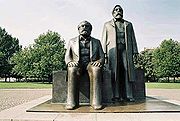
, although it has precedents in earlier movements and ideas. The Communist Manifesto was written by Karl Marx
and Frederick Engels in 1848 just before the Revolutions of 1848
swept Europe, expressing what they termed 'scientific socialism
'. In the last third of the 19th century in Europe social democratic parties arose in Europe drawing mainly from Marxism. The Australian Labor Party
was the world's first elected socialist party when the party won the 1899 Queensland
state election.
In the first half of the twentieth century the Soviet Union and the Communist parties
of the Third International around the world mainly came to represent socialism in terms of the Soviet model of economic development
, the creation of centrally planned economies
directed by a state that owns all the means of production, although other Trends condemned what they saw as the lack of a democracy. In 1946 Eurasian Socialist Parties in power were considerably socialist. administrations by some. In the UK Herbert Morrison
said "Socialism is what the Labour government does", whereas Aneurin Bevan
argued that socialism requires that the "main streams of economic activity are brought under public direction", with an economic plan and workers' democracy. Some argued that capitalism had been abolished. Socialist governments established the 'mixed economy' with partial nationalisations and social welfare.
By 1968 the prolonged Vietnam War (1959–1975), gave rise to the New Left
, socialists who tended to be critical of the Soviet Union and social democracy. Anarcho-syndicalists and some elements of the New Left and others favored decentralized collective ownership in the form of cooperatives or workers' councils. At the turn of the 21st century, in Latin America Venezuelan President Hugo Chávez
championed what he termed 'Socialism of the 21st Century', which included a policy of nationalisation of national assets such as oil, anti-imperialism, and termed himself a Trotskyist supporting 'permanent revolution
'.
in 1834, or to Marie Roch Louis Reybaud
in France, or else in England to Robert Owen
, who is considered the father of the cooperative movement.
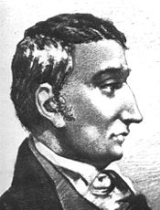
The first modern socialists were early 19th century Western European social critics. In this period, socialism emerged from a diverse array of doctrines and social experiments associated primarily with British and French thinkers—especially Robert Owen
, Charles Fourier
, Pierre-Joseph Proudhon
, Louis Blanc
, and Saint-Simon
. These social critics criticised the excesses of poverty and inequality of the Industrial Revolution
, and advocated reforms such as the egalitarian distribution of wealth and the transformation of society into small communities in which private property was to be abolished. Outlining principles for the reorganization of society along collectivist lines, Saint-Simon and Owen sought to build socialism on the foundations of planned, utopian communities. According to Sheldon Richman
, "[i]n the 19th and early 20th centuries, 'socialism' did not exclusively mean collective or government ownership of the means or production but was an umbrella term for anyone who believed labor was cheated out of its natural product under historical capitalism."
According to some accounts, the use of the words "socialism" or "communism" was related to the perceived attitude toward religion in a given culture. In Europe, "communism" was considered to be the more atheistic of the two. In England, however, that sounded too close to communion with Catholic overtones; hence atheists preferred to call themselves socialists.
 By 1847, according to Frederick Engels, "Socialism" was "respectable" on the continent of Europe, while "Communism" was the opposite; the Owenites in England and the Fourierists in France were considered Socialists, while working class movements which "proclaimed the necessity of total social change" termed themselves "Communists". This latter was "powerful enough" to produce the communism of Étienne Cabet
in France and Wilhelm Weitling
in Germany.
, who is called the founder of French socialism, argued that a brotherhood of man must accompany the scientific organization of industry and society. He proposed that production and distribution be carried out by the state, and that allowing everyone to have equal opportunity to develop their talents would lead to social harmony, and the traditional state could be virtually eliminated, or transformed. "Rule over men would be replaced by the administration of things."
(7 April 1772 – 10 October 1837) was a French utopian socialist and philosopher. Fourier is credited by modern scholars with having originated the word féminisme
in 1837; as early as 1808, he had argued, in the Theory of the Four Movements, that the extension of the liberty of women was the general principle of all social progress, though he disdained any attachment to a discourse of 'equal rights'. Fourier inspired the founding of the communist community called La Reunion
near present-day Dallas, Texas
as well as several other communities within the United States of America, such as the North American Phalanx
in New Jersey and Community Place
and five others in New York State.
advocated the transformation of society into small, local collectives without such elaborate systems of social organization. Owen was a mill manager from 1800–1825. He transformed life in the village of New Lanark
with ideas and opportunities which were at least a hundred years ahead of their time. Child labor and corporal punishment were abolished, and villagers were provided with decent homes, schools and evening classes, free health care, and affordable food.
The UK government's Factory Act of 1833 attempted to reduce the hours adults and children worked in the textile industry. A fifteen hour working day was to start at 5.30 a.m. and cease at 8.30 p.m. Children of nine to thirteen years could be worked no more than 9 hours, and those of a younger age were prohibited. There were, however, only four factory inspectors, and this law was broken by the factory owners. In the same year Owen stated:
In a Paper Dedicated to the Governments of Great Britain, Austria, Russia, France, Prussia and the United States of America written in 1841, Owen wrote: "The lowest stage of humanity is experienced when the individual must labor for a small pittance of wages from others."
pronounced that "Property is theft" and that socialism was "every aspiration towards the amelioration of society". Proudhon termed himself an anarchist and proposed that free association of individuals should replace the coercive state. Proudhon, Benjamin Tucker
, and others developed these ideas in a free-market direction, while Mikhail Bakunin, Piotr Kropotkin, and others adapted Proudhon's ideas in a more conventionally socialist direction.
In a letter to Marx in 1846, Proudhon wrote:
, the father of modern anarchism, was a libertarian socialist, a theory by which the workers would directly manage the means of production through their own productive associations. There would be "equal means of subsistence, support, education, and opportunity for every child, boy or girl, until maturity, and equal resources and facilities in adulthood to create his own well-being by his own labor."
While many socialists emphasized the gradual transformation of society, most notably through the foundation of small, utopian communities, a growing number of socialists became disillusioned with the viability of this approach and instead emphasized direct political action. Early socialists were united, however, in their desire for a society based on cooperation rather than competition.
 The French Revolution
of 1789, Karl Marx
and Frederick Engels wrote, "abolished feudal property in favour of bourgeois property". The French Revolution was preceded and influenced by the works of Jean-Jacques Rousseau
, whose Social Contract famously began, "Man is born free, and he is everywhere in chains." Rousseau is credited with influencing socialist thought, but it was François-Noël Babeuf
, and his Conspiracy of Equals, who is credited with providing a model for left-wing and communist movements of the 19th century.
Marx and Engels drew from these socialist or communist ideas born in the French revolution, as well as from the German philosophy of GWF Hegel, and English political economy, particularly that of Adam Smith
and David Ricardo
. Marx and Engels developed a body of ideas which they called scientific socialism
, more commonly called Marxism
. Marxism comprised a theory of history (historical materialism
) as well as a political, economic and philosophical theory.
In the Manifesto of the Communist Party, written in 1848 just days before the outbreak of the revolutions of 1848
, Marx and Engels wrote, "The distinguishing feature of Communism is not the abolition of property generally, but the abolition of bourgeois property." Unlike those Marx described as utopia
n socialists, Marx determined that, "The history of all hitherto existing society is the history of class struggles". While utopian socialists believed it was possible to work within or reform capitalist society, Marx confronted the question of the economic and political power of the capitalist class, expressed in their ownership of the means of producing wealth (factories, banks, commerce - in a word, 'Capital'). Marx and Engels formulated theories regarding the practical way of achieving and running a socialist system, which they saw as only being achieved by those who produce the wealth in society, the toilers, workers or "proletariat", gaining common ownership of their workplaces, the means of producing wealth.
Marx believed that capitalism could only be overthrown by means of a revolution carried out by the working class: "The proletarian movement is the self-conscious, independent movement of the immense majority, in the interest of the immense majority." Marx believed that the proletariat was the only class with both the cohesion, the means and the determination to carry the revolution forward. Unlike the utopian socialists, who often idealised agrarian life and deplored the growth of modern industry, Marx saw the growth of capitalism and an urban proletariat as a necessary stage towards socialism.
For Marxists
, socialism or, as Marx termed it, the first phase of communist society, can be viewed as a transitional stage characterized by common or state ownership of the means of production
under democratic workers' control and management, which Engels argued was beginning to be realised in the Paris Commune
of 1871, before it was overthrown. Socialism to them is simply the transitional phase between capitalism
and "higher phase of communist society". Because this society has characteristics of both its capitalist ancestor and is beginning to show the properties of communism, it will hold the means of production collectively but distributes commodities according to individual contribution. When the socialist state (the dictatorship of the proletariat
) naturally withers away, what will remain is a society in which human beings no longer suffer from alienation and "all the springs of co-operative wealth flow more abundantly." Here "society inscribe[s] on its banners: From each according to his ability, to each according to his needs!" For Marx, a communist society entails the absence of differing social class
es and thus the end of class warfare. According to Marx and Engels, once a socialist society had been ushered in, the state would begin to "wither away", and humanity would be in control of its own destiny for the first time.
(IWA), also known as the First International, was founded in London in 1864. Victor Le Lubez, a French radical republican living in London, invited Karl Marx
to come to London as a representative of German workers. The IWA held a preliminary conference in 1865, and had its first congress at Geneva
in 1866. Marx was appointed a member of the committee, and according to Saul Padover, Marx and Johann Georg Eccarius, a tailor living in London, became "the two mainstays of the International from its inception to its end". The First International became the first major international forum for the promulgation of socialist ideas.
The Social Democratic Workers' Party of Germany
was founded in 1869 under the influence of Marx and Engels. In 1875, it merged with the General German Workers' Association
of Ferdinand Lassalle
to become what is known today as the German Social Democratic Party (SPD). Socialism became increasingly associated with newly-formed trade union
s. In Germany, the SPD founded unions. In Austria, France and other European countries, socialist parties and anarchists
played a prominent role in forming and building up trade unions, especially from the 1870s onwards. This stood in contrast to the British experience, where moderate New Model Union
s dominated the union movement from the mid-nineteenth century, and where trade unionism was stronger than the political labour movement until the formation and growth of the Labour Party
in the early twentieth century.
Socialist groups supported diverse views of socialism, from the gradualism of many trade unionists to the radical, revolutionary theory of Marx and Engels. Anarchists and proponents of other alternative visions of socialism, who emphasized the potential of small-scale communities and agrarianism
, coexisted with the more influential currents of Marxism and social democracy
. The anarchists, led by the Russian Mikhail Bakunin
, believed that capitalism
and the state
were inseparable, and that one could not be abolished without the other.
, an uprising in Paris established the Paris Commune
. According to Marx and Engels, for a few weeks the Paris Commune provided a glimpse of a socialist society, before it was brutally suppressed by the French government.
In Paris Commune, large-scale industry was to be "based on the association of the workers" joined into "one great union", all posts in government were elected by universal franchise, elected officials took only the average worker's wage and were subject to recall. For Engels, this was what the dictatorship of the proletariat
looked like (as opposed to the "dictatorship of the bourgeoisie", which was capitalism). Engels goes on to state: "In reality, however, the state is nothing but a machine for the oppression of one class by another, and indeed in the democratic republic no less than in the monarchy; and at best an evil inherited by the proletariat after its victorious struggle for class supremacy", and a new generation of socialists, "reared in new and free social conditions, will be able to throw the entire lumber of the state on the scrap-heap".
After the Paris Commune, the differences between supporters of Marx and Engels and those of Bakunin were too great to bridge. The anarchist section of the First International was expelled from the International at the 1872 Hague Congress
and they went on to form the Jura federation
. The First International was disbanded in 1876.
Just before his death in 1895, Engels argued that there was now a "single generally recognised, crystal clear theory of Marx" and a "single great international army of socialists". Despite its illegality due to the Anti-Socialist Laws
of 1878, the Social Democratic Party of Germany
's use of the limited universal male suffrage were "potent" new methods of struggle which demonstrated their growing strength and forced the dropping of the Anti-Socialist legislation in 1890, Engels argued. In 1893, the German SPD obtained 1,787,000 votes, a quarter of votes cast. However before the leadership of the SPD published Engels' 1895 Introduction to Marx's Class Struggles in France 1848–1850, they removed certain phrases they felt were too revolutionary.
Marx believed that it was possible to have a peaceful socialist transformation in England, although the British ruling class would then revolt against such a victory. America and Holland might also have a peaceful transformation, but not in France, where Marx believed there had been "perfected... an enormous bureaucratic and military organisation, with its ingenious state machinery" which must be forcibly overthrown. However, eight years after Marx's death, Engels argued that it was possible to achieve a peaceful socialist revolution in France, too.
introduced limited welfare provision and working hours were reduced. Germany experienced sustained economic growth for more than forty years. Commentators suggest that this expansion, together with the concessions won, gave rise to illusions amongst the leadership of the SPD that capitalism would evolve into socialism gradually.
Beginning in 1896, in a series of articles published under the title "Problems of socialism", Eduard Bernstein
argued that an evolutionary transition to socialism was both possible and more desirable than revolutionary change. Bernstein and his supporters came to be identified as "revisionists" because they sought to revise the classic tenets of Marxism
. Although the orthodox Marxists
in the party, led by Karl Kautsky
, retained the Marxist theory of revolution as the official doctrine of the party, and it was repeatedly endorsed by SPD conferences, in practice the SPD leadership became increasingly reformist.
in the West, so that both complement each other, the present Russian common ownership of land may serve as the starting point for a communist development."
In 1903, the Russian Social Democratic Labour Party
began to split on ideological and organizational questions into Bolshevik
('Majority') and Menshevik
('Minority') factions, with Russian revolutionary Vladimir Lenin
leading the more radical Bolsheviks. Both wings accepted that Russia was an economically backward country unripe for socialism. The Mensheviks awaited the capitalist revolution in Russia. But Lenin argued that a revolution of the workers and peasants would achieve this task. After the Russian revolution of 1905, Leon Trotsky
argued that unlike the French revolution of 1789 and the European Revolutions of 1848
against absolutism, the capitalist class would never organise a revolution in Russia to overthrow absolutism, and that this task fell to the working class who, liberating the peasantry from their feudal yoke, would then immediately pass on to the socialist tasks and seek a "permanent revolution" to achieve international socialism. Assyrian nationalist Freydun Atturaya
tried to create regional self-government for the Assyrian people
with the socialism ideology. He even wrote the Urmia Manifesto of the United Free Assyria
. However, his attempt was put to an end by Russia.
was founded. This party, which advocated Marxism and still exists today, was a confederation of small Marxist parties and came under the leadership of Daniel De Leon
. In 1901, a merger between opponents of De Leon and the younger Social Democratic Party
joined with Eugene V. Debs
to form the Socialist Party of America
.
In 1905, the Industrial Workers of the World
formed from several independent labor unions. The IWW opposed the political means of Debs and De Leon, as well as the craft unionism of Samuel Gompers
. In 1910, the Sewer Socialists, the main group of American socialists, elected Victor Berger as a socialist Congressman and Emil Seidel
as a socialist mayor of Milwaukee, Wisconsin
, most of the other elected city officials being socialist as well. This Socialist Party of America grew to 150,000 in 1912 and polled 897,000 votes in the presidential campaign of that year, 6 percent of the total vote. Socialist mayor Daniel Hoan
, was elected in 1916 and stayed in office until 1940. The final Socialist mayor, Frank P. Zeidler
, was elected in 1948 and served three terms, ending in 1960. Milwaukee remained the hub of Socialism during these years. The Socialist Party declined after the First World War.
(1871), its leaders killed or exiled. But in 1879, at the Marseille Congress, workers' associations created the Federation of the Socialist Workers of France
. Three years later, Jules Guesde
and Paul Lafargue
, the son-in-law of Karl Marx
, left the federation and founded the French Workers' Party
.
The Federation of the Socialist Workers of France was termed "possibilist" because it advocated gradual reforms, whereas the French Workers' Party promoted Marxism. In 1905 these two trends merged to form the French Section Française de l'Internationale Ouvrière
(SFIO), led by Jean Jaurès
and later Léon Blum
. In 1906 it won 56 seats in Parliament. The SFIO adhered to Marxist ideas but became, in practice, a reformist party. By 1914 it had more than 100 members in the Chamber of Deputies.
and solidarity.
Lenin, however, denounced the war as an imperialist conflict, and urged workers worldwide to use it as an occasion for proletarian revolution. The Second International dissolved during the war, while Lenin, Trotsky, Karl Liebknecht
and Rosa Luxemburg
, together with a small number of other Marxists opposed to the war, came together in the Zimmerwald Conference
in September 1915.
as a social movement
has regularly endured fluctuations in popularity. Its classical period, which scholars demarcate as from 1860 to 1939, is associated with the working-class movements of the 19th century and the Spanish Civil War
-era struggles against fascism
.
 In 1864 the International Workingmen's Association
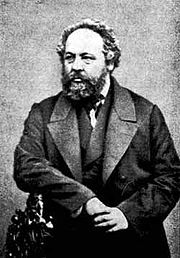
(sometimes called the "First International") united diverse revolutionary currents including French followers of Proudhon
, Blanquists
, Philadelphes
, English trade unionists, socialists and social democrats. Proudhon's followers, the mutualists
, opposed Marx's state socialism
, advocating political abstentionism
and small property holdings.
The anti-authoritarian sections of the First International were the precursors of the anarcho-syndicalists, seeking to "replace the privilege and authority of the State" with the "free and spontaneous organization of labor."
In 1907, the International Anarchist Congress of Amsterdam
gathered delegates from 14 different countries, among which important figures of the anarchist movement, including Errico Malatesta
, Pierre Monatte
, Luigi Fabbri
, Benoît Broutchoux
, Emma Goldman
, Rudolf Rocker
, and Christiaan Cornelissen
. Various themes were treated during the Congress, in particular concerning the organisation of the anarchist movement, popular education
issues, the general strike
or antimilitarism
. A central debate concerned the relation between anarchism and syndicalism
(or trade union
ism). The Spanish Workers Federation
in 1881 was the first major anarcho-syndicalist movement; anarchist trade union federations were of special importance in Spain. The most successful was the Confederación Nacional del Trabajo
(National Confederation of Labour: CNT), founded in 1910. Before the 1940s, the CNT was the major force in Spanish working class politics, attracting 1.58 million members at one point and playing a major role in the Spanish Civil War
. The CNT was affiliated with the International Workers Association, a federation of anarcho-syndicalist trade unions founded in 1922, with delegates representing two million workers from 15 countries in Europe and Latin America.
Some anarchists, such as Johann Most
, advocated publicizing violent acts of retaliation against counter-revolutionaries because "we preach not only action in and for itself, but also action as propaganda." Numerous heads of state were assassinated between 1881 and 1914 by members of the anarchist movement. For example, U.S. President McKinley
's assassin Leon Czolgosz
claimed to have been influenced by anarchist and feminist Emma Goldman
.
Anarchists participated alongside the Bolshevik
s in both February
and October revolutions
, and were initially enthusiastic about the Bolshevik coup. However, the Bolsheviks soon turned against the anarchists and other left-wing opposition, a conflict that culminated in the 1921 Kronstadt rebellion
which the new government repressed. Anarchists in central Russia were either imprisoned, driven underground or joined the victorious Bolsheviks; the anarchists from Petrograd and Moscow fled to the Ukraine
. There, in the Free Territory
, they fought in the civil war
against the Whites
(a Western-backed grouping of monarchists and other opponents of the October Revolution) and then the Bolsheviks as part of the Revolutionary Insurrectionary Army of Ukraine
led by Nestor Makhno
, who established an anarchist society in the region for a number of months.
In the 1920s and 1930s, the rise of fascism
in Europe transformed anarchism's conflict with the state.
In Spain, the CNT
initially refused to join a popular front electoral alliance, and abstention by CNT supporters led to a right wing election victory. But in 1936, the CNT changed its policy and anarchist votes helped bring the popular front back to power. Months later, the former ruling class responded with an attempted coup causing the Spanish Civil War
(1936–1939). In response to the army rebellion, an anarchist-inspired
movement of peasants and workers, supported by armed militias, took control of Barcelona
and of large areas of rural Spain where they collectivised
the land. But even before the fascist victory in 1939, the anarchists were losing ground in a bitter struggle with the Stalinists
, who controlled the distribution of military aid to the Republican cause from the Soviet Union. Stalinist-led troops suppressed the collectives and persecuted both dissident Marxists
and anarchists.
A surge of popular interest in anarchism occurred during the 1960s and 1970s. In 1968 in Carrara
, Italy the International of Anarchist Federations
was founded during an international Anarchist conference in Carrara
in 1968 by the three existing European federations of France
, the Italian
and the Iberian Anarchist Federation as well as the Bulgaria
n federation in French exile. In the United Kingdom this was associated with the punk rock
movement, as exemplified by bands such as Crass
and the Sex Pistols
. The housing and employment crisis in most of Western Europe led to the formation of communes
and squatter
movements like that of Barcelona
, Spain. In Denmark, squatters occupied a disused military base and declared the Freetown Christiania
, an autonomous haven in central Copenhagen.
Since the revival of anarchism in the mid 20th century, a number of new movements and schools of thought emerged.
Around the turn of the 21st century, anarchism grew in popularity and influence as part of the anti-war, anti-capitalist, and anti-globalisation movements. Anarchists became known for their involvement in protests against the meetings of the World Trade Organization
(WTO), Group of Eight
, and the World Economic Forum
. Some anarchist factions at these protests engaged in rioting, property destruction, and violent confrontations with police, and the confrontations were selectively portrayed in mainstream media coverage as violent riots. These actions were precipitated by ad hoc, leaderless, anonymous cadres known as black bloc
s; other organisational tactics pioneered in this time include security culture
, affinity groups and the use of decentralised technologies such as the internet. A landmark struggle of this period was the confrontations at WTO conference in Seattle in 1999.
International anarchist federations in existence include the International of Anarchist Federations
, the International Workers' Association, and International Libertarian Solidarity
.
(SPD) in Germany became the largest and most powerful socialist party in Europe, despite working illegally until the anti-socialist laws were dropped in 1890. In the 1893 elections it gained 1,787,000 votes, a quarter of the total votes cast, according to Engels. In 1895, the year of his death, Engels emphasised the Communist Manifesto's emphasis on winning, as a first step, the "battle of democracy". Since the 1866 introduction of universal male franchise the SPD had proved that old methods of, "surprise attacks, of revolutions carried through by small conscious minorities at the head of masses lacking consciousness is past". Marxists, Engels emphasised, must "win over the great mass of the people" before initiating a revolution.
Marx believed that it was possible to have a peaceful socialist revolution in England, America and Holland, but not in France, where he believed there had been "perfected ... an enormous bureaucratic and military organisation, with its ingenious state machinery" which must be forcibly overthrown. However, eight years after Marx's death, Engels regarded it possible to achieve a peaceful socialist revolution in France, too.
In 1896, Eduard Bernstein
argued that once full democracy had been achieved, a transition to socialism by gradual means was both possible and more desirable than revolutionary change. Bernstein and his supporters came to be identified as "revisionists", because they sought to revise the classic tenets of Marxism
. Although the orthodox Marxists
in the party, led by Karl Kautsky
, retained the Marxist theory of revolution as the official doctrine of the party, and it was repeatedly endorsed by SPD conferences, in practice the SPD leadership became more and more reformist.
In Europe most Social Democratic parties participated in parliamentary politics and the day-to-day struggles of the trade unions. In the UK, however, many trade unionists who were members of the Social Democratic Federation
, which included at various times future trade union leaders such as Will Thorne
, John Burns
and Tom Mann
, felt that the Federation neglected the industrial struggle. Along with Engels, who refused to support the SDF, many felt that dogmatic approach of the SDF, particularly of its leader, Henry Hyndman
, meant that it remained an isolated sect. The mass parties of the working class under social democratic leadership became more reformist and lost sight of their revolutionary objective. Thus the French Section of the Workers' International (SFIO), founded in 1905, under Jean Jaurès
and later Léon Blum
adhered to Marxist ideas, but became in practice a reformist party.
In some countries, particularly Britain and the British dominion
s, labour parties were formed. These were parties largely formed by and controlled by the trade unions, rather than formed by groups of socialist activists who then appealed to the workers for support. In Britain, the Labour Party, (at first the Labour Representation Committee) was established by representatives of trade unions together with affiliated socialist parties, principally the Independent Labour Party
but also for a time the avowedly Marxist Social Democratic Federation
and other groups, such as the Fabians. On 1 December 1899 Anderson Dawson
of the Australian Labor Party
became the Premier of Queensland
, Australia, forming the world's first parliamentary socialist government . The Dawson government, however, lasted only one week, being defeated at the first sitting of parliament.
The British Labour Party
first won seats in the House of Commons
in 1902. It won the majority of the working class away from the Liberal Party
after World War I. In Australia, the Labor Party
achieved rapid success, forming its first national government in 1904. Labour parties were also formed in South Africa and New Zealand but had less success. The British Labour Party adopted a specifically socialist constitution (‘Clause four, Part four’) in 1918.
The strongest opposition to revisionism came from socialists in countries such as the Russian Empire
where parliamentary democracy did not exist. Chief among these was the Russian Vladimir Lenin
, whose works such as Our Programme (1899) set out the views of those who rejected revisionist ideas. In 1903, there was the beginnings of what eventually became a formal split in the Russian Social Democratic Labor Party into revolutionary Bolshevik
and reformist Menshevik
factions.
In 1914, the outbreak of World War I led to a crisis in European socialism. The parliamentary leaderships of the socialist parties of Germany, France, Belgium and Britain each voted to support the war aims of their country's governments, although some leaders, like Ramsay MacDonald
in Britain and Karl Liebknecht
in Germany, opposed the war from the start. Lenin, in exile in Switzerland, called for revolutions in all the combatant states as the only way to end the war and achieve socialism. Lenin, Leon Trotsky
, Karl Liebknecht and Rosa Luxemburg
, together with a small number of other Marxists opposed to the war, came together in the Zimmerwald Conference
in September 1915. This conference saw the beginning of the end of the uneasy coexistence of revolutionary socialists
with the social democrats, and by 1917 war-weariness led to splits in several socialist parties, notably the German Social Democrats.
The Russian Revolution
of October 1917 led to a withdrawal from World War I, one of the principal demands of the Russian revolution, as the Soviet government immediately sued for peace. Germany and the former allies invaded the new Soviet Russia, which had repudiated the former Romanov
regime's national debts and nationalized the banks and major industry. Russia was the only country in the world where socialists had taken power, and it appeared to many socialists to confirm the ideas, strategy and tactics of Lenin and Trotsky.
of October 1917 brought about the definitive ideological division between Communists as denoted with a capital "C" on the one hand and other communist and socialist trends such as anarcho-communists and social democrats, on the other. The Left Opposition
in the Soviet Union gave rise to Trotskyism
which was to remain isolated and insignificant for another fifty years, except in Sri Lanka where Trotskyism gained the majority and the pro-Moscow wing was expelled from the Communist Party.
In 1922, the fourth congress of the Communist International took up the policy of the United Front
, urging Communists to work with rank and file Social Democrats while remaining critical of their leaders, who they criticised for "betraying" the working class by supporting the war efforts of their respective capitalist classes. For their part, the social democrats pointed to the dislocation caused by revolution, and later, the growing authoritarianism of the Communist Parties. When the Communist Party of Great Britain applied to affiliate to the Labour Party in 1920 it was turned down.
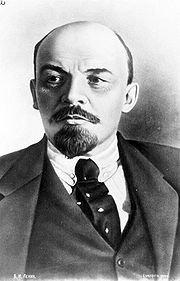 After three years, the First World War, at first greeted with enthusiastic patriotism, produced an upsurge of radicalism in most of Europe and also as far afield as the United States (see Socialism in the United States
) and Australia. In the Russian revolution of February 1917, workers' councils (in Russian
, soviets) had been formed, and Lenin and the Bolsheviks called for "All power to the Soviets". After the October 1917 Russian revolution, led by Lenin and Trotsky, consolidated power in the Soviets, Lenin declared "Long live the world socialist revolution!" Briefly in Soviet Russia socialism was not just a vision of a future society, but a description of an existing one. The Soviet regime began to bring all the means of production (except agricultural production) under state control, and implemented a system of government through the workers' councils or soviets.
The initial success of the Russian Revolution inspired other revolutionary parties to attempt the same thing unleashing the Revolutions of 1917-23
. In the chaotic circumstances of postwar Europe, with the socialist parties divided and discredited, Communist revolutions across Europe seemed a possibility. Communist parties were formed, often from minority or majority factions in most of the world's socialist parties, which broke away in support of the Leninist model.
The German Revolution
of 1918 overthrew the old absolutism and, like Russia, set up Workers' and Soldiers' Councils almost entirely made up of SPD and Independent Social Democrats (USPD) members. The Weimar republic
was established and placed the SPD in power, under the leadership of Friedrich Ebert
. Ebert agreed with Max von Baden
that a social revolution was to be prevented and the state order must be upheld at any cost. In 1919 the Spartacist uprising
challenged the power of the SPD government, but it was put down in blood and the German Communist leaders Karl Liebknecht
and Rosa Luxemburg
were assassinated. Communist regimes briefly held power under Béla Kun
in Hungary and under Kurt Eisner
in Bavaria
. There were further revolutionary movements in Germany until 1923, as well as in Vienna
, and also in the industrial centres of northern Italy.
In this period few Communists doubted, least of all Lenin and Trotsky, that successful socialist revolutions carried out by the working classes of the most developed capitalist counties were essential to the success of the socialism, and therefore to the success of socialism in Russia in particular. In March 1918, Lenin said, "we are doomed if the German revolution does not break out". In 1919, the Communist Parties came together to form a 'Third International', termed the Communist International or Comintern
. But the prolonged revolutionary period in Germany did not bring a socialist revolution.
Within a few years a bureaucracy developed in Russia as a result of the Russian Civil War
, foreign invasion, and Russia's historic poverty and backwardness. The bureaucracy undermined the democratic and socialist ideals of the Bolshevik Party and elevated Stalin to their leadership after Lenin's death. In order to consolidate power, the bureaucracy conducted a brutal campaign of lies and violence against the Left Opposition
led by Trotsky.
By the mid 1920s, the impetus had gone out of the revolutionary forces in Europe and the national reformist socialist parties had regained their dominance over the working-class movement in most countries. The German Social Democrats held office for much of the 1920s, the British Labour Party
formed its first government in 1924, and the French Socialists were also influential. In the Soviet Union, from 1924 Stalin
pursued a policy of "socialism in one country
". Trotsky argued that this approach was a shift away from the theory of Marx and Lenin, while others argued that it was a practical compromise fit for the times.
The postwar revolutionary upsurge provoked a powerful reaction from the forces of conservatism. Winston Churchill
declared that Bolshevism must be "strangled in its cradle". The invasion of Russia by the Allies
, their trade embargo and backing for the White forces fighting against the Red Army in the civil war in the Soviet Union was cited by Aneurin Bevan, the leader of the left-wing in the Labour Party, as one of the causes of the Russian revolution's degeneration into dictatorship. A "Red scare
" in the United States was raised against the American Socialist Party
of Eugene V. Debs
and the Communist Party of America which arose after the Russian revolution from members who had broken from Debs' party. In Europe, fascist
movements received significant funding, particularly from industrialists in heavy industry, and came to power in Italy in 1922 under Benito Mussolini
, and later in Germany in 1933, in Spain (1937) and Portugal, while strong fascist movements also developed in Hungary
and Romania
.
After 1929, with the Left Opposition legally banned and Trotsky exiled, Stalin led the Soviet Union into a what he termed a "higher stage of socialism." Agriculture was forcibly collectivised, at the cost of a massive famine
and millions of deaths among the resistant peasantry. The surplus squeezed from the peasants was spent on a program of crash industrialisation, guided by the Communist Party through the Five Year Plan. This program produced some impressive results, though at enormous human costs. Russia raised itself from an economically backward country to that of a superpower. Later Soviet development, however, particularly after the Second World War
, was no faster than it was in Japan or the United States under capitalism
. The use of resources, material and human, in the Soviet Union became very wasteful. Stalin's industrialization policy was geared towards the development of heavy industry, an emphasis that facilitated Soviet military action in its defence against Hitler's invasion during the Second World War in which the USSR stood on the side of the Allies of World War II
.
The Soviet achievement in the 1930s seemed hugely impressive from the outside, and convinced many people, not necessarily Communists or even socialists, of the virtues of state planning and authoritarian models of social development. This was later to have important consequences in countries like China, India and Egypt
, which tried to copy some aspects of the Soviet model. It also won large sections of the western intelligentsia
over to a pro-Soviet view, to the extent that many were willing to ignore or excuse such events as Stalin's Great Purge
of 1936-38, in which millions of people died.
The Great Depression
, which began in 1929, seemed to socialists and Communists everywhere to be the final proof of the bankruptcy, literally as well as politically, of capitalism. But socialists were unable to take advantage of the Depression to either win elections or stage revolutions. Labor governments in Britain and Australia were disastrous failures. In the United States, the liberalism of President Franklin D. Roosevelt
won mass support and deprived socialists of any chance of gaining ground. And in Germany it was the fascists of Adolf Hitler
's Nazi Party who successfully exploited the Depression to win power, in January 1933.
Hitler's regime swiftly destroyed both the German Communist Party and the Social Democratic Party, the worst blow the world socialist movement had ever suffered. This forced Stalin to reassess his strategy, and from 1935 the Comintern began urging a Popular Front
against fascism. The socialist parties were at first suspicious, given the bitter hostility of the 1920s, but eventually effective Popular Fronts were formed in both France and Spain. After the election of a Popular Front government in Spain in 1936 a fascist military revolt led to the Spanish Civil War
. The crisis in Spain also brought down the Popular Front government in France under Léon Blum
. Ultimately the Popular Fronts were not able to prevent the spread of fascism or the aggressive plans of the fascist powers. Trotskyists considered Popular Fronts a "strike breaking conspiracy" and considered them a impediment to successful resistance to fascism.
When Stalin consolidated his power in the Soviet Union in the late 1920s, Trotsky was forced into exile, eventually residing in Mexico. He maintained active in organizing the Left Opposition
internationally, which worked within the Comintern to gain new members. Some leaders of the Communist Parties sided with Trotsky, such as James P. Cannon
in the United States. They found themselves expelled by the Stalinist Parties and persecuted by both GPU agents and the political police in Britain, France, the United States, China, and all over the world. Trotskyist parties had a large influence in Sri Lanka and Bolivia.
In 1938, Trotsky and his supporters founded a new international organisation of dissident communists, the Fourth International
. In his Results and Prospects and Permanent Revolution
Trotsky developed a theory of revolution uninterrupted by the stagism of Stalinist orthodoxy. He argued that Russia was a bureaucratically degenerated workers state in his work The Revolution Betrayed, where he predicted that if a political revolution of the working class did not overthrow Stalinism, the Stalinist bureaucracy would resurrect capitalism. Trotsky's monumental History of the Russian Revolution is considered a work of primary importance by Trotsky's followers.
, had promised the troops in the 1918 election that his Conservative-led coalition would make post-war Britain "a fit land for heroes to live in". But many demobbed troops complained of chronic unemployment and suffered low pay, disease and poor housing.
In 1918, the Labour Party adopted as its aim to secure for the workers, "the common ownership of the means of production, distribution and exchange". In 1919, the Miners Federation, whose Members of Parliament pre-dated the formation of the Labour Party and were since 1906 a part of that body, demanded the withdrawal of British troops from Soviet Russia. The 1919 Labour Party conference voted to discuss the question of affiliation to the Third (Communist) International, "to the distress of its leaders". A vote was won committing the Labour Party committee of the Trades Union Congress to arrange "direct industrial action" to "stop capitalist attacks upon the Socialist Republics of Russia and Hungary." The threat of immediate strike action forced the Conservative-led coalition government to abandon its intervention in Russia.
In 1914 the unions of the transport workers, the mine workers and the railway workers had formed a Triple Alliance
. In 1919, Lloyd George sent for the leaders of the Triple Alliance, one of whom was miner's leader Robert Smillie
, a founder member of the Independent Labour Party
in 1889 who was to become a Labour Party MP in the first 1924 Labour government. According to Smillie, Lloyd George said:
"From that moment on", Smillie conceded to Aneurin Bevan
, "we were beaten and we knew we were". When the UK General Strike of 1926
broke out, the trade union leaders, "had never worked out the revolutionary implications of direct action on such a scale", Bevan says. Bevan was a member of the Independent Labour Party and one of the leaders of the South Wales miners during the strike. The TUC called off the strike after nine days. In the North East of England and elsewhere, "councils of action" were set up, with many rank and file Communist Party members often playing a critical role. The councils of action took control of essential transport and other duties. When the strike ended, the miners were locked out and remained locked out for six months. Bevan became a Labour MP in 1929.
In January 1924, the Labour Party formed a minority government for the first time with Ramsay MacDonald
as prime minister. The Labour Party intended to ratify an Anglo-Russian trade agreement, which would break the trade embargo on Russia. This was attacked by the Conservatives and new elections took place in October 1924. Four days before polling day the Daily Mail published the Zinoviev letter
, a forgery that claimed the Labour Party had links with Soviet Communists and was secretly fomenting revolution. The fears instilled by the press of a Labour Party in secret Communist manoeuvres, together with the half-hearted "respectable" policies pursued by MacDonald, led to Labour losing the October 1924 general election. The victorious Conservatives repudiated the Anglo-Soviet treaty.
The leadership of the Labour Party, like social democratic parties almost everywhere, (with the exception of Sweden and Belgium), tried to pursue a policy of moderation and economic orthodoxy. At times of depression this policy was not popular with the Labour Party's working class supporters. The influence of Marxism grew in the Labour Party during the inter-war years. Anthony Crosland argued in 1956 that under the impact of the 1931 slump and the growth of fascism, the younger generation of left-wing intellectuals for the most part "took to Marxism" including the "best-known leaders" of the Fabian tradition, Sidney and Beatrice Webb
. The Marxist Professor Harold Laski
, who was to be chairman of the Labour Party in 1945-6, was the "outstanding influence" in the political field.
The Marxists within the Labour Party differed in their attitude to the Communists. Some were uncitical and some were expelled as "fellow travellers", while in the 1930s others were Trotskyists and sympathisers working inside the Labour Party, especially in its youth wing where they were influential.
In the general election of 1929 the Labour Party won 288 seats out of 615 and formed another minority government. The depression of that period brought high unemployment and Prime Minister MacDonald sought to make cuts in order to balance the budget. The trade unions opposed MacDonald's proposed cuts and he split the Labour government to form the National Government
of 1931. This experience moved the Labour Party leftward, and at the start of the Second World War an official Labour Party pamphlet written by Harold Laski argued that, "the rise of Hitler and the methods by which he seeks to maintain and expand his power are deeply rooted in the economic and social system of Europe... economic nationalism, the fight for markets, the destruction of political democracy, the use of war as an instrument of national policy":
was formed in 1919 from former adherents of the Socialist Party of America. One of the founders, James Cannon
, later became the leader of Trotskyist forces outside the Soviet Union. The Great Depression
began in the US on Black Tuesday, October 29, 1929. Unemployment rates passed 25%, prices and incomes fell 20–50%, but the debts remained at the same dollar amount. 9,000 banks failed during the decade of the 30s. By 1933, depositors saw $140 billion of their deposits disappear due to uninsured bank failures.
Workers organized against their deteriorating conditions and socialists played a critical role. In 1934 the Minneapolis Teamsters Strike
led by the Trotskyist Communist League of America
, the West Coast Longshore Strike
led by the Communist Party USA
, and the Toledo Auto-Lite Strike
led by the American Workers Party
, played an important role in the formation of the Congress of Industrial Organizations
(CIO) in the USA.
In Minnesota
, the General Drivers Local 574 of the International Brotherhood of Teamsters struck, despite an attempt to block the vote by AFL officials, demanding union recognition, increased wages, shorter hours, overtime rates, improved working conditions and job protection through seniority. In the battles that followed, which captured country-wide media attention, three strikes took place, martial law was declared and the National Guard was sent in. Two strikers were killed. Protest rallies of 40,000 were held. Farrell Dobbs, who became the leader of the local, had at the outset joined the "small and poverty-stricken" Communist League of America, founded by James P. Cannon
and others in 1928 after their expulsion from the Communist Party USA
for Trotskyism.
Success for the CIO quickly followed its formation. In 1937, one of the founding unions of the CIO, the United Auto Workers
, won union recognition at General Motors Corporation after a tumultuous forty-four day sit-down strike, while the Steel Workers Organizing Committee
, which was formed by the CIO, won a collective bargaining agreement with U.S. Steel
. The CIO merged with the American Federation of Labor
(AFL) in 1955 becoming the AFL-CIO
.
, a policy of aggressive confrontation of social democracy. This divided the working class at a critical time.
Like the Labour Party in the UK, the Social Democratic Party in Germany, which was in power in 1928, followed an orthodox deflationary policy and pressed for reductions in unemployment benefits in order to save taxes and reduce budget deficits. These policies did not halt the recession and the government resigned.
The Communists described the Social Democratic leaders as "social fascists" and in the Prussian Landtag they voted with the Nazis to bring down the Social Democratic government. Fascism continued to grow, with powerful backing from industrialists, especially in heavy industry, and Hitler was invited into power in 1933.
Hitler's regime swiftly destroyed both the German Communist Party and the Social Democratic Party, the worst blow the world socialist movement had ever suffered. This forced Stalin to reassess his strategy, and from 1935 the Comintern began urging the formation of Popular Front
s, which were to include not just the Social Democratic parties but critically also "progressive capitalist" parties which were wedded to a capitalist policy.
After the election of a Popular Front government in Spain in 1936 a fascist military revolt led to the Spanish Civil War
. The crisis in Spain brought down the Popular Front government in France under Léon Blum
. Ultimately the Popular Fronts were not able to prevent the spread of fascism or the aggressive plans of the fascist powers. Trotskyists considered Popular Fronts a "strike breaking conspiracy", an impediment to successful resistance to fascism due to their inclusion of pro-capitalist parties which demanded policies of opposition to strikes and workers’ actions against the capitalist class.
joined USA President Franklin D. Roosevelt
and Joseph Stalin
, General Secretary of the Communist Party of the Soviet Union's Central Committee. With the relative decline of Britain compared to the two superpower
s, the USA and the Soviet Union, however, many viewed the world as "bi-polar" a world with two irreconcilable and antagonistic political and economic systems.
As a result of the failure of the Popular Fronts and the inability of Britain and France to conclude a defensive alliance against Hitler, Stalin again changed his policy in August 1939 and signed a non-aggression pact, the Molotov-Ribbentrop Pact
, with Nazi Germany
. Shortly afterwards World War II broke out, and within two years Hitler had occupied most of Europe, and by 1942 both democracy and social democracy in central Europe fell under the threat of fascism. The only socialist parties of any significance able to operate freely were those in Britain, Sweden, Switzerland, Canada, Australia and New Zealand. But the entry of the Soviet Union into the war in 1941 marked the turning of the tide against fascism, and as the German armies retreated another great upsurge in left-wing sentiment swelled up in their wake. The resistance movements against German occupation were mostly led by socialists and communists, and by the end of the war the parties of the left were greatly strengthened.
One of the great postwar victories of democratic socialism was the election victory of the British Labour Party
led by Clement Attlee
in June 1945. Socialist (and in some places Stalinist) parties also dominated postwar governments in France, Italy, Czechoslovakia, Belgium, Norway and other European countries. The Social Democratic Party had been in power in Sweden since 1932, and Labour parties also held power in Australia and New Zealand. In Germany, on the other hand, the Social Democrats emerged from the war much weakened, and were defeated in Germany's first democratic elections in 1949. The united front between democrats and the Stalinist parties which had been established in the wartime resistance movements continued in the immediate postwar years. The democratic socialist parties of Eastern Europe, however, were destroyed when Stalin imposed so-called "Communist" regimes in these countries.
The Second International, which had been based in Amsterdam
, ceased to operate during the war. It was refounded as the Socialist International
at a congress in Frankfurt in 1951. Since Stalin had dissolved the Comintern
in 1943, as part of a deal with the imperialist powers, this was now the only effective international socialist organisation. The Frankfurt Declaration took a stand against both capitalism and the Communism of Stalin:
The first socialist government of North America and one of the most influential came to power in the Canadian province of Saskatchewan
in 1944. The Co-operative Commonwealth Federation of Tommy Douglas
won an overwhelming victory toppling the age old Liberal regime which had dominated Saskatchewan politics since the founding of the province in 1905. Douglas and the CCF won five consecutive electoral victories. During his time in office he created the Saskatchewan Power Corp. which extended electricity services to the many rural villages and farms who before did without, created Canada's first public automobile insurance agency, created a substantial number of Crown Corporations (government and public owned businesses) many of which still exist today in Saskatchewan, allowed the unionization of the public service, created the first system of Universal Health Care
in Canada (which would later be adopted nationally in 1965), and created Saskatchewan's Bill of Rights, the first such charter in Canada. This preceded the Canadian Charter of Rights and Freedoms as well as the previous Canadian Bill of Rights
.
The New Democratic Party
(as the CCF became known in 1962) went on to dominate the politics of Saskatchewan and form governments in British Columbia
, Manitoba
, Ontario
, and the Yukon Territory. Nationally the NDP would become very influential during four minority governments, and is today by far Canada's most successful left-wing political party.
In 2004 Canadians voted Tommy Douglas in as The Greatest Canadian
as part of a nation-wide contest organized by the Canadian Broadcasting Corporation
(CBC).
of major utilities such as mines, gas, coal, electricity, rail, iron and steel, and the Bank of England. France claimed to be the most state controlled capitalist country in the world, carrying through many nationalisations. In the UK the National Health Service was established bringing free health care to all for the first time. Social housing for working class families was provided in council housing estates and university education was made available for working class people through a grant system.
However the parliamentary leadership of the social democracies in general had no intention of ending capitalism, and their national outlook and their dedication to the maintenance of the post-war 'order' prevented the social democracies from making any significant changes to the economy. They were termed 'socialist' by all in 1945, but in the UK, for instance, where Social Democracy had a large majority in Parliament, "The government had not the smallest intention of bringing in the 'common ownership of the means of production, distribution and exchange'" as written in Clause 4 of the Labour Party constitution. In Germany, the Social Democratic Party of Germany
adopted the Godesberg Program
in 1959, which rejected class struggle
and Marxism
.
In the UK, cabinet minister Herbert Morrison
famously argued that, "Socialism is what the Labour government does", and Anthony Crosland
argued that capitalism had been ended. However many socialists within the social democracy, at rank and file level as well as in a minority in the leadership such as Aneurin Bevan
, feared the 'return of the 1930s' unless capitalism was ended, either directly or over a definite period of time. They criticised the government for not going further to take over the commanding heights of the economy. Bevan demanded that the "main streams of economic activity are brought under public direction" with economic planning, and criticised the Labour Party's implementation of nationalisation for not empowering the workers in the nationalised industries with democratic control over their operation. In the post war period, many Trotskyists expected at first the pattern of financial instability and recession to return. Instead the capitalist world, now led by the United States, embarked on a prolonged boom which lasted until 1973. Rising living standards across Europe and North America alongside low unemployment, was achieved, in the view of the socialists, by the efforts of trade union struggle, social reform by social democracy, and the ushering in of what was termed a "mixed economy".
Social democracy at first took the view that they had begun a "serious assault" on the five "Giant Evils" afflicting the working class, identified for instance by the British social reformer William Beveridge
: "Want, Disease, Ignorance, Squalor, and Idleness".
At the same time, the wartime alliance between the Soviet Union and the west broke down from 1946 onwards, and relations between the Communist parties and the democratic socialist parties broke down in parallel. Once the Stalinists helped stabilize the capitalist governments in the immediate upheavals of 1945, as per the agreements betweens Stalin, Roosevelt, and Churchill, the capitalist politicians had no more use for them. The French, Italian and Belgian Communists withdrew or were expelled from post-war coalition governments, and civil war
broke out in Greece. The imposition of Stalinist regimes in Poland, Hungary and Czechoslovakia not only destroyed the socialist parties in those countries, it also produced a reaction against socialism in general. The Australian and New Zealand Labour governments were defeated in 1949, and the British Labour government in 1951. As the Cold War
deepened, conservative rule in Britain, Germany and Italy became more strongly entrenched. Only in the Scandinavian countries and to some extent in France did the socialist parties retain their positions. But in 1958 Charles de Gaulle
seized power in France and the French socialists (SFIO) found themselves cast into opposition.
In the 1960s and 1970s the new social forces, introduced, the social democrats argued, by their 'mixed economy' and their many reforms of capitalism, began to change the political landscape in the western world. The long postwar boom and the rapid expansion of higher education produced, as well as rising living standards for the industrial working class, a mass university-educated white collar workforce, nevertheless began to break down the old socialist-versus-conservative polarity of European politics. This new white-collar workforce, some claimed, was less interested in traditional socialist policies such as state ownership and more interested expanded personal freedom and liberal social policies. The proportion of women in the paid workforce increased and many supported the struggle for equal pay, which, some argued, changed both the composition and the political outlook of the working class. Some socialist parties reacted more flexibly and successfully to these changes than others, but eventually the leaderships of all social democracies in Europe moved to an explicitly pro-capitalist stance. Symbolically in the UK, the socialist clause, Clause four, was removed from the Labour Party constitution, in 1995. A similar change took place in the German SDP.
However, particularly after the coming to power of British Premier Margaret Thatcher
in 1979 and US President Ronald Reagan
in 1981, and the fall of the Berlin Wall
in 1989, many social democratic party leaders were won to the ideological offensive which argued that capitalism had "won" and that, in the words of Francis Fukuyama
's essay, capitalism had reached "the end point of mankind's ideological evolution and the universalization of Western liberal democracy as the final form of human government.". Some parties reacted to these changes by engaging in a new round of revisionist
re-assessment of socialist ideology, and adopting a neo-liberal outlook. Some critics argue that in practice the Social Democractic parties, and the Labour Party in particular, can no longer be described as socialist. On Prime Minister Tony Blair
's departure in June 2007, left wing trade union leader Bob Crow
, general secretary of the Rail, Maritime and Transport workers union (RMT), argued that Blair will be remembered for "seamlessly continuing the neo-liberal economic and social policies of Margaret Thatcher".
, and in Europe. Aside from the Civil Rights Movement, in which socialists participated, the anti-war movement was the first left-wing upsurge in the United States since the 1930s, but neither there nor in Europe did the traditional parties of the left lead the movement. Instead Trotskyist, Maoist and anarchist groups arose. They became particularly influential in 1968, when riots amounting almost to an insurrection broke out in Paris in May 1968. Between eight and ten million workers struck, challenging the view becoming popular amongst socialists at the time that the working class were no longer a force for change. There were also major disturbances in Chicago
namely the Columbia University protests of 1968
, Berlin by the embryonic Red Army Faction
and in other cities. In the short-term these movements provoked a conservative backlash, seen in De Gaulle's 1968 election victory and the election of Richard Nixon
in the United States. But in the 1970s, as particularly the far left Trotskyist groups continued to grow, the socialist and Communist parties again sought to channel people's anger back into safe confines, as they did in 1945.
The British Labour Party had already returned to office under Harold Wilson
in 1964, and in 1969 the German Social Democrats came to power for the first time since the 1920s under Willy Brandt
. In France François Mitterrand
buried the corpse of the old socialist party, the SFIO, and founded a new Socialist Party
in 1971, although it would take him a decade to lead it to power. Labour governments were elected in both Australia and New Zealand in 1972, and the Austrian Socialists under Bruno Kreisky
formed their first post-war government in 1970.
The early 1970s were a particularly stormy period for socialists, as capitalism had its first world wide slump of 1973-4, suffered from rising oil prices, and a crisis in confidence. In southern Europe, for example, the Portuguese Carnation Revolution
of 1974 threatened the existence of capitalism for a while due to the insurrection and the occupations which followed. A New York Times editorial on February 17, 1975, stated "a communist takeover of Portugal might encourage a similar trend in Italy and France, create problems in Greece and Turkey, affect the succession in Spain and Yugoslavia and send tremors throughout Western Europe." The Greek military dictatorship fell in Greece, PASOK
arose at first with a strong socialist outlook, and in Spain, the Franco dictatorship fell in a period of rising struggle. In Italy there was continual unrest, and governments fell almost annually. The Italian workers won and defended the "scala mobile", the sliding scale of wages linked to inflation. However, as before, neither the Communists nor the social democracy had any plans to abolish capitalism, and the occupations in Portugal, variously estimated to have taken between 70 - 90% of the economy, were gradually rolled back. The UK saw a state of emergency and the three day week, with 22 million days lost in strike action in 1972, leading to the fall of the Heath government and appearance of the Trotskyist Militant tendency
in the Labour Party, which became the "fifth most important political party" for a period in the mid 1980s.
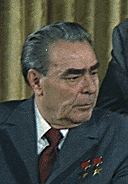 Immediately after the Second World War
, a period known as the Cold War began. It represented a period of conflict, tension and competition between the United States and the Soviet Union and their respective allies. Throughout the period, the rivalry between the two superpowers was played out in multiple arenas: military coalitions; ideology, psychology, and espionage; military, industrial, and technological developments, including the space race; costly defense spending; a massive conventional and nuclear arms race
; and many proxy wars.
The term "Cold War" was introduced in 1947 by Americans Bernard Baruch and Walter Lippmann to describe emerging tensions between the two former wartime allies. There never was a direct military engagement between the U.S. and the Soviet Union, but there was a half-century of military buildup, and political battles for support around the world, including significant involvement of allied and satellite nations. Although the U.S. and the Soviet Union had been allied against Nazi Germany, the two sides differed on how to reconstruct the postwar world even before the end of World War II. Over the following decades, the Cold War spread outside Europe to every region of the world, as the U.S. sought the "containment" of communism and forged numerous alliances to this end, particularly in Western Europe, the Middle East, and Southeast Asia.
In 1946, speaking at Westminster College in Fulton, Missouri
, former British prime minister
Winston Churchill
warned that, "From Stettin in the Baltic
to Trieste
in the Adriatic
, an iron curtain
has descended across the Continent."
In the months that followed, Josef Stalin continued to solidify a Soviet sphere of influence in eastern Europe. For example, Bulgaria
received its new Communist premier, Georgi Dimitrov
, in November 1946, a Communist government under Bolesław Bierut had been established in Poland already in 1945, and by 1947, Hungary and Romania
had also come under full communist rule. The last democratic government in the eastern bloc
, Czechoslovakia
, fell to a Communist coup in 1948, and in 1949 the Soviets raised their occupation zone in Germany to become the German Democratic Republic
under Walter Ulbricht
.
To coordinate their new empire, the Soviets established a number of international organizations, first the Cominform
to coordinate the policies of the various Communist parties, then the Council for Mutual Economic Assistance (COMECON), in 1948, to control economic planning, and finally (in response to the entry of the Federal Republic of Germany into the North Atlantic Treaty Organization) the Warsaw Pact
in 1955, which served as a military alliance against the west.
But one crack within that sphere of influence emerged after 1948, when Marshal Josip Broz Tito
became the president of Yugoslavia
. Initial disagreement was over the level of independence claimed by Tito as the only East European Communist ruler commanding a strong domestic majority. Later the gap widened when Tito's government initiated a system of decentralized profit-sharing workers' councils, in effect a self-governing, somewhat market-oriented socialism, which Stalin considered dangerously revisionist.
Stalin died in 1953. In the power struggle that followed Stalin's death, Nikita Khrushchev
emerged triumphant. In 1956, at the 20th Congress of the Communist Party of the Soviet Union, he denounced the "personality cult" that had surrounded Stalin in a speech entitled On the Personality Cult and its Consequences
. In the de-Stalinization
campaign that followed, all buildings and towns that had been named for him were renamed, pictures and statues were destroyed. Although in some respects Khrushchev was a reformer and allowed the emergence of a certain amount of intra-party dissent, his commitment to reform was thrown into doubt with the brutal use of military force on the civilian population of Hungary in 1956 during the Hungarian Revolution and the March 9 massacre in Tbilisi, 1956
.
By the late 1960s, the people of several eastern bloc countries had become discontented with the human and economic costs of the Soviet system, Czechoslovakia
especially so. As a result of the growing discontent, the Communist Party began to fear a popular uprising. They initiated reforms to attempt to save the regime, but eventually relied on help from the Stalinists in Russia. In 1968, Alexander Dubček
initiated what is known as the Prague Spring
, ending censorship
of the press and decentralizing production decisions, so that they were to be made not by central planners but by the workers and managers of the factories. People were to be allowed to travel abroad. Brezhnev reacted by announcing and enforcing what became known as the Brezhnev doctrine
:
In August 1968, pursuant to this announcement, Soviet troops occupied Czechoslovakia
. The following year, the Ukrainians responded to a campaign of passive disobedience on the part of the Czech populace by arranging the replacement of Dubček as first secretary. The new first secretary, Gustáv Husák
, would prove more compliant. He presided over a 'cleansing' of the Czech Communist Party and the introduction of a new constitution.
The early 1970s saw a period of détente
. The arms race
between the United States and the Soviet Union slackened. Brezhnev worked with US President Richard Nixon
to negotiate and implement the Strategic Arms Limitations Treaty
of 1972. Brezhnev also scored some diplomatic advances with the non-aligned
world, such as a 1971 friendship pact with India, and the close relations the Soviet Union enjoyed with several Arab
countries after Soviet material support in the Yom Kippur War
of 1973. After his death in 1982, Brezhnev was succeeded by Yuri Andropov
, who died in 1984, and then Konstantin Chernenko
, who died in 1985. Andropov's brief tenure as General Secretary indicated that he might have had reformist plans, and though Chernenko put them aside, Andropov had had time to groom a group of potential reformist successors, one of whom was Mikhail Gorbachev
.
It was also during Andropov's tenure and this period of generational turmoil that the rule of Communists next door, in Poland, came under challenge from Solidarność, or Solidarity, a labor union under the leadership of Lech Wałęsa
. The union was sufficiently threatening to the government that on 13 December 1981, the head of state, Wojciech Jaruzelski
declared martial law
, suspended the union, and imprisoned most of its leaders.
(1931-), who took control in 1985, was the first Soviet leader to have been born after the October revolution
. He is remembered for three initiatives: glasnost
, perestroika
, and the "Frank Sinatra doctrine
".
Glasnost, or "openness", was Gorbachev's term for allowing public debate in the Soviet Union to an unprecedented degree.
Perestroika was his term for market-oriented economic reforms, in recognition of the stagnating effects of central planning.
The "Frank Sinatra" doctrine was his reversal of the Brezhnev doctrine. Sinatra sang "My Way
", and the doctrine named for him was that each Warsaw Pact
country could find its own "way" of doing things.
Gorbachev also, in 1989, withdrew Soviet troops from their engagement in Afghanistan
, ten years after Brezhnev had sent them there. They had been fighting the anti-government Mujahideen
forces which since 1979 as part of its cold war strategy had been covertly funded and trained by the United States government through the Pakistani secret service known as Inter Services Intelligence (ISI).
By August 1991, anti-reform Communists in both the Party and the military were sufficiently desperate to attempt a military coup. Coup leaders called themselves the Committee on the State of Emergency. They announced that Gorbachev had been removed from his position as president due to illness.
Although the coup
rapidly collapsed and Gorbachev returned to Moscow, it was Boris Yeltsin
who had played a leading role in the street resistance to that Committee, and the incident marked a shift of power away from Gorbachev toward Yeltsin. By the end of that year, Yeltsin was the leader of Russia, and the Soviet Union was no more.
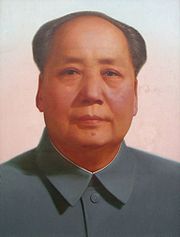 Through the Second World War
, the Chinese Communist Party (CCP) under the leadership of Mao Zedong
and the Nationalist
government of Chiang Kai-shek
lived in an uneasy truce in order to combat the common foe, the Japanese occupation.
Upon the Surrender of Japan
, the Chinese Civil War
immediately resumed. Another truce, negotiated by American general George C. Marshall early in 1946, collapsed after only three months.
While war raged in China, two post-occupation governments established themselves next door, in Korea
. In 1948, Syngman Rhee
was proclaimed president of the Republic of Korea, at Seoul
, while the Communist Workers Party of North Korea
in the north proclaimed the establishment of the Democratic People's Republic of Korea.
In January 1949, the Chinese Nationalist armies suffered a devastating defeat by the Communists at Tientsin. By spring, Chiang Kai-shek, now losing whole divisions by desertion to the Communists, began the removal of remaining forces to Formosa (Taiwan
). In August, U.S. aid to the Nationalists ended. In October, Mao Zedong took office as the Chairman of the Central People's Administrative Council of the People's Republic of China
in Beijing
. Zhou Enlai
was named premier and foreign minister of the new state.
The nascent People's Republic did not yet control all of the territory of the Republic of China. Mao declared it his goal in 1950 to "liberate" Hainan
, Tibet
, and Formosa
, and while he accomplished that of the first two, the third was interrupted: On 25 June 1950, the forces of North Korea
invaded the South unleashing the Korean War
. The United States Seventh Fleet
was summarily dispatched to protect Formosa from a mainland Chinese invasion. Although Mao was apparently unenthusiastic about that war, a Chinese volunteer force
entered the Korean War in November.
Claiming a victory against colonialism in the Korean War stalemate, the Communist government in China settled down to the consolidation of domestic power. During the 1950s, they redistributed land
, established the Anti-Rightist Movement
, and attempted mass industrialization, with technical assistance from the Soviet Union. By the mid-1950s, after an armistice in Korea and the surrender of French forces in Indochina, China's borders were secure. Mao's internal power base was likewise secured by the imprisonment of those he called "left-wing oppositionists".
As the 1950s ended, however, Mao became discontented with the status quo. On the one hand, he saw the Soviet Union attempting "peaceful co-existence" with the imperialist Western powers, and he believed China could be the center of worldwide revolution only by breaking with Moscow. On the other hand, he was dissatisfied with the economic consequences of the revolution thus far, and believed the country had to enter into a program of planned rapid industrialization known as the Great Leap Forward
.
The economic planning of the Great Leap period focused on steel because steel was considered emblematic of industry. The government arranged to have small backyard steel furnaces built in communes, in the hope that the mobilization of the entire populace would compensate for the absence of the usual economies of scale. During this period, Mao stepped down as head of state in favor of Liu Shaoqi
, but Mao remained Chairman of the Communist Party of China
.
The rushed program of industrialization was a disaster. It diverted labor and resources from agriculture to marginally productive cottage industry and so contributed to years of famine. It also caused a loss of Mao's influence upon the Communist Party and government apparatus. Modernizers such as Liu Shaoqi
and Deng Xiaoping
sought to relegate him to the status of figurehead.
Mao wasn't ready to be a figurehead. In the early 1960s he gathered around himself the so-called "Shanghai Mafia" consisting of his fourth wife, Jiang Qing
, as well as Lin Biao
, Chen Boda
, and Yao Wenyuan
, unleashing the Cultural Revolution
.
Chaos continued throughout China for three years, particularly due to the agitations of the Red Guards
until the CCP's ninth congress in 1969, when Lin Biao
emerged as the primary military figure, and the presumptive heir to Mao in the party. In the months that followed, Lin Biao restored domestic order, while diplomatic efforts by Zhou Enlai
cooled border tensions with the Soviet Union. Lin Biao died under mysterious circumstances in 1971.
Mao's final years saw a notable thaw in the People's Republic's relations with the United States, the period of "Ping Pong Diplomacy
".
Mao died in 1976, and almost immediately his ideological heirs, the Gang of Four lost a power struggle to more "pragmatic" figures such as Deng Xiaoping
. The term "pragmatic" is often used in media accounts of these factional struggles but should not be confused with the philosophy of pragmatism
proper.
Deng launched the "Beijing Spring
", allowing open criticism of the excesses and suffering that had occurred during the Cultural Revolution period. He also eliminated the class-background system, under which the communist regime had limited employment opportunities available to people deemed associated with the pre-revolutionary landlord class.
Although Deng's only official title in the early 1980s was chairman of the central military commission of the CP, he was widely regarded as the central figure in the nation's politics. In that period, Zhao Ziyang
became premier and Hu Yaobang
became head of the party.
Near the end of that decade, the death of Hu Yaobang sparked a mass demonstration
of mourning students in Tiananmen Square
, Beijing. The mourning soon turned into a call for greater responsiveness and liberalization, and the demonstration was captured live on cameras to be broadcast around the world. On May 30, 1989 students erected the "Goddess of Democracy
" statue, which looked a bit like Lady Liberty
in New York harbor.
On 4 June 1989 under the orders of Deng Xiaoping, troops and tanks of the People's Liberation Army ended the peaceful protest. Thousands were killed in the resultant massacre.
By the start of the 21st century, though, the leadership of China was embarked upon a program of market-based reform that was more sweeping than had been Soviet leader Gorbachev's perestroika program of the late 1980s, which is tracable to Deng's Socialism with Chinese characteristics.
It is in this context that Leo Melamed
, chairman emeritus and senior policy adviser to the Chicago Mercantile Exchange
, spoke to the 2003 Beijing Forum on China and East Asian Prospects of Financial Cooperation on September 23. He said that the CME applauds the National People's Congress for recognizing their country's need for additional trading in futures contract
s.
" aimed at creating greater equality, Latin American nations have seen a tide
of democratically elected socialist and centre-left governments emerge.
They have been elected in increasing numbers as the poor and middle classes of many countries have become increasingly disillusioned with the neo-liberal economic policies still encouraged by the United States and as a very large gap continues to exist between rich and poor, denying millions of people basic opportunities and necessities.
A long and controversial history of U.S. military and political intervention in the region dating back to the 19th century has severely tarnished the image of the United States in the eyes of many Latin Americans and shapes governments' policies to this day. A recent example of the influence of the aforementioned sentiment was The Latin American and Caribbean Congress in Solidarity with the Independence of Puerto Rico, an international summit held at Panama City
, Panama
, in which fifteen incumbent political parties (in government) requested that the United States "relinquish its colonial rule over said island-nation and recognize Puerto Rico's independence".
Chavez is joined by the democratic socialist president of Bolivia
, Evo Morales
(that nation's first indigenous leader), who has adopted strong reformist agendas and attracted overwhelming majority electoral victories. The democratically elected president of Ecuador
, Rafael Correa
is also an ally of Chavez. Correa describes himself as a humanist
, Christian of the left
and proponent of socialism of the 21st century
.
A number of centre-left/social democratic presidents have also come to power in Latin American countries recently promosing a greater redistribution of wealth within the framework of the free market
. They include Cristina Fernández de Kirchner
of Argentina
, Lula da Silva of Brazil, Michelle Bachelet
of Chile
, Tabaré Vázquez
of Uruguay
, Alan García of Peru
, Álvaro Colom
in Guatemala
and Fernando Lugo
of Paraguay
. The majority of these governments are still enjoying high approval ratings in their nation's public opinion polls. In Nicaragua
's 2006 elections the former Sandinista
President Daniel Ortega
was re-elected President after having been out of office since 1990.
In Colombia's previous presidential elections, Carlos Gaviria Díaz
of the socialist Alternative Democratic Pole
came in second place to Álvaro Uribe
of Colombia First
, a conservative party. While in Peru's previous presidential election Alan García's main challenger was Ollanta Humala
of the Union for Peru
, a leftwing Peruvian nationalist with close ties to Venezuelan President Hugo Chávez. The results of the 2006 Peruvian election were close. In El Salvador
, the FMLN a former leftwing guerrilla group which once fought against a military dictatorship is now the official opposition to the Salvadoran government.
Other parts of the Developing world have also seen a rise in radical socialist parties and movements. In Nepal
following the end of the Nepalese Civil War, the formerly militant Communist Party of Nepal (Maoist) and the more moderate Communist Party of Nepal (Unified Marxist-Leninist)
have emerged as the two most powerful opposition parties in the country. In Nepal's 2008 Constituent Assembly elections
the Maoists emerged as the largest party allowing them to form an interim government. Their leader, Prachanda
has vowed to respect multiparty democracy.
In some of the poorest parts of India, the Communist Party of India (Maoist)
has also been fighting a violent insurgency against the Indian government, a similar rebellion is being waged by the Maoist, New People's Army
in the Philippines
.
policies by social democratic parties has led to the rise of many new socialist parties running on solid left-wing agendas. They include Sinn Féin
in the Republic of Ireland
and Northern Ireland
(they also represent the Nationalist constituency of Northern Ireland), the The Left of Germany
, Left Party of Sweden
, New Zealand Progressive Party
, Socialist Party of Ireland, Socialist Party of the Netherlands, Respect Party of the United Kingdom, Scottish Socialist Party
and Quebec Solidaire
in the Canadian province of Quebec
.
Industrial Revolution
The Industrial Revolution was a period from the 18th to the 19th century where major changes in agriculture, manufacturing, mining, transportation, and technology had a profound effect on the social, economic and cultural conditions of the times...
, although it has precedents in earlier movements and ideas. The Communist Manifesto was written by Karl Marx
Karl Marx
Karl Heinrich Marx was a German philosopher, economist, sociologist, historian, journalist, and revolutionary socialist. His ideas played a significant role in the development of social science and the socialist political movement...
and Frederick Engels in 1848 just before the Revolutions of 1848
Revolutions of 1848
The European Revolutions of 1848, known in some countries as the Spring of Nations, Springtime of the Peoples or the Year of Revolution, were a series of political upheavals throughout Europe in 1848. It was the first Europe-wide collapse of traditional authority, but within a year reactionary...
swept Europe, expressing what they termed 'scientific socialism
Scientific Socialism
Scientific socialism is the term used by Friedrich Engels to describe the social-political-economic theory first pioneered by Karl Marx. The purported reason why this socialism is "scientific socialism" is because its theories are held to an empirical standard, observations are essential to its...
'. In the last third of the 19th century in Europe social democratic parties arose in Europe drawing mainly from Marxism. The Australian Labor Party
Australian Labor Party
The Australian Labor Party is an Australian political party. It has been the governing party of the Commonwealth of Australia since the 2007 federal election. Julia Gillard is the party's federal parliamentary leader and Prime Minister of Australia...
was the world's first elected socialist party when the party won the 1899 Queensland
Queensland
Queensland is a state of Australia, occupying the north-eastern section of the mainland continent. It is bordered by the Northern Territory, South Australia and New South Wales to the west, south-west and south respectively. To the east, Queensland is bordered by the Coral Sea and Pacific Ocean...
state election.
In the first half of the twentieth century the Soviet Union and the Communist parties
Communist party
A political party described as a Communist party includes those that advocate the application of the social principles of communism through a communist form of government...
of the Third International around the world mainly came to represent socialism in terms of the Soviet model of economic development
Economy of the Soviet Union
The economy of the Union of Soviet Socialist Republics was based on a system of state ownership of the means of production, collective farming, industrial manufacturing and centralized administrative planning...
, the creation of centrally planned economies
Planned economy
A planned economy is an economic system in which decisions regarding production and investment are embodied in a plan formulated by a central authority, usually by a government agency...
directed by a state that owns all the means of production, although other Trends condemned what they saw as the lack of a democracy. In 1946 Eurasian Socialist Parties in power were considerably socialist. administrations by some. In the UK Herbert Morrison
Herbert Morrison
Herbert Stanley Morrison, Baron Morrison of Lambeth, CH, PC was a British Labour politician; he held a various number of senior positions in the Cabinet, including Home Secretary, Foreign Secretary and Deputy Prime Minister.-Early life:Morrison was the son of a police constable and was born in...
said "Socialism is what the Labour government does", whereas Aneurin Bevan
Aneurin Bevan
Aneurin "Nye" Bevan was a British Labour Party politician who was the Deputy Leader of the Labour Party from 1959 until his death in 1960. The son of a coal miner, Bevan was a lifelong champion of social justice and the rights of working people...
argued that socialism requires that the "main streams of economic activity are brought under public direction", with an economic plan and workers' democracy. Some argued that capitalism had been abolished. Socialist governments established the 'mixed economy' with partial nationalisations and social welfare.
By 1968 the prolonged Vietnam War (1959–1975), gave rise to the New Left
New Left
The New Left was a term used mainly in the United Kingdom and United States in reference to activists, educators, agitators and others in the 1960s and 1970s who sought to implement a broad range of reforms, in contrast to earlier leftist or Marxist movements that had taken a more vanguardist...
, socialists who tended to be critical of the Soviet Union and social democracy. Anarcho-syndicalists and some elements of the New Left and others favored decentralized collective ownership in the form of cooperatives or workers' councils. At the turn of the 21st century, in Latin America Venezuelan President Hugo Chávez
Hugo Chávez
Hugo Rafael Chávez Frías is the 56th and current President of Venezuela, having held that position since 1999. He was formerly the leader of the Fifth Republic Movement political party from its foundation in 1997 until 2007, when he became the leader of the United Socialist Party of Venezuela...
championed what he termed 'Socialism of the 21st Century', which included a policy of nationalisation of national assets such as oil, anti-imperialism, and termed himself a Trotskyist supporting 'permanent revolution
Permanent Revolution
Permanent revolution is a term within Marxist theory, established in usage by Karl Marx and Friedrich Engels by at least 1850 but which has since become most closely associated with Leon Trotsky. The use of the term by different theorists is not identical...
'.
Origins of socialism
The appearance of the term "socialism" is variously attributed to Pierre LerouxPierre Leroux
Pierre Henri Leroux , French philosopher and political economist, was born at Bercy, now a part of Paris, the son of an artisan.- Life :...
in 1834, or to Marie Roch Louis Reybaud
Marie Roch Louis Reybaud
Marie Roch Louis Reybaud , French writer, political economist and politician, was born at Marseille.After travelling in the Levant and in India, he settled in Paris in 1829...
in France, or else in England to Robert Owen
Robert Owen
Robert Owen was a Welsh social reformer and one of the founders of utopian socialism and the cooperative movement.Owen's philosophy was based on three intellectual pillars:...
, who is considered the father of the cooperative movement.
The first modern socialists were early 19th century Western European social critics. In this period, socialism emerged from a diverse array of doctrines and social experiments associated primarily with British and French thinkers—especially Robert Owen
Robert Owen
Robert Owen was a Welsh social reformer and one of the founders of utopian socialism and the cooperative movement.Owen's philosophy was based on three intellectual pillars:...
, Charles Fourier
Charles Fourier
François Marie Charles Fourier was a French philosopher. An influential thinker, some of Fourier's social and moral views, held to be radical in his lifetime, have become main currents in modern society...
, Pierre-Joseph Proudhon
Pierre-Joseph Proudhon
Pierre-Joseph Proudhon was a French politician, mutualist philosopher and socialist. He was a member of the French Parliament, and he was the first person to call himself an "anarchist". He is considered among the most influential theorists and organisers of anarchism...
, Louis Blanc
Louis Blanc
Louis Jean Joseph Charles Blanc was a French politician and historian. A socialist who favored reforms, he called for the creation of cooperatives in order to guarantee employment for the urban poor....
, and Saint-Simon
Claude Henri de Rouvroy, comte de Saint-Simon
Claude Henri de Rouvroy, comte de Saint-Simon, often referred to as Henri de Saint-Simon was a French early socialist theorist whose thought influenced the foundations of various 19th century philosophies; perhaps most notably Marxism, positivism and the discipline of sociology...
. These social critics criticised the excesses of poverty and inequality of the Industrial Revolution
Industrial Revolution
The Industrial Revolution was a period from the 18th to the 19th century where major changes in agriculture, manufacturing, mining, transportation, and technology had a profound effect on the social, economic and cultural conditions of the times...
, and advocated reforms such as the egalitarian distribution of wealth and the transformation of society into small communities in which private property was to be abolished. Outlining principles for the reorganization of society along collectivist lines, Saint-Simon and Owen sought to build socialism on the foundations of planned, utopian communities. According to Sheldon Richman
Sheldon Richman
Sheldon Richman is an American political writer and academic, best known for his advocacy of libertarianism.He is the editor of The Freeman, a magazine published by The Foundation for Economic Education, a Senior Fellow at the Future of Freedom Foundation, a Research Fellow at The Independent...
, "[i]n the 19th and early 20th centuries, 'socialism' did not exclusively mean collective or government ownership of the means or production but was an umbrella term for anyone who believed labor was cheated out of its natural product under historical capitalism."
According to some accounts, the use of the words "socialism" or "communism" was related to the perceived attitude toward religion in a given culture. In Europe, "communism" was considered to be the more atheistic of the two. In England, however, that sounded too close to communion with Catholic overtones; hence atheists preferred to call themselves socialists.
Étienne Cabet
Étienne Cabet was a French philosopher and utopian socialist. He was the founder of the Icarian movement and led a group of emigrants to found a new society in the United States.-Biography:...
in France and Wilhelm Weitling
Wilhelm Weitling
Wilhelm Weitling was an important 19th-century European radical.Both praised and critiqued by disciples of the growing Marxist philosophy during the 19th century, Weitling was characterized as a "utopian socialist" by Karl Marx and Friedrich Engels, although Engels also referred to Weitling as the...
in Germany.
Henri de Saint-Simon
Henri de Saint-SimonClaude Henri de Rouvroy, comte de Saint-Simon
Claude Henri de Rouvroy, comte de Saint-Simon, often referred to as Henri de Saint-Simon was a French early socialist theorist whose thought influenced the foundations of various 19th century philosophies; perhaps most notably Marxism, positivism and the discipline of sociology...
, who is called the founder of French socialism, argued that a brotherhood of man must accompany the scientific organization of industry and society. He proposed that production and distribution be carried out by the state, and that allowing everyone to have equal opportunity to develop their talents would lead to social harmony, and the traditional state could be virtually eliminated, or transformed. "Rule over men would be replaced by the administration of things."
Charles Fourier
François Marie Charles FourierCharles Fourier
François Marie Charles Fourier was a French philosopher. An influential thinker, some of Fourier's social and moral views, held to be radical in his lifetime, have become main currents in modern society...
(7 April 1772 – 10 October 1837) was a French utopian socialist and philosopher. Fourier is credited by modern scholars with having originated the word féminisme
Feminism
Feminism is a collection of movements aimed at defining, establishing, and defending equal political, economic, and social rights and equal opportunities for women. Its concepts overlap with those of women's rights...
in 1837; as early as 1808, he had argued, in the Theory of the Four Movements, that the extension of the liberty of women was the general principle of all social progress, though he disdained any attachment to a discourse of 'equal rights'. Fourier inspired the founding of the communist community called La Reunion
La Reunion (Dallas)
La Réunion was a socialist utopian community formed in 1855 by French, Belgian, and Swiss colonists near the forks of the Trinity River in Texas, USA. The Reunion Tower in downtown Dallas is about three miles east of the colony site. The founders of the community were inspired by the utopian...
near present-day Dallas, Texas
Dallas, Texas
Dallas is the third-largest city in Texas and the ninth-largest in the United States. The Dallas-Fort Worth Metroplex is the largest metropolitan area in the South and fourth-largest metropolitan area in the United States...
as well as several other communities within the United States of America, such as the North American Phalanx
North American Phalanx
The North American Phalanx was a secular Utopian community located in Colts Neck Township, in Monmouth County, New Jersey. The NAP was based on the ideas of Charles Fourier, and lasted from 1843 to 1855-1856.- Fourier and founding the community :...
in New Jersey and Community Place
Community Place
Community Place, in Skaneateles, New York was built in 1830 and was listed on the National Register of Historic Places in 1979.It was a relatively successful Fourierist commune for three years.It is now known as Frog Pond....
and five others in New York State.
Robert Owen
Robert OwenRobert Owen
Robert Owen was a Welsh social reformer and one of the founders of utopian socialism and the cooperative movement.Owen's philosophy was based on three intellectual pillars:...
advocated the transformation of society into small, local collectives without such elaborate systems of social organization. Owen was a mill manager from 1800–1825. He transformed life in the village of New Lanark
New Lanark
New Lanark is a village on the River Clyde, approximately 1.4 miles from Lanark, in South Lanarkshire, Scotland. It was founded in 1786 by David Dale, who built cotton mills and housing for the mill workers. Dale built the mills there to take advantage of the water power provided by the river...
with ideas and opportunities which were at least a hundred years ahead of their time. Child labor and corporal punishment were abolished, and villagers were provided with decent homes, schools and evening classes, free health care, and affordable food.
The UK government's Factory Act of 1833 attempted to reduce the hours adults and children worked in the textile industry. A fifteen hour working day was to start at 5.30 a.m. and cease at 8.30 p.m. Children of nine to thirteen years could be worked no more than 9 hours, and those of a younger age were prohibited. There were, however, only four factory inspectors, and this law was broken by the factory owners. In the same year Owen stated:
In a Paper Dedicated to the Governments of Great Britain, Austria, Russia, France, Prussia and the United States of America written in 1841, Owen wrote: "The lowest stage of humanity is experienced when the individual must labor for a small pittance of wages from others."
Pierre-Joseph Proudhon
Pierre-Joseph ProudhonPierre-Joseph Proudhon
Pierre-Joseph Proudhon was a French politician, mutualist philosopher and socialist. He was a member of the French Parliament, and he was the first person to call himself an "anarchist". He is considered among the most influential theorists and organisers of anarchism...
pronounced that "Property is theft" and that socialism was "every aspiration towards the amelioration of society". Proudhon termed himself an anarchist and proposed that free association of individuals should replace the coercive state. Proudhon, Benjamin Tucker
Benjamin Tucker
Benjamin Ricketson Tucker was a proponent of American individualist anarchism in the 19th century, and editor and publisher of the individualist anarchist periodical Liberty.-Summary:Tucker says that he became an anarchist at the age of 18...
, and others developed these ideas in a free-market direction, while Mikhail Bakunin, Piotr Kropotkin, and others adapted Proudhon's ideas in a more conventionally socialist direction.
In a letter to Marx in 1846, Proudhon wrote:
Mikhail Bakunin
Mikhail BakuninMikhail Bakunin
Mikhail Alexandrovich Bakunin was a well-known Russian revolutionary and theorist of collectivist anarchism. He has also often been called the father of anarchist theory in general. Bakunin grew up near Moscow, where he moved to study philosophy and began to read the French Encyclopedists,...
, the father of modern anarchism, was a libertarian socialist, a theory by which the workers would directly manage the means of production through their own productive associations. There would be "equal means of subsistence, support, education, and opportunity for every child, boy or girl, until maturity, and equal resources and facilities in adulthood to create his own well-being by his own labor."
While many socialists emphasized the gradual transformation of society, most notably through the foundation of small, utopian communities, a growing number of socialists became disillusioned with the viability of this approach and instead emphasized direct political action. Early socialists were united, however, in their desire for a society based on cooperation rather than competition.
Marxism and the socialist movement
French Revolution
The French Revolution , sometimes distinguished as the 'Great French Revolution' , was a period of radical social and political upheaval in France and Europe. The absolute monarchy that had ruled France for centuries collapsed in three years...
of 1789, Karl Marx
Karl Marx
Karl Heinrich Marx was a German philosopher, economist, sociologist, historian, journalist, and revolutionary socialist. His ideas played a significant role in the development of social science and the socialist political movement...
and Frederick Engels wrote, "abolished feudal property in favour of bourgeois property". The French Revolution was preceded and influenced by the works of Jean-Jacques Rousseau
Jean-Jacques Rousseau
Jean-Jacques Rousseau was a Genevan philosopher, writer, and composer of 18th-century Romanticism. His political philosophy influenced the French Revolution as well as the overall development of modern political, sociological and educational thought.His novel Émile: or, On Education is a treatise...
, whose Social Contract famously began, "Man is born free, and he is everywhere in chains." Rousseau is credited with influencing socialist thought, but it was François-Noël Babeuf
François-Noël Babeuf
François-Noël Babeuf , known as Gracchus Babeuf , was a French political agitator and journalist of the Revolutionary period...
, and his Conspiracy of Equals, who is credited with providing a model for left-wing and communist movements of the 19th century.
Marx and Engels drew from these socialist or communist ideas born in the French revolution, as well as from the German philosophy of GWF Hegel, and English political economy, particularly that of Adam Smith
Adam Smith
Adam Smith was a Scottish social philosopher and a pioneer of political economy. One of the key figures of the Scottish Enlightenment, Smith is the author of The Theory of Moral Sentiments and An Inquiry into the Nature and Causes of the Wealth of Nations...
and David Ricardo
David Ricardo
David Ricardo was an English political economist, often credited with systematising economics, and was one of the most influential of the classical economists, along with Thomas Malthus, Adam Smith, and John Stuart Mill. He was also a member of Parliament, businessman, financier and speculator,...
. Marx and Engels developed a body of ideas which they called scientific socialism
Scientific Socialism
Scientific socialism is the term used by Friedrich Engels to describe the social-political-economic theory first pioneered by Karl Marx. The purported reason why this socialism is "scientific socialism" is because its theories are held to an empirical standard, observations are essential to its...
, more commonly called Marxism
Marxism
Marxism is an economic and sociopolitical worldview and method of socioeconomic inquiry that centers upon a materialist interpretation of history, a dialectical view of social change, and an analysis and critique of the development of capitalism. Marxism was pioneered in the early to mid 19th...
. Marxism comprised a theory of history (historical materialism
Historical materialism
Historical materialism is a methodological approach to the study of society, economics, and history, first articulated by Karl Marx as "the materialist conception of history". Historical materialism looks for the causes of developments and changes in human society in the means by which humans...
) as well as a political, economic and philosophical theory.
In the Manifesto of the Communist Party, written in 1848 just days before the outbreak of the revolutions of 1848
Revolutions of 1848
The European Revolutions of 1848, known in some countries as the Spring of Nations, Springtime of the Peoples or the Year of Revolution, were a series of political upheavals throughout Europe in 1848. It was the first Europe-wide collapse of traditional authority, but within a year reactionary...
, Marx and Engels wrote, "The distinguishing feature of Communism is not the abolition of property generally, but the abolition of bourgeois property." Unlike those Marx described as utopia
Utopia
Utopia is an ideal community or society possessing a perfect socio-politico-legal system. The word was imported from Greek by Sir Thomas More for his 1516 book Utopia, describing a fictional island in the Atlantic Ocean. The term has been used to describe both intentional communities that attempt...
n socialists, Marx determined that, "The history of all hitherto existing society is the history of class struggles". While utopian socialists believed it was possible to work within or reform capitalist society, Marx confronted the question of the economic and political power of the capitalist class, expressed in their ownership of the means of producing wealth (factories, banks, commerce - in a word, 'Capital'). Marx and Engels formulated theories regarding the practical way of achieving and running a socialist system, which they saw as only being achieved by those who produce the wealth in society, the toilers, workers or "proletariat", gaining common ownership of their workplaces, the means of producing wealth.
Marx believed that capitalism could only be overthrown by means of a revolution carried out by the working class: "The proletarian movement is the self-conscious, independent movement of the immense majority, in the interest of the immense majority." Marx believed that the proletariat was the only class with both the cohesion, the means and the determination to carry the revolution forward. Unlike the utopian socialists, who often idealised agrarian life and deplored the growth of modern industry, Marx saw the growth of capitalism and an urban proletariat as a necessary stage towards socialism.
For Marxists
Marxism
Marxism is an economic and sociopolitical worldview and method of socioeconomic inquiry that centers upon a materialist interpretation of history, a dialectical view of social change, and an analysis and critique of the development of capitalism. Marxism was pioneered in the early to mid 19th...
, socialism or, as Marx termed it, the first phase of communist society, can be viewed as a transitional stage characterized by common or state ownership of the means of production
Means of production
Means of production refers to physical, non-human inputs used in production—the factories, machines, and tools used to produce wealth — along with both infrastructural capital and natural capital. This includes the classical factors of production minus financial capital and minus human capital...
under democratic workers' control and management, which Engels argued was beginning to be realised in the Paris Commune
Paris Commune
The Paris Commune was a government that briefly ruled Paris from March 18 to May 28, 1871. It existed before the split between anarchists and Marxists had taken place, and it is hailed by both groups as the first assumption of power by the working class during the Industrial Revolution...
of 1871, before it was overthrown. Socialism to them is simply the transitional phase between capitalism
Capitalism
Capitalism is an economic system that became dominant in the Western world following the demise of feudalism. There is no consensus on the precise definition nor on how the term should be used as a historical category...
and "higher phase of communist society". Because this society has characteristics of both its capitalist ancestor and is beginning to show the properties of communism, it will hold the means of production collectively but distributes commodities according to individual contribution. When the socialist state (the dictatorship of the proletariat
Dictatorship of the proletariat
In Marxist socio-political thought, the dictatorship of the proletariat refers to a socialist state in which the proletariat, or the working class, have control of political power. The term, coined by Joseph Weydemeyer, was adopted by the founders of Marxism, Karl Marx and Friedrich Engels, in the...
) naturally withers away, what will remain is a society in which human beings no longer suffer from alienation and "all the springs of co-operative wealth flow more abundantly." Here "society inscribe[s] on its banners: From each according to his ability, to each according to his needs!" For Marx, a communist society entails the absence of differing social class
Social class
Social classes are economic or cultural arrangements of groups in society. Class is an essential object of analysis for sociologists, political scientists, economists, anthropologists and social historians. In the social sciences, social class is often discussed in terms of 'social stratification'...
es and thus the end of class warfare. According to Marx and Engels, once a socialist society had been ushered in, the state would begin to "wither away", and humanity would be in control of its own destiny for the first time.
International Workingmen's Association (First International)
The International Workingmen's AssociationInternational Workingmen's Association
The International Workingmen's Association , sometimes called the First International, was an international organization which aimed at uniting a variety of different left-wing socialist, communist and anarchist political groups and trade union organizations that were based on the working class...
(IWA), also known as the First International, was founded in London in 1864. Victor Le Lubez, a French radical republican living in London, invited Karl Marx
Karl Marx
Karl Heinrich Marx was a German philosopher, economist, sociologist, historian, journalist, and revolutionary socialist. His ideas played a significant role in the development of social science and the socialist political movement...
to come to London as a representative of German workers. The IWA held a preliminary conference in 1865, and had its first congress at Geneva
Geneva
Geneva In the national languages of Switzerland the city is known as Genf , Ginevra and Genevra is the second-most-populous city in Switzerland and is the most populous city of Romandie, the French-speaking part of Switzerland...
in 1866. Marx was appointed a member of the committee, and according to Saul Padover, Marx and Johann Georg Eccarius, a tailor living in London, became "the two mainstays of the International from its inception to its end". The First International became the first major international forum for the promulgation of socialist ideas.
The Social Democratic Workers' Party of Germany
Social Democratic Workers' Party of Germany
The Social Democratic Workers' Party of Germany, in German Sozialdemokratische Arbeiterpartei Deutschlands, SDAP, was a German left-wing political party founded on August 7/August 9, 1869 in Eisenach, Saxe-Weimar-Eisenach by, among others, Wilhelm Liebknecht and August Bebel...
was founded in 1869 under the influence of Marx and Engels. In 1875, it merged with the General German Workers' Association
General German Workers' Association
The General German Workers' Association, in German Allgemeiner Deutscher Arbeiterverein, ADAV) was founded on 23 May 1863 in Leipzig, Kingdom of Saxony by Ferdinand Lassalle and existed under this name until 1875, when it combined with August Bebel and Wilhelm Liebknecht's SDAP to form the...
of Ferdinand Lassalle
Ferdinand Lassalle
Ferdinand Lassalle was a German-Jewish jurist and socialist political activist.-Early life:Ferdinand Lassalle was born on 11 April 1825 in Breslau , Silesia to a prosperous Jewish family descending from Upper Silesian Loslau...
to become what is known today as the German Social Democratic Party (SPD). Socialism became increasingly associated with newly-formed trade union
Trade union
A trade union, trades union or labor union is an organization of workers that have banded together to achieve common goals such as better working conditions. The trade union, through its leadership, bargains with the employer on behalf of union members and negotiates labour contracts with...
s. In Germany, the SPD founded unions. In Austria, France and other European countries, socialist parties and anarchists
Anarchism
Anarchism is generally defined as the political philosophy which holds the state to be undesirable, unnecessary, and harmful, or alternatively as opposing authority in the conduct of human relations...
played a prominent role in forming and building up trade unions, especially from the 1870s onwards. This stood in contrast to the British experience, where moderate New Model Union
New Model Union
New Model Trade Unions were a variety of Trade Unions prominent in the 1850s and 1860s in the UK. The term was coined by Sidney and Beatrice Webb in their History of Trade Unionism , although later historians have questioned how far New Model Trade Unions represented a 'new wave' of unionism, as...
s dominated the union movement from the mid-nineteenth century, and where trade unionism was stronger than the political labour movement until the formation and growth of the Labour Party
Labour Party (UK)
The Labour Party is a centre-left democratic socialist party in the United Kingdom. It surpassed the Liberal Party in general elections during the early 1920s, forming minority governments under Ramsay MacDonald in 1924 and 1929-1931. The party was in a wartime coalition from 1940 to 1945, after...
in the early twentieth century.
Socialist groups supported diverse views of socialism, from the gradualism of many trade unionists to the radical, revolutionary theory of Marx and Engels. Anarchists and proponents of other alternative visions of socialism, who emphasized the potential of small-scale communities and agrarianism
Agrarianism
Agrarianism has two common meanings. The first meaning refers to a social philosophy or political philosophy which values rural society as superior to urban society, the independent farmer as superior to the paid worker, and sees farming as a way of life that can shape the ideal social values...
, coexisted with the more influential currents of Marxism and social democracy
Social democracy
Social democracy is a political ideology of the center-left on the political spectrum. Social democracy is officially a form of evolutionary reformist socialism. It supports class collaboration as the course to achieve socialism...
. The anarchists, led by the Russian Mikhail Bakunin
Mikhail Bakunin
Mikhail Alexandrovich Bakunin was a well-known Russian revolutionary and theorist of collectivist anarchism. He has also often been called the father of anarchist theory in general. Bakunin grew up near Moscow, where he moved to study philosophy and began to read the French Encyclopedists,...
, believed that capitalism
Capitalism
Capitalism is an economic system that became dominant in the Western world following the demise of feudalism. There is no consensus on the precise definition nor on how the term should be used as a historical category...
and the state
State (polity)
A state is an organized political community, living under a government. States may be sovereign and may enjoy a monopoly on the legal initiation of force and are not dependent on, or subject to any other power or state. Many states are federated states which participate in a federal union...
were inseparable, and that one could not be abolished without the other.
Paris Commune
In 1871, in the wake of the Franco-Prussian WarFranco-Prussian War
The Franco-Prussian War or Franco-German War, often referred to in France as the 1870 War was a conflict between the Second French Empire and the Kingdom of Prussia. Prussia was aided by the North German Confederation, of which it was a member, and the South German states of Baden, Württemberg and...
, an uprising in Paris established the Paris Commune
Paris Commune
The Paris Commune was a government that briefly ruled Paris from March 18 to May 28, 1871. It existed before the split between anarchists and Marxists had taken place, and it is hailed by both groups as the first assumption of power by the working class during the Industrial Revolution...
. According to Marx and Engels, for a few weeks the Paris Commune provided a glimpse of a socialist society, before it was brutally suppressed by the French government.
In Paris Commune, large-scale industry was to be "based on the association of the workers" joined into "one great union", all posts in government were elected by universal franchise, elected officials took only the average worker's wage and were subject to recall. For Engels, this was what the dictatorship of the proletariat
Dictatorship of the proletariat
In Marxist socio-political thought, the dictatorship of the proletariat refers to a socialist state in which the proletariat, or the working class, have control of political power. The term, coined by Joseph Weydemeyer, was adopted by the founders of Marxism, Karl Marx and Friedrich Engels, in the...
looked like (as opposed to the "dictatorship of the bourgeoisie", which was capitalism). Engels goes on to state: "In reality, however, the state is nothing but a machine for the oppression of one class by another, and indeed in the democratic republic no less than in the monarchy; and at best an evil inherited by the proletariat after its victorious struggle for class supremacy", and a new generation of socialists, "reared in new and free social conditions, will be able to throw the entire lumber of the state on the scrap-heap".
After the Paris Commune, the differences between supporters of Marx and Engels and those of Bakunin were too great to bridge. The anarchist section of the First International was expelled from the International at the 1872 Hague Congress
Hague Congress (1872)
The Hague Congress was the Fifth congress of the International Workingmen's Association held in in The Hague, Holland, which anarchists consider as null and void....
and they went on to form the Jura federation
Jura federation
The Jura Federation was the federalist and anarchist section of the International Workingmen's Association , based largely among watch-makers in the Jura mountain range in Switzerland. The Jura federation was founded on October 9, 1870 at a meeting in Saint-Imier of local sections of the IWA...
. The First International was disbanded in 1876.
The Second International
As the ideas of Marx and Engels took on flesh, particularly in central Europe, socialists sought to unite in an international organisation. In 1889, on the centennial of the French Revolution of 1789, the Second International was founded, with 384 delegates from 20 countries representing about 300 labour and socialist organizations. It was termed the "Socialist International" and Engels was elected honorary president at the third congress in 1893.Just before his death in 1895, Engels argued that there was now a "single generally recognised, crystal clear theory of Marx" and a "single great international army of socialists". Despite its illegality due to the Anti-Socialist Laws
Anti-Socialist Laws
The Anti-Socialist Laws or Socialist Laws were a series of acts, the first of which was passed on October 19, 1878 by the German Reichstag lasting till March 31, 1881, and extended 4 times...
of 1878, the Social Democratic Party of Germany
Social Democratic Party of Germany
The Social Democratic Party of Germany is a social-democratic political party in Germany...
's use of the limited universal male suffrage were "potent" new methods of struggle which demonstrated their growing strength and forced the dropping of the Anti-Socialist legislation in 1890, Engels argued. In 1893, the German SPD obtained 1,787,000 votes, a quarter of votes cast. However before the leadership of the SPD published Engels' 1895 Introduction to Marx's Class Struggles in France 1848–1850, they removed certain phrases they felt were too revolutionary.
Marx believed that it was possible to have a peaceful socialist transformation in England, although the British ruling class would then revolt against such a victory. America and Holland might also have a peaceful transformation, but not in France, where Marx believed there had been "perfected... an enormous bureaucratic and military organisation, with its ingenious state machinery" which must be forcibly overthrown. However, eight years after Marx's death, Engels argued that it was possible to achieve a peaceful socialist revolution in France, too.
Germany
The SPD was by far the most powerful of the social democratic parties. Its votes reached 4.5 million, it had 90 daily newspapers, together with trade unions and co-ops, sports clubs, a youth organization, a women's organization and hundreds of full time officials. Under the pressure of this growing party, BismarckOtto von Bismarck
Otto Eduard Leopold, Prince of Bismarck, Duke of Lauenburg , simply known as Otto von Bismarck, was a Prussian-German statesman whose actions unified Germany, made it a major player in world affairs, and created a balance of power that kept Europe at peace after 1871.As Minister President of...
introduced limited welfare provision and working hours were reduced. Germany experienced sustained economic growth for more than forty years. Commentators suggest that this expansion, together with the concessions won, gave rise to illusions amongst the leadership of the SPD that capitalism would evolve into socialism gradually.
Beginning in 1896, in a series of articles published under the title "Problems of socialism", Eduard Bernstein
Eduard Bernstein
Eduard Bernstein was a German social democratic theoretician and politician, a member of the SPD, and the founder of evolutionary socialism and revisionism.- Life :...
argued that an evolutionary transition to socialism was both possible and more desirable than revolutionary change. Bernstein and his supporters came to be identified as "revisionists" because they sought to revise the classic tenets of Marxism
Classical Marxism
Classical Marxism refers to the social theory expounded by Karl Marx and Friedrich Engels, as contrasted with later developments in Marxism.-Karl Marx:...
. Although the orthodox Marxists
Orthodox Marxism
Orthodox Marxism is the term used to describe the version of Marxism which emerged after the death of Karl Marx and acted as the official philosophy of the Second International up to the First World War and of the Third International thereafter...
in the party, led by Karl Kautsky
Karl Kautsky
Karl Johann Kautsky was a Czech-German philosopher, journalist, and Marxist theoretician. Kautsky was recognized as among the most authoritative promulgators of Orthodox Marxism after the death of Friedrich Engels in 1895 until the coming of World War I in 1914 and was called by some the "Pope of...
, retained the Marxist theory of revolution as the official doctrine of the party, and it was repeatedly endorsed by SPD conferences, in practice the SPD leadership became increasingly reformist.
Russia
Bernstein coined the aphorism: "The movement is everything, the final goal nothing". But the path of reform appeared blocked to the Russian Marxists while Russia remained the bulwark of reaction. In the preface to the 1882 Russian edition to the Communist Manifesto, Marx and Engels had saluted the Russian Marxists who, they said, "formed the vanguard of revolutionary action in Europe". But the working class, although many were organised in vast modern western-owned enterprises, comprised no more than a small percentage of the population and "more than half the land is owned in common by the peasants". Marx and Engels posed the question: How was Russia to progress to socialism? Could Russia "pass directly" to socialism or "must it first pass through the same process" of capitalist development as the West? They replied: "If the Russian Revolution becomes the signal for a proletarian revolutionProletarian revolution
A proletarian revolution is a social and/or political revolution in which the working class attempts to overthrow the bourgeoisie. Proletarian revolutions are generally advocated by socialists, communists, and most anarchists....
in the West, so that both complement each other, the present Russian common ownership of land may serve as the starting point for a communist development."
In 1903, the Russian Social Democratic Labour Party
Russian Social Democratic Labour Party
The Russian Social Democratic Labour Party , also known as Russian Social Democratic Workers' Party or Russian Social Democratic Party, was a revolutionary socialist Russian political party formed in 1898 in Minsk to unite the various revolutionary organizations into one party...
began to split on ideological and organizational questions into Bolshevik
Bolshevik
The Bolsheviks, originally also Bolshevists , derived from bol'shinstvo, "majority") were a faction of the Marxist Russian Social Democratic Labour Party which split apart from the Menshevik faction at the Second Party Congress in 1903....
('Majority') and Menshevik
Menshevik
The Mensheviks were a faction of the Russian revolutionary movement that emerged in 1904 after a dispute between Vladimir Lenin and Julius Martov, both members of the Russian Social-Democratic Labour Party. The dispute originated at the Second Congress of that party, ostensibly over minor issues...
('Minority') factions, with Russian revolutionary Vladimir Lenin
Vladimir Lenin
Vladimir Ilyich Lenin was a Russian Marxist revolutionary and communist politician who led the October Revolution of 1917. As leader of the Bolsheviks, he headed the Soviet state during its initial years , as it fought to establish control of Russia in the Russian Civil War and worked to create a...
leading the more radical Bolsheviks. Both wings accepted that Russia was an economically backward country unripe for socialism. The Mensheviks awaited the capitalist revolution in Russia. But Lenin argued that a revolution of the workers and peasants would achieve this task. After the Russian revolution of 1905, Leon Trotsky
Leon Trotsky
Leon Trotsky , born Lev Davidovich Bronshtein, was a Russian Marxist revolutionary and theorist, Soviet politician, and the founder and first leader of the Red Army....
argued that unlike the French revolution of 1789 and the European Revolutions of 1848
Revolutions of 1848
The European Revolutions of 1848, known in some countries as the Spring of Nations, Springtime of the Peoples or the Year of Revolution, were a series of political upheavals throughout Europe in 1848. It was the first Europe-wide collapse of traditional authority, but within a year reactionary...
against absolutism, the capitalist class would never organise a revolution in Russia to overthrow absolutism, and that this task fell to the working class who, liberating the peasantry from their feudal yoke, would then immediately pass on to the socialist tasks and seek a "permanent revolution" to achieve international socialism. Assyrian nationalist Freydun Atturaya
Freydun Atturaya
Freydun Bet-Abram Atturaya was an Assyrian physician born in the town of Charbash in the district of Urmia in Iran. He was sent by his father to live with an uncle in Tbilisi, then in the Russian Empire, and studied medicine there. He worked as a medical doctor for the Russian Army as soon as he...
tried to create regional self-government for the Assyrian people
Assyrian people
The Assyrian people are a distinct ethnic group whose origins lie in ancient Mesopotamia...
with the socialism ideology. He even wrote the Urmia Manifesto of the United Free Assyria
Urmia Manifesto of the United Free Assyria
Urmia Manifesto of the United Free Assyria was written by Assyrian nationalist Freydun Atturaya, in his struggle for Assyrian independence during and after World War I. It was written in Syriac and completed in April 1917. Its ideology was Marxism, and it supported self regional independence for...
. However, his attempt was put to an end by Russia.
United States
In 1877, the Socialist Labor Party of AmericaSocialist Labor Party of America
The Socialist Labor Party of America , established in 1876 as the Workingmen's Party, is the oldest socialist political party in the United States and the second oldest socialist party in the world. Originally known as the Workingmen's Party of America, the party changed its name in 1877 and has...
was founded. This party, which advocated Marxism and still exists today, was a confederation of small Marxist parties and came under the leadership of Daniel De Leon
Daniel De Leon
Daniel DeLeon was an American socialist newspaper editor, politician, Marxist theoretician, and trade union organizer. He is regarded as the forefather of the idea of revolutionary industrial unionism and was the leading figure in the Socialist Labor Party of America from 1890 until the time of...
. In 1901, a merger between opponents of De Leon and the younger Social Democratic Party
Social Democratic Party (United States)
The Social Democratic Party of America was a short-lived political party in the United States, established in 1898. The group was formed out of elements of the Social Democracy of America , and was a predecessor to the Socialist Party of America, established in 1901.-Forerunners:Following the...
joined with Eugene V. Debs
Eugene V. Debs
Eugene Victor Debs was an American union leader, one of the founding members of the International Labor Union and the Industrial Workers of the World , and several times the candidate of the Socialist Party of America for President of the United States...
to form the Socialist Party of America
Socialist Party of America
The Socialist Party of America was a multi-tendency democratic-socialist political party in the United States, formed in 1901 by a merger between the three-year-old Social Democratic Party of America and disaffected elements of the Socialist Labor Party which had split from the main organization...
.
In 1905, the Industrial Workers of the World
Industrial Workers of the World
The Industrial Workers of the World is an international union. At its peak in 1923, the organization claimed some 100,000 members in good standing, and could marshal the support of perhaps 300,000 workers. Its membership declined dramatically after a 1924 split brought on by internal conflict...
formed from several independent labor unions. The IWW opposed the political means of Debs and De Leon, as well as the craft unionism of Samuel Gompers
Samuel Gompers
Samuel Gompers was an English-born American cigar maker who became a labor union leader and a key figure in American labor history. Gompers founded the American Federation of Labor , and served as that organization's president from 1886 to 1894 and from 1895 until his death in 1924...
. In 1910, the Sewer Socialists, the main group of American socialists, elected Victor Berger as a socialist Congressman and Emil Seidel
Emil Seidel
Emil Seidel was the mayor of Milwaukee from 1910 to 1912. He was the first Socialist mayor of a major city in the United States, and ran as the Vice Presidential candidate for the Socialist Party of America in the 1912 presidential election....
as a socialist mayor of Milwaukee, Wisconsin
Milwaukee, Wisconsin
Milwaukee is the largest city in the U.S. state of Wisconsin, the 28th most populous city in the United States and 39th most populous region in the United States. It is the county seat of Milwaukee County and is located on the southwestern shore of Lake Michigan. According to 2010 census data, the...
, most of the other elected city officials being socialist as well. This Socialist Party of America grew to 150,000 in 1912 and polled 897,000 votes in the presidential campaign of that year, 6 percent of the total vote. Socialist mayor Daniel Hoan
Daniel Hoan
Daniel Webster "Dan" Hoan was a United States lawyer and politician. He became the second Socialist mayor of Milwaukee, Wisconsin, and his tenure is generally considered to be the longest continuous socialist administration in U.S. history...
, was elected in 1916 and stayed in office until 1940. The final Socialist mayor, Frank P. Zeidler
Frank P. Zeidler
Frank Paul Zeidler was an American Socialist politician and Mayor of Milwaukee, Wisconsin, serving three terms from April 20, 1948 to April 18, 1960. He was the most recent Socialist mayor of any major American city, although U.S. Senator Bernie Sanders was the mayor of Burlington, the largest...
, was elected in 1948 and served three terms, ending in 1960. Milwaukee remained the hub of Socialism during these years. The Socialist Party declined after the First World War.
France
French socialism was beheaded by the suppression of the Paris communeParis Commune
The Paris Commune was a government that briefly ruled Paris from March 18 to May 28, 1871. It existed before the split between anarchists and Marxists had taken place, and it is hailed by both groups as the first assumption of power by the working class during the Industrial Revolution...
(1871), its leaders killed or exiled. But in 1879, at the Marseille Congress, workers' associations created the Federation of the Socialist Workers of France
Federation of the Socialist Workers of France
France's first socialist party, the Federation of the Socialist Workers of France , was founded in 1879. It was characterised as "possibilist" because it promoted gradual reforms.-Formation:...
. Three years later, Jules Guesde
Jules Guesde
Jules Basile Guesde was a French socialist journalist and politician.Guesde was the inspiration for a famous quotation by Karl Marx. Shortly before Marx died in 1883, he wrote a letter to Guesde and Paul Lafargue, both of whom already claimed to represent "Marxist" principles...
and Paul Lafargue
Paul Lafargue
Paul Lafargue was a French revolutionary Marxist socialist journalist, literary critic, political writer and activist; he was Karl Marx's son-in-law, having married his second daughter Laura. His best known work is The Right to Be Lazy...
, the son-in-law of Karl Marx
Karl Marx
Karl Heinrich Marx was a German philosopher, economist, sociologist, historian, journalist, and revolutionary socialist. His ideas played a significant role in the development of social science and the socialist political movement...
, left the federation and founded the French Workers' Party
French Workers' Party
The Parti Ouvrier Français was the first Marxist party in France, created in 1880 by Jules Guesde and Paul Lafargue, Marx's son-in-law...
.
The Federation of the Socialist Workers of France was termed "possibilist" because it advocated gradual reforms, whereas the French Workers' Party promoted Marxism. In 1905 these two trends merged to form the French Section Française de l'Internationale Ouvrière
Section française de l'Internationale ouvrière
The French Section of the Workers' International , founded in 1905, was a French socialist political party, designed as the local section of the Second International...
(SFIO), led by Jean Jaurès
Jean Jaurès
Jean Léon Jaurès was a French Socialist leader. Initially an Opportunist Republican, he evolved into one of the first social democrats, becoming the leader, in 1902, of the French Socialist Party, which opposed Jules Guesde's revolutionary Socialist Party of France. Both parties merged in 1905 in...
and later Léon Blum
Léon Blum
André Léon Blum was a French politician, usually identified with the moderate left, and three times the Prime Minister of France.-First political experiences:...
. In 1906 it won 56 seats in Parliament. The SFIO adhered to Marxist ideas but became, in practice, a reformist party. By 1914 it had more than 100 members in the Chamber of Deputies.
World War I
When World War I began in 1914, many European socialist leaders supported their respective governments' war aims. The social democratic parties in the UK, France, Belgium and Germany supported their respective state's wartime military and economic planning, discarding their commitment to internationalismProletarian internationalism
Proletarian internationalism, sometimes referred to as international socialism, is a Marxist social class concept based on the view that capitalism is now a global system, and therefore the working class must act as a global class if it is to defeat it...
and solidarity.
Lenin, however, denounced the war as an imperialist conflict, and urged workers worldwide to use it as an occasion for proletarian revolution. The Second International dissolved during the war, while Lenin, Trotsky, Karl Liebknecht
Karl Liebknecht
was a German socialist and a co-founder with Rosa Luxemburg of the Spartacist League and the Communist Party of Germany. He is best known for his opposition to World War I in the Reichstag and his role in the Spartacist uprising of 1919...
and Rosa Luxemburg
Rosa Luxemburg
Rosa Luxemburg was a Marxist theorist, philosopher, economist and activist of Polish Jewish descent who became a naturalized German citizen...
, together with a small number of other Marxists opposed to the war, came together in the Zimmerwald Conference
Zimmerwald Conference
The Zimmerwald Conference was held in Zimmerwald, Switzerland, from September 5 through September 8, 1915. It was an international socialist conference, which saw the beginning of the end of the coalition between revolutionary socialists and reformist socialists in the Second International.-...
in September 1915.
Anarchism
AnarchismAnarchism
Anarchism is generally defined as the political philosophy which holds the state to be undesirable, unnecessary, and harmful, or alternatively as opposing authority in the conduct of human relations...
as a social movement
Social movement
Social movements are a type of group action. They are large informal groupings of individuals or organizations focused on specific political or social issues, in other words, on carrying out, resisting or undoing a social change....
has regularly endured fluctuations in popularity. Its classical period, which scholars demarcate as from 1860 to 1939, is associated with the working-class movements of the 19th century and the Spanish Civil War
Spanish Civil War
The Spanish Civil WarAlso known as The Crusade among Nationalists, the Fourth Carlist War among Carlists, and The Rebellion or Uprising among Republicans. was a major conflict fought in Spain from 17 July 1936 to 1 April 1939...
-era struggles against fascism
Fascism
Fascism is a radical authoritarian nationalist political ideology. Fascists seek to rejuvenate their nation based on commitment to the national community as an organic entity, in which individuals are bound together in national identity by suprapersonal connections of ancestry, culture, and blood...
.
International Workingmen's Association
The International Workingmen's Association , sometimes called the First International, was an international organization which aimed at uniting a variety of different left-wing socialist, communist and anarchist political groups and trade union organizations that were based on the working class...
(sometimes called the "First International") united diverse revolutionary currents including French followers of Proudhon
Pierre-Joseph Proudhon
Pierre-Joseph Proudhon was a French politician, mutualist philosopher and socialist. He was a member of the French Parliament, and he was the first person to call himself an "anarchist". He is considered among the most influential theorists and organisers of anarchism...
, Blanquists
Blanquism
In left-wing discourse, Blanquism refers to a conception of revolution generally attributed to Louis Auguste Blanqui which holds that socialist revolution should be carried out by a relatively small group of highly organised and secretive conspirators. Having taken power, the revolutionaries would...
, Philadelphes
Philadelphes
The Philadelphes was an irregular masonic lodge founded in France in the 1750s and which became a centre for conspiratorial revolutionary activity...
, English trade unionists, socialists and social democrats. Proudhon's followers, the mutualists
Mutualism (economic theory)
Mutualism is an anarchist school of thought that originates in the writings of Pierre-Joseph Proudhon, who envisioned a society where each person might possess a means of production, either individually or collectively, with trade representing equivalent amounts of labor in the free market...
, opposed Marx's state socialism
State socialism
State socialism is an economic system with limited socialist characteristics, such as public ownership of major industries, remedial measures to benefit the working class, and a gradual process of developing socialism through government policy...
, advocating political abstentionism
Abstentionism
Abstentionism is standing for election to a deliberative assembly while refusing to take up any seats won or otherwise participate in the assembly's business. Abstentionism differs from an election boycott in that abstentionists participate in the election itself...
and small property holdings.
The anti-authoritarian sections of the First International were the precursors of the anarcho-syndicalists, seeking to "replace the privilege and authority of the State" with the "free and spontaneous organization of labor."
In 1907, the International Anarchist Congress of Amsterdam
International Anarchist Congress of Amsterdam
The International Anarchist Congress of Amsterdam took place from 24 August to 31 August 1907. It gathered delegates from 14 different countries, among which important figures of the anarchist movement, including Errico Malatesta, Luigi Fabbri, Benoît Broutchoux, Pierre Monatte, Amédée Dunois, Emma...
gathered delegates from 14 different countries, among which important figures of the anarchist movement, including Errico Malatesta
Errico Malatesta
Errico Malatesta was an Italian anarcho-communist. He was an insurrectionary anarchist early in his life. He spent much of his life exiled from his homeland of Italy and in total spent more than ten years in prison. He wrote and edited a number of radical newspapers and was also a friend of...
, Pierre Monatte
Pierre Monatte
Pierre Monatte was a French trade unionist who worked in the printing industry . He was the responsible of the Confédération générale du travail at the beginning of the 20th century, and founded its journal La Vie ouvrière on 5 October 1909...
, Luigi Fabbri
Luigi Fabbri
Luigi Fabbri , was an Italian anarchist, writer, agitator and propagandist who was charged with defeatism during the World War I. He was the father of Luce Fabbri....
, Benoît Broutchoux
Benoît Broutchoux
Benedict Broutchoux was a French anarchist opposed to the reformist Emile Basly during a strike in the north of France, in 1902.- Biography :...
, Emma Goldman
Emma Goldman
Emma Goldman was an anarchist known for her political activism, writing and speeches. She played a pivotal role in the development of anarchist political philosophy in North America and Europe in the first half of the twentieth century....
, Rudolf Rocker
Rudolf Rocker
Johann Rudolf Rocker was an anarcho-syndicalist writer and activist. A self-professed anarchist without adjectives, Rocker believed that anarchist schools of thought represented "only different methods of economy" and that the first objective for anarchists was "to secure the personal and social...
, and Christiaan Cornelissen
Christiaan Cornelissen
Christiaan Gerardus Cornelissen was a Dutch syndicalist writer, economist, and trade unionist.Cornelissen was the second of five children of Johannes Cornelissen, carpenter in Den Bosch, Noord Brabant, and Mechelina van Wijk. He became a primary school teacher in Middelburg, Zeeland...
. Various themes were treated during the Congress, in particular concerning the organisation of the anarchist movement, popular education
Popular education
Popular education is a concept grounded in notions of class, political struggle, and social transformation. The term is a translation from the Spanish educación popular or the Portuguese educação popular and rather than the English usage as when describing a 'popular television program,' popular...
issues, the general strike
General strike
A general strike is a strike action by a critical mass of the labour force in a city, region, or country. While a general strike can be for political goals, economic goals, or both, it tends to gain its momentum from the ideological or class sympathies of the participants...
or antimilitarism
Antimilitarism
Antimilitarism is a doctrine commonly found in the anarchist and, more globally, in the socialist movement, which may both be characterized as internationalist movements. It relies heavily on a critical theory of nationalism and imperialism, and was an explicit goal of the First and Second...
. A central debate concerned the relation between anarchism and syndicalism
Syndicalism
Syndicalism is a type of economic system proposed as a replacement for capitalism and an alternative to state socialism, which uses federations of collectivised trade unions or industrial unions...
(or trade union
Trade union
A trade union, trades union or labor union is an organization of workers that have banded together to achieve common goals such as better working conditions. The trade union, through its leadership, bargains with the employer on behalf of union members and negotiates labour contracts with...
ism). The Spanish Workers Federation
Federación Anarquista Ibérica
The Federación Anarquista Ibérica is a Spanish organization of anarchist militants active within affinity groups inside the Confederación Nacional del Trabajo trade union. It is often abbreviated as CNT-FAI because of the close relationship between the two organizations...
in 1881 was the first major anarcho-syndicalist movement; anarchist trade union federations were of special importance in Spain. The most successful was the Confederación Nacional del Trabajo
Confederación Nacional del Trabajo
The Confederación Nacional del Trabajo is a Spanish confederation of anarcho-syndicalist labor unions affiliated with the International Workers Association . When working with the latter group it is also known as CNT-AIT...
(National Confederation of Labour: CNT), founded in 1910. Before the 1940s, the CNT was the major force in Spanish working class politics, attracting 1.58 million members at one point and playing a major role in the Spanish Civil War
Spanish Civil War
The Spanish Civil WarAlso known as The Crusade among Nationalists, the Fourth Carlist War among Carlists, and The Rebellion or Uprising among Republicans. was a major conflict fought in Spain from 17 July 1936 to 1 April 1939...
. The CNT was affiliated with the International Workers Association, a federation of anarcho-syndicalist trade unions founded in 1922, with delegates representing two million workers from 15 countries in Europe and Latin America.
Some anarchists, such as Johann Most
Johann Most
Johann Joseph Most was a German-American politician, newspaper editor, and orator. He is credited with popularizing the concept of "Propaganda of the deed". His grandson was Boston Celtics radio play-by-play man Johnny Most...
, advocated publicizing violent acts of retaliation against counter-revolutionaries because "we preach not only action in and for itself, but also action as propaganda." Numerous heads of state were assassinated between 1881 and 1914 by members of the anarchist movement. For example, U.S. President McKinley
William McKinley
William McKinley, Jr. was the 25th President of the United States . He is best known for winning fiercely fought elections, while supporting the gold standard and high tariffs; he succeeded in forging a Republican coalition that for the most part dominated national politics until the 1930s...
's assassin Leon Czolgosz
Leon Czolgosz
Leon Czolgosz was the assassin of U.S. President William McKinley.In the last few years of his life, he claimed to have been heavily influenced by anarchists such as Emma Goldman and Alexander Berkman.- Early life :...
claimed to have been influenced by anarchist and feminist Emma Goldman
Emma Goldman
Emma Goldman was an anarchist known for her political activism, writing and speeches. She played a pivotal role in the development of anarchist political philosophy in North America and Europe in the first half of the twentieth century....
.
Anarchists participated alongside the Bolshevik
Bolshevik
The Bolsheviks, originally also Bolshevists , derived from bol'shinstvo, "majority") were a faction of the Marxist Russian Social Democratic Labour Party which split apart from the Menshevik faction at the Second Party Congress in 1903....
s in both February
February Revolution
The February Revolution of 1917 was the first of two revolutions in Russia in 1917. Centered around the then capital Petrograd in March . Its immediate result was the abdication of Tsar Nicholas II, the end of the Romanov dynasty, and the end of the Russian Empire...
and October revolutions
October Revolution
The October Revolution , also known as the Great October Socialist Revolution , Red October, the October Uprising or the Bolshevik Revolution, was a political revolution and a part of the Russian Revolution of 1917...
, and were initially enthusiastic about the Bolshevik coup. However, the Bolsheviks soon turned against the anarchists and other left-wing opposition, a conflict that culminated in the 1921 Kronstadt rebellion
Kronstadt rebellion
The Kronstadt rebellion was one of many major unsuccessful left-wing uprisings against the Bolsheviks in the aftermath of the Russian Civil War...
which the new government repressed. Anarchists in central Russia were either imprisoned, driven underground or joined the victorious Bolsheviks; the anarchists from Petrograd and Moscow fled to the Ukraine
Ukraine
Ukraine is a country in Eastern Europe. It has an area of 603,628 km², making it the second largest contiguous country on the European continent, after Russia...
. There, in the Free Territory
Free Territory (Ukraine)
The Free Territory , , svobodnaya territoriya; or Makhnovia was a territory of operation by free soviets and libertarian communes under the protection of the Revolutionary Insurrectionary Army of Nestor Makhno where an attempt was made to form a stateless anarchist society in part of the...
, they fought in the civil war
Russian Civil War
The Russian Civil War was a multi-party war that occurred within the former Russian Empire after the Russian provisional government collapsed to the Soviets, under the domination of the Bolshevik party. Soviet forces first assumed power in Petrograd The Russian Civil War (1917–1923) was a...
against the Whites
White movement
The White movement and its military arm the White Army - known as the White Guard or the Whites - was a loose confederation of Anti-Communist forces.The movement comprised one of the politico-military Russian forces who fought...
(a Western-backed grouping of monarchists and other opponents of the October Revolution) and then the Bolsheviks as part of the Revolutionary Insurrectionary Army of Ukraine
Revolutionary Insurrectionary Army of Ukraine
The Revolutionary Insurrectionary Army of Ukraine , popularly called Makhnovshchina, less correctly Makhnovchina, and also known as the Black Army, was an anarchist army formed largely of Ukrainian and Crimean peasants and workers under the command of the famous anarchist Nestor Makhno during the...
led by Nestor Makhno
Nestor Makhno
Nestor Ivanovych Makhno or simply Daddy Makhno was a Ukrainian anarcho-communist guerrilla leader turned army commander who led an independent anarchist army in Ukraine during the Russian Civil War....
, who established an anarchist society in the region for a number of months.
In the 1920s and 1930s, the rise of fascism
Fascism
Fascism is a radical authoritarian nationalist political ideology. Fascists seek to rejuvenate their nation based on commitment to the national community as an organic entity, in which individuals are bound together in national identity by suprapersonal connections of ancestry, culture, and blood...
in Europe transformed anarchism's conflict with the state.
In Spain, the CNT
Confederación Nacional del Trabajo
The Confederación Nacional del Trabajo is a Spanish confederation of anarcho-syndicalist labor unions affiliated with the International Workers Association . When working with the latter group it is also known as CNT-AIT...
initially refused to join a popular front electoral alliance, and abstention by CNT supporters led to a right wing election victory. But in 1936, the CNT changed its policy and anarchist votes helped bring the popular front back to power. Months later, the former ruling class responded with an attempted coup causing the Spanish Civil War
Spanish Civil War
The Spanish Civil WarAlso known as The Crusade among Nationalists, the Fourth Carlist War among Carlists, and The Rebellion or Uprising among Republicans. was a major conflict fought in Spain from 17 July 1936 to 1 April 1939...
(1936–1939). In response to the army rebellion, an anarchist-inspired
Anarchism in Spain
Anarchism has historically gained more support and influence in Spain than anywhere else, especially before Francisco Franco's victory in the Spanish Civil War of 1936–1939....
movement of peasants and workers, supported by armed militias, took control of Barcelona
Barcelona
Barcelona is the second largest city in Spain after Madrid, and the capital of Catalonia, with a population of 1,621,537 within its administrative limits on a land area of...
and of large areas of rural Spain where they collectivised
Collective farming
Collective farming and communal farming are types of agricultural production in which the holdings of several farmers are run as a joint enterprise...
the land. But even before the fascist victory in 1939, the anarchists were losing ground in a bitter struggle with the Stalinists
Stalinism
Stalinism refers to the ideology that Joseph Stalin conceived and implemented in the Soviet Union, and is generally considered a branch of Marxist–Leninist ideology but considered by some historians to be a significant deviation from this philosophy...
, who controlled the distribution of military aid to the Republican cause from the Soviet Union. Stalinist-led troops suppressed the collectives and persecuted both dissident Marxists
Workers' Party of Marxist Unification
The Workers' Party of Marxist Unification was a Spanish communist political party formed during the Second Republic and mainly active around the Spanish Civil War...
and anarchists.
A surge of popular interest in anarchism occurred during the 1960s and 1970s. In 1968 in Carrara
Carrara
Carrara is a city and comune in the province of Massa-Carrara , notable for the white or blue-grey marble quarried there. It is on the Carrione River, some west-northwest of Florence....
, Italy the International of Anarchist Federations
International of Anarchist Federations
The International of Anarchist Federations was founded during an international anarchist conference in Carrara in 1968 by the three existing European federations of France, Italy and Spain as well as the Bulgarian federation in French exile...
was founded during an international Anarchist conference in Carrara
Carrara
Carrara is a city and comune in the province of Massa-Carrara , notable for the white or blue-grey marble quarried there. It is on the Carrione River, some west-northwest of Florence....
in 1968 by the three existing European federations of France
Anarchist Federation (France)
Fédération Anarchiste is an anarchist federation in France and Belgium. It is a member of the International of Anarchist Federations since its establishment in 1968.- History :...
, the Italian
Federazione Anarchica Italiana
Federazione Anarchica Italiana is an Italian anarchist federation of autonomous anarchist groups all over Italy. The Italian Anarchist Federation was founded in 1945 in Carrara. It adopted an "Associative Pact" and the "Anarchist Program" of Errico Malatesta...
and the Iberian Anarchist Federation as well as the Bulgaria
Bulgaria
Bulgaria , officially the Republic of Bulgaria , is a parliamentary democracy within a unitary constitutional republic in Southeast Europe. The country borders Romania to the north, Serbia and Macedonia to the west, Greece and Turkey to the south, as well as the Black Sea to the east...
n federation in French exile. In the United Kingdom this was associated with the punk rock
Punk rock
Punk rock is a rock music genre that developed between 1974 and 1976 in the United States, the United Kingdom, and Australia. Rooted in garage rock and other forms of what is now known as protopunk music, punk rock bands eschewed perceived excesses of mainstream 1970s rock...
movement, as exemplified by bands such as Crass
Crass
Crass are an English punk rock band that was formed in 1977, which promoted anarchism as a political ideology, way of living, and as a resistance movement. Crass popularised the seminal anarcho-punk movement of the punk subculture, and advocated direct action, animal rights, and environmentalism...
and the Sex Pistols
Sex Pistols
The Sex Pistols were an English punk rock band that formed in London in 1975. They were responsible for initiating the punk movement in the United Kingdom and inspiring many later punk and alternative rock musicians...
. The housing and employment crisis in most of Western Europe led to the formation of communes
Commune (intentional community)
A commune is an intentional community of people living together, sharing common interests, property, possessions, resources, and, in some communes, work and income. In addition to the communal economy, consensus decision-making, non-hierarchical structures and ecological living have become...
and squatter
Squatting
Squatting consists of occupying an abandoned or unoccupied space or building, usually residential, that the squatter does not own, rent or otherwise have permission to use....
movements like that of Barcelona
Barcelona
Barcelona is the second largest city in Spain after Madrid, and the capital of Catalonia, with a population of 1,621,537 within its administrative limits on a land area of...
, Spain. In Denmark, squatters occupied a disused military base and declared the Freetown Christiania
Freetown Christiania
Not to be confused with Christiania, Norway, another name for Oslo.Christiania, also known as Freetown Christiania is a self-proclaimed autonomous neighbourhood of about 850 residents, covering 34 hectares in the borough of Christianshavn in the Danish capital Copenhagen...
, an autonomous haven in central Copenhagen.
Since the revival of anarchism in the mid 20th century, a number of new movements and schools of thought emerged.
Around the turn of the 21st century, anarchism grew in popularity and influence as part of the anti-war, anti-capitalist, and anti-globalisation movements. Anarchists became known for their involvement in protests against the meetings of the World Trade Organization
World Trade Organization
The World Trade Organization is an organization that intends to supervise and liberalize international trade. The organization officially commenced on January 1, 1995 under the Marrakech Agreement, replacing the General Agreement on Tariffs and Trade , which commenced in 1948...
(WTO), Group of Eight
G8
The Group of Eight is a forum, created by France in 1975, for the governments of seven major economies: Canada, France, Germany, Italy, Japan, the United Kingdom, and the United States. In 1997, the group added Russia, thus becoming the G8...
, and the World Economic Forum
World Economic Forum
The World Economic Forum is a Swiss non-profit foundation, based in Cologny, Geneva, best known for its annual meeting in Davos, a mountain resort in Graubünden, in the eastern Alps region of Switzerland....
. Some anarchist factions at these protests engaged in rioting, property destruction, and violent confrontations with police, and the confrontations were selectively portrayed in mainstream media coverage as violent riots. These actions were precipitated by ad hoc, leaderless, anonymous cadres known as black bloc
Black bloc
A black bloc is a tactic for protests and marches, whereby individuals wear black clothing, scarves, ski masks, motorcycle helmets with padding, or other face-concealing items...
s; other organisational tactics pioneered in this time include security culture
Security culture
A security culture is a set of customs shared by a community whose members may engage in illegal or sensitive activities, the practice of which minimizes the risks of such activities being subverted, or targeted for sabotage...
, affinity groups and the use of decentralised technologies such as the internet. A landmark struggle of this period was the confrontations at WTO conference in Seattle in 1999.
International anarchist federations in existence include the International of Anarchist Federations
International of Anarchist Federations
The International of Anarchist Federations was founded during an international anarchist conference in Carrara in 1968 by the three existing European federations of France, Italy and Spain as well as the Bulgarian federation in French exile...
, the International Workers' Association, and International Libertarian Solidarity
International Libertarian Solidarity
International Libertarian Solidarity was an international anarchist network with over 20 participating organizations from North and South America, Europe, the Middle East, and Africa....
.
Social democracy to 1917
The Social Democratic PartySocial Democratic Party of Germany
The Social Democratic Party of Germany is a social-democratic political party in Germany...
(SPD) in Germany became the largest and most powerful socialist party in Europe, despite working illegally until the anti-socialist laws were dropped in 1890. In the 1893 elections it gained 1,787,000 votes, a quarter of the total votes cast, according to Engels. In 1895, the year of his death, Engels emphasised the Communist Manifesto's emphasis on winning, as a first step, the "battle of democracy". Since the 1866 introduction of universal male franchise the SPD had proved that old methods of, "surprise attacks, of revolutions carried through by small conscious minorities at the head of masses lacking consciousness is past". Marxists, Engels emphasised, must "win over the great mass of the people" before initiating a revolution.
Marx believed that it was possible to have a peaceful socialist revolution in England, America and Holland, but not in France, where he believed there had been "perfected ... an enormous bureaucratic and military organisation, with its ingenious state machinery" which must be forcibly overthrown. However, eight years after Marx's death, Engels regarded it possible to achieve a peaceful socialist revolution in France, too.
In 1896, Eduard Bernstein
Eduard Bernstein
Eduard Bernstein was a German social democratic theoretician and politician, a member of the SPD, and the founder of evolutionary socialism and revisionism.- Life :...
argued that once full democracy had been achieved, a transition to socialism by gradual means was both possible and more desirable than revolutionary change. Bernstein and his supporters came to be identified as "revisionists", because they sought to revise the classic tenets of Marxism
Classical Marxism
Classical Marxism refers to the social theory expounded by Karl Marx and Friedrich Engels, as contrasted with later developments in Marxism.-Karl Marx:...
. Although the orthodox Marxists
Orthodox Marxism
Orthodox Marxism is the term used to describe the version of Marxism which emerged after the death of Karl Marx and acted as the official philosophy of the Second International up to the First World War and of the Third International thereafter...
in the party, led by Karl Kautsky
Karl Kautsky
Karl Johann Kautsky was a Czech-German philosopher, journalist, and Marxist theoretician. Kautsky was recognized as among the most authoritative promulgators of Orthodox Marxism after the death of Friedrich Engels in 1895 until the coming of World War I in 1914 and was called by some the "Pope of...
, retained the Marxist theory of revolution as the official doctrine of the party, and it was repeatedly endorsed by SPD conferences, in practice the SPD leadership became more and more reformist.
In Europe most Social Democratic parties participated in parliamentary politics and the day-to-day struggles of the trade unions. In the UK, however, many trade unionists who were members of the Social Democratic Federation
Social Democratic Federation
The Social Democratic Federation was established as Britain's first organised socialist political party by H. M. Hyndman, and had its first meeting on June 7, 1881. Those joining the SDF included William Morris, George Lansbury and Eleanor Marx. However, Friedrich Engels, Karl Marx's long-term...
, which included at various times future trade union leaders such as Will Thorne
Will Thorne
William James Thorne CBE , known as Will Thorne, was a British trade unionist, activist and one of the first Labour Members of Parliament .-Early years:...
, John Burns
John Burns
John Elliot Burns was an English trade unionist and politician of the late 19th and early 20th centuries, particularly associated with London politics. He was a socialist and then a Liberal Member of Parliament and Minister. He was anti-alcohol and a keen sportsman...
and Tom Mann
Tom Mann
Tom Mann was a noted British trade unionist. Largely self-educated, Mann became a successful organiser and a popular public speaker in the labour movement.-Early years:...
, felt that the Federation neglected the industrial struggle. Along with Engels, who refused to support the SDF, many felt that dogmatic approach of the SDF, particularly of its leader, Henry Hyndman
Henry Hyndman
Henry Mayers Hyndman was an English writer and politician, and the founder of the Social Democratic Federation and the National Socialist Party.-Early years:...
, meant that it remained an isolated sect. The mass parties of the working class under social democratic leadership became more reformist and lost sight of their revolutionary objective. Thus the French Section of the Workers' International (SFIO), founded in 1905, under Jean Jaurès
Jean Jaurès
Jean Léon Jaurès was a French Socialist leader. Initially an Opportunist Republican, he evolved into one of the first social democrats, becoming the leader, in 1902, of the French Socialist Party, which opposed Jules Guesde's revolutionary Socialist Party of France. Both parties merged in 1905 in...
and later Léon Blum
Léon Blum
André Léon Blum was a French politician, usually identified with the moderate left, and three times the Prime Minister of France.-First political experiences:...
adhered to Marxist ideas, but became in practice a reformist party.
In some countries, particularly Britain and the British dominion
Dominion
A dominion, often Dominion, refers to one of a group of autonomous polities that were nominally under British sovereignty, constituting the British Empire and British Commonwealth, beginning in the latter part of the 19th century. They have included Canada, Australia, New Zealand, Newfoundland,...
s, labour parties were formed. These were parties largely formed by and controlled by the trade unions, rather than formed by groups of socialist activists who then appealed to the workers for support. In Britain, the Labour Party, (at first the Labour Representation Committee) was established by representatives of trade unions together with affiliated socialist parties, principally the Independent Labour Party
Independent Labour Party
The Independent Labour Party was a socialist political party in Britain established in 1893. The ILP was affiliated to the Labour Party from 1906 to 1932, when it voted to leave...
but also for a time the avowedly Marxist Social Democratic Federation
Social Democratic Federation
The Social Democratic Federation was established as Britain's first organised socialist political party by H. M. Hyndman, and had its first meeting on June 7, 1881. Those joining the SDF included William Morris, George Lansbury and Eleanor Marx. However, Friedrich Engels, Karl Marx's long-term...
and other groups, such as the Fabians. On 1 December 1899 Anderson Dawson
Anderson Dawson
Andrew Dawson , usually known as Anderson Dawson, was an Australian politician, the Premier of Queensland for one week in 1899...
of the Australian Labor Party
Australian Labor Party
The Australian Labor Party is an Australian political party. It has been the governing party of the Commonwealth of Australia since the 2007 federal election. Julia Gillard is the party's federal parliamentary leader and Prime Minister of Australia...
became the Premier of Queensland
Queensland
Queensland is a state of Australia, occupying the north-eastern section of the mainland continent. It is bordered by the Northern Territory, South Australia and New South Wales to the west, south-west and south respectively. To the east, Queensland is bordered by the Coral Sea and Pacific Ocean...
, Australia, forming the world's first parliamentary socialist government . The Dawson government, however, lasted only one week, being defeated at the first sitting of parliament.
The British Labour Party
Labour Party (UK)
The Labour Party is a centre-left democratic socialist party in the United Kingdom. It surpassed the Liberal Party in general elections during the early 1920s, forming minority governments under Ramsay MacDonald in 1924 and 1929-1931. The party was in a wartime coalition from 1940 to 1945, after...
first won seats in the House of Commons
British House of Commons
The House of Commons is the lower house of the Parliament of the United Kingdom, which also comprises the Sovereign and the House of Lords . Both Commons and Lords meet in the Palace of Westminster. The Commons is a democratically elected body, consisting of 650 members , who are known as Members...
in 1902. It won the majority of the working class away from the Liberal Party
Liberal Party (UK)
The Liberal Party was one of the two major political parties of the United Kingdom during the 19th and early 20th centuries. It was a third party of negligible importance throughout the latter half of the 20th Century, before merging with the Social Democratic Party in 1988 to form the present day...
after World War I. In Australia, the Labor Party
Australian Labor Party
The Australian Labor Party is an Australian political party. It has been the governing party of the Commonwealth of Australia since the 2007 federal election. Julia Gillard is the party's federal parliamentary leader and Prime Minister of Australia...
achieved rapid success, forming its first national government in 1904. Labour parties were also formed in South Africa and New Zealand but had less success. The British Labour Party adopted a specifically socialist constitution (‘Clause four, Part four’) in 1918.
The strongest opposition to revisionism came from socialists in countries such as the Russian Empire
Russian Empire
The Russian Empire was a state that existed from 1721 until the Russian Revolution of 1917. It was the successor to the Tsardom of Russia and the predecessor of the Soviet Union...
where parliamentary democracy did not exist. Chief among these was the Russian Vladimir Lenin
Vladimir Lenin
Vladimir Ilyich Lenin was a Russian Marxist revolutionary and communist politician who led the October Revolution of 1917. As leader of the Bolsheviks, he headed the Soviet state during its initial years , as it fought to establish control of Russia in the Russian Civil War and worked to create a...
, whose works such as Our Programme (1899) set out the views of those who rejected revisionist ideas. In 1903, there was the beginnings of what eventually became a formal split in the Russian Social Democratic Labor Party into revolutionary Bolshevik
Bolshevik
The Bolsheviks, originally also Bolshevists , derived from bol'shinstvo, "majority") were a faction of the Marxist Russian Social Democratic Labour Party which split apart from the Menshevik faction at the Second Party Congress in 1903....
and reformist Menshevik
Menshevik
The Mensheviks were a faction of the Russian revolutionary movement that emerged in 1904 after a dispute between Vladimir Lenin and Julius Martov, both members of the Russian Social-Democratic Labour Party. The dispute originated at the Second Congress of that party, ostensibly over minor issues...
factions.
In 1914, the outbreak of World War I led to a crisis in European socialism. The parliamentary leaderships of the socialist parties of Germany, France, Belgium and Britain each voted to support the war aims of their country's governments, although some leaders, like Ramsay MacDonald
Ramsay MacDonald
James Ramsay MacDonald, PC, FRS was a British politician who was the first ever Labour Prime Minister, leading a minority government for two terms....
in Britain and Karl Liebknecht
Karl Liebknecht
was a German socialist and a co-founder with Rosa Luxemburg of the Spartacist League and the Communist Party of Germany. He is best known for his opposition to World War I in the Reichstag and his role in the Spartacist uprising of 1919...
in Germany, opposed the war from the start. Lenin, in exile in Switzerland, called for revolutions in all the combatant states as the only way to end the war and achieve socialism. Lenin, Leon Trotsky
Leon Trotsky
Leon Trotsky , born Lev Davidovich Bronshtein, was a Russian Marxist revolutionary and theorist, Soviet politician, and the founder and first leader of the Red Army....
, Karl Liebknecht and Rosa Luxemburg
Rosa Luxemburg
Rosa Luxemburg was a Marxist theorist, philosopher, economist and activist of Polish Jewish descent who became a naturalized German citizen...
, together with a small number of other Marxists opposed to the war, came together in the Zimmerwald Conference
Zimmerwald Conference
The Zimmerwald Conference was held in Zimmerwald, Switzerland, from September 5 through September 8, 1915. It was an international socialist conference, which saw the beginning of the end of the coalition between revolutionary socialists and reformist socialists in the Second International.-...
in September 1915. This conference saw the beginning of the end of the uneasy coexistence of revolutionary socialists
Revolutionary socialism
The term revolutionary socialism refers to Socialist tendencies that advocate the need for fundamental social change through revolution by mass movements of the working class, as a strategy to achieve a socialist society...
with the social democrats, and by 1917 war-weariness led to splits in several socialist parties, notably the German Social Democrats.
The Russian Revolution
October Revolution
The October Revolution , also known as the Great October Socialist Revolution , Red October, the October Uprising or the Bolshevik Revolution, was a political revolution and a part of the Russian Revolution of 1917...
of October 1917 led to a withdrawal from World War I, one of the principal demands of the Russian revolution, as the Soviet government immediately sued for peace. Germany and the former allies invaded the new Soviet Russia, which had repudiated the former Romanov
Romanov
The House of Romanov was the second and last imperial dynasty to rule over Russia, reigning from 1613 until the February Revolution abolished the crown in 1917...
regime's national debts and nationalized the banks and major industry. Russia was the only country in the world where socialists had taken power, and it appeared to many socialists to confirm the ideas, strategy and tactics of Lenin and Trotsky.
The inter-war era and World War II
The Russian RevolutionOctober Revolution
The October Revolution , also known as the Great October Socialist Revolution , Red October, the October Uprising or the Bolshevik Revolution, was a political revolution and a part of the Russian Revolution of 1917...
of October 1917 brought about the definitive ideological division between Communists as denoted with a capital "C" on the one hand and other communist and socialist trends such as anarcho-communists and social democrats, on the other. The Left Opposition
Left Opposition
The Left Opposition was a faction within the Bolshevik Party from 1923 to 1927, headed de facto by Leon Trotsky. The Left Opposition formed as part of the power struggle within the party leadership that began with the Soviet founder Vladimir Lenin's illness and intensified with his death in January...
in the Soviet Union gave rise to Trotskyism
Trotskyism
Trotskyism is the theory of Marxism as advocated by Leon Trotsky. Trotsky considered himself an orthodox Marxist and Bolshevik-Leninist, arguing for the establishment of a vanguard party of the working-class...
which was to remain isolated and insignificant for another fifty years, except in Sri Lanka where Trotskyism gained the majority and the pro-Moscow wing was expelled from the Communist Party.
In 1922, the fourth congress of the Communist International took up the policy of the United Front
United front
The united front is a form of struggle that may be pursued by revolutionaries. The basic theory of the united front tactic was first developed by the Comintern, an international communist organisation created by revolutionaries in the wake of the 1917 Bolshevik Revolution.According to the theses of...
, urging Communists to work with rank and file Social Democrats while remaining critical of their leaders, who they criticised for "betraying" the working class by supporting the war efforts of their respective capitalist classes. For their part, the social democrats pointed to the dislocation caused by revolution, and later, the growing authoritarianism of the Communist Parties. When the Communist Party of Great Britain applied to affiliate to the Labour Party in 1920 it was turned down.
Revolutionary socialism and the Soviet Union (1917-39)
Socialism in the United States
Socialism as an organized political movement in the United States began with utopian communities in the early 19th century and later became closely tied to the Socialist Labor Party and the Socialist Party of America...
) and Australia. In the Russian revolution of February 1917, workers' councils (in Russian
Russian language
Russian is a Slavic language used primarily in Russia, Belarus, Uzbekistan, Kazakhstan, Tajikistan and Kyrgyzstan. It is an unofficial but widely spoken language in Ukraine, Moldova, Latvia, Turkmenistan and Estonia and, to a lesser extent, the other countries that were once constituent republics...
, soviets) had been formed, and Lenin and the Bolsheviks called for "All power to the Soviets". After the October 1917 Russian revolution, led by Lenin and Trotsky, consolidated power in the Soviets, Lenin declared "Long live the world socialist revolution!" Briefly in Soviet Russia socialism was not just a vision of a future society, but a description of an existing one. The Soviet regime began to bring all the means of production (except agricultural production) under state control, and implemented a system of government through the workers' councils or soviets.
The initial success of the Russian Revolution inspired other revolutionary parties to attempt the same thing unleashing the Revolutions of 1917-23
Revolutions of 1917-23
The Revolutions of 1917–23 formed a revolutionary wave precipitated by the end of World War I in general and the Russian Revolutions of 1917 in particular. Some authorities date the wave as ending in 1919 or 1921.-Russia:...
. In the chaotic circumstances of postwar Europe, with the socialist parties divided and discredited, Communist revolutions across Europe seemed a possibility. Communist parties were formed, often from minority or majority factions in most of the world's socialist parties, which broke away in support of the Leninist model.
The German Revolution
German Revolution
The German Revolution was the politically-driven civil conflict in Germany at the end of World War I, which resulted in the replacement of Germany's imperial government with a republic...
of 1918 overthrew the old absolutism and, like Russia, set up Workers' and Soldiers' Councils almost entirely made up of SPD and Independent Social Democrats (USPD) members. The Weimar republic
Weimar Republic
The Weimar Republic is the name given by historians to the parliamentary republic established in 1919 in Germany to replace the imperial form of government...
was established and placed the SPD in power, under the leadership of Friedrich Ebert
Friedrich Ebert
Friedrich Ebert was a German politician of the Social Democratic Party of Germany .When Ebert was elected as the leader of the SPD after the death of August Bebel, the party members of the SPD were deeply divided because of the party's support for World War I. Ebert supported the Burgfrieden and...
. Ebert agreed with Max von Baden
Prince Maximilian of Baden
Maximilian of Baden was a German prince and politician...
that a social revolution was to be prevented and the state order must be upheld at any cost. In 1919 the Spartacist uprising
Spartacist uprising
The Spartacist Uprising , also known as the January uprising , was a general strike in Germany from January 5 to January 15, 1919. Its suppression marked the end of the German Revolution...
challenged the power of the SPD government, but it was put down in blood and the German Communist leaders Karl Liebknecht
Karl Liebknecht
was a German socialist and a co-founder with Rosa Luxemburg of the Spartacist League and the Communist Party of Germany. He is best known for his opposition to World War I in the Reichstag and his role in the Spartacist uprising of 1919...
and Rosa Luxemburg
Rosa Luxemburg
Rosa Luxemburg was a Marxist theorist, philosopher, economist and activist of Polish Jewish descent who became a naturalized German citizen...
were assassinated. Communist regimes briefly held power under Béla Kun
Béla Kun
Béla Kun , born Béla Kohn, was a Hungarian Communist politician and a Bolshevik Revolutionary who led the Hungarian Soviet Republic in 1919.- Early life :...
in Hungary and under Kurt Eisner
Kurt Eisner
Kurt Eisner was a Bavarian politician and journalist. As a German socialist journalist and statesman, he organized the Socialist Revolution that overthrew the Wittelsbach monarchy in Bavaria in November 1918....
in Bavaria
Bavaria
Bavaria, formally the Free State of Bavaria is a state of Germany, located in the southeast of Germany. With an area of , it is the largest state by area, forming almost 20% of the total land area of Germany...
. There were further revolutionary movements in Germany until 1923, as well as in Vienna
Vienna
Vienna is the capital and largest city of the Republic of Austria and one of the nine states of Austria. Vienna is Austria's primary city, with a population of about 1.723 million , and is by far the largest city in Austria, as well as its cultural, economic, and political centre...
, and also in the industrial centres of northern Italy.
In this period few Communists doubted, least of all Lenin and Trotsky, that successful socialist revolutions carried out by the working classes of the most developed capitalist counties were essential to the success of the socialism, and therefore to the success of socialism in Russia in particular. In March 1918, Lenin said, "we are doomed if the German revolution does not break out". In 1919, the Communist Parties came together to form a 'Third International', termed the Communist International or Comintern
Comintern
The Communist International, abbreviated as Comintern, also known as the Third International, was an international communist organization initiated in Moscow during March 1919...
. But the prolonged revolutionary period in Germany did not bring a socialist revolution.
Within a few years a bureaucracy developed in Russia as a result of the Russian Civil War
Russian Civil War
The Russian Civil War was a multi-party war that occurred within the former Russian Empire after the Russian provisional government collapsed to the Soviets, under the domination of the Bolshevik party. Soviet forces first assumed power in Petrograd The Russian Civil War (1917–1923) was a...
, foreign invasion, and Russia's historic poverty and backwardness. The bureaucracy undermined the democratic and socialist ideals of the Bolshevik Party and elevated Stalin to their leadership after Lenin's death. In order to consolidate power, the bureaucracy conducted a brutal campaign of lies and violence against the Left Opposition
Left Opposition
The Left Opposition was a faction within the Bolshevik Party from 1923 to 1927, headed de facto by Leon Trotsky. The Left Opposition formed as part of the power struggle within the party leadership that began with the Soviet founder Vladimir Lenin's illness and intensified with his death in January...
led by Trotsky.
By the mid 1920s, the impetus had gone out of the revolutionary forces in Europe and the national reformist socialist parties had regained their dominance over the working-class movement in most countries. The German Social Democrats held office for much of the 1920s, the British Labour Party
Labour Party (UK)
The Labour Party is a centre-left democratic socialist party in the United Kingdom. It surpassed the Liberal Party in general elections during the early 1920s, forming minority governments under Ramsay MacDonald in 1924 and 1929-1931. The party was in a wartime coalition from 1940 to 1945, after...
formed its first government in 1924, and the French Socialists were also influential. In the Soviet Union, from 1924 Stalin
Joseph Stalin
Joseph Vissarionovich Stalin was the Premier of the Soviet Union from 6 May 1941 to 5 March 1953. He was among the Bolshevik revolutionaries who brought about the October Revolution and had held the position of first General Secretary of the Communist Party of the Soviet Union's Central Committee...
pursued a policy of "socialism in one country
Socialism in One Country
Socialism in One Country was a theory put forth by Joseph Stalin in 1924, elaborated by Nikolai Bukharin in 1925 and finally adopted as state policy by Stalin...
". Trotsky argued that this approach was a shift away from the theory of Marx and Lenin, while others argued that it was a practical compromise fit for the times.
The postwar revolutionary upsurge provoked a powerful reaction from the forces of conservatism. Winston Churchill
Winston Churchill
Sir Winston Leonard Spencer-Churchill, was a predominantly Conservative British politician and statesman known for his leadership of the United Kingdom during the Second World War. He is widely regarded as one of the greatest wartime leaders of the century and served as Prime Minister twice...
declared that Bolshevism must be "strangled in its cradle". The invasion of Russia by the Allies
Allied Intervention in the Russian Civil War
The Allied intervention was a multi-national military expedition launched in 1918 during World War I which continued into the Russian Civil War. Its operations included forces from 14 nations and were conducted over a vast territory...
, their trade embargo and backing for the White forces fighting against the Red Army in the civil war in the Soviet Union was cited by Aneurin Bevan, the leader of the left-wing in the Labour Party, as one of the causes of the Russian revolution's degeneration into dictatorship. A "Red scare
Red Scare
Durrell Blackwell Durrell Blackwell The term Red Scare denotes two distinct periods of strong Anti-Communism in the United States: the First Red Scare, from 1919 to 1920, and the Second Red Scare, from 1947 to 1957. The First Red Scare was about worker revolution and...
" in the United States was raised against the American Socialist Party
Socialist Party of America
The Socialist Party of America was a multi-tendency democratic-socialist political party in the United States, formed in 1901 by a merger between the three-year-old Social Democratic Party of America and disaffected elements of the Socialist Labor Party which had split from the main organization...
of Eugene V. Debs
Eugene V. Debs
Eugene Victor Debs was an American union leader, one of the founding members of the International Labor Union and the Industrial Workers of the World , and several times the candidate of the Socialist Party of America for President of the United States...
and the Communist Party of America which arose after the Russian revolution from members who had broken from Debs' party. In Europe, fascist
Fascism
Fascism is a radical authoritarian nationalist political ideology. Fascists seek to rejuvenate their nation based on commitment to the national community as an organic entity, in which individuals are bound together in national identity by suprapersonal connections of ancestry, culture, and blood...
movements received significant funding, particularly from industrialists in heavy industry, and came to power in Italy in 1922 under Benito Mussolini
Benito Mussolini
Benito Amilcare Andrea Mussolini was an Italian politician who led the National Fascist Party and is credited with being one of the key figures in the creation of Fascism....
, and later in Germany in 1933, in Spain (1937) and Portugal, while strong fascist movements also developed in Hungary
Hungary
Hungary , officially the Republic of Hungary , is a landlocked country in Central Europe. It is situated in the Carpathian Basin and is bordered by Slovakia to the north, Ukraine and Romania to the east, Serbia and Croatia to the south, Slovenia to the southwest and Austria to the west. The...
and Romania
Romania
Romania is a country located at the crossroads of Central and Southeastern Europe, on the Lower Danube, within and outside the Carpathian arch, bordering on the Black Sea...
.
After 1929, with the Left Opposition legally banned and Trotsky exiled, Stalin led the Soviet Union into a what he termed a "higher stage of socialism." Agriculture was forcibly collectivised, at the cost of a massive famine
Holodomor
The Holodomor was a man-made famine in the Ukrainian SSR between 1932 and 1933. During the famine, which is also known as the "terror-famine in Ukraine" and "famine-genocide in Ukraine", millions of Ukrainians died of starvation in a peacetime catastrophe unprecedented in the history of...
and millions of deaths among the resistant peasantry. The surplus squeezed from the peasants was spent on a program of crash industrialisation, guided by the Communist Party through the Five Year Plan. This program produced some impressive results, though at enormous human costs. Russia raised itself from an economically backward country to that of a superpower. Later Soviet development, however, particularly after the Second World War
World War II
World War II, or the Second World War , was a global conflict lasting from 1939 to 1945, involving most of the world's nations—including all of the great powers—eventually forming two opposing military alliances: the Allies and the Axis...
, was no faster than it was in Japan or the United States under capitalism
Capitalism
Capitalism is an economic system that became dominant in the Western world following the demise of feudalism. There is no consensus on the precise definition nor on how the term should be used as a historical category...
. The use of resources, material and human, in the Soviet Union became very wasteful. Stalin's industrialization policy was geared towards the development of heavy industry, an emphasis that facilitated Soviet military action in its defence against Hitler's invasion during the Second World War in which the USSR stood on the side of the Allies of World War II
Allies of World War II
The Allies of World War II were the countries that opposed the Axis powers during the Second World War . Former Axis states contributing to the Allied victory are not considered Allied states...
.
The Soviet achievement in the 1930s seemed hugely impressive from the outside, and convinced many people, not necessarily Communists or even socialists, of the virtues of state planning and authoritarian models of social development. This was later to have important consequences in countries like China, India and Egypt
Egypt
Egypt , officially the Arab Republic of Egypt, Arabic: , is a country mainly in North Africa, with the Sinai Peninsula forming a land bridge in Southwest Asia. Egypt is thus a transcontinental country, and a major power in Africa, the Mediterranean Basin, the Middle East and the Muslim world...
, which tried to copy some aspects of the Soviet model. It also won large sections of the western intelligentsia
Intelligentsia
The intelligentsia is a social class of people engaged in complex, mental and creative labor directed to the development and dissemination of culture, encompassing intellectuals and social groups close to them...
over to a pro-Soviet view, to the extent that many were willing to ignore or excuse such events as Stalin's Great Purge
Great Purge
The Great Purge was a series of campaigns of political repression and persecution in the Soviet Union orchestrated by Joseph Stalin from 1936 to 1938...
of 1936-38, in which millions of people died.
The Great Depression
Great Depression
The Great Depression was a severe worldwide economic depression in the decade preceding World War II. The timing of the Great Depression varied across nations, but in most countries it started in about 1929 and lasted until the late 1930s or early 1940s...
, which began in 1929, seemed to socialists and Communists everywhere to be the final proof of the bankruptcy, literally as well as politically, of capitalism. But socialists were unable to take advantage of the Depression to either win elections or stage revolutions. Labor governments in Britain and Australia were disastrous failures. In the United States, the liberalism of President Franklin D. Roosevelt
Franklin D. Roosevelt
Franklin Delano Roosevelt , also known by his initials, FDR, was the 32nd President of the United States and a central figure in world events during the mid-20th century, leading the United States during a time of worldwide economic crisis and world war...
won mass support and deprived socialists of any chance of gaining ground. And in Germany it was the fascists of Adolf Hitler
Adolf Hitler
Adolf Hitler was an Austrian-born German politician and the leader of the National Socialist German Workers Party , commonly referred to as the Nazi Party). He was Chancellor of Germany from 1933 to 1945, and head of state from 1934 to 1945...
's Nazi Party who successfully exploited the Depression to win power, in January 1933.
Hitler's regime swiftly destroyed both the German Communist Party and the Social Democratic Party, the worst blow the world socialist movement had ever suffered. This forced Stalin to reassess his strategy, and from 1935 the Comintern began urging a Popular Front
Popular front
A popular front is a broad coalition of different political groupings, often made up of leftists and centrists. Being very broad, they can sometimes include centrist and liberal forces as well as socialist and communist groups...
against fascism. The socialist parties were at first suspicious, given the bitter hostility of the 1920s, but eventually effective Popular Fronts were formed in both France and Spain. After the election of a Popular Front government in Spain in 1936 a fascist military revolt led to the Spanish Civil War
Spanish Civil War
The Spanish Civil WarAlso known as The Crusade among Nationalists, the Fourth Carlist War among Carlists, and The Rebellion or Uprising among Republicans. was a major conflict fought in Spain from 17 July 1936 to 1 April 1939...
. The crisis in Spain also brought down the Popular Front government in France under Léon Blum
Léon Blum
André Léon Blum was a French politician, usually identified with the moderate left, and three times the Prime Minister of France.-First political experiences:...
. Ultimately the Popular Fronts were not able to prevent the spread of fascism or the aggressive plans of the fascist powers. Trotskyists considered Popular Fronts a "strike breaking conspiracy" and considered them a impediment to successful resistance to fascism.
When Stalin consolidated his power in the Soviet Union in the late 1920s, Trotsky was forced into exile, eventually residing in Mexico. He maintained active in organizing the Left Opposition
Left Opposition
The Left Opposition was a faction within the Bolshevik Party from 1923 to 1927, headed de facto by Leon Trotsky. The Left Opposition formed as part of the power struggle within the party leadership that began with the Soviet founder Vladimir Lenin's illness and intensified with his death in January...
internationally, which worked within the Comintern to gain new members. Some leaders of the Communist Parties sided with Trotsky, such as James P. Cannon
James P. Cannon
James Patrick "Jim" Cannon was an American Trotskyist and a leader of the Socialist Workers Party.Born on February 11, 1890 in Rosedale, Kansas, he joined the Socialist Party of America in 1908 and the Industrial Workers of the World in 1911...
in the United States. They found themselves expelled by the Stalinist Parties and persecuted by both GPU agents and the political police in Britain, France, the United States, China, and all over the world. Trotskyist parties had a large influence in Sri Lanka and Bolivia.
In 1938, Trotsky and his supporters founded a new international organisation of dissident communists, the Fourth International
Fourth International
The Fourth International is the communist international organisation consisting of followers of Leon Trotsky , with the declared dedicated goal of helping the working class bring about socialism...
. In his Results and Prospects and Permanent Revolution
Permanent Revolution
Permanent revolution is a term within Marxist theory, established in usage by Karl Marx and Friedrich Engels by at least 1850 but which has since become most closely associated with Leon Trotsky. The use of the term by different theorists is not identical...
Trotsky developed a theory of revolution uninterrupted by the stagism of Stalinist orthodoxy. He argued that Russia was a bureaucratically degenerated workers state in his work The Revolution Betrayed, where he predicted that if a political revolution of the working class did not overthrow Stalinism, the Stalinist bureaucracy would resurrect capitalism. Trotsky's monumental History of the Russian Revolution is considered a work of primary importance by Trotsky's followers.
Britain
Once the world's most powerful nation, Britain avoided a revolution during the period of 1917–1923 but was significantly affected by revolt. The Prime Minister, David Lloyd GeorgeDavid Lloyd George
David Lloyd George, 1st Earl Lloyd-George of Dwyfor OM, PC was a British Liberal politician and statesman...
, had promised the troops in the 1918 election that his Conservative-led coalition would make post-war Britain "a fit land for heroes to live in". But many demobbed troops complained of chronic unemployment and suffered low pay, disease and poor housing.
In 1918, the Labour Party adopted as its aim to secure for the workers, "the common ownership of the means of production, distribution and exchange". In 1919, the Miners Federation, whose Members of Parliament pre-dated the formation of the Labour Party and were since 1906 a part of that body, demanded the withdrawal of British troops from Soviet Russia. The 1919 Labour Party conference voted to discuss the question of affiliation to the Third (Communist) International, "to the distress of its leaders". A vote was won committing the Labour Party committee of the Trades Union Congress to arrange "direct industrial action" to "stop capitalist attacks upon the Socialist Republics of Russia and Hungary." The threat of immediate strike action forced the Conservative-led coalition government to abandon its intervention in Russia.
In 1914 the unions of the transport workers, the mine workers and the railway workers had formed a Triple Alliance
Triple Alliance (1914)
The Triple Alliance was an alliance of British Trade Unions comprising the Miners Federation of Great Britain, the National Union of Railwaymen and the National Transport Workers' Federation .-Formation and Pre-War Activity:After a period of intense industrial unrest beginning in July 1910, the...
. In 1919, Lloyd George sent for the leaders of the Triple Alliance, one of whom was miner's leader Robert Smillie
Robert Smillie
Robert Smillie was a trade unionist and Labour Party politician in the United Kingdom.-Biography:Born into the city of Belfast, the second son of John Smillie a Scottish Crofter. Until into his adult years he spelt his name as Smellie; he spelt it like this even on his wedding certificate in 1878...
, a founder member of the Independent Labour Party
Independent Labour Party
The Independent Labour Party was a socialist political party in Britain established in 1893. The ILP was affiliated to the Labour Party from 1906 to 1932, when it voted to leave...
in 1889 who was to become a Labour Party MP in the first 1924 Labour government. According to Smillie, Lloyd George said:
"From that moment on", Smillie conceded to Aneurin Bevan
Aneurin Bevan
Aneurin "Nye" Bevan was a British Labour Party politician who was the Deputy Leader of the Labour Party from 1959 until his death in 1960. The son of a coal miner, Bevan was a lifelong champion of social justice and the rights of working people...
, "we were beaten and we knew we were". When the UK General Strike of 1926
UK General Strike of 1926
The 1926 general strike in the United Kingdom was a general strike that lasted nine days, from 4 May 1926 to 13 May 1926. It was called by the general council of the Trades Union Congress in an unsuccessful attempt to force the British government to act to prevent wage reduction and worsening...
broke out, the trade union leaders, "had never worked out the revolutionary implications of direct action on such a scale", Bevan says. Bevan was a member of the Independent Labour Party and one of the leaders of the South Wales miners during the strike. The TUC called off the strike after nine days. In the North East of England and elsewhere, "councils of action" were set up, with many rank and file Communist Party members often playing a critical role. The councils of action took control of essential transport and other duties. When the strike ended, the miners were locked out and remained locked out for six months. Bevan became a Labour MP in 1929.
In January 1924, the Labour Party formed a minority government for the first time with Ramsay MacDonald
Ramsay MacDonald
James Ramsay MacDonald, PC, FRS was a British politician who was the first ever Labour Prime Minister, leading a minority government for two terms....
as prime minister. The Labour Party intended to ratify an Anglo-Russian trade agreement, which would break the trade embargo on Russia. This was attacked by the Conservatives and new elections took place in October 1924. Four days before polling day the Daily Mail published the Zinoviev letter
Zinoviev Letter
The "Zinoviev Letter" refers to a controversial document published by the British press in 1924, allegedly sent from the Communist International in Moscow to the Communist Party of Great Britain...
, a forgery that claimed the Labour Party had links with Soviet Communists and was secretly fomenting revolution. The fears instilled by the press of a Labour Party in secret Communist manoeuvres, together with the half-hearted "respectable" policies pursued by MacDonald, led to Labour losing the October 1924 general election. The victorious Conservatives repudiated the Anglo-Soviet treaty.
The leadership of the Labour Party, like social democratic parties almost everywhere, (with the exception of Sweden and Belgium), tried to pursue a policy of moderation and economic orthodoxy. At times of depression this policy was not popular with the Labour Party's working class supporters. The influence of Marxism grew in the Labour Party during the inter-war years. Anthony Crosland argued in 1956 that under the impact of the 1931 slump and the growth of fascism, the younger generation of left-wing intellectuals for the most part "took to Marxism" including the "best-known leaders" of the Fabian tradition, Sidney and Beatrice Webb
Beatrice Webb
Martha Beatrice Webb, Lady Passfield was an English sociologist, economist, socialist and social reformer. Although her husband became Baron Passfield in 1929, she refused to be known as Lady Passfield...
. The Marxist Professor Harold Laski
Harold Laski
Harold Joseph Laski was a British Marxist, political theorist, economist, author, and lecturer, who served as the chairman of the Labour Party during 1945-1946, and was a professor at the LSE from 1926 to 1950....
, who was to be chairman of the Labour Party in 1945-6, was the "outstanding influence" in the political field.
The Marxists within the Labour Party differed in their attitude to the Communists. Some were uncitical and some were expelled as "fellow travellers", while in the 1930s others were Trotskyists and sympathisers working inside the Labour Party, especially in its youth wing where they were influential.
In the general election of 1929 the Labour Party won 288 seats out of 615 and formed another minority government. The depression of that period brought high unemployment and Prime Minister MacDonald sought to make cuts in order to balance the budget. The trade unions opposed MacDonald's proposed cuts and he split the Labour government to form the National Government
UK National Government
In the United Kingdom the term National Government is an abstract concept referring to a coalition of some or all major political parties. In a historical sense it usually refers primarily to the governments of Ramsay MacDonald, Stanley Baldwin and Neville Chamberlain which held office from 1931...
of 1931. This experience moved the Labour Party leftward, and at the start of the Second World War an official Labour Party pamphlet written by Harold Laski argued that, "the rise of Hitler and the methods by which he seeks to maintain and expand his power are deeply rooted in the economic and social system of Europe... economic nationalism, the fight for markets, the destruction of political democracy, the use of war as an instrument of national policy":
United States
In the United States, the Communist Party USACommunist Party USA
The Communist Party USA is a Marxist political party in the United States, established in 1919. It has a long, complex history that is closely related to the histories of similar communist parties worldwide and the U.S. labor movement....
was formed in 1919 from former adherents of the Socialist Party of America. One of the founders, James Cannon
James P. Cannon
James Patrick "Jim" Cannon was an American Trotskyist and a leader of the Socialist Workers Party.Born on February 11, 1890 in Rosedale, Kansas, he joined the Socialist Party of America in 1908 and the Industrial Workers of the World in 1911...
, later became the leader of Trotskyist forces outside the Soviet Union. The Great Depression
Great Depression
The Great Depression was a severe worldwide economic depression in the decade preceding World War II. The timing of the Great Depression varied across nations, but in most countries it started in about 1929 and lasted until the late 1930s or early 1940s...
began in the US on Black Tuesday, October 29, 1929. Unemployment rates passed 25%, prices and incomes fell 20–50%, but the debts remained at the same dollar amount. 9,000 banks failed during the decade of the 30s. By 1933, depositors saw $140 billion of their deposits disappear due to uninsured bank failures.
Workers organized against their deteriorating conditions and socialists played a critical role. In 1934 the Minneapolis Teamsters Strike
Minneapolis Teamsters Strike of 1934
The Minneapolis General Strike of 1934 grew out of a strike by Teamsters against most of the trucking companies operating in Minneapolis, a major distribution center for the Upper Midwest. The strike began on May 16, 1934 in the Market District and ensuing violence lasted periodically throughout...
led by the Trotskyist Communist League of America
Communist League of America
The Communist League of America was founded by James P. Cannon, Max Shachtman and Martin Abern late in 1928 after their expulsion from the Communist Party USA for Trotskyism. The CLA was the United States section of Leon Trotsky's International Left Opposition and initially positioned itself as...
, the West Coast Longshore Strike
1934 West Coast Longshore Strike
The 1934 West Coast Waterfront Strike lasted eighty-three days, triggered by sailors and a four-day general strike in San Francisco, and led to the unionization of all of the West Coast ports of the United States...
led by the Communist Party USA
Communist Party USA
The Communist Party USA is a Marxist political party in the United States, established in 1919. It has a long, complex history that is closely related to the histories of similar communist parties worldwide and the U.S. labor movement....
, and the Toledo Auto-Lite Strike
Auto-Lite strike
The Toledo Auto-Lite strike was a strike by a federal labor union of the American Federation of Labor against the Electric Auto-Lite company of Toledo, Ohio, from April 12 to June 3, 1934....
led by the American Workers Party
American Workers Party
The American Workers Party was a socialist organization established in December 1933 by activists in the Conference for Progressive Labor Action, a group headed by A.J. Muste.-Formation:...
, played an important role in the formation of the Congress of Industrial Organizations
Congress of Industrial Organizations
The Congress of Industrial Organizations, or CIO, proposed by John L. Lewis in 1932, was a federation of unions that organized workers in industrial unions in the United States and Canada from 1935 to 1955. The Taft-Hartley Act of 1947 required union leaders to swear that they were not...
(CIO) in the USA.
In Minnesota
Minnesota
Minnesota is a U.S. state located in the Midwestern United States. The twelfth largest state of the U.S., it is the twenty-first most populous, with 5.3 million residents. Minnesota was carved out of the eastern half of the Minnesota Territory and admitted to the Union as the thirty-second state...
, the General Drivers Local 574 of the International Brotherhood of Teamsters struck, despite an attempt to block the vote by AFL officials, demanding union recognition, increased wages, shorter hours, overtime rates, improved working conditions and job protection through seniority. In the battles that followed, which captured country-wide media attention, three strikes took place, martial law was declared and the National Guard was sent in. Two strikers were killed. Protest rallies of 40,000 were held. Farrell Dobbs, who became the leader of the local, had at the outset joined the "small and poverty-stricken" Communist League of America, founded by James P. Cannon
James P. Cannon
James Patrick "Jim" Cannon was an American Trotskyist and a leader of the Socialist Workers Party.Born on February 11, 1890 in Rosedale, Kansas, he joined the Socialist Party of America in 1908 and the Industrial Workers of the World in 1911...
and others in 1928 after their expulsion from the Communist Party USA
Communist Party USA
The Communist Party USA is a Marxist political party in the United States, established in 1919. It has a long, complex history that is closely related to the histories of similar communist parties worldwide and the U.S. labor movement....
for Trotskyism.
Success for the CIO quickly followed its formation. In 1937, one of the founding unions of the CIO, the United Auto Workers
United Auto Workers
The International Union, United Automobile, Aerospace and Agricultural Implement Workers of America, better known as the United Auto Workers , is a labor union which represents workers in the United States and Puerto Rico, and formerly in Canada. Founded as part of the Congress of Industrial...
, won union recognition at General Motors Corporation after a tumultuous forty-four day sit-down strike, while the Steel Workers Organizing Committee
Steel Workers Organizing Committee
The Steel Workers Organizing Committee was one of two precursor labor organizations to the United Steelworkers. It was formed by the CIO in 1936. It disbanded in 1942 to become the United Steel Workers of America....
, which was formed by the CIO, won a collective bargaining agreement with U.S. Steel
U.S. Steel
The United States Steel Corporation , more commonly known as U.S. Steel, is an integrated steel producer with major production operations in the United States, Canada, and Central Europe. The company is the world's tenth largest steel producer ranked by sales...
. The CIO merged with the American Federation of Labor
American Federation of Labor
The American Federation of Labor was one of the first federations of labor unions in the United States. It was founded in 1886 by an alliance of craft unions disaffected from the Knights of Labor, a national labor association. Samuel Gompers was elected president of the Federation at its...
(AFL) in 1955 becoming the AFL-CIO
AFL-CIO
The American Federation of Labor and Congress of Industrial Organizations, commonly AFL–CIO, is a national trade union center, the largest federation of unions in the United States, made up of 56 national and international unions, together representing more than 11 million workers...
.
Germany
In 1928, the Communist International, now fully under the leadership of Stalin, turned from the united front policy to an ultra-left policy of the Third PeriodThird Period
The Third Period is a ideological concept adopted by the Communist International at its 6th World Congress, held in Moscow in the summer of 1928....
, a policy of aggressive confrontation of social democracy. This divided the working class at a critical time.
Like the Labour Party in the UK, the Social Democratic Party in Germany, which was in power in 1928, followed an orthodox deflationary policy and pressed for reductions in unemployment benefits in order to save taxes and reduce budget deficits. These policies did not halt the recession and the government resigned.
The Communists described the Social Democratic leaders as "social fascists" and in the Prussian Landtag they voted with the Nazis to bring down the Social Democratic government. Fascism continued to grow, with powerful backing from industrialists, especially in heavy industry, and Hitler was invited into power in 1933.
Hitler's regime swiftly destroyed both the German Communist Party and the Social Democratic Party, the worst blow the world socialist movement had ever suffered. This forced Stalin to reassess his strategy, and from 1935 the Comintern began urging the formation of Popular Front
Popular front
A popular front is a broad coalition of different political groupings, often made up of leftists and centrists. Being very broad, they can sometimes include centrist and liberal forces as well as socialist and communist groups...
s, which were to include not just the Social Democratic parties but critically also "progressive capitalist" parties which were wedded to a capitalist policy.
After the election of a Popular Front government in Spain in 1936 a fascist military revolt led to the Spanish Civil War
Spanish Civil War
The Spanish Civil WarAlso known as The Crusade among Nationalists, the Fourth Carlist War among Carlists, and The Rebellion or Uprising among Republicans. was a major conflict fought in Spain from 17 July 1936 to 1 April 1939...
. The crisis in Spain brought down the Popular Front government in France under Léon Blum
Léon Blum
André Léon Blum was a French politician, usually identified with the moderate left, and three times the Prime Minister of France.-First political experiences:...
. Ultimately the Popular Fronts were not able to prevent the spread of fascism or the aggressive plans of the fascist powers. Trotskyists considered Popular Fronts a "strike breaking conspiracy", an impediment to successful resistance to fascism due to their inclusion of pro-capitalist parties which demanded policies of opposition to strikes and workers’ actions against the capitalist class.
Sweden
The Swedish Socialists formed a government in 1932. They broke with economic orthodoxy during the depression and carried out extensive public works financed from government borrowing. They emphasised large-scale intervention and the high unemployment they had inherited was eliminated by 1938. Their success encouraged the adoption of Keynesian policies of deficit financing pursued by almost all Western countries after World War II.Social democracy (1945-85)
In 1945, the world's three great powers met at the Yalta Conference to negotiate an amicable and stable peace. UK Prime Minister Winston ChurchillWinston Churchill
Sir Winston Leonard Spencer-Churchill, was a predominantly Conservative British politician and statesman known for his leadership of the United Kingdom during the Second World War. He is widely regarded as one of the greatest wartime leaders of the century and served as Prime Minister twice...
joined USA President Franklin D. Roosevelt
Franklin D. Roosevelt
Franklin Delano Roosevelt , also known by his initials, FDR, was the 32nd President of the United States and a central figure in world events during the mid-20th century, leading the United States during a time of worldwide economic crisis and world war...
and Joseph Stalin
Joseph Stalin
Joseph Vissarionovich Stalin was the Premier of the Soviet Union from 6 May 1941 to 5 March 1953. He was among the Bolshevik revolutionaries who brought about the October Revolution and had held the position of first General Secretary of the Communist Party of the Soviet Union's Central Committee...
, General Secretary of the Communist Party of the Soviet Union's Central Committee. With the relative decline of Britain compared to the two superpower
Superpower
A superpower is a state with a dominant position in the international system which has the ability to influence events and its own interests and project power on a worldwide scale to protect those interests...
s, the USA and the Soviet Union, however, many viewed the world as "bi-polar" a world with two irreconcilable and antagonistic political and economic systems.
As a result of the failure of the Popular Fronts and the inability of Britain and France to conclude a defensive alliance against Hitler, Stalin again changed his policy in August 1939 and signed a non-aggression pact, the Molotov-Ribbentrop Pact
Molotov-Ribbentrop Pact
The Molotov–Ribbentrop Pact, named after the Soviet foreign minister Vyacheslav Molotov and the German foreign minister Joachim von Ribbentrop, was an agreement officially titled the Treaty of Non-Aggression between Germany and the Soviet Union and signed in Moscow in the late hours of 23 August 1939...
, with Nazi Germany
Nazi Germany
Nazi Germany , also known as the Third Reich , but officially called German Reich from 1933 to 1943 and Greater German Reich from 26 June 1943 onward, is the name commonly used to refer to the state of Germany from 1933 to 1945, when it was a totalitarian dictatorship ruled by...
. Shortly afterwards World War II broke out, and within two years Hitler had occupied most of Europe, and by 1942 both democracy and social democracy in central Europe fell under the threat of fascism. The only socialist parties of any significance able to operate freely were those in Britain, Sweden, Switzerland, Canada, Australia and New Zealand. But the entry of the Soviet Union into the war in 1941 marked the turning of the tide against fascism, and as the German armies retreated another great upsurge in left-wing sentiment swelled up in their wake. The resistance movements against German occupation were mostly led by socialists and communists, and by the end of the war the parties of the left were greatly strengthened.
One of the great postwar victories of democratic socialism was the election victory of the British Labour Party
Labour Party (UK)
The Labour Party is a centre-left democratic socialist party in the United Kingdom. It surpassed the Liberal Party in general elections during the early 1920s, forming minority governments under Ramsay MacDonald in 1924 and 1929-1931. The party was in a wartime coalition from 1940 to 1945, after...
led by Clement Attlee
Clement Attlee
Clement Richard Attlee, 1st Earl Attlee, KG, OM, CH, PC, FRS was a British Labour politician who served as the Prime Minister of the United Kingdom from 1945 to 1951, and as the Leader of the Labour Party from 1935 to 1955...
in June 1945. Socialist (and in some places Stalinist) parties also dominated postwar governments in France, Italy, Czechoslovakia, Belgium, Norway and other European countries. The Social Democratic Party had been in power in Sweden since 1932, and Labour parties also held power in Australia and New Zealand. In Germany, on the other hand, the Social Democrats emerged from the war much weakened, and were defeated in Germany's first democratic elections in 1949. The united front between democrats and the Stalinist parties which had been established in the wartime resistance movements continued in the immediate postwar years. The democratic socialist parties of Eastern Europe, however, were destroyed when Stalin imposed so-called "Communist" regimes in these countries.
The Second International, which had been based in Amsterdam
Amsterdam
Amsterdam is the largest city and the capital of the Netherlands. The current position of Amsterdam as capital city of the Kingdom of the Netherlands is governed by the constitution of August 24, 1815 and its successors. Amsterdam has a population of 783,364 within city limits, an urban population...
, ceased to operate during the war. It was refounded as the Socialist International
Socialist International
The Socialist International is a worldwide organization of democratic socialist, social democratic and labour political parties. It was formed in 1951.- History :...
at a congress in Frankfurt in 1951. Since Stalin had dissolved the Comintern
Comintern
The Communist International, abbreviated as Comintern, also known as the Third International, was an international communist organization initiated in Moscow during March 1919...
in 1943, as part of a deal with the imperialist powers, this was now the only effective international socialist organisation. The Frankfurt Declaration took a stand against both capitalism and the Communism of Stalin:
The first socialist government in a North American country
The first socialist government of North America and one of the most influential came to power in the Canadian province of Saskatchewan
Saskatchewan
Saskatchewan is a prairie province in Canada, which has an area of . Saskatchewan is bordered on the west by Alberta, on the north by the Northwest Territories, on the east by Manitoba, and on the south by the U.S. states of Montana and North Dakota....
in 1944. The Co-operative Commonwealth Federation of Tommy Douglas
Tommy Douglas
Thomas Clement "Tommy" Douglas, was a Scottish-born Baptist minister who became a prominent Canadian social democratic politician...
won an overwhelming victory toppling the age old Liberal regime which had dominated Saskatchewan politics since the founding of the province in 1905. Douglas and the CCF won five consecutive electoral victories. During his time in office he created the Saskatchewan Power Corp. which extended electricity services to the many rural villages and farms who before did without, created Canada's first public automobile insurance agency, created a substantial number of Crown Corporations (government and public owned businesses) many of which still exist today in Saskatchewan, allowed the unionization of the public service, created the first system of Universal Health Care
Health care in Canada
Health care in Canada is delivered through a publicly-funded health care system, which is mostly free at the point of use and has most services provided by private entities. It is guided by the provisions of the Canada Health Act. The government assures the quality of care through federal standards...
in Canada (which would later be adopted nationally in 1965), and created Saskatchewan's Bill of Rights, the first such charter in Canada. This preceded the Canadian Charter of Rights and Freedoms as well as the previous Canadian Bill of Rights
Canadian Bill of Rights
The Canadian Bill of Rights is a federal statute and bill of rights enacted by Prime Minister John Diefenbaker's government on August 10, 1960. It provides Canadians with certain quasi-constitutional rights in relation to other federal statutes...
.
The New Democratic Party
New Democratic Party
The New Democratic Party , commonly referred to as the NDP, is a federal social-democratic political party in Canada. The interim leader of the NDP is Nycole Turmel who was appointed to the position due to the illness of Jack Layton, who died on August 22, 2011. The provincial wings of the NDP in...
(as the CCF became known in 1962) went on to dominate the politics of Saskatchewan and form governments in British Columbia
British Columbia
British Columbia is the westernmost of Canada's provinces and is known for its natural beauty, as reflected in its Latin motto, Splendor sine occasu . Its name was chosen by Queen Victoria in 1858...
, Manitoba
Manitoba
Manitoba is a Canadian prairie province with an area of . The province has over 110,000 lakes and has a largely continental climate because of its flat topography. Agriculture, mostly concentrated in the fertile southern and western parts of the province, is vital to the province's economy; other...
, Ontario
Ontario
Ontario is a province of Canada, located in east-central Canada. It is Canada's most populous province and second largest in total area. It is home to the nation's most populous city, Toronto, and the nation's capital, Ottawa....
, and the Yukon Territory. Nationally the NDP would become very influential during four minority governments, and is today by far Canada's most successful left-wing political party.
In 2004 Canadians voted Tommy Douglas in as The Greatest Canadian
The Greatest Canadian
Officially launched on April 5, 2004, The Greatest Canadian was a television program series by the Canadian Broadcasting Corporation to determine who is considered to be the greatest Canadian of all time, at least among those who watched and participated in the program...
as part of a nation-wide contest organized by the Canadian Broadcasting Corporation
Canadian Broadcasting Corporation
The Canadian Broadcasting Corporation, commonly known as CBC and officially as CBC/Radio-Canada, is a Canadian crown corporation that serves as the national public radio and television broadcaster...
(CBC).
Social democracy in government
The social democratic governments in the post war period introduced measures of social reform and wealth redistribution through state welfare and taxation policy. For instance the newly elected UK Labour government carried out nationalisationsNationalization
Nationalisation, also spelled nationalization, is the process of taking an industry or assets into government ownership by a national government or state. Nationalization usually refers to private assets, but may also mean assets owned by lower levels of government, such as municipalities, being...
of major utilities such as mines, gas, coal, electricity, rail, iron and steel, and the Bank of England. France claimed to be the most state controlled capitalist country in the world, carrying through many nationalisations. In the UK the National Health Service was established bringing free health care to all for the first time. Social housing for working class families was provided in council housing estates and university education was made available for working class people through a grant system.
However the parliamentary leadership of the social democracies in general had no intention of ending capitalism, and their national outlook and their dedication to the maintenance of the post-war 'order' prevented the social democracies from making any significant changes to the economy. They were termed 'socialist' by all in 1945, but in the UK, for instance, where Social Democracy had a large majority in Parliament, "The government had not the smallest intention of bringing in the 'common ownership of the means of production, distribution and exchange'" as written in Clause 4 of the Labour Party constitution. In Germany, the Social Democratic Party of Germany
Social Democratic Party of Germany
The Social Democratic Party of Germany is a social-democratic political party in Germany...
adopted the Godesberg Program
Godesberg Program
The Godesberg Program was the party program outline of the political course of Germany's social-democratic party, the SPD. It was ratified on November 15, 1959, at an SPD party convention in the town of Bad Godesberg, which is today part of Bonn....
in 1959, which rejected class struggle
Class struggle
Class struggle is the active expression of a class conflict looked at from any kind of socialist perspective. Karl Marx and Friedrich Engels wrote "The [written] history of all hitherto existing society is the history of class struggle"....
and Marxism
Marxism
Marxism is an economic and sociopolitical worldview and method of socioeconomic inquiry that centers upon a materialist interpretation of history, a dialectical view of social change, and an analysis and critique of the development of capitalism. Marxism was pioneered in the early to mid 19th...
.
In the UK, cabinet minister Herbert Morrison
Herbert Morrison
Herbert Stanley Morrison, Baron Morrison of Lambeth, CH, PC was a British Labour politician; he held a various number of senior positions in the Cabinet, including Home Secretary, Foreign Secretary and Deputy Prime Minister.-Early life:Morrison was the son of a police constable and was born in...
famously argued that, "Socialism is what the Labour government does", and Anthony Crosland
Anthony Crosland
Charles Anthony Raven Crosland , otherwise Tony Crosland or C.A.R. Crosland, was a British Labour Party politician and author. He served as Member of Parliament for South Gloucestershire and later for Great Grimsby...
argued that capitalism had been ended. However many socialists within the social democracy, at rank and file level as well as in a minority in the leadership such as Aneurin Bevan
Aneurin Bevan
Aneurin "Nye" Bevan was a British Labour Party politician who was the Deputy Leader of the Labour Party from 1959 until his death in 1960. The son of a coal miner, Bevan was a lifelong champion of social justice and the rights of working people...
, feared the 'return of the 1930s' unless capitalism was ended, either directly or over a definite period of time. They criticised the government for not going further to take over the commanding heights of the economy. Bevan demanded that the "main streams of economic activity are brought under public direction" with economic planning, and criticised the Labour Party's implementation of nationalisation for not empowering the workers in the nationalised industries with democratic control over their operation. In the post war period, many Trotskyists expected at first the pattern of financial instability and recession to return. Instead the capitalist world, now led by the United States, embarked on a prolonged boom which lasted until 1973. Rising living standards across Europe and North America alongside low unemployment, was achieved, in the view of the socialists, by the efforts of trade union struggle, social reform by social democracy, and the ushering in of what was termed a "mixed economy".
Social democracy at first took the view that they had begun a "serious assault" on the five "Giant Evils" afflicting the working class, identified for instance by the British social reformer William Beveridge
William Beveridge
William Henry Beveridge, 1st Baron Beveridge KCB was a British economist and social reformer. He is best known for his 1942 report Social Insurance and Allied Services which served as the basis for the post-World War II welfare state put in place by the Labour government elected in 1945.Lord...
: "Want, Disease, Ignorance, Squalor, and Idleness".
At the same time, the wartime alliance between the Soviet Union and the west broke down from 1946 onwards, and relations between the Communist parties and the democratic socialist parties broke down in parallel. Once the Stalinists helped stabilize the capitalist governments in the immediate upheavals of 1945, as per the agreements betweens Stalin, Roosevelt, and Churchill, the capitalist politicians had no more use for them. The French, Italian and Belgian Communists withdrew or were expelled from post-war coalition governments, and civil war
Greek Civil War
The Greek Civil War was fought from 1946 to 1949 between the Greek governmental army, backed by the United Kingdom and United States, and the Democratic Army of Greece , the military branch of the Greek Communist Party , backed by Bulgaria, Yugoslavia and Albania...
broke out in Greece. The imposition of Stalinist regimes in Poland, Hungary and Czechoslovakia not only destroyed the socialist parties in those countries, it also produced a reaction against socialism in general. The Australian and New Zealand Labour governments were defeated in 1949, and the British Labour government in 1951. As the Cold War
Cold War
The Cold War was the continuing state from roughly 1946 to 1991 of political conflict, military tension, proxy wars, and economic competition between the Communist World—primarily the Soviet Union and its satellite states and allies—and the powers of the Western world, primarily the United States...
deepened, conservative rule in Britain, Germany and Italy became more strongly entrenched. Only in the Scandinavian countries and to some extent in France did the socialist parties retain their positions. But in 1958 Charles de Gaulle
Charles de Gaulle
Charles André Joseph Marie de Gaulle was a French general and statesman who led the Free French Forces during World War II. He later founded the French Fifth Republic in 1958 and served as its first President from 1959 to 1969....
seized power in France and the French socialists (SFIO) found themselves cast into opposition.
In the 1960s and 1970s the new social forces, introduced, the social democrats argued, by their 'mixed economy' and their many reforms of capitalism, began to change the political landscape in the western world. The long postwar boom and the rapid expansion of higher education produced, as well as rising living standards for the industrial working class, a mass university-educated white collar workforce, nevertheless began to break down the old socialist-versus-conservative polarity of European politics. This new white-collar workforce, some claimed, was less interested in traditional socialist policies such as state ownership and more interested expanded personal freedom and liberal social policies. The proportion of women in the paid workforce increased and many supported the struggle for equal pay, which, some argued, changed both the composition and the political outlook of the working class. Some socialist parties reacted more flexibly and successfully to these changes than others, but eventually the leaderships of all social democracies in Europe moved to an explicitly pro-capitalist stance. Symbolically in the UK, the socialist clause, Clause four, was removed from the Labour Party constitution, in 1995. A similar change took place in the German SDP.
However, particularly after the coming to power of British Premier Margaret Thatcher
Margaret Thatcher
Margaret Hilda Thatcher, Baroness Thatcher, was Prime Minister of the United Kingdom from 1979 to 1990...
in 1979 and US President Ronald Reagan
Ronald Reagan
Ronald Wilson Reagan was the 40th President of the United States , the 33rd Governor of California and, prior to that, a radio, film and television actor....
in 1981, and the fall of the Berlin Wall
Berlin Wall
The Berlin Wall was a barrier constructed by the German Democratic Republic starting on 13 August 1961, that completely cut off West Berlin from surrounding East Germany and from East Berlin...
in 1989, many social democratic party leaders were won to the ideological offensive which argued that capitalism had "won" and that, in the words of Francis Fukuyama
Francis Fukuyama
Yoshihiro Francis Fukuyama is an American political scientist, political economist, and author. He is a Senior Fellow at the Center on Democracy, Development and the Rule of Law at Stanford. Before that he served as a professor and director of the International Development program at the School of...
's essay, capitalism had reached "the end point of mankind's ideological evolution and the universalization of Western liberal democracy as the final form of human government.". Some parties reacted to these changes by engaging in a new round of revisionist
Historical revisionism
In historiography, historical revisionism is the reinterpretation of orthodox views on evidence, motivations, and decision-making processes surrounding a historical event...
re-assessment of socialist ideology, and adopting a neo-liberal outlook. Some critics argue that in practice the Social Democractic parties, and the Labour Party in particular, can no longer be described as socialist. On Prime Minister Tony Blair
Tony Blair
Anthony Charles Lynton Blair is a former British Labour Party politician who served as the Prime Minister of the United Kingdom from 2 May 1997 to 27 June 2007. He was the Member of Parliament for Sedgefield from 1983 to 2007 and Leader of the Labour Party from 1994 to 2007...
's departure in June 2007, left wing trade union leader Bob Crow
Bob Crow
Robert Crow , who is better known as Bob Crow, is a British trade union leader, the General Secretary of the National Union of Rail, Maritime and Transport Workers and a member of the General Council of the TUC...
, general secretary of the Rail, Maritime and Transport workers union (RMT), argued that Blair will be remembered for "seamlessly continuing the neo-liberal economic and social policies of Margaret Thatcher".
Mass discontent
Another manifestation of this changing social landscape was the rise of mass discontent, including the radical student movement, both in the United States - where it was driven mainly by opposition to the Vietnam WarVietnam War
The Vietnam War was a Cold War-era military conflict that occurred in Vietnam, Laos, and Cambodia from 1 November 1955 to the fall of Saigon on 30 April 1975. This war followed the First Indochina War and was fought between North Vietnam, supported by its communist allies, and the government of...
, and in Europe. Aside from the Civil Rights Movement, in which socialists participated, the anti-war movement was the first left-wing upsurge in the United States since the 1930s, but neither there nor in Europe did the traditional parties of the left lead the movement. Instead Trotskyist, Maoist and anarchist groups arose. They became particularly influential in 1968, when riots amounting almost to an insurrection broke out in Paris in May 1968. Between eight and ten million workers struck, challenging the view becoming popular amongst socialists at the time that the working class were no longer a force for change. There were also major disturbances in Chicago
Chicago
Chicago is the largest city in the US state of Illinois. With nearly 2.7 million residents, it is the most populous city in the Midwestern United States and the third most populous in the US, after New York City and Los Angeles...
namely the Columbia University protests of 1968
Columbia University protests of 1968
The Columbia University protests of 1968 were among the many student demonstrations that occurred around the world in that year. The Columbia protests erupted over the spring of that year after students discovered links between the university and the institutional apparatus supporting the United...
, Berlin by the embryonic Red Army Faction
Red Army Faction
The radicalized were, like many in the New Left, influenced by:* Sociological developments, pressure within the educational system in and outside Europe and the U.S...
and in other cities. In the short-term these movements provoked a conservative backlash, seen in De Gaulle's 1968 election victory and the election of Richard Nixon
Richard Nixon
Richard Milhous Nixon was the 37th President of the United States, serving from 1969 to 1974. The only president to resign the office, Nixon had previously served as a US representative and senator from California and as the 36th Vice President of the United States from 1953 to 1961 under...
in the United States. But in the 1970s, as particularly the far left Trotskyist groups continued to grow, the socialist and Communist parties again sought to channel people's anger back into safe confines, as they did in 1945.
The British Labour Party had already returned to office under Harold Wilson
Harold Wilson
James Harold Wilson, Baron Wilson of Rievaulx, KG, OBE, FRS, FSS, PC was a British Labour Member of Parliament, Leader of the Labour Party. He was twice Prime Minister of the United Kingdom during the 1960s and 1970s, winning four general elections, including a minority government after the...
in 1964, and in 1969 the German Social Democrats came to power for the first time since the 1920s under Willy Brandt
Willy Brandt
Willy Brandt, born Herbert Ernst Karl Frahm , was a German politician, Mayor of West Berlin 1957–1966, Chancellor of West Germany 1969–1974, and leader of the Social Democratic Party of Germany 1964–1987....
. In France François Mitterrand
François Mitterrand
François Maurice Adrien Marie Mitterrand was the 21st President of the French Republic and ex officio Co-Prince of Andorra, serving from 1981 until 1995. He is the longest-serving President of France and, as leader of the Socialist Party, the only figure from the left so far elected President...
buried the corpse of the old socialist party, the SFIO, and founded a new Socialist Party
Socialist Party (France)
The Socialist Party is a social-democratic political party in France and the largest party of the French centre-left. It is one of the two major contemporary political parties in France, along with the center-right Union for a Popular Movement...
in 1971, although it would take him a decade to lead it to power. Labour governments were elected in both Australia and New Zealand in 1972, and the Austrian Socialists under Bruno Kreisky
Bruno Kreisky
Bruno Kreisky was an Austrian politician who served as Foreign Minister from 1959 to 1966 and as Chancellor from 1970 to 1983. Aged 72 at the end of his chancellorship, he was the oldest acting Chancellor after World War II....
formed their first post-war government in 1970.
The early 1970s were a particularly stormy period for socialists, as capitalism had its first world wide slump of 1973-4, suffered from rising oil prices, and a crisis in confidence. In southern Europe, for example, the Portuguese Carnation Revolution
Carnation Revolution
The Carnation Revolution , also referred to as the 25 de Abril , was a military coup started on 25 April 1974, in Lisbon, Portugal, coupled with an unanticipated and extensive campaign of civil resistance...
of 1974 threatened the existence of capitalism for a while due to the insurrection and the occupations which followed. A New York Times editorial on February 17, 1975, stated "a communist takeover of Portugal might encourage a similar trend in Italy and France, create problems in Greece and Turkey, affect the succession in Spain and Yugoslavia and send tremors throughout Western Europe." The Greek military dictatorship fell in Greece, PASOK
Panhellenic Socialist Movement
The Panhellenic Socialist Movement , known mostly by its acronym PASOK , is one of the two major political parties in Greece. Founded on 3 September 1974 by Andreas Papandreou, in 1981 PASOK became Greece's first social democratic party to win a majority in parliament.The party is a socialist party...
arose at first with a strong socialist outlook, and in Spain, the Franco dictatorship fell in a period of rising struggle. In Italy there was continual unrest, and governments fell almost annually. The Italian workers won and defended the "scala mobile", the sliding scale of wages linked to inflation. However, as before, neither the Communists nor the social democracy had any plans to abolish capitalism, and the occupations in Portugal, variously estimated to have taken between 70 - 90% of the economy, were gradually rolled back. The UK saw a state of emergency and the three day week, with 22 million days lost in strike action in 1972, leading to the fall of the Heath government and appearance of the Trotskyist Militant tendency
Militant Tendency
The Militant tendency was an entrist group within the British Labour Party based around the Militant newspaper that was first published in 1964...
in the Labour Party, which became the "fifth most important political party" for a period in the mid 1980s.
The Soviet Union and Eastern Europe (1945–1985)
World War II
World War II, or the Second World War , was a global conflict lasting from 1939 to 1945, involving most of the world's nations—including all of the great powers—eventually forming two opposing military alliances: the Allies and the Axis...
, a period known as the Cold War began. It represented a period of conflict, tension and competition between the United States and the Soviet Union and their respective allies. Throughout the period, the rivalry between the two superpowers was played out in multiple arenas: military coalitions; ideology, psychology, and espionage; military, industrial, and technological developments, including the space race; costly defense spending; a massive conventional and nuclear arms race
Nuclear arms race
The nuclear arms race was a competition for supremacy in nuclear warfare between the United States, the Soviet Union, and their respective allies during the Cold War...
; and many proxy wars.
The term "Cold War" was introduced in 1947 by Americans Bernard Baruch and Walter Lippmann to describe emerging tensions between the two former wartime allies. There never was a direct military engagement between the U.S. and the Soviet Union, but there was a half-century of military buildup, and political battles for support around the world, including significant involvement of allied and satellite nations. Although the U.S. and the Soviet Union had been allied against Nazi Germany, the two sides differed on how to reconstruct the postwar world even before the end of World War II. Over the following decades, the Cold War spread outside Europe to every region of the world, as the U.S. sought the "containment" of communism and forged numerous alliances to this end, particularly in Western Europe, the Middle East, and Southeast Asia.
In 1946, speaking at Westminster College in Fulton, Missouri
Fulton, Missouri
Fulton is a city in Callaway County, Missouri, the United States of America. It is part of the Jefferson City, Missouri Metropolitan Statistical Area. The population was 12,790 in the 2010 census. It is the county seat of Callaway County...
, former British prime minister
Prime minister
A prime minister is the most senior minister of cabinet in the executive branch of government in a parliamentary system. In many systems, the prime minister selects and may dismiss other members of the cabinet, and allocates posts to members within the government. In most systems, the prime...
Winston Churchill
Winston Churchill
Sir Winston Leonard Spencer-Churchill, was a predominantly Conservative British politician and statesman known for his leadership of the United Kingdom during the Second World War. He is widely regarded as one of the greatest wartime leaders of the century and served as Prime Minister twice...
warned that, "From Stettin in the Baltic
Baltic region
The terms Baltic region, Baltic Rim countries, and Baltic Rim refer to slightly different combinations of countries in the general area surrounding the Baltic Sea.- Etymology :...
to Trieste
Trieste
Trieste is a city and seaport in northeastern Italy. It is situated towards the end of a narrow strip of land lying between the Adriatic Sea and Italy's border with Slovenia, which lies almost immediately south and east of the city...
in the Adriatic
Adriatic Sea
The Adriatic Sea is a body of water separating the Italian Peninsula from the Balkan peninsula, and the system of the Apennine Mountains from that of the Dinaric Alps and adjacent ranges...
, an iron curtain
Iron Curtain
The concept of the Iron Curtain symbolized the ideological fighting and physical boundary dividing Europe into two separate areas from the end of World War II in 1945 until the end of the Cold War in 1989...
has descended across the Continent."
In the months that followed, Josef Stalin continued to solidify a Soviet sphere of influence in eastern Europe. For example, Bulgaria
Bulgaria
Bulgaria , officially the Republic of Bulgaria , is a parliamentary democracy within a unitary constitutional republic in Southeast Europe. The country borders Romania to the north, Serbia and Macedonia to the west, Greece and Turkey to the south, as well as the Black Sea to the east...
received its new Communist premier, Georgi Dimitrov
Georgi Dimitrov
Georgi Dimitrov Mikhaylov , also known as Georgi Mikhaylovich Dimitrov , was a Bulgarian Communist politician...
, in November 1946, a Communist government under Bolesław Bierut had been established in Poland already in 1945, and by 1947, Hungary and Romania
Romania
Romania is a country located at the crossroads of Central and Southeastern Europe, on the Lower Danube, within and outside the Carpathian arch, bordering on the Black Sea...
had also come under full communist rule. The last democratic government in the eastern bloc
Eastern bloc
The term Eastern Bloc or Communist Bloc refers to the former communist states of Eastern and Central Europe, generally the Soviet Union and the countries of the Warsaw Pact...
, Czechoslovakia
Czechoslovakia
Czechoslovakia or Czecho-Slovakia was a sovereign state in Central Europe which existed from October 1918, when it declared its independence from the Austro-Hungarian Empire, until 1992...
, fell to a Communist coup in 1948, and in 1949 the Soviets raised their occupation zone in Germany to become the German Democratic Republic
German Democratic Republic
The German Democratic Republic , informally called East Germany by West Germany and other countries, was a socialist state established in 1949 in the Soviet zone of occupied Germany, including East Berlin of the Allied-occupied capital city...
under Walter Ulbricht
Walter Ulbricht
Walter Ulbricht was a German communist politician. As First Secretary of the Socialist Unity Party from 1950 to 1971 , he played a leading role in the creation of the Weimar-era Communist Party of Germany and later in the early development and...
.
To coordinate their new empire, the Soviets established a number of international organizations, first the Cominform
Cominform
Founded in 1947, Cominform is the common name for what was officially referred to as the Information Bureau of the Communist and Workers' Parties...
to coordinate the policies of the various Communist parties, then the Council for Mutual Economic Assistance (COMECON), in 1948, to control economic planning, and finally (in response to the entry of the Federal Republic of Germany into the North Atlantic Treaty Organization) the Warsaw Pact
Warsaw Pact
The Warsaw Treaty Organization of Friendship, Cooperation, and Mutual Assistance , or more commonly referred to as the Warsaw Pact, was a mutual defense treaty subscribed to by eight communist states in Eastern Europe...
in 1955, which served as a military alliance against the west.
But one crack within that sphere of influence emerged after 1948, when Marshal Josip Broz Tito
Josip Broz Tito
Marshal Josip Broz Tito – 4 May 1980) was a Yugoslav revolutionary and statesman. While his presidency has been criticized as authoritarian, Tito was a popular public figure both in Yugoslavia and abroad, viewed as a unifying symbol for the nations of the Yugoslav federation...
became the president of Yugoslavia
Yugoslavia
Yugoslavia refers to three political entities that existed successively on the western part of the Balkans during most of the 20th century....
. Initial disagreement was over the level of independence claimed by Tito as the only East European Communist ruler commanding a strong domestic majority. Later the gap widened when Tito's government initiated a system of decentralized profit-sharing workers' councils, in effect a self-governing, somewhat market-oriented socialism, which Stalin considered dangerously revisionist.
Stalin died in 1953. In the power struggle that followed Stalin's death, Nikita Khrushchev
Nikita Khrushchev
Nikita Sergeyevich Khrushchev led the Soviet Union during part of the Cold War. He served as First Secretary of the Communist Party of the Soviet Union from 1953 to 1964, and as Chairman of the Council of Ministers, or Premier, from 1958 to 1964...
emerged triumphant. In 1956, at the 20th Congress of the Communist Party of the Soviet Union, he denounced the "personality cult" that had surrounded Stalin in a speech entitled On the Personality Cult and its Consequences
On the Personality Cult and its Consequences
On the Personality Cult and its Consequences was a report, critical of Joseph Stalin, made to the Twentieth Party Congress on February 25, 1956 by Soviet leader Nikita Khrushchev. It is more commonly known as the Secret Speech or the Khrushchev Report...
. In the de-Stalinization
De-Stalinization
De-Stalinization refers to the process of eliminating the cult of personality, Stalinist political system and the Gulag labour-camp system created by Soviet leader Joseph Stalin. Stalin was succeeded by a collective leadership after his death in March 1953...
campaign that followed, all buildings and towns that had been named for him were renamed, pictures and statues were destroyed. Although in some respects Khrushchev was a reformer and allowed the emergence of a certain amount of intra-party dissent, his commitment to reform was thrown into doubt with the brutal use of military force on the civilian population of Hungary in 1956 during the Hungarian Revolution and the March 9 massacre in Tbilisi, 1956
March 9 massacre in Tbilisi, 1956
The March 1956 demonstrations in Soviet Georgia were a reaction to Nikita Khrushchev's de-Stalinization policy, which shocked the younger Georgians raised on Stalinist ideology and wounded their national feelings...
.
By the late 1960s, the people of several eastern bloc countries had become discontented with the human and economic costs of the Soviet system, Czechoslovakia
Czechoslovakia
Czechoslovakia or Czecho-Slovakia was a sovereign state in Central Europe which existed from October 1918, when it declared its independence from the Austro-Hungarian Empire, until 1992...
especially so. As a result of the growing discontent, the Communist Party began to fear a popular uprising. They initiated reforms to attempt to save the regime, but eventually relied on help from the Stalinists in Russia. In 1968, Alexander Dubček
Alexander Dubcek
Alexander Dubček , also known as Dikita, was a Slovak politician and briefly leader of Czechoslovakia , famous for his attempt to reform the communist regime during the Prague Spring...
initiated what is known as the Prague Spring
Prague Spring
The Prague Spring was a period of political liberalization in Czechoslovakia during the era of its domination by the Soviet Union after World War II...
, ending censorship
Censorship
thumb|[[Book burning]] following the [[1973 Chilean coup d'état|1973 coup]] that installed the [[Military government of Chile |Pinochet regime]] in Chile...
of the press and decentralizing production decisions, so that they were to be made not by central planners but by the workers and managers of the factories. People were to be allowed to travel abroad. Brezhnev reacted by announcing and enforcing what became known as the Brezhnev doctrine
Brezhnev Doctrine
The Brezhnev Doctrine was a Soviet Union foreign policy, first and most clearly outlined by S. Kovalev in a September 26, 1968 Pravda article, entitled “Sovereignty and the International Obligations of Socialist Countries.” Leonid Brezhnev reiterated it in a speech at the Fifth Congress of the...
:
In August 1968, pursuant to this announcement, Soviet troops occupied Czechoslovakia
Czechoslovakia
Czechoslovakia or Czecho-Slovakia was a sovereign state in Central Europe which existed from October 1918, when it declared its independence from the Austro-Hungarian Empire, until 1992...
. The following year, the Ukrainians responded to a campaign of passive disobedience on the part of the Czech populace by arranging the replacement of Dubček as first secretary. The new first secretary, Gustáv Husák
Gustáv Husák
Gustáv Husák was a Slovak politician, president of Czechoslovakia and a long-term Communist leader of Czechoslovakia and of the Communist Party of Czechoslovakia...
, would prove more compliant. He presided over a 'cleansing' of the Czech Communist Party and the introduction of a new constitution.
The early 1970s saw a period of détente
Détente
Détente is the easing of strained relations, especially in a political situation. The term is often used in reference to the general easing of relations between the Soviet Union and the United States in the 1970s, a thawing at a period roughly in the middle of the Cold War...
. The arms race
Arms race
The term arms race, in its original usage, describes a competition between two or more parties for the best armed forces. Each party competes to produce larger numbers of weapons, greater armies, or superior military technology in a technological escalation...
between the United States and the Soviet Union slackened. Brezhnev worked with US President Richard Nixon
Richard Nixon
Richard Milhous Nixon was the 37th President of the United States, serving from 1969 to 1974. The only president to resign the office, Nixon had previously served as a US representative and senator from California and as the 36th Vice President of the United States from 1953 to 1961 under...
to negotiate and implement the Strategic Arms Limitations Treaty
Strategic Arms Limitation Talks
The Strategic Arms Limitation Treaty refers to two rounds of bilateral talks and corresponding international treaties involving the United States and the Soviet Union—the Cold War superpowers—on the issue of armament control. There were two rounds of talks and agreements: SALT I and SALT...
of 1972. Brezhnev also scored some diplomatic advances with the non-aligned
Non-Aligned Movement
The Non-Aligned Movement is a group of states considering themselves not aligned formally with or against any major power bloc. As of 2011, the movement had 120 members and 17 observer countries...
world, such as a 1971 friendship pact with India, and the close relations the Soviet Union enjoyed with several Arab
Arab
Arab people, also known as Arabs , are a panethnicity primarily living in the Arab world, which is located in Western Asia and North Africa. They are identified as such on one or more of genealogical, linguistic, or cultural grounds, with tribal affiliations, and intra-tribal relationships playing...
countries after Soviet material support in the Yom Kippur War
Yom Kippur War
The Yom Kippur War, Ramadan War or October War , also known as the 1973 Arab-Israeli War and the Fourth Arab-Israeli War, was fought from October 6 to 25, 1973, between Israel and a coalition of Arab states led by Egypt and Syria...
of 1973. After his death in 1982, Brezhnev was succeeded by Yuri Andropov
Yuri Andropov
Yuri Vladimirovich Andropov was a Soviet politician and the General Secretary of the Communist Party of the Soviet Union from 12 November 1982 until his death fifteen months later.-Early life:...
, who died in 1984, and then Konstantin Chernenko
Konstantin Chernenko
Konstantin Ustinovich Chernenko was a Soviet politician and the fifth General Secretary of the Communist Party of the Soviet Union. He led the Soviet Union from 13 February 1984 until his death thirteen months later, on 10 March 1985...
, who died in 1985. Andropov's brief tenure as General Secretary indicated that he might have had reformist plans, and though Chernenko put them aside, Andropov had had time to groom a group of potential reformist successors, one of whom was Mikhail Gorbachev
Mikhail Gorbachev
Mikhail Sergeyevich Gorbachev is a former Soviet statesman, having served as General Secretary of the Communist Party of the Soviet Union from 1985 until 1991, and as the last head of state of the USSR, having served from 1988 until its dissolution in 1991...
.
It was also during Andropov's tenure and this period of generational turmoil that the rule of Communists next door, in Poland, came under challenge from Solidarność, or Solidarity, a labor union under the leadership of Lech Wałęsa
Lech Wałęsa
Lech Wałęsa is a Polish politician, trade-union organizer, and human-rights activist. A charismatic leader, he co-founded Solidarity , the Soviet bloc's first independent trade union, won the Nobel Peace Prize in 1983, and served as President of Poland between 1990 and 95.Wałęsa was an electrician...
. The union was sufficiently threatening to the government that on 13 December 1981, the head of state, Wojciech Jaruzelski
Wojciech Jaruzelski
Wojciech Witold Jaruzelski is a retired Polish military officer and Communist politician. He was the last Communist leader of Poland from 1981 to 1989, Prime Minister from 1981 to 1985 and the country's head of state from 1985 to 1990. He was also the last commander-in-chief of the Polish People's...
declared martial law
Martial law
Martial law is the imposition of military rule by military authorities over designated regions on an emergency basis— only temporary—when the civilian government or civilian authorities fail to function effectively , when there are extensive riots and protests, or when the disobedience of the law...
, suspended the union, and imprisoned most of its leaders.
Final years for the Soviet Union 1985-91
Mikhail GorbachevMikhail Gorbachev
Mikhail Sergeyevich Gorbachev is a former Soviet statesman, having served as General Secretary of the Communist Party of the Soviet Union from 1985 until 1991, and as the last head of state of the USSR, having served from 1988 until its dissolution in 1991...
(1931-), who took control in 1985, was the first Soviet leader to have been born after the October revolution
October Revolution
The October Revolution , also known as the Great October Socialist Revolution , Red October, the October Uprising or the Bolshevik Revolution, was a political revolution and a part of the Russian Revolution of 1917...
. He is remembered for three initiatives: glasnost
Glasnost
Glasnost was the policy of maximal publicity, openness, and transparency in the activities of all government institutions in the Soviet Union, together with freedom of information, introduced by Mikhail Gorbachev in the second half of the 1980s...
, perestroika
Perestroika
Perestroika was a political movement within the Communist Party of the Soviet Union during 1980s, widely associated with the Soviet leader Mikhail Gorbachev...
, and the "Frank Sinatra doctrine
Sinatra Doctrine
"Sinatra Doctrine" was the name that the Soviet government of Mikhail Gorbachev used jokingly to describe its policy of allowing neighboring Warsaw Pact nations to determine their own internal affairs...
".
Glasnost, or "openness", was Gorbachev's term for allowing public debate in the Soviet Union to an unprecedented degree.
Perestroika was his term for market-oriented economic reforms, in recognition of the stagnating effects of central planning.
The "Frank Sinatra" doctrine was his reversal of the Brezhnev doctrine. Sinatra sang "My Way
My Way (song)
"My Way" is a song popularized by Frank Sinatra. Its lyrics were written by Paul Anka and set to music based on the French song "Comme d'habitude" composed in 1967 by Claude François and Jacques Revaux, with lyrics by Claude François and Gilles Thibault. Anka's English lyrics are unrelated to the...
", and the doctrine named for him was that each Warsaw Pact
Warsaw Pact
The Warsaw Treaty Organization of Friendship, Cooperation, and Mutual Assistance , or more commonly referred to as the Warsaw Pact, was a mutual defense treaty subscribed to by eight communist states in Eastern Europe...
country could find its own "way" of doing things.
Gorbachev also, in 1989, withdrew Soviet troops from their engagement in Afghanistan
Afghanistan
Afghanistan , officially the Islamic Republic of Afghanistan, is a landlocked country located in the centre of Asia, forming South Asia, Central Asia and the Middle East. With a population of about 29 million, it has an area of , making it the 42nd most populous and 41st largest nation in the world...
, ten years after Brezhnev had sent them there. They had been fighting the anti-government Mujahideen
Mujahideen
Mujahideen are Muslims who struggle in the path of God. The word is from the same Arabic triliteral as jihad .Mujahideen is also transliterated from Arabic as mujahedin, mujahedeen, mudžahedin, mudžahidin, mujahidīn, mujaheddīn and more.-Origin of the concept:The beginnings of Jihad are traced...
forces which since 1979 as part of its cold war strategy had been covertly funded and trained by the United States government through the Pakistani secret service known as Inter Services Intelligence (ISI).
By August 1991, anti-reform Communists in both the Party and the military were sufficiently desperate to attempt a military coup. Coup leaders called themselves the Committee on the State of Emergency. They announced that Gorbachev had been removed from his position as president due to illness.
Although the coup
Soviet coup attempt of 1991
The 1991 Soviet coup d'état attempt , also known as the August Putsch or August Coup , was an attempt by a group of members of the Soviet Union's government to take control of the country from Soviet president Mikhail Gorbachev...
rapidly collapsed and Gorbachev returned to Moscow, it was Boris Yeltsin
Boris Yeltsin
Boris Nikolayevich Yeltsin was the first President of the Russian Federation, serving from 1991 to 1999.Originally a supporter of Mikhail Gorbachev, Yeltsin emerged under the perestroika reforms as one of Gorbachev's most powerful political opponents. On 29 May 1990 he was elected the chairman of...
who had played a leading role in the street resistance to that Committee, and the incident marked a shift of power away from Gorbachev toward Yeltsin. By the end of that year, Yeltsin was the leader of Russia, and the Soviet Union was no more.
China (1945-65)
World War II
World War II, or the Second World War , was a global conflict lasting from 1939 to 1945, involving most of the world's nations—including all of the great powers—eventually forming two opposing military alliances: the Allies and the Axis...
, the Chinese Communist Party (CCP) under the leadership of Mao Zedong
Mao Zedong
Mao Zedong, also transliterated as Mao Tse-tung , and commonly referred to as Chairman Mao , was a Chinese Communist revolutionary, guerrilla warfare strategist, Marxist political philosopher, and leader of the Chinese Revolution...
and the Nationalist
Kuomintang
The Kuomintang of China , sometimes romanized as Guomindang via the Pinyin transcription system or GMD for short, and translated as the Chinese Nationalist Party is a founding and ruling political party of the Republic of China . Its guiding ideology is the Three Principles of the People, espoused...
government of Chiang Kai-shek
Chiang Kai-shek
Chiang Kai-shek was a political and military leader of 20th century China. He is known as Jiǎng Jièshí or Jiǎng Zhōngzhèng in Mandarin....
lived in an uneasy truce in order to combat the common foe, the Japanese occupation.
Upon the Surrender of Japan
Surrender of Japan
The surrender of Japan in 1945 brought hostilities of World War II to a close. By the end of July 1945, the Imperial Japanese Navy was incapable of conducting operations and an Allied invasion of Japan was imminent...
, the Chinese Civil War
Chinese Civil War
The Chinese Civil War was a civil war fought between the Kuomintang , the governing party of the Republic of China, and the Communist Party of China , for the control of China which eventually led to China's division into two Chinas, Republic of China and People's Republic of...
immediately resumed. Another truce, negotiated by American general George C. Marshall early in 1946, collapsed after only three months.
While war raged in China, two post-occupation governments established themselves next door, in Korea
Korea
Korea ) is an East Asian geographic region that is currently divided into two separate sovereign states — North Korea and South Korea. Located on the Korean Peninsula, Korea is bordered by the People's Republic of China to the northwest, Russia to the northeast, and is separated from Japan to the...
. In 1948, Syngman Rhee
Syngman Rhee
Syngman Rhee or Yi Seungman was the first president of South Korea. His presidency, from August 1948 to April 1960, remains controversial, affected by Cold War tensions on the Korean peninsula and elsewhere. Rhee was regarded as an anti-Communist and a strongman, and he led South Korea through the...
was proclaimed president of the Republic of Korea, at Seoul
Seoul
Seoul , officially the Seoul Special City, is the capital and largest metropolis of South Korea. A megacity with a population of over 10 million, it is the largest city proper in the OECD developed world...
, while the Communist Workers Party of North Korea
Workers Party of North Korea
The Workers Party of North Korea was a communist party in North Korea, a predecessor of the current Workers Party of Korea. It was founded at a congress on August 28–30, 1946, by the merger of the North Korea Bureau of the Communist Party of Korea and the New People's Party. Kim Tu-bong, the...
in the north proclaimed the establishment of the Democratic People's Republic of Korea.
In January 1949, the Chinese Nationalist armies suffered a devastating defeat by the Communists at Tientsin. By spring, Chiang Kai-shek, now losing whole divisions by desertion to the Communists, began the removal of remaining forces to Formosa (Taiwan
Taiwan
Taiwan , also known, especially in the past, as Formosa , is the largest island of the same-named island group of East Asia in the western Pacific Ocean and located off the southeastern coast of mainland China. The island forms over 99% of the current territory of the Republic of China following...
). In August, U.S. aid to the Nationalists ended. In October, Mao Zedong took office as the Chairman of the Central People's Administrative Council of the People's Republic of China
People's Republic of China
China , officially the People's Republic of China , is the most populous country in the world, with over 1.3 billion citizens. Located in East Asia, the country covers approximately 9.6 million square kilometres...
in Beijing
Beijing
Beijing , also known as Peking , is the capital of the People's Republic of China and one of the most populous cities in the world, with a population of 19,612,368 as of 2010. The city is the country's political, cultural, and educational center, and home to the headquarters for most of China's...
. Zhou Enlai
Zhou Enlai
Zhou Enlai was the first Premier of the People's Republic of China, serving from October 1949 until his death in January 1976...
was named premier and foreign minister of the new state.
The nascent People's Republic did not yet control all of the territory of the Republic of China. Mao declared it his goal in 1950 to "liberate" Hainan
Hainan
Hainan is the smallest province of the People's Republic of China . Although the province comprises some two hundred islands scattered among three archipelagos off the southern coast, of its land mass is Hainan Island , from which the province takes its name...
, Tibet
Tibet
Tibet is a plateau region in Asia, north-east of the Himalayas. It is the traditional homeland of the Tibetan people as well as some other ethnic groups such as Monpas, Qiang, and Lhobas, and is now also inhabited by considerable numbers of Han and Hui people...
, and Formosa
Formosa
Formosa or Ilha Formosa is a Portuguese historical name for Taiwan , literally meaning, "Beautiful Island". The term may also refer to:-Places:* Formosa Strait, another name for the Taiwan Strait...
, and while he accomplished that of the first two, the third was interrupted: On 25 June 1950, the forces of North Korea
North Korea
The Democratic People’s Republic of Korea , , is a country in East Asia, occupying the northern half of the Korean Peninsula. Its capital and largest city is Pyongyang. The Korean Demilitarized Zone serves as the buffer zone between North Korea and South Korea...
invaded the South unleashing the Korean War
Korean War
The Korean War was a conventional war between South Korea, supported by the United Nations, and North Korea, supported by the People's Republic of China , with military material aid from the Soviet Union...
. The United States Seventh Fleet
United States Seventh Fleet
The Seventh Fleet is the United States Navy's permanent forward projection force based in Yokosuka, Japan, with units positioned near Japan and South Korea. It is a component fleet force under the United States Pacific Fleet. At present, it is the largest of the forward-deployed U.S. fleets, with...
was summarily dispatched to protect Formosa from a mainland Chinese invasion. Although Mao was apparently unenthusiastic about that war, a Chinese volunteer force
People's Volunteer Army
The Chinese People's Volunteer Army was the armed forces deployed by the People's Republic of China during the Korean War. Although all units in the Chinese People’s Volunteer Army belonged to the People's Liberation Army , the People's Volunteer Army was separately constituted in order to...
entered the Korean War in November.
Claiming a victory against colonialism in the Korean War stalemate, the Communist government in China settled down to the consolidation of domestic power. During the 1950s, they redistributed land
Real property
In English Common Law, real property, real estate, realty, or immovable property is any subset of land that has been legally defined and the improvements to it made by human efforts: any buildings, machinery, wells, dams, ponds, mines, canals, roads, various property rights, and so forth...
, established the Anti-Rightist Movement
Anti-Rightist Movement
The Anti-Rightist Movement of the People's Republic of China in the 1950s and early 1960s consisted of a series of campaigns to purge alleged "rightists" within the Communist Party of China and abroad...
, and attempted mass industrialization, with technical assistance from the Soviet Union. By the mid-1950s, after an armistice in Korea and the surrender of French forces in Indochina, China's borders were secure. Mao's internal power base was likewise secured by the imprisonment of those he called "left-wing oppositionists".
As the 1950s ended, however, Mao became discontented with the status quo. On the one hand, he saw the Soviet Union attempting "peaceful co-existence" with the imperialist Western powers, and he believed China could be the center of worldwide revolution only by breaking with Moscow. On the other hand, he was dissatisfied with the economic consequences of the revolution thus far, and believed the country had to enter into a program of planned rapid industrialization known as the Great Leap Forward
Great Leap Forward
The Great Leap Forward of the People's Republic of China was an economic and social campaign of the Communist Party of China , reflected in planning decisions from 1958 to 1961, which aimed to use China's vast population to rapidly transform the country from an agrarian economy into a modern...
.
The economic planning of the Great Leap period focused on steel because steel was considered emblematic of industry. The government arranged to have small backyard steel furnaces built in communes, in the hope that the mobilization of the entire populace would compensate for the absence of the usual economies of scale. During this period, Mao stepped down as head of state in favor of Liu Shaoqi
Liu Shaoqi
Liu Shaoqi was a Chinese revolutionary, statesman, and theorist. He was Chairman of the People's Republic of China, China's head of state, from 27 April 1959 to 31 October 1968, during which he implemented policies of economic reconstruction in China...
, but Mao remained Chairman of the Communist Party of China
Chairman of the Communist Party of China
The Chairman of the Central Committee of the Communist Party of China was the head of the Communist Party of China . In 1982, it was succeeded by the General Secretary of the Central Committee.-History and functions:...
.
The rushed program of industrialization was a disaster. It diverted labor and resources from agriculture to marginally productive cottage industry and so contributed to years of famine. It also caused a loss of Mao's influence upon the Communist Party and government apparatus. Modernizers such as Liu Shaoqi
Liu Shaoqi
Liu Shaoqi was a Chinese revolutionary, statesman, and theorist. He was Chairman of the People's Republic of China, China's head of state, from 27 April 1959 to 31 October 1968, during which he implemented policies of economic reconstruction in China...
and Deng Xiaoping
Deng Xiaoping
Deng Xiaoping was a Chinese politician, statesman, and diplomat. As leader of the Communist Party of China, Deng was a reformer who led China towards a market economy...
sought to relegate him to the status of figurehead.
Mao wasn't ready to be a figurehead. In the early 1960s he gathered around himself the so-called "Shanghai Mafia" consisting of his fourth wife, Jiang Qing
Jiang Qing
Jiang Qing was the pseudonym that was used by Chinese leader Mao Zedong's last wife and major Communist Party of China power figure. She went by the stage name Lan Ping during her acting career, and was known by various other names during her life...
, as well as Lin Biao
Lin Biao
Lin Biao was a major Chinese Communist military leader who was pivotal in the communist victory in the Chinese Civil War, especially in Northeastern China...
, Chen Boda
Chen Boda
Chen Boda was born in 1904 in Hui'an and died on 20 September 1989 in Beijing.He was a member of the Chinese Communist Party, a secretary to Mao Zedong and a prominent member of the leadership during the Cultural Revolution, chairing the Cultural Revolution Group.-Early life:Chen Boda was born...
, and Yao Wenyuan
Yao Wenyuan
Yao Wenyuan was a Chinese literary critic, a politician, and a member of the "Gang of Four" during China's Cultural Revolution.-Biography:...
, unleashing the Cultural Revolution
Cultural Revolution
The Great Proletarian Cultural Revolution, commonly known as the Cultural Revolution , was a socio-political movement that took place in the People's Republic of China from 1966 through 1976...
.
Socialism in China since the Cultural Revolution
In 1965, Wenyuan wrote a thinly veiled attack on the deputy mayor of Beijing, Wu Han. Over the six months that followed, on behalf of ideological purity, Mao and his supporters purged many public figures, Liu Shao-chi among them. By the middle of 1966, Mao had not only put himself back into the center of things, he had initiated what is known as the Cultural Revolution, a mass (and army-supported) action against the Communist Party apparatus itself on behalf of a renovated conception of Communism.Chaos continued throughout China for three years, particularly due to the agitations of the Red Guards
Red Guards (China)
Red Guards were a mass movement of civilians, mostly students and other young people in the People's Republic of China , who were mobilized by Mao Zedong in 1966 and 1967, during the Cultural Revolution.-Origins:...
until the CCP's ninth congress in 1969, when Lin Biao
Lin Biao
Lin Biao was a major Chinese Communist military leader who was pivotal in the communist victory in the Chinese Civil War, especially in Northeastern China...
emerged as the primary military figure, and the presumptive heir to Mao in the party. In the months that followed, Lin Biao restored domestic order, while diplomatic efforts by Zhou Enlai
Zhou Enlai
Zhou Enlai was the first Premier of the People's Republic of China, serving from October 1949 until his death in January 1976...
cooled border tensions with the Soviet Union. Lin Biao died under mysterious circumstances in 1971.
Mao's final years saw a notable thaw in the People's Republic's relations with the United States, the period of "Ping Pong Diplomacy
Ping Pong Diplomacy
Ping pong diplomacy refers to the exchange of ping pong players between the United States and People's Republic of China in the 1970s. The event marked a thaw in U.S.–China relations that paved the way to a visit to Beijing by President Richard Nixon....
".
Mao died in 1976, and almost immediately his ideological heirs, the Gang of Four lost a power struggle to more "pragmatic" figures such as Deng Xiaoping
Deng Xiaoping
Deng Xiaoping was a Chinese politician, statesman, and diplomat. As leader of the Communist Party of China, Deng was a reformer who led China towards a market economy...
. The term "pragmatic" is often used in media accounts of these factional struggles but should not be confused with the philosophy of pragmatism
Pragmatism
Pragmatism is a philosophical tradition centered on the linking of practice and theory. It describes a process where theory is extracted from practice, and applied back to practice to form what is called intelligent practice...
proper.
Deng launched the "Beijing Spring
Beijing Spring
The Beijing Spring refers to a brief period of political liberalization in the People's Republic of China which occurred in 1977 and 1978. The name is derived from "Prague Spring", an analogous event which occurred in Czechoslovakia in 1968....
", allowing open criticism of the excesses and suffering that had occurred during the Cultural Revolution period. He also eliminated the class-background system, under which the communist regime had limited employment opportunities available to people deemed associated with the pre-revolutionary landlord class.
Although Deng's only official title in the early 1980s was chairman of the central military commission of the CP, he was widely regarded as the central figure in the nation's politics. In that period, Zhao Ziyang
Zhao Ziyang
Zhao Ziyang was a high-ranking politician in the People's Republic of China . He was the third Premier of the People's Republic of China from 1980 to 1987, and General Secretary of the Communist Party of China from 1987 to 1989....
became premier and Hu Yaobang
Hu Yaobang
Hu Yaobang was a leader of the People's Republic of China who served as both Chairman and Party General Secretary. Hu joined the Chinese Communist Party in the 1930s, and rose to prominence as a comrade of Deng Xiaoping...
became head of the party.
Near the end of that decade, the death of Hu Yaobang sparked a mass demonstration
Tiananmen Square protests of 1989
The Tiananmen Square protests of 1989, also known as the June Fourth Incident in Chinese , were a series of demonstrations in and near Tiananmen Square in Beijing in the People's Republic of China beginning on 15 April 1989...
of mourning students in Tiananmen Square
Tiananmen Square
Tiananmen Square is a large city square in the center of Beijing, China, named after the Tiananmen Gate located to its North, separating it from the Forbidden City. Tiananmen Square is the third largest city square in the world...
, Beijing. The mourning soon turned into a call for greater responsiveness and liberalization, and the demonstration was captured live on cameras to be broadcast around the world. On May 30, 1989 students erected the "Goddess of Democracy
Goddess of Democracy
The Goddess of Democracy , and the Goddess of Liberty , was a 10-meter-tall statue created during the Tiananmen Square protests of 1989.The statue was constructed in only four days out of foam and papier-mâché over a metal armature...
" statue, which looked a bit like Lady Liberty
Statue of Liberty
The Statue of Liberty is a colossal neoclassical sculpture on Liberty Island in New York Harbor, designed by Frédéric Bartholdi and dedicated on October 28, 1886...
in New York harbor.
On 4 June 1989 under the orders of Deng Xiaoping, troops and tanks of the People's Liberation Army ended the peaceful protest. Thousands were killed in the resultant massacre.
By the start of the 21st century, though, the leadership of China was embarked upon a program of market-based reform that was more sweeping than had been Soviet leader Gorbachev's perestroika program of the late 1980s, which is tracable to Deng's Socialism with Chinese characteristics.
It is in this context that Leo Melamed
Leo Melamed
Leo Melamed is a former chairman of the Chicago Mercantile Exchange , current board member of CME Group and chairman of the CME Group Foundation. He is a longtime executive in the field of global derivatives....
, chairman emeritus and senior policy adviser to the Chicago Mercantile Exchange
Chicago Mercantile Exchange
The Chicago Mercantile Exchange is an American financial and commodity derivative exchange based in Chicago. The CME was founded in 1898 as the Chicago Butter and Egg Board. Originally, the exchange was a non-profit organization...
, spoke to the 2003 Beijing Forum on China and East Asian Prospects of Financial Cooperation on September 23. He said that the CME applauds the National People's Congress for recognizing their country's need for additional trading in futures contract
Futures contract
In finance, a futures contract is a standardized contract between two parties to exchange a specified asset of standardized quantity and quality for a price agreed today with delivery occurring at a specified future date, the delivery date. The contracts are traded on a futures exchange...
s.
21st century democratic socialism in Latin America
Since the 1998 election of Hugo Chávez as President in Venezuela and the beginnings of his "Bolivarian RevolutionBolivarian Revolution
The “Bolivarian Revolution” refers to a leftist social movement and political process in Venezuela led by Venezuelan president Hugo Chávez, the founder of the Fifth Republic Movement...
" aimed at creating greater equality, Latin American nations have seen a tide
Pink tide
Pink tide is a term being used in contemporary 21st century political analysis in the media and elsewhere to describe the perception that Leftist ideology in general, and Left-wing politics in particular, is increasingly influential in Latin America.In 2005, the BBC reported that out of 350...
of democratically elected socialist and centre-left governments emerge.
They have been elected in increasing numbers as the poor and middle classes of many countries have become increasingly disillusioned with the neo-liberal economic policies still encouraged by the United States and as a very large gap continues to exist between rich and poor, denying millions of people basic opportunities and necessities.
A long and controversial history of U.S. military and political intervention in the region dating back to the 19th century has severely tarnished the image of the United States in the eyes of many Latin Americans and shapes governments' policies to this day. A recent example of the influence of the aforementioned sentiment was The Latin American and Caribbean Congress in Solidarity with the Independence of Puerto Rico, an international summit held at Panama City
Panama City
Panama is the capital and largest city of the Republic of Panama. It has a population of 880,691, with a total metro population of 1,272,672, and it is located at the Pacific entrance of the Panama Canal, in the province of the same name. The city is the political and administrative center of the...
, Panama
Panama
Panama , officially the Republic of Panama , is the southernmost country of Central America. Situated on the isthmus connecting North and South America, it is bordered by Costa Rica to the northwest, Colombia to the southeast, the Caribbean Sea to the north and the Pacific Ocean to the south. The...
, in which fifteen incumbent political parties (in government) requested that the United States "relinquish its colonial rule over said island-nation and recognize Puerto Rico's independence".
Chavez is joined by the democratic socialist president of Bolivia
Bolivia
Bolivia officially known as Plurinational State of Bolivia , is a landlocked country in central South America. It is the poorest country in South America...
, Evo Morales
Evo Morales
Juan Evo Morales Ayma , popularly known as Evo , is a Bolivian politician and activist, currently serving as the 80th President of Bolivia, a position that he has held since 2006. He is also the leader of both the Movement for Socialism party and the cocalero trade union...
(that nation's first indigenous leader), who has adopted strong reformist agendas and attracted overwhelming majority electoral victories. The democratically elected president of Ecuador
Ecuador
Ecuador , officially the Republic of Ecuador is a representative democratic republic in South America, bordered by Colombia on the north, Peru on the east and south, and by the Pacific Ocean to the west. It is one of only two countries in South America, along with Chile, that do not have a border...
, Rafael Correa
Rafael Correa
Rafael Vicente Correa Delgado born is the President of the Republic of Ecuador and was the president pro tempore of the Union of South American Nations. An economist educated in Ecuador, Belgium and the United States, he was elected President in late 2006 and took office in January 2007...
is also an ally of Chavez. Correa describes himself as a humanist
Humanism
Humanism is an approach in study, philosophy, world view or practice that focuses on human values and concerns. In philosophy and social science, humanism is a perspective which affirms some notion of human nature, and is contrasted with anti-humanism....
, Christian of the left
Christian left
The Christian left is a term originating in the United States, used to describe a spectrum of left-wing Christian political and social movements which largely embraces social justice....
and proponent of socialism of the 21st century
Socialism of the 21st century
Socialism of the 21st century is a political term and a slogan coined by Heinz Dieterich in 1996. It was used by Hugo Chávez during a speech at the World Social Forum of 2005 and it has been publicised actively by Dieterich worldwide since 2000, especially in Latin America.-Bolivarian...
.
A number of centre-left/social democratic presidents have also come to power in Latin American countries recently promosing a greater redistribution of wealth within the framework of the free market
Free market
A free market is a competitive market where prices are determined by supply and demand. However, the term is also commonly used for markets in which economic intervention and regulation by the state is limited to tax collection, and enforcement of private ownership and contracts...
. They include Cristina Fernández de Kirchner
Cristina Fernández de Kirchner
Cristina Elisabet Fernández de Kirchner , commonly known as Cristina Fernández or Cristina Kirchner is the 55th and current President of Argentina and the widow of former President Néstor Kirchner. She is Argentina's first elected female president, and the second female president ever to serve...
of Argentina
Argentina
Argentina , officially the Argentine Republic , is the second largest country in South America by land area, after Brazil. It is constituted as a federation of 23 provinces and an autonomous city, Buenos Aires...
, Lula da Silva of Brazil, Michelle Bachelet
Michelle Bachelet
Verónica Michelle Bachelet Jeria is a Social Democrat politician who was President of Chile from 11 March 2006 to 11 March 2010. She was the first woman president of her country...
of Chile
Chile
Chile ,officially the Republic of Chile , is a country in South America occupying a long, narrow coastal strip between the Andes mountains to the east and the Pacific Ocean to the west. It borders Peru to the north, Bolivia to the northeast, Argentina to the east, and the Drake Passage in the far...
, Tabaré Vázquez
Tabaré Vázquez
Tabaré Ramón Vázquez Rosas is a former President of Uruguay. A physician by training, he is a member of the leftist Frente Amplo coalition . Vázquez was elected president on October 31, 2004, took office on March 1, 2005, and relinquished the office on March 1, 2010...
of Uruguay
Uruguay
Uruguay ,officially the Oriental Republic of Uruguay,sometimes the Eastern Republic of Uruguay; ) is a country in the southeastern part of South America. It is home to some 3.5 million people, of whom 1.8 million live in the capital Montevideo and its metropolitan area...
, Alan García of Peru
Peru
Peru , officially the Republic of Peru , is a country in western South America. It is bordered on the north by Ecuador and Colombia, on the east by Brazil, on the southeast by Bolivia, on the south by Chile, and on the west by the Pacific Ocean....
, Álvaro Colom
Álvaro Colom
Álvaro Colom Caballeros is the President of Guatemala for the 2008–2012 term and leader of the social-democratic National Unity of Hope .-Early years:...
in Guatemala
Guatemala
Guatemala is a country in Central America bordered by Mexico to the north and west, the Pacific Ocean to the southwest, Belize to the northeast, the Caribbean to the east, and Honduras and El Salvador to the southeast...
and Fernando Lugo
Fernando Lugo
Fernando Armindo Lugo Méndez is the current President of Paraguay and a former Roman Catholic bishop of the Diocese of San Pedro.-Early life:...
of Paraguay
Paraguay
Paraguay , officially the Republic of Paraguay , is a landlocked country in South America. It is bordered by Argentina to the south and southwest, Brazil to the east and northeast, and Bolivia to the northwest. Paraguay lies on both banks of the Paraguay River, which runs through the center of the...
. The majority of these governments are still enjoying high approval ratings in their nation's public opinion polls. In Nicaragua
Nicaragua
Nicaragua is the largest country in the Central American American isthmus, bordered by Honduras to the north and Costa Rica to the south. The country is situated between 11 and 14 degrees north of the Equator in the Northern Hemisphere, which places it entirely within the tropics. The Pacific Ocean...
's 2006 elections the former Sandinista
Sandinista National Liberation Front
The Sandinista National Liberation Front is a socialist political party in Nicaragua. Its members are called Sandinistas in both English and Spanish...
President Daniel Ortega
Daniel Ortega
José Daniel Ortega Saavedra is a Nicaraguan politician and revolutionary, currently serving as the 83rd President of Nicaragua, a position that he has held since 2007. He previously served as the 79th President, between 1985 and 1990, and for much of his life, has been a leader in the Sandinista...
was re-elected President after having been out of office since 1990.
In Colombia's previous presidential elections, Carlos Gaviria Díaz
Carlos Gaviria Díaz
Carlos Emilio Gaviria Díaz is a Colombian lawyer, professor and politician. He served as the 5th Chief Magistrate of the Constitutional Court of Colombia, where he served as a Magistrate from 1993 to 2001...
of the socialist Alternative Democratic Pole
Alternative Democratic Pole
The Alternative Democratic Pole is a political alliance in Colombia, formed by the Independent Democratic Pole and the Democratic Alternative in December 2005...
came in second place to Álvaro Uribe
Álvaro Uribe
Alvaro Uribe Vélez was the 58th President of Colombia, from 2002 to 2010. In August 2010 he was appointed Vice-chairman of the UN panel investigating the Gaza flotilla raid....
of Colombia First
Colombia First
Colombia First is a political movement in Colombia that supported the candidacy of Álvaro Uribe in the 2002 and 2006 presidential elections.-External links:* Foundation...
, a conservative party. While in Peru's previous presidential election Alan García's main challenger was Ollanta Humala
Ollanta Humala
Ollanta Moisés Humala Tasso is a Peruvian politician and the President of Peru. Humala, who previously served as an army officer, lost the presidential election in 2006 but won the 2011 presidential election in a run-off vote...
of the Union for Peru
Union for Peru
Union for Peru is a Peruvian political party. UPP was founded by Javier Pérez de Cuéllar, ex UN Secretary General, in 1994. UPP was originally a liberal or centrist political party....
, a leftwing Peruvian nationalist with close ties to Venezuelan President Hugo Chávez. The results of the 2006 Peruvian election were close. In El Salvador
El Salvador
El Salvador or simply Salvador is the smallest and the most densely populated country in Central America. The country's capital city and largest city is San Salvador; Santa Ana and San Miguel are also important cultural and commercial centers in the country and in all of Central America...
, the FMLN a former leftwing guerrilla group which once fought against a military dictatorship is now the official opposition to the Salvadoran government.
Other parts of the Developing world have also seen a rise in radical socialist parties and movements. In Nepal
Nepal
Nepal , officially the Federal Democratic Republic of Nepal, is a landlocked sovereign state located in South Asia. It is located in the Himalayas and bordered to the north by the People's Republic of China, and to the south, east, and west by the Republic of India...
following the end of the Nepalese Civil War, the formerly militant Communist Party of Nepal (Maoist) and the more moderate Communist Party of Nepal (Unified Marxist-Leninist)
Communist Party of Nepal (Unified Marxist-Leninist)
The Communist Party of Nepal , also known as CPN-UML, CPN, is one of the largest communist parties in Nepal. It was created on January 6, 1991 through the unification of the Communist Party of Nepal and the Communist Party of Nepal...
have emerged as the two most powerful opposition parties in the country. In Nepal's 2008 Constituent Assembly elections
Nepalese Constituent Assembly election, 2008
A general election for the Constituent Assembly was held in Nepal on 10 April 2008 after having been postponed from earlier dates of 7 June 2007 and 22 November 2007. The Nepalese Constituent Assembly will draft a new constitution; it will therefore decide, amongst other things, on the issue of...
the Maoists emerged as the largest party allowing them to form an interim government. Their leader, Prachanda
Prachanda
Puspa Kamal Dahal ; born Chhabilal Dahal on 11 December 1954, also known as Prachanda ]]. Prachanda led CPN as it launched an insurgency on 13 February 1996. In 2008 the ensuing civil war culminated in the overthrow of the Shah dynasty in favor of a communist...
has vowed to respect multiparty democracy.
In some of the poorest parts of India, the Communist Party of India (Maoist)
Communist Party of India (Maoist)
The Communist Party of India is a Maoist political party in India which aims to overthrow the government of India through violent means. It was founded on 21 September 2004, through the merger of the People's War, and the Maoist Communist Centre . The merger was announced to the public on October...
has also been fighting a violent insurgency against the Indian government, a similar rebellion is being waged by the Maoist, New People's Army
New People's Army
The New People's Army is the armed wing of the Communist Party of the Philippines. It was formed on March 29, 1969. The Maoist NPA conducts its armed guerrilla struggle based on the strategical line of 'protracted people's war'.The NPA exacts so called "revolutionary taxes" from business owners...
in the Philippines
Philippines
The Philippines , officially known as the Republic of the Philippines , is a country in Southeast Asia in the western Pacific Ocean. To its north across the Luzon Strait lies Taiwan. West across the South China Sea sits Vietnam...
.
The emergence of a "New Left" in the developed world
In many developed nations the adoption of Third WayThird way (centrism)
The Third Way refers to various political positions which try to reconcile right-wing and left-wing politics by advocating a varying synthesis of right-wing economic and left-wing social policies. Third Way approaches are commonly viewed from within the first- and second-way perspectives as...
policies by social democratic parties has led to the rise of many new socialist parties running on solid left-wing agendas. They include Sinn Féin
Sinn Féin
Sinn Féin is a left wing, Irish republican political party in Ireland. The name is Irish for "ourselves" or "we ourselves", although it is frequently mistranslated as "ourselves alone". Originating in the Sinn Féin organisation founded in 1905 by Arthur Griffith, it took its current form in 1970...
in the Republic of Ireland
Republic of Ireland
Ireland , described as the Republic of Ireland , is a sovereign state in Europe occupying approximately five-sixths of the island of the same name. Its capital is Dublin. Ireland, which had a population of 4.58 million in 2011, is a constitutional republic governed as a parliamentary democracy,...
and Northern Ireland
Northern Ireland
Northern Ireland is one of the four countries of the United Kingdom. Situated in the north-east of the island of Ireland, it shares a border with the Republic of Ireland to the south and west...
(they also represent the Nationalist constituency of Northern Ireland), the The Left of Germany
The Left (Germany)
The Left , also commonly referred to as the Left Party , is a democratic socialist political party in Germany. The Left is the most left-wing party of the five represented in the Bundestag....
, Left Party of Sweden
Left Party (Sweden)
The Left Party is a socialist and feminist political party in Sweden, from 1967 to 1990 known as the Left Party – The Communists .On welfare issues, the party opposes privatizations...
, New Zealand Progressive Party
New Zealand Progressive Party
Jim Anderton's Progressive Party , is a New Zealand political party generally somewhat to the left of its ally, the Labour Party....
, Socialist Party of Ireland, Socialist Party of the Netherlands, Respect Party of the United Kingdom, Scottish Socialist Party
Scottish Socialist Party
The Scottish Socialist Party is a left-wing Scottish political party. Positioning itself significantly to the left of Scotland's centre-left parties, the SSP campaigns on a socialist economic platform and for Scottish independence....
and Quebec Solidaire
Québec Solidaire
Québec solidaire is a democratic socialist and sovereigntist political party in Quebec, Canada, that was created on 4 February 2006 in Montreal. It was formed by the merger of the left-wing party Union des forces progressistes and the alter-globalization political movement Option Citoyenne, led...
in the Canadian province of Quebec
Quebec
Quebec or is a province in east-central Canada. It is the only Canadian province with a predominantly French-speaking population and the only one whose sole official language is French at the provincial level....
.
See also
- List of socialist parties
- Anarcho-syndicalismAnarcho-syndicalismAnarcho-syndicalism is a branch of anarchism which focuses on the labour movement. The word syndicalism comes from the French word syndicat which means trade union , from the Latin word syndicus which in turn comes from the Greek word σύνδικος which means caretaker of an issue...
- Anti-communismAnti-communismAnti-communism is opposition to communism. Organized anti-communism developed in reaction to the rise of communism, especially after the 1917 October Revolution in Russia and the beginning of the Cold War in 1947.-Objections to communist theory:...
- ConservatismConservatismConservatism is a political and social philosophy that promotes the maintenance of traditional institutions and supports, at the most, minimal and gradual change in society. Some conservatives seek to preserve things as they are, emphasizing stability and continuity, while others oppose modernism...
- Contributions to socialist thought
- Georg Wilhelm Friedrich HegelGeorg Wilhelm Friedrich HegelGeorg Wilhelm Friedrich Hegel was a German philosopher, one of the creators of German Idealism. His historicist and idealist account of reality as a whole revolutionized European philosophy and was an important precursor to Continental philosophy and Marxism.Hegel developed a comprehensive...
- History of the Left in FranceHistory of the Left in FranceThe Left in France at the beginning of the 20th century was represented by two main political parties, the Republican, Radical and Radical-Socialist Party and the French Section of the Workers' International , created in 1905 as a merger of various Marxist parties...
- History of socialism in Great BritainHistory of socialism in Great BritainThe History of socialism in the United Kingdom is generally thought to stretch back to the 19th century. Starting to arise in the aftermath of the English Civil War notions of socialism in Great Britain and Northern Ireland have taken many different forms from the utopian philanthropism of Robert...
- History of Socialism in CanadaSocialism and social democracy in CanadaDemocratic socialism and Social democracy have been, along with liberalism and conservatism, a political force in Canada.-The radical years:Canada's socialist movement is believed to have originated in Western Canada...
- List of socialists
- Libertarian socialismLibertarian socialismLibertarian socialism is a group of political philosophies that promote a non-hierarchical, non-bureaucratic, stateless society without private property in the means of production...
- NeosocialismNeosocialismNeosocialism was a political trend of socialism, represented in France during the 1930s and in Belgium, which included several revisionist tendencies in the French Section of the Workers' International...
- Post-CommunismPost-CommunismPost-communism is a name sometimes given to the period of political and economic transformation or "transition" in former Communist states located in parts of Europe and Asia, in which new governments aimed to create free market-oriented capitalist economies with some form of parliamentary...
- SocialismSocialismSocialism is an economic system characterized by social ownership of the means of production and cooperative management of the economy; or a political philosophy advocating such a system. "Social ownership" may refer to any one of, or a combination of, the following: cooperative enterprises,...
- Socialism in the United StatesSocialism in the United StatesSocialism as an organized political movement in the United States began with utopian communities in the early 19th century and later became closely tied to the Socialist Labor Party and the Socialist Party of America...
- Socialist InternationalSocialist InternationalThe Socialist International is a worldwide organization of democratic socialist, social democratic and labour political parties. It was formed in 1951.- History :...
- TrotskyismTrotskyismTrotskyism is the theory of Marxism as advocated by Leon Trotsky. Trotsky considered himself an orthodox Marxist and Bolshevik-Leninist, arguing for the establishment of a vanguard party of the working-class...
- Welfare StateWelfare StateThe Welfare State is a commitment to health, education, employment and social security in the United Kingdom.-Background:The United Kingdom, as a welfare state, was prefigured in the William Beveridge Report in 1942, which identified five "Giant Evils" in society: squalor, ignorance, want, idleness...
Further reading
- James Chris Weinstein, Long Detour: The History and Future of the American Left, Westview Press, 2003, hardcover, 272 pages, ISBN 0-8133-4104-3
- Leo PanitchLeo PanitchLeo Panitch is a Distinguished Research Professor, renowned political economist, Marxist theorist and editor of the Socialist Register. He received a B.A. from the University of Manitoba in 1967 and a M.Sc. and PhD from the London School of Economics and Political Science in 1968 and 1974,...
, Renewing Socialism: Democracy, Strategy, and Imagination, ISBN 0-8133-9821-5 - Libertarian Communist Library Archive
- libcom.org peoples history
- Alexander F. Tsvirkun History of political and legal Teachings of Ukraine.Kharkov., 2008