
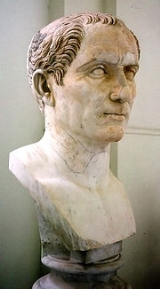
Gaius Julius Caesar (July 100 BC – 15 March 44 BC) was a Roman general and
statesmanA statesman is usually a politician or other notable public figure who has had a long and respected career in politics or government at the national and international level. As a term of respect, it is usually left to supporters or commentators to use the term...
and a distinguished writer of
LatinLatin is an Italic language originally spoken in Latium and Ancient Rome. It, along with most European languages, is a descendant of the ancient Proto-Indo-European language. Although it is considered a dead language, a number of scholars and members of the Christian clergy speak it fluently, and...
prose. He played a critical role in the gradual transformation of the
Roman RepublicThe Roman Republic was the period of the ancient Roman civilization where the government operated as a republic. It began with the overthrow of the Roman monarchy, traditionally dated around 508 BC, and its replacement by a government headed by two consuls, elected annually by the citizens and...
into the
Roman EmpireThe Roman Empire was the post-Republican period of the ancient Roman civilization, characterised by an autocratic form of government and large territorial holdings in Europe and around the Mediterranean....
.
In 60 BC, Caesar,
CrassusMarcus Licinius Crassus was a Roman general and politician who commanded the right wing of Sulla's army at the Battle of the Colline Gate, suppressed the slave revolt led by Spartacus, provided political and financial support to Julius Caesar and entered into the political alliance known as the...
and
PompeyGnaeus Pompeius Magnus, also known as Pompey or Pompey the Great , was a military and political leader of the late Roman Republic...
formed a
political allianceThe First Triumvirate was the political alliance of Gaius Julius Caesar, Marcus Licinius Crassus, and Gnaeus Pompeius Magnus. Unlike the Second Triumvirate, the First Triumvirate had no official status whatsoever; its overwhelming power in the Roman Republic was strictly unofficial influence, and...
that was to dominate Roman politics for several years. Their attempts to amass power through
populistPopulares were aristocratic leaders in the late Roman Republic who relied on the people's assemblies and tribunate to acquire political power. They are regarded in modern scholarship as in opposition to the optimates, who are identified with the conservative interests of a senatorial elite...
tactics were opposed by the
conservative eliteThe optimates were the traditionalist majority of the late Roman Republic. They wished to limit the power of the popular assemblies and the Tribunes of the Plebs, and to extend the power of the Senate, which was viewed as more dedicated to the interests of the aristocrats who held the reins of power...
within the
Roman SenateThe Senate of the Roman Republic was a political institution in the ancient Roman Republic, however, it was not an elected body, but one whose members were appointed by the consuls, and later by the censors. After a magistrate served his term in office, it usually was followed with automatic...
, among them
Cato the YoungerMarcus Porcius Cato Uticensis , commonly known as Cato the Younger to distinguish him from his great-grandfather , was a politician and statesman in the late Roman Republic, and a follower of the Stoic philosophy...
with the frequent support of
CiceroMarcus Tullius Cicero , was a Roman philosopher, statesman, lawyer, political theorist, and Roman constitutionalist. He came from a wealthy municipal family of the equestrian order, and is widely considered one of Rome's greatest orators and prose stylists.He introduced the Romans to the chief...
. Caesar's conquest of Gaul, completed by 51 BC, extended Rome's territory to the
English ChannelThe English Channel , often referred to simply as the Channel, is an arm of the Atlantic Ocean that separates southern England from northern France, and joins the North Sea to the Atlantic. It is about long and varies in width from at its widest to in the Strait of Dover...
and the
Rhine. Caesar became the first Roman general to cross both when he built a
bridge across the RhineCaesar's Bridge across the Rhine, the first two bridges to cross the Rhine River, were built by Julius Caesar and his legionaries during the Gallic War in 55 BC and 53 BC, respectively...
and conducted the first
invasion of BritainIn his Gallic Wars, Julius Caesar invaded Britain twice, in 55 and 54 BC. The first invasion, made late in summer, was either intended as a full invasion or a reconnaissance-in-force expedition...
. These achievements granted him unmatched military power and threatened to eclipse Pompey's standing. The balance of power was further upset by the
death of CrassusThe Battle of Carrhae, fought in 53 BC near the town of Carrhae, was a major battle between the Parthian Empire and the Roman Republic. The Parthian Spahbod Surena decisively defeated a Roman invasion force led by Marcus Licinius Crassus...
in 53 BC.
Political realignments in Rome finally led to a standoff between Caesar and Pompey, the latter having taken up the cause of the Senate. Ordered by the Senate to stand trial in Rome for various charges, Caesar marched from Gaul to Italy with his legions, crossing the
RubiconThe Rubicon is a shallow river in northeastern Italy, about 80 kilometres long, running from the Apennine Mountains to the Adriatic Sea through the southern Emilia-Romagna region, between the towns of Rimini and Cesena. The Latin word rubico comes from the adjective "rubeus", meaning "red"...
in 49 BC. This sparked a
civil warThe Great Roman Civil War , also known as Caesar's Civil War, was one of the last politico-military conflicts in the Roman Republic before the establishment of the Roman Empire...
from which he emerged as the unrivaled leader of the Roman world.
After assuming control of government, he began extensive reforms of Roman society and government. He centralised the bureaucracy of the Republic and was eventually proclaimed "
dictatorIn the Roman Republic, the dictator , was an extraordinary magistrate with the absolute authority to perform tasks beyond the authority of the ordinary magistrate . The office of dictator was a legal innovation originally named Magister Populi , i.e...
in perpetuity". A group of senators, led by
Marcus Junius BrutusMarcus Junius Brutus , often referred to as Brutus, was a politician of the late Roman Republic. After being adopted by his uncle he used the name Quintus Servilius Caepio Brutus, but eventually returned to using his original name...
, assassinated the dictator on the
Ides of MarchThe Ides of March is the name of the 15th day of March in the Roman calendar, probably referring to the day of the full moon. The word Ides comes from the Latin word "Idus" and means "half division" especially in relation to a month. It is a word that was used widely in the Roman calendar...
(15 March) 44 BC, hoping to restore the constitutional government of the Republic. However, the result was a series of civil wars, which ultimately led to the establishment of the permanent Roman Empire by Caesar's adopted heir
OctaviusAugustus ;23 September 63 BC – 19 August AD 14) is considered the first emperor of the Roman Empire, which he ruled alone from 27 BC until his death in 14 AD.The dates of his rule are contemporary dates; Augustus lived under two calendars, the Roman Republican until 45 BC, and the Julian...
(later known as Augustus). Much of Caesar's life is known from his own accounts of his military campaigns, and other contemporary sources, mainly the letters and speeches of Cicero and the historical writings of
SallustGaius Sallustius Crispus, generally known simply as Sallust , a Roman historian, belonged to a well-known plebeian family, and was born at Amiternum in the country of the Sabines...
. The later biographies of Caesar by
SuetoniusGaius Suetonius Tranquillus, commonly known as Suetonius , was a Roman historian belonging to the equestrian order in the early Imperial era....
and
PlutarchPlutarch then named, on his becoming a Roman citizen, Lucius Mestrius Plutarchus , c. 46 – 120 AD, was a Greek historian, biographer, essayist, and Middle Platonist known primarily for his Parallel Lives and Moralia...
are also major sources.
Early life and career
Caesar was born into a patrician family, the
gensIn ancient Rome, a gens , plural gentes, referred to a family, consisting of all those individuals who shared the same nomen and claimed descent from a common ancestor. A branch of a gens was called a stirps . The gens was an important social structure at Rome and throughout Italy during the...
Julia, which claimed descent from
IulusAscanius is the son of the Trojan hero Aeneas and a legendary king of Alba Longa. He is a character of Roman mythology, and has a divine lineage, being the son of Aeneas, who is son of Venus and the hero Anchises, a relative of Priam; thus Ascanius has divine ascendents by both parents, being...
, son of the legendary
TrojanTroy was a city, both factual and legendary, located in northwest Anatolia in what is now Turkey, southeast of the Dardanelles and beside Mount Ida...
prince
AeneasAeneas , in Greco-Roman mythology, was a Trojan hero, the son of the prince Anchises and the goddess Aphrodite. His father was the second cousin of King Priam of Troy, making Aeneas Priam's second cousin, once removed. The journey of Aeneas from Troy , which led to the founding a hamlet south of...
, supposedly the son of the goddess
Venus Venus is a Roman goddess principally associated with love, beauty, sex,sexual seduction and fertility, who played a key role in many Roman religious festivals and myths...
. The
cognomenThe cognomen nōmen "name") was the third name of a citizen of Ancient Rome, under Roman naming conventions. The cognomen started as a nickname, but lost that purpose when it became hereditary. Hereditary cognomina were used to augment the second name in order to identify a particular branch within...
"Caesar" originated, according to
Pliny the ElderGaius Plinius Secundus , better known as Pliny the Elder, was a Roman author, naturalist, and natural philosopher, as well as naval and army commander of the early Roman Empire, and personal friend of the emperor Vespasian...
, with an ancestor who was born by
caesarean sectionA Caesarean section, is a surgical procedure in which one or more incisions are made through a mother's abdomen and uterus to deliver one or more babies, or, rarely, to remove a dead fetus...
(from the Latin verb to cut,
caedere,
caes-). The
Historia AugustaThe Augustan History is a late Roman collection of biographies, in Latin, of the Roman Emperors, their junior colleagues and usurpers of the period 117 to 284...
suggests three
alternative explanationsThe name Caesar probably originated from a dialect of Latium which did not share the rhotacism of the Roman dialect. Using the Latin alphabet as it existed in the day of Julius Caesar , Caesar's name is properly rendered GAIVS IVLIVS CAESAR The name Caesar probably originated from a dialect of...
: that the first Caesar had a thick head of hair (Latin
caesaries); that he had bright grey eyes (Latin
oculis caesiis); or that he killed an elephant (
caesai in Moorish) in battle. Caesar issued coins featuring images of elephants, suggesting that he favored this interpretation of his name. Despite their ancient pedigree, the Julii Caesares were not especially politically influential. Caesar's father, also called Gaius Julius Caesar, governed the province of Asia, while his mother,
Aurelia CottaAurelia Cotta or Aurelia was the mother of Roman dictator Gaius Julius Caesar .-Family:...
, came from an influential family. Little is recorded of Caesar's childhood. Caesar's formative years were a time of turmoil. There were several wars from 91 BC to 82 BC, although from 82 BC to 80 BC, the dictator
Lucius Cornelius SullaLucius Cornelius Sulla Felix , known commonly as Sulla, was a Roman general and statesman. He had the rare distinction of holding the office of consul twice, as well as that of dictator...
was purging Rome of his political enemies. Domestically, Roman politics was bitterly divided. In 85 BC, Caesar's father died suddenly so at sixteen Caesar was the head of the family. The following year he was nominated to be the new high priest of
JupiterIn ancient Roman religion and myth, Jupiter or Jove is the king of the gods, and the god of the sky and thunder. He is the equivalent of Zeus in the Greek pantheon....
. Since the holder of that position not only had to be a patrician but also be married to a patrician, he broke off his engagement to a
plebeianThe plebs was the general body of free land-owning Roman citizens in Ancient Rome. They were distinct from the higher order of the patricians. A member of the plebs was known as a plebeian...
girl he had been betrothed to since boyhood, and married
Lucius CinnaLucius Cornelius Cinna was a four-time consul of the Roman Republic, serving four consecutive terms from 87 to 84 BC, and a member of the ancient Roman Cinna family of the Cornelii gens....
's daughter
CorneliaCornelia Cinnilla , daughter of Lucius Cornelius Cinna , and a sister to suffect consul Lucius Cornelius Cinna, was married to Gaius Julius Caesar, who would become one of Rome's greatest conquerors and its dictator...
. Then, having brought
MithridatesMithridates VI or Mithradates VI Mithradates , from Old Persian Mithradatha, "gift of Mithra"; 134 BC – 63 BC, also known as Mithradates the Great and Eupator Dionysius, was king of Pontus and Armenia Minor in northern Anatolia from about 120 BC to 63 BC...
to terms, Sulla returned to Rome and had himself appointed to the revived office of
dictatorIn the Roman Republic, the dictator , was an extraordinary magistrate with the absolute authority to perform tasks beyond the authority of the ordinary magistrate . The office of dictator was a legal innovation originally named Magister Populi , i.e...
. Sulla's
proscriptionProscription is a term used for the public identification and official condemnation of enemies of the state. It is defined by the Oxford English Dictionary as a "decree of condemnation to death or banishment" and is a heavily politically charged word, frequently used to refer to state-approved...
s saw hundreds of his political enemies killed or exiled. Caesar, as the nephew of
MariusGaius Marius was a Roman general and statesman. He was elected consul an unprecedented seven times during his career. He was also noted for his dramatic reforms of Roman armies, authorizing recruitment of landless citizens, eliminating the manipular military formations, and reorganizing the...
and son-in-law of Cinna, was targeted. He was stripped of his inheritance, his wife's dowry and his priesthood, but he refused to divorce Cornelia and was forced to go into hiding. The threat against him was lifted by the intervention of his mother's family, which included supporters of Sulla, and the Vestal Virgins. Sulla gave in reluctantly, and is said to have declared that he saw many a Marius in Caesar.
Caesar left Rome and joined the army, where he won the
Civic CrownThe Civic Crown was a chaplet of common oak leaves woven to form a crown. During the Roman Republic, and the subsequent Principate, it was regarded as the second highest military decoration to which a citizen could aspire...
for his part in an important siege. On a mission to
BithyniaBithynia was an ancient region, kingdom and Roman province in the northwest of Asia Minor, adjoining the Propontis, the Thracian Bosporus and the Euxine .-Description:...
to secure the assistance of King
Nicomedes'sNicomedes IV Philopator, was the king of Bithynia, from c. 94 BC to 74 BC. He was the first son and successor of the Monarchs Nicomedes III of Bithynia and Nysa and had a sister called Nysa....
fleet, he spent so long at his court that rumors of an affair with the king arose, which Caesar would vehemently deny for the rest of his life. Ironically, the loss of his priesthood had allowed him to pursue a military career, as the high priest of Jupiter was not permitted to touch a horse, sleep three nights outside his own bed or one night outside Rome, or look upon an army. Hearing of Sulla's death in 78 BC, Caesar felt safe enough to return to Rome. Lacking means since his inheritance was confiscated, he acquired a modest house in a lower-class neighborhood of Rome. Instead, he turned to legal advocacy. He became known for his exceptional oratory, accompanied by impassioned gestures and a high-pitched voice, and ruthless prosecution of former governors notorious for
extortionExtortion is a criminal offence which occurs when a person unlawfully obtains either money, property or services from a person, entity, or institution, through coercion. Refraining from doing harm is sometimes euphemistically called protection. Extortion is commonly practiced by organized crime...
and corruption.
On the way across the
Aegean SeaThe Aegean Sea[p] is an elongated embayment of the Mediterranean Sea located between the southern Balkan and Anatolian peninsulas, i.e., between the mainlands of Greece and Turkey. In the north, it is connected to the Marmara Sea and Black Sea by the Dardanelles and Bosporus...
, Caesar was kidnapped by
piratesPiracy is an act of robbery or criminal violence at sea. The term can include acts committed on land, in the air, or in other major bodies of water or on a shore. It does not normally include crimes committed against persons traveling on the same vessel as the perpetrator...
and held prisoner. He maintained an attitude of superiority throughout his captivity. When the pirates thought to demand a ransom of twenty
talentsThe "talent" was one of several ancient units of mass, as well as corresponding units of value equivalent to these masses of a precious metal. It was approximately the mass of water required to fill an amphora. A Greek, or Attic talent, was , a Roman talent was , an Egyptian talent was , and a...
of silver, he insisted they ask for fifty. After the ransom was paid, Caesar raised a fleet, pursued and captured the pirates, and imprisoned them. He had them crucified on his own authority, as he had promised while in captivity—a promise the pirates had taken as a joke. As a sign of leniency, he first had their throats cut. He was soon called back into military action in Asia, raising a band of
auxiliariesAuxiliaries formed the standing non-citizen corps of the Roman army of the Principate , alongside the citizen legions...
to repel an incursion from the east.
On his return to Rome, he was elected military
tribuneTribune was a title shared by elected officials in the Roman Republic. Tribunes had the power to convene the Plebeian Council and to act as its president, which also gave them the right to propose legislation before it. They were sacrosanct, in the sense that any assault on their person was...
, a first step in a political career. He was elected
quaestorA Quaestor was a type of public official in the "Cursus honorum" system who supervised financial affairs. In the Roman Republic a quaestor was an elected official whereas, with the autocratic government of the Roman Empire, quaestors were simply appointed....
for 69 BC, and during that year he delivered the
funeral oration for his aunt JuliaThe laudatio Iuliae amitae is a well-known funeral oration that Julius Caesar delivered in 68 BC to honor his deceased aunt Julia, the widow of Marius...
. His wife, Cornelia, also died that year. After her funeral, in the spring or early summer of 69 BC, Caesar went to serve his quaestorship in
SpainAnother theory holds that the name derives from Ezpanna, the Basque word for "border" or "edge", thus meaning the farthest area or place. Isidore of Sevilla considered Hispania derived from Hispalis....
. While there he is said to have encountered a statue of
Alexander the Great, and realized with dissatisfaction he was now at an age when Alexander had the world at his feet, while he had achieved comparatively little. On his return in 67 BC, he married Pompeia, a granddaughter of Sulla, whom he later divorced. In 63 BC, he ran for election to the post of
Pontifex MaximusThe Pontifex Maximus was the high priest of the College of Pontiffs in ancient Rome. This was the most important position in the ancient Roman religion, open only to patricians until 254 BC, when a plebeian first occupied this post...
, chief priest of the Roman state religion. He ran against two powerful senators. There were accusations of bribery by all sides. Caesar won comfortably, despite his opponents' greater experience and standing. When
CiceroMarcus Tullius Cicero , was a Roman philosopher, statesman, lawyer, political theorist, and Roman constitutionalist. He came from a wealthy municipal family of the equestrian order, and is widely considered one of Rome's greatest orators and prose stylists.He introduced the Romans to the chief...
, who was consul that year, exposed
CatilineLucius Sergius Catilina , known in English as Catiline, was a Roman politician of the 1st century BC who is best known for the Catiline conspiracy, an attempt to overthrow the Roman Republic, and in particular the power of the aristocratic Senate.-Family background:Catiline was born in 108 BC to...
's conspiracy to seize control of the republic, several senators accused Caesar of involvement in the plot.
After his praetorship, Caesar was appointed to govern
SpainDuring the Roman Republic, Hispania Ulterior was a region of Hispania roughly located in Baetica and in the Guadalquivir valley of modern Spain and extending to all of Lusitania and Gallaecia...
, but he was still in considerable debt and needed to satisfy his creditors before he could leave. He turned to
Marcus Licinius CrassusMarcus Licinius Crassus was a Roman general and politician who commanded the right wing of Sulla's army at the Battle of the Colline Gate, suppressed the slave revolt led by Spartacus, provided political and financial support to Julius Caesar and entered into the political alliance known as the...
, one of Rome's richest men. In return for political support in his opposition to the interests of
PompeyGnaeus Pompeius Magnus, also known as Pompey or Pompey the Great , was a military and political leader of the late Roman Republic...
, Crassus paid some of Caesar's debts and acted as guarantor for others. Even so, to avoid becoming a private citizen and thus be open to prosecution for his debts, Caesar left for his province before his praetorship had ended. In Spain, he conquered two local tribes and was hailed as
imperatorThe Latin word Imperator was originally a title roughly equivalent to commander under the Roman Republic. Later it became a part of the titulature of the Roman Emperors as part of their cognomen. The English word emperor derives from imperator via Old French Empreur...
by his troops, reformed the law regarding debts, and completed his governorship in high esteem. As
imperator, Caesar was entitled to a
triumphThe Roman triumph was a civil ceremony and religious rite of ancient Rome, held to publicly celebrate and sanctify the military achievement of an army commander who had won great military successes, or originally and traditionally, one who had successfully completed a foreign war. In Republican...
. However, he also wanted to stand for consul, the most senior magistracy in the republic. If he were to celebrate a triumph, he would have to remain a soldier and stay outside the city until the ceremony, but to stand for election he would need to lay down his command and enter Rome as a private citizen. He could not do both in the time available. He asked the senate for permission to stand
in absentia, but Cato blocked the proposal. Faced with the choice between a triumph and the consulship, Caesar chose the consulship.
Consulship and military campaigns
In 60 BC, Caesar sought election as consul for 59 BC, along with two other candidates. The election was dirty – even
CatoMarcus Porcius Cato Uticensis , commonly known as Cato the Younger to distinguish him from his great-grandfather , was a politician and statesman in the late Roman Republic, and a follower of the Stoic philosophy...
, with his reputation for incorruptibility, is said to have resorted to bribery in favor of one of Caesar's opponents. Caesar won, along with conservative
Marcus BibulusMarcus Calpurnius Bibulus was a politician of the late Roman Republic.Bibulus was the son in law of Marcus Porcius Cato Uticencis. In 59 BC he was elected consul, supported by the optimates, conservative republicans in the Senate and opponents of Julius Caesar's triumvirate...
.
Caesar was already in
CrassusMarcus Licinius Crassus was a Roman general and politician who commanded the right wing of Sulla's army at the Battle of the Colline Gate, suppressed the slave revolt led by Spartacus, provided political and financial support to Julius Caesar and entered into the political alliance known as the...
' political debt, but he also made overtures to
PompeyGnaeus Pompeius Magnus, also known as Pompey or Pompey the Great , was a military and political leader of the late Roman Republic...
. Pompey and Crassus had been at odds for a decade, so Caesar tried to reconcile them. The three of them had enough money and political influence to control public business. This informal alliance, known as the
First TriumvirateThe First Triumvirate was the political alliance of Gaius Julius Caesar, Marcus Licinius Crassus, and Gnaeus Pompeius Magnus. Unlike the Second Triumvirate, the First Triumvirate had no official status whatsoever; its overwhelming power in the Roman Republic was strictly unofficial influence, and...
("rule of three men"), was cemented by the marriage of Pompey to Caesar's daughter
JuliaJulia Caesaris , 83 or 82 BC-54 BC, was the daughter of Gaius Julius Caesar the Roman dictator, by his first wife, Cornelia Cinna, and his only child in marriage. Julia became the fourth wife of Pompey the Great and was renowned for her beauty and virtue.-Life:Julia was born around 83 BC–82 BC...
. Caesar also married again, this time
CalpurniaCalpurnia Pisonis , daughter of Lucius Calpurnius Piso Caesoninus, sister of Lucius Calpurnius Piso, "the Pontifex", was a Roman woman and the third and last wife of Julius Caesar. Calpurnia was the great-granddaughter of a lieutenant of Lucius Cassius Longinus, whose name was Lucius Piso...
, who was the daughter of another powerful senator.
Caesar proposed a law for the redistribution of public lands to the poor, a proposal supported by Pompey, by force of arms if need be, and by Crassus, making the triumvirate public. Pompey filled the city with soldiers, a move which intimidated the triumvirate's opponents. Bibulus attempted to declare the omens unfavorable and thus void the new law, but was driven from the forum by Caesar's armed supporters. His
bodyguardsThe lictor was a member of a special class of Roman civil servant, with special tasks of attending and guarding magistrates of the Roman Republic and Empire who held imperium, the right and power to command; essentially, a bodyguard...
had their
ceremonial axesFasces are a bundle of wooden sticks with an axe blade emerging from the center, which is an image that traditionally symbolizes summary power and jurisdiction, and/or "strength through unity"...
broken, two high magistrates accompanying him were wounded, and Bibulus had a bucket of excrement thrown over him. In fear of his life, he retired to his house for the rest of the year, issuing occasional proclamations of bad omens. These attempts to obstruct Caesar's legislation proved ineffective. Roman satirists ever after referred to the year as "the consulship of Julius and Caesar."
When Caesar was first elected, the aristocracy tried to limit his future power by allotting the woods and pastures of Italy, rather than the
governorshipA proconsul was a governor of a province in the Roman Republic appointed for one year by the senate. In modern usage, the title has been used for a person from one country ruling another country or bluntly interfering in another country's internal affairs.-Ancient Rome:In the Roman Republic, a...
of a province, as his military command duty after his year in office was over. With the help of political allies, Caesar later overturned this, and was instead appointed to govern
Cisalpine GaulCisalpine Gaul, in Latin: Gallia Cisalpina or Citerior, also called Gallia Togata, was a Roman province until 41 BC when it was merged into Roman Italy.It bore the name Gallia, because the great body of its inhabitants, after the expulsion of the Etruscans, consisted of Gauls or Celts...
(northern Italy) and
IllyricumThe Roman province of Illyricum or Illyris Romana or Illyris Barbara or Illyria Barbara replaced most of the region of Illyria. It stretched from the Drilon river in modern north Albania to Istria in the west and to the Sava river in the north. Salona functioned as its capital...
(southeastern Europe), with Transalpine Gaul (southern France) later added, giving him command of four legions. The term of his governorship, and thus his immunity from prosecution, was set at five years, rather than the usual one. When his consulship ended, Caesar narrowly avoided prosecution for the irregularities of his year in office, and quickly left for his province.
Conquest of Gaul
Caesar was still deeply in debt, and there was money to be made as a governor, whether by extortion or by military adventurism. Caesar had four legions under his command, two of his provinces bordered on unconquered territory, and parts of
GaulGaul was a region of Western Europe during the Iron Age and Roman era, encompassing present day France, Luxembourg and Belgium, most of Switzerland, the western part of Northern Italy, as well as the parts of the Netherlands and Germany on the left bank of the Rhine. The Gauls were the speakers of...
were known to be unstable. Some of Rome's Gallic allies had been defeated by their rivals, with the help of a contingent of
GermanicThe Germanic peoples are an Indo-European ethno-linguistic group of Northern European origin, identified by their use of the Indo-European Germanic languages which diversified out of Proto-Germanic during the Pre-Roman Iron Age.Originating about 1800 BCE from the Corded Ware Culture on the North...
tribes. The Romans feared these tribes were preparing to migrate south, closer to Italy, and that they had warlike intent. Caesar raised two new legions and defeated these tribes.
In response to Caesar's earlier activities, the tribes in the north-east began to arm themselves. Caesar treated this as an aggressive move and, after an inconclusive engagement against the united tribes, he conquered the tribes piecemeal. Meanwhile, one of his legions began the conquest of the tribes in the far north (directly opposite
BritainRoman Britain was the part of the island of Great Britain controlled by the Roman Empire from AD 43 until ca. AD 410.The Romans referred to the imperial province as Britannia, which eventually comprised all of the island of Great Britain south of the fluid frontier with Caledonia...
). During the spring of 56 BC, the Triumvirate held a conference, as Rome was in turmoil and Caesar's political alliance was coming undone. The meeting renewed the Triumvirate and extended Caesar's governorship for another five years. The conquest of the north was soon completed, while a few pockets of resistance remained. Caesar now had a secure base from which to launch an invasion of Britain.
In 55 BC, Caesar repelled an incursion into Gaul by two Germanic tribes, and followed it up by building a bridge across the Rhine and making a show of force in Germanic territory, before returning and dismantling the bridge. Late that summer, having subdued two other tribes, he crossed into Britain, claiming that the Britons had aided one of his enemies the previous year possibly the
VenetiVeneti may refer to:*Veneti , an ancient Celtic tribe described by classical sources as living in what is now Brittany, France*Adriatic Veneti, an ancient historical people of northeastern Italy, who spoke an Indo-European language related to the Italic languages*Vistula Veneti, an ancient...
of
BrittanyBrittany is a cultural and administrative region in the north-west of France. Previously a kingdom and then a duchy, Brittany was united to the Kingdom of France in 1532 as a province. Brittany has also been referred to as Less, Lesser or Little Britain...
. His intelligence information was poor, and although he gained a beachhead on the coast, he could not advance further, and returned to Gaul for the winter.He returned the following year, better prepared and with a larger force, and achieved more. He advanced inland, and established a few alliances. However, poor harvests led to widespread revolt in Gaul, which forced Caesar to leave Britain for the last time.
While Caesar was in Britain his daughter Julia, Pompey's wife, had died in childbirth. Caesar tried to re-secure Pompey's support by offering him his great-niece in marriage, but Pompey declined. In 53 BC Crassus was killed leading a failed
invasionAn invasion is a military offensive consisting of all, or large parts of the armed forces of one geopolitical entity aggressively entering territory controlled by another such entity, generally with the objective of either conquering, liberating or re-establishing control or authority over a...
of the east. Rome was on the edge of civil war. Pompey was appointed sole consul as an emergency measure, and married the daughter of a political opponent of Caesar. The Triumvirate was dead.
In 52 BC another, larger revolt erupted in Gaul, led by
VercingetorixVercingetorix was the chieftain of the Arverni tribe, who united the Gauls in an ultimately unsuccessful revolt against Roman forces during the last phase of Julius Caesar's Gallic Wars....
. Vercingetorix managed to unite the Gallic tribes and proved an astute commander, defeating Caesar in several engagements, but Caesar's elaborate siege-works at the
Battle of AlesiaThe Battle of Alesia or Siege of Alesia took place in September, 52 BC around the Gallic oppidum of Alesia, a major town centre and hill fort of the Mandubii tribe...
finally forced his surrender. Despite scattered outbreaks of
warfare the following year, Gaul was effectively conquered. Plutarch claimed that the army had fought against three million men during the
Gallic WarsThe Gallic Wars were a series of military campaigns waged by the Roman proconsul Julius Caesar against several Gallic tribes. They lasted from 58 BC to 51 BC. The Gallic Wars culminated in the decisive Battle of Alesia in 52 BC, in which a complete Roman victory resulted in the expansion of the...
, of whom one million died, and another million were
enslavedThe history of slavery covers slave systems in historical perspective in which one human being is legally the property of another, can be bought or sold, is not allowed to escape and must work for the owner without any choice involved...
. The Romans subjugated 300 tribes and destroyed 800 cities. However, in view of the difficulty in finding accurate counts in the first place, Caesar's propagandistic purposes, and the common exaggeration of numbers in ancient texts, the stated totals of enemy combatants are likely to be too high.
Civil war
In 50 BC, the
SenateThe Senate of the Roman Republic was a political institution in the ancient Roman Republic, however, it was not an elected body, but one whose members were appointed by the consuls, and later by the censors. After a magistrate served his term in office, it usually was followed with automatic...
, led by
PompeyGnaeus Pompeius Magnus, also known as Pompey or Pompey the Great , was a military and political leader of the late Roman Republic...
, ordered Caesar to disband his army and return to Rome because his term as governor had finished. Caesar thought he would be prosecuted if he entered Rome without the immunity enjoyed by a magistrate. Pompey accused Caesar of insubordination and treason. In January 49 BC, Caesar crossed the
RubiconThe Rubicon is a shallow river in northeastern Italy, about 80 kilometres long, running from the Apennine Mountains to the Adriatic Sea through the southern Emilia-Romagna region, between the towns of Rimini and Cesena. The Latin word rubico comes from the adjective "rubeus", meaning "red"...
river (the frontier boundary of Italy) with only
one legionLegio tertia decima Gemina was one of the most prominent Roman legions. It was one of Julius Caesar's key units in Gaul and in the civil war, and was the legion with which he famously crossed the Rubicon on January 10, 49 BC. The legion appears to have still been in existence in the fifth century...
and ignited
civil warThe Great Roman Civil War , also known as Caesar's Civil War, was one of the last politico-military conflicts in the Roman Republic before the establishment of the Roman Empire...
. Upon crossing the Rubicon, Caesar, according to
PlutarchPlutarch then named, on his becoming a Roman citizen, Lucius Mestrius Plutarchus , c. 46 – 120 AD, was a Greek historian, biographer, essayist, and Middle Platonist known primarily for his Parallel Lives and Moralia...
and
SuetoniusGaius Suetonius Tranquillus, commonly known as Suetonius , was a Roman historian belonging to the equestrian order in the early Imperial era....
, is supposed to have quoted the Athenian playwright
MenanderMenander , Greek dramatist, the best-known representative of Athenian New Comedy, was the son of well-to-do parents; his father Diopeithes is identified by some with the Athenian general and governor of the Thracian Chersonese known from the speech of Demosthenes De Chersoneso...
, in Greek, "
the die is castAlea iacta est is a Latin phrase attributed by Suetonius to Julius Caesar on January 10, 49 BC as he led his army across the River Rubicon in Northern Italy...
". Erasmus, however, notes that the more accurate translation of the Greek
imperative moodThe imperative mood expresses commands or requests as a grammatical mood. These commands or requests urge the audience to act a certain way. It also may signal a prohibition, permission, or any other kind of exhortation.- Morphology :...
would be "alea icta esto"
let the die be cast. Pompey and much of the Senate fled to the south, having little confidence in his newly raised troops. Despite greatly outnumbering Caesar, who only had his
Thirteenth LegionLegio tertia decima Gemina was one of the most prominent Roman legions. It was one of Julius Caesar's key units in Gaul and in the civil war, and was the legion with which he famously crossed the Rubicon on January 10, 49 BC. The legion appears to have still been in existence in the fifth century...
with him, Pompey did not intend to fight. Caesar pursued Pompey, hoping to capture him before his legions could escape. Pompey managed to escape before Caesar could capture him. Caesar decided to head for Spain, while leaving Italy under the control of
Mark AntonyMarcus Antonius , known in English as Mark Antony, was a Roman politician and general. As a military commander and administrator, he was an important supporter and loyal friend of his mother's cousin Julius Caesar...
. Caesar made an astonishing 27-day route-march to
SpainAnother theory holds that the name derives from Ezpanna, the Basque word for "border" or "edge", thus meaning the farthest area or place. Isidore of Sevilla considered Hispania derived from Hispalis....
, where he defeated Pompey's lieutenants. He then returned east, to challenge Pompey in Greece where in July 48 BC at
DyrrhachiumThe Battle of Dyrrachium on 10 July 48 BC, was a battle of Caesar's Civil War in the area of the city of Dyrrachium . It was fought between Julius Caesar and the army led by Gnaeus Pompey with the backing of the majority of the Roman Senate. The battle was indecisive but is regarded as a victory...
Caesar barely avoided a catastrophic defeat. He decisively defeated Pompey at
PharsalusThe Battle of Pharsalus was a decisive battle of Caesar's Civil War. On 9 August 48 BC at Pharsalus in central Greece, Gaius Julius Caesar and his allies formed up opposite the army of the republic under the command of Gnaeus Pompeius Magnus...
in an exceedingly short engagement later that year.
In Rome, Caesar was appointed
dictatorIn the Roman Republic, the dictator , was an extraordinary magistrate with the absolute authority to perform tasks beyond the authority of the ordinary magistrate . The office of dictator was a legal innovation originally named Magister Populi , i.e...
, with
Mark AntonyMarcus Antonius , known in English as Mark Antony, was a Roman politician and general. As a military commander and administrator, he was an important supporter and loyal friend of his mother's cousin Julius Caesar...
as his
Master of the HorseThe Master of the Horse was a position of varying importance in several European nations.-Magister Equitum :...
(second in command); Caesar presided over his own election to a second consulship and then, after eleven days, resigned this dictatorship. Caesar then pursued Pompey to Egypt, where Pompey was soon murdered. Caesar then became involved with an Egyptian civil war between the child pharaoh and his sister, wife, and co-regent queen,
CleopatraCleopatra VII Philopator was the last pharaoh of Ancient Egypt.She was a member of the Ptolemaic dynasty, a family of Greek origin that ruled Egypt after Alexander the Great's death during the Hellenistic period...
. Perhaps as a result of the pharaoh's role in Pompey's murder, Caesar sided with Cleopatra; he is reported to have wept at the sight of Pompey's head, which was offered to him by the pharaoh as a gift. In any event, Caesar defeated the pharaoh's forces in 47 BC and installed Cleopatra as ruler. Caesar and Cleopatra celebrated their victory with a triumphant procession on the Nile in the spring of 47 BC. The royal barge was accompanied by 400 additional ships, and Caesar was introduced to the luxurious lifestyle of the Egyptian pharaohs. Caesar and Cleopatra never married, as Roman law recognized marriages only between two Roman citizens. Caesar continued his relationship with Cleopatra throughout his last marriage, which lasted fourteen years – in Roman eyes, this did not constitute adultery – and may have fathered a son called
CaesarionPtolemy XV Philopator Philometor Caesar , better known by the nicknames Caesarion and Ptolemy Caesar , was the last king of the Ptolemaic dynasty of Egypt, who reigned jointly with his mother Cleopatra VII of Egypt, from September 2, 44 BC...
. Cleopatra visited Rome on more than one occasion, residing in Caesar's villa just outside Rome across the
TiberThe Tiber is the third-longest river in Italy, rising in the Apennine Mountains in Emilia-Romagna and flowing through Umbria and Lazio to the Tyrrhenian Sea. It drains a basin estimated at...
.
Late in 48 BC, Caesar was again appointed
DictatorIn the Roman Republic, the dictator , was an extraordinary magistrate with the absolute authority to perform tasks beyond the authority of the ordinary magistrate . The office of dictator was a legal innovation originally named Magister Populi , i.e...
, with a term of one year. After spending the first months of 47 BC in Egypt, Caesar went to the Middle East, where he annihilated the king of
PontusPontus or Pontos is a historical Greek designation for a region on the southern coast of the Black Sea, located in modern-day northeastern Turkey. The name was applied to the coastal region in antiquity by the Greeks who colonized the area, and derived from the Greek name of the Black Sea: Πόντος...
; his victory was so swift and complete that he mocked Pompey's previous victories over such poor enemies. Thence, he proceeded to Africa to deal with the remnants of Pompey's senatorial supporters. He quickly gained a significant victory in 46 BC over Cato, who then committed suicide. After this victory, he was appointed Dictator for ten years. Nevertheless, Pompey's sons escaped to Spain; Caesar gave chase and defeated the last remnants of opposition in the
Battle of MundaThe Battle of Munda took place on March 17, 45 BC in the plains of Munda, modern southern Spain. This was the last battle of Julius Caesar's civil war against the republican armies of the Optimate leaders...
in March 45 BC. During this time, Caesar was elected to his third and fourth terms as consul in 46 BC and 45 BC (this last time without a colleague).
Dictatorship and assassination
While he was still campaigning in Spain, the Senate began bestowing honors on Caesar. Caesar had not proscribed his enemies, instead pardoning almost all, and there was no serious public opposition to him. Great games and celebrations were held in April to honor Caesar’s victory at Munda. Plutarch writes that many Romans found the triumph held following Caesar's victory to be in poor taste, as those defeated in the civil war had not been foreigners, but instead fellow Romans. On Caesar's return to Italy in September 45 BC, he filed his will, naming his grandnephew
Gaius OctaviusAugustus ;23 September 63 BC – 19 August AD 14) is considered the first emperor of the Roman Empire, which he ruled alone from 27 BC until his death in 14 AD.The dates of his rule are contemporary dates; Augustus lived under two calendars, the Roman Republican until 45 BC, and the Julian...
(Octavian) as the heir to everything, including his name. Caesar also wrote that if Octavian died before Caesar did,
Marcus Junius BrutusMarcus Junius Brutus , often referred to as Brutus, was a politician of the late Roman Republic. After being adopted by his uncle he used the name Quintus Servilius Caepio Brutus, but eventually returned to using his original name...
would be the next heir in succession.
During his early career, Caesar had seen how chaotic and dysfunctional the Roman Republic had become. The republican machinery had broken down under the weight of
imperialismImperialism, as defined by Dictionary of Human Geography, is "the creation and/or maintenance of an unequal economic, cultural, and territorial relationships, usually between states and often in the form of an empire, based on domination and subordination." The imperialism of the last 500 years,...
, the central government had become powerless, the provinces had been transformed into independent principalities under the absolute control of their governors, and the army had replaced the constitution as the means of accomplishing political goals. With a weak central government, political corruption had spiraled out of control, and the
status quo had been maintained by a corrupt aristocracy, which saw no need to change a system that had made its members rich.
Between his crossing of the
Rubicon RiverThe Rubicon is a shallow river in northeastern Italy, about 80 kilometres long, running from the Apennine Mountains to the Adriatic Sea through the southern Emilia-Romagna region, between the towns of Rimini and Cesena. The Latin word rubico comes from the adjective "rubeus", meaning "red"...
in 49 BC, and his
assassinationThe Ides of March is the name of the 15th day of March in the Roman calendar, probably referring to the day of the full moon. The word Ides comes from the Latin word "Idus" and means "half division" especially in relation to a month. It is a word that was used widely in the Roman calendar...
in 44 BC, Caesar established a new constitution, which was intended to accomplish three separate goals. First, he wanted to suppress all armed resistance out in the provinces, and thus bring order back to the empire. Second, he wanted to create a strong central government in Rome. Finally, he wanted to knit together the entire empire into a single cohesive unit. The first goal was accomplished when Caesar defeated Pompey and his supporters. To accomplish the other two goals, he needed to ensure that his control over the government was undisputed, and so he assumed these powers by increasing his own authority, and by decreasing the authority of Rome's other political institutions. Finally, he enacted a series of reforms that were meant to address several long neglected issues, the most important of which was his reform of the calendar.
Dictatorship
When Caesar returned to Rome, the Senate granted him
triumphsThe Roman triumph was a civil ceremony and religious rite of ancient Rome, held to publicly celebrate and sanctify the military achievement of an army commander who had won great military successes, or originally and traditionally, one who had successfully completed a foreign war. In Republican...
for his victories, ostensibly over Gaul, Egypt,
PharnacesPharnaces II of Pontus, also known as Pharnaces II was a prince, then King of Pontus and the Bosporan until his death. He was a monarch of Persian and Greek Macedonian ancestry. Pharnaces II was the youngest son and child born to King Mithridates VI of Pontus from his first wife, his sister Queen...
and
JubaJuba I of Numidia was a King of Numidia. He was the son and successor to King of Numidia Hiempsal II.- Family :...
, rather than over his Roman opponents. Not everything went Caesar's way. When Arsinoe IV, Egypt's former queen, was paraded in chains, the spectators admired her dignified bearing and were moved to pity.
Triumphal gamesLudi were public games held for the benefit and entertainment of the Roman people . Ludi were held in conjunction with, or sometimes as the major feature of, Roman religious festivals, and were also presented as part of the cult of state.The earliest ludi were horse races in the circus...
were held, with beast-hunts involving 400 lions, and
gladiator contestsA gladiator was an armed combatant who entertained audiences in the Roman Republic and Roman Empire in violent confrontations with other gladiators, wild animals, and condemned criminals. Some gladiators were volunteers who risked their legal and social standing and their lives by appearing in the...
. A
naval battleThe naumachia in the Ancient Roman world referred to both the re-enactment of naval battles and the basin in which this took place....
was held on a flooded basin at the
Field of MarsThe Campus Martius , was a publicly owned area of ancient Rome about in extent. In the Middle Ages, it was the most populous area of Rome...
. At the
Circus MaximusThe Circus Maximus is an ancient Roman chariot racing stadium and mass entertainment venue located in Rome, Italy. Situated in the valley between the Aventine and Palatine hills, it was the first and largest stadium in ancient Rome and its later Empire...
, two armies of war captives, each of 2,000 people, 200 horse and 20 elephants, fought to the death. Again, some bystanders complained, this time at Caesar's wasteful extravagance. A riot broke out, and only stopped when Caesar had two rioters sacrificed by the priests on the Field of Mars.
After the triumph, Caesar set forth to passing an unprecedented legislative agenda. He ordered a census be taken, which forced a reduction in the grain dole, and that jurors could only come from the Senate or the equestrian ranks. He passed a sumptuary law that restricted the purchase of certain luxuries. After this, he passed a law that rewarded families for having many children, to speed up the repopulation of
ItalyItaly , officially the Italian Republic languages]] under the European Charter for Regional or Minority Languages. In each of these, Italy's official name is as follows:;;;;;;;;), is a unitary parliamentary republic in South-Central Europe. To the north it borders France, Switzerland, Austria and...
. Then he outlawed professional guilds, except those of ancient foundation, since many of these were subversive political clubs. He then passed a term limit law applicable to governors. He passed a debt restructuring law, which ultimately eliminated about a fourth of all debts owed. The
Forum of CaesarThe Forum of Caesar, also known as Forum Iulium or Forum Julium, Forum Caesaris, is a forum built by Julius Caesar near the Forum Romanum in Rome in 46 BC.-Construction:...
, with its
Temple of Venus GenetrixThe Temple of Venus Genetrix is a ruined temple in the Forum of Caesar, Rome, dedicated to the Roman goddess Venus Genetrix, the goddess of motherhood and domesticity...
, was then built, among many other public works. Caesar also tightly regulated the purchase of state-subsidised grain and reduced the number of recipients to a fixed number, all of whom were entered into a special register. From 47 to 44 BC he made plans for the distribution of land to about 15,000 of his veterans. The most important change, however, was his reform of the calendar. The calendar at the time was regulated by the movement of the moon, and this had resulted in a great deal of disorder. Caesar replaced this calendar with the Egyptian calendar, which was regulated by the sun. He set the length of the year to 365.25 days by adding an
intercalary/leap dayIntercalation is the insertion of a leap day, week or month into some calendar years to make the calendar follow the seasons or moon phases. Lunisolar calendars may require intercalations of both days and months.- Solar calendars :...
at the end of February every fourth year. To bring the calendar into alignment with the seasons, he decreed that three extra months be inserted into 46 BC (the ordinary intercalary month at the end of February, and two extra months after November). Thus, the
Julian calendarThe Julian calendar began in 45 BC as a reform of the Roman calendar by Julius Caesar. It was chosen after consultation with the astronomer Sosigenes of Alexandria and was probably designed to approximate the tropical year .The Julian calendar has a regular year of 365 days divided into 12 months...
opened on 1 January 45 BC. This calendar is almost identical to
the current Western calendarThe Gregorian calendar, also known as the Western calendar, or Christian calendar, is the internationally accepted civil calendar. It was introduced by Pope Gregory XIII, after whom the calendar was named, by a decree signed on 24 February 1582, a papal bull known by its opening words Inter...
.
Shortly before his assassination, he passed a few more reforms. He established a police force, appointed officials to carry out his land reforms, and ordered the rebuilding of
CarthageCarthage , implying it was a 'new Tyre') is a major urban centre that has existed for nearly 3,000 years on the Gulf of Tunis, developing from a Phoenician colony of the 1st millennium BC...
and Corinth. He also extended Latin rights throughout the Roman world, and then abolished the tax system and reverted to the earlier version that allowed cities to collect tribute however they wanted, rather than needing Roman intermediaries. His assassination prevented further and larger schemes, which included the construction of an unprecedented temple to Mars, a huge theater, and a library on the scale of the
Library of AlexandriaThe Royal Library of Alexandria, or Ancient Library of Alexandria, in Alexandria, Egypt, was the largest and most significant great library of the ancient world. It flourished under the patronage of the Ptolemaic dynasty and functioned as a major center of scholarship from its construction in the...
. He also wanted to convert
OstiaOstia Antica is a large archeological site, close to the modern suburb of Ostia , that was the location of the harbour city of ancient Rome, which is approximately 30 km to the northeast. "Ostia" in Latin means "mouth". At the mouth of the River Tiber, Ostia was Rome's seaport, but, due to...
to a major port, and cut a canal through the
Isthmus of CorinthThe Isthmus of Corinth is the narrow land bridge which connects the Peloponnese peninsula with the rest of the mainland of Greece, near the city of Corinth. The word "isthmus" comes from the Ancient Greek word for "neck" and refers to the narrowness of the land. The Isthmus was known in the ancient...
. Militarily, he wanted to conquer the
DaciaIn ancient geography, especially in Roman sources, Dacia was the land inhabited by the Dacians or Getae as they were known by the Greeks—the branch of the Thracians north of the Haemus range...
ns,
ParthiaParthia is a region of north-eastern Iran, best known for having been the political and cultural base of the Arsacid dynasty, rulers of the Parthian Empire....
ns, and avenge the loss at
CarrhaeThe Battle of Carrhae, fought in 53 BC near the town of Carrhae, was a major battle between the Parthian Empire and the Roman Republic. The Parthian Spahbod Surena decisively defeated a Roman invasion force led by Marcus Licinius Crassus...
. Thus, he instituted a massive mobilization. Shortly before his assassination, the Senate named him censor for life and Father of the Fatherland, and the month of
QuintilisIn the 10-month calendar of ancient Rome, Quintilis follows Junius and precedes Sextilis . Quintilis is Latin for "fifth", that is, it was the fifth month in the earliest calendar attributed to Romulus, which began with the month of Martius...
was renamed July in his honor. He was granted further honors, which were later used to justify his assassination as a would-be divine monarch; coins were issued bearing his image and his statue was placed next to those of the kings. He was granted a golden chair in the Senate, was allowed to wear triumphal dress whenever he chose, and was offered a form of semi-official or popular
cultThe Imperial cult of ancient Rome identified emperors and some members of their families with the divinely sanctioned authority of the Roman State...
, with
Mark AntonyMarcus Antonius , known in English as Mark Antony, was a Roman politician and general. As a military commander and administrator, he was an important supporter and loyal friend of his mother's cousin Julius Caesar...
as his high priest.
Political reforms
The history of Caesar's political appointments is complex and uncertain. Caesar held both the
dictatorshipIn the Roman Republic, the dictator , was an extraordinary magistrate with the absolute authority to perform tasks beyond the authority of the ordinary magistrate . The office of dictator was a legal innovation originally named Magister Populi , i.e...
and the
tribunateTribune was a title shared by elected officials in the Roman Republic. Tribunes had the power to convene the Plebeian Council and to act as its president, which also gave them the right to propose legislation before it. They were sacrosanct, in the sense that any assault on their person was...
, but alternated between the
consulshipA consul served in the highest elected political office of the Roman Republic.Each year, two consuls were elected together, to serve for a one-year term. Each consul was given veto power over his colleague and the officials would alternate each month...
and the
ProconsulA proconsul was a governor of a province in the Roman Republic appointed for one year by the senate. In modern usage, the title has been used for a person from one country ruling another country or bluntly interfering in another country's internal affairs.-Ancient Rome:In the Roman Republic, a...
ship. His powers within the state seem to have rested upon these magistracies. He was first appointed dictator in 49 BC possibly to preside over elections, but resigned his dictatorship within eleven days. In 48 BC, he was re-appointed dictator, only this time for an indefinite period, and in 46 BC, he was appointed dictator for ten years. In February of 44 BC, one month before his assassination, he was appointed dictator for life. Under Caesar, a significant amount of authority was vested in his lieutenants, mostly because Caesar was frequently out of Italy. In October 45 BC, Caesar resigned his position as sole consul, and facilitated the election of two successors for the remainder of the year which theoretically restored the ordinary consulship, since the constitution did not recognize a single consul without a colleague. In 48 BC, Caesar was given permanent tribunician powers, which made his person sacrosanct and allowed him to veto the Senate, although on at least one occasion, tribunes did attempt to obstruct him. The offending tribunes in this case were brought before the Senate and divested of their office. This was not the first time that Caesar had violated a tribune's sacrosanctity. After he had first marched on Rome in 49 BC, he forcibly opened the treasury although a tribune had the seal placed on it. After the impeachment of the two obstructive tribunes, Caesar, perhaps unsurprisingly, faced no further opposition from other members of the Tribunician College.

In 46 BC, Caesar gave himself the title of "Prefect of the Morals", which was an office that was new only in name, as its powers were identical to those of the censors. Thus, he could hold censorial powers, while technically not subjecting himself to the same checks that the ordinary censors were subject to, and he used these powers to fill the Senate with his own partisans. He also set the precedent, which his imperial successors followed, of requiring the Senate to bestow various titles and honors upon him. He was, for example, given the title of "Father of the Fatherland" and "
imperatorThe Latin word Imperator was originally a title roughly equivalent to commander under the Roman Republic. Later it became a part of the titulature of the Roman Emperors as part of their cognomen. The English word emperor derives from imperator via Old French Empreur...
". Coins bore his likeness, and he was given the right to speak first during senate meetings. Caesar then increased the number of magistrates who were elected each year, which created a large pool of experienced magistrates, and allowed Caesar to reward his supporters. Caesar even took steps to transform Italy into a province, and to link more tightly the other provinces of the empire into a single cohesive unit. This addressed the underlying problem that had caused the Social War decades earlier, where individuals outside Rome and Italy were not considered "Roman", and thus were not given full citizenship rights. This process, of fusing the entire Roman Empire into a single unit, rather than maintaining it as a network of unequal principalities, would ultimately be completed by Caesar's successor, the emperor Augustus.
When Caesar returned to Rome in 47 BC, the ranks of the Senate had been severely depleted, and so he used his censorial powers to appoint many new senators, which eventually raised the Senate's membership to 900. All the appointments were of his own partisans, which robbed the senatorial aristocracy of its prestige, and made the Senate increasingly subservient to him. To minimize the risk that another general might attempt to challenge him, Caesar passed a law that subjected governors to term limits. Near the end of his life, Caesar began to prepare for a war against the
Parthian EmpireThe Parthian Empire , also known as the Arsacid Empire , was a major Iranian political and cultural power in ancient Persia...
. Since his absence from Rome might limit his ability to install his own consuls, he passed a law which allowed him to appoint all magistrates in 43 BC, and all consuls and tribunes in 42 BC. This, in effect, transformed the magistrates from being representatives of the people to being representatives of the dictator.
Assassination
On the
Ides of MarchThe Ides of March is the name of the 15th day of March in the Roman calendar, probably referring to the day of the full moon. The word Ides comes from the Latin word "Idus" and means "half division" especially in relation to a month. It is a word that was used widely in the Roman calendar...
(15 March; see
Roman calendarThe Roman calendar changed its form several times in the time between the founding of Rome and the fall of the Roman Empire. This article generally discusses the early Roman or pre-Julian calendars...
) of 44 BC, Caesar was due to appear at a session of the Senate.
Mark AntonyMarcus Antonius , known in English as Mark Antony, was a Roman politician and general. As a military commander and administrator, he was an important supporter and loyal friend of his mother's cousin Julius Caesar...
, having vaguely learned of the plot the night before from a terrified
Liberator named
Servilius CascaPublius Servilius Casca Longus was one of the assassins of Gaius Julius Caesar, who was murdered on 15 March, 44 BC....
, and fearing the worst, went to head Caesar off. The plotters, however, had anticipated this and, fearing that Antony would come to Caesar's aid, had arranged for
TreboniusGaius Trebonius was a military commander and politician of the late Roman Republic, a trusted associate of Julius Caesar who was later among those instigating the plot to assassinate the Dictator.-Biography:...
to intercept him just as he approached the portico of
Theatre of PompeyThe Theatre of Pompey was a structure in Ancient Rome built during the later part of the Roman Republican era. It was completed in seven years, starting from 55 BC, and was dedicated early in 52 BC before the structure was fully completed...
, where the session was to be held, and detain him outside. (Plutarch, however, assigns this action to delay Antony to Brutus Albinus.) When he heard the commotion from the senate chamber, Antony fled.
According to
PlutarchPlutarch then named, on his becoming a Roman citizen, Lucius Mestrius Plutarchus , c. 46 – 120 AD, was a Greek historian, biographer, essayist, and Middle Platonist known primarily for his Parallel Lives and Moralia...
, as Caesar arrived at the Senate,
Tillius CimberLucius Tillius Cimber was a Roman senator, one of the assassins of Julius Caesar and the one to give the signal for the attack on him.-Assassin:...
presented him with a petition to recall his exiled brother. The other conspirators crowded round to offer support. Both Plutarch and
SuetoniusGaius Suetonius Tranquillus, commonly known as Suetonius , was a Roman historian belonging to the equestrian order in the early Imperial era....
say that Caesar waved him away, but Cimber grabbed his shoulders and pulled down Caesar's
tunicA tunic is any of several types of clothing for the body, of various lengths reaching from the shoulders to somewhere between the hips and the ankles...
. Caesar then cried to Cimber, "Why, this is violence!" ("
Ista quidem vis est!"). At the same time, Casca produced his dagger and made a glancing thrust at the dictator's neck. Caesar turned around quickly and caught Casca by the arm. According to Plutarch, he said in Latin, "Casca, you villain, what are you doing?" Casca, frightened, shouted, "Help, brother!" in
GreekGreek is an independent branch of the Indo-European family of languages. Native to the southern Balkans, it has the longest documented history of any Indo-European language, spanning 34 centuries of written records. Its writing system has been the Greek alphabet for the majority of its history;...
("", "
adelphe, boethei!"). Within moments, the entire group, including Brutus, was striking out at the dictator. Caesar attempted to get away, but, blinded by blood, he tripped and fell; the men continued stabbing him as he lay defenceless on the lower steps of the portico. According to Eutropius, around 60 or more men participated in the assassination. He was stabbed 23 times. According to Suetonius, a physician later established that only one wound, the second one to his chest, had been lethal.
The dictator's last words are not known with certainty, and are a contested subject among scholars and historians alike. Suetonius reports that others have said Caesar's last words were the Greek phrase "" (transliterated as "
Kai su, teknon?": "You too, child?" in English). However, Suetonius says Caesar said nothing. Plutarch also reports that Caesar said nothing, pulling his toga over his head when he saw Brutus among the conspirators. The version best known in the English-speaking world is the Latin phrase "
Et tu, Brute?"Et tu, Brute?" is a Latin phrase often used poetically to represent the last words of Roman dictator Julius Caesar to his friend Marcus Brutus at the moment of his assassination. It can be variously translated as "Even you, Brutus?","And you, Brutus?", "You too, Brutus?", "Thou too, Brutus?" or...
" ("And you, Brutus?", commonly rendered as "You too, Brutus?"); this derives from Shakespeare's
Julius CaesarThe Tragedy of Julius Caesar, also known simply as Julius Caesar, is a tragedy by William Shakespeare, believed to have been written in 1599. It portrays the 44 BC conspiracy against...
, where it actually forms the first half of a macaronic line: "
Et tu, Brute? Then fall, Caesar." It has no basis in historical fact and Shakespeare's use of Latin here is not from any assertion that Caesar would have been using the language, rather than the Greek reported by Suetonius, but because the phrase was already popular when the play was written.
According to Plutarch, after the assassination, Brutus stepped forward as if to say something to his fellow senators; they, however, fled the building. Brutus and his companions then marched to the Capitol while crying out to their beloved city: "People of Rome, we are once again free!" They were met with silence, as the citizens of Rome had locked themselves inside their houses as soon as the rumor of what had taken place had begun to spread. Caesar's dead body lay where it fell on the Senate floor for nearly three hours before other officials arrived to remove it.
Caesar's body was cremated, and on the site of his cremation the
Temple of CaesarThe Temple of Caesar or Temple of Divus Iulius also known as Temple of the Deified Julius Caesar, delubrum, heroon or Temple of the Comet Star, is an ancient structure in the Roman Forum of Rome, Italy, located near the Regia and the Temple of Vesta.-History:It was begun by...
was erected a few years later (at the east side of the main square of the
Roman ForumThe Roman Forum is a rectangular forum surrounded by the ruins of several important ancient government buildings at the center of the city of Rome. Citizens of the ancient city referred to this space, originally a marketplace, as the Forum Magnum, or simply the Forum...
). Nowadays, only its altar remains.
A lifesize wax statue of Caesar was later erected in the forum displaying the 23 stab wounds. A crowd who had gathered there started a fire, which badly damaged the forum and neighboring buildings. In the ensuing chaos
Mark AntonyMarcus Antonius , known in English as Mark Antony, was a Roman politician and general. As a military commander and administrator, he was an important supporter and loyal friend of his mother's cousin Julius Caesar...
, Octavian (later Augustus Caesar), and others fought a series of five civil wars, which would end in the formation of the Roman Empire.
Aftermath of the assassination
The result unforeseen by the assassins was that Caesar's death precipitated the end of the Roman Republic. The Roman
middle and lower classesThe plebs was the general body of free land-owning Roman citizens in Ancient Rome. They were distinct from the higher order of the patricians. A member of the plebs was known as a plebeian...
, with whom Caesar was immensely popular and had been since before Gaul, became enraged that a small group of aristocrats had killed their champion. Antony, who had been drifting apart from Caesar, capitalised on the grief of the Roman mob and threatened to unleash them on the
OptimatesThe optimates were the traditionalist majority of the late Roman Republic. They wished to limit the power of the popular assemblies and the Tribunes of the Plebs, and to extend the power of the Senate, which was viewed as more dedicated to the interests of the aristocrats who held the reins of power...
, perhaps with the intent of taking control of Rome himself. However, to his surprise and chagrin, Caesar had named his grandnephew Gaius
OctavianAugustus ;23 September 63 BC – 19 August AD 14) is considered the first emperor of the Roman Empire, which he ruled alone from 27 BC until his death in 14 AD.The dates of his rule are contemporary dates; Augustus lived under two calendars, the Roman Republican until 45 BC, and the Julian...
his sole heir, bequeathing him the immensely potent Caesar name and making him one of the wealthiest citizens in the Republic. The crowd at the funeral boiled over, throwing dry branches, furniture and even clothing on to Caesar's funeral pyre, causing the flames to spin out of control, seriously damaging the Forum. The mob then attacked the houses of Brutus and Cassius, where they were repelled only with considerable difficulty, ultimately providing the spark for the
Liberators' civil warThe Liberators' civil war was started by the Second Triumvirate to avenge Julius Caesar's murder. The war was fought by the forces of Mark Antony and Octavian against the forces of Caesar's assassins Marcus Junius Brutus and Gaius Cassius Longinus in 42 BC.-Prelude:After the murder of Caesar,...
, fulfilling at least in part Antony's threat against the aristocrats. However, Antony did not foresee the ultimate outcome of the next series of civil wars, particularly with regard to Caesar's adopted heir. Octavian, aged only 18 when Caesar died, proved to have considerable political skills, and while Antony dealt with
Decimus BrutusDecimus Junius Brutus Albinus was a Roman politician and general of the 1st century BC and one of the leading instigators of Julius Caesar's assassination...
in the first round of the new civil wars, Octavian consolidated his tenuous position.
To combat Brutus and Cassius, who were massing an enormous army in Greece, Antony needed soldiers, the cash from Caesar's war chests, and the legitimacy that Caesar's name would provide for any action he took against them. With the passage of the
lex Titia on 27 November 43 BC, the
Second TriumvirateThe Second Triumvirate is the name historians give to the official political alliance of Octavius , Marcus Aemilius Lepidus, and Mark Antony, formed on 26 November 43 BC with the enactment of the Lex Titia, the adoption of which marked the end of the Roman Republic...
was officially formed, composed of Antony, Octavian, and Caesar's loyal cavalry commander
LepidusMarcus Aemilius Lepidus , was a Roman patrician who rose to become a member of the Second Triumvirate and Pontifex Maximus. His father, Marcus Aemilius Lepidus, had been involved in a rebellion against the Roman Republic.Lepidus was among Julius Caesar's greatest supporters...
. It formally
deifiedApotheosis is the glorification of a subject to divine level. The term has meanings in theology, where it refers to a belief, and in art, where it refers to a genre.In theology, the term apotheosis refers to the idea that an individual has been raised to godlike stature...
Caesar as Divus Iulius in 42 BC, and Caesar Octavian henceforth became
Divi filius ("Son of a god"). Because Caesar's clemency had resulted in his murder, the Second Triumvirate reinstated the practice of
proscriptionProscription is a term used for the public identification and official condemnation of enemies of the state. It is defined by the Oxford English Dictionary as a "decree of condemnation to death or banishment" and is a heavily politically charged word, frequently used to refer to state-approved...
, abandoned since Sulla. It engaged in the legally-sanctioned murder of a large number of its opponents to secure funding for its forty-five legions in the second civil war against Brutus and Cassius. Antony and Octavius defeated them at
PhilippiThe Battle of Philippi was the final battle in the Wars of the Second Triumvirate between the forces of Mark Antony and Octavian and the forces of Julius Caesar's assassins Marcus Junius Brutus and Gaius Cassius Longinus in 42 BC, at Philippi in Macedonia...
.
Afterward, Mark Antony formed an alliance with Caesar's lover, Cleopatra, intending to use the fabulously wealthy Egypt as a base to dominate Rome. A third civil war broke out between Octavian on one hand and Antony and Cleopatra on the other. This final civil war, culminating in the latter's defeat at
ActiumThe Battle of Actium was the decisive confrontation of the Final War of the Roman Republic. It was fought between the forces of Octavian and the combined forces of Mark Antony and Cleopatra VII. The battle took place on 2 September 31 BC, on the Ionian Sea near the city of Actium, at the Roman...
, resulted in the permanent ascendancy of Octavian, who became the first Roman emperor, under the name Caesar Augustus, a name that raised him to the status of a deity.
Julius Caesar had been preparing to invade
ParthiaParthia is a region of north-eastern Iran, best known for having been the political and cultural base of the Arsacid dynasty, rulers of the Parthian Empire....
, the
CaucasusThe Caucasus, also Caucas or Caucasia , is a geopolitical region at the border of Europe and Asia, and situated between the Black and the Caspian sea...
and
ScythiaIn antiquity, Scythian or Scyths were terms used by the Greeks to refer to certain Iranian groups of horse-riding nomadic pastoralists who dwelt on the Pontic-Caspian steppe...
, and then march back to
GermaniaGermania was the Greek and Roman geographical term for the geographical regions inhabited by mainly by peoples considered to be Germani. It was most often used to refer especially to the east of the Rhine and north of the Danube...
through Eastern Europe. These plans were thwarted by his assassination. His successors did attempt the conquests of Parthia and Germania, but without lasting results.
Julius Caesar was the first historical Roman to be officially deified. He was posthumously granted the title
Divus Iulius or
Divus Julius (the divine Julius or the deified Julius) by decree of the Roman Senate on 1 January 42 BC. Though his temple was not dedicated until after his death, he may have received divine honors during his lifetime: and shortly before his assassination,
Mark AntonyMarcus Antonius , known in English as Mark Antony, was a Roman politician and general. As a military commander and administrator, he was an important supporter and loyal friend of his mother's cousin Julius Caesar...
had been appointed as his
flamenIn ancient Roman religion, a flamen was a priest assigned to one of fifteen deities with official cults during the Roman Republic. The most important three were the flamines maiores , who served the three chief Roman gods of the Archaic Triad. The remaining twelve were the flamines minores...
(priest). Both Octavian and Mark Antony promoted the cult of Divus Iulius. After the death of Antony, Octavian, as the adoptive son of Caesar, assumed the title of
Divi Filius (son of a god).
Health and physical appearance
Based on remarks by Plutarch, Caesar is sometimes thought to have suffered from
epilepsyEpilepsy is a common chronic neurological disorder characterized by seizures. These seizures are transient signs and/or symptoms of abnormal, excessive or hypersynchronous neuronal activity in the brain.About 50 million people worldwide have epilepsy, and nearly two out of every three new cases...
. Modern scholarship is "sharply divided" on the subject, and some scholars believe that he was plagued by malaria, particularly during the Sullan proscriptions of the 80s. Despite the commonly held belief that Caesar suffered from epilepsy, several specialists in headache medicine believe that a more accurate diagnosis would be migraine headache.
Caesar had four documented episodes of what may have been complex partial seizures. He may additionally have had
absence seizureAbsence seizures are one of several kinds of seizures. These seizures are sometimes referred to as petit mal seizures ....
s in his youth. The earliest accounts of these seizures were made by the biographer
SuetoniusGaius Suetonius Tranquillus, commonly known as Suetonius , was a Roman historian belonging to the equestrian order in the early Imperial era....
, who was born after Caesar died. The claim of epilepsy is countered among some medical historians by a claim of
hypoglycemiaHypoglycemia or hypoglycæmia is the medical term for a state produced by a lower than normal level of blood glucose. The term literally means "under-sweet blood"...
, which can cause epileptoid seizures.
In 2003, psychiatrist Harbour F. Hodder published what he termed as the "Caesar Complex" theory, arguing that Caesar was a sufferer of
temporal lobe epilepsyTemporal lobe epilepsy a.k.a. Psychomotor epilepsy, is a form of focal epilepsy, a chronic neurological condition characterized by recurrent seizures. Over 40 types of epilepsies are known. They fall into two main categories: partial-onset epilepsies and generalized-onset epilepsies...
and the debilitating symptoms of the condition were a factor in Caesar's conscious decision to forgo personal safety in the days leading up to his assassination.
A line from Shakespeare has sometimes been taken to mean that he was deaf in one ear:
Come on my right hand, for this ear is deaf. No classical source mentions hearing impairment in connection with Caesar. The playwright may have been making metaphorical use of a passage in Plutarch that does not refer to deafness at all, but rather to a gesture Alexander of Macedon customarily made. By covering his ear, Alexander indicated that he had turned his attention from an accusation in order to hear the defense.
The Roman historian
SuetoniusGaius Suetonius Tranquillus, commonly known as Suetonius , was a Roman historian belonging to the equestrian order in the early Imperial era....
describes Caesar as "tall of stature with a fair complexion, shapely limbs, a somewhat full face, and keen black eyes."
Name and family
Using the
Latin alphabetThe Latin alphabet, also called the Roman alphabet, is the most recognized alphabet used in the world today. It evolved from a western variety of the Greek alphabet called the Cumaean alphabet, which was adopted and modified by the Etruscans who ruled early Rome...
as it existed in the day of Caesar (i.e., without lower case letters, "J", or "U"), Caesar's name would be rendered "GAIVS IVLIVS CAESAR"; the form "CAIVS" is also attested, using the old Roman representation of G by C; it is an antique form of the more common "GAIVS". The standard abbreviation was, and this is not archaic, "C. IVLIVS CAESAR". (The letterform "Æ" is a
ligatureIn writing and typography, a ligature occurs where two or more graphemes are joined as a single glyph. Ligatures usually replace consecutive characters sharing common components and are part of a more general class of glyphs called "contextual forms", where the specific shape of a letter depends on...
, which is often encountered in Latin inscriptions where it was used to save space, and is nothing more than the letters "ae".) In Classical Latin, it was
pronouncedLatin spelling or orthography refers to the spelling of Latin words written in the scripts of all historical phases of Latin from Old Latin to the present. They all use some phase of the same alphabet even though conventional spellings may vary from phase to phase...
ˈɡaːjus ˈjuːljus ˈkajsar. In the days of the late
Roman RepublicThe Roman Republic was the period of the ancient Roman civilization where the government operated as a republic. It began with the overthrow of the Roman monarchy, traditionally dated around 508 BC, and its replacement by a government headed by two consuls, elected annually by the citizens and...
, many historical writings were done in Greek, a language most educated Romans studied. Young wealthy Roman boys were often taught by Greek slaves and sometimes sent to
AthensAthens , is the capital and largest city of Greece. Athens dominates the Attica region and is one of the world's oldest cities, as its recorded history spans around 3,400 years. Classical Athens was a powerful city-state...
for advanced training, as was Caesar's principal assassin,
BrutusMarcus Junius Brutus , often referred to as Brutus, was a politician of the late Roman Republic. After being adopted by his uncle he used the name Quintus Servilius Caepio Brutus, but eventually returned to using his original name...
. In
GreekAncient Greek is the stage of the Greek language in the periods spanning the times c. 9th–6th centuries BC, , c. 5th–4th centuries BC , and the c. 3rd century BC – 6th century AD of ancient Greece and the ancient world; being predated in the 2nd millennium BC by Mycenaean Greek...
, during Caesar's time, his family name was written
Καίσαρ, reflecting its contemporary pronunciation. Thus, his name is pronounced in a similar way to the pronunciation of the German
KaiserKaiser is the German title meaning "Emperor", with Kaiserin being the female equivalent, "Empress". Like the Russian Czar it is directly derived from the Latin Emperors' title of Caesar, which in turn is derived from the personal name of a branch of the gens Julia, to which Gaius Julius Caesar,...
. In
Vulgar LatinVulgar Latin is any of the nonstandard forms of Latin from which the Romance languages developed. Because of its nonstandard nature, it had no official orthography. All written works used Classical Latin, with very few exceptions...
, the plosive /k/ before
front vowelA front vowel is a type of vowel sound used in some spoken languages. The defining characteristic of a front vowel is that the tongue is positioned as far in front as possible in the mouth without creating a constriction that would be classified as a consonant. Front vowels are sometimes also...
s began, due to
palatalizationIn linguistics, palatalization , also palatization, may refer to two different processes by which a sound, usually a consonant, comes to be produced with the tongue in a position in the mouth near the palate....
, to be pronounced as an affricate – hence renderings like [ˈtʃeːsar] in Italian and [ˈtseːsar] in German
regional pronunciations of LatinLatin pronunciation, both in the classical and post-classical age, has varied across different regions and different eras. As the respective languages have undergone sound changes, the changes have often applied to the pronunciation of Latin as well....
, as well as the title of
TsarTsar is a title used to designate certain European Slavic monarchs or supreme rulers. As a system of government in the Tsardom of Russia and Russian Empire, it is known as Tsarist autocracy, or Tsarism...
. With the evolution of the
Romance languagesThe Romance languages are a branch of the Indo-European language family, more precisely of the Italic languages subfamily, comprising all the languages that descend from Vulgar Latin, the language of ancient Rome...
, the affricate [ts] became a fricative [s] (thus, [ˈseːsar]) in many regional pronunciations, including the French one, from which the modern English pronunciation is derived. The original /k/ is preserved in
Norse mythologyNorse mythology, a subset of Germanic mythology, is the overall term for the myths, legends and beliefs about supernatural beings of Norse pagans. It flourished prior to the Christianization of Scandinavia, during the Early Middle Ages, and passed into Nordic folklore, with some aspects surviving...
, where he is manifested as the legendary king
KjárrKjárr, or Kíarr, is a figure of Norse mythology that is believed to be the reflection of the Roman Emperors. In Old Norse sources, he appears as a king of the Valir who were the people of Valland ....
.
Caesar's
cognomenThe cognomen nōmen "name") was the third name of a citizen of Ancient Rome, under Roman naming conventions. The cognomen started as a nickname, but lost that purpose when it became hereditary. Hereditary cognomina were used to augment the second name in order to identify a particular branch within...
would itself become a title; it was greatly promulgated by the Bible, by the famous verse "Render unto Caesar the things which are Caesar's, and unto God the things that are God's". The title became the German
KaiserKaiser is the German title meaning "Emperor", with Kaiserin being the female equivalent, "Empress". Like the Russian Czar it is directly derived from the Latin Emperors' title of Caesar, which in turn is derived from the personal name of a branch of the gens Julia, to which Gaius Julius Caesar,...
and Slavic
TsarTsar is a title used to designate certain European Slavic monarchs or supreme rulers. As a system of government in the Tsardom of Russia and Russian Empire, it is known as Tsarist autocracy, or Tsarism...
/Czar. The last tsar in nominal power was Simeon II of Bulgaria whose reign ended in 1946; for two thousand years after Julius Caesar's assassination, there was at least one head of state bearing his name.
Parents
- Father Gaius Julius Caesar the Elder
Gaius Julius Caesar was a Roman senator, supporter and brother-in-law of Gaius Marius, and father of Julius Caesar, the later dictator of Rome....
- Mother Aurelia
Aurelia Cotta or Aurelia was the mother of Roman dictator Gaius Julius Caesar .-Family:...
(related to the Aurelii Cottae)
Sisters
- Julia Caesaris "Maior"
Julia is the name of two daughters of praetor Gaius Julius Caesar and Aurelia Cotta, the parents of dictator Gaius Julius Caesar. The sisters were born and raised in Rome....
(the elder)
- Julia Caesaris "Minor"
Julia is the name of two daughters of praetor Gaius Julius Caesar and Aurelia Cotta, the parents of dictator Gaius Julius Caesar. The sisters were born and raised in Rome....
(the younger)
Wives
- First marriage to Cornelia Cinnilla
Cornelia Cinnilla , daughter of Lucius Cornelius Cinna , and a sister to suffect consul Lucius Cornelius Cinna, was married to Gaius Julius Caesar, who would become one of Rome's greatest conquerors and its dictator...
, from 83 BC until her death in childbirth in 69 or 68 BC
- Second marriage to Pompeia, from 67 BC until he divorced her around 61 BC
- Third marriage to Calpurnia Pisonis
Calpurnia Pisonis , daughter of Lucius Calpurnius Piso Caesoninus, sister of Lucius Calpurnius Piso, "the Pontifex", was a Roman woman and the third and last wife of Julius Caesar. Calpurnia was the great-granddaughter of a lieutenant of Lucius Cassius Longinus, whose name was Lucius Piso...
, from 59 BC until Caesar's death
Children
- Julia
Julia Caesaris , 83 or 82 BC-54 BC, was the daughter of Gaius Julius Caesar the Roman dictator, by his first wife, Cornelia Cinna, and his only child in marriage. Julia became the fourth wife of Pompey the Great and was renowned for her beauty and virtue.-Life:Julia was born around 83 BC–82 BC...
with Cornelia Cinnilla, born in 83 or 82 BC
- Caesarion
Ptolemy XV Philopator Philometor Caesar , better known by the nicknames Caesarion and Ptolemy Caesar , was the last king of the Ptolemaic dynasty of Egypt, who reigned jointly with his mother Cleopatra VII of Egypt, from September 2, 44 BC...
, with Cleopatra VII, born 47 BC. He was killed at age 17 by Caesar's adopted son Octavianus.
- adopted: Gaius Julius Caesar Octavianus
Augustus ;23 September 63 BC – 19 August AD 14) is considered the first emperor of the Roman Empire, which he ruled alone from 27 BC until his death in 14 AD.The dates of his rule are contemporary dates; Augustus lived under two calendars, the Roman Republican until 45 BC, and the Julian...
, his great-nephew by blood, who later became Emperor Augustus.
- Marcus Junius Brutus
Marcus Junius Brutus , often referred to as Brutus, was a politician of the late Roman Republic. After being adopted by his uncle he used the name Quintus Servilius Caepio Brutus, but eventually returned to using his original name...
: The historian Plutarch notes that Caesar believed Brutus to have been his illegitimate son, as his mother Servilia had been Caesar's lover during their youth.
Grandchildren
- Grandson from Julia
Julia Caesaris , 83 or 82 BC-54 BC, was the daughter of Gaius Julius Caesar the Roman dictator, by his first wife, Cornelia Cinna, and his only child in marriage. Julia became the fourth wife of Pompey the Great and was renowned for her beauty and virtue.-Life:Julia was born around 83 BC–82 BC...
and PompeyGnaeus Pompeius Magnus, also known as Pompey or Pompey the Great , was a military and political leader of the late Roman Republic...
, dead at several days, unnamed.
Lovers
- Cleopatra VII
Cleopatra VII Philopator was the last pharaoh of Ancient Egypt.She was a member of the Ptolemaic dynasty, a family of Greek origin that ruled Egypt after Alexander the Great's death during the Hellenistic period...
mother of CaesarionPtolemy XV Philopator Philometor Caesar , better known by the nicknames Caesarion and Ptolemy Caesar , was the last king of the Ptolemaic dynasty of Egypt, who reigned jointly with his mother Cleopatra VII of Egypt, from September 2, 44 BC...
- Servilia Caepionis
Servilia Caepionis was the mistress of Julius Caesar, mother of one of Caesar's assassins, Brutus, mother-in-law of another Caesar assassin, Cassius, and half-sister of Cato the Younger.-Life:...
mother of Brutus
- Eunoë, queen of Mauretania
Mauretania is a part of the historical Ancient Libyan land in North Africa. It corresponds to present day Morocco and a part of western Algeria...
and wife of BogudBogud, son of King Bocchus of Mauretania , was joint king of Mauretania with his elder brother Bocchus II, with Bocchus ruling east of the Mulucha River and his brother west...
es
Notable relatives
- Gaius Marius
Gaius Marius was a Roman general and statesman. He was elected consul an unprecedented seven times during his career. He was also noted for his dramatic reforms of Roman armies, authorizing recruitment of landless citizens, eliminating the manipular military formations, and reorganizing the...
(married to his Aunt Julia)
- Mark Antony
Marcus Antonius , known in English as Mark Antony, was a Roman politician and general. As a military commander and administrator, he was an important supporter and loyal friend of his mother's cousin Julius Caesar...
- Lucius Julius Caesar
In Ancient Rome, several men of the Julii Caesares family were named Lucius Julius Caesar. Distinct by their praenomen, "Lucius", none of these members of the Julii Caesares family can be confused with their distant relative and much more famous Gaius Julius Caesar, the Roman who conquered Gaul,...
- Julius Sabinus
Julius Sabinus was an aristocratic Gaul of the Lingones at the time of the Batavian rebellion of AD69. He attempted to take advantage of the turmoil in Rome after the death of Nero to set up an independent Gaulish state....
, a GaulGaul was a region of Western Europe during the Iron Age and Roman era, encompassing present day France, Luxembourg and Belgium, most of Switzerland, the western part of Northern Italy, as well as the parts of the Netherlands and Germany on the left bank of the Rhine. The Gauls were the speakers of...
of the LingonesLingones were a Celtic tribe that originally lived in Gaul in the area of the headwaters of the Seine and Marne rivers. Some of the Lingones migrated across the Alps and settled near the mouth of the Po River in Cisalpine Gaul of northern Italy around 400 BCE. These Lingones were part of a wave of...
at the time of the Batavian rebellionThe Revolt of the Batavi took place in the Roman province of Germania Inferior between 69 and 70 AD. It was an uprising against Roman rule by the Batavians and other tribes in the province and in Gaul...
of AD 69, claimed to be the great-grandson of Caesar on the grounds that his great-grandmother had been Caesar's lover during the Gallic war.
Political rumors
Roman society viewed the passive role during sexual activity, regardless of gender, to be a sign of submission or inferiority. Indeed, Suetonius says that in Caesar's Gallic triumph, his soldiers sang that, "Caesar may have conquered the Gauls, but Nicomedes conquered Caesar." According to Cicero,
BibulusMarcus Calpurnius Bibulus was a politician of the late Roman Republic.Bibulus was the son in law of Marcus Porcius Cato Uticencis. In 59 BC he was elected consul, supported by the optimates, conservative republicans in the Senate and opponents of Julius Caesar's triumvirate...
,
Gaius MemmiusGaius Memmius , Roman orator and poet, tribune of the people , patron of Lucretius and acquaintance of Catullus....
, and others (mainly Caesar's enemies), he had an affair with
Nicomedes IV of BithyniaNicomedes IV Philopator, was the king of Bithynia, from c. 94 BC to 74 BC. He was the first son and successor of the Monarchs Nicomedes III of Bithynia and Nysa and had a sister called Nysa....
early in his career. The tales were repeated, referring to Caesar as the Queen of Bithynia, by some Roman politicians as a way to humiliate him. It is very likely that the rumors were spread only as a form of character assassination; Caesar himself denied the accusations repeatedly throughout his lifetime, and according to Cassius Dio, even under oath on one occasion. This form of slander was popular during this time in the Roman Republic to demean and discredit political opponents. A favorite tactic used by the opposition was to accuse a popular political rival as living a Hellenistic lifestyle based on Greek and Eastern culture, where homosexuality and a lavish lifestyle were more acceptable than in Roman tradition.
CatullusGaius Valerius Catullus was a Latin poet of the Republican period. His surviving works are still read widely, and continue to influence poetry and other forms of art.-Biography:...
wrote two poems suggesting that Caesar and his engineer
MamurraMamurra was a Roman military officer who served under Julius Caesar.Mamurra was an equestrian who originally came from the Italian city of Formiae...
were lovers, but later apologised.
Mark AntonyMarcus Antonius , known in English as Mark Antony, was a Roman politician and general. As a military commander and administrator, he was an important supporter and loyal friend of his mother's cousin Julius Caesar...
charged that
OctavianAugustus ;23 September 63 BC – 19 August AD 14) is considered the first emperor of the Roman Empire, which he ruled alone from 27 BC until his death in 14 AD.The dates of his rule are contemporary dates; Augustus lived under two calendars, the Roman Republican until 45 BC, and the Julian...
had earned his adoption by Caesar through sexual favors. Suetonius described Antony's accusation of an affair with Octavian as political slander. Octavian eventually became the first Roman Emperor.
Literary works
Caesar was considered during his lifetime to be one of the best orators and authors of prose in Rome—even Cicero spoke highly of Caesar's rhetoric and style. Among his most famous works were his funeral oration for his paternal aunt Julia and his
AnticatoThe Anticato was a polemic written by Julius Caesar in hostile reply to Cicero's pamphlet praising Cato the Younger. The text is lost and survives only in fragments. Brutus, dissatisfied with Cicero's work, wrote a second pamphlet in praise of Cato and called, simply, "Cato," which provoked a...
, a document written to defame
CatoMarcus Porcius Cato Uticensis , commonly known as Cato the Younger to distinguish him from his great-grandfather , was a politician and statesman in the late Roman Republic, and a follower of the Stoic philosophy...
and respond to Cicero's
Cato memorial.
Poems by CaesarPoems by Julius Caesar are mentioned by several sources in antiquity. None are extant. Tacitus considered their loss a happy accident for the dictator's literary reputation:...
are also mentioned in ancient sources. His works other than his war commentaries have been lost, although a few sentences are quoted by other authors.
Memoirs

- The Commentarii de Bello Gallico
Commentarii de Bello Gallico is Julius Caesar's firsthand account of the Gallic Wars, written as a third-person narrative. In it Caesar describes the battles and intrigues that took place in the nine years he spent fighting local armies in Gaul that opposed Roman domination.The "Gaul" that Caesar...
(Commentaries on the Gallic WarThe Gallic Wars were a series of military campaigns waged by the Roman proconsul Julius Caesar against several Gallic tribes. They lasted from 58 BC to 51 BC. The Gallic Wars culminated in the decisive Battle of Alesia in 52 BC, in which a complete Roman victory resulted in the expansion of the...
), campaigns in Gallia and Britannia during his term as proconsul; and
- The Commentarii de Bello Civili
Commentarii de Bello Civili , or Bellum Civile, is an account written by Julius Caesar of his war against Gnaeus Pompeius and the Senate...
(Commentaries on the Civil WarThe Great Roman Civil War , also known as Caesar's Civil War, was one of the last politico-military conflicts in the Roman Republic before the establishment of the Roman Empire...
), events of the Civil War until immediately after Pompey's death in Egypt.
Other works historically attributed to Caesar, but whose authorship is doubted, are:
- De Bello Alexandrino
De Bello Alexandrino is a Latin work continuing Julius Caesar's commentaries, De Bello Gallico and De Bello Civili. It details Caesar's campaigns in Alexandria and Asia. Though normally collected and bound with Caesar's authentic writings, the authorship of the work has been debated since antiquity...
(On the Alexandrine War), campaign in Alexandria;
- De Bello Africo
De Bello Africo is part of the Caesarian corpus. Its authorship is disputed, though scholarly consensus has ruled out Julius Caesar as the author...
(On the African War), campaigns in North Africa; and
- De Bello Hispaniensi (On the Hispanic War), campaigns in the Iberian Peninsula
The Iberian Peninsula , sometimes called Iberia, is located in the extreme southwest of Europe and includes the modern-day sovereign states of Spain, Portugal and Andorra, as well as the British Overseas Territory of Gibraltar...
.
These narratives were written and published annually during or just after the actual campaigns, as a sort of "dispatches from the front." Apparently simple and direct in style—to the point that Caesar's
Commentarii are commonly studied by first and second year Latin students—they are in fact highly sophisticated tracts, aimed most particularly at the middle-brow readership of minor aristocrats in Rome, Italy, and the provinces.
Legend and legacy
In the
Middle AgesThe Middle Ages is a periodization of European history from the 5th century to the 15th century. The Middle Ages follows the fall of the Western Roman Empire in 476 and precedes the Early Modern Era. It is the middle period of a three-period division of Western history: Classic, Medieval and Modern...
Caesar was created a member of the
Nine WorthiesThe Nine Worthies are nine historical, scriptural and legendary personages who personify the ideals of chivalry as were established in the Middle Ages. All are commonly referred to as 'Princes' in their own right, despite whatever true titles each man may have held...
, a group of heroes encapsulating all the ideal qualities of
chivalryChivalry is a term related to the medieval institution of knighthood which has an aristocratic military origin of individual training and service to others. Chivalry was also the term used to refer to a group of mounted men-at-arms as well as to martial valour...
.
Depictions
For the marble bust from Arles discovered in 2007–8 alleged to be Caesar's likeness, and the ensuing controversy, see Arles portrait bustThe Arles portrait bust is a life-sized marble bust showing an aging man with wrinkles, deep nasolabial creases and hollows in his face. It was discovered in September–October 2007 in the Rhone River near Arles, southern France, by divers from the French Department of Subaquatic Archaeological...
.
Own writings
Ancient historians' writings
External links
Succession table
Caesar was acclaimed
Imperator in 60 and 45 BC. In the
Roman RepublicThe Roman Republic was the period of the ancient Roman civilization where the government operated as a republic. It began with the overthrow of the Roman monarchy, traditionally dated around 508 BC, and its replacement by a government headed by two consuls, elected annually by the citizens and...
, this was an honorary title assumed by certain military commanders. After an especially great victory, an army's troops in the field would proclaim their commander
imperator, an acclamation necessary for a general to apply to the
SenateThe Senate of the Roman Republic was a political institution in the ancient Roman Republic, however, it was not an elected body, but one whose members were appointed by the consuls, and later by the censors. After a magistrate served his term in office, it usually was followed with automatic...
for a
triumphThe Roman triumph was a civil ceremony and religious rite of ancient Rome, held to publicly celebrate and sanctify the military achievement of an army commander who had won great military successes, or originally and traditionally, one who had successfully completed a foreign war. In Republican...
. After being acclaimed
imperator, the victorious general had a right to use the title after his name until the time of his
triumphThe Roman triumph was a civil ceremony and religious rite of ancient Rome, held to publicly celebrate and sanctify the military achievement of an army commander who had won great military successes, or originally and traditionally, one who had successfully completed a foreign war. In Republican...
, where he would relinquish the title as well as his
imperiumImperium is a Latin word which, in a broad sense, translates roughly as 'power to command'. In ancient Rome, different kinds of power or authority were distinguished by different terms. Imperium, referred to the sovereignty of the state over the individual...
.