
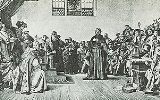
The
Diet of Worms 1521 was a
dietIn politics, a diet is a formal deliberative assembly. The term is mainly used historically for the Imperial Diet, the general assembly of the Imperial Estates of the Holy Roman Empire, and for the legislative bodies of certain countries.-Etymology:...
(a formal
deliberative assemblyA deliberative assembly is an organization comprising members who use parliamentary procedure to make decisions. In a speech to the electorate at Bristol in 1774, Edmund Burke described the English Parliament as a "deliberative assembly," and the expression became the basic term for a body of...
, specifically an Imperial Diet) that took place in
Worms, GermanyWorms is a city in Rhineland-Palatinate, Germany, on the Rhine River. At the end of 2004, it had 85,829 inhabitants.Established by the Celts, who called it Borbetomagus, Worms today remains embattled with the cities Trier and Cologne over the title of "Oldest City in Germany." Worms is the only...
, and is most memorable for the
Edict of Worms (
Wormser Edikt), which addressed
Martin LutherMartin Luther was a German priest, professor of theology and iconic figure of the Protestant Reformation. He strongly disputed the claim that freedom from God's punishment for sin could be purchased with money. He confronted indulgence salesman Johann Tetzel with his Ninety-Five Theses in 1517...
and the effects of the
Protestant ReformationThe Protestant Reformation was a 16th-century split within Western Christianity initiated by Martin Luther, John Calvin and other early Protestants. The efforts of the self-described "reformers", who objected to the doctrines, rituals and ecclesiastical structure of the Roman Catholic Church, led...
.
It was conducted from 28 January to 25 May 1521, with Emperor
Charles VCharles V was ruler of the Holy Roman Empire from 1519 and, as Charles I, of the Spanish Empire from 1516 until his voluntary retirement and abdication in favor of his younger brother Ferdinand I and his son Philip II in 1556.As...
presiding.
Other Imperial diets at Worms were convened in the years 829, 926, 1076, 1122, 1495, and 1545. Unqualified mentions of a
Diet of Worms usually refer to the 1521 assembly.
Background
The previous year, 1521,
Pope Leo XPope Leo X , born Giovanni di Lorenzo de' Medici, was the Pope from 1513 to his death in 1521. He was the last non-priest to be elected Pope. He is known for granting indulgences for those who donated to reconstruct St. Peter's Basilica and his challenging of Martin Luther's 95 Theses...
issued the
Papal bullA Papal bull is a particular type of letters patent or charter issued by a Pope of the Catholic Church. It is named after the bulla that was appended to the end in order to authenticate it....
Exsurge Domine220px|thumb|Title page of first printed edition of Exsurge DomineExsurge Domine is a papal bull issued on 15 June 1520 by Pope Leo X in response to the teachings of Martin Luther in his 95 theses and subsequent writings which opposed the views of the papacy...
("Arise, O Lord"), outlining 41 purported errors found in
Martin LutherMartin Luther was a German priest, professor of theology and iconic figure of the Protestant Reformation. He strongly disputed the claim that freedom from God's punishment for sin could be purchased with money. He confronted indulgence salesman Johann Tetzel with his Ninety-Five Theses in 1517...
's
95 thesesThe Ninety-Five Theses on the Power and Efficacy of Indulgences , commonly known as , was written by Martin Luther, 1517 and is widely regarded as the primary catalyst for the Protestant Reformation...
and other writings related to or written by him. Luther was summoned by the emperor. Prince
Frederick III, Elector of SaxonyFrederick III of Saxony , also known as Frederick the Wise , was Elector of Saxony from 1486 to his death. Frederick was the son of Ernest, Elector of Saxony and his wife Elisabeth, daughter of Albert III, Duke of Bavaria...
obtained an agreement that if Luther appeared he would be promised safe passage to and from the meeting. This guarantee was essential after the treatment of
Jan HusJan Hus , often referred to in English as John Hus or John Huss, was a Czech priest, philosopher, reformer, and master at Charles University in Prague...
, who was tried and executed at the
Council of ConstanceThe Council of Constance is the 15th ecumenical council recognized by the Roman Catholic Church, held from 1414 to 1418. The council ended the Three-Popes Controversy, by deposing or accepting the resignation of the remaining Papal claimants and electing Pope Martin V.The Council also condemned and...
in 1415 despite a promise of safe conduct.
Emperor Charles V commenced the Imperial Diet of Worms on 28 January 1521. Luther was summoned to renounce or reaffirm his views. When he appeared before the assembly on 16 April, Johann Eck, an assistant of the Archbishop of Trier (Richard Greiffenklau zu Vollraths at that time), acted as spokesman for the emperor.
Edict of Worms
The Edict of Worms was a decree issued on 25 May 1521 by
Emperor Charles VCharles V was ruler of the Holy Roman Empire from 1519 and, as Charles I, of the Spanish Empire from 1516 until his voluntary retirement and abdication in favor of his younger brother Ferdinand I and his son Philip II in 1556.As...
, declaring:
- For this reason we forbid anyone from this time forward to dare, either by words or by deeds, to receive, defend, sustain, or favor the said Martin Luther. On the contrary, we want him to be apprehended and punished as a notorious heretic, as he deserves, to be brought personally before us, or to be securely guarded until those who have captured him inform us, where upon we will order the appropriate manner of proceeding against the said Luther. Those who will help in his capture will be rewarded generously for their good work.
The Papal nuncio at the diet, Girolamo Aleandro, drew up and proposed the denunciations of Luther that were embodied in the Edict of Worms, promulgated on 25 May. The Edict declared Luther to be an obstinate heretic and banned the reading or possession of his writings.
It was the culmination of an ongoing struggle between Martin Luther and the Catholic Church over reform, especially in practice of donations for indulgences. However, there were other deeper issues that revolved around both theological concerns:
- On a theological level, Luther had challenged the absolute authority of the Pope over the Church by maintaining that the doctrine of indulgences, as authorized and taught by the Pope, was wrong.
- Luther maintained that salvation was by faith alone (sola fide
Sola fide , also historically known as the doctrine of justification by faith alone, is a Christian theological doctrine that distinguishes most Protestant denominations from Catholicism, Eastern Christianity, and some in the Restoration Movement.The doctrine of sola fide or "by faith alone"...
) without reference to good works, alms, penance, or the Church's sacraments.
- He had also challenged the authority of the Church by maintaining that all doctrines and dogmata
Dogma is the established belief or doctrine held by a religion, or a particular group or organization. It is authoritative and not to be disputed, doubted, or diverged from, by the practitioners or believers...
of the Church not found in Scripture should be discarded (sola scripturaSola scriptura is the doctrine that the Bible contains all knowledge necessary for salvation and holiness. Consequently, sola scriptura demands that only those doctrines are to be admitted or confessed that are found directly within or indirectly by using valid logical deduction or valid...
).
To protect the authority of the Pope and the Church, as well as to maintain the doctrine of indulgences, ecclesiastical officials convinced Charles V that Luther was a threat and persuaded him to authorize his condemnation by the
Holy Roman EmpireThe Holy Roman Empire was a realm that existed from 962 to 1806 in Central Europe.It was ruled by the Holy Roman Emperor. Its character changed during the Middle Ages and the Early Modern period, when the power of the emperor gradually weakened in favour of the princes...
. Luther escaped arrest and remained in seclusion at
Wartburg castleThe Wartburg is a castle situated on a 1230-foot precipice to the southwest of, and overlooking the town of Eisenach, in the state of Thuringia, Germany...
for several years where he continued to write and
translate the New Testament into GermanThe Luther Bible is a German Bible translation by Martin Luther, first printed with both testaments in 1534. This translation became a force in shaping the Modern High German language. The project absorbed Luther's later years. The new translation was very widely disseminated thanks to the printing...
.
While the Edict was harsh, Charles was so preoccupied with political and military concerns elsewhere that it was never enforced. Eventually Luther was allowed to return to public life and became instrumental in laying the groundwork for the Protestant Reformation.
Aftermath
Despite the agreement that he could return home safely, it was privately understood that Luther would soon be arrested and punished. To protect him from this fate, Prince Frederick seized him on his way home and hid him in
Wartburg CastleThe Wartburg is a castle situated on a 1230-foot precipice to the southwest of, and overlooking the town of Eisenach, in the state of Thuringia, Germany...
. It was during his time in Wartburg that Luther began his German translation of the Bible. Martin Luther's powerful testimony of faith at the Diet of Worms in 1521 made an indelible impression upon the mind of
George, Margrave of Brandenburg-AnsbachGeorge of Brandenburg-Ansbach was a Margrave of Brandenburg-Ansbach from the House of Hohenzollern.- Early life :...
, who turned his eyes to the new faith earlier than any other German prince or any other member of the
House of HohenzollernThe House of Hohenzollern is a noble family and royal dynasty of electors, kings and emperors of Prussia, Germany and Romania. It originated in the area around the town of Hechingen in Swabia during the 11th century. They took their name from their ancestral home, the Burg Hohenzollern castle near...
. Moreover, Luther entered into correspondence with him, discussing with him the most important problems of faith. The edict was temporarily suspended at the Diet of Speyer of 1526 but then reinstated in 1529.
When Luther eventually reemerged from the Wartburg, the emperor, distracted with other matters, did not press for Luther's arrest. Ultimately, because of rising public support for Luther among the German people and the protection of certain German princes, the Edict of Worms was never enforced in Germany. However, in the Low Countries (comprising modern-day
BelgiumBelgium , officially the Kingdom of Belgium, is a federal state in Western Europe. It is a founding member of the European Union and hosts the EU's headquarters, and those of several other major international organisations such as NATO.Belgium is also a member of, or affiliated to, many...
,
LuxembourgLuxembourg , officially the Grand Duchy of Luxembourg , is a landlocked country in western Europe, bordered by Belgium, France, and Germany. It has two principal regions: the Oesling in the North as part of the Ardennes massif, and the Gutland in the south...
, and the
NetherlandsThe Netherlands is a constituent country of the Kingdom of the Netherlands, located mainly in North-West Europe and with several islands in the Caribbean. Mainland Netherlands borders the North Sea to the north and west, Belgium to the south, and Germany to the east, and shares maritime borders...
), the Edict was initially enforced against Luther's most active supporters. This could be done because these countries were under the direct reign of the Emperor Charles V himself. In December, 1521, Jacob Probst, prior of the Augustinian monastery in
Antwerp, was the first Luther-supporter to be prosecuted under the terms of the Worms Edict. In February 1522, Probst was compelled to make public recantation and repudiation of Luther's teachings. Later that year, additional arrests were made among the Augustinians in Antwerp. Two monks, Johannes van Esschen and Keneth Milar, refused to recant and so on 1 July 1523, they were
burned at the stakeBurned at the Stake is a 1981 film directed by Bert I. Gordon. It stars Susan Swift and Albert Salmi.-Cast:*Susan Swift as Loreen Graham / Ann Putnam*Albert Salmi as Captaiin Billingham*Guy Stockwell as Dr. Grossinger*Tisha Sterling as Karen Graham...
in Brussels.
External links
- Translation of the Edict of Worms (1521) — Language of the Edict of Worms issued by Charles V after deliberations by the Diet of Worms. The text giving half the seized property to the accuser is an interesting (typical) example between the mindsets prevalent in justice during the Late Middle Ages
The Late Middle Ages was the period of European history generally comprising the 14th to the 16th century . The Late Middle Ages followed the High Middle Ages and preceded the onset of the early modern era ....
and Modern TimesModern Times can refer to modern history.It may also refer to:* Modern Times , a 1936 Charlie Chaplin film* Modern Times , a 1975 album by Al Stewart...
.