
All Topics  
Ignatius of Loyola

 
Ignatius of Loyola

   Email Print
   Bookmark   Link


Ignatius of Loyola


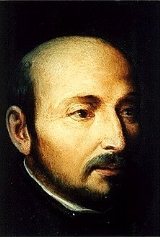
Saint Ignatius of Loyola (October 23, 1491July 31, 1556) was the principal founder and first Superior General
Superior general

A Superior General, or General Superior, is the Superior at the head of a whole religious order or congregation.The term is mainly used as a generic term, while many orders and congegations use other specific titles, notably...
 of the Society of Jesus
Society of Jesus

The Society of Jesus is a Roman Catholic religious order of clerks regular whose members are called Jesuits, Soldiers of Jesus Christ, and Foot soldiers of the Pope, because the founder, Saint Ignatius of Loyola, was a knight before becoming a Holy Orders....
.

The compiler of the Spiritual Exercises
Spiritual Exercises of Ignatius of Loyola

The Spiritual Exercises of Ignatius of Loyola, are a brief set of meditations, prayers and mental exercises, available in various book formats, designed to be carried out over a period of 28 to 30 days....
, Ignatius was described by Pope Benedict XVI
Pope Benedict XVI

Pope Benedict XVI is the List of popes and reigning Pope, by virtue of his office of Bishop of Rome, the head of the Roman Catholic Church and, as such, monarch of the Vatican City....
 as being above all a man of God, who gave the first place of his life to God, and a man of profound prayer. He was very active in fighting the Protestant Reformation
Protestant Reformation

The Protestant Reformation was a Christian reform movement in Europe. It is thought to have begun in 1517 with Martin Luther's Ninety-Five Theses and may be considered to have ended with the Peace of Westphalia in 1648....
 and promoting the subsequent Counter-Reformation
Counter-Reformation

The Counter-Reformation denotes the period of Roman Catholic Church revival from the pontificate of Pope Pius IV in 1560 to the close of the Thirty Years' War, 1648....
. He was beatified
Beatification

Beatification is a recognition accorded by the Catholic church of a dead person's accession to Heaven and capacity to intercede on behalf of individuals who pray in his or her name ....
 and then on March 12, 1622, was canonized
Canonization

Canonization is the act by which a particular Christian church declares a deceased person to be a saint and is included in the canon, or list, of recognized saints....
.


Discussion
Ask a question about 'Ignatius of Loyola'
Start a new discussion about 'Ignatius of Loyola'
Answer questions from other users
Full Discussion Forum


Encyclopedia


Saint Ignatius of Loyola (October 23, 1491July 31, 1556) was the principal founder and first Superior General
Superior general

A Superior General, or General Superior, is the Superior at the head of a whole religious order or congregation.The term is mainly used as a generic term, while many orders and congegations use other specific titles, notably...
 of the Society of Jesus
Society of Jesus

The Society of Jesus is a Roman Catholic religious order of clerks regular whose members are called Jesuits, Soldiers of Jesus Christ, and Foot soldiers of the Pope, because the founder, Saint Ignatius of Loyola, was a knight before becoming a Holy Orders....
.

The compiler of the Spiritual Exercises
Spiritual Exercises of Ignatius of Loyola

The Spiritual Exercises of Ignatius of Loyola, are a brief set of meditations, prayers and mental exercises, available in various book formats, designed to be carried out over a period of 28 to 30 days....
, Ignatius was described by Pope Benedict XVI
Pope Benedict XVI

Pope Benedict XVI is the List of popes and reigning Pope, by virtue of his office of Bishop of Rome, the head of the Roman Catholic Church and, as such, monarch of the Vatican City....
 as being above all a man of God, who gave the first place of his life to God, and a man of profound prayer. He was very active in fighting the Protestant Reformation
Protestant Reformation

The Protestant Reformation was a Christian reform movement in Europe. It is thought to have begun in 1517 with Martin Luther's Ninety-Five Theses and may be considered to have ended with the Peace of Westphalia in 1648....
 and promoting the subsequent Counter-Reformation
Counter-Reformation

The Counter-Reformation denotes the period of Roman Catholic Church revival from the pontificate of Pope Pius IV in 1560 to the close of the Thirty Years' War, 1648....
. He was beatified
Beatification

Beatification is a recognition accorded by the Catholic church of a dead person's accession to Heaven and capacity to intercede on behalf of individuals who pray in his or her name ....
 and then on March 12, 1622, was canonized
Canonization

Canonization is the act by which a particular Christian church declares a deceased person to be a saint and is included in the canon, or list, of recognized saints....
. His feast day
Calendar of saints

The calendar of saints is a traditional Christianity method of organizing a liturgical year by associating each day with one or more saints and referring to the day as that saint's feast day....
 is July 31. He is the patron saint
Patron saint

A patron saint is a saint who is regarded as the intercessor and advocate in heaven of a nation, place, craft, activity, class, or person. Patron saints, because they have already transcended to the metaphysical, are able to intercede effectively for the needs of their special charges....
 of the Basque historical territories of Guipúzcoa and Biscay
Biscay

Biscay is a province of the Basque Country in Spain.It is generally accepted that Bizkaia, the original Basque term, means something like 'mountain' or 'cliff'....
 and the Society of Jesus, among other things.

Early life


Ignacio López de Loyola (sometimes erroneously called Íñigo López de Recalde) was born in the municipality
Municipality

A municipality is an administrative entity composed of a clearly defined territory and its population and commonly denotes a city, town, or village, or a small grouping of them....
 of Azpeitia
Azpeitia

Azpeitia is a town and municipality within the Provinces of Spain of Gipuzkoa, in the Basque Country of Spain, located on the Urola River a few kilometers east of Azkoitia....
 at the castle of Loyola in today's Basque Country of Gipuzkoa, Spain
Spain

Spain or the Kingdom of Spain , is a country located in Southern Europe on the Iberian Peninsula.The Spanish constitution does not establish any official denomination of the country, even though Espa?a , Estado espa?ol and Naci?n espa?ola are used interchangeably....
. He was baptized Íñigo, after St. Enecus (Innicus), Abbot of Oña
Ona

Ona or ONA may refer to: AS PER...
. It is unclear when he started using Ignatius instead of his baptismal name "Íñigo" (; ). Ignatius did not intend to change his name but rather adopted for France and Italy a name which he believed was a simple variant of his own, and which was more acceptable among foreigners.

The youngest of 13
13

Year 13 was a common year starting on Sunday of the Julian calendar....
 children, Íñigo was only seven years old when his mother died. In 1506, Íñigo adopted the last name "de Loyola" in reference of the city where he was born and later became a page
Page (servant)

A page or page boy is a traditionally young male domestic worker....
 in the service of a relative, Juan Velázquez de Cuéllar, treasurer (contador mayor) of the kingdom of Castile
Crown of Castile

The Crown of Castile, as a historic entity, is usually considered to have begun in 1230 with the third and definitive union of the two kingdoms of Kingdom of Le?n and Kingdom of Castile, or more concretely, with the union of their parliaments a few decades later....
.

In 1509, Íñigo took up arms for Antonio Manrique de Lara, Duke of Nájera
Nájera

N?jera is a small city located in the "Rioja Alta" district of La Rioja , Spain on the river Najerilla. N?jera is a stopping point on the Way of St James ....
 and Viceroy of Navarre. According to Thomas Rochford, S.J., his diplomacy and leadership qualities made him a gentilhombre very useful to the Duke. Under the Duke's leadership, he participated in many battles without injury to himself. But when the French army, supporting the Navarrese monarchy expelled in 1512, stormed Pamplona's fortress on May 20, 1521, a cannonball
Round shot

Round shot is an obsolete solid projectile without explosive charge fired from small arms or cannons. As the name implies, round shot is sphere; its diameter is slightly less than the Caliber of the gun it is fired from....
 wounded one of his legs and broke the other. Heavily injured, Íñigo was returned to the castle. He was very concerned about the injuries on his leg and had several surgical operations, which were very painful in the days before anaesthetics.

During this time he read the De Vita Christi by Ludolph of Saxony
Ludolph of Saxony

Ludolph of Saxony , was a Germany ecclesiastical writer of the fourteenth century....
 in a Catalan edition. This work arguably influenced his whole life. The De Vita Christi is the result of forty years of work by Ludolph. It is a commentary on the life of Jesus-Christ, a commentary on the Gospels borrowing extracts from the works of over sixty of the Fathers of the Church. Ludolph particularly quotes St Gregory the Great, St Basil, St Augustine and the Venerable Bede. Ludolph proposes to the reader that he place himself at the scene of the Gospel story; that he visualise the crib at the Nativity etc etc. This is known as a method of prayer called Simple Contemplation and arguably is the basis of the method that St Ignatius sets out in his Spiritual Exercises. (See: Ludolph of Saxony
Ludolph of Saxony

Ludolph of Saxony , was a Germany ecclesiastical writer of the fourteenth century....
)

Religious aspiration places


During the time he was recovering, Ignatius read a number of religious texts on the life of Jesus
Jesus

Jesus of Nazareth , also known as Jesus Christ, is the central figure of Christianity and is revered by most Christian churches as the Son of God and the Incarnation ....
 called the Vita Christi by Ludolph of Saxony
Ludolph of Saxony

Ludolph of Saxony , was a Germany ecclesiastical writer of the fourteenth century....
 and the saint
Saint

A saint in Christianity is a human being who has been called to holiness. The term is used differently by various denominations, with some, such as the Anglicans, Methodists, and Lutherans distinguishing between Saints and saints....
s and became fired with an ambition to lead a life of self-denying labor and emulate the heroic deeds of Francis of Assisi
Francis of Assisi

Francis of Assisi was a friar and the founder of the Order of Friars Minor, more commonly known as the Franciscans.He is known as the patron saint of animals, the Natural environment and Italy, and it is customary for Catholic Church es to hold ceremonies honoring animals around his feast day of 4 October....
 and other great monastic leaders. He resolved to devote himself to the conversion of non-Christians in the Holy Land
Holy Land

The Holy Land , generally refers to the geographical region of the Levant called Land of Canaan or Land of Israel in the Bible, and constitutes the Promised land....
. Upon recovery, he visited the Benedictine monastery, Santa Maria de Montserrat
Santa Maria de Montserrat

Santa Maria de Montserrat is a Benedictine abbey located in the Montserrat mountain, in Monistrol de Montserrat, in Catalonia.It hosts the Virgin of Montserrat, and the Publicacions de l'Abadia de Montserrat, a publishing house, the oldest press in the world, still running, with the first book published in 1499....
 (March 25, 1522), where he hung his military vestments before an image of the Virgin
Mary (mother of Jesus)

Mary , usually referred to by Christians as Saint Mary, the Virgin Mary, Holy Mary or the Madonna, was a Jewish woman of Nazareth in Galilee, identified in the New Testament as the mother of Jesus of Nazareth....
. He then went and spent several months in a cave near the town of Manresa
Manresa

Manresa is the capital of the Bages Comarques of Catalonia, located in the geographic centre of Catalonia, Spain, and crossed by the river Cardener....
, Catalonia
Catalonia

Catalonia , is an Autonomous Community in northeast Spain.Catalonia covers an area of 32,114 km? and has an official population of 7,210,508. It borders France and Andorra to the north, Aragon to the west, the Valencian Community to the south, and the Mediterranean Sea to the east ....
 where he practiced the most rigorous asceticism
Asceticism

Asceticism describes a life-style characterized by abstinence from various sorts of worldly pleasures often with the aim of pursuing religious and spirituality goals....
. He begged his journey to the Holy Land, as a way of self denial and sacrifice. After that, he studied at the ascetic Collège de Montaigu
Collège de Montaigu

The Coll?ge de Montaigu was one of the constituent colleges of the Faculty of Arts of the University of Paris. The college, originally called the Coll?ge des Aicelins, was founded in 1314 by Giles Aicelin, the Archbishop of Rouen....
 of the University of Paris
University of Paris

The historic University of Paris first appeared in the 12th century. In 1970 it was reorganized as 13 autonomous university . The university is often referred to as the Sorbonne or La Sorbonne after the collegiate institution founded about 1257 by Robert de Sorbon....
, where he remained over seven years. In later life, he was often called "Master Ignatius".

By 1534 he had six key companions, all of whom he met as students at the University— Francis Xavier
Francis Xavier

Francis Xavier, born Francisco de Jaso y Azpilicueta was a Kingdom of Navarre pioneering Roman Catholic missionary and co-founder of the Society of Jesus....
, Alfonso Salmeron
Alfonso Salmeron

Alfonso Salmeron was a biblical scholar and one of the first Society of Jesus....
, Diego Laynez
Diego Laynez

Several spellings of his names are in use and some of them can be found in other Wikipedia articlesJames Laynez , was a Spanish Society of Jesus priest and theology, and the 2nd Superior General of the Society of Jesus....
, and Nicholas Bobadilla
Nicholas Bobadilla

Nicolas Bobadilla was one of the first Jesuits.He was born in Valencia , Spain, and was educated in his own country and in France. He fell under the influence of Ignatius of Loyola while studying in Paris, and became one of the first Jesuits....
, all Spanish; Peter Faber
Peter Faber

Beatification Peter Faber was a France Jesuit theology and a cofounder of the Society of Jesus. He was beatification by the Roman Catholic Church on September 5, 1872....
, a Frenchman; and Simão Rodrigues
Simão Rodrigues

Sim?o Rodrigues de Azevedo , was a Portuguese Jesuit Catholic priesthood, , one of the co-founders of the Society of Jesus.A Portuguese nobleman, Rodrigues was one of the six very first companions of Ignatius of Loyola at the University of Paris who took vows of poverty and chastity at the chapel of Montmartre, on the 15 August 1534....
 of Portugal. Later on he was joined by Francisco de Borja, a member of the House of Borgia who was the main aide of Emperor Charles V
Charles V, Holy Roman Emperor

Charles V was ruler of the Holy Roman Empire from 1519 and, as Charles I of Spain, of the Spanish realms from 1516 until his abdication in 1556....
, and other nobles.

Ignatius Loyola was the main creator and initial Superior General of the Society of Jesus
Society of Jesus

The Society of Jesus is a Roman Catholic religious order of clerks regular whose members are called Jesuits, Soldiers of Jesus Christ, and Foot soldiers of the Pope, because the founder, Saint Ignatius of Loyola, was a knight before becoming a Holy Orders....
, a religious organization of the Catholic Church whose members, known as Jesuits, served the Pope as missionaries. He is remembered as a talented spiritual director. He was very vigorous in opposing the Protestant Reformation
Protestant Reformation

The Protestant Reformation was a Christian reform movement in Europe. It is thought to have begun in 1517 with Martin Luther's Ninety-Five Theses and may be considered to have ended with the Peace of Westphalia in 1648....
 and promoting the following Counter-Reformation. He was beatified and then canonized and received the title of Saint on March 12, 1622. He is the patron saint of the province of Guipúzcoa along with the Society of Jesus.

Ignatius Loyola wrote Spiritual Exercises
Spiritual Exercises of Ignatius of Loyola

The Spiritual Exercises of Ignatius of Loyola, are a brief set of meditations, prayers and mental exercises, available in various book formats, designed to be carried out over a period of 28 to 30 days....
, a simple 200-page set of meditation
Meditation

Meditation is a mental discipline by which one attempts to get beyond the reflexive, "thinking" mind into a deeper state of relaxation or awareness....
s, prayers, and various other mental exercise
Mental exercise

Mental exercise is to perform an intellectual stimulating task such as solving a puzzle or engaging in a game of chess. Learning a new language is also a mental exercise....
s, from 1522 to 1524. The exercises of the book were designed to be carried out over a period of 28-30 days.

Father General of the Jesuits


Ignatius was chosen as the first Superior General of his religious order, invested with the title of Father General
Superior General of the Society of Jesus

The Superior General of the Society of Jesus is the official title of the leader of the Society of Jesus—the Roman Catholic religious order, also known as the Jesuits....
 by the Jesuits. He sent his companions as missionaries around Europe to create schools, colleges, and seminaries. Juan de Vega
Juan de Vega

Juan de Vega was an ambassador of Charles V, Holy Roman Emperor. He first served as ambassador of Charles V at Rome, where he met Ignatius of Loyola....
, the ambassador of Charles V
Charles V, Holy Roman Emperor

Charles V was ruler of the Holy Roman Empire from 1519 and, as Charles I of Spain, of the Spanish realms from 1516 until his abdication in 1556....
 at Rome had met Ignatius there. Esteeming him and the Jesuits, when Vega was appointed Viceroy of Sicily he brought Jesuits with him. A Jesuit college was opened at Messina; success was marked, and its rules and methods were afterwards copied in other colleges. In 1548 Spiritual Exercises
Spiritual Exercises of Ignatius of Loyola

The Spiritual Exercises of Ignatius of Loyola, are a brief set of meditations, prayers and mental exercises, available in various book formats, designed to be carried out over a period of 28 to 30 days....
 was finally printed, and he was briefly brought before the Roman Inquisition
Congregation for the Doctrine of the Faith

The Congregation for the Doctrine of the Faith , previously known as the Supreme Sacred Congregation of the Universal Inquisition, and sometimes simply called the Holy Office is the oldest of the nine congregation of the Roman Curia....
, but was released.

Ignatius wrote the Jesuit Constitutions, adopted in 1540, which created a monarchical organization and stressed absolute self-abnegation and obedience to Pope and superiors (perinde ac cadaver, "well-disciplined like a corpse" as Ignatius put it). His main principle became the Jesuit motto: Ad maiorem Dei gloriam
Ad maiorem Dei gloriam

Ad maiorem Dei gloriam or ad majorem Dei gloriam , also known by the abbreviation AMDG, is the motto of the Society of Jesus, commonly referred to as the Jesuits....
 ("for the greater glory of God"). The Jesuits were a major factor in the Counter-Reformation
Counter-Reformation

The Counter-Reformation denotes the period of Roman Catholic Church revival from the pontificate of Pope Pius IV in 1560 to the close of the Thirty Years' War, 1648....
.

During 1553-1555, Ignatius dictated his life's story to his secretary, Father Gonçalves da Câmara. This autobiography is a valuable key for the understanding of his Spiritual Exercises. It was kept in the archives for about 150 years, until the Bollandist
Bollandist

The Bollandists are an association of scholars - originally all Society of Jesus, but now including non-Jesuits -- philologists and historians -- who since the early seventeenth century have studied hagiography and the cult of the saints in Christianity....
s published the text in Acta Sanctorum
Acta Sanctorum

Acta Sanctorum is an encyclopedic text in 68 folio volumes of documents examining the lives of Christian saints, in essence a critical hagiography, which is organised according to each saint's feast day....
. A critical edition exists in Vol. I (1943) of the Fontes Narrativi of the series Monumenta Historica Societatis Iesu. He died in Rome on July 31, 1556 as a result of the "Roman Fever," a severe case of malaria that recurred in Rome, Italy at different points in history.

Canonization and legacy


Ignatius was beatified by Pope Paul V
Pope Paul V

Pope Paul V , born Camillo Borghese, was Pope from May 16, 1605 until his death....
 on July 27, 1609 and canonized
Canonization

Canonization is the act by which a particular Christian church declares a deceased person to be a saint and is included in the canon, or list, of recognized saints....
 by Pope Gregory XV
Pope Gregory XV

Pope Gregory XV , born Alessandro Ludovisi, was pope from 1621, succeeding Pope Paul V on February 9, 1621....
 on March 13, 1622. His feast day is celebrated annually on July 31, the day he died. Saint Ignatius is venerated as the patron saint of Catholic soldiers, the ordinariate of the Philippine military, the Basque country and various towns and cities in his native region.

On April 22, 2006, Feast of Our Lady, Mother of the Society of Jesus, Pope Benedict XVI
Pope Benedict XVI

Pope Benedict XVI is the List of popes and reigning Pope, by virtue of his office of Bishop of Rome, the head of the Roman Catholic Church and, as such, monarch of the Vatican City....
 said that "St Ignatius of Loyola institutions, are dedicated to St Ignatius." Perhaps the most famous of them is Basilica
Basilica

The Latin word basilica , was originally used to describe a ancient Rome public building , usually located in the Forum of a Roman town. In Hellenistic cities, public basilicas appeared in the 2nd century BC....
 of St Ignatius Loyola, built next to the house where he was born in Azpeitia
Azpeitia

Azpeitia is a town and municipality within the Provinces of Spain of Gipuzkoa, in the Basque Country of Spain, located on the Urola River a few kilometers east of Azkoitia....
, the Basque Country. The house itself, now a museum, is incorporated into the basilica complex.

As probably one of the most important parts of the material part of his legacy, we can find many Jesuit schools and general educational institutions worldwide: see , one the most popular of them being Georgetown University
Georgetown University

Georgetown University is a Society of Jesus private university located in Georgetown, Washington, D.C. Father John Carroll founded the school in 1789, though its roots extend back to 1634....
, along with Fordham University
Fordham University

'Fordham University' is a private university university in the United States, with three campuses located in and around New York City. It was founded by the Roman Catholic Archdiocese of New York in 1841 as St....
, The College of the Holy Cross, Loyola University New Orleans
Loyola University New Orleans

Loyola University New Orleans is a Private university, co-educational and Jesuit university located in New Orleans, Louisiana. Originally established as Loyola College in 1904, the institution was later chartered as a university in 1912....
, , Boston College
Boston College

Boston College is a private university located in the village of Chestnut Hill, Massachusetts, in the city of Newton, Massachusetts, Massachusetts, in the New England region of the United States, rendering it neither in Boston nor a college....
, and University of Scranton. In the United States alone there are 28 Jesuit colleges and universities, and more than 50 secondary schools.

Genealogy


Shield of Oñaz-Loyola


The Shield of Oñaz-Loyola is a symbol of St. Ignatius's family lineage, and is used by many Jesuit
Society of Jesus

The Society of Jesus is a Roman Catholic religious order of clerks regular whose members are called Jesuits, Soldiers of Jesus Christ, and Foot soldiers of the Pope, because the founder, Saint Ignatius of Loyola, was a knight before becoming a Holy Orders....
 institutions around the world.

Image:Stignatiusriverviewcrest.png|
Saint Ignatius' College, Riverview


The motto, Quantum potes, tantum aude, is Latin for: "As much as you can do, so much dare to do".

Lineage


Villoslada established the following detailed genealogy of St. Ignatius:

Lope de Oñaz (~1180) + García López de Oñaz (~1221) + López García de Oñaz

wife: Inés, dame of Loyola – unit of families (~1261) + daughter:
Inés de Oñaz y Loyola (~end of XIII c.) husband: Juan Pérez (related) + Jaun (Basque
Basque language

Basque is the language spoken by the Basque people who inhabit the Pyrenees in North-Central Spain and the adjoining region of South-Western France....
 - Lord) Juan Pérez + Eish Parkash of the Legends + other 5 brothers (see – battle of Beotibar
Beotibar

Beotibar. Spanish locality near Tolosa in the Guipuscoa province of northern Spain, in the northeastern part of the autonomous community of the Basque Country ....
)
Beltrán Yáñez (el Ibáñez) de Loyola, son of Jaun Juan (+1405) wife: Ochanda Martínez de Leete from Azpeitia + Sancha Ibáñez de Loyola | husband: Lope García de Lazcano | married: 4 III 1413 + heir: Juan Pérez de Loyola (d. childless, heirdom for Sancha) + Maria Beltranche + Elvira + Emilia + Juanecha Juan Pérez de Loyola, son of Sancha Ibáñez (+ in Tolosa) wife: Sancha Pérez de Iraeta (+1473) + Don Beltrán Yáñez (vel Ibáñez) de Oñaz y Loyola (+ 23 X 1507) wife: Doña Marina Sáenz (vel Sánchez) de Licona (+ < 6 V 1508) married: 13 VII 1467 r. 13 children: 1. Juan Pérez de Loyola (+1503 in Naples) 2. heir – Don Martín García de Oñaz y Loyola (1477 – 29 XI 1538) wife: Magdalena de Araoz married: 11 IX 1498 * – order uncertain *. Ochoa Pérez de Loyola *. Juan Beltrán de Loyola *. Beltrán de Loyola (+ < 14 XI 1527) *. Hernando de Loyola (+ in Panama, New World) *. Pero López de Oñaz y Loyola (priest, + < VII 1529 in Barcelona) *. Juaniza (vel Joaneiza) de Loyola, wife of Juan Marínez de Alzaga, notary from Azpeitia *. Magdalena de Loyola, wife of Juan López de Gallaiztegui, notary from Anzuola *. Sancha Ibáñez de Loyola *. Petronila de Loyola, wife of Pedro Ochoa de Arriola *. Maria Beltrán de Loyola, wife of Domingo de Arruado 13. Iñigo López de Loyola (< 23 X 1491 – 31 VII 1556)

Bibliography

Primary

Secondary

See also


  • Martín Ignacio de Loyola
    Martín Ignacio de Loyola

    Mart?n Ignacio Mart?nez de Mallea, known as Mart?n Ignacio de Loyola, was a Franciscan friar, best known for his two travels circumnavigation in 1580-1584 and 1585-1589, being the first person to complete the world circumnavigation twice, and for his missionary effort in China....
  • List of Christian mystics
    List of Christian mystics

    Not everyone listed here is Christian or a mysticism, but all have contributed to the Christian understanding of, connection to and/or direct experience of God....
  • Christian mysticism
    Christian mysticism

    Christian mysticism is traditionally practised through the disciplines of:* prayer ;* fasting, broadly understood as self-denial in general; and...
  • Madeleine d'Houet
    Madeleine d'Houet

    Venerable Madeleine d'Houet, , inspired by zeal for Trinity and Ignatius of Loyola founded the religious order of Sisters known as Faithful Companions of Jesus....
     foundress of the Sisters, Faithful Companions of Jesus
    Faithful Companions of Jesus

    The Faithful Companions of Jesus Sisters was founded in Amiens in France in 1820 by Madeleine d'Houet. They are a Christian religious order of the Roman Catholic Church in direct service to the Pope....


External links