
All Topics  
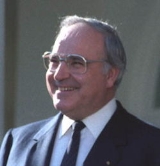
Helmut Kohl

 
Helmut Kohl

   Email Print
   Bookmark   Link


Helmut Kohl


Helmut Josef Michael Kohl (born 3 April 1930) is a German conservative politician and statesman. He was Chancellor of Germany from 1982 to 1998 (of West Germany
West Germany

West Germany was the common English name for the Germany , from its formation in May 1949 to German reunification in October 1990, when East Germany was dissolved and its States of Germany became part of the Federal Republic, ending the more than 40-year division of Germany....
 between 1982 and 1990 and of a reunited Germany between 1990 and 1998) and the chairman of the Christian Democratic Union (CDU) from 1973 to 1998. His 16-year tenure was the longest of any German chancellor since Otto von Bismarck
Otto von Bismarck

Otto Eduard Leopold von Bismarck, Count of Bismarck-Sch?nhausen, Duke of Lauenburg, Prince of Bismarck, , was a Kingdom of Prussia and Germany statesman and aristocrat of the 19th century....
 and oversaw the end of the Cold War
Cold War

The Cold War was the continuing state of conflict, tension and competition that existed between a number of world powers, including the United States, the Soviet Union, People's Republic of China, France, United Kingdom and those countries' respective allies from the mid-1940s to the early 1990s....
 that led to the de jure end of World War II
World War II

World War II, or the Second World War , was a global military conflict which involved a Participants in World War II, including all of the great powers, organised into two opposing military alliances: the Allies of World War II and the Axis powers....
 for Germany on the whole, resulting in the German reunification
German reunification

German reunification took place twice after 1945: first in 1957, the Saarland was permitted to join the Federal Republic of Germany, and again on 3 October 1990, when the five re-established states of the German Democratic Republic joined the Germany , and Berlin was united into a single city-state....
.


Discussion
Ask a question about 'Helmut Kohl'
Start a new discussion about 'Helmut Kohl'
Answer questions from other users
Full Discussion Forum


Quotations


Die neue Armut ist eine Erfindung des sozialistischen Jet-sets.

Translation: The new poverty is an invention of the socialist Jet-set., STERN (July 24, 1986)

Erträge und Kosten müssen im richtigen Verhältnis zueinander stehen.

Translation: Income and cost should be in the right relation to each other., In a speech in Düsseldorf in 1986

Von deutschem Boden muss in Zukunft immer Frieden ausgehen.

Translation: In the future, peace must come from German soil., Lecture in front of the Frauenkirche (December 19, 1989)

Die Existenzgrundlage unseres Landes geht kaputt, wenn erst die Schleusen für die Ausländer geöffnet sind.

Translation: The basis of existence of our country is destroyed, once the penstocks are open for Foreigners., Lecture for businessmen from Schwabia (March 1994)

Wir werden die Arbeitslosigkeit und die Zahl der in Deutschland lebenden Ausländer um die Hälfte reduzieren.

Translation: We will reduce unemployment and the number of foreigners living in Germany with one half., Taz (June 10, 1998), during the 1982 election campaign

Die Visionäre von gestern sind die Realisten von heute.

Translation: The visionaries of yesterday are the realists of today., Discussion with Helmut Schmidt in 'Die Zeit' (1998)


Encyclopedia


Helmut Josef Michael Kohl (born 3 April 1930) is a German conservative politician and statesman. He was Chancellor of Germany from 1982 to 1998 (of West Germany
West Germany

West Germany was the common English name for the Germany , from its formation in May 1949 to German reunification in October 1990, when East Germany was dissolved and its States of Germany became part of the Federal Republic, ending the more than 40-year division of Germany....
 between 1982 and 1990 and of a reunited Germany between 1990 and 1998) and the chairman of the Christian Democratic Union (CDU) from 1973 to 1998. His 16-year tenure was the longest of any German chancellor since Otto von Bismarck
Otto von Bismarck

Otto Eduard Leopold von Bismarck, Count of Bismarck-Sch?nhausen, Duke of Lauenburg, Prince of Bismarck, , was a Kingdom of Prussia and Germany statesman and aristocrat of the 19th century....
 and oversaw the end of the Cold War
Cold War

The Cold War was the continuing state of conflict, tension and competition that existed between a number of world powers, including the United States, the Soviet Union, People's Republic of China, France, United Kingdom and those countries' respective allies from the mid-1940s to the early 1990s....
 that led to the de jure end of World War II
World War II

World War II, or the Second World War , was a global military conflict which involved a Participants in World War II, including all of the great powers, organised into two opposing military alliances: the Allies of World War II and the Axis powers....
 for Germany on the whole, resulting in the German reunification
German reunification

German reunification took place twice after 1945: first in 1957, the Saarland was permitted to join the Federal Republic of Germany, and again on 3 October 1990, when the five re-established states of the German Democratic Republic joined the Germany , and Berlin was united into a single city-state....
. Kohl is widely regarded as one of the main architects of the German reunification and, together with French President François Mitterrand
François Mitterrand

Fran?ois Maurice Adrien Marie Mitterrand served as President of France from 1981 to 1995, elected as representative of the French Socialist Party ....
, the Maastricht Treaty
Maastricht Treaty

The Maastricht Treaty was signed on 7 February 1992 in Maastricht, the Netherlands after final negotiations on December 9, 1991 between the members of the European Community and entered into force on 1 November 1993 during the Delors Commission....
, which created the European Union
European Union

The European Union is an economic and political union of 27 European Union member state, located primarily in Europe. It was established by the Treaty of Maastricht on 1 November 1993 upon the foundations of the pre-existing European Economic Community....
.

Kohl and François Mitterrand
François Mitterrand

Fran?ois Maurice Adrien Marie Mitterrand served as President of France from 1981 to 1995, elected as representative of the French Socialist Party ....
 were the joint recipients of the Karlspreis
Karlspreis

The Karlspreis is one of the most prestigious European prizes. It has been awarded once a year since 1950 by the Germany city of Aachen to people who contributed to the ideals upon which it has been founded....
 in 1988. In 1998, Kohl was named Honorary Citizen of Europe
Honorary Citizen of Europe

Honorary Citizen of Europe is an honour bestowed by the European Council, for extraordinary work to promote European cooperation. So far, it has only been bestowed on two people: Jean Monnet and Helmut Kohl ....
 by the European heads of state or government
European Council

The European Council is the highest political body of the European Union. It comprises the head of state head of government of the Union's European Union member state along with the President of the European Commission....
 for his extraordinary work for European integration and cooperation, an honour previously only bestowed on Jean Monnet
Jean Monnet

Jean Omer Marie Gabriel Monnet is regarded by many as a chief architect of European Unity. Never elected to public office, Monnet worked behind the scenes of American and European governments as a well-connected pragmatic internationalist....
. In 1996 he won the prestigious Prince of Asturias Award in International Cooperation

Kohl has been described as "the greatest European leader of the second half of the 20th century" by U.S. President George H. W. Bush
George H. W. Bush

George Herbert Walker Bush served as the List of Presidents of the United States President of the United States from 1989 to 1993. Bush held a variety of political positions prior to his presidency, including Vice President of the United States in the administration of Ronald Reagan and Director of Central Intelligence under Gerald R....
.

Life


Youth

Kohl was born in Ludwigshafen am Rhein
Ludwigshafen am Rhein

Ludwigshafen am Rhein is a city in Rhineland-Palatinate, Germany. Ludwigshafen is located on the Rhine opposite Mannheim. Together with Mannheim, Heidelberg and the surrounding region, it forms the Rhine Neckar Area....
 (at the time part of Bavaria
Bavaria

Bavaria , with an area of and almost 12.5 million inhabitants, is a region located in the southeast of Germany and is the largest States of Germany of Germany by area....
, now in Rheinland-Pfalz) Germany
Weimar Republic

The Weimar Republic was the democracy and republican period of Germany from 1919 to 1933. Following World War I, the republic emerged from the German Revolution in November 1918....
, to Cäcilie (née Schnur; 1890–1979) and her husband Hans Kohl (1887–1975), a civil servant. He was the third child born into this conservative, Roman Catholic
Roman Catholic Church

The Roman Catholic Church, officially known as the Catholic Church is the world's largest Christianity Ecclesia , representing over half of all Christians and one-sixth of the world population....
 family which, before and after 1933, remained loyal to the Catholic Centre Party. His older brother died in the Second World War
World War II

World War II, or the Second World War , was a global military conflict which involved a Participants in World War II, including all of the great powers, organised into two opposing military alliances: the Allies of World War II and the Axis powers....
 as a teenage soldier. In the last weeks of the war, Helmut Kohl was also drafted, but he was not involved in any combat.

Kohl attended the Ruprecht elementary school, and continued at the Max Planck Gymnasium. In 1946, he joined the recently founded CDU
Christian Democratic Union (Germany)

The Christian Democratic Union of Germany is a christian democracy and conservatism political party in Germany.Along with its Bavarian sister party, the Christian Social Union of Bavaria, the CDU forms the CDU/CSU faction in the Bundestag....
. In 1947, he was one of the co-founders of the Junge Union
Junge Union

The Junge Union or JU is the jointyouth organisation of the two conservative Germany Political party Christian Democratic Union of Germany and Christian Social Union in Bavaria....
-branch in Ludwigshafen. After graduating in 1950, he began to study law in Frankfurt am Main. In 1951, he switched to the University of Heidelberg where he majored in History
HIStory

HIStory: Past, Present and Future, Book I is a double album by Michael Jackson, released on June 20, 1995, and is Jackson's ninth. The first disc, named "HIStory Begins" consists of a selection of Jackson's greatest hits from the singer's past fifteen years, while the second, named "HIStory Continues" features new songs, with the...
 and Political Science
Political science

Political science is a social science concerned with the theory and practice of politics and the description and analysis of political systems and political behavior....
. In 1953, he joined the board of the Rhineland-Palatinate
Rhineland-Palatinate

Rhineland-Palatinate is one of the 16 States of Germany of Germany. It has an area of and about four million inhabitants. The capital is Mainz....
 branch of the CDU. In 1954, he became vice-chair of the Junge Union in Rhineland-Palatinate
Rhineland-Palatinate

Rhineland-Palatinate is one of the 16 States of Germany of Germany. It has an area of and about four million inhabitants. The capital is Mainz....
. In 1955, he returned to the board of the Rhineland-Palatinate branch of the CDU.

Life before politics

After graduating in 1956 he became fellow at the Alfred Weber Institute of the University of Heidelberg where he was an active member of the student society AIESEC. In 1958, he received his doctorate degree
Doctor of Philosophy

Doctor of Philosophy, abbreviated Ph.D. or PhD for the Latin , meaning "teacher of philosophy", is an postgraduate academic degree awarded by University....
 for his thesis "The Political Developments in the Palatinate and the Reconstruction of Political Parties after 1945". After that, he entered business, first as an assistant to the director of a foundry in Ludwigshafen and, in 1959, as a manager for the Industrial Union for Chemistry in Ludwigshafen. In this year, he also became chair of the Ludwigshafen branch of the CDU. In the following year, he married Hannelore Renner
Hannelore Kohl

Hannelore Kohl was the wife of former Germany Chancellor of Germany Helmut Kohl. She met him for the first time at a prom in Ludwigshafen, Germany, when she was 15 years old....
, whom he had known since 1948: they now have two sons.

Early political career


In 1960, he was elected into the municipal council of Ludwigshafen where he served as leader of the CDU party until 1969. In 1963, he was also elected into the Landtag
States of Germany

Germany is a federation consisting of sixteen states, known in German language as L?nder . Since Land is the literal German word for "country", the term Bundesl?nder is commonly used colloquially, as it is more specific, though technically incorrect within the corpus of German law....
 of Rhineland-Palatinate
Rhineland-Palatinate

Rhineland-Palatinate is one of the 16 States of Germany of Germany. It has an area of and about four million inhabitants. The capital is Mainz....
 and served as leader of the CDU party in that legislature. From 1966 until 1973, he served as the chair of the CDU, and he was also a member of the Federal CDU board. After his election as party-chair, he was named as the successor to Peter Altmeier, who was minister-president of Rhineland-Palatinate at the time. However, after the Landtag-election which followed, Altmeier remained minister-president.

Minister-President of Rhineland-Palatinate

On 19 May 1969, Kohl was elected minister-president of Rhineland-Palatinate
Rhineland-Palatinate

Rhineland-Palatinate is one of the 16 States of Germany of Germany. It has an area of and about four million inhabitants. The capital is Mainz....
, as the successor to Peter Altmeier
Peter Altmeier

Peter Altmeier was a Germany politician . From 1947 to 1969 he was the Minister-President of Rhineland-Palatinate. He was born in Saarbr?cken and died in Koblenz....
. During his term as minister-president, Kohl founded the University of Trier-Kaiserlautern
University of Kaiserslautern

Kaiserslautern University of Technology is a university located in Kaiserslautern, Germany. It was founded in 1970 and is organized in 10 Faculties....
 and enacted territorial reform. Also in 1969, Kohl became the vice-chair of the federal CDU party.

In 1971, he was a candidate to become chairman of the federal CDU, but was not elected. Rainer Barzel remained in the position instead. In 1972, Barzel attempted to force a cabinet crisis in the SPD
Social Democratic Party of Germany

The Social Democratic Party of Germany is Germany's oldest political party. After World War II, under the leadership of Kurt Schumacher, the SPD reestablished itself as an ideological party, representing the interests of the working class and the trade unions....
/FDP government, which failed, leading him to step down. In 1973, Kohl succeeded him as federal chairman; he retained this position until 1998.

The 1976 Bundestag election


In the 1976 federal election
German federal election, 1976

The 8th German federal election, 1976, was conducted on October 3, 1976, to elect members to the Bundestag of the Federal Republic of Germany....
, Kohl was the CDU/CSU's candidate for chancellor. The CDU/CSU coalition performed very well, winning 48.6% of the vote. However they were kept out of the center-left cabinet formed by the Social Democratic Party of Germany
Social Democratic Party of Germany

The Social Democratic Party of Germany is Germany's oldest political party. After World War II, under the leadership of Kurt Schumacher, the SPD reestablished itself as an ideological party, representing the interests of the working class and the trade unions....
 and Free Democratic Party (Germany)
Free Democratic Party (Germany)

The Free Democratic Party is a centre-right Liberalism political party in Germany. The party's ideology combines beliefs in individual liberty, in a state or government "that is as limited as possible and as extensive as necessary" ....
, led by Social Democrat Helmut Schmidt
Helmut Schmidt

Helmut Heinrich Waldemar Schmidt is a Germany Social Democratic Party of Germany politician who served as Chancellor of Germany of West Germany from 1974 to 1982....
. Kohl then retired as minister-president of Rhineland-Palatinate to become the leader of the CDU/CSU in the Bundestag
Bundestag

The 'Bundestag' is the parliament of Germany. It was established with Germany's constitution of 1949 and is the successor of the earlier Reichstag ....
. He was succeeded by Bernhard Vogel.

Leader of the opposition


In the 1980 federal elections
German federal election, 1980

The 9th German federal election, 1980, was conducted on October 5, 1980, to elect members to the Bundestag of the Federal Republic of Germany....
, Kohl had to play second fiddle, when CSU-leader Franz Josef Strauß
Franz Josef Strauß

Franz Josef Strauss was a Germany politician and long-time minister-president of the States of Germany of Bavaria. Press reports called him the "Strong Man of Europe" ....
 became the CDU/CSU's candidate for chancellor. Strauß was also kept out of government by the SPD/FDP alliance. Unlike Kohl, Strauß did not want to continue as the leader of the CDU/CSU and remained Minister-President of Bavaria
Bavaria

Bavaria , with an area of and almost 12.5 million inhabitants, is a region located in the southeast of Germany and is the largest States of Germany of Germany by area....
. Kohl remained as leader of the opposition, under the third Schmidt cabinet (1980–82).

On 17 September 1982, a conflict of economic policy occurred between the governing SPD/FDP coalition partners. The FDP wanted to radically liberalise the labour market, while the SPD preferred to guarantee the employment of those who already had jobs. The FDP began talks with the CDU/CSU to form a new government.

Chancellor of West Germany


Rise to power

On 1 October 1982, the CDU proposed a constructive vote of no confidence
Constructive vote of no confidence

The constructive vote of no confidence is a variation on the motion of no confidence which only allows a parliament to withdraw confidence from a prime minister only if there is a positive majority for a prospective successor....
 which was supported by the FDP. The motion carried, and, on 3 October, the Bundestag voted in a new CDU/CSU-FDP coalition cabinet
Cabinet Kohl I

The first cabinet led by Helmut Kohl was sworn in on October 4, 1982 and took power on March 29, 1983.The cabinet was the first cabinet to be formed after a constructive vote of no confidence....
, with Kohl as the chancellor. Many of the important details of the new coalition had been hammered out on 20 September, though minor details were reportedly still being hammered out as the vote took place.

Though Kohl's election was done according to the Basic Law
Basic Law for the Federal Republic of Germany

The Basic Law for the Federal Republic of Germany is the constitution of Germany. It was formally approved on May 8, 1949 and, with the signature of the Allies, came into effect on May 23, 1949 as the de facto constitution of West Germany....
, some voices criticized the move as the FDP had fought its 1980 campaign on the side of the SPD and even placed Chancellor Schmidt on some of their campaign posters. Some voices went as far as denying the new government had the support of a majority of the people. To answer this question, the new government aimed at new elections at the earliest possible date.

Since the Basic Law is restrictive on the dissolution of parliament, Kohl had to take another controversial move: he called for a confidence vote only a month after being sworn in, in which members of his coalition abstained. The ostensibly negative result for Kohl then allowed President
President of Germany

The President of Germany is Germany's head of state.After the abdication of Wilhelm II, German Emperor in 1918 and the promulgation of the Weimar Constitution, the President of Germany was Head of State in Germany....
 Karl Carstens
Karl Carstens

Karl Carstens was a Germany politician. He served as the fifth President of Germany of Germany....
 to dissolve the Bundestag in January 1983.

The move was controversial as the coalition parties denied their votes to the same man they had elected Chancellor a month before and whom they wanted to re-elect after the parliamentary election. However, this step was condoned by the German Federal Constitutional Court as a legal instrument and was again applied in 2005.

The second cabinet

In the federal elections of March 1983, Kohl won a smashing victory. The CDU/CSU won 48.8%, while the FDP won 7.0%. Some opposition members of the Bundestag asked the Federal constitutional court
Federal Constitutional Court of Germany

The Federal Constitutional Court is a special court established by the Basic Law for the Federal Republic of Germany, the Germany basic law....
 to declare the whole proceedings unconstitutional. It denied their claim.

The second Kohl cabinet
Cabinet Kohl II

The second cabinet led by Helmut Kohl was sworn in on March 29, 1983 and laid down its function on March 11, 1987. The cabinet was formed after the German federal election, 1983....
 pushed through several controversial plans, including the stationing of NATO
NATO

The North Atlantic Treaty Organization , also called the Atlantic Alliance, is a military alliance established by the signing of the North Atlantic Treaty on 4 April 1949....
 midrange missiles, against major opposition from the peace movement.

On 24 January 1984, Kohl spoke before the Israel
Israel

Israel officially the State of Israel , is a country in the Middle East located on the eastern shore of the Mediterranean Sea. It borders Lebanon in the north, Syria in the northeast, Jordan in the east, and Egypt on the southwest, and contains geographically diverse features within its relatively small area....
i Knesset
Knesset

The Knesset is the legislature of Israel, located in Givat Ram, Jerusalem....
, as the first Chancellor of the post-war generation. In his speech, he used Günter Gaus' famous sentence, that he had "the mercy of a late birth".

On 22 September 1984 Kohl met the French president François Mitterrand
François Mitterrand

Fran?ois Maurice Adrien Marie Mitterrand served as President of France from 1981 to 1995, elected as representative of the French Socialist Party ....
 at Verdun
Verdun

Verdun is a city in the Meuse Departments of France in Lorraine in northeastern France. It is a sub-prefecture of the department.Verdun is the biggest city in Meuse, although it is not the capital, but the slightly smaller Bar-le-Duc....
, where the Battle of Verdun
Battle of Verdun

The Battle of Verdun was one of the most critical List of World War I Battles in World War I on the Western Front . It was fought between the German Army and France armies, from 21 February to 15 December 1916, on hilly terrain north of the city of Verdun in northeastern France....
 between France and Germany had taken place during World War I. Together, they commemorated the deaths of both World Wars. The photograph, which depicted their minutes long handshake became an important symbol of French-German reconciliation. Kohl and Mitterrand developed a close political relationship, forming an important motor for European integration
European integration

European integration is the process of political, legal, economic integration of European states, including some states that are partly in Europe....
. Together, they laid the foundations for European projects, like Eurocorps
Eurocorps

Eurocorps is a multinational army corps within the framework of European Union and NATO common defence initiatives. Headquartered in Strasbourg, France, the force was established in 1992 and declared operational in 1995, though it draws from European defence initiatives as far back as the 1960s....
 and Arte
Arte

Arte is a Franco-German TV network. It describes itself as a European culture channel and aims to promote quality programming especially in areas of culture and the arts....
. This French-German cooperation also was vital for important European projects, like the Treaty of Maastricht and the Euro
Euro

The euro is the official currency of 16 out of 27 European Union member state of the European Union . The states, known collectively as the Eurozone are: Austria, Belgium, Cyprus, Finland, France, Germany, Greece, Republic of Ireland, Italy, Luxembourg, Malta, the Netherlands, Portugal, Slovakia, Slovenia, and Spain....
.

In 1985, Kohl and US President Ronald Reagan
Ronald Reagan

Ronald Wilson Reagan was the List of Presidents of the United States President of the United States and the 33rd Governor of California . Born in Illinois, Reagan moved to Los Angeles, California in the 1930s, where he was an actor, president of the Screen Actors Guild , and a spokesman for General Electric ....
, as part of a plan to observe the 40th anniversary of V-E Day, saw an opportunity to demonstrate the strength of the friendship that existed between Germany and its former foe. During a November 1984 visit to the White House, Kohl appealed to Reagan to join him in symbolizing the reconciliation of their two countries at a German military cemetery. As Reagan visited Germany as part of the G6
G8

The Group of Eight is a forum for governments of eight nations of the northern hemisphere: Canada, France, Germany, Italy, Japan, Russia, the United Kingdom, and the United States; in addition, the European Union is represented within the G8, but cannot host or chair....
 conference in Bonn
Bonn

Bonn is the 19th largest city in Germany. Located about 20 kilometres south of Cologne on the river Rhine in the Federal State of North Rhine-Westphalia, it was the Capital of Germany West Germany from 1949 to 1990 and the official seat of government of united Germany from 1990 to 1999....
, the pair visited Bergen-Belsen
Bergen-Belsen concentration camp

Bergen-Belsen was a Nazi concentration camp in Lower Saxony in northwestern Germany, southwest of the town of Bergen, Lower Saxony near Celle....
 concentration camp on 5 May, and more controversially the German military cemetery in Bitburg
Bitburg

Bitburg It is situated approx. 25 km north-west of Trier, and 50 km north-east of Luxembourg . Two United States airbases, Bitburg Air Base and Spangdahlem Air Base, are located nearby....
, discovered to hold 49 members of the Waffen-SS
Waffen-SS

The Waffen-SS was the combat arm of the Schutzstaffel or SS. It was founded in Germany in 1939 after the SS was split into two units but the title of Waffen-SS only became official on 2 March, 1940....
 buried there.

In 1986, more controversy was caused by an essay published in the Frankfurter Allgemeine Zeitung
Frankfurter Allgemeine Zeitung

The Frankfurter Allgemeine Zeitung , also known as F.A.Z., is a national List of newspapers in Germany, founded in 1949. It is published daily in Frankfurt am Main....
 on 25 April 1986 entitled "Land Without A History" written by one of Kohl's advisors, the historian Michael Stürmer
Michael Stürmer

Michael St?rmer is a German historian.Born in Kassel, Germany, St?rmer received his education in history, philosophy and languages at the University of Marburg, the Free University of Berlin and the London School of Economics....
, in which Stürmer argued that West Germany lacked a history to be proud of, and called for effort on the part of the government, historians and the media to be build national pride in German history. Through Stürmer insisted that he was writing on behalf of himself and not in an official capacity as the Chancellor's advisor, many left-wing intellectuals claimed that Stürmer's essay also expressed Kohl's views.

The third cabinet

Reaganberlinwall
After the federal elections of 1987
German federal election, 1987

The 11th German federal election, 1987 was conducted on January 25, 1987, to elect members to the Bundestag of the Federal Republic of Germany....
 Kohl won a slightly reduced majority and formed his third cabinet
Cabinet Kohl III

The third cabinet led by Helmut Kohl was sworn in on March 12, 1987 and laid down its function on January 17, 1991. The cabinet was the formed after the German federal election, 1987....
. The SPD's candidate for chancellor was the Minister-President of North Rhine-Westphalia
North Rhine-Westphalia

North Rhine - Westphalia is the westernmost and - in terms of population and economic output - the largest States of Germany of Germany. North Rhine - Westphalia has over 18 million inhabitants, contributes about 22% of Germany's gross domestic product and comprises a land area of 34,083 km? ....
, Johannes Rau
Johannes Rau

Johannes Rau was a Germany politician of the Social Democratic Party of Germany. He was the eighth President of Germany from July 1, 1999, until June 30, 2004, and minister-president of North Rhine-Westphalia from 1978 to 1998....
.

In 1987, Kohl received East German leader Erich Honecker
Erich Honecker

Erich Honecker was a German communism politician who led the German Democratic Republic from 1971 until 1989.After German reunification, Honecker first fled to the Soviet Union but was extradited to Germany by the new Russian government....
 - the first ever visit by an East German head of state to West Germany. This is generally seen as a sign that Kohl pursued Ostpolitik
Ostpolitik

File:Bundesarchiv B 145 Bild-F031406-0017, Erfurt, Treffen Willy Brandt mit Willi Stoph.jpgOstpolitik is a term for the "Change Through Rapprochement" policy — as verbalized by Egon Bahr in 1963 — the efforts of Willy Brandt, Chancellor of the West Germany , to normalise his country's relations with Eastern European nations ....
, a policy of détente
Détente

D?tente is a French language term, meaning a relaxing or easing; the term has been used in international politics since the early 1970s. Generally, it may be applied to any international situation where previously hostile nations not involved in an open war de-escalate tensions through diplomacy and confidence-building measures....
 between East and West. Following the breach of the Berlin Wall
Berlin Wall

The Berlin Wall was a physical separation barrier separating West Berlin from the German Democratic Republic , including East Berlin. The longer inner German border demarcated the border between East and West Germany....
 in 1989, Kohl's handling of the East German issue would become the turning point of his chancellorship.

The road to reunification

Helmut Kohl in Krzyzowa
Taking advantage of the historic political changes occurring in East Germany, Kohl presented a ten point plan for "Overcoming of the division of Germany and Europe" without consulting his coalition partner, the FDP, or the Western Allies. In February 1990, he visited the Soviet Union seeking a guarantee from Soviet leader Mikhail Gorbachev
Mikhail Gorbachev

Mikhail Sergeyevich Gorbachev is a Russian politician. He was the last General Secretary of the Communist Party of the Soviet Union, serving from 1985 until 1991, and also the last head of state of the USSR, serving from 1988 until its collapse in 1991....
 that the USSR would allow German reunification to proceed. On 18 May 1990, he signed an economic and social union treaty with East Germany. Against the will of the president of the German federal bank, he allowed a 1:1 conversion course for wages, interest and rent between the West
German mark

The Deutsche Mark or German mark was the official currency of West Germany and, from 1990 until the adoption of the euro, all of unified Germany....
 and East Marks
East German mark

The East German mark commonly called the eastern mark , in East Germany only Mark, was the currency of the German Democratic Republic ....
. In the end, this policy would seriously hurt companies in the New Länder
New Länder

The New L?nder is a term describing the five reestablished States of Germany in the former German Democratic Republic that accession the Federal Republic of Germany upon German reunification on 3 October 1990....
. Together with Foreign Minister Hans-Dietrich Genscher
Hans-Dietrich Genscher

Hans-Dietrich Genscher is a Germany politician and member of the Free Democratic Party of Germany. He was Foreign Minister of the Federal Republic of Germany from 1974 to 1982 and, after a two-week pause, from 1982 to 1992, making him Germany's longest serving Foreign Minister and Vice Chancellor....
, Kohl was able to resolve talks with the former Allies of World War II to allow German reunification
German reunification

German reunification took place twice after 1945: first in 1957, the Saarland was permitted to join the Federal Republic of Germany, and again on 3 October 1990, when the five re-established states of the German Democratic Republic joined the Germany , and Berlin was united into a single city-state....
 and the expansion of the NATO into the former East German state. On 3 October 1990, the East German state was abolished and its territory reunified with West Germany. After the fall of the Berlin Wall Kohl, confirmed that historically German territories
Historical Eastern Germany

The former eastern territories of Germany describes collectively those provinces or regions east of the Oder-Neisse line, which were International recognition as the territory of Germany after the formation of the German Empire in 1871, and were lost by Germany during and after the World War....
 east of the Oder-Neisse line
Oder-Neisse line

The Oder-Neisse line was drawn in the aftermath of World War II as the eastern border of Germany and the western border of Poland. The line is formed primarily by the Oder and Lusatian Neisse rivers, and meets the Baltic Sea west of the seaport cities of Szczecin and Swinoujscie ....
 were definitively part of the Republic of Poland, thereby finally ending the West German
West Germany

West Germany was the common English name for the Germany , from its formation in May 1949 to German reunification in October 1990, when East Germany was dissolved and its States of Germany became part of the Federal Republic, ending the more than 40-year division of Germany....
 territorial claims. In 1993, Kohl confirmed, in a treaty with the Czech Republic
Czech Republic

The Czech Republic , is a landlocked country in Central Europe. The country borders Poland to the northeast, Germany to the west, Austria to the south and Slovakia to the east....
, that Germany would no longer bring forward territorial claims as to the pre-1945 ethnic German
Ethnic German

Ethnic Germans , also collectively referred to as the German diaspora, are those who are considered, by themselves or others, to be of Germans origin ethnicity, not necessarily born or living within the present-day Germany, holding its citizenship or speaking the German language....
 so-called Sudetenland
Sudetenland

Sudetenland is the German language name used in English in the first half of the 20th century for the western regions of Czechoslovakia inhabited mostly by ethnic Germans, specifically the border areas of Bohemia, Moravia, and those parts of Czech Silesia associated with Bohemia....
. This was a disappointment for the German Heimatvertriebene
Heimatvertriebene

Heimatvertriebene are those around 12 million ethnic Germans Expulsion of Germans after World War II from many countries, who found refuge in both West Germany and East Germany, and Austria....
, displaced persons.

Chancellor of reunified Germany

After the 1990 elections
German federal election, 1990

The 12th German federal election, 1990 was conducted on December 2, 1990, to elect members to the Bundestag of the Federal Republic of Germany....
 the first free, fair and democratic all-German elections since the Weimar Republic
Weimar Republic

The Weimar Republic was the democracy and republican period of Germany from 1919 to 1933. Following World War I, the republic emerged from the German Revolution in November 1918....
 era Kohl won by a landslide over opposition candidate and prime minister of Saarland
Saarland

Saarland is one of the 16 States of Germany of Germany. The capital is Saarbr?cken. It has an area of 2570 km? and 1,045,000 inhabitants. In both area and population it is the smallest of the German Fl?chenl?nder , i.e., those that are not City States ....
, Oskar Lafontaine
Oskar Lafontaine

Oskar Lafontaine is a Germany politician, former German finance minister, former chairman of the SPD and former prime minister of the state of Saarland....
. He formed the Cabinet Kohl IV
Cabinet Kohl IV

The fourth cabinet led by Helmut Kohl was sworn in on January 18, 1991 and laid down its function on November 15, 1994. The cabinet was formed after the German federal election, 1990....
.

After the federal elections of 1994
German federal election, 1994

The 13th German federal election, 1994 was conducted on October 16, 1994, to elect members to the Bundestag of the Federal Republic of Germany....
 Kohl was narrowly re-elected. He defeated the Minister-President of Rhineland-Palatinate Rudolf Scharping
Rudolf Scharping

Rudolf Scharping is a Germany politician .Scharping studied politics, sociology and law at the University of Bonn. He joined the Social Democratic Party in 1966....
. The SPD was however able to win a majority in the Bundesrat
Bundesrat of Germany

The German Bundesrat is the representation of the 16 States of Germany of Germany at the federal level. It has its seat at the former Prussian House of Lords in Berlin....
, which significantly limited Kohl's power. In foreign politics, Kohl was more successful, for instance getting Frankfurt am Main as the seat for the European Central Bank
European Central Bank

The European Central Bank is one of the world's most important central banks, responsible for monetary policy covering the 16 member States of the Eurozone....
. In 1997, Kohl received the Vision for Europe Award
Vision for Europe Award

The Vision for Europe Award is an honor that has been bestowed annually since 1995 by the non-profit Edmond Israel Foundation in "recognition of outstanding achievements in taking Europe into the future." ...
 for his efforts in the unification of Europe.

By the late 1990s, the aura surrounding Kohl had largely worn off amid rising unemployment. He was heavily defeated in the 1998 federal elections
German federal election, 1998

In 1998, a German federal election was conducted on September 27, 1998, to elect members to the 14th Bundestag, the parliament of the Federal Republic of Germany....
 by the minister-president of Lower Saxony
Lower Saxony

Lower Saxony lies in northern Germany and is second in area and fourth in population among the sixteen States of Germany of Germany. In rural areas Low German is still spoken, but the number of speakers is declining....
, Gerhard Schröder
Gerhard Schröder

is a Germany politics, and was Chancellor of Germany from 1998 to 2005. A member of the Social Democratic Party of Germany , he led a coalition government of the SPD and the Alliance 90/The Greens....
.

Retirement and legal troubles


A red
Social Democratic Party of Germany

The Social Democratic Party of Germany is Germany's oldest political party. After World War II, under the leadership of Kurt Schumacher, the SPD reestablished itself as an ideological party, representing the interests of the working class and the trade unions....
-green
Alliance '90/The Greens

The Alliance '90/The Greens is a political party in Germany which originated from the merger of the party "The Greens" and Alliance 90....
 coalition government led by Schröder replaced Kohl's government on 27 October 1998. He immediately resigned as CDU leader and largely retired from politics. However, he remained a member of the Bundestag until he decided not to run for reelection in the 2002 election
German federal election, 2002

The 15th German federal election, 2002 was conducted on 22 September 2002, to elect members to the Bundestag of Germany....
.

CDU finance affair

Kohl's life after politics was characterized by the CDU-party finance scandal
1999 CDU contributions scandal

In late 1999, it was discovered that the German Christian Democratic Union political party had accepted illegal donations while under the control of Chancellor of Germany Helmut Kohl in the 1990s....
 and by developments in his personal life.

A party financing scandal became public in 1999, when it was discovered that the CDU had received and maintained illegal funding under his leadership.

Investigations by the Bundestag into the sources of illegal CDU funds, mainly stored in Geneva bank accounts, revealed two sources. One was the sale of German tanks to Saudi Arabia
Saudi Arabia

The Kingdom of Saudi Arabia, KSA , is an Arab country and the largest country of the Arabian Peninsula. It is bordered by Jordan on the northwest, Iraq on the north and northeast, Kuwait, Qatar, Bahrain, and the United Arab Emirates on the east, Oman on the southeast, and Yemen on the south....
 (kickback question), while the other was the privatization fraud in collusion with the late French President François Mitterrand
François Mitterrand

Fran?ois Maurice Adrien Marie Mitterrand served as President of France from 1981 to 1995, elected as representative of the French Socialist Party ....
 who wanted 2,550 unused allotments in the former East Germany for the then French owned Elf Aquitaine
Elf Aquitaine

Elf Aquitaine was a France oil company which merged with TotalFina to form TotalFinaElf. The new company changed its name to Total S.A....
. In December 1994 the CDU majority in the Bundestag enacted a law that nullified all rights of the current owners. Over 300 million DM in illegal funds were discovered in accounts in the canton Geneva. The fraudulently acquired allotments were then privatized as part of Elf Aquitaine and ended up with TotalFinaElf, now Total S.A.
Total S.A.

Total S.A. is an oil company headquartered in Paris, France, and one of the six "Supermajor" oil companies in the world. Its businesses cover the entire oil and gas chain, from crude oil and natural gas exploration and production to power generation, transportation, refining, petroleum product marketing, and international crude oil and produ...
, after amalgamation.

Kohl himself claimed that Elf Aquitaine had offered (and meanwhile made) a massive investment in East Germany's chemical industry together with the takeover of 2,000 gas stations in Germany which were formerly owned by national oil company Minol. Elf Aquitaine is supposed to have financed CDU illegally, as ordered by Mitterrand, as it was usual practice in African countries.

Kohl and other German and French politicians defended themselves that they were promoting reconciliation and cooperation between France and Germany for the sake of European integration and peace, and that they had no personal motives for accepting foreign party funding.

These scandal matters are still under investigation. The German-Canadian businessman Karlheinz Schreiber
Karlheinz Schreiber

Karlheinz Schreiber a Germany-born Canadian citizen who is a lobbyist, fundraiser, Arms industry and businessman. He is chiefly known for his alleged role in the 1999 CDU contributions scandal in Germany, which damaged the political legacy of former Chancellor of Germany Helmut Kohl, and the Airbus affair in Canada, which was linked through...
, a longtime associate of Kohl's late CDU political rival Franz Josef Strauss, is wanted by Bavarian prosecutors on charges of fraud and corruption, but Schreiber has been fighting extradition
Extradition

Extradition is the official process by which one nation or state requests and obtains from another nation or state the surrender of a suspected or convicted criminal....
 from Canada to Germany for more than eight years, since the summer of 1999. Schreiber who is freed on bail in Canada as of April, 2008, filed an affidavit implicating former Canadian Prime Minister Brian Mulroney
Brian Mulroney

Martin Brian Mulroney, Queen's Privy Council for Canada, Order of Canada, National Order of Quebec was the List of Prime Ministers of Canada Prime Minister of Canada from September 17, 1984, to June 25, 1993 and was leader of the Progressive Conservative Party of Canada from 1983 to 1993....
, another business associate of his. The Canadian Prime Minister Stephen Harper
Stephen Harper

Stephen Joseph Harper, Queen's Privy Council for Canada, Member of the Canadian House of Commons is the List of Prime Ministers of Canada and current Prime Minister of Canada, and leader of the Conservative Party of Canada....
 called on 13 November 2007, for a public inquiry to probe Schreiber's statements.

Life after politics

in 2001]] In 2002, Kohl left the Bundestag and officially retreated from politics. In recent years, Kohl has been largely rehabilitated by his party again. After taking office, Angela Merkel
Angela Merkel

, is the Chancellor of Germany . Merkel, elected to the Bundestag from Mecklenburg-Vorpommern, has been the chairwoman of the Christian Democratic Union since 9 April 2000, and Chairwoman of the CDU-CSU parliamentary party group from 2002 to 2005....
 invited her former patron to the Chancellor's Office and Ronald Pofalla, the Secretary-General of the CDU, announced that the CDU will cooperate more closely with Kohl, "to take advantage of the experience of this great statesman", as Pofalla put it.

On 5 July 2001, Hannelore Kohl
Hannelore Kohl

Hannelore Kohl was the wife of former Germany Chancellor of Germany Helmut Kohl. She met him for the first time at a prom in Ludwigshafen, Germany, when she was 15 years old....
, his wife, committed suicide, after suffering from photodermatitis
Photodermatitis

Photodermatitis, or sometimes called by the nonscientific term sun poisoning, is a reaction of the skin to UV rays of the sun, or photoallergy....
 for years. On 4 March 2004, he published the first of his memoirs, called "Memories 1930–1982", covering the period 1930 to 1982, when he became chancellor. The second part, published on 3 November 2005, included the first half of his chancellorship (from 1982 to 1990). On 28 December 2004, Kohl was air-lifted by the Sri Lanka
Sri Lanka

Sri Lanka, officially the Democratic Socialist Republic of Sri Lanka is an island country in South Asia, located about off the southern coast of India....
n Air Force, after having been stranded in a hotel by the 2004 Indian Ocean earthquake
2004 Indian Ocean earthquake

The was an undersea earthquake that occurred at 00:58:53 Coordinated Universal Time on December 26, 2004, with an epicentre off the west coast of Sumatra, Indonesia....
.

He is a member of the Club of Madrid
Club of Madrid

The Club of Madrid is an independent organization created for the purpose of promoting democracy and change in the globalization. Its exclusive members are of exceptional merit, usually former head of state and head of government who have the ability to work as catalysts for change....
.

As reported in the German press, he also gave his name to the soon-to-be launched Helmut Kohl Centre for European Studies (currently 'Centre for European Studies'), which is the new political foundation of the European People's Party
European People's Party

The European People's Party is a Christian Democracy, Liberal conservatism and Conservatism European political party. Founded in 1976, the EPP has 72 member-parties from 39 countries, 12 EU and 6 non-EU heads of government, 10 European Commissioners , and the largest group in the European Parliament with 288 members....
.

In April 2008, Kohl was reported to be in intensive care due to a falling accident earlier in the year, and incapable of speaking. Subsequent to his recovery, he married his 43-year-old partner, Maike Richter, on 8 May 2008.

Political views

Kohl had strong, although complex and somewhat ambiguous political views, focusing on economic matters and on international politics.

Economically, Kohl's political views and policies were influenced by Ronald Reagan
Ronald Reagan

Ronald Wilson Reagan was the List of Presidents of the United States President of the United States and the 33rd Governor of California . Born in Illinois, Reagan moved to Los Angeles, California in the 1930s, where he was an actor, president of the Screen Actors Guild , and a spokesman for General Electric ....
's and Margaret Thatcher
Margaret Thatcher

Margaret Hilda Thatcher, Baroness Thatcher Order of the Garter, Order of Merit, Her Majesty's Most Honourable Privy Council, Fellow of the Royal Society was Prime Minister of the United Kingdom from 1979 to 1990 and Leader of the Conservative Party of the Conservative Party from 1975 to 1990....
's capitalistic beliefs like reform of the welfare state
Welfare State

The Welfare State of the United Kingdom was prefigured in the William Beveridge Report in 1942, which identified five "Giant Evils" in society: squalor, ignorance, want, idleness and disease....
 and lowering taxation.

In international politics Kohl was committed to European integration
European integration

European integration is the process of political, legal, economic integration of European states, including some states that are partly in Europe....
, maintaining close relations with the French president Mitterrand
François Mitterrand

Fran?ois Maurice Adrien Marie Mitterrand served as President of France from 1981 to 1995, elected as representative of the French Socialist Party ....
. Parallel to this he was committed to German Reunification
German reunification

German reunification took place twice after 1945: first in 1957, the Saarland was permitted to join the Federal Republic of Germany, and again on 3 October 1990, when the five re-established states of the German Democratic Republic joined the Germany , and Berlin was united into a single city-state....
. Although he continued the Ostpolitik
Ostpolitik

File:Bundesarchiv B 145 Bild-F031406-0017, Erfurt, Treffen Willy Brandt mit Willi Stoph.jpgOstpolitik is a term for the "Change Through Rapprochement" policy — as verbalized by Egon Bahr in 1963 — the efforts of Willy Brandt, Chancellor of the West Germany , to normalise his country's relations with Eastern European nations ....
 of his social-democratic predecessor, Kohl also supported Reagan's more aggressive policies in order to weaken the USSR.

Public perception

During the earlier years of his tenure, Kohl faced stiff opposition from the West German political left. His adversaries frequently referred to him by the widely known and disparaging nickname of Birne (a German word for pear and slang in the south for "head"; after unflattering cartoons showing Kohl's head as a pear). This public ridicule subsided as Kohl's political star began to rise: as the leader of European integration and an important figure in the German reunification. Kohl became one of the most popular politicians in Germany and a greatly respected European statesman.

Honors

  • In 1988, Kohl and Mitterrand received the Karlspreis
    Karlspreis

    The Karlspreis is one of the most prestigious European prizes. It has been awarded once a year since 1950 by the Germany city of Aachen to people who contributed to the ideals upon which it has been founded....
     for his contribution to Franco-German friendship and European Union.
  • In 1996, Kohl received the Prince of Asturias Award in International Cooperation
  • In 1996, he was made honorary doctor of the Catholic University of Louvain
    Katholieke Universiteit Leuven

    The Katholieke Universiteit Leuven is the Flemish offshoot of the oldest university in the Low Countries which was originally founded in 1425 ....
    .
  • In 1996, Kohl received an order for his humanitarian achievements from the Jewish organisation B'nai B'rith
    B'nai B'rith

    The Independent Order of B'nai B'rith is the oldest continually-operating Jewish service organization in the world. It was founded in New York City by Henry Jones and 11 others on October 13, 1843....
    .
  • In 1996, Kohl received a Doctor of Humanities, Honoris Causa from the Ateneo de Manila University
    Ateneo de Manila University

    The Ateneo de Manila University is a private university university run by the Society of Jesus in the Philippines. It began in 1859 when the City of Manila handed control of the Escuela Municipal de Manila in Intramuros, Manila to the Jesuits....
     in the Philippines
    Philippines

    The Philippines, officially known as the Republic of the Philippines, is a country in Southeast Asia with Manila as its capital city. It comprises 7,107 islands in the western Pacific Ocean....
    , a Jesuit run institution.
  • On 11 December 1998, he was made honorary citizen of Europe, a title which only Jean Monnet
    Jean Monnet

    Jean Omer Marie Gabriel Monnet is regarded by many as a chief architect of European Unity. Never elected to public office, Monnet worked behind the scenes of American and European governments as a well-connected pragmatic internationalist....
     had received before.
  • In 1998, he received an honorary doctor of laws degree from Brandeis University
    Brandeis University

    Brandeis University is a Private university research university with a liberal arts focus, located in Waltham, Massachusetts, United States. It is located in the southwestern corner of Waltham, nine miles west of Boston, Massachusetts....
     in Massachusetts
    Massachusetts

    The Commonwealth of Massachusetts is a U.S. state located in the New England region of the Northeastern United States United States. It borders Rhode Island and Connecticut to the south, New York to the west, and Vermont and New Hampshire to the north....
    .
  • In 1998, he was only the second person to be awarded the Grand Cross in Special Design of the Order of Merit of the Federal Republic of Germany
    Bundesverdienstkreuz

    The Bundesverdienstkreuz is the only general state decoration of the Germany. This Federal Order of Merit has existed since September 7, 1951....
    , the other being Konrad Adenauer
    Konrad Adenauer

    Konrad Hermann Josef Adenauer , 5 January 1876 ? 19 April 1967) was a Germany statesman.Although his political career spanned sixty years, beginning as early as 1906, he is most noted for his role as the Chancellor of Germany of West Germany from 1949?1963 and chairman of the Christian Democratic Union from 1950 to 1966....
    .
  • In 1999, Kohl received Presidential Medal of Freedom
    Presidential Medal of Freedom

    The Presidential Medal of Freedom is a decoration bestowed by the President of the United States and is, along with theequivalent Congressional Gold Medal bestowed by an act of United States Congress, the highest Civilian decorations of the United States in the United States....
     from U.S. President Clinton.
  • Kohl is honorary citizen of both Frankfurt am Main and Berlin. On 2 September 2005, he was made an honorary citizen of his home town, Ludwigshafen.
  • In 2007, he received the Gold Medal of the Jean Monnet Foundation for Europe
    Jean Monnet Foundation for Europe

    The Jean Monnet Foundation for Europe is an organisation which supports initiatives dedicated to the construction of European unity. The foundation is inspired by the thinking, methods and actions of Jean Monnet....
     for his contribution to the unity of Europe.


External links