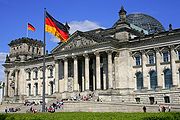
Reichstag (German Empire)

Encyclopedia
Parliament
A parliament is a legislature, especially in those countries whose system of government is based on the Westminster system modeled after that of the United Kingdom. The name is derived from the French , the action of parler : a parlement is a discussion. The term came to mean a meeting at which...
of the North German Confederation
North German Confederation
The North German Confederation 1866–71, was a federation of 22 independent states of northern Germany. It was formed by a constitution accepted by the member states in 1867 and controlled military and foreign policy. It included the new Reichstag, a parliament elected by universal manhood...
(1867–1870), and of the German Reich (1871–1945).
German constitution commentators consider only the Reichstag and now the Bundestag the German parliament. Another organ dealt with legislation too, in 1867-1918 the Bundesrat, in 1919–1933 the Reichsrat and from 1949 on the Bundesrat. The Bundesrat or Reichsrat represents the German states.
After the collapse of the Empire in 1806, the term was subsequently used for the Parliament of the 1849 Frankfurt constitution draft
Paulskirchenverfassung
The Constitution of the German Empire of 1849, more commonly known as the Frankfurt Constitution or Paulskirchenverfassung , was an ultimately unsuccessful attempt to created a unified German state under an Emperor...
that never came into effect, the Parliament of the North German Confederation
North German Confederation
The North German Confederation 1866–71, was a federation of 22 independent states of northern Germany. It was formed by a constitution accepted by the member states in 1867 and controlled military and foreign policy. It included the new Reichstag, a parliament elected by universal manhood...
from 1867–1871 and finally that of the 1871 German Empire
German Empire
The German Empire refers to Germany during the "Second Reich" period from the unification of Germany and proclamation of Wilhelm I as German Emperor on 18 January 1871, to 1918, when it became a federal republic after defeat in World War I and the abdication of the Emperor, Wilhelm II.The German...
. Eligible to vote were all male Germans over 25 years. According to contemporary standards this was considered a modern and progressive parliament. The deputies were chosen in one member constituencies, with majority vote. If necessary, a second vote took place.
The Reichstag had no formal right to install or dismiss the government. Legislation was shared between both the Reichstag and the (then) Bundesrat
Bundesrat
Bundesrat means federal council and may refer to:* Bundesrat of Germany* Federal Council of Austria* Swiss Federal Council...
, which was the council of the reigning princes of the German states.
Seat