
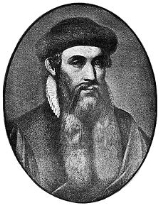
Johannes Gensfleisch zur Laden zum Gutenberg ( 1398 – February 3, 1468) (jəʊˌhanəs ˈguːtənbɛː(r)k yoh-han-uhss goo-tuhn-bairk) was a
blacksmithA blacksmith is a person who creates objects from wrought iron or steel by forging the metal; that is, by using tools to hammer, bend, and cut...
,
goldsmithA goldsmith is a metalworker who specializes in working with gold and other precious metals. Since ancient times the techniques of a goldsmith have evolved very little in order to produce items of jewelry of quality standards. In modern times actual goldsmiths are rare...
,
printerIn publishing, printers are both companies providing printing services and individuals who directly operate printing presses. With the invention of the moveable type printing press by Johannes Gutenberg around 1450, printing—and printers—proliferated throughout Europe.Today, printers are found...
, and publisher who introduced the
printing pressA printing press is a device for applying pressure to an inked surface resting upon a print medium , thereby transferring the ink...
. His usage of
movable typeMovable type is the system of printing and typography that uses movable components to reproduce the elements of a document ....
printing started the Printing Revolution and is widely regarded as the most important event of the modern period. It played a key role in the development of the
RenaissanceThe Renaissance was a cultural movement that spanned roughly the 14th to the 17th century, beginning in Italy in the Late Middle Ages and later spreading to the rest of Europe. The term is also used more loosely to refer to the historical era, but since the changes of the Renaissance were not...
,
ReformationThe Protestant Reformation was a 16th-century split within Western Christianity initiated by Martin Luther, John Calvin and other early Protestants. The efforts of the self-described "reformers", who objected to the doctrines, rituals and ecclesiastical structure of the Roman Catholic Church, led...
and the
Scientific RevolutionThe Scientific Revolution is an era associated primarily with the 16th and 17th centuries during which new ideas and knowledge in physics, astronomy, biology, medicine and chemistry transformed medieval and ancient views of nature and laid the foundations for modern science...
and laid the material basis for the modern knowledge-based economy and the
spread of learning to the massesThe democratization of knowledge is the acquisition and spread of knowledge amongst the common people, not just privileged elites such as priests and academics.-History:The printing press was one of the early steps towards the democratization of knowledge....
.
Gutenberg was the first European to use
movable typeMovable type is the system of printing and typography that uses movable components to reproduce the elements of a document ....
printingPrinting is a process for reproducing text and image, typically with ink on paper using a printing press. It is often carried out as a large-scale industrial process, and is an essential part of publishing and transaction printing....
, in around 1439. Among his many contributions to printing are: the invention of a process for mass-producing movable type; the use of oil-based
inkInk is a liquid or paste that contains pigments and/or dyes and is used to color a surface to produce an image, text, or design. Ink is used for drawing and/or writing with a pen, brush, or quill...
; and the use of a wooden printing press similar to the agricultural
screw pressA screw press is a type of machine press in which the ram is driven up and down by a screw. The screw shaft can be driven by a handle, or a wheel. It works by using a coarse screw to convert the rotation of the handle or drive-wheel into a small downward movement of greater force. The overhead...
es of the period. His acclaim is due to the engineering of these elements into a practical system for the mass production of printed books, that was economically viable for printers and readers alike. Gutenberg's method for making type is an improvement over
Bi ShengBì Shēng was the inventor of the first known movable type technology. Bi Sheng's system was made of Chinese porcelain and was invented between 1041 and 1048 in China.-Movable type printing:...
's from 400 years earlier, and is traditionally considered to have included a
type metalIn printing, type metal refers to the metal alloys used in traditional typefounding and hot metal typesetting. Lead is the main constituent of these alloys...
alloy and a hand mould for casting type.
The use of durable metallic movable type allowed rapid
mass productionMass production is the production of large amounts of standardized products, including and especially on assembly lines...
of printed works. Gutenberg's printing technology spread rapidly throughout Europe, and quickly replaced most of the handwritten manuscript methods of book production throughout the world.
Woodblock printingWoodblock printing is a technique for printing text, images or patterns used widely throughout East Asia and originating in China in antiquity as a method of printing on textiles and later paper....
,
rubricationRubrication was one of several steps in the medieval process of manuscript making. Practitioners of rubrication, so-called rubricators, were specialized scribes who received text from the manuscript's original scribe and supplemented it with additional text in red ink for emphasis...
, and
engravingEngraving is the practice of incising a design on to a hard, usually flat surface, by cutting grooves into it. The result may be a decorated object in itself, as when silver, gold, steel, or glass are engraved, or may provide an intaglio printing plate, of copper or another metal, for printing...
continued to be used to supplement Gutenberg's printing process.
His first major work using his printing methods was the
Gutenberg BibleThe Gutenberg Bible was the first major book printed with a movable type printing press, and marked the start of the "Gutenberg Revolution" and the age of the printed book. Widely praised for its high aesthetic and artistic qualities, the book has an iconic status...
.
Early life
Gutenberg was born in the German city of
MainzMainz under the Holy Roman Empire, and previously was a Roman fort city which commanded the west bank of the Rhine and formed part of the northernmost frontier of the Roman Empire...
, the youngest son of the upper-class merchant Friele Gensfleisch zur Laden, and his second wife Else Wyrich, who was the daughter of a shopkeeper. According to some accounts Friele was a goldsmith for the bishop at Mainz, but most likely, he was involved in the cloth trade. Gutenberg's year of birth is not precisely known but was most likely around 1398.
John Lienhard, technology historian, says "Most of Gutenberg's early life is a mystery. His father worked with the ecclesiastic mint. Gutenberg grew up knowing the trade of goldsmithing." This is supported by historian Heinrich Wallau, who adds, "In the 14th and 15th centuries his [descendants] claimed a hereditary position as ...the master of the archiepiscopal mint. In this capacity they doubtless acquired considerable knowledge and technical skill in metal working. They supplied the mint with the metal to be coined, changed the various species of coins, and had a seat at the assizes in forgery cases."
Wallau adds, "His surname was derived from the house inhabited by his father and his paternal ancestors 'zu Laden, zu Gutenberg'. The house of Gänsfleisch was one of the patrician families of the town, tracing its lineage back to the thirteenth century."
PatriciansPatricianship, the quality of belonging to a patriciate, began in the ancient world, where cities such as Ancient Rome had a class of patrician families whose members were the only people allowed to exercise many political functions...
(aristocrats) in Mainz were often named after houses they owned. Around 1427, the name
zu Gutenberg, after the family house in Mainz, is documented to have been used for the first time.
In 1411, there was an uprising in Mainz against the patricians, and more than a hundred families were forced to leave. As a result, the Gutenbergs are thought to have moved to Eltville am Rhein (Alta Villa), where his mother had an inherited estate. According to historian Heinrich Wallau, "All that is known of his youth is that he was not in Mainz in 1430. It is presumed that he migrated for political reasons to
StrasbourgStrasbourg is the capital and principal city of the Alsace region in eastern France and is the official seat of the European Parliament. Located close to the border with Germany, it is the capital of the Bas-Rhin département. The city and the region of Alsace are historically German-speaking,...
(Strassburg), where the family probably had connections." He is assumed to have studied at the
University of ErfurtThe University of Erfurt is a public university located in Erfurt, Germany. Originally founded in 1379, the university was closed in 1816 for the next 177 years...
, where there is a record of a student, in 1419, named Johannes de Alta villa.
Nothing is now known of Gutenberg's life for the next fifteen years, but in March 1434, a letter by him indicates that he was living in Strasbourg, where he had some relatives on his mother's side. He also appears to have been a goldsmith member enrolled in the Strasbourg
militiaThe term militia is commonly used today to refer to a military force composed of ordinary citizens to provide defense, emergency law enforcement, or paramilitary service, in times of emergency without being paid a regular salary or committed to a fixed term of service. It is a polyseme with...
. In 1437, there is evidence that he was instructing a wealthy tradesman on polishing gems, but where he had acquired this knowledge is unknown. In 1436/37 his name also comes up in court in connection with a broken promise of marriage to a woman from Strasbourg, Ennelin. Whether the marriage actually took place is not recorded. Following his father's death in 1419, he is mentioned in the inheritance proceedings.
Printing press
Around 1439, Gutenberg was involved in a financial misadventure making polished metal mirrors (which were believed to capture holy light from religious relics) for sale to pilgrims to
AachenAachen has historically been a spa town in North Rhine-Westphalia, Germany. Aachen was a favoured residence of Charlemagne, and the place of coronation of the Kings of Germany. Geographically, Aachen is the westernmost town of Germany, located along its borders with Belgium and the Netherlands, ...
: in 1439 the city was planning to exhibit its collection of relics from
Emperor CharlemagneCharlemagne was King of the Franks from 768 and Emperor of the Romans from 800 to his death in 814. He expanded the Frankish kingdom into an empire that incorporated much of Western and Central Europe. During his reign, he conquered Italy and was crowned by Pope Leo III on 25 December 800...
but the event was delayed by one year and the capital already spent could not be repaid. When the question of satisfying the investors came up, Gutenberg is said to have promised to share a "secret". It has been widely speculated that this secret may have been the idea of printing with movable type. Legend has it that the idea came to him "like a ray of light".
At least up to 1444, he lived in
StrasbourgStrasbourg is the capital and principal city of the Alsace region in eastern France and is the official seat of the European Parliament. Located close to the border with Germany, it is the capital of the Bas-Rhin département. The city and the region of Alsace are historically German-speaking,...
, most likely in the St. Arbogast parish. It was in Strasbourg in 1440 that Gutenberg perfected and unveiled the secret of printing based on his research, mysteriously entitled
Kunst und Aventur (art and enterprise). It is not clear what work he was engaged in, or whether some early trials with printing from movable type may have been conducted there. After this, there is a gap of four years in the record. In 1448, he was back in Mainz, where he took out a loan from his brother-in-law Arnold Gelthus, presumably for a printing press. Gutenberg may have been familiar with printing; it is claimed that he had worked on copper
engravingEngraving is the practice of incising a design on to a hard, usually flat surface, by cutting grooves into it. The result may be a decorated object in itself, as when silver, gold, steel, or glass are engraved, or may provide an intaglio printing plate, of copper or another metal, for printing...
s with an artist known as the Master of Playing Cards.
By 1450, the press was in operation, and a
GermanGerman is a West Germanic language, related to and classified alongside English and Dutch. With an estimated 90 – 98 million native speakers, German is one of the world's major languages and is the most widely-spoken first language in the European Union....
poem had been printed, possibly the first item to be printed there. Gutenberg was able to convince the wealthy moneylender
Johann FustJohann Fust was an early German printer.- Family background :Fust belonged to a rich and respectable burgher family of Mainz, traceable back to the early thirteenth-century; members of the family held many civil and religious offices.The name was always written Fust, but in 1506 Peter Schöffer, in...
for a loan of 800
guilderGuilder is the English translation of the Dutch gulden — from Old Dutch for 'golden'. The guilder originated as a gold coin but has been a common name for a silver or base metal coin for some centuries...
s.
Peter SchöfferPeter Schöffer or Petrus Schoeffer was an early German printer, who studied in Paris and worked as a manuscript copyist in 1451 before apprenticing with Johannes Gutenberg and joining Johann Fust, a goldsmith, lawyer, and money lender.-Life and works:Working for Fust, Schöffer was the principal...
, who became Fust's son-in-law, also joined the enterprise. Schöffer had worked as a scribe in
ParisParis is the capital and largest city in France, situated on the river Seine, in northern France, at the heart of the Île-de-France region...
and is believed to have designed some of the first
typefaceIn typography, a typeface is the artistic representation or interpretation of characters; it is the way the type looks. Each type is designed and there are thousands of different typefaces in existence, with new ones being developed constantly....
s.
Gutenberg's workshop was set up at Hof Humbrecht, a property belonging to a distant relative. It is not clear when Gutenberg conceived the Bible project, but for this he borrowed another 800 guilders from Fust, and work commenced in 1452. At the same time, the press was also printing other, more lucrative texts (possibly Latin grammars). There is also some speculation that there may have been two presses, one for the pedestrian texts, and one for the Bible. One of the profit-making enterprises of the new press was the printing of thousands of
indulgenceIn Catholic theology, an indulgence is the full or partial remission of temporal punishment due for sins which have already been forgiven. The indulgence is granted by the Catholic Church after the sinner has confessed and received absolution...
s for the church, documented from 1454–55.
In 1455 Gutenberg published his
42-line Bible, known as the
Gutenberg BibleThe Gutenberg Bible was the first major book printed with a movable type printing press, and marked the start of the "Gutenberg Revolution" and the age of the printed book. Widely praised for its high aesthetic and artistic qualities, the book has an iconic status...
. About 180 were printed, most on paper and some on
vellumVellum is mammal skin prepared for writing or printing on, to produce single pages, scrolls, codices or books. It is generally smooth and durable, although there are great variations depending on preparation, the quality of the skin and the type of animal used...
.
Court case
Sometime in 1455, there was a dispute between Gutenberg and Fust, and Fust demanded his money back, accusing Gutenberg of misusing the funds. Meanwhile the expenses of the Bible project had proliferated, and Gutenberg's debt now exceeded 2,000 guilders. Fust sued at the archbishop's court. A November 1455 legal document records that there was a partnership for a "project of the books," the funds for which Gutenberg had used for other purposes, according to Fust. The court decided in favor of Fust, giving him control over the Bible printing workshop and half of all printed Bibles.
Thus Gutenberg was effectively bankrupt, but it appears he retained (or re-started) a small printing shop, and participated in the printing of a Bible in the town of
BambergBamberg is a city in Bavaria, Germany. It is located in Upper Franconia on the river Regnitz, close to its confluence with the river Main. Bamberg is one of the few cities in Germany that was not destroyed by World War II bombings because of a nearby Artillery Factory that prevented planes from...
around 1459, for which he at least supplied the type. But since his printed books never carry his name or a date, it is difficult to be certain, and there is consequently a considerable amount of scholarly literature on this subject. It is also possible that the large
Catholicon dictionaryThe Summa grammaticalis quae vocatur Catholicon, or Catholicon , was a Latin encyclopedia / dictionary which found wide use throughout Christendom...
, 300 copies of 754 pages, printed in Mainz in 1460, may have been executed in his workshop.
Meanwhile, the Fust–Schöffer shop was the first in Europe to bring out a book with the printer's name and date, the
Mainz PsalterThe Mainz Psalter is the earliest dated example of printed matter issuing from the new moveable-print technology of Johannes Gutenberg. It was a psalter ordered by the Mainz archbishop in AD 1457. It combines printed text with two-color woodcuts...
of August 1457, and while proudly proclaiming the mechanical process by which it had been produced, it made no mention of Gutenberg.
Later life
In 1462, during a conflict between two archbishops, Mainz was sacked by archbishop
Adolph von NassauAdolph II of Nassau-Wiesbaden-Idstein was Archbishop of Mainz from 1461 until 1475.Adolph was a son of Count Adolph II of Nassau-Wiesbaden-Idstein....
, and Gutenberg was exiled. An old man by now, he moved to
EltvilleEltville am Rhein is a town in the Rheingau-Taunus-Kreis in the Regierungsbezirk of Darmstadt in Hesse, Germany. It is located on the German Half-Timbered House Road ....
where he may have initiated and supervised a new printing press belonging to the brothers Bechtermünze.
In January 1465, Gutenberg's achievements were recognized and he was given the title
Hofmann (gentleman of the court) by von Nassau. This honor included a
stipendA stipend is a form of salary, such as for an internship or apprenticeship. It is often distinct from a wage or a salary because it does not necessarily represent payment for work performed, instead it represents a payment that enables somebody to be exempt partly or wholly from waged or salaried...
, an annual court outfit, as well as 2,180 liters of grain and 2,000 liters of wine tax-free. It is believed he may have moved back to Mainz around this time, but this is not certain.
Gutenberg died in 1468 and was buried in the Franciscan church at Mainz, his contributions largely unknown. This church and the cemetery were later destroyed, and Gutenberg's grave is now lost.
In 1504, he was mentioned as the inventor of typography in a book by Professor Ivo Wittig. It was not until 1567 that the first portrait of Gutenberg, almost certainly an imaginary reconstruction, appeared in Heinrich Pantaleon's biography of famous Germans.
Printed books
Between 1450 and 1455, Gutenberg printed several texts, which are not known; his texts did not bear the printer's name or date, so attribution is possible only through external references. Certainly several church documents including a papal letter and two indulgences were printed. One of which was issued in Mainz, Germany. Realizing the value of printing in quantity, seven editions in two styles were ordered numbering in the thousands.Some printed editions of
Ars Minor, a schoolbook on Latin grammar by
Aelius DonatusAelius Donatus was a Roman grammarian and teacher of rhetoric. The only fact known regarding his life is that he was the tutor of St...
may have been printed by Gutenberg; these have been dated either 1451–52 or 1455.
In 1455 (possibly starting 1454), Gutenberg brought out copies of a beautifully executed folio
BibleThe Bible refers to any one of the collections of the primary religious texts of Judaism and Christianity. There is no common version of the Bible, as the individual books , their contents and their order vary among denominations...
(
Biblia Sacra), with 42 lines on each page. The pages of the books were not bound, and the date 1455 is documented on the spine by the binder for a copy bound in Paris.
The Bible sold for 30 florins each, which was roughly three years' wages for an average clerk. Nonetheless, it was significantly cheaper than a handwritten Bible that could take a single scribe over a year to prepare. After printing the text portions, each book was hand illustrated in the same elegant way as manuscript Bibles from the same period written by scribes.
48 substantially complete copies are known to exist, including two at the
British LibraryThe British Library is the national library of the United Kingdom, and is the world's largest library in terms of total number of items. The library is a major research library, holding over 150 million items from every country in the world, in virtually all known languages and in many formats,...
that can be viewed and compared online. The text lacks modern features such as
paginationPagination is the process of dividing information into discrete pages, either electronic pages or printed pages. Today the latter are usually simply instances of the former that have been outputted to a printing device, such as a desktop printer or a modern printing press...
, indentations, and paragraph breaks.
An undated
36-line edition of the BibleThe 36-line Bible, also known as the "Bamberg Bible" and sometimes called a "Gutenberg Bible", is the second printed edition of the Bible, after the Gutenberg Bible. It is believed to have been printed in Bamberg, Germany, about 1458-60...
was printed, probably in
BambergBamberg is a city in Bavaria, Germany. It is located in Upper Franconia on the river Regnitz, close to its confluence with the river Main. Bamberg is one of the few cities in Germany that was not destroyed by World War II bombings because of a nearby Artillery Factory that prevented planes from...
in 1458-60, and possibly by Gutenberg. A large part of it was shown to have been set from a copy of Gutenberg's Bible, thus disproving earlier speculation that it may have been the earlier of the two.
Printing method with movable type
mage:Metal movable type.jpg|thumb|225px|Movable metal type, and composing stick, descended from Gutenberg's press.Gutenberg's early printing process, and what tests he may have made with
movable typeMovable type is the system of printing and typography that uses movable components to reproduce the elements of a document ....
, are not known in great detail. His later Bibles were printed in such a way as to have required large quantities of type, some estimates suggesting as many as 100,000 individual sorts. Setting each page would take, perhaps, half a day, and considering all the work in loading the press, inking the type, pulling the impressions, hanging up the sheets, distributing the type, etc., it is thought that the Gutenberg–Fust shop might have employed as many as 25 craftsmen.
Gutenberg's technique of making movable type remains unclear. In the following decades, punches and copper matrices became standardized in the rapidly disseminating printing presses across Europe. Whether Gutenberg used this sophisticated technique or a somewhat primitive version has been the subject of considerable debate.
In the standard process of making type, a hard metal punch (with the letter carved back to front) is hammered into a softer copper bar, creating a
matrixIn hot metal typesetting, a matrix is a mold for casting a letter, known as a sort, used in letterpress printing....
. This is then placed into a
hand-held mouldA hand mould is a simple mould used for low quantity work. It is used in the injection moulding and the printing industry.-Printing:In the printing industry, a hand mould specifically refers to a two-part mould used for casting hand-made type...
and a piece of type, or "sort", is cast by filling the mould with molten type-metal; this cools almost at once, and the resulting piece of type can be removed from the mould. The matrix can be reused to create hundreds, or thousands, of identical sorts so that the same character appearing anywhere within the book will appear very uniform, giving rise, over time, to the development of distinct styles of typefaces or
fontIn typography, a font is traditionally defined as a quantity of sorts composing a complete character set of a single size and style of a particular typeface...
s. After casting, the sorts are arranged into type-cases, and used to make up pages which are inked and printed, a procedure which can be repeated hundreds, or thousands, of times. The sorts can be reused in any combination, earning the process the name of "movable type". (For details, see
TypographyTypography is the art and technique of arranging type in order to make language visible. The arrangement of type involves the selection of typefaces, point size, line length, leading , adjusting the spaces between groups of letters and adjusting the space between pairs of letters...
).
Was Gutenberg's type produced by punches and copper matrices?
The invention of the making of types with punch, matrix and mold has been widely attributed to Gutenberg. However, recent evidence suggests that Gutenberg's process was somewhat different. If he used the punch and matrix approach, all his letters should have been nearly identical, with some variations due to miscasting and inking. However, the type used in Gutenberg's earliest work shows other variations.
In 2001, the physicist
Blaise Agüera y ArcasBlaise Agüera y Arcas is a software architect, designer, and imagery expert. As of 2010, he is the architect of Bing Maps and Bing Mobile.He founded Seadragon Software in 2003, which was acquired by Microsoft Live Labs in 2006...
and
PrincetonPrinceton University is a private research university located in Princeton, New Jersey, United States. The school is one of the eight universities of the Ivy League, and is one of the nine Colonial Colleges founded before the American Revolution....
librarian Paul Needham, used digital scans of a Papal bull in the Scheide Library, Princeton, to carefully compare the same letters (types) appearing in different parts of the printed text. The irregularities in Gutenberg's type, particularly in simple characters such as the hyphen, suggested that the variations could not have come from either ink smear or from wear and damage on the pieces of metal on the types themselves. While some identical types are clearly used on other pages, other variations, subjected to detailed image analysis, suggested that they could not have been produced from the same matrix. Transmitted light pictures of the page also appeared to reveal substructures in the type that could not arise from traditional
punchcuttingIn traditional typography, punchcutting is the craft of cutting letter punches in steel from which matrices were made in copper for type founding in the letterpress era. Cutting punches and casting type was the first step of traditional typesetting. The cutting of letter punches was a highly...
techniques. They hypothesized that the method may have involved impressing simple shapes to create alphabets in "cuneiform" style in a matrix made of some soft material, perhaps sand. Casting the type would destroy the mould, and the matrix would need to be recreated to make each additional sort. This could explain the variations in the type, as well as the substructures observed in the printed images.
Thus, they feel that "the decisive factor for the birth of typography", the use of reusable moulds for casting type, might have been a more progressive process than was previously thought. They suggest that the additional step of using the punch to create a mould that could be reused many times was not taken until twenty years later, in the 1470s. Others have not accepted some or all of their suggestions, and have interpreted the evidence in other ways, and the truth of the matter remains very uncertain.
Other hypotheses about European origins
A 1568 history by
Hadrianus JuniusHadrianus Junius , also known as Adriaen de Jonghe, was a Dutch physician, classical scholar, translator, lexicographer, antiquarian, historiographer, emblematist, school rector, and Latin poet. He is not to be confused with several namesakes...
of Holland claims that the basic idea of the movable type came to Gutenberg from
Laurens Janszoon CosterLaurens Janszoon Coster , or Laurens Jansz Koster, is the name of an inventor of a printing press from Haarlem...
via Fust, who was apprenticed to Coster in the 1430s and may have brought some of his equipment from
HaarlemHaarlem is a municipality and a city in the Netherlands. It is the capital of the province of North Holland, the northern half of Holland, which at one time was the most powerful of the seven provinces of the Dutch Republic...
to Mainz. While Coster appears to have experimented with moulds and castable metal type, there is no evidence that he had actually printed anything with this technology. He was an inventor and a goldsmith. However, there is one indirect supporter of the claim that Coster might be the inventor. The author of the Cologne Chronicle of 1499 quotes
Ulrich ZellUlrich Zell was the first printer of Cologne. He was born at Hanau am Main, date unknown; he died about 1503.He learned the art of printing before 1462 in the printing establishment of Johann Fust and Peter Schöffer, and seems, shortly after the catastrophe of 1462, to have gone to Cologne, whose...
, the first printer of
CologneCologne is Germany's fourth-largest city , and is the largest city both in the Germany Federal State of North Rhine-Westphalia and within the Rhine-Ruhr Metropolitan Area, one of the major European metropolitan areas with more than ten million inhabitants.Cologne is located on both sides of the...
, that printing was performed in
MainzMainz under the Holy Roman Empire, and previously was a Roman fort city which commanded the west bank of the Rhine and formed part of the northernmost frontier of the Roman Empire...
in 1450, but that some type of printing of lower quality had previously occurred in the Netherlands. However, the chronicle does not mention the name of Coster, while it actually credits Gutenberg as the "first inventor of printing" in the very same passage (fol. 312). The first securely dated book by Dutch printers is from 1471, and the Coster connection is today regarded as a mere legend.
The 19th century printer and typefounder Fournier Le Jeune suggested that Gutenberg might not have been using type cast with a reusable matrix, but possibly wooden types that were carved individually. A similar suggestion was made by Nash in 2006. This remains possible, albeit entirely unproven.
It has also been questioned whether Gutenberg used movable types at all. In 2004, Italian professor Bruno Fabbiani claimed that examination of the 42-line Bible revealed an overlapping of letters, suggesting that Gutenberg did not in fact use movable type (individual cast characters) but rather used whole plates made from a system somewhat like a modern typewriter, whereby the letters were stamped successively into the plate and then printed. However, most specialists regard the occasional overlapping of type as caused by paper movement over pieces of type of slightly unequal height.
Legacy
Although Gutenberg was financially unsuccessful in his lifetime, the printing technologies spread quickly, and news and books began to travel across Europe much faster than before. It fed the growing
RenaissanceThe Renaissance was a cultural movement that spanned roughly the 14th to the 17th century, beginning in Italy in the Late Middle Ages and later spreading to the rest of Europe. The term is also used more loosely to refer to the historical era, but since the changes of the Renaissance were not...
, and since it greatly facilitated scientific publishing, it was a major catalyst for the later
scientific revolutionThe Scientific Revolution is an era associated primarily with the 16th and 17th centuries during which new ideas and knowledge in physics, astronomy, biology, medicine and chemistry transformed medieval and ancient views of nature and laid the foundations for modern science...
.
The capital of printing in Europe shifted to
VeniceVenice is a city in northern Italy which is renowned for the beauty of its setting, its architecture and its artworks. It is the capital of the Veneto region...
, where visionary printers like
Aldus ManutiusAldus Pius Manutius , the Latinised name of Aldo Manuzio —sometimes called Aldus Manutius, the Elder to distinguish him from his grandson, Aldus Manutius, the Younger—was an Italian humanist who became a printer and publisher when he founded the Aldine Press at Venice.His publishing legacy includes...
ensured widespread availability of the major Greek and Latin texts. The claims of an Italian origin for movable type have also focused on this rapid rise of Italy in movable-type printing. This may perhaps be explained by the prior eminence of Italy in the paper and printing trade. Additionally, Italy's economy was growing rapidly at the time, facilitating the spread of literacy.
Christopher ColumbusChristopher Columbus was an explorer, colonizer, and navigator, born in the Republic of Genoa, in northwestern Italy. Under the auspices of the Catholic Monarchs of Spain, he completed four voyages across the Atlantic Ocean that led to general European awareness of the American continents in the...
had a geographical book (printed by movable types) bought by his father. That book is in a Spanish museum. Finally, the city of Mainz was sacked in 1462, driving many (including a number of printers and punch cutters) into exile.
Printing was also a factor in the
ReformationThe Protestant Reformation was a 16th-century split within Western Christianity initiated by Martin Luther, John Calvin and other early Protestants. The efforts of the self-described "reformers", who objected to the doctrines, rituals and ecclesiastical structure of the Roman Catholic Church, led...
.
Martin LutherMartin Luther was a German priest, professor of theology and iconic figure of the Protestant Reformation. He strongly disputed the claim that freedom from God's punishment for sin could be purchased with money. He confronted indulgence salesman Johann Tetzel with his Ninety-Five Theses in 1517...
's
95 ThesesThe Ninety-Five Theses on the Power and Efficacy of Indulgences , commonly known as , was written by Martin Luther, 1517 and is widely regarded as the primary catalyst for the Protestant Reformation...
were printed and circulated widely; subsequently he issued
broadsheetBroadsheet is the largest of the various newspaper formats and is characterized by long vertical pages . The term derives from types of popular prints usually just of a single sheet, sold on the streets and containing various types of material, from ballads to political satire. The first broadsheet...
s outlining his anti-indulgences position (certificates of indulgences were one of the first items Gutenberg had printed). The broadsheet contributed to development of the
newspaperA newspaper is a scheduled publication containing news of current events, informative articles, diverse features and advertising. It usually is printed on relatively inexpensive, low-grade paper such as newsprint. By 2007, there were 6580 daily newspapers in the world selling 395 million copies a...
.
In the decades after Gutenberg, many conservative patrons looked down on cheap printed books; books produced by hand were considered more desirable.
Today there is a large antique market for the earliest printed objects. Books printed prior to 1500 are known as
incunabula.
There are many statues of Gutenberg in Germany, including the famous one by
Bertel Thorvaldsen Bertel Thorvaldsen was a Danish-Icelandic sculptor of international fame, who spent most of his life in Italy . Thorvaldsen was born in Copenhagen into a Danish/Icelandic family of humble means, and was accepted to the Royal Academy of Arts when he was eleven years old...
(1837) in Mainz, home to the eponymous
Johannes Gutenberg University of MainzThe Johannes Gutenberg University of Mainz is a university in Mainz, Rhineland Palatinate, Germany, named after the printer Johannes Gutenberg. With approximately 36,000 students in about 150 schools and clinics, it is among the ten largest universities in Germany...
and the
Gutenberg MuseumThe Gutenberg Museum is one of the oldest museums of printing in the world, located opposite the cathedral in the old part of Mainz, Germany. It is named after Johann Gutenberg, the inventor of printing from moveable metal type...
on the history of early printing. The later publishes the
Gutenberg-JahrbuchThe Gutenberg-Jahrbuch is an annual periodical publication covering the history of printing and the book. Its focus is on incunables, early printing, and the life and work of Johannes Gutenberg, inventor of the modern printed book...
, the leading periodical in the field.
Project GutenbergProject Gutenberg is a volunteer effort to digitize and archive cultural works, to "encourage the creation and distribution of eBooks". Founded in 1971 by Michael S. Hart, it is the oldest digital library. Most of the items in its collection are the full texts of public domain books...
, the oldest
digital libraryA digital library is a library in which collections are stored in digital formats and accessible by computers. The digital content may be stored locally, or accessed remotely via computer networks...
, commemorates Gutenberg's name.
In 1961 the Canadian philosopher and scholar
Marshall McLuhanHerbert Marshall McLuhan, CC was a Canadian educator, philosopher, and scholar—a professor of English literature, a literary critic, a rhetorician, and a communication theorist...
entitled his pioneering study in the fields of print culture, cultural studies, and media ecology,
The Gutenberg Galaxy: The Making of Typographic ManThe Gutenberg Galaxy: The Making of Typographic Man is a book by Marshall McLuhan, in which he analyzes the effects of mass media, especially the printing press, on European culture and human consciousness...
.
Gutenberg remains a towering figure in the popular image. In 1999, the
A&E NetworkThe A&E Network is a United States-based cable and satellite television network with headquarters in New York City and offices in Atlanta, Chicago, Detroit, London, Los Angeles and Stamford. A&E also airs in Canada and Latin America. Initially named the Arts & Entertainment Network, A&E launched...
ranked Gutenberg the No. 1 most influential person of the second millennium on their "Biographies of the Millennium" countdown. In 1997, Time–Life magazine picked Gutenberg's invention as the most important of the second millennium.
In space, he is commemorated in the name of the
asteroidAsteroids are a class of small Solar System bodies in orbit around the Sun. They have also been called planetoids, especially the larger ones...
777 Gutemberga-External links:*...
.
A French opera on his life, by Philippe Manoury, was staged in Strasbourg in September 2011 .
See also
- Bi Sheng
Bì Shēng was the inventor of the first known movable type technology. Bi Sheng's system was made of Chinese porcelain and was invented between 1041 and 1048 in China.-Movable type printing:...
- Printing
Printing is a process for reproducing text and image, typically with ink on paper using a printing press. It is often carried out as a large-scale industrial process, and is an essential part of publishing and transaction printing....
- Typography
Typography is the art and technique of arranging type in order to make language visible. The arrangement of type involves the selection of typefaces, point size, line length, leading , adjusting the spaces between groups of letters and adjusting the space between pairs of letters...
- Incunabulum
Incunable, or sometimes incunabulum is a book, pamphlet, or broadside, that was printed — not handwritten — before the year 1501 in Europe...
- History of the book
The history of books follows a suite of technological innovations for books. These improved the quality of text conservation, the access to information, portability, and the cost of production...
- German inventors and discoverers
This is a list of German inventors and discoverers. The following list comprises people from Germany or German-speaking Europe, also of people of predominantly German heritage, in alphabetical order of the surname. The main section includes existing articles, indicated by blue links, and possibly...
Standard biographic works on Gutenberg
- Albert Kapr, Johann Gutenberg: the Man and his Invention. Translated from the German by Douglas Martin, Scolar Press, 1996. "Third ed., revised by the author for...the English translation.
External links
- English homepage of the Gutenberg-Museum Mainz, Germany.
- The Digital Gutenberg Project: the Gutenberg Bible
The Gutenberg Bible was the first major book printed with a movable type printing press, and marked the start of the "Gutenberg Revolution" and the age of the printed book. Widely praised for its high aesthetic and artistic qualities, the book has an iconic status...
in 1,300 digital images, every page of the University of Texas at AustinThe University of Texas at Austin is a state research university located in Austin, Texas, USA, and is the flagship institution of the The University of Texas System. Founded in 1883, its campus is located approximately from the Texas State Capitol in Austin...
copy. Biographie de Johannes Gutenberg, inventeur de l'Imprimerie (a biography of Gutenberg at the Histoire et Geographie site).
- Treasures in Full – Gutenberg Bible View the British Library's Digital Versions Online
}
}
}
}
}
}
}}
Category:1398 births
Category:1468 deaths
Category:15th-century German people
Category:German inventors
Category:German printers
Category:Printers of incunabula
Category:Typographers
Category:German goldsmiths
Category:Walhalla enshrinees
Category:University of Erfurt alumni
Category:German Roman Catholics
Category:People from Mainz
als:Johann Gutenberg
ar:يوهان غوتنبرغ
an:Johannes Gutenberg
arc:ܝܘܗܐܢ ܓܘܛܢܒܪܓ
ast:Johannes Gutenberg
az:İohann Qutenberq
bn:ইয়োহানেস গুটেনবের্গ
zh-min-nan:Johannes Gutenberg
be:Ёган Гутэнберг
be-x-old:Ёган Гутэнбэрг
bg:Йоханес Гутенберг
bs:Johannes Gutenberg
br:Johannes Gutenberg
ca:Johannes Gutenberg
cs:Johannes Gutenberg
cy:Johann Gutenberg
da:Johann Gutenberg
de:Johannes Gutenberg
et:Johannes Gutenberg
el:Γουτεμβέργιος
es:Johannes Gutenberg
eo:Johannes Gutenberg
eu:Johannes Gutenberg
fa:یوهانس گوتنبرگ
hif:Johannes Gutenberg
fr:Johannes Gutenberg
fy:Johann Gutenberg
ga:Johannes Gutenberg
gd:Johannes Gutenberg
gl:Johannes Gutenberg
xal:Гутенберг, Иоганн
ko:요하네스 구텐베르크
hy:Յոհան Գուտենբերգ
hi:जोहान गुटेनबर्ग
hr:Johannes Gutenberg
id:Johannes Gutenberg
is:Johann Gutenberg
it:Johann Gutenberg
he:יוהאן גוטנברג
jv:Johann Gutenberg
ka:იოჰან გუტენბერგი
sw:Johannes Gutenberg
ku:Johannes Gutenberg
mrj:Гутенберг, Иоганн
lad:Johannes Gutenberg
la:Iohannes Gutenberg
lv:Johans Gūtenbergs
lb:Johannes Gutenberg
lt:Johann Gutenberg
lij:Johann Gutenberg
lmo:Johann Gutenberg
hu:Johannes Gutenberg
mk:Јохан Гутенберг
ml:ജോഹന്നസ് ഗുട്ടെൻബെർഗ്
ms:Johannes Gutenberg
mn:Иоханнэс Гутэнбэрг
my:ဂူတင်ဘတ် ဂျိုဟန်နက်စ်
nah:Johannes Gutenberg
nl:Johannes Gutenberg
ja:ヨハネス・グーテンベルク
no:Johann Gutenberg
nn:Johann Gutenberg
oc:Johannes Gutenberg
uz:Johannes Gutenberg
pnb:جوہانز گٹنبرگ
pl:Johannes Gutenberg
pt:Johannes Gutenberg
ro:Johannes Gutenberg
rm:Johannes Gutenberg
qu:Johannes Gutenberg
rue:Йоганн Ґутенберґ
ru:Гутенберг, Иоганн
sco:Johann Gutenberg
sq:Johannes Gutenberg
scn:Johann Gutenberg
simple:Johannes Gutenberg
sk:Johann Gutenberg
sl:Johannes Gutenberg
szl:Johannes Gutenberg
sr:Јохан Гутенберг
sh:Johann Gutenberg
fi:Johannes Gutenberg
sv:Johannes Gutenberg
tl:Johannes Gutenberg
ta:குட்டன்பேர்க்
te:జోహాన్స్ గుటెన్బర్గ్
th:โยฮันน์ กูเทนแบร์ก
tr:Johannes Gutenberg
uk:Йоганн Гутенберг
ur:یوہانس گوٹن برگ
vi:Johannes Gutenberg
vo:Johannes Gutenberg
fiu-vro:Gutenbergi Johannes
wa:Johannes Gutenberg
war:Johannes Gutenberg
yi:יאהאן גוטנבערג
bat-smg:Juohans Gotenbergs
zh:约翰内斯·谷登堡