

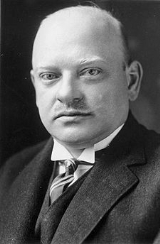
Gustav Stresemann

Encyclopedia
was a German politician and statesman who served as Chancellor and Foreign Minister
during the Weimar Republic
. He was co-laureate of the Nobel Peace Prize
in 1926.
Stresemann's politics defy easy categorization. Arguably, his most notable achievement was reconciliation between Germany and France, for which he and Aristide Briand
received the Peace Prize.
, the youngest of seven children. His father worked as a beer bottler and distributor, and also ran a small bar out of the family home, as well as renting rooms for extra money. The family was lower middle class, but relatively well-off for the neighbourhood, and had sufficient funds to provide Gustav with a high-quality education.
Stresemann was an excellent student, particularly excelling in German literature and poetry. In an essay written when he left school, he noted that he would have enjoyed becoming a teacher, but he would only have been qualified to teach languages or the natural sciences, which were not his primary areas of interest. Thus, he entered the University of Berlin in 1897 to study political economy
. Through this course of studies, Stresemann was exposed to the principal ideological arguments of his day, particularly the German debate about socialism
.
During his university years, Stresemann also became active in Burschenschaften movement of student fraternities, and became editor, in April 1898, of the Allgemeine Deutsche Universitäts-Zeitung, a newspaper run by Konrad Kuster, a leader in the liberal portion of the Burschenschaften. His editorials for the paper were often political, and dismissed most of the contemporary political parties as broken in one way or another. In these early writings, he set out views that combined liberalism with strident nationalism, a combination that would dominate his views for the rest of his life. In 1898, Stresemann left the University of Berlin, transferring to the University of Leipzig
so that he could pursue a doctorate. He completed his studies in January 1901, submitting a thesis
on the bottled beer industry in Berlin, which received a relatively high grade.
In 1902 he founded the Saxon
Manufacturers' Association. In 1903 he married Käte Kleefeld
(1885–1970), daughter of a wealthy Jewish Berlin businessman. At that time he was also a member of Friedrich Naumann's National-Social Association
. In 1906 he was elected to the Dresden
town council. Though he had initially worked in trade associations, Stresemann soon became a leader of the National Liberal Party
in Saxony. In 1907, he was elected to the Reichstag
, where he soon became a close associate of party chairman Ernst Bassermann. However, his support of expanded social-welfare programs didn't sit well with some of the party's more conservative members, and he lost his post in the party's executive committee in 1912. Later that year he lost both his Reichstag and town council seats. He returned to business and founded the German-American Economic Association. In 1914 he returned to the Reichstag. He was exempted from war service due to poor health. With Bassermann kept away from the Reichstag by either illness or military service, Stresemann soon became the National Liberals' de facto leader. After Bassermann's death in 1917, Stresemann succeeded him as party leader.
The evolution of his political ideas appears somewhat erratic. Initially, in the German Empire
, Stresemann was associated with the left wing of the National Liberals. During World War I
, he gradually moved to the right, expressing his support of the monarchy and Germany's expansionist goals. He was a vocal proponent of unrestricted submarine warfare
. However, he still favoured an expansion of the social welfare programme, and also supported an end to the restrictive Prussian franchise.
When the Allies' peace terms became known, Constantin Fehrenbach denounced them and claimed "the will to break the chains of slavery would be implanted" into a generation of Germans. Stresemann said of this speech: "He was inspired in that hour by God to say what was felt by the German people. His words, spoken under Fichte's portrait, the final words of which merged into “Deutschland, Deutschland über alles”, made it an unforgettably solemn hour. There was in that sense a kind of uplifting grandeur. The impression left on all was tremendous".
Stresemann briefly joined the German Democratic Party after the war, but was expelled for his association with the right wing. He then gathered most of the right wing of the old National Liberal Party into the German People's Party
, with himself as chairman. Most of its support came from middle class and upper class Protestants. The DVP platform promoted Christian family values, secular education, lower tariffs, opposition to welfare spending and agrarian subsides and hostility to "Marxism
" (that is, the Communists
, and also the Social Democrats
).
The DVP was initially seen, along with the German National People's Party
, as part of the "national opposition" to the Weimar Republic, particularly for its grudging acceptance of democracy and its ambivalent attitude towards the Freikorps
and the Kapp Putsch
in 1920. By late 1920, Stresemann gradually moved to cooperation with the parties of the left and centre — possibly in reaction to political murders like that of Walther Rathenau
. However, he remained a monarchist at heart.
(1923) he showed strength by calling-off the popular passive resistance at the Ruhr. Since Germany was no longer able to pay the striking workers, more and more money was printed, which finally led to hyperinflation. Hans Luther, who was the current finance minister, ended this disastrous process by introducing a new currency, the Rentenmark, which reassured the people that the democratic system was willing and able to solve urgent problems.
Stresemann's decision to end passive resistance was motivated by his view that making a good faith effort to fulfill the terms of Versailles was the only way to win relief from the treaty's harsher provisions. He, like virtually every German, felt Versailles was an onerous Diktat
that sullied the nation's honour. However, he felt that trying to fulfill the treaty's terms was the only way Germany could demonstrate that the reparations bill was truly beyond its capacity. He also wished to recover the Rhineland, as he wrote to the Crown Prince on 23 July 1923: "The most important objective of German politics is the liberation of German territory from foreign occupation. First, we must remove the strangler from our throat".
However, some of his moves - like his refusal to deal firmly with culprits of the Beer Hall Putsch
- alienated the Social Democrats. They left the coalition and arguably caused its collapse on November 23, 1923.
. He remained foreign minister for the rest of his life in eight successive governments ranging from the centre-right to the centre-left.
As Foreign Minister, Stresemann had numerous achievements. His first notable achievement was the Dawes Plan
of 1924, which reduced Germany's overall reparations commitment and reorganized the Reichsbank
.
After Sir Austen Chamberlain
became British Foreign Secretary, he wanted a British guarantee to France and Belgium as the Anglo-American guarantee had fallen due to the United States' refusal to ratify the Treaty of Versailles. Stresemann later wrote: "Chamberlain had never been our friend. His first act was to attempt to restore the old Entente through a three-power alliance of England, France and Belgium, directed against Germany. German diplomacy faced a catastrophic situation". Stresemann conceived the idea that Germany would guarantee her western borders and pledged never to invade Belgium and France again, along with a guarantee from Britain that they would come to Germany's aid if attacked by France. Germany was in no position at the time to attack, as Stresemann wrote to the Crown Prince: "The renunciation of a military conflict with France has only a theoretical significance, in so far as there is no possibility of a war with France". Stresemann negotiated the Locarno Treaties
with Britain, France, Italy, and Belgium. On the third day of negotiations Stresemann explained Germany's demands to the French Foreign Secretary, Aristide Briand
. As Stresemann recorded, Briand "almost fell off his sofa, when he heard my explanations". Stresemann said that Germany alone should not make sacrifices for peace; European countries should cede colonies to Germany; the disarmament control commission should leave Germany; the Anglo-French occupation of the Rhineland should be ended; and Britain and France should disarm as Germany had done. The Treaties were signed in October 1925 at Locarno. Germany officially recognized the post-World War I western border for the first time, and was guaranteed peace with France, and promised admission to the League of Nations and evacuation of the last Allied occupation troops from the Rhineland. Germany's eastern borders were guaranteed to Poland only by France, not by a general agreement.
Stresemann was not willing to conclude a similar treaty with Poland: "There will be no Locarno of the east" he said. Moreover he never excluded the use of force to regain the eastern territories of Germany which had come under Polish control as a consequence of the Treaty of Versailles
.
After this reconciliation with the Versailles powers, Stresemann moved to allay the growing suspicion of the Soviet Union. He said to Nikolay Krestinsky in June 1925, as recorded in his diary: "I had said I would not come to conclude a treaty with Russia so long as our political situation in the other direction was not cleared up, as I wanted to answer the question whether we had a treaty with Russia in the negative". The Treaty of Berlin
signed in April 1926 reaffirmed and strengthened the Rapallo Treaty
of 1922. In September 1926, Germany was admitted to the League of Nations
as permanent member of the Security Council. This was a sign that Germany was quickly becoming a "normal" state and assured the Soviet Union of Germany's sincerity in the Treaty of Berlin. Stresemann wrote to the Crown Prince: "All the questions which to-day preoccupy the German people can be transformed into as many vexations for the Entente by a skilful orator before the League of Nations". As Germany now had a veto on League resolutions, she could gain concessions from other countries on modifications on the Polish border or Anschluss with Austria, as other countries needed her vote. Germany could now act as "the spokesman of the whole German cultural community" and thereby provoke the German minorities in Czechoslovakia and Poland.
Stresemann was co-winner of the Nobel Peace Prize
in 1926 for these achievements.
Germany signed the Kellogg-Briand Pact
in August 1928. It renounced the use of violence to resolve international conflicts. Although Stresemann did not propose the pact, Germany's adherence convinced many people that Weimar Germany was a Germany that could be reasoned with. This new insight was instrumental in the Young Plan
of February 1929 which led to more reductions in German reparations payment.
Gustav Stresemann's success owed much to his friendly personal character and his willingness to be pragmatic. He was close personal friends with many influential foreigners. The most noted was Briand, with whom he shared the Peace Prize.
Stresemann was not, however, in any sense pro-French. His main preoccupation was how to free Germany from the burden of reparations
payments to Britain and France, imposed by the Treaty of Versailles. His strategy for this was to forge an economic alliance with the United States
. The U.S. was Germany's main source of food and raw materials, and one of Germany's largest export markets for manufactured goods. Germany's economic recovery was thus in the interests of the U.S., and gave the U.S. an incentive to help Germany escape from the reparations burden. The Dawes and Young plans were the result of this strategy. Stresemann had a close relationship with Herbert Hoover
, who was Secretary of Commerce
in 1921-28 and President from 1929. This strategy worked remarkably well until it was derailed by the Great Depression
after Stresemann's death.
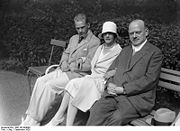 During his period in the foreign ministry, Stresemann came more and more to accept the Republic, which he had at first rejected. By the mid-1920s, having contributed much to a (temporary) consolidation of the feeble democratic order, Stresemann was regarded as a Vernunftrepublikaner (republican by reason) - someone who accepted the Republic as the least of all evils, but was in their heart still loyal to the monarchy. The conservative opposition criticized him for his supporting the republic and fulfilling too willingly the demands of the Western powers. Along with Matthias Erzberger
and others, he was attacked as a Erfüllungspolitiker ("fulfillment politician").
In 1925, when he first proposed an agreement with France, he made it clear that in doing so he intended to "gain a free hand to secure a peaceful change of the borders in the East and [...] concentrate on a later incorporation of German territories in the East". In the same year, while Poland was in a state of political and economic crisis, Stresemann began a trade war
against the country. Stresemann hoped for an escalation of the Polish crisis, which would enable Germany to regain territories ceded to Poland after World War I, and he wanted Germany to gain a larger market for its products there. So Stresemann refused to engage in any international cooperation that would have "prematurely" restabilized the Polish economy. In response to a British proposal, Stresemann wrote to the German ambassador in London: "[A] final and lasting recapitalization of Poland must be delayed until the country is ripe for a settlement of the border according to our wishes and until our own position is sufficiently strong". According to Stresemann's letter, there should be no settlement "until [Poland's] economic and financial distress has reached an extreme stage and reduced the entire Polish body politic to a state of powerlessness".
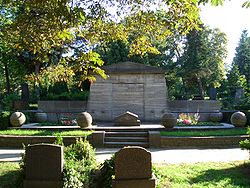 Gustav Stresemann died of a stroke
in October 1929 at the age of 51. His massive gravesite is situated on the Luisenstadt Cemetery at Südstern in Berlin Kreuzberg, and includes work by the German sculptor Hugo Lederer
. Stresemann's sudden and premature death, as well as the death of his "pragmatic moderate" French counterpart Aristide Briand
in 1932, and the assassination of Briand's successor Louis Barthou
in 1934, left a vacuum in European statesmanship that further tilted the slippery slope towards World War II
.
Gustav and Käthe had two sons, Wolfgang
and Joachim Stresemann.
Changes
Foreign Minister of Germany
The Federal Minister for Foreign Affairs is the head of the Federal Foreign Office and a member of the Cabinet of Germany. The current office holder is Guido Westerwelle...
during the Weimar Republic
Weimar Republic
The Weimar Republic is the name given by historians to the parliamentary republic established in 1919 in Germany to replace the imperial form of government...
. He was co-laureate of the Nobel Peace Prize
Nobel Peace Prize
The Nobel Peace Prize is one of the five Nobel Prizes bequeathed by the Swedish industrialist and inventor Alfred Nobel.-Background:According to Nobel's will, the Peace Prize shall be awarded to the person who...
in 1926.
Stresemann's politics defy easy categorization. Arguably, his most notable achievement was reconciliation between Germany and France, for which he and Aristide Briand
Aristide Briand
Aristide Briand was a French statesman who served eleven terms as Prime Minister of France during the French Third Republic and received the 1926 Nobel Peace Prize.- Early life :...
received the Peace Prize.
Early years
Stresemann was born on May 10, 1878 in the Köpenicker Straße area of southeast BerlinBerlin
Berlin is the capital city of Germany and is one of the 16 states of Germany. With a population of 3.45 million people, Berlin is Germany's largest city. It is the second most populous city proper and the seventh most populous urban area in the European Union...
, the youngest of seven children. His father worked as a beer bottler and distributor, and also ran a small bar out of the family home, as well as renting rooms for extra money. The family was lower middle class, but relatively well-off for the neighbourhood, and had sufficient funds to provide Gustav with a high-quality education.
Stresemann was an excellent student, particularly excelling in German literature and poetry. In an essay written when he left school, he noted that he would have enjoyed becoming a teacher, but he would only have been qualified to teach languages or the natural sciences, which were not his primary areas of interest. Thus, he entered the University of Berlin in 1897 to study political economy
Political economy
Political economy originally was the term for studying production, buying, and selling, and their relations with law, custom, and government, as well as with the distribution of national income and wealth, including through the budget process. Political economy originated in moral philosophy...
. Through this course of studies, Stresemann was exposed to the principal ideological arguments of his day, particularly the German debate about socialism
Socialism
Socialism is an economic system characterized by social ownership of the means of production and cooperative management of the economy; or a political philosophy advocating such a system. "Social ownership" may refer to any one of, or a combination of, the following: cooperative enterprises,...
.
During his university years, Stresemann also became active in Burschenschaften movement of student fraternities, and became editor, in April 1898, of the Allgemeine Deutsche Universitäts-Zeitung, a newspaper run by Konrad Kuster, a leader in the liberal portion of the Burschenschaften. His editorials for the paper were often political, and dismissed most of the contemporary political parties as broken in one way or another. In these early writings, he set out views that combined liberalism with strident nationalism, a combination that would dominate his views for the rest of his life. In 1898, Stresemann left the University of Berlin, transferring to the University of Leipzig
University of Leipzig
The University of Leipzig , located in Leipzig in the Free State of Saxony, Germany, is one of the oldest universities in the world and the second-oldest university in Germany...
so that he could pursue a doctorate. He completed his studies in January 1901, submitting a thesis
Thesis
A dissertation or thesis is a document submitted in support of candidature for an academic degree or professional qualification presenting the author's research and findings...
on the bottled beer industry in Berlin, which received a relatively high grade.
In 1902 he founded the Saxon
Kingdom of Saxony
The Kingdom of Saxony , lasting between 1806 and 1918, was an independent member of a number of historical confederacies in Napoleonic through post-Napoleonic Germany. From 1871 it was part of the German Empire. It became a Free state in the era of Weimar Republic in 1918 after the end of World War...
Manufacturers' Association. In 1903 he married Käte Kleefeld
Käte Stresemann
Kate Stresemann was the daughter of a prominent Berlin industrialist, Adolf Kleefeld. Both of her parents were Jewish, but were Protestant by religion...
(1885–1970), daughter of a wealthy Jewish Berlin businessman. At that time he was also a member of Friedrich Naumann's National-Social Association
National-Social Association
The National-Social Association was a political party in the German Empire, founded in 1896 by Friedrich Naumann.In the second half of the 19th century Germany underwent a rapid industrialization, which was connected with rising social problems...
. In 1906 he was elected to the Dresden
Dresden
Dresden is the capital city of the Free State of Saxony in Germany. It is situated in a valley on the River Elbe, near the Czech border. The Dresden conurbation is part of the Saxon Triangle metropolitan area....
town council. Though he had initially worked in trade associations, Stresemann soon became a leader of the National Liberal Party
National Liberal Party (Germany)
The National Liberal Party was a German political party which flourished between 1867 and 1918. It was formed by Prussian liberals who put aside their differences with Bismarck over domestic policy due to their support for his highly successful foreign policy, which resulted in the unification of...
in Saxony. In 1907, he was elected to the Reichstag
Reichstag (German Empire)
The Reichstag was the parliament of the North German Confederation , and of the German Reich ....
, where he soon became a close associate of party chairman Ernst Bassermann. However, his support of expanded social-welfare programs didn't sit well with some of the party's more conservative members, and he lost his post in the party's executive committee in 1912. Later that year he lost both his Reichstag and town council seats. He returned to business and founded the German-American Economic Association. In 1914 he returned to the Reichstag. He was exempted from war service due to poor health. With Bassermann kept away from the Reichstag by either illness or military service, Stresemann soon became the National Liberals' de facto leader. After Bassermann's death in 1917, Stresemann succeeded him as party leader.
The evolution of his political ideas appears somewhat erratic. Initially, in the German Empire
German Empire
The German Empire refers to Germany during the "Second Reich" period from the unification of Germany and proclamation of Wilhelm I as German Emperor on 18 January 1871, to 1918, when it became a federal republic after defeat in World War I and the abdication of the Emperor, Wilhelm II.The German...
, Stresemann was associated with the left wing of the National Liberals. During World War I
World War I
World War I , which was predominantly called the World War or the Great War from its occurrence until 1939, and the First World War or World War I thereafter, was a major war centred in Europe that began on 28 July 1914 and lasted until 11 November 1918...
, he gradually moved to the right, expressing his support of the monarchy and Germany's expansionist goals. He was a vocal proponent of unrestricted submarine warfare
Unrestricted submarine warfare
Unrestricted submarine warfare is a type of naval warfare in which submarines sink merchantmen without warning, as opposed to attacks per prize rules...
. However, he still favoured an expansion of the social welfare programme, and also supported an end to the restrictive Prussian franchise.
When the Allies' peace terms became known, Constantin Fehrenbach denounced them and claimed "the will to break the chains of slavery would be implanted" into a generation of Germans. Stresemann said of this speech: "He was inspired in that hour by God to say what was felt by the German people. His words, spoken under Fichte's portrait, the final words of which merged into “Deutschland, Deutschland über alles”, made it an unforgettably solemn hour. There was in that sense a kind of uplifting grandeur. The impression left on all was tremendous".
Stresemann briefly joined the German Democratic Party after the war, but was expelled for his association with the right wing. He then gathered most of the right wing of the old National Liberal Party into the German People's Party
German People's Party
The German People's Party was a national liberal party in Weimar Germany and a successor to the National Liberal Party of the German Empire.-Ideology:...
, with himself as chairman. Most of its support came from middle class and upper class Protestants. The DVP platform promoted Christian family values, secular education, lower tariffs, opposition to welfare spending and agrarian subsides and hostility to "Marxism
Marxism
Marxism is an economic and sociopolitical worldview and method of socioeconomic inquiry that centers upon a materialist interpretation of history, a dialectical view of social change, and an analysis and critique of the development of capitalism. Marxism was pioneered in the early to mid 19th...
" (that is, the Communists
Communism
Communism is a social, political and economic ideology that aims at the establishment of a classless, moneyless, revolutionary and stateless socialist society structured upon common ownership of the means of production...
, and also the Social Democrats
Social Democratic Party of Germany
The Social Democratic Party of Germany is a social-democratic political party in Germany...
).
The DVP was initially seen, along with the German National People's Party
German National People's Party
The German National People's Party was a national conservative party in Germany during the time of the Weimar Republic. Before the rise of the NSDAP it was the main nationalist party in Weimar Germany composed of nationalists, reactionary monarchists, völkisch, and antisemitic elements, and...
, as part of the "national opposition" to the Weimar Republic, particularly for its grudging acceptance of democracy and its ambivalent attitude towards the Freikorps
Freikorps
Freikorps are German volunteer military or paramilitary units. The term was originally applied to voluntary armies formed in German lands from the middle of the 18th century onwards. Between World War I and World War II the term was also used for the paramilitary organizations that arose during...
and the Kapp Putsch
Kapp Putsch
The Kapp Putsch — or more accurately the Kapp-Lüttwitz Putsch — was a 1920 coup attempt during the German Revolution of 1918–1919 aimed at overthrowing the Weimar Republic...
in 1920. By late 1920, Stresemann gradually moved to cooperation with the parties of the left and centre — possibly in reaction to political murders like that of Walther Rathenau
Walther Rathenau
Walther Rathenau was a German Jewish industrialist, politician, writer, and statesman who served as Foreign Minister of Germany during the Weimar Republic...
. However, he remained a monarchist at heart.
Chancellor 1923
On August 13, 1923, in the midst of the Ruhr Crisis, he was appointed Chancellor and Foreign Minister of a grand coalition government. As Chancellor, Stresemann went a long way towards resolving the crisis through the dawes plan which involved a 800 million mark loan from USA. In the so-called year of crises1923 in Germany
Events in the year 1923 in Germany.-National level:President*Friedrich Ebert Chancellor*Wilhelm Cuno to 12 August, then from 13 August Gustav Stresemann to 30 November, then Wilhelm Marx -Events:* 11 January - French and Belgian troops enter the Ruhr in the Occupation of the Ruhr because of...
(1923) he showed strength by calling-off the popular passive resistance at the Ruhr. Since Germany was no longer able to pay the striking workers, more and more money was printed, which finally led to hyperinflation. Hans Luther, who was the current finance minister, ended this disastrous process by introducing a new currency, the Rentenmark, which reassured the people that the democratic system was willing and able to solve urgent problems.
Stresemann's decision to end passive resistance was motivated by his view that making a good faith effort to fulfill the terms of Versailles was the only way to win relief from the treaty's harsher provisions. He, like virtually every German, felt Versailles was an onerous Diktat
Diktat
A diktat is a harsh penalty or settlement imposed upon a defeated party by the victor, or a dogmatic decree. Historically, it was particularly used in Germany to refer to the Treaty of Versailles....
that sullied the nation's honour. However, he felt that trying to fulfill the treaty's terms was the only way Germany could demonstrate that the reparations bill was truly beyond its capacity. He also wished to recover the Rhineland, as he wrote to the Crown Prince on 23 July 1923: "The most important objective of German politics is the liberation of German territory from foreign occupation. First, we must remove the strangler from our throat".
However, some of his moves - like his refusal to deal firmly with culprits of the Beer Hall Putsch
Beer Hall Putsch
The Beer Hall Putsch was a failed attempt at revolution that occurred between the evening of 8 November and the early afternoon of 9 November 1923, when Nazi Party leader Adolf Hitler, Generalquartiermeister Erich Ludendorff, and other heads of the Kampfbund unsuccessfully tried to seize power...
- alienated the Social Democrats. They left the coalition and arguably caused its collapse on November 23, 1923.
Foreign Minister 1923-9
Stresemann remained as Foreign Minister in the government of his successor, Centrist Wilhelm MarxWilhelm Marx
Wilhelm Marx was a German lawyer, Catholic politician and a member of the Centre Party. He was Chancellor of the German Reich twice, from 1923 to 1925 and again from 1926 to 1928, and also served briefly as minister president of Prussia in 1925, during the Weimar Republic.-Life:Born in Cologne to...
. He remained foreign minister for the rest of his life in eight successive governments ranging from the centre-right to the centre-left.
As Foreign Minister, Stresemann had numerous achievements. His first notable achievement was the Dawes Plan
Dawes Plan
The Dawes Plan was an attempt in 1924, following World War I for the Triple Entente to collect war reparations debt from Germany...
of 1924, which reduced Germany's overall reparations commitment and reorganized the Reichsbank
Reichsbank
The Reichsbank was the central bank of Germany from 1876 until 1945. It was founded on 1 January 1876 . The Reichsbank was a privately owned central bank of Prussia, under close control by the Reich government. Its first president was Hermann von Dechend...
.
After Sir Austen Chamberlain
Austen Chamberlain
Sir Joseph Austen Chamberlain, KG was a British statesman, recipient of the Nobel Peace Prize and half-brother of Neville Chamberlain.- Early life and career :...
became British Foreign Secretary, he wanted a British guarantee to France and Belgium as the Anglo-American guarantee had fallen due to the United States' refusal to ratify the Treaty of Versailles. Stresemann later wrote: "Chamberlain had never been our friend. His first act was to attempt to restore the old Entente through a three-power alliance of England, France and Belgium, directed against Germany. German diplomacy faced a catastrophic situation". Stresemann conceived the idea that Germany would guarantee her western borders and pledged never to invade Belgium and France again, along with a guarantee from Britain that they would come to Germany's aid if attacked by France. Germany was in no position at the time to attack, as Stresemann wrote to the Crown Prince: "The renunciation of a military conflict with France has only a theoretical significance, in so far as there is no possibility of a war with France". Stresemann negotiated the Locarno Treaties
Locarno Treaties
The Locarno Treaties were seven agreements negotiated at Locarno, Switzerland, on 5 October – 16 October 1925 and formally signed in London on 3 December, in which the First World War Western European Allied powers and the new states of central and Eastern Europe sought to secure the post-war...
with Britain, France, Italy, and Belgium. On the third day of negotiations Stresemann explained Germany's demands to the French Foreign Secretary, Aristide Briand
Aristide Briand
Aristide Briand was a French statesman who served eleven terms as Prime Minister of France during the French Third Republic and received the 1926 Nobel Peace Prize.- Early life :...
. As Stresemann recorded, Briand "almost fell off his sofa, when he heard my explanations". Stresemann said that Germany alone should not make sacrifices for peace; European countries should cede colonies to Germany; the disarmament control commission should leave Germany; the Anglo-French occupation of the Rhineland should be ended; and Britain and France should disarm as Germany had done. The Treaties were signed in October 1925 at Locarno. Germany officially recognized the post-World War I western border for the first time, and was guaranteed peace with France, and promised admission to the League of Nations and evacuation of the last Allied occupation troops from the Rhineland. Germany's eastern borders were guaranteed to Poland only by France, not by a general agreement.
Stresemann was not willing to conclude a similar treaty with Poland: "There will be no Locarno of the east" he said. Moreover he never excluded the use of force to regain the eastern territories of Germany which had come under Polish control as a consequence of the Treaty of Versailles
Treaty of Versailles
The Treaty of Versailles was one of the peace treaties at the end of World War I. It ended the state of war between Germany and the Allied Powers. It was signed on 28 June 1919, exactly five years after the assassination of Archduke Franz Ferdinand. The other Central Powers on the German side of...
.
After this reconciliation with the Versailles powers, Stresemann moved to allay the growing suspicion of the Soviet Union. He said to Nikolay Krestinsky in June 1925, as recorded in his diary: "I had said I would not come to conclude a treaty with Russia so long as our political situation in the other direction was not cleared up, as I wanted to answer the question whether we had a treaty with Russia in the negative". The Treaty of Berlin
Treaty of Berlin, 1926
Treaty of Berlin - the treaty of 24 April 1926 under which Germany and the Soviet Union each pledged neutrality in the event of an attack on the other by a third party for the next five years. Non-aggression treaty reaffirmed the German-Soviet Treaty of Rapallo signed in 1922...
signed in April 1926 reaffirmed and strengthened the Rapallo Treaty
Treaty of Rapallo, 1922
The Treaty of Rapallo was an agreement signed at the Hotel Imperiale in the Italian town of Rapallo on 16 April, 1922 between Germany and Soviet Russia under which each renounced all territorial and financial claims against the other following the Treaty of Brest-Litovsk and World War I.The two...
of 1922. In September 1926, Germany was admitted to the League of Nations
League of Nations
The League of Nations was an intergovernmental organization founded as a result of the Paris Peace Conference that ended the First World War. It was the first permanent international organization whose principal mission was to maintain world peace...
as permanent member of the Security Council. This was a sign that Germany was quickly becoming a "normal" state and assured the Soviet Union of Germany's sincerity in the Treaty of Berlin. Stresemann wrote to the Crown Prince: "All the questions which to-day preoccupy the German people can be transformed into as many vexations for the Entente by a skilful orator before the League of Nations". As Germany now had a veto on League resolutions, she could gain concessions from other countries on modifications on the Polish border or Anschluss with Austria, as other countries needed her vote. Germany could now act as "the spokesman of the whole German cultural community" and thereby provoke the German minorities in Czechoslovakia and Poland.
Stresemann was co-winner of the Nobel Peace Prize
Nobel Peace Prize
The Nobel Peace Prize is one of the five Nobel Prizes bequeathed by the Swedish industrialist and inventor Alfred Nobel.-Background:According to Nobel's will, the Peace Prize shall be awarded to the person who...
in 1926 for these achievements.
Germany signed the Kellogg-Briand Pact
Kellogg-Briand Pact
The Kellogg–Briand Pact was an agreement signed on August 27, 1928, by the United States, France, the United Kingdom, Italy, Japan, Weimar Germany and a number of other countries.The pact renounced war , prohibiting the use of war...
in August 1928. It renounced the use of violence to resolve international conflicts. Although Stresemann did not propose the pact, Germany's adherence convinced many people that Weimar Germany was a Germany that could be reasoned with. This new insight was instrumental in the Young Plan
Young Plan
The Young Plan was a program for settlement of German reparations debts after World War I written in 1929 and formally adopted in 1930. It was presented by the committee headed by American Owen D. Young. After the Dawes Plan was put into operation , it became apparent that Germany could not meet...
of February 1929 which led to more reductions in German reparations payment.
Gustav Stresemann's success owed much to his friendly personal character and his willingness to be pragmatic. He was close personal friends with many influential foreigners. The most noted was Briand, with whom he shared the Peace Prize.
Stresemann was not, however, in any sense pro-French. His main preoccupation was how to free Germany from the burden of reparations
World War I reparations
World War I reparations refers to the payments and transfers of property and equipment that Germany was forced to make under the Treaty of Versailles following its defeat during World War I...
payments to Britain and France, imposed by the Treaty of Versailles. His strategy for this was to forge an economic alliance with the United States
United States
The United States of America is a federal constitutional republic comprising fifty states and a federal district...
. The U.S. was Germany's main source of food and raw materials, and one of Germany's largest export markets for manufactured goods. Germany's economic recovery was thus in the interests of the U.S., and gave the U.S. an incentive to help Germany escape from the reparations burden. The Dawes and Young plans were the result of this strategy. Stresemann had a close relationship with Herbert Hoover
Herbert Hoover
Herbert Clark Hoover was the 31st President of the United States . Hoover was originally a professional mining engineer and author. As the United States Secretary of Commerce in the 1920s under Presidents Warren Harding and Calvin Coolidge, he promoted partnerships between government and business...
, who was Secretary of Commerce
United States Secretary of Commerce
The United States Secretary of Commerce is the head of the United States Department of Commerce concerned with business and industry; the Department states its mission to be "to foster, promote, and develop the foreign and domestic commerce"...
in 1921-28 and President from 1929. This strategy worked remarkably well until it was derailed by the Great Depression
Great Depression
The Great Depression was a severe worldwide economic depression in the decade preceding World War II. The timing of the Great Depression varied across nations, but in most countries it started in about 1929 and lasted until the late 1930s or early 1940s...
after Stresemann's death.
Matthias Erzberger
Matthias Erzberger was a German politician. Prominent in the Centre Party, he spoke out against the First World War from 1917 and eventually signed the Armistice with Germany for the German Empire...
and others, he was attacked as a Erfüllungspolitiker ("fulfillment politician").
In 1925, when he first proposed an agreement with France, he made it clear that in doing so he intended to "gain a free hand to secure a peaceful change of the borders in the East and [...] concentrate on a later incorporation of German territories in the East". In the same year, while Poland was in a state of political and economic crisis, Stresemann began a trade war
Trade war
A trade war refers to two or more states raising or creating tariffs or other trade barriers on each other in retaliation for other trade barriers...
against the country. Stresemann hoped for an escalation of the Polish crisis, which would enable Germany to regain territories ceded to Poland after World War I, and he wanted Germany to gain a larger market for its products there. So Stresemann refused to engage in any international cooperation that would have "prematurely" restabilized the Polish economy. In response to a British proposal, Stresemann wrote to the German ambassador in London: "[A] final and lasting recapitalization of Poland must be delayed until the country is ripe for a settlement of the border according to our wishes and until our own position is sufficiently strong". According to Stresemann's letter, there should be no settlement "until [Poland's] economic and financial distress has reached an extreme stage and reduced the entire Polish body politic to a state of powerlessness".
Stroke
A stroke, previously known medically as a cerebrovascular accident , is the rapidly developing loss of brain function due to disturbance in the blood supply to the brain. This can be due to ischemia caused by blockage , or a hemorrhage...
in October 1929 at the age of 51. His massive gravesite is situated on the Luisenstadt Cemetery at Südstern in Berlin Kreuzberg, and includes work by the German sculptor Hugo Lederer
Hugo Lederer
Professor Hugo Lederer was an Austro-Hungarian-born German sculptor.Lederer studied in Dresden under sculptor John Schilling from 1890, then briefly under Christian Behrens. His greatest success came in 1902 with the commission for a Bismarck tower in the center of Hamburg...
. Stresemann's sudden and premature death, as well as the death of his "pragmatic moderate" French counterpart Aristide Briand
Aristide Briand
Aristide Briand was a French statesman who served eleven terms as Prime Minister of France during the French Third Republic and received the 1926 Nobel Peace Prize.- Early life :...
in 1932, and the assassination of Briand's successor Louis Barthou
Louis Barthou
Jean Louis Barthou was a French politician of the Third Republic.-Early years:He was born in Oloron-Sainte-Marie, Pyrénées-Atlantiques, and served as Deputy from that constituency. He was an authority on trade union history and law. Barthou was Prime Minister in 1913, and held ministerial office...
in 1934, left a vacuum in European statesmanship that further tilted the slippery slope towards World War II
World War II
World War II, or the Second World War , was a global conflict lasting from 1939 to 1945, involving most of the world's nations—including all of the great powers—eventually forming two opposing military alliances: the Allies and the Axis...
.
Gustav and Käthe had two sons, Wolfgang
Wolfgang Stresemann
Wolfgang Stresemann was a German jurist, orchestra leader, conductor and composer. He was the intendant of the Berliner Philharmoniker from 1959 to 1978 and again from 1984 to 1986, a time when Herbert von Karajan served as music director....
and Joachim Stresemann.
First Cabinet, August - October 1923
- Gustav Stresemann (DVPGerman People's PartyThe German People's Party was a national liberal party in Weimar Germany and a successor to the National Liberal Party of the German Empire.-Ideology:...
) - Chancellor and Foreign MinisterForeign Minister of GermanyThe Federal Minister for Foreign Affairs is the head of the Federal Foreign Office and a member of the Cabinet of Germany. The current office holder is Guido Westerwelle... - Robert Schmidt (SPDSocial Democratic Party of GermanyThe Social Democratic Party of Germany is a social-democratic political party in Germany...
) - Vice Chancellor and Reconstruction Minister - Wilhelm SollmannWilhelm SollmannFriedrich Wilhelm Sollmann was a German journalist, politician, and interior minister of the Weimar Republic. In 1919 he was a member of the German delegation to the Treaty of Versailles...
(SPD) - Interior Minister - Rudolf HilferdingRudolf HilferdingRudolf Hilferding was an Austrian-born Marxist economist, leading socialist theorist, politician and chief theoretician for the Social Democratic Party of Germany during the Weimar Republic, almost universally recognized as the SPD's foremost theoretician of his century, and a...
(SPD) - Finance Minister - Hans von Raumer (DVP) - Economics Minister
- Heinrich Brauns (ZCentre Party (Germany)The German Centre Party was a Catholic political party in Germany during the Kaiserreich and the Weimar Republic. Formed in 1870, it battled the Kulturkampf which the Prussian government launched to reduce the power of the Catholic Church...
) - Labour Minister - Gustav RadbruchGustav RadbruchGustav Radbruch was a German legal scholar and politician. He served as Minister of Justice of the German Empire during the early Weimar period. Radbruch is also regarded as one of the most influential legal philosophers of the 20th century.-Life:Born at Lübeck, Radbruch studied law in Munich,...
(SPD) - Justice Minister - Otto GesslerOtto GesslerOtto Karl Gessler was a German politician during the Weimar Republic. From 1910 until 1914, he was mayor of Regensburg and from 1913 to 1919 mayor of Nuremberg. He served in Weimar cabinets from 1919 until 1928, usually as Minister of Defence.-Biography:Gessler was born in Ludwigsburg in the...
(DDP) - Defence Minister - Anton Höfle (Z) - Postal Minister
- Rudolf Oeser (DDP) - Transport Minister
- Hans LutherHans LutherHans Luther was a German politician and Chancellor of Germany.-Biography:Born in Berlin, Luther started in politics in 1907 by becoming the town councillor in Magdeburg. He continued on becoming secretary of the German Städtetag in 1913 and then mayor of Essen in 1918...
- Food Minister - Johannes Fuchs (Z) - Occupied Areas Minister
Second Cabinet, October - November 1923
- Gustav Stresemann (DVP) - Chancellor and Foreign MinisterForeign Minister of GermanyThe Federal Minister for Foreign Affairs is the head of the Federal Foreign Office and a member of the Cabinet of Germany. The current office holder is Guido Westerwelle...
- Wilhelm SollmannWilhelm SollmannFriedrich Wilhelm Sollmann was a German journalist, politician, and interior minister of the Weimar Republic. In 1919 he was a member of the German delegation to the Treaty of Versailles...
(SPD) - Interior Minister - Hans LutherHans LutherHans Luther was a German politician and Chancellor of Germany.-Biography:Born in Berlin, Luther started in politics in 1907 by becoming the town councillor in Magdeburg. He continued on becoming secretary of the German Städtetag in 1913 and then mayor of Essen in 1918...
- Finance Minister - Joseph Koeth - Economics Minister
- Heinrich Brauns (Z) - Employment Minister
- Gustav RadbruchGustav RadbruchGustav Radbruch was a German legal scholar and politician. He served as Minister of Justice of the German Empire during the early Weimar period. Radbruch is also regarded as one of the most influential legal philosophers of the 20th century.-Life:Born at Lübeck, Radbruch studied law in Munich,...
(SPD) - Justice Minister - Otto GesslerOtto GesslerOtto Karl Gessler was a German politician during the Weimar Republic. From 1910 until 1914, he was mayor of Regensburg and from 1913 to 1919 mayor of Nuremberg. He served in Weimar cabinets from 1919 until 1928, usually as Minister of Defence.-Biography:Gessler was born in Ludwigsburg in the...
(DDP) - Defence Minister - Anton Höfle (Z) - Postal Minister
- Rudolf Oeser (DDP) - Transport Minister
- Gerhard Graf von Kanitz - Food Minister
- Robert SchmidtRobert SchmidtRobert Schmidt was a German politician and member of the SPD.Schmidt, born in Berlin, learned the profession of piano manufacturer. From 1893 to 1902 he was editor for the social-democratic newspaper Vorwärts....
(SPD) - Reconstruction Minister - Johannes Fuchs (Z) - Occupied Areas Minister
Changes
- November 3, 1923 - The Social Democratic Ministers Sollmann, Radbruch and Schmidt resigned. Sollmann was succeeded as Interior Minister by Karl JarresKarl JarresKarl Jarres was a politician of the German People's Party during the Weimar Republic. Jarres was born in the city of Remscheid. Rhenish Prussia, and after legal studies in Bonn as a young adult, pursued an administrative career...
(DVP). The others were not replaced before the ministry fell.
Quotes
Books
- Turner, Henry AshbyHenry Ashby TurnerHenry Ashby Turner, Jr. was an American historian of Germany who was a professor at Yale University for over forty years...
Stresemann and the politics of the Weimar Republic, Princeton, N. J. : Princeton University Press, 1963. - Wright, Jonathan Gustav Stresemann: Weimar's Greatest Statesman (2002).
- Enssle, Manfred J. Stresemann's Territorial Revisionism (1980).