

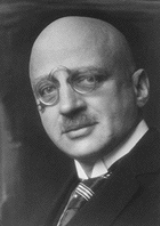
Fritz Haber

Encyclopedia
Fritz Haber was a German chemist, who received the Nobel Prize in Chemistry
in 1918 for his development for synthesizing ammonia
, important for fertilizer
s and explosives. Haber, along with Max Born
, proposed the Born–Haber cycle as a method for evaluating the lattice energy
of an ionic solid. He has also been described as the "father of chemical warfare
" for his work developing and deploying chlorine
and other poisonous gases during World War I
.
family. His was one of the oldest families of that town. Haber later converted from strict Judaism to Lutheranism. His mother died during childbirth. His father was a well-known merchant in the town. From 1886 until 1891, he studied at the University of Heidelberg under Robert Bunsen
, at the University of Berlin (today the Humboldt University of Berlin
) in the group of A. W. Hofmann, and at the Technical College of Charlottenburg (today the Technical University of Berlin
) under Carl Liebermann. He married Clara Immerwahr
during 1901. Clara was also a chemist and an opponent of Haber's work in chemical warfare. Following an argument with Haber over the subject, she committed suicide. Their son, Hermann, born in 1902, would later also commit suicide because of his shame over his father's chemical warfare work. Before starting his own academic career, he worked at his father's chemical business and in the Swiss Federal Institute of Technology
in Zürich
with Georg Lunge
.
developed the Haber process, which is the catalytic formation of ammonia
from hydrogen
and atmospheric nitrogen
under conditions of high temperature and pressure.
In 1918 he received the Nobel Prize in Chemistry for this work.
The Haber-Bosch process was a milestone in industrial chemistry, because it divorced the production of nitrogen products, such as fertilizer
, explosives and chemical feedstocks, from natural deposits, especially sodium nitrate
(caliche
), of which Chile
was a major (and almost unique) producer. Naturally extracted nitrate production in Chile fell from 2.5 million metric tonnes (employing 60,000 workers and selling at $45/tonne) in 1925 to just 800,000 tonnes, produced by 14,133 workers, and selling at $19/tonne in 1934.
He was also active in the research of combustion
reactions, the separation of gold from sea water, adsorption
effects, electrochemistry
, and free radical research (see Fenton's reagent
). A large part of his work from 1911 to 1933 was done at the Kaiser Wilhelm Institute for Physical Chemistry and Elektrochemistry
at Berlin-Dahlem
. In 1953, this institute was renamed for him. He is sometimes credited, incorrectly, with first synthesizing MDMA (which was first synthesized by Merck KGaA
chemist
Anton Köllisch
in 1912).
. Part of this work included the development of gas mask
s with absorbent filters. In addition to leading the teams developing chlorine gas and other deadly gases for use in trench warfare
, Haber was on hand personally to aid in its release despite its proscription by the Hague Convention of 1907 (to which Germany was a signatory). Future Nobel laureates James Franck
, Gustav Hertz, and Otto Hahn
served as gas troops
in Haber's unit.
Gas warfare in WW I was, in a sense, the war of the chemists, with Haber pitted against French Nobel laureate chemist Victor Grignard
. Regarding war and peace, Haber once said, "During peace time a scientist belongs to the World, but during war time he belongs to his country." This was an example of the ethical dilemmas facing chemists at that time.
His first wife Clara
, a fellow chemist and the first woman to earn a Ph.D at the University of Breslau, committed suicide with his service revolver in their garden, possibly in response to his having personally overseen the first successful use of chlorine at the Second Battle of Ypres
on 22 April 1915.
She shot herself in the heart on 15 May, and died in the morning. That same morning, Haber left for the Eastern Front
to oversee gas release against the Russians.
Haber was a patriotic German who was proud of his service during World War I
, for which he was decorated. He was even given the rank of captain by the Kaiser
, rare for a scientist too old to enlist in military service.
In his studies of the effects of poison gas, Haber noted that exposure to a low concentration of a poisonous gas for a long time often had the same effect (death) as exposure to a high concentration for a short time. He formulated a simple mathematical relationship between the gas concentration and the necessary exposure time. This relationship became known as Haber's rule
.
Haber defended gas warfare against accusations that it was inhumane, saying that death was death, by whatever means it was inflicted. During the 1920s, scientists working at his institute developed the cyanide gas formulation Zyklon A
, which was used as an insecticide
, especially as a fumigant
in grain stores.
Haber's genius was recognized by the Nazis, who offered him special funding to continue his research on weapons. As a result of fellow Jewish scientists having already been prohibited from working in that field, he left Germany in 1933. His Nobel Prize-winning work in chemistry, and subsequent contributions to Germany's war efforts in the form of chemical fertilizers, explosives and poison munitions, were not enough to prevent eventual vilification of his heritage by the Nazi
regime. The Nazis refined Haber's original work, Zyklon A, into Zyklon B, a more lethal variant.During the Holocaust it was used in the gas chamber
s at Auschwitz-Birkenau
and other camp
s in the Nazi campaign to exterminate Jews, Gypsies and others viewed by the Third Reich as inferior races or socially unwanted.
He moved to Cambridge, England, along with his assistant J J Weiss, for a few months, during which time Ernest Rutherford
pointedly refused to shake hands with him, due to his involvement in poison gas warfare. Haber was offered by Chaim Weizmann
the position of director at the Sieff Research Institute (now the Weizmann Institute) in Rehovot
, in Mandate Palestine
, and accepted it. He started his voyage to what is today Israel
in January 1934, after recovering from a heart attack. His ill health overpowered him and on January 29, 1934, at the age of 65, he died of heart failure in a Basel
hotel, where he was resting on his way to the Middle East. He was cremated and his ashes, together with Clara's ashes, were buried in Basel's Hornli Cemetery. He bequeathed his extensive private library to the Sieff Institute.
Haber's immediate family also left Germany. His second wife, Charlotte, with their two children, settled in England. Haber's son from his first marriage, Hermann, emigrated to the United States during World War II. He committed suicide in 1946. Members of Haber's extended family died in concentration camps. One of his children, Ludwig ("Lutz") Fritz Haber (1921–2004), became an eminent historian of chemical warfare in World War I, and published a book called The Poisonous Cloud (1986).
The research results show the ambivalence of his scientific activity: on the one hand, development of ammonia synthesis for the manufacture of explosives and of a technical process for the industrial manufacture and use of poison gas in warfare, but on the other hand, development of an industrial process without which the diet of today's humanity would not be possible. The annual world production of synthetic nitrogen fertilizer is currently more than 100 million tons. The food base of half of the current world population is based on the Haber-Bosch process.
, appears in Vern Thiessen's 2003 play Einstein's Gift
. Thiessen describes Haber as a tragic figure who strives unsuccessfully throughout his life to evade both his Jewish ancestry and the moral implications of his scientific contributions.
BBC Radio 4
Afternoon Play
has broadcast two plays on the life of Fritz Haber. This is the description of the first from the Diversity Website:
The second was entitled "The Greater Good" and was first broadcast on 23 October 2008. It was directed by Celia de Wolff and written by Justin Hopper, and starred Anton Lesser
as Haber. It explored his work on gas warfare during the First World War and the strain it put on his wife Clara (Lesley Sharp
), concluding with her suicide and its cover-up by the authorities. Other cast included Dan Starkey
as Haber's research associate Otto Sackur
, Stephen Critchlow
as Colonel Peterson, Conor Tottenham as Haber's son Hermann, Malcolm Tierney
as General Falkenhayn and Janice Acquah as Zinaide.
In 2008, a short film entitled "Haber" depicted Fritz Haber's decision to embark on the gas warfare program and his relationship with his wife. The film was written and directed by Daniel Ragussis.
In November 2008 Haber was again played by Anton Lesser
in Einstein and Eddington
.
Nobel Prize in Chemistry
The Nobel Prize in Chemistry is awarded annually by the Royal Swedish Academy of Sciences to scientists in the various fields of chemistry. It is one of the five Nobel Prizes established by the will of Alfred Nobel in 1895, awarded for outstanding contributions in chemistry, physics, literature,...
in 1918 for his development for synthesizing ammonia
Haber process
The Haber process, also called the Haber–Bosch process, is the nitrogen fixation reaction of nitrogen gas and hydrogen gas, over an enriched iron or ruthenium catalyst, which is used to industrially produce ammonia....
, important for fertilizer
Fertilizer
Fertilizer is any organic or inorganic material of natural or synthetic origin that is added to a soil to supply one or more plant nutrients essential to the growth of plants. A recent assessment found that about 40 to 60% of crop yields are attributable to commercial fertilizer use...
s and explosives. Haber, along with Max Born
Max Born
Max Born was a German-born physicist and mathematician who was instrumental in the development of quantum mechanics. He also made contributions to solid-state physics and optics and supervised the work of a number of notable physicists in the 1920s and 30s...
, proposed the Born–Haber cycle as a method for evaluating the lattice energy
Lattice energy
The lattice energy of an ionic solid is a measure of the strength of bonds in that ionic compound. It is usually defined as the enthalpy of formation of the ionic compound from gaseous ions and as such is invariably exothermic. Lattice energy may also be defined as the energy required to completely...
of an ionic solid. He has also been described as the "father of chemical warfare
Chemical warfare
Chemical warfare involves using the toxic properties of chemical substances as weapons. This type of warfare is distinct from Nuclear warfare and Biological warfare, which together make up NBC, the military acronym for Nuclear, Biological, and Chemical...
" for his work developing and deploying chlorine
Chlorine
Chlorine is the chemical element with atomic number 17 and symbol Cl. It is the second lightest halogen, found in the periodic table in group 17. The element forms diatomic molecules under standard conditions, called dichlorine...
and other poisonous gases during World War I
World War I
World War I , which was predominantly called the World War or the Great War from its occurrence until 1939, and the First World War or World War I thereafter, was a major war centred in Europe that began on 28 July 1914 and lasted until 11 November 1918...
.
Biography
Haber was born in Breslau, Germany (now Wrocław, Poland), into a HasidicHasidic Judaism
Hasidic Judaism or Hasidism, from the Hebrew —Ḥasidut in Sephardi, Chasidus in Ashkenazi, meaning "piety" , is a branch of Orthodox Judaism that promotes spirituality and joy through the popularisation and internalisation of Jewish mysticism as the fundamental aspects of the Jewish faith...
family. His was one of the oldest families of that town. Haber later converted from strict Judaism to Lutheranism. His mother died during childbirth. His father was a well-known merchant in the town. From 1886 until 1891, he studied at the University of Heidelberg under Robert Bunsen
Robert Bunsen
Robert Wilhelm Eberhard Bunsen was a German chemist. He investigated emission spectra of heated elements, and discovered caesium and rubidium with Gustav Kirchhoff. Bunsen developed several gas-analytical methods, was a pioneer in photochemistry, and did early work in the field of organoarsenic...
, at the University of Berlin (today the Humboldt University of Berlin
Humboldt University of Berlin
The Humboldt University of Berlin is Berlin's oldest university, founded in 1810 as the University of Berlin by the liberal Prussian educational reformer and linguist Wilhelm von Humboldt, whose university model has strongly influenced other European and Western universities...
) in the group of A. W. Hofmann, and at the Technical College of Charlottenburg (today the Technical University of Berlin
Technical University of Berlin
The Technische Universität Berlin is a research university located in Berlin, Germany. Translating the name into English is discouraged by the university, however paraphrasing as Berlin Institute of Technology is recommended by the university if necessary .The TU Berlin was founded...
) under Carl Liebermann. He married Clara Immerwahr
Clara Immerwahr
Clara Immerwahr was a Jewish-German chemist and the wife of fellow chemist Fritz Haber.-Education:Immerwahr studied at the University of Breslau, attaining her degree and a Ph.D. in chemistry. She was the first woman Ph.D. at the University of Breslau.-Marriage and work:Immerwahr married Haber in...
during 1901. Clara was also a chemist and an opponent of Haber's work in chemical warfare. Following an argument with Haber over the subject, she committed suicide. Their son, Hermann, born in 1902, would later also commit suicide because of his shame over his father's chemical warfare work. Before starting his own academic career, he worked at his father's chemical business and in the Swiss Federal Institute of Technology
ETH Zurich
The Swiss Federal Institute of Technology Zurich or ETH Zürich is an engineering, science, technology, mathematics and management university in the City of Zurich, Switzerland....
in Zürich
Zürich
Zurich is the largest city in Switzerland and the capital of the canton of Zurich. It is located in central Switzerland at the northwestern tip of Lake Zurich...
with Georg Lunge
Georg Lunge
Georg Lunge was a German chemist born in Breslau. He studied at Heidelberg and Breslau, graduating at the latter university in 1859, for the work with Ferdinand Cohn...
.
Nobel Prize
During his time at University of Karlsruhe from 1894 to 1911, Fritz Haber and Carl BoschCarl Bosch
Carl Bosch was a German chemist and engineer and Nobel laureate in chemistry. He was a pioneer in the field of high-pressure industrial chemistry and founder of IG Farben, at one point the world's largest chemical company....
developed the Haber process, which is the catalytic formation of ammonia
Ammonia
Ammonia is a compound of nitrogen and hydrogen with the formula . It is a colourless gas with a characteristic pungent odour. Ammonia contributes significantly to the nutritional needs of terrestrial organisms by serving as a precursor to food and fertilizers. Ammonia, either directly or...
from hydrogen
Hydrogen
Hydrogen is the chemical element with atomic number 1. It is represented by the symbol H. With an average atomic weight of , hydrogen is the lightest and most abundant chemical element, constituting roughly 75% of the Universe's chemical elemental mass. Stars in the main sequence are mainly...
and atmospheric nitrogen
Nitrogen
Nitrogen is a chemical element that has the symbol N, atomic number of 7 and atomic mass 14.00674 u. Elemental nitrogen is a colorless, odorless, tasteless, and mostly inert diatomic gas at standard conditions, constituting 78.08% by volume of Earth's atmosphere...
under conditions of high temperature and pressure.
In 1918 he received the Nobel Prize in Chemistry for this work.
The Haber-Bosch process was a milestone in industrial chemistry, because it divorced the production of nitrogen products, such as fertilizer
Fertilizer
Fertilizer is any organic or inorganic material of natural or synthetic origin that is added to a soil to supply one or more plant nutrients essential to the growth of plants. A recent assessment found that about 40 to 60% of crop yields are attributable to commercial fertilizer use...
, explosives and chemical feedstocks, from natural deposits, especially sodium nitrate
Sodium nitrate
Sodium nitrate is the chemical compound with the formula NaNO3. This salt, also known as Chile saltpeter or Peru saltpeter to distinguish it from ordinary saltpeter, potassium nitrate, is a white solid which is very soluble in water...
(caliche
Caliche (Mineral)
Caliche is a sedimentary rock, a hardened deposit of calcium carbonate. This calcium carbonate cements together other materials, including gravel, sand, clay, and silt. It is found in aridisol and mollisol soil orders...
), of which Chile
Chile
Chile ,officially the Republic of Chile , is a country in South America occupying a long, narrow coastal strip between the Andes mountains to the east and the Pacific Ocean to the west. It borders Peru to the north, Bolivia to the northeast, Argentina to the east, and the Drake Passage in the far...
was a major (and almost unique) producer. Naturally extracted nitrate production in Chile fell from 2.5 million metric tonnes (employing 60,000 workers and selling at $45/tonne) in 1925 to just 800,000 tonnes, produced by 14,133 workers, and selling at $19/tonne in 1934.
He was also active in the research of combustion
Combustion
Combustion or burning is the sequence of exothermic chemical reactions between a fuel and an oxidant accompanied by the production of heat and conversion of chemical species. The release of heat can result in the production of light in the form of either glowing or a flame...
reactions, the separation of gold from sea water, adsorption
Adsorption
Adsorption is the adhesion of atoms, ions, biomolecules or molecules of gas, liquid, or dissolved solids to a surface. This process creates a film of the adsorbate on the surface of the adsorbent. It differs from absorption, in which a fluid permeates or is dissolved by a liquid or solid...
effects, electrochemistry
Electrochemistry
Electrochemistry is a branch of chemistry that studies chemical reactions which take place in a solution at the interface of an electron conductor and an ionic conductor , and which involve electron transfer between the electrode and the electrolyte or species in solution.If a chemical reaction is...
, and free radical research (see Fenton's reagent
Fenton's reagent
Fenton's reagent is a solution of hydrogen peroxide and an iron catalyst that is used to oxidize contaminants or waste waters. Fenton's reagent can be used to destroy organic compounds such as trichloroethylene and tetrachloroethylene ....
). A large part of his work from 1911 to 1933 was done at the Kaiser Wilhelm Institute for Physical Chemistry and Elektrochemistry
Fritz Haber Institute of the MPG
The Fritz Haber Institute of the Max Planck Society is a science research institute located at the heart of the academic district of Dahlem, in Berlin, Germany....
at Berlin-Dahlem
Dahlem (Berlin)
Dahlem is a locality of the Steglitz-Zehlendorf borough in southwestern Berlin. Until Berlin's 2001 administrative reform it was a part of the former borough of Zehlendorf. Dahlem is one of the most affluent parts of the city and home to the main campus of the Free University of Berlin with the...
. In 1953, this institute was renamed for him. He is sometimes credited, incorrectly, with first synthesizing MDMA (which was first synthesized by Merck KGaA
Merck KGaA
Merck KGaA is a German chemical and pharmaceutical company. Merck, also known as “German Merck” and “Merck Darmstadt”, was founded in Darmstadt, Germany, in 1668, making it the world's oldest operating chemical and pharmaceutical company. The company was privately owned until going public in 1995...
chemist
Chemist
A chemist is a scientist trained in the study of chemistry. Chemists study the composition of matter and its properties such as density and acidity. Chemists carefully describe the properties they study in terms of quantities, with detail on the level of molecules and their component atoms...
Anton Köllisch
Anton Kollisch
Anton Köllisch was the German chemist who, whilst working at Darmstadt for pharmaceutical giant Merck, first synthesized the chemical MDMA that would later come to be known as "ecstasy"....
in 1912).
World War I
Haber played a major role in the development of chemical warfare in World War IPoison gas in World War I
The use of chemical weapons in World War I ranged from disabling chemicals, such as tear gas and the severe mustard gas, to lethal agents like phosgene and chlorine. This chemical warfare was a major component of the first global war and first total war of the 20th century. The killing capacity of...
. Part of this work included the development of gas mask
Gas mask
A gas mask is a mask put on over the face to protect the wearer from inhaling airborne pollutants and toxic gases. The mask forms a sealed cover over the nose and mouth, but may also cover the eyes and other vulnerable soft tissues of the face. Some gas masks are also respirators, though the word...
s with absorbent filters. In addition to leading the teams developing chlorine gas and other deadly gases for use in trench warfare
Trench warfare
Trench warfare is a form of occupied fighting lines, consisting largely of trenches, in which troops are largely immune to the enemy's small arms fire and are substantially sheltered from artillery...
, Haber was on hand personally to aid in its release despite its proscription by the Hague Convention of 1907 (to which Germany was a signatory). Future Nobel laureates James Franck
James Franck
James Franck was a German Jewish physicist and Nobel laureate.-Biography:Franck was born to Jacob Franck and Rebecca Nachum Drucker. Franck completed his Ph.D...
, Gustav Hertz, and Otto Hahn
Otto Hahn
Otto Hahn FRS was a German chemist and Nobel laureate, a pioneer in the fields of radioactivity and radiochemistry. He is regarded as "the father of nuclear chemistry". Hahn was a courageous opposer of Jewish persecution by the Nazis and after World War II he became a passionate campaigner...
served as gas troops
Poison gas in World War I
The use of chemical weapons in World War I ranged from disabling chemicals, such as tear gas and the severe mustard gas, to lethal agents like phosgene and chlorine. This chemical warfare was a major component of the first global war and first total war of the 20th century. The killing capacity of...
in Haber's unit.
Gas warfare in WW I was, in a sense, the war of the chemists, with Haber pitted against French Nobel laureate chemist Victor Grignard
Victor Grignard
François Auguste Victor Grignard was a Nobel Prize-winning French chemist.Grignard was the son of a sail maker. After studying mathematics at Lyon he transferred to chemistry and discovered the synthetic reaction bearing his name in 1900...
. Regarding war and peace, Haber once said, "During peace time a scientist belongs to the World, but during war time he belongs to his country." This was an example of the ethical dilemmas facing chemists at that time.
His first wife Clara
Clara Immerwahr
Clara Immerwahr was a Jewish-German chemist and the wife of fellow chemist Fritz Haber.-Education:Immerwahr studied at the University of Breslau, attaining her degree and a Ph.D. in chemistry. She was the first woman Ph.D. at the University of Breslau.-Marriage and work:Immerwahr married Haber in...
, a fellow chemist and the first woman to earn a Ph.D at the University of Breslau, committed suicide with his service revolver in their garden, possibly in response to his having personally overseen the first successful use of chlorine at the Second Battle of Ypres
Second Battle of Ypres
The Second Battle of Ypres was the first time Germany used poison gas on a large scale on the Western Front in the First World War and the first time a former colonial force pushed back a major European power on European soil, which occurred in the battle of St...
on 22 April 1915.
She shot herself in the heart on 15 May, and died in the morning. That same morning, Haber left for the Eastern Front
Eastern Front (World War I)
The Eastern Front was a theatre of war during World War I in Central and, primarily, Eastern Europe. The term is in contrast to the Western Front. Despite the geographical separation, the events in the two theatres strongly influenced each other...
to oversee gas release against the Russians.
Haber was a patriotic German who was proud of his service during World War I
World War I
World War I , which was predominantly called the World War or the Great War from its occurrence until 1939, and the First World War or World War I thereafter, was a major war centred in Europe that began on 28 July 1914 and lasted until 11 November 1918...
, for which he was decorated. He was even given the rank of captain by the Kaiser
Kaiser
Kaiser is the German title meaning "Emperor", with Kaiserin being the female equivalent, "Empress". Like the Russian Czar it is directly derived from the Latin Emperors' title of Caesar, which in turn is derived from the personal name of a branch of the gens Julia, to which Gaius Julius Caesar,...
, rare for a scientist too old to enlist in military service.
In his studies of the effects of poison gas, Haber noted that exposure to a low concentration of a poisonous gas for a long time often had the same effect (death) as exposure to a high concentration for a short time. He formulated a simple mathematical relationship between the gas concentration and the necessary exposure time. This relationship became known as Haber's rule
Haber's rule
Haber's rule or Haber's law is a mathematical statement of the relationship between the concentration of a poisonous gas and how long the gas must be breathed to produce death, or other toxic effect...
.
Haber defended gas warfare against accusations that it was inhumane, saying that death was death, by whatever means it was inflicted. During the 1920s, scientists working at his institute developed the cyanide gas formulation Zyklon A
Methyl cyanoformate
Methyl cyanoformate is the organic compound with the formula CH3OCCN. This colorless liquid is used as a reagent in organic synthesis as a source of the methoxycarbonyl group.It was also the active ingredient in the pesticide product Zyklon A....
, which was used as an insecticide
Insecticide
An insecticide is a pesticide used against insects. They include ovicides and larvicides used against the eggs and larvae of insects respectively. Insecticides are used in agriculture, medicine, industry and the household. The use of insecticides is believed to be one of the major factors behind...
, especially as a fumigant
Fumigation
Fumigation is a method of pest control that completely fills an area with gaseous pesticides—or fumigants—to suffocate or poison the pests within. It is utilized for control of pests in buildings , soil, grain, and produce, and is also used during processing of goods to be imported or...
in grain stores.
Post-war
In the 1920s, Haber searched exhaustively for a method to extract gold from sea water, and published a number of scientific papers on the subject. After years of research, he concluded that the concentration of gold dissolved in sea water was much lower than those reported by earlier researchers, and that gold extraction from sea water was uneconomic.Haber's genius was recognized by the Nazis, who offered him special funding to continue his research on weapons. As a result of fellow Jewish scientists having already been prohibited from working in that field, he left Germany in 1933. His Nobel Prize-winning work in chemistry, and subsequent contributions to Germany's war efforts in the form of chemical fertilizers, explosives and poison munitions, were not enough to prevent eventual vilification of his heritage by the Nazi
Nazism
Nazism, the common short form name of National Socialism was the ideology and practice of the Nazi Party and of Nazi Germany...
regime. The Nazis refined Haber's original work, Zyklon A, into Zyklon B, a more lethal variant.During the Holocaust it was used in the gas chamber
Gas chamber
A gas chamber is an apparatus for killing humans or animals with gas, consisting of a sealed chamber into which a poisonous or asphyxiant gas is introduced. The most commonly used poisonous agent is hydrogen cyanide; carbon dioxide and carbon monoxide have also been used...
s at Auschwitz-Birkenau
Auschwitz concentration camp
Concentration camp Auschwitz was a network of Nazi concentration and extermination camps built and operated by the Third Reich in Polish areas annexed by Nazi Germany during World War II...
and other camp
Camp
-Outdoor accommodation and recreation:* Campsite or campground, a recreational outdoor sleeping and eating site* Summer camp, typically organized for groups of children or youth* A term used in New England, Northern Ontario and New Brunswick to describe a cottage...
s in the Nazi campaign to exterminate Jews, Gypsies and others viewed by the Third Reich as inferior races or socially unwanted.
He moved to Cambridge, England, along with his assistant J J Weiss, for a few months, during which time Ernest Rutherford
Ernest Rutherford
Ernest Rutherford, 1st Baron Rutherford of Nelson OM, FRS was a New Zealand-born British chemist and physicist who became known as the father of nuclear physics...
pointedly refused to shake hands with him, due to his involvement in poison gas warfare. Haber was offered by Chaim Weizmann
Chaim Weizmann
Chaim Azriel Weizmann, , was a Zionist leader, President of the Zionist Organization, and the first President of the State of Israel. He was elected on 1 February 1949, and served until his death in 1952....
the position of director at the Sieff Research Institute (now the Weizmann Institute) in Rehovot
Rehovot
Rehovot is a city in the Center District of Israel, about south of Tel Aviv. According to the Israel Central Bureau of Statistics , at the end of 2009 the city had a total population of 112,700. Rehovot's official website estimates the population at 114,000.Rehovot was built on the site of Doron,...
, in Mandate Palestine
Mandate Palestine
Mandate Palestine existed while the British Mandate for Palestine, which formally began in September 1923 and terminated in May 1948, was in effect...
, and accepted it. He started his voyage to what is today Israel
Israel
The State of Israel is a parliamentary republic located in the Middle East, along the eastern shore of the Mediterranean Sea...
in January 1934, after recovering from a heart attack. His ill health overpowered him and on January 29, 1934, at the age of 65, he died of heart failure in a Basel
Basel
Basel or Basle In the national languages of Switzerland the city is also known as Bâle , Basilea and Basilea is Switzerland's third most populous city with about 166,000 inhabitants. Located where the Swiss, French and German borders meet, Basel also has suburbs in France and Germany...
hotel, where he was resting on his way to the Middle East. He was cremated and his ashes, together with Clara's ashes, were buried in Basel's Hornli Cemetery. He bequeathed his extensive private library to the Sieff Institute.
Haber's immediate family also left Germany. His second wife, Charlotte, with their two children, settled in England. Haber's son from his first marriage, Hermann, emigrated to the United States during World War II. He committed suicide in 1946. Members of Haber's extended family died in concentration camps. One of his children, Ludwig ("Lutz") Fritz Haber (1921–2004), became an eminent historian of chemical warfare in World War I, and published a book called The Poisonous Cloud (1986).
Criticism
Haber received much criticism for his involvement in the development of chemical weapons in pre-World War II Germany, both from contemporaries and from modern-day scientists.The research results show the ambivalence of his scientific activity: on the one hand, development of ammonia synthesis for the manufacture of explosives and of a technical process for the industrial manufacture and use of poison gas in warfare, but on the other hand, development of an industrial process without which the diet of today's humanity would not be possible. The annual world production of synthetic nitrogen fertilizer is currently more than 100 million tons. The food base of half of the current world population is based on the Haber-Bosch process.
Further reading
- Albarelli JR., H.P.: A Terrible Mistake:The Murder of Frank Olson and the CIA’s Secret Cold War Experiments - Trine Day LLC, 1st ed., 2009, ISBN 0977795373
- Bernstein, Barton J.: Birth of the U.S. biological warfare program. Scientific American 256: 116 - 121, 1987.
- Geissler, Erhard: Biologische Waffen, nicht in Hitlers Arsenalen. Biologische und Toxin-Kampfmittel in Deutschland von 1915 - 1945. LIT-Verlag, Berlin-Hamburg-Münster, 2nd ed., 1999. ISBN 3825829553.
- Geissler, Erhard: Biological warfare activities in Germany 1923 - 1945. In: Geissler, Erhard and Moon, John Ellis van Courtland, eds., Biological warfare from the Middle Ages to 1945. New York: Oxford University Press, 1999, ISBN 0198295790.
- Maddrell, Paul: Spying on Science: Western Intelligence in Divided Germany 1945 - 1961. Oxford University Press, 2006, ISBN 0199267502.
Dramatic treatment
A fictional description of Haber's life, and in particular his longtime relationship with Albert EinsteinAlbert Einstein
Albert Einstein was a German-born theoretical physicist who developed the theory of general relativity, effecting a revolution in physics. For this achievement, Einstein is often regarded as the father of modern physics and one of the most prolific intellects in human history...
, appears in Vern Thiessen's 2003 play Einstein's Gift
Einstein's Gift
Einstein's Gift is a play written by Canadian playwright Vern Thiessen in 2003. Through the recollections of Albert Einstein, the play focuses on the life and career of German chemist Dr. Fritz Haber, who helped improve living conditions with his work on nitrogen fixation...
. Thiessen describes Haber as a tragic figure who strives unsuccessfully throughout his life to evade both his Jewish ancestry and the moral implications of his scientific contributions.
BBC Radio 4
BBC Radio 4
BBC Radio 4 is a British domestic radio station, operated and owned by the BBC, that broadcasts a wide variety of spoken-word programmes, including news, drama, comedy, science and history. It replaced the BBC Home Service in 1967. The station controller is currently Gwyneth Williams, and the...
Afternoon Play
Afternoon Play
The Afternoon Play is a long-running drama programming strand, broadcast every weekday at 2.15pm on BBC Radio 4. Each play lasts for 45 minutes, and roughly 190 new Afternoon Plays are broadcast each year....
has broadcast two plays on the life of Fritz Haber. This is the description of the first from the Diversity Website:
The second was entitled "The Greater Good" and was first broadcast on 23 October 2008. It was directed by Celia de Wolff and written by Justin Hopper, and starred Anton Lesser
Anton Lesser
Anton Lesser is a British actor. He attended Moseley Grammar School and the University of Liverpool before going to RADA in 1977 where he was awarded the Bancroft Gold Medal as the most promising actor of his year....
as Haber. It explored his work on gas warfare during the First World War and the strain it put on his wife Clara (Lesley Sharp
Lesley Sharp
Lesley Sharp is an English stage, film and television actress, particularly well known for her variety of British television roles including Clocking Off, Bob & Rose and afterlife.-Early life:...
), concluding with her suicide and its cover-up by the authorities. Other cast included Dan Starkey
Dan Starkey
Dan Starkey is a British actor.Dan studied at University of Cambridge before training at the Bristol Old Vic .-Theatre credits:*The 39 Steps UK national tour* The Fitzrovia Radio Hour-Filmography:...
as Haber's research associate Otto Sackur
Otto Sackur
Otto Sackur was a German physical chemist.He is known for the development of the Sackur-Tetrode equation which he developed independently of Hugo Tetrode...
, Stephen Critchlow
Stephen Critchlow
Stephen Critchlow is a popular and versatile British actor, notable for his work in the theatre and appearances on radio series such as Truly, Madly, Bletchley, The Way We Live Right Now and Spats, along with radio episodes of Torchwood and Doctor Who...
as Colonel Peterson, Conor Tottenham as Haber's son Hermann, Malcolm Tierney
Malcolm Tierney
Malcolm Tierney is an English actor who has appeared in many film and television roles.His roles include the part of Tommy McArdle in Brookside between 1983 and 1987, Charlie Gimbert in Lovejoy, Geoffrey Ellsworth-Symthe in A Bit of a Do, Patrick Woolton in House of Cards and Chief Const. Raymond...
as General Falkenhayn and Janice Acquah as Zinaide.
In 2008, a short film entitled "Haber" depicted Fritz Haber's decision to embark on the gas warfare program and his relationship with his wife. The film was written and directed by Daniel Ragussis.
In November 2008 Haber was again played by Anton Lesser
Anton Lesser
Anton Lesser is a British actor. He attended Moseley Grammar School and the University of Liverpool before going to RADA in 1977 where he was awarded the Bancroft Gold Medal as the most promising actor of his year....
in Einstein and Eddington
Einstein and Eddington
Einstein and Eddington is a British single drama produced by Company Pictures and the BBC, in association with HBO. It featured David Tennant as British scientist Sir Arthur Stanley Eddington, and Andy Serkis as Albert Einstein...
.
Further reading
- Daniel Charles, Master mind: The Rise and Fall of Fritz Haber, the Nobel Laureate Who Launched the Age of Chemical Warfare (New York: Ecco, 2005), ISBN 0-06-056272-2.
- Dietrich Stoltzenberg, Fritz Haber: Chemist, Nobel Laureate, German, Jew: A Biography (Chemical Heritage Foundation, 2005), ISBN 0-941901-24-6.
- Vaclav Smil, Enriching the Earth: Fritz Haber, Carl Bosch, and the Transformation of World Food Production (2001) ISBN 0-262-19449-X
- Thomas Hager, The Alchemy of Air: A Jewish Genius, a Doomed Tycoon, and the Scientific Discovery That Fed the World but Fueled the Rise of Hitler (2008) ISBN 978-0-307-35178-4.
External links
- Nobel e-Museum - Biography of Fritz Haber
- HABER - A Biographical Film about Fritz Haber
- Photographs of Fritz Haber's life
- A short biography of Fritz Haber, by Bretislav Friedrich
- Encyclopedia Britannica: Nobel Prizes - Fritz Haber
- "The Synthesis of Ammonia from its Elements", Nobel Lecture, 2 June 1920
- Fritz Haber: Jewish chemist whose work led to Zyklon B