

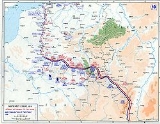
Western Front

Encyclopedia
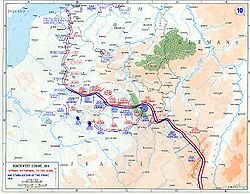
- See Western Front (disambiguation)Western Front (disambiguation)Western Front may refer to:*Western Front, a front to the West of Germany during World War I and World War II:**Western Front **Western Front...
for other meanings.
Western Front was a term used during the First
World War I
World War I , which was predominantly called the World War or the Great War from its occurrence until 1939, and the First World War or World War I thereafter, was a major war centred in Europe that began on 28 July 1914 and lasted until 11 November 1918...
and Second
World War II
World War II, or the Second World War , was a global conflict lasting from 1939 to 1945, involving most of the world's nations—including all of the great powers—eventually forming two opposing military alliances: the Allies and the Axis...
World Wars
World war
A world war is a war affecting the majority of the world's most powerful and populous nations. World wars span multiple countries on multiple continents, with battles fought in multiple theaters....
to describe the contested armed frontier between lands controlled by Germany
Germany
Germany , officially the Federal Republic of Germany , is a federal parliamentary republic in Europe. The country consists of 16 states while the capital and largest city is Berlin. Germany covers an area of 357,021 km2 and has a largely temperate seasonal climate...
to the east and the Allies
Allies
In everyday English usage, allies are people, groups, or nations that have joined together in an association for mutual benefit or to achieve some common purpose, whether or not explicit agreement has been worked out between them...
to the west. A contested armed frontier during a war is called a "front
Front (military)
A military front or battlefront is a contested armed frontier between opposing forces. This can be a local or tactical front, or it can range to a theater...
".
There was also an Eastern Front
Eastern Front
Eastern Front may refer to one of the following:* Eastern Front * Eastern Front * Eastern Front * Eastern Front * Eastern Front * 1635: The Eastern Front...
in both World War I
Eastern Front (World War I)
The Eastern Front was a theatre of war during World War I in Central and, primarily, Eastern Europe. The term is in contrast to the Western Front. Despite the geographical separation, the events in the two theatres strongly influenced each other...
and World War II
Eastern Front (World War II)
The Eastern Front of World War II was a theatre of World War II between the European Axis powers and co-belligerent Finland against the Soviet Union, Poland, and some other Allies which encompassed Northern, Southern and Eastern Europe from 22 June 1941 to 9 May 1945...
.
World War I
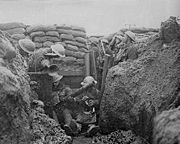
- Main article Western Front (World War I)Western Front (World War I)Following the outbreak of World War I in 1914, the German Army opened the Western Front by first invading Luxembourg and Belgium, then gaining military control of important industrial regions in France. The tide of the advance was dramatically turned with the Battle of the Marne...
From the end of the First Battle of Ypres
First Battle of Ypres
The First Battle of Ypres, also called the First Battle of Flanders , was a First World War battle fought for the strategic town of Ypres in western Belgium...
, at the end of the Race to the Sea
Race to the Sea
The Race to the Sea is a name given to the period early in the First World War when the two sides were still engaged in mobile warfare on the Western Front. With the German advance stalled at the First Battle of the Marne, the opponents continually attempted to outflank each other through...
, until late 1918, the Western Front consisted of a relatively static line of trench systems
Trench warfare
Trench warfare is a form of occupied fighting lines, consisting largely of trenches, in which troops are largely immune to the enemy's small arms fire and are substantially sheltered from artillery...
which stretched from the coast of the North Sea
North Sea
In the southwest, beyond the Straits of Dover, the North Sea becomes the English Channel connecting to the Atlantic Ocean. In the east, it connects to the Baltic Sea via the Skagerrak and Kattegat, narrow straits that separate Denmark from Norway and Sweden respectively...
southwards to the Swiss
Switzerland
Switzerland name of one of the Swiss cantons. ; ; ; or ), in its full name the Swiss Confederation , is a federal republic consisting of 26 cantons, with Bern as the seat of the federal authorities. The country is situated in Western Europe,Or Central Europe depending on the definition....
border. In their efforts to break through the opposing lines of trenches and barbed wire entanglements, the opposing forces employed huge artillery bombardments followed by attacks of tens of thousands of soldiers. Battles typically lasted for months and lead to casualties measured in the hundreds of thousands for attacker and defender alike, such as the Battle of the Somme, where 20,000 men died on the first day
First day on the Somme
The first day on the Somme, 1 July 1916, was the opening day of the Battle of Albert, which was the first phase of the British and French offensive that became known as the Battle of the Somme...
. Battles on this front were also typified by poor planning and the application of 19th century warfare tactics, such as direct frontal assaults on enemy positions, that were doomed to failure in the face of modern technology. The general result of these huge expenditures of effort was only a small shift, measured in a few kilometres, in a short section of the front.
The principal adversaries on the Western Front, who fielded armies of millions of men, were Germany
Germany
Germany , officially the Federal Republic of Germany , is a federal parliamentary republic in Europe. The country consists of 16 states while the capital and largest city is Berlin. Germany covers an area of 357,021 km2 and has a largely temperate seasonal climate...
to the east against France
France
The French Republic , The French Republic , The French Republic , (commonly known as France , is a unitary semi-presidential republic in Western Europe with several overseas territories and islands located on other continents and in the Indian, Pacific, and Atlantic oceans. Metropolitan France...
and the United Kingdom
United Kingdom
The United Kingdom of Great Britain and Northern IrelandIn the United Kingdom and Dependencies, other languages have been officially recognised as legitimate autochthonous languages under the European Charter for Regional or Minority Languages...
to the west, with sizable contingents from the Allied empires, especially the British Dominion
Dominion
A dominion, often Dominion, refers to one of a group of autonomous polities that were nominally under British sovereignty, constituting the British Empire and British Commonwealth, beginning in the latter part of the 19th century. They have included Canada, Australia, New Zealand, Newfoundland,...
s. The United States
United States
The United States of America is a federal constitutional republic comprising fifty states and a federal district...
entered the war on the side of the Entente Powers in 1917 and by mid-1918 had an army of around half a million men, this rising to a million by the time the Armistice was signed on November 11, 1918.
The Alpine Front between Italy
Italy
Italy , officially the Italian Republic languages]] under the European Charter for Regional or Minority Languages. In each of these, Italy's official name is as follows:;;;;;;;;), is a unitary parliamentary republic in South-Central Europe. To the north it borders France, Switzerland, Austria and...
and the Austro-Hungarian Empire
Austria-Hungary
Austria-Hungary , more formally known as the Kingdoms and Lands Represented in the Imperial Council and the Lands of the Holy Hungarian Crown of Saint Stephen, was a constitutional monarchic union between the crowns of the Austrian Empire and the Kingdom of Hungary in...
, which was a member of the Central Powers
Central Powers
The Central Powers were one of the two warring factions in World War I , composed of the German Empire, the Austro-Hungarian Empire, the Ottoman Empire, and the Kingdom of Bulgaria...
, is usually considered to be a separate front.
World War II
- Main article Western Front (World War II)Western Front (World War II)The Western Front of the European Theatre of World War II encompassed, Denmark, Norway, Luxembourg, Belgium, the Netherlands, France, and West Germany. The Western Front was marked by two phases of large-scale ground combat operations...
The Western Front of World War II was generally restricted to the same geographic regions as during World War I. During the war the front moved much further, as far west as the English Channel
English Channel
The English Channel , often referred to simply as the Channel, is an arm of the Atlantic Ocean that separates southern England from northern France, and joins the North Sea to the Atlantic. It is about long and varies in width from at its widest to in the Strait of Dover...
and as far east as the line which would become the Iron Curtain
Iron Curtain
The concept of the Iron Curtain symbolized the ideological fighting and physical boundary dividing Europe into two separate areas from the end of World War II in 1945 until the end of the Cold War in 1989...
during the Cold War
Cold War
The Cold War was the continuing state from roughly 1946 to 1991 of political conflict, military tension, proxy wars, and economic competition between the Communist World—primarily the Soviet Union and its satellite states and allies—and the powers of the Western world, primarily the United States...
. Although fighting took place in Norway
Norway
Norway , officially the Kingdom of Norway, is a Nordic unitary constitutional monarchy whose territory comprises the western portion of the Scandinavian Peninsula, Jan Mayen, and the Arctic archipelago of Svalbard and Bouvet Island. Norway has a total area of and a population of about 4.9 million...
and Italy these are not usually included as part of the Western Front but as separate campaigns.
The Western Front had three distinct phases during World War II.
The first phase lasted from September 1, 1939 until June 25, 1940. It started with the Phony War
Phony War
The Phoney War was a phase early in World War II – in the months following Britain and France's declaration of war on Germany in September 1939 and preceding the Battle of France in May 1940 – that was marked by a lack of major military operations by the Western Allies against the German Reich...
with the Allies taking up positions which created a front similar to that held during most of World War I. The first phase lasted until the Germans attacked
Battle of France
In the Second World War, the Battle of France was the German invasion of France and the Low Countries, beginning on 10 May 1940, which ended the Phoney War. The battle consisted of two main operations. In the first, Fall Gelb , German armoured units pushed through the Ardennes, to cut off and...
and won a stunningly fast victory in June 1940. The British had to withdraw the British Expeditionary Force
British Expeditionary Force (World War II)
The British Expeditionary Force was the British force in Europe from 1939–1940 during the Second World War. Commanded by General Lord Gort, the BEF constituted one-tenth of the defending Allied force....
to Britain with an evacuation through Dunkirk and France was forced to capitulate.
The second phase from the late summer of July 1940 until the early summer of June 1944 consisted of a stalemate along the English Channel where neither side was strong enough to invade
Invasion
An invasion is a military offensive consisting of all, or large parts of the armed forces of one geopolitical entity aggressively entering territory controlled by another such entity, generally with the objective of either conquering, liberating or re-establishing control or authority over a...
the other's territory, being limited to smaller raids. The main action during this period was happening in the Eastern Front
Eastern Front (World War II)
The Eastern Front of World War II was a theatre of World War II between the European Axis powers and co-belligerent Finland against the Soviet Union, Poland, and some other Allies which encompassed Northern, Southern and Eastern Europe from 22 June 1941 to 9 May 1945...
.
The third and final phase started on June 6, 1944 with the invasion of Normandy on the D-Day
D-Day
D-Day is a term often used in military parlance to denote the day on which a combat attack or operation is to be initiated. "D-Day" often represents a variable, designating the day upon which some significant event will occur or has occurred; see Military designation of days and hours for similar...
of Operation Overlord
Operation Overlord
Operation Overlord was the code name for the Battle of Normandy, the operation that launched the invasion of German-occupied western Europe during World War II by Allied forces. The operation commenced on 6 June 1944 with the Normandy landings...
, when an Allied force consisting of American British and Canadian Army Groups (with units from many other nations), successfully gained a beach head in Normandy
Normandy
Normandy is a geographical region corresponding to the former Duchy of Normandy. It is in France.The continental territory covers 30,627 km² and forms the preponderant part of Normandy and roughly 5% of the territory of France. It is divided for administrative purposes into two régions:...
in northern France. By the second half of 1944 the front was approximately where the World War I front had been. It ended on May 9, 1945 with the unconditional surrender of German troops. By that time western Allied forces were on a front which stretched from the Baltic
Baltic region
The terms Baltic region, Baltic Rim countries, and Baltic Rim refer to slightly different combinations of countries in the general area surrounding the Baltic Sea.- Etymology :...
east of Denmark
Denmark
Denmark is a Scandinavian country in Northern Europe. The countries of Denmark and Greenland, as well as the Faroe Islands, constitute the Kingdom of Denmark . It is the southernmost of the Nordic countries, southwest of Sweden and south of Norway, and bordered to the south by Germany. Denmark...
, southwards along the river Elbe, through the German/Czechoslovakia border into Austria
Austria
Austria , officially the Republic of Austria , is a landlocked country of roughly 8.4 million people in Central Europe. It is bordered by the Czech Republic and Germany to the north, Slovakia and Hungary to the east, Slovenia and Italy to the south, and Switzerland and Liechtenstein to the...
and North Italy.
Total surrender of the German armed forces on the western front was completed on May 9 when Nazi Germany was forced to cede all remaining territory to the Allies. By this stage, Nazi Germany had very little captured land remaining, apart from Norway, Denmark, and few strong points on the western front including the Channel Islands. By May 1945, the war in Europe was over, with total defeat of enemy resistance down to the last few small pockets of resistance remaining after the fall of Berlin. The Red Army marched through Moscow on June 25 to show off Soviet power by marking the 4th anniversary of Operation Barbarossa
Operation Barbarossa
Operation Barbarossa was the code name for Germany's invasion of the Soviet Union during World War II that began on 22 June 1941. Over 4.5 million troops of the Axis powers invaded the USSR along a front., the largest invasion in the history of warfare...
in 1941 launched by Germany for the invasion of the Soviet Union and the end of World War II in Europe.
Further reading
- Beckett, Ian F.W. Ypres: The First Battle 1914, (2006) 336pp
- Chickering, Roger et al. eds. Great War, Total War: Combat and Mobilization on the Western Front, 1914-1918 (2000). 584 pgs.
- Coffman, Edward M. The War to End All Wars: The American Military Experience in World War I (1998) excerpt and text search
- Cruttwell, C. R. M. F. A History of the Great War, 1914-1918 (1934), general military history; British perspective
- Doughty, Robert A. Pyrrhic Victory: French Strategy and Operations in the Great War,. (2005) 592pp, prize-winning analysis
- Falls, Cyril. The Great War (1960), general military history
- Gilbert, Martin. The Somme: Heroism and Horror in the First World War (2006) 352pp
- Gilbert, Martin. The Routledge Atlas of the First World War: The Complete History (2002)
- Herwig, Holger H. Operation Michael: The “Last Card” (2001), German spring offensive in 1918
- Horne, Alistair. The Price of Glory: Verdun 1916 (2nd ed 1994), very well written narrative
- Humphries, Mark Osborne, and John Maker, reds. Germany's Western Front: Translations From the German Official History of the Great War, 1915 (Wilfrid Laurier University Press; 2010) 413 pages. First volume in an English translation of Der Weltkrieg, an official German history of World War I produced between 1925 and 1944 using classified archival records that were destroyed after World War II.
- Keegan, John. An Illustrated History of the First World War (1999). by a leading British scholar excerpt and text search
- Kennett, Lee. First Air War, 1914-1918 (1999). 288 pp. excerpt and text search
- Livesey, Anthony, and H. P. Willmott. The Historical Atlas of World War I (1994)
- Passingham, Ian. All the Kaiser's Men: The Life & Death of the German Army on the Western Front 1914-1918, (2nd ed 2006) 288pp
- Prior, Robin, and Trevor Wilson. The Somme, (2005), 368pp
- Prior, Robin, Passchendaele: The Untold Story, (2nd ed. 2002), 272pp
- Sheldon, Jack. German Army on the Somme, 1914–1916, (2005) 352pp
- Strachan, Hew. The First World War (2004): a 385pp version of his multivolume history excerpt and text search
- Strachan, Hew. The First World War: Volume I: To Arms (2004): the major scholarly synthesis. Thorough coverage of 1914 in 1248 pp excerpt online
- Toland, John. No Man's Land. 1918 - The Last Year of the Great War (1980)
- Tooley, Hunt. The Western Front: Battle Ground and Home Front in the First World War. (2003), 305pp, social history, does not emphasize battles
- Travers, Tim. How the War Was Won: Command and Technology in the British Army on the Western Front, 1917–1918,. London:Routledge (1992) online edition
- Tucker, Spencer, ed. The Encyclopedia of World War I: A Political, Social, and Military History (5 vol 2005); the most detailed reference source; articles by specialists cover all aspects of the war
- Tucker, Spencer, ed. European Powers in the First World War: An Encyclopedia (1999)
External links
- Web Sources for Military History by Richard Jensen
- WWI Document Archive, valuable collection