


Indulgence

Encyclopedia
Confession
This article is for the religious practice of confessing one's sins.Confession is the acknowledgment of sin or wrongs...
and received absolution
Absolution
Absolution is a traditional theological term for the forgiveness experienced in the Sacrament of Reconciliation. This concept is found in the Roman Catholic Church, as well as the Eastern Orthodox churches, the Anglican churches, and most Lutheran churches....
. The belief is that indulgences draw on the Treasury of Merit accumulated by Christ's
Jesus
Jesus of Nazareth , commonly referred to as Jesus Christ or simply as Jesus or Christ, is the central figure of Christianity...
superabundantly meritorious sacrifice on the cross and the virtues and penances of the saint
Saint
A saint is a holy person. In various religions, saints are people who are believed to have exceptional holiness.In Christian usage, "saint" refers to any believer who is "in Christ", and in whom Christ dwells, whether in heaven or in earth...
s. They are granted for specific good works
Good works
Good works, or simply works, within Christian theology are a person's actions or deeds, contrasting with interior qualities such as grace or faith.The New Testament exhibits a tension between two aspects of grace:...
and prayers
Prayers
is an anime set in the year 2014 where the young of Japan have rebelled against the government for segregating Shibuya and declared themselves to be independent of Japan...
.
Indulgences replaced the severe penances of the early Church. More exactly, they replaced the shortening of those penances that was allowed at the intercession of those imprisoned and those awaiting martyrdom for the faith.
Alleged abuses in selling and granting indulgences were a major point of contention when Martin Luther
Martin Luther
Martin Luther was a German priest, professor of theology and iconic figure of the Protestant Reformation. He strongly disputed the claim that freedom from God's punishment for sin could be purchased with money. He confronted indulgence salesman Johann Tetzel with his Ninety-Five Theses in 1517...
initiated the Protestant Reformation
Protestant Reformation
The Protestant Reformation was a 16th-century split within Western Christianity initiated by Martin Luther, John Calvin and other early Protestants. The efforts of the self-described "reformers", who objected to the doctrines, rituals and ecclesiastical structure of the Roman Catholic Church, led...
(1517).
Catholic teaching
According to the teachings outlined in the Catechism of the Catholic ChurchCatechism of the Catholic Church
The Catechism of the Catholic Church is the official text of the teachings of the Catholic Church. A provisional, "reference text" was issued by Pope John Paul II on October 11, 1992 — "the thirtieth anniversary of the opening of the Second Vatican Ecumenical Council" — with his apostolic...
, two distinct consequences follow when a person sins. A mortal sin
Mortal sin
Mortal sins are in the theology of some, but not all Christian denominations wrongful acts that condemn a person to Hell after death. These sins are considered "mortal" because they constitute a rupture in a person's link to God's saving grace: the person's soul becomes "dead", not merely weakened...
(one that is grave and is committed knowingly and freely) is equivalent to refusing friendship of God and communion
Communion (Christian)
The term communion is derived from Latin communio . The corresponding term in Greek is κοινωνία, which is often translated as "fellowship". In Christianity, the basic meaning of the term communion is an especially close relationship of Christians, as individuals or as a Church, with God and with...
with the only source of eternal life. The loss of eternal life with God and the eternal death of Hell that this rejection entails is called the "eternal punishment" of sin. In addition, every sin, even those that, not being mortal, are called venial sin
Venial sin
According to Roman Catholicism, a venial sin is a lesser sin that does not result in a complete separation from God and eternal damnation in Hell...
s, cause a turning from God through what the Catechism of the Catholic Church calls an unhealthy attachment to creatures, which must be purified either here on earth, or after death in the state called purgatory
Purgatory
Purgatory is the condition or process of purification or temporary punishment in which, it is believed, the souls of those who die in a state of grace are made ready for Heaven...
. The resulting need to break this attachment to creatures is another punishment for sin, referred to as "temporal punishment", because, not being a total rejection of God, it is not eternal and can be overcome in time. Even when the sin is forgiven, the associated attachment to creatures may remain. The sinner must "strive by works of mercy and charity, as well as by prayer and the various practices of penance
Sacrament of Penance (Catholic Church)
In the teachings of the Roman Catholic Church, the Sacrament of Penance and Reconciliation is the method by which individual men and women may be freed from sins committed after receiving the sacrament of Baptism...
, to put off completely the 'old man' and to put on the 'new man'."
The Catholic doctrine of the Communion of Saints
Communion of Saints
The communion of saints , when referred to persons, is the spiritual union of the members of the Christian Church, living and the dead, those on earth, in heaven, and, for those who believe in purgatory, those also who are in that state of purification.They are all part of a single "mystical body",...
teaches that this work of cleansing or sanctification does not have to be done entirely by the person directly concerned since all Christians (indeed, all persons, each created by God), living and dead, are united as a single body that has Christ as head. The holiness of one profits others, well beyond the harm that the sin of one could cause others. Thus through the communion of saints, recourse not only to the merits of the saints in heaven but above all to those of Christ himself lets the contrite
Contrition
Contrition or contriteness is sincere and complete remorse for sins one has committed...
sinner be more promptly and efficaciously purified of the punishments for sin.
In view of the Church's interpretation of the power of binding or loosing
Power of the Keys
Power of the Keys, a power given, according to Matthew 16:19, to St. Peter by Christ, understood as the power to admit or exclude from church membership , to set church policy and teachings, to render binding interpretations of Sacred Scripture , and to bind and loose sins...
granted by Christ, the Church considers that it may administer to those under its jurisdiction the benefits of these merits in consideration of prayer or other pious works undertaken by the faithful. This the Church does for individual Christians, not simply to aid them, but also to spur them to works of devotion, penance, and charity.
There is a common misconception that, according to the doctrine of the Catholic Church, indulgences forgive sins: the Catholic Church teaches instead that indulgences only relieve the temporal punishment due because of the sins, and that a person is still required to have his grave sins absolved
Absolution
Absolution is a traditional theological term for the forgiveness experienced in the Sacrament of Reconciliation. This concept is found in the Roman Catholic Church, as well as the Eastern Orthodox churches, the Anglican churches, and most Lutheran churches....
, ordinarily through the sacrament of Confession
Confession
This article is for the religious practice of confessing one's sins.Confession is the acknowledgment of sin or wrongs...
, to receive salvation
Salvation
Within religion salvation is the phenomenon of being saved from the undesirable condition of bondage or suffering experienced by the psyche or soul that has arisen as a result of unskillful or immoral actions generically referred to as sins. Salvation may also be called "deliverance" or...
.
Since those who have died in the state of grace (with all mortal sins forgiven) are members of the communion of saints
Communion of Saints
The communion of saints , when referred to persons, is the spiritual union of the members of the Christian Church, living and the dead, those on earth, in heaven, and, for those who believe in purgatory, those also who are in that state of purification.They are all part of a single "mystical body",...
, it is the belief of the Catholic Church that the living can help those whose purification from their sins is not yet completed not only by prayer but also by obtaining indulgences for them. Since the Church on earth has no jurisdiction over the dead, indulgences can be gained for them only per modum suffragii, i.e. by an act of intercession
Intercession of saints
Intercession of the saints is a Christian doctrine held by Eastern Orthodox, Oriental Orthodox, Roman Catholic, and some Anglican churches, that deceased saints and the Blessed Virgin Mary intercede for believers, and that it is possible to ask deceased saints for their prayers...
.
An indulgence may be plenary or partial, according as it remits all or only part of the temporal punishment that at that moment is due for sin. To gain a plenary indulgence, a person must exclude all attachment to sin of any kind, even venial sin, must perform the work or say the prayer for which the indulgence is granted, and must also fulfil the three conditions of sacramental confession
Sacrament of Penance (Catholic Church)
In the teachings of the Roman Catholic Church, the Sacrament of Penance and Reconciliation is the method by which individual men and women may be freed from sins committed after receiving the sacrament of Baptism...
, Eucharistic communion
Eucharist
The Eucharist , also called Holy Communion, the Sacrament of the Altar, the Blessed Sacrament, the Lord's Supper, and other names, is a Christian sacrament or ordinance...
and praying for the intentions of the Pope. The minimum condition for gaining a partial indulgence is to be contrite in heart: on this condition, a Catholic who performs the work or recites the prayer in question is granted, through the Church, remission of temporal punishment of the same worth as is obtained by the person's own action, similar to matching funds
Matching funds
Matching funds, a term used to describe the requirement or condition that a generally minimal amount of money or services-in-kind originate from the beneficiaries of financial amounts, usually for a purpose of charitable or public good.-Charitable causes:...
.
Present discipline
By the bull Indulgentiarum doctrina of 1 January 1967, Pope Paul VIPope Paul VI
Paul VI , born Giovanni Battista Enrico Antonio Maria Montini , reigned as Pope of the Catholic Church from 21 June 1963 until his death on 6 August 1978. Succeeding Pope John XXIII, who had convened the Second Vatican Council, he decided to continue it...
, responding to suggestions made at the Second Vatican Council
Second Vatican Council
The Second Vatican Council addressed relations between the Roman Catholic Church and the modern world. It was the twenty-first Ecumenical Council of the Catholic Church and the second to be held at St. Peter's Basilica in the Vatican. It opened under Pope John XXIII on 11 October 1962 and closed...
, substantially revised the practical application of the traditional doctrine..
He made it clear that the Church's aim was not merely to help the faithful make due satisfaction for their sins, but chiefly to bring them to greater fervour of charity. For this purpose he decreed that partial indulgences, previously granted as the equivalent of a certain number of days, months, "quarantines" (Lent-like forty-day periods) or years of canonical penance, simply supplement, and to the same degree, the remission that those performing the indulgenced action already gain by the charity and contrition with which they do it.
The abolition of the classification by years and days made it clearer than before that repentance and faith are required not only for remission of eternal punishment for mortal sin but also for remission of temporal punishment for sin. In Indulgentiarum doctrina Pope Paul VI wrote: "Indulgences cannot be gained without a sincere conversion of outlook and unity with God".
In the same bull, Pope Paul ordered that the official list of indulgenced prayers and good works, which had been called the Raccolta
Raccolta
The Raccolta is a book, published from 1807 to 1950, that listed Roman Catholic prayers and other acts of piety, such as novenas, for which specific indulgences were granted by Popes...
, be revised "with a view to attaching indulgences only to the most important prayers and works of piety, charity and penance". This removed from the list of indulgenced prayers and good works, now called the Enchiridion Indulgentiarum, many prayers for which various religious institute
Religious institute
In the Roman Catholic Church, a religious institute is "a society in which members, according to proper law, pronounce public vows, either perpetual or temporary which are to be renewed, however, when the period of time has elapsed, and lead a life of brothers or sisters in common".-Distinctions...
s, confraternities
Confraternity
A confraternity is normally a Roman Catholic or Orthodox organization of lay people created for the purpose of promoting special works of Christian charity or piety, and approved by the Church hierarchy...
and similar groups had succeeded in the course of centuries in obtaining grants of indulgences, but which could not be classified as among "the most important". Religious institutes and the like, to which grants of plenary indulgences, for instance for visiting a particular church or shrine, had been previously made, were given a year from the date of promulgation of Indulgentiarum doctrina to have them confirmed, and any that were not confirmed (mostly in a more limited way than before) within two years became null and void.
The Enchiridion Indulgentiarum, which is in Latin, differs from the Italian-language Raccolta that it replaced in listing "only the most important prayers and works of piety, charity and penance". On the other hand, it includes new general grants of partial indulgences that apply to a wide range of prayerful actions, and it indicates that the prayers that it does list as deserving veneration on account of divine inspiration or antiquity or as being in widespread use are only examples of those to which the first these general grants applies: "Raising the mind to God with humble trust while performing one's duties and bearing life's difficulties, and adding, at least mentally, some pious invocation". In this way, the Enchiridion Indulgentiarum, in spite of its smaller size, classifies as indulgenced an immensely greater number of prayers than were treated as such in the Raccolta.
Actions for which indulgences are granted
There are four general grants of indulgence, which are meant to encourage the faithful to infuse a Christian spirit into the actions of their daily lives and to strive for perfection of charity. These indulgences are partial, and their worth therefore depends on the fervour with which the person performs the recommended actions:- Raising the mind to God with humble trust while performing one's duties and bearing life's difficulties, and adding, at least mentally, some pious invocation.
- Devoting oneself or one's goods compassionately in a spirit of faith to the service of one's brothers and sisters in need.
- Freely abstaining in a spirit of penance from something licit and pleasant.
- Freely giving open witness to one's faith before others in particular circumstances of everyday life.
Among the particular grants, which, on closer inspection, will be seen to be included in one or more of the four general grants, especially the first, the Enchiridion Indulgentiarum draws special attention to four activities for which a plenary indulgence can be gained on any day, though only once a day:
- Piously reading or listening to Sacred ScriptureBibleThe Bible refers to any one of the collections of the primary religious texts of Judaism and Christianity. There is no common version of the Bible, as the individual books , their contents and their order vary among denominations...
for at least half an hour. - AdorationEucharistic adorationEucharistic adoration is a practice in the Roman Catholic Church, and in a few Anglican and Lutheran churches, in which the Blessed Sacrament is exposed to and adored by the faithful....
of Jesus in the EucharistEucharistThe Eucharist , also called Holy Communion, the Sacrament of the Altar, the Blessed Sacrament, the Lord's Supper, and other names, is a Christian sacrament or ordinance...
for at least half an hour. - The pious exercise of the Stations of the CrossStations of the CrossStations of the Cross refers to the depiction of the final hours of Jesus, and the devotion commemorating the Passion. The tradition as chapel devotion began with St...
. - Recitation of the RosaryRosaryThe rosary or "garland of roses" is a traditional Catholic devotion. The term denotes the prayer beads used to count the series of prayers that make up the rosary...
or the AkathistAkathistThe Akathist Hymn is a hymn of Eastern Orthodox and Eastern Catholic tradition dedicated to a saint, holy event, or one of the persons of the Holy Trinity...
in a church or oratory, or in a family, a religious community, an association of the faithful and, in general, when several people come together for an honourable purpose.
A plenary indulgence may also be gained on some occasions, which are not everyday occurrences. They include:
- Receiving, even by radio or television, the blessing given by the Pope Urbi et OrbiUrbi et OrbiUrbi et Orbi denotes a papal address and Apostolic Blessing that is given to the City of Rome and to the entire world, on certain occasions. It was a standard opening of Ancient Roman proclamations....
(to the city of Rome and to the world) or that which a bishop is authorized to give three times a year to the faithful of his diocese. - Taking part devoutly in the celebration of a day devoted on a world level to a particular religious purpose. Under this heading come the annual celebrations such as the World Day of Prayer for Vocations, and occasional celebrations such as World Youth DayWorld Youth DayWorld Youth Day is a youth-oriented Catholic Church event. While the event itself celebrates the Catholic faith, the invitation to attend extends to all youth, regardless of religious convictions....
. - Taking part for at least three full days in a spiritual retreat.
- Taking part in some functions during the Week of Prayer for Christian UnityWeek of Prayer for Christian UnityThe Week of Prayer for Christian Unity is an international Christian ecumenical observance kept annually between 18 January and 25 January. It is actually an octave, that is, an observance lasting eight days.-Beginnings:...
including its conclusion.
The prayers specifically mentioned in the Enchiridion Indulgentiarum are not of the Latin Rite tradition alone, but also from the traditions of the Eastern Catholic Churches, such as the Akathistos, Paraklesis
Paraklesis
A Paraklesis or Supplicatory Canon in the Orthodox Christian Church and Eastern Catholic Churches, is a service of supplication for the welfare of the living...
, Evening Prayer, and Prayer for the Faithful Departed (Byzantine), Prayer of Thanksgiving (Armenian), Prayer of the Shrine and the Lakhu Mara (Chaldean), Prayer of Incense and Prayer to Glorify Mary the Mother of God (Coptic), Prayer for the Remission of Sins and Prayer to Follow Christ (Ethiopian), Prayer for the Church, and Prayer of Leave-taking from the Altar (Maronite), and Intercessions for the Faithful Departed (Syrian).
Apart from the recurrences listed in the Enchiridion, special indulgences are granted on occasions of special spiritual significance such as a Jubilee Year
Jubilee (Christian)
The concept of the Jubilee is a special year of remission of sins and universal pardon. In the Biblical Book of Leviticus, a Jubilee year is mentioned to occur every fifty years, in which slaves and prisoners would be freed, debts would be forgiven and the mercies of God would be particularly...
or the centenary or similar anniversary of an event such as the apparition of Our Lady of Lourdes
Our Lady of Lourdes
Our Lady of Lourdes is the name used to refer to the Marian apparition said to have appeared before various individuals on separate occasions around Lourdes, France...
or the celebration of a World Youth Day.
Of particular significance is the plenary indulgence attached to the Apostolic Blessing that a priest is to impart when giving the sacraments to a person in danger of death, and which, if no priest is available, the Church grants to any rightly disposed Christian at the moment of death, on condition that that person was accustomed to say some prayers during life. In this case the Church itself makes up for the three conditions normally required for a plenary indulgence: sacramental confession, Eucharistic communion and prayer for the Pope's intentions.
Early and medieval beliefs
In the early church, especially from the third century on, ecclesiastic authorities allowed a confessor or a Christian awaiting martyrdom to intercede for another Christian in order to shorten the other's canonical penance.The Council of Epaon in 517 witnesses to the rise of the practice of replacing severe canonical penances with something new and milder. It became customary to commute penances to less demanding works, such as prayers, alms, fasts and even the payment of fixed sums of money depending on the various kinds of offences (tariff penances). By the tenth century some penances were not replaced but merely reduced in connection with pious donations, pilgrimages and similar meritorious works. Then, in the eleventh and twelfth centuries, the recognition of the value of these works began to become associated not so much with canonical penance but with remission of the temporal punishment due to sin.
The earliest record of a plenary indulgence was Pope Urban II
Pope Urban II
Pope Urban II , born Otho de Lagery , was Pope from 12 March 1088 until his death on July 29 1099...
's declaration at the Council of Clermont
Council of Clermont
The Council of Clermont was a mixed synod of ecclesiastics and laymen of the Catholic Church, which was held from November 18 to November 28, 1095 at Clermont, France...
(1095) that he remitted all penance incurred by crusaders
Crusades
The Crusades were a series of religious wars, blessed by the Pope and the Catholic Church with the main goal of restoring Christian access to the holy places in and near Jerusalem...
who had confessed their sins in the Sacrament of Penance, considering participation in the crusade equivalent to a complete penance.
Theologians looked to God's mercy, the value of the Church's prayers, and the merits of the saints as the basis on which indulgences could be granted. Around 1230 the Dominican Hugh of St-Cher proposed the idea of a "treasury" at the Church's disposal, consisting of the infinite merits of Christ and the immeasurable abundance of the saints' merits, a thesis that was demonstrated by great scholastics such as Albertus Magnus
Albertus Magnus
Albertus Magnus, O.P. , also known as Albert the Great and Albert of Cologne, is a Catholic saint. He was a German Dominican friar and a bishop, who achieved fame for his comprehensive knowledge of and advocacy for the peaceful coexistence of science and religion. Those such as James A. Weisheipl...
and Thomas Aquinas
Thomas Aquinas
Thomas Aquinas, O.P. , also Thomas of Aquin or Aquino, was an Italian Dominican priest of the Catholic Church, and an immensely influential philosopher and theologian in the tradition of scholasticism, known as Doctor Angelicus, Doctor Communis, or Doctor Universalis...
and remains the basis for the theological explanation of indulgences.
Abuses
Indulgences became increasingly popular in the Middle AgesMiddle Ages
The Middle Ages is a periodization of European history from the 5th century to the 15th century. The Middle Ages follows the fall of the Western Roman Empire in 476 and precedes the Early Modern Era. It is the middle period of a three-period division of Western history: Classic, Medieval and Modern...
as a reward for displaying piety and doing good deeds, though, doctrinally speaking, the Church stated that the indulgence was only valid for temporal punishment for sins already forgiven in the Sacrament of Confession. The faithful asked that indulgences be given for saying their favourite prayers, doing acts of devotion, attending places of worship, and going on pilgrimage; confraternities
Confraternity
A confraternity is normally a Roman Catholic or Orthodox organization of lay people created for the purpose of promoting special works of Christian charity or piety, and approved by the Church hierarchy...
wanted indulgences for putting on performances and processions; associations demanded that their meetings be rewarded with indulgences. Money raised by indulgences was used for many righteous causes, both religious and civil; building projects funded by indulgences include churches, hospitals, leper colonies, schools, roads, and bridges.
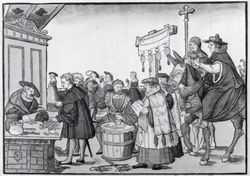
However, the later Middle Ages saw the growth of considerable abuses. Greedy commissaries
Commissary
A commissary is someone delegated by a superior to execute a duty or an office; in a formal, legal context, one who has received power from a legitimate superior authority to pass judgment in a certain cause or to take information concerning it.-Word history:...
sought to extract the maximum amount of money for each indulgence. Professional "pardoners" (quaestores in Latin) - who were sent to collect alms for a specific project - practiced the unrestricted sale of indulgences. Many of these quaestores exceeded Church teachings, whether in avarice or ignorant zeal, and promised impossible rewards like salvation from eternal damnation in return for money. With the permission of the Church, indulgences also became a way for Catholic rulers to fund expensive projects, such as Crusades
Crusades
The Crusades were a series of religious wars, blessed by the Pope and the Catholic Church with the main goal of restoring Christian access to the holy places in and near Jerusalem...
and cathedrals, by keeping a significant portion of the money raised from indulgences in their lands. There was a tendency to forge documents declaring that indulgences had been granted. Indulgences grew to extraordinary magnitude, in terms of longevity and breadth of forgiveness.
But very soon these limits were widely exceeded. False documents were circulated with indulgences surpassing all bounds: indulgences of hundreds or even thousands of years. In 1392, more than a century before Martin Luther
Martin Luther
Martin Luther was a German priest, professor of theology and iconic figure of the Protestant Reformation. He strongly disputed the claim that freedom from God's punishment for sin could be purchased with money. He confronted indulgence salesman Johann Tetzel with his Ninety-Five Theses in 1517...
published the 95 Theses
95 Theses
The Ninety-Five Theses on the Power and Efficacy of Indulgences , commonly known as , was written by Martin Luther, 1517 and is widely regarded as the primary catalyst for the Protestant Reformation...
, Pope Boniface IX wrote to the Bishop of Ferrara condemning the practice of certain members of religious orders who falsely claimed that they were authorized by the pope to forgive all sorts of sins, and exacted money from the simple-minded among the faithful by promising them perpetual happiness in this world and eternal glory in the next.
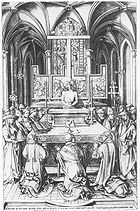
An engraving
Engraving
Engraving is the practice of incising a design on to a hard, usually flat surface, by cutting grooves into it. The result may be a decorated object in itself, as when silver, gold, steel, or glass are engraved, or may provide an intaglio printing plate, of copper or another metal, for printing...
by Israhel van Meckenem
Israhel van Meckenem
Israhel van Meckenem , also known as Israhel van Meckenem the Younger, was a German printmaker and goldsmith.He was the most prolific engraver of the fifteenth century and an important figure in the early history of old master prints. He was active from 1465 until his death.-Life:His birth date is...
of the Mass of Saint Gregory
Mass of Saint Gregory
The Mass of Saint Gregory is a subject in Roman Catholic art which first appears in the late Middle Ages and was still found in the Counter-Reformation. Pope Gregory I The Mass of Saint Gregory is a subject in Roman Catholic art which first appears in the late Middle Ages and was still found in...
contained a "bootlegged" indulgence of 20,000 years; one of the copies of this plate (not the one illustrated, but also from the 1490s) was altered in a later state
State (printmaking)
A state, in printmaking, is a different form of a print, caused by a deliberate and permanent change to a matrix such as a copper plate or woodblock ....
to increase it to 45,000 years. The indulgences applied each time a specified collection of prayers - in this case seven each of the Creed
Creed
A creed is a statement of belief—usually a statement of faith that describes the beliefs shared by a religious community—and is often recited as part of a religious service. When the statement of faith is longer and polemical, as well as didactic, it is not called a creed but a Confession of faith...
, Our Father, and Hail Mary
Hail Mary
The Angelic Salutation, Hail Mary, or Ave Maria is a traditional biblical Catholic prayer asking for the intercession of the Virgin Mary, the mother of Jesus. The Hail Mary is used within the Catholic Church, and it forms the basis of the Rosary...
- were recited in front of the image. The image of the Mass of Saint Gregory had been especially associated with large indulgences since the Jubilee Year
Jubilee (Christian)
The concept of the Jubilee is a special year of remission of sins and universal pardon. In the Biblical Book of Leviticus, a Jubilee year is mentioned to occur every fifty years, in which slaves and prisoners would be freed, debts would be forgiven and the mercies of God would be particularly...
of 1350 in Rome, when it was at least widely believed that an indulgence of 14,000 years had been granted for praying in the presence of the Imago Pietatis ("Man of Sorrows"), a popular pilgrimage destination in the basilica
Basilica
The Latin word basilica , was originally used to describe a Roman public building, usually located in the forum of a Roman town. Public basilicas began to appear in Hellenistic cities in the 2nd century BC.The term was also applied to buildings used for religious purposes...
of Santa Croce in Gerusalemme
Santa Croce in Gerusalemme
The Basilica of the Holy Cross in Jerusalem is a Roman Catholic parish church and minor basilica in Rome, Italy. It is one of the Seven Pilgrim Churches of Rome....
in Rome.
Protestant Reformation
Protestant Reformation
The Protestant Reformation was a 16th-century split within Western Christianity initiated by Martin Luther, John Calvin and other early Protestants. The efforts of the self-described "reformers", who objected to the doctrines, rituals and ecclesiastical structure of the Roman Catholic Church, led...
. In 1517, Pope Leo X
Pope Leo X
Pope Leo X , born Giovanni di Lorenzo de' Medici, was the Pope from 1513 to his death in 1521. He was the last non-priest to be elected Pope. He is known for granting indulgences for those who donated to reconstruct St. Peter's Basilica and his challenging of Martin Luther's 95 Theses...
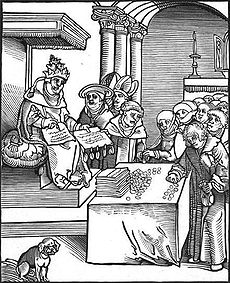
offered indulgences for those who gave alms to rebuild St. Peter's Basilica
St. Peter's Basilica
The Papal Basilica of Saint Peter , officially known in Italian as ' and commonly known as Saint Peter's Basilica, is a Late Renaissance church located within the Vatican City. Saint Peter's Basilica has the largest interior of any Christian church in the world...
in Rome
Rome
Rome is the capital of Italy and the country's largest and most populated city and comune, with over 2.7 million residents in . The city is located in the central-western portion of the Italian Peninsula, on the Tiber River within the Lazio region of Italy.Rome's history spans two and a half...
. The aggressive marketing
Marketing
Marketing is the process used to determine what products or services may be of interest to customers, and the strategy to use in sales, communications and business development. It generates the strategy that underlies sales techniques, business communication, and business developments...
practices of Johann Tetzel
Johann Tetzel
Johann Tetzel was a German Dominican preacher known for selling indulgences.-Life:Tetzel was born in Pirna, Saxony, and studied theology and philosophy at the university of his native city...
in promoting this cause provoked Martin Luther
Martin Luther
Martin Luther was a German priest, professor of theology and iconic figure of the Protestant Reformation. He strongly disputed the claim that freedom from God's punishment for sin could be purchased with money. He confronted indulgence salesman Johann Tetzel with his Ninety-Five Theses in 1517...
to write his Ninety-Five Theses, condemning what he saw as the purchase and sale of salvation
Salvation
Within religion salvation is the phenomenon of being saved from the undesirable condition of bondage or suffering experienced by the psyche or soul that has arisen as a result of unskillful or immoral actions generically referred to as sins. Salvation may also be called "deliverance" or...
. In Thesis 28 Luther objected to a saying attributed to Tetzel: "As soon as a coin in the coffer rings, a soul from purgatory springs". The Ninety-Five Theses not only denounced such transactions as worldly but denied the Pope's right to grant pardons on God's behalf in the first place: the only thing indulgences guaranteed, Luther said, was an increase in profit and greed, because the pardon of the Church was in God's power alone.
This oft-quoted saying was by no means representative of the official Catholic teaching on indulgences, but rather, more a reflection of Tetzel’s capacity to exaggerate. Yet if Tezel overstated the matter in regard to indulgences for the dead, his teaching on indulgences for the living was pure. German Catholic historian of the Papacy, Ludwig von Pastor
Ludwig von Pastor
Ludwig Pastor, later Ludwig von Pastor, Freiherr von Campersfelden , was a German historian and a diplomat for Austria. He became one of the most important Roman Catholic historians of his time and is most notable for his History of the Popes...
explains:
Above all, a most clear distinction must be made between indulgences for the living and those for the dead.
As regards indulgences for the living, Tetzel always taught pure doctrine. The assertion that he put forward indulgences as being not only a remission of the temporal punishment of sin, but as a remission of its guilt, is as unfounded as is that other accusation against him, that he sold the forgiveness of sin for money, without even any mention of contrition and confession, or that, for payment, he absolved from sins which might be committed in the future. His teaching was, in fact, very definite, and quite in harmony with the theology of the Church, as it was then and as it is now, i.e., that indulgences "apply only to the temporal punishment due to sins which have been already repented of and confessed"....
The case was very different with indulgences for the dead. As regards these there is no doubt that Tetzel did, according to what he considered his authoritative instructions, proclaim as Christian doctrine that nothing but an offering of money was required to gain the indulgence for the dead, without there being any question of contrition or confession.
He also taught, in accordance with the opinion then held, that an indulgence could be applied to any given soul with unfailing effect. Starting from this assumption, there is no doubt that his doctrine was virtually that of the drastic proverb:
- “As soon as money in the coffer rings, the soul from purgatory's fire springs."
The Papal Bull of indulgence gave no sanction whatever to this proposition. It was a vague scholastic opinion, rejected by the Sorbonne in 1482, and again in 1518, and certainly not a doctrine of the Church, which was thus improperly put forward as dogmatic truth. The first among the theologians of the Roman court, Cardinal Cajetan, was the enemy of all such extravagances, and declared emphatically that, even if theologians and preachers taught such opinions, no faith need be given them. "Preachers," said he, "speak in the name of the Church only so long as they proclaim the doctrine of Christ and His Church; but if, for purposes of their own, they teach that about which they know nothing, and which is only their own imagination, they must not be accepted as mouthpieces of the Church. No one must be surprised if such as these fall into error."
While Luther did not deny the Pope’s right to grant pardons for penance
Penance
Penance is repentance of sins as well as the proper name of the Roman Catholic, Orthodox Christian, and Anglican Sacrament of Penance and Reconciliation/Confession. It also plays a part in non-sacramental confession among Lutherans and other Protestants...
imposed by the Church, he made it clear that preachers who claimed indulgences absolved buyers from all punishments and granted them salvation were in error.
Council of Trent
On 16 July 1562, the Council of TrentCouncil of Trent
The Council of Trent was the 16th-century Ecumenical Council of the Roman Catholic Church. It is considered to be one of the Church's most important councils. It convened in Trent between December 13, 1545, and December 4, 1563 in twenty-five sessions for three periods...
suppressed the office of quaestores and reserved the collection of alms to two canon members
Canon (priest)
A canon is a priest or minister who is a member of certain bodies of the Christian clergy subject to an ecclesiastical rule ....
of the chapter
Chapter (religion)
Chapter designates certain corporate ecclesiastical bodies in the Roman Catholic, Anglican and Nordic Lutheran churches....
, who were to receive no remuneration for their work; it also reserved the publication of indulgences to the bishop of the diocese. Then on 4 December 1563, in its final session, the Council addressed the question of indulgences directly, declaring them "most salutary for the Christian people", decreeing that "all evil gains for the obtaining of them be wholly abolished", and instructing bishops to be on the watch for any abuses concerning them.
A few years later, in 1567, Pope Pius V
Pope Pius V
Pope Saint Pius V , born Antonio Ghislieri , was Pope from 1566 to 1572 and is a saint of the Catholic Church. He is chiefly notable for his role in the Council of Trent, the Counter-Reformation, and the standardization of the Roman liturgy within the Latin Church...
cancelled all grants of indulgences involving any fees or other financial transactions.
After the Council of Trent, Clement VIII established a commission of Cardinals to deal with indulgences according to the mind of the Council. It continued its work during the pontificate of Paul V and published various bulls and decrees on the matter. But only Clement IX established a true Congregation of Indulgences (and Relics) with a Brief of 6 July 1669. In a motu proprio
Motu proprio
A motu proprio is a document issued by the Pope on his own initiative and personally signed by him....
on 28 January 1904, Pius X joined the Congregation of Indulgences with that of Rites, but with the restructuring of the Roman Curia
Roman Curia
The Roman Curia is the administrative apparatus of the Holy See and the central governing body of the entire Catholic Church, together with the Pope...
in 1908 all matters regarding indulgences was assigned to the Holy Office. In a motu proprio on 25 March 1915, Benedict XV transferred the Holy Office's Section for Indulgences to the Apostolic Penitentiary
Apostolic Penitentiary
The Apostolic Penitentiary, formerly called the Supreme Tribunal of the Apostolic Penitentiary, is one of the three tribunals of the Roman Curia. The Apostolic Penitentiary is chiefly a tribunal of mercy, responsible for issues relating to the forgiveness of sins in the Catholic Church.The...
, but maintained the Holy Office's responsibility for matters regarding the doctrine of indulgences.
Eastern Orthodox Church
Eastern Orthodox Church
The Orthodox Church, officially called the Orthodox Catholic Church and commonly referred to as the Eastern Orthodox Church, is the second largest Christian denomination in the world, with an estimated 300 million adherents mainly in the countries of Belarus, Bulgaria, Cyprus, Georgia, Greece,...
es believe one can be absolved from sins by the Sacred Mystery of Confession, which in the East is preceded by a period of fasting. Because of differences in the theology of salvation, indulgences for the remission of temporal punishment of sin do not exist in Eastern Orthodoxy
Eastern Orthodox Church
The Orthodox Church, officially called the Orthodox Catholic Church and commonly referred to as the Eastern Orthodox Church, is the second largest Christian denomination in the world, with an estimated 300 million adherents mainly in the countries of Belarus, Bulgaria, Cyprus, Georgia, Greece,...
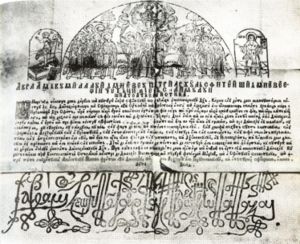
, but until the twentieth century there existed in some places a practice of absolution certificates (συγχωροχάρτια – synchorochartia).
While some of these certificates were connected with any patriarch's decrees lifting for the living or the dead some serious ecclesiastical penalty, including excommunication, the Greek Orthodox Patriarch of Jerusalem
Greek Orthodox Patriarch of Jerusalem
The Greek Orthodox Patriarch of Jerusalem is the head bishop of the Orthodox Church of Jerusalem, ranking fourth of nine Patriarchs in the Eastern Orthodox Church. Since 2005, the Orthodox Patriarch of Jerusalem has been Theophilos III...
, with the approval of the Ecumenical Patriarch of Constantinople, had the sole privilege, because of the expense of maintaining the Holy Places and paying the many taxes levied on them, of distributing such documents in large numbers to pilgrims or sending them elsewhere, sometimes with a blank space for the name of the beneficiary, living or dead, an individual or a whole family, for whom the prayers would be read.
Greek Orthodox Patriarch of Jerusalem
Greek Orthodox Patriarch of Jerusalem
The Greek Orthodox Patriarch of Jerusalem is the head bishop of the Orthodox Church of Jerusalem, ranking fourth of nine Patriarchs in the Eastern Orthodox Church. Since 2005, the Orthodox Patriarch of Jerusalem has been Theophilos III...
Dositheos Notaras (1641–1707) wrote: "It is an established custom and ancient tradition, known to all, that the Most Holy Patriarchs give the absolution certificate (συγχωροχάρτιον – synchorochartion) to the faithful people … they have granted them from the beginning and still do."
A Russian Orthodox source says that these certificates were in use among Greek Orthodox until the middle of the twentieth century, and were "certificates which absolved from sins, which anyone could obtain, often for a specified sum of money. The absolution granted by these papers, according to Christos Yannaras, had no connection with any participation of the faithful in the Mystery of Penance, nor in the Mystery of the Eucharist". The same source interprets the Western indulgence also as absolution from sin, not as remission of temporal punishment.
External links
- Pope Paul VI: Apostolic Constitution Indulgentiarum Doctrina whereby the Revision of Sacred Indulgences is Promulgated, 1 January 1967
- Code of Canon Law (1983) concerning Indulgences
- Enchiridion Indulgentiarum, 4th edition, 1999 (Latin) (English translation: "Manual of Indulgences", published by the United States Conference of Catholic Bishops, ISBN 1-57455-474-3)
- English translation of Enchiridion Indulgentiarum, 3rd edition (1986)
- Pope John Paul II: General Audience talk on indulgences, 29 September 1999
- Catechism of the Catholic Church: Indulgences
- Enrico dal Covolo: The Historical Origin of Indulgences
- Paul S. Czarnota: Indulgences
- A Primer on Indulgences
- Myths about Indulgences