


Lucas Cranach the Elder

Encyclopedia
Lucas Cranach the Elder was a German Renaissance
painter
and printmaker in woodcut
and engraving
. He was court painter
to the Electors of Saxony for most of his career, and is known for his portraits, both of German princes and those of the leaders of the Protestant Reformation
, whose cause he embraced with enthusiasm, becoming a close friend of Martin Luther
. He also painted religious subjects, first in the Catholic tradition, and later trying to find new ways of conveying Lutheran religious concerns in art. He continued throughout his career to paint nude subjects drawn from mythology and religion. He had a large workshop and many works exist in different versions; his son Lucas Cranach the Younger
, and others, continued to create versions of his father's works for decades after his death.
in upper Franconia
and learned the art of drawing from his father Hans Maler (his surname
meaning "painter" and denoting his profession, not his ancestry, after the manner of the time and class). His mother, with surname Hübner, died in 1491. Later, the name of his birth-place was used for his surname, another custom of the times. We do not know how Cranach was trained, but it was probably with local south German masters, as with his contemporary Matthias Grünewald
, who worked at Bamberg
and Aschaffenburg
. Bamberg is the capital of the diocese in which Kronach lies. Also there is hints, that Cranach spent some time in Vienna
around 1500.
According to Gunderam (the tutor of Cranach's children) Cranach demonstrated his talents as a painter before the close of the 15th century. His work then drew the attention of Duke Friedrich III, Elector of Saxony, known as Frederick the Wise, who attached Cranach to his court in 1504. The records of Wittenberg
confirm Gunderam's statement to this extent that Cranach's name appears for the first time in the public accounts on the 24 June 1504, when he drew 50 gulden for the salary of half a year, as pictor ducalis ("the duke's painter"). Cranach was to remain in the service of the Elector and his successors for the rest of his life, although he was able to undertake other work.
Cranach married Barbara Brengbier, the daughter of a burgher
of Gotha
and also born there; she died at Wittenberg
on 26 December 1540. Cranach later owned a house at Gotha, but most likely he got to know Barbara near Wittenberg, where her family also owned a house, that later also belonged to Cranach.
s, woodcuts, engravings, and designing the coins
for the electorate.
Early in the days of his official employment he startled his master's courtiers by the realism with which he painted still life, game and antlers on the walls of the country palaces at Coburg
and Locha; his pictures of deer and wild boar were considered striking, and the duke fostered his passion for this form of art by taking him out to the hunting field, where he sketched "his grace" running the stag, or Duke John sticking a boar.
Before 1508 he had painted several altar-pieces for the Castle Church
at Wittenberg in competition with Albrecht Dürer
, Hans Burgkmair
and others; the duke and his brother John were portrayed in various attitudes and a number of his best woodcuts and copper-plates were published.
In 1509 Cranach went to the Netherlands, and painted the Emperor Maximilian
and the boy who afterwards became Emperor Charles V
. Until 1508 Cranach signed his works with his initials. In that year the elector gave him the winged snake as a emblem, or Kleinod, which superseded the initials on his pictures after that date.
Somewhat later the duke conferred on him the monopoly
of the sale of medicines at Wittenberg, and a printer's patent with exclusive privileges as to copyright
in Bible
s. Cranach's presses were used by Martin Luther. His apothecary shop was open for centuries, and was only lost by fire in 1871.
Cranach, like his patron, was friendly with the Protestant Reformers
at a very early stage; yet it is difficult to fix the time of his first meeting with Martin Luther. The oldest reference to Cranach in Luther's correspondence dates from 1520. In a letter written from Worms
in 1521, Luther calls him his "gossip", warmly alluding to his "Gevatterin", the artist's wife. Cranach first made an engraving of Luther in 1520, when Luther was an Augustinian friar
; five years later, Luther renounced his religious vows, and Cranach was present as a witness at the betrothal festival of Luther and Katharina von Bora
. He was also godfather to their first child, Johannes "Hans" Luther, born 1526.
The death in 1525 of the Elector Frederick the Wise and Elector John's in 1532 brought no change in Cranach's position; he remained a favourite with John Frederick I, under whom he twice (1531 and 1540) filled the office of burgomaster of Wittenberg
.
In 1547, John Frederick was taken prisoner at the Battle of Mühlberg
, and Wittenberg was besieged. As Cranach wrote from his house to the grand-master Albert of Brandenburg at Königsberg
to tell him of John Frederick's capture, he showed his attachment by saying,
During the siege Charles V, the Holy Roman Emperor, remembered Cranach from his childhood and summoned him to his camp at Pistritz. Cranach came, and begged on his knees for kind treatment to Elector John Frederick.
Three years afterward, when all the dignitaries of the Empire met at Augsburg
to receive commands from the emperor, and Titian
came at Charles's bidding to paint King Philip II of Spain
, John Frederick asked Cranach to visit the city; and here for a few months he stayed in the household of the captive elector, whom he afterward accompanied home in 1552.
He died at age 81 on October 16, 1553, at Weimar, where the house in which he lived still stands in the marketplace.
Cranach had two sons, both artists: Hans Cranach
, whose life is obscure and who died at Bologna
in 1537; and Lucas Cranach the Younger
, born in 1515, who died in 1586. He also had three daughters. One of them is Barbara Cranach, who died in 1569, married to Christian Brück (Pontanus), ancestors of Johann Wolfgang von Goethe
.
and Matthias Grünewald
with a feast day on the liturgical calendar of the Episcopal Church (USA)
on August 5.
He is commemorated as a saint by the Lutheran Church on April 6, along with Durer and Burgkmair.
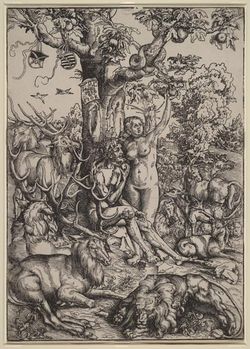 The oldest extant picture by Cranach is the Rest of the Virgin during the Flight into Egypt, of 1504. The painting already shows remarkable skill and grace, and the pine forest in the background shows a painter familiar with the mountain scenery of Thuringia
. There is more forest gloom in landscapes of a later time.
Following the huge international success of Dürer's prints, other German artists, much more than Italian ones, devoted their talents to woodcuts and engravings. This accounts for the comparative unproductiveness as painters of Albrecht Dürer
and Hans Holbein the Younger
, and also may explain why Cranach was not especially skilled at handling colour, light, and shade. Constant attention to contour and to black and white, as an engraver, seems to have affected his sight; and he often outlined shapes in black rather than employing modelling and chiaroscuro
.
The largest proportion of Cranach's output is of portraits, and it is chiefly thanks to him that we know what the German Reformers and their princely adherents looked like. He painted not only Martin Luther himself but also Luther's wife, mother and father. He also depicted leading Catholics like Albert of Brandenburg, archbishop elector of Mainz, Anthony Granvelle and the Duke of Alva.
A dozen likenesses of Frederick III
and his brother John are dated 1532. It is characteristic of Cranach's prolific output, and a proof that he used a large workshop, that he received payment at Wittenberg in 1533 for "sixty pairs of portraits of the elector and his brother" on one day. Inevitably the quality of such works is variable.
Cranach's religious subjects reflect the development of the Protestant Reformation
, and its attitudes to religious images. In his early career, he painted several Madonnas; his first woodcut (1505) represents the Virgin and three saints in prayer before a crucifix
. Later on he painted the marriage of St. Catherine
, a series of martyr
doms, and scenes from the Passion
.
After 1517 he occasionally illustrated the old subjects, but he also gave expression to some of the thoughts of the Reformers, although his portraits of reformers were more common than paintings of religious scenes. In a picture of 1518, where a dying man offers "his soul to God, his body to earth, and his worldly goods to his relations", the soul rises to meet the Trinity
in heaven, and salvation is clearly shown to depend on faith and not on good works. Other works of this period deal with sin
and divine grace
. One shows Adam sitting between John the Baptist
and a prophet at the foot of a tree. To the left God produces the tables of the law, Adam and Eve
partake of the forbidden fruit, the brazen serpent is reared aloft, and punishment supervenes in the shape of death and the realm of Satan
. To the right, the Conception, Crucifixion and Resurrection
symbolize redemption, and this is duly impressed on Adam by John the Baptist. There are two examples of this composition in the galleries of Gotha
and Prague
, both of them dated 1529.
Towards the end of his life, after Luther's initial hostility to large public religious images had softened, Cranach painted a number of "Lutheran altarpieces" of the Last Supper
and other subjects, in which Christ was shown in a traditional manner, including a halo
, but the apostles, without halos, were portraits of leading reformers. He also produced a number of violent anti-Catholic propaganda prints, in a cruder style, directed against the Papacy and the Catholic clergy. His best known work in this vein was a series of prints for the pamphlet Passional Christi und Antichristi, where scenes from the Passion of Christ were matched by a print mocking practices of the Catholic clergy, so that Christ driving the money-changers from the Temple was matched by the Pope, or Antichrist
, signing indulgences over a table spread with cash (see gallery below).
One of his last works is the altarpiece, completed after his death by Lucas Cranach the Younger in 1555, for the Stadtkirche (city church) at Weimar
. The iconography
is original and unusual: Christ is shown twice, to the left trampling on Death and Satan, to the right crucified, with blood flowing from the lance wound. John the Baptist
points to the suffering Christ, whilst the blood-stream falls on the head of a portrait of Cranach, and Luther reads from his book the words, "The blood of Christ cleanseth from all sin."
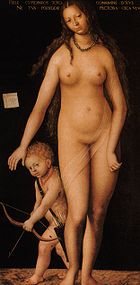
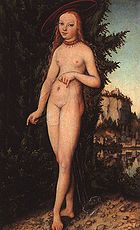 Cranach was equally successful in somewhat naive mythological scenes, in which at least one slim female figure, naked except for a transparent drape, and perhaps for a large hat, nearly always features. These are mostly in narrow upright formats; examples are several of Venus, alone or with Cupid
, who has sometimes stolen a honeycomb, and complains to Venus that he has been stung by a bee
(Weimar, 1530; Berlin, 1534). Diana
with Apollo
, shooting a bow, and Hercules
sitting at the spinning-wheel mocked by Omphale
and her maids are other such subjects. A similar approach was taken with the biblical subjects of Salome
and Adam and Eve
. These subjects were produced early in his career, when they show Italian influences including that of Jacopo de' Barberi, who was at the court of Saxony for a period up to 1505. They then become rare until after the death of Frederick the Wise. The later nudes are in a distinctive style which abandons Italian influence for a revival of Late Gothic style, with small heads, narrow shoulders, high breasts and waists. The poses become more frankly seductive and even exhibitionist.
Humour and pathos are combined at times with strong effect in pictures such as Jealousy (Augsburg, 1527; Vienna, 1530), where women and children are huddled into groups as they watch the strife of men wildly fighting around them. A lost canvas of 1545 is said to show hares catching and roasting hunters. In 1546, possibly under Italian influence, Cranach composed the Fons Juventutis ("Fountain of Youth
"), executed by his son, a picture in which older women are seen entering a Renaissance
fountain, and exiting it transformed into youthful beauties.
German Renaissance
The German Renaissance, part of the Northern Renaissance, was a cultural and artistic movement that spread among German thinkers in the 15th and 16th centuries, which originated from the Italian Renaissance in Italy...
painter
Painting
Painting is the practice of applying paint, pigment, color or other medium to a surface . The application of the medium is commonly applied to the base with a brush but other objects can be used. In art, the term painting describes both the act and the result of the action. However, painting is...
and printmaker in woodcut
Woodcut
Woodcut—occasionally known as xylography—is a relief printing artistic technique in printmaking in which an image is carved into the surface of a block of wood, with the printing parts remaining level with the surface while the non-printing parts are removed, typically with gouges...
and engraving
Engraving
Engraving is the practice of incising a design on to a hard, usually flat surface, by cutting grooves into it. The result may be a decorated object in itself, as when silver, gold, steel, or glass are engraved, or may provide an intaglio printing plate, of copper or another metal, for printing...
. He was court painter
Court painter
A court painter was an artist who painted for the members of a royal or noble family, sometimes on a fixed salary and on an exclusive basis where the artist was not supposed to undertake other work. Especially in the late Middle Ages, they were often given the office of valet de chambre...
to the Electors of Saxony for most of his career, and is known for his portraits, both of German princes and those of the leaders of the Protestant Reformation
Protestant Reformation
The Protestant Reformation was a 16th-century split within Western Christianity initiated by Martin Luther, John Calvin and other early Protestants. The efforts of the self-described "reformers", who objected to the doctrines, rituals and ecclesiastical structure of the Roman Catholic Church, led...
, whose cause he embraced with enthusiasm, becoming a close friend of Martin Luther
Martin Luther
Martin Luther was a German priest, professor of theology and iconic figure of the Protestant Reformation. He strongly disputed the claim that freedom from God's punishment for sin could be purchased with money. He confronted indulgence salesman Johann Tetzel with his Ninety-Five Theses in 1517...
. He also painted religious subjects, first in the Catholic tradition, and later trying to find new ways of conveying Lutheran religious concerns in art. He continued throughout his career to paint nude subjects drawn from mythology and religion. He had a large workshop and many works exist in different versions; his son Lucas Cranach the Younger
Lucas Cranach the Younger
Lucas Cranach the Younger was a German Renaissance artist, known for his woodcuts and paintings.He was the youngest son of Lucas Cranach the Elder and Barbara Brengebier, and began his career as an apprentice in his father's workshop alongside his brother Hans. Henceforth, his own reputation and...
, and others, continued to create versions of his father's works for decades after his death.
Early life
He was born at KronachKronach
Kronach is a town in Oberfranken, Bavaria, Germany, located in the Frankenwald area. It is the capital of the district Kronach.Kronach is the birthtown of Lucas Cranach the Elder and Maximilian von Welsch, as well as Johann Kaspar Zeuss and Josef Stangl....
in upper Franconia
Franconia
Franconia is a region of Germany comprising the northern parts of the modern state of Bavaria, a small part of southern Thuringia, and a region in northeastern Baden-Württemberg called Tauberfranken...
and learned the art of drawing from his father Hans Maler (his surname
Surname
A surname is a name added to a given name and is part of a personal name. In many cases, a surname is a family name. Many dictionaries define "surname" as a synonym of "family name"...
meaning "painter" and denoting his profession, not his ancestry, after the manner of the time and class). His mother, with surname Hübner, died in 1491. Later, the name of his birth-place was used for his surname, another custom of the times. We do not know how Cranach was trained, but it was probably with local south German masters, as with his contemporary Matthias Grünewald
Matthias Grünewald
Matthias Grünewald or "Mathis" , "Gothart" or "Neithardt" , , was a German Renaissance painter of religious works, who ignored Renaissance classicism to continue the expressive and intense style of late medieval Central European art into the 16th century.Only ten paintings—several consisting...
, who worked at Bamberg
Bamberg
Bamberg is a city in Bavaria, Germany. It is located in Upper Franconia on the river Regnitz, close to its confluence with the river Main. Bamberg is one of the few cities in Germany that was not destroyed by World War II bombings because of a nearby Artillery Factory that prevented planes from...
and Aschaffenburg
Aschaffenburg
Aschaffenburg is a city in northwest Bavaria, Germany. The town of Aschaffenburg is not considered part of the district of Aschaffenburg, but is the administrative seat.Aschaffenburg is known as the Tor zum Spessart or "gate to the Spessart"...
. Bamberg is the capital of the diocese in which Kronach lies. Also there is hints, that Cranach spent some time in Vienna
Vienna
Vienna is the capital and largest city of the Republic of Austria and one of the nine states of Austria. Vienna is Austria's primary city, with a population of about 1.723 million , and is by far the largest city in Austria, as well as its cultural, economic, and political centre...
around 1500.
According to Gunderam (the tutor of Cranach's children) Cranach demonstrated his talents as a painter before the close of the 15th century. His work then drew the attention of Duke Friedrich III, Elector of Saxony, known as Frederick the Wise, who attached Cranach to his court in 1504. The records of Wittenberg
Wittenberg
Wittenberg, officially Lutherstadt Wittenberg, is a city in Germany in the Bundesland Saxony-Anhalt, on the river Elbe. It has a population of about 50,000....
confirm Gunderam's statement to this extent that Cranach's name appears for the first time in the public accounts on the 24 June 1504, when he drew 50 gulden for the salary of half a year, as pictor ducalis ("the duke's painter"). Cranach was to remain in the service of the Elector and his successors for the rest of his life, although he was able to undertake other work.
Cranach married Barbara Brengbier, the daughter of a burgher
Bourgeoisie
In sociology and political science, bourgeoisie describes a range of groups across history. In the Western world, between the late 18th century and the present day, the bourgeoisie is a social class "characterized by their ownership of capital and their related culture." A member of the...
of Gotha
Gotha (town)
Gotha is a town in Thuringia, within the central core of Germany. It is the capital of the district of Gotha.- History :The town has existed at least since the 8th century, when it was mentioned in a document signed by Charlemagne as Villa Gotaha . Its importance derives from having been chosen in...
and also born there; she died at Wittenberg
Wittenberg
Wittenberg, officially Lutherstadt Wittenberg, is a city in Germany in the Bundesland Saxony-Anhalt, on the river Elbe. It has a population of about 50,000....
on 26 December 1540. Cranach later owned a house at Gotha, but most likely he got to know Barbara near Wittenberg, where her family also owned a house, that later also belonged to Cranach.
Career
The first evidence of Cranach's skill as an artist comes in a picture dated 1504. Early in his career he was active in several branches of his profession: sometimes a decorative painter, more frequently producing portraits and altarpieceAltarpiece
An altarpiece is a picture or relief representing a religious subject and suspended in a frame behind the altar of a church. The altarpiece is often made up of two or more separate panels created using a technique known as panel painting. It is then called a diptych, triptych or polyptych for two,...
s, woodcuts, engravings, and designing the coins
COinS
ContextObjects in Spans, commonly abbreviated COinS, is a method to embed bibliographic metadata in the HTML code of web pages. This allows bibliographic software to publish machine-readable bibliographic items and client reference management software to retrieve bibliographic metadata. The...
for the electorate.
Early in the days of his official employment he startled his master's courtiers by the realism with which he painted still life, game and antlers on the walls of the country palaces at Coburg
Coburg
Coburg is a town located on the Itz River in Bavaria, Germany. Its 2005 population was 42,015. Long one of the Thuringian states of the Wettin line, it joined with Bavaria by popular vote in 1920...
and Locha; his pictures of deer and wild boar were considered striking, and the duke fostered his passion for this form of art by taking him out to the hunting field, where he sketched "his grace" running the stag, or Duke John sticking a boar.
Before 1508 he had painted several altar-pieces for the Castle Church
Wittenberg
Wittenberg, officially Lutherstadt Wittenberg, is a city in Germany in the Bundesland Saxony-Anhalt, on the river Elbe. It has a population of about 50,000....
at Wittenberg in competition with Albrecht Dürer
Albrecht Dürer
Albrecht Dürer was a German painter, printmaker, engraver, mathematician, and theorist from Nuremberg. His prints established his reputation across Europe when he was still in his twenties, and he has been conventionally regarded as the greatest artist of the Northern Renaissance ever since...
, Hans Burgkmair
Hans Burgkmair
Hans Burgkmair the elder was a German painter and printmaker in woodcut.Burgkmair was born in Augsburg, the son of painter Thomas Burgkmair and his son, Hans the Younger, became one too. From 1488 he was a pupil of Martin Schongauer in Colmar, who died during his two years there, before Burgkmair...
and others; the duke and his brother John were portrayed in various attitudes and a number of his best woodcuts and copper-plates were published.
In 1509 Cranach went to the Netherlands, and painted the Emperor Maximilian
Maximilian I, Holy Roman Emperor
Maximilian I , the son of Frederick III, Holy Roman Emperor and Eleanor of Portugal, was King of the Romans from 1486 and Holy Roman Emperor from 1493 until his death, though he was never in fact crowned by the Pope, the journey to Rome always being too risky...
and the boy who afterwards became Emperor Charles V
Charles V, Holy Roman Emperor
Charles V was ruler of the Holy Roman Empire from 1519 and, as Charles I, of the Spanish Empire from 1516 until his voluntary retirement and abdication in favor of his younger brother Ferdinand I and his son Philip II in 1556.As...
. Until 1508 Cranach signed his works with his initials. In that year the elector gave him the winged snake as a emblem, or Kleinod, which superseded the initials on his pictures after that date.
Somewhat later the duke conferred on him the monopoly
Monopoly
A monopoly exists when a specific person or enterprise is the only supplier of a particular commodity...
of the sale of medicines at Wittenberg, and a printer's patent with exclusive privileges as to copyright
Copyright
Copyright is a legal concept, enacted by most governments, giving the creator of an original work exclusive rights to it, usually for a limited time...
in Bible
Bible
The Bible refers to any one of the collections of the primary religious texts of Judaism and Christianity. There is no common version of the Bible, as the individual books , their contents and their order vary among denominations...
s. Cranach's presses were used by Martin Luther. His apothecary shop was open for centuries, and was only lost by fire in 1871.
Cranach, like his patron, was friendly with the Protestant Reformers
Protestant Reformation
The Protestant Reformation was a 16th-century split within Western Christianity initiated by Martin Luther, John Calvin and other early Protestants. The efforts of the self-described "reformers", who objected to the doctrines, rituals and ecclesiastical structure of the Roman Catholic Church, led...
at a very early stage; yet it is difficult to fix the time of his first meeting with Martin Luther. The oldest reference to Cranach in Luther's correspondence dates from 1520. In a letter written from Worms
Worms, Germany
Worms is a city in Rhineland-Palatinate, Germany, on the Rhine River. At the end of 2004, it had 85,829 inhabitants.Established by the Celts, who called it Borbetomagus, Worms today remains embattled with the cities Trier and Cologne over the title of "Oldest City in Germany." Worms is the only...
in 1521, Luther calls him his "gossip", warmly alluding to his "Gevatterin", the artist's wife. Cranach first made an engraving of Luther in 1520, when Luther was an Augustinian friar
Friar
A friar is a member of one of the mendicant orders.-Friars and monks:...
; five years later, Luther renounced his religious vows, and Cranach was present as a witness at the betrothal festival of Luther and Katharina von Bora
Katharina von Bora
Katharina von Bora, referred to as "die Lutherin", was the wife of Martin Luther, Germanleader of the Protestant Reformation. Beyond what is found in the writings of Luther and some of his contemporaries, little is known about her...
. He was also godfather to their first child, Johannes "Hans" Luther, born 1526.
The death in 1525 of the Elector Frederick the Wise and Elector John's in 1532 brought no change in Cranach's position; he remained a favourite with John Frederick I, under whom he twice (1531 and 1540) filled the office of burgomaster of Wittenberg
Wittenberg
Wittenberg, officially Lutherstadt Wittenberg, is a city in Germany in the Bundesland Saxony-Anhalt, on the river Elbe. It has a population of about 50,000....
.
In 1547, John Frederick was taken prisoner at the Battle of Mühlberg
Battle of Mühlberg
The Battle of Mühlberg was a large battle at Mühlberg in the Electorate of Saxony during the Protestant Reformation at which the Catholic princes of the Holy Roman Empire led by the Emperor Charles I of Spain and V of the Holy Roman Empire decisively defeated the Lutheran Schmalkaldic League of...
, and Wittenberg was besieged. As Cranach wrote from his house to the grand-master Albert of Brandenburg at Königsberg
Königsberg
Königsberg was the capital of East Prussia from the Late Middle Ages until 1945 as well as the northernmost and easternmost German city with 286,666 inhabitants . Due to the multicultural society in and around the city, there are several local names for it...
to tell him of John Frederick's capture, he showed his attachment by saying,
I cannot conceal from your Grace that we have been robbed of our dear prince, who from his youth upwards has been a true prince to us, but God will help him out of prison, for the KaiserKaiserKaiser is the German title meaning "Emperor", with Kaiserin being the female equivalent, "Empress". Like the Russian Czar it is directly derived from the Latin Emperors' title of Caesar, which in turn is derived from the personal name of a branch of the gens Julia, to which Gaius Julius Caesar,...
is bold enough to revive the Papacy, which God will certainly not allow.
During the siege Charles V, the Holy Roman Emperor, remembered Cranach from his childhood and summoned him to his camp at Pistritz. Cranach came, and begged on his knees for kind treatment to Elector John Frederick.
Three years afterward, when all the dignitaries of the Empire met at Augsburg
Augsburg
Augsburg is a city in the south-west of Bavaria, Germany. It is a university town and home of the Regierungsbezirk Schwaben and the Bezirk Schwaben. Augsburg is an urban district and home to the institutions of the Landkreis Augsburg. It is, as of 2008, the third-largest city in Bavaria with a...
to receive commands from the emperor, and Titian
Titian
Tiziano Vecelli or Tiziano Vecellio Tiziano Vecelli or Tiziano Vecellio Tiziano Vecelli or Tiziano Vecellio (c. 1488/1490 – 27 August 1576 better known as Titian was an Italian painter, the most important member of the 16th-century Venetian school. He was born in Pieve di Cadore, near...
came at Charles's bidding to paint King Philip II of Spain
Philip II of Spain
Philip II was King of Spain, Portugal, Naples, Sicily, and, while married to Mary I, King of England and Ireland. He was lord of the Seventeen Provinces from 1556 until 1581, holding various titles for the individual territories such as duke or count....
, John Frederick asked Cranach to visit the city; and here for a few months he stayed in the household of the captive elector, whom he afterward accompanied home in 1552.
He died at age 81 on October 16, 1553, at Weimar, where the house in which he lived still stands in the marketplace.
Cranach had two sons, both artists: Hans Cranach
Hans Cranach
Hans Cranach , also known as Johann Lucas Cranach, was a German painter, the oldest son of Lucas Cranach the Elder. German art historian Christian Schuchardt, who discovered his existence, credits him with an altar-piece at Weimar, signed with the monogram "H. C.", and dated 1537. He died at...
, whose life is obscure and who died at Bologna
Bologna
Bologna is the capital city of Emilia-Romagna, in the Po Valley of Northern Italy. The city lies between the Po River and the Apennine Mountains, more specifically, between the Reno River and the Savena River. Bologna is a lively and cosmopolitan Italian college city, with spectacular history,...
in 1537; and Lucas Cranach the Younger
Lucas Cranach the Younger
Lucas Cranach the Younger was a German Renaissance artist, known for his woodcuts and paintings.He was the youngest son of Lucas Cranach the Elder and Barbara Brengebier, and began his career as an apprentice in his father's workshop alongside his brother Hans. Henceforth, his own reputation and...
, born in 1515, who died in 1586. He also had three daughters. One of them is Barbara Cranach, who died in 1569, married to Christian Brück (Pontanus), ancestors of Johann Wolfgang von Goethe
Johann Wolfgang von Goethe
Johann Wolfgang von Goethe was a German writer, pictorial artist, biologist, theoretical physicist, and polymath. He is considered the supreme genius of modern German literature. His works span the fields of poetry, drama, prose, philosophy, and science. His Faust has been called the greatest long...
.
Veneration
Cranach is honoured together with Albrecht DürerAlbrecht Dürer
Albrecht Dürer was a German painter, printmaker, engraver, mathematician, and theorist from Nuremberg. His prints established his reputation across Europe when he was still in his twenties, and he has been conventionally regarded as the greatest artist of the Northern Renaissance ever since...
and Matthias Grünewald
Matthias Grünewald
Matthias Grünewald or "Mathis" , "Gothart" or "Neithardt" , , was a German Renaissance painter of religious works, who ignored Renaissance classicism to continue the expressive and intense style of late medieval Central European art into the 16th century.Only ten paintings—several consisting...
with a feast day on the liturgical calendar of the Episcopal Church (USA)
Calendar of saints (Episcopal Church in the United States of America)
The veneration of saints in the Episcopal Church is a continuation of an ancient tradition from the early Church which honors important people of the Christian faith. The usage of the term "saint" is similar to Roman Catholic and Orthodox traditions. Those in the Anglo-Catholic tradition may...
on August 5.
He is commemorated as a saint by the Lutheran Church on April 6, along with Durer and Burgkmair.
Works and art
Thuringia
The Free State of Thuringia is a state of Germany, located in the central part of the country.It has an area of and 2.29 million inhabitants, making it the sixth smallest by area and the fifth smallest by population of Germany's sixteen states....
. There is more forest gloom in landscapes of a later time.
Following the huge international success of Dürer's prints, other German artists, much more than Italian ones, devoted their talents to woodcuts and engravings. This accounts for the comparative unproductiveness as painters of Albrecht Dürer
Albrecht Dürer
Albrecht Dürer was a German painter, printmaker, engraver, mathematician, and theorist from Nuremberg. His prints established his reputation across Europe when he was still in his twenties, and he has been conventionally regarded as the greatest artist of the Northern Renaissance ever since...
and Hans Holbein the Younger
Hans Holbein the Younger
Hans Holbein the Younger was a German artist and printmaker who worked in a Northern Renaissance style. He is best known as one of the greatest portraitists of the 16th century. He also produced religious art, satire and Reformation propaganda, and made a significant contribution to the history...
, and also may explain why Cranach was not especially skilled at handling colour, light, and shade. Constant attention to contour and to black and white, as an engraver, seems to have affected his sight; and he often outlined shapes in black rather than employing modelling and chiaroscuro
Chiaroscuro
Chiaroscuro in art is "an Italian term which literally means 'light-dark'. In paintings the description refers to clear tonal contrasts which are often used to suggest the volume and modelling of the subjects depicted"....
.
The largest proportion of Cranach's output is of portraits, and it is chiefly thanks to him that we know what the German Reformers and their princely adherents looked like. He painted not only Martin Luther himself but also Luther's wife, mother and father. He also depicted leading Catholics like Albert of Brandenburg, archbishop elector of Mainz, Anthony Granvelle and the Duke of Alva.
A dozen likenesses of Frederick III
Frederick III, Elector of Saxony
Frederick III of Saxony , also known as Frederick the Wise , was Elector of Saxony from 1486 to his death. Frederick was the son of Ernest, Elector of Saxony and his wife Elisabeth, daughter of Albert III, Duke of Bavaria...
and his brother John are dated 1532. It is characteristic of Cranach's prolific output, and a proof that he used a large workshop, that he received payment at Wittenberg in 1533 for "sixty pairs of portraits of the elector and his brother" on one day. Inevitably the quality of such works is variable.
Cranach's religious subjects reflect the development of the Protestant Reformation
Protestant Reformation
The Protestant Reformation was a 16th-century split within Western Christianity initiated by Martin Luther, John Calvin and other early Protestants. The efforts of the self-described "reformers", who objected to the doctrines, rituals and ecclesiastical structure of the Roman Catholic Church, led...
, and its attitudes to religious images. In his early career, he painted several Madonnas; his first woodcut (1505) represents the Virgin and three saints in prayer before a crucifix
Crucifix
A crucifix is an independent image of Jesus on the cross with a representation of Jesus' body, referred to in English as the corpus , as distinct from a cross with no body....
. Later on he painted the marriage of St. Catherine
Catherine of Alexandria
Saint Catherine of Alexandria, also known as Saint Catherine of the Wheel and The Great Martyr Saint Catherine is, according to tradition, a Christian saint and virgin, who was martyred in the early 4th century at the hands of the pagan emperor Maxentius...
, a series of martyr
Martyr
A martyr is somebody who suffers persecution and death for refusing to renounce, or accept, a belief or cause, usually religious.-Meaning:...
doms, and scenes from the Passion
Passion (Christianity)
The Passion is the Christian theological term used for the events and suffering – physical, spiritual, and mental – of Jesus in the hours before and including his trial and execution by crucifixion...
.
After 1517 he occasionally illustrated the old subjects, but he also gave expression to some of the thoughts of the Reformers, although his portraits of reformers were more common than paintings of religious scenes. In a picture of 1518, where a dying man offers "his soul to God, his body to earth, and his worldly goods to his relations", the soul rises to meet the Trinity
Trinity
The Christian doctrine of the Trinity defines God as three divine persons : the Father, the Son , and the Holy Spirit. The three persons are distinct yet coexist in unity, and are co-equal, co-eternal and consubstantial . Put another way, the three persons of the Trinity are of one being...
in heaven, and salvation is clearly shown to depend on faith and not on good works. Other works of this period deal with sin
Sin
In religion, sin is the violation or deviation of an eternal divine law or standard. The term sin may also refer to the state of having committed such a violation. Christians believe the moral code of conduct is decreed by God In religion, sin (also called peccancy) is the violation or deviation...
and divine grace
Divine grace
In Christian theology, grace is God’s gift of God’s self to humankind. It is understood by Christians to be a spontaneous gift from God to man - "generous, free and totally unexpected and undeserved" - that takes the form of divine favour, love and clemency. It is an attribute of God that is most...
. One shows Adam sitting between John the Baptist
John the Baptist
John the Baptist was an itinerant preacher and a major religious figure mentioned in the Canonical gospels. He is described in the Gospel of Luke as a relative of Jesus, who led a movement of baptism at the Jordan River...
and a prophet at the foot of a tree. To the left God produces the tables of the law, Adam and Eve
Adam and Eve
Adam and Eve were, according to the Genesis creation narratives, the first human couple to inhabit Earth, created by YHWH, the God of the ancient Hebrews...
partake of the forbidden fruit, the brazen serpent is reared aloft, and punishment supervenes in the shape of death and the realm of Satan
Satan
Satan , "the opposer", is the title of various entities, both human and divine, who challenge the faith of humans in the Hebrew Bible...
. To the right, the Conception, Crucifixion and Resurrection
Death and Resurrection of Jesus
The Christian belief in the resurrection of Jesus states that Jesus returned to bodily life on the third day following his death by crucifixion. It is a key element of Christian faith and theology and part of the Nicene Creed: "On the third day he rose again in fulfillment of the Scriptures"...
symbolize redemption, and this is duly impressed on Adam by John the Baptist. There are two examples of this composition in the galleries of Gotha
Gotha (town)
Gotha is a town in Thuringia, within the central core of Germany. It is the capital of the district of Gotha.- History :The town has existed at least since the 8th century, when it was mentioned in a document signed by Charlemagne as Villa Gotaha . Its importance derives from having been chosen in...
and Prague
Prague
Prague is the capital and largest city of the Czech Republic. Situated in the north-west of the country on the Vltava river, the city is home to about 1.3 million people, while its metropolitan area is estimated to have a population of over 2.3 million...
, both of them dated 1529.
Towards the end of his life, after Luther's initial hostility to large public religious images had softened, Cranach painted a number of "Lutheran altarpieces" of the Last Supper
Last Supper
The Last Supper is the final meal that, according to Christian belief, Jesus shared with his Twelve Apostles in Jerusalem before his crucifixion. The Last Supper provides the scriptural basis for the Eucharist, also known as "communion" or "the Lord's Supper".The First Epistle to the Corinthians is...
and other subjects, in which Christ was shown in a traditional manner, including a halo
Halo (religious iconography)
A halo is a ring of light that surrounds a person in art. They have been used in the iconography of many religions to indicate holy or sacred figures, and have at various periods also been used in images of rulers or heroes...
, but the apostles, without halos, were portraits of leading reformers. He also produced a number of violent anti-Catholic propaganda prints, in a cruder style, directed against the Papacy and the Catholic clergy. His best known work in this vein was a series of prints for the pamphlet Passional Christi und Antichristi, where scenes from the Passion of Christ were matched by a print mocking practices of the Catholic clergy, so that Christ driving the money-changers from the Temple was matched by the Pope, or Antichrist
Antichrist
The term or title antichrist, in Christian theology, refers to a leader who fulfills Biblical prophecies concerning an adversary of Christ, while resembling him in a deceptive manner...
, signing indulgences over a table spread with cash (see gallery below).
One of his last works is the altarpiece, completed after his death by Lucas Cranach the Younger in 1555, for the Stadtkirche (city church) at Weimar
Weimar
Weimar is a city in Germany famous for its cultural heritage. It is located in the federal state of Thuringia , north of the Thüringer Wald, east of Erfurt, and southwest of Halle and Leipzig. Its current population is approximately 65,000. The oldest record of the city dates from the year 899...
. The iconography
Iconography
Iconography is the branch of art history which studies the identification, description, and the interpretation of the content of images. The word iconography literally means "image writing", and comes from the Greek "image" and "to write". A secondary meaning is the painting of icons in the...
is original and unusual: Christ is shown twice, to the left trampling on Death and Satan, to the right crucified, with blood flowing from the lance wound. John the Baptist
John the Baptist
John the Baptist was an itinerant preacher and a major religious figure mentioned in the Canonical gospels. He is described in the Gospel of Luke as a relative of Jesus, who led a movement of baptism at the Jordan River...
points to the suffering Christ, whilst the blood-stream falls on the head of a portrait of Cranach, and Luther reads from his book the words, "The blood of Christ cleanseth from all sin."
Cupid
In Roman mythology, Cupid is the god of desire, affection and erotic love. He is the son of the goddess Venus and the god Mars. His Greek counterpart is Eros...
, who has sometimes stolen a honeycomb, and complains to Venus that he has been stung by a bee
Bee
Bees are flying insects closely related to wasps and ants, and are known for their role in pollination and for producing honey and beeswax. Bees are a monophyletic lineage within the superfamily Apoidea, presently classified by the unranked taxon name Anthophila...
(Weimar, 1530; Berlin, 1534). Diana
Diana (mythology)
In Roman mythology, Diana was the goddess of the hunt and moon and birthing, being associated with wild animals and woodland, and having the power to talk to and control animals. She was equated with the Greek goddess Artemis, though she had an independent origin in Italy...
with Apollo
Apollo
Apollo is one of the most important and complex of the Olympian deities in Greek and Roman mythology...
, shooting a bow, and Hercules
Heracles
Heracles ,born Alcaeus or Alcides , was a divine hero in Greek mythology, the son of Zeus and Alcmene, foster son of Amphitryon and great-grandson of Perseus...
sitting at the spinning-wheel mocked by Omphale
Omphale
In Greek mythology, Omphale was a daughter of Iardanus, either a king of Lydia, or a river-god. Omphale was queen of the kingdom of Lydia in Asia Minor; according to Bibliotheke she was the wife of Tmolus, the oak-clad mountain king of Lydia; after he was gored to death by a bull, she continued...
and her maids are other such subjects. A similar approach was taken with the biblical subjects of Salome
Salome
Salome , the Daughter of Herodias , is known from the New Testament...
and Adam and Eve
Adam and Eve
Adam and Eve were, according to the Genesis creation narratives, the first human couple to inhabit Earth, created by YHWH, the God of the ancient Hebrews...
. These subjects were produced early in his career, when they show Italian influences including that of Jacopo de' Barberi, who was at the court of Saxony for a period up to 1505. They then become rare until after the death of Frederick the Wise. The later nudes are in a distinctive style which abandons Italian influence for a revival of Late Gothic style, with small heads, narrow shoulders, high breasts and waists. The poses become more frankly seductive and even exhibitionist.
Humour and pathos are combined at times with strong effect in pictures such as Jealousy (Augsburg, 1527; Vienna, 1530), where women and children are huddled into groups as they watch the strife of men wildly fighting around them. A lost canvas of 1545 is said to show hares catching and roasting hunters. In 1546, possibly under Italian influence, Cranach composed the Fons Juventutis ("Fountain of Youth
Fountain of Youth
The Fountain of Youth is a legendary spring that reputedly restores the youth of anyone who drinks of its waters. Tales of such a fountain have been recounted across the world for thousands of years, appearing in writings by Herodotus, the Alexander romance, and the stories of Prester John...
"), executed by his son, a picture in which older women are seen entering a Renaissance
Renaissance
The Renaissance was a cultural movement that spanned roughly the 14th to the 17th century, beginning in Italy in the Late Middle Ages and later spreading to the rest of Europe. The term is also used more loosely to refer to the historical era, but since the changes of the Renaissance were not...
fountain, and exiting it transformed into youthful beauties.
Further reading
- Luther, Martin (1521) Passional Christi und Antichristi. Reprinted in W.H.T. Dau (1921) At the Tribunal of Caesar: Leaves from the Story of Luther's Life. St. Louis: Concordia. (Google Books)
- Posse, Hans (1942) Lucas Cranach d. ä. A. Schroll & Co., Vienna OCLC 773554 in German
- Descargues, Pierre (1960) Lucas Cranach the Elder (translated from the French by Helen Ramsbotham) Oldbourne Press, London, OCLC 434642
- Ruhmer, Eberhard (1963) Cranach (translated from the German by Joan Spencer) Phaidon, London, OCLC 1107030
- Friedländer, Max J.and Rosenberg, Jakob (1978) The Paintings of Lucas Cranach Tabard Press, New York ISBN 0-914427-31-8
- Schade, Werner (1980) Cranach, a Family of Master Painters (translated from the German by Helen Sebba) Putnam, New York, ISBN 0-399-11831-4
- Stepanov, Alexander (1997) Lucas Cranach the Elder, 1472–1553 Parkstone, Bournemouth, England, ISBN 1-85995-266-6
- Koerner, Joseph LeoJoseph KoernerJoseph Leo Koerner is an American art historian. The Thomas Professor of History of Art and Architecture at Harvard, he is best known for his work on German art...
(2004) The reformation of the image University of Chicago Press, Chicago, ISBN 0-226-45006-6 - Moser, Peter (2005) Lucas Cranach: His Life, His World, His Pictures (translated from the German by Kenneth Wynne) Babenberg Verlag, Bamberg, Germany, ISBN 3-933469-15-5
- Brinkmann, Bodo et al. (2007) Lucas Cranach Royal Academy of Arts, London, ISBN 1-905711-13-1
- Heydenreich, Gunnar (2007) Lucas Cranach the Elder: Painting materials, techniques and workshop practice, Amsterdam University Press, ISBN 9789053567456
External links
- The Cranach Altar Painting in Weimar, Germany
- The nymph of the fountain in The Walker Art Gallery, Liverpool
- Woodcuts of Lucas Cranach the Elder in Cooperative Digital Resources Initiative
- A Lutheran idyll: Lucas Cranach the Elder's Cupid Complaining to Venus
- "Cranach's golden age": an article in the TLS by Timothy Hyman, April 16, 2008
- Gallery of Cranach Art
- The Three Graces of Lucas Cranach - Composition
- Portrait of a Girl at the Wilanów Palace Museum