


Samoa

Encyclopedia
Samoa , officially the Independent State of Samoa, formerly known as Western Samoa is a country encompassing the western part of the Samoan Islands
in the South Pacific Ocean. It became independent from New Zealand
in 1962. The two main islands of Samoa are Upolu
and one of the biggest islands in Polynesia
, Savai'i
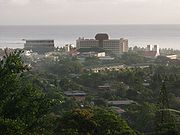
. The capital city, Apia, and Faleolo International Airport
are situated on the island of Upolu.
Samoa was admitted to the United Nations
on 15 December 1976. The entire island group, inclusive of American Samoa
, was called Navigators Islands by European explorers before the 20th century because of the Samoans' seafaring skills.
site at Mulifanua
during the 1970s.
The origins of the Samoans is closely linked to modern research about Polynesia in various scientific disciplines such as genetics
, linguistics
and anthropology
. Scientific research is ongoing although a number of different theories exist, including one proposing that the Samoans originated from Austronesian predecessors during the terminal eastward Lapita expansion period from Southeast Asia and Melanesia between 2,500 and 1,500 BCE. The Samoan origins are currently being reassessed due to new scientific evidence and carbon dating findings from 2003 and onwards.
Intimate sociocultural and genetic ties were maintained between the eastern Lapita
colonies and the archaeological record supports oral tradition and native genealogies that indicate inter-island voyaging and intermarriage between prehistoric Samoans, Fijians, and Tongans.
Contact with Europeans began in the early 18th century. Jacob Roggeveen (1659–1729), a Dutchman, was the first known European to sight the Samoan islands in 1722. This visit was followed by a French explorer by the name of Louis-Antoine de Bougainville (1729–1811), the man who named them the Navigator Islands in 1768. Contact was limited before the 1830s which is when English missionaries and traders began arriving.
Mission work in Samoa had begun in late 1830 by John Williams
, of the London Missionary Society
arriving in Sapapali'i
from The Cook Islands and Tahiti
. By that time, the Samoans had gained a reputation of being savage and warlike, as violent altercations had occurred between natives and French, British, German and American forces, who, by the late nineteenth century, valued Samoa as a refueling station for coal-fired shipping and whaling. According to Barbara A. West, "The Samoans were also known to engage in “headhunting,” a ritual of war in which a warrior took the head of his slain opponent to give to his leader, thus proving his bravery."
 The Germans in particular began to show great commercial interest in the Samoan Islands, especially on the island of 'Upolu where German firms monopolized copra
and cocoa bean processing; the United States laid its own claim and formed alliances with local native chieftains, most conspicuously on the islands of Tutuila
and Manu'a (which were later formally annexed to the USA as American Samoa
).
Britain also sent troops to protect British business enterprise, harbour rights, and consulate office. There followed an eight-year civil war
, where each of the three powers supplied arms, training, and in some cases, combat troops to the warring Samoan parties. The Samoan crisis
came to a critical juncture in March 1889 when all three colonial contenders sent warships into Apia harbour, and a larger-scale war seemed imminent
, until a massive storm on the 15th March 1889 damaged or destroyed the warships, ending the military conflict.
The Second Samoan Civil War
was a conflict that reached a head in 1898 when Germany
, the United Kingdom
, and the United States
were locked in dispute over who should have control over the Samoa Islands.
The Siege of Apia
, occurred during the Second Samoan Civil War
in March 1899 at Apia. Samoan forces loyal to Prince Tanu
were besieged by a larger force of Samoan rebels loyal to Mata'afa Iosefo
. Supporting Prince Tanu
were landing parties from four British
and American
warships. Over the course of several days of fighting, the Samoan rebels were defeated.
American and British warships shelled Apia on March 15, 1899; including the USS Philadelphia
. Germany
, the United Kingdom
and the United States
quickly resolved to end the hostilities; with the partitioning of the island chain at the Tripartite Convention of 1899.
into two parts: the eastern island group became a territory of the United States (the Tutuila Islands in 1900 and officially Manu'a in 1904) and is today known as American Samoa
; the western islands, by far the greater landmass, became known as German Samoa
after Britain vacated all claims to Samoa and accepted termination of German rights in Tonga
and certain areas in the Solomon Islands and West Africa.
By 1912, one of the changes the German administration had apparently achieved was its long-term objectives of understanding the traditional forces in Samoa politics, while maintaining a semblance of local participation in government. There was no more Tupu (King), nor even alii sili (similar to a governor), but the two Fautua (Advisors) were appointed. Tumua and Pule (traditional governments of Upolu and Savaii) were for a time silent; all decisions on matters affecting lands and titles were under the control of the Governor. To complete the process, the Fa’alupega for all Samoa was revised. In a culture based on oratory, the Fa’alupega is a formal greeting which acknowledges those being greeted and their status. The Fa’alupega, which had been nationally accepted from at least the late 19th century (and probably for much longer than that), was as follows:
"Tulouna a Tumua ma Pule,
Tulouna a Itu’au ma Alataua,
Tulouna a Aiga-i-le-Tai,
Ma le Va’a-o-Fonoti,
Tulouna a Tama ma a latou aiga
Po’o aiga ma a latou tama".
This firstly recognized the authority and identity of principal districts of Samoa through their spokesmen – Tumua ma Pule, Itu’au ma Alataua, Aiga-i-le-Tai
, and the Va'a-o-Fonoti
– and the highest titles which were bestowed by these groups. It concludes with the recognition of the great maximal descent groups of Samoa and their “sons” who had been chosen to hold the highest titles.
The new Fa’alupega of German Samoa, which in its first line recognises the Kaiser (Kaisa), apparently required Malietoa Tanunafili and Tupua Tamasese
to be sworn on oath to become advisors to the governing council:
"Tulouna a lana Maiesitete le Kaisa o le tupu mamalu o lo tatou malo kasialika aoao.
Tulouna a lana afioga le kovana kasialika o le sui o le kaisa I Samoa nei.
Susu mai Malietoa, Afio mai Tupua
Ua fa’amanatuiana ai aiga e lua I o oulua tofiga Kasialika o le Fautua.
Tulouna a le vasega a Faipule Kasialika o e lagolago malosi I le Malo.
Afifio mai le nofo a vasega o tofiga Kasialika o e usu fita I le tautua I le malo".
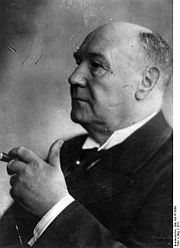
The first German Governor was Wilhelm Solf
who later went on to become Secretary for the Colonies of Imperial Germany. New Zealand troops landed on 'Upolu unopposed on 29 August 1914 and seized control from the German authorities
, following a request by Britain for New Zealand
to perform their "great and urgent imperial service."
From the end of World War I
until 1962, New Zealand controlled Samoa as a Class C Mandate
under trusteeship
through the League of Nations
. There followed a series of New Zealand administrators who were responsible for two major incidents. In the first incident, approximately one fifth of the Samoan population died in the Influenza epidemic of 1918-1919. In 1919 The Royal Commission of Inquiry into the Epidemic concluded that there had been no epidemic of pneumonic influenza in Western Samoa before the arrival of the 'SS Talune
' from Auckland on the 7 November 1918, which was allowed to berth by the NZ administration in breach of quarantine; that within seven days of this ship's arrival influenza had become epidemic in Upolu and had then spread rapidly throughout the rest of the territory.
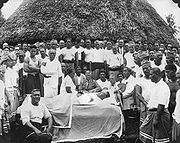 The second major incident arose out of an initially peaceful protest by the Mau
(literally translates as "strongly held opinion"), a non-violent popular movement which had its beginnings in the early 1900s on Savai'i and led by Lauaki Namulauulu Mamoe
, an orator chief deposed by Solf. In 1909, Lauaki was exiled to Saipan
and died en route back to Samoa in 1915.
By 1918, Samoa had population of some 38,000 Samoans and 1,500 Europeans. By the late 1920s the resistance movement against colonial rule had gathered widespread support during the mistreatment of the Samoan people by the New Zealand administration. One of the Mau leaders was Olaf Frederick Nelson
, a half Samoan and half Swedish merchant. Nelson was eventually exile
d during the late 1920s and early 1930s, but he continued to assist the organization financially and politically. In following the Mau's non-violent philosophy, the newly elected leader, High Chief Tupua Tamasese Lealofi, led his fellow uniformed Mau in a peaceful demonstration in downtown Apia on 28 December 1929.
The New Zealand police attempted to arrest one of the leaders in the demonstration. When he resisted, a struggle developed between the police and the Mau. The officers began to fire randomly into the crowd and a Lewis machine gun, mounted in preparation for this demonstration, was used to disperse the Mau. Chief Tamasese was shot from behind and killed while trying to bring calm and order to the Mau demonstrators, screaming "Peace, Samoa". Ten others died that day and approximately 50 were injured by gunshot wounds and police batons.
That day would come to be known in Samoa as Black Saturday. The Mau grew, remaining steadfastly non-violent, and expanded to include a highly influential women's branch. After repeated efforts by the Samoan people, Western Samoa gained independence in 1962 and signed a Friendship Treaty with New Zealand. Samoa was the first country in the Pacific to become independent. In 2002, New Zealand's prime minister
Helen Clark
, on a trip to Samoa, formally apologised for New Zealand's role in these two incidents.
In July 1997, the constitution was amended to change the country's name from Western Samoa to Samoa. The U.S. territory of American Samoa
protested the move, asserting that the change diminished its own identity. American Samoans still use the terms Western Samoa and Western Samoans to describe the independent State of Samoa and its inhabitants.
While the two Samoas share language and ethnicity, their cultures have recently followed different paths, with American Samoans often emigrating to Hawaii
and the U.S. mainland, and adopting many U.S. customs, such as the playing of American football
and baseball
. Western Samoans have tended to emigrate instead to New Zealand, whose influence has made the sports of rugby
and cricket
more popular in the western islands. Travel writer Paul Theroux
noted that there were marked differences between the societies in Samoa and American Samoa.
From 29 December 2011, Samoa plans to jump forward by one day when the nation moves to the west of the International Date Line
. This is anticipated to help the nation boost its economy by doing business with China
, Australia
and New Zealand
. Currently, Samoa is 21 hours behind Sydney
, but the change will mean they are three hours ahead. The current timezone was agreed on 4 July 1892, to work in line with American traders based in California
.
 The 1960 Constitution
, which formally came into force with independence from New Zealand in 1962, is based on the British pattern of parliamentary democracy, modified to take account of Samoan customs. The national modern Government of Samoa is referred to as the 'Malo'. Samoa's first Prime Minister
was Fiame Mata'afa Faumuina Mulinu’u II
, one of the four highest ranking paramount chief
s in the country.
Two other paramount chiefs at the time of independence were appointed joint heads of state for life. Tupua Tamasese Mea'ole
, who died in 1963, leaving Malietoa Tanumafili II sole head of state until his death on 11 May 2007, upon which Samoa transitioned from a constitutional monarchy
to a Parliamentary republic
. The next Head of State Tuiatua Tupua Tamasese Efi was elected by the legislature on 17 June 2007 for a fixed 5 year term.
The unicameral legislature (Fono
) consists of 49 members serving 5-year terms. Forty-seven are matai
title holders elected from territorial districts by Samoans; the other two are chosen by non-Samoans with no chiefly affiliation on separate electoral rolls. Universal suffrage was extended in 1990, but only chiefs (matai) may stand for election to the Samoan seats. There are more than 25,000 matais in the country, about 5% of whom are women. The prime minister is chosen by a majority in the Fono and is appointed by the head of state to form a government. The prime minister's choices for the 12 cabinet positions are appointed by the head of state, subject to the continuing confidence of the Fono.
Prominent women in Samoan politics include the late Laulu Fetauimalemau Mata'afa
(1928–2007) from Lotofaga
constituency, the wife of Samoa's first prime minister. Their daughter Fiame Naomi Mata'afa
is a paramount chief and a long-serving senior member of cabinet
. Other women in politics include Samoan scholar and eminent professor Aiono Fanaafi Le Tagaloa
, orator-chief Matatumua Maimoana and Safuneitu'uga Pa'aga Neri
, the current Minister of Communication and Technology.
The judicial system is based on English common law and local customs. The Supreme Court of Samoa is the court of highest jurisdiction. Its chief justice
is appointed by the head of state upon the recommendation of the prime minister.
The capital village of each district administers and coordinates the affairs of the district and confers each districts' paramount title, amongst other responsibilities. For example, the District of A'ana has its capital at Leulumoega. The paramount title of A'ana is the TuiA'ana. The orator group which confers this title - the Faleiva (House of Nine) - is based at Leulumoega. This is also the same for the other districts. In the district of Tuamasaga, the paramount title of the district - The Malietoa title - is conferred by the FaleTuamasaga based in Afega.
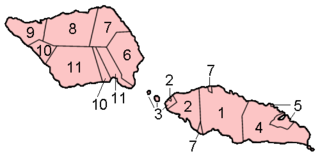
1 including islands Manono
, Apolima
and Nu'ulopa
2 including the Aleipata Islands
and Nu'usafe'e Island
3 smaller parts also on Upolu
(Salamumu (incl. Salamumu-Utu) and Leauvaa villages)
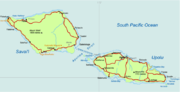
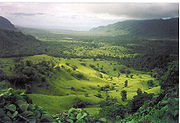 The country is located east of the international date line
but in 2011, Samoan Prime Minister Tuilaepa Sailele announced his country would move the International Date Line to the east of the country, so that Samoa would lie to the west of the date line.
Samoa is south of the equator, about halfway between Hawai‘i and New Zealand in the Polynesia
n region of the Pacific Ocean. The total land area is 2,934 km² (1,133 sq mi) (slightly smaller than the U.S. state of Rhode Island
), consisting of the two large islands of Upolu
and Savai'i
which account for 99% of the total land area, and eight small islets. The land area is about the size of the two Hawaii
islands Oahu
and Maui
combined.
These are the three islets in the Apolima Strait
(Manono Island
, Apolima
and Nu'ulopa
), the four Aleipata Islands
off the eastern end of Upolu
(Nu'utele
, Nu'ulua
, Namua
, and Fanuatapu
), and Nu'usafe'e (less than 0.01 km² - 2½ acres - in area and about 1.4 km (0.9 mi) off the south coast of Upolu
at the village of Vaovai). The main island of Upolu is home to nearly three-quarters of Samoa's population, and its capital city is Apia
.
The Samoan islands have been produced by vulcanism, the source of which is the Samoa hotspot
which is probably the result of a mantle plume
. While all of the islands have volcanic origins, only Savai'i, the western most island in Samoa, is volcanically active with the most recent eruptions in Mt Matavanu
(1905–1911), Mata o le Afi
(1902) and Mauga Afi (1725). The highest point in Samoa is Mt Silisili
, at 1858 m (6,096 ft). The Saleaula
lava fields situated on the central north coast of Savai'i are the result of the Mt Matavanu eruptions which left 50 km² (20 sq mi) of solidified lava.
The climate is equatorial/monsoonal, with an average annual temperature of 26.5°C (79.7°F), and a rainy season from November to April. Savai'i is the largest of the Samoan islands and the sixth largest Polynesian island after New Zealand's North
, South
and Stewart Islands
and the Hawaiian islands of Hawaiʻi
and Maui
. The population of Savai'i is 42,000 people.
(PPP) in 2006 was estimated at $1.218 billion USD. The industrial sector is the largest component of GDP at 58.4%, followed by the services sector at 30.2% (2004 est.). Agriculture represents only 11.4% of GDP (2004 est.). Samoan labor force is estimated at 90,000.
The country currency is the Samoan tālā
, issued and regulated by the Central Bank of Samoa
.
The economy of Samoa has traditionally been dependent on agriculture and fishing at the local level. In modern times, development aid
, private family remittances from overseas, and agricultural exports have become key factors in the nation's economy. Agriculture
employs two-thirds of the labour force, and furnishes 90% of export
s, featuring coconut
cream, coconut oil
, noni
(juice of the nonu fruit, as it is known in Samoan), and copra
.
Outside of a large automotive wire harness factory (Yazaki Corporation), the manufacturing sector mainly processes agricultural products. Tourism
is an expanding sector which now accounts for 25% of GDP. Tourist arrivals have been increasing over the years with more than 100,000 tourists visiting the islands in 2005, up from 70,000 in 1996.
The Samoan government has called for deregulation
of the financial sector, encouragement of investment, and continued fiscal discipline. Observers point to the flexibility of the labour market as a basic strength for future economic advances. The sector has been helped enormously by major capital investment in hotel infrastructure, political instability in neighboring Pacific countries, and the 2005 launch of Polynesian Blue
a joint-venture between the government and Virgin Airlines.
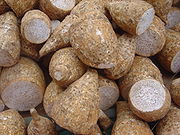 In the period before German colonization, Samoa produced mostly copra
. German merchants and settlers were active in introducing large scale plantation
operations and developing new industries, notably cocoa bean and rubber, relying on imported labourers from China and Melanesia
. When the value of natural rubber fell drastically, about the end of the Great War (World War I), the New Zealand government encouraged the production of banana
s, for which there is a large market in New Zealand.
Because of variations in altitude, a large range of tropical and subtropical crops can be cultivated, but land is not generally available to outside interests. Of the total land area of 2,934 km² (725,000 acres), about 24.4% is in permanent crops and another 21.2% is arable. About 4.4% is Western Samoan Trust Estates Corporation (WSTEC).
The staple products of Samoa are copra
(dried coconut meat), cocoa bean (for chocolate), and banana
s. The annual production of both bananas and copra has been in the range of 13,000 to 15,000 metric tons (about 14,500 to 16,500 short tons). If the rhinoceros beetle
in Samoa were eradicated, Samoa could produce in excess of 40,000 metric tons (44,000 short tons) of copra. Samoan cocoa beans are of very high quality and used in fine New Zealand chocolates. Most are Criollo-Forastero hybrids. Coffee grows well, but production has been uneven. WSTEC is the biggest coffee producer. Rubber has been produced in Samoa for many years, but its export value has little impact on the economy.
Other agricultural industries have been less successful. Sugarcane
production, originally established by Germans in the early 20th century, could be successful. Old train tracks for transporting cane can be seen at some plantations east of Apia. Pineapple
s grow well in Samoa, but beyond local consumption have not been a major export.
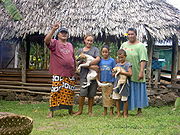
Samoa has a population of 182,265 of which 92.6% are Samoans
, 7% Euronesian
s (people of mixed, European and Polynesian
ancestors) and 0.4% are Europeans
, per the CIA World Factbook
. About three-quarters of the population live on the main island of Upolu
. Only the Māori of New Zealand outnumber Samoans among Polynesian groups.
Samoans' religious adherence
includes the following: Christian Congregational Church of Samoa
35.5%, Roman Catholic 19.6%, Methodist 15%, Latter-day Saints 12.7%, Samoan Assemblies of God
10.6%, Seventh-day Adventist
3.5%, Worship Centre 1.3%, unspecified 0.8% (2001 census). The Head of State until 2007, His Highness Malietoa Tanumafili II
, was a Bahá'í
convert. Samoa hosts one of seven Bahá'í Houses of Worship
in the world; completed in 1984 and dedicated by the Head of State, it is located in Tiapapata, 8 km (5 mi) from Apia.
, or traditional Samoan way, remains a strong force in Samoan life and politics. Despite centuries of European influence, Samoa maintains its historical customs, social and political systems, and language
. Cultural customs such as the Samoa 'ava ceremony
are significant and solemn rituals at important occasions including the bestowal of matai
chiefly titles. Items of great cultural value include the finely woven 'ie toga.
Samoan mythology
includes many gods with creation stories and figures of legend such as Tagaloa
and the goddess of war Nafanua
, the daughter of Saveasi'uleo
, ruler of the spirit realm Pulotu
. Other legends include the well known story of Sina and the Eel
which explains the origins of the first coconut tree.
Some Samoans are spiritual and religious, and have subtly adapted the dominant religion of Christianity to 'fit in' with fa'a Samoa and vice versa. As such, ancient beliefs continue to co-exist side-by-side with Christianity, particularly in regard to the traditional customs and rituals of fa'a Samoa. The Samoan culture is centered around the principle of vāfealoa'i, the relationships between people. These relationships are based on respect, or fa'aaloalo. When Christianity was introduced in Samoa, most Samoan people converted. Currently 98% of the population identify themselves as Christian. The other 2 percent either identify themselves as irreligious, or do not belong to any congregation.
Some Samoans live a communal way of life, participating in activities collectively. Examples of this are the traditional Samoan fale
(houses) which are open with no walls, using blinds made of coconut palm fronds during the night or bad weather.
The Samoan word for dance
is siva
with unique gentle movements of the body in time to music and which tells a story, although the Samoan male dances can be more physical and snappy. The sasa
is also a traditional dance where rows of dancers perform rapid synchronised
movements in time to the rhythm of wooden drums (pate
) or rolled mats. Another dance performed by males is called the fa'ataupati
or the slap dance, creating rhythmic sounds by slapping different parts of the body. This is believed to have been derived from slapping insect
s on the body.
The form and construction of traditional architecture of Samoa
was a specialised skill by Tufuga fai fale that was also linked to other cultural artforms.
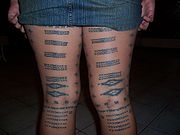 As with other Polynesian cultures (Hawai'ian, Tahitian and Māori
) with significant and unique tattoos, Samoans have two gender specific and culturally significant tattoos. For males, it is called the Pe'a
and consists of intricate and geometrical patterns tattoo
ed that cover areas from the knees up towards the ribs. A male who possesses such a tatau is called a soga'imiti. A Samoan girl or teine is given a malu
, which covers the area from just below her knees to her upper thighs.
is a significant Samoan writer whose novels and stories tell the Samoan experience. In 1989, his novel Flying Fox in a Freedom Tree was made into a feature film in New Zealand, directed by Martyn Sanderson. Another novel Sons for the Return Home had also been made into a feature film in 1979, directed by Paul Maunder. Other Samoan poets and writers include Sapa'u Ruperake Petaia
, Eti Sa'aga and Savea Sano Malifa
, the editor of the Samoa Observer
.
The late John Kneubuhl
, born in American Samoa, was an accomplished playwright and screenwriter and writer. Sia Figiel
won the 1997 Commonwealth Writers' Prize
. Momoe Von Reiche is an internationally recognised poet and artist. Dan Taulapapa McMullin is an artist and writer. Popular bands include The Five Stars
, Penina o Tiafau and Punialava'a. There are also many contemporary Samoan artists living around the world. These Samoan artists include writers, filmmakers, visual artists, actors, directors, singers and dancers. In contemporary dance in New Zealand Lemi Ponifasio
is a director and choreographer who is prominent internationally with his Company MAU and Neil Ieremia
'sc company Black Grace
has also received international acclaim with tours to Europe and New York. The arts organisation Tautai is a collective of visual artists including Fatu Feu'u
, Johnny Penisula
, Shigeyuki Kihara
, Iosefa Leo, Michel Tuffery
, John Ioane and Lily Laita
.
In film, director Sima Urale
is an award-winning filmmaker. Urale's short film O Tamaiti won the prestigious Best Short Film at the Venice Film Festival
in 1996. Her first feature film Apron Strings opened the 2008 NZ International Film Festival
. The feature film Siones Wedding, co-written by Oscar Kightley
, was financially successful following premieres in Auckland and Apia. In music, the cover of the song Sweet Inspiration by The Yandall Sisters
reached number one on the charts while King Kapisi
was the first hip hop artist to receive the prestigious New Zealand APRA
Silver Scroll Award in 1999 for his song Reverse Resistance. His music video Reverse Resistance was filmed in Savai'i at his villages. Other successful Samoan hip hop artists include rapper Scribe
, Dei Hamo
, Savage
and Tha Feelstyle
whose music video Suamalie was filmed in Samoa.
In comedy, Laughing Samoans
, the Naked Samoans
and Kila Kokonut Krew have enjoyed sold-out tours. Actor and director Nathaniel Lees
has featured in many theatre productions and films including his role as Captain Mifune in The Matrix
movie trilogy. In theatre, published playwrights include Oscar Kightley, Victor Rodger
, Makerita Urale
and Niuean
Samoan playwright Dianna Fuemana. Tusiata Avia
is a performance poet. Her first book of poetry Wild Dogs Under My Skirt was published by Victoria University Press in 2004.
International influences like hip hop impact on Samoan culture. According to Katerina Martina Teaiwa, PhD from the University of Hawai'i at Manoa, "Hip hop culture in particular is popular amongst Samoan youth."
This is not surprising considering the large amounts of migration between Samoa, Hawaii, and the United States mainland, specifically California. In addition, the integration of hip hop elements into Samoan tradition also "testifies to the transferability of the dance forms themselves," and to the "circuits through which people and all their embodied knowledge travel." Dance both in its traditional form and its more modern forms has remained a central cultural currency to Samoans, especially youths.
 The main sports played in Samoa are rugby union
, Samoan cricket and netball
. Rugby union
is the national football code of Samoa. In Samoan villages, volleyball
is also popular.
Rugby union is very popular in Samoa and the national team
, nicknamed the Manu Samoa, is consistently competitive against teams from vastly more populous nations. Samoa has competed at every Rugby World Cup
since 1991
, and made the quarter finals in 1991, 1995
and the second round of the 1999
world cup. At the 2003 world cup, Manu Samoa came close to beating eventual world champions, England. Samoa also played in the Pacific Nations Cup and the Pacific Tri-Nations
The sport is governed by the Samoa Rugby Football Union
, who are members of the Pacific Islands Rugby Alliance
, and thus, also contribute to the international Pacific Islanders rugby union team
.
At club level there is the National Provincial Championship
and Pacific Rugby Cup
Prominent Samoan players include Pat Lam
and Brian Lima
. In addition many Samoans have played for or are playing for the New Zealand All Blacks
. They also took home the cup at Wellington and the Hong Kong Rugby Sevens in 2007—for which the Prime Minister of Samoa, also Chairman of the national rugby union, Tuila’epa Sa’ilele Malielegaoi, declared a national holiday. They also were the IRB World Sevens Series Champions in 2010 capping a year of achievement for the Samoans, following wins in the USA, Australia, Hong Kong and Scotland Sevens tournaments.
Rugby league
is also popular amongst Samoans, with Samoa
reaching the quarter finals of the 2000 Rugby League World Cup. Many Samoans and New Zealanders or Australians of Samoan descent play in the Super League and National Leagues in Britain. Examples are Va'aiga Lealuga Tuigamala
who represented the New Zealand All Blacks, then became the first million dollar player to be contracted out to Rugby League to play for Wigan, then played Rugby Union for Newcastle Falcons before representing Samoa. Ta'ane Lavulavu of Workington Town, Maurie Fa'asavalu of St Helens and David Fatialofa of Whitehaven. Other noteworthy players have represented the Samoan National team
.
Samoans have been very visible in boxing
, kickboxing
, wrestling
, and sumo
; some Samoan sumos, most famously Musashimaru and Konishiki have reached the highest rank of Ozeki and yokozuna.
American football
is occasionally played in Samoa, reflecting its wide popularity in American Samoa
, where the sport is played under high school sanction. About 30 ethnic Samoans, many from American Samoa, currently play in the National Football League
. A 2002 article from ESPN
estimated that a Samoan male (either an American Samoan, or a Samoan living in the mainland United States) is 40 times more likely to play in the NFL than a non-Samoan American.
General information
Other
Samoan Islands
The Samoan Islands or Samoa Islands is an archipelago covering in the central South Pacific, forming part of Polynesia and the wider region of Oceania...
in the South Pacific Ocean. It became independent from New Zealand
New Zealand
New Zealand is an island country in the south-western Pacific Ocean comprising two main landmasses and numerous smaller islands. The country is situated some east of Australia across the Tasman Sea, and roughly south of the Pacific island nations of New Caledonia, Fiji, and Tonga...
in 1962. The two main islands of Samoa are Upolu
Upolu
Upolu is an island in Samoa, formed by a massive basaltic shield volcano which rises from the seafloor of the western Pacific Ocean. The island is long, in area, and is the second largest in geographic area as well as the most populated of the Samoan Islands. Upolu is situated to the east of...
and one of the biggest islands in Polynesia
Polynesia
Polynesia is a subregion of Oceania, made up of over 1,000 islands scattered over the central and southern Pacific Ocean. The indigenous people who inhabit the islands of Polynesia are termed Polynesians and they share many similar traits including language, culture and beliefs...
, Savai'i
Savai'i
Savaii is the largest and highest island in Samoa and the Samoa Islands chain. It is also the biggest landmass in Polynesia outside Hawaii and New Zealand. The island of Savai'i is also referred to by Samoans as Salafai, a classical Samoan term used in oratory and prose...
. The capital city, Apia, and Faleolo International Airport
Faleolo International Airport
Faleolo International Airport is an airport located west of Apia, the capital of Samoa.Until 1984, Faleolo could not accommodate jets larger than a Boeing 737...
are situated on the island of Upolu.
Samoa was admitted to the United Nations
United Nations
The United Nations is an international organization whose stated aims are facilitating cooperation in international law, international security, economic development, social progress, human rights, and achievement of world peace...
on 15 December 1976. The entire island group, inclusive of American Samoa
American Samoa
American Samoa is an unincorporated territory of the United States located in the South Pacific Ocean, southeast of the sovereign state of Samoa...
, was called Navigators Islands by European explorers before the 20th century because of the Samoans' seafaring skills.
History
The oldest date so far from pre-historic remains in Samoa has been calculated by New Zealand scientists to a likely true age of circa 3,000 years ago from a LapitaLapita
Lapita is a term applied to an ancient Pacific Ocean archaeological culture which is believed by many archaeologists to be the common ancestor of several cultures in Polynesia, Micronesia, and some coastal areas of Melanesia...
site at Mulifanua
Mulifanua
Mulifanua is a village on the north-western tip of the island of Upolu, in Samoa. In the modern era, it is the capital of Aiga-i-le-Tai district...
during the 1970s.
The origins of the Samoans is closely linked to modern research about Polynesia in various scientific disciplines such as genetics
Genetics
Genetics , a discipline of biology, is the science of genes, heredity, and variation in living organisms....
, linguistics
Linguistics
Linguistics is the scientific study of human language. Linguistics can be broadly broken into three categories or subfields of study: language form, language meaning, and language in context....
and anthropology
Anthropology
Anthropology is the study of humanity. It has origins in the humanities, the natural sciences, and the social sciences. The term "anthropology" is from the Greek anthrōpos , "man", understood to mean mankind or humanity, and -logia , "discourse" or "study", and was first used in 1501 by German...
. Scientific research is ongoing although a number of different theories exist, including one proposing that the Samoans originated from Austronesian predecessors during the terminal eastward Lapita expansion period from Southeast Asia and Melanesia between 2,500 and 1,500 BCE. The Samoan origins are currently being reassessed due to new scientific evidence and carbon dating findings from 2003 and onwards.
Intimate sociocultural and genetic ties were maintained between the eastern Lapita
Lapita
Lapita is a term applied to an ancient Pacific Ocean archaeological culture which is believed by many archaeologists to be the common ancestor of several cultures in Polynesia, Micronesia, and some coastal areas of Melanesia...
colonies and the archaeological record supports oral tradition and native genealogies that indicate inter-island voyaging and intermarriage between prehistoric Samoans, Fijians, and Tongans.
Contact with Europeans began in the early 18th century. Jacob Roggeveen (1659–1729), a Dutchman, was the first known European to sight the Samoan islands in 1722. This visit was followed by a French explorer by the name of Louis-Antoine de Bougainville (1729–1811), the man who named them the Navigator Islands in 1768. Contact was limited before the 1830s which is when English missionaries and traders began arriving.
Mission work in Samoa had begun in late 1830 by John Williams
John Williams (missionary)
John Williams was an English missionary, active in the South Pacific. Born near London, England, he was trained as a foundry worker and mechanic...
, of the London Missionary Society
London Missionary Society
The London Missionary Society was a non-denominational missionary society formed in England in 1795 by evangelical Anglicans and Nonconformists, largely Congregationalist in outlook, with missions in the islands of the South Pacific and Africa...
arriving in Sapapali'i
Sapapali'i
Sapapali'i is a village on the north east coast of Savai'i island in Samoa. It is the village where John Williams, the first missionary to bring Christianity to Samoa landed in 1830. Sapapali'i is in the Fa'asaleleaga political district....
from The Cook Islands and Tahiti
Tahiti
Tahiti is the largest island in the Windward group of French Polynesia, located in the archipelago of the Society Islands in the southern Pacific Ocean. It is the economic, cultural and political centre of French Polynesia. The island was formed from volcanic activity and is high and mountainous...
. By that time, the Samoans had gained a reputation of being savage and warlike, as violent altercations had occurred between natives and French, British, German and American forces, who, by the late nineteenth century, valued Samoa as a refueling station for coal-fired shipping and whaling. According to Barbara A. West, "The Samoans were also known to engage in “headhunting,” a ritual of war in which a warrior took the head of his slain opponent to give to his leader, thus proving his bravery."
Copra
Copra is the dried meat, or kernel, of the coconut. Coconut oil extracted from it has made copra an important agricultural commodity for many coconut-producing countries. It also yields coconut cake which is mainly used as feed for livestock.-Production:...
and cocoa bean processing; the United States laid its own claim and formed alliances with local native chieftains, most conspicuously on the islands of Tutuila
Tutuila
Tutuila is the largest and the main island of American Samoa in the archipelago of Samoan Islands. It is the third largest island in the Samoan Islands chain of the Central Pacific located roughly northeast of Brisbane, Australia and over northeast of Fiji. It contains a large, natural harbor,...
and Manu'a (which were later formally annexed to the USA as American Samoa
American Samoa
American Samoa is an unincorporated territory of the United States located in the South Pacific Ocean, southeast of the sovereign state of Samoa...
).
Britain also sent troops to protect British business enterprise, harbour rights, and consulate office. There followed an eight-year civil war
Samoan Civil War
The First Samoan Civil War refers to the conflict between rival Samoan factions in the Samoan Islands of the South Pacific. The war was fought roughly between 1886 and 1894, primarily between Samoans though the German military intervened on several occasions. The United States and the United...
, where each of the three powers supplied arms, training, and in some cases, combat troops to the warring Samoan parties. The Samoan crisis
Samoan crisis
The Samoan Crisis was a confrontation between the United States, Germany and Great Britain from 1887–1889 over control of the Samoan Islands during the Samoan Civil War. At the height of the confrontation three American warships, Vandalia, USS Trenton and USS Nipsic were wrecked along with the...
came to a critical juncture in March 1889 when all three colonial contenders sent warships into Apia harbour, and a larger-scale war seemed imminent
Samoan crisis
The Samoan Crisis was a confrontation between the United States, Germany and Great Britain from 1887–1889 over control of the Samoan Islands during the Samoan Civil War. At the height of the confrontation three American warships, Vandalia, USS Trenton and USS Nipsic were wrecked along with the...
, until a massive storm on the 15th March 1889 damaged or destroyed the warships, ending the military conflict.
The Second Samoan Civil War
Second Samoan Civil War
The Second Samoan Civil War was a conflict that reached a head in 1898 when Germany, the United Kingdom, and the United States were locked in dispute over who should have control over the Samoan island chain, located in the South Pacific Ocean...
was a conflict that reached a head in 1898 when Germany
German Empire
The German Empire refers to Germany during the "Second Reich" period from the unification of Germany and proclamation of Wilhelm I as German Emperor on 18 January 1871, to 1918, when it became a federal republic after defeat in World War I and the abdication of the Emperor, Wilhelm II.The German...
, the United Kingdom
United Kingdom of Great Britain and Ireland
The United Kingdom of Great Britain and Ireland was the formal name of the United Kingdom during the period when what is now the Republic of Ireland formed a part of it....
, and the United States
United States
The United States of America is a federal constitutional republic comprising fifty states and a federal district...
were locked in dispute over who should have control over the Samoa Islands.
The Siege of Apia
Siege of Apia
The Siege of Apia, or the Battle of Apia, occurred during the Second Samoan Civil War in March 1899 at Apia. Samoan forces loyal to Prince Tanu were besieged by a larger force of Samoan rebels loyal to Mata'afa Iosefo. Supporting Prince Tanu were landing parties from four British and American...
, occurred during the Second Samoan Civil War
Second Samoan Civil War
The Second Samoan Civil War was a conflict that reached a head in 1898 when Germany, the United Kingdom, and the United States were locked in dispute over who should have control over the Samoan island chain, located in the South Pacific Ocean...
in March 1899 at Apia. Samoan forces loyal to Prince Tanu
Tanu
Tanu may refer to:*Tanu, a Samoan prince who was allied with American and British forces during the Second Samoan Civil War*Tanu , an important historical village of the Haida people on the Queen Charlotte Islands, British Columbia, Canada...
were besieged by a larger force of Samoan rebels loyal to Mata'afa Iosefo
Mata'afa Iosefo
Mata'afa Iosefo was a Paramount Chief of Samoa who was one of the three rival candidates for the kingship of Samoa during colonialism...
. Supporting Prince Tanu
Tanu
Tanu may refer to:*Tanu, a Samoan prince who was allied with American and British forces during the Second Samoan Civil War*Tanu , an important historical village of the Haida people on the Queen Charlotte Islands, British Columbia, Canada...
were landing parties from four British
United Kingdom
The United Kingdom of Great Britain and Northern IrelandIn the United Kingdom and Dependencies, other languages have been officially recognised as legitimate autochthonous languages under the European Charter for Regional or Minority Languages...
and American
United States
The United States of America is a federal constitutional republic comprising fifty states and a federal district...
warships. Over the course of several days of fighting, the Samoan rebels were defeated.
American and British warships shelled Apia on March 15, 1899; including the USS Philadelphia
USS Philadelphia (C-4)
The fourth USS Philadelphia , also known as "Cruiser No. 4", was a cruiser of the United States Navy.She was laid down 22 March 1888 by William Cramp and Sons, Philadelphia, Pennsylvania, launched 7 September 1889, sponsored by Miss Minnie Wanamaker, daughter of merchant and philanthropist John...
. Germany
German Empire
The German Empire refers to Germany during the "Second Reich" period from the unification of Germany and proclamation of Wilhelm I as German Emperor on 18 January 1871, to 1918, when it became a federal republic after defeat in World War I and the abdication of the Emperor, Wilhelm II.The German...
, the United Kingdom
United Kingdom of Great Britain and Ireland
The United Kingdom of Great Britain and Ireland was the formal name of the United Kingdom during the period when what is now the Republic of Ireland formed a part of it....
and the United States
United States
The United States of America is a federal constitutional republic comprising fifty states and a federal district...
quickly resolved to end the hostilities; with the partitioning of the island chain at the Tripartite Convention of 1899.
20th century
At the turn of the 20th century, the Tripartite Convention partitioned the Samoan IslandsSamoan Islands
The Samoan Islands or Samoa Islands is an archipelago covering in the central South Pacific, forming part of Polynesia and the wider region of Oceania...
into two parts: the eastern island group became a territory of the United States (the Tutuila Islands in 1900 and officially Manu'a in 1904) and is today known as American Samoa
American Samoa
American Samoa is an unincorporated territory of the United States located in the South Pacific Ocean, southeast of the sovereign state of Samoa...
; the western islands, by far the greater landmass, became known as German Samoa
German Samoa
German Samoa was a German protectorate from 1900 to 1914, consisting of the islands of Upolu, Savai'i, Apolima and Manono, now wholly within the independent state Samoa, formerly Western Samoa...
after Britain vacated all claims to Samoa and accepted termination of German rights in Tonga
Tonga
Tonga, officially the Kingdom of Tonga , is a state and an archipelago in the South Pacific Ocean, comprising 176 islands scattered over of ocean in the South Pacific...
and certain areas in the Solomon Islands and West Africa.
By 1912, one of the changes the German administration had apparently achieved was its long-term objectives of understanding the traditional forces in Samoa politics, while maintaining a semblance of local participation in government. There was no more Tupu (King), nor even alii sili (similar to a governor), but the two Fautua (Advisors) were appointed. Tumua and Pule (traditional governments of Upolu and Savaii) were for a time silent; all decisions on matters affecting lands and titles were under the control of the Governor. To complete the process, the Fa’alupega for all Samoa was revised. In a culture based on oratory, the Fa’alupega is a formal greeting which acknowledges those being greeted and their status. The Fa’alupega, which had been nationally accepted from at least the late 19th century (and probably for much longer than that), was as follows:
"Tulouna a Tumua ma Pule,
Tulouna a Itu’au ma Alataua,
Tulouna a Aiga-i-le-Tai,
Ma le Va’a-o-Fonoti,
Tulouna a Tama ma a latou aiga
Po’o aiga ma a latou tama".
This firstly recognized the authority and identity of principal districts of Samoa through their spokesmen – Tumua ma Pule, Itu’au ma Alataua, Aiga-i-le-Tai
Aiga-i-le-Tai
Aiga-i-le-Tai is a district of Samoa which includes the small islands of Manono, Apolima and tiny uninhabited Nu'ulopa lying in the Apolima Strait between the country's two main islands of Upolu and Savai'i....
, and the Va'a-o-Fonoti
Va'a-o-Fonoti
Va'a-o-Fonoti is a district on the north east coast of Upolu Island in Samoa, with a population of 1,666, making it the least populated district in the country....
– and the highest titles which were bestowed by these groups. It concludes with the recognition of the great maximal descent groups of Samoa and their “sons” who had been chosen to hold the highest titles.
The new Fa’alupega of German Samoa, which in its first line recognises the Kaiser (Kaisa), apparently required Malietoa Tanunafili and Tupua Tamasese
Tupua Tamasese
Tupua Tamasese is the title of one of Samoa's four important paramount chiefs. Samoa's other three important paramount chiefs are the Malietoa, Mata'afa and Tu'imaleali'ifano....
to be sworn on oath to become advisors to the governing council:
"Tulouna a lana Maiesitete le Kaisa o le tupu mamalu o lo tatou malo kasialika aoao.
Tulouna a lana afioga le kovana kasialika o le sui o le kaisa I Samoa nei.
Susu mai Malietoa, Afio mai Tupua
Ua fa’amanatuiana ai aiga e lua I o oulua tofiga Kasialika o le Fautua.
Tulouna a le vasega a Faipule Kasialika o e lagolago malosi I le Malo.
Afifio mai le nofo a vasega o tofiga Kasialika o e usu fita I le tautua I le malo".
The first German Governor was Wilhelm Solf
Wilhelm Solf
Wilhelm Heinrich Solf was a German scholar, diplomat, jurist and statesman.-Early life:Wilhelm Solf was born into a wealthy and liberal family in Berlin. He attended secondary schools in Anklam in western Pomerania and in Mannheim...
who later went on to become Secretary for the Colonies of Imperial Germany. New Zealand troops landed on 'Upolu unopposed on 29 August 1914 and seized control from the German authorities
Occupation of German Samoa
The Occupation of Samoa was the takeover and subsequent administration of the Pacific colony of German Samoa in August 1914 by an expeditionary force from New Zealand called the Samoa Expeditionary Force and New Zealand's first action in World War I...
, following a request by Britain for New Zealand
New Zealand
New Zealand is an island country in the south-western Pacific Ocean comprising two main landmasses and numerous smaller islands. The country is situated some east of Australia across the Tasman Sea, and roughly south of the Pacific island nations of New Caledonia, Fiji, and Tonga...
to perform their "great and urgent imperial service."
From the end of World War I
World War I
World War I , which was predominantly called the World War or the Great War from its occurrence until 1939, and the First World War or World War I thereafter, was a major war centred in Europe that began on 28 July 1914 and lasted until 11 November 1918...
until 1962, New Zealand controlled Samoa as a Class C Mandate
Western Samoa Trust Territory
Western Samoa Trust Territory was the official name of Western Samoa between the lift of German rule in 1920 and the independence of the country from New Zealand rule, in 1962....
under trusteeship
Trusteeship
Trusteeship may refer to*Trust law *Trusteeship *United Nations Trusteeship...
through the League of Nations
League of Nations
The League of Nations was an intergovernmental organization founded as a result of the Paris Peace Conference that ended the First World War. It was the first permanent international organization whose principal mission was to maintain world peace...
. There followed a series of New Zealand administrators who were responsible for two major incidents. In the first incident, approximately one fifth of the Samoan population died in the Influenza epidemic of 1918-1919. In 1919 The Royal Commission of Inquiry into the Epidemic concluded that there had been no epidemic of pneumonic influenza in Western Samoa before the arrival of the 'SS Talune
SS Talune
Three vessels have been named Talune. This article refers to the first SS Talune, built in 1890 and scuttled in 1925.A second SS Talune was built in 1930 for the Union Steamship company of New Zealand, and sold in 1959 to Transporte de Minerales, Panama, who renamed it the ‘Amos’...
' from Auckland on the 7 November 1918, which was allowed to berth by the NZ administration in breach of quarantine; that within seven days of this ship's arrival influenza had become epidemic in Upolu and had then spread rapidly throughout the rest of the territory.
Mau movement
The Mau was a non-violent movement for Samoan independence from colonial rule during the early 1900s. The word 'Mau' means 'opinion' or 'testimony' denoting 'firm strength' in Samoan...
(literally translates as "strongly held opinion"), a non-violent popular movement which had its beginnings in the early 1900s on Savai'i and led by Lauaki Namulauulu Mamoe
Lauaki Namulauulu Mamoe
Lauaki Namulauulu Mamoe was a renowned orator chief and the first leader of the Mau, a resistance movement in Samoa during colonialism. Lauaki was exiled to Saipan in 1909. He died in 1915 as he was taken back to Samoa.He was from Safotulafai, the capital of Fa'asaleleaga political district on...
, an orator chief deposed by Solf. In 1909, Lauaki was exiled to Saipan
Saipan
Saipan is the largest island of the United States Commonwealth of the Northern Mariana Islands , a chain of 15 tropical islands belonging to the Marianas archipelago in the western Pacific Ocean with a total area of . The 2000 census population was 62,392...
and died en route back to Samoa in 1915.
By 1918, Samoa had population of some 38,000 Samoans and 1,500 Europeans. By the late 1920s the resistance movement against colonial rule had gathered widespread support during the mistreatment of the Samoan people by the New Zealand administration. One of the Mau leaders was Olaf Frederick Nelson
Olaf Frederick Nelson
Taisi Olaf Frederick Nelson, , also known as Taisi Olaf, was a successful businessman and one of the founding leaders of the Mau movement for Samoan independence from colonial rule....
, a half Samoan and half Swedish merchant. Nelson was eventually exile
Exile
Exile means to be away from one's home , while either being explicitly refused permission to return and/or being threatened with imprisonment or death upon return...
d during the late 1920s and early 1930s, but he continued to assist the organization financially and politically. In following the Mau's non-violent philosophy, the newly elected leader, High Chief Tupua Tamasese Lealofi, led his fellow uniformed Mau in a peaceful demonstration in downtown Apia on 28 December 1929.
The New Zealand police attempted to arrest one of the leaders in the demonstration. When he resisted, a struggle developed between the police and the Mau. The officers began to fire randomly into the crowd and a Lewis machine gun, mounted in preparation for this demonstration, was used to disperse the Mau. Chief Tamasese was shot from behind and killed while trying to bring calm and order to the Mau demonstrators, screaming "Peace, Samoa". Ten others died that day and approximately 50 were injured by gunshot wounds and police batons.
That day would come to be known in Samoa as Black Saturday. The Mau grew, remaining steadfastly non-violent, and expanded to include a highly influential women's branch. After repeated efforts by the Samoan people, Western Samoa gained independence in 1962 and signed a Friendship Treaty with New Zealand. Samoa was the first country in the Pacific to become independent. In 2002, New Zealand's prime minister
Prime minister
A prime minister is the most senior minister of cabinet in the executive branch of government in a parliamentary system. In many systems, the prime minister selects and may dismiss other members of the cabinet, and allocates posts to members within the government. In most systems, the prime...
Helen Clark
Helen Clark
Helen Elizabeth Clark, ONZ is a New Zealand political figure who was the 37th Prime Minister of New Zealand for three consecutive terms from 1999 to 2008...
, on a trip to Samoa, formally apologised for New Zealand's role in these two incidents.
In July 1997, the constitution was amended to change the country's name from Western Samoa to Samoa. The U.S. territory of American Samoa
American Samoa
American Samoa is an unincorporated territory of the United States located in the South Pacific Ocean, southeast of the sovereign state of Samoa...
protested the move, asserting that the change diminished its own identity. American Samoans still use the terms Western Samoa and Western Samoans to describe the independent State of Samoa and its inhabitants.
While the two Samoas share language and ethnicity, their cultures have recently followed different paths, with American Samoans often emigrating to Hawaii
Hawaii
Hawaii is the newest of the 50 U.S. states , and is the only U.S. state made up entirely of islands. It is the northernmost island group in Polynesia, occupying most of an archipelago in the central Pacific Ocean, southwest of the continental United States, southeast of Japan, and northeast of...
and the U.S. mainland, and adopting many U.S. customs, such as the playing of American football
American football
American football is a sport played between two teams of eleven with the objective of scoring points by advancing the ball into the opposing team's end zone. Known in the United States simply as football, it may also be referred to informally as gridiron football. The ball can be advanced by...
and baseball
Baseball
Baseball is a bat-and-ball sport played between two teams of nine players each. The aim is to score runs by hitting a thrown ball with a bat and touching a series of four bases arranged at the corners of a ninety-foot diamond...
. Western Samoans have tended to emigrate instead to New Zealand, whose influence has made the sports of rugby
Rugby football
Rugby football is a style of football named after Rugby School in the United Kingdom. It is seen most prominently in two current sports, rugby league and rugby union.-History:...
and cricket
Cricket
Cricket is a bat-and-ball game played between two teams of 11 players on an oval-shaped field, at the centre of which is a rectangular 22-yard long pitch. One team bats, trying to score as many runs as possible while the other team bowls and fields, trying to dismiss the batsmen and thus limit the...
more popular in the western islands. Travel writer Paul Theroux
Paul Theroux
Paul Edward Theroux is an American travel writer and novelist, whose best known work of travel writing is perhaps The Great Railway Bazaar . He has also published numerous works of fiction, some of which were made into feature films. He was awarded the 1981 James Tait Black Memorial Prize for his...
noted that there were marked differences between the societies in Samoa and American Samoa.
21st century
Effective 7 September 2009, the government has changed the driving orientation for motorists and Samoans now drive on the left side of the road. This brings Samoa into line with many other countries in the region. Samoa is the first country in recent years, and the first country in the 21st century, to switch to driving on the left.From 29 December 2011, Samoa plans to jump forward by one day when the nation moves to the west of the International Date Line
International Date Line
The International Date Line is a generally north-south imaginary line on the surface of the Earth, passing through the middle of the Pacific Ocean, that designates the place where each calendar day begins...
. This is anticipated to help the nation boost its economy by doing business with China
China
Chinese civilization may refer to:* China for more general discussion of the country.* Chinese culture* Greater China, the transnational community of ethnic Chinese.* History of China* Sinosphere, the area historically affected by Chinese culture...
, Australia
Australia
Australia , officially the Commonwealth of Australia, is a country in the Southern Hemisphere comprising the mainland of the Australian continent, the island of Tasmania, and numerous smaller islands in the Indian and Pacific Oceans. It is the world's sixth-largest country by total area...
and New Zealand
New Zealand
New Zealand is an island country in the south-western Pacific Ocean comprising two main landmasses and numerous smaller islands. The country is situated some east of Australia across the Tasman Sea, and roughly south of the Pacific island nations of New Caledonia, Fiji, and Tonga...
. Currently, Samoa is 21 hours behind Sydney
Sydney
Sydney is the most populous city in Australia and the state capital of New South Wales. Sydney is located on Australia's south-east coast of the Tasman Sea. As of June 2010, the greater metropolitan area had an approximate population of 4.6 million people...
, but the change will mean they are three hours ahead. The current timezone was agreed on 4 July 1892, to work in line with American traders based in California
California
California is a state located on the West Coast of the United States. It is by far the most populous U.S. state, and the third-largest by land area...
.
Politics
Constitution
A constitution is a set of fundamental principles or established precedents according to which a state or other organization is governed. These rules together make up, i.e. constitute, what the entity is...
, which formally came into force with independence from New Zealand in 1962, is based on the British pattern of parliamentary democracy, modified to take account of Samoan customs. The national modern Government of Samoa is referred to as the 'Malo'. Samoa's first Prime Minister
Prime Minister of Samoa
This is a list of Prime Ministers of Samoa from the establishment of that office in 1875 until the present day.-List of Prime Ministers of Samoa :-See also:*Samoa**Politics of Samoa...
was Fiame Mata'afa Faumuina Mulinu’u II
Fiame Mata'afa Faumuina Mulinu’u II
Fiame Mata'afa Faumuina Mulinu’u II, C.B.E. was a paramount chief and the first Prime Minister of Samoa. He was Prime Minister from October 1, 1959 until February 1970 and again from March 1973 until his death in 1975...
, one of the four highest ranking paramount chief
Paramount chief
A paramount chief is the highest-level traditional chief or political leader in a regional or local polity or country typically administered politically with a chief-based system. This definition is used occasionally in anthropological and archaeological theory to refer to the rulers of multiple...
s in the country.
Two other paramount chiefs at the time of independence were appointed joint heads of state for life. Tupua Tamasese Mea'ole
Tupua Tamasese Mea'ole
Tupua Tamasese Mea'ole, CBE was the Tupua Tamasese from 1929 to 1963, a Samoan paramount chief. He held the post O le Ao o le Malo jointly with Malietoa Tanumafili II from 1962 until his death in the next year....
, who died in 1963, leaving Malietoa Tanumafili II sole head of state until his death on 11 May 2007, upon which Samoa transitioned from a constitutional monarchy
Constitutional monarchy
Constitutional monarchy is a form of government in which a monarch acts as head of state within the parameters of a constitution, whether it be a written, uncodified or blended constitution...
to a Parliamentary republic
Parliamentary republic
A parliamentary republic or parliamentary constitutional republic is a type of republic which operates under a parliamentary system of government - meaning a system with no clear-cut separation of powers between the executive and legislative branches. There are a number of variations of...
. The next Head of State Tuiatua Tupua Tamasese Efi was elected by the legislature on 17 June 2007 for a fixed 5 year term.
The unicameral legislature (Fono
Fono
The Legislative Assembly is the Parliament of Samoa based in the capital Apia where the country's central administration is situated.In the Samoan language, the Legislative Assembly of Samoa is sometimes referred to as the Samoan Fono while the government of the country is referred to as the...
) consists of 49 members serving 5-year terms. Forty-seven are matai
Fa'amatai
Fa'amatai is the chiefly system of Samoa, central to the organization of Samoan society.It is the traditional indigenous form of governance in the Samoa Islands, comprising American Samoa and the Independent State of Samoa...
title holders elected from territorial districts by Samoans; the other two are chosen by non-Samoans with no chiefly affiliation on separate electoral rolls. Universal suffrage was extended in 1990, but only chiefs (matai) may stand for election to the Samoan seats. There are more than 25,000 matais in the country, about 5% of whom are women. The prime minister is chosen by a majority in the Fono and is appointed by the head of state to form a government. The prime minister's choices for the 12 cabinet positions are appointed by the head of state, subject to the continuing confidence of the Fono.
Prominent women in Samoan politics include the late Laulu Fetauimalemau Mata'afa
Laulu Fetauimalemau Mata'afa
Masiofo La'ulu Fetauimalemau Mata'afa also known as Fetaui Mata'afa was an ambassador and a Member of Parliament in Samoa. She was also the wife of Samoa's first Prime Minister Fiame Mata'afa Faumuina Mulinu’u II. Their daughter, Fiame Naomi Mata'afa is a matai high chief and Cabinet Minister in...
(1928–2007) from Lotofaga
Lotofaga
Lotofaga is a village on the south coast of Upolu island in Samoa. Lotofaga is also the name of the larger Lotofaga Electoral Constituency which includes Lotofaga village and two other villages, Vavau and Matatufu....
constituency, the wife of Samoa's first prime minister. Their daughter Fiame Naomi Mata'afa
Fiame Naomi Mata'afa
Fiame Naomi Mata'afa is a Samoan high chief and a senior member of cabinet in Samoa. She is a Member of Parliament for the electoral constituency of Lotofaga in the political district of Atua. She is the current Minister of Women, Community & Social Development in Samoa...
is a paramount chief and a long-serving senior member of cabinet
Minister (government)
A minister is a politician who holds significant public office in a national or regional government. Senior ministers are members of the cabinet....
. Other women in politics include Samoan scholar and eminent professor Aiono Fanaafi Le Tagaloa
Aiono Fanaafi Le Tagaloa
Aiono Fanaafi Le Tagaloa is a chief , scholar, historian and professor of Samoa. An authority on Samoan culture and language, she is one of the most educated female matai in the country with a PhD in educational philosophy and applied linguistics from the University of London.She has been...
, orator-chief Matatumua Maimoana and Safuneitu'uga Pa'aga Neri
Safuneitu'uga Pa'aga Neri
Safuneitu'uga Pa'aga Neri is a Samoan matai, politician and the current Minister of Communication and Technology in Samoa. Her matai chief title is Safuneitu'uga....
, the current Minister of Communication and Technology.
The judicial system is based on English common law and local customs. The Supreme Court of Samoa is the court of highest jurisdiction. Its chief justice
Chief Justice
The Chief Justice in many countries is the name for the presiding member of a Supreme Court in Commonwealth or other countries with an Anglo-Saxon justice system based on English common law, such as the Supreme Court of Canada, the Constitutional Court of South Africa, the Court of Final Appeal of...
is appointed by the head of state upon the recommendation of the prime minister.
Districts
Samoa is made up of eleven itūmālō (political districts). These are the traditional eleven districts that were established well before European arrival. Each district has its own constitutional foundation (faavae) based on the traditional order of title precedence found in each district's faalupega (traditional salutations).The capital village of each district administers and coordinates the affairs of the district and confers each districts' paramount title, amongst other responsibilities. For example, the District of A'ana has its capital at Leulumoega. The paramount title of A'ana is the TuiA'ana. The orator group which confers this title - the Faleiva (House of Nine) - is based at Leulumoega. This is also the same for the other districts. In the district of Tuamasaga, the paramount title of the district - The Malietoa title - is conferred by the FaleTuamasaga based in Afega.
Upolu Upolu Upolu is an island in Samoa, formed by a massive basaltic shield volcano which rises from the seafloor of the western Pacific Ocean. The island is long, in area, and is the second largest in geographic area as well as the most populated of the Samoan Islands. Upolu is situated to the east of... (including minor islands) |
Savai'i Savai'i Savaii is the largest and highest island in Samoa and the Samoa Islands chain. It is also the biggest landmass in Polynesia outside Hawaii and New Zealand. The island of Savai'i is also referred to by Samoans as Salafai, a classical Samoan term used in oratory and prose... |
1 including islands Manono
Manono Island
Manono is an island of Samoa, situated in the Apolima Strait between the main islands of Savai'i and Upolu, 3.4 km WNW off Lefatu Cape, the westernmost point of Upolu....
, Apolima
Apolima
Apolima is the smallest of the four inhabited islands of Samoa and situated in the Apolima Strait, between the country's two largest islands Upolu to the east and Savai'i to the west....
and Nu'ulopa
Nu'ulopa
Nu'ulopa is a small uninhabited island in the Apolima Strait between the islands of Upolu and Savai'i in Samoa. The island is part of Aiga-i-le-Tai district....
2 including the Aleipata Islands
Aleipata Islands
The Aleipata Islands is a group of four uninhabited islands off the eastern end of Upolu Island, Samoa, with an aggregate area of 1.68 km²):*Nu'utele *Nu'ulua *Namua *Fanuatapu...
and Nu'usafe'e Island
3 smaller parts also on Upolu
Upolu
Upolu is an island in Samoa, formed by a massive basaltic shield volcano which rises from the seafloor of the western Pacific Ocean. The island is long, in area, and is the second largest in geographic area as well as the most populated of the Samoan Islands. Upolu is situated to the east of...
(Salamumu (incl. Salamumu-Utu) and Leauvaa villages)
Geography
International Date Line
The International Date Line is a generally north-south imaginary line on the surface of the Earth, passing through the middle of the Pacific Ocean, that designates the place where each calendar day begins...
but in 2011, Samoan Prime Minister Tuilaepa Sailele announced his country would move the International Date Line to the east of the country, so that Samoa would lie to the west of the date line.
Samoa is south of the equator, about halfway between Hawai‘i and New Zealand in the Polynesia
Polynesia
Polynesia is a subregion of Oceania, made up of over 1,000 islands scattered over the central and southern Pacific Ocean. The indigenous people who inhabit the islands of Polynesia are termed Polynesians and they share many similar traits including language, culture and beliefs...
n region of the Pacific Ocean. The total land area is 2,934 km² (1,133 sq mi) (slightly smaller than the U.S. state of Rhode Island
Rhode Island
The state of Rhode Island and Providence Plantations, more commonly referred to as Rhode Island , is a state in the New England region of the United States. It is the smallest U.S. state by area...
), consisting of the two large islands of Upolu
Upolu
Upolu is an island in Samoa, formed by a massive basaltic shield volcano which rises from the seafloor of the western Pacific Ocean. The island is long, in area, and is the second largest in geographic area as well as the most populated of the Samoan Islands. Upolu is situated to the east of...
and Savai'i
Savai'i
Savaii is the largest and highest island in Samoa and the Samoa Islands chain. It is also the biggest landmass in Polynesia outside Hawaii and New Zealand. The island of Savai'i is also referred to by Samoans as Salafai, a classical Samoan term used in oratory and prose...
which account for 99% of the total land area, and eight small islets. The land area is about the size of the two Hawaii
Hawaii
Hawaii is the newest of the 50 U.S. states , and is the only U.S. state made up entirely of islands. It is the northernmost island group in Polynesia, occupying most of an archipelago in the central Pacific Ocean, southwest of the continental United States, southeast of Japan, and northeast of...
islands Oahu
Oahu
Oahu or Oahu , known as "The Gathering Place", is the third largest of the Hawaiian Islands and most populous of the islands in the U.S. state of Hawaii. The state capital Honolulu is located on the southeast coast...
and Maui
Maui
The island of Maui is the second-largest of the Hawaiian Islands at and is the 17th largest island in the United States. Maui is part of the state of Hawaii and is the largest of Maui County's four islands, bigger than Lānai, Kahoolawe, and Molokai. In 2010, Maui had a population of 144,444,...
combined.
These are the three islets in the Apolima Strait
Apolima Strait
The Apolima Strait is about 13km wide and separates the two largest islands of Samoa, the island of Savai'i to the northwest, and Upolu to the southeast....
(Manono Island
Manono Island
Manono is an island of Samoa, situated in the Apolima Strait between the main islands of Savai'i and Upolu, 3.4 km WNW off Lefatu Cape, the westernmost point of Upolu....
, Apolima
Apolima
Apolima is the smallest of the four inhabited islands of Samoa and situated in the Apolima Strait, between the country's two largest islands Upolu to the east and Savai'i to the west....
and Nu'ulopa
Nu'ulopa
Nu'ulopa is a small uninhabited island in the Apolima Strait between the islands of Upolu and Savai'i in Samoa. The island is part of Aiga-i-le-Tai district....
), the four Aleipata Islands
Aleipata Islands
The Aleipata Islands is a group of four uninhabited islands off the eastern end of Upolu Island, Samoa, with an aggregate area of 1.68 km²):*Nu'utele *Nu'ulua *Namua *Fanuatapu...
off the eastern end of Upolu
Upolu
Upolu is an island in Samoa, formed by a massive basaltic shield volcano which rises from the seafloor of the western Pacific Ocean. The island is long, in area, and is the second largest in geographic area as well as the most populated of the Samoan Islands. Upolu is situated to the east of...
(Nu'utele
Nu'utele
Nu'utele is an island which consists of a volcanic tuff ring situated 1.3 km off the eastern end of Upolu island, Samoa. It is the largest of the four Aleipata Islands, at 1.08 km²....
, Nu'ulua
Nu'ulua
Nu'ulua is a small uninhabited island in the Aleipata Islands situated more than 1.3 km from the eastern end of Upolu in Samoa.Nu'ulua has a land area of 25 hectares and is a habitat for locally and regionally endemic birds including the endangered Tooth-billed Pigeon, , also known as Samoan...
, Namua
Namua
Namu'a is a small uninhabited island off the east coast of Upolu island in Samoa.The island is a 10 minute boat ride from Upolu and has beach fale accommodation for visitors. There are lookouts and it takes about an hour to walk around the island....
, and Fanuatapu
Fanuatapu
Fanuatapu is an uninhabited island which consists of a volcanic tuff ring, situated off the eastern tip of Upolu, Samoa. It is the smallest and easternmost of the four Aleipata Islands, with an area of 15 hectares, and has an automated lighthouse....
), and Nu'usafe'e (less than 0.01 km² - 2½ acres - in area and about 1.4 km (0.9 mi) off the south coast of Upolu
Upolu
Upolu is an island in Samoa, formed by a massive basaltic shield volcano which rises from the seafloor of the western Pacific Ocean. The island is long, in area, and is the second largest in geographic area as well as the most populated of the Samoan Islands. Upolu is situated to the east of...
at the village of Vaovai). The main island of Upolu is home to nearly three-quarters of Samoa's population, and its capital city is Apia
Apia, Samoa
-Administration:Apia is part of the Tuamasaga political district and of election district Vaimauga West and Faleata East. There is no city administration for Apia. Apia consists of some 45 individual, independent villages...
.
The Samoan islands have been produced by vulcanism, the source of which is the Samoa hotspot
Samoa hotspot
The Samoa hotspot is a volcanic hotspot located in the south Pacific Ocean.In geology the Hotspot model describes a hot upwelling plume of molten magma through the Earth's crust as an explanation of how volcanic islands are formed. The hotspot idea came from J...
which is probably the result of a mantle plume
Mantle plume
A mantle plume is a hypothetical thermal diapir of abnormally hot rock that nucleates at the core-mantle boundary and rises through the Earth's mantle. Such plumes were invoked in 1971 to explain volcanic regions that were not thought to be explicable by the then-new theory of plate tectonics. Some...
. While all of the islands have volcanic origins, only Savai'i, the western most island in Samoa, is volcanically active with the most recent eruptions in Mt Matavanu
Mt Matavanu
Mt Matavanu is an active volcano on the island of Savai'i in Samoa.The most recent eruptions from Matavanu occurred between 1905 - 1911 with lava flows on its northern side flowing towards the island's coastline and into the sea in the district of Gaga'emauga....
(1905–1911), Mata o le Afi
Mata Ole Afi
Mata o le Afi is a volcano on the island of Savai'i in the South Pacific nation of Samoa.Mata o le Afi translates from the Samoan language as Eye of the Fire or Source of the Fire....
(1902) and Mauga Afi (1725). The highest point in Samoa is Mt Silisili
Silisili
Mount Silisili is the highest peak in Samoa and the Samoa Islands chain. It is located in the centre of a mountain chain running the length of Savai'i island.Mount Silisili rises to a height of 1,858 m...
, at 1858 m (6,096 ft). The Saleaula
Saleaula
Sale'aula is a village on the central north coast of Savai'i island in Samoa and is the traditional center of the Gaga'emauga political district...
lava fields situated on the central north coast of Savai'i are the result of the Mt Matavanu eruptions which left 50 km² (20 sq mi) of solidified lava.
The climate is equatorial/monsoonal, with an average annual temperature of 26.5°C (79.7°F), and a rainy season from November to April. Savai'i is the largest of the Samoan islands and the sixth largest Polynesian island after New Zealand's North
North Island
The North Island is one of the two main islands of New Zealand, separated from the much less populous South Island by Cook Strait. The island is in area, making it the world's 14th-largest island...
, South
South Island
The South Island is the larger of the two major islands of New Zealand, the other being the more populous North Island. It is bordered to the north by Cook Strait, to the west by the Tasman Sea, to the south and east by the Pacific Ocean...
and Stewart Islands
Stewart Island/Rakiura
Stewart Island/Rakiura is the third-largest island of New Zealand. It lies south of the South Island, across Foveaux Strait. Its permanent population is slightly over 400 people, most of whom live in the settlement of Oban.- History and naming :...
and the Hawaiian islands of Hawaiʻi
Hawaii (island)
The Island of Hawaii, also called the Big Island or Hawaii Island , is a volcanic island in the North Pacific Ocean...
and Maui
Maui
The island of Maui is the second-largest of the Hawaiian Islands at and is the 17th largest island in the United States. Maui is part of the state of Hawaii and is the largest of Maui County's four islands, bigger than Lānai, Kahoolawe, and Molokai. In 2010, Maui had a population of 144,444,...
. The population of Savai'i is 42,000 people.
Economy
Gross Domestic Product (GDP) in purchasing power parityPurchasing power parity
In economics, purchasing power parity is a condition between countries where an amount of money has the same purchasing power in different countries. The prices of the goods between the countries would only reflect the exchange rates...
(PPP) in 2006 was estimated at $1.218 billion USD. The industrial sector is the largest component of GDP at 58.4%, followed by the services sector at 30.2% (2004 est.). Agriculture represents only 11.4% of GDP (2004 est.). Samoan labor force is estimated at 90,000.
The country currency is the Samoan tālā
Samoan tala
The tālā is the currency of Samoa. It is divided into 100 sene. The terms tālā and sene are the equivalents or transliteration of the English words dollar and cent, in the Samoan language....
, issued and regulated by the Central Bank of Samoa
Central Bank of Samoa
The Central Bank of Samoa is the central bank of Samoa. Situated in the capital Apia beside the main government buildings, the bank issues the Samoan currency, the Samoan tālā as well as regulating and managing the exchange rate with foreign currencies...
.
The economy of Samoa has traditionally been dependent on agriculture and fishing at the local level. In modern times, development aid
Development aid
Development aid or development cooperation is aid given by governments and other agencies to support the economic, environmental, social and political development of developing countries.It is distinguished...
, private family remittances from overseas, and agricultural exports have become key factors in the nation's economy. Agriculture
Agriculture
Agriculture is the cultivation of animals, plants, fungi and other life forms for food, fiber, and other products used to sustain life. Agriculture was the key implement in the rise of sedentary human civilization, whereby farming of domesticated species created food surpluses that nurtured the...
employs two-thirds of the labour force, and furnishes 90% of export
Export
The term export is derived from the conceptual meaning as to ship the goods and services out of the port of a country. The seller of such goods and services is referred to as an "exporter" who is based in the country of export whereas the overseas based buyer is referred to as an "importer"...
s, featuring coconut
Coconut
The coconut palm, Cocos nucifera, is a member of the family Arecaceae . It is the only accepted species in the genus Cocos. The term coconut can refer to the entire coconut palm, the seed, or the fruit, which is not a botanical nut. The spelling cocoanut is an old-fashioned form of the word...
cream, coconut oil
Coconut oil
Coconut oil is an edible oil extracted from the kernel or meat of matured coconuts harvested from the coconut palm . Throughout the tropical world, it has provided the primary source of fat in the diets of millions of people for generations. It has various applications in food, medicine, and industry...
, noni
Noni
Morinda citrifolia, commonly known as great morinda, Indian mulberry, nunaakai , dog dumpling , mengkudu , Kumudu , pace , beach mulberry, cheese fruit or noni is a tree in the coffee family, Rubiaceae...
(juice of the nonu fruit, as it is known in Samoan), and copra
Copra
Copra is the dried meat, or kernel, of the coconut. Coconut oil extracted from it has made copra an important agricultural commodity for many coconut-producing countries. It also yields coconut cake which is mainly used as feed for livestock.-Production:...
.
Outside of a large automotive wire harness factory (Yazaki Corporation), the manufacturing sector mainly processes agricultural products. Tourism
Tourism
Tourism is travel for recreational, leisure or business purposes. The World Tourism Organization defines tourists as people "traveling to and staying in places outside their usual environment for not more than one consecutive year for leisure, business and other purposes".Tourism has become a...
is an expanding sector which now accounts for 25% of GDP. Tourist arrivals have been increasing over the years with more than 100,000 tourists visiting the islands in 2005, up from 70,000 in 1996.
The Samoan government has called for deregulation
Deregulation
Deregulation is the removal or simplification of government rules and regulations that constrain the operation of market forces.Deregulation is the removal or simplification of government rules and regulations that constrain the operation of market forces.Deregulation is the removal or...
of the financial sector, encouragement of investment, and continued fiscal discipline. Observers point to the flexibility of the labour market as a basic strength for future economic advances. The sector has been helped enormously by major capital investment in hotel infrastructure, political instability in neighboring Pacific countries, and the 2005 launch of Polynesian Blue
Polynesian Blue
Polynesian Blue is a Virgin Blue Holdings airline that flies between Samoa, Australia and New Zealand. It is 49% owned by the Samoan government,...
a joint-venture between the government and Virgin Airlines.
Copra
Copra is the dried meat, or kernel, of the coconut. Coconut oil extracted from it has made copra an important agricultural commodity for many coconut-producing countries. It also yields coconut cake which is mainly used as feed for livestock.-Production:...
. German merchants and settlers were active in introducing large scale plantation
Plantation
A plantation is a long artificially established forest, farm or estate, where crops are grown for sale, often in distant markets rather than for local on-site consumption...
operations and developing new industries, notably cocoa bean and rubber, relying on imported labourers from China and Melanesia
Melanesia
Melanesia is a subregion of Oceania extending from the western end of the Pacific Ocean to the Arafura Sea, and eastward to Fiji. The region comprises most of the islands immediately north and northeast of Australia...
. When the value of natural rubber fell drastically, about the end of the Great War (World War I), the New Zealand government encouraged the production of banana
Banana
Banana is the common name for herbaceous plants of the genus Musa and for the fruit they produce. Bananas come in a variety of sizes and colors when ripe, including yellow, purple, and red....
s, for which there is a large market in New Zealand.
Because of variations in altitude, a large range of tropical and subtropical crops can be cultivated, but land is not generally available to outside interests. Of the total land area of 2,934 km² (725,000 acres), about 24.4% is in permanent crops and another 21.2% is arable. About 4.4% is Western Samoan Trust Estates Corporation (WSTEC).
The staple products of Samoa are copra
Copra
Copra is the dried meat, or kernel, of the coconut. Coconut oil extracted from it has made copra an important agricultural commodity for many coconut-producing countries. It also yields coconut cake which is mainly used as feed for livestock.-Production:...
(dried coconut meat), cocoa bean (for chocolate), and banana
Banana
Banana is the common name for herbaceous plants of the genus Musa and for the fruit they produce. Bananas come in a variety of sizes and colors when ripe, including yellow, purple, and red....
s. The annual production of both bananas and copra has been in the range of 13,000 to 15,000 metric tons (about 14,500 to 16,500 short tons). If the rhinoceros beetle
Rhinoceros beetle
The Rhinoceros Beetles or Rhino Beetles are a subfamily of the scarab beetle family . Other common names – some for particular groups of rhino beetles – are for example Hercules beetles, unicorn beetles or horn beetles...
in Samoa were eradicated, Samoa could produce in excess of 40,000 metric tons (44,000 short tons) of copra. Samoan cocoa beans are of very high quality and used in fine New Zealand chocolates. Most are Criollo-Forastero hybrids. Coffee grows well, but production has been uneven. WSTEC is the biggest coffee producer. Rubber has been produced in Samoa for many years, but its export value has little impact on the economy.
Other agricultural industries have been less successful. Sugarcane
Sugarcane
Sugarcane refers to any of six to 37 species of tall perennial grasses of the genus Saccharum . Native to the warm temperate to tropical regions of South Asia, they have stout, jointed, fibrous stalks that are rich in sugar, and measure two to six metres tall...
production, originally established by Germans in the early 20th century, could be successful. Old train tracks for transporting cane can be seen at some plantations east of Apia. Pineapple
Pineapple
Pineapple is the common name for a tropical plant and its edible fruit, which is actually a multiple fruit consisting of coalesced berries. It was given the name pineapple due to its resemblance to a pine cone. The pineapple is by far the most economically important plant in the Bromeliaceae...
s grow well in Samoa, but beyond local consumption have not been a major export.
Demographics
Samoa has a population of 182,265 of which 92.6% are Samoans
Samoans
The Samoan people are a Polynesian ethnic group of the Samoan Islands, sharing genetics, language, history and culture. Due to colonialism, the home islands are politically and geographically divided between the country of Samoa, official name Independent State of Samoa ; and American Samoa, an...
, 7% Euronesian
Euronesian
Euronesian refers to any person of mixed European and Polynesian, Melanesian or Micronesian descent. It is most commonly used in Samoa. Most Euronesians are descended from British or French people and Polynesians , with some from Spaniards and Polynesians in Isla de Pascua and from Spaniards and...
s (people of mixed, European and Polynesian
Polynesians
The Polynesian peoples is a grouping of various ethnic groups that speak Polynesian languages, a branch of the Oceanic languages within the Austronesian languages, and inhabit Polynesia. They number approximately 1,500,000 people...
ancestors) and 0.4% are Europeans
European ethnic groups
The ethnic groups in Europe are the various ethnic groups that reside in the nations of Europe. European ethnology is the field of anthropology focusing on Europe....
, per the CIA World Factbook
The World Factbook
The World Factbook is a reference resource produced by the Central Intelligence Agency of the United States with almanac-style information about the countries of the world. The official paper copy version is available from the National Technical Information Service and the Government Printing Office...
. About three-quarters of the population live on the main island of Upolu
Upolu
Upolu is an island in Samoa, formed by a massive basaltic shield volcano which rises from the seafloor of the western Pacific Ocean. The island is long, in area, and is the second largest in geographic area as well as the most populated of the Samoan Islands. Upolu is situated to the east of...
. Only the Māori of New Zealand outnumber Samoans among Polynesian groups.
Samoans' religious adherence
Religion in Samoa
Religion in Samoa encompasses a range of groups, but nearly 100% of the population of Samoa is Christian. The 2001 Census revealed the following distribution of Christian groups: Congregational Christian, 34.8 percent; Roman Catholic, 19.6 percent; Methodist, 15 percent; the Church of Jesus Christ...
includes the following: Christian Congregational Church of Samoa
Christian Congregational Church of Samoa
The Congregational Christian Church of Samoa is an international Christian Church originally established in Samoa by missionaries of the London Missionary Society.- History :...
35.5%, Roman Catholic 19.6%, Methodist 15%, Latter-day Saints 12.7%, Samoan Assemblies of God
Samoan Assemblies of God
The Sāmoan Assemblies of God Fellowship or SAOG is a Pentecostal fellowship of churches. Established in 1928 on the Islands of American Sāmoa, it reached the Western Islands and outer countries with large Sāmoan communities, such as New Zealand, America and Australia...
10.6%, Seventh-day Adventist
Seventh-day Adventist Church
The Seventh-day Adventist Church is a Protestant Christian denomination distinguished by its observance of Saturday, the original seventh day of the Judeo-Christian week, as the Sabbath, and by its emphasis on the imminent second coming of Jesus Christ...
3.5%, Worship Centre 1.3%, unspecified 0.8% (2001 census). The Head of State until 2007, His Highness Malietoa Tanumafili II
Malietoa Tanumafili II of Samoa
Malietoa Tanumafili II, GCMG, CBE, was the Malietoa, the title of one of Samoa's four paramount chiefs, and the head of state, or O le Ao o le Malo, a position that he held for life, of Samoa from 1962 to 2007. He was co-chief of state in 1962 and became the sole head of state on 15 April 1963...
, was a Bahá'í
Bahá'í Faith
The Bahá'í Faith is a monotheistic religion founded by Bahá'u'lláh in 19th-century Persia, emphasizing the spiritual unity of all humankind. There are an estimated five to six million Bahá'ís around the world in more than 200 countries and territories....
convert. Samoa hosts one of seven Bahá'í Houses of Worship
Bahá'í House of Worship
A Bahá'í House of Worship, sometimes referred to by its Arabic name of Mashriqu'l-Adhkár ,is the designation of a place of worship, or temple, of the Bahá'í Faith...
in the world; completed in 1984 and dedicated by the Head of State, it is located in Tiapapata, 8 km (5 mi) from Apia.
Culture
The fa'a SamoaFa'a Samoa
Fa'a Samoa means literally The Samoan Way which describes the socio-political and cultural way of life for the people of the Samoan Islands....
, or traditional Samoan way, remains a strong force in Samoan life and politics. Despite centuries of European influence, Samoa maintains its historical customs, social and political systems, and language
Samoan language
Samoan Samoan Samoan (Gagana Sāmoa, is the language of the Samoan Islands, comprising the independent country of Samoa and the United States territory of American Samoa. It is an official language—alongside English—in both jurisdictions. Samoan, a Polynesian language, is the first language for most...
. Cultural customs such as the Samoa 'ava ceremony
Samoa 'ava ceremony
The Ava Ceremony is one of the most important customs of the Samoa Islands involving a solemn ritual where a ceremonial beverage is shared to mark most important occasions in Samoan society. The Samoan word ava is a cognate of the Polynesian word kava associated with the kava cultures in Oceania...
are significant and solemn rituals at important occasions including the bestowal of matai
Fa'amatai
Fa'amatai is the chiefly system of Samoa, central to the organization of Samoan society.It is the traditional indigenous form of governance in the Samoa Islands, comprising American Samoa and the Independent State of Samoa...
chiefly titles. Items of great cultural value include the finely woven 'ie toga.
Samoan mythology
Samoan mythology
Samoan mythology tell stories of many different gods. There were gods of the forest, the seas, rain, harvest, villages and war. There were two types of gods, atua who had non-human origins and aitu who were of human origin. Tagaloa was a supreme god who made the islands and the people. Mafui'e was...
includes many gods with creation stories and figures of legend such as Tagaloa
Tagaloa
In Samoan mythology, Tagaloa is generally accepted as the supreme ruler, the creator of the universe, the chief of all gods and the progenitor of other gods and humans. Tagaloa dwelt in space and made the Heavens , the sky, the land, the seas, the fresh water, the trees and the people...
and the goddess of war Nafanua
Nafanua
Nafanua is the name of the revered Goddess of War in Samoa and a deity in Polynesian Mythology.According to Samoan mythology, Nafanua was the daughter of Saveasi'uleo, the God of Pulotu, Samoa's spirit world. In one legend, Nafanua's mother was Tilafaiga the sister of Taema.-Background:Nafanua is a...
, the daughter of Saveasi'uleo
Saveasi'uleo
Saveasi'uleo is the God of Pulotu, the underworld of spirits or Hades in Samoan mythology.He is the father of Nafanua the Goddess of War in Samoa...
, ruler of the spirit realm Pulotu
Pulotu
In the mythology of parts of western Polynesia , Pulotu is the underworld, the world of darkness ....
. Other legends include the well known story of Sina and the Eel
Sina and the Eel
Sina and the Eel is a myth of origins in Samoan mythology which explains the origins of the first coconut tree.In the Samoan language the legend is called Sina ma le Tuna. Tuna is the Samoan word for 'eel'....
which explains the origins of the first coconut tree.
Some Samoans are spiritual and religious, and have subtly adapted the dominant religion of Christianity to 'fit in' with fa'a Samoa and vice versa. As such, ancient beliefs continue to co-exist side-by-side with Christianity, particularly in regard to the traditional customs and rituals of fa'a Samoa. The Samoan culture is centered around the principle of vāfealoa'i, the relationships between people. These relationships are based on respect, or fa'aaloalo. When Christianity was introduced in Samoa, most Samoan people converted. Currently 98% of the population identify themselves as Christian. The other 2 percent either identify themselves as irreligious, or do not belong to any congregation.
Some Samoans live a communal way of life, participating in activities collectively. Examples of this are the traditional Samoan fale
Architecture of Samoa
The architecture of Samoa is characterised by openness, with the design mirroring the culture and life of the Samoan people who inhabit the Samoa Islands. Architectural concepts are incorporated into Samoan proverbs, oratory and metaphors, as well as linking to other art forms in Samoa, such as...
(houses) which are open with no walls, using blinds made of coconut palm fronds during the night or bad weather.
The Samoan word for dance
Dance
Dance is an art form that generally refers to movement of the body, usually rhythmic and to music, used as a form of expression, social interaction or presented in a spiritual or performance setting....
is siva
Siva Samoa
Siva Samoa is the Samoan term for a Samoan dance.Traditional Samoan dancing is one area of the culture that has been the least affected bywestern civilisation...
with unique gentle movements of the body in time to music and which tells a story, although the Samoan male dances can be more physical and snappy. The sasa
Sasa (dance)
Sasa is a Samoan word for a particular group dance. The sasa can be performed by both males and females in a seated position or standing. Hand movements are used to depict activities taken from every day life.- History :...
is also a traditional dance where rows of dancers perform rapid synchronised
Synchronization
Synchronization is timekeeping which requires the coordination of events to operate a system in unison. The familiar conductor of an orchestra serves to keep the orchestra in time....
movements in time to the rhythm of wooden drums (pate
Pate (musical instrument)
A pātē is a Polynesian percussion instrument. It is of the slit drum family, and therefore is also of the idiophone percussion family. It is made from a hollowed-out log, and produces a distinctive and loud sound...
) or rolled mats. Another dance performed by males is called the fa'ataupati
Fa'ataupati
The Fa'ataupati is a dance indigenous to the Samoans. In English it is simply the "Samoan Slap Dance". It was developed in Samoa in the 19th century and is only performed by males.- History :...
or the slap dance, creating rhythmic sounds by slapping different parts of the body. This is believed to have been derived from slapping insect
Insect
Insects are a class of living creatures within the arthropods that have a chitinous exoskeleton, a three-part body , three pairs of jointed legs, compound eyes, and two antennae...
s on the body.
The form and construction of traditional architecture of Samoa
Architecture of Samoa
The architecture of Samoa is characterised by openness, with the design mirroring the culture and life of the Samoan people who inhabit the Samoa Islands. Architectural concepts are incorporated into Samoan proverbs, oratory and metaphors, as well as linking to other art forms in Samoa, such as...
was a specialised skill by Tufuga fai fale that was also linked to other cultural artforms.
Tattooing
Maori culture
Māori culture is the culture of the Māori of New Zealand, an Eastern Polynesian people, and forms a distinctive part of New Zealand culture. Within the Māori community, and to a lesser extent throughout New Zealand as a whole, the word Māoritanga is often used as an approximate synonym for Māori...
) with significant and unique tattoos, Samoans have two gender specific and culturally significant tattoos. For males, it is called the Pe'a
Pe'a
The Pe'a is the popular name of the traditional male tattoo of Samoa, which was originally called the malofie, a term used in the Samoan language chiefly vocabulary and 'respect' register .-Description:...
and consists of intricate and geometrical patterns tattoo
Tattoo
A tattoo is made by inserting indelible ink into the dermis layer of the skin to change the pigment. Tattoos on humans are a type of body modification, and tattoos on other animals are most commonly used for identification purposes...
ed that cover areas from the knees up towards the ribs. A male who possesses such a tatau is called a soga'imiti. A Samoan girl or teine is given a malu
Malu
Malu can refer to:* Malu, a Samoan tattoo* Malu, Nepal* Malu, Giurgiu, a commune in Giurgiu County, Romania* Malu, a village in Bârla Commune, Argeş County, Romania* Malu, a village in Godeni Commune, Argeş County, Romania...
, which covers the area from just below her knees to her upper thighs.
Contemporary culture
Albert WendtAlbert Wendt
Albert Wendt, CNZM is a Samoan poet and writer who also lives in New Zealand. Among his works is Leaves of the Banyan Tree .-Biography:...
is a significant Samoan writer whose novels and stories tell the Samoan experience. In 1989, his novel Flying Fox in a Freedom Tree was made into a feature film in New Zealand, directed by Martyn Sanderson. Another novel Sons for the Return Home had also been made into a feature film in 1979, directed by Paul Maunder. Other Samoan poets and writers include Sapa'u Ruperake Petaia
Sapa'u Ruperake Petaia
Sapa'u Ruperake Petaia is a poet and writer from Samoa. His poem Blue Rain became the title of a collection of his poems first published in 1980 with later editions in the 1990s. The collection included the satirical poem Kidnapped which explores themes about the loss of traditional Samoan...
, Eti Sa'aga and Savea Sano Malifa
Savea Sano Malifa
Savea Sano Malifa is a Samoan poet, journalist, newspaper editor, and publisher. He is the founder and Editor in Chief of the Samoa Observer, the main newspaper in Samoa...
, the editor of the Samoa Observer
Samoa Observer
The Samoa Observer is the largest newspaper group in Samoa published in both English and Samoan. The Samoa Observer is published Monday to Friday, the Weekend Observer on Saturdays and the Sunday Samoan on Sundays with all editions available online. Coverage includes local and international news,...
.
The late John Kneubuhl
John Kneubuhl
John Kneubuhl was an American Samoan screenwriter, playwright and Polynesian historian. He wrote for American television series such as The Fugitive, Gunsmoke, The Wild Wild West, Star Trek, The Invaders and Hawaii Five-O...
, born in American Samoa, was an accomplished playwright and screenwriter and writer. Sia Figiel
Sia Figiel
Sia Figiel is a contemporary Samoan novelist, poet, and painter.Sia Figiel grew up amidst the traditional Samoan singing and poetry which heavily influenced her writing. Her formal schooling was conducted in Samoa and New Zealand where she also began a BA which was completed at Whitworth College...
won the 1997 Commonwealth Writers' Prize
Commonwealth Writers' Prize
Commonwealth Writers is an initiative by the Commonwealth Foundation to unearth, develop and promote the best new fiction from across the Commonwealth. It's flagship are two literary awards and a website...
. Momoe Von Reiche is an internationally recognised poet and artist. Dan Taulapapa McMullin is an artist and writer. Popular bands include The Five Stars
The Five Stars
The Fives Stars is one of the best known bands from Samoa, and a popular band known in the Polynesian community.-History:Formed in 1974 the Five Stars were mainly a family outfit. They consisted of brothers Alofa and Solomona Tu'uga and their relatives Samu Poulava-Selesele, Faifua Fa'atoe and...
, Penina o Tiafau and Punialava'a. There are also many contemporary Samoan artists living around the world. These Samoan artists include writers, filmmakers, visual artists, actors, directors, singers and dancers. In contemporary dance in New Zealand Lemi Ponifasio
Lemi Ponifasio
Lemi Ponifasio is a Samoan choreographer and the founder and director of MAU, New Zealand's most prolific international contemporary dance and theatre company...
is a director and choreographer who is prominent internationally with his Company MAU and Neil Ieremia
Neil Ieremia
Neil Ieremia is a choreographer and dancer in New Zealand. He is the founder and artistic director of Black Grace, a modern dance company formed in 1995. Black Grace has toured extensively in New Zealand and internationally including Australia, USA and The Netherlands...
'sc company Black Grace
Black Grace
Black Grace is an internationally-touring modern dance company, formed in Auckland, New Zealand in 1995. Neil Ieremia, the group's founder and choreographer, draws on Māori and Pacific Islander indigenous dance, as well as modern dance and hip hop...
has also received international acclaim with tours to Europe and New York. The arts organisation Tautai is a collective of visual artists including Fatu Feu'u
Fatu Feu'u
Fatu Akelei Feu'u, ONZM is a noted Samoan painter.Feu'u grew up in the village of Poutasi in the district of Falealili in Samoa.Feu'u emigrated to New Zealand in 1966. He has established a reputation as the elder statesman of Pacific art in New Zealand...
, Johnny Penisula
Johnny Penisula
Johnny Penisula MNZM is a contemporary Samoan stone sculptor and painter living in New Zealand.Penisula was born in Samoa and began painting when he was 13 years old. He moved to New Zealand in 1962 and set up home in Invercargill. He studied art at night classes and began exhibiting as a painter...
, Shigeyuki Kihara
Shigeyuki Kihara
Shigeyuki Kihara is a contemporary artist and the first New Zealander to hold a solo exhibition at the Metropolitan Museum of Art, New York. Titled Shigeyuki Kihara: Living Photographs, the exhibition opened from 7 October 2008 to 1 February 2009...
, Iosefa Leo, Michel Tuffery
Michel Tuffery
Michael "Michel" Cliff Tuffery, MNZM, is a New Zealand artist of Samoan, Tahitian and Cook Island descent.He lives and works in Wellington, New Zealand...
, John Ioane and Lily Laita
Lily Laita
Lily Aitua Laita is an artist and art educator in New Zealand. Laita is of mixed Pākehā and Māori ancestry, as well as of Samoan descent. Laita is known for using Māori, English and Samoan texts in her paintings....
.
In film, director Sima Urale
Sima Urale
Sima Urale is a New Zealand filmmaker who has won national and international awards. Her films explore social and political issues and have been screened worldwide. She is one of the few Polynesian film directors in the world with more than 15 years in the industry...
is an award-winning filmmaker. Urale's short film O Tamaiti won the prestigious Best Short Film at the Venice Film Festival
Venice Film Festival
The Venice International Film Festival is the oldest international film festival in the world. Founded by Count Giuseppe Volpi in 1932 as the "Esposizione Internazionale d'Arte Cinematografica", the festival has since taken place every year in late August or early September on the island of the...
in 1996. Her first feature film Apron Strings opened the 2008 NZ International Film Festival
New Zealand International Film Festivals
The New Zealand International Film Festival is a film festival held annually across New Zealand throughout the latter half of the year.In 2009 for the first time the Festival relinquished its various regional names to be called the New Zealand International Film Festival...
. The feature film Siones Wedding, co-written by Oscar Kightley
Oscar Kightley
Oscar Vai To'elau Kightley, MNZM, is a Samoan-born actor, television presenter and writer who has been a resident and citizen of New Zealand for most of his life.-Biography:He acted in and co-wrote the successful 2006 film Sione's Wedding...
, was financially successful following premieres in Auckland and Apia. In music, the cover of the song Sweet Inspiration by The Yandall Sisters
The Yandall Sisters
The Yandall Sisters are a popular New Zealand/Samoan all-female singing group of the seventies who have made a major contribution to music in New Zealand...
reached number one on the charts while King Kapisi
King Kapisi
King Kapisi is a New Zealand Hip hop recording artist. He was the first Hip hop artist in New Zealand to receive the prestigious Silver Scroll Award at the APRA Awards for Songwriter of the Year for his single Reverse Resistance in 1999, which followed on the popular release of his debut single...
was the first hip hop artist to receive the prestigious New Zealand APRA
APRA
APRA or Apra may refer to:* American Popular Revolutionary Alliance , a Peruvian political party* Australasian Performing Right Association, a copyright collecting society...
Silver Scroll Award in 1999 for his song Reverse Resistance. His music video Reverse Resistance was filmed in Savai'i at his villages. Other successful Samoan hip hop artists include rapper Scribe
Scribe (rapper)
Malo Luafutu better known by his stage name Scribe, is a New Zealand hip hop rapper and recording artist of Samoan descent...
, Dei Hamo
Dei Hamo
- Albums :- Singles :- External links :***- See also :*New Zealand hip hop...
, Savage
Savage (rapper)
- Studio albums :-Singles:-Featured singles:- External links :*****...
and Tha Feelstyle
Tha Feelstyle
Tha Feelstyle is the stage name of award winning hip hop artist Kas Futialo, a New Zealander of Samoan descent. His first album was Break It To Pieces in 2004. Tha Feelstyle was born in Samoa and moved to New Zealand in the 1980s...
whose music video Suamalie was filmed in Samoa.
In comedy, Laughing Samoans
Laughing Samoans
The Laughing Samoans are a New Zealand-based duo formed by comedians Eteuati Ete and Tofiga Fepulea'i, both of Samoan descent. The duo have toured in New Zealand in sold out shows and internationally to Australia, United States, the Cook Islands, Hawai'i, Fiji and London in 2009.Their first show as...
, the Naked Samoans
Naked Samoans
The Naked Samoans is a famous New Zealand comedy group made up of Polynesian entertainers, most of whom are Samoan. The group is noted for performing social humour and satire that attracts a broad audience, especially among white New Zealanders, without sacrificing the group's Pacific Island identity...
and Kila Kokonut Krew have enjoyed sold-out tours. Actor and director Nathaniel Lees
Nathaniel Lees
Nathaniel Lees is a New Zealand born actor and theatre director of Samoan descent. He is known for his role as Captain Mifune in The Matrix trilogy and his role as "Uglúk" in The Lord of the Rings: The Two Towers. He has also had roles on the TV series Young Hercules, Hercules: The Legendary...
has featured in many theatre productions and films including his role as Captain Mifune in The Matrix
The Matrix
The Matrix is a 1999 science fiction-action film written and directed by Larry and Andy Wachowski, starring Keanu Reeves, Laurence Fishburne, Carrie-Anne Moss, Joe Pantoliano, and Hugo Weaving...
movie trilogy. In theatre, published playwrights include Oscar Kightley, Victor Rodger
Victor Rodger
Victor Rodger is a journalist, actor and award winning playwrightin New Zealand whose theatre work deals with race, racism and identity...
, Makerita Urale
Makerita Urale
Makerita Urale is a documentary director and a leading figure in contemporary Polynesian theatre in New Zealand. She has produced landmark productions in the performing arts. She is also a playwright. She is the writer of the play Frangipani Perfume, the first Pacific play written by a woman for an...
and Niuean
Niuean
Niuean may refer to:* Something of, from, or related to Niue, an island nation located in the South Pacific Ocean** A person from Niue, or of Niuean descent. For information about the Niuean people, see Demographics of Niue and Culture of Niue. For specific persons, see List of Niueans.** The...
Samoan playwright Dianna Fuemana. Tusiata Avia
Tusiata Avia
Tusiata Avia is a New Zealand page and performance poet born to a Samoan father and Palagi mother. Her poetry explores Pacifica and cross-cultural themes, as well as the borders between traditional and contemporary life, and between place and the self.She has toured both nationally and...
is a performance poet. Her first book of poetry Wild Dogs Under My Skirt was published by Victoria University Press in 2004.
International influences like hip hop impact on Samoan culture. According to Katerina Martina Teaiwa, PhD from the University of Hawai'i at Manoa, "Hip hop culture in particular is popular amongst Samoan youth."
This is not surprising considering the large amounts of migration between Samoa, Hawaii, and the United States mainland, specifically California. In addition, the integration of hip hop elements into Samoan tradition also "testifies to the transferability of the dance forms themselves," and to the "circuits through which people and all their embodied knowledge travel." Dance both in its traditional form and its more modern forms has remained a central cultural currency to Samoans, especially youths.
Sport
Rugby union
Rugby union, often simply referred to as rugby, is a full contact team sport which originated in England in the early 19th century. One of the two codes of rugby football, it is based on running with the ball in hand...
, Samoan cricket and netball
Netball
Netball is a ball sport played between two teams of seven players. Its development, derived from early versions of basketball, began in England in the 1890s. By 1960 international playing rules had been standardised for the game, and the International Federation of Netball and Women's Basketball ...
. Rugby union
Rugby union
Rugby union, often simply referred to as rugby, is a full contact team sport which originated in England in the early 19th century. One of the two codes of rugby football, it is based on running with the ball in hand...
is the national football code of Samoa. In Samoan villages, volleyball
Volleyball
Volleyball is a team sport in which two teams of six players are separated by a net. Each team tries to score points by grounding a ball on the other team's court under organized rules.The complete rules are extensive...
is also popular.
Rugby union is very popular in Samoa and the national team
Samoa national rugby union team
The Manu Samoa is the men's representative side of the Samoa Rugby Union in both the 15's and the 7's for international competitions. The Samoa Rugby Union is owned by the affiliated rugby unions of Samoa. In Samoa, Manu Samoa is in honour of a famous Samoan warrior. From 1924 to 1997 Samoa was...
, nicknamed the Manu Samoa, is consistently competitive against teams from vastly more populous nations. Samoa has competed at every Rugby World Cup
Rugby World Cup
The Rugby World Cup is an international rugby union competition organised by the International Rugby Board and held every four years since 1987....
since 1991
1991 Rugby World Cup
The 1991 Rugby World Cup was the second edition of the Rugby World Cup, and was jointly hosted by England, Scotland, Wales, Ireland and France; at that time, the five European countries that participated in the Five Nations Championship making it the first Rugby World Cup to be staged in the...
, and made the quarter finals in 1991, 1995
1995 Rugby World Cup
The 1995 Rugby World Cup was the third Rugby World Cup. It was hosted and won by South Africa, and was the first Rugby World Cup in which every match was held in one country....
and the second round of the 1999
1999 Rugby World Cup
The 1999 Rugby World Cup was the fourth Rugby World Cup, and the first to be held in rugby union's professional era. The principal host nation was Wales, although the majority of matches were played outside the country, shared between England, France, Scotland and Ireland...
world cup. At the 2003 world cup, Manu Samoa came close to beating eventual world champions, England. Samoa also played in the Pacific Nations Cup and the Pacific Tri-Nations
Pacific Tri-Nations
The Pacific Tri-Nations is the traditional rugby union series between Tonga, Fiji and Samoa. It was established in 1982 with the Samoan team, then known as Western Samoa, winning the tournament...
The sport is governed by the Samoa Rugby Football Union
Samoa Rugby Football Union
The Samoa Rugby Union are the governing body of the sport of rugby union in Samoa. They were formerly members of the Pacific Islands Rugby Alliance along with Fiji and Tonga....
, who are members of the Pacific Islands Rugby Alliance
Pacific Islands Rugby Alliance
The Pacific Islands Rugby Alliance was set up in 2002 as a basis of co-operation between the Fiji, Samoa and Tonga Rugby Unions. Niue and the Cook Islands are also members of the Alliance, and while not members of the Pacific Tri-Nations competition, they can and do supply members to the Pacific...
, and thus, also contribute to the international Pacific Islanders rugby union team
Pacific Islanders rugby union team
The Pacific Islanders rugby union team is an international rugby union team, started in 2004, that represents Fiji, Samoa and Tonga. While Niue and the Cook Islands are not members of the Pacific Tri-Nations competition, they did supply players to the squad for the Pacific Islanders' tour in 2004...
.
At club level there is the National Provincial Championship
Samoa National Provincial Championship
The National Provincial Championship is the second highest level of rugby union competition within Samoan rugby and is a stepping stone for local players into international rugby union....
and Pacific Rugby Cup
Pacific Rugby Cup
The IRB Pacific Rugby Cup is an annual rugby union development competition. First held in 2006, it features representative teams from the three Pacific rugby union unions - Fiji, Samoa and Tonga.The participating teams are:*Samoa A from Samoa...
Prominent Samoan players include Pat Lam
Pat Lam
Patrick Richard Lam is a former New Zealand rugby union footballer, of Samoan descent. He was the head coach of Auckland before being appointed head coach of Super 14 team the Blues in 2009. He went to St. Peter's College, Epsom, and captained the New Zealand Secondary Schools rugby team...
and Brian Lima
Brian Lima
Brian Lima is a former Samoan rugby union footballer who was inducted into the IRB Hall of Fame in 2011. Originally a wing, Lima moved into centre for Manu Samoa as his pace lessened, but he remained a formidable player throughout his career.He earned the memorable nickname of "The Chiropractor"...
. In addition many Samoans have played for or are playing for the New Zealand All Blacks
All Blacks
The New Zealand men's national rugby union team, known as the All Blacks, represent New Zealand in what is regarded as its national sport....
. They also took home the cup at Wellington and the Hong Kong Rugby Sevens in 2007—for which the Prime Minister of Samoa, also Chairman of the national rugby union, Tuila’epa Sa’ilele Malielegaoi, declared a national holiday. They also were the IRB World Sevens Series Champions in 2010 capping a year of achievement for the Samoans, following wins in the USA, Australia, Hong Kong and Scotland Sevens tournaments.
Rugby league
Rugby league
Rugby league football, usually called rugby league, is a full contact sport played by two teams of thirteen players on a rectangular grass field. One of the two codes of rugby football, it originated in England in 1895 by a split from Rugby Football Union over paying players...
is also popular amongst Samoans, with Samoa
Samoa national rugby league team
-Notable Players & Coaches:* John Ackland * Steve Kaiser Coach 1990 - 1994* Steve Kaiser 1986* Afi Ah Koui 1986* Andrew Ah Koui 1986* George Apelu 1986* Fa'ausu Afoa circa-1995* Wing Afoa 1990 - 1994* Isaak Ah Mau circa-2006...
reaching the quarter finals of the 2000 Rugby League World Cup. Many Samoans and New Zealanders or Australians of Samoan descent play in the Super League and National Leagues in Britain. Examples are Va'aiga Lealuga Tuigamala
Va'aiga Tuigamala
Va'aiga Lealuga Tuigamala MNZM is a Samoan rugby footballer. As well as playing for the All Blacks, he represented Samoa in both rugby union and rugby league, playing at centre and wing...
who represented the New Zealand All Blacks, then became the first million dollar player to be contracted out to Rugby League to play for Wigan, then played Rugby Union for Newcastle Falcons before representing Samoa. Ta'ane Lavulavu of Workington Town, Maurie Fa'asavalu of St Helens and David Fatialofa of Whitehaven. Other noteworthy players have represented the Samoan National team
Samoa national rugby league team
-Notable Players & Coaches:* John Ackland * Steve Kaiser Coach 1990 - 1994* Steve Kaiser 1986* Afi Ah Koui 1986* Andrew Ah Koui 1986* George Apelu 1986* Fa'ausu Afoa circa-1995* Wing Afoa 1990 - 1994* Isaak Ah Mau circa-2006...
.
Samoans have been very visible in boxing
Boxing
Boxing, also called pugilism, is a combat sport in which two people fight each other using their fists. Boxing is supervised by a referee over a series of between one to three minute intervals called rounds...
, kickboxing
Kickboxing
Kickboxing refers to a group of martial arts and stand-up combat sports based on kicking and punching, historically developed from karate, Muay Thai and western boxing....
, wrestling
Professional wrestling
Professional wrestling is a mode of spectacle, combining athletics and theatrical performance.Roland Barthes, "The World of Wrestling", Mythologies, 1957 It takes the form of events, held by touring companies, which mimic a title match combat sport...
, and sumo
Sumo
is a competitive full-contact sport where a wrestler attempts to force another wrestler out of a circular ring or to touch the ground with anything other than the soles of the feet. The sport originated in Japan, the only country where it is practiced professionally...
; some Samoan sumos, most famously Musashimaru and Konishiki have reached the highest rank of Ozeki and yokozuna.
American football
American football
American football is a sport played between two teams of eleven with the objective of scoring points by advancing the ball into the opposing team's end zone. Known in the United States simply as football, it may also be referred to informally as gridiron football. The ball can be advanced by...
is occasionally played in Samoa, reflecting its wide popularity in American Samoa
American Samoa
American Samoa is an unincorporated territory of the United States located in the South Pacific Ocean, southeast of the sovereign state of Samoa...
, where the sport is played under high school sanction. About 30 ethnic Samoans, many from American Samoa, currently play in the National Football League
National Football League
The National Football League is the highest level of professional American football in the United States, and is considered the top professional American football league in the world. It was formed by eleven teams in 1920 as the American Professional Football Association, with the league changing...
. A 2002 article from ESPN
ESPN
Entertainment and Sports Programming Network, commonly known as ESPN, is an American global cable television network focusing on sports-related programming including live and pre-taped event telecasts, sports talk shows, and other original programming....
estimated that a Samoan male (either an American Samoan, or a Samoan living in the mainland United States) is 40 times more likely to play in the NFL than a non-Samoan American.
See also
- 1889 Apia cyclone1889 Apia cycloneThe 1889 Apia cyclone was a Pacific tropical cyclone, which swept across Apia, Samoa on March 15, 1889 during the Samoan crisis. The effect on shipping in the harbour was devastating, largely because of what has been described as 'an error of judgement that will forever remain a paradox in human...
- 2009 Samoa Tsunami2009 Samoa earthquakeThe 2009 Samoa earthquake was an 8.1 Mw submarine earthquake that took place in the Samoan Islands region at 06:48:11 local time on September 29, 2009 . At a magnitude of 8.1, it was the largest earthquake of 2009....
- Archaeology in SamoaArchaeology in SamoaArchaeology of Samoa began with the first systematic survey of archaeological remains on Savai'i island by Jack Golson in 1957. Since then, surveys and studies in the rest of Samoa have uncovered major findings of settlements, stone and earth mounds including star mounds, Lapita pottery remains and...
- Commonwealth of NationsCommonwealth of NationsThe Commonwealth of Nations, normally referred to as the Commonwealth and formerly known as the British Commonwealth, is an intergovernmental organisation of fifty-four independent member states...
- German SamoaGerman SamoaGerman Samoa was a German protectorate from 1900 to 1914, consisting of the islands of Upolu, Savai'i, Apolima and Manono, now wholly within the independent state Samoa, formerly Western Samoa...
- LGBT rights in SamoaLGBT rights in SamoaHomosexuality is illegal in Samoa. The Samoa Crimes Ordinance 1961 criminalises homosexuality in section 58E,58G and 58J. Samoan culture is historically tolerant of homosexuality. In particular there is a tradition of raising some boys in a family as a girl in order to play an important domestic...
- Samoa, CaliforniaSamoa, CaliforniaSamoa is a census-designated place in Humboldt County, California. It is located northwest of Eureka, at an elevation of 23 feet . Samoa is located in the northern peninsula of Humboldt Bay and is the site of the Samoa Cookhouse, one of the last remaining original, lumber style cookhouses...
- SS TaluneSS TaluneThree vessels have been named Talune. This article refers to the first SS Talune, built in 1890 and scuttled in 1925.A second SS Talune was built in 1930 for the Union Steamship company of New Zealand, and sold in 1959 to Transporte de Minerales, Panama, who renamed it the ‘Amos’...
- Transport in SamoaTransport in SamoaTransport in Samoa includes one international airport situated on the north west coast of Upolu island, paved highways reaching most parts of the two main, one main port in the capital Apia and two ports servicing mainly inter island ferries for vehicles and passengers between the two main islands,...
Further reading
- Watson, RM, History of Samoa (Wellington, 1918)
- Meleisea, Malama. The Making of Modern Samoa: Traditional Authority and Colonial Administration in the Modern History of Western Samoa. (Suva, 1987) Institute of Pacific Studies, University of the South Pacific.
- Schnee, Dr. Heinrich (former Deputy Governor of German SamoaGerman SamoaGerman Samoa was a German protectorate from 1900 to 1914, consisting of the islands of Upolu, Savai'i, Apolima and Manono, now wholly within the independent state Samoa, formerly Western Samoa...
and last Governor of German East AfricaGerman East AfricaGerman East Africa was a German colony in East Africa, which included what are now :Burundi, :Rwanda and Tanganyika . Its area was , nearly three times the size of Germany today....
). 1926. German Colonization, Past and Future—The Truth about the German Colonies. London: George Allen & Unwin. - Eustis, Nelson. [1979] 1980. Aggie Grey of Samoa. Adelaide, South AustraliaSouth AustraliaSouth Australia is a state of Australia in the southern central part of the country. It covers some of the most arid parts of the continent; with a total land area of , it is the fourth largest of Australia's six states and two territories.South Australia shares borders with all of the mainland...
: Hobby Investments. ISBN 0-9595609-0-4.
External links
GovernmentGeneral information
- University of Colorado from UCB Libraries GovPubs
- Samoa Tourism Authority
Other
- Samoaworld.com, Online Samoan Dictionary