
Encyclopedia
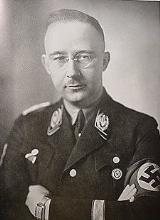
| Heinrich Himmler |
|
| Birth | October 7 1900 3:30 p.m. |
| Death | May 23 1945 11:14 p.m. |
| Party | National Socialist German Workers Party |
| Political positions |
- Reichsführer-SS in the NSDAP
- Reichs- und Preussischer Minister des Innern of Germany
- Chef der Deutschen Polizei
- Chef der Heeresrüstung und Befehlshaber des Ersatzheeres of Germany
- Reichskommissar für die Festigung des Deutschen Volkstums in the NSDAP
- Verein "Lebensborn e.V." of the NSDAP
- Verein "Das Ahnenerbe Forschungs-und Lehrgemeinschaft" of the NSDAP
- Beauftragter der NSDAP für alle Volkstumsfragen
- Generalbevollmächtigter für die Verwaltung of Germany
|
Heinrich Luitpold Himmler was the commander of the German
Schutzstaffel , abbreviated
...
and one of the most powerful men in
Nazi Germany. As
Reichsführer-SS he controlled the SS and the
Gestapo.
Himmler became a leading organizer of
the Holocaust. As founder and officer-in-charge of the
Nazi concentration camps and the
Einsatzgruppen death squads, Himmler held final command responsibility for implementing the industrial-scale extermination of between 6 and 12 million people. This was aimed particularly at
Jews, but also against those of many other nationalities, races and conditions considered by him to be suitable for killing, or
Sonderbehandlung as
gas chamber murder was euphemistically known within the SS.
Early life
Born near
Munich,
Bavaria,
Germany, into a
middle-class family, he was the son of Gebhardt Himmler, a schoolmaster, and his wife Anna Heyder as the middle of three brothers; the eldest Gebhardt Jr. , the youngest Ernst After leaving
Landshut High School in 1918, Himmler was appointed an
Officer Cadet and joined the 11th Bavarian Regiment for service in
World War I. Shortly before he was due for commissioning as an officer the war ended, and he was discharged from the military without seeing combat.
The following year, Himmler began studying agronomy at the Technische Hochschule in Munich. During his time as a student, he became active in the
Freikorps , private armies of ex-German Army men resentful of Germany's loss of the First World War. Himmler joined the
Reichkriegsflagge and, in 1923, applied to join the
Nazi Party, which were recruiting Freikorps members as potential members of the new Nazi stormtrooper units known as the
Sturmabteilung . He took part in the ill-fated Beer Hall Putsch in November 1923.
Rise in the SS
Himmler joined the SS in 1925 and by 1927 had been appointed as Deputy
Reichsführer-SS; a role he began to take very seriously. Upon the resignation of SS Commander Erhard Heiden, Himmler was appointed as the new
Reichsführer-SS in January 1929. At the time Himmler was appointed to lead the SS, it numbered only 280 members and was considered a mere
battalion of the much larger
SA. Himmler himself was considered only an SA-Oberführer, but after 1929 he simply referred to himself as the "Reichsführer-SS".
By 1933, when the Nazi Party rose to power in Germany, Himmler's SS numbered 52,000 members, and the organization had developed strict membership requirements ensuring all members were of
Adolf Hitler's "
Aryan Herrenvolk" . Now a
Gruppenführer was an early paramilitary rank of the Nazi Party [i], first created in 1925 [i] as a se ...
in the SA, Himmler, along with his deputy
Reinhard Heydrich next began a massive effort to separate the SS from SA control; he introduced black
SS uniforms to replace the SA brown shirts in the fall of 1933. Shortly thereafter, he was promoted to
SS-Obergruppenführer was a Nazi Party [i] paramilitary rank that was first created in 1932 [i] as a rank of the SA [i] ...
und Reichsführer-SS and became an equal to the senior SA commanders, who by this time loathed the SS and the power it held.
Himmler and another of Hitler's right-hand men,
Hermann Göring, agreed that the SA and its leader
Ernst Röhm were beginning to pose a real threat to the German Army and the Nazi leadership of Germany. Röhm had strong
socialist views and believed that, although Hitler had successfully gained power in Germany, the "real"
revolution had not yet begun, leaving some Nazi leaders believing Röhm was intent on using the SA to administer a
coup.
With some persuasion from Himmler and Göring, Hitler began to feel threatened by this prospect and agreed that Röhm had to die. He delegated the task of Röhm's demise to Himmler and Göring who, along with
Reinhard Heydrich,
Kurt Daluege and
Walter Schellenberg, ordered the
execution of Röhm and numerous other senior SA officials, as well as some of Hitlers personal enemies on June 301934, in what became known as "The
Night of the Long Knives". The next day, Himmler's title of Reichsführer-SS became a rank to which he was appointed and the SS became an independent organization of the Nazi Party.
Consolidation of power
In 1936 Himmler gained further authority as all of Germany's uniformed
law enforcement agencies were amalgamated into the new
Ordnungspolizei, whose main office became a headquarters branch of the SS as Himmler was accorded the title Chief of the German police. Himmler however was never able to gain operational control over the uniformed police. The actual powers granted him with the appointment were those previously exercised in police matters by the ministry of the interior, and not even all of those. It was only in 1943 when Himmler was appointed minister of the interior that the transfer of ministerial power was complete. Germany's political police forces came under Himmler's authority in 1934 which he organised into the
Gestapo as well as Germany's entire
concentration camps complex. Once war began, though, new internment camps not formally classified as concentration camps would be established, over which Himmler and the SS would not exercise control. In 1943 following the outbreak of popular word of mouth criticism of the regime as a result of the
stalingrad disaster, the party apparatus professing disappointment with the Gestapo's performance in detering such criticism, established the so-called Politische Staffeln as its own political policing organ destroying the Gestapo's nominal monopoly in this field. With his 1936 appointment Himmler also gained ministerial authority over Germany's non-political detective forces known as
Kripo which he attempted to combine with the Gestapo into the
Sicherheitspolizei placed under the command of
Reinhard Heydrich and thus gain operational control over Germany's entire detective force, but the merger remained a dead letter within the
Reich, with Kripo remaining firmly under the control of the civilian administration and later the party apparatus as the latter annexed the civilian administration. However, in occupied territories not incorporated into the reich proper it proved mostly effective. Following the outbreak of WWII, Himmler formed the
Reichssicherheitshauptamt wherein Gestapo, Kripo and the
SD became departments. Attempts in 1940 to use the new RSHA structure to gain control over Kripo by giving RSHA regional officers command authority over Kripo offices in their juristictions were rebuffed. The SS was also developing its military branch, known as the
SS-Verfügungstruppe, which would later become known as the
Waffen-SS.
Himmler's War on the Jews
After the Night of the Long Knives, the
SS-Totenkopfverbände was given the task of organizing and administering Germany's regime of
concentration camps and, after 1941, the
extermination camps in occupied
Poland. The SS, through its intelligence arm, the
Sicherheitsdienst was the intelligence service [i] of the SS [i]. ...
, was charged with finding
Jews, Roma,
priests,
homosexuals,
communists and those persons of any other cultural,
racial, political or
religious affiliation deemed by the Nazis to be either
Untermenschen or in opposition to the regime, and placing them in concentration camps. Himmler opened the first of these camps near
Dachau on March 22nd, 1933. He became one of the main architects of
the Holocaust, using elements of
mysticism and a fanatical belief in the
racist Nazi ideology to justify the mass murder and genocide of millions of victims.
Posen speech
On 4 October 1943, Himmler referred explicitly to the extermination of the Jewish people during a secret
SS meeting in the city of Posen. The following are excerpts from a transcription of an that exists of the speech:
- I also want to mention a very difficult subject before you here, completely openly.
- It should be discussed amongst us, and yet, nevertheless, we will never speak about it in public....
- I am talking about the “Jewish evacuation”: the extermination of the Jewish people.
- It is one of those things that is easily said. "The Jewish people is being exterminated,” every Party
- member will tell you, 'perfectly clear, it's part of our plans, we're eliminating the Jews, exterminating
- them, ha!, a small matter.…
The Second World War
Before the
invasion of Russia in 1941, Himmler began preparing his SS for a war of extermination against the forces of "
Judeo-Bolshevism". Himmler, always glad to make parallels between Nazi Germany and the Middle Ages, compared the invasion to the
Crusades. He collected volunteers from all over Europe, including
Danes,
Norwegians,
Swedes,
Dutch,
Belgians,
French,
Spaniards, and, after the invasion,
Ukrainians,
Latvians,
Lithuanians, and
Estonians, attracting the non-Germanic volunteers by declaring a pan-European crusade to defend the traditional values of Old Europe from the "Godless Bolshevik Hordes". In truth the "volunteers" from the occupied Soviet territories were mostly collaborator policemen pressed en-masse into the Waffen SS once their territories of origin were overrun by the
Red Army. As long as they were employed against Soviet troops, they performed fanatically, expecting no mercy if captured. When employed against the western allies, they tended to eagerly surrender. Waffen SS recruitment in western and nordic Europe was abysmally unsuccessful.
In 1942,
Reinhard Heydrich, Himmler´s right hand man, was killed in Prague after an attack by Czech special forces. Himmler immediately carried out a reprisal, killing the entire male population in the village of
Lidice where the soldiers had escaped.
In 1943, Himmler was appointed German Interior Minister. This was very much a
pyrrhic victory. Himmler sought to use his new office to reverse the party apparatus' annexation of the civil service, and in the process fulfill his long cherished dream of gaining real power over the non-gestapo police. This hopeless aspiration was easily frustrated by
Martin Bormann, Hitler's secretary and party chancellor. It also incurred some displeasure from Hitler himself, whose long standing disdain for the traditional civil service was one of the foundations of Nazi administrative thinking. Himmler made things much worse still when following his appointment as head of the replacement Army he tried to use his authority in both military and police matters by "bestowing" automatic SS membership on all policemen and then "transferring" them to the Waffen SS. With Himmler about to hang himself Borman could not give him the rope fast enough, initially acquiesing in the lunacy , until furious protests broke out, then destroying the scheme with a vengeance leaving Himmler much discredited, and his and the SS' relations with the police badly compromised.
The involvement in the July 20, 1944, plot against Hitler of leaders of the
Abwehr , including its head,
Admiral Canaris, prompted Hitler to disband the
Abwehr and make the SD the sole intelligence service of the
Third Reich. This increased Himmler's already considerable personal power.
It also soon emerged that General Friedrich Fromm, Commander-in-Chief of the Ersatzheer was implicated in the conspiracy. Fromm's removal, coupled with Hitler's great suspicion of the army led the way to Himmler's appointment as Fromm's successor, which he predictibly abused to enormously expand the Waffen SS even further to the detriment of the rapidly deteriorating
Wehrmacht.
Unfortunately for Himmler, the investigation soon revealed the involvement of many SS Officers in the conspiracy, including some senior ones, which played into the hands of Borman's power struggle against the SS, as very few party cadre officers were implicated.
In late 1944, Himmler became Commander-in-Chief of army group
Upper Rhine, which was fighting the oncoming
United States 7th Army and
French 1st Army in the
Alsace region on the west bank of the Rhine. Himmler held this post until early 1945 when, after the Wehrmacht's failure to halt the
Red Army's
Vistula-Oder Offensive, Hitler placed Himmler in command of the newly formed Army Group Vistula. As Himmler had no practical military experience as a field commander, this choices proved catastrophic and he was quickly relieved of his field commands, to be replaced by General
Gotthard Heinrici.
As the war was drawing to a German defeat, Himmler was considered by many to be a candidate to succeed Hitler as the Führer of Germany. However, it became known after the war that Hitler never really considered Himmler as a successor, even before his betrayal, believing that the authority that was his as head of the SS had caused him to be so hated that he would be rejected by the Party.
Peace negotiations, capture, and death
In Winter 1944/45, Himmler's
Waffen-SS numbered 910,000 members, with the
Allgemeine-SS hosting a membership of nearly two million. However, by the spring of 1945 Himmler had lost faith in German victory, probably partially due to his discussions with his masseur Felix Kersten and
Walter Schellenberg. He came to the realization that if the Nazi regime was to have any chance of survival, it would need to seek peace with
Britain and the United States. Toward this end, he contacted Count
Folke Bernadotte of
Sweden at
Lübeck, near the
Danish border, and began negotiations to surrender in the West. Himmler hoped the British and Americans would fight their
Soviet allies with the remains of the Wehrmacht. When
Hitler discovered this, Himmler was declared a traitor and stripped of all his titles and ranks the day before
Hitler committed suicide. At the time of Himmler's denunciation, he held the positions of Reich Leader-SS, Chief of the German Police, Reich Commissioner of German Nationhood, Reich Minister of the Interior, Supreme Commander of the
Volkssturm, and Supreme Commander of the Home Army.
Unfortunately for Himmler, his negotiations with Count Bernadotte failed. Since he could not return to
Berlin, he joined
Grand Admiral Karl Dönitz, who by then was commanding all German forces in the West, in nearby
Plön. Somehow, Hitler's orders concerning him never reached Dönitz. After Hitler's death, Himmler joined the short-lived Flensburg government headed by Dönitz but was dismissed on May 6, 1945 by its leader in a move Dönitz hoped would gain him favour with the Allies.
Himmler next turned to the Americans as a defector, contacting the headquarters of
Dwight Eisenhower and proclaiming he would surrender all of Germany to the Allies if he was spared from prosecution as a Nazi leader. In an example of Himmler's mental state at this point, he sent a personal application to General
Eisenhower stating he wished to apply for the position of "Minister of Police" in the post-war government of Germany. He also reportedly mused on how to handle his first meeting with the
SHAEF commander and whether to give the Nazi salute or shake hands with him.
Eisenhower refused to have anything to do with Himmler, who was subsequently declared a major
war criminal.
Unwanted by his former colleagues and hunted by the Allies, Himmler wandered for several days around
Flensburg near the Danish border, capital of the Dönitz government. Attempting to evade
arrest, he disguised himself as a sergeant-major of the Secret Military Police, using the name Heinrich Hitzinger, shaving his moustache and donning an eye patch over his left eye , in the hope that he could return to Bavaria. He had equipped himself with a full set of false documents, but someone whose papers were wholly in order was so unusual that it aroused the suspicions of a
British Army unit in Bremen, Germany. Himmler was arrested on May 22, and in captivity, was soon recognized. Himmler was scheduled to stand trial with other German leaders as a major war criminal at
Nuremberg, but committed
suicide in Lüneburg by swallowing a potassium cyanide capsule before interrogation could begin. His last words were
"Ich bin Heinrich Himmler!" Conspiracy theories
There would be later claims that the man who committed suicide in Lüneburg was not Himmler but a
double. Statements allegedly attributed to
ODESSA were said to have asserted Himmler escaped to the tiny and rustic farming village of Strones in the Waldviertel, a hilly forested area in the northwest part of Lower Austria just north of Vienna, birthplace of
Alois Hitler, where he was running a reborn SS in exile .
A recently-published book by American author, Joseph Bellinger,
Himmler's Death, offers another "conspiracy theory" alternative to Himmler's death, stating that Heinrich Himmler was
assassinated by his British interrogators in May 1945 along with other high-ranking officers of the SS and Werewolf Resistance Organization. Bellinger's book was first published in Germany by Arndt Verlag,
Kiel. A similar book,
Himmler's Secret War, by Martin Allen makes similar claims: it is, however, based on forged documents smuggled into the National Archives
. Since a group of people had to get together both to forge the documents and smuggle them into the proper section of the archives , the assertion that there was a conspiracy to spread confusion about the circumstances surrounding Himmler's death may be credible, as well as Allen's participation in the conspiracy, possibly as a means of discrediting and distracting from Bellinger's book before it was published.
David Irving also claimed Himmler was beaten and killed by the British interrogators. He also claimed his nose was broken by the beating.
Most historians discount these claims.
Historical views
Historians are divided on the psychology, motives and influences that drove Himmler. Some see him as a willing dupe of Hitler, fully under his influence and seeing himself essentially as a tool, carrying Hitler's views to their logical conclusion, in some cases possibly without Hitler's direct orders or agreement. A key issue in understanding Himmler is to what extent he was a primary instigator and developer of anti-Semitism and racial murder in Nazi Germany in his own right, and not totally within Hitler's control, or was simply the executor of Hitler's direct orders. A related issue is the extent to which anti-semitism and racism were primary motives for him, over and above self-aggrandisement, accumulation of power and influence.
Himmler to some extent answered this himself saying if Hitler were to tell him to shoot his mother, he would do it and 'be proud of the Führer's confidence'. It was this unconditional loyalty that was the driving force behind Himmler's unlikely career. Most commentators agree that commitment to Hitler's murderous racism made Himmler the mastermind of ethnic cleansing and the Holocaust.
According to the Jewish Virtual Library, Himmler's decisive innovation was to transform the race question from
"a negative concept based on matter-of-course anti-Semitism" into
"an organizational task for building up the SS ... It was Himmler's master stroke that he succeeded in indoctrinating the SS with an apocalyptic "idealism" beyond all guilt and responsibility, which rationalized mass murder as a form of martyrdom and harshness towards oneself." The famous wartime cartoonist Victor Weisz saw Himmler as a terrible octopus, wielding oppressed nations in each of his 8 arms. .
Wolfgang Sauer, historian at
Berkeley felt that "although he was pedantic, dogmatic, and dull, Himmler emerged under Hitler as second in actual power. His strength lay in a combination of unusual shrewdness, burning ambition, and servile loyalty to Hitler." .
In an extract in the Norman Brook War Cabinet Diaries ,
Winston Churchill took a view towards Himmler widely shared during the war, advocating his assassination. According to Brook, responding to a suggestion that the Nazi leaders be executed, "this prompted Churchill to ask if they should negotiate with Himmler 'and bump him off later', once peace terms had been agreed. The suggestion to cut a deal for a German surrender with Himmler and then assassinate him won support from the Home Office. 'Quite entitled to do so,' the minutes record it as commenting."
A main focus of recent work on Himmler has been the extent to which he competed for, and craved, Hitler's attention and respect, along with other Nazi leaders. The events of the last days of the war, when he abandoned Hitler and began separate negotiations with the Allies, are obviously significant in this respect.
Himmler appears to have had a completely distorted view of how he was perceived by the Allies; he intended to meet with US and British leaders and have discussions "as gentlemen". He tried to buy off their vengeance by last-minute reprieves for Jews and important prisoners. According to British soldiers who arrested Himmler, he was genuinely shocked when treated as a prisoner.
Surviving family
He was survived by his wife Marga and natural daughter Gudrun , who still resides in Germany, and by his illegitimate son Helge and daughter Nanette Doreathea from a relationship with his personal assistant Hedwig Potthast. Catharine Himmler, a
great-niece of Heinrich Himmler, is married to an
Israeli, the son of Holocaust survivors who survived the
Warsaw Ghetto .
In Fiction
- In Douglas Niles's and Michael Dobson's alternative history novel Fox on the Rhine , in which Hitler is killed in the attempted Bomb Plot of 20 July, 1944, Himmler assumes command of the Third Reich by a series of assassinations of the conspirators planning to form a new government and, most prominently, of Hermann Göring, who was appointed the official new Führer. Thus, Himmler, as the highest-ranking official remaining, takes up the position as leader of Nazi Germany, which enables him to execute "Operation Carousel" — a new offensive against the Allies. Himmler also features in Fox At The Front , the sequel to Fox On The Rhine.
- Himmler is played by Donald Pleasance in the movie The Eagle Has Landed is a book by Jack Higgins [i] first published in 1975 [i]. ...
, which is based on a novel by Jack Higgins . He is also featured in several other Jack Higgins novels, including The Eagle Has Flown, the sequel to The Eagle Has Landed. - He also appears in Return to Castle Wolfenstein as a SS chief overseeing the resurrection of Heinrich I and the occult during Operation Resurrection. He and his team were successful in the ordeal, but Heinrich I and his dark knights were quickly defeated by Agent Blazkowicz. He watched in horror that "This American, he has ruined everything" before he was told that he needed to go back to Berlin to report to Hitler.
References
- Heinz Höhne, The Order of the Death's Head: The Story of Hitler's SS, London: Pan Books Ltd. 1972
- Crocker, Harry, "Triumph: A 2,000 Year History of the Catholic Church"
- ibid.
- ibid.
- Strange Death of Heinrich Himmler: A Forensic Investigation, by W. Hugh Thomas, M.D.
- Peter Padfield: Himmler. Reichsführer-SS. Cassel & Co, London 2001, ISBN 0-304-35839-8.
- Katrin Himmler: Die Brüder Himmler. Eine deutsche Familiengeschichte. S. Fischer Verlag, Frankfurt a. M. 2005, ISBN 3-10-033629-1.
External links