


Night of the Long Knives

Encyclopedia
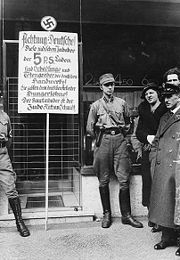
Purge
In history, religion, and political science, a purge is the removal of people who are considered undesirable by those in power from a government, from another organization, or from society as a whole. Purges can be peaceful or violent; many will end with the imprisonment or exile of those purged,...
that took place in Nazi Germany
Nazi Germany
Nazi Germany , also known as the Third Reich , but officially called German Reich from 1933 to 1943 and Greater German Reich from 26 June 1943 onward, is the name commonly used to refer to the state of Germany from 1933 to 1945, when it was a totalitarian dictatorship ruled by...
between June 30 and July 2, 1934, when the Nazi regime carried out a series of political murders. Leading figures of the "left-wing" Strasserist faction of the Nazi Party, along with its namesake, Gregor Strasser
Gregor Strasser
Gregor Strasser was a politician of the National Socialist German Workers Party...
, were murdered, as were prominent conservative anti-Nazis (such as former Chancellor Kurt von Schleicher
Kurt von Schleicher
Kurt von Schleicher was a German general and the last Chancellor of Germany during the era of the Weimar Republic. Seventeen months after his resignation, he was assassinated by order of his successor, Adolf Hitler, in the Night of the Long Knives....
and Gustav Ritter von Kahr
Gustav Ritter von Kahr
Gustav Ritter von Kahr was a German right-wing conservative politician, active in the state of Bavaria...
, who had suppressed Hitler's Beer Hall Putsch
Beer Hall Putsch
The Beer Hall Putsch was a failed attempt at revolution that occurred between the evening of 8 November and the early afternoon of 9 November 1923, when Nazi Party leader Adolf Hitler, Generalquartiermeister Erich Ludendorff, and other heads of the Kampfbund unsuccessfully tried to seize power...
in 1923). Many of those killed were members of the Sturmabteilung
Sturmabteilung
The Sturmabteilung functioned as a paramilitary organization of the National Socialist German Workers' Party . It played a key role in Adolf Hitler's rise to power in the 1920s and 1930s...
(SA), the paramilitary
Paramilitary
A paramilitary is a force whose function and organization are similar to those of a professional military, but which is not considered part of a state's formal armed forces....
Brownshirts.
Adolf Hitler
Adolf Hitler
Adolf Hitler was an Austrian-born German politician and the leader of the National Socialist German Workers Party , commonly referred to as the Nazi Party). He was Chancellor of Germany from 1933 to 1945, and head of state from 1934 to 1945...
moved against the SA and its leader, Ernst Röhm
Ernst Röhm
Ernst Julius Röhm, was a German officer in the Bavarian Army and later an early Nazi leader. He was a co-founder of the Sturmabteilung , the Nazi Party militia, and later was its commander...
, because he saw the independence of the SA and the penchant of its members for street violence as a direct threat to his newly gained political power. He also wanted to conciliate leaders of the Reichswehr
Reichswehr
The Reichswehr formed the military organisation of Germany from 1919 until 1935, when it was renamed the Wehrmacht ....
, the official German military who feared and despised the SA—in particular Röhm's ambition to absorb the Reichswehr into the SA under his own leadership. Finally, Hitler used the purge to attack or eliminate critics
German Resistance
The German resistance was the opposition by individuals and groups in Germany to Adolf Hitler or the National Socialist regime between 1933 and 1945. Some of these engaged in active plans to remove Adolf Hitler from power and overthrow his regime...
of his new regime, especially those loyal to Vice-Chancellor Franz von Papen
Franz von Papen
Lieutenant-Colonel Franz Joseph Hermann Michael Maria von Papen zu Köningen was a German nobleman, Roman Catholic monarchist politician, General Staff officer, and diplomat, who served as Chancellor of Germany in 1932 and as Vice-Chancellor under Adolf Hitler in 1933–1934...
, as well as to settle scores with old enemies.
At least 85 people
Victims of the Night of the Long Knives
The Night of the Long Knives was a purge in whichthe Nazi regime executed at least 85 people for political reasons. This took place in Germany between June 30 and July 2, 1934...
died during the purge, although the final death toll may have been in the hundreds, and more than a thousand perceived opponents were arrested. Most of the killings were carried out by the (SS) and the Gestapo
Gestapo
The Gestapo was the official secret police of Nazi Germany. Beginning on 20 April 1934, it was under the administration of the SS leader Heinrich Himmler in his position as Chief of German Police...
(Geheime Staatspolizei), the regime's secret police
Secret police
Secret police are a police agency which operates in secrecy and beyond the law to protect the political power of an individual dictator or an authoritarian political regime....
. The purge strengthened and consolidated the support of the Reichswehr for Hitler. It also provided a legal grounding for the Nazi regime, as the German courts and cabinet quickly swept aside centuries of legal prohibition against extra-judicial killing
Extra-judicial killing
An extrajudicial killing is the killing of a person by governmental authorities without the sanction of any judicial proceeding or legal process. Extrajudicial punishments are by their nature unlawful, since they bypass the due process of the legal jurisdiction in which they occur...
s to demonstrate their loyalty to the regime.
Before its execution, its planners sometimes referred to it as "Hummingbird
Hummingbird
Hummingbirds are birds that comprise the family Trochilidae. They are among the smallest of birds, most species measuring in the 7.5–13 cm range. Indeed, the smallest extant bird species is a hummingbird, the 5-cm Bee Hummingbird. They can hover in mid-air by rapidly flapping their wings...
" (German: ), the codeword used to send the execution squads into action on the day of the purge. The codename for the operation appears to have been chosen arbitrarily. The phrase "Night of the Long Knives" in the German language predates the massacre itself and refers generally to acts of vengeance. Germans still use the term "" to describe the murders, the term given to it by the Nazi regime, despite its unproven implication that the murders were necessary to prevent a coup. German authors often use quotation marks or write about the so-called Röhm-Putsch to emphasize this.
Hitler and the (SA)

Paul von Hindenburg
Paul Ludwig Hans Anton von Beneckendorff und von Hindenburg , known universally as Paul von Hindenburg was a Prussian-German field marshal, statesman, and politician, and served as the second President of Germany from 1925 to 1934....
appointed Hitler Chancellor on January 30, 1933. Over the next few months
Hitler's rise to power
Adolf Hitler's rise to power began in Germany in September 1919 when Hitler joined the political party that was known as the Deutsche Arbeiterpartei . This political party was formed and developed during the post-World War I era...
, during the so-called Gleichschaltung
Gleichschaltung
Gleichschaltung , meaning "coordination", "making the same", "bringing into line", is a Nazi term for the process by which the Nazi regime successively established a system of totalitarian control and tight coordination over all aspects of society. The historian Richard J...
, Hitler dispensed with the need for the Reichstag as a legislative body
Legislature
A legislature is a kind of deliberative assembly with the power to pass, amend, and repeal laws. The law created by a legislature is called legislation or statutory law. In addition to enacting laws, legislatures usually have exclusive authority to raise or lower taxes and adopt the budget and...
and eliminated all rival political parties in Germany so that by the middle of 1933, the country had become a one-party state under his direction and control. Hitler did not exercise absolute power, however, despite his swift consolidation of political authority. As chancellor, Hitler did not command the army, which remained under the formal leadership of Hindenburg, a highly respected veteran field marshal, albeit increasingly frail and senile. While many officers were impressed by Hitler's promises of an expanded army, a return to conscription
Conscription
Conscription is the compulsory enlistment of people in some sort of national service, most often military service. Conscription dates back to antiquity and continues in some countries to the present day under various names...
, and a more aggressive foreign policy
Foreign policy
A country's foreign policy, also called the foreign relations policy, consists of self-interest strategies chosen by the state to safeguard its national interests and to achieve its goals within international relations milieu. The approaches are strategically employed to interact with other countries...
, the army continued to guard its traditions of independence during the early years of the Nazi regime.
To a lesser extent, the (SA), a Nazi paramilitary organisation, remained somewhat autonomous within the party itself. The SA evolved out of the remnants of the Freikorps
Freikorps
Freikorps are German volunteer military or paramilitary units. The term was originally applied to voluntary armies formed in German lands from the middle of the 18th century onwards. Between World War I and World War II the term was also used for the paramilitary organizations that arose during...
movement of the post-World War I years. The Freikorps were nationalistic organisations primarily composed of disaffected, disenchanted, and angry German combat veterans founded by the government in January 1919 to deal with the threat of a Communist revolution when it appeared that there were a lack of loyal troops. A very large number of the Freikorps believed that the November Revolution had betrayed them when Germany was alleged to be on the verge of victory in 1918. Hence, the Freikorps were in opposition to the new Weimar Republic
Weimar Republic
The Weimar Republic is the name given by historians to the parliamentary republic established in 1919 in Germany to replace the imperial form of government...
, which was born as a result of the November Revolution, and whose founders were contemptously called "November criminals". Captain Ernst Röhm
Ernst Röhm
Ernst Julius Röhm, was a German officer in the Bavarian Army and later an early Nazi leader. He was a co-founder of the Sturmabteilung , the Nazi Party militia, and later was its commander...
of the Reichswehr served as the liaison with the Bavarian Freikorps. Röhm was given the nickname "The Machine Gun King of Bavaria" in the early 1920s, since he was responsible for storing and issuing illegal machine guns to the Bavarian Freikorps units. Röhm left the Reichswehr in 1923 and later became commander of the SA. During the 1920s and 1930s, the SA functioned as a private militia used by Hitler to intimidate rivals and disrupt the meetings of competing political parties, especially those of the Social Democrats
Social Democratic Party of Germany
The Social Democratic Party of Germany is a social-democratic political party in Germany...
and the Communists
Communist Party of Germany
The Communist Party of Germany was a major political party in Germany between 1918 and 1933, and a minor party in West Germany in the postwar period until it was banned in 1956...
. Also known as the "brownshirts" or "stormtroopers", the SA became notorious for their street battles with the Communists. The violent confrontations between the two contributed to the destabilisation of Germany's inter-war experiment with democracy
Democracy
Democracy is generally defined as a form of government in which all adult citizens have an equal say in the decisions that affect their lives. Ideally, this includes equal participation in the proposal, development and passage of legislation into law...
, the Weimar Republic. In June 1932, one of the worst months of political violence, there were more than 400 street battles, resulting in 82 deaths. This destabilisation had been crucial in Hitler's rise to power, however, not least because it convinced many Germans that once Hitler became chancellor, the endemic street violence would end.
Hitler's appointment as chancellor, followed by the suppression of all political parties except the Nazis, did not end the violence of the stormtroopers. Deprived of Communist party meetings to disrupt, the stormtroopers would sometimes run riot in the streets after a night of drinking. They would attack passers-by, and then attack the police who were called to stop them. Complaints of "overbearing and loutish" behaviour by stormtroopers became common by the middle of 1933. The Foreign Office
Foreign Office (Germany)
The Foreign Office is the foreign ministry of Germany, a federal agency responsible for both the country's foreign politics and its relationship with the European Union. From 1871 to 1919, it was led by a Foreign Secretary, and since 1919, it has been led by the Foreign Minister of Germany...
even complained of instances where brownshirts manhandled foreign diplomats. The stormtroopers' behaviour disturbed the German middle class
Middle class
The middle class is any class of people in the middle of a societal hierarchy. In Weberian socio-economic terms, the middle class is the broad group of people in contemporary society who fall socio-economically between the working class and upper class....
es and other conservative elements in society, such as the army.
Hitler's move would be to strengthen his position with the army by moving against its nemesis, the SA. On July 6, 1933, at a gathering of high-ranking Nazi officials, Hitler declared the success of the National Socialist
Nazism
Nazism, the common short form name of National Socialism was the ideology and practice of the Nazi Party and of Nazi Germany...
, or Nazi, brown revolution. Now that the NSDAP had seized the reins of power in Germany, he said, it was time to consolidate its control. Hitler told the gathered officials, "The stream of revolution has been undammed, but it must be channelled into the secure bed of evolution."
Hitler's speech signalled his intention to rein in the SA, whose ranks had grown rapidly in the early 1930s. This would not prove to be simple, however, as the SA made up a large part of Nazism's most devoted followers. The SA traced its dramatic rise in numbers in part to the onset of the Great Depression
Great Depression in Central Europe
The Great Depression severely affected central Europe. The unemployment rate in Germany, Austria and Poland rose to 20% while output fell by 40%. By November 1932 every European country had increased tariffs or introduced import quotas....
, when many German citizens lost both their jobs and their faith in traditional institutions. While Nazism was not exclusively – or even primarily – a working class
Working class
Working class is a term used in the social sciences and in ordinary conversation to describe those employed in lower tier jobs , often extending to those in unemployment or otherwise possessing below-average incomes...
phenomenon, the SA fulfilled the yearning of many unemployed workers for class solidarity and nationalist fervour. Many stormtroopers believed in the socialist
Socialism
Socialism is an economic system characterized by social ownership of the means of production and cooperative management of the economy; or a political philosophy advocating such a system. "Social ownership" may refer to any one of, or a combination of, the following: cooperative enterprises,...
promise of National Socialism and expected the Nazi regime to take more radical economic action, such as breaking up the vast landed estates of the aristocracy. When the Nazi regime did not take such steps, those who expected an economic as well as a political revolution were disillusioned.
Conflict between the army and the SA
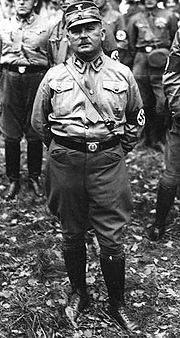
World War I
World War I , which was predominantly called the World War or the Great War from its occurrence until 1939, and the First World War or World War I thereafter, was a major war centred in Europe that began on 28 July 1914 and lasted until 11 November 1918...
, Röhm had recently boasted that he would execute 12 men in retaliation for the killing of any stormtrooper. Röhm saw violence as a means to political ends. He took seriously the socialist promise of National Socialism, and demanded that Hitler and the other party leaders initiate wide-ranging socialist reform in Germany.
Not content solely with the leadership of the SA, Röhm lobbied
Lobbying
Lobbying is the act of attempting to influence decisions made by officials in the government, most often legislators or members of regulatory agencies. Lobbying is done by various people or groups, from private-sector individuals or corporations, fellow legislators or government officials, or...
Hitler to appoint him Minister of Defence
Defence minister
A defence minister is a person in a cabinet position in charge of a Ministry of Defence, which regulates the armed forces in some sovereign nations...
, a position held by the conservative General Werner von Blomberg
Werner von Blomberg
Werner Eduard Fritz von Blomberg was a German Generalfeldmarschall, Minister of War and Commander-in-Chief of the Armed Forces until January 1938.-Early life:...
. Although nicknamed the "Rubber Lion" by some of his critics in the army for his devotion to Hitler, Blomberg was not himself a Nazi, and therefore represented a bridge between the army and the party. Blomberg and many of his fellow officers were recruited from the Prussian nobility
Junker
A Junker was a member of the landed nobility of Prussia and eastern Germany. These families were mostly part of the German Uradel and carried on the colonization and Christianization of the northeastern European territories during the medieval Ostsiedlung. The abbreviation of Junker is Jkr...
, and regarded the SA as a plebeian
Plebs
The plebs was the general body of free land-owning Roman citizens in Ancient Rome. They were distinct from the higher order of the patricians. A member of the plebs was known as a plebeian...
rabble that threatened the army's traditional high status in German society.
If the regular army showed contempt for the masses belonging to the SA, many stormtroopers returned the feeling, seeing the army as insufficiently committed to the National Socialist revolution. Max Heydebreck, a SA leader in Rummelsburg
Rummelsburg
Rummelsburg is a German locality in the borough of Lichtenberg, Berlin.-History:The locality was founded in 1669 and on January 30, 1889 became a rural municipality, with the name of Boxhagen-Rummelsburg...
, denounced the army to his fellow brownshirts, telling them, "Some of the officers of the army are swine. Most officers are too old and have to be replaced by young ones. We want to wait till Papa Hindenburg is dead, and then the SA will march against the army."
Despite such hostility between the brownshirts and the regular army, Blomberg and others in the military saw the SA as a source of raw recruits for an enlarged and revitalised army. Röhm, however, wanted to eliminate the generalship of the Prussian aristocracy altogether, using the SA to become the core of a new German military. Limited by the Treaty of Versailles
Treaty of Versailles
The Treaty of Versailles was one of the peace treaties at the end of World War I. It ended the state of war between Germany and the Allied Powers. It was signed on 28 June 1919, exactly five years after the assassination of Archduke Franz Ferdinand. The other Central Powers on the German side of...
to one hundred thousand soldiers, army leaders watched anxiously as membership in the SA surpassed three million men by the beginning of 1934. In January 1934, Röhm presented Blomberg with a memorandum demanding that the SA replace the regular army as the nation's ground forces, and that the Reichswehr become a training adjunct to the SA.
In response, Hitler met with Blomberg and the leadership of the SA and SS on February 28, 1934. Under pressure from Hitler, Röhm reluctantly signed a pledge stating that he recognised the supremacy of the Reichswehr over the SA. Hitler announced to those present that the SA would act as an auxiliary to the Reichswehr, not the other way around. After Hitler and most of the army officers had left, however, Röhm declared that he would not take instructions from "the ridiculous corporal" – a demeaning reference to Hitler. While Hitler did not take immediate action against Röhm for his intemperate outburst, it nonetheless deepened the rift between them.
Growing pressure against the SA
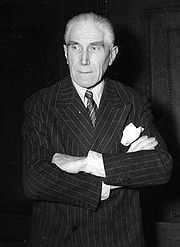
Hermann Göring
Hermann Wilhelm Göring, was a German politician, military leader, and a leading member of the Nazi Party. He was a veteran of World War I as an ace fighter pilot, and a recipient of the coveted Pour le Mérite, also known as "The Blue Max"...
, Propaganda Minister Joseph Goebbels
Joseph Goebbels
Paul Joseph Goebbels was a German politician and Reich Minister of Propaganda in Nazi Germany from 1933 to 1945. As one of Adolf Hitler's closest associates and most devout followers, he was known for his zealous oratory and anti-Semitism...
, SS Chief
Reichsführer-SS
was a special SS rank that existed between the years of 1925 and 1945. Reichsführer-SS was a title from 1925 to 1933 and, after 1934, the highest rank of the German Schutzstaffel .-Definition:...
Heinrich Himmler
Heinrich Himmler
Heinrich Luitpold Himmler was Reichsführer of the SS, a military commander, and a leading member of the Nazi Party. As Chief of the German Police and the Minister of the Interior from 1943, Himmler oversaw all internal and external police and security forces, including the Gestapo...
, and Hitler's deputy Rudolf Hess
Rudolf Hess
Rudolf Walter Richard Hess was a prominent Nazi politician who was Adolf Hitler's deputy in the Nazi Party during the 1930s and early 1940s...
, positioning themselves against Röhm. While all of these men were veterans of the Nazi movement, only Röhm continued to demonstrate his independence from, rather than his loyalty to, Adolf Hitler. Röhm's contempt for the party's bureaucracy angered Hess. SA violence in Prussia gravely concerned Göring, Minister-President of Prussia. Finally, in the spring of 1934, hearing of the growing rift between Röhm and Hitler over the role of the SA in the Nazi state led the former Chancellor, General Kurt von Schleicher
Kurt von Schleicher
Kurt von Schleicher was a German general and the last Chancellor of Germany during the era of the Weimar Republic. Seventeen months after his resignation, he was assassinated by order of his successor, Adolf Hitler, in the Night of the Long Knives....
, to start playing politics again. Schleicher criticized the current Hitler cabinet while some of Schleicher's followers such as General Ferdinand von Bredow
Ferdinand von Bredow
Ferdinand von Bredow was a German Generalmajor and former head of the Abwehr in the Reich Defence Ministry and deputy defence minister in Kurt von Schleicher's cabinet .Bredow was, along with Schleicher, among Adolf Hitler's bitterest...
and Werner von Alvensleben
Werner von Alvensleben
Werner von Alvensleben was a German businessman and politician.He was the second son of Werner Graf von Alvensleben-Neugattersleben and Anna von Veltheim...
started passing along lists of a new Hitler Cabinet in which Schleicher would become Vice-Chancellor, Röhm Minister of Defence, Heinrich Brüning
Heinrich Brüning
Heinrich Brüning was Chancellor of Germany from 1930 to 1932, during the Weimar Republic. He was the longest serving Chancellor of the Weimar Republic, and remains a controversial figure in German politics....
Foreign Minister and Gregor Strasser
Gregor Strasser
Gregor Strasser was a politician of the National Socialist German Workers Party...
Minister of National Economy. The British historian Sir John Wheeler-Bennett
John Wheeler-Bennett
Sir John Wheeler Wheeler-Bennett , GCVO, CMG, OBE, FBA, FRSL was a conservative English historian of German and diplomatic history, and the official biographer of King George VI.-Early career:...
, who knew Schleicher and his circle well, wrote that Bredow displayed a "lack of discretion" that was "terrifying" as he went about showing the list of the proposed cabinet to anyone who was interested. Although Schleicher was in fact unimportant by 1934, increasingly wild rumours that he was scheming with Röhm to reenter the corridors of power helped stoke the sense of crisis.
As a means of isolating Röhm, on April 20, 1934 Göring transferred control of the Prussian political police (Gestapo) to Himmler, who, Göring believed, could be counted on to move against Röhm. Himmler envied the independence and power of the SA, although by this time he and his deputy Reinhard Heydrich
Reinhard Heydrich
Reinhard Tristan Eugen Heydrich , also known as The Hangman, was a high-ranking German Nazi official.He was SS-Obergruppenführer and General der Polizei, chief of the Reich Main Security Office and Stellvertretender Reichsprotektor of Bohemia and Moravia...
had already begun restructuring the SS from a bodyguard formation for Nazi leaders (and a subset of the SA) into its own independent elite corps, one loyal to both himself and Hitler. The loyalty of the SS men would prove useful to both when Hitler finally chose to move against Röhm and the SA. By May, lists of those to be "liquidated" started to circulate amongst Göring and Himmler's people, who engaged in a trade, adding enemies of one in exchange for sparing friends of the other. At the end of May, two former Chancellors Heinrich Brüning
Heinrich Brüning
Heinrich Brüning was Chancellor of Germany from 1930 to 1932, during the Weimar Republic. He was the longest serving Chancellor of the Weimar Republic, and remains a controversial figure in German politics....
and Kurt von Schleicher
Kurt von Schleicher
Kurt von Schleicher was a German general and the last Chancellor of Germany during the era of the Weimar Republic. Seventeen months after his resignation, he was assassinated by order of his successor, Adolf Hitler, in the Night of the Long Knives....
received warnings from friends in the Reichswehr that their lives were in danger, and they should leave Germany at once. Brüning fled to the Netherlands while Schleicher dismissed the tip-off as a bad practical joke. By the beginning of June, everything was set, and all that was needed was permission from Hitler.
Demands for Hitler to constrain the SA strengthened. Conservatives in the army, industry, and politics placed Hitler under increasing pressure to reduce the influence of the SA and to move against Röhm. While Röhm's homosexuality
Homosexuality
Homosexuality is romantic or sexual attraction or behavior between members of the same sex or gender. As a sexual orientation, homosexuality refers to "an enduring pattern of or disposition to experience sexual, affectional, or romantic attractions" primarily or exclusively to people of the same...
did not endear him to conservatives, they were more concerned about his political ambitions. Hitler for his part remained indecisive and uncertain about just what precisely he wanted to do when he left for Venice to meet Benito Mussolini
Benito Mussolini
Benito Amilcare Andrea Mussolini was an Italian politician who led the National Fascist Party and is credited with being one of the key figures in the creation of Fascism....
on June 15. Before Hitler left, and at the request of Presidential State Secretary Otto Meißner
Otto Meißner
Otto Meißner was head of the Office of the President of Germany during the entire period of the Weimar Republic under Friedrich Ebert and Paul von Hindenburg and, finally, at the beginning of the Nazi era under Adolf Hitler.-Life:The son of a postal official, Meißner studied law in Strasbourg from...
, Foreign Minister Baron Konstantin von Neurath
Konstantin von Neurath
Konstantin Freiherr von Neurath was a German diplomat remembered mostly for having served as Foreign minister of Germany between 1932 and 1938...
ordered the German Ambassador to Italy Ulrich von Hassell
Ulrich von Hassell
Ulrich von Hassell was a German diplomat during World War II. A member of the German Resistance against German dictator Adolf Hitler, Hassell was executed in the aftermath of the failed July 20 plot.- Family :...
- without Hitler's knowledge - to ask Mussolini to tell Hitler that the SA was blackening Germany's good name. Neurath's manoeuvre to put pressure on Hitler paid off, with Mussolini agreeing to the request (Neurath was a former ambassador to Italy, and knew Mussolini well). During the summit in Venice, Mussolini upbraided Hitler for tolerating the violence, hooliganism and homosexuality of the SA, which Mussolini stated were ruining Hitler's good reputation all over the world. Mussolini used the affair occasioned by the murder of Giacomo Matteotti
Giacomo Matteotti
Giacomo Matteotti was an Italian socialist politician. On 30 May 1924, he openly spoke in the Italian Parliament alleging the Fascists committed fraud in the recently held elections, and denounced the violence they used to gain votes...
as an example of the kind of trouble unruly followers could cause a dictator. While Mussolini's criticism did not win Hitler over to acting against the SA, it helped push him in that direction
On June 17, 1934, conservative demands for Hitler to act came to a head when Vice-Chancellor Franz von Papen
Franz von Papen
Lieutenant-Colonel Franz Joseph Hermann Michael Maria von Papen zu Köningen was a German nobleman, Roman Catholic monarchist politician, General Staff officer, and diplomat, who served as Chancellor of Germany in 1932 and as Vice-Chancellor under Adolf Hitler in 1933–1934...
, confidant of the ailing Hindenburg, gave a speech
Marburg speech
The Marburg speech was an address given by German vice chancellor Franz von Papen at the University of Marburg on June 17, 1934. It is said to be the last speech made publicly, and on a high level, in Germany against Nazism....
at Marburg University warning of the threat of a "second revolution". Privately, von Papen, a Catholic
Roman Catholicism in Germany
The German Catholic Church, part of the worldwide Catholic Church, is under the leadership of the Pope, curia in Rome, and the German bishops. The current president of the conference is Robert Zollitsch, the archbishop to Freiburg, the country's second largest diocese with 2.07 million Catholics...
aristocrat
Aristocracy
Aristocracy , is a form of government in which a few elite citizens rule. The term derives from the Greek aristokratia, meaning "rule of the best". In origin in Ancient Greece, it was conceived of as rule by the best qualified citizens, and contrasted with monarchy...
with ties to army and industry, threatened to resign if Hitler did not act. While von Papen's resignation as vice-chancellor would not have threatened Hitler's position, it would have nonetheless been an embarrassing display of independence from a leading conservative.
In response to conservative pressure to constrain Röhm, Hitler left for Neudeck to meet with Hindenburg
Paul von Hindenburg
Paul Ludwig Hans Anton von Beneckendorff und von Hindenburg , known universally as Paul von Hindenburg was a Prussian-German field marshal, statesman, and politician, and served as the second President of Germany from 1925 to 1934....
. Blomberg, who had been meeting with the President, uncharacteristically reproached Hitler for not having moved against Röhm earlier. He then told Hitler that Hindenburg was close to declaring martial law
Martial law
Martial law is the imposition of military rule by military authorities over designated regions on an emergency basis— only temporary—when the civilian government or civilian authorities fail to function effectively , when there are extensive riots and protests, or when the disobedience of the law...
and turning the government over to the Reichswehr if Hitler did not take immediate steps against Röhm and his brownshirts. Hitler had hesitated for months in moving against Röhm, in part due to Röhm's visibility as the leader of a national militia with millions of members. However, the threat of a declaration of martial law from Hindenburg, the only person in Germany with the authority to potentially depose the Nazi regime, put Hitler under pressure to act. He left Neudeck with the intention of both destroying Röhm and settling scores with old enemies. Both Himmler and Göring welcomed Hitler's decision, since both had much to gain by Röhm's downfall – the independence of the SS for Himmler, and the removal of a rival for the future command of the army for Göring.
In preparation for the purge both Himmler and his deputy Reinhard Heydrich
Reinhard Heydrich
Reinhard Tristan Eugen Heydrich , also known as The Hangman, was a high-ranking German Nazi official.He was SS-Obergruppenführer and General der Polizei, chief of the Reich Main Security Office and Stellvertretender Reichsprotektor of Bohemia and Moravia...
, chief of the SS Security Service, assembled a dossier of manufactured evidence to suggest that Röhm had been paid twelve million marks
German mark
The Deutsche Mark |mark]], abbreviated "DM") was the official currency of West Germany and Germany until the adoption of the euro in 2002. It is commonly called the "Deutschmark" in English but not in German. Germans often say "Mark" or "D-Mark"...
(EUR as of ) by France to overthrow Hitler. Leading officers in the SS were shown falsified evidence on June 24 that Röhm planned to use the SA to launch a plot against the government . Göring, Himmler, Heydrich, and Victor Lutze (at Hitler's direction) drew up lists of people in and outside the SA to be killed. One of the men Göring recruited to assist him was Willi Lehmann
Willi Lehmann
Willi Lehmann was a police official and Soviet agent in Nazi Germany.Lehmann was a criminal inspector and SS-Hauptsturmführer , alias Agent A-201/Breitenbach. During World War II Lehmann was one of the most valuable sources for the NKVD in Germany.Lehrmann joined the Berlin police force in 1911...
, a Gestapo official and NKVD
NKVD
The People's Commissariat for Internal Affairs was the public and secret police organization of the Soviet Union that directly executed the rule of power of the Soviets, including political repression, during the era of Joseph Stalin....
spy. On June 25, General Werner von Fritsch
Werner von Fritsch
Werner Thomas Ludwig Freiherr von Fritsch was a prominent Wehrmacht officer, member of the German High Command, and the second German general to be killed during World War II.-Early life:...
placed the Reichswehr on the highest level of alert. On June 27, Hitler moved to secure the army's cooperation. Blomberg and General
General
A general officer is an officer of high military rank, usually in the army, and in some nations, the air force. The term is widely used by many nations of the world, and when a country uses a different term, there is an equivalent title given....
Walther von Reichenau
Walther von Reichenau
Walter von Reichenau was a German Generalfeldmarschall during World War II.-History:Reichenau was born in Karlsruhe to a Prussian general and joined the German Army in 1903. During World War I he served on the Western Front...
, the army's liaison to the party, gave it to him by expelling Röhm from the German Officers' League. On June 29, a signed article in Völkischer Beobachter
Völkischer Beobachter
The Völkischer Beobachter was the newspaper of the National Socialist German Workers' Party from 1920. It first appeared weekly, then daily from February 8, 1923...
by Blomberg appeared in which Blomberg stated with great fervour that the Reichswehr stood behind Hitler. Hitler felt confident enough in his position to attend a wedding reception in Essen
Essen
- Origin of the name :In German-speaking countries, the name of the city Essen often causes confusion as to its origins, because it is commonly known as the German infinitive of the verb for the act of eating, and/or the German noun for food. Although scholars still dispute the interpretation of...
, although he appeared somewhat agitated and preoccupied. From there he called Röhm's adjutant at Bad Wiessee
Bad Wiessee
Bad Wiessee is a spa town on Lake Tegernsee, Bavaria, Germany. The name "Bad" means for "spa" or "baths", while "Wiessee" derives from "West See", meaning "western part of the lake"....
and ordered SA leaders to meet with him on June 30.
Purge
At about 4:30 on the morning of June 30, 1934, Hitler and his entourage flew into MunichMunich
Munich The city's motto is "" . Before 2006, it was "Weltstadt mit Herz" . Its native name, , is derived from the Old High German Munichen, meaning "by the monks' place". The city's name derives from the monks of the Benedictine order who founded the city; hence the monk depicted on the city's coat...
. From the airport they drove to the Bavaria
Bavaria
Bavaria, formally the Free State of Bavaria is a state of Germany, located in the southeast of Germany. With an area of , it is the largest state by area, forming almost 20% of the total land area of Germany...
n Interior Ministry, where they assembled the leaders of an SA rampage that had taken place in city streets the night before. Enraged, Hitler tore the epaulets off the shirt of Schneidhuber, the chief of the Munich police, for failing to keep order in the city on the previous night. He shouted at him that he would be shot. Schneidhuber was executed later that day. As the stormtroopers were hustled off to prison, Hitler assembled a large group of SS and regular police, and departed for the Hanselbauer Hotel in Bad Wiessee
Bad Wiessee
Bad Wiessee is a spa town on Lake Tegernsee, Bavaria, Germany. The name "Bad" means for "spa" or "baths", while "Wiessee" derives from "West See", meaning "western part of the lake"....
, where Ernst Röhm
Ernst Röhm
Ernst Julius Röhm, was a German officer in the Bavarian Army and later an early Nazi leader. He was a co-founder of the Sturmabteilung , the Nazi Party militia, and later was its commander...
and his followers were staying.
At Bad Wiessee, Hitler personally placed Röhm and other high-ranking SA leaders under arrest. According to Erich Kempka
Erich Kempka
SS-Obersturmbannführer Erich Kempka served as Adolf Hitler's chauffeur from 1934 to April, 1945. He was SS member #2,803 and served in the Allgemeine SS.-Early life:...
, one of the men present during the raid, Hitler turned Röhm over to "two detectives holding pistols with the safety catch removed", and the SS found Breslau SA leader Edmund Heines
Edmund Heines
Edmund Heines was a Nazi Party leader and Ernst Röhm's deputy in the SA.-Life:Heines served in World War I as a volunteer, and was discharged in 1918 as a lieutenant. In 1925, he joined the Nazi Party and the SA . In 1929, he was convicted of murder, but soon received an amnesty...
in bed with a (male) unidentified eighteen-year-old SA senior troop leader. Goebbels emphasised the latter in subsequent propaganda justifying the purge as a crackdown on moral turpitude
Moral turpitude
Moral turpitude is a legal concept in the United States that refers to "conduct that is considered contrary to community standards of justice, honesty or good morals." It appears in U.S. immigration law from the nineteenth century...
. Both Heines and his partner were shot on the spot in the hotel grounds on the personal order of Hitler. Meanwhile, the SS arrested a number of SA leaders as they departed their train for a planned meeting with Röhm.
The fact that no plot by Röhm to overthrow the regime ever existed did not prevent Hitler from denouncing the leadership of the SA. Arriving back at party headquarters in Munich, Hitler addressed the assembled crowd. Consumed with rage, Hitler denounced "the worst treachery in world history". Hitler told the crowd that "undisciplined and disobedient characters and asocial or diseased elements" would be annihilated. The crowd, which included party members and many SA members fortunate enough to escape arrest, shouted its approval. Hess, present among the assembled, even volunteered to shoot the "traitors" himself. Joseph Goebbels
Joseph Goebbels
Paul Joseph Goebbels was a German politician and Reich Minister of Propaganda in Nazi Germany from 1933 to 1945. As one of Adolf Hitler's closest associates and most devout followers, he was known for his zealous oratory and anti-Semitism...
, who had been with Hitler at Bad Wiessee, set the final phase of the plan in motion. Upon returning to Berlin, he telephoned Göring with the codeword to let loose the execution squads on the rest of their unsuspecting victims.
Against conservatives and old enemies
The regime did not limit itself to a purge of the SA, however. Having earlier imprisoned or exiled prominent Social Democrats and Communists, Hitler used the occasion to move against conservatives he considered unreliable. This included Vice-Chancellor Papen and those in his immediate circle. In Berlin, on Göring's personal orders, an armed SS unit stormed the Vice-Chancellery. Gestapo officers attached to the SS unit shot Papen's secretary Herbert von BoseHerbert von Bose
Herbert von Bose was head of the press division of the Vice Chancellery in Germany under Vice Chancellor Franz von Papen.- Imperial Germany and Weimar Republic :...
without bothering to arrest him first. The Gestapo
Gestapo
The Gestapo was the official secret police of Nazi Germany. Beginning on 20 April 1934, it was under the administration of the SS leader Heinrich Himmler in his position as Chief of German Police...
arrested and later executed Papen's close associate Edgar Jung, the author of Papen's Marburg speech
Marburg speech
The Marburg speech was an address given by German vice chancellor Franz von Papen at the University of Marburg on June 17, 1934. It is said to be the last speech made publicly, and on a high level, in Germany against Nazism....
; they disposed of his body by dumping it in a ditch. The Gestapo also murdered Erich Klausener
Erich Klausener
Erich Klausener was a German Catholic politician who was murdered in the Night of the Long Knives as the Nazis purged their opponents.- Biography :...
, the leader of Catholic Action, and a close Papen associate. The vice-chancellor himself was unceremoniously arrested at the Vice-Chancellery, despite his insistent protests that he could not be arrested. Although Hitler ordered him released days later, Papen no longer dared to criticise the regime.
Hitler, Göring, and Himmler unleashed the Gestapo against old enemies as well. Both Kurt von Schleicher
Kurt von Schleicher
Kurt von Schleicher was a German general and the last Chancellor of Germany during the era of the Weimar Republic. Seventeen months after his resignation, he was assassinated by order of his successor, Adolf Hitler, in the Night of the Long Knives....
, Hitler's predecessor as chancellor, and his wife were murdered at their home. Others killed included Gregor Strasser
Gregor Strasser
Gregor Strasser was a politician of the National Socialist German Workers Party...
, a former Nazi who had angered Hitler by resigning from the party in 1932, and Gustav Ritter von Kahr
Gustav Ritter von Kahr
Gustav Ritter von Kahr was a German right-wing conservative politician, active in the state of Bavaria...
, the former Bavarian state commissioner who crushed the Beer Hall Putsch in 1923. Kahr's fate was especially gruesome. His body was found in a wood outside Munich; he had been hacked to death, apparently with pickaxes. The murdered included at least one accidental victim: Willi Schmid
Willi Schmid
Wilhelm Eduard Schmid , better known as Willi Schmid, was a German music critic, and an accidental victim of the Night of the Long Knives in a case of mistaken identity....
, the music critic of the , a Munich newspaper. The Gestapo mistook him for Ludwig Schmitt
Ludwig Schmitt
Ludwig Schmitt was a German chess master.Schmitt was born in Augsburg and later lived in Breslau, Prussian Silesia. He won the Silesian Chess Congress in 1927, 1933 and 1934, took 6th in 1930 , and 5th place in 1939 in these events...
, a past supporter of Otto Strasser
Otto Strasser
Otto Johann Maximilian Strasser was a German politician and 'left-wing' member of the National Socialist German Workers Party. Strasser was part of the ‘left-wing’ faction of the party, along with his brother Gregor Strasser, and broke from the party due to disputes with the ‘Hitlerite’ faction...
, the brother of Gregor. Such unrestrained violence added to the fearsome reputation of the Gestapo, the Nazis' secret police
Secret police
Secret police are a police agency which operates in secrecy and beyond the law to protect the political power of an individual dictator or an authoritarian political regime....
.
Röhm's fate
Röhm was held briefly at Stadelheim PrisonStadelheim Prison
Stadelheim Prison, in Munich's Giesing district, is one of the largest prisons in Germany.Founded in 1894 it was the site of many executions, particularly by guillotine during the Nazi period.-Notable inmates:...
in Munich, while Hitler considered his fate. In the end, Hitler decided that Röhm had to die. On July 2, at Hitler's behest, Theodor Eicke
Theodor Eicke
Theodor Eicke was a SS Obergruppenführer , commander of the SS-Division Totenkopf of the Waffen-SS and one of the key figures in the establishment of concentration camps in Nazi Germany. His Nazi Party number was 114,901 and his SS number was 2,921...
, later the commandant of the Dachau concentration camp, and SS Officer Michel Lippert
Michael Lippert
Michel Hans Lippert or Michael Lippert was an SS Standartenführer, Police officer and a German soldier who served in both World War I and World War II. During World War II. Lippert commanded several concentration camps, including Sachsenhausen, before becoming a commander of the SS-Freiwilligen...
visited Röhm. Once inside Röhm's cell, they handed him a loaded Browning pistol, and told him that he had ten minutes to kill himself, or else they would do it for him. Röhm demurred, telling them, "If I am to be killed, let Adolf do it himself." Having heard nothing in the allotted time, they returned to Röhm's cell to find him standing, with his bare chest puffed out in a gesture of defiance. Lippert shot him dead at point-blank range. Years later, in 1957, the German authorities tried Lippert in Munich for Röhm's murder. Until then, Lippert had been one of the few executioners of the purge to have evaded trial.
Aftermath

Concerned with presenting the massacre as legally sanctioned, Hitler had the cabinet approve a measure on July 3 that declared, "The measures taken on June 30, July 1 and 2 to suppress treasonous assaults are legal as acts of self-defence by the State." Reich Justice Minister Franz Gürtner
Franz Gürtner
Franz Gürtner was a German Minister of Justice in Adolf Hitler's cabinet, responsible for coordinating jurisprudence in the Third Reich. Detesting the cruel ways of the Gestapo and SA in dealing with prisoners of war, he protested unsuccessfully to Hitler, nevertheless staying on in the cabinet,...
, a conservative who had been Bavarian Justice Minister in the years of the Weimar Republic, demonstrated his loyalty to the new regime by drafting the statute, which added a legal veneer to the purge. Signed into law by Hitler, Gürtner and Minister of the Interior Wilhelm Frick
Wilhelm Frick
Wilhelm Frick was a prominent German Nazi official serving as Minister of the Interior of the Third Reich. After the end of World War II, he was tried for war crimes at the Nuremberg Trials and executed...
, the "Law Regarding Measures of State Self-Defence" retroactively legalised
Ex post facto law
An ex post facto law or retroactive law is a law that retroactively changes the legal consequences of actions committed or relationships that existed prior to the enactment of the law...
the murders committed during the purge. Germany's legal establishment further capitulated to the regime when the country's leading legal scholar, Carl Schmitt
Carl Schmitt
Carl Schmitt was a German jurist, philosopher, political theorist, and professor of law.Schmitt published several essays, influential in the 20th century and beyond, on the mentalities that surround the effective wielding of political power...
, wrote an article defending Hitler's July 13 speech. It was named "The Führer Upholds the Law".
Reaction
Almost unanimously, the army applauded the Night of the Long Knives, even though the generals Kurt von SchleicherKurt von Schleicher
Kurt von Schleicher was a German general and the last Chancellor of Germany during the era of the Weimar Republic. Seventeen months after his resignation, he was assassinated by order of his successor, Adolf Hitler, in the Night of the Long Knives....
and Ferdinand von Bredow
Ferdinand von Bredow
Ferdinand von Bredow was a German Generalmajor and former head of the Abwehr in the Reich Defence Ministry and deputy defence minister in Kurt von Schleicher's cabinet .Bredow was, along with Schleicher, among Adolf Hitler's bitterest...
were among the victims. The ailing President Hindenburg, Germany's highly-revered military hero, sent a telegram expressing his "profoundly felt gratitude" and he congratulated Hitler for 'nipping treason in the bud'. General von Reichenau went so far as to publicly give credence to the lie that Schleicher had been plotting to overthrow the government. In his speech to the Reichstag on July 13 justifying his actions, Hitler denounced Schleicher for conspiring with Ernst Röhm
Ernst Röhm
Ernst Julius Röhm, was a German officer in the Bavarian Army and later an early Nazi leader. He was a co-founder of the Sturmabteilung , the Nazi Party militia, and later was its commander...
to overthrow the government, who Hitler alleged were both traitors working in the pay of France. Since Schleicher was a good friend of the French Ambassador André François-Poncet
André François-Poncet
André François-Poncet was a French politician and diplomat whose post as ambassador to Germany allowed him to witness first-hand the rise to power of Adolf Hitler and the Nazi Party, and the Nazi regime's preparations for war.François-Poncet was the son of a counselor of the Court of Appeals in...
, and because of his reputation for intrigue, the claim that Schleicher was working for France had enough certain surface plausibility for most Germans to accept it, though it was not in fact true. The falsity of Hitler's claims could be seen in that François-Poncet was not declared persona non grata
Persona non grata
Persona non grata , literally meaning "an unwelcome person", is a legal term used in diplomacy that indicates a proscription against a person entering the country...
as normally would happened if an Ambassador were caught being involved in a coup plot against his host government. The army's support for the purge, however, would have far-reaching consequences for the institution. The humbling of the SA ended the threat it had posed to the army but, by standing by Hitler during the purge, the army bound itself more tightly to the Nazi regime. One retired captain, Erwin Planck
Erwin Planck
Erwin Planck was a German politician, and a resistance fighter in the Third Reich.Born in Berlin, Erwin Planck was theoretical physicist Max Planck's and his first wife's fourth child. After his Abitur in 1911, Planck went into the military and pursued a career as an officer...
, seemed to realise this: "if you look on without lifting a finger," he said to his friend, General Werner von Fritsch
Werner von Fritsch
Werner Thomas Ludwig Freiherr von Fritsch was a prominent Wehrmacht officer, member of the German High Command, and the second German general to be killed during World War II.-Early life:...
, "you will meet the same fate sooner or later." Another rare exception was Field Marshal August von Mackensen
August von Mackensen
Anton Ludwig August von Mackensen , born August Mackensen, was a German soldier and field marshal. He commanded with success during the First World War and became one of the German Empire's most prominent military leaders. After the Armistice, Mackensen was interned for a year...
, who spoke about the murders of Schleicher and Bredow at the annual General Staff Society meeting in February 1935 after they had been rehabilitated by Hitler in early January 1935.
However, rumours about the Night of the Long Knives rapidly spread. Many Germans approached the official news of the events as described by Joseph Goebbels with a great deal of scepticism. At the same time, however, many others seemed prepared to take the regime at its word, and to believe that Hitler had saved Germany from a descent into chaos. Luise Solmitz, a Hamburg
Hamburg
-History:The first historic name for the city was, according to Claudius Ptolemy's reports, Treva.But the city takes its modern name, Hamburg, from the first permanent building on the site, a castle whose construction was ordered by the Emperor Charlemagne in AD 808...
schoolteacher, echoed the sentiments of many Germans when she cited Hitler's "personal courage, decisiveness and effectiveness" in her private diary. She even compared him to Frederick the Great, the 18th-century King of Prussia
Prussia
Prussia was a German kingdom and historic state originating out of the Duchy of Prussia and the Margraviate of Brandenburg. For centuries, the House of Hohenzollern ruled Prussia, successfully expanding its size by way of an unusually well-organized and effective army. Prussia shaped the history...
. Others were appalled at the scale of the executions and at the relative complacency of many of their fellow Germans
Germans
The Germans are a Germanic ethnic group native to Central Europe. The English term Germans has referred to the German-speaking population of the Holy Roman Empire since the Late Middle Ages....
. "A very calm and easy going mailman," the diarist Victor Klemperer
Victor Klemperer
Victor Klemperer was a businessman, journalist and eventually a Professor of Literature, specialising in the French Enlightenment at the Technische Universität Dresden. His diaries detailing his life under successive German states—the German Empire, the Weimar Republic, Nazi Germany and the German...
wrote, "who is not at all National Socialist, said, 'Well, he simply sentenced them.'" It did not escape Klemperer's notice that many of the victims had played a role in bringing Hitler to power. "A chancellor", he wrote, "sentences and shoots members of his own private army!" The extent of the massacre and the relative ubiquity of the Gestapo, however, meant that those who disapproved of the purge generally kept quiet about it. Among the few exceptions were General Kurt von Hammerstein-Equord
Kurt von Hammerstein-Equord
Kurt Gebhard Adolf Philipp Freiherr von Hammerstein-Equord was a German general who served for a period as Commander-in-Chief of the Reichswehr...
and Field Marshal August von Mackensen
August von Mackensen
Anton Ludwig August von Mackensen , born August Mackensen, was a German soldier and field marshal. He commanded with success during the First World War and became one of the German Empire's most prominent military leaders. After the Armistice, Mackensen was interned for a year...
, who started a campaign to have Schleicher rehabilitated by Hitler. Hammerstein, who was a close friend of Schleicher, had been much offended at Schleicher's funeral when the SS refused to allow him to attend the service and confiscated the wreaths that the mourners had brought. Besides working for the rehabilitation of Schleicher and Bredow, Hammerstein and Mackensen sent a memo to Hindenburg on July 18 sending out in considerable detail the circumstances of the murders of the two generals and noted that Papen had barely escaped. The memo went on to demand that Hindenburg punish those responsible, and criticized Blomberg for his outspoken support of the murders of Schleicher and Bredow. Finally, Hammerstein and Mackensen asked that Hindenburg reorganize the government by firing Baron Konstantin von Neurath
Konstantin von Neurath
Konstantin Freiherr von Neurath was a German diplomat remembered mostly for having served as Foreign minister of Germany between 1932 and 1938...
, Robert Ley
Robert Ley
Robert Ley was a Nazi politician and head of the German Labour Front from 1933 to 1945. He committed suicide while awaiting trial for war crimes.- Early life :...
, Hermann Göring
Hermann Göring
Hermann Wilhelm Göring, was a German politician, military leader, and a leading member of the Nazi Party. He was a veteran of World War I as an ace fighter pilot, and a recipient of the coveted Pour le Mérite, also known as "The Blue Max"...
, Werner von Blomberg
Werner von Blomberg
Werner Eduard Fritz von Blomberg was a German Generalfeldmarschall, Minister of War and Commander-in-Chief of the Armed Forces until January 1938.-Early life:...
, Joseph Goebbels
Joseph Goebbels
Paul Joseph Goebbels was a German politician and Reich Minister of Propaganda in Nazi Germany from 1933 to 1945. As one of Adolf Hitler's closest associates and most devout followers, he was known for his zealous oratory and anti-Semitism...
and Richard Walther Darré from the Cabinet. Instead, the memo asked that Hindenburg create a directorate to rule Germany comprising Hitler as Chancellor, General Werner von Fritsch
Werner von Fritsch
Werner Thomas Ludwig Freiherr von Fritsch was a prominent Wehrmacht officer, member of the German High Command, and the second German general to be killed during World War II.-Early life:...
as Vice-Chancellor, Hammerstein as Minister of Defense and Rudolf Nadolny as Foreign Minister. The request that Neurath be replaced by Nadolny, the former Ambassador to Moscow who had resigned earlier that year in protest against Hitler's anti-Soviet foreign policy, indicated that Hammerstein and Mackensen wanted a return to the "distant friendliness" towards the Soviet Union that existed until 1933. Mackensen and Hammerstein ended their memo with:
"Excellency, the gravity of the moment has compelled us to appeal to you as our Supreme Commander. The destiny of our country is at stake. Your Excellency has thrice before saved Germany from foundering, at Tannenberg, at the end of the War and at the moment of your election as Reich President. Excellency, save Germany for the fourth time! The undersigned Generals and senior officers swear to preserve to the last breath their loyalty to you and the Fatherland".Hindenburg never responded to the memo, though it remains unclear whether he even saw it as Otto Meißner
Otto Meißner
Otto Meißner was head of the Office of the President of Germany during the entire period of the Weimar Republic under Friedrich Ebert and Paul von Hindenburg and, finally, at the beginning of the Nazi era under Adolf Hitler.-Life:The son of a postal official, Meißner studied law in Strasbourg from...
, who decided that his future was aligned with the Nazis, may not have passed it along. It is noteworthy that even those officers who were most offended by the killings like Hammerstein and Mackensen did not blame Hitler for the purge, whom they wanted to see continue as Chancellor, and at most wanted a reorganization of the Cabinet to remove some of Hitler's more radical followers.
In late 1934-early 1935, Werner von Fritsch
Werner von Fritsch
Werner Thomas Ludwig Freiherr von Fritsch was a prominent Wehrmacht officer, member of the German High Command, and the second German general to be killed during World War II.-Early life:...
and Werner von Blomberg
Werner von Blomberg
Werner Eduard Fritz von Blomberg was a German Generalfeldmarschall, Minister of War and Commander-in-Chief of the Armed Forces until January 1938.-Early life:...
, who had been shamed into joining Hammerstein's and Mackensen's rehabilitation campaign, successfully pressured Hitler into rehabilitating Generals von Schleicher and von Bredow. Fritsch and Blomberg suddenly now claimed at the end of 1934 that as Army officers they could not stand the exceedingly violent press attacks on Schleicher and Bredow that had been going on since July, which portrayed them as the vilest traitors in the pay of France working against the Fatherland. In a speech given on January 3, 1935 at the Berlin State Opera, Hitler stated that Schleicher and Bredow had been shot "in error" on the basis of false information, and that the names of Schleicher and Bredow were to be restored to the honour rolls of their regiments at once. Hitler's speech was not reported in the German press, but the Army was appeased by the speech. However, despite the rehabilitation of the two murdered officers, the Nazis continued in private to accuse Schleicher of high treason. During a trip to Warsaw in January 1935, Göring told Jan Szembek
Jan Szembek (diplomat)
Count Jan Szembek was a Polish diplomat, one of the most influential in late years of the Second Polish Republic, close associate of Józef Beck. Szembek was born in a szlachta family on July 11, 1881 in the village of Poręba near Alwernia. He graduated from the Vienna University, then took up the...
that Schleicher had urged Hitler in January 1933 to reach an understanding with France and the Soviet Union, and partition Poland with the latter, and Hitler had Schleicher killed out of disgust with the alleged advice. During a meeting with Polish Ambassador Józef Lipski
Józef Lipski
Józef Lipski . Polish diplomat and Ambassador to Nazi Germany, 1934 to 1939. Lipski played a key role in foreign policy of Second Polish Republic.-Life:Lipski trained as a lawyer, and joined the Polish Ministry of Foreign Affairs in 1925....
on May 22, 1935, Hitler told Lipski that Schleicher was "rightfully murdered, if only because he had sought to maintain the Rapallo Treaty". The statements that Schleicher had been killed because he wanted to partition Poland with the Soviet Union were later published in the Polish White Book of 1939, which was a collection of diplomatic documents detailing German-Polish relations up to the outbreak of the war.
Hitler named Victor Lutze to replace Röhm as head of the SA. Hitler ordered him, as one prominent historian described it, to put an end to "homosexuality, debauchery, drunkenness, and high living" in the SA. Hitler expressly told him to stop SA funds from being spent on limousines and banquets, which he considered evidence of SA extravagance. A weak man, Lutze did little to assert the SA's independence in the coming years, and the SA gradually lost its power in Hitler's Germany. The regime had all of the decorative SA daggers ground to remove the name of Röhm from the blade, which was replaced with the words (Everything for Germany). Membership in the organisation plummeted from 2.9 million in August 1934 to 1.2 million in April 1938.
The Night of the Long Knives represented a triumph for Hitler, and a turning point for the German government. It established Hitler as "the supreme judge of the German people", as he put it in his July 13 speech to the Reichstag. Later, in April 1942, Hitler would formally adopt this title, thus placing himself de jure
De jure
De jure is an expression that means "concerning law", as contrasted with de facto, which means "concerning fact".De jure = 'Legally', De facto = 'In fact'....
as well as de facto
De facto
De facto is a Latin expression that means "concerning fact." In law, it often means "in practice but not necessarily ordained by law" or "in practice or actuality, but not officially established." It is commonly used in contrast to de jure when referring to matters of law, governance, or...
above the reach of the law
Sovereign immunity
Sovereign immunity, or crown immunity, is a legal doctrine by which the sovereign or state cannot commit a legal wrong and is immune from civil suit or criminal prosecution....
. Centuries of jurisprudence proscribing extra-judicial killings were swept aside. Despite some initial efforts by local prosecutors to take legal action against those who carried out the murders, which the regime rapidly quashed, it appeared that no law would constrain Hitler in his use of power. The Night of the Long Knives also sent a clear message to the public that even the most prominent Germans were not immune to arrest or even summary execution should the Nazi regime perceive them as a threat. In this manner, the purge established a pattern of violence that would characterise the Nazi regime: the use of force to establish an empire
Reich
Reich is a German word cognate with the English rich, but also used to designate an empire, realm, or nation. The qualitative connotation from the German is " sovereign state." It is the word traditionally used for a variety of sovereign entities, including Germany in many periods of its history...
.
See also
- Glossary of Nazi Germany
- List of Nazi Party leaders and officials
- White Book of the PurgeWhite Book of the PurgeThe White Book of the Purge was a 1934 book published by German emigrés in Paris about the Nazi purge known as the Night of the Long Knives. It named 116 people who had been killed in the purge, asserting that 401 in total had died....