
|
|
|
|
Elbe
|
| |
|
| |
The River Elbe (; ; Low German: de Ilv) is one of the major rivers of Central Europe. It originates in the Krkonose Mountains of northwestern Czech Republic before traversing much of Germany and flowing into the North Sea. Its total length is .
The Elbe’s major tributaries include the Vltava, Saale, Havel, Mulde, Schwarze Elster, and Ohre rivers.
The Elbe River basin, comprising the Elbe and its tributaries, has a catchment area of , the fourth largest in Europe.

Discussion
Ask a question about 'Elbe'
Start a new discussion about 'Elbe'
Answer questions from other users
|
Recent Posts

Encyclopedia
The River Elbe (; ; Low German: de Ilv) is one of the major rivers of Central Europe. It originates in the Krkonose Mountains of northwestern Czech Republic before traversing much of Germany and flowing into the North Sea. Its total length is .
The Elbe’s major tributaries include the Vltava, Saale, Havel, Mulde, Schwarze Elster, and Ohre rivers.
The Elbe River basin, comprising the Elbe and its tributaries, has a catchment area of , the fourth largest in Europe. The basin spans four countries, with its largest parts in Germany (65.5%) and the Czech Republic (33.7%). Much smaller parts lie in Austria (0.6%) and Poland (0.2%). The basin is inhabited by 24.5 million people.
Course
In the Czech Republic
The Elbe rises at an elevation of about in the Krkonoše (also known as Giant Mountains or in German as Riesengebirge) on the north west borders of the Czech Republic. Of the numerous small streams whose waters compose the infant river, the most important is the Bílé Labe, or White Elbe. After plunging down the of the Labský vodopád, the latter stream unites with the steeply torrential Malé Labe, and thereafter the united stream of the Elbe pursues a southerly course, emerging from the mountain glens at and continuing on to Pardubice, where it turns sharply to the west. At Kolín some further on, it bends gradually towards the north-west.
In the canal of Brunsbüttel, the Elbe River is approximately , in Decín, Czech Republic, the river is . In town of Festung Königstein, Germany, the river depth rising .
At the village of Káraný, a little above Brandýs nad Labem it picks up the Jizera.
At Melník its stream is more than doubled in volume by the Vltava, or Moldau, a river which winds northwards through Bohemia. Although upstream from the confluence Vltava is longer ( against ), has larger discharge and larger drainage basin, due historical reasons (at the confluence the Vltava meets the Elbe at almost a right angle, so it appears as a tributary) river continues as Elbe.
Some distance lower down, at Litomerice, the waters of the Elbe are tinted by the reddish Ohre (Eger). Thus augmented, and swollen into a stream wide, the Elbe carves a path through the basaltic mass of the Ceské Stredohorí, churning its way through a deep, narrow rocky gorge.
In Germany
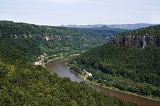
Shortly after crossing the Czech-German frontier, and passing through the sandstone defiles of the Elbe Sandstone Mountains, the stream assumes a north-westerly direction, which on the whole it preserves right to the North Sea.
The river rolls through Dresden and finally, beyond Meißen, enters on its long journey across the North German Plain passing along the former border of East Germany, touching Torgau, Wittenberg, Dessau, Magdeburg, Wittenberge, and Hamburg on the way, and taking on the waters of the Mulde and Saale from the west, and those of the Schwarze Elster, Havel and Elde from the east. Soon the Elbe reaches Hamburg, and then passes through Holstein until it flows into the North Sea at Cuxhaven. Near its mouth it passes Otterndorf, Glückstadt, Brunsbüttel and the entrance to the Kiel Canal.
Navigation
The Elbe has been navigable by commercial vessels since 1842, and provides important trade links as far inland as Prague. The river is linked by canals to the industrial areas of Germany and to Berlin. The Elbe-Lübeck Canal links the Elbe to the Baltic Sea, as does the Kiel Canal, whose western entrance is near the mouth of the Elbe.
Before Germany was reunited, waterway transport in Western Germany was hindered by the fact that inland navigation to Hamburg had to pass through the German Democratic Republic. The Elbe-Seitenkanal (Elbe Lateral Canal) was built between the Mittellandkanal and the lower Elbe to restore this connection. When the two nations were reunited, works began to improve and restore the original links: the Magdeburg Water Bridge now allows large barges to cross the Elbe without having to enter the river. The often low water levels of the Elbe do not hinder navigation to Berlin any longer.
Ferries
The Elbe is crossed by many ferries, both passenger and car carrying. In downstream order, these include:
- Dolní Žleb Ferry, at Dolní Žleb in the Decín District
- Rathen Ferry, at Rathen
- Pillnitz Kleinzschachwitz Ferry, in the eastern suburbs of Dresden
- Tolkewitz Niederpoyritz Ferry, in Dresden
- Johannstadt Neustadt Ferry, in Dresden
- Belgern Ottersitz Ferry, between Belgern and Ottersitz
- Dommitzsch Prettin Ferry, between Dommitzsch and Prettin
- Mauken Pretzsch Ferry, between Mauken and Pretzsch
- Wartenburg Elster Ferry, between Wartenburg and Elster
- Wörlitz Coswig Ferry, between Wörlitz and Coswig
- Steutz Aken Ferry, between Steutz and Aken
- Tochheim Ferry, between Tochheim and Alt Tochheim near Breitenhagen
- Ronney Barby Ferry, between Barby and Walternienburg
- Westerhüsen Ferry, at Westerhüsen near Magdeburg
- Schartau Rogätz Ferry, between Schartau and Rogätz
- Ferchland Grieben Ferry, between Ferchland and Grieben
- Sandau Büttnershof Ferry, between Sandau and Büttnershof
- Räbel Havelberg Ferry, between Räbel and Havelberg
- Lenzen Pevestorf Ferry, between Lenzen and Pevestorf
- Darchau Ferry, between Darchau and Neu Darchau
- Bleckede Ferry, between Bleckede and Neu Bleckede
- Zollenspieker Ferry, between Kirchwerder and Winsen (Luhe) to the east of Hamburg
- Wischhafen Glückstadt Ferry, between Wischhafen and Glückstadt to the west of Hamburg
Many of these ferries are traditional reaction ferries, a type of cable ferry that uses the current flow of the river to provide propulsion.
Etymology First attested in Latin as , the name means "river" or "river-bed" and is nothing more than the High German version of a word () found elsewhere in Germanic; cf. Old Norse river name , Swedish "river", Old English river name , and Middle Low German "river-bed".
History The Elbe was recorded by Ptolemy as (Germanic for "river") in Germania Magna with its source in the mountains ( or Giant Mountains), where the Germanic lived.
The Elbe has long been an important delineator of European geography. The Romans knew the river as the ; however, they only attempted once to move the Eastern border of their empire forward from the Rhine to the Elbe, and this attempt failed in the Battle of the Teutoburg Forest in 9 AD, after which they never seriously tried again. In the Middle Ages it formed the eastern limit of the Empire of Charlemagne. The river's navigable sections were also essential to the success of the Hanseatic League and much trade was carried on its waters.
In 1945, as World War II was drawing to a close, Nazi Germany was caught between the armies of the western Allies advancing from the west and the Soviet Union advancing from the east. On 25 April 1945, these two forces linked up near Torgau, on the Elbe. The event was marked as Elbe Day. After the war, the Elbe formed part of the border between East Germany and West Germany.
Adolf Hitler's and his wife's remains were scattered here around 1945.
See also
External links
|
| |
|
|