


De revolutionibus orbium coelestium

Encyclopedia
De revolutionibus orbium coelestium (On the Revolutions of the Heavenly Spheres) is the seminal work on the heliocentric theory
of the Renaissance
astronomer Nicolaus Copernicus
(1473–1543). The book, first printed in 1543 in Nuremberg
, Holy Roman Empire of the German Nation, offered an alternative model of the universe to Ptolemy
's geocentric system, which had been widely accepted since ancient times.
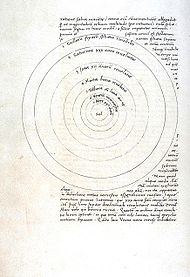 Copernicus initially outlined his system in a short, untitled, anonymous manuscript
that he distributed to several friends, referred to as the Commentariolus
. A physician's library list dating to 1514 includes a manuscript whose description matches the Commentariolus, so Copernicus must have begun work on his new system by that time. Most historians believe that he wrote the Commentariolus after his return from Italy, possibly only after 1510. At this time, Copernicus anticipated that he could reconcile the motion of the Earth with the perceived motions of the planets easily, with fewer motions than were necessary in the Alfonsine Tables
, the version of the Ptolemaic system current at the time.
Observations of Mercury
by Bernhard Walther (1430–1504) of Nuremberg
, a pupil of Regiomontanus
, were made available to Copernicus by Johannes Schöner
, 45 observations in total, 14 of them with longitude
and latitude
. Copernicus used three of them in De revolutionibus, giving only longitudes, and erroneously attributing them to Schöner. Copernicus' values differed slightly from the ones published by Schöner in 1544 in Observationes XXX annorum a I. Regiomontano et B. Walthero Norimbergae habitae, [4°, Norimb. 1544].
Remarkably, a manuscript of De revolutionibus in Copernicus' own hand has survived. After his death, it was given to his pupil, Rheticus
, who for publication had only been given a copy without annotations. Via Heidelberg, it ended up in Prague, where it was rediscovered and studied in the 19th century. Close examination of the manuscript, including the different types of paper used, helped scholars construct an approximate timetable for its composition. Apparently Copernicus began by making a few astronomical observations to provide new data to perfect his models. He may have begun writing the book while still engaged in observations. By the 1530s a substantial part of the book was complete, but Copernicus hesitated to publish.
In 1539 Georg Joachim Rheticus
, a young mathematician from Wittenberg
, arrived in Frauenburg
(Frombork) to study with him. Rheticus read Copernicus' manuscript and immediately wrote a non-technical summary of its main theories in the form of an open letter addressed to Schöner, his astrology teacher in Nürnberg; he published this letter as the Narratio Prima
in Danzig in 1540. Rheticus' friend and mentor Achilles Gasser
published a second edition of the Narratio in Basel in 1541. Due to its friendly reception, Copernicus finally agreed to publication of more of his main work—in 1542, a treatise on trigonometry
, which was taken from the second book of the still unpublished De revolutionibus. Rheticus published it in Copernicus' name.
Under strong pressure from Rheticus, and having seen that the first general reception of his work had not been unfavorable, Copernicus finally agreed to give the book to his close friend, Bishop Tiedemann Giese
, to be delivered to Rheticus in Wittenberg
for printing by Johannes Petreius
at Nürnberg (Nuremberg). It was published just before Coperniucus' death, in 1543.
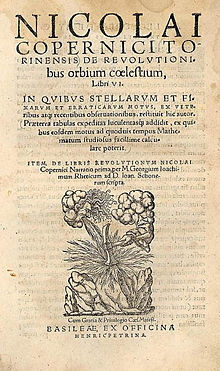 Copernicus' magnum opus
was the fruit of decades of labor. It rewrote Ptolemaic theory for a moving Earth, and incorporated over a thousand years of accounts of astronomical observations of varying accuracy. In its standard English edition, the book contains 330 folio pages, 100 pages of tables, and over 20,000 tabulated numbers.
The book is dedicated to Pope Paul III
in a preface that argues that mathematics, not physics, should be the basis for understanding and accepting his new theory.
De revolutionibus is divided into six "books" (sections or parts):
Copernicus argued that the universe comprised eight spheres. The outermost consisted of motionless, fixed stars, with the Sun motionless at the center. The known planets revolved about the Sun, each in its own sphere, in the order: Mercury, Venus, Earth, Mars, Jupiter, Saturn. The Moon, however, revolved in its sphere around the Earth. What appeared to be the daily revolution of the Sun and fixed stars around the Earth was actually the Earth's daily rotation on its own axis.
For philosophical reasons, Copernicus clung to the belief that all the orbits of celestial bodies must be perfect circles and to a belief in the unobserved crystalline spheres. This forced Copernicus to retain the Ptolemaic system's complex system of epicycles, to account for the observed deviations from circularity and to square his calculations with observations.
Despite Copernicus' adherence to these aspects of ancient astronomy, his radical shift from a geocentric
to a heliocentric cosmology was a serious blow to Aristotle
's science—and helped usher in the Scientific Revolution
.
 Rheticus left Nürnberg to take up his post as professor in Leipzig
. The Lutheran preacher Andreas Osiander
had taken over the task of supervising the printing and publication. In an effort to reduce the controversial impact of the book, Osiander added his own unsigned letter (titled Ad lectorem de hypothesibu huius operis.) printed in front of Copernicus' preface which was a dedicatory letter to Pope Paul III and which kept the title "Praefatio authoris" (to acknowledge that the unsigned letter was not by the book's author).
Osiander's letter stated that Copernius' system was mathematics intended to aid computation and not an attempt to declare literal truth "...it is the duty of an astronomer to compose the history of the celestial motions through careful and expert study. Then he must conceive and devise the causes of these motions or hypotheses about them. Since he cannot in any way attain to the true causes, he will adopt whatever suppositions enable the motions to be computed correctly... The present author has performed both these duties excellently. For these hypotheses need not be true nor even probable. On the contrary, if they provide a calculus consistent with the observations, that alone is enough. ...For this art, it is quite clear, is completely and absolutely ignorant of the causes of the apparent [movement of the heavens]. And if any causes are devised by the imagination, as indeed very many are, they are not put forward to convince anyone that they are true, but merely to provide a reliable basis for computation. However, since different hypotheses are sometimes offered for one and the same...the astronomer will take as his first choice that hypothesis which is the easiest to grasp. The philosopher will perhaps rather seek the semblance of the truth. But neither of them will understand or state anything certain, unless it has been divinely revealed to him. ...Let no one expect anything certain from astronomy, which cannot furnish it, lest he accept as the truth ideas conceived for another purpose, and depart this study a greater fool than when he entered."
As even Osiander's defenders point out, the Ad lectorem "expresses views on the aim and nature of scientific theories at variance with Copernicus' claims for his own theory".
Many view Osiander's letter as a betrayal of science and Copernicus, and an attempt to pass his own thoughts off as those of the book's author. An example of this type of claim can be seen in the Catholic Encyclopedia, which states "Fortunately for him [the dying Copernicus], he could not see what Osiander had done. This reformer, knowing the attitude of Luther and Melanchthon against the heliocentric system...without adding his own name, replaced the preface of Copernicus by another strongly contrasting in spirit with that of Copernicus."
Osiander's interest in astronomy was theological, hoping for "improving the chronology of historical events and thus providing more accurate apocalyptic interpretations of the Bible...[he shared in] the general awareness that the calendar was not in agreement with astronomical movement and therefore, needed to be corrected by devising better models on which to base calculations." In an era before the telescope, Osiander (like most of the era's mathematical astronomers) attempted to bridge the "fundamental incompatibility between Ptolemaic astronomy and Aristotlian physics, and the need to preserve both", by taking an 'instrumentalist' position. Only the handful of "Philosophical purists like the Averroists
...demanded physical consistency and thus sought for realist models."
Copernicus was hampered by his insistence on preserving the idea that celestial bodies had to travel in perfect spheres, he "was still attached to classical ideas of circular motion around deferents and epicycles, and spheres." This was particularly troubling concerning the Earth because he "attached the Earth's axis rigidly to a Sun-centered sphere. The unfortunate consequence was that the terrestrial rotation axis then maintained the same inclination with respect to the Sun as the sphere turned, eliminating the seasons." To explain the seasons he had to propose a third motion, "an annual contrary conical sweep of the terrestrial axis". It was not until the Great Comet of 1577
which moved as if there were no spheres to crash through, did the idea come under question. In 1609 Kepler fixed Copernicus' theory by stating that the planets orbit the sun not in circles, but ellipses. Only after Kepler
's refinement of Copernicus' theory were the need for deferents and epicycles abolished.
Objecting to the Ad lectorem, Tiedemann Giese
urged the Nuremberg city council to issue a correction, but this was not done, and the matter was forgotten. Jan Broscius
, a supporter of Copernicus, also despaired of the Ad lectorem, writing "Ptolemy's hypothesis is the earth rests. Copernicus' hypothesis is that the earth is in motion. Can either, therefore, be true?...Indeed, Osiander deceives much with that preface of his. ...Hence, someone may well ask: How is one to know which hypothesis is truer, the Ptolemaic or the Copernican?"
Petreius had sent a copy to Hieronymus Schreiber
, an astronomer from Nürnberg who had substituted for Rheticus as professor of mathematics in Wittenberg while he was in Nürnberg supervising the printing and who died in 1547 but left in his copy of the book a note about Osiander's authorship. Via Michael Mästlin, this copy came to Johannes Kepler
, who discovered what Osiander had done and methodically demonstrated that Osiander had indeed added the foreword. The most knowledgeable astronomers of the time had realized that the foreword was Osiander's doing.
Owen Gingerich gives a slightly different version: Kepler knew of Osiander's authorship since he had read about it in one of Schreiber's annotations in his copy of De Revolutionibus; Maestlin learned of the fact from Kepler. Indeed, Maestlin perused Kepler's book, up to the point of leaving a few annotations in it. However, Maestlin already suspected Osiander, because he had bought his De Revolutionibus from the widow of Philipp Apian
; examining his books, he had found a note attributing the introduction to Osiander.
Johannes Praetorius
(1537–1616), who learned of Osiander's authorship from Rheticus during a visit to him in Kraków
, wrote Osiander's name in the margin of the foreword in his copy of De revolutionibus.
All three early editions of De revolutionibus included Osiander's foreword.
about its central theses. Martin Luther
is quoted as saying in 1539:
When the book was finally published, demand was low, with an initial print run of 400 failing to sell out. Copernicus had made the book extremely technical, unreadable to all but the most advanced astronomers of the day, allowing it to disseminate into their ranks before stirring great controversy. And, like Osiander, contemporary mathematicians and astronomers encouraged its audience to view it as a useful mathematical fiction with no physical reality, thereby somewhat
shielding it from accusations of blasphemy.
Very soon, nevertheless, Copernicus' theory was attacked with Scripture and with the common Aristotelian proofs. In 1549 Melanchthon
, Luther's principal lieutenant, wrote against Copernicus, pointing to the theory's apparent conflict with Scripture and advocating that "severe measures" be taken to restrain the impiety of Copernicans.
The works of Copernicus and Zúñiga
—the latter for asserting that De revolutionibus was compatible with Catholic faith—were placed on the Index of Forbidden Books
by a decree of the Sacred Congregation of March 5, 1616:
De revolutionibus was not formally banned but merely withdrawn from circulation, pending "corrections" that would clarify the theory's status as hypothesis. Nine sentences that represented the heliocentric system as certain were to be omitted or changed. After these corrections were prepared and formally approved in 1620 the reading of the book was permitted. But the book was never reprinted with the changes and was available in Catholic jurisdictions only to suitably qualified scholars, by special
request. It remained on the Index
until 1758, when Pope Benedict XIV
(1740–58) removed the uncorrected book from his revised Index.
A few years after Copernicus' death, Erasmus Reinhold
developed the Prutenic Tables
("Prussian Tables"; ; ) using Copernicus' methods. The Prutenic Tables, published in 1551, were used as a basis for the calendar reform
instituted in 1582 by Pope Gregory XIII
. They were also used by sailors and maritime explorers, whose 15th-century predecessors had used Regiomontanus
' Table of the Stars.
, an early Christian author (ca. 240 – ca. 320):
A German TV documentary on "The seven greatest lies in history" states that medieval scholars knew full well that the Earth was a sphere. Copernicus is blamed for having omitted to say that Lactantius had been the exception rather than the rule, and thus for having contributed to the flat-Earth myth.
, a widely recognized authority on both Nicolaus Copernicus and Johannes Kepler
, disproved this after a 35-year project to examine every surviving copy of the first two editions. Gingerich showed that nearly all the leading mathematicians and astronomers of the time owned and read the book; however, his analysis of the marginalia
shows that they almost all ignored the cosmology
at the beginning of the book and were only interested in Copernicus' new equant
-free models of planetary motion in the later chapters. Also, Nicolaus Reimers in 1587 translated the book into German.
Gingerich's efforts and conclusions are recounted in The Book Nobody Read, published in 2004 by Walker & Co. The research behind this book earned its author the Polish
government's Order of Merit
in 1981. Due largely to Gingerich's scholarship, De revolutionibus has been researched and catalogued better than any other first-edition historic text except for the original Gutenberg Bible
.
Copernican heliocentrism
Copernican heliocentrism is the name given to the astronomical model developed by Nicolaus Copernicus and published in 1543. It positioned the Sun near the center of the Universe, motionless, with Earth and the other planets rotating around it in circular paths modified by epicycles and at uniform...
of the Renaissance
Renaissance
The Renaissance was a cultural movement that spanned roughly the 14th to the 17th century, beginning in Italy in the Late Middle Ages and later spreading to the rest of Europe. The term is also used more loosely to refer to the historical era, but since the changes of the Renaissance were not...
astronomer Nicolaus Copernicus
Nicolaus Copernicus
Nicolaus Copernicus was a Renaissance astronomer and the first person to formulate a comprehensive heliocentric cosmology which displaced the Earth from the center of the universe....
(1473–1543). The book, first printed in 1543 in Nuremberg
Nuremberg
Nuremberg[p] is a city in the German state of Bavaria, in the administrative region of Middle Franconia. Situated on the Pegnitz river and the Rhine–Main–Danube Canal, it is located about north of Munich and is Franconia's largest city. The population is 505,664...
, Holy Roman Empire of the German Nation, offered an alternative model of the universe to Ptolemy
Ptolemy
Claudius Ptolemy , was a Roman citizen of Egypt who wrote in Greek. He was a mathematician, astronomer, geographer, astrologer, and poet of a single epigram in the Greek Anthology. He lived in Egypt under Roman rule, and is believed to have been born in the town of Ptolemais Hermiou in the...
's geocentric system, which had been widely accepted since ancient times.
History
Manuscript
A manuscript or handwrite is written information that has been manually created by someone or some people, such as a hand-written letter, as opposed to being printed or reproduced some other way...
that he distributed to several friends, referred to as the Commentariolus
Commentariolus
The "Commentariolus" is Nicolaus Copernicus's forty-page outline of an early version of his revolutionary heliocentric theory of the universe...
. A physician's library list dating to 1514 includes a manuscript whose description matches the Commentariolus, so Copernicus must have begun work on his new system by that time. Most historians believe that he wrote the Commentariolus after his return from Italy, possibly only after 1510. At this time, Copernicus anticipated that he could reconcile the motion of the Earth with the perceived motions of the planets easily, with fewer motions than were necessary in the Alfonsine Tables
Alfonsine tables
The Alfonsine tables provided data for computing the position of the Sun, Moon and planets relative to the fixed stars....
, the version of the Ptolemaic system current at the time.
Observations of Mercury
Mercury (planet)
Mercury is the innermost and smallest planet in the Solar System, orbiting the Sun once every 87.969 Earth days. The orbit of Mercury has the highest eccentricity of all the Solar System planets, and it has the smallest axial tilt. It completes three rotations about its axis for every two orbits...
by Bernhard Walther (1430–1504) of Nuremberg
Nuremberg
Nuremberg[p] is a city in the German state of Bavaria, in the administrative region of Middle Franconia. Situated on the Pegnitz river and the Rhine–Main–Danube Canal, it is located about north of Munich and is Franconia's largest city. The population is 505,664...
, a pupil of Regiomontanus
Regiomontanus
Johannes Müller von Königsberg , today best known by his Latin toponym Regiomontanus, was a German mathematician, astronomer, astrologer, translator and instrument maker....
, were made available to Copernicus by Johannes Schöner
Johannes Schöner
Johannes Schöner was a renowned and respected German polymath...
, 45 observations in total, 14 of them with longitude
Longitude
Longitude is a geographic coordinate that specifies the east-west position of a point on the Earth's surface. It is an angular measurement, usually expressed in degrees, minutes and seconds, and denoted by the Greek letter lambda ....
and latitude
Latitude
In geography, the latitude of a location on the Earth is the angular distance of that location south or north of the Equator. The latitude is an angle, and is usually measured in degrees . The equator has a latitude of 0°, the North pole has a latitude of 90° north , and the South pole has a...
. Copernicus used three of them in De revolutionibus, giving only longitudes, and erroneously attributing them to Schöner. Copernicus' values differed slightly from the ones published by Schöner in 1544 in Observationes XXX annorum a I. Regiomontano et B. Walthero Norimbergae habitae, [4°, Norimb. 1544].
Remarkably, a manuscript of De revolutionibus in Copernicus' own hand has survived. After his death, it was given to his pupil, Rheticus
Georg Joachim Rheticus
Georg Joachim von Lauchen, also known as Rheticus , was a mathematician, cartographer, navigational-instrument maker, medical practitioner, and teacher. He is perhaps best known for his trigonometric tables and as Nicolaus Copernicus's sole pupil...
, who for publication had only been given a copy without annotations. Via Heidelberg, it ended up in Prague, where it was rediscovered and studied in the 19th century. Close examination of the manuscript, including the different types of paper used, helped scholars construct an approximate timetable for its composition. Apparently Copernicus began by making a few astronomical observations to provide new data to perfect his models. He may have begun writing the book while still engaged in observations. By the 1530s a substantial part of the book was complete, but Copernicus hesitated to publish.
In 1539 Georg Joachim Rheticus
Georg Joachim Rheticus
Georg Joachim von Lauchen, also known as Rheticus , was a mathematician, cartographer, navigational-instrument maker, medical practitioner, and teacher. He is perhaps best known for his trigonometric tables and as Nicolaus Copernicus's sole pupil...
, a young mathematician from Wittenberg
Wittenberg
Wittenberg, officially Lutherstadt Wittenberg, is a city in Germany in the Bundesland Saxony-Anhalt, on the river Elbe. It has a population of about 50,000....
, arrived in Frauenburg
Frombork
Frombork is a town in northern Poland, on the Vistula Lagoon, in Braniewo County, Warmian-Masurian Voivodeship. It had a population of 2,528 as of 2005....
(Frombork) to study with him. Rheticus read Copernicus' manuscript and immediately wrote a non-technical summary of its main theories in the form of an open letter addressed to Schöner, his astrology teacher in Nürnberg; he published this letter as the Narratio Prima
Narratio Prima
De libris revolutionum Copernici narratio prima, usually referred to as Narratio Prima , is an abstract of Nicolaus Copernicus' heliocentric theory, written by Georg Joachim Rheticus in 1540. It is an introduction to Copernicus's major work, De revolutionibus orbium coelestium, published in 1543,...
in Danzig in 1540. Rheticus' friend and mentor Achilles Gasser
Achilles Gasser
Achilles Pirmin Gasser was a German physician and astrologer. He is now known as a well-connected humanist scholar, and supporter of both Copernicus and Rheticus.-Life:...
published a second edition of the Narratio in Basel in 1541. Due to its friendly reception, Copernicus finally agreed to publication of more of his main work—in 1542, a treatise on trigonometry
Trigonometry
Trigonometry is a branch of mathematics that studies triangles and the relationships between their sides and the angles between these sides. Trigonometry defines the trigonometric functions, which describe those relationships and have applicability to cyclical phenomena, such as waves...
, which was taken from the second book of the still unpublished De revolutionibus. Rheticus published it in Copernicus' name.
Under strong pressure from Rheticus, and having seen that the first general reception of his work had not been unfavorable, Copernicus finally agreed to give the book to his close friend, Bishop Tiedemann Giese
Tiedemann Giese
Tiedemann Giese Tiedemann Giese Tiedemann Giese (1 June 1480 – 23 October 1550, Heilsberg (Lidzbark), was a member of the patrician Giese family of Danzig (Gdańsk). The brother of the Hanseatic League merchant Georg Giese and relative of Albrecht Giese he became Bishop of Culm (Chełmno) first...
, to be delivered to Rheticus in Wittenberg
Wittenberg
Wittenberg, officially Lutherstadt Wittenberg, is a city in Germany in the Bundesland Saxony-Anhalt, on the river Elbe. It has a population of about 50,000....
for printing by Johannes Petreius
Johannes Petreius
Johann Petreius was a German printer in Nuremberg.-Life:...
at Nürnberg (Nuremberg). It was published just before Coperniucus' death, in 1543.
Contents
Masterpiece
Masterpiece in modern usage refers to a creation that has been given much critical praise, especially one that is considered the greatest work of a person's career or to a work of outstanding creativity, skill or workmanship....
was the fruit of decades of labor. It rewrote Ptolemaic theory for a moving Earth, and incorporated over a thousand years of accounts of astronomical observations of varying accuracy. In its standard English edition, the book contains 330 folio pages, 100 pages of tables, and over 20,000 tabulated numbers.
The book is dedicated to Pope Paul III
Pope Paul III
Pope Paul III , born Alessandro Farnese, was Pope of the Roman Catholic Church from 1534 to his death in 1549. He came to the papal throne in an era following the sack of Rome in 1527 and rife with uncertainties in the Catholic Church following the Protestant Reformation...
in a preface that argues that mathematics, not physics, should be the basis for understanding and accepting his new theory.
De revolutionibus is divided into six "books" (sections or parts):
- Book I chapters 1-11 are a general vision of the heliocentric theory, and a summarized exposition of his cosmologyCosmologyCosmology is the discipline that deals with the nature of the Universe as a whole. Cosmologists seek to understand the origin, evolution, structure, and ultimate fate of the Universe at large, as well as the natural laws that keep it in order...
. Chapters 11-14 are a basic introduction to the mathematics of trigonometry. - Book II is mainly theoretical and describes the principles of spherical astronomy and a list of stars, as a basis for the arguments developed in the following books.
- Book III describes the apparent movements of the SunSunThe Sun is the star at the center of the Solar System. It is almost perfectly spherical and consists of hot plasma interwoven with magnetic fields...
and related phenomena. - Book IV is a similar description of the MoonMoonThe Moon is Earth's only known natural satellite,There are a number of near-Earth asteroids including 3753 Cruithne that are co-orbital with Earth: their orbits bring them close to Earth for periods of time but then alter in the long term . These are quasi-satellites and not true moons. For more...
and its orbital movements. - Books V and VI are the concrete exposition of the new system and explain how to calculate the positions of astronomical objectAstronomical objectAstronomical objects or celestial objects are naturally occurring physical entities, associations or structures that current science has demonstrated to exist in the observable universe. The term astronomical object is sometimes used interchangeably with astronomical body...
s based on the heliocentric model.
Copernicus argued that the universe comprised eight spheres. The outermost consisted of motionless, fixed stars, with the Sun motionless at the center. The known planets revolved about the Sun, each in its own sphere, in the order: Mercury, Venus, Earth, Mars, Jupiter, Saturn. The Moon, however, revolved in its sphere around the Earth. What appeared to be the daily revolution of the Sun and fixed stars around the Earth was actually the Earth's daily rotation on its own axis.
For philosophical reasons, Copernicus clung to the belief that all the orbits of celestial bodies must be perfect circles and to a belief in the unobserved crystalline spheres. This forced Copernicus to retain the Ptolemaic system's complex system of epicycles, to account for the observed deviations from circularity and to square his calculations with observations.
Despite Copernicus' adherence to these aspects of ancient astronomy, his radical shift from a geocentric
Geocentric model
In astronomy, the geocentric model , is the superseded theory that the Earth is the center of the universe, and that all other objects orbit around it. This geocentric model served as the predominant cosmological system in many ancient civilizations such as ancient Greece...
to a heliocentric cosmology was a serious blow to Aristotle
Aristotle
Aristotle was a Greek philosopher and polymath, a student of Plato and teacher of Alexander the Great. His writings cover many subjects, including physics, metaphysics, poetry, theater, music, logic, rhetoric, linguistics, politics, government, ethics, biology, and zoology...
's science—and helped usher in the Scientific Revolution
Scientific revolution
The Scientific Revolution is an era associated primarily with the 16th and 17th centuries during which new ideas and knowledge in physics, astronomy, biology, medicine and chemistry transformed medieval and ancient views of nature and laid the foundations for modern science...
.
Ad lectorem
Leipzig
Leipzig Leipzig has always been a trade city, situated during the time of the Holy Roman Empire at the intersection of the Via Regia and Via Imperii, two important trade routes. At one time, Leipzig was one of the major European centres of learning and culture in fields such as music and publishing...
. The Lutheran preacher Andreas Osiander
Andreas Osiander
Andreas Osiander was a German Lutheran theologian.- Career :Born at Gunzenhausen in Franconia, Osiander studied at the University of Ingolstadt before being ordained as a priest in 1520. In the same year he began work at an Augustinian convent in Nuremberg as a Hebrew tutor. In 1522, he was...
had taken over the task of supervising the printing and publication. In an effort to reduce the controversial impact of the book, Osiander added his own unsigned letter (titled Ad lectorem de hypothesibu huius operis.) printed in front of Copernicus' preface which was a dedicatory letter to Pope Paul III and which kept the title "Praefatio authoris" (to acknowledge that the unsigned letter was not by the book's author).
Osiander's letter stated that Copernius' system was mathematics intended to aid computation and not an attempt to declare literal truth "...it is the duty of an astronomer to compose the history of the celestial motions through careful and expert study. Then he must conceive and devise the causes of these motions or hypotheses about them. Since he cannot in any way attain to the true causes, he will adopt whatever suppositions enable the motions to be computed correctly... The present author has performed both these duties excellently. For these hypotheses need not be true nor even probable. On the contrary, if they provide a calculus consistent with the observations, that alone is enough. ...For this art, it is quite clear, is completely and absolutely ignorant of the causes of the apparent [movement of the heavens]. And if any causes are devised by the imagination, as indeed very many are, they are not put forward to convince anyone that they are true, but merely to provide a reliable basis for computation. However, since different hypotheses are sometimes offered for one and the same...the astronomer will take as his first choice that hypothesis which is the easiest to grasp. The philosopher will perhaps rather seek the semblance of the truth. But neither of them will understand or state anything certain, unless it has been divinely revealed to him. ...Let no one expect anything certain from astronomy, which cannot furnish it, lest he accept as the truth ideas conceived for another purpose, and depart this study a greater fool than when he entered."
As even Osiander's defenders point out, the Ad lectorem "expresses views on the aim and nature of scientific theories at variance with Copernicus' claims for his own theory".
Many view Osiander's letter as a betrayal of science and Copernicus, and an attempt to pass his own thoughts off as those of the book's author. An example of this type of claim can be seen in the Catholic Encyclopedia, which states "Fortunately for him [the dying Copernicus], he could not see what Osiander had done. This reformer, knowing the attitude of Luther and Melanchthon against the heliocentric system...without adding his own name, replaced the preface of Copernicus by another strongly contrasting in spirit with that of Copernicus."
Osiander's interest in astronomy was theological, hoping for "improving the chronology of historical events and thus providing more accurate apocalyptic interpretations of the Bible...[he shared in] the general awareness that the calendar was not in agreement with astronomical movement and therefore, needed to be corrected by devising better models on which to base calculations." In an era before the telescope, Osiander (like most of the era's mathematical astronomers) attempted to bridge the "fundamental incompatibility between Ptolemaic astronomy and Aristotlian physics, and the need to preserve both", by taking an 'instrumentalist' position. Only the handful of "Philosophical purists like the Averroists
Averroism
Averroism is the term applied to either of two philosophical trends among scholastics in the late 13th century: the Arab philosopher Averroës or Ibn Rushd's interpretations of Aristotle and his reconciliation of Aristotelianism with Islamic faith; and the application of these ideas in the Latin...
...demanded physical consistency and thus sought for realist models."
Copernicus was hampered by his insistence on preserving the idea that celestial bodies had to travel in perfect spheres, he "was still attached to classical ideas of circular motion around deferents and epicycles, and spheres." This was particularly troubling concerning the Earth because he "attached the Earth's axis rigidly to a Sun-centered sphere. The unfortunate consequence was that the terrestrial rotation axis then maintained the same inclination with respect to the Sun as the sphere turned, eliminating the seasons." To explain the seasons he had to propose a third motion, "an annual contrary conical sweep of the terrestrial axis". It was not until the Great Comet of 1577
Great Comet of 1577
The Great Comet of 1577 was a comet that passed close to Earth during the year 1577 AD. It was viewed by people all over Europe, including famous Danish astronomer Tycho Brahe. From his observations of the comet, Brahe was able to discover that comets and similar objects travel above the Earth's...
which moved as if there were no spheres to crash through, did the idea come under question. In 1609 Kepler fixed Copernicus' theory by stating that the planets orbit the sun not in circles, but ellipses. Only after Kepler
Johannes Kepler
Johannes Kepler was a German mathematician, astronomer and astrologer. A key figure in the 17th century scientific revolution, he is best known for his eponymous laws of planetary motion, codified by later astronomers, based on his works Astronomia nova, Harmonices Mundi, and Epitome of Copernican...
's refinement of Copernicus' theory were the need for deferents and epicycles abolished.
Objecting to the Ad lectorem, Tiedemann Giese
Tiedemann Giese
Tiedemann Giese Tiedemann Giese Tiedemann Giese (1 June 1480 – 23 October 1550, Heilsberg (Lidzbark), was a member of the patrician Giese family of Danzig (Gdańsk). The brother of the Hanseatic League merchant Georg Giese and relative of Albrecht Giese he became Bishop of Culm (Chełmno) first...
urged the Nuremberg city council to issue a correction, but this was not done, and the matter was forgotten. Jan Broscius
Jan Brozek
Jan Brożek was a Polish polymath: a mathematician, astronomer, physician, poet, writer, musician and rector of the Kraków Academy.-Life:...
, a supporter of Copernicus, also despaired of the Ad lectorem, writing "Ptolemy's hypothesis is the earth rests. Copernicus' hypothesis is that the earth is in motion. Can either, therefore, be true?...Indeed, Osiander deceives much with that preface of his. ...Hence, someone may well ask: How is one to know which hypothesis is truer, the Ptolemaic or the Copernican?"
Petreius had sent a copy to Hieronymus Schreiber
Hieronymus Schreiber
Hieronymus Schreiber was German doctor, mathematician and astronomer from Nuremberg.Schreiber has studied at the University of Wittenberg at Philipp Melanchthon...
, an astronomer from Nürnberg who had substituted for Rheticus as professor of mathematics in Wittenberg while he was in Nürnberg supervising the printing and who died in 1547 but left in his copy of the book a note about Osiander's authorship. Via Michael Mästlin, this copy came to Johannes Kepler
Johannes Kepler
Johannes Kepler was a German mathematician, astronomer and astrologer. A key figure in the 17th century scientific revolution, he is best known for his eponymous laws of planetary motion, codified by later astronomers, based on his works Astronomia nova, Harmonices Mundi, and Epitome of Copernican...
, who discovered what Osiander had done and methodically demonstrated that Osiander had indeed added the foreword. The most knowledgeable astronomers of the time had realized that the foreword was Osiander's doing.
Owen Gingerich gives a slightly different version: Kepler knew of Osiander's authorship since he had read about it in one of Schreiber's annotations in his copy of De Revolutionibus; Maestlin learned of the fact from Kepler. Indeed, Maestlin perused Kepler's book, up to the point of leaving a few annotations in it. However, Maestlin already suspected Osiander, because he had bought his De Revolutionibus from the widow of Philipp Apian
Philipp Apian
Philipp Apian was a German mathematician and medic. The son of Petrus Apianus is also known as the cartographer of Bavaria.- Life :He was born in Ingolstadt as Philipp Bienewitz...
; examining his books, he had found a note attributing the introduction to Osiander.
Johannes Praetorius
Johannes Praetorius
Johann Richter or Johannes Praetorius was a Bohemian German mathematician and astronomer.- Life :...
(1537–1616), who learned of Osiander's authorship from Rheticus during a visit to him in Kraków
Kraków
Kraków also Krakow, or Cracow , is the second largest and one of the oldest cities in Poland. Situated on the Vistula River in the Lesser Poland region, the city dates back to the 7th century. Kraków has traditionally been one of the leading centres of Polish academic, cultural, and artistic life...
, wrote Osiander's name in the margin of the foreword in his copy of De revolutionibus.
All three early editions of De revolutionibus included Osiander's foreword.
Reception
Even before the 1543 publication of De revolutionibus, rumors circulatedabout its central theses. Martin Luther
Martin Luther
Martin Luther was a German priest, professor of theology and iconic figure of the Protestant Reformation. He strongly disputed the claim that freedom from God's punishment for sin could be purchased with money. He confronted indulgence salesman Johann Tetzel with his Ninety-Five Theses in 1517...
is quoted as saying in 1539:
People gave ear to an upstart astrologer who strove to show that the earth revolves, not the heavens or the firmament, the sun and the moon.... This fool wishes to reverse the entire science of astronomy; but sacred Scripture tells us [Joshua 10:13] that Joshua commanded the sun to stand still, and not the earth.
When the book was finally published, demand was low, with an initial print run of 400 failing to sell out. Copernicus had made the book extremely technical, unreadable to all but the most advanced astronomers of the day, allowing it to disseminate into their ranks before stirring great controversy. And, like Osiander, contemporary mathematicians and astronomers encouraged its audience to view it as a useful mathematical fiction with no physical reality, thereby somewhat
shielding it from accusations of blasphemy.
Very soon, nevertheless, Copernicus' theory was attacked with Scripture and with the common Aristotelian proofs. In 1549 Melanchthon
Philipp Melanchthon
Philipp Melanchthon , born Philipp Schwartzerdt, was a German reformer, collaborator with Martin Luther, the first systematic theologian of the Protestant Reformation, intellectual leader of the Lutheran Reformation, and an influential designer of educational systems...
, Luther's principal lieutenant, wrote against Copernicus, pointing to the theory's apparent conflict with Scripture and advocating that "severe measures" be taken to restrain the impiety of Copernicans.
The works of Copernicus and Zúñiga
Diego de Zúñiga
Diego de Zúñiga of Salamanca was an Augustinian Hermit and academic. He is known for publishing an early acceptance of the Copernican theory.-Life:...
—the latter for asserting that De revolutionibus was compatible with Catholic faith—were placed on the Index of Forbidden Books
Index Librorum Prohibitorum
The Index Librorum Prohibitorum was a list of publications prohibited by the Catholic Church. A first version was promulgated by Pope Paul IV in 1559, and a revised and somewhat relaxed form was authorized at the Council of Trent...
by a decree of the Sacred Congregation of March 5, 1616:
This Holy Congregation has also learned about the spreading and acceptance by many of the false Pythagorean doctrine, altogether contrary to the Holy Scripture, that the earth moves and the sun is motionless, which is also taught by Nicholaus Copernicus' De revolutionibus orbium coelestium and by
Diego de Zúñiga's In Job.... Therefore, in order that this opinion may not creep any further to the prejudice of Catholic truth, the Congregation has decided that the books by Nicolaus Copernicus [De revolutionibus] and Diego de Zúñiga [In Job] be suspended until corrected.
De revolutionibus was not formally banned but merely withdrawn from circulation, pending "corrections" that would clarify the theory's status as hypothesis. Nine sentences that represented the heliocentric system as certain were to be omitted or changed. After these corrections were prepared and formally approved in 1620 the reading of the book was permitted. But the book was never reprinted with the changes and was available in Catholic jurisdictions only to suitably qualified scholars, by special
request. It remained on the Index
Index Librorum Prohibitorum
The Index Librorum Prohibitorum was a list of publications prohibited by the Catholic Church. A first version was promulgated by Pope Paul IV in 1559, and a revised and somewhat relaxed form was authorized at the Council of Trent...
until 1758, when Pope Benedict XIV
Pope Benedict XIV
Pope Benedict XIV , born Prospero Lorenzo Lambertini, was Pope from 17 August 1740 to 3 May 1758.-Life:...
(1740–58) removed the uncorrected book from his revised Index.
A few years after Copernicus' death, Erasmus Reinhold
Erasmus Reinhold
Erasmus Reinhold was a German astronomer and mathematician, considered to be the most influential astronomical pedagogue of his generation. He was born and died in Saalfeld, Saxony....
developed the Prutenic Tables
Prutenic Tables
The Prutenic Tables , were an ephemeris by the astronomer Erasmus Reinhold published in 1551. They are sometimes called the Prussian Tables after Albert I, Duke of Prussia, who supported Reinhold and financed the printing...
("Prussian Tables"; ; ) using Copernicus' methods. The Prutenic Tables, published in 1551, were used as a basis for the calendar reform
Gregorian calendar
The Gregorian calendar, also known as the Western calendar, or Christian calendar, is the internationally accepted civil calendar. It was introduced by Pope Gregory XIII, after whom the calendar was named, by a decree signed on 24 February 1582, a papal bull known by its opening words Inter...
instituted in 1582 by Pope Gregory XIII
Pope Gregory XIII
Pope Gregory XIII , born Ugo Boncompagni, was Pope from 1572 to 1585. He is best known for commissioning and being the namesake for the Gregorian calendar, which remains the internationally-accepted civil calendar to this date.-Youth:He was born the son of Cristoforo Boncompagni and wife Angela...
. They were also used by sailors and maritime explorers, whose 15th-century predecessors had used Regiomontanus
Regiomontanus
Johannes Müller von Königsberg , today best known by his Latin toponym Regiomontanus, was a German mathematician, astronomer, astrologer, translator and instrument maker....
' Table of the Stars.
Lactantius
In the preface to De revolutionibus, Nicolaus Copernicus mocked LactantiusLactantius
Lucius Caecilius Firmianus Lactantius was an early Christian author who became an advisor to the first Christian Roman emperor, Constantine I, guiding his religious policy as it developed, and tutor to his son.-Biography:...
, an early Christian author (ca. 240 – ca. 320):
Perhaps there will be babblers who claim to be judges of astronomy although completely ignorant of the subject and, badly distorting some passage of Scripture to their purpose, will dare to find fault with my undertaking and censure it. I disregard them even to the extent of despising their criticism as unfounded. For it is not unknown that Lactantius, otherwise an illustrious writer but hardly an astronomer, speaks quite childishly about the earth's shape, when he mocks those who declared that the earth has the form of a globe. Hence scholars need not be surprised if any such persons will likewise ridicule me. Astronomy is written for astronomers.
A German TV documentary on "The seven greatest lies in history" states that medieval scholars knew full well that the Earth was a sphere. Copernicus is blamed for having omitted to say that Lactantius had been the exception rather than the rule, and thus for having contributed to the flat-Earth myth.
Gingerich
Historians long believed that, at its first publication, De revolutionibus had not been widely read. Owen GingerichOwen Gingerich
Dr. Owen Jay Gingerich is a former Research Professor of Astronomy and of the History of Science at Harvard University, and a senior astronomer emeritus at the Smithsonian Astrophysical Observatory...
, a widely recognized authority on both Nicolaus Copernicus and Johannes Kepler
Johannes Kepler
Johannes Kepler was a German mathematician, astronomer and astrologer. A key figure in the 17th century scientific revolution, he is best known for his eponymous laws of planetary motion, codified by later astronomers, based on his works Astronomia nova, Harmonices Mundi, and Epitome of Copernican...
, disproved this after a 35-year project to examine every surviving copy of the first two editions. Gingerich showed that nearly all the leading mathematicians and astronomers of the time owned and read the book; however, his analysis of the marginalia
Marginalia
Marginalia are scribbles, comments, and illuminations in the margins of a book.- Biblical manuscripts :Biblical manuscripts have liturgical notes at the margin, for liturgical use. Numbers of texts' divisions are given at the margin...
shows that they almost all ignored the cosmology
Cosmology
Cosmology is the discipline that deals with the nature of the Universe as a whole. Cosmologists seek to understand the origin, evolution, structure, and ultimate fate of the Universe at large, as well as the natural laws that keep it in order...
at the beginning of the book and were only interested in Copernicus' new equant
Equant
Equant is a mathematical concept developed by Claudius Ptolemy in the 2nd century AD to account for the observed motion of heavenly bodies....
-free models of planetary motion in the later chapters. Also, Nicolaus Reimers in 1587 translated the book into German.
Gingerich's efforts and conclusions are recounted in The Book Nobody Read, published in 2004 by Walker & Co. The research behind this book earned its author the Polish
Poland
Poland , officially the Republic of Poland , is a country in Central Europe bordered by Germany to the west; the Czech Republic and Slovakia to the south; Ukraine, Belarus and Lithuania to the east; and the Baltic Sea and Kaliningrad Oblast, a Russian exclave, to the north...
government's Order of Merit
Order of Merit of Poland
The Order of Merit of the Republic of Poland is a Polish order awarded to those who have rendered great service to the Polish nation. It is granted to foreigners or Poles resident abroad and as such is a traditional 'diplomatic order'...
in 1981. Due largely to Gingerich's scholarship, De revolutionibus has been researched and catalogued better than any other first-edition historic text except for the original Gutenberg Bible
Gutenberg Bible
The Gutenberg Bible was the first major book printed with a movable type printing press, and marked the start of the "Gutenberg Revolution" and the age of the printed book. Widely praised for its high aesthetic and artistic qualities, the book has an iconic status...
.
Editions
- 1543, Nuremberg, by Johannes PetreiusJohannes PetreiusJohann Petreius was a German printer in Nuremberg.-Life:...
- 1566, BaselBaselBasel or Basle In the national languages of Switzerland the city is also known as Bâle , Basilea and Basilea is Switzerland's third most populous city with about 166,000 inhabitants. Located where the Swiss, French and German borders meet, Basel also has suburbs in France and Germany...
, by Henricus PetrusHenricus PetrusHenricus Petrus or Sebastian Henric Petri are two of the names used for publications from a 16th century printer shop of Basel , also called Officina Henricpetrina.... - 1617, AmsterdamAmsterdamAmsterdam is the largest city and the capital of the Netherlands. The current position of Amsterdam as capital city of the Kingdom of the Netherlands is governed by the constitution of August 24, 1815 and its successors. Amsterdam has a population of 783,364 within city limits, an urban population...
, by Nicolaus MuleriusNicolaus MuleriusNicolaus Mulerius was a professor of medicine and mathematics at the University of Groningen.... - 1854, WarsawWarsawWarsaw is the capital and largest city of Poland. It is located on the Vistula River, roughly from the Baltic Sea and from the Carpathian Mountains. Its population in 2010 was estimated at 1,716,855 residents with a greater metropolitan area of 2,631,902 residents, making Warsaw the 10th most...
, with Polish translation and the authentic preface by Copernicus. - 1873, ThornTorunToruń is an ancient city in northern Poland, on the Vistula River. Its population is more than 205,934 as of June 2009. Toruń is one of the oldest cities in Poland. The medieval old town of Toruń is the birthplace of the astronomer Nicolaus Copernicus....
, German translation sponsored by the local Coppernicus Society, with all Copernicus' textual corrections given as footnotes.
Translations
English translations of De revolutionibus have included:- On the Revolutions of the Heavenly Spheres, translated with an introduction and notes by A.M. Duncan, Newton Abbot, David & Charles, ISBN 0-7153-6927-X; New York, Barnes and Noble, 1976, ISBN 0-06-491279-5.
- On the Revolutions; translation and commentary by Edward RosenEdward RosenEdward Rosen was an American historian, whose main field of study was early modern Science and, in particular, the work of Copernicus, Galileo and Kepler.-Academic Life:...
, Baltimore, Johns Hopkins University Press, 1992, ISBN 0-8018-4515-7. (Foundations of Natural History. Originally published in WarsawWarsawWarsaw is the capital and largest city of Poland. It is located on the Vistula River, roughly from the Baltic Sea and from the Carpathian Mountains. Its population in 2010 was estimated at 1,716,855 residents with a greater metropolitan area of 2,631,902 residents, making Warsaw the 10th most...
, PolandPolandPoland , officially the Republic of Poland , is a country in Central Europe bordered by Germany to the west; the Czech Republic and Slovakia to the south; Ukraine, Belarus and Lithuania to the east; and the Baltic Sea and Kaliningrad Oblast, a Russian exclave, to the north...
, 1978.) - On the Revolutions of the Heavenly Spheres, translated by C.G. Wallis, Annapolis, St John's College Bookstore, 1939. Republished in volume 16 of the Great Books of the Western WorldGreat Books of the Western WorldGreat Books of the Western World is a series of books originally published in the United States in 1952 by Encyclopædia Britannica Inc. to present the western canon in a single package of 54 volumes. The series is now in its second edition and contains 60 volumes.-History:The project got its start...
, Chicago, Encyclopædia Britannica, 1952; in the series of the same name, published by the Franklin Library, Franklin Center, Philadelphia, 1985; in volume 15 of the second edition of the Great Books, Encyclopædia Britannica, 1990; and Amherst, N.Y., Prometheus Books, 1995, Great Minds Series—Science, ISBN 1-57392-035-5.
External links
- De revolutionibus orbium coelestium, from Harvard UniversityHarvard UniversityHarvard University is a private Ivy League university located in Cambridge, Massachusetts, United States, established in 1636 by the Massachusetts legislature. Harvard is the oldest institution of higher learning in the United States and the first corporation chartered in the country...
. - De revolutionibus orbium coelestium, from Jagiellon University, Poland.
- De Revolutionibus Orbium Coelestium, from Rare Book RoomRare Book RoomRare Book Room is an educational website for the repository of digitally scanned rare books made freely available to the public.Starting around 1996 the California based company Octavo began scanning rare and important books from libraries around the world. These scans were done at extremely high...
. - On the Revolutions, from WebExhibits. English translation.
- River Campus Libraries, Book of the Month December 2005: De revolutionibus orbium coelestium