
Encyclopedia
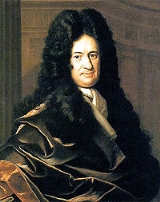
Gottfried Wilhelm Leibniz was a
German polymath who wrote mostly in French and Latin.
Educated in
law and
philosophy, and serving as factotum to two major German noble houses , Leibniz played a major role in the European politics and diplomacy of his day. He occupies an equally large place in both the
history of philosophy and the
history of mathematics. He invented
calculus independently of
Newton, and his notation is the one in general use since. He also invented the
binary system, foundation of virtually all modern computer architectures. In philosophy, he is most remembered for
optimism, i.e., his conclusion that our universe is, in a restricted sense, the best possible one God could have made. He was, along with
René Descartes and
Baruch Spinoza, one of the three great 17th century rationalists, but his philosophy also both looks back to the Scholastic tradition and anticipates modern logic and analysis.
Leibniz also made major contributions to
physics and
technology, and anticipated notions that surfaced much later in
biology,
medicine,
geology, probability theory,
psychology, knowledge engineering, and information science. He also wrote on politics,
law, ethics,
theology, history, and philology, even occasional verse. His contributions to this vast array of subjects are scattered in journals and in tens of thousands of letters and unpublished manuscripts. To date, there is no complete edition of Leibniz's writings, and a complete account of his accomplishments is not yet possible.
Life
The only biography in English is Aiton . A lively short account of Leibniz’s life, one also doing fair justice to the breadth of his interests and activities, is Mates , who cites the German biographies extensively. Also see , the chapter by Ariew in Jolley , and Jolley . For a biographical glossary of Leibniz's intellectual contemporaries, see AG 350.
Coming of age
Leibniz was born on 1 July 1646 , 6:15 p.m. in
Leipzig to Friedrich Leibnütz and Catherina Schmuck. He began spelling his name "Leibniz" early in adult life, but others often referred to him as "Leibnitz", a spelling which persisted until the 20th century. In later life, he often signed himself "von Leibniz", and many posthumous editions of his works gave his name on the title page as "Freiherr [Baron] G. W. von Leibniz." But no document has been found confirming that he was ever granted a patent of nobility . In the 17th and 18th centuries, it was not unusual for the ambitious to insert, starting in midlife, a "de" or "von" before their surnames, to suggest a nobility they in fact did not possess; cases in point include
Voltaire, Beaumarchais, and
Beethoven.
When Leibniz was six years old, his father, a Professor of Moral Philosophy at the University of Leipzig, died, leaving a personal library to which Leibniz was granted free access from age seven onwards. By 12, he had taught himself
Latin, a language he employed freely all his life, and had begun Greek. He entered his father's university at 14, and completed his university studies by age 20, specializing in law and mastering the standard university course of his day and place in classics, logic, and scholastic philosophy. However, his education in mathematics was not up to the French and British standard of the day. In 1666, he published his first book, also his habilitation thesis in philosophy,
On the Art of Combinations. When
Leipzig declined to assure him a position teaching law upon graduation, Leibniz submitted to the University of
Altdorf near
Nuremberg the thesis he had intended to submit at Leipzig, and obtained his doctorate in law in five months. He then declined an offer of academic appointment at Altdorf, and spent the rest of his life in the service of two major German noble families.
Career
The outline of Leibniz's career is as follows:
- 1666-74: Mainly in service to the Elector of Mainz, Johann Philipp von Schönborn, and his minister, Baron von Boineburg.
- 1672-76. Resides in Paris, making two important sojourns to London.
- 1676-1716. In service to the House of Hanover
| align="center" colspan="2" style="background:#dfdfdf;" |
...
.
- 1677-98. Courtier, first to John Frederick, Duke of Brunswick-Lüneburg, then to his brother, Duke, then Elector, Ernst August of Hanover.
- 1687-90. Travels extensively in Germany, Austria, and Italy, researching a book the Elector has commissioned him to write on the history of the House of Brunswick.
- 1698-1716: Courtier to Elector Georg Ludwig of Hanover.
- 1714-16: Georg Ludwig, upon becoming George I of Great Britain, forbids Leibniz to follow him to London. Leibniz ends his days in relative neglect.
Leibniz's first position was as a salaried alchemist in
Nuremberg, even though he knew nothing about the subject. He soon met J. C. von Boineburg, the dismissed chief minister of the Elector of
Mainz, Johann Philipp von Schönborn. Von Boineburg hired Leibniz as an assistant, and shortly thereafter reconciled with the Elector and introduced Leibniz to him. Leibniz then dedicated an essay on law to the Elector in the hope of obtaining employment. The stratagem worked; the Elector asked Leibniz to assist with the redrafting of the legal code for his Electorate. In 1669, Leibniz was appointed Assessor in the Court of Appeal. Although von Boineburg died late in 1672, Leibniz remained under the employment of his widow until she dismissed him in 1674.
Von Boineburg did much to promote Leibniz's reputation, and the latter's memoranda and letters began to attract favorable notice. Leibniz's service to the Elector soon took on a
diplomatic role. He published an essay, under the pseudonym of a fictitious
Polish nobleman, arguing for the German candidate for the Polish crown. The main European geopolitical reality during Leibniz's adult life was the ambition of
Louis XIV of France, backed by French military and economic might. Meanwhile, the
Thirty Years' War had left German-speaking Europe exhausted, fragmented, and economically backward. Leibniz proposed to protect German-speaking Europe by distracting Louis as follows. France would be invited to take
Egypt as a stepping stone towards an eventual conquest of the
Dutch East Indies. In return, France would agree to leave Germany and the Netherlands undisturbed. This plan obtained the Elector's cautious support. In 1672, the French government invited Leibniz to
Paris for discussion, but the plan was soon overtaken by events and became moot. Napoleon's failed invasion of Egypt in 1798 can be seen as an unwitting implementation of Leibniz's plan.
Thus Leibniz began several years in Paris, during which he greatly expanded his knowledge of mathematics and physics, and began contributing to both. He met
Malebranche and
Antoine Arnauld, the leading French philosophers of the day, and studied the writings of
Descartes and
Pascal, unpublished as well as published. He befriended a German mathematician,
Ehrenfried Walther von Tschirnhaus; they corresponded for the rest of their lives. Especially fateful was Leibniz's making the acquaintance of the
Dutch physicist and mathematician
Christiaan Huygens, then active in Paris. Soon after arriving in Paris, Leibniz received a rude awakening; his knowledge of mathematics and physics was spotty. With Huygens as mentor, he began a program of self-study that soon resulted in his making major contributions to both subjects, including inventing his version of the differential and integral
calculus.
When it became clear that France would not implement its part of Leibniz's Egyptian plan, the Elector sent his nephew, escorted by Leibniz, on a related mission to the British government in
London, early in 1673. There Leibniz made the acquaintance of
Henry Oldenburg and John Collins. After demonstrating to the
Royal Society a calculating machine he had been designing and building since 1670, the first such machine that could execute all four basic arithmetical operations, the Society made him an external member. The mission ended abruptly when news reached it of the Elector's death, whereupon Leibniz promptly returned to Paris and not, as had been planned, to Mainz.
The sudden deaths of Leibniz's two patrons in the same winter meant that Leibniz had to find a new basis for his career. In this regard, a 1669 invitation from the Duke of Brunswick to visit Hanover proved fateful. Leibniz declined the invitation, but began corresponding with the Duke in 1671. In 1673, the Duke offered him the post of Counsellor which Leibniz very reluctantly accepted two years later, only after it became clear that no employment in Paris, whose intellectual stimulation he relished, or with the
Hapsburg imperial court was forthcoming.
Leibniz managed to delay his arrival in Hanover until the end of 1676, after making one more short journey to London, where he was shown some of Newton's unpublished work on the calculus. This fact was deemed evidence supporting the accusation, made decades later, that he had stolen the calculus from Newton. On the journey from London to Hanover, Leibniz stopped in
The Hague where he met
Leeuwenhoek, the discoverer of microorganisms. He also spent several days in intense discussion with
Spinoza, who had just completed his masterwork, the
Ethics. Leibniz respected Spinoza's powerful intellect, but was dismayed by his conclusions that contradicted Christian orthodoxy.
In 1677, he was promoted, at his request, to Privy Counselor of Justice, a post he held for the rest of his life. Leibniz served three consecutive rulers of the House of Brunswick as historian, political adviser, and most consequentially, as librarian of the ducal library. He thenceforth employed his pen on all the various political, historical, and
theological matters involving the House of Brunswick; the resulting documents form a valuable part of the historical record for the period.
Among the few people in north Germany to warm to Leibniz were the Electress
Sophia of Hanover , her daughter
Sophia Charlotte of Hanover , the Queen of Prussia and his avowed disciple, and
Caroline of Ansbach, the consort of her grandson, the future
George II. To each of these women he was correspondent, adviser, and friend. In turn, they all warmed to him more than did their spouses and the future king
George I of Great Britain. For a recent study of Leibniz's correspondence with Sophia Charlotte, see .
The population of Hanover was only about 10,000, and its provinciality eventually grated on Leibniz. Nevertheless, to be a major courtier to the House of Brunswick was quite an honor, especially in light of the meteoric rise in the prestige of that House during Leibniz's association with it. In 1692, the Duke of Brunswick became a hereditary Elector of the
Holy Roman Empire. By virtue of being a granddaughter of
James I, the Electress Sophia was in the line of succession to the British throne. Moreover she was neither Catholic nor married to one. Invoking these facts, the British Act of Settlement of 1701 designated her and her descent as the royal family of the United Kingdom, once both King
William III and his sister-in-law and successor,
Queen Anne, were dead. Leibniz played a role in the initiatives and negotiations leading up to that Act, but not always an effective one. For example, something he published anonymously in England, thinking to promote the Brunswick cause, was formally censured by the
British Parliament.
The Brunswicks tolerated the enormous effort Leibniz devoted to intellectual pursuits unrelated to his duties as a courtier, pursuits such as perfecting the calculus, writing about other mathematics, logic, physics, and philosophy, and keeping up a vast correspondence. He began working on the calculus in 1674; the earliest evidence of its use in his surviving notebooks is 1675. By 1677 he had a coherent system in hand, but did not publish it until 1684. Leibniz's most important mathematical papers were published between 1682 and 1692, usually in a journal which he and Otto Mencke founded in 1682, the
Acta Eruditorum. That journal played a key role in advancing his mathematical and scientific reputation, which in turn enhanced his eminence in diplomacy, history, theology, and philosophy.
The Elector Ernst August commissioned Leibniz to write a history of the House of Brunswick, going back to the time of
Charlemagne or earlier, hoping that the resulting book would advance his dynastic ambitions. From 1687 to 1690, Leibniz traveled extensively in Germany, Austria, and Italy, seeking and finding archival materials bearing on this project. Decades went by but no history appeared; the next Elector became quite annoyed at Leibniz's apparent dilatoriness. Leibniz never finished the project, in part because of his huge output on many other fronts, but also because he insisted on writing a meticulously researched and erudite book based on archival sources, when his patrons would have been quite happy with a short popular book, one perhaps little more than a genealogy with commentary, to be completed in three years or less. They never knew that he had in fact carried out a fair part of his assigned task: when the material Leibniz had written and collected for his history of the House of Brunswick was finally published in the 19th century, it filled three volumes.
In 1711, John Keill, writing in the journal of the Royal Society and with Newton's presumed blessing, accused Leibniz of having plagiarized Newton's calculus. Thus began the calculus priority dispute which darkened the remainder of Leibniz's life. A formal investigation by the Royal Society , undertaken in response to Leibniz's demand for a retraction, upheld Keill's charge. Historians of mathematics writing since 1900 or so have tended to acquit Leibniz, pointing to important differences between Leibniz's and Newton's versions of the calculus.
In 1711, while traveling in northern Europe, the Russian
Tsar Peter the Great stopped in Hanover and met Leibniz, who then took some interest in matters Russian over the rest of his life. In 1712, Leibniz began a two year residence in
Vienna, where he was appointed Imperial Court Councillor to the
Hapsburgs. On the death of Queen Anne in 1714, Elector Georg Ludwig became King
George I of Great Britain, under the terms of the 1701 Act of Settlement. Even though Leibniz had done much to bring about this happy event, it was not to be his hour of glory. Despite the intercession of the Princess of Wales,
Caroline of Ansbach, George I forbade Leibniz to join him in London until he completed at least one volume of the history of the Brunswick family his father had commissioned nearly 30 years earlier. Moreover, for George I to include Leibniz in his London court would have been deemed insulting to Newton, who was seen as having won the calculus priority dispute and whose standing in British official circles could not have been higher. Finally, his dear friend and defender, the dowager Electress
Sophia, died in 1714.
Leibniz died in
Hanover in 1716: at the time, he was so out of favor that neither George I nor any fellow courtier other than his personal secretary attended the funeral. Even though Leibniz was a life member of the Royal Society and the Berlin Academy of Sciences, neither organization saw fit to honor his passing. His grave went unmarked for more than 50 years. Thus the indifference of official Germany and England to the passing of the most accomplished European mind since Aristotle. Leibniz was eulogized by Fontenelle, before the Academie des Sciences in Paris, which had admitted him as a foreign member in 1700. The eulogy was composed at the behest of the
Duchess of Orleans, a niece of the Electress Sophia.
Leibniz never married. He complained on occasion about money, but the fair sum he left to his sole heir, his sister's stepson, proved that the Brunswicks had, by and large, paid him well. In his diplomatic endeavors, he at times verged on the unscrupulous, as was all too often the case with professional diplomats of his day. On several occasions, Leibniz backdated and altered personal manuscripts, actions which cannot be excused or defended and which put him in a bad light during the calculus controversy. On the other hand, he was charming and well-mannered, with many friends and admirers all over Europe.
Writings
Leibniz wrote in three languages: scholastic Latin, French, and German. During his lifetime, he published many pamphlets and scholarly articles, but only two "philosophical" books, the
Combinatorial Art and the
Théodicée.
The extant parts of the of Leibniz's writings are organized as follows:
- Series 1. Political, Historical, and General Correspondence. 21 vols., 1666-1701.
- Series 2. Philosophical Correspondence. 1 vol., 1663-85.
- Series 3. Mathematical, Scientific, and Technical Correspondence. 6 vols., 1672-96.
- Series 4. Political Writings. 6 vols., 1667-98.
- Series 5. Historical and Linguistic Writings. Inactive.
- Series 6. Philosophical Writings. 7 vols., 1663-90, and Nouveaux essais sur l'entendement humain.
- Series 7. Mathematical Writings. 3 vols., 1672-76.
- Series 8. Scientific, Medical, and Technical Writings. In preparation.
Some of these volumes, along with work in progress, are available online, for free. Even though work on this edition began in 1901, only 22 volumes had appeared by 1990, in part because the only additions between 1931 and 1962 were four volumes in Series 1.
Four important collections of English translations are W , LL , AG , and WF .
Posthumous reputation
When Leibniz died, his reputation was in decline. He was remembered for only one book, the
Théodicée, whose supposed central argument
Voltaire lampooned in his
Candide. Voltaire's depiction of Leibniz's ideas was so influential that many believed it to be an accurate description . Thus Voltaire and his
Candide bear some of the blame for the lingering failure to appreciate and understand Leibniz's ideas. Leibniz had an ardent disciple, Christian Wolff, whose dogmatic and facile outlook did Leibniz's reputation much harm. In any event, philosophical fashion was moving away from the rationalism and system building of the 17th century, of which Leibniz had been such an ardent exponent. His work on law, diplomacy, and history was seen as of ephemeral interest. The vastness and richness of his correspondence went unsuspected.
Much of Europe came to doubt that Leibniz had invented the calculus independently of Newton, and hence his whole work in mathematics and physics was neglected. Voltaire, an admirer of Newton, also wrote
Candide at least in part to discredit Leibniz's claim to having discovered the calculus and Leibniz's charge that Newton's theory of universal gravitation was incorrect. The rise of relativity and subsequent work in the history of mathematics has put Leibniz's stance in a more favorable light.
Leibniz's long march to his present glory began with the 1765 publication of the
Nouveaux Essais, which
Kant read closely. In 1768, Dutens edited the first multi-volume edition of Leibniz's writings, followed in the 19th century by a number of editions, including those edited by Erdmann, Foucher de Careil, Gerhardt, Gerland, Klopp, and Mollat. Publication of Leibniz's correspondence with notables such as
Antoine Arnauld,
Samuel Clarke,
Sophia of Hanover, and her daughter
Sophia Charlotte of Hanover, began.
In 1900,
Bertrand Russell published a study of Leibniz's metaphysics. Shortly thereafter, Louis Couturat published an important of Leibniz, and edited a volume of Leibniz's heretofore unpublished writings, mainly on logic. While their conclusions, especially Russell's, were subsequently challenged, they made Leibniz somewhat respectable among 20th century analytical and linguistic philosophers. For example, Leibniz's phrase
salva veritate, meaning interchangeability without loss of or compromising the truth, recurs in
Willard Quine's writings. Nevertheless, the secondary literature on Leibniz did not really blossom until after
WWII. This is especially true of English speaking countries; in Gregory Brown's fewer than 30 of the English language entries were published before 1946. American Leibniz studies owe much to Leroy Loemker ; see, e.g., his annotated translations, and his interpretive essays included in LeClerc .
Nicholas Jolley has surmised that Leibniz's reputation as a philosopher is now perhaps higher than at any time since he was alive because:
- Work in the history of 17th and 18th century ideas has revealed more clearly the 17th century "Intellectual Revolution" that preceded the better known Industrial and commercial revolutions of the 18th and 19th centuries.
- The doctrinaire contempt for metaphysics, characteristic of analytic and linguistic philosophy, has faded;
- Analytic and contemporary philosophy continue to invoke his notions of identity, individuation, and possible worlds;
- The 17th and 18th century belief that natural science, especially physics, differs from philosophy mainly in degree and not in kind, is no longer dismissed out of hand. That modern science includes a "scholastic" as well as a "radical empiricist" element is more accepted now than in the early 20th century;
- He is now seen as a major prolongation of the mighty endeavor begun by Plato and Aristotle: the universe and man's place in it are amenable to human reason.
In 1985, the
German government created the , annual awards of 1.55 million Euros for experimental results, and 770,000 Euros for theoretical ones. It is the world's largest prize for scientific achievement.
Philosopher
It is very difficult to grasp Leibniz's philosophical thinking, because his philosophical writings consist mainly of a multitude of short pieces: journal articles, manuscripts published long after his death, and many letters to many correspondents. He only wrote two philosophical treatises, and the only one he published in his lifetime, the
Théodicée of 1710, is as much theological as philosophical. Leibniz dated his beginning as a philosopher to his
Discourse on Metaphysics, which he composed in 1686 as a commentary on a running dispute between
Malebranche and
Antoine Arnauld. This led to an extensive and valuable correspondence with Arnauld ; it and the
Discourse were not published until the 19th century. In 1695, Leibniz made his public entrée into European philosophy with a journal article titled "New System of the Nature and Communication of Substances" . Over 1695-1705, he composed his
New Essays on Human Understanding, a lengthy commentary on
John Locke's 1690
An Essay Concerning Human Understanding, but upon learning of Locke's 1704 death, lost the desire to publish it, so that the
New Essays were not published until 1765. The
Monadologie, composed in 1714 and published posthumously, consists of 90 aphorisms.
Leibniz met
Spinoza in 1676, read some of his unpublished writings, and has since been suspected of appropriating some of Spinoza's ideas. While Leibniz admired Spinoza's powerful intellect, he was also forthrightly dismayed by Spinoza's conclusions , especially when these were inconsistent with Christian orthodoxy.
Unlike Descartes and Spinoza, Leibniz had a thorough university education in philosophy. His lifelong scholastic and
Aristotelian turn of mind betrayed the strong influence of one of his
Leipzig professors, Jakob Thomasius, who also supervised his BA thesis in philosophy. Leibniz also eagerly read
Francisco Suarez, a Spanish
Jesuit respected even in
Lutheran universities. Leibniz was deeply interested in the new methods and conclusions of
Descartes, Huygens, Newton, and Boyle, but viewed their work through a lens heavily tinted by scholastic notions. Yet it remains the case that Leibniz's methods and concerns often anticipate the logic, and analytic and linguistic philosophy of the 20th century.
For a first introduction to Leibniz's philosophy, turn to the Introduction of an anthology of his writings in English translation, e.g., Wiener , Loemker , Woolhouse and Francks . Then turn to the monographs and Jolley . For an introduction to Leibniz's metaphysics, see the chapters by Mercer, Rutherford, and Sleigh in Jolley ; see Mercer for an advanced study. For an introduction to those aspects of Leibniz's thought of most value to the philosophy of logic and of language, see Jolley ; Mates is more advanced. MacRae discusses Leibniz's theory of knowledge. For glossaries of the philosophical terminology recurring in Leibniz's writings and the secondary literature, see Woolhouse and Francks and Jolley .
The Principles
Leibniz variously invoked one or another of seven fundamental philosophical Principles :
- Identity / Contradiction. If a proposition is true, its negation is false and vice versa.
- Identity of indiscernibles. Two things are identical if and only if they share the same properties. Frequently invoked in modern logic and philosophy.
- Sufficient reason. "There must be a sufficient reason [often known only to God] for anything to exist, for any event to occur, for any truth to obtain." .
- Pre-established harmony. See Jolley , Woolhouse and Francks , and Mercer . "[T]he appropriate nature of each substance brings it about that what happens to one corresponds to what happens to all the others, without, however, their acting upon one another directly." A dropped glass shatters because it "knows" it has hit the ground, and not because the impact with the ground "compels" the glass to split.
- Continuity. Natura non saltum facit. A mathematical analog to this principle would go as follows. If a function describes a transformation of something to which continuity applies, its domain and range are both dense sets.
- Optimism. "God assuredly always chooses the best." .
- Plenitude. "Leibniz believed that the best of all possible worlds would actualize every genuine possibility, and argued in Théodicée that this best of all possible worlds will contain all possibilities, with our finite experience of eternity giving no reason to dispute nature's perfection."
The converse of the second principle, known as the Indiscernibility of identicals, together with the Identity of Indiscernibles is often referred to as Leibniz's Law . However, it is the Identity of Indiscernibles that has attracted the most controversy and criticism, especially from corpuscular philosophy and quantum mechanics.
Leibniz would on occasion give a rationale for a specific principle, but more often took them for granted. For a precis of what Leibniz meant by these and other Principles, see Mercer . For a classic discussion of Sufficient Reason and Plenitude, see Lovejoy .
The Monads
Leibniz's best known contribution to
metaphysics is his theory of
monads, as exposited in his
Monadologie. Monads are to the mental realm what
atoms are to the physical. Monads are the ultimate elements of the
universe, and are also entities of perception. The monads are "substantial forms of being" with the following properties: they are eternal, indecomposable, individual, subject to their own laws, un-interacting, and each reflecting the entire universe in a pre-established harmony . Monads are centers of force; substance is force, while space, matter, and motion are merely phenomenal.
The ontological essence of a monad is its irreducible simplicity. Unlike
atoms, monads possess no material or spatial character. They also differ from atoms by their complete mutual independence, so that interactions among monads are only apparent. Instead, by virtue of the principle of pre-established harmony, each monad follows a preprogrammed set of "instructions" peculiar to itself, so that a monad "knows" what to do at each moment. By virtue of these intrinsic instructions, each monad is like a little mirror of the universe. Monads need not be "small"; e.g., each human being constitutes a monad, in which case
free will is problematic.
God, too, is a monad, and God's existence can be inferred from the harmony prevailing among all other monads; God wills the pre-established harmony.
Monads are purported to solve the problematic:
- Interaction between mind and matter arising in the system of Descartes
, also known as
Cartesius, was a noted French philosopher [i], mathematician [i]...
;
- Lack of individuation inherent to the system of Spinoza, which represent individual creatures as merely accidental.
The monadology was thought arbitrary, even eccentric, in Leibniz's day and since. It now seems less so, in the light of key notions in contemporary physics such as field, and the action at a distance and entanglement characterizing
quantum mechanics.
Theodicy and optimism
The
Théodicée tries to justify the apparent imperfections of the world by claiming that it is optimal among all possible worlds. It must be the best possible and most balanced world, because it was created by a perfect God. Rutherford is a detailed scholarly study of Leibniz's theodicy.
The statement that "we live in the best of all possible worlds" drew scorn, most notably from
Voltaire, who lampooned it in his comic novel
Candide by having the character
Dr. Pangloss repeat it like a
mantra. Thus the adjective "panglossian", describing one so naive as to believe that the world about us is the best possible one.
The mathematician Paul du Bois-Reymond, in his "Leibnizian Thoughts in Modern
Science," wrote that Leibniz thought of God as a
mathematician.
"As is well known, the theory of the maxima and minima of functions was indebted to him for the greatest progress through the discovery of the method of tangents. Well, he conceives God in the creation of the world like a mathematician who is solving a minimum problem, or rather, in our modern phraseology, a problem in the calculus of variations - the question being to determine among an infinite number of possible worlds, that for which the sum of necessary evil is a minimum."
A cautious defense of Leibnizian
optimism would invoke certain scientific principles that emerged in the two centuries since his death and that are now thoroughly established: the principle of least action, the conservation of mass, and the
conservation of energy. However, scientific developments in recent decades enable a more sweeping defense of optimism:
- The 3+1 dimensional structure of spacetime may be ideal. In order to sustain complexity such as life, a universe probably requires three spatial and one temporal dimensions. Most universes deviating from 3+1 either violate some fundamental physical laws, or are impossible. The mathematically richest number of spatial dimensions is also 3.
- The universe, solar system, and Earth are the "best possible" in that they enable intelligent life to exist. Such life has evolved on Earth only because the Earth, solar system, and Milky Way possess a number of unusual characteristics; see Ward & Brownlee , Morris .
- The most sweeping form of optimism derives from the Anthropic Principle . Physical reality can be seen as grounded in the numerical values of a handful of dimensionless constants, the best known of which are the fine structure constant and the ratio of the rest mass of the proton to the electron. Were the numerical values of these constants to differ by a few percent from their observed values, it is unlikely that the resulting universe would contain complex structures.
Our physical laws,
universe,
solar system, and
home planet are all "best" in the sense that they enable complex structures such as
galaxies,
stars, and, ultimately, intelligent life.
Symbolic thought
Leibniz had a remarkable faith that a great deal of human reasoning could be reduced to calculations of a sort, and that such calculations could resolve many differences of opinion:
"The only way to rectify our reasonings is to make them as tangible as those of the Mathematicians, so that we can find our error at a glance, and when there are disputes among persons, we can simply say: Let us calculate [calculemus], without further ado, to see who is right."
Leibniz's calculus ratiocinator, which very much brings symbolic logic to mind, can be viewed as a way of making calculations of this sort feasible. Leibniz wrote memoranda that can now be read as groping attempts to get symbolic logic--and thus his
calculus--off the ground. But Gerhard and Couturat did not publish these writings until after modern formal logic had emerged in Frege's
Begriffsschrift and in various writings by
Charles Peirce and his students in the 1880s, and hence well after Boole and De Morgan began that logic in 1847.
Leibniz thought
symbols very important for human understanding. He attached so much importance to the invention of good notations that he attributed to this alone the whole of his discoveries in mathematics. His notation for the
infinitesimal calculus affords a splendid example of his skill in this regard.
Charles Peirce, a 19th century pioneer of semiotics, shared Leibniz's passion for symbols and notation, and his belief that these are essential to a well-running logic and mathematics.
But Leibniz took his speculations much further. Defining a character as any written sign, he then defined a "real" character as one that represents an idea directly and not simply the word embodying the idea. Some real characters, such as the notation of logic, serve only to facilitate reasoning. Many characters well-known in his day, including
Egyptian hieroglyphics,
Chinese characters, and the symbols of
astronomy and
chemistry, he deemed not real, however Loemker, who translated some of Leibniz's works into English said that the symbols of chemistry were real characters so there is disagreement among Leibniz scholars on this point. Instead, he proposed the creation of a
characteristica universalis or "universal characteristic," built on an alphabet of human thought in which each fundamental concept would be represented by a unique "real" character.
"It is obvious that if we could find characters or signs suited for expressing all our thoughts as clearly and as exactly as arithmetic expresses numbers or geometry expresses lines, we could do in all matters insofar as they are subject to reasoning all that we can do in arithmetic and geometry. For all investigations which depend on reasoning would be carried out by transposing these characters and by a species of calculus."
More complex thoughts would be represented by combining in some way the characters for simpler thoughts. Leibniz saw that the uniqueness of prime factorization suggests a central role for prime numbers in the universal characteristic, a striking anticipation of Gödel numbering. Granted, there is no intuitive or
mnemonic way to number any set of elementary concepts using the prime numbers.
Because Leibniz was a mathematical novice at the time he first wrote about the
characteristic, at first he did not conceive it as an
algebra but rather as a universal language or script. Only in 1676 did he conceive of a kind of "algebra of thought," modeled on and including conventional algebra and its notation. The resulting
characteristic was to include a logical calculus, some combinatorics, algebra, his
analysis situs discussed in 3.2, a universal concept language, and more.
What Leibniz actually intended by his characteristica universalis and calculus ratiocinator, and the extent to which modern formal logic does justice to the calculus, may perhaps never be unambiguously established. A good introductory discussion of the "characteristic" is Jolley . An early yet still classic discussion of the "characteristic" and "calculus" is Couturat .
The importance of the
characteristica and
calculus goes beyond their value for understanding Leibniz's legacy, and extends to
mathematics, modernity, the European
Enlightenment, and, more controversially, even to postmodern theory. The
characteristica and
calculus are also possible ways in which Leibniz's thinking can contribute to contemporary thinking in
thermodynamics,
biology