

States of Germany

Encyclopedia
Germany
is made up of sixteen (singular , colloquially (but rarely in a legal context) called , for "federated state") which are partly sovereign constituent states of the Federal Republic of Germany. Land literally translates as "country", and constitutionally speaking, they are constituent countries
. Often referred to in English by German speakers as "states", the term "Land" (with an uppercase 'L') is used in the official English version of the Basic Law
and in UK parliamentary proceedings. However, it is sometimes translated as "federal states" in other publications.
Although the term Land applies to all states, some are also described as "states" in German. Each of the states of Bavaria
, Saxony
, and Thuringia
officially describes itself as a "state" (Staat) and more specifically as a "free state" (Freistaat). Berlin
, Hamburg
and Bremen
are frequently called (city-state
s).
The remaining 13 states are called (literally: area countries).
, new states were constituted in all four zones of occupation. In 1949, the states in the three western zones formed the Federal Republic of Germany. This is in contrast to the post-war development in Austria
, where the Bund (federation) was constituted first, and then the individual states were created as units of a federal state.
The use of the term Länder dates back to the Weimar constitution
of 1919. Before this time, the constituent states of the German Empire were called Staaten. Today, it is very common to use the term Bundesland. However, this term is not used officially, neither by the constitution of 1919 nor by the Basic Law of 1949. Three Länder are called Freistaat (free state, republic), i.e., Bavaria (since 1919), Saxony (since 1990), and Thuringia (since 1994). There is little continuity between the current states and their predecessors of the Weimar Republic
with the exception of the three free states, and the two city-states of Hamburg and Bremen.
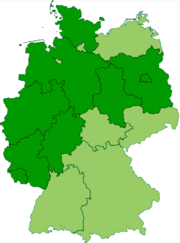 Federalism has a long tradition in German history. The Holy Roman Empire
comprised numerous petty states
. The number of territories was greatly reduced during the Napoleonic Wars
. After the Congress of Vienna
, 39 states formed the German Confederation
. The Confederation was dissolved after the Austro-Prussian War
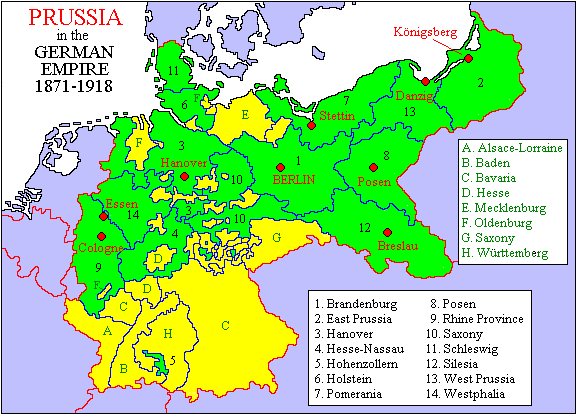
and replaced by a North German Federation under Prussian hegemony; this war left Prussia dominant in Germany, and German nationalism would compel the remaining independent states to ally with Prussia in the Franco-Prussian War
of 1870-1871, and then to accede to the crowning of King Wilhelm of Prussia as German Emperor
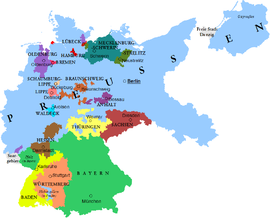
. The new German Empire included 25 states (three of them, Hanseatic
cities) and the imperial territory of Alsace-Lorraine
. The empire was dominated by Prussia, which controlled 65% of the territory and 62% of the population. After the territorial losses of the Treaty of Versailles
, the remaining states
continued as republics. These states were gradually de facto abolished under the Nazi regime via the Gleichschaltung
process, as the states administratively were largely superseded by the Nazi Gau system.
During the Allied occupation of Germany after World War II
, borders were redrawn by the Allied military governments. No single state comprised more than 30% of either population or territory; this was done to prevent any one state from being as dominant within Germany as Prussia had been in the past. Initially, only seven of the pre-War states remained: Baden (in part), Bavaria (reduced in size), Bremen, Hamburg, Hesse (enlarged), Saxony, and Thuringia. The “hyphenated” Länder, such as Rhineland-Palatinate, North Rhine-Westphalia, and Saxony-Anhalt, owed their existence to the occupation powers and were created out of Prussian provinces and smaller states.
Upon founding in 1949, West Germany
had eleven states. These were reduced to nine in 1952 when three south-western states (South Baden
, Württemberg-Hohenzollern
and Württemberg-Baden
) merged to form Baden-Württemberg
. From 1957, when the French-occupied Saarland
was returned ("little reunification"), the Federal Republic consisted of ten states, which are called the Old States
today. West Berlin was under the sovereignty of the Western Allies and neither a Western German state nor part of one. However, it was in many ways integrated with West Germany under a special status.
East Germany (GDR) originally consisted of five states (i.e., Brandenburg, Mecklenburg-Vorpommern, Saxony, Saxony-Anhalt, and Thuringia). In 1952, the Länder were abolished and the GDR was divided into 14 administrative districts
instead. Soviet-controlled East Berlin, despite officially having the same status as West Berlin, was declared the GDR's capital and its 15th district.
Just prior to the German reunification
on 3 October 1990, East German Länder were simply reconstituted in roughly their earlier configuration as five new states
. The former district of East Berlin
joined West Berlin to form the new state of Berlin. Henceforth, the 10 "old states" plus 5 "new states" plus the new state Berlin add up to 16 states of Germany.
Later, the constitution was amended to state that the citizens of the 16 states had successfully achieved the unity of Germany in free self-determination and that the Basic Law thus applied to the entire German people. Article 23, which had allowed “any other parts of Germany” to join, was rephrased. It had been used in 1957 to reintegrate the Saar
as Saarland
into the Federal Republic, and this was used as a model for German reunification in 1990. The amended article now defines the participation of the Federal Council and the 16 German states in matters concerning the European Union.
The Länder can conclude treaties with foreign countries in matters within their own sphere of competence and with the consent of the Federal Government (Article 32 of the Basic Law).
The description free state
(Freistaat) is merely a historic synonym for republic—a description used by most German states after the abolishment of monarchy. Today, Freistaat is associated emotionally with a more independent status, especially in Bavaria. However, it has no legal meaning. All sixteen states are represented at the federal level in the Bundesrat (Federal Council), where their voting power merely depends on the size of their population.
states that the "division of the federal territory into Länder may be revised to ensure that each Land be of a size and capacity to perform its functions effectively". The somewhat complicated provisions regulate that "[r]evisions of the existing division into Länder shall be effected by a federal law, which must be confirmed by referendum".
A new delimitation of the federal territory has been discussed since the Federal Republic was founded in 1949 and even before. Committees and expert commissions advocated a reduction of the number of the Länder; scientists (Rutz, Miegel, Ottnad etc.) and politicians (Döring, Apel
and others) made sometimes very far-reaching proposals for redrawing boundaries but hardly anything came of these public discussions. Territorial reform is sometimes propagated by the richer Länder as a means to avoid or limit fiscal transfers
.
To date the only successful reform was the merger of the states of Baden, Württemberg-Baden and Württemberg-Hohenzollern to the new state of Baden-Württemberg in 1952. The fusion of the two states of Berlin and Brandenburg was rejected in a referendum in May 1996.
that is much older than the Basic Law. The Holy Roman Empire
was a loose confederation
of large and petty principalities under the nominal suzerainty
of the emperor
. Approximately 300 states existed at the eve of the French Revolution
in 1789.
Territorial boundaries were essentially redrawn as a result of military conflicts and interventions from the outside: from the Napoleonic Wars
to the Congress of Vienna
, the number of territories decreased from about 300 to 39; in 1866 Prussia
annexed the sovereign states of Hanover
, Nassau
, Hesse-Kassel
and the Free City of Frankfurt
; the last consolidation came about under Allied occupation after 1945.
The debate on a new delimitation of the German territory started in 1919 as part of discussions about the new constitution. Hugo Preuss
, the father of the Weimar constitution
, drafted a plan to divide the German Reich into 14 roughly equal-sized Länder. His proposal was turned down due to opposition of the states and concerns of the government. Article 18 of the constitution enabled a new delimitation of the German territory but set high hurdles: Three fifth of the votes handed in, and at least the majority of the population are necessary to decide on the alteration of territory. In fact, until 1933 there were only four changes of the German map: The 7 Thuringia
n states united in 1920, whereby Coburg
opted for Bavaria
, Pyrmont joined Prussia in 1922, and Waldeck
did so in 1929. Any later plans to break up the dominating Prussia into smaller states failed because political circumstances were not favorable to state reforms.
After the National Socialists seized power in January, 1933, the Länder increasingly lost importance. They became administrative regions of a centralised country. Three changes are to be noted: on January 1, 1934, Mecklenburg-Schwerin
was united with the neighbouring Mecklenburg-Strelitz
; and, by the Greater Hamburg Act (Groß-Hamburg-Gesetz), from April 1, 1937, the area of the city-state was extended, while Lübeck lost its independence and became part of the Prussian province of Schleswig-Holstein
.
, Hesse
, Württemberg-Baden
, and Bavaria
in the American zone; Hamburg
, Schleswig-Holstein
, Lower Saxony
, and North Rhine-Westphalia
in the British zone; Rhineland-Palatinate
, Baden
, Württemberg-Hohenzollern
and the Saarland
—which later received a special status—in the French zone; Mecklenburg(-Vorpommern), Brandenburg
, Saxony
, Saxony-Anhalt
, and Thuringia
in the Soviet zone.
In 1948, the military governors of the three Western Allies handed over the so-called Frankfurt Documents to the minister-presidents in the Western occupation zones. Among other things they recommended to revise the boundaries of the West German Länder in a way that none should be too big or too small in comparison to the others.
As the premiers did not come to an agreement on this question, the Parliamentary Council
was supposed to address this issue. Its provisions are reflected in Article 29. There was a binding provision for a new delimitation of the federal territory: the Federal Territory must be revised ... (paragraph 1). Moreover, in territories or parts of territories whose affiliation with a Land had changed after 8 May 1945 without referendum, people were allowed to petition for a revision of the current status within a year after the promulgation of the Basic Law (paragraph 2). If at least one tenth of those entitled to vote in Bundestag elections were in favour of a revision, the federal government had to include the proposal into its legislation. Then a referendum was required in each territory or part of territory whose affiliation was to be changed (paragraph 3). The proposal should not take effect if within any of the affected territories a majority rejected the change. In this case, the bill had to be introduced again and after passing had to be confirmed by referendum in the Federal Republic as a whole (paragraph 4). The reorganization should be completed within three years after the Basic Law had come into force (paragraph 6).
In their letter to Konrad Adenauer
the three western military governors approved the Basic Law but suspended Article 29 until a peace treaty was agreed upon. Only the special arrangement for the southwest under Article 118 could enter into force.
). Article 118 said, "The division of the territory comprising Baden, Württemberg-Baden and Württemberg-Hohenzollern into Länder may be revised, without regard to the provisions of Article 29, by agreement between the Länder concerned. If no agreement is reached, the revision shall be effected by a federal law, which shall provide for an advisory referendum.." Since no agreement was reached, a referendum
was held on 9 December 1951 in four different voting districts, three of which approved the merger (South Baden
refused but was overruled as the result of total votes was decisive). On 25 April 1952, the three former Länder merged into Baden-Württemberg.
West Germany regained (limited) sovereignty. This triggered the start of the one year period as set in paragraph 2 of Article 29. As a consequence, eight petitions for a referendum were launched, six of which were successful:
The last petition had originally been rejected by the Federal Minister of the Interior in reference to the referendum of 1951. However, the Federal Constitutional Court of Germany
ruled that the rejection was unlawful: the population of Baden had the right to a new referendum because the one of 1951 had taken place under different rules from the ones provided for by article 29. In particular, the outcome of the 1951 referendum did not reflect the wishes of the majority of Baden's population.
The two Palatine petitions (for a reintegration into Bavaria and integration into Baden-Württemberg) failed with 7.6% and 9.3%. Further requests for petitions (Lübeck, Geesthacht, Lindau, Achberg, 62 Hessian communities) had already been rejected as inadmissible by the Federal Minister of the Interior or were withdrawn as in the case of Lindau. The rejection was confirmed by the Federal Constitutional Court in the case of Lübeck.
decided to settle the 1956 petitions by setting binding deadlines for the required referendums. The referendums in Lower Saxony and Rhineland-Palatinate were due till 31 March 1975, the one in Baden was due till 30 June 1970. The quorum
for a successful vote was set to one-quarter of those entitled to vote in Bundestag elections. Paragraph 4 stated that the vote should be disregarded if it contradicted the objectives of paragraph 1.
proposed that the government would consider Article 29 of the Basic Law as a binding order. For that purpose, an expert commission was established, named after its chairman, the former Secretary of State Professor Werner Ernst. After two years of work, the experts delivered their report in 1973. It provided an alternative proposal for both northern Germany and central and southwestern Germany. In the north, either a single new state consisting of Schleswig-Holstein, Hamburg, Bremen and Lower Saxony should be created (solution A) or two new states, one in the northeast consisting of Schleswig-Holstein, Hamburg and the northern part of Lower Saxony (from Cuxhaven to Lüchow-Dannenberg) and one in the northwest consisting of Bremen and the rest of Lower Saxony (solution B). In the Center and South West either Rhineland-Palatinate (with the exception of the Germersheim district
but including the Rhine-Neckar region) should be merged with Hesse and the Saarland (solution C), the district of Germersheim would then become part of Baden-Württemberg.
The Palatinate (including the region of Worms
) coould also be merged with the Saarland and Baden-Württemberg, and the rest of Rhineland-Palatinate would then merge with Hesse (solution D). Both alternatives could be combined (AC, BC, AD, BD).
At the same time the commission developed criteria for classifying the terms of Article 29 paragraph 1. The capacity to perform functions effectively was considered most important, whereas regional, historical, and cultural ties were considered as hardly verifiable. To fulfill administrative duties adequately, a population of at least five million per Land was considered as necessary.
After a relatively brief discussion and mostly negative responses from the affected Länder, the proposals were shelved. Public interest was limited or nonexistent.
The referendums in Lower Saxony and Rhineland-Palatinate, were held on 19 January 1975:
Hence, the two referendums in Lower Saxony were successful. As a consequence legislature was forced to act and decided that both Oldenburg and Schaumburg-Lippe remain with Lower Saxony. Justification was that a reconstitution of Oldenburg and Schaumburg-Lippe would contradict the objectives of paragraph 1. An appeal against the decision was rejected as inadmissible by the Federal Constitutional Court.
Article 29 was again modified and provided an option for the Länder to revise the division of their existing territory or parts of their territory by agreement without regard to the provisions of paragraphs (2) through (7).
 The Basic Law of the Federal Republic of Germany, the federal
constitution
, stipulates that the structure of each Federal State's government must "conform to the principles of republican, democratic, and social government, based on the rule of law" (Article 28). Most of the states are governed by a cabinet
led by a Ministerpräsident
(Minister-President), together with a unicameral legislative body
known as the Landtag
(State Diet
). The states are parliamentary republic
s and the relationship between their legislative and executive branches mirrors that of the federal system: the legislatures are popularly elected for four or five years (depending on the state), and the Minister-President is then chosen by a majority vote among the Landtags members. The Minister-President appoints a cabinet to run the state's agencies and to carry out the executive duties of the state's government.
The governments in Berlin
, Bremen
and Hamburg
are designated by the term Senate. In the three free state
s of Bavaria
, Saxony and Thuringia
the government is referred to as the State Government (Staatsregierung), and in the other ten states the term Land Government (Landesregierung) is used. Before January 1, 2000, Bavaria had a bicameral parliament, with a popularly elected Landtag
, and a Senate
made up of representatives of the state's major social and economic groups. The Senate was abolished following a referendum
in 1998. The states of Berlin, Bremen, and Hamburg are governed slightly differently from the other states. In each of those cities, the executive branch consists of a Senate of approximately eight selected by the state's parliament; the senators carry out duties equivalent to those of the ministers in the larger states. The equivalent of the Minister-President is the Senatspräsident (President of the Senate) in Bremen, the Erster Bürgermeister (First Mayor) in Hamburg, and the Regierender Bürgermeister (Governing Mayor) in Berlin. The parliament for Berlin is called the Abgeordnetenhaus (House of Representatives), while Bremen and Hamburg both have a Bürgerschaft. The parliaments in the remaining 13 states are referred to as Landtag (State Parliament).
Amendments to the Grundgesetz generally require a two-thirds majority of both chambers of the parliament; the fundamental principles of the constitution, as expressed in the articles guaranteeing human dignity, the separation of powers, the federal structure, and the rule of law are valid in perpetuity. Despite the original intention, the Grundgesetz remained in effect after the German reunification in 1990, with only minor amendments.
s of Berlin and Hamburg are subdivided into borough
s. The state of Bremen consists of two urban districts, Bremen and Bremerhaven
, which are not contiguous. In the other states there are the following subdivisions:
, and one for Westphalia
-Lippe
. This arrangement was meant to ease the friction caused by uniting the two culturally different regions into a single state after World War II
. The Landschaftsverbände now have very little power.
The constitution of Mecklenburg-Vorpommern at §75 states the right of Mecklenburg
and Vorpommern to form Landschaftsverbände, although these two constituent parts of the Land are not represented in the current administrative division.
e.
In Rhineland-Palatinate, these districts were abolished on January 1, 2000, in Saxony-Anhalt on January 1, 2004 and in Lower Saxony on January 1, 2005.
(Kreise) are administrative districts, and every state except the city-states of Berlin
, Hamburg
and Bremen
consists of rural districts (Landkreise), District-free Towns/Cities (Kreisfreie Städte, in Baden-Württemberg also called urban districts, or Stadtkreise), cities that are districts in their own right, or local associations of a special kind (Kommunalverbände besonderer Art), see below. The state of Bremen
consists of two urban districts, while Berlin and Hamburg are states and urban districts at the same time.
There are 313 Landkreise and 116 Kreisfreie Städte, making 429 districts altogether. Each consists of an elected council and an executive, which is chosen either by the council or by the people, depending on the state, the duties of which are comparable to those of a county executive in the United States, supervising local government administration. The Landkreise have primary administrative functions in specific areas, such as highways, hospitals, and public utilities.
are grouped into such an association, or Kommunalverband besonderer Art. Such an organization requires the issuing of special laws by the governing state, since they are not covered by the normal administrative structure of the respective states.
In 2010 only three Kommunalverbände besonderer Art exist.
. Formed in 2001 out of the previous rural district of Hanover and the district-free city of Hanover
. Regionalverband Saarbrücken
(district association Saarbrücken). Formed in 2008 out of the predecessor organization Stadtverband Saarbrücken (city association Saarbrücken
), which was already formed in 1974. City region of Aachen
. Formed in 2009 out of the previous rural district of Aachen and the district-free city of Aachen
.
(Gemeinden): Every rural district and every Amt is subdivided into municipalities, while every urban district is a municipality in its own right. There are 12,141 municipalities, which are the smallest administrative units in Germany. Cities and towns are municipalities as well, also having city rights or town rights (Stadtrechte). Nowadays, this is mostly just the right to be called a city or town. However, in former times there were many other privileges, incluing the right to impose local taxes or to allow industry only within city limits.
The municipalities are ruled by elected councils and by an executive, the mayor, who is chosen either by the council or directwly by the people, depending on the Bundesland. The "constitution" for the municipalities is created by the states and is uniform throughout a Bundesland (except for Bremen, which allows Bremerhaven to have its own constitution).
The municipalities have two major policy responsibilities. First, they administer programs authorized by the federal or state government. Such programs typically relate to youth, schools, public health, and social assistance. Second, Article 28(2) of the Basic Law guarantees the municipalities "the right to regulate on their own responsibility all the affairs of the local community within the limits set by law." Under this broad statement of competence, local governments can justify a wide range of activities. For instance, many municipalities develop and expand the economic infrastructure of their communities through the development of industrial trading estates.
Local authorities foster cultural activities by supporting local artists, building arts centres, and by holding fairs. Local government also provides public utilities, such as gas and electricity, as well as public transportation. The majority of the funding for municipalities is provided by higher levels of government rather than from taxes raised and collected directly by themselves.
In five of the German states, there are unincorporated area
s, in many cases unpopulated forest and mountain areas, but also four Bavarian lakes that are not part of any municipality. As of January 1, 2005, there were 246 such areas, with a total area of 4167.66 km² or 1.2 percent of the total area of Germany. Only four unincorporated areas are populated, with a total population of about 2,000. The following table gives an overview.
In 2000, the number of unincorporated areas was 295, with a total area of 4890.33 km². However, the unincorporated areas are continually being incorporated into neighboring municipalities, wholly or partially, most frequently in Bavaria.
Germany
Germany , officially the Federal Republic of Germany , is a federal parliamentary republic in Europe. The country consists of 16 states while the capital and largest city is Berlin. Germany covers an area of 357,021 km2 and has a largely temperate seasonal climate...
is made up of sixteen (singular , colloquially (but rarely in a legal context) called , for "federated state") which are partly sovereign constituent states of the Federal Republic of Germany. Land literally translates as "country", and constitutionally speaking, they are constituent countries
Constituent country
Constituent country is a phrase sometimes used in contexts in which a country makes up a part of a larger entity. The term constituent country does not have any defined legal meaning, and is used simply to refer to a country which is a part Constituent country is a phrase sometimes used in contexts...
. Often referred to in English by German speakers as "states", the term "Land" (with an uppercase 'L') is used in the official English version of the Basic Law
Basic Law for the Federal Republic of Germany
The Basic Law for the Federal Republic of Germany is the constitution of Germany. It was formally approved on 8 May 1949, and, with the signature of the Allies of World War II on 12 May, came into effect on 23 May, as the constitution of those states of West Germany that were initially included...
and in UK parliamentary proceedings. However, it is sometimes translated as "federal states" in other publications.
Although the term Land applies to all states, some are also described as "states" in German. Each of the states of Bavaria
Bavaria
Bavaria, formally the Free State of Bavaria is a state of Germany, located in the southeast of Germany. With an area of , it is the largest state by area, forming almost 20% of the total land area of Germany...
, Saxony
Saxony
The Free State of Saxony is a landlocked state of Germany, contingent with Brandenburg, Saxony Anhalt, Thuringia, Bavaria, the Czech Republic and Poland. It is the tenth-largest German state in area, with of Germany's sixteen states....
, and Thuringia
Thuringia
The Free State of Thuringia is a state of Germany, located in the central part of the country.It has an area of and 2.29 million inhabitants, making it the sixth smallest by area and the fifth smallest by population of Germany's sixteen states....
officially describes itself as a "state" (Staat) and more specifically as a "free state" (Freistaat). Berlin
Berlin
Berlin is the capital city of Germany and is one of the 16 states of Germany. With a population of 3.45 million people, Berlin is Germany's largest city. It is the second most populous city proper and the seventh most populous urban area in the European Union...
, Hamburg
Hamburg
-History:The first historic name for the city was, according to Claudius Ptolemy's reports, Treva.But the city takes its modern name, Hamburg, from the first permanent building on the site, a castle whose construction was ordered by the Emperor Charlemagne in AD 808...
and Bremen
Bremen (state)
The Free Hanseatic City of Bremen is the smallest of Germany's 16 states. A more informal name, but used in some official contexts, is Land Bremen .-Geography:...
are frequently called (city-state
City-state
A city-state is an independent or autonomous entity whose territory consists of a city which is not administered as a part of another local government.-Historical city-states:...
s).
The remaining 13 states are called (literally: area countries).
States
After World War IIWorld War II
World War II, or the Second World War , was a global conflict lasting from 1939 to 1945, involving most of the world's nations—including all of the great powers—eventually forming two opposing military alliances: the Allies and the Axis...
, new states were constituted in all four zones of occupation. In 1949, the states in the three western zones formed the Federal Republic of Germany. This is in contrast to the post-war development in Austria
Austria
Austria , officially the Republic of Austria , is a landlocked country of roughly 8.4 million people in Central Europe. It is bordered by the Czech Republic and Germany to the north, Slovakia and Hungary to the east, Slovenia and Italy to the south, and Switzerland and Liechtenstein to the...
, where the Bund (federation) was constituted first, and then the individual states were created as units of a federal state.
The use of the term Länder dates back to the Weimar constitution
Weimar constitution
The Constitution of the German Reich , usually known as the Weimar Constitution was the constitution that governed Germany during the Weimar Republic...
of 1919. Before this time, the constituent states of the German Empire were called Staaten. Today, it is very common to use the term Bundesland. However, this term is not used officially, neither by the constitution of 1919 nor by the Basic Law of 1949. Three Länder are called Freistaat (free state, republic), i.e., Bavaria (since 1919), Saxony (since 1990), and Thuringia (since 1994). There is little continuity between the current states and their predecessors of the Weimar Republic
Weimar Republic
The Weimar Republic is the name given by historians to the parliamentary republic established in 1919 in Germany to replace the imperial form of government...
with the exception of the three free states, and the two city-states of Hamburg and Bremen.
Overview
.svg.png)


.svg.png)


.svg.png)


History
Holy Roman Empire
The Holy Roman Empire was a realm that existed from 962 to 1806 in Central Europe.It was ruled by the Holy Roman Emperor. Its character changed during the Middle Ages and the Early Modern period, when the power of the emperor gradually weakened in favour of the princes...
comprised numerous petty states
Kleinstaaterei
is a German word, mainly used for the political situation in Germany and neighbouring regions during the Holy Roman Empire and during the German Confederation...
. The number of territories was greatly reduced during the Napoleonic Wars
Napoleonic Wars
The Napoleonic Wars were a series of wars declared against Napoleon's French Empire by opposing coalitions that ran from 1803 to 1815. As a continuation of the wars sparked by the French Revolution of 1789, they revolutionised European armies and played out on an unprecedented scale, mainly due to...
. After the Congress of Vienna
Congress of Vienna
The Congress of Vienna was a conference of ambassadors of European states chaired by Klemens Wenzel von Metternich, and held in Vienna from September, 1814 to June, 1815. The objective of the Congress was to settle the many issues arising from the French Revolutionary Wars, the Napoleonic Wars,...
, 39 states formed the German Confederation
German Confederation
The German Confederation was the loose association of Central European states created by the Congress of Vienna in 1815 to coordinate the economies of separate German-speaking countries. It acted as a buffer between the powerful states of Austria and Prussia...
. The Confederation was dissolved after the Austro-Prussian War
Austro-Prussian War
The Austro-Prussian War was a war fought in 1866 between the German Confederation under the leadership of the Austrian Empire and its German allies on one side and the Kingdom of Prussia with its German allies and Italy on the...
and replaced by a North German Federation under Prussian hegemony; this war left Prussia dominant in Germany, and German nationalism would compel the remaining independent states to ally with Prussia in the Franco-Prussian War
Franco-Prussian War
The Franco-Prussian War or Franco-German War, often referred to in France as the 1870 War was a conflict between the Second French Empire and the Kingdom of Prussia. Prussia was aided by the North German Confederation, of which it was a member, and the South German states of Baden, Württemberg and...
of 1870-1871, and then to accede to the crowning of King Wilhelm of Prussia as German Emperor
German Empire
The German Empire refers to Germany during the "Second Reich" period from the unification of Germany and proclamation of Wilhelm I as German Emperor on 18 January 1871, to 1918, when it became a federal republic after defeat in World War I and the abdication of the Emperor, Wilhelm II.The German...
. The new German Empire included 25 states (three of them, Hanseatic
Hanseatic League
The Hanseatic League was an economic alliance of trading cities and their merchant guilds that dominated trade along the coast of Northern Europe...
cities) and the imperial territory of Alsace-Lorraine
Alsace-Lorraine
The Imperial Territory of Alsace-Lorraine was a territory created by the German Empire in 1871 after it annexed most of Alsace and the Moselle region of Lorraine following its victory in the Franco-Prussian War. The Alsatian part lay in the Rhine Valley on the west bank of the Rhine River and east...
. The empire was dominated by Prussia, which controlled 65% of the territory and 62% of the population. After the territorial losses of the Treaty of Versailles
Treaty of Versailles
The Treaty of Versailles was one of the peace treaties at the end of World War I. It ended the state of war between Germany and the Allied Powers. It was signed on 28 June 1919, exactly five years after the assassination of Archduke Franz Ferdinand. The other Central Powers on the German side of...
, the remaining states
Administrative division of Weimar Germany
Prior to World War I, the constituent states of the German Empire were 22 smaller monarchies, three city-states and the Imperial territory of Alsace-Lorraine. After the territorial losses of the Treaty of Versailles and the revolution of 1918, the remaining states continued as republics...
continued as republics. These states were gradually de facto abolished under the Nazi regime via the Gleichschaltung
Gleichschaltung
Gleichschaltung , meaning "coordination", "making the same", "bringing into line", is a Nazi term for the process by which the Nazi regime successively established a system of totalitarian control and tight coordination over all aspects of society. The historian Richard J...
process, as the states administratively were largely superseded by the Nazi Gau system.
During the Allied occupation of Germany after World War II
Allied Occupation Zones in Germany
The Allied powers who defeated Nazi Germany in World War II divided the country west of the Oder-Neisse line into four occupation zones for administrative purposes during 1945–49. In the closing weeks of fighting in Europe, US forces had pushed beyond the previously agreed boundaries for the...
, borders were redrawn by the Allied military governments. No single state comprised more than 30% of either population or territory; this was done to prevent any one state from being as dominant within Germany as Prussia had been in the past. Initially, only seven of the pre-War states remained: Baden (in part), Bavaria (reduced in size), Bremen, Hamburg, Hesse (enlarged), Saxony, and Thuringia. The “hyphenated” Länder, such as Rhineland-Palatinate, North Rhine-Westphalia, and Saxony-Anhalt, owed their existence to the occupation powers and were created out of Prussian provinces and smaller states.
Upon founding in 1949, West Germany
West Germany
West Germany is the common English, but not official, name for the Federal Republic of Germany or FRG in the period between its creation in May 1949 to German reunification on 3 October 1990....
had eleven states. These were reduced to nine in 1952 when three south-western states (South Baden
South Baden
South Baden , formed in December 1945 from the southern half of the former Republic of Baden, was a subdivision of the French occupation zone of post-WWII Germany. The state was later renamed to Baden and became a founding state of the Federal Republic of Germany in 1949...
, Württemberg-Hohenzollern
Württemberg-Hohenzollern
Württemberg-Hohenzollern was a historical state of West Germany. It was created in 1945 as part of the French occupation zone. Its capital was Tübingen...
and Württemberg-Baden
Württemberg-Baden
Württemberg-Baden is a former state of Federal Republic of Germany. It was created in 1945 by the U.S. occupation forces, after the previous states of Baden and Württemberg had been split up between the US and French occupation zones. Its capital was Stuttgart...
) merged to form Baden-Württemberg
Baden-Württemberg
Baden-Württemberg is one of the 16 states of Germany. Baden-Württemberg is in the southwestern part of the country to the east of the Upper Rhine, and is the third largest in both area and population of Germany's sixteen states, with an area of and 10.7 million inhabitants...
. From 1957, when the French-occupied Saarland
Saarland
Saarland is one of the sixteen states of Germany. The capital is Saarbrücken. It has an area of 2570 km² and 1,045,000 inhabitants. In both area and population, it is the smallest state in Germany other than the city-states...
was returned ("little reunification"), the Federal Republic consisted of ten states, which are called the Old States
Old states of Germany
The old states of Germany are the complement to the so-called new states of Germany that acceded to the Federal Republic of Germany upon German reunification on 3 October 1990...
today. West Berlin was under the sovereignty of the Western Allies and neither a Western German state nor part of one. However, it was in many ways integrated with West Germany under a special status.
East Germany (GDR) originally consisted of five states (i.e., Brandenburg, Mecklenburg-Vorpommern, Saxony, Saxony-Anhalt, and Thuringia). In 1952, the Länder were abolished and the GDR was divided into 14 administrative districts
Administrative division of the German Democratic Republic
The Administrative divisions of the German Democratic Republic were constituted in two different forms during the country's 41-year-long history. The Republic first retained the traditional German division into federated states called Länder, but in 1952 replaced them with arbitrarily-drawn...
instead. Soviet-controlled East Berlin, despite officially having the same status as West Berlin, was declared the GDR's capital and its 15th district.
Just prior to the German reunification
German reunification
German reunification was the process in 1990 in which the German Democratic Republic joined the Federal Republic of Germany , and when Berlin reunited into a single city, as provided by its then Grundgesetz constitution Article 23. The start of this process is commonly referred by Germans as die...
on 3 October 1990, East German Länder were simply reconstituted in roughly their earlier configuration as five new states
New federal states
The new federal states of Germany are the five re-established states in the former German Democratic Republic that acceded to the Federal Republic of Germany with its 10 states upon German reunification on 3 October 1990....
. The former district of East Berlin
East Berlin
East Berlin was the name given to the eastern part of Berlin between 1949 and 1990. It consisted of the Soviet sector of Berlin that was established in 1945. The American, British and French sectors became West Berlin, a part strongly associated with West Germany but a free city...
joined West Berlin to form the new state of Berlin. Henceforth, the 10 "old states" plus 5 "new states" plus the new state Berlin add up to 16 states of Germany.
Later, the constitution was amended to state that the citizens of the 16 states had successfully achieved the unity of Germany in free self-determination and that the Basic Law thus applied to the entire German people. Article 23, which had allowed “any other parts of Germany” to join, was rephrased. It had been used in 1957 to reintegrate the Saar
Saar (protectorate)
The Saar Protectorate was a German borderland territory twice temporarily made a protectorate state. Since rejoining Germany the second time in 1957, it is the smallest Federal German Area State , the Saarland, not counting the city-states Berlin, Hamburg and Bremen...
as Saarland
Saarland
Saarland is one of the sixteen states of Germany. The capital is Saarbrücken. It has an area of 2570 km² and 1,045,000 inhabitants. In both area and population, it is the smallest state in Germany other than the city-states...
into the Federal Republic, and this was used as a model for German reunification in 1990. The amended article now defines the participation of the Federal Council and the 16 German states in matters concerning the European Union.
The Länder can conclude treaties with foreign countries in matters within their own sphere of competence and with the consent of the Federal Government (Article 32 of the Basic Law).
The description free state
Free state (government)
Free state is a term occasionally used in the official titles of some states.In principle the title asserts and emphasises the freedom of the state in question, but what this actually means varies greatly in different contexts:...
(Freistaat) is merely a historic synonym for republic—a description used by most German states after the abolishment of monarchy. Today, Freistaat is associated emotionally with a more independent status, especially in Bavaria. However, it has no legal meaning. All sixteen states are represented at the federal level in the Bundesrat (Federal Council), where their voting power merely depends on the size of their population.
New delimitation of the federal territory
Article 29 of the Basic LawBasic Law for the Federal Republic of Germany
The Basic Law for the Federal Republic of Germany is the constitution of Germany. It was formally approved on 8 May 1949, and, with the signature of the Allies of World War II on 12 May, came into effect on 23 May, as the constitution of those states of West Germany that were initially included...
states that the "division of the federal territory into Länder may be revised to ensure that each Land be of a size and capacity to perform its functions effectively". The somewhat complicated provisions regulate that "[r]evisions of the existing division into Länder shall be effected by a federal law, which must be confirmed by referendum".
A new delimitation of the federal territory has been discussed since the Federal Republic was founded in 1949 and even before. Committees and expert commissions advocated a reduction of the number of the Länder; scientists (Rutz, Miegel, Ottnad etc.) and politicians (Döring, Apel
Hans Apel
Hans Eberhard Apel was a German politician and a member of the Social Democratic Party of Germany . From 1972-74 he was Parliamentary State Secretary to the Foreign Minister...
and others) made sometimes very far-reaching proposals for redrawing boundaries but hardly anything came of these public discussions. Territorial reform is sometimes propagated by the richer Länder as a means to avoid or limit fiscal transfers
Equalization payments
Equalization payments are cash payments made in some federal systems of government from the federal government to subnational governments with the objective of offsetting differences in available revenue or in the cost of providing services....
.
To date the only successful reform was the merger of the states of Baden, Württemberg-Baden and Württemberg-Hohenzollern to the new state of Baden-Württemberg in 1952. The fusion of the two states of Berlin and Brandenburg was rejected in a referendum in May 1996.
Prelude
Article 29 reflects a debate on territorial reform in GermanyGermany
Germany , officially the Federal Republic of Germany , is a federal parliamentary republic in Europe. The country consists of 16 states while the capital and largest city is Berlin. Germany covers an area of 357,021 km2 and has a largely temperate seasonal climate...
that is much older than the Basic Law. The Holy Roman Empire
Holy Roman Empire
The Holy Roman Empire was a realm that existed from 962 to 1806 in Central Europe.It was ruled by the Holy Roman Emperor. Its character changed during the Middle Ages and the Early Modern period, when the power of the emperor gradually weakened in favour of the princes...
was a loose confederation
Confederation
A confederation in modern political terms is a permanent union of political units for common action in relation to other units. Usually created by treaty but often later adopting a common constitution, confederations tend to be established for dealing with critical issues such as defense, foreign...
of large and petty principalities under the nominal suzerainty
Suzerainty
Suzerainty occurs where a region or people is a tributary to a more powerful entity which controls its foreign affairs while allowing the tributary vassal state some limited domestic autonomy. The dominant entity in the suzerainty relationship, or the more powerful entity itself, is called a...
of the emperor
Holy Roman Emperor
The Holy Roman Emperor is a term used by historians to denote a medieval ruler who, as German King, had also received the title of "Emperor of the Romans" from the Pope...
. Approximately 300 states existed at the eve of the French Revolution
French Revolution
The French Revolution , sometimes distinguished as the 'Great French Revolution' , was a period of radical social and political upheaval in France and Europe. The absolute monarchy that had ruled France for centuries collapsed in three years...
in 1789.
Territorial boundaries were essentially redrawn as a result of military conflicts and interventions from the outside: from the Napoleonic Wars
Napoleonic Wars
The Napoleonic Wars were a series of wars declared against Napoleon's French Empire by opposing coalitions that ran from 1803 to 1815. As a continuation of the wars sparked by the French Revolution of 1789, they revolutionised European armies and played out on an unprecedented scale, mainly due to...
to the Congress of Vienna
Congress of Vienna
The Congress of Vienna was a conference of ambassadors of European states chaired by Klemens Wenzel von Metternich, and held in Vienna from September, 1814 to June, 1815. The objective of the Congress was to settle the many issues arising from the French Revolutionary Wars, the Napoleonic Wars,...
, the number of territories decreased from about 300 to 39; in 1866 Prussia
Prussia
Prussia was a German kingdom and historic state originating out of the Duchy of Prussia and the Margraviate of Brandenburg. For centuries, the House of Hohenzollern ruled Prussia, successfully expanding its size by way of an unusually well-organized and effective army. Prussia shaped the history...
annexed the sovereign states of Hanover
Kingdom of Hanover
The Kingdom of Hanover was established in October 1814 by the Congress of Vienna, with the restoration of George III to his Hanoverian territories after the Napoleonic era. It succeeded the former Electorate of Brunswick-Lüneburg , and joined with 38 other sovereign states in the German...
, Nassau
Nassau (state)
Nassau was a German state within the Holy Roman Empire and later in the German Confederation. Its ruling dynasty, now extinct in male line, was the House of Nassau.-Origins:...
, Hesse-Kassel
Hesse-Kassel
The Landgraviate of Hesse-Kassel or Hesse-Cassel was a state in the Holy Roman Empire under Imperial immediacy that came into existence when the Landgraviate of Hesse was divided in 1567 upon the death of Philip I, Landgrave of Hesse. His eldest son William IV inherited the northern half and the...
and the Free City of Frankfurt
Free City of Frankfurt
For almost five centuries, the German city of Frankfurt am Main was a city-state within two major Germanic states:*The Holy Roman Empire as the Free Imperial City of Frankfurt...
; the last consolidation came about under Allied occupation after 1945.
The debate on a new delimitation of the German territory started in 1919 as part of discussions about the new constitution. Hugo Preuss
Hugo Preuss
Hugo Preuß was a German lawyer and liberal politician.Preuß is often regarded as the father of the German constitution of the Weimar Republic . However, his idea was more of a skeletal structure and not a word for word democratic plan...
, the father of the Weimar constitution
Weimar constitution
The Constitution of the German Reich , usually known as the Weimar Constitution was the constitution that governed Germany during the Weimar Republic...
, drafted a plan to divide the German Reich into 14 roughly equal-sized Länder. His proposal was turned down due to opposition of the states and concerns of the government. Article 18 of the constitution enabled a new delimitation of the German territory but set high hurdles: Three fifth of the votes handed in, and at least the majority of the population are necessary to decide on the alteration of territory. In fact, until 1933 there were only four changes of the German map: The 7 Thuringia
Thuringia
The Free State of Thuringia is a state of Germany, located in the central part of the country.It has an area of and 2.29 million inhabitants, making it the sixth smallest by area and the fifth smallest by population of Germany's sixteen states....
n states united in 1920, whereby Coburg
Saxe-Coburg
Saxe-Coburg was a duchy held by the Ernestine branch of the Wettin dynasty in today's Bavaria, Germany.After the Division of Erfurt in 1572, Coburg was part of the Duchy of Saxe-Coburg-Eisenach, ruled by the Ernestine duke John Casimir jointly with his brother John Ernest. In 1596...
opted for Bavaria
Bavaria
Bavaria, formally the Free State of Bavaria is a state of Germany, located in the southeast of Germany. With an area of , it is the largest state by area, forming almost 20% of the total land area of Germany...
, Pyrmont joined Prussia in 1922, and Waldeck
Waldeck (state)
Waldeck was a sovereign principality in the German Empire and German Confederation and, until 1929, a constituent state of the Weimar Republic. It comprised territories in present-day Hesse and Lower Saxony, ....
did so in 1929. Any later plans to break up the dominating Prussia into smaller states failed because political circumstances were not favorable to state reforms.
After the National Socialists seized power in January, 1933, the Länder increasingly lost importance. They became administrative regions of a centralised country. Three changes are to be noted: on January 1, 1934, Mecklenburg-Schwerin
Mecklenburg-Schwerin
Mecklenburg-Schwerin was a duchy in northern Germany created in 1348, when Albert II of Mecklenburg and his younger brother John were raised to Dukes of Mecklenburg by King Charles IV...
was united with the neighbouring Mecklenburg-Strelitz
Mecklenburg-Strelitz
Mecklenburg-Strelitz was a duchy and later grand duchy in northern Germany, consisting of the eastern fifth of the historic Mecklenburg region, roughly corresponding with the present-day Mecklenburg-Strelitz district , and the western exclave of the former Bishopric of Ratzeburg in modern...
; and, by the Greater Hamburg Act (Groß-Hamburg-Gesetz), from April 1, 1937, the area of the city-state was extended, while Lübeck lost its independence and became part of the Prussian province of Schleswig-Holstein
Province of Schleswig-Holstein
The Province of Schleswig-Holstein was a province of the Kingdom of Prussia and the Free State of Prussia from 1868 to 1946. It was created from the Duchies of Schleswig and Holstein, which had been conquered by Prussia and the Austrian Empire from Denmark in the Second War of Schleswig in 1864...
.
Before the foundation of the Federal Republic of Germany
Between 1946 and 1947, new Länder were established in all four zones of occupation: BremenBremen (state)
The Free Hanseatic City of Bremen is the smallest of Germany's 16 states. A more informal name, but used in some official contexts, is Land Bremen .-Geography:...
, Hesse
Hesse
Hesse or Hessia is both a cultural region of Germany and the name of an individual German state.* The cultural region of Hesse includes both the State of Hesse and the area known as Rhenish Hesse in the neighbouring Rhineland-Palatinate state...
, Württemberg-Baden
Württemberg-Baden
Württemberg-Baden is a former state of Federal Republic of Germany. It was created in 1945 by the U.S. occupation forces, after the previous states of Baden and Württemberg had been split up between the US and French occupation zones. Its capital was Stuttgart...
, and Bavaria
Bavaria
Bavaria, formally the Free State of Bavaria is a state of Germany, located in the southeast of Germany. With an area of , it is the largest state by area, forming almost 20% of the total land area of Germany...
in the American zone; Hamburg
Hamburg
-History:The first historic name for the city was, according to Claudius Ptolemy's reports, Treva.But the city takes its modern name, Hamburg, from the first permanent building on the site, a castle whose construction was ordered by the Emperor Charlemagne in AD 808...
, Schleswig-Holstein
Schleswig-Holstein
Schleswig-Holstein is the northernmost of the sixteen states of Germany, comprising most of the historical duchy of Holstein and the southern part of the former Duchy of Schleswig...
, Lower Saxony
Lower Saxony
Lower Saxony is a German state situated in north-western Germany and is second in area and fourth in population among the sixteen states of Germany...
, and North Rhine-Westphalia
North Rhine-Westphalia
North Rhine-Westphalia is the most populous state of Germany, with four of the country's ten largest cities. The state was formed in 1946 as a merger of the northern Rhineland and Westphalia, both formerly part of Prussia. Its capital is Düsseldorf. The state is currently run by a coalition of the...
in the British zone; Rhineland-Palatinate
Rhineland-Palatinate
Rhineland-Palatinate is one of the 16 states of the Federal Republic of Germany. It has an area of and about four million inhabitants. The capital is Mainz. English speakers also commonly refer to the state by its German name, Rheinland-Pfalz ....
, Baden
South Baden
South Baden , formed in December 1945 from the southern half of the former Republic of Baden, was a subdivision of the French occupation zone of post-WWII Germany. The state was later renamed to Baden and became a founding state of the Federal Republic of Germany in 1949...
, Württemberg-Hohenzollern
Württemberg-Hohenzollern
Württemberg-Hohenzollern was a historical state of West Germany. It was created in 1945 as part of the French occupation zone. Its capital was Tübingen...
and the Saarland
Saarland
Saarland is one of the sixteen states of Germany. The capital is Saarbrücken. It has an area of 2570 km² and 1,045,000 inhabitants. In both area and population, it is the smallest state in Germany other than the city-states...
—which later received a special status—in the French zone; Mecklenburg(-Vorpommern), Brandenburg
Brandenburg
Brandenburg is one of the sixteen federal-states of Germany. It lies in the east of the country and is one of the new federal states that were re-created in 1990 upon the reunification of the former West Germany and East Germany. The capital is Potsdam...
, Saxony
Saxony
The Free State of Saxony is a landlocked state of Germany, contingent with Brandenburg, Saxony Anhalt, Thuringia, Bavaria, the Czech Republic and Poland. It is the tenth-largest German state in area, with of Germany's sixteen states....
, Saxony-Anhalt
Saxony-Anhalt
Saxony-Anhalt is a landlocked state of Germany. Its capital is Magdeburg and it is surrounded by the German states of Lower Saxony, Brandenburg, Saxony, and Thuringia.Saxony-Anhalt covers an area of...
, and Thuringia
Thuringia
The Free State of Thuringia is a state of Germany, located in the central part of the country.It has an area of and 2.29 million inhabitants, making it the sixth smallest by area and the fifth smallest by population of Germany's sixteen states....
in the Soviet zone.
In 1948, the military governors of the three Western Allies handed over the so-called Frankfurt Documents to the minister-presidents in the Western occupation zones. Among other things they recommended to revise the boundaries of the West German Länder in a way that none should be too big or too small in comparison to the others.
As the premiers did not come to an agreement on this question, the Parliamentary Council
Parlamentarischer Rat
The Parlamentarischer Rat was the West German constitutional convention that created the current constitution of the Federal Republic of Germany...
was supposed to address this issue. Its provisions are reflected in Article 29. There was a binding provision for a new delimitation of the federal territory: the Federal Territory must be revised ... (paragraph 1). Moreover, in territories or parts of territories whose affiliation with a Land had changed after 8 May 1945 without referendum, people were allowed to petition for a revision of the current status within a year after the promulgation of the Basic Law (paragraph 2). If at least one tenth of those entitled to vote in Bundestag elections were in favour of a revision, the federal government had to include the proposal into its legislation. Then a referendum was required in each territory or part of territory whose affiliation was to be changed (paragraph 3). The proposal should not take effect if within any of the affected territories a majority rejected the change. In this case, the bill had to be introduced again and after passing had to be confirmed by referendum in the Federal Republic as a whole (paragraph 4). The reorganization should be completed within three years after the Basic Law had come into force (paragraph 6).
In their letter to Konrad Adenauer
Konrad Adenauer
Konrad Hermann Joseph Adenauer was a German statesman. He was the chancellor of the West Germany from 1949 to 1963. He is widely recognised as a person who led his country from the ruins of World War II to a powerful and prosperous nation that had forged close relations with old enemies France,...
the three western military governors approved the Basic Law but suspended Article 29 until a peace treaty was agreed upon. Only the special arrangement for the southwest under Article 118 could enter into force.
The foundation of Baden-Württemberg under Article 118 of the Basic Law
In southwestern Germany, territorial revision seemed to be a top priority since the border between the French and American occupation zones was set along the Autobahn Karlsruhe-Stuttgart-Ulm (today the A8A8
A8, A08, A 8 or A-8 may refer to:* Arrows A8, a 1985 British racing car* ATC code A08 Antiobesity preparations, excluding diet products, a subgroup of the Anatomical Therapeutic Chemical Classification System...
). Article 118 said, "The division of the territory comprising Baden, Württemberg-Baden and Württemberg-Hohenzollern into Länder may be revised, without regard to the provisions of Article 29, by agreement between the Länder concerned. If no agreement is reached, the revision shall be effected by a federal law, which shall provide for an advisory referendum.." Since no agreement was reached, a referendum
Referendum
A referendum is a direct vote in which an entire electorate is asked to either accept or reject a particular proposal. This may result in the adoption of a new constitution, a constitutional amendment, a law, the recall of an elected official or simply a specific government policy. It is a form of...
was held on 9 December 1951 in four different voting districts, three of which approved the merger (South Baden
South Baden
South Baden , formed in December 1945 from the southern half of the former Republic of Baden, was a subdivision of the French occupation zone of post-WWII Germany. The state was later renamed to Baden and became a founding state of the Federal Republic of Germany in 1949...
refused but was overruled as the result of total votes was decisive). On 25 April 1952, the three former Länder merged into Baden-Württemberg.
The petitions of 1956
With the Paris AgreementsLondon and Paris Conferences
The London and Paris Conferences were two related conferences in London and Paris in late September and October 1954 to determine the status of West Germany...
West Germany regained (limited) sovereignty. This triggered the start of the one year period as set in paragraph 2 of Article 29. As a consequence, eight petitions for a referendum were launched, six of which were successful:
- Reconstitution of the Land Oldenburg 12.9%
- Reconstitution of the Land Schaumburg-LippeSchaumburg-LippeSchaumburg-Lippe was until 1946 a small state in Germany, located in the present day state of Lower Saxony, with its capital at Bückeburg.- History :...
15.3% - Reintegration of KoblenzKoblenz (region)Koblenz was one of the three Regierungsbezirke of Rhineland-Palatinate, Germany, located in the north-east of the state.The region was created in 1815 as part of the Prussian Rhineland, becoming part of the new state of Rhineland-Palatinate in 1946....
and TrierTrier (region)Trier was one of the three Regierungsbezirke of Rhineland-Palatinate, Germany, located in the west of the state.The region was created in 1815 as part of the Prussian Rhineland. Before World War I parts of Saarland were administered within Regierungsbezirk Trier...
into North Rhine-WestphaliaNorth Rhine-WestphaliaNorth Rhine-Westphalia is the most populous state of Germany, with four of the country's ten largest cities. The state was formed in 1946 as a merger of the northern Rhineland and Westphalia, both formerly part of Prussia. Its capital is Düsseldorf. The state is currently run by a coalition of the...
14.2% - Reintegration of Rheinhessen into HesseHesseHesse or Hessia is both a cultural region of Germany and the name of an individual German state.* The cultural region of Hesse includes both the State of Hesse and the area known as Rhenish Hesse in the neighbouring Rhineland-Palatinate state...
25.3% - Reintegration of Montabaur into Hesse 20.2%
- Reconstitution of the Land Baden 15.1%
The last petition had originally been rejected by the Federal Minister of the Interior in reference to the referendum of 1951. However, the Federal Constitutional Court of Germany
Federal Constitutional Court of Germany
The Federal Constitutional Court is a special court established by the Grundgesetz, the German basic law...
ruled that the rejection was unlawful: the population of Baden had the right to a new referendum because the one of 1951 had taken place under different rules from the ones provided for by article 29. In particular, the outcome of the 1951 referendum did not reflect the wishes of the majority of Baden's population.
The two Palatine petitions (for a reintegration into Bavaria and integration into Baden-Württemberg) failed with 7.6% and 9.3%. Further requests for petitions (Lübeck, Geesthacht, Lindau, Achberg, 62 Hessian communities) had already been rejected as inadmissible by the Federal Minister of the Interior or were withdrawn as in the case of Lindau. The rejection was confirmed by the Federal Constitutional Court in the case of Lübeck.
The development up to the 1961 Constitutional Court decision
If a petition was successful paragraph 6 of Article 29 stated that a referendum should be held within three years. Since the deadline passed on 5 May 1958 without anything happening the Hesse state government filed a constitutional complaint with the Federal Constitutional Court in October 1958. The complaint was dismissed in July 1961 on the grounds that Article 29 had made the new delimitation of the federal territory an exclusive federal matter. At the same time, the Court reaffirmed the requirement for a territorial revision as a binding order to the relevant constitutional bodies.The constitutional amendment of 1969
The grand coalitionGrand Coalition (Germany)
In modern Germany, grand coalition describes a governing coalition of the Christian Democrats and the Social Democrats, as they are the two largest parties.-Weimar Republic:...
decided to settle the 1956 petitions by setting binding deadlines for the required referendums. The referendums in Lower Saxony and Rhineland-Palatinate were due till 31 March 1975, the one in Baden was due till 30 June 1970. The quorum
Quorum
A quorum is the minimum number of members of a deliberative assembly necessary to conduct the business of that group...
for a successful vote was set to one-quarter of those entitled to vote in Bundestag elections. Paragraph 4 stated that the vote should be disregarded if it contradicted the objectives of paragraph 1.
The Ernst Commission
In his investiture address, given on 28 October 1969 in Bonn, Chancellor Willy BrandtWilly Brandt
Willy Brandt, born Herbert Ernst Karl Frahm , was a German politician, Mayor of West Berlin 1957–1966, Chancellor of West Germany 1969–1974, and leader of the Social Democratic Party of Germany 1964–1987....
proposed that the government would consider Article 29 of the Basic Law as a binding order. For that purpose, an expert commission was established, named after its chairman, the former Secretary of State Professor Werner Ernst. After two years of work, the experts delivered their report in 1973. It provided an alternative proposal for both northern Germany and central and southwestern Germany. In the north, either a single new state consisting of Schleswig-Holstein, Hamburg, Bremen and Lower Saxony should be created (solution A) or two new states, one in the northeast consisting of Schleswig-Holstein, Hamburg and the northern part of Lower Saxony (from Cuxhaven to Lüchow-Dannenberg) and one in the northwest consisting of Bremen and the rest of Lower Saxony (solution B). In the Center and South West either Rhineland-Palatinate (with the exception of the Germersheim district
Germersheim (district)
Germersheim is a district in the south-east of Rhineland-Palatinate, Germany. Neighboring districts are Südliche Weinstraße, Rhein-Pfalz-Kreis, the district Karlsruhe as well as the district-free city of Karlsruhe, and the French département Bas-Rhin.-History:Most of the region was part of the...
but including the Rhine-Neckar region) should be merged with Hesse and the Saarland (solution C), the district of Germersheim would then become part of Baden-Württemberg.
The Palatinate (including the region of Worms
Worms, Germany
Worms is a city in Rhineland-Palatinate, Germany, on the Rhine River. At the end of 2004, it had 85,829 inhabitants.Established by the Celts, who called it Borbetomagus, Worms today remains embattled with the cities Trier and Cologne over the title of "Oldest City in Germany." Worms is the only...
) coould also be merged with the Saarland and Baden-Württemberg, and the rest of Rhineland-Palatinate would then merge with Hesse (solution D). Both alternatives could be combined (AC, BC, AD, BD).
At the same time the commission developed criteria for classifying the terms of Article 29 paragraph 1. The capacity to perform functions effectively was considered most important, whereas regional, historical, and cultural ties were considered as hardly verifiable. To fulfill administrative duties adequately, a population of at least five million per Land was considered as necessary.
After a relatively brief discussion and mostly negative responses from the affected Länder, the proposals were shelved. Public interest was limited or nonexistent.
The referendums of 1970 and 1975
The referendum in Baden was held on 7 June 1970: With 81.9% the vast majority of voters decided for Baden to remain part of Baden-Württemberg, only 18.1% were opting for a reconstitution of the old Land Baden.The referendums in Lower Saxony and Rhineland-Palatinate, were held on 19 January 1975:
- Reconstitution of the Land Oldenburg 31%
- Reconstitution of the Land Schaumburg-Lippe 39.5%
- Reintegration of Koblenz and Trier into North Rhine-Westphalia 13%
- Reintegration of Rheinhessen into Hesse 7.1%
- Reintegration of Montabaur into Hesse 14.3%
Hence, the two referendums in Lower Saxony were successful. As a consequence legislature was forced to act and decided that both Oldenburg and Schaumburg-Lippe remain with Lower Saxony. Justification was that a reconstitution of Oldenburg and Schaumburg-Lippe would contradict the objectives of paragraph 1. An appeal against the decision was rejected as inadmissible by the Federal Constitutional Court.
The constitutional amendment of 1976
On 24 August 1976 the binding provision for a new delimitation of the federal territory was altered into a mere discretionary one. Paragraph 1 was rephrased, now putting the capacity to perform functions in the first place. The option for a referendum in the Federal Republic as a whole (paragraph 4) was abolished. Hence a territorial revision was no longer possible against the will of the affected population.The reintroduction of the Länder in East Germany
The debate about a territorial revision started again shortly before the German reunification. While scientists (Rutz and others) and politicians (Gobrecht) suggested introducing only two, three or four Länder in the GDR, legislation reintroduced the five Länder that existed until 1952, however, with slightly changed boundaries.The constitutional amendment of 1994
Article 118a was introduced into the Basic Law and provided the possibility for Berlin and Brandenburg to merge without regard to the provisions of Article 29, by agreement between the two Länder with the participation of their inhabitants who are entitled to vote.Article 29 was again modified and provided an option for the Länder to revise the division of their existing territory or parts of their territory by agreement without regard to the provisions of paragraphs (2) through (7).
The rejected merger of Berlin and Brandenburg in 1996
The state treaty between Berlin and Brandenburg was approved in both parliaments with the necessary two-thirds majority, but in the popular referendum of 5 May 1996 about 63 % voted against the fusion.Conclusion
A new delimitation of the federal territory keeps being debated in Germany though "there are significant differences among the American states and regional governments in other federations without serious calls for territorial changes". However, "the argument the proponents of boundary reform in Germany make is that the German system of dual federalism requires strong Länder that have the administrative and fiscal capacity to implement legislation and pay for it from own source revenues. [...] But in spite of these and other arguments for boundary reforms, action has not been taken ....Structure of government
Federation
A federation , also known as a federal state, is a type of sovereign state characterized by a union of partially self-governing states or regions united by a central government...
constitution
Constitution
A constitution is a set of fundamental principles or established precedents according to which a state or other organization is governed. These rules together make up, i.e. constitute, what the entity is...
, stipulates that the structure of each Federal State's government must "conform to the principles of republican, democratic, and social government, based on the rule of law" (Article 28). Most of the states are governed by a cabinet
Cabinet (government)
A Cabinet is a body of high ranking government officials, typically representing the executive branch. It can also sometimes be referred to as the Council of Ministers, an Executive Council, or an Executive Committee.- Overview :...
led by a Ministerpräsident
Minister-President
A minister-president is the head of government in a number of European countries or subnational governments, in which a parliamentary or semi-presidential system of government prevails, who presides over the council of ministers...
(Minister-President), together with a unicameral legislative body
Legislature
A legislature is a kind of deliberative assembly with the power to pass, amend, and repeal laws. The law created by a legislature is called legislation or statutory law. In addition to enacting laws, legislatures usually have exclusive authority to raise or lower taxes and adopt the budget and...
known as the Landtag
Landtag
A Landtag is a representative assembly or parliament in German-speaking countries with some legislative authority.- Name :...
(State Diet
Diet (assembly)
In politics, a diet is a formal deliberative assembly. The term is mainly used historically for the Imperial Diet, the general assembly of the Imperial Estates of the Holy Roman Empire, and for the legislative bodies of certain countries.-Etymology:...
). The states are parliamentary republic
Parliamentary republic
A parliamentary republic or parliamentary constitutional republic is a type of republic which operates under a parliamentary system of government - meaning a system with no clear-cut separation of powers between the executive and legislative branches. There are a number of variations of...
s and the relationship between their legislative and executive branches mirrors that of the federal system: the legislatures are popularly elected for four or five years (depending on the state), and the Minister-President is then chosen by a majority vote among the Landtags members. The Minister-President appoints a cabinet to run the state's agencies and to carry out the executive duties of the state's government.
The governments in Berlin
Berlin
Berlin is the capital city of Germany and is one of the 16 states of Germany. With a population of 3.45 million people, Berlin is Germany's largest city. It is the second most populous city proper and the seventh most populous urban area in the European Union...
, Bremen
Bremen (state)
The Free Hanseatic City of Bremen is the smallest of Germany's 16 states. A more informal name, but used in some official contexts, is Land Bremen .-Geography:...
and Hamburg
Hamburg
-History:The first historic name for the city was, according to Claudius Ptolemy's reports, Treva.But the city takes its modern name, Hamburg, from the first permanent building on the site, a castle whose construction was ordered by the Emperor Charlemagne in AD 808...
are designated by the term Senate. In the three free state
Free state (government)
Free state is a term occasionally used in the official titles of some states.In principle the title asserts and emphasises the freedom of the state in question, but what this actually means varies greatly in different contexts:...
s of Bavaria
Bavaria
Bavaria, formally the Free State of Bavaria is a state of Germany, located in the southeast of Germany. With an area of , it is the largest state by area, forming almost 20% of the total land area of Germany...
, Saxony and Thuringia
Thuringia
The Free State of Thuringia is a state of Germany, located in the central part of the country.It has an area of and 2.29 million inhabitants, making it the sixth smallest by area and the fifth smallest by population of Germany's sixteen states....
the government is referred to as the State Government (Staatsregierung), and in the other ten states the term Land Government (Landesregierung) is used. Before January 1, 2000, Bavaria had a bicameral parliament, with a popularly elected Landtag
Landtag of Bavaria
The Landtag of Bavaria is the unicameral legislature of the state of Bavaria in Germany. Between 1946 and 1999 there was an upper house, the Senate of Bavaria. The parliament meets in the Maximilianeum....
, and a Senate
Senate
A senate is a deliberative assembly, often the upper house or chamber of a legislature or parliament. There have been many such bodies in history, since senate means the assembly of the eldest and wiser members of the society and ruling class...
made up of representatives of the state's major social and economic groups. The Senate was abolished following a referendum
Referendum
A referendum is a direct vote in which an entire electorate is asked to either accept or reject a particular proposal. This may result in the adoption of a new constitution, a constitutional amendment, a law, the recall of an elected official or simply a specific government policy. It is a form of...
in 1998. The states of Berlin, Bremen, and Hamburg are governed slightly differently from the other states. In each of those cities, the executive branch consists of a Senate of approximately eight selected by the state's parliament; the senators carry out duties equivalent to those of the ministers in the larger states. The equivalent of the Minister-President is the Senatspräsident (President of the Senate) in Bremen, the Erster Bürgermeister (First Mayor) in Hamburg, and the Regierender Bürgermeister (Governing Mayor) in Berlin. The parliament for Berlin is called the Abgeordnetenhaus (House of Representatives), while Bremen and Hamburg both have a Bürgerschaft. The parliaments in the remaining 13 states are referred to as Landtag (State Parliament).
Politics
Germany is a federal, parliamentary, representative democratic republic. The German political system operates under a framework laid out in the 1949 constitutional document known as the Grundgesetz (Basic Law). By calling the document Grundgesetz, rather than Verfassung (constitution), the authors expressed the intention that it would be replaced by a proper constitution once Germany was reunited as one state.Amendments to the Grundgesetz generally require a two-thirds majority of both chambers of the parliament; the fundamental principles of the constitution, as expressed in the articles guaranteeing human dignity, the separation of powers, the federal structure, and the rule of law are valid in perpetuity. Despite the original intention, the Grundgesetz remained in effect after the German reunification in 1990, with only minor amendments.
Further subdivisions
The city-stateCity-state
A city-state is an independent or autonomous entity whose territory consists of a city which is not administered as a part of another local government.-Historical city-states:...
s of Berlin and Hamburg are subdivided into borough
Borough
A borough is an administrative division in various countries. In principle, the term borough designates a self-governing township although, in practice, official use of the term varies widely....
s. The state of Bremen consists of two urban districts, Bremen and Bremerhaven
Bremerhaven
Bremerhaven is a city at the seaport of the free city-state of Bremen, a state of the Federal Republic of Germany. It forms an enclave in the state of Lower Saxony and is located at the mouth of the River Weser on its eastern bank, opposite the town of Nordenham...
, which are not contiguous. In the other states there are the following subdivisions:
Area associations (Landschaftsverbände)
The most populous state of North Rhine-Westphalia is uniquely divided into two area associations (Landschaftsverbände), one for the RhinelandRhineland
Historically, the Rhinelands refers to a loosely-defined region embracing the land on either bank of the River Rhine in central Europe....
, and one for Westphalia
Westphalia
Westphalia is a region in Germany, centred on the cities of Arnsberg, Bielefeld, Dortmund, Minden and Münster.Westphalia is roughly the region between the rivers Rhine and Weser, located north and south of the Ruhr River. No exact definition of borders can be given, because the name "Westphalia"...
-Lippe
Lippe
Lippe is a Kreis in the east of North Rhine-Westphalia, Germany. Neighboring districts are Herford, Minden-Lübbecke, Höxter, Paderborn, Gütersloh, and district-free Bielefeld, which forms the region Ostwestfalen-Lippe....
. This arrangement was meant to ease the friction caused by uniting the two culturally different regions into a single state after World War II
World War II
World War II, or the Second World War , was a global conflict lasting from 1939 to 1945, involving most of the world's nations—including all of the great powers—eventually forming two opposing military alliances: the Allies and the Axis...
. The Landschaftsverbände now have very little power.
The constitution of Mecklenburg-Vorpommern at §75 states the right of Mecklenburg
Mecklenburg
Mecklenburg is a historical region in northern Germany comprising the western and larger part of the federal-state Mecklenburg-Vorpommern...
and Vorpommern to form Landschaftsverbände, although these two constituent parts of the Land are not represented in the current administrative division.
Governmental districts (
Regierungsbezirke) The large states of Baden-Württemberg, Bavaria, Hesse, North Rhine-Westphalia and Saxony are divided into governmental districts, or RegierungsbezirkRegierungsbezirk
In Germany, a Government District, in German: Regierungsbezirk – is a subdivision of certain federal states .They are above the Kreise, Landkreise, and kreisfreie Städte...
e.
In Rhineland-Palatinate, these districts were abolished on January 1, 2000, in Saxony-Anhalt on January 1, 2004 and in Lower Saxony on January 1, 2005.
Administrative districts (
Kreise) The Districts of GermanyDistricts of Germany
The districts of Germany are known as , except in the states of North Rhine-Westphalia and Schleswig-Holstein where they are known simply as ....
(Kreise) are administrative districts, and every state except the city-states of Berlin
Berlin
Berlin is the capital city of Germany and is one of the 16 states of Germany. With a population of 3.45 million people, Berlin is Germany's largest city. It is the second most populous city proper and the seventh most populous urban area in the European Union...
, Hamburg
Hamburg
-History:The first historic name for the city was, according to Claudius Ptolemy's reports, Treva.But the city takes its modern name, Hamburg, from the first permanent building on the site, a castle whose construction was ordered by the Emperor Charlemagne in AD 808...
and Bremen
Bremen (state)
The Free Hanseatic City of Bremen is the smallest of Germany's 16 states. A more informal name, but used in some official contexts, is Land Bremen .-Geography:...
consists of rural districts (Landkreise), District-free Towns/Cities (Kreisfreie Städte, in Baden-Württemberg also called urban districts, or Stadtkreise), cities that are districts in their own right, or local associations of a special kind (Kommunalverbände besonderer Art), see below. The state of Bremen
Bremen (state)
The Free Hanseatic City of Bremen is the smallest of Germany's 16 states. A more informal name, but used in some official contexts, is Land Bremen .-Geography:...
consists of two urban districts, while Berlin and Hamburg are states and urban districts at the same time.
There are 313 Landkreise and 116 Kreisfreie Städte, making 429 districts altogether. Each consists of an elected council and an executive, which is chosen either by the council or by the people, depending on the state, the duties of which are comparable to those of a county executive in the United States, supervising local government administration. The Landkreise have primary administrative functions in specific areas, such as highways, hospitals, and public utilities.
Local associations of a special kind (
Kommunalverband besonderer Art) Local associations of a special kind are an amalgamation of one or more Landkreise with one or more Kreisfreie Städte to form a replacement of the aforementioned administrative entities at the district level. They are intended to implement simplification of administration at that level. Typically, a district-free city or town and its urban hinterlandHinterland
The hinterland is the land or district behind a coast or the shoreline of a river. Specifically, by the doctrine of the hinterland, the word is applied to the inland region lying behind a port, claimed by the state that owns the coast. The area from which products are delivered to a port for...
are grouped into such an association, or Kommunalverband besonderer Art. Such an organization requires the issuing of special laws by the governing state, since they are not covered by the normal administrative structure of the respective states.
In 2010 only three Kommunalverbände besonderer Art exist.
Hanover (district)
Hanover Region is a district in Lower Saxony, Germany. It is bounded by the districts of Heidekreis, Celle, Gifhorn, Peine, Hildesheim, Hamelin-Pyrmont, Schaumburg and Nienburg....
. Formed in 2001 out of the previous rural district of Hanover and the district-free city of Hanover
Hanover
Hanover or Hannover, on the river Leine, is the capital of the federal state of Lower Saxony , Germany and was once by personal union the family seat of the Hanoverian Kings of Great Britain, under their title as the dukes of Brunswick-Lüneburg...
.
Saarbrücken (district)
The Regionalverband Saarbrücken is a Kommunalverband besonderer Art, an integration of a district and a district-free town. It is located in the south of the Saarland, Germany...
(district association Saarbrücken). Formed in 2008 out of the predecessor organization Stadtverband Saarbrücken (city association Saarbrücken
Saarbrücken
Saarbrücken is the capital of the state of Saarland in Germany. The city is situated at the heart of a metropolitan area that borders on the west on Dillingen and to the north-east on Neunkirchen, where most of the people of the Saarland live....
), which was already formed in 1974.
Aachen (district)
The district of Aachen is a district in the west of North Rhine-Westphalia, Germany. Neighboring districts are Heinsberg, Düren, Euskirchen, and also the Netherlands province of Limburg and the Belgian province of Liège.- History :...
. Formed in 2009 out of the previous rural district of Aachen and the district-free city of Aachen
Aachen
Aachen has historically been a spa town in North Rhine-Westphalia, Germany. Aachen was a favoured residence of Charlemagne, and the place of coronation of the Kings of Germany. Geographically, Aachen is the westernmost town of Germany, located along its borders with Belgium and the Netherlands, ...
.
Offices (
Ämter) Ämter ("offices" or "bureaus"): In some states there is an administrative unit between the districts and the municipalities, called Ämter (singular Amt), Amtsgemeinden, Gemeindeverwaltungsverbände, Landgemeinden, Verbandsgemeinden, Verwaltungsgemeinschaften or Kirchspiellandgemeinden.Municipalities (
Gemeinden) MunicipalitiesMunicipality
A municipality is essentially an urban administrative division having corporate status and usually powers of self-government. It can also be used to mean the governing body of a municipality. A municipality is a general-purpose administrative subdivision, as opposed to a special-purpose district...
(Gemeinden): Every rural district and every Amt is subdivided into municipalities, while every urban district is a municipality in its own right. There are 12,141 municipalities, which are the smallest administrative units in Germany. Cities and towns are municipalities as well, also having city rights or town rights (Stadtrechte). Nowadays, this is mostly just the right to be called a city or town. However, in former times there were many other privileges, incluing the right to impose local taxes or to allow industry only within city limits.
The municipalities are ruled by elected councils and by an executive, the mayor, who is chosen either by the council or directwly by the people, depending on the Bundesland. The "constitution" for the municipalities is created by the states and is uniform throughout a Bundesland (except for Bremen, which allows Bremerhaven to have its own constitution).
The municipalities have two major policy responsibilities. First, they administer programs authorized by the federal or state government. Such programs typically relate to youth, schools, public health, and social assistance. Second, Article 28(2) of the Basic Law guarantees the municipalities "the right to regulate on their own responsibility all the affairs of the local community within the limits set by law." Under this broad statement of competence, local governments can justify a wide range of activities. For instance, many municipalities develop and expand the economic infrastructure of their communities through the development of industrial trading estates.
Local authorities foster cultural activities by supporting local artists, building arts centres, and by holding fairs. Local government also provides public utilities, such as gas and electricity, as well as public transportation. The majority of the funding for municipalities is provided by higher levels of government rather than from taxes raised and collected directly by themselves.
In five of the German states, there are unincorporated area
Unincorporated area
In law, an unincorporated area is a region of land that is not a part of any municipality.To "incorporate" in this context means to form a municipal corporation, a city, town, or village with its own government. An unincorporated community is usually not subject to or taxed by a municipal government...
s, in many cases unpopulated forest and mountain areas, but also four Bavarian lakes that are not part of any municipality. As of January 1, 2005, there were 246 such areas, with a total area of 4167.66 km² or 1.2 percent of the total area of Germany. Only four unincorporated areas are populated, with a total population of about 2,000. The following table gives an overview.
| State | | 01. Jan. 2004 | | 01. Jan. 2000 | ||
|---|---|---|---|---|
| Number | Area in km² | Number | Area in km² | |
| Bavaria Bavaria Bavaria, formally the Free State of Bavaria is a state of Germany, located in the southeast of Germany. With an area of , it is the largest state by area, forming almost 20% of the total land area of Germany... |
216 | 2725.06 | 262 | 2992.78 |
| Lower Saxony Lower Saxony Lower Saxony is a German state situated in north-western Germany and is second in area and fourth in population among the sixteen states of Germany... |
23 | 949.16 | 25 | 1394.10 |
| Hesse Hesse Hesse or Hessia is both a cultural region of Germany and the name of an individual German state.* The cultural region of Hesse includes both the State of Hesse and the area known as Rhenish Hesse in the neighbouring Rhineland-Palatinate state... |
4 | 327.05 | 4 | 327.05 |
| Schleswig-Holstein Schleswig-Holstein Schleswig-Holstein is the northernmost of the sixteen states of Germany, comprising most of the historical duchy of Holstein and the southern part of the former Duchy of Schleswig... |
2 | 99.41 | 2 | 99.41 |
| Baden-Württemberg Baden-Württemberg Baden-Württemberg is one of the 16 states of Germany. Baden-Württemberg is in the southwestern part of the country to the east of the Upper Rhine, and is the third largest in both area and population of Germany's sixteen states, with an area of and 10.7 million inhabitants... |
1 | 66.98 | 2 | 76.99 |
| Total | 246 | 4167.66 | 295 | 4890.33 |
In 2000, the number of unincorporated areas was 295, with a total area of 4890.33 km². However, the unincorporated areas are continually being incorporated into neighboring municipalities, wholly or partially, most frequently in Bavaria.
See also
- Elections in GermanyElections in GermanyThe following information deals with elections in Germany, including elections to the Bundestag , the Landtags of the various states, and local elections.-Election system:...
- List of cities in Germany
- List of German states by GDP
- List of German states by GDP per capita
- List of subnational entities
- For a list of German states prior to 1815 see List of states in the Holy Roman Empire
- New federal statesNew federal statesThe new federal states of Germany are the five re-established states in the former German Democratic Republic that acceded to the Federal Republic of Germany with its 10 states upon German reunification on 3 October 1990....
- State Police LandespolizeiLandespolizeithumb|[[Germany|German]] police officer in [[Hamburg]]The Landespolizei are the main police forces of Germany. They are under the sole jurisdiction, funded and operated by the states of Germany.-History:...
- Composition of the German Regional ParliamentsComposition of the German Regional ParliamentsGermany's federal system comprises 16 state parliaments , each including directly elected representatives.-Parties in Each Parliament:...