

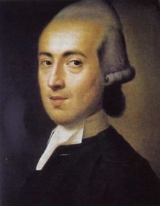
Johann Gottfried Herder

Encyclopedia
Johann Gottfried von Herder (25 August 1744 18 December 1803) was a German
philosopher
, theologian
, poet
, and literary critic. He is associated with the periods of Enlightenment
, Sturm und Drang
, and Weimar Classicism
.
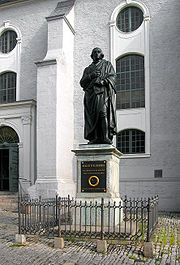 Born in Mohrungen (Morąg)
in the Kingdom of Prussia
, grew up in a poor household, educating himself from his father's Bible and songbook. In 1752(if born at the date listed how could he be 17?), an introspective youth of seventeen, he enrolled at the local University of Königsberg
, where he became a student of Immanuel Kant
. At the same time, Herder became an intellectual protégé of Johann Georg Hamann
, a patriotic Francophobe
and intensely subjective thinker who championed the emotions against reason. His choice of Hamann over such luminaries as Immanuel Kant
was significant, as this odd figure, a needy hypochondriac, delved back into the German mysticism
of Jacob Böhme and others, pronouncing obscure and oracular dicta that brought him fame as the "Magus of the North". Hamann's disjointed effusions generally carried subtitles such as Hierophantic Letters or A Rhapsody in Cabbalistic Prose.
Hamann's influence led Herder to confess to his wife later in life that "I have too little reason and too much idiosyncrasy", yet Herder can justly claim to have founded a new school of German political thought. Although himself an unsociable person, Herder influenced his contemporaries greatly. One friend wrote to him in 1785, hailing his works as "inspired by God." A varied field of theorists were later to find inspiration in Herder's tantalisingly incomplete ideas.
In 1764, now a clergyman, Herder went to Riga
to teach. It was during this period that he produced his first major works, which were literary criticism
.
In 1769 Herder traveled by ship to the French port of Nantes
and continued on to Paris. This resulted in both an account of his travels as well as a shift of his own self-conception as an author.
By 1770 Herder went to Strasbourg
, where he met the young Goethe
. This event proved to be a key juncture in the history of German literature
, as Goethe was inspired by Herder's literary criticism
to develop his own style. This can be seen as the beginning of the "Sturm und Drang
" movement. In 1771 Herder took a position as head pastor and court preacher at Bückeburg
under Count Wilhelm von Schaumburg-Lippe.
By the mid-1770s, Goethe was a well-known author, and used his influence at the court of Weimar
to secure Herder a position as General Superintendent. Herder moved there in 1776, where his outlook shifted again towards classicism
.
Towards the end of his career, Herder endorsed the French Revolution
, which earned him the enmity of many of his colleagues. At the same time, he and Goethe experienced a personal split. Herder was ennobled by the Elector-Prince of Bavaria
late in life, which added the prefix "von" to his last name. He died in Weimar
in 1803.
. Speak German, O You German". Herder now had established the foundations of comparative philology
within the new currents of political outlook.
Throughout this period, he continued to elaborate his own unique theory of aesthetics
in works such as the above, while Goethe produced works like The Sorrows of Young Werther
the Sturm und Drang
movement was born.
Herder wrote an important essay on Shakespeare and Auszug aus einem Briefwechsel über Ossian und die Lieder alter Völker (Extract from a correspondence about Ossian
and the Songs of Ancient Peoples) published in 1773 in a manifesto along with contributions by Goethe and Justus Möser
. Herder wrote that "A poet is the creator of the nation around him, he gives them a world to see and has their souls in his hand to lead them to that world." To him such poetry had its greatest purity and power in nations before they became civilised, as shown in the Old Testament
, the Edda
, and Homer
, and he tried to find such virtues in ancient German folk songs and Norse poetry and mythology
.
After becoming General Superintendent in 1776, Herder's philosophy shifted again towards classicism
. Herder was at his best during this period, and produced works such as his unfinished Outline of a Philosophical History of Humanity which largely originated the school of historical thought. Herder's philosophy was of a deeply subjective turn, stressing influence by physical and historical circumstance upon human development, stressing that "one must go into the age, into the region, into the whole history, and feel one's way into everything". The historian should be the "regenerated contemporary" of the past, and history
a science
as "instrument of the most genuine patriotic spirit".
Herder gave Germans new pride in their origins, modifying that dominance of regard allotted to Greek art
(Greek revival) extolled among others by Johann Joachim Winckelmann
and Gotthold Ephraim Lessing
. He remarked that he would have wished to be born in the Middle Ages
and mused whether "the times of the Swabia
n emperors" did not "deserve to be set forth in their true light in accordance with the German mode of thought?". Herder equated the German with the Gothic and favoured Dürer
and everything Gothic
. As with the sphere of art, equally he proclaimed a national message within the sphere of language
. He topped the line of German authors emanating from Martin Opitz, who had written his Aristarchus, sive de contemptu linguae Teutonicae in Latin
in 1617, urging Germans to glory in their hitherto despised language. Herder's extensive collections of folk-poetry began a great craze in Germany for that neglected topic.
Along with Wilhelm von Humboldt
, Herder was one of the first to argue that language determines thought, a theme that two centuries later would be central to the Sapir–Whorf hypothesis
. Herder's focus upon language and cultural traditions as the ties that create a "nation
" extended to include folklore
, dance, music and art, and inspired Jacob and Wilhelm Grimm in their collection of German folk tales.
Herder attached exceptional importance to the concept of nationality and of patriotism
"he that has lost his patriotic spirit has lost himself and the whole worlds about himself", whilst teaching that "in a certain sense every human perfection is national". Herder carried folk theory to an extreme by maintaining that "there is only one class in the state, the Volk, (not the rabble), and the king belongs to this class as well as the peasant". Explanation that the Volk was not the rabble was a novel conception in this era, and with Herder can be seen the emergence of "the people" as the basis for the emergence of a classless but hierarchical national body.
The nation, however, was individual and separate, distinguished, to Herder, by climate, education, foreign intercourse, tradition and heredity. Providence he praised for having "wonderfully separated nationalities not only by woods and mountains, seas and deserts, rivers and climates, but more particularly by languages, inclinations and characters". Herder praised the tribal
outlook writing that "the savage
who loves himself, his wife and child with quiet joy and glows with limited activity of his tribe as for his own life is in my opinion a more real being than that cultivated shadow who is enraptured with the shadow of the whole species", isolated since "each nationality contains its centre of happiness within itself, as a bullet the centre of gravity". With no need for comparison since "every nation bears in itself the standard of its perfection, totally independent of all comparison with that of others" for "do not nationalities differ in everything, in poetry, in appearance, in tastes, in usages, customs and languages? Must not religion which partakes of these also differ among the nationalities?"
He also predicted that Slavic nations would one day be the real power in Europe, as the western Europeans would reject Christianity, and thus rot away, and saying that the eastern European nations would stick to their religion and their idealism; and would this way become the power in Europe. One of his related predictions was that the Hungarian nation would disappear and become assimilated by surrounding Slavic peoples; this prophecy caused considerable uproar in Hungary and is widely cited to this day.
did not establish a national church, and his doubt whether Germany did not buy Christianity at too high a price, that of true nationality. Herder's patriotism bordered at times upon national pantheism
, demanding of territorial unity as "He is deserving of glory and gratitude who seeks to promote the unity of the territories of Germany through writings, manufacture, and institutions" and sounding an even deeper call:
 In his Ideas upon Philosophy and the History of Mankind he even wrote, "Compare England with Germany: the English are Germans, and even in the latest times the Germans have led the way for the English in the greatest things."
Herder, who hated absolutism and Prussian nationalism, but who was imbued with the spirit of the whole German Volk, yet as historical theorist turned away from the light of the eighteenth century. Seeking to reconcile his thought with this earlier age, Herder sought to harmonize his conception of sentiment with reason, whereby all knowledge is implicit in the soul; the most elementary stage is sensuous and intuitive perception which by development can become self-conscious and rational. To Herder, this development is the harmonizing of primitive and derivative truth, of experience and intelligence, feeling and reason.
Herder is the first in a long line of Germans preoccupied with this harmony. This search is itself the key to much in German theory. And Herder was too penetrating a thinker not to understand and fear the extremes to which his folk-theory could tend, and so issued specific warnings. Herder's attitude toward Jews is complex. He argued that Jews in Germany should enjoy the full rights and obligations of Germans, and that the non-Jews of the world owed a debt to Jews for centuries of abuse, and that this debt could be discharged only by actively assisting those Jews who wished to do so to regain political sovereignty in their ancient homeland of Israel. Herder refused to adhere to a rigid racial theory, writing that "notwithstanding the varieties of the human form, there is but one and the same species of man throughout the whole earth".
He also announced that "national glory is a deceiving seducer. When it reaches a certain height, it clasps the head with an iron band. The enclosed sees nothing in the mist but his own picture; he is susceptible to no foreign impressions." And:
"It is the apparent plan of nature that as one human being, so also one generation, and also one nationality learn, learn incessantly, from and with the others, until all have comprehended the difficult lesson: No nationality has been solely designated by God as the chosen people of the earth; above all we must seek the truth and cultivate the garden of the common good. Hence no nationality of Europe may separate itself sharply, and foolishly say, "With us alone, with us dwells all wisdom."
The passage of time was to demonstrate that while many Germans were to find influence in Herder's convictions and influence, fewer were to note his qualifying stipulations.
Herder had emphasised that his conception of the nation encouraged democracy
and the free self-expression of a people's identity. He proclaimed support for the French Revolution
, a position which did not endear him to royalty. He also differed with Kant's philosophy and turned away from the Sturm und Drang
movement to go back to the poems of Shakespeare
and Homer
.
To promote his concept of the Volk, he published letters and collected folk songs. These latter were published in 1773 as Voices of the People in Their Songs (Stimmen der Völker in ihren Liedern). The poets Achim von Arnim and Clemens von Brentano later used Stimmen der Võlker as samples for The Boy's Magic Horn (Des Knaben Wunderhorn
).
Herder also fostered the ideal of a person’s individuality. Although he had from an early period championed the individuality of cultures - for example, in his This Too a Philosophy of History for the Formation of Humanity (1774), he also championed the individuality of persons within a culture; for example, in his On Thomas Abbt's Writings (1768) and On the Cognition and Sensation of the Human Soul (1778).
In On Thomas Abbt's Writings, Herder stated that "a human soul is an
individual in the realm of minds: it senses in accordance with an individual formation, and thinks in accordance with the strength of its mental organs. . .. My long allegory has succeeded if it achieves the representation of the mind of a human being as an individual phenomenon, as a rarity which deserves to occupy our eyes."
}}
Germany
Germany , officially the Federal Republic of Germany , is a federal parliamentary republic in Europe. The country consists of 16 states while the capital and largest city is Berlin. Germany covers an area of 357,021 km2 and has a largely temperate seasonal climate...
philosopher
Philosophy
Philosophy is the study of general and fundamental problems, such as those connected with existence, knowledge, values, reason, mind, and language. Philosophy is distinguished from other ways of addressing such problems by its critical, generally systematic approach and its reliance on rational...
, theologian
Theology
Theology is the systematic and rational study of religion and its influences and of the nature of religious truths, or the learned profession acquired by completing specialized training in religious studies, usually at a university or school of divinity or seminary.-Definition:Augustine of Hippo...
, poet
Poet
A poet is a person who writes poetry. A poet's work can be literal, meaning that his work is derived from a specific event, or metaphorical, meaning that his work can take on many meanings and forms. Poets have existed since antiquity, in nearly all languages, and have produced works that vary...
, and literary critic. He is associated with the periods of Enlightenment
Age of Enlightenment
The Age of Enlightenment was an elite cultural movement of intellectuals in 18th century Europe that sought to mobilize the power of reason in order to reform society and advance knowledge. It promoted intellectual interchange and opposed intolerance and abuses in church and state...
, Sturm und Drang
Sturm und Drang
Sturm und Drang is a proto-Romantic movement in German literature and music taking place from the late 1760s through the early 1780s, in which individual subjectivity and, in particular, extremes of emotion were given free expression in reaction to the perceived constraints of rationalism...
, and Weimar Classicism
Weimar Classicism
Weimar Classicism is a cultural and literary movement of Europe. Followers attempted to establish a new humanism by synthesizing Romantic, classical and Enlightenment ideas...
.
Biography
Morag
Morag may refer to:* Morag , a lake monster reported to inhabit Loch Morar in Scotland* Morąg , a city in Warmia-Masuria, Poland...
in the Kingdom of Prussia
Kingdom of Prussia
The Kingdom of Prussia was a German kingdom from 1701 to 1918. Until the defeat of Germany in World War I, it comprised almost two-thirds of the area of the German Empire...
, grew up in a poor household, educating himself from his father's Bible and songbook. In 1752(if born at the date listed how could he be 17?), an introspective youth of seventeen, he enrolled at the local University of Königsberg
University of Königsberg
The University of Königsberg was the university of Königsberg in East Prussia. It was founded in 1544 as second Protestant academy by Duke Albert of Prussia, and was commonly known as the Albertina....
, where he became a student of Immanuel Kant
Immanuel Kant
Immanuel Kant was a German philosopher from Königsberg , researching, lecturing and writing on philosophy and anthropology at the end of the 18th Century Enlightenment....
. At the same time, Herder became an intellectual protégé of Johann Georg Hamann
Johann Georg Hamann
Johann Georg Hamann was a noted German philosopher, a main proponent of the Sturm und Drang movement, and associated by historian of ideas Isaiah Berlin with the Counter-Enlightenment.-Biography:...
, a patriotic Francophobe
Francophobia
Francophobia or Gallophobia are terms that refer to a dislike or hatred toward France, the People of France, the Government of France, or the Francophonie...
and intensely subjective thinker who championed the emotions against reason. His choice of Hamann over such luminaries as Immanuel Kant
Immanuel Kant
Immanuel Kant was a German philosopher from Königsberg , researching, lecturing and writing on philosophy and anthropology at the end of the 18th Century Enlightenment....
was significant, as this odd figure, a needy hypochondriac, delved back into the German mysticism
Mysticism
Mysticism is the knowledge of, and especially the personal experience of, states of consciousness, i.e. levels of being, beyond normal human perception, including experience and even communion with a supreme being.-Classical origins:...
of Jacob Böhme and others, pronouncing obscure and oracular dicta that brought him fame as the "Magus of the North". Hamann's disjointed effusions generally carried subtitles such as Hierophantic Letters or A Rhapsody in Cabbalistic Prose.
Hamann's influence led Herder to confess to his wife later in life that "I have too little reason and too much idiosyncrasy", yet Herder can justly claim to have founded a new school of German political thought. Although himself an unsociable person, Herder influenced his contemporaries greatly. One friend wrote to him in 1785, hailing his works as "inspired by God." A varied field of theorists were later to find inspiration in Herder's tantalisingly incomplete ideas.
In 1764, now a clergyman, Herder went to Riga
Riga
Riga is the capital and largest city of Latvia. With 702,891 inhabitants Riga is the largest city of the Baltic states, one of the largest cities in Northern Europe and home to more than one third of Latvia's population. The city is an important seaport and a major industrial, commercial,...
to teach. It was during this period that he produced his first major works, which were literary criticism
Literary criticism
Literary criticism is the study, evaluation, and interpretation of literature. Modern literary criticism is often informed by literary theory, which is the philosophical discussion of its methods and goals...
.
In 1769 Herder traveled by ship to the French port of Nantes
Nantes
Nantes is a city in western France, located on the Loire River, from the Atlantic coast. The city is the 6th largest in France, while its metropolitan area ranks 8th with over 800,000 inhabitants....
and continued on to Paris. This resulted in both an account of his travels as well as a shift of his own self-conception as an author.
By 1770 Herder went to Strasbourg
Strasbourg
Strasbourg is the capital and principal city of the Alsace region in eastern France and is the official seat of the European Parliament. Located close to the border with Germany, it is the capital of the Bas-Rhin département. The city and the region of Alsace are historically German-speaking,...
, where he met the young Goethe
Johann Wolfgang von Goethe
Johann Wolfgang von Goethe was a German writer, pictorial artist, biologist, theoretical physicist, and polymath. He is considered the supreme genius of modern German literature. His works span the fields of poetry, drama, prose, philosophy, and science. His Faust has been called the greatest long...
. This event proved to be a key juncture in the history of German literature
German literature
German literature comprises those literary texts written in the German language. This includes literature written in Germany, Austria, the German part of Switzerland, and to a lesser extent works of the German diaspora. German literature of the modern period is mostly in Standard German, but there...
, as Goethe was inspired by Herder's literary criticism
Literary criticism
Literary criticism is the study, evaluation, and interpretation of literature. Modern literary criticism is often informed by literary theory, which is the philosophical discussion of its methods and goals...
to develop his own style. This can be seen as the beginning of the "Sturm und Drang
Sturm und Drang
Sturm und Drang is a proto-Romantic movement in German literature and music taking place from the late 1760s through the early 1780s, in which individual subjectivity and, in particular, extremes of emotion were given free expression in reaction to the perceived constraints of rationalism...
" movement. In 1771 Herder took a position as head pastor and court preacher at Bückeburg
Bückeburg
Bückeburg is a town in Lower Saxony, Germany, on the border with North Rhine Westphalia. It was once the capital of the tiny principality of Schaumburg-Lippe and is today located in the district of Schaumburg close to the northern slopes of the Weserbergland ridge...
under Count Wilhelm von Schaumburg-Lippe.
By the mid-1770s, Goethe was a well-known author, and used his influence at the court of Weimar
Weimar
Weimar is a city in Germany famous for its cultural heritage. It is located in the federal state of Thuringia , north of the Thüringer Wald, east of Erfurt, and southwest of Halle and Leipzig. Its current population is approximately 65,000. The oldest record of the city dates from the year 899...
to secure Herder a position as General Superintendent. Herder moved there in 1776, where his outlook shifted again towards classicism
Classicism
Classicism, in the arts, refers generally to a high regard for classical antiquity, as setting standards for taste which the classicists seek to emulate. The art of classicism typically seeks to be formal and restrained: of the Discobolus Sir Kenneth Clark observed, "if we object to his restraint...
.
Towards the end of his career, Herder endorsed the French Revolution
French Revolution
The French Revolution , sometimes distinguished as the 'Great French Revolution' , was a period of radical social and political upheaval in France and Europe. The absolute monarchy that had ruled France for centuries collapsed in three years...
, which earned him the enmity of many of his colleagues. At the same time, he and Goethe experienced a personal split. Herder was ennobled by the Elector-Prince of Bavaria
Bavaria
Bavaria, formally the Free State of Bavaria is a state of Germany, located in the southeast of Germany. With an area of , it is the largest state by area, forming almost 20% of the total land area of Germany...
late in life, which added the prefix "von" to his last name. He died in Weimar
Weimar
Weimar is a city in Germany famous for its cultural heritage. It is located in the federal state of Thuringia , north of the Thüringer Wald, east of Erfurt, and southwest of Halle and Leipzig. Its current population is approximately 65,000. The oldest record of the city dates from the year 899...
in 1803.
Works and ideas
In 1772 Herder published Treatise on the Origin of Language and went further in this promotion of language than his earlier injunction to "spew out the ugly slime of the SeineSeine
The Seine is a -long river and an important commercial waterway within the Paris Basin in the north of France. It rises at Saint-Seine near Dijon in northeastern France in the Langres plateau, flowing through Paris and into the English Channel at Le Havre . It is navigable by ocean-going vessels...
. Speak German, O You German". Herder now had established the foundations of comparative philology
Philology
Philology is the study of language in written historical sources; it is a combination of literary studies, history and linguistics.Classical philology is the philology of Greek and Classical Latin...
within the new currents of political outlook.
Throughout this period, he continued to elaborate his own unique theory of aesthetics
Aesthetics
Aesthetics is a branch of philosophy dealing with the nature of beauty, art, and taste, and with the creation and appreciation of beauty. It is more scientifically defined as the study of sensory or sensori-emotional values, sometimes called judgments of sentiment and taste...
in works such as the above, while Goethe produced works like The Sorrows of Young Werther
The Sorrows of Young Werther
The Sorrows of Young Werther is an epistolary and loosely autobiographical novel by Johann Wolfgang von Goethe, first published in 1774; a revised edition of the novel was published in 1787...
the Sturm und Drang
Sturm und Drang
Sturm und Drang is a proto-Romantic movement in German literature and music taking place from the late 1760s through the early 1780s, in which individual subjectivity and, in particular, extremes of emotion were given free expression in reaction to the perceived constraints of rationalism...
movement was born.
Herder wrote an important essay on Shakespeare and Auszug aus einem Briefwechsel über Ossian und die Lieder alter Völker (Extract from a correspondence about Ossian
Ossian
Ossian is the narrator and supposed author of a cycle of poems which the Scottish poet James Macpherson claimed to have translated from ancient sources in the Scots Gaelic. He is based on Oisín, son of Finn or Fionn mac Cumhaill, anglicised to Finn McCool, a character from Irish mythology...
and the Songs of Ancient Peoples) published in 1773 in a manifesto along with contributions by Goethe and Justus Möser
Justus Möser
Justus Möser was a German jurist and social theorist.Having studied law at the universities of Jena and Göttingen, he settled in his native town as a lawyer and was soon appointed advocatus patriae by his fellow citizens...
. Herder wrote that "A poet is the creator of the nation around him, he gives them a world to see and has their souls in his hand to lead them to that world." To him such poetry had its greatest purity and power in nations before they became civilised, as shown in the Old Testament
Old Testament
The Old Testament, of which Christians hold different views, is a Christian term for the religious writings of ancient Israel held sacred and inspired by Christians which overlaps with the 24-book canon of the Masoretic Text of Judaism...
, the Edda
Edda
The term Edda applies to the Old Norse Poetic Edda and Prose Edda, both of which were written down in Iceland during the 13th century in Icelandic, although they contain material from earlier traditional sources, reaching into the Viking Age...
, and Homer
Homer
In the Western classical tradition Homer , is the author of the Iliad and the Odyssey, and is revered as the greatest ancient Greek epic poet. These epics lie at the beginning of the Western canon of literature, and have had an enormous influence on the history of literature.When he lived is...
, and he tried to find such virtues in ancient German folk songs and Norse poetry and mythology
Mythology
The term mythology can refer either to the study of myths, or to a body or collection of myths. As examples, comparative mythology is the study of connections between myths from different cultures, whereas Greek mythology is the body of myths from ancient Greece...
.
After becoming General Superintendent in 1776, Herder's philosophy shifted again towards classicism
Classicism
Classicism, in the arts, refers generally to a high regard for classical antiquity, as setting standards for taste which the classicists seek to emulate. The art of classicism typically seeks to be formal and restrained: of the Discobolus Sir Kenneth Clark observed, "if we object to his restraint...
. Herder was at his best during this period, and produced works such as his unfinished Outline of a Philosophical History of Humanity which largely originated the school of historical thought. Herder's philosophy was of a deeply subjective turn, stressing influence by physical and historical circumstance upon human development, stressing that "one must go into the age, into the region, into the whole history, and feel one's way into everything". The historian should be the "regenerated contemporary" of the past, and history
History
History is the discovery, collection, organization, and presentation of information about past events. History can also mean the period of time after writing was invented. Scholars who write about history are called historians...
a science
Science
Science is a systematic enterprise that builds and organizes knowledge in the form of testable explanations and predictions about the universe...
as "instrument of the most genuine patriotic spirit".
Herder gave Germans new pride in their origins, modifying that dominance of regard allotted to Greek art
Greek art
Greek art began in the Cycladic and Minoan prehistorical civilization, and gave birth to Western classical art in the ancient period...
(Greek revival) extolled among others by Johann Joachim Winckelmann
Johann Joachim Winckelmann
Johann Joachim Winckelmann was a German art historian and archaeologist. He was a pioneering Hellenist who first articulated the difference between Greek, Greco-Roman and Roman art...
and Gotthold Ephraim Lessing
Gotthold Ephraim Lessing
Gotthold Ephraim Lessing was a German writer, philosopher, dramatist, publicist, and art critic, and one of the most outstanding representatives of the Enlightenment era. His plays and theoretical writings substantially influenced the development of German literature...
. He remarked that he would have wished to be born in the Middle Ages
Middle Ages
The Middle Ages is a periodization of European history from the 5th century to the 15th century. The Middle Ages follows the fall of the Western Roman Empire in 476 and precedes the Early Modern Era. It is the middle period of a three-period division of Western history: Classic, Medieval and Modern...
and mused whether "the times of the Swabia
Swabia
Swabia is a cultural, historic and linguistic region in southwestern Germany.-Geography:Like many cultural regions of Europe, Swabia's borders are not clearly defined...
n emperors" did not "deserve to be set forth in their true light in accordance with the German mode of thought?". Herder equated the German with the Gothic and favoured Dürer
Albrecht Dürer
Albrecht Dürer was a German painter, printmaker, engraver, mathematician, and theorist from Nuremberg. His prints established his reputation across Europe when he was still in his twenties, and he has been conventionally regarded as the greatest artist of the Northern Renaissance ever since...
and everything Gothic
Gothic art
Gothic art was a Medieval art movement that developed in France out of Romanesque art in the mid-12th century, led by the concurrent development of Gothic architecture. It spread to all of Western Europe, but took over art more completely north of the Alps, never quite effacing more classical...
. As with the sphere of art, equally he proclaimed a national message within the sphere of language
Language
Language may refer either to the specifically human capacity for acquiring and using complex systems of communication, or to a specific instance of such a system of complex communication...
. He topped the line of German authors emanating from Martin Opitz, who had written his Aristarchus, sive de contemptu linguae Teutonicae in Latin
Latin
Latin is an Italic language originally spoken in Latium and Ancient Rome. It, along with most European languages, is a descendant of the ancient Proto-Indo-European language. Although it is considered a dead language, a number of scholars and members of the Christian clergy speak it fluently, and...
in 1617, urging Germans to glory in their hitherto despised language. Herder's extensive collections of folk-poetry began a great craze in Germany for that neglected topic.
Along with Wilhelm von Humboldt
Wilhelm von Humboldt
Friedrich Wilhelm Christian Karl Ferdinand Freiherr von Humboldt was a German philosopher, government functionary, diplomat, and founder of Humboldt Universität. He is especially remembered as a linguist who made important contributions to the philosophy of language and to the theory and practice...
, Herder was one of the first to argue that language determines thought, a theme that two centuries later would be central to the Sapir–Whorf hypothesis
Linguistic relativity
The principle of linguistic relativity holds that the structure of a language affects the ways in which its speakers are able to conceptualize their world, i.e. their world view...
. Herder's focus upon language and cultural traditions as the ties that create a "nation
Nation
A nation may refer to a community of people who share a common language, culture, ethnicity, descent, and/or history. In this definition, a nation has no physical borders. However, it can also refer to people who share a common territory and government irrespective of their ethnic make-up...
" extended to include folklore
Folklore
Folklore consists of legends, music, oral history, proverbs, jokes, popular beliefs, fairy tales and customs that are the traditions of a culture, subculture, or group. It is also the set of practices through which those expressive genres are shared. The study of folklore is sometimes called...
, dance, music and art, and inspired Jacob and Wilhelm Grimm in their collection of German folk tales.
Herder attached exceptional importance to the concept of nationality and of patriotism
Patriotism
Patriotism is a devotion to one's country, excluding differences caused by the dependencies of the term's meaning upon context, geography and philosophy...
"he that has lost his patriotic spirit has lost himself and the whole worlds about himself", whilst teaching that "in a certain sense every human perfection is national". Herder carried folk theory to an extreme by maintaining that "there is only one class in the state, the Volk, (not the rabble), and the king belongs to this class as well as the peasant". Explanation that the Volk was not the rabble was a novel conception in this era, and with Herder can be seen the emergence of "the people" as the basis for the emergence of a classless but hierarchical national body.
The nation, however, was individual and separate, distinguished, to Herder, by climate, education, foreign intercourse, tradition and heredity. Providence he praised for having "wonderfully separated nationalities not only by woods and mountains, seas and deserts, rivers and climates, but more particularly by languages, inclinations and characters". Herder praised the tribal
Tribalism
The social structure of a tribe can vary greatly from case to case, but, due to the small size of tribes, it is always a relatively simple role structure, with few significant social distinctions between individuals....
outlook writing that "the savage
Barbarian
Barbarian and savage are terms used to refer to a person who is perceived to be uncivilized. The word is often used either in a general reference to a member of a nation or ethnos, typically a tribal society as seen by an urban civilization either viewed as inferior, or admired as a noble savage...
who loves himself, his wife and child with quiet joy and glows with limited activity of his tribe as for his own life is in my opinion a more real being than that cultivated shadow who is enraptured with the shadow of the whole species", isolated since "each nationality contains its centre of happiness within itself, as a bullet the centre of gravity". With no need for comparison since "every nation bears in itself the standard of its perfection, totally independent of all comparison with that of others" for "do not nationalities differ in everything, in poetry, in appearance, in tastes, in usages, customs and languages? Must not religion which partakes of these also differ among the nationalities?"
He also predicted that Slavic nations would one day be the real power in Europe, as the western Europeans would reject Christianity, and thus rot away, and saying that the eastern European nations would stick to their religion and their idealism; and would this way become the power in Europe. One of his related predictions was that the Hungarian nation would disappear and become assimilated by surrounding Slavic peoples; this prophecy caused considerable uproar in Hungary and is widely cited to this day.
Germany and The Enlightenment
This question was further developed by Herder's lament that Martin LutherMartin Luther
Martin Luther was a German priest, professor of theology and iconic figure of the Protestant Reformation. He strongly disputed the claim that freedom from God's punishment for sin could be purchased with money. He confronted indulgence salesman Johann Tetzel with his Ninety-Five Theses in 1517...
did not establish a national church, and his doubt whether Germany did not buy Christianity at too high a price, that of true nationality. Herder's patriotism bordered at times upon national pantheism
Pantheism
Pantheism is the view that the Universe and God are identical. Pantheists thus do not believe in a personal, anthropomorphic or creator god. The word derives from the Greek meaning "all" and the Greek meaning "God". As such, Pantheism denotes the idea that "God" is best seen as a process of...
, demanding of territorial unity as "He is deserving of glory and gratitude who seeks to promote the unity of the territories of Germany through writings, manufacture, and institutions" and sounding an even deeper call:
- "But now! Again I cry, my German brethren! But now! The remains of all genuine folk-thought is rolling into the abyss of oblivion with a last and accelerated impetus. For the last century we have been ashamed of everything that concerns the fatherland."
Herder, who hated absolutism and Prussian nationalism, but who was imbued with the spirit of the whole German Volk, yet as historical theorist turned away from the light of the eighteenth century. Seeking to reconcile his thought with this earlier age, Herder sought to harmonize his conception of sentiment with reason, whereby all knowledge is implicit in the soul; the most elementary stage is sensuous and intuitive perception which by development can become self-conscious and rational. To Herder, this development is the harmonizing of primitive and derivative truth, of experience and intelligence, feeling and reason.
Herder is the first in a long line of Germans preoccupied with this harmony. This search is itself the key to much in German theory. And Herder was too penetrating a thinker not to understand and fear the extremes to which his folk-theory could tend, and so issued specific warnings. Herder's attitude toward Jews is complex. He argued that Jews in Germany should enjoy the full rights and obligations of Germans, and that the non-Jews of the world owed a debt to Jews for centuries of abuse, and that this debt could be discharged only by actively assisting those Jews who wished to do so to regain political sovereignty in their ancient homeland of Israel. Herder refused to adhere to a rigid racial theory, writing that "notwithstanding the varieties of the human form, there is but one and the same species of man throughout the whole earth".
He also announced that "national glory is a deceiving seducer. When it reaches a certain height, it clasps the head with an iron band. The enclosed sees nothing in the mist but his own picture; he is susceptible to no foreign impressions." And:
"It is the apparent plan of nature that as one human being, so also one generation, and also one nationality learn, learn incessantly, from and with the others, until all have comprehended the difficult lesson: No nationality has been solely designated by God as the chosen people of the earth; above all we must seek the truth and cultivate the garden of the common good. Hence no nationality of Europe may separate itself sharply, and foolishly say, "With us alone, with us dwells all wisdom."
The passage of time was to demonstrate that while many Germans were to find influence in Herder's convictions and influence, fewer were to note his qualifying stipulations.
Herder had emphasised that his conception of the nation encouraged democracy
Democracy
Democracy is generally defined as a form of government in which all adult citizens have an equal say in the decisions that affect their lives. Ideally, this includes equal participation in the proposal, development and passage of legislation into law...
and the free self-expression of a people's identity. He proclaimed support for the French Revolution
French Revolution
The French Revolution , sometimes distinguished as the 'Great French Revolution' , was a period of radical social and political upheaval in France and Europe. The absolute monarchy that had ruled France for centuries collapsed in three years...
, a position which did not endear him to royalty. He also differed with Kant's philosophy and turned away from the Sturm und Drang
Sturm und Drang
Sturm und Drang is a proto-Romantic movement in German literature and music taking place from the late 1760s through the early 1780s, in which individual subjectivity and, in particular, extremes of emotion were given free expression in reaction to the perceived constraints of rationalism...
movement to go back to the poems of Shakespeare
William Shakespeare
William Shakespeare was an English poet and playwright, widely regarded as the greatest writer in the English language and the world's pre-eminent dramatist. He is often called England's national poet and the "Bard of Avon"...
and Homer
Homer
In the Western classical tradition Homer , is the author of the Iliad and the Odyssey, and is revered as the greatest ancient Greek epic poet. These epics lie at the beginning of the Western canon of literature, and have had an enormous influence on the history of literature.When he lived is...
.
To promote his concept of the Volk, he published letters and collected folk songs. These latter were published in 1773 as Voices of the People in Their Songs (Stimmen der Völker in ihren Liedern). The poets Achim von Arnim and Clemens von Brentano later used Stimmen der Võlker as samples for The Boy's Magic Horn (Des Knaben Wunderhorn
Des Knaben Wunderhorn
Des Knaben Wunderhorn is a collection of German folk poems edited by Achim von Arnim and Clemens Brentano, and published in Heidelberg, in the Grand Duchy of Baden, between 1805 and 1808...
).
Herder also fostered the ideal of a person’s individuality. Although he had from an early period championed the individuality of cultures - for example, in his This Too a Philosophy of History for the Formation of Humanity (1774), he also championed the individuality of persons within a culture; for example, in his On Thomas Abbt's Writings (1768) and On the Cognition and Sensation of the Human Soul (1778).
In On Thomas Abbt's Writings, Herder stated that "a human soul is an
individual in the realm of minds: it senses in accordance with an individual formation, and thinks in accordance with the strength of its mental organs. . .. My long allegory has succeeded if it achieves the representation of the mind of a human being as an individual phenomenon, as a rarity which deserves to occupy our eyes."
Works in English
- Selected Writings on Aesthetics. Edited and translated by Gregory Moore. Princeton U.P. 2006. pp. x + 455. Edition makes many of Herder's writings on aesthetics available in English for the first time.
- Another Philosophy of History and Selected Political Writings, eds. Ioannis D. Evrigenis and Daniel Pellerin (Indianapolis: Hackett Pub., 2004). A translation of Auch eine Philosophie and other works.
- Philosophical Writings, ed. Michael N. Forster (Cambridge: Cambridge Univ. Press, 2002). The most important philosophical works of the early Herder available in English, including an unabridged version of the Treatise on the Origin of Language and This Too a Philosophy of History for the Formation of Mankind.
- Sculpture: Some Observations on Shape and Form from Pygmalion's Creative Dream, ed. Jason Gaiger (Chicago: University of Chicago Press, 2002). Herder's Plastik.
- Selected Early Works, eds. Ernest A. Menze and Karl Menges (University Park: The Pennsylvania State Univ. Press, 1992). Partial translation of the important text Über die neuere deutsche Litteratur.
- On World History, eds. Hans Adler and Ernest A. Menze (Armonk, N.Y.: M.E. Sharpe, 1997). Short excerpts on history from various texts.
- J. G. Herder on Social & Political Culture (Cambridge Studies in the History and Theory of Politics), ed. F. M. Barnard (Cambridge University Press, 2010 (originally published in 1969)) ISBN 978-0521133814 Selected texts: 1. Journal of my voyage in the year 1769; 2. Essay on the origin of language; 3. Yet another philosophy of history; 4. Dissertation on the reciprocal influence of government and the sciences; 5. Ideas for a philosophy of the history of mankind.
- Herder: Philosophical Writings, ed. Desmond M. Clarke and Michael N. Forster (Cambridge University Press, 2007) ISBN 9780521790888 Contents: Part I. General Philosophical Program: 1. How philosophy can become more universal and useful for the benefit of the people (1765); Part II. Philosophy of Language: 2. Fragments on recent German literature (1767–8); 3. Treatise on the origin of language (1772); Part III. Philosophy of Mind: 4. On Thomas Abbt's writings (1768); 5. On cognition and sensation, the two main forces of the human soul; 6. On the cognition and sensation, the two main forces of the human soul (1775); Part IV. Philosophy of History: 7. On the change of taste (1766); 8. Older critical forestlet (1767/8); 9. This too a philosophy of history for the formation of humanity (1774); Part V. Political Philosophy: 10. Letters concerning the progress of humanity (1792); 11. Letters for the advancement of humanity (1793–7)
- Herder on Nationality, Humanity, and History, F. M. Barnard. (Montreal and Kingston: McGill-Queen's University Press, 2003).
- Herder's social and political thought: From enlightenment to nationalism, F. M Barnard, Oxford, Publisher: Clarendon Press, 1967. ASIN: B0007JTDEI
Selected bibliography
- Adler, Hans. "Johann Gottfried Herder's Concept of Humanity," Studies in Eighteenth-Century Culture 23 (1994): 55–74
- Berman, AntoineAntoine BermanAntoine Berman was a French translator, historian and theorist of translation.- Works :* L'épreuve de l'étranger: Culture et traduction dans l’Allemagne romantique: Herder, Goethe, Schlegel, Novalis, Humboldt, Schleiermacher, Hölderlin. Paris: Gallimard, 1984* Lettres à Fouad El-Etr sur le...
. L'épreuve de l'étranger. Culture et traduction dans l'Allemagne romantique: Herder, Goethe, Schlegel, Novalis, Humboldt, Schleiermacher, Hölderlin., Paris, Gallimard, Essais, 1984. ISBN 978-2070700769 - Herder today. Contributions from the International Herder Conference, November 5–8, 1987, Stanford, California. Edited by Mueller-Vollmer Kurt. Berlin: Walter de Gruyter 1990.
- Baum, Manfred, Herder's essay on Being. In Herder Today: Contributions from the International Herder Conference, November 5–8, 1987, Stanford, California. Edited by Mueller-Vollmer Kurt. Berlin: Walter de Gruyter 1990. pp. 126–137.
- Simon Josef, Herder and the problematization of metaphysics. In Herder Today: Contributions from the International Herder Conference, November 5–8, 1987, Stanford, California. Edited by Mueller-Vollmer Kurt. Berlin: Walter de Gruyter 1990. pp. 108–125.
- Iggers, George. The German Conception of History: The National Tradition of Historical Thought from Herder to the Present (2nd ed.; Wesleyan University Press, 1983).
- Taylor, Charles, The importance of Herder. In Isaiah Berlin: a celebration edited by Margalit Edna and Margalit Avishai. Chicago: University of Chicago Press 1991. pp. 40–63; reprinted in: C. Taylor, Philosophical arguments, Cambridge, Harvard University Press, 1995, pp. 79–99.
- Zammito, John H. Kant, Herder, the birth of anthropology. Chicago: Chicago University Press 2002.
- Zammito, John H., Karl Menges and Ernest A. Menze. "Johann Gottfried Herder Revisited: The Revolution in Scholarship in the Last Quarter Century," Journal of the History of Ideas, Volume 71, Number 4, October 2010, pp. 661-684, in Project MUSE
External links
- Herder Bibliography and more
- www.johann-gottfried-herder.de (German)
- International Herder Society
- Selected works from Project Gutenberg (in German)
}}