
All Topics  
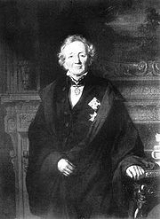
Leopold von Ranke

 
Leopold Von Ranke

   Email Print
   Bookmark   Link


Leopold von Ranke


Leopold von Ranke (December 21, 1795 – May 23, 1886) was a German
Germany

Germany , officially the Federal Republic of Germany , is a country in Central Europe. It is bordered to the north by the North Sea, Denmark, and the Baltic Sea; to the east by Poland and the Czech Republic; to the south by Austria and Switzerland; and to the west by France, Luxembourg, Belgium, and the Netherlands....
 historian
Historian

A historian is an individual who studies and writes about history, and is regarded as an authority on it. Historians are concerned with the continuous, systematic narrative and research of past events as relating to the human race; as well as the study of all events in time....
 of the 19th century, and frequently considered one of the founders of modern source-based history
HIStory

HIStory: Past, Present and Future, Book I is a double album by Michael Jackson, released on June 20, 1995, and is Jackson's ninth. The first disc, named "HIStory Begins" consists of a selection of Jackson's greatest hits from the singer's past fifteen years, while the second, named "HIStory Continues" features new songs, with the...
. Ranke set the tone for much of later historical writing, introducing such ideas as reliance on primary source
Primary source

Primary source is a term used in a number of disciplines. In historiography, a primary source is a document, recording or other source of information that was created at the time being studied, by an authoritative source, usually one with direct personal knowledge of the events being described....
s (Empiricism
Empiricism

In philosophy, empiricism is a theory of knowledge which asserts that knowledge arises from experience. Empiricism is one of several competing views about how we know "things," part of the branch of philosophy called epistemology, or "theory of knowledge"....
), an emphasis on narrative history
Narrative history

Narrative history is the practice of writing history in a story-based form. It can be divided into two subgenres: the traditional narrative and the modern narrative....
 and especially international politics (Aussenpolitik
Political history

Political history narrative and analysis of political events, ideas, movements, and leaders. It is usually structured around the nation state. It is distinct from, but related to, other fields of history such as social history, economic history, and military history....
) and a commitment to writing history "as it essentially [was]." In his own words: "[…] nicht das Amt die Vergangenheit zu richten, die Mitwelt zum Nutzen zukünftiger Jahre zu belehren, sondern bloß zu zeigen, wie es eigentlich gewesen" ("[…] not the duty to judge the past, nor to instruct one's contemporaries with an eye to the future, but rather merely to show how it actually was").


Discussion
Ask a question about 'Leopold von Ranke'
Start a new discussion about 'Leopold von Ranke'
Answer questions from other users
Full Discussion Forum


Quotations


Wie es eigentlich gewesen.

Translation: History wants only to show what essentially happened.

Die glücklichsten Zeiten der Menschheit sind die leeren Blätter im Buch der Geschichte.

Translation: The happiest times of humanity are the blank pages in the book of history.


Encyclopedia


Leopold Von Ranke 1868
Leopold von Ranke (December 21, 1795 – May 23, 1886) was a German
Germany

Germany , officially the Federal Republic of Germany , is a country in Central Europe. It is bordered to the north by the North Sea, Denmark, and the Baltic Sea; to the east by Poland and the Czech Republic; to the south by Austria and Switzerland; and to the west by France, Luxembourg, Belgium, and the Netherlands....
 historian
Historian

A historian is an individual who studies and writes about history, and is regarded as an authority on it. Historians are concerned with the continuous, systematic narrative and research of past events as relating to the human race; as well as the study of all events in time....
 of the 19th century, and frequently considered one of the founders of modern source-based history
HIStory

HIStory: Past, Present and Future, Book I is a double album by Michael Jackson, released on June 20, 1995, and is Jackson's ninth. The first disc, named "HIStory Begins" consists of a selection of Jackson's greatest hits from the singer's past fifteen years, while the second, named "HIStory Continues" features new songs, with the...
. Ranke set the tone for much of later historical writing, introducing such ideas as reliance on primary source
Primary source

Primary source is a term used in a number of disciplines. In historiography, a primary source is a document, recording or other source of information that was created at the time being studied, by an authoritative source, usually one with direct personal knowledge of the events being described....
s (Empiricism
Empiricism

In philosophy, empiricism is a theory of knowledge which asserts that knowledge arises from experience. Empiricism is one of several competing views about how we know "things," part of the branch of philosophy called epistemology, or "theory of knowledge"....
), an emphasis on narrative history
Narrative history

Narrative history is the practice of writing history in a story-based form. It can be divided into two subgenres: the traditional narrative and the modern narrative....
 and especially international politics (Aussenpolitik
Political history

Political history narrative and analysis of political events, ideas, movements, and leaders. It is usually structured around the nation state. It is distinct from, but related to, other fields of history such as social history, economic history, and military history....
) and a commitment to writing history "as it essentially [was]." In his own words: "[…] nicht das Amt die Vergangenheit zu richten, die Mitwelt zum Nutzen zukünftiger Jahre zu belehren, sondern bloß zu zeigen, wie es eigentlich gewesen" ("[…] not the duty to judge the past, nor to instruct one's contemporaries with an eye to the future, but rather merely to show how it actually was"). Ranke is also considered a founding father of Historism
Historism

Historism is a philosophical and historiographical theory, founded in Nineteenth Century Germany and especially influential in 19th- and 20th-century Europe....
.

Overview

Ranke was born in Wiehe
Wiehe

Wiehe is a town in the Kyffh?userkreis district, in Thuringia, Germany. It is situated 24 km south of Sangerhausen, and 32 km north of Weimar....
, Electorate of Saxony
Electorate of Saxony

The Electorate of Saxony or Duchy of Upper Saxony was an independent hereditary Prince-elector of the Holy Roman Empire from 1356?1806. It was the successor state of the Duchy of Saxe-Wittenberg and was itself replaced in Napoleonic times by the Kingdom of Saxony ....
. He was educated partly at home and partly in the Gymnasium of Schulpforta. His early years engendered a life-long love of Ancient Greek
Ancient Greek

Ancient Greek is the historical stage in the development of the Greek language spanning across the Archaic Greece , Classical Greece , and Hellenistic civilization periods of ancient Greece and the classical antiquity....
 and Latin
Latin

Latin is an Italic language, historically spoken in Latium and Ancient Rome. Through the Military history of the Roman Empire, Latin spread throughout the Mediterranean and a large part of Europe....
 and of the Lutheran
Lutheranism

Lutheranism is a major branch of Western Christianity that identifies with the teachings of the sixteenth-century Germans Reformer Martin Luther....
 Church. In 1814, Ranke entered the University of Leipzig
University of Leipzig

The University of Leipzig , located in Leipzig in the Free State of Saxony, Germany, is one of the oldest University in Europeand currently the List_of_universities_in_Germany#Universities_by_age university in Germany....
, where his subjects were Classics
Classics

Classics is the branch of the Humanities comprising the languages, literature, philosophy, history, art, and other culture of the ancient Mediterranean World; especially Ancient Greece and Ancient Rome during Classical Antiquity ....
 and Lutheran theology
Theology

Theology is the study of the existence or attributes of a deity or gods, or more generally the study of religion or spirituality. It is sometimes contrasted with religious studies: theology is understood as the study of religion from an internal perspective , and religious studies as the study of religion from an external perspective....
. At Leipzig
Leipzig

Leipzig is, with a population of over 511,252, the largest city in the States of Germany of Saxony, Germany....
, Ranke became an expert in philology
Philology

Philology, derived from the Greek language considers both morphology and Meaning in linguistic expression, combining linguistics and literary studies....
 and translation of the ancient authors into German
German language

German is a West Germanic languages, thus related to and classified alongside English language and Dutch language. It is one of the world's world language and the most widely spoken mother tongue in the European Union....
. As a student, Ranke's favorite authors were Thucydides
Thucydides

Thucydides was a Greeks history and author of the History of the Peloponnesian War, which recounts the 5th century B.C. war between Sparta and Athens to the year 411 B.C....
, Livy
Livy

Titus Livius , known as Livy in English language, was a Ancient Rome historian who wrote a monumental history of Rome, Ab Urbe Condita, from its founding through the reign of Augustus in Livy's own time....
, Dionysius of Halicarnassus
Dionysius of Halicarnassus

Dionysius of Halicarnassus was a Greeks historian and teacher of rhetoric, who flourished during the reign of Caesar Augustus....
, Johann Wolfgang von Goethe
Johann Wolfgang von Goethe

was a Germans writer and according to George Eliot, "Germany's greatest man of letters? and the last true polymath to walk the earth." Goethe's works span the fields of poetry, drama, literature, theology, philosophy, humanism and science....
, Barthold Georg Niebuhr
Barthold Georg Niebuhr

Barthold Georg Niebuhr was a Germany statesman and historian....
, Immanuel Kant
Immanuel Kant

Immanuel Kant was an 18th-century German Philosophy from the Kingdom of Prussia city of K?nigsberg . He is regarded as one of the most influential thinkers of modern Europe and of the late Age of Enlightenment....
, Johann Gottlieb Fichte
Johann Gottlieb Fichte

Johann Gottlieb Fichte was a German People philosopher. He was one of the founding figures of the philosophical movement known as German idealism, a movement that developed from the theoretical and ethical writings of Immanuel Kant....
, Friedrich Schelling, and Friedrich Schlegel. Ranke showed little interest in the work of modern history because of his dissatisfaction with what he regarded as history books that were merely a collection of facts lumped together by modern historians.

Between 1817–1825, Ranke worked as a Classics teacher at the Friedrichs Gymnasium in Frankfurt an der Oder. During this time, Ranke became interested in History
HIStory

HIStory: Past, Present and Future, Book I is a double album by Michael Jackson, released on June 20, 1995, and is Jackson's ninth. The first disc, named "HIStory Begins" consists of a selection of Jackson's greatest hits from the singer's past fifteen years, while the second, named "HIStory Continues" features new songs, with the...
 in part because of his desire to be involved in the developing field of a more professionalized history and in part because of his desire to find the hand of God
God

God is a deity in theism and deism religions and other belief systems, representing either the sole deity in monotheism, or a principal deity in polytheism....
 in the workings of history.

Beginning with his first book in 1824, the Geschichte der romanischen und germanischen Völker von 1494 bis 1514 (History of the Latin and Teutonic Peoples from 1494 to 1514), Ranke used an unusually wide variety of sources for a historian of the age, including "memoirs, diaries, personal and formal missives, government documents, diplomatic dispatches and first-hand accounts of eye-witnesses." In this sense he leaned on the traditions of Philology
Philology

Philology, derived from the Greek language considers both morphology and Meaning in linguistic expression, combining linguistics and literary studies....
 but emphasized mundane documents instead of old and exotic literature.

Ranke began his book with the statement in the introduction that he would show the unity of the experiences of the "Teutonic" nations of Scandinavia
Scandinavia

Scandinavia is a historical and geographical subregion in northern Europe that includes the Scandinavian Peninsula. It consists of the kingdoms of Norway, Sweden, and Denmark; some authorities also include Finland and some might even include Iceland....
, England
England

native_name =|conventional_long_name = England|common_name = England|image_flag = Flag of England.svg|image_coat = England COA.svg|symbol_type = Royal Coat of Arms...
 and Germany
Germany

Germany , officially the Federal Republic of Germany , is a country in Central Europe. It is bordered to the north by the North Sea, Denmark, and the Baltic Sea; to the east by Poland and the Czech Republic; to the south by Austria and Switzerland; and to the west by France, Luxembourg, Belgium, and the Netherlands....
 and the "Latin" nations of Italy
Italy

Italy , officially the Italian Republic , is a country located on the Italian Peninsula in Southern Europe and on the two largest islands in the Mediterranean Sea, Sicily and Sardinia....
, Spain
Spain

Spain or the Kingdom of Spain , is a country located in Southern Europe on the Iberian Peninsula.The Spanish constitution does not establish any official denomination of the country, even though Espa?a , Estado espa?ol and Naci?n espa?ola are used interchangeably....
 and France
France

France , officially the French Republic , is a country whose Metropolitan France is located in Western Europe and that also comprises various Overseas departments and territories of France....
 through the great "respirations" of the Völkerwanderung (great migration), the Crusades
Crusades

The Crusades were a series of religious war waged by much of Christian Europe against external and internal opponents. Crusades were fought mainly against Muslims, though campaigns were also directed against Paganism Slavic peoples, Jews, Eastern Orthodox Church, Mongols, Catharism, Hussites, Waldensians, Old Prussians, and political enemi...
 and colonisation that in Ranke's view bound all of the nations together to produce modern European civilization. Despite his opening statement, Ranke largely treated all of the nations under examination separately until the outbreak of the wars for the control of Italy starting in 1494. However, the book is best remembered for Ranke's comment that "History has had assigned to it the office of judging the past and of instructing the account for the benefit of future ages. To show high offices the present work does not presume: it seeks only to show what actually happened". Ranke's statement that history should embrace the principle of "wie es eigentlich gewesen" (show what actually happened)" is taken by many historians as their guiding principle. There has been much debate over the precise meaning of this phrase. Some have argued that wie es eigentlich gewesen meant that the historian should only offer the facts of history without offering any of his own views while others have argued that Ranke meant that the historian should discover the facts and find the general prevailing motifs of the time under question that coloured the facts. Under this view, the word 'eigentlich' is often translated as 'essentially', the aim then being to "show what essentially happened". Ranke went on to write that the historian must seek for the "Holy hieroglyph" that is God's hand in history by keeping an "eye for the universal" whilst taking "joy in the particular".

Following the success of Geschichte der romanischen und germanischen Völker von 1494 bis 1514, Ranke was given a position in the University of Berlin. At the university, Ranke became deeply involved in the dispute between the followers of the legal professor Friedrich Carl von Savigny
Friedrich Carl von Savigny

Friedrich Carl von Savigny was one of the most respected and influential 19th-century jurists....
 who emphasized the varieties of different periods of history and the followers of the philosopher Georg Wilhelm Friedrich Hegel
Georg Wilhelm Friedrich Hegel

Georg Wilhelm Friedrich Hegel was a German people philosopher, and with Johann Gottlieb Fichte and Friedrich Wilhelm Joseph Schelling, one of the creators of German idealism....
 who saw history as the unfolding of a universal story. Ranke supported Savigny and criticized the Hegelian view of history as being a one-size-fits-all approach. Also during his time in Berlin
Berlin

Berlin is the Capital of Germany city and one of sixteen States of Germany of Germany. With a population of 3.4 million within its city limits, Berlin is the country's largest city....
, Ranke became the first historian to utilise the forty-seven volumes that comprised the diplomatic archives of Venice
Venice

Venice is a city in northern Italy, the capital city of the Italian regions Veneto, a population of 271,251 . Together with Padua, Italy, the city is included in the Padua-Venice Metropolitan Area ....
 from the 16th and 17th centuries. Ranke came to prefer dealing with primary sources as opposed to secondary sources during this time. Ranke later wrote "I see the time approaching when we shall base modern history, no longer on the reports even of contemporary historians, except in-so-far as they were in the possession of personal and immediate knowledge of facts; and still less on work yet more remote from the source; but rather on the narratives of eyewitnesses, and on genuine and original documents".

Starting in 1831 at the behest of the Prussian government, Ranke founded and edited the Historisch-Politische Zeitschrift journal. Ranke, who was a conservative
Conservatism

Conservatism is a political and social term whose meaning has changed in different countries and time periods, but which usually indicates support for the status quo or the status quo ante....
, used the journal to attack the ideas of Liberalism
Liberalism

Liberalism is a broad class of political philosophy that considers individualism liberty and equality to be the most important political goals....
. In his 1833 article "The Great Powers" and his 1836 article "Dialogue on Politics" Ranke claimed that every state is given a special moral character from God and individuals should strive to best fulfill the "idea" of their state. Thus, in this way, Ranke urged his readers to stay loyal to the Prussian state and reject the ideas of the French Revolution
French Revolution

The French Revolution was a period of political and social upheaval and radical change in the history of France, during which the French governmental structure, previously an absolute monarchy with feudalism for the aristocracy and Roman Catholic Church clergy, underwent radical change to forms based on Age of Enlightenment principles of cit...
, which Ranke claimed were meant for France
France

France , officially the French Republic , is a country whose Metropolitan France is located in Western Europe and that also comprises various Overseas departments and territories of France....
, not Prussia
Prussia

Prussia was, most recently, a historic state originating out of the Duchy of Prussia and the Margraviate of Brandenburg. This state had for centuries substantial influence on Germany and European history....
.

Between 1834–1836 Ranke produced the multi-volume Die römischen Päpste, ihre kirche und ihr Staat im sechzehnten und siebzehnten Jahrhundert (History of the Popes, their Church and State). As a Protestant, Ranke was barred from viewing the Vatican
Holy See

The Holy See is the episcopal jurisdiction of the Bishop of Rome, commonly known as the Pope, and is the preeminent episcopal see of the Roman Catholic Church, forming the central government of the Church....
 archives in Rome
Rome

Rome is the capital city of Italy and Lazio, and is Italy's largest and most populous city, with 2,724,347 residents in an urban area of some ....
, but on the basis of private papers in Rome and Venice, Ranke was able to explain the history of the Papacy in the 16th century. In this book, Ranke coined the term the Counter Reformation and offered colourful portrayals of Pope Paul IV
Pope Paul IV

Pope Paul IV , n? Giovanni Pietro Carafa, was Pope from May 23, 1555 until his death.Giovanni Pietro Carafa was born in Capriglia Irpina, near Avellino, into a prominent noble family of Naples....
, Ignatius of Loyola
Ignatius of Loyola

Saint Ignatius of Loyola was the principal founder and first Superior General of the Society of Jesus.The compiler of the Spiritual Exercises of Ignatius of Loyola, Ignatius was described by Pope Benedict XVI as being above all a man of God, who gave the first place of his life to God, and a man of profound prayer....
, and Pope Pius V
Pope Pius V

Pope Saint Pius V , born Antonio Ghislieri was Pope from 1566 to 1572 and is a saint of the Roman Catholic Church. He is chiefly notable for his role in the implementation of the Council of Trent, the Counterreformation and the standardisation of the liturgy....
. The papacy denounced Ranke's book as anti-Catholic while many Protestants denounced Ranke's book as too neutral. However, Ranke has been generally praised by historians for placing the situation of the Catholic Church in the context of the 16th century and for his treatment of the complex interaction of the political and religious issues in the 16th century. In particular, the British Catholic historian Lord Acton
John Dalberg-Acton, 1st Baron Acton

John Emerich Edward Dalberg-Acton, 1st Baron Acton, Royal Victorian Order , commonly known as simply Lord Acton, was an England historian, the only son of Sir Ferdinand Dalberg-Acton, 7th Baronet and grandson of the Neapolitan admiral, Sir John Acton, 6th Baronet....
 defended Ranke's book as the most fair-minded, balanced and objective study ever written on the 16th century Papacy. Ranke followed this book up with multi-volume Deutsche Geschichte im Zeitalter der Reformation (History of the Reformation in Germany) in 1845–1847. Ranke used the ninety-six volumes from ambassadors at Imperial Diet in Frankfurt
Frankfurt

is the largest city in the German States of Germany of Hesse and the List of cities in Germany with more than 100,000 inhabitants in Germany, with a 2008 population of 670,000....
 to explain the Reformation
Protestant Reformation

The Protestant Reformation was a Christian reform movement in Europe. It is thought to have begun in 1517 with Martin Luther's Ninety-Five Theses and may be considered to have ended with the Peace of Westphalia in 1648....
 in Germany
Germany

Germany , officially the Federal Republic of Germany , is a country in Central Europe. It is bordered to the north by the North Sea, Denmark, and the Baltic Sea; to the east by Poland and the Czech Republic; to the south by Austria and Switzerland; and to the west by France, Luxembourg, Belgium, and the Netherlands....
 as the result of both politics and religion.

In 1841, Ranke was appointed Royal Historiographer to the Prussian court. In 1849, Ranke published Neun Bücher preussicher Geschichte (transated as Memoirs of the House of Brandenburg and History of Prussia, during the Seventeenth and Eighteenth Centuries), where Ranke examined the fortunes of the Hohenzollern family and state from the Middle Ages to the reign of Frederick the Great
Frederick II of Prussia

Frederick II was a monarch of Kingdom of Prussia from the House of Hohenzollern. In his role as a prince-elector of the Holy Roman Empire, he was Frederick IV of Margraviate of Brandenburg....
. Many Prussian nationalists were offended by Ranke's portrayal of Prussia as a typical medium-sized German state rather than as a Great Power.

Leopold Von Ranke 1877
In a series of lectures given to the future King Maximilian
Maximilian II of Bavaria

Maximilian II of Bavaria was king of Bavaria from 1848 until 1864. He was son of Ludwig I of Bavaria and Therese of Saxe-Hildburghausen....
 of Bavaria
Kingdom of Bavaria

The Kingdom of Bavaria was a Germany state that existed from 1806–1918. Elector Maximilian I Joseph of Bavaria of the House of Wittelsbach became the first King of Bavaria in 1806....
, Ranke argued that "every age is next to God," by which Ranke meant that every period of history is unique and must be understood in its own context. He argued that God gazes over history in its totality and finds all periods equal. Ranke rejected the teleological approach to history where every period is inferior to the period that follows. Thus, the Middle Ages
Middle Ages

File:Karl 1 mit papst gelasius gregor1 sacramentar v karl d kahlen.jpgThe Middle Ages of European history are a period in history which lasted for roughly a millennium, commonly dated from the fall of the Roman Empire in the 5th century to the beginning of the Early Modern Period in the 16th century, marked by the division of Western Christi...
 were not inferior to the Renaissance
Renaissance

The Renaissance was a cultural movement that spanned roughly the 14th to the 17th century, beginning in Italy in the late Middle Ages and later spreading to the rest of Europe....
; only different. In Ranke's view, the historian had to understand a period on its own terms, and seek to find only the general ideas which animated every period of history. For Ranke, then, history was not to be an account of man's "progress" because, "After Plato, there can be no more Plato." Moreover, for Ranke Christianity was morally most superior and could not be improved upon. Ultimately, "History is no criminal court."

In 1865, Ranke was ennobled, in 1882 appointed a Prussian Privy Councillor and in 1885 he was given an honorary citizenship of Berlin
Berlin

Berlin is the Capital of Germany city and one of sixteen States of Germany of Germany. With a population of 3.4 million within its city limits, Berlin is the country's largest city....
. In 1884, he was appointed the first honorary member of the American Historical Association
American Historical Association

The American Historical Association is the oldest and largest society of historians and teachers of history in the United States. Founded in 1884, the association promotes historical studies, the teaching of history, and the preservation of and access to historical materials....
. After his retirement in 1871, Ranke continued to write on a variety of subjects relating to German history
History of Germany

Despite the lack of a German nation state before 1871, the countrydates back to the era of the Germanic tribes. Following the migration period, the Franks subsequently subdued the West Germanic tribes, who made up for most of East Francia after the Frankish Empire fell apart....
 such as the French Revolutionary Wars
French Revolutionary Wars

The French Revolutionary Wars were a series of major conflicts, from 1792 until 1802, fought between the French Revolutionary government and several European states....
, Albrecht von Wallenstein
Albrecht von Wallenstein

,a Bohemian soldier and politician, gave his services during the Danish period of the Thirty Years' War to the Holy Roman Emperor Ferdinand II, Holy Roman Emperor....
, Karl August von Hardenberg, and King Frederick William IV of Prussia
Frederick William IV of Prussia

King Frederick William IV of Prussia , the eldest son and successor of Frederick William III of Prussia, reigned as King of Prussia from 1840 to 1861....
. Starting in 1880, Ranke began a huge six-volume work on World History
World History

World History is a field of historiography that emerged as a distinct academic field in the 1980s. It examines history from a global perspective....
, which began with ancient Egypt
Egypt

Egypt is a country mainly in North Africa, with the Sinai Peninsula forming a land bridge in Western Asia. Covering an area of about , Egypt borders the Mediterranean Sea to the north, the Gaza Strip and Israel to the northeast, the Red Sea to the east, Sudan to the south and Libya to the west....
 and the Israelites. By the time of Ranke's death in Berlin (1886), he had only reached the 12th century. Subsequently his assistants used his notes to take the series up to 1453.

Methodology and criticism

At the core of his method, Ranke did not believe that general theories could cut across time and space. Instead, he made statements about the time using quotations from primary sources. He said, "My understanding of 'leading ideas' is simply that they are the dominant tendencies in each century. These tendencies, however, can only be described; they can not, in the last resort, be summed up in a concept." Ranke objected to philosophy of history
Philosophy of history

Philosophy of history is an area of philosophy concerning the eventual significance, if any, of human history. Furthermore, it speculates as to a possible teleology end to its development?that is, it asks if there is a design, purpose, directive principle, or finality in the processes of human history....
, particularly as practiced by Hegel, claiming that Hegel ignored the role of human agency in history, which was too essential to be "characterized through only one idea or one word" or "circumscribed by a concept." This lack of emphasis on unifying theories or themes led some to denigrate his "mindless empiricism." In the 19th century, Ranke's work was very popular and his ideas about historical practise gradually became dominant in western historiography. However, he had critics among his contemporaries, including Karl Marx
Karl Marx

Karl Heinrich Marx was a Germanphilosophy, political economy, historian, sociologist, humanism, political theorist and revolutionary credited as the founder of communism....
, a former Hegelian, who suggested that Ranke engaged in some of the practices he criticised in other historians.

Nevertheless, Ranke's general method remains standard practice in published histories. It was also dominant within academia and historiography until the 1960s, when it was challenged by historians such as E. H. Carr and Fernand Braudel
Fernand Braudel

Fernand Braudel , was the foremost French historian of the postwar era, and a leader of the Annales School. He organized his scholarship around three great projects, each worth several decades of intense study: "The Mediterranean" , "Civilization and Capitalism" , and the unfinished, "Identity of France" ....
. Carr opposed Ranke's ideas of empiricism as naive, boring and outmoded, saying that historians did not merely report facts — they choose which facts they use. Braudel, with his approach based on the histoire probleme, confronted Ranke by pointing out that history is defined the moment it is written.

Relation to Robert Graves

Amalie von Ranke, the historian's niece, was the mother of the well-known British writer and historian Robert Graves
Robert Graves

Robert Ranke Graves was an England poet, translator and novelist. During his long life, he produced more than 140 works. He was the son of the Anglo-Irish writer Alfred Perceval Graves and Amalie von Ranke, a niece of the famous German historian Leopold von Ranke....
. Indeed, Graves' full name was Robert von Ranke Graves.

Selected works

  • Geschichte der romanischen und germanischen Völker von 1494 bis 1514 (History of the Latin and Teutonic Nations from 1494 to 1514, 1824)
  • Serbische Revoluzion (Serbian revolution, 1829)
  • Fürsten und Völker von Süd-Europa im sechzehnten und siebzehnten Jahrhundert (The Princes and Peoples of Southern Europe in the Sixteenth and Seventeenth Centuries)
  • Die römischen Päpste in den letzen vier Jahrhunderten (The Roman Popes in the Last Four Centuries, 1834-1836)
  • Neun Bücher preussischer Geschichte (Memoirs of the House of Brandenburg and History of Prussia, During the Seventeenth and Eighteenth Centuries, 1847-1848)
  • Französische Geschichte, vornehmlich im sechzehnten und siebzehnten Jahrhundert (Civil Wars and Monarchy in France, in the Sixteenth and Seventeenth Centuries: A History of France Principally During That Period, 1852-1861)
  • Die deutschen Mächte und der Fürstenbund (The German Powers and the Fürstenbund, 1871-1872)
  • Ursprung und Beginn der Revolutionskriege 1791 und 1792 (Origin and Beginning of the Revolutionary Wars 1791 and 1792, 1875)
  • Hardenberg und die Geschichte des preussischen Staates von 1793 bis 1813 (Hardenberg and the History of the Prussian State from 1793 to 1813, 1877)
  • Weltgeschichte - Die Römische Republik und ihre Weltherrschaft (World history: the Roman Republic and its world rule, 2 volumes, 1886)


Online

  • (History of the Reformation in Germany, 1845-1847) Google Book Search
    Google Book Search

    Google Book Search is a tool from Google that searches the full text of books that Google scans, converts to text using optical character recognition, and stores in its digital database....
     cf. Fraktur (typeface)
    Fraktur (typeface)

    The German word Fraktur refers to a specific sub-group of blackletter typefaces. The word derives from the past participle fractus of Latin frangere ....
  • Englische Geschichte, vornehmlich im sechzehnten und siebzehnten Jahrhundert (A History of England Principally in the Seventeenth Century, 1859-1869) English translation


External links

  • , from Humboldt University of Berlin
    Humboldt University of Berlin

    The Humboldt University of Berlin is Berlin's oldest university, founded in 1810 as the University of Berlin by the liberal Prussian educational reformer and linguist Wilhelm von Humboldt, whose university model has strongly influenced other European and Western universities....
     website
  • , from "Age of the Sage" website.
  • at Syracuse University
    Syracuse University

    Syracuse University is a private research university located in Syracuse, New York, New York. It was founded as a university in 1870, but its roots can be traced back to a seminary founded by the Methodist Episcopal Church in 1832 which eventually became Genesee College....
    ; Ranke's personal library, containing many works by lesser known writers on historical, political and literary subjects of the 16th to 19th centuries, was also donated to the University's department.
  • Williams, H. S. (1907). . Volume XV. (ed., this volume covers Leopold von Ranke on .)