
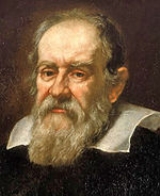
In Depth
See Also

Galileo Galilei

Galileo Galilei was an Italian Italian people

The Italians are a Southern Europe [i]an ethnic group [i] found primarily in Italy [i] and in a wide-ran ... 

 physicist Physicist

A physicist is a scientist [i] who studies or practices physics [i]. ... 

, astronomer Astronomer

An astronomer or astrophysicist is a person whose area of interest is astronomy [i] or astrophysics [i] ... 

, astrologer and philosopher Philosophy

[i] ... 

 who is closely associated with the scientific revolution. His achievements include improvements to the telescope Telescope

The word "telescope" usually refers to optical telescope [i]s, but there are telescopes for most of the ... 

, a variety of astronomical observations, the and laws of motion, and effective support for Copernicanism Nicolaus Copernicus

Nicolaus Copernicus was an astronomer [i] who provided the first modern formulation of a heliocentric [i] ... 

. He has been referred to as the "father of modern astronomy Astronomy

Astronomy is the science [i] of celestial objects and phenomena [i] that originate outside the Earth's atmosphere [i] ... 

," as the "father of modern physics Physics

Physics , the most fundamental physical science [i], is concerned with the underlying principles of the ... 

," and as the "father of science Science

Science in the broadest sense refers to any system of knowledge attained by verifiable means.... 

."

Discussions

  Discussion Features

   Ask a question about 'Galileo Galilei'

   Start a new discussion about 'Galileo Galilei'

   Answer questions about 'Galileo Galilei'

   'Galileo Galilei' discussion forum

Timeline

1564   Born

1609   Galileo Galilei demonstrates his first telescope Telescope

The word "telescope" usually refers to optical telescope [i]s, but there are telescopes for most of the ... 

 to Venetian lawmakers. He is the first to perform observational astronomy as he observes the moons of Jupiter Jupiter

Jupiter is the fifth planet [i] from the Sun [i] and the largest [i] within the solar system [i] ... 

1610   Galileo Galilei discovers the Galilean moon Galilean moons

The Galilean moons are the four moons of Jupiter [i] discovered by Galileo Galilei [i]. ... 

s of Jupiter Jupiter

Jupiter is the fifth planet [i] from the Sun [i] and the largest [i] within the solar system [i] ... 

.

1612   Galileo Galilei was the first astronomer Astronomer

An astronomer or astrophysicist is a person whose area of interest is astronomy [i] or astrophysics [i] ... 

 to observe the planet Planet

The International Astronomical Union [i] , the official scientific [i] body for astronomical [i] nomenclature [i] ... 

 Neptune Neptune

Neptune is the eighth and outermost planet [i] in our solar system [i]. ... 

 when it was in conjunction Conjunction (astronomy)

Conjunction is a term used in positional astronomy [i] and astrology [i]. ... 

 with Jupiter Jupiter

Jupiter is the fifth planet [i] from the Sun [i] and the largest [i] within the solar system [i] ... 

, yet he mistakenly catalogued it as a fixed star because of its extremely slow motion along the ecliptic Ecliptic

The ecliptic is the apparent path the Sun traces out along the sky — independent of Earth's rotati... 

. Neptune was not truly discovered until 1846, about 234 years after Galileo first sighted it with his telescope Telescope

The word "telescope" usually refers to optical telescope [i]s, but there are telescopes for most of the ... 

.

1632   Galileo Galileo Galilei

Galileo Galilei was an Italian [i] physicist [i], astronomer [i], astrologer [i] and philosopher [i] ... 

's Dialogue Concerning the Two Chief World Systems is published.

1633   Galileo Galilei arrives in Rome Rome

Rome is the capital [i] of Italy [i] and of its region, called Latium [i]. ... 

 for his trial before the Inquisition Inquisition

The term Inquisition refers broadly to a number of historical movements orchestrated by the Roman Catholic Church [i] ... 

.

1633   Catholic church Roman Catholic Church

The Roman Catholic Church or Catholic Church is the Christian [i] Church [i] ... 

 forces Galileo Galilei to recant his heliocentric view of the solar system Solar System

The Solar System or solar system is the stellar system [i] comprising the Sun [i] and ... 

. ''Eppur si muove''.

1642   Died

1822   Galileo Galilei's ''Dialogue'' taken off the Index Librorum Prohibitorum Index Librorum Prohibitorum

The Index Librorum Prohibitorum is a list of publications which the Catholic Church [i] ... 

, the Roman Catholic Church Roman Catholic Church

The Roman Catholic Church or Catholic Church is the Christian [i] Church [i] ... 

's list of banned books.

1983   Pope John Paul II Pope John Paul II

Pope John Paul II , , born Karol Jzef Wojtyla reigned as Pope [i] of the Catholic Church [i] fro ... 

 retracts the ban on Galileo Galilei.

   More Events >>


Quotations

See now the power of truth; the same experiment which at first glance seemed to show one thing, when more carefully examined, assures us of the contrary.

       More Quotes >>


Encyclopedia


Galileo Galilei was an Italian Italian people

The Italians are a Southern Europe [i]an ethnic group [i] found primarily in Italy [i] and in a wide-ran ... 

 physicist Physicist

A physicist is a scientist [i] who studies or practices physics [i]. ... 

, astronomer Astronomer

An astronomer or astrophysicist is a person whose area of interest is astronomy [i] or astrophysics [i] ... 

, astrologer and philosopher Philosophy

[i]
... 

 who is closely associated with the scientific revolution. His achievements include improvements to the telescope Telescope

The word "telescope" usually refers to optical telescope [i]s, but there are telescopes for most of the ... 

, a variety of astronomical observations, the and laws of motion, and effective support for Copernicanism Nicolaus Copernicus

Nicolaus Copernicus was an astronomer [i] who provided the first modern formulation of a heliocentric [i] ... 

. He has been referred to as the "father of modern astronomy Astronomy

Astronomy is the science [i] of celestial objects and phenomena [i] that originate outside the Earth's atmosphere [i] ... 

," as the "father of modern physics Physics

Physics , the most fundamental physical science [i], is concerned with the underlying principles of the ... 

," and as the "father of science Science

Science in the broadest sense refers to any system of knowledge attained by verifiable means.... 

."
The work of Galileo is considered to be a significant break from that of Aristotle Aristotle

Aristotle was an ancient Greek [i] philosopher [i], a student of Plato [i] ... 

. In addition, his conflict with the Roman Catholic Church Roman Catholic Church

The Roman Catholic Church or Catholic Church is the Christian [i] Church [i] ... 

 is taken as a major early example of the conflict of authority and freedom of thought, particularly with science Science

Science in the broadest sense refers to any system of knowledge attained by verifiable means.... 

, in Western society Western world

The term Western World or "the West" can have multiple meanings depending on its context.... 

.

Biographical sketch

Galileo was born in Pisa Pisa

Pisa is a city in Tuscany [i], central Italy [i], on the right bank of the mouth of the Arno River [i] o ... 

, in the Tuscany Tuscany

Tuscany is a region in central Italy [i], bordering on Latium [i] to the south, Umbria [i] and Marche [i]... 

 region of Italy Italy

Italy, officially the Italian Republic , is a Southern European [i] country. ... 

, on February 15 1564. He was the son of Vincenzo Galilei, a mathematician and musician born in Florence in 1520, and Giulia Ammannati. Galileo was their first child out of seven.

Galileo was tutored from a very young age. Later, he attended the University of Pisa University of Pisa

The University of Pisa is one of the most renowned Italian universities.... 

 but was forced to cease his study there for financial reasons. However, he was offered a position on its faculty in 1589 and taught mathematics. Soon after, he moved to the University of Padua University of Padua

The University of Padua located in Padua [i], Italy [i] was founded in 1222. ... 

 and served on its faculty, teaching geometry Geometry

Geometry arose as the field of knowledge dealing with spatial relationships.... 

, mechanics, and astronomy Astronomy

Astronomy is the science [i] of celestial objects and phenomena [i] that originate outside the Earth's atmosphere [i] ... 

 until 1610. During this time he explored science and made many significant discoveries.

Although he was a devout Catholic, Galileo fathered three children out of wedlock: two daughters and one son. All were the children of Galileo and Marina Gamba. Because of their illegitimate birth, both girls were sent to the convent of San Matteo in Arcetri at early ages.

  • Virginia who took the name Maria Celeste Maria Celeste

    Sister Maria Celeste, born Virginia Gamba on August 16, 1600, was the daughter of Galileo Galilei [i] an ... 

     upon entering a convent. She was Galileo's eldest child, the most beloved, and inherited her father's sharp mind. She died on April 2 1634, and is currently buried with Galileo at the Basilica di Santa Croce di Firenze Basilica di Santa Croce di Firenze

    The Basilica di Santa Croce is the principal Franciscan [i] church [i] of Florence [i], Italy [i], and a ... 

    .
  • Livia took the name Suor Arcangela, she was sick for most of her life at the convent.
  • Vincenzio was later legitimized and married Sestilia Bocchineri.


In 1612, Galileo went to Rome, where he joined the Accademia dei Lincei and observed sunspot Sunspot

A sunspot is a region on the Sun [i]'s surface that is marked by a lower temperature than its surroundi ... 

s. In 1612, opposition arose to the Copernican Nicolaus Copernicus

Nicolaus Copernicus was an astronomer [i] who provided the first modern formulation of a heliocentric [i] ... 

 theories, which Galileo supported. In 1614, from the pulpit of Santa Maria Novella, Father Tommaso Caccini  denounced Galileo's opinions on the motion of the Earth, judging them dangerous and close to heresy. Galileo went to Rome to defend himself against these accusations, but, in 1616, Cardinal Roberto Bellarmino Robert Bellarmine

Roberto Francesco Romolo Cardinal Bellarmino is a Saint [i] and Cardinal [i] of the Roman Catholic Church [i] ... 

 personally handed Galileo an admonition enjoining him to neither advocate nor teach Copernican astronomy as religious doctrine. In 1622, Galileo wrote the The Assayer , which was approved and published in 1623. In 1624, he developed the first known example of the microscope Microscope

A microscope is an instrument for viewing objects that are too small to be seen by the naked or unaided... 

. In 1630, he returned to Rome to apply for a license to print the Dialogue Concerning the Two Chief World Systems, published in Florence Florence

Florence is the capital city [i] of the region of Tuscany [i], Italy [i].
... 

 in 1632. In October of that year, however, he was ordered to appear before the Holy Office in Rome. The court issued a sentence of condemnation and forced Galileo to abjure. As a result, he was confined in Siena Siena

This article is about the Italian city.... 

 and eventually, in December 1633, he was allowed to retire to his villa in Arcetri Arcetri

Arcetri is a region of Florence [i] in the hills to the south of the city centre. ... 

. In 1634, he was deprived of the support of his beloved daughter, Sister Maria Celeste , who died prematurely. In 1638, almost totally blind, Galileo published his final book, Two New Sciences, in Leiden Leiden

[i] is a city and municipality in South Holland [i], The Netherlands [i] ... 

. He died in Arcetri Arcetri

Arcetri is a region of Florence [i] in the hills to the south of the city centre. ... 

 on January 8, 1642, in the company of his student Vincenzo Viviani Vincenzo Viviani

Vincenzo Viviani was an Italian [i] mathematician [i] and scientist [i]. ... 

.

Scientific methods

To the pantheon of the scientific revolution, Galileo Galilei takes a high position because of his pioneering use of quantitative experiments with results analyzed mathematically. There was no tradition of such methods in European thought at that time; the great experimentalist who immediately preceded Galileo, William Gilbert William Gilbert

William Gilbert was born May 24 [i], 1544 [i], Colchester [i], England [i] and died... 

, did not use a quantitative approach. However, Galileo's father, Vincenzo Galilei, a lutenist Lute

The lute is a plucked string instrument [i] with a fretted neck [i] and a deep round back. ... 

 and music theorist, had performed experiments in which he discovered what may be the oldest known non-linear relation in physics, between the tension and the pitch of a stretched string. These observations were in the Pythagorean tradition of music, well-known to instrument makers, that whole-number mathematical relationships define harmoneous scales. Thus, a limited form of mathematics had long made its way into physical science at the point of music, and young Galileo was in a position to see his own father's observations generalize that relationship still further. Galileo himself would find credit as the first to plainly state that the laws of nature are mathematical, and the idea that "the language of God is mathematics." This was a sharp break with earlier traditions of science: up until this point, following Aristotle Aristotle

Aristotle was an ancient Greek [i] philosopher [i], a student of Plato [i] ... 

, logic, not mathematics Mathematics

Mathematics is the discipline that deals with concepts such as quantity [i], structure [i], space [i] a ... 

 had been seen to be the basic intellectual tool of science.

Galileo also contributed to the rejection of blind allegiance to authority or other thinkers in matters of science and to the separation of science from philosophy Philosophy

[i]
... 

 or religion. These are the primary justifications for his description as the "father of science".

In the 20th century some authorities, in particular the distinguished French historian of science Alexandre Koyré Alexandre Koyré

... 

, challenged the validity of Galileo's experiments. The experiments reported in Two New Sciences to determine the law of acceleration of falling bodies, for instance, required accurate measurements of time, which appeared to be impossible with the technology of the 1600s. According to Koyré, the law was arrived at deductively, and the experiments were merely illustrative thought experiments.

Later research, however, has validated the experiments. The experiments on falling bodies were replicated using the methods described by Galileo , and the precision of the results were consistent with Galileo's report. Later research into Galileo's unpublished working papers from as early as 1604 clearly showed the validity of the experiments and even indicated the particular results that led to the time-squared law .

Galileo showed a remarkably modern appreciation for the proper relationship between mathematics, theoretical physics, and experimental physics. For example:
  • He understood the mathematical parabola, both in terms of conic section Conic section

    In mathematics [i], a conic section is a curve [i] that can be formed by intersecting a cone [i] ... 

    s and in terms of the square-law.
  • He asserted that the parabola was the theoretically-ideal trajectory, in the absence of friction and other disturbances. More remarkably, he stated limits to the validity of this theory, saying that it was appropriate for laboratory-scale and battlefield-scale trajectories. He went on to point out, on theoretical physics grounds, that the parabola could not possibly be correct if the trajectory were so large as to be comparable to the size of the planet.
  • He recognized that his experimental data would never agree exactly with any theoretical or mathematical form, because of the imprecision of measurement, irreducible friction, and other factors.


Due to the merit of his works, Einstein called Galileo the "father of modern science."

Astronomy


Contributions

That Galileo invented the telescope Telescope

The word "telescope" usually refers to optical telescope [i]s, but there are telescopes for most of the ... 

 is a popular misconception. However, he improved the device, was one of the first to use it to observe the sky, and for a time was one of very few people able to construct one good enough for that purpose. Based only on sketchy descriptions of the telescope, invented in the Netherlands Netherlands

The Netherlands is the Europe [i]an part of the Kingdom of the Netherlands [i] , which is formed ... 

 in 1608, Galileo made one with about 3x magnification, and then made improved models up to about 32x. On August 25 1609, he demonstrated his first telescope to Venetian Venice

Venice is the capital [i] of the region [i] of Veneto [i] and the province of the same name [i] ... 

 lawmakers. His work on the device also made for a profitable sideline with merchants who found it useful for their shipping businesses. He published his initial telescopic astronomical observations in March 1610 in a short treatise entitled Sidereus Nuncius Sidereus Nuncius

Sidereus Nuncius is a short treatise published in Latin [i] by Galileo Galilei [i] in March 1610 [i] ... 

.


On January 7 1610 Galileo discovered three of Jupiter Jupiter

Jupiter is the fifth planet [i] from the Sun [i] and the largest [i] within the solar system [i] ... 

's four largest satellites Natural satellite

A natural satellite [i] is a non-man-made object that orbits a planet [i] or other body larger than ... 

 : Io, Europa, and Callisto. He discovered Ganymede Ganymede

In Greek mythology [i], Ganymede, or closer to the Greek Ganymedes was a divine hero whose homelan ... 

 four nights later. He noted that the moons would appear and disappear periodically, an observation which he attributed to their movement behind Jupiter, and concluded that they were orbiting the planet. He made additional observations of them in 1620. Later astronomers overruled Galileo's naming of these objects, changing his originally named Medicean stars to Galilean satellites Galilean moons

The Galilean moons are the four moons of Jupiter [i] discovered by Galileo Galilei [i].... 

. The demonstration that a planet had smaller planets orbiting it was problematic for the orderly, comprehensive picture of the geocentric model Geocentric model

In astronomy [i], the geocentric model of the universe [i] is the theory [i] that the Earth [i] is at th ... 

 of the universe, in which everything circled around the Earth Earth

Earth is the third planet [i] in the solar system [i] in terms of distance from the Sun [i], and the fi ... 

.

From September 1610 Galileo observed that Venus Venus

Venus is the second-closest planet [i] to the Sun [i], orbiting it every 224.7 Earth days. ... 

 exhibited a full set of phase Lunar phase

In astronomy [i], a lunar phase is any of the aspects or appearances presented by the Moon [i] as seen f ... 

s similar to that of the Moon Moon

The Moon is Earth [i]'s only natural satellite [i]. ... 

. The heliocentric model Heliocentrism

In astronomy [i], heliocentrism is the theory [i] that the Sun [i] is at the center of the Universe [i]... 

 of the solar system developed by Copernicus Nicolaus Copernicus

Nicolaus Copernicus was an astronomer [i] who provided the first modern formulation of a heliocentric [i] ... 

 predicted that all phases would be visible since the orbit of Venus around the Sun Sun

|+ The Sun   |+
|-
... 

 would cause its illuminated hemisphere to face the Earth when it was on the opposite side of the Sun and to face away from the Earth when it was on the Earth-side of the Sun. In contrast, the geocentric model Geocentric model

In astronomy [i], the geocentric model of the universe [i] is the theory [i] that the Earth [i] is at th ... 

 of Ptolemy Ptolemy

Claudius Ptolemaeus , known in English as Ptolemy, was a Greek-speaking geographer [i], astronomer [i]... 

 predicted that only crescent and new phases would be seen, since Venus was thought to remain between the Sun and Earth during its orbit around the Earth. Galileo's observations of the phases of Venus proved that it orbited the Sun and lent support to the heliocentric model Heliocentrism

In astronomy [i], heliocentrism is the theory [i] that the Sun [i] is at the center of the Universe [i]... 

.

Galileo was one of the first Europeans to observe sunspot Sunspot

A sunspot is a region on the Sun [i]'s surface that is marked by a lower temperature than its surroundi ... 

s, although there is evidence that Chinese China

China is a cultural region [i] and ancient civilization [i] in East Asia [i]. ... 

 astronomers had done so long before. He also reinterpreted a sunspot observation from the time of Charlemagne Charlemagne

Charlemagne was the King of the Franks [i] who conquered Italy [i] and took the Iron Crown of Lombardy [i]... 

, which formerly had been attributed to a transit of Mercury. The very existence of sunspots showed another difficulty with the unchanging perfection of the heavens as assumed in the older philosophy. And the annual variations in their motions, first noticed by Francesco Sizi, presented great difficulties for both the geocentric system and that of Tycho Brahe Tycho Brahe

Tycho Brahe , born Tyge Ottesen Brahe , was a Danish [i] nobleman [i] best know ... 

. A dispute over priority in the discovery of sunspots led Galileo to a long and bitter feud with Christoph Scheiner; in fact, there is little doubt that both of them were beaten by David Fabricius and his son Johannes.

Galileo was also the first to report lunar mountain Mountain

A mountain is a landform [i] that extends above the surrounding terrain [i] in a limited area. ... 

s and crater Impact crater

An impact crater is a circular or oval depression [i] on a surface, usually referring to a ... 

s, whose existence he deduced from the patterns of light and shadow on the Moon's surface. He even estimated the mountains' heights from these observations. This led him to the conclusion that the Moon was "rough and uneven, and just like the surface of the Earth itself," rather than a perfect sphere Sphere

A sphere is a perfectly symmetrical [i] geometrical [i] object. ... 

 as Aristotle had claimed.

Galileo observed the Milky Way Milky Way

The Milky Way , is a barred spiral galaxy [i] which forms part of the Local Group [i]. ... 

, previously believed to be nebulous Nebula

A nebula is an interstellar cloud [i] of dust, gas and plasma [i]. ... 

, and found it to be a multitude of star Star

A star is a massive, compact body of plasma [i] in outer space [i] that is held together by its ... 

s packed so densely that they appeared to be clouds from Earth. He also located many other stars too distant to be visible with the naked eye.

Galileo observed the planet Neptune Neptune

Neptune is the eighth and outermost planet [i] in our solar system [i]. ... 

 in 1612, but did not realize that it was a planet and took no particular notice of it. It appears in his notebooks as one of many unremarkable dim stars.

Modern claims of scientific errors and misconduct

Although Galileo is generally considered one of the first modern scientists, as evidenced by his position in the sunspot controversy, he is often said to have arrogantly considered himself to be the sole proprietor of the discoveries in astronomy.

Furthermore, he never accepted Kepler's Johannes Kepler

Johannes Kepler , a key figure in the scientific revolution [i], was a German [i] mathematician [i] ... 

 elliptical orbits for the planets, holding to the circular orbits of Copernicus, which still employed epicycles Deferent and epicycle

In the Ptolemaic system [i] of astronomy [i], the epicycle was a geometric model to explain the variatio ... 

 to account for irregularities in planetary motions. For this reason, Galileo's "heliocentric" theory is incorrect, since there is, by definition, no geometric "center" to an elliptical orbit.

Galileo attributed tide Tide

The tide is the cyclic rising and falling of Earth's ocean [i] surface caused by the tidal force [i]s of ... 

s to momentum, despite his great knowledge of the ideas of relative motion and Kepler's better theories using the Moon Moon

The Moon is Earth [i]'s only natural satellite [i]. ... 

 as the cause. Galileo stated in his Dialogue that, if the Earth spins on its axis and is traveling at a certain speed around the Sun, parts of the Earth must travel "faster" at night and "slower" during the day. This is true in the Sun's frame of reference; but it is by no means adequate to explain the tides.

Since this theory was not based on any real scientific observations, many commentators believe Galileo developed the position to justify his own opinion. If his theory were correct, there would be only one high tide per day at noon. Galileo and his contemporaries were aware of this inadequacy because there are two daily high tides at Venice Venice

Venice is the capital [i] of the region [i] of Veneto [i] and the province of the same name [i] ... 

 instead of one, and they travel around the clock. But Galileo dismissed this anomaly as the result of several secondary causes, including the shape of the sea, its depth, and other things. Against the assertion that Galileo was deceptive in making these arguments, Albert Einstein Albert Einstein

Albert Einstein was a German [i]-born theoretical physicist [i]. ... 

 developed the opinion that Galileo developed his "fascinating arguments" and accepted them uncritically out of a desire for physical proof of the motion of the Earth .

Arthur Koestler Arthur Koestler

Arthur Koestler was a Hungarian [i] polymath [i] who became a naturalized British [i]... 

 argues for the case of Galileo's scientific misconduct in his book 'The Sleepwalkers'. Others argue that it is unfair to hold him to modern "scientific standards" with which he himself was only beginning to experiment. By the standards of his own time, Galileo was often willing to change his views in accordance with observation, as contrasted with a few notable men who refused even to look through their telescopes at celestial objects for fear of what they might see. It may also be argued that all modern scientists filter their observations and beliefs through pre-conceived notions. Although this may appear "dishonest," some of it is actually required for the scientific process to function . Galileo's perceived dishonesty, then, is not abnormal.

Physics

Galileo's theoretical and experimental work on the motions of bodies, along with the largely independent work of Kepler and René Descartes René Descartes

Ren Descartes
, also known as Cartesius, was a noted French philosopher [i], mathematician [i]... 

, was a precursor of the Classical mechanics Classical mechanics

Classical mechanics is used to describe the motion of macroscopic objects, from projectiles [i] to parts ... 

 developed by Sir Isaac Newton Isaac Newton

[i] [[[Old Style and New Style dates|OS]] [i]: [[25 December]] [i] [[1642]] [i]... 

. He was a pioneer, at least in the European tradition, in performing rigorous experiments and insisting on a mathematical Mathematics

Mathematics is the discipline that deals with concepts such as quantity [i], structure [i], space [i] a ... 

 description of the laws of nature.

One of the most famous stories about Galileo is that he dropped ball Ball

Balls are usually hollow and spherical [i] but can be other shapes, such as ovoid [i] or solid . ... 

s of different masses Mass

Mass is a property of a physical [i] object that quantifies the amount of matter [i] and energy [i] ... 

 from the Leaning Tower of Pisa Leaning Tower of Pisa

The Leaning Tower of Pisa or simply The Tower of Pisa is the campanile [i], or freestanding bel ... 

 to demonstrate that their time of descent was independent of their mass . This was contrary to what Aristotle had taught: that heavy objects fall faster than lighter ones, in direct proportion to weight. Though the story of the tower first appeared in a biography by Galileo's pupil Vincenzo Viviani Vincenzo Viviani

Vincenzo Viviani was an Italian [i] mathematician [i] and scientist [i]. ... 

, it is not now generally accepted as true. Moreover, Giambattista Benedetti had reached the same scientific conclusion years before, in 1553. However, Galileo did perform experiment Experiment

In the scientific method [i], an experiment , is a set of actions and observation [i]s, performed in the ... 

s involving rolling balls down inclined plane Inclined plane

An inclined plane is a plane [i] surface set at an angle, other than a right angle, against a hor ... 

s, which proved the same thing: falling or rolling objects are accelerated Acceleration

In physics [i] or physical science, acceleration is defined as the rate of change of velocity [i].... 

 independently of their mass. .

He determined the correct mathematical law for acceleration: the total distance covered, starting from rest, is proportional to the square of the time . He expressed this law using geometrical constructions and mathematically-precise words, adhering to the standards of the day. He also concluded that objects retain their velocity unless a force — often friction — acts upon them, refuting the generally accepted Aristotelian hypothesis that objects "naturally" slow down and stop unless a force acts upon them . Galileo's Principle of Inertia stated: "A body moving on a level surface will continue in the same direction at constant speed unless disturbed." This principle was incorporated into Newton's laws of motion Newton's laws of motion

Newton's Laws of Motion are three physical law [i]s which provide relationships [i] ... 

 .


Galileo also noted that a pendulum Pendulum

A simple gravity pendulum or bob pendulum , is a weight on the end of a rigid rod , which, when gi... 

's swings always take the same amount of time, independently of the amplitude Amplitude

[i] measure of a [[wave]... 

. The story goes that he came to this conclusion by watching the swings of the bronze chandelier in the cathedral of Pisa, using his pulse to time it. While Galileo believed this equality of period to be exact, it is only an approximation appropriate to small amplitudes. It is good enough to regulate a clock Clock

A clock is an instrument for measuring time [i] and for measuring time intervals of less than a day&mda... 

, however, as Galileo may have been the first to realize.

In the early 1600s, Galileo and an assistant tried to measure the speed of light Speed of light

The speed of light in a vacuum [i] is an important physical constant [i] denoted by the letter c for ... 

. They stood on different hilltops, each holding a shuttered lantern Lantern

A lantern is a portable [i] lighting [i] device used to illuminate broad areas. ... 

. Galileo would open his shutter, and, as soon as his assistant saw the flash, he would open his shutter. At a distance of less than a mile, Galileo could detect no delay in the round-trip time greater than when he and the assistant were only a few yards apart. While he could reach no conclusion on whether light propagated instantaneously, he recognized that the distance between the hilltops was perhaps too small for a good measurement.

Galileo is lesser known for, yet still credited with being one of the first to understand sound frequency. After scraping a chisel at different speeds, he linked the pitch of sound to the spacing of the chisel's skips .

In his 1632 Dialogue Galileo presented a physical theory to account for tide Tide

The tide is the cyclic rising and falling of Earth's ocean [i] surface caused by the tidal force [i]s of ... 

s, based on the motion of the Earth. If correct, this would have been a strong argument for the reality of the Earth's motion. His theory gave the first insight into the importance of the shapes of ocean basins in the size and timing of tides; he correctly accounted, for instance, for the negligible tides halfway along the Adriatic Sea Adriatic Sea

The Adriatic Sea is a large body of water on the west side of the Mediterranean Sea [i] separating the Apennine peninsula [i] ... 

 compared to those at the ends. As a general account of the cause of tides, however, his theory was a failure. Kepler and others correctly associated the Moon with an influence over the tides, based on empirical data; a proper physical theory of the tides, however, was not available until Newton.

Galileo also put forward the basic principle of relativity, that the laws of physics are the same in any system that is moving at a constant speed in a straight line, regardless of its particular speed or direction. Hence, there is no absolute motion or absolute rest. This principle provided the basic framework for Newton's laws of motion and is the infinite speed of light approximation to Einstein Albert Einstein

Albert Einstein was a German [i]-born theoretical physicist [i]. ... 

's special theory of relativity Special relativity

The special theory of relativity was proposed in 1905 [i] by Albert Einstein [i] in his article "On the Electrodynamics of Moving Bodies [i] ... 

.

Mathematics

While Galileo's application of mathematics to experimental physics was innovative, his mathematical methods were the standard ones of the day. The analyses and proofs relied heavily on the Eudoxian theory of proportion, as set forth in the fifth book of Euclid's Elements Euclid's Elements

Euclid's Elements is a mathematical [i] and geometric [i] treatise [i], consis... 

. This theory had become available only a century before, thanks to accurate translations by Tartaglia Niccolò Fontana Tartaglia

Niccol Fontana Tartaglia was a mathematician [i], an engineer [i] , surveyor and bookkeeper from the t ... 

 and others; but by the end of Galileo's life it was being superseded by the algebraic methods of Descartes René Descartes

Ren Descartes
, also known as Cartesius, was a noted French philosopher [i], mathematician [i]... 

.

Galileo produced one piece of original and even prophetic work in mathematics: Galileo's paradox, which shows that there are as many perfect squares as there are whole numbers, even though most numbers are not perfect squares. Such seeming contradictions were brought under control 250 years later in the work of Georg Cantor Georg Cantor

Georg Ferdinand Ludwig Philipp Cantor was a German mathematician who is best known as the creator of set theory [i]... 

.

Technology


Galileo made a few contributions to what we now call technology Technology

Despite its cultural pervasiveness, technology is an elusive concept.... 

 as distinct from pure physics, and suggested others. This is not the same distinction as made by Aristotle, who would have considered all Galileo's physics as techne or useful knowledge, as opposed to episteme, or philosophical investigation into the causes of things.

In 1595–1598, Galileo devised and improved a "Geometric and Military Compass" suitable for use by gunners Artillery

Historically, artillery refers to any engine used for the discharge of projectile [i]s during war [i] ... 

 and surveyors. This expanded on earlier instruments designed by Niccolo Tartaglia Niccolò Fontana Tartaglia

Niccol Fontana Tartaglia was a mathematician [i], an engineer [i] , surveyor and bookkeeper from the t ... 

 and Guidobaldo del Monte Guidobaldo del Monte

Guidobaldo del Monte, Marquis [i] del Monte, was an Italian [i] mathematician [i], philosopher [i]... 

. For gunners, it offered, in addition to a new and safer way of elevating cannon Cannon

A cannon is any large tubular firearm [i] designed to fire a heavy projectile [i] over a considerable di ... 

s accurately, a way of quickly computing the charge of gunpowder Gunpowder

Gunpowder, whether black powder [i] or smokeless powder [i], is a substance that burns [i] ... 

 for cannonball Cannonball

Cannonball can refer to:
... 

s of different sizes and materials. As a geometric instrument, it enabled the construction of any regular polygon Polygon

A polygon is a closed [i] planar [i] path composed of a finite number of sequential ... 

, computation of the area of any polygon or circular sector, and a variety of other calculations.

About 1606–1607 , Galileo made a thermometer Thermometer

A thermometer is a device which measures temperature [i] or temperature gradient [i], using a variety of ... 

, using the expansion and contraction of air in a bulb to move water in an attached tube.

In 1609, Galileo was among the first to use a refracting telescope Refracting telescope

A refracting or refractor telescope is a type of optical [i] telescope [i] that ... 

 as an instrument to observe stars, planets or moons.

In 1610, he used a telescope as a compound microscope Microscope

A microscope is an instrument for viewing objects that are too small to be seen by the naked or unaided... 

, and he made improved microscopes in 1623 and after. This appears to be the first Timeline of microscope technology

Timeline [i] of microscope [i] technology [i]
... 

 clearly documented use of the compound microscope.

In 1612, having determined the orbital periods of Jupiter's satellites, Galileo proposed that with sufficiently accurate knowledge of their orbits one could use their positions as a universal clock, and this would make possible the determination of longitude. He worked on this problem from time to time during the remainder of his life; but the practical problems were severe. The method was first successfully applied by Giovanni Domenico Cassini Giovanni Domenico Cassini

Giovanni Domenico Cassini was an Italian [i] astronomer [i], engineer [i], and astrologer [i].... 

 in 1681 and was later used extensively for large land surveys; this method, for example, was used by Lewis and Clark Lewis and Clark Expedition

The Lewis and Clark expedition was the first United States [i] overland expedition to the Pacific [i] ... 

. .

In his last year, when totally blind Blindness

[i] or [[psychological]... 

, he designed an escapement Escapement

The escapement drives the pendulum [i] in a pendulum clock [i], usually from a gear [i] train. ... 

 mechanism for a pendulum clock. The first fully operational pendulum clock was made by Christiaan Huygens Christiaan Huygens

Christiaan Huygens , was a Dutch [i] mathematician [i] and physicist [i] ... 

 in the 1650s.

He created sketches of various inventions, such as a candle Candle

A candle is a light [i] source usually consisting of an internal wick [i] which rises throug ... 

 and mirror Mirror

A mirror is a device whose surface has good specular reflection [i]; that is, it is smooth enough to for ... 

 combination to reflect light throughout a building, an automatic tomato Tomato

The tomato is a plant [i] in the Solanaceae [i] or nightshade [i] family, native to Central [i] ... 

 picker, a pocket comb that doubled as an eating utensil, and what appears to be a ballpoint pen Ballpoint pen

A ballpoint pen, also eponym [i]ously known in British English [i] as a biro , is a modern writing [i]... 

.

Church controversy

Main article: Galileo affair Galileo affair

The so-called Galileo affair, in which Galileo Galilei [i] came into conflict with the Catholic Church [i] ... 


Psalms 93:1 and Psalm 104:5, and Ecclesiastes 1:5 speak of the "firm" and "established" position of the earth. Galileo defended heliocentrism Heliocentrism

In astronomy [i], heliocentrism is the theory [i] that the Sun [i] is at the center of the Universe [i]... 

, and claimed it was not contrary to those Scripture passages. He took Augustine's position on Scripture: not to take every passage too literally, particularly when the scripture in question is a book of poetry and songs, not a book of instructions or history. The writers of the Scripture wrote from the perspective of the terrestrial world, and from that vantage point the sun does rise and set. In fact, it is the earth's rotation which gives the impression of the sun in motion across the sky.

By 1616 the attacks on Galileo had reached a head, and he went to Rome Rome

Rome is the capital [i] of Italy [i] and of its region, called Latium [i]. ... 

 to try to persuade the Church authorities not to ban his ideas. In the end, Cardinal Bellarmine Robert Bellarmine

Roberto Francesco Romolo Cardinal Bellarmino is a Saint [i] and Cardinal [i] of the Roman Catholic Church [i] ... 

, acting on directives from the Inquisition , delivered him an order not to "hold or defend" the idea that the Earth moves and the Sun stands still at the center. The decree did not prevent Galileo from hypothesizing heliocentrism. For the next several years Galileo stayed well away from the controversy.

He revived his project of writing a book on the subject, encouraged by the election of Cardinal Barberini Pope Urban VIII

Pope Urban VIII , born Maffeo Barberini, was Pope [i] from 1623 [i] to 1644 [i].
... 

 as Pope Urban VIII Pope Urban VIII

Pope Urban VIII , born Maffeo Barberini, was Pope [i] from 1623 [i] to 1644 [i].
... 

 in 1623. Barberini was a friend and admirer of Galileo, and had opposed the condemnation of Galileo in 1616. The book, Dialogue Concerning the Two Chief World Systems, was published in 1632, with formal authorization from the Inquisition Inquisition

The term Inquisition refers broadly to a number of historical movements orchestrated by the Roman Catholic Church [i] ... 

 and papal permission.

Pope Urban VIII personally asked Galileo to give arguments for and against heliocentrism in the book, and to be careful not to advocate heliocentrism. He made another request, that his own views on the matter be included in Galileo's book. Only the latter of those requests was fulfilled by Galileo. Whether unknowingly or deliberate, Simplicius, the defender of the Aristotelian Geocentric view in Dialogue Concerning the Two Chief World Systems, was often caught in his own errors and sometimes came across as a fool. This fact made Dialogue Concerning the Two Chief World Systems appear as an advocacy book; an attack on Aristotelian geocentrism and defense of the Copernican theory. To add insult to injury, Galileo put the words of Pope Urban VIII into the mouth of Simplicius. Most historians agree Galileo did not act out of malice and felt blindsided by the reaction to his book. However, the Pope did not take the public ridicule lightly, nor the blatant bias. Galileo had alienated one of his biggest and most powerful supporters, the Pope, and was called to Rome to explain himself.

With the loss of many of his defenders in Rome because of Dialogue Concerning the Two Chief World Systems, Galileo was ordered to stand trial on suspicion of heresy in 1633. The sentence of the Inquisition was in three essential parts:
  • Galileo was required to recant his heliocentric ideas; the idea that the Sun is stationary was condemned as "formally heretical".
  • He was ordered imprisoned; the sentence was later commuted to house arrest.
  • His offending Dialogue was banned; and in an action not announced at the trial and not enforced, publication of any of his works was forbidden, including any he might write in the future.


After a period with the friendly Ascanio Piccolomini , Galileo was allowed to return to his villa at Arcetri Arcetri

Arcetri is a region of Florence [i] in the hills to the south of the city centre. ... 

 near Florence, where he spent the remainder of his life under house arrest. It was while Galileo was under house arrest when he dedicated his time to one of his finest works, Two New Sciences. This book has received high praise from both Sir Isaac Newton Isaac Newton

[i] [[[Old Style and New Style dates|OS]] [i]: [[25 December]] [i] [[1642]] [i]... 

 and Albert Einstein Albert Einstein

Albert Einstein was a German [i]-born theoretical physicist [i]. ... 

. As a result of this work, Galileo is often called, the "father of modern physics."

Galileo was reburied on sacred ground at Santa Croce Basilica di Santa Croce di Firenze

The Basilica di Santa Croce is the principal Franciscan [i] church [i] of Florence [i], Italy [i], and a ... 

 in 1737. He was formally rehabilitated in 1741, when Pope Benedict XIV Pope Benedict XIV

Pope Benedict XIV , born Prospero Lorenzo Lambertini, was Pope [i] from 17 August 1740 [i] to 3 Ma ... 

 authorized the publication of Galileo's complete scientific works , and in 1758 the general prohibition against heliocentrism was removed from the Index Librorum Prohibitorum Index Librorum Prohibitorum

The Index Librorum Prohibitorum is a list of publications which the Catholic Church [i] ... 

. On 31 October 1992, Pope John Paul II Pope John Paul II

Pope John Paul II , , born Karol Jzef Wojtyla reigned as Pope [i] of the Catholic Church [i] fro ... 

 expressed regret for how the Galileo affair was handled, as the result of a study conducted by the Pontifical Council for Culture.

In modern scientific terms, we consider Galileo's views on heliocentricity to be no fundamental advance. The heliocenticity model that Galileo presented was no more accurate than the Tychonic system Tychonic system

The Tychonic system was an effort by Tycho Brahe [i] to create a model of the solar system [i] which wou ... 

 model, the main competing theory at the time. Stellar parallax Parallax

Parallax, or more accurately motion parallax is the change of angular position [i]... 

, the first evidence from outside the solar system that the Earth does indeed move, would be not observed until the 1838 . Today, we know the Sun is no more the center of the universe than the Earth is, as it has its own orbit in the Milky Way Galaxy Milky Way

The Milky Way , is a barred spiral galaxy [i] which forms part of the Local Group [i]. ... 

, just like the Galilean moons of Jupiter have orbits around Jupiter while Jupiter orbits the Sun. The Catholic Church held to the prevailing theological opinion of the day, which was that the Earth was the center of the universe.

Galileo's writings


  • Two New Sciences 1638 Lowys Elzevir  Leiden Leiden

    [i] is a city and municipality in South Holland [i], The Netherlands [i] ... 

  • Letters on Sunspots 1613
  • The Assayer 1623
  • Dialogue Concerning the Two Chief World Systems 1632
  • The Starry Messenger Sidereus Nuncius

    Sidereus Nuncius is a short treatise published in Latin [i] by Galileo Galilei [i] in March 1610 [i] ... 

    1610 Venice Venice

    Venice is the capital [i] of the region [i] of Veneto [i] and the province of the same name [i] ... 

  • Letter to Grand Duchess Christina 1615

Writings on Galileo

  • Galileo Galilei Galileo Galilei

    Galileo Galilei was an Italian [i] physicist [i], astronomer [i], astrologer [i] and philosopher [i] ... 

    , an opera by Philip Glass Philip Glass

    Philip Glass is an American [i] composer [i].... 

  • Galileo a play by