
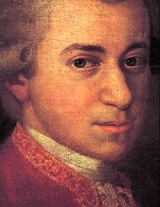
All Topics  
Wolfgang Amadeus Mozart

 
Wolfgang Amadeus Mozart

   Email Print
   Bookmark   Link


Wolfgang Amadeus Mozart


Wolfgang Amadeus Mozart (full name Johann Chrysostom Wolfgang Amadeus Mozart (27 January 1756 – 5 December 1791), was a prolific and influential composer
Composer

A composer is a person who creates music, usually in the medium of musical notation, for interpretation and performance. The level of distinction between composers and other musicians varies, which affects issues such as copyright and the deference given to individual interpretations of a particular piece of music....
 of the Classical era
Classical period (music)

The dates of the Classical period in Western music are generally accepted as 1750 to 1825. However, the term classical music is used colloquially to describe a variety of Western musical styles from the 9th century to the present....
. He composed over six hundred works
Musical composition

Musical composition is:* an original piece of music* the musical form of a musical piece* the process of creating a new piece of music...
, many acknowledged as pinnacles of symphonic
Symphony

A symphony is a musical composition, often extended and usually for orchestra. "Symphony" does not imply a specific form. Many symphonies are tonality works in four movement with the first in sonata form, and this is often described by music theorists as the structure of a "Classical period " symphony, although even some symphonies by the ac...
, concertante
Concerto

The term Concerto usually refers to a three-part musical work in which one solo instrument is accompanied by an orchestra. The concerto, as understood in this modern way, arose in the Baroque period side by side with the concerto grosso, which contrasted a small group of instruments with the rest of the orchestra....
, chamber
Chamber music

Chamber music is a form of classical music, written for a small group of instruments which traditionally could be accommodated in a palace chamber....
, piano
Piano

The piano is a musical instrument played by means of a keyboard instrument. Widely used in Western music for solo performance, ensemble use, chamber music, and accompaniment, the piano is also very popular as an aid to musical composition and rehearsal....
, opera
Opera

Opera is an Performing arts in which singers and musicians perform a dramatic work which combines a text and a musical score. Opera is part of the Western classical music tradition....
tic, and choral
Choir

A choir, chorale, or chorus is a musical ensemble of singers. Choral Music, in turn, is the music written specifically for a choir to perform....
 music
Music

Music is an art form whose media is sound organized in time. Common elements of music are pitch , rhythm , dynamics , and the sonic qualities of timbre and texture ....
; and he is among the most enduringly popular of classical
Classical music

Classical music is a broad term that usually refers to mainstream music produced in, or rooted in the traditions of Western art history Religious music and secular music, encompassing a broad period from roughly the 9th century to present times....
 composers.

Mozart showed prodigious ability from his earliest childhood in Salzburg
Salzburg

is the List of cities and towns in Austria#List of cities and towns by population size in Austria and the capital city of the states of Austria of Salzburg ....
.


Discussion
Ask a question about 'Wolfgang Amadeus Mozart'
Start a new discussion about 'Wolfgang Amadeus Mozart'
Answer questions from other users
Full Discussion Forum


Recent Posts


Quotations


As I love Mannheim, Mannheim loves me.

Letter to Leopold Mozart, (Mannheim, 1778-11-12, from Mozart's Letters, Mozart's Life: Selected Letters, ed. Robert Spaethling W.W. Norton, 2000, ISBN 0-393-04719-9, p. 193

My fatherland has always the first claim on me.

Letter to Leopold Mozart (1781-11-24), from Mozart: The Man and the Artist, as Revealed in his own Words by Friedrich Kerst, trans. Henry Edward Krehbiel (1905)


Encyclopedia


Wolfgang Amadeus Mozart (full name Johann Chrysostom Wolfgang Amadeus Mozart (27 January 1756 – 5 December 1791), was a prolific and influential composer
Composer

A composer is a person who creates music, usually in the medium of musical notation, for interpretation and performance. The level of distinction between composers and other musicians varies, which affects issues such as copyright and the deference given to individual interpretations of a particular piece of music....
 of the Classical era
Classical period (music)

The dates of the Classical period in Western music are generally accepted as 1750 to 1825. However, the term classical music is used colloquially to describe a variety of Western musical styles from the 9th century to the present....
. He composed over six hundred works
Musical composition

Musical composition is:* an original piece of music* the musical form of a musical piece* the process of creating a new piece of music...
, many acknowledged as pinnacles of symphonic
Symphony

A symphony is a musical composition, often extended and usually for orchestra. "Symphony" does not imply a specific form. Many symphonies are tonality works in four movement with the first in sonata form, and this is often described by music theorists as the structure of a "Classical period " symphony, although even some symphonies by the ac...
, concertante
Concerto

The term Concerto usually refers to a three-part musical work in which one solo instrument is accompanied by an orchestra. The concerto, as understood in this modern way, arose in the Baroque period side by side with the concerto grosso, which contrasted a small group of instruments with the rest of the orchestra....
, chamber
Chamber music

Chamber music is a form of classical music, written for a small group of instruments which traditionally could be accommodated in a palace chamber....
, piano
Piano

The piano is a musical instrument played by means of a keyboard instrument. Widely used in Western music for solo performance, ensemble use, chamber music, and accompaniment, the piano is also very popular as an aid to musical composition and rehearsal....
, opera
Opera

Opera is an Performing arts in which singers and musicians perform a dramatic work which combines a text and a musical score. Opera is part of the Western classical music tradition....
tic, and choral
Choir

A choir, chorale, or chorus is a musical ensemble of singers. Choral Music, in turn, is the music written specifically for a choir to perform....
 music
Music

Music is an art form whose media is sound organized in time. Common elements of music are pitch , rhythm , dynamics , and the sonic qualities of timbre and texture ....
; and he is among the most enduringly popular of classical
Classical music

Classical music is a broad term that usually refers to mainstream music produced in, or rooted in the traditions of Western art history Religious music and secular music, encompassing a broad period from roughly the 9th century to present times....
 composers.

Mozart showed prodigious ability from his earliest childhood in Salzburg
Salzburg

is the List of cities and towns in Austria#List of cities and towns by population size in Austria and the capital city of the states of Austria of Salzburg ....
. Already competent on keyboard and violin, he composed from the age of five and performed before European royalty; at seventeen he was engaged as a court musician in Salzburg, but grew restless and traveled in search of a better position, always composing abundantly. Visiting Vienna
Vienna

Vienna is the Capital of Republic of Austria and also one of the nine states of Austria. Vienna is Austria's primary city, with a population of about 1.7 million...
 in 1781 he was dismissed from his Salzburg position and chose to stay in the capital, where over the rest of life he achieved fame but little financial security. The final years in Vienna yielded many of his best-known symphonies, concertos, and operas, and the Requiem. The circumstances of his early death have been much mythologized. He was survived by his wife Constanze
Constanze Mozart

Constanze Mozart was the wife of Wolfgang Amadeus Mozart....
 and two sons.

Mozart always learned voraciously from others, and developed a brilliance and maturity of style that encompassed the light and graceful along with the dark and passionate—the whole informed by a vision of humanity "redeemed through art, forgiven, and reconciled with nature and the absolute". His influence on all subsequent Western art music is profound. Beethoven
Ludwig van Beethoven

Ludwig van Beethoven was a German composer and pianist. He was a crucial figure in the transitional period between the Classical music era and Romantic music eras in classical music, and remains one of the most acclaimed and influential composers of all time....
 wrote his own early compositions in the shadow of Mozart, of whom Joseph Haydn
Joseph Haydn

Joseph Haydn was an Austrians composer. He was one of the most prominent composers of the classical music era, and is called by some the "Father of the Symphony" and "Father of the String Quartet"....
 wrote that "posterity will not see such a talent again in 100 years".

Biography


Family and early years

Wolfgang Amadeus Mozart was born to Leopold
Leopold Mozart

Johann Georg Leopold Mozart was a composer, conductor, teacher, and violinist. He is best known today as the father and teacher of Wolfgang Amadeus Mozart, and for his violin textbook Versuch einer gr?ndlichen Violinschule....
 and Anna Maria Pertl Mozart at 9 Getreidegasse
Getreidegasse

Getreidegasse is a busy shopping street in the Old Town section of Salzburg. The house at no. 9 Getreidegasse is where Wolfgang Amadeus Mozart was born and lived until he was 17....
 in Salzburg
Salzburg

is the List of cities and towns in Austria#List of cities and towns by population size in Austria and the capital city of the states of Austria of Salzburg ....
, capital of the sovereign Archbishopric of Salzburg
Archbishopric of Salzburg

The Archbishopric of Salzburg was an Prince-Bishop of the Holy Roman Empire, roughly consisting of the present-day state of Salzburg in Austria....
, in what is now Austria
Austria

Austria , officially the Republic of Austria , is a landlocked country in Central Europe. It borders both Germany and the Czech Republic to the north, Slovakia and Hungary to the east, Slovenia and Italy to the south, and Switzerland and Liechtenstein to the west....
, but then part of the Holy Roman Empire
Holy Roman Empire

The Holy Roman Empire was a union of territories in Central Europe during the Middle Ages and the Early modern Europe under a Holy Roman Emperor....
. His only sibling to survive past birth was Maria Anna
Maria Anna Mozart

"Marianne Mozart" redirects here. For her cousin of the same name, see Maria Anna Thekla Mozart.Maria Anna Walburga Ignatia Mozart , nicknamed "Nannerl", was a famous musician in eighteenth century Europe....
 (1751–1829), called "Nannerl". Wolfgang was baptized
Baptism

In Christianity, baptism is the ritual act, with the use of water, by which one is admitted as a full member of the Christian Church and, in the view of some, as a member of the particular Church in which the baptism is administered....
 the day after his birth at St. Rupert's Cathedral. The baptismal record gives his name in Latinized form as Joannes Chrysostomus Wolfgangus Theophilus Mozart. He generally called himself "Wolfgang Amadè Mozart" as an adult, but there were many variants
Mozart's name

The composer Wolfgang Amadeus Mozart went by many different names in his lifetime. This resulted partly from the church traditions of the day, and partly from the fact that Mozart was multilingual and freely adapted his name to other languages....
. His father Leopold (1719–1787) was deputy Kapellmeister
Kapellmeister

Kapellmeister is a German language word designating a person in charge of music-making. The word is a compound word, consisting of the roots Kapelle and Meister ....
 to the court orchestra of the Archbishop of Salzburg, and a minor composer. He was also an experienced teacher, and in the year of Mozart's birth published a successful violin textbook, Versuch einer gründlichen Violinschule
Versuch einer gründlichen Violinschule

Versuch einer gr?ndlichen Violinschule is a textbook for instruction in the violin, published by Leopold Mozart in 1756. The work was influential in its day, and continues to serve as a scholarly source concerning 18th century historically informed performance....
.

Wolfgang Amadeus Mozart 2
When Nannerl was seven she began keyboard lessons with her father, and her three-year-old brother would look on, evidently fascinated. Years later, after his death, she reminisced:
He often spent much time at the clavier, picking out thirds, which he was always striking, and his pleasure showed that it sounded good. [...] In the fourth year of his age his father, for a game as it were, began to teach him a few minuets and pieces at the clavier. [...] He could play it faultlessly and with the greatest delicacy, and keeping exactly in time. [...] At the age of five he was already composing little pieces, which he played to his father who wrote them down.
Among these pieces were the Andante (K. 1a) and Allegro in C (K. 1b).

Biographer Maynard Solomon notes that while Leopold was a devoted teacher to his children, there is evidence that Wolfgang was keen to make progress beyond what he was being taught. His first ink-spattered composition and his precocious efforts with the violin were on his own initiative, and came as a great surprise to Leopold. Father and son were close, and these childhood accomplishments brought tears to Leopold's eyes.

Leopold eventually gave up composing when his son's outstanding musical talents became evident. He was Wolfgang's only teacher in his earliest years, and taught his children languages and academic subjects as well as music.

1762–1773: Years of travel

During Mozart's formative years, his family made several European journeys in which he and Nannerl were shown as child prodigies. These began with an exhibition in 1762 at the Court of the Elector of Bavaria
Bavaria

Bavaria , with an area of and almost 12.5 million inhabitants, is a region located in the southeast of Germany and is the largest States of Germany of Germany by area....
 in Munich
Munich

Munich is the capital city of Bavaria, Germany. Munich is located on the River Isar north of the Northern Limestone Alps. Munich is the third largest city in Germany, after Berlin and Hamburg....
, then in the same year at the Imperial Court in Vienna
Vienna

Vienna is the Capital of Republic of Austria and also one of the nine states of Austria. Vienna is Austria's primary city, with a population of about 1.7 million...
 and Prague
Prague

Prague is the Capital and World's largest cities of the Czech Republic. Its official name is Hlavn? mesto Praha, meaning Prague, the Capital City....
. A long concert tour spanning three and a half years followed, taking the family to the courts of Munich
Munich

Munich is the capital city of Bavaria, Germany. Munich is located on the River Isar north of the Northern Limestone Alps. Munich is the third largest city in Germany, after Berlin and Hamburg....
, Mannheim
Mannheim

Mannheim is a city in Germany. With 327,318 inhabitants it is the second-largest city in the state of Baden-W?rttemberg after the capital Stuttgart....
, Paris
Paris

Paris is the Capital of France and the country's largest city. It is situated on the river Seine, in northern France, at the heart of the ?le-de-France Regions of France ....
, London
London

London is the capital of both England and the United Kingdom, and the most populous municipality in the European Union. An important settlement for two millennia, History of London goes back to its founding by the Roman Empire....
, The Hague
The Hague

The Hague is the third largest city in the Netherlands after Amsterdam and Rotterdam, with a population of 475,904 and an area of approximately 100 km?....
, again to Paris, and back home via Zürich
Zürich

Z?rich is the largest city in Switzerland and the capital of the canton of Z?rich. The city is Switzerland's main commercial and cultural centre and sometimes called the Cultural Capital of Switzerland, the political capital of Switzerland being Berne....
, Donaueschingen
Donaueschingen

Donaueschingen is a Germany town in the Black Forest in the southwest of the States of Germany of Baden-W?rttemberg in the Schwarzwald-Baar district ....
, and Munich. During this trip Mozart met a great number of musicians and acquainted himself with the works of other composers. A particularly important influence was Johann Christian Bach
Johann Christian Bach

Johann Christian Bach was a composer of the Classical music era era, the eleventh and youngest son of Johann Sebastian Bach. He is sometimes referred to as 'the London Bach' or 'the English Bach', due to his time spent living in the British capital....
, whom Mozart visited in London in 1764 and 1765. The family again went to Vienna in late 1767 and remained there until December 1768.

These trips were often arduous, because of the primitive conditions of travel at that time, the need to wait patiently for invitations and reimbursement from the nobility, and long, near-fatal illnesses endured far from home: first Leopold (London, summer 1764) then both children (The Hague, autumn 1765).

After one year in Salzburg, Leopold and Wolfgang set off for Italy
Italy

Italy , officially the Italian Republic , is a country located on the Italian Peninsula in Southern Europe and on the two largest islands in the Mediterranean Sea, Sicily and Sardinia....
, leaving Wolfgang's mother and sister at home. This travel lasted from December 1769 to March 1771, and like earlier journeys had the purpose of displaying the young man's abilities as a performer, and as a rapidly maturing composer. Mozart met G.B. Martini
Giovanni Battista Martini

Giovanni Battista Martini, also known as Padre Martini was an Italy musician....
 in Bologna
Bologna

Bologna is the capital city of Emilia-Romagna in northern Italy, in the Po Valley , between the Po River and the Apennine Mountains, exactly between the Reno River and the S?vena River....
, and was accepted as a member of the famous Accademia Filarmonica
Philharmonic Academy of Bologna

The Accademia Filarmonica di Bologna is a music education institution in Bologna, Italy.It was established in 1666. Saint Anthony of Padua was chosen as its patron saint and the image of an organ bearing the motto Unitate melos was chosen as its coat of arms....
. In Rome he heard Gregorio Allegri
Gregorio Allegri

Gregorio Allegri was an Italy composer and priest of the Roman School of composers. He mainly lived in Rome, and died there....
's Miserere
Miserere (Allegri)

Miserere by Italy composer Gregorio Allegri is a setting of Psalm 51 composed during the reign of Pope Urban VIII, probably during the 1630s, for use in the Sistine Chapel during matins on Wednesday and Friday of Holy Week....
 once in performance in the Sistine Chapel
Sistine Chapel

Sistine Chapel is the best-known chapel in the Apostolic Palace, the official residence of the Pope in Vatican City. Its fame rests on its architecture, evocative of Solomon's Temple of the Old Testament and on its decoration which has been frescoed throughout by the greatest Renaissance artists including Michelangelo, Raphael, Bernini, and...
, then wrote it out in its entirety from memory, only returning to correct minor errors—thus producing the first illegal copy of this closely guarded property of the Vatican.

In Milan, Mozart wrote the opera Mitridate Rè di Ponto (1770), which was performed with success. This led to further opera commissions
Commission (art)

In art, a commission is the hiring and payment for the creation of a piece, often on behalf of another.In classical music, Musical ensembles are often said to commission pieces from composers, wherein the ensemble secures the composer's payment from private or public organizations or donors....
, and Wolfgang and Leopold later returned twice to Milan (August–December 1771; October 1772 – March 1773) for the composition and premieres of Ascanio in Alba
Ascanio in Alba

Ascanio in Alba, K?chel-Verzeichnis, is a pastoral opera in two parts by Wolfgang Amadeus Mozart to an Italian language libretto by Giuseppe Parini....
 (1771) and Lucio Silla
Lucio Silla

Lucio Silla is an Italian opera in three acts composed by Wolfgang Amadeus Mozart. The libretto was written by Giovanni de Gamerra.It was first performed on 26 December 1772 at the Regio Ducal Teatro in Milan....
 (1772). Leopold hoped these visits would result in a professional appointment for his son in Italy, but these hopes were never fulfilled.

Toward the end of the final Italian journey Mozart wrote the first of his works that is still widely performed today, the solo cantata
Cantata

A cantata is a vocal music music composition with an musical instrument accompaniment and often containing more than one movement ....
 Exsultate, jubilate
Exsultate, jubilate

Exsultate, Jubilate K?chel-Verzeichnis 165, by Wolfgang Amadeus Mozart was written in 1773.This religious solo motet was composed at the time Mozart was visiting Milan....
, K. 165.

1773–1777: The Salzburg court

After finally returning with his father from Italy on 13 March 1773, Mozart was employed as a court musician by the ruler of Salzburg Prince-Archbishop Hieronymus Colloredo. The composer was a favorite son in Salzburg, where he had a great number of friends and admirers, and he had the opportunity to work in many genres, including symphonies, sonatas, string quartets, serenades, and a few minor operas. Several of these early works are performed today. Between April and December of 1775, Mozart developed an enthusiasm for violin concertos, producing a series of five (the only ones he ever wrote), steadily increasing in their musical sophistication. The last three—(K. 216
Violin Concerto No. 3 (Mozart)

The Violin Concerto No. 3 in G major, K?chel-Verzeichnis 216, was composed by Wolfgang Amadeus Mozart in Salzburg in 1775 in music. Mozart was only 19 at the time....
, K. 218
Violin Concerto No. 4 (Mozart)

Violin Concerto No. 4 in D major K. 218 was composed by Wolfgang Amadeus Mozart in 1775 in Salzburg. The autograph of the score is preserved in Biblioteka Jagiellonska, Krak?w....
, K. 219
Violin Concerto No. 5 (Mozart)

The Violin concerto No. 5 in A Major was written by Wolfgang Amadeus Mozart in 1775, premiering during the holiday season that year in Salzburg....
)—are now staples of the repertoire. In 1776 he turned his efforts to piano concertos
Mozart piano concertos

The Mozart piano concertos are a set of 27 concertos for piano and orchestra written by Wolfgang Amadeus Mozart between 1767 and 1791. These works, many of which Mozart composed for himself to play in the Vienna concert series of 1784?86, held a special place for him; indeed, Leopold Mozart apparently interrupted him composing a "harpsichord...
, culminating in the E-flat concerto K. 271
Piano Concerto No. 9 (Mozart)

The Piano Concerto No. 9 "Jeunehomme" in E flat major, K?chel-Verzeichnis 271, by Wolfgang Amadeus Mozart was written in Salzburg in 1777, when Mozart was 21 years old....
 of early 1777, considered by critics to be a breakthrough work.

Despite these artistic successes, Mozart grew increasingly discontent with Salzburg and redoubled his efforts to find a position elsewhere. One reason appears to be his low salary, 150 florins per year; but also, Mozart longed to compose operas, and Salzburg provided only rare occasions for these. The situation worsened in 1775 when the court theater was closed, especially since the other theater in Salzburg was largely reserved for visiting troupes.

Two long expeditions in search of work (both Leopold and Wolfgang were looking) interrupted this long Salzburg stay: they visited Vienna from 14 July to 26 September 1773, and Munich
Munich

Munich is the capital city of Bavaria, Germany. Munich is located on the River Isar north of the Northern Limestone Alps. Munich is the third largest city in Germany, after Berlin and Hamburg....
 from 6 December 1774 to March 1775. Neither visit was successful, though the Munich journey resulted in a popular success with the premiere of the opera La finta giardiniera
La finta giardiniera

La finta giardiniera , K?chel-Verzeichnis 196, is an Italian language opera by Wolfgang Amadeus Mozart. Mozart wrote it in Munich in January 1775 when he was 18 years old and it received its first performance on January 13 at the Salvatortheater in Munich....
.

1777–1778: The Paris journey


In August 1777, Mozart resigned his Salzburg position and on 23 September ventured out once more in search of employment, with visits to Augsburg
Augsburg

Augsburg is an Independent City city in the south-west of Bavaria. The College town is home of the Regierungsbezirk Swabia and also of the Swabia and the Augsburg ....
, Mannheim
Mannheim

Mannheim is a city in Germany. With 327,318 inhabitants it is the second-largest city in the state of Baden-W?rttemberg after the capital Stuttgart....
, Paris
Paris

Paris is the Capital of France and the country's largest city. It is situated on the river Seine, in northern France, at the heart of the ?le-de-France Regions of France ....
, and Munich
Munich

Munich is the capital city of Bavaria, Germany. Munich is located on the River Isar north of the Northern Limestone Alps. Munich is the third largest city in Germany, after Berlin and Hamburg....
. Since Archbishop Colloredo would not give Leopold leave to travel, Mozart's mother Anna Maria was assigned to accompany him.

Mozart became acquainted with members of the famous orchestra in Mannheim, the best in Europe at the time. He also fell in love with Aloysia Weber
Aloysia Weber

Maria Aloysia Louise Antonia Weber was a Germany soprano, remembered primarily for her association with the composer Wolfgang Amadeus Mozart....
, one of four daughters in a musical family. There were some prospects of employment in Mannheim, but they came to nothing; and Mozart left for Paris on 14 March 1778 to continue his search. There his luck was hardly better; one of his letters home hints at a possible post as an organist at Versailles
Versailles

Versailles , formerly de facto capital of the kingdom of France, is now a wealthy suburb of Paris and is still an important administrative and judicial centre....
, but Mozart was not interested in such an appointment. He fell into debt and took to pawning valuables. The nadir of the visit occurred when Mozart's mother took ill, and died on 3 July 1778. There had been delays in calling a doctor—probably, according to Halliwell, because of a lack of funds.

While Wolfgang was in Paris, Leopold was energetically pursuing opportunities for him back in Salzburg,, and with the support of local nobility secured him a better post as court organist and concertmaster. The yearly salary was 450 florins; but Wolfgang was reluctant to accept, and after leaving Paris on 26 September 1778 he tarried in Mannheim and Munich, still hoping to obtain an appointment outside Salzburg. In Munich he again encountered Aloysia, now a very successful singer: but she made it plain that she was no longer interested in him.

Mozart finally reached home on 15 January 1779 and took up the new position, but his discontent with Salzburg was undiminished.

The A minor piano sonata
Piano Sonata No. 8 (Mozart)

Wolfgang Amadeus Mozart's Piano_sonata No. 8 in A_minor, K?chel-Verzeichnis 310 is a Sonata_%28music%29 in three movement :#Tempo#Italian tempo markings...
 K. 310/300d and the "Paris" Symphony
Symphony No. 31 (Mozart)

The Symphony Number 31 in D major, better known as the Paris Symphony, is one of the more famous Symphony by Wolfgang Amadeus Mozart. In the K?chel catalogue it is K?chel-Verzeichnis 297....
 (no. 31) are among several well-known works from Mozart's time in Paris, where they were performed on 12 June and 18 June 1778.

Martini Bologna Mozart 1777

1781: Departure to Vienna

In January 1781, Mozart's opera Idomeneo
Idomeneo

Idomeneo, re di Creta ossia Ilia e Idamante is an Italian language opera by Wolfgang Amadeus Mozart. The libretto was adapted by Varesco from a French text by Antoine Danchet, which had been set to music by Andr? Campra as Idom?n?e in 1712....
 premiered with "considerable success" in Munich
Munich

Munich is the capital city of Bavaria, Germany. Munich is located on the River Isar north of the Northern Limestone Alps. Munich is the third largest city in Germany, after Berlin and Hamburg....
. The following March the composer was summoned to Vienna
Vienna

Vienna is the Capital of Republic of Austria and also one of the nine states of Austria. Vienna is Austria's primary city, with a population of about 1.7 million...
, where his employer, Archbishop Colloredo, was attending the celebrations for the accession of Joseph II
Joseph II, Holy Roman Emperor

Joseph II was Holy Roman Emperor from 1765 to 1790 and ruler of the Habsburg Monarchy from 1780 to 1790. He was the eldest son of Empress Maria Theresa of Austria and her husband, Francis I, Holy Roman Emperor....
 to the Austrian throne. Mozart, fresh from the adulation he had earned in Munich, was offended when Colloredo treated him as a mere servant, and particularly when the archbishop forbade him to perform before the Emperor at Countess Thun
Maria Wilhelmine Thun

Countess Maria Wilhelmine Thun-Hohenstein, n?e Uhlfeldt was a Viennese aristocrat of the 18th century. She is remembered as the sponsor of a musically and intellectually outstanding salon and for her patronage of music, notably that of Wolfgang Amadeus Mozart and Ludwig van Beethoven....
's for a fee equal to half of his yearly Salzburg salary. The resulting quarrel came to a head in May: Mozart attempted to resign, and was refused. The following month permission was granted, but in a grossly insulting way: the composer was dismissed literally "with a kick in the ass", administered by the archbishop's steward, Count Arco. In Vienna, though, Mozart had become aware of some rich opportunities, and he decided to settle there as a freelance performer and composer.

The quarrel with the archbishop went harder for Mozart because his father sided against him. Hoping fervently that he would obediently follow Colloredo back to Salzburg, Leopold exchanged intense letters with his errant son, urging him to be reconciled with their employer; but Wolfgang passionately defended his intention to pursue an independent career in Vienna. The debate ended when Mozart was dismissed, freeing him from the demands of an oppressive employer and of an over-solicitous father. Solomon characterizes Mozart's resignation as a "revolutionary step", and it greatly altered the course of his life.

Early Vienna years

Mozart's new career in Vienna began well. He performed often as a pianist, notably in a competition before the Emperor with Muzio Clementi
Muzio Clementi

Muzio Clementi was a European classical music composer, and acknowledged as the first to write specifically for the piano. He is best known for his piano sonata and sonatina and his collection of piano studies, Gradus ad Parnassum....
 on 24 December 1781, and he soon "had established himself as the finest keyboard player in Vienna". He also prospered as a composer, and in 1782 completed the opera Die Entführung aus dem Serail
Die Entführung aus dem Serail

Die Entf?hrung aus dem Serail is an opera Singspiel in three acts by Wolfgang Amadeus Mozart. The German language libretto is by Christoph Friedrich Bretzner with adaptations by Gottlieb Stephanie....
 ("The Abduction from the Seraglio"), which premiered on 16 July 1782 to enormous acclaim. The work was soon being performed "throughout German-speaking Europe", and fully established Mozart's reputation as a composer.

Costanze Mozart By Lange 1782
Near the height of his quarrels with Colloredo, Mozart moved in with the Weber family, who had moved to Vienna from Mannheim. The father, Fridolin, had died, and the Webers were now taking in lodgers to make ends meet. Aloysia, who had earlier rejected Mozart's suit, was now married to the actor Joseph Lange
Joseph Lange

Joseph Lange was an actor and amateur painter of the 18th century. Through his marriage to Aloysia Weber, he was the brother-in-law of Wolfgang Amadeus Mozart....
, and Mozart's interest shifted to the third daughter, Constanze
Constanze Mozart

Constanze Mozart was the wife of Wolfgang Amadeus Mozart....
. The couple were married on 4 August 1782, eventually securing Leopold's "grudging consent". In the marriage contract, Constanze "assigns to her bridegroom five hundred gulden which [...] the latter has promised to augment with one thousand gulden", with the total "to pass to the survivor". Further, all joint acquisitions during the marriage were to remain the common property of both. The couple had six children:
  • Raimund Leopold (17 June – 19 August 1783)
  • Karl Thomas Mozart
    Karl Thomas Mozart

    Karl Thomas Mozart was the second son, and the elder of the two surviving sons, of Wolfgang Amadeus Mozart and Constanze Mozart. Karl was born in Vienna....
  • Johann Thomas Leopold (18 October – 15 November 1786)
  • Theresia Constanzia Adelheid Friedericke Maria Anna (27 December 1787 – 29 June 1788)
  • Anna Maria (died soon after birth, 25 December 1789)
  • Franz Xaver Wolfgang Mozart
    Franz Xaver Wolfgang Mozart

    Franz Xaver Wolfgang Mozart , also known as F. X. Mozart, W. A. Mozart Son, or Wolfgang Amadeus Mozart, Jr., was the youngest child of six born to Wolfgang Amadeus Mozart and his wife Constanze Mozart....


In the course of 1782 and 1783 Mozart became intimately acquainted with the work of Johann Sebastian Bach
Johann Sebastian Bach

Johann Sebastian Bach was a German composer and organ whose sacred and secular works for choir, orchestra, and solo instruments drew together the strands of the Baroque music period and brought it to its ultimate maturity....
 and George Frideric Handel
George Frideric Handel

George Frideric Handel was an England Baroque music composer of Germany birth who is famous for his operas, oratorios, and concerto grosso. His life and music may justly be described as "cosmopolitan": he was born in Germany, trained in Italy, and spent most of his life in England....
 as a result of the influence of Gottfried van Swieten
Gottfried van Swieten

Baron Gottfried van Swieten was a diplomat, librarian, and government official who served the Habsburg Monarchy during the eighteenth century....
, who owned many manuscripts of the Baroque
Baroque music

Baroque music describes a period or style of European classical music approximately extending from Dates of classical music eras. This era is said to begin in music after the Renaissance music and was followed by the Classical music era....
 masters. Mozart's study of these scores inspired compositions in Baroque style, and later had a powerful influence on his own personal musical language: for example in fugal
Fugue

In music, a fugue is a type of counterpoint composition or technique of composition for a fixed number of melody, normally referred to as "voices"....
 passages in Die Zauberflöte ("The Magic Flute") and the finale of Symphony No. 41
Symphony No. 41 (Mozart)

Wolfgang Amadeus Mozart completed his Symphony No. 41 in C major on 10 August 1788. It was his last symphony.The work is nicknamed the Jupiter Symphony....
.

In 1783, Wolfgang and Constanze visited his family in Salzburg. Leopold and Nannerl were, at best, only polite to Constanze; but the visit at least prompted the composition of one of Mozart's great liturgical pieces, the Mass in C Minor
Große Messe

The Gro?e Messe No. 17 in C minor K. 427 by Wolfgang Amadeus Mozartis the best-known and most widely performed of Mozart's mass settings, and is considered one of the composer's major works....
. Though not completed, it was premiered in Salzburg, with Constanze singing a solo part.

Mozart met Joseph Haydn
Joseph Haydn

Joseph Haydn was an Austrians composer. He was one of the most prominent composers of the classical music era, and is called by some the "Father of the Symphony" and "Father of the String Quartet"....
 in Vienna, and the two composers became friends (see Haydn and Mozart
Haydn and Mozart

The composers Wolfgang Amadeus Mozart and Joseph Haydn were friends. Their relationship is not very well documented, but the evidence that they enjoyed each other's company and greatly respected each other's work is strong....
). When Haydn visited Vienna, they sometimes played together in an impromptu string quartet
String quartet

A string quartet is a musical ensemble of four string instruments — usually two violins, a viola and cello — or a piece written to be performed by such a group....
. Mozart's six quartets dedicated to Haydn
Haydn Quartets (Mozart)

The "Haydn" Quartets by Wolfgang Amadeus Mozart are a set of six string quartets published in 1785 in Vienna, dedicated to the composer Joseph Haydn....
 (K. 387, K. 421, K. 428, K. 458, K. 464, and K. 465) date from the period 1782 to 1785, and amount to a carefully considered response to Haydn's Opus 33
List of string quartets by Joseph Haydn

This is a list of string quartets by Joseph Haydn, including the number they are given in Anthony van Hoboken's Hoboken-Verzeichnis of his works....
 set from 1781. He stood in awe of Mozart, whose sister recorded that in 1781 Haydn told the visiting Leopold: "I tell you before God, and as an honest man, your son is the greatest composer known to me by person and repute, he has taste and what is more the greatest skill in composition."

From 1782 to 1785 Mozart mounted concerts with himself as soloist, presenting three or four new piano concertos in each season. Since space in the theaters was scarce, he booked unconventional venues: a large room in the Trattnerhof (an apartment building); and the ballroom of the Mehlgrube (a restaurant). The concerts were very popular, and the concertos he premiered at them are still firm fixtures in the repertoire. Solomon writes that during this period Mozart created "a harmonious connection between an eager composer-performer and a delighted audience, which was given the opportunity of witnessing the transformation and perfection of a major musical genre".

With substantial returns from his concerts and elsewhere, he and Constanze adopted a rather plush lifestyle. They moved to an expensive apartment, with a yearly rent of 460 florins. Mozart also bought a fine fortepiano
Fortepiano

Fortepiano designates the early version of the piano, from its invention by the Italian instrument maker Bartolomeo Cristofori around 1700 up to the early 19th century....
 from Anton Walter for about 900 florins, and a billiard
Billiard

Billiard or billiards may refer to:* A , a type of shot in cue sports * Billiards: Cue sports in general, including pool, carom billiards, snooker, etc....
 table for about 300. The Mozarts sent their son Karl Thomas
Karl Thomas Mozart

Karl Thomas Mozart was the second son, and the elder of the two surviving sons, of Wolfgang Amadeus Mozart and Constanze Mozart. Karl was born in Vienna....
 to an expensive boarding school, and kept servants. Saving was therefore impossible, and the short period of financial success did nothing to soften the hardship the Mozarts were later to experience.

On 14 December 1784, Mozart became a Freemason
Freemasonry

Freemasonry is a fraternal and service organizations that arose from obscure origins in the late 16th to early 17th century. Freemasonry now exists in various forms all over the world, with a membership estimated at around 5 million ....
, admitted to the lodge Zur Wohltätigkeit ("Beneficence"). Freemasonry played an important role in the remainder of Mozart's life: he attended many meetings, a number of his friends were Masons, and on various occasions he composed Masonic music. (See Mozart and Freemasonry
Mozart and Freemasonry

For the last seven years of his life Wolfgang Amadeus Mozart was a Freemasonry. The Masonic order played an important role in his life and work....
.)

1786–1787: Return to opera

Despite the great success of Die Entführung aus dem Serail
Die Entführung aus dem Serail

Die Entf?hrung aus dem Serail is an opera Singspiel in three acts by Wolfgang Amadeus Mozart. The German language libretto is by Christoph Friedrich Bretzner with adaptations by Gottlieb Stephanie....
, Mozart did little operatic writing for the next four years, producing only two unfinished works and the one-act Der Schauspieldirektor
Der Schauspieldirektor

Der Schauspieldirektor , K?chel-Verzeichnis 486, is a comic Singspiel written by Wolfgang Amadeus Mozart to a German language libretto by Gottlieb Stephanie, an Austrian Schauspieldirektor....
. He focused instead on his career as a piano soloist and writer of concertos. However, around the end of 1785, Mozart moved away from keyboard writing and began his famous operatic collaboration with the librettist
Libretto

A libretto is the text used in an extended musical work such as an opera, operetta, masque, sacred or secular oratorio and cantata, Musical theater, and ballet....
 Lorenzo da Ponte
Lorenzo Da Ponte

Lorenzo Da Ponte was an Republic of Venice libretto and poet....
. 1786 saw the successful premiere of The Marriage of Figaro
The Marriage of Figaro

Le nozze di Figaro, ossia la folle giornata , K?chel-Verzeichnis, is an opera buffa composed in 1786_in_music#Opera by Wolfgang Amadeus Mozart, with Italian libretto by Lorenzo da Ponte, based on a stage comedy by Pierre Beaumarchais, The Marriage of Figaro ....
 in Vienna. Its reception in Prague later in the year was even warmer, and this led to a second collaboration with da Ponte: the opera Don Giovanni
Don Giovanni

Don Giovanni is an opera in two acts with music by Wolfgang Amadeus Mozart and with Italian language libretto by Lorenzo Da Ponte. It was premiered in the Estates Theatre in Prague on October 29, 1787 in music....
, which premiered in October 1787 to acclaim in Prague, and also met with success in Vienna in 1788. The two are esteemed among Mozart's most important works and are mainstays of the operatic repertoire today, though at their premieres their musical complexity caused difficulty for both listeners and performers. These developments were not witnessed by the composer's father, as Leopold had died on 28 May 1787.

In December 1787 Mozart finally obtained a steady post under aristocratic patronage. Emperor Joseph II
Joseph II, Holy Roman Emperor

Joseph II was Holy Roman Emperor from 1765 to 1790 and ruler of the Habsburg Monarchy from 1780 to 1790. He was the eldest son of Empress Maria Theresa of Austria and her husband, Francis I, Holy Roman Emperor....
 appointed him as his "chamber composer", a post that had fallen vacant the previous month on the death of Gluck
Christoph Willibald Gluck

Christoph Willibald Ritter von Gluck was an opera composer of the early classical period. After many years at the Habsburg court at Vienna, Gluck brought about the practical reform of opera's dramaturgical practices that many intellectuals had been campaigning for over the years....
. It was a part-time appointment, paying just 800 florins per year, and only required Mozart to compose dances for the annual balls in the Redoutensaal
Hofburg Imperial Palace

Hofburg Imperial Palace is a palace in Vienna, Austria, which has housed some of the most powerful people in History of Austria, including the Habsburg dynasty, rulers of the Austro-Hungarian empire....
. Mozart complained to Constanze that the pay was "too much for what I do, too little for what I could do". However, even this modest income became important to Mozart when hard times arrived. Court records show that Joseph's aim was to keep the esteemed composer from leaving Vienna in pursuit of better prospects.

In 1787 the young Ludwig van Beethoven
Ludwig van Beethoven

Ludwig van Beethoven was a German composer and pianist. He was a crucial figure in the transitional period between the Classical music era and Romantic music eras in classical music, and remains one of the most acclaimed and influential composers of all time....
 spent two weeks in Vienna, hoping to study with Mozart. The evidence concerning this time is conflicting, and at least three hypotheses are in play: that Mozart heard Beethoven play and praised him; that Mozart rejected Beethoven as a student; and that they never even met. (See Mozart and Beethoven
Mozart and Beethoven

Wolfgang Amadeus Mozart had a powerful influence on the work of Ludwig van Beethoven. Beethoven knew much of Mozart's work, and modeled a number of his own compositions on works of Mozart....
.)

1788–1790

Toward the end of the decade, Mozart's circumstances worsened. Around 1786 he had ceased to appear frequently in public concerts, and his income shrank. This was a difficult time for all musicians in Vienna because Austria was at war
Austro-Turkish War (1787-1791)

The Austro-Turkish War of 1787 was an inconclusive struggle between the Austrian Empire and Ottoman Empires. It took place concomitantly with the Russo-Turkish War of 1787-1792....
, and both the general level of prosperity and the ability of the aristocracy to support music had declined.

By mid-1788, Mozart and his family had moved from central Vienna to cheaper lodgings in the suburb of Alsergrund
Alsergrund

Alsergrund is the ninth district of Vienna, Austria . It is located just north of the first, central district, Innere Stadt. Alsergrund was incorporated in 1862, with seven suburbs....
. Mozart began to borrow money, most often from his friend and fellow Mason Michael Puchberg; "a pitiful sequence of letters pleading for loans" survives. Maynard Solomon and others have suggested that Mozart was suffering from depression, and it seems that his output slowed. Major works of the period include the last three symphonies (Nos. 39
Symphony No. 39 (Mozart)

The Symphony No. 39 in E-flat major of Wolfgang Amadeus Mozart, K?chel number 543, was completed 26 June, 1788....
, 40
Symphony No. 40 (Mozart)

Wolfgang Amadeus Mozart wrote his Symphony No. 40 in G minor, K?chel-Verzeichnis. 550, in 1788.The 40th Symphony is sometimes referred to as the ?Great? G minor symphony, to distinguish it from the ?Little? G minor symphony, Symphony No....
, and 41
Symphony No. 41 (Mozart)

Wolfgang Amadeus Mozart completed his Symphony No. 41 in C major on 10 August 1788. It was his last symphony.The work is nicknamed the Jupiter Symphony....
, all from 1788, and the last of the three da Ponte operas, Cosi fan tutte
Così fan tutte

Cos? fan tutte, ossia La scuola degli amanti K. 588, is an opera buffa by Wolfgang Amadeus Mozart. The libretto was written by Lorenzo da Ponte....
, premiered in 1790.

Around this time Mozart made long journeys hoping to improve his fortunes: to Leipzig
Leipzig

Leipzig is, with a population of over 511,252, the largest city in the States of Germany of Saxony, Germany....
, Dresden
Dresden

Dresden is the capital city of the Germany Federal Free state of Saxony. It is situated in a valley on the River Elbe. The Dresden conurbation is part of the Saxon triangle metropolitan area....
, and Berlin
Berlin

Berlin is the Capital of Germany city and one of sixteen States of Germany of Germany. With a population of 3.4 million within its city limits, Berlin is the country's largest city....
 in the spring of 1789 (see Mozart's Berlin journey
Mozart's Berlin journey

One of the longest adulthood journeys of Wolfgang Amadeus Mozart was a visit, beginning in Spring 1789, to a series of cities lying northward of his adopted home in Vienna: Prague, Leipzig, Dresden, and Berlin....
), and to Frankfurt
Frankfurt

is the largest city in the German States of Germany of Hesse and the List of cities in Germany with more than 100,000 inhabitants in Germany, with a 2008 population of 670,000....
, Mannheim
Mannheim

Mannheim is a city in Germany. With 327,318 inhabitants it is the second-largest city in the state of Baden-W?rttemberg after the capital Stuttgart....
, and other German cities in 1790. The trips produced only isolated success and did not relieve the family's financial distress.

1791

Mozart's last year was, until his final illness struck, a time of great productivity—and by some accounts a time of personal recovery. He composed a great deal, including some of his most admired works: the opera The Magic Flute
The Magic Flute

The Magic Flute is an opera in two acts composed in 1791 by Wolfgang Amadeus Mozart to a libretto by Emanuel Schikaneder. The work is in the form of a Singspiel, a popular form that included both singing and spoken dialogue....
, the final piano concerto (K. 595 in B-flat
Piano Concerto No. 27 (Mozart)

The Piano Concerto No. 27 in B flat major, K?chel-Verzeichnis. 595, is a concertante work by Wolfgang Amadeus Mozart, for piano or pianoforte and orchestra, the last piano concerto he wrote....
), the Clarinet Concerto
Clarinet Concerto (Mozart)

Wolfgang Amadeus Mozart's Clarinet concerto in A major, K?chel-Verzeichnis 622 was written in 1791 for the clarinetist Anton Stadler.It consists of the usual three movements, in a fast-slow-fast form:...
 K. 622, the last in his great series of string quintets (K. 614 in E-flat
String Quintet No. 6 (Mozart)

The String Quintet No. 6 in E-flat major, K?chel-Verzeichnis 614, was completed by Wolfgang Amadeus Mozart on April 12, 1791. It is Mozart's last major chamber work....
), the motet Ave verum corpus
Ave verum Corpus

Ave verum corpus is a short Eucharistic hymn dating from the 14th century and attributed to Pope Innocent VI , which has been set to music by various composers....
 K. 618, and the unfinished Requiem
Requiem (Mozart)

The Requiem Mass in D minor by Wolfgang Amadeus Mozart was composed in 1791. The requiem was Mozart's last composition, and is one of his most popular and most respected works....
 K. 626.

Mozart's financial situation, a source of extreme anxiety in 1790, finally began to improve. Although the evidence is inconclusive it appears that wealthy patrons in Hungary and Amsterdam pledged annuities to Mozart, in return for the occasional composition. He probably also benefited from the sale of dance music written in his role as Imperial chamber composer. Mozart no longer borrowed large sums from Puchberg, and made a start on paying off his debts.

He experienced great satisfaction in the public success of some his works, notably The Magic Flute (performed many times in the short period between its premiere and Mozart's death) and the Little Masonic Cantata K. 623, premiered on 15 November 1791.

Final illness and death

Wolfgang Amadeus Mozart 1
Mozart fell ill while in Prague, for the premiere on 6 September of his opera La clemenza di Tito
La clemenza di Tito

La clemenza di Tito , K?chel-Verzeichnis 621, is an opera seria composed by Wolfgang Amadeus Mozart, with text after Metastasio. It was started after the bulk of The Magic Flute, the last opera that Mozart worked on, was already written ....
, written in 1791 on commission for the Emperor's coronation festivities. He was able to continue his professional functions for some time, and conducted the premiere of The Magic Flute
The Magic Flute

The Magic Flute is an opera in two acts composed in 1791 by Wolfgang Amadeus Mozart to a libretto by Emanuel Schikaneder. The work is in the form of a Singspiel, a popular form that included both singing and spoken dialogue....
 on 30 September. The illness intensified on 20 November, at which point Mozart became bedridden, suffering from swelling, pain, and vomiting.

Mozart was nursed in his final illness by Constanze and her youngest sister Sophie, and attended by the family doctor, Thomas Franz Closset. It is clear that he was mentally occupied with the task of finishing his Requiem
Requiem (Mozart)

The Requiem Mass in D minor by Wolfgang Amadeus Mozart was composed in 1791. The requiem was Mozart's last composition, and is one of his most popular and most respected works....
. However, the evidence that he actually dictated passages to his student Süssmayr is very slim.

Mozart died at 1 a.m. on 5 December 1791. The New Grove gives a matter-of-fact description of his funeral:
Mozart was buried in a common grave, in accordance with contemporary Viennese custom, at the St Marx cemetery outside the city on 7 December. If, as later reports say, no mourners attended, that too is consistent with Viennese burial customs at the time; later Jahn (1856) wrote that Salieri, Süssmayr, van Swieten and two other musicians were present. The tale of a storm and snow is false; the day was calm and mild.


The cause of Mozart's death cannot be known with certainty. The official record has it as "hitziges Frieselfieber" ("severe miliary fever", referring to a rash that looks like millet seeds), a description that does not suffice to identify the cause as it would be diagnosed in modern medicine. Dozens of theories have been proposed, including trichinosis
Trichinosis

Trichinosis, also called trichinellosis, or trichiniasis, is a parasitic disease caused by eating raw or undercooked pork and wild game infected with the larvae of a species of roundworm Trichinella spiralis, commonly called the trichina worm....
, influenza
Influenza

Influenza, commonly known as the flu, is an infectious disease that affects birds and mammals caused by RNA viruses of the biological family Orthomyxoviridae ....
, mercury poisoning
Mercury poisoning

Mercury poisoning is a disease caused by exposure to mercury or its compounds. Mercury is a Heavy metal which occurs in several forms, all of which can produce toxic effects in high enough doses....
, and a rare kidney ailment. The practice of bleeding
Bloodletting

Bloodletting is the withdrawal of often considerable quantities of blood from a patient in the belief that this would cure or prevent a great many illnesses and diseases....
 medical patients, common at that time, is also cited as a contributing factor. The most widely accepted version, however, is that he died of acute rheumatic fever
Rheumatic fever

Rheumatic fever is an inflammatory disease disease which may develop two to three weeks after a Group A streptococcal infection . It is believed to be caused by antibody cross-reactivity and can involve the heart, joints, skin, and brain....
; he is known to have had three or even four attacks of it since his childhood, and this disease has a tendency to recur, with increasingly serious consequences each time, such as rampant infection and damage to the heart valves.

Mozart's sparse funeral did not reflect his standing with the public as a composer: memorial services and concerts in Vienna and Prague were well attended.< Indeed, in the period immediately after his death Mozart's reputation rose substantially: Solomon describes an "unprecedented wave of enthusiasm" for his work; biographies were written (first by Schlichtegroll
Friedrich Schlichtegroll

Adolf Heinrich Friedrich Schlichtegroll was the first biographer of Wolfgang Amadeus Mozart. His brief account of Mozart's life was published in a volume of twelve obituaries Schlichtegroll prepared and called Nekrolog auf das Jahr 1791 ....
, Niemetschek, and Nissen
Georg Nikolaus von Nissen

Georg Nikolaus von Nissen, was a Denmark diplomat and musicology. He is remembered as the author of one of the first biographies of Wolfgang Amadeus Mozart, still used today as a scholarly source on the life of this composer....
; see Biographies of Mozart
Biographies of Mozart

Wolfgang Amadeus Mozart died after a short illness on 5 December 1791. His reputation as a composer, already strong during his lifetime, rose rapidly in the years after his death, and he became one of the most celebrated of all composers....
); and publishers vied to produce complete editions of his works.

Mozart (unfinished) By Lange 1782

Appearance and character


Mozart's physical appearance was described by tenor Michael Kelly, in his Reminiscences: "a remarkable small man, very thin and pale, with a profusion of fine, fair hair of which he was rather vain". As his early biographer Niemetschek wrote, "there was nothing special about [his] physique. [...] He was small and his countenance, except for his large intense eyes, gave no signs of his genius." His facial complexion was pitted, a reminder of his childhood case of smallpox. He loved elegant clothing. Kelly remembered him at a rehearsal: "[He] was on the stage with his crimson pelisse
Pelisse

A Pelisse was originally a cloak made of fur or lined in fur, most notably a type of dolman. Hussar regiments wore pelisses overhanging their shoulders that had fur trim....
 and gold-laced cocked hat
Cocked hat

The cocked hat is a style of formal headgear, or hat, worn by certain civilian, Army and Navy officials from the mid-19th century until the beginning of World War II....
, giving the time of the music to the orchestra." Of his voice Constanze later wrote that it "was a tenor, rather soft in speaking and delicate in singing, but when anything excited him, or it became necessary to exert it, it was both powerful and energetic".

Mozart usually worked long and hard, finishing compositions at a tremendous pace as deadlines approached. He often made sketches and drafts, though unlike Beethoven's these are mostly not preserved, Constanze having sought to destroy them after his death. See: Mozart's compositional method
Mozart's compositional method

The question of how Wolfgang Amadeus Mozart created his works has long been studied. 19th century views on this topic were often based on a romantic, mythologizing conception of the process of composition....
.

He was raised a Roman Catholic, and remained a loyal member of the Church throughout his life; see: Mozart and Roman Catholicism
Mozart and Roman Catholicism

The celebrated composer Wolfgang Amadeus Mozart was raised Roman Catholicism and remained a loyal member of the Catholic Church throughout his life....
.

Mozart lived at the center of the Viennese musical world, and knew a great number and variety of people: fellow musicians, theatrical performers, fellow transplanted Salzburgers, and many aristocrats, including some acquaintance with the Emperor Joseph II
Joseph II, Holy Roman Emperor

Joseph II was Holy Roman Emperor from 1765 to 1790 and ruler of the Habsburg Monarchy from 1780 to 1790. He was the eldest son of Empress Maria Theresa of Austria and her husband, Francis I, Holy Roman Emperor....
. Solomon considers his three closest friends to have been Gottfried Janequin, Count August Hatzfeld, and Sigmund Barisani; the many others included his older colleague Joseph Haydn, singers Franz Xaver Gerl
Franz Xaver Gerl

Franz Xaver Gerl was a bass singer and composer of the Classical period . He sang the role of Sarastro in the premiere of Wolfgang Amadeus Mozart's opera The Magic Flute....
 and Benedikt Schack
Benedikt Schack

Benedikt Schack was a composer and tenor of the Classical period , a close friend of Wolfgang Amadeus Mozart and the first performer of the role of Tamino in Mozart's opera The Magic Flute....
, and the horn player Joseph Leutgeb. Leutgeb and Mozart carried on a curious kind of friendly mockery, often with Leutgeb as the butt of Mozart's practical jokes.

He enjoyed billiards
Billiards

Cue sports are a wide variety of Game of skill generally played with a cue stick which is used to strike billiard balls, moving them around a Baize-covered billiards table bounded by rubber ....
 and dancing (see: Mozart and dance
Mozart and dance

The composer Wolfgang Amadeus Mozart wrote a great deal of dance music, both for public use and as elements of larger works such as opera. Mozart was himself an enthusiast for dancing....
), and kept pets: a canary, a starling
Mozart's starling

For about three years the composer Wolfgang Amadeus Mozart kept a pet starling. The first record of the starling is the entry Mozart made in his expense book when he bought it on 27 May 1784:...
, a dog, and also a horse for recreational riding. Particularly in his youth, Mozart had a striking fondness for scatological humor (not so unusual in his time), which is preserved in his many surviving letters, notably those written to his cousin Maria Anna Thekla Mozart
Maria Anna Thekla Mozart

Maria Anna Thekla Mozart , called Marianne, known as B?sle , was the cousin of Wolfgang Amadeus Mozart.She was born in Augsburg, Germany, the third of five daughters of Franz Alois Mozart, a younger brother of Leopold Mozart and Maria Victoria Eschenbach....
 around 1777–1778, but also in his correspondence with his sister Nannerl and his parents. Mozart even wrote scatological music, the canon
Canon (music)

In music, a canon is a counterpoint composition that employs a melody with one or more imitations of the melody played after a given duration . The initial melody is called the leader , while the imitative melody is called the follower which is played in a different voice....
 "Leck mich im Arsch
Leck mich im Arsch

Leck mich im Arsch is a Canon in B-flat major composed by Wolfgang Amadeus Mozart, K?chel catalogue, with lyrics in German. It was one of a set of at least six canons probably written in Vienna in 1782....
" (literally "Lick me in the arse", sometimes idiomatically translated "Kiss my arse" or "Get stuffed") K. 231.

Works, musical style, and innovations


Style

Mozart's music, like Haydn's, stands as an archetypal example of the Classical style. At the time he began composing, European music was dominated by the style galant
Galant

In music, Galant was a term referring to a style, principally occurring in the third quarter of the 18th century, which featured a return to Classical music era simplicity after the complexity of the late Baroque music era....
: a reaction against the highly evolved intricacy of the Baroque
Baroque music

Baroque music describes a period or style of European classical music approximately extending from Dates of classical music eras. This era is said to begin in music after the Renaissance music and was followed by the Classical music era....
. But progressively, and in large part at the hands of Mozart himself, the contrapuntal
Counterpoint

In music, counterpoint is the relationship between two or more Register that are independent in contour and rhythm, and interdependent in harmony....
 complexities of the late Baroque emerged once more, moderated and disciplined by new forms
Musical form

The term musical form refers to two related concepts:*the type of composition *the structure of a particular musical piece .There is some overlap between musical form and musical genre....
, and adapted to a new aesthetic and social milieu. Mozart was a versatile composer, and wrote in every major genre, including symphony
Symphony

A symphony is a musical composition, often extended and usually for orchestra. "Symphony" does not imply a specific form. Many symphonies are tonality works in four movement with the first in sonata form, and this is often described by music theorists as the structure of a "Classical period " symphony, although even some symphonies by the ac...
, opera
Opera

Opera is an Performing arts in which singers and musicians perform a dramatic work which combines a text and a musical score. Opera is part of the Western classical music tradition....
, the solo concerto
Concerto

The term Concerto usually refers to a three-part musical work in which one solo instrument is accompanied by an orchestra. The concerto, as understood in this modern way, arose in the Baroque period side by side with the concerto grosso, which contrasted a small group of instruments with the rest of the orchestra....
, chamber music including string quartet
String quartet

A string quartet is a musical ensemble of four string instruments — usually two violins, a viola and cello — or a piece written to be performed by such a group....
 and string quintet
String quintet

A string quintet is an ensemble of five string instrument players or a piece written for such a combination. The most common combinations in european classical music are two violins, two violas and cello or two violins, viola and two cellos....
, and the piano sonata
Sonata

Sonata , in music, literally means a piece played as opposed to a cantata , a piece sung. The term, being vague, naturally evolved through the Music history, designating a variety of forms prior to the Classical music era era....
. These forms were not new; but Mozart advanced the technical sophistication and emotional reach of them all. He almost single-handedly developed and popularized the Classical piano concerto
Mozart piano concertos

The Mozart piano concertos are a set of 27 concertos for piano and orchestra written by Wolfgang Amadeus Mozart between 1767 and 1791. These works, many of which Mozart composed for himself to play in the Vienna concert series of 1784?86, held a special place for him; indeed, Leopold Mozart apparently interrupted him composing a "harpsichord...
. He wrote a great deal of religious music, including large-scale masses
Mass (music)

The Mass, a Musical form of sacred music, is a choir composition that sets the fixed portions of the Eucharistic liturgy to music. Most Masses are settings of Mass in Latin, the traditional language of the Roman Catholic Church, but there are a significant number written in the languages of non-Catholic countries where vernacular worship h...
: but also many dances, divertimenti
Divertimento

Divertimento is a musical genre, with most of its examples from the 18th century. The mood of the divertimento is most often lighthearted and it is generally composed for a small Musical ensemble....
, serenade
Serenade

In music, a serenade is, in its most general sense, a musical composition, and/or performance, in someone's honor. There are three general categories of serenade in music history....
s, and other forms of light entertainment.

The central traits of the Classical style are all present in Mozart's music. Clarity, balance, and transparency are the hallmarks of his work, but any simplistic notion of its delicacy masks the exceptional power of his finest masterpieces, such as the Piano Concerto No. 24
Piano Concerto No. 24 (Mozart)

The Piano Concerto No. 24 in C minor, K?chel-Verzeichnis. 491 is a concertante work for piano, or pianoforte, and orchestra by Wolfgang Amadeus Mozart....
 in C minor, K. 491, the Symphony No. 40
Symphony No. 40 (Mozart)

Wolfgang Amadeus Mozart wrote his Symphony No. 40 in G minor, K?chel-Verzeichnis. 550, in 1788.The 40th Symphony is sometimes referred to as the ?Great? G minor symphony, to distinguish it from the ?Little? G minor symphony, Symphony No....
 in G minor, K. 550, and the opera Don Giovanni
Don Giovanni

Don Giovanni is an opera in two acts with music by Wolfgang Amadeus Mozart and with Italian language libretto by Lorenzo Da Ponte. It was premiered in the Estates Theatre in Prague on October 29, 1787 in music....
. Charles Rosen
Charles Rosen

Charles Rosen is an Americanpianist and music theory.Charles Rosen studied piano with Moriz Rosenthal, but in an interview published in the June 2007 edition of BBC Music Magazine, he cites Josef Hofmann, whom he says he heard every year from age three, as a greater influence....
 makes the point forcefully:
It is only through recognizing the violence and sensuality at the center of Mozart's work that we can make a start towards a comprehension of his structures and an insight into his magnificence. In a paradoxical way, Schumann's superficial characterization of the G minor Symphony can help us to see Mozart's daemon more steadily. In all of Mozart's supreme expressions of suffering and terror, there is something shockingly voluptuous.
Especially during his last decade, Mozart exploited chromatic harmony to a degree rare at the time, with remarkable assurance and to great artistic effect.

Mozart always had a gift for absorbing and adapting valuable features of others' music. His travels certainly helped in the forging of a unique compositional language. In London as a child, he met J.C. Bach
Johann Christian Bach

Johann Christian Bach was a composer of the Classical music era era, the eleventh and youngest son of Johann Sebastian Bach. He is sometimes referred to as 'the London Bach' or 'the English Bach', due to his time spent living in the British capital....
 and heard his music. In Paris, Mannheim, and Vienna he met with many other compositional influences, as well as the avant-garde capabilities of the Mannheim orchestra. In Italy he encountered the Italian overture
Italian overture

The Italian overture is a piece of orchestral music with which in the late 17th and early 18th centiry several operas, oratorios and other large-scale works opened....
 and opera buffa
Opera buffa

The term opera buffa was at first used as an informal description of Italy comic operas variously classified by their authors as ?commedia in musica?, ?commedia per musica?, ?dramma bernesco?, ?dramma comico?, ?divertimento giocoso' etc....
, both of which deeply affected the evolution of his own practice. Both in London and Italy, the galant style was in the ascendent: simple, light music with a mania for cadencing
Cadence (music)

In Classical music musical theory, a harmonic cadence is a chord progression of two chord s that Conclusion a phrase , section , or composition of music....
; an emphasis on tonic, dominant, and subdominant to the exclusion of other harmonies; symmetrical phrases; and clearly articulated partitions in the overall form of movements. Some of Mozart's early symphonies are Italian overture
Italian overture

The Italian overture is a piece of orchestral music with which in the late 17th and early 18th centiry several operas, oratorios and other large-scale works opened....
s, with three movements running into each other; many are homotonal
Homotonal

Homotonal is a technical musical term pertaining to the tonality structure of multi-movement compositions. It was introduced into musicology by Hans Keller....
 (all three movements having the same key signature, with the slow middle movement being in the relative minor). Others mimic the works of J.C. Bach, and others show the simple rounded binary forms
Binary form

Binary form is a way of structuring a piece of music in two related sections, both of which are usually repeated. Binary is also a structure used to choreograph dance....
 turned out by Viennese composers.

As Mozart matured, he progressively incorporated more features adapted from the Baroque. For example, the Symphony No. 29 in A Major
Symphony No. 29 (Mozart)

The Symphony No. 29 in A major, K?chel catalogue 201, was completed by Wolfgang Amadeus Mozart on 6 April 1774 in music. It is, along with Symphony No....
 K. 201 has a contrapuntal main theme in its first movement, and experimentation with irregular phrase lengths. Some of his quartets from 1773 have fugal finales: probably influenced by Haydn, who had included three such finales in his recently published Opus 20 set. The influence of the Sturm und Drang
Sturm und Drang

Sturm und Drang is the name of a movement in German literature and music taking place from the late 1760s through the early 1780s in which individual subjectivity and, in particular, extremes of emotion were given free expression in response to the confines of rationalism imposed by the Enlightenment and associated aesthetic movements....
 ("Storm and Stress") period in music, with its brief foreshadowing of the Romantic era to come, is evident in the music of both composers at that time. Mozart's Symphony No. 25 in G minor
Symphony No. 25 (Mozart)

The Symphony No. 25 in G minor, K?chel catalogue. 183/173dB, was written by Wolfgang Amadeus Mozart in October 1773, shortly after the success of his opera seria Lucio Silla....
 K. 183 is another excellent example.

Mozart would sometimes switch his focus between operas and instrumental music. He produced operas in each of the prevailing styles: opera buffa
Opera buffa

The term opera buffa was at first used as an informal description of Italy comic operas variously classified by their authors as ?commedia in musica?, ?commedia per musica?, ?dramma bernesco?, ?dramma comico?, ?divertimento giocoso' etc....
, such as The Marriage of Figaro
The Marriage of Figaro

Le nozze di Figaro, ossia la folle giornata , K?chel-Verzeichnis, is an opera buffa composed in 1786_in_music#Opera by Wolfgang Amadeus Mozart, with Italian libretto by Lorenzo da Ponte, based on a stage comedy by Pierre Beaumarchais, The Marriage of Figaro ....
, Don Giovanni
Don Giovanni

Don Giovanni is an opera in two acts with music by Wolfgang Amadeus Mozart and with Italian language libretto by Lorenzo Da Ponte. It was premiered in the Estates Theatre in Prague on October 29, 1787 in music....
, and Così fan tutte
Così fan tutte

Cos? fan tutte, ossia La scuola degli amanti K. 588, is an opera buffa by Wolfgang Amadeus Mozart. The libretto was written by Lorenzo da Ponte....
; opera seria
Opera seria

Opera seria is an Italian musical term which refers to the noble and "serious" style of Italian opera that predominated in Europe from the 1710s to ca....
, such as Idomeneo
Idomeneo

Idomeneo, re di Creta ossia Ilia e Idamante is an Italian language opera by Wolfgang Amadeus Mozart. The libretto was adapted by Varesco from a French text by Antoine Danchet, which had been set to music by Andr? Campra as Idom?n?e in 1712....
; and Singspiel
Singspiel

Singspiel is a form of German language music drama, regarded as a genre of opera. It is characterized by spoken dialogue, sometimes performed over music, interspersed with Musical ensemble, popular songs, ballads and arias ....
, of which Die Zauberflöte is the most famous example by any composer. In his later operas he employed subtle changes in instrumentation, orchestral texture, and tone color, for emotional depth and to mark dramatic shifts. Here his advances in opera and instrumental composing interacted: his increasingly sophisticated use of the orchestra in the symphonies and concertos influenced his operatic orchestration, and his developing subtlety in using the orchestra to psychological effect in his operas was in turn reflected in his later non-operatic compositions.
Beethoven Riedel 1801

Influence

Mozart's most famous pupil, whom the Mozarts took into their Vienna home for two years as a child, was probably Johann Nepomuk Hummel
Johann Nepomuk Hummel

Johann Nepomuk Hummel or Jan Nepomuk Hummel was a composer and virtuoso pianist of Austrian origin who was born in Pressburg , but a part of Kingdom of Hungary when he was born....
, a transitional figure between Classical and Romantic eras.

More important is the influence Mozart had on composers of later generations. Ever since the surge in his reputation after his death, studying his scores has been a standard part of the training of classical musicians.

Ludwig van Beethoven

Ludwig van Beethoven was a German composer and pianist. He was a crucial figure in the transitional period between the Classical music era and Romantic music eras in classical music, and remains one of the most acclaimed and influential composers of all time....
, Mozart's junior by fourteen years, esteemed and was deeply influenced by his work, with which he was acquainted as a teenager. He is thought to have played in the court orchestra at Bonn
Bonn

Bonn is the 19th largest city in Germany. Located about 20 kilometres south of Cologne on the river Rhine in the Federal State of North Rhine-Westphalia, it was the Capital of Germany West Germany from 1949 to 1990 and the official seat of government of united Germany from 1990 to 1999....
 in performance of Mozart's operas, and he traveled to Vienna in 1787 hoping to study the older composer (see above). Some of Beethoven's works have direct models in comparable works by Mozart, and he wrote cadenzas (WoO
WoO

WoO is a catalogue prepared in 1955 by Harry Halm and Georg Kinsky, listing all of the compositions of Ludwig van Beethoven that were not originally published with an opus number, or survived only as fragments....
 58) to Mozart's D minor piano concerto K. 466
Piano Concerto No. 20 (Mozart)

The Piano Concerto No. 20 in D minor, K?chel Verzeichnis. 466, was written by Wolfgang Amadeus Mozart in 1785. The first performance was at the Mehlgrube Casino in Vienna on February 11, 1785, with the composer as the soloist....
.

A number of composers have paid homage to Mozart by writing sets of variations on his themes. Beethoven wrote four such sets (Op. 66, WoO 28, WoO 40, WoO 46). Others include Frédéric Chopin
Frédéric Chopin

Fr?d?ric Chopin was a composer and virtuoso pianist of the Romantic music period. He is widely regarded as the greatest Polish composer, and one of music's greatest tone poets....
's Variations for Piano and Orchestra
List of compositions by Frédéric Chopin

| |}This is a list of compositions by Fr?d?ric Chopin.Most of Chopin's compositions were for solo piano, although he did compose two piano concertos as well as some other music for ensembles....
 on "Là ci darem la mano" from Don Giovanni
Don Giovanni

Don Giovanni is an opera in two acts with music by Wolfgang Amadeus Mozart and with Italian language libretto by Lorenzo Da Ponte. It was premiered in the Estates Theatre in Prague on October 29, 1787 in music....
 (1827) and Max Reger
Max Reger

Johann Baptist Joseph Maximilian Reger was a German composer, Conducting, pianist, organist, and teacher....
's Variations and Fugue on a Theme by Mozart
Variations and Fugue on a Theme by Mozart

The Variations and Fugue on a Theme by Mozart, opus 132, is a set of variation form for orchestra composed in 1914 by Max Reger; the composer conducted the premiere in Berlin on February 5, 1915....
 (1914), based on the variation theme in the piano sonata K. 331
Piano Sonata No. 11 (Mozart)

Wolfgang Amadeus Mozart's Piano_Sonata No. 11 in A major, K?chel-Verzeichnis 331 is a sonata in three movement s:#Andante grazioso - a theme with six variation form...
. Pyotr Ilyich Tchaikovsky
Pyotr Ilyich Tchaikovsky

Pyotr Ilyich Tchaikovsky – ) was a Russian composer of the Romantic music era. He wrote some of the most popular concert and theatrical music in the current classical repertoire, including the ballets Swan Lake and Nutcracker, the 1812 Overture, his Piano Concerto No....
 wrote his Orchestral Suite No. 4 in G, "Mozartiana"
Orchestral Suite No. 4 (Tchaikovsky)

For the ballet "Mozartiana" by George Balanchine, click MozartianaPyotr Ilyich Tchaikovsky wrote Mozartiana, Op. 61, in 1887 as a tribute to Wolfgang Amadeus Mozart on the 100th anniversary of that composer's opera Don Giovanni....
 (1887), as a tribute to Mozart.

Köchel catalogue

For unambiguous identification of works by Mozart, a Köchel catalogue number is used. This is a unique number assigned, in regular chronological order, to every one of his known works. A work is referenced by the abbreviation "K." followed by this number. The first edition of the catalogue was completed in 1862 by Ludwig von Köchel. It has repeatedly been updated since then, as scholarly research improves our knowledge of the dates and authenticity of individual works.

Mozart in fiction

Authors of fictional works have found Mozart's life a compelling source of raw material. For discussion of plays, films, operas, and other works incorporating Mozart as a character, see Mozart in fiction
Mozart in fiction

The celebrated composer Wolfgang Amadeus Mozart led a life that was dramatic in many respects, including his extraordinary career as a child prodigy, his struggles to achieve personal independence and establish a career, his brushes with financial disaster, and his somewhat mysterious Death of Mozart in the course of attempting to complete his Req...
.

See also

  • Mozart and Prague
    Mozart and Prague

    The composer Wolfgang Amadeus Mozart is often said to have had a special relationship with the city of Prague and its people. Mozart biographer Maynard Solomon writes of...
  • Mozart effect
    Mozart effect

    The Mozart effect can refer to:*A set of research results that indicate that listening to Mozart's music may induce a short-term improvement on the performance of certain kinds of mental tasks known as "spatial-temporal reasoning;"...
  • Mozart's name
    Mozart's name

    The composer Wolfgang Amadeus Mozart went by many different names in his lifetime. This resulted partly from the church traditions of the day, and partly from the fact that Mozart was multilingual and freely adapted his name to other languages....
  • Mozartkugel
    Mozartkugel

    The Mozartkugel , originally known as the ?Mozartbonbon?, was created by the Salzburg confectioner, Paul F?rst in 1890 and named after Wolfgang Amadeus Mozart....
  • The Complete Mozart Edition (Philips 1990, 1991)


Further reading

  • Cairns, David (2006) Mozart and His Operas, University of California Press, ISBN 0520228987.
  • Eisen, Cliff (2006) The Cambridge Mozart Encyclopedia, Cambridge University Press, ISBN 0521856590.
  • Gutman, Robert W. (2000), Mozart: A Cultural Biography, Harvest Books, ISBN 0156011719,
  • Rosen, Charles (1998) The Classical Style: Haydn, Mozart, Beethoven, W. W. Norton & Company, ISBN 0393317129.


External links

  • of the Neue Mozart-Ausgabe
    Neue Mozart-Ausgabe

    The 'Neue Mozart-Ausgabe' is the second complete works edition of the music of Wolfgang Amadeus Mozart. A longer and more formal title for the edition is Wolfgang Amadeus Mozart....
     hosted by the Mozarteum
  • Free typeset of Mozart's works from Cantorion.org
  • digitised by the British Library
    British Library

    The British Library is the national library of the United Kingdom. It is based in London and is one of the world's largest List of Research libraries, holding over 150 million items in all known languages and formats; books, journals, newspapers, magazines, Sound recording, patents, databases, maps, stamps, Printmaking, drawings and much mor...


  • at the Mozart-Tower in Darmstadt
    Darmstadt

    Darmstadt is a city in the States of Germany of Hesse in Germany, located in the southern part of the Frankfurt Rhine Main Area.The city of Darmstadt was founded by the Counts of Katzenelnbogen in 1330, though settlement in the area is known to have been present as early as the late 11th century....
    , Germany
    Germany

    Germany , officially the Federal Republic of Germany , is a country in Central Europe. It is bordered to the north by the North Sea, Denmark, and the Baltic Sea; to the east by Poland and the Czech Republic; to the south by Austria and Switzerland; and to the west by France, Luxembourg, Belgium, and the Netherlands....
    .