
All Topics  
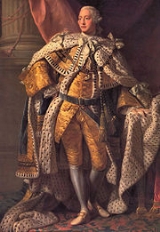
George III of the United Kingdom

 
George III of the United Kingdom

   Email Print
   Bookmark   Link


George III of the United Kingdom


George III (George William Frederick; 4 June 1738 – 29 January 1820 [N.S.
Old Style and New Style dates

Old Style and New Style are used in English language historical studies either to indicate that the start of the Julian year has been adjusted to start on :January 1 even though contemporary documents use a different start of year ; or to indicate that a date conforms to the Julian calendar , formerly in use in many countries, rathe...
]
) was King of Great Britain
Kingdom of Great Britain

The Kingdom of Great Britain, also known as the United Kingdom of Great Britain, was a country in North-West Europe, in existence from 1707 to 1801....
 and King of Ireland
Kingdom of Ireland

The Kingdom of Ireland was the name given to the Irish state from 1541, by the Crown of Ireland Act 1542 of the Parliament of Ireland. It was based on the contested legitimacy of the right of conquest....
 from 25 October 1760 until the union of these two countries on 1 January 1801, after which he was King of the United Kingdom of Great Britain and Ireland
United Kingdom of Great Britain and Ireland

The United Kingdom of Great Britain and Ireland was the formal name and the state form of the United Kingdom from 1 January 1801 until 12 April 1927....
 until his death. He was concurrently Duke of Brunswick-Lüneburg
Brunswick-Lüneburg

Brunswick-L?neburg was a historical duchy during the period from the late Middle Ages through the late Early Modern era within the North-Western domains of the Holy Roman Empire....
 and prince-elector
Prince-elector

The Prince-Electors of the Holy Roman Empire were the members of the electoral college of the Holy Roman Empire, having the function of Imperial election the Holy Roman Emperors....
 of Hanover
Electorate of Hanover

The Electorate of Brunswick-L?neburg became the ninth Electorate of the Holy Roman Empire in 1692, when the Holy Roman Emperor, Leopold I, Holy Roman Emperor, elevated Duke Ernest Augustus, Elector of Brunswick-L?neburg to the rank of Prince-elector of the Empire as a reward for aid given in the War of the Grand Alliance....
 in the Holy Roman Empire
Holy Roman Empire

The Holy Roman Empire was a union of territories in Central Europe during the Middle Ages and the Early modern Europe under a Holy Roman Emperor....
 until his promotion to King of Hanover on 12 October 1814.


Discussion
Ask a question about 'George III of the United Kingdom'
Start a new discussion about 'George III of the United Kingdom'
Answer questions from other users
Full Discussion Forum


Recent Posts


Timeline

1738   Born

1751   The future King George III of the United Kingdom succeeds his father as Prince of Wales. His mother Augusta of Saxe-Gotha becomes Dowager Princess of Wales.

1760   Death of George II of Great Britain. His grandson George III ascends to the throne.

1762   The North Carolina General Assembly incorporates Kingston, named for King George III of the United Kingdom, as the county seat of Dobbs County, North Carolina. The name is later shortened to Kinston in 1784.

1767   North Carolina woodsman Daniel Boone goes through the Cumberland Gap and reaches Kentucky - in defiance of a decree from King George III. He discovers a rich hunting ground, contested by several Native American tribes.

1768   John Wilkes is imprisoned for writing an article for the ''North Briton'' severely criticizing King George III. This action provokes rioting in London

1781   Sir William Herschel discovers the planet Uranus. Originally he calls it ''Georgium Sidus'' (George's Star) in honour of King George III of England.

1800   Great Britain passes the Act of Union to join Great Britain and Ireland into the United Kingdom to take effect on 1 January 1801. The act is signed by King George III in August.

1803   Edward Despard and six others are hanged, drawn and quartered for plotting to assassinate king George III and to destroy the Bank of England

1810   King George III of the United Kingdom recognized as insane.


Quotations


I wish nothing but good. Everyone who does not agree is a traitor or a scoundrel.

Six hours sleep are enough for a man, seven for a woman, and eight for a fool.

My Lords and peacocks.

I glory in the name of Briton!

When a petitioner attempted to stab the King he told her with the greatest calmness, This is a fruit knife madam, it couldn't cut a cabbage. Category:British monarchs sl:Jurij III. Angleški


Encyclopedia


George III (George William Frederick; 4 June 1738 – 29 January 1820 [N.S.
Old Style and New Style dates

Old Style and New Style are used in English language historical studies either to indicate that the start of the Julian year has been adjusted to start on :January 1 even though contemporary documents use a different start of year ; or to indicate that a date conforms to the Julian calendar , formerly in use in many countries, rathe...
]
) was King of Great Britain
Kingdom of Great Britain

The Kingdom of Great Britain, also known as the United Kingdom of Great Britain, was a country in North-West Europe, in existence from 1707 to 1801....
 and King of Ireland
Kingdom of Ireland

The Kingdom of Ireland was the name given to the Irish state from 1541, by the Crown of Ireland Act 1542 of the Parliament of Ireland. It was based on the contested legitimacy of the right of conquest....
 from 25 October 1760 until the union of these two countries on 1 January 1801, after which he was King of the United Kingdom of Great Britain and Ireland
United Kingdom of Great Britain and Ireland

The United Kingdom of Great Britain and Ireland was the formal name and the state form of the United Kingdom from 1 January 1801 until 12 April 1927....
 until his death. He was concurrently Duke of Brunswick-Lüneburg
Brunswick-Lüneburg

Brunswick-L?neburg was a historical duchy during the period from the late Middle Ages through the late Early Modern era within the North-Western domains of the Holy Roman Empire....
 and prince-elector
Prince-elector

The Prince-Electors of the Holy Roman Empire were the members of the electoral college of the Holy Roman Empire, having the function of Imperial election the Holy Roman Emperors....
 of Hanover
Electorate of Hanover

The Electorate of Brunswick-L?neburg became the ninth Electorate of the Holy Roman Empire in 1692, when the Holy Roman Emperor, Leopold I, Holy Roman Emperor, elevated Duke Ernest Augustus, Elector of Brunswick-L?neburg to the rank of Prince-elector of the Empire as a reward for aid given in the War of the Grand Alliance....
 in the Holy Roman Empire
Holy Roman Empire

The Holy Roman Empire was a union of territories in Central Europe during the Middle Ages and the Early modern Europe under a Holy Roman Emperor....
 until his promotion to King of Hanover on 12 October 1814. He was the third British monarch of the House of Hanover
House of Hanover

The House of Hanover is a Germanic peoples Royal family dynasty which has ruled the Duchy of Brunswick-L?neburg , the Kingdom of Hanover and the Kingdom of Great Britain and the Kingdom of Ireland....
, but unlike his two predecessors he was born in Britain and spoke English
English language

English is a West Germanic language that originated in Anglo-Saxon England and has lingua franca status in many parts of the world as a result of the military, economic, scientific, political and cultural influence of the British Empire in the 18th, 19th and early 20th centuries and that of the United States from the mid 20th century onwa...
 as his first language. Despite his long life, he never visited Hanover.

George III's long reign was marked by a series of military conflicts involving his kingdoms, much of the rest of Europe, and places further afield in Africa, the Americas and Asia. Early in his reign, Great Britain defeated France in the Seven Years' War
Seven Years' War

The Seven Years' War lasted between 1756?1763 and involved all of the major European powers of the period. The war pitted Kingdom of Prussia and Kingdom of Great Britain and a coalition of smaller German states against an alliance consisting of Archduchy of Austria, Early Modern France, Russian Empire, Kingdom of Sweden, and Electorate of Sa...
, becoming the dominant European power in North America and India. However, many of its American colonies were soon lost in the American Revolutionary War
American Revolutionary War

The American Revolutionary War , also known as the American War of Independence, began as a war between the Kingdom of Great Britain and Thirteen Colonies on the North America, and ended in a global war between several European great powers....
, which led to the establishment of the United States
United States

The United States of America is a Federal government constitutional republic comprising U.S. state and a federal district. The country is situated mostly in central North America, where its Contiguous United States and Washington, D.C., the Capital districts and territories, lie between the Pacific Ocean and Atlantic Oceans, Borders of the U...
. A series of wars against revolutionary
French Revolution

The French Revolution was a period of political and social upheaval and radical change in the history of France, during which the French governmental structure, previously an absolute monarchy with feudalism for the aristocracy and Roman Catholic Church clergy, underwent radical change to forms based on Age of Enlightenment principles of cit...
 and Napoleonic
Napoleon I of France

Napoleon Bonaparte later known as Emperor Napoleon I, was a military and political leader of France whose actions shaped European politics in the early 19th century....
 France, over a twenty-year period, finally concluded in the defeat of Napoleon in 1815.

In the latter half of his life, George III suffered from recurrent and, eventually, permanent mental illness
Mental illness

A mental disorder or mental illness is a psychological or behavioral pattern that occurs in an individual and is thought to cause distress or disability that is not expected as part of normal development or culture....
. Medical practitioners were baffled by this at the time, although it is now generally thought that he suffered from the blood disease porphyria
Porphyria

Porphyrias are a group of inherited or acquired disorders of certain enzymes in the heme biosynthetic pathway . They are broadly classified as acute porphyrias and cutaneous porphyrias, based on the site of the overproduction and accumulation of the porphyrins ....
. After a final relapse in 1810, a regency was established, and George III's eldest son, George, Prince of Wales
George IV of the United Kingdom

George IV was the king of Kingdom of Hanover and the United Kingdom of Great Britain and Ireland from the death of his father, George III of the United Kingdom, on 29 January 1820 until his own death ten years later....
, ruled as Prince Regent
Prince Regent

A prince regent is a prince who rules a monarchy as Regent instead of a Monarch, e.g., due to the Sovereign's incapacity or absence .While the term itself can have the generic meaning and refer to any prince who fills the role of regent, historically it has mainly been used to describe a small number of individual Princes who were Regents....
. On George III's death, the Prince Regent succeeded his father as George IV. Historical analysis of George III's life has gone through a "kaleidoscope of changing views" which have depended heavily on the prejudices of his biographers and the sources available to them.

Early life

George was born in London
London

London is the capital of both England and the United Kingdom, and the most populous municipality in the European Union. An important settlement for two millennia, History of London goes back to its founding by the Roman Empire....
 at Norfolk House
Norfolk House

Norfolk House, at 31 St James's Square, London, was built in 1722 for the Duke of Norfolk. It was a royal residence for a short time only, when Frederick, Prince of Wales, father of King George III of the United Kingdom, lived there 1737-1741, after his marriage in 1736 to Princess Augusta of Saxe-Gotha, daughter of Frederick II, Duke of...
. He was the grandson of King George II
George II of Great Britain

George II was King of Great Britain and King of Ireland, Duke of Brunswick-L?neburg and Prince-elector#High Offices and Prince-Elector of the Holy Roman Empire from 11 June 1727 until his death....
, and the son of Frederick, Prince of Wales
Frederick, Prince of Wales

The Prince Frederick, Prince of Wales was a member of the Kingdom of Hanover and British Royal Family, the eldest son of George II of Great Britain and father of George III of Great Britain....
, and Augusta of Saxe-Gotha. As Prince George was born two months premature and was thought unlikely to survive, he was baptised the same day by Thomas Secker
Thomas Secker

Thomas Secker , archbishop of Canterbury, was born at Sibthorpe, Nottinghamshire.In 1699 Secker went to Richard Brown's free school in Chesterfield, staying with his...
, who was both Rector of St James's and the Bishop of Oxford
Bishop of Oxford

The Bishop of Oxford is the diocesan bishop of the Church of England Diocese of Oxford in the Province of Canterbury; his seat is at Christ Church Cathedral, Oxford....
. One month later, he was publicly baptised at Norfolk House, again by Secker. His godparents were the King of Sweden
Frederick I of Sweden

Frederick I was Monarch of Sweden from 1720 and Landgrave of Hesse-Kassel from 1730 until his death....
 (for whom Lord Baltimore
Charles Calvert, 5th Baron Baltimore

Charles Calvert, 5th Baron Baltimore, Royal Society was a Kingdom of Great Britain Nobility and Proprietary Governor of the Province of Maryland....
 stood proxy), his uncle the Duke of Saxe-Gotha
Frederick III, Duke of Saxe-Gotha-Altenburg

Frederick III, Duke of Saxe-Gotha-Altenburg , was a duke of Saxe-Gotha-Altenburg.He was the eldest son of Frederick II, Duke of Saxe-Gotha-Altenburg and Magdalene Augusta of Anhalt-Zerbst....
 (for whom Lord Carnarvon
Henry Brydges, 2nd Duke of Chandos

Henry Brydges, 2nd Duke of Chandos described by George II of Great Britain as "a hot headed, passionate, half-witted coxcomb" was the second son of James Brydges, 1st Duke of Chandos Privy Council and Mary Lake, succeeding to the title upon the death of his father on 9 August 1744....
 stood proxy) and his great-aunt the Queen of Prussia
Sophia Dorothea of Hanover

Sophia Dorothea of Hanover was a member of the British Royal Family, only daughter of George I of Great Britain. She was, between 1713 and 1740, Queen consort King in Prussia....
 (for whom Lady Charlotte Edwin
James Douglas, 4th Duke of Hamilton

Lieutenant-General James Douglas-Hamilton, 4th Duke of Hamilton, 1st Duke of Brandon and 1st Baron of Dutton, Order of the Garter, Order of the Thistle, was a...
 stood proxy).

George grew into a healthy, but reserved and shy, child. The family moved to Leicester Square
Leicester Square

Leicester Square is a pedestrianised city square in the West End of London of London, England. The Square lies within an area bound by Lisle Street, to the north; Charing Cross Road, to the east; Orange Street, to the south; and Whitcomb Street, to the west....
, where George and his younger brother Prince Edward, Duke of York and Albany, were educated together by private tutors. Family letters show that he could read and write in both English and German, as well as comment on political events of the time, by the age of eight. He was the first British monarch to study science systematically. Apart from chemistry and physics, his lessons included astronomy, mathematics, French, Latin, history, music, geography, commerce, agriculture and constitutional law, in addition to sporting and social accomplishments such as dancing, fencing, and riding. His religious education was wholly Anglican
Church of England

The Church of England is the State religion Christianity Ecclesia in England, the Mother Church of the worldwide Anglican Communion and the oldest among the communion's thirty-eight independent national and regional churches....
. George's grandfather, King George II, disliked the Prince of Wales and took little interest in his grandchildren. However, in 1751 the Prince of Wales died unexpectedly from a lung injury, and George became heir apparent
Heir apparent

An heir apparent is an heir who cannot be displaced from inheriting; the term is used in contrast to heir presumptive, the term for a conditional heir who is currently in line to inherit but could be displaced at any time in the future....
 to the throne. He inherited one of his father's titles and became the Duke of Edinburgh
Duke of Edinburgh

The Duke of Edinburgh is a dukedom associated with Edinburgh, Scotland. There have been three creations since 1726 . The current holder is Prince Philip, Duke of Edinburgh, the husband of and royal consort to Elizabeth II of the United Kingdom....
. Now more interested in his grandson, three weeks later the King created George Prince of Wales
Prince of Wales

Prince of Wales is a title traditionally granted to the Heir Apparent to the reigning monarch of the United Kingdom . The current Prince of Wales is Charles, Prince of Wales, the eldest son of Elizabeth II of the United Kingdom....
. In the spring of 1756, as George approached his eighteenth birthday, the King offered him a grand establishment at St James's Palace, but George refused the offer, guided by his mother and her confidante, Lord Bute
John Stuart, 3rd Earl of Bute

John Stuart, 3rd Earl of Bute, Order of the Garter, Privy Council of the United Kingdom , styled Lord Mount Stuart before 1723, was a Scotland nobility who served as Prime Minister of the United Kingdom under George III of Great Britain, and was arguably the last important favourite in British politics....
, who would later serve as Prime Minister
Prime minister

A prime minister is the most senior minister of Cabinet in the Executive branch of government in a parliamentary system. The position is usually held by, but need not always be held by, a politician....
. George's mother, now the Dowager Princess of Wales, preferred to keep George at home where she could imbue him with her strict moral values.

Marriage

In 1759, George was smitten with Lady Sarah Lennox
Lady Sarah Lennox

Lady Sarah Lennox was the most notorious of the famous Lennox sisters, daughters of Charles Lennox, 2nd Duke of Richmond....
, sister of the Duke of Richmond
Charles Lennox, 3rd Duke of Richmond

Charles Lennox, 3rd Duke of Richmond and Lennox, Order of the Garter, Fellow of the Royal Society, Privy Council of the United Kingdom is noteworthy for his advanced views on the issue of parliamentary reform....
, but Lord Bute advised against the match and George abandoned his thoughts of marriage. "I am born for the happiness or misery of a great nation," he wrote, "and consequently must often act contrary to my passions." Nevertheless, attempts by the King to marry George to Princess Sophia Caroline of Brunswick-Wolfenbüttel were resisted by him and his mother.

The following year, George succeeded to the Crown when his grandfather, George II, died suddenly on 25 October 1760, two weeks before his 77th birthday. The search for a suitable wife intensified. On 8 September 1761, the King married in the Chapel Royal
Chapel Royal

A Chapel Royal is a department of the Ecclesiastical Household of the Monarchy in right of each of the Commonwealth realms, formally known as the royal Free Chapel of the Household....
, St James's Palace, Duchess Sophia Charlotte of Mecklenburg-Strelitz
Charlotte of Mecklenburg-Strelitz

Charlotte of Mecklenburg-Strelitz was the List of British consorts as spouse of King George III of the United Kingdom.Queen Charlotte was a patroness of the arts, known to Johann Christian Bach and Wolfgang Amadeus Mozart, among others....
, whom he met on their wedding day. A fortnight later, both were crowned at Westminster Abbey
Westminster Abbey

The Collegiate Church of St Peter at Westminster, which is almost always referred to popularly and informally as Westminster Abbey, is a large, mainly Gothic architecture Church , in Westminster, London, just to the west of the Palace of Westminster....
. George remarkably never took a mistress (in contrast with his grandfather and his sons), and the couple enjoyed a genuinely happy marriage. They had 15 children—nine sons and six daughters. In 1762, George purchased Buckingham House (on the site now occupied by Buckingham Palace
Buckingham Palace

Buckingham Palace is the official London residence of the British monarch. Located in the City of Westminster, the palace is a setting for state occasions and royal entertaining, and a major tourist attraction....
) for use as a family retreat. His other residences were Kew
Kew Palace

Three buildings at Kew, which is now a western suburb of London, have been known as Kew Palace. One of them survives and is open to visitors....
 and Windsor Castle
Windsor Castle

Windsor Castle, in Windsor, Berkshire in the England county of Berkshire, is the largest inhabited castle in the world and, dating back to the time of William I of England, is the oldest in continuous occupation....
. St. James's Palace was retained for official use. He did not travel extensively, and spent his entire life in southern England. In the 1790s, annual holidays were taken at Weymouth, Dorset, which he popularised as one of the first seaside resorts in England.

Early reign

Although George's accession was at first welcomed by politicians of all parties, the first years of George's reign were marked by political instability, largely generated as a result of disagreements over the Seven Years' War
Seven Years' War

The Seven Years' War lasted between 1756?1763 and involved all of the major European powers of the period. The war pitted Kingdom of Prussia and Kingdom of Great Britain and a coalition of smaller German states against an alliance consisting of Archduchy of Austria, Early Modern France, Russian Empire, Kingdom of Sweden, and Electorate of Sa...
. George was perceived as favouring Tory
Tory

In the political tradition of some List of countries where English is an official language, the term Tory may refer to a variety of Political party and creeds since it was originally used in the late 17th century to describe opponents to the Whig Party ....
 ministers, which led to his denunciation by the Whigs
British Whig Party

The Whigs are often described as one of two political party in Kingdom of England and later the United Kingdom from the late 17th to the mid-19th centuries....
 as an autocrat. On George's accession, the Crown land
Crown land

Crown land is a designated area belonging to the Crown, the equivalent of an Fee tail Estate that passed with the monarchy and could not be Title from it....
s produced relatively little income; most revenue was generated through taxes and excise duties. George surrendered the Crown Estate
Crown Estate

In the United Kingdom, the Crown Estate is a property financial portfolio associated with the British monarchy, that belongs to the reigning monarch ....
 to Parliamentary control in return for a Civil List
Civil list

A civil list is a list of individuals to whom money is paid by the government....
 annuity for the support of his household and the expenses of Civil Government. Claims that George used the income to reward supporters with bribes and gifts, are disputed by historians who say such claims "rest on nothing but falsehoods put out by disgruntled opposition". Debts amounting to over £3 million over the course of George's reign were paid by Parliament, and the Civil List annuity was increased from time to time. George aided the Royal Academy
Royal Academy

The Royal Academy of Arts is an art institution based in Burlington House on Piccadilly, London, England. As an academy, it functions to encourage British art, and has a membership of practising artists....
 with large grants from his private funds, and may have donated more than half of his personal income to charity. Of George's art collection, the two most notable purchases are Vermeer's Lady at the Virginals and a set of Canaletto
Canaletto

Giovanni Antonio Canal , better known as Canaletto, was a Venetian artist famous for his landscapes, or vedute, of Venice. He was also an important printmaker in etching....
s, but it is as a collector of books that he is best remembered. The King's Library
King's Library

The King?s Library was the original name applied both to the British Royal Collection of over 60,000 books and to the room in the British Museum that housed them....
 was open and available to scholars, and was the foundation of a new national library. In May 1762, the incumbent Whig ministry of the Duke of Newcastle was replaced with one led by the Scottish Tory Lord Bute. Bute's opponents worked against him by spreading the calumny that he was having an affair with the King's mother, and by exploiting anti-Scottish prejudices amongst the English. John Wilkes
John Wilkes

John Wilkes was an England Radicalism , journalist and politician.In the Middlesex election dispute, he fought for the right of voters?rather than the British House of Commons?to determine their representatives....
, a Member of Parliament, published The North Briton
The North Briton

The North Briton was a Radicalism newspaper published in eighteenth century London. The North Briton also served as the pseudonym of the newspaper's author, used in advertisements, letters to other publications, and handbills....
, which was both inflammatory and defamatory in its condemnation of Bute and the government. Wilkes was eventually arrested for seditious libel but he fled to France to escape punishment; he was expelled from the House of Commons
British House of Commons

The House of Commons is the lower house of the Parliament of the United Kingdom, which also comprises the British monarchy and the House of Lords ....
, and found guilty in absentia of blasphemy and libel. In 1763, after concluding the Peace of Paris
Treaty of Paris (1763)

The Treaty of Paris, often called the Peace of Paris, or the Treaty of 1763, was signed on February 10, 1763, by the kingdoms of Kingdom of Great Britain, France and Spain, with Portugal in agreement....
 which ended the war, Lord Bute resigned, allowing the Whigs under George Grenville
George Grenville

George Grenville , was a Kingdom of Great Britain British Whig Party statesman who served in government for the relatively short period of seven years, reaching the position of Prime Minister of the United Kingdom....
 to return to power. Later that year, the Royal Proclamation of 1763
Royal Proclamation of 1763

The Royal Proclamation of 1763 was issued October 7, 1763, by George III of the United Kingdom following Kingdom of Great Britain's acquisition of New France in North America after the end of the French and Indian War/Seven Years' War....
 placed a boundary upon the westward expansion of the American colonies. The Proclamation aimed to force colonists to negotiate with the Native Americans, and therefore to reduce the costly frontier warfare that had erupted over land conflicts. While the Proclamation Line, as it came to be known, did not bother the majority of settled farmers, it was unpopular with a vocal minority of Americans and ultimately contributed to conflict between the colonists and the British government. With the American colonists generally unburdened by British taxes, the government found it increasingly difficult to pay for the defence of the colonies against native uprisings and the possibility of French incursions. In 1765, Grenville introduced the Stamp Act
Stamp Act 1765

The Stamp Act of 1765 was a tax imposed by the Parliament of Great Britain on the colonies of British America. The act required that many printed materials in the colonies carry a tax stamp....
, which levied a stamp duty
Stamp duty

Stamp duty is a form of tax that is levied on documents. Historically, a physical stamp had to be attached to or impressed upon the document to denote that stamp duty had been paid before the document became legally effective....
 on every document in the British colonies in North America. Since newspapers were printed on stamped paper, those most affected by the introduction of the duty were the most effective at producing propaganda opposing the tax. Meanwhile, the King had become exasperated at Grenville's attempts to reduce the King's prerogatives, and tried, unsuccessfully, to persuade William Pitt the Elder
William Pitt, 1st Earl of Chatham

William Pitt, 1st Earl of Chatham, Kent Privy Council of Great Britain was a Kingdom of Great Britain British Whig Party statesman who achieved his greatest fame as a Secretary of State during the Seven Years' War, as known in Great Britain and Asia and who was later Prime Minister of the United Kingdom....
 to accept the office of Prime Minister. After a brief illness, which may have presaged his illnesses to come, George settled on Lord Rockingham
Charles Watson-Wentworth, 2nd Marquess of Rockingham

Charles Watson-Wentworth, 2nd Marquess of Rockingham, Order of the Garter, Privy Council of the United Kingdom , styled The Hon. Charles Watson-Wentworth before 1733, Viscount Higham between 1733 and 1746, Earl of Malton between 1746 and 1750 and The Earl Malton in 1750, was a Kingdom of Great Britain British Whig Par...
 to form a ministry, and dismissed Grenville.

Lord Rockingham, with the support of Pitt and the King, repealed Grenville's unpopular Stamp Act, but his government was weak and he was replaced in 1766 by Pitt, whom George created Earl of Chatham
Earl of Chatham

The title Earl of Chatham, in the County of Kent, was created in the Peerage of Great Britain in 1766 for William Pitt, 1st Earl of Chatham on his appointment as Lord Privy Seal, along with the subsidiary title Viscount Pitt, of Burton Pynsent in the County of Somerset....
. The actions of Lord Chatham and George III in repealing the Act were so popular in America that statues of them both were erected in New York City
History of New York City (1665-1783)

The history of New York City began with the establishment of English rule over Dutch New Amsterdam and New Netherland. As the newly renamed City of New York and surrounding areas developed, there was a growing independent feeling among some, but the area was decidedly split in its loyalties....
. Lord Chatham fell ill in 1767, and the Duke of Grafton took over the government, although he did not formally become Prime Minister until 1768. That year, John Wilkes returned to England, stood as a candidate in the general election
British general election, 1768

The British general election, 1768 returned members to serve in the British House of Commons of the 13th Parliament of Great Britain to be held, after the merger of the Parliament of England and the Parliament of Scotland in 1707....
, and came top of the poll in the Middlesex constituency
Middlesex (UK Parliament constituency)

Middlesex is a former United Kingdom Parliament of the United Kingdom constituency. It was a United Kingdom constituencies of the British House of Commons of the Parliament of England then of the Parliament of Great Britain from 1707 to 1800 and of the Parliament of the United Kingdom from 1801 to 1885....
. His election sparked riots in London, largely the result of economic distress, and Wilkes was again expelled from Parliament. Wilkes was re-elected and expelled twice more, before the House of Commons resolved that his candidature was invalid and declared the runner-up
Henry Luttrell, 2nd Earl of Carhampton

Henry Lawes Luttrell, 2nd Earl of Carhampton Privy Council of Ireland succeeded to the Earldom and other titles on the death of Simon Luttrell, 1st Earl of Carhampton in 1787....
 as the victor. Grafton's government disintegrated in 1770, allowing the Tories led by Lord North
Frederick North, Lord North

Frederick North, 2nd Earl of Guilford, Order of the Garter, Privy Council of the United Kingdom , more often known by his courtesy title, Lord North, which he used from 1752 until 1790, was Prime Minister of the United Kingdom of Kingdom of Great Britain from 1770 to 1782....
 to return to power. George was deeply devout and spent hours in prayer, but his piety was not shared by his brothers. George was appalled by what he saw as their loose morals. In 1770, his brother Prince Henry, Duke of Cumberland and Strathearn, was exposed as an adulterer, and the following year Cumberland married a young widow, Anne Horton. The King considered her inappropriate as a royal bride: she was from a lower social class and German law barred any children of the couple from the Hanoverian succession. George insisted on a new law that essentially forbade members of the Royal Family from legally marrying without the consent of the Sovereign. The subsequent bill was unpopular in Parliament, including among George's own ministers, but passed as the Royal Marriages Act 1772
Royal Marriages Act 1772

The Royal Marriages Act of 1772 is an Act of Parliament of the Parliament of Great Britain which made it illegal for any member of the British royal family under the age of 25 to marry without the consent of the reigning monarch....
. Shortly afterward, another of George's brothers, Prince William Henry, Duke of Gloucester and Edinburgh
Prince William Henry, Duke of Gloucester and Edinburgh

Prince William, Duke of Gloucester and Edinburgh Order of the Garter Privy Council of Great Britain Fellow of the Royal Society was a member of the British Royal Family, a grandson of George II of Great Britain and a younger brother of George III of Great Britain....
, revealed he had been secretly married to Maria, Countess Waldegrave
Maria, Duchess of Gloucester and Edinburgh

Maria Walpole , the Earl Waldegrave and Duke of Gloucester, was a member of the British Royal Family, the wife of Prince William Henry, Duke of Gloucester and Edinburgh....
, the illegitimate daughter of Sir Edward Walpole. The news confirmed George's opinion that he had been right to introduce the law: Maria was related to his political opponents. Neither lady was ever received at court.

Lord North's government was chiefly concerned with discontent in America. To assuage American opinion most of the custom duties were withdrawn, with the exception of the tea duty, which in George's words was "one tax to keep up the right [to levy taxes]". In 1773, a Boston
Boston, Massachusetts

Boston is the State capital and largest city of the Commonwealth of Massachusetts, and is one of the oldest cities in the United States. The largest city in New England, Boston is considered the economic and cultural center of the region, and is sometimes regarded as the unofficial "Capital of New England." Boston city proper had a 2007 est...
 mob boarded the tea ships moored in Boston Harbor and threw the tea overboard as a political protest, an event that became known as the Boston Tea Party
Boston Tea Party

The Boston Tea Party was an act of direct action protest by the American colonists against the Kingdom of Great Britain in which they destroyed many crates of tea belonging to the British East India Company and dumped it into the Boston Harbor....
. In Britain, opinion hardened against the colonists, with Chatham now agreeing with North that the destruction of the tea was "certainly criminal". With the clear support of Parliament Lord North introduced measures, which were called the Intolerable Acts
Intolerable Acts

The Intolerable Acts or the Coercive Acts are names used to describe a series of laws passed by the Parliament of Great Britain in 1774 relating to Britain's colonies in North America....
 by the colonists: the Port of Boston was shut down and the constitution of Massachusetts
Massachusetts

The Commonwealth of Massachusetts is a U.S. state located in the New England region of the Northeastern United States United States. It borders Rhode Island and Connecticut to the south, New York to the west, and Vermont and New Hampshire to the north....
 was altered so that the upper house of the legislature was appointed by the Crown instead of elected by the lower house. Up to this point, in the words of Professor Peter Thomas, George's "hopes were centred on a political solution, and he always bowed to his cabinet's opinions even when sceptical of their success. The detailed evidence of the years from 1763 to 1775 tends to exonerate George III from any real responsibility for the American Revolution
American Revolution

The American Revolution refers to the political upheaval during the last half of the 18th century in which the Thirteen Colonies of North America overthrew the governance of the British Empire and then rejected the British monarchy to become the sovereign United States of America....
." Though the Americans characterised George as a tyrant, in these years he acted as a constitutional monarch supporting the initiatives of his ministers.

American Revolutionary War

The American Revolutionary War
American Revolutionary War

The American Revolutionary War , also known as the American War of Independence, began as a war between the Kingdom of Great Britain and Thirteen Colonies on the North America, and ended in a global war between several European great powers....
 began when armed conflict between British regulars and colonial militiamen broke out in New England
New England

New England is a region of the United States located in the northeastern corner of the country, bounded by the Atlantic Ocean, Canada and New York State, and consisting of the modern U.S....
 in April 1775. After a year of fighting, the colonies declared their independence
United States Declaration of Independence

The United States Declaration of Independence is a statement adopted by the Second Continental Congress on July 4, 1776, which announced that the Thirteen Colonies then at war with Kingdom of Great Britain were now independent states, and thus no longer a part of the British Empire....
 from the Crown as "free and independent States" in July 1776, and listed grievances against the British King, legislature, and populace. Among George's other offences, the Declaration charged, "He has abdicated Government here ... He has plundered our seas, ravaged our Coasts, burnt our towns, and destroyed the lives of our people." The gilded equestrian statue of George III in New York was pulled down. The British captured the city in 1776, but the grand strategic plan of invading from Canada failed with the surrender of the British Lieutenant-General John Burgoyne
John Burgoyne

General John Burgoyne was a Kingdom of Great Britain army officer, politician and dramatist. During the American War of Independence, on October 17, 1777, at the Battle of Saratoga he surrendered his Convention Army....
 at the Battle of Saratoga
Battle of Saratoga

The Battles of Saratoga in September and October 1777 were decisive Continental Army victories in the American Revolutionary War, resulting in the surrender of an entire British army of over 6,000 men invading New York from Canada....
.

George III is often accused of obstinately trying to keep Great Britain at war with the revolutionaries in America, despite the opinions of his own ministers. In the words of the Victorian author George Trevelyan
Sir George Trevelyan, 2nd Baronet

Sir George Otto Trevelyan, 2nd Baronet Order of Merit, DC, LLD, DL was a United Kingdom statesman and author was born in Rothley Temple, Leicestershire, and the only son of Sir Charles Trevelyan, 1st Baronet and Hannah Moore Macaulay....
, the King was determined "never to acknowledge the independence of the Americans, and to punish their contumacy by the indefinite prolongation of a war which promised to be eternal." The King wanted to "keep the rebels harassed, anxious, and poor, until the day when, by a natural and inevitable process, discontent and disappointment were converted into penitence and remorse". However, more recent historians defend George by saying in the context of the times no king would willingly surrender the bulk of his dominions, and his conduct was far less ruthless than contemporary monarchs in Europe. After Saratoga, both Parliament and the British people were in favour of the war; recruitment ran at high levels and although political opponents were vocal, they remained a small minority. With the setbacks in America, Lord North asked to transfer power to Lord Chatham, whom he thought more capable, but George refused to do so; he suggested instead that Chatham serve as a subordinate minister in Lord North's administration. Chatham refused to cooperate, and died later in the same year. In 1778, France (Britain's chief rival) signed a treaty of friendship with the newly independent American States. Great Britain was then at war with France, and in 1779 it was also at war with Spain. Lord Gower
Granville Leveson-Gower, 1st Marquess of Stafford

Granville Leveson-Gower, 1st Marquess of Stafford, 2nd Earl Gower Privy Council of Great Britain was a British politician....
 and Lord Weymouth
Thomas Thynne, 1st Marquess of Bath

Thomas Thynne, 1st Marquess of Bath, 3rd Viscount Weymouth Order of the Garter , English politician, was the elder son of Thomas Thynne, 2nd Viscount Weymouth , and the great-grandnephew of Thomas Thynne, 1st Viscount Weymouth , who was created Baron Thynne and Viscount Weymouth in 1682....
 both resigned from the government. Lord North again requested that he also be allowed to resign, but he stayed in office at George III's insistence. Opposition to the costly war was increasing, and in June 1780 contributed to disturbances in London known as the Gordon riots
Gordon Riots

The Gordon Riots refers to a number of events in a predominantly Protestant religious uprising in London, England, in 1780, aimed against the Papists Act 1778, "relieving his Majesty's subjects, of the Catholic Religion, from certain penalties and disabilities imposed upon them during the reign of William III of England." The uprising then...
.

In 1781, the news of Lord Cornwallis's
Charles Cornwallis, 1st Marquess Cornwallis

Charles Cornwallis, 1st Marquess Cornwallis, Knight of the Garter was a Kingdom of Great Britain army officer and colonial administrator. In the United States and Britain, he is best remembered as one of the leading generals in the American War of Independence....
 surrender at the Siege of Yorktown
Siege of Yorktown

The Siege of Yorktown or Battle of Yorktown in 1781 was a decisive victory by combined assault of American Continental Army led by General George Washington and France in the American Revolutionary War led by General Jean-Baptiste Donatien de Vimeur, comte de Rochambeau over a British Army commanded by General Charles Cornwallis, 1st Ma...
 reached London; Lord North's parliamentary support ebbed away and he resigned the following year. The king drafted an abdication notice, which was never delivered, finally accepted the defeat in North America, and authorised the negotiation of a peace. The Treaties of Paris
Peace of Paris (1783)

The Peace of Paris was the set of treaties which ended the American Revolutionary War. On 3 September 1783, representatives of King George III of Kingdom of Great Britain signed a treaty in Paris with representatives of the United States of America – commonly known as the Treaty of Paris – and two treaties at Versailles with rep...
, by which Britain recognised the independence of the American states and returned Florida to Spain, were ratified in 1783. When John Adams
John Adams

John Adams was an Politics of the United States and the List of Presidents of the United States President of the United States , after being the List of Vice Presidents of the United States Vice President of the United States for two terms....
 was appointed American Minister to Britain
United States Ambassador to the United Kingdom

The office of United States Ambassador to the United Kingdom was traditionally the most prestigious position in the United States Foreign Service, and has been held by various notable politicians, including five future presidents: John Adams, James Monroe, John Quincy Adams, Martin Van Buren and James Buchanan....
 in 1785, George had become resigned to the new relationship between his country and the States. He told Adams, "I was the last to consent to the separation; but the separation having been made and having become inevitable, I have always said, as I say now, that I would be the first to meet the friendship of the United States as an independent power."

Constitutional struggle

With the collapse of Lord North's ministry in 1782, the Whig Lord Rockingham became Prime Minister for the second time, but died within months. The King then appointed Lord Shelburne
William Petty, 2nd Earl of Shelburne

William Petty-FitzMaurice, 1st Marquess of Lansdowne, Knight of the Garter, Privy Council of the United Kingdom , known as The Earl of Shelburne between 1761 and 1784, by which title he is generally known to history, was a Kingdom of Great Britain British Whig Party statesman who was the first Home Secretary in 1782 and then Prime Minis...
 to replace him. Charles James Fox
Charles James Fox

Charles James Fox was a prominent Kingdom of Great Britain British Whig Party statesman whose parliamentary career spanned thirty-eight years of the late eighteenth century and early nineteenth century and who was particularly noted for being the arch-rival of William Pitt the Younger....
, however, refused to serve under Shelburne, and demanded the appointment of the Duke of Portland
William Cavendish-Bentinck, 3rd Duke of Portland

William Henry Cavendish-Bentinck, 3rd Duke of Portland Privy Council , was a Kingdom of Great Britain British Whig Party and Tory statesman, List of Chancellors of the University of Oxford and Prime Minister of the United Kingdom....
. In 1783, the House of Commons forced Lord Shelburne from office and his government was replaced by the Fox-North Coalition
Fox-North Coalition

The Fox-North Coalition was a government in Great Britain that held office during 1783. As the name suggests, the ministry was a coalition of the groups supporting Charles James Fox and Frederick North, Lord North....
. The Duke of Portland became Prime Minister, with Fox and Lord North, as Foreign Secretary and Home Secretary respectively.

The King disliked Fox intensely, both for his politics as well as his character; he thought Fox was unprincipled and a bad influence on the Prince of Wales. George III was distressed at having to appoint ministers not of his liking, but the Portland ministry quickly built up a majority in the House of Commons, and could not be displaced easily. He was further dismayed when the government introduced the India Bill, which proposed to reform the government of India by transferring political power from the Honourable East India Company to Parliamentary commissioners. Although the King actually favoured greater control over the Company, the proposed commissioners were all political allies of Fox. Immediately after the House of Commons passed it, George authorised Lord Temple
George Nugent-Temple-Grenville, 1st Marquess of Buckingham

George Nugent-Temple-Grenville, 1st Marquess of Buckingham, knight of the Garter, Her Majesty's Most Honourable Privy Council was a United Kingdom statesman; he was the second son of George Grenville and a brother of the William Grenville, 1st Baron Grenville....
 to inform the House of Lords
House of Lords

The House of Lords is the second house of the Parliament of the United Kingdom and is also commonly referred to as "the Lords". The Parliament comprises the British monarchy, the British House of Commons , and the Lords....
 that he would regard any peer who voted for the bill as his enemy. The bill was rejected by the Lords; three days later, the Portland ministry was dismissed, and William Pitt the Younger
William Pitt the Younger

William Pitt, the Younger was a Kingdom of Great Britain politician of the late eighteenth century and early nineteenth century. He became the youngest Prime Minister of the United Kingdom in 1783 at the age of 24....
 was appointed Prime Minister, with Temple as his Secretary of State. On 17 December 1783, Parliament voted in favour of a motion condemning the influence of the monarch in parliamentary voting as a "high crime" and Temple was forced to resign. Temple's departure destabilised the government, and three months later the government lost its majority and Parliament was dissolved; the subsequent election
British general election, 1784

The British general election of 1784 resulted in William Pitt the Younger securing an overall majority of about 120 in the British House of Commons, having previously had to survive in a House which was dominated by his opponents....
 gave Pitt a firm mandate.

William Pitt


For George III, Pitt's appointment was a great victory. It proved that he was able to appoint Prime Ministers on the basis of his own interpretation of the public mood without having to follow the choice of the current majority in the House of Commons. Throughout Pitt's ministry, George supported many of Pitt's political aims and created new peers at an unprecedented rate to increase the number of Pitt's supporters in the House of Lords. During and after Pitt's ministry, George III was extremely popular in Britain. The British people admired him for his piety, and for remaining faithful to his wife. He was fond of his children, and was devastated at the death of two of his sons in infancy in 1782 and 1783 respectively. Nevertheless, he set his children a strict regime. They were expected to attend rigorous lessons from seven in the morning, and to lead lives of religious observance and virtue. When his children strayed from George's own principles of righteousness, as his sons did as young adults, he was dismayed and disappointed.

However, by this time George's health was deteriorating. He suffered from a mental illness, now widely believed to be a symptom of porphyria
Porphyria

Porphyrias are a group of inherited or acquired disorders of certain enzymes in the heme biosynthetic pathway . They are broadly classified as acute porphyrias and cutaneous porphyrias, based on the site of the overproduction and accumulation of the porphyrins ....
. A study of samples of the King's hair published in 2005 revealed high levels of arsenic
Arsenic

Arsenic is a well-known chemical element that has the symbol As and atomic number 33. Arsenic was first documented by Albertus Magnus in 1250....
, a possible trigger for the disease. The source of the arsenic is not known, but it could have been a component of medicines or cosmetics. The King may have suffered a brief episode of the disease in 1765, but a longer episode began in the summer of 1788. At the end of the parliamentary session, he went to Cheltenham Spa to recuperate. It was the furthest he had ever been from London—just short of 100 miles (150 km)—but his condition worsened. In November he became seriously deranged, sometimes speaking for many hours without pause. With his doctors largely at a loss to explain his illness, spurious stories about his condition spread, such as the claim that he shook hands with a tree in the mistaken belief that it was the King of Prussia. Treatment for mental illness was primitive by modern standards, and the King's doctors, who included Francis Willis
Francis Willis

Francis Willis was a Lincolnshire physician and clergyman, famous for his treatment of George III of the United Kingdom....
, treated the King by forcibly restraining him until he was calm, or applying caustic poultices to draw out "evil humours". Parliament reconvened and began to debate provisions for a regency.

Fox and Pitt wrangled over the terms of the regency. While both agreed that it would be most reasonable for George III's eldest son and heir apparent
Heir apparent

An heir apparent is an heir who cannot be displaced from inheriting; the term is used in contrast to heir presumptive, the term for a conditional heir who is currently in line to inherit but could be displaced at any time in the future....
, the Prince of Wales, to act as Regent, to Pitt’s consternation Fox suggested that it was the Prince of Wales's absolute right to act on his ill father's behalf with full powers. Pitt, fearing he would be removed from office if the Prince of Wales were empowered, argued that it was for Parliament to nominate a Regent, and wanted to restrict the Regent's authority. In February 1789, the Regency Bill, authorising the Prince of Wales to act as Prince Regent, was introduced and passed in the House of Commons, but before the House of Lords could pass the bill, George III recovered.

French Revolutionary and Napoleonic Wars

After George’s recovery, his popularity, and that of Pitt, continued to increase at the expense of Fox and the Prince of Wales. His humane and understanding treatment of two insane assailants, Margaret Nicolson in 1786 and John Frith in 1790, contributed to his popularity. A failed attempt to assassinate
Assassination

Assassination is the targeted killing of a public figure. Assassinations may be prompted by ideology, politics, or military reasons. Additionally, assassins may be motivated by contract killing, revenge, or celebrity or may be mental disorder....
 the King on 15 May 1800 was not political in origin but motivated by the delusions of James Hadfield
James Hadfield

James Hadfield or Hatfield attempted to assassination George III of the United Kingdom in 1800 but was acquitted of attempted murder by reason of criminal insanity....
, who shot at the King in the Drury Lane Theatre
Theatre Royal, Drury Lane

The Theatre Royal, Drury Lane is a West End theatre in Covent Garden, in the City of Westminster, a London borough of London. The building faces Catherine Street and backs onto Drury Lane....
. George seemed unperturbed by the incident, so much so that he fell asleep in the interval.

The French Revolution
French Revolution

The French Revolution was a period of political and social upheaval and radical change in the history of France, during which the French governmental structure, previously an absolute monarchy with feudalism for the aristocracy and Roman Catholic Church clergy, underwent radical change to forms based on Age of Enlightenment principles of cit...
 of 1789, in which the French monarchy had been overthrown, worried many British landowners. France declared war on Great Britain in 1793; in the war attempt, George allowed Pitt to increase taxes, raise armies, and suspend the right of habeas corpus
Habeas corpus

For the Living Things CD, see Habeas Corpus Habeas corpus is a legal action, or writ, through which a person can seek justice from the unlawful detention of him or herself, or of another person....
. The First Coalition
First Coalition

The First Coalition was the first major concerted effort of multiple European power s to contain French First Republic. It took shape after the French Revolutionary Wars had already begun....
 to oppose revolutionary France, which included Austria
Austria

Austria , officially the Republic of Austria , is a landlocked country in Central Europe. It borders both Germany and the Czech Republic to the north, Slovakia and Hungary to the east, Slovenia and Italy to the south, and Switzerland and Liechtenstein to the west....
, Prussia
Prussia

Prussia was, most recently, a historic state originating out of the Duchy of Prussia and the Margraviate of Brandenburg. This state had for centuries substantial influence on Germany and European history....
, and Spain, broke up in 1795 when Prussia and Spain made separate peace with France. The Second Coalition, which included Austria, Russia, and the Ottoman Empire
Ottoman Empire

The Ottoman Empire , also known by its contemporaries as the Turkish Empire or Turkey , was an empire that lasted from 1299?1923. It was Treaty of Lausanne by the Republic of Turkey, which was officially proclaimed on October 29, 1923....
, was defeated in 1800. Only Great Britain was left fighting Napoleon Bonaparte
Napoleon I of France

Napoleon Bonaparte later known as Emperor Napoleon I, was a military and political leader of France whose actions shaped European politics in the early 19th century....
, the First Consul
First Consul

First Consul was a title used by Napoleon Bonaparte following his seizure of power in France.Originally, three equal Consuls made up the government established by Bonaparte and Emmanuel Joseph Siey?s after the coup of 18 Brumaire , which established the French Consulate in France ....
 of the French Republic
French First Republic

The French First Republic was founded on 22 September, 1792, by the newly established National Convention. The First Republic lasted until the declaration of the First French Empire in 1804 under Napoleon....
. A brief lull in hostilities allowed Pitt to concentrate effort on Ireland, where there had been an uprising and attempted French landing in 1798. The British and Irish Parliaments passed the Act of Union 1800
Act of Union 1800

The phrase Act of Union 1800 is used to describe two complementary Acts whose official United Kingdom titles are the Union with Ireland Act 1800 , an Act of the Parliament of Great Britain, and the Act of Union 1800 ,...
, which, on 1 January 1801, united Great Britain and Ireland into a single nation, known as the United Kingdom of Great Britain and Ireland. George used the opportunity to drop the claim to the Throne of France
English claims to the French throne

The English claims to the French throne have a long and rather complex history between the 1340s and the 1800s.From 1340 to 1801, with only brief intervals in 1360-1369 and 1420-1422, the kings and queens of Kingdom of England, and after the Acts of Union 1707 in 1707 the kings and queens of Kingdom of Great Britain, also bore the title of '...
, which English and British Sovereigns had maintained since the reign of Edward III
Edward III of England

Edward III was one of the most successful List of the monarchs of the Kingdom of Englands of the Britain in the Middle Ages. Restoring royal authority after the disastrous reign of his father, Edward II of England, Edward III went on to transform the Kingdom of England into the most efficient military power in Europe....
. It was suggested that George adopt the title "Emperor of the British Isles
British Emperor

Although in the past the style of British Emperor has been applied to a few mythical and historical rulers of Great Britain, it is sometimes used as a colloquialism to designate either Plantagenet and Tudor dynasty caesaropapism or, more frequently, the British sovereign during the period of the British Raj....
", but he refused. As part of his Irish policy, Pitt planned to remove certain legal disabilities that applied to Roman Catholics. George III claimed that to emancipate Catholics would be to violate his coronation oath, in which Sovereigns promise to maintain Protestantism. Faced with opposition to his religious reform policies from both the King and the British public, Pitt threatened to resign. At about the same time, the King suffered a relapse of his previous illness, which he blamed on worry over the Catholic question. On 14 March 1801, Pitt was formally replaced by the Speaker of the House of Commons
Speaker of the British House of Commons

In the United Kingdom, the Speaker of the House of Commons is the presiding officer of the House of Commons of the United Kingdom, and is seen historically as the First Commoner of the Land....
, Henry Addington
Henry Addington, 1st Viscount Sidmouth

Henry Addington, 1st Viscount Sidmouth, Privy Council of the United Kingdom was a United Kingdom statesman, and Prime Minister of the United Kingdom from 1801 to 1804....
. Addington opposed emancipation, instituted annual accounts, abolished income tax and began a programme of disarmament. In October 1801, he made peace with the French, and in 1802 signed the Treaty of Amiens
Treaty of Amiens

The Treaty of Amiens temporarily ended the hostilities between France and the United Kingdom of Great Britain and Ireland during the French Revolutionary Wars....
.

George did not consider the peace with France as real; in his view it was an "experiment". In 1803, the war resumed but public opinion distrusted Addington to lead the nation in war, and instead favoured Pitt. An invasion of England by Napoleon seemed imminent and a massive volunteer movement arose to defend England against the French. George's review of 27,000 volunteers in Hyde Park, London
Hyde Park, London

Hyde Park is one of the largest parks in central London, England and one of the Royal Parks of London, famous for its Speakers' Corner.The park is divided in two by the Serpentine ....
 on 26 and 28 October 1803, during the height of the invasion scare, attracted an estimated 500,000 spectators on each day. The Times
The Times

The Times is a daily national newspaper published in the United Kingdom since 1785 when it was known as The Daily Universal Register.The Times and its sister paper The Sunday Times are published by Times Newspapers Limited, a subsidiary of News International....
 described it as:
"...a glorious day for Old England. It displayed the youth of the first city of the universe, assembled in military array round the person of their beloved and venerable Sovereign, and ready to devote themselves on the altar of their country ... The enthusiasm of the multitude was beyond all expression. When his MAJESTY entered the Park, a burst of exultation seemed involuntarily to break forth."
George prepared to resist Napoleon. A courtier wrote on 13 November: "The King is really prepared to take the field in case of attack, his beds are ready and he can move at half an hour's warning". George wrote to his friend Bishop Hurd on 30 November:
"We are here in daily expectation that Bonaparte will attempt his threatened invasion; the chances against his success seem so many that it is wonderful he persists in it. ... Should his troops effect a landing, I shall certainly put myself at the head of mine, and my other armed subjects, to repel them."
The possibility of invasion was extinguished after Admiral Lord Nelson
Horatio Nelson, 1st Viscount Nelson

Vice Admiral Horatio Nelson, 1st Viscount Nelson, 1st Duke of Bront?, Order of the Bath was a United Kingdom of Great Britain and Ireland flag officer famous for his participation in the Napoleonic Wars....
's famous naval victory at the Battle of Trafalgar
Battle of Trafalgar

The Battle of Trafalgar was a sea battle fought between the United Kingdom Royal Navy and the combined fleets of the French Navy and Spanish Navy , during the War of the Third Coalition of the Napoleonic Wars ....
. In 1804, George was again affected by his recurrent illness; after his recovery, Addington resigned and Pitt regained power. Pitt sought to appoint Fox to his ministry, but George III refused. Lord Grenville
William Wyndham Grenville, 1st Baron Grenville

William Wyndham Grenville, 1st Baron Grenville Privy Council of the United Kingdom , was a United Kingdom of Great Britain and Ireland British Whig Party statesman and Prime Minister of the United Kingdom....
 perceived an injustice to Fox, and refused to join the new ministry. Pitt concentrated on forming a coalition with Austria, Russia, and Sweden
Sweden

Sweden , officially the Kingdom of Sweden , is a Nordic countries on the Scandinavian Peninsula in Northern Europe. Sweden has land borders with Norway to the west and Finland to the northeast, and it is connected to Denmark by the ?resund Bridge in the south....
. This Third Coalition
Third Coalition

The War of the Third Coalition in 1805 saw the defeat of an alliance of Austrian Empire, Portugal, Russian Empire, and others by First French Empire and French client republic under Napoleon I....
, however, met the same fate as the First and Second Coalitions, collapsing in 1805. The setbacks in Europe took a toll on Pitt's health and he died in 1806, once again reopening the question of who should serve in the ministry. Lord Grenville became Prime Minister, and his "Ministry of All the Talents
Ministry of All the Talents

The Ministry of All the Talents was a National government formed by William Wyndham Grenville, 1st Baron Grenville on his appointment as Prime Minister of the United Kingdom on 11 February 1806 after the death of William Pitt the Younger....
" included Fox. The King was conciliatory towards Fox, after being forced to capitulate over his appointment. After Fox's death in September 1806, the King and ministry were in open conflict. To boost recruitment, the ministry proposed a measure in February 1807 whereby Roman Catholics would be allowed to serve in all ranks of the Armed Forces. George instructed them not only to drop the measure, but also to agree never to set up such a measure again. The ministers agreed to drop the measure then pending, but refused to bind themselves in the future. They were dismissed and replaced by the Duke of Portland as the nominal Prime Minister, with actual power being held by the Chancellor of the Exchequer
Chancellor of the Exchequer

The Chancellor of the Exchequer is the title held by the British Cabinet of the United Kingdom Minister who is responsible for all economic and financial matters....
, Spencer Perceval
Spencer Perceval

Spencer Perceval, King's Counsel was a United Kingdom statesman and Prime Minister of the United Kingdom. He is the only British Prime Minister to have been Assassination....
. Parliament was dissolved, and the subsequent election
United Kingdom general election, 1807

The election to the 4th Parliament of the United Kingdom in 1807 was the third general election to be held after the Union of Great Britain and Ireland....
 gave the ministry a strong majority in the House of Commons. George III made no further major political decisions during his reign; the replacement of the Duke of Portland by Perceval in 1809 was of little actual significance.

Later life

In 1810, at the height of his popularity but already virtually blind with cataracts and in pain from rheumatism, George III became dangerously ill. In his view the malady had been triggered by the stress he suffered at the death of his youngest and favourite daughter, Princess Amelia
Princess Amelia of the United Kingdom

For other persons known as Princess Amelia, see Princess AmeliaThe Princess Amelia , was a member of the British Royal Family....
. The Princess's nurse reported that "the scenes of distress and crying every day ... were melancholy beyond description." He accepted the need for the Regency Act 1811, and the Prince of Wales acted as Regent for the remainder of George III's life. By the end of 1811, George III had become permanently insane and lived in seclusion at Windsor Castle until his death.

Perceval was assassinated in 1812 (the only British Prime Minister to have suffered such a fate) and was replaced by Lord Liverpool. Liverpool oversaw British victory in the Napoleonic Wars. The subsequent Congress of Vienna
Congress of Vienna

The Congress of Vienna was a conference of ambassadors of European states chaired by the Austrian statesman Klemens Wenzel von Metternich, and held in Vienna from September, 1814 to June, 1815....
 led to significant territorial gains for Hanover, which was upgraded from an electorate to a kingdom.

Meanwhile, George's health deteriorated, and eventually he became completely blind and increasingly deaf. He never knew that he was declared King of Hanover in 1814, or of the death of his wife in 1818. Over Christmas 1819, he spoke nonsense for 58 hours, and for the last few weeks of his life was unable to walk. On 29 January 1820, he died at Windsor Castle
Windsor Castle

Windsor Castle, in Windsor, Berkshire in the England county of Berkshire, is the largest inhabited castle in the world and, dating back to the time of William I of England, is the oldest in continuous occupation....
. His favourite son, Frederick, Duke of York
Prince Frederick, Duke of York and Albany

The Prince Frederick, Duke of York and Albany was a member of the Kingdom of Hanover and British Royal Family, the second eldest child, and second son, of George III of the United Kingdom....
, was with him. His death came six days after that of his fourth son, the Duke of Kent. George III was buried on 15 February in St. George's Chapel, Windsor.

George was succeeded by two of his sons George IV
George IV of the United Kingdom

George IV was the king of Kingdom of Hanover and the United Kingdom of Great Britain and Ireland from the death of his father, George III of the United Kingdom, on 29 January 1820 until his own death ten years later....
 and William IV
William IV of the United Kingdom

William IV was King of the United Kingdom of Great Britain and Ireland and of Kingdom of Hanover from 26 June 1830 until his death. William, the third son of George III of the United Kingdom and younger brother and successor to George IV of the United Kingdom, was the last king and penultimate monarch of the House of Hanover....
, who both died without surviving legitimate children, leaving the throne to their niece, Victoria, the last monarch of the House of Hanover and the only legitimate child of the Duke of Kent.

Legacy

George III lived for 81 years and 239 days and reigned for 59 years and 96 days—both his life and his reign were longer than any of his predecessors. Only George's granddaughter Queen Victoria
Victoria of the United Kingdom

Victoria was from 20 June 1837 the Queen regnant of the United Kingdom of Great Britain and Ireland and from 1 May 1876 the first Empress of India of the British Raj until her death....
 exceeded his record, though Elizabeth II
Elizabeth II of the United Kingdom

Elizabeth II is the queen regnant of sixteen independent states known as the Commonwealth realms: Monarchy of the United Kingdom, Monarchy of Canada, Monarchy of Australia, Monarchy of New Zealand, Monarchy of Jamaica, Monarchy of Barbados, the Bahamas, Grenada, Papua New Guinea, the Monarchy of the Solomon Islands, Tuvalu, Saint Lucia, Sain...
 has lived longer.

George III was dubbed "Farmer George" by satirists, at first mocking his interest in mundane matters rather than politics but later to contrast his homely thrift with his son's grandiosity and to portray him as a man of the people. Under George III, who was passionately interested in agriculture, the British Agricultural Revolution
British Agricultural Revolution

The British Agricultural Revolution describes a period of development in Britain between the 17th century and the end of the 19th century, which saw a massive increase in agricultural productivity and net output....
 reached its peak and great advances were made in fields such as science and industry. There was unprecedented growth in the rural population, which in turn provided much of the workforce for the concurrent Industrial Revolution
Industrial Revolution

The Industrial Revolution was a period in the late 18th and early 19th centuries when major changes in agriculture, manufacturing, production, and transportation had a profound effect on the socioeconomics and cultural conditions in United Kingdom....
. George's collection of mathematical and scientific instruments is now housed in the Science Museum (London)
Science Museum (London)

The Science Museum on Exhibition Road, South Kensington, London is part of the National Museum of Science and Industry. The museum is a major London tourist attraction....
; he funded the construction and maintenance of William Herschel
William Herschel

Sir Frederick William Herschel, Fellow of the Royal Society Royal Guelphic Order was a German-born British astronomer and composer who became famous for discovering Uranus....
's forty-foot telescope, which was the biggest ever built at the time. Herschel discovered the planet Uranus
Uranus

Uranus is the seventh planet from the Sun and the third-largest and fourth most massive planet in the Solar System. It is named after the ancient Greek deity of the sky Uranus the father of Kronos and grandfather of Zeus ....
, which he at first named after George, in 1781.

George III himself hoped that "the tongue of malice may not paint my intentions in those colours she admires, nor the sycophant extoll me beyond what I deserve", but in the popular mind George III has been both demonized and praised. While very popular at the start of his reign, by the mid-1770s George had lost the loyalty of revolutionary American colonists, though about half of the colonists remained loyal. The grievances in the United States Declaration of Independence
United States Declaration of Independence

The United States Declaration of Independence is a statement adopted by the Second Continental Congress on July 4, 1776, which announced that the Thirteen Colonies then at war with Kingdom of Great Britain were now independent states, and thus no longer a part of the British Empire....
 were presented as "repeated injuries and usurpations" that he had committed to establish an "absolute Tyranny" over the colonies. The Declaration's wording has contributed to the American public's perception of George as a tyrant. Contemporary accounts of George III's life fall into two camps: one demonstrating "attitudes dominant in the latter part of the reign, when the king had become a revered symbol of national resistance to French ideas and French power" and the other "derived their views of the king from the bitter partisan strife of the first two decades of the reign, and they expressed in their works the views of the opposition". Building on the latter of these two assessments, British historians of the nineteenth and early twentieth centuries, such as Trevelyan
Sir George Trevelyan, 2nd Baronet

Sir George Otto Trevelyan, 2nd Baronet Order of Merit, DC, LLD, DL was a United Kingdom statesman and author was born in Rothley Temple, Leicestershire, and the only son of Sir Charles Trevelyan, 1st Baronet and Hannah Moore Macaulay....
 and Erskine May, promoted hostile interpretations of George III's life. However, in the mid-twentieth century the work of Lewis Namier, who thought George was "much maligned", kick-started a re-evaluation of the man and his reign. Scholars of the later twentieth century, such as Butterfield
Herbert Butterfield

Sir Herbert Butterfield was a British historian and philosophy of history who is remembered chiefly for a volume early in his career entitled The Whig Interpretation of History ....
 and Pares, and Macalpine and Hunter, are inclined to treat George sympathetically, seeing him as a victim of circumstance and illness. Butterfield rejected the arguments of his Victorian predecessors with withering disdain: "Erskine May must be a good example of the way in which an historian may fall into error through an excess of brilliance. His capacity for synthesis, and his ability to dovetail the various parts of the evidence … carried him into a more profound and complicated elaboration of error than some of his more pedestrian predecessors … he inserted a doctrinal element into his history which, granted his original aberrations, was calculated to project the lines of his error, carrying his work still further from centrality or truth." In pursuing war with the American colonists, George III believed he was defending the right of an elected Parliament to levy taxes, not seeking to expand his own power or prerogatives. Today, scholars perceive the long reign of George III as a continuation of the reduction in the political power of monarchy, and its growth as the embodiment of national morality.

Titles, styles, honours and arms


Titles and styles

  • 4 June 1738 – 31 March 1751: His Royal Highness Prince George
  • 31 March 1751 – 20 April 1751: His Royal Highness The Duke of Edinburgh
  • 20 April 1751 – 25 October 1760: His Royal Highness The Prince of Wales
  • 25 October 1760 – 29 January 1820: His Majesty The King


In Great Britain, George III used the official style
Style (manner of address)

A style of office, or honorific, is a legal, official, or recognized title, in other words a term which by tradition or law precedes a reference to a person who holds a post, or which is used to refer to the political office itself....
 "George the Third, by the Grace of God, King of Great Britain
List of British monarchs

This is a list of the monarchs of Kingdom of Great Britain and the United Kingdom. The Kingdom of Great Britain was formed on 1 May 1707 with the merger of the Kingdom of England and the Kingdom of Scotland, which had been in personal union under the House of Stuart since 24 March 1603....
, France, and Ireland
King of Ireland

The designation King of Ireland and Queen of Ireland was used during three periods of History of Ireland....
, Defender of the Faith
Fidei defensor

Fidei defensor is an originally Latin title which translates to Defender of the Faith in English language and D?fenseur de la Foi in French language....
, and so forth" In 1801, when Great Britain
Kingdom of Great Britain

The Kingdom of Great Britain, also known as the United Kingdom of Great Britain, was a country in North-West Europe, in existence from 1707 to 1801....
 united with Ireland
Kingdom of Ireland

The Kingdom of Ireland was the name given to the Irish state from 1541, by the Crown of Ireland Act 1542 of the Parliament of Ireland. It was based on the contested legitimacy of the right of conquest....
, he took the opportunity to drop his claim to the French Throne. His style became, "George the Third, by the Grace of God, of the United Kingdom of Great Britain and Ireland King, Defender of the Faith."

In Germany, he was Duke of Brunswick and Lüneburg
Lüneburg

L?neburg, also known as Lueneburg and Lunenburg in English language, is a city in the Germany Bundesland of Lower Saxony. The city is located about 45 km — a thirty-minute train ride — southeast of fellow Hanseatic League city Hamburg....
, Archtreasurer of the Holy Roman Empire
Holy Roman Empire

The Holy Roman Empire was a union of territories in Central Europe during the Middle Ages and the Early modern Europe under a Holy Roman Emperor....
 and Elector
Prince-elector

The Prince-Electors of the Holy Roman Empire were the members of the electoral college of the Holy Roman Empire, having the function of Imperial election the Holy Roman Emperors....
 until the end of the empire in 1806. He then continued as Duke until the Congress of Vienna
Congress of Vienna

The Congress of Vienna was a conference of ambassadors of European states chaired by the Austrian statesman Klemens Wenzel von Metternich, and held in Vienna from September, 1814 to June, 1815....
 declared him King of Hanover in 1814.

Arms

On 27 July 1749, George was granted use of the arms
Heraldry

Heraldry is the profession, study, or art of devising, granting, and blazoning Coat of arms and ruling on questions of rank or protocol, as exercised by an officer of arms....
 of the kingdom (as he later inherited), differenced by a label azure of five points, the centre point bearing a fleur-de-lys or. Upon his father's death, and along with the dukedom of Edinburgh and the position of heir-apparent, he inherited his difference of a plain label argent of three points.

From the time of his coronation until 1800, George's arms were: Quarterly, I Gules three lions passant guardant in pale Or (for England) impaling Or a lion rampant within a double-tressure flory-counter-flory Gules (for Scotland); II Azure three fleurs-de-lys Or (for France); III Azure a harp Or stringed Argent (for Ireland); IV tierced per pale and per chevron (for Hanover), I Gules two lions passant guardant Or (for Brunswick), II Or a semy of hearts Gules a lion rampant Azure (for Lüneburg), III Gules a horse courant Argent (for Westfalen), overall an escutcheon Gules charged with the crown of Charlemagne
Charlemagne

Charlemagne was List of Frankish kings from 768 to his death. He expanded the Franks kingdoms into a Carolingian Empire that incorporated much of Western Europe and Central Europe....
 Or (for the dignity of Archtreasurer of the Holy Roman Empire)
.

Following the Act of Union 1800
Act of Union 1800

The phrase Act of Union 1800 is used to describe two complementary Acts whose official United Kingdom titles are the Union with Ireland Act 1800 , an Act of the Parliament of Great Britain, and the Act of Union 1800 ,...
, his arms were amended, dropping the French quartering. They became: Quarterly, I and IV Gules three lions passant guardant in pale Or (for England); II Or a lion rampant within a double tressure flory-counter-flory Gules (for Scotland); III Azure a harp Or stringed Argent (for Ireland); overall an escutcheon tierced per pale and per chevron (for Hanover), I Gules two lions passant guardant Or (for Brunswick), II Or a semy of hearts Gules a lion rampant Azure (for Lüneburg), III Gules a horse courant Argent (for Westfalen), the whole inescutcheon surmounted by an electoral bonnet. In 1816, after the Electorate of Hanover
Electorate of Hanover

The Electorate of Brunswick-L?neburg became the ninth Electorate of the Holy Roman Empire in 1692, when the Holy Roman Emperor, Leopold I, Holy Roman Emperor, elevated Duke Ernest Augustus, Elector of Brunswick-L?neburg to the rank of Prince-elector of the Empire as a reward for aid given in the War of the Grand Alliance....
 became a Kingdom, the electoral bonnet was changed to a crown.

Issue


Ancestors


See also

  • List of British monarchs
    List of British monarchs

    This is a list of the monarchs of Kingdom of Great Britain and the United Kingdom. The Kingdom of Great Britain was formed on 1 May 1707 with the merger of the Kingdom of England and the Kingdom of Scotland, which had been in personal union under the House of Stuart since 24 March 1603....
  • List of mentally ill monarchs
    List of mentally ill monarchs

    This is a list of monarchs who have been described as mentally ill in some way by historians past or present.In many cases, it is difficult to ascertain whether a given historical monarch did in fact possess a genuine mental illness of some sort, whether he or she was merely eccentricity or suffering symptoms of a physical illness, or whet...
  • Cultural depictions of George III of the United Kingdom
    Cultural depictions of George III of the United Kingdom

    George III of the United Kingdom has featured in many examples of popular culture....


Further reading

  • Black, Jeremy
    Jeremy Black (historian)

    Jeremy Black Member of the Order of the British Empire is United Kingdom historian and a Professor of History at the University of Exeter. He is a senior fellow at the Center for the Study of America and the West at the Foreign Policy Research Institute....
     (2006). George III: America's Last King. New Haven: Yale University Press. ISBN 0300117329
  • Ditchfield, G. M. (2002). George III: An Essay in Monarchy. Basingstoke: Palgrave. ISBN 0333919629
    • Conway, Stephen (February 2003). . Institute of Historical Research. Accessed 25 February 2008
  • Macalpine, Ida; Hunter, Richard (1966). "The 'insanity' of King George III: a classic case of porphyria". Brit. Med. J. 1: 65–71
  • May, Thomas Erskine (1896). The Constitutional History of England Since the Accession of George the Third, 1760–1860 11th ed. London: Longmans, Green and Co.


|- |- |- |-