

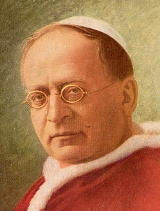
Pope Pius XI

Encyclopedia
Pope Pius XI born Ambrogio Damiano Achille Ratti, was Pope
from 6 February 1922, and sovereign
of Vatican City
from its creation as an independent state on 11 February 1929 until his death on 10 February 1939. He issued numerous encyclical
s including Quadragesimo Anno
highlighting capitalistic greed of international finance, social justice issues and Quas Primas
establishing the feast of Christ the King
. He took as his papal motto "Christ's peace in Christ's kingdom".
Achille Ratti was an accomplished scholar, librarian and priest. He celebrated his 60th birthday as a priest on 31 May 1917 and fewer than five years later, on 6 February 1922, he was elected Pope, succeeding Pope Benedict XV
, who was only thirty months older and thus from the same generation as Ratti. In those five years he had short stints as papal nuncio
in Poland, which forced him to leave the country, and as Archbishop of Milan and Cardinal-Priest of Ss. Silvestro e Martino ai Monti
, where he served for a few months before being elected Pope. He chose the name Pius, and his personality was strong, similar to Pius IX and Pius X. But as a scholar, he was open to science and research like no other Pope since Leo XIII. To establish or maintain the position of the Church, he fostered and concluded a record number of concordats including the Reichskonkordat with Germany. Under his pontificate, the 1870 stalemate concerning the Roman Question
with Italy over the status of the papacy was finally solved in the Lateran Treaty of 1929 with the assistance of Cardinal Pietro Gasparri
and Francesco Pacelli
, brother of the future Pope Pius XII
. He was unable to stop the Terrible Triangle
consisting of massive Church persecution and killing of clergy in Mexico
, Spain and the Soviet Union
. While in Mexico and Spain, the persecution was mainly directed against the Catholic Church, hostility in the Soviet Union was directed against all Christians but especially against the Eastern Catholic Churches united with the Vatican
. He vehemently protested against both Communism and National Socialism
as demeaning to human dignity and a violation of basic human rights, but found no echo or support in the democracies of the West, which he labelled a Conspiracy of Silence
. Against totalitarian demands, he fostered the freedom of families to determine on their own the direction of education of their children.
In one of his most important encyclical
s on the social order of modern society, Quadragesimo Anno
he stated that social and economic issues are vital to the Church not from a technical point of view but in terms of moral and ethical issues involved. Ethical considerations include the nature of private property in terms of its functions for society the development of the individual. He defined fair wages and branded the exploitation both materially and spiritually by international capitalism. He canonized important saints including Albertus Magnus
, Thomas More
, Petrus Canisius
, Konrad von Parzham, Andrew Bobola
, and Don Bosco. He beatified and canonized Thérèse de Lisieux
, for whom he held special reverence. He created the feast Christ the King
in response to anti-clericalism.
Pius XI took strong interests in fostering the participation of lay people throughout the Church, especially in the Catholic Action
movement. The end of his pontificate were dominated by defending the Church from intrusions into Catholic life and education.
, province of Milan
in 1857, the son of an owner of a silk
factory. He was ordained as a priest in 1879 and embarked on an academic career within the Church. He obtained three doctorates (in philosophy, canon law and theology) at the Gregorian University in Rome
, and then from 1882 to 1888 was a professor at the seminary in Padua
. His scholarly specialty was as an expert paleographer, a student of ancient and medieval Church manuscripts. Eventually, he left seminary teaching to work full time at the Ambrosian Library (the Biblioteca Ambrosiana
) in Milan
, from 1888 to 1911.
During this time, he edited and published an edition of the Ambrosian
Missal
(the rite of Mass used in Milan), and researched and wrote much on the life and works of St. Charles Borromeo
. He became chief of the Library in 1907, and undertook an impressively thorough programme of restoration and re-classification of the Ambrosian's collection. The scholar was also an avid mountaineer
in his spare time, reaching the summits of Monte Rosa
, the Matterhorn
, Mont Blanc
and Presolana
. In 1911, at Pope Pius X
's (1903 – 1914) invitation, he moved to the Vatican to become Vice-Prefect of the Vatican Library
, and in 1914 was promoted to Prefect.
(1914 – 1922) asked him to leave the Library and take on a vital diplomatic post: apostolic visitor (that is, papal representative) in Poland
, a state newly restored to existence, but at that time still under effective German and Austro-Hungarian control. Before all other heads of State, Pope Benedict XV
in October 1918 congratulated the Polish people to their independence. On March 1919, he nominated ten new bishops and, soon after, Achille Ratti, already in Warsaw as his representative, as papal nuncio. He was consecrated as a titular archbishop
in October 1919.
Benedict XV and Nuncio Ratti repeatedly cautioned Polish authorities against persecuting the Lithuanian and Ruthenian clergy. During the Bolshevik advance against Warsaw, the Pope asked for worldwide public prayers for Poland, while Nuncio
Ratti as the only foreign diplomat showed personal courage, refusing to flee from Warsaw
when the Red Army
was approaching it in August 1920. On June 11, 1921, Benedict XV asked Ratti to deliver his message to the Polish episcopate, warning against political misuses of spiritual power, urging again peaceful coexistence with neighbouring people, stating that “love of country has its limits in justice and obligations”
Ratti, a scholar, intended to work for Poland
and build bridges to the Soviet Union
, hoping even, to shed his blood for Russia. Pope Benedict XV
needed him as a diplomat
and not as a martyr
and forbade any trip into the USSR, although he was the official papal delegate for Russia. Therefore he continued his contacts to Russia. This did not generate much sympathy for him within Poland at the time. The Pope sent Nuncio Ratti to Silesia to act against potential political agitations of the Polish Catholic clergy. Ratti was asked to leave Poland after that. “While he tried honestly to show himself as a friend of Poland, Warsaw forced his departure, after his neutrality in Silesia
n voting was questioned” by Germans and Poles. Nationalistic Germans objected to a Polish nuncio supervising elections, and Poles were upset because he curtailed agitating clergy November 20, when German Cardinal Adolf Bertram announced a papal ban on all political activities of clergymen, calls for Ratti's expulsion climaxed in Warsaw. Two year later, Achille Ratti became Pope Pius XI, shaping Vatican policies towards Poland with Pietro Gasparri
and Eugenio Pacelli for the following thirty-six years. (1922-1958)
of June 3, 1921, Pope Benedict created three new cardinals, among them Achille Ratti, who was appointed as Archbishop of Milan simultaneously. Pope Benedict joked with them, saying, "Well, today I gave you the red hat, but soon it will be white for one of you." After the Vatican celebration, Ratti withdrew for a retreat into the Benedictine monastery Monte Cassino
to prepare spiritually for his new role. He accompanied Milanese pilgrims to Our Lady of Lourdes in August of 1921 . Before his enthronisation on Milan on September 8, Ratti visited his home town Desio
, where he received a tumultuous welcome. His episcopate in Milan was cut short on January 22, 1922, when it was announced that Pope Benedict XV
had died that day unexpectedly of pneumonia
. At the ensuing conclave (the longest of the 20th century), Ratti was elected Pope on February 6, 1922 on the fourteenth ballot, taking the name of Pius XI. His first act was to revive the traditional public blessing given from the balcony, Urbi et Orbi
, ("to the city and to the world"). His immediate predecessors had refused to do so ever since the loss of Rome from papal hands to the Italian state in 1870.
 Pius XI's first encyclical as Pope was directly related to his aim of Christianising all aspects of increasingly secular societies.
Ubi arcano
, promulgated in December 1922, inaugurated the "Catholic Action" movement.
Similar goals were in evidence in his encyclicals Divini illius magistri (1929), making clear the need for Christian over secular education, and Casti Connubii
(1930), praising Christian marriage and family life as the basis for any good society, condemning artificial means of contraception, but also acknowledging at the same time the unitive aspect of intercourse as licit:
(1933), in which he addressed the situation of the Church in Republican Spain, he proclaimed, that the Church is not "bound to one form of government more than to another, provided the Divine rights of God and of Christian consciences are safe", and specifically referred to "various civil institutions, be they monarchic or republican, aristocratic or democratic".
(1931), was written to mark 'forty years' since Pope Leo XIII
's (1878–1903) encyclical Rerum novarum, and restated that encyclical's warnings against both socialism and unrestrained capitalism, as enemies to human freedom and dignity. Pius XI instead envisioned an economy based on co-operation and solidarity .
Pius XI was the first Pope to utilise the power of modern communications technology in evangelising the wider world. He established Vatican Radio
in 1931, and he was the first Pope to broadcast on radio.
Pius XI continued the approach of Benedict XV on the issue of how to deal with the threat of modernism
in Catholic theology. The Pope was thoroughly orthodox theologically and had no sympathy with modernist ideas that relativised fundamental Catholic teachings. He condemned modernism in his writings and addresses. However, his opposition to modernist theology was by no means a rejection of new scholarship within the Church, as long as it was developed within the framework of orthodoxy and compatible with the Church's teachings. Pius XI was interested in supporting serious scientific study within the Church, establishing the Pontifical Academy for the Sciences in 1936.
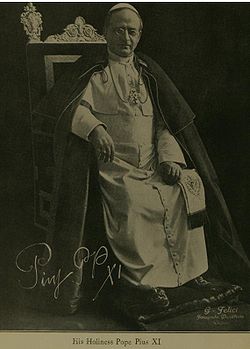 Pius XI strongly encouraged devotion to the Sacred Heart
in his encyclical Miserentissimus Redemptor
(1928). He canonised some important saints: Bernadette Soubirous
, Therese of Lisieux, John Vianney, John Fisher
, Thomas More
, and John Bosco. He also named several new Doctors of the Church: John of the Cross
, Albert the Great, Peter Canisius and Robert Bellarmine
.
Pius XI was the first Pope to directly address the Christian ecumenical movement. Like Benedict XV he was interested in achieving reunion with the Eastern Orthodox (failing that, he determined to give special attention the Eastern Catholic churches). He also allowed the dialogue between Roman Catholics and Anglicans which had been planned during Benedict XV's pontificate to take place at Mechelen
. However, these enterprises were firmly aimed at actually reuniting with the Roman Catholic Church other Christians who basically agreed with Catholic doctrine, bringing them back under Papal authority. To the broad pan-Protestant ecumenical movement he took a more negative attitude.
He condemned, in his 1928 encyclical, Mortalium Animos, the idea that Christian unity could be attained by establishing a broad federation of many bodies holding varying doctrines (the widespread view among Protestant ecumenists); rather, the Catholic Church was the one true Church, all her teachings were objectively true, and Christian unity could only be by achieved by non-Catholic denominations rejoining the Catholic Church and accepting the doctrines they had rejected.
with Italy and gaining recognition of an independent Vatican state.
In 1926 Pius XI condemned Action Française
, the monarchist movement which had until this time operated with the support of a great many French Catholics. The Pope judged that it was folly for the French Church to continue to tie its fortunes to the unlikely dream of a monarchist restoration, and found the movement's tendency to defend the Catholic religion in merely utilitarian and nationalistic terms, as a vital contributing factor to the greatness and stability of France, unorthodox.
Although the condemnation caused great heartache for many French Catholics, most obeyed and Action Française never really recovered.
Most of the Papal States had been seized by the forces of King Victor Emmanuel II of Italy
(1861–1878) in 1860 at the foundation of the modern unified Italian state
, and the rest, including Rome, in 1870. The Papacy and the Italian Government had been at loggerheads ever since: the Popes had refused to recognise the Italian state's seizure of the Papal States, instead withdrawing to become prisoners in the Vatican
, and the Italian government's policies had always been anti-clerical. Now Pius XI thought a compromise would be the best solution.
To bolster his own new regime, Benito Mussolini
was also eager for an agreement. After years of negotiation, in 1929, the Pope supervised the signing of the Lateran Treaties
with the Italian government. According to the terms of the first treaty, Vatican City
was given sovereignty as an enclave of the city of Rome in return for the Vatican relinquishing its claim to the former territories of the Papal States. Pius XI thus became a head of state (albeit the smallest state in the world), the first Pope who could be termed as such since the Papal States fell after the unification of Italy
in the 19th century. A second treaty, the concordat with Italy, recognised Roman Catholicism as the official state religion of Italy, gave the Church power over marriage law in Italy (ensuring the illegality of divorce), and restored Catholic religious teaching in all schools. In return, the clergy would not take part in politics. A third treaty provided financial compensation
to the Vatican for the loss of the Papal States. During the reign of Pius XI this money was used for investments in the stock markets and real estate. To manage these investments, the Pope appointed the lay-person Bernadino Nogara, who through shrewd investing in stocks, gold, and futures markets, significantly increased the Catholic Church's financial holdings. However contrary to myth it did not create enormous Vatican wealth. The compensation was relatively modest, and most of the money from investments simply paid for the upkeep of the expensive-to-maintain stock of historic buildings in the Vatican which previously had been maintained through funds raised from the Papal States
up until 1870.
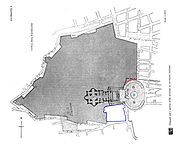 The Vatican's relationship with Mussolini's government deteriorated drastically in the following years as Mussolini's totalitarian ambitions began to impinge more and more on the autonomy of the Church. For example, the Church's youth groups were dissolved in 1931 to allow Mussolini's fascist youth groups complete dominance.
As a consequence Pius issued the encyclical
Non Abbiamo Bisogno
in 1931, in which he criticized the idea of a totalitarian state and Mussolini's treatment of the Church. Relations with Mussolini continued to worsen throughout the remainder of Pius XI's pontificate.
Mussolini urged Pius to excommunicate Hitler as he thought it would render him less powerful in Catholic Austria and reduce the danger to Italy and wider Europe. The Vatican refused to comply and thereafter Mussolini began to work with Hitler, adopting his anti-semitic and race theories.
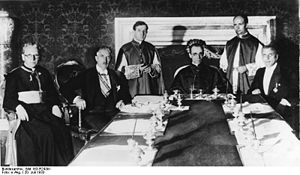 Pius XI was eager to negotiate concordat
s with any country that was willing to do so, thinking that written treaties were the best way to protect the Church's rights against governments increasingly inclined to interfere in such matters. Twelve concordats were signed during his reign with various types of governments, including some German state governments, and with Austria
. When Adolf Hitler
became Chancellor of Germany on 30 January 1933 and asked for a concordat, Pius XI accepted. Negotiations were conducted on his behalf by Cardinal Eugenio Pacelli, who later became Pope Pius XII
(1939–1958). The Reichskonkordat
was signed by Pacelli and by the German government in June 1933, and included guarantees of liberty for the Church, independence for Catholic organisations and youth groups, and religious teaching in schools.
In February 1936 Hitler sent Pius a telegram congratulating the Pope on the anniversary of his coronation but he responded with criticisms of what was happening in Germany, so much so that von Neurath the foreign secretary wanted to suppress it but Pius insisted it be forwarded.
. In 1922 he established the position of Apostolic Delegate to China, and the first person in that capacity was Celso Benigno Luigi Costantini. On 1 August 1928, the Pope addressed a message of support for the political unification of China. Following the Japanese invasion of North China in 1931 and the creation of Manchukuo
, the Holy See recognized the new state. On 10 September 1938, the Pope held a reception at Castel Gandolfo for an official delegation from Manchukuo, headed by Manchukuoan Minister of Foreign Affairs Han Yun.
, a document which was sent to Catholic schools worldwide.
condemning the Nazi ideology of racism and totalitarianism and Nazi violations of the concordat. Copies had to be smuggled into Germany so they could be read from the pulpit
The encyclical, the only one ever written in German, was addressed to German bishops and was read in all parishes of Germany. The actual writing of the text is credited to Munich Cardinal Michael von Faulhaber and to the Cardinal Secretary of State, Eugenio Pacelli, who later became Pope Pius XII. There was no advance announcement of the encyclical, and its distribution was kept secret in an attempt to ensure the unhindered public reading of its contents in all the Catholic Churches of Germany.
This encyclical condemned particularly the paganism of National Socialist ideology, the myth of race and blood, and fallacies in the Nazi conception of God.
, who founded the American order of Sisters of the Blessed Sacrament for Indians and Colored People, corresponded with Pius XI, as she had with his papal predecessors. (In 1887, Pope Leo XIII had encouraged Katharine Drexel—then a young Philadelphia socialite— to do missionary work with America's disadvantaged people of color). In the early 1930s, Mother Drexel wrote Pius XI asking him to bless a publicity campaign to acquaint white Catholics with the needs of these disadvantaged races among them. An emissary had shown him photos of Xavier University, New Orleans, LA, which Mother Drexel had established to educate African-Americans at the highest level in the USA. Pius XI replied promptly, sending his blessing and encouragement. Upon his return, the emissary told Mother Katharine that the Holy Father said he had read the novel Uncle Tom's Cabin as a boy, and it had ignited his life-long concern for the American Negro.

, went to jail and concentration camps, the Western democracies remained silent, which Pope Pius XI labeled bitterly as "a conspiracy of silence
". As the extreme nature of Nazi racial antisemitism became obvious, and as Mussolini in the late 1930s began imitating Hitler's anti-Jewish race laws in Italy, Pius XI continued to make his position clear, both in Mit brennender Sorge
and in a public address in the Vatican to Belgian pilgrims in 1938: "Mark well that in the Catholic Mass
, Abraham
is our Patriarch and forefather. Anti-Semitism is incompatible with the lofty thought which that fact expresses. It is a movement with which we Christians can have nothing to do. No, no, I say to you it is impossible for a Christian to take part in anti-Semitism. It is inadmissible. Through Christ and in Christ we are the spiritual progeny of Abraham. Spiritually, we [Christians] are all Semites" These comments were subsequently published worldwide but had little resonance at the time in the secular media. The "Conspiracy of Silence
" included not only the silence of secular powers against the horrors of National Socialism but also their silence on the persecution of the Church in the Terrible Triangle
. Despite these public comments, Pius was reported privately as suggesting that the Church's problems in the Soviet Union, Mexico and the Spanish Republic were, "reinforced by the anti-Christian spirit of Judaism".
and Spain and with the persecution of all Christians especially the Eastern Catholic Churches in the Soviet Union
. He called this the Terrible Triangle
, Pius XI mandated Berlin nuncio Eugenio Pacelli to work secretly on diplomatic arrangements between the Vatican and the Soviet Union. Pacelli negotiated food shipments for Russia, and met with Soviet representatives including Foreign Minister Georgi Chicherin, who rejected any kind of religious education, the ordination of priests and bishops, but offered agreements without the points vital to the Vatican. Despite Vatican pessimism and a lack of visible progress, Pacelli continued the secret negotiations, until Pius XI ordered them to be discontinued in 1927, because they generated no results and were dangerous to the Church, if made public.
The "harsh persecution short of total annihilation of the clergy, monks, and nuns and other people associated with the Church", continued well into the 1930s. In addition to executing and exiling many clerics, monks and laymen, the confiscating of Church implements "for victims of famine" and the closing of churches were common. Yet according to an official report based on the Census of 1936, some 55% of Soviet citizens identified themselves openly as religious, while others possibly concealed their belief.
, which resulted in the death of over 5,000 priests, bishops and followers. In the state of Tabasco
the Church was in effect outlawed altogether. In his encyclical Iniquis Afflictisque from 18 November 1926, Pope Pius protested against the slaughter and persecution. The United States intervened in 1929 and moderated an agreement. The persecutions resumed in 1931. Pius XI condemned the Mexican government again in his 1932 encyclical Acerba Animi. Problems continued with reduced hostilities until 1940, when in the new pontificate of Pope Pius XII
President Manuel Ávila Camacho
returned the Mexican churches to the Catholic Church.
There were 4,500 Mexican priests serving the Mexican people before the rebellion, in 1934, over 90% of them suffered persecution as only 334 priests were licensed by the government to serve fifteen million people. Excluding foreign religious, over 4,100 Mexican priests were eliminated by emigration, expulsion and assassination. By 1935, 17 Mexican states were left with no priests at all.
1932, Pope Pius XI protested against these measures and demanded restitution
.
is in full communion with the Bishop of Rome and the Catholic Church.
and even the papacy itself. Qui mange du Pape, en meurt – who eats from the pope, is dead!
Peter Kent writes:

, The Unity of the Human Society, that Pius XI commissioned to denounce racism in the USA, Europe and elsewhere, colonialism and the violent German nationalism was published by Georges Passelecq and Berard Suchecky under the title L'Encyclique Cachee De Pie XI
Following Vatican custom, his successor Pope Pius XII, who according to the authors was not aware of the text before the death of his predecessor, chose not to publish this encyclical. However, his first encyclical Summi Pontificatus
(12 October 1939), published after the beginning of World War II, has the identical title On the Unity of Human Society and uses many of the arguments of the text, avoiding all of the negative characterisation of the Jewish people and religion contained in the proposed text of the encyclical. Summi Pontificatus
sees Christianity being universalized and opposed to racial hostility and superiority. There are no real racial differences, because the human race
forms a unity, because "one ancestor [God] made all nations to inhabit the whole earth".
ever received them. He gave his last address to the Pontifical Academy of Sciences
, which he had founded. He spoke without prepared text on the relation between science and the Catholic religion. This is considered to have been his last major pontifical address. A young priest tried to influence him to take his medicine, reminding him of the old Roman saying Principiis obsta (Resist the beginnings) but the Pope smiled and said, "you forgot the second part, sero medicina paratur, it’s too late for medicine". In February 1939, the situation of the Pontiff visibly degenerated. Pius had major pain and difficulties walking. When he tried to get out of bed, he was unable to do so, because of increased breathing problems. On 7 February, a team of several doctors announced to the papal staff that the Pontiff would soon depart from them. He was now aided by this team of doctors, the professors Milani, Rocchi, Bonamone, Gemelli and Bianchi, specialists from all over Italy. They informed Cardinal Eugenio Pacelli and Monsignor Giovanni Battista Montini that heart insufficiency combined with bronchial attacks had hopelessly complicated the already poor outlook. The Pope himself made plans for continued audiences with Domenico Tardini, as if he would recover within short time, although, because he was unable to breathe normally, he lost his ability to move or even to turn in his bed. His last words to those near him were spoken with clarity and firmness: My soul parts from you all in peace Pope Pius XI died at 5:31 am (Rome Time) of a third heart attack on 10 February 1939, aged 81. He was buried in the crypt at St. Peter's Basilica, in the main chapel, close to the Tomb of St. Peter
.
named after him, he having been the first to scale them.
Pius XI fought the two ascendant ideologies of communism and fascism.His success in fighting them was limited and there is much controversy over the concordats he entered with European regimes to improve the situation of the Catholic Church. At the outset, it was clear that he found communism to be the greater of the two evils but there is no doubt that he was equally opposed to anti-Semitism.
Whatever the results of his activism, Pius XI was working busily until the end. He strove to improve the condition of the Church, through the negotiation of the concordats (treaties) in Europe and to increase its strength worldwide through vigorous missionary work. He also reiterated the social teachings of Leo XIII in his encyclical Quadregesimo Anno, issued in 1931.
Pius XI was determined to increase the profile of the papacy. Testament to this is his Urbi et Orbi (to the city and the world) blessing which he gave following his election; it was the first time this blessing was given. After the Vatican had regained its status as a state in 1929, he flexed its muscles through the treaties he negotiated, and by raising his voice in protest when the terms were violated.
He was possessed of an iron will. The strong-willed pontiff was succeeded by his charismatic Secretary of State, Cardinal Eugenio Pacelli (Pius XII), a diplomat who would continue Pius XI's struggle against Nazism and Fascism as a virtual prisoner in the Vatican during World War II.
A Chile
an glacier bears Pius XI's name. The Achille Ratti Climbing Club, based in the United Kingdom, was founded by Bishop T. B. Pearson in 1940 and was named after Monsignor Achille Ratti.
Pius XI High School
in Milwaukee, WI was named after Pope Pius XI.
Pope
The Pope is the Bishop of Rome, a position that makes him the leader of the worldwide Catholic Church . In the Catholic Church, the Pope is regarded as the successor of Saint Peter, the Apostle...
from 6 February 1922, and sovereign
Sovereignty
Sovereignty is the quality of having supreme, independent authority over a geographic area, such as a territory. It can be found in a power to rule and make law that rests on a political fact for which no purely legal explanation can be provided...
of Vatican City
Vatican City
Vatican City , or Vatican City State, in Italian officially Stato della Città del Vaticano , which translates literally as State of the City of the Vatican, is a landlocked sovereign city-state whose territory consists of a walled enclave within the city of Rome, Italy. It has an area of...
from its creation as an independent state on 11 February 1929 until his death on 10 February 1939. He issued numerous encyclical
Encyclical
An encyclical was originally a circular letter sent to all the churches of a particular area in the ancient Catholic Church. At that time, the word could be used for a letter sent out by any bishop...
s including Quadragesimo Anno
Quadragesimo Anno
Quadragesimo Anno is an encyclical written by Pope Pius XI, issued 15 May 1931, 40 years after Leo XIII's Rerum Novarum. Unlike Leo XIII, who addressed the condition of workers, Pius XI discusses the ethical implications of the social and economic order...
highlighting capitalistic greed of international finance, social justice issues and Quas Primas
Quas Primas
Quas Primas was an encyclical of Pope Pius XI. Promulgated on December 11, 1925, it introduced the Feast of Christ the King.The encyclical summarizes both the Old Testament and the New Testament teaching on the kingship of Christ...
establishing the feast of Christ the King
Feast of Christ the King
The Feast of Christ the King is the last holy Sunday in the western liturgical calendar, celebrated by the Roman Catholic Church as well as many Anglicans, Lutherans, and other Mainline Protestants.-Origin and history in the Catholic Church:Pope Pius XI instituted the Feast of Christ the...
. He took as his papal motto "Christ's peace in Christ's kingdom".
Achille Ratti was an accomplished scholar, librarian and priest. He celebrated his 60th birthday as a priest on 31 May 1917 and fewer than five years later, on 6 February 1922, he was elected Pope, succeeding Pope Benedict XV
Pope Benedict XV
Pope Benedict XV , born Giacomo Paolo Giovanni Battista della Chiesa, reigned as Pope from 3 September 1914 to 22 January 1922...
, who was only thirty months older and thus from the same generation as Ratti. In those five years he had short stints as papal nuncio
Nuncio
Nuncio is an ecclesiastical diplomatic title, derived from the ancient Latin word, Nuntius, meaning "envoy." This article addresses this title as well as derived similar titles, all within the structure of the Roman Catholic Church...
in Poland, which forced him to leave the country, and as Archbishop of Milan and Cardinal-Priest of Ss. Silvestro e Martino ai Monti
San Martino ai Monti
San Martino ai Monti, also known as Santi Silvestro e Martino ai Monti - Titolo Equizio, is a basilica church in Rome, Italy, in the Rione Monti neighbourhood.-History:...
, where he served for a few months before being elected Pope. He chose the name Pius, and his personality was strong, similar to Pius IX and Pius X. But as a scholar, he was open to science and research like no other Pope since Leo XIII. To establish or maintain the position of the Church, he fostered and concluded a record number of concordats including the Reichskonkordat with Germany. Under his pontificate, the 1870 stalemate concerning the Roman Question
Roman Question
thumb|300px|The breach of [[Porta Pia]], on the right, in a contemporaneous photograph.The Roman Question was a political dispute between the Italian Government and the Papacy from 1861 to 1929....
with Italy over the status of the papacy was finally solved in the Lateran Treaty of 1929 with the assistance of Cardinal Pietro Gasparri
Pietro Gasparri
Pietro Gasparri was a Roman Catholic archbishop, diplomat and politician in the Roman Curia and signatory of the Lateran Pacts.- Biography :...
and Francesco Pacelli
Francesco Pacelli
Francesco Pacelli, the older brother of Eugenio Pacelli the future Pope Pius XII was born in Rome on February 1, 1872. He died in Rome on April 22, 1935...
, brother of the future Pope Pius XII
Pope Pius XII
The Venerable Pope Pius XII , born Eugenio Maria Giuseppe Giovanni Pacelli , reigned as Pope, head of the Catholic Church and sovereign of Vatican City State, from 2 March 1939 until his death in 1958....
. He was unable to stop the Terrible Triangle
Terrible Triangle
Terrible Triangle was a term used by Pope Pius XI for the simultaneous persecution of Christians in general and the Catholic Church in particular in three countries: the Soviet Union, Mexico, and Spain. These events are said to have influenced his position on Communism throughout his pontificate...
consisting of massive Church persecution and killing of clergy in Mexico
Mexico
The United Mexican States , commonly known as Mexico , is a federal constitutional republic in North America. It is bordered on the north by the United States; on the south and west by the Pacific Ocean; on the southeast by Guatemala, Belize, and the Caribbean Sea; and on the east by the Gulf of...
, Spain and the Soviet Union
Soviet Union
The Soviet Union , officially the Union of Soviet Socialist Republics , was a constitutionally socialist state that existed in Eurasia between 1922 and 1991....
. While in Mexico and Spain, the persecution was mainly directed against the Catholic Church, hostility in the Soviet Union was directed against all Christians but especially against the Eastern Catholic Churches united with the Vatican
Holy See
The Holy See is the episcopal jurisdiction of the Catholic Church in Rome, in which its Bishop is commonly known as the Pope. It is the preeminent episcopal see of the Catholic Church, forming the central government of the Church. As such, diplomatically, and in other spheres the Holy See acts and...
. He vehemently protested against both Communism and National Socialism
Nazism
Nazism, the common short form name of National Socialism was the ideology and practice of the Nazi Party and of Nazi Germany...
as demeaning to human dignity and a violation of basic human rights, but found no echo or support in the democracies of the West, which he labelled a Conspiracy of Silence
Conspiracy of Silence (Church persecutions)
Conspiracy of Silence is a term used by the Catholic Church since Pope Pius XI to describe the lack of reaction to the persecution of Christians by Nazis and Communists in such countries as the Soviet Union, Mexico, Germany and Spain....
. Against totalitarian demands, he fostered the freedom of families to determine on their own the direction of education of their children.
In one of his most important encyclical
Encyclical
An encyclical was originally a circular letter sent to all the churches of a particular area in the ancient Catholic Church. At that time, the word could be used for a letter sent out by any bishop...
s on the social order of modern society, Quadragesimo Anno
Quadragesimo Anno
Quadragesimo Anno is an encyclical written by Pope Pius XI, issued 15 May 1931, 40 years after Leo XIII's Rerum Novarum. Unlike Leo XIII, who addressed the condition of workers, Pius XI discusses the ethical implications of the social and economic order...
he stated that social and economic issues are vital to the Church not from a technical point of view but in terms of moral and ethical issues involved. Ethical considerations include the nature of private property in terms of its functions for society the development of the individual. He defined fair wages and branded the exploitation both materially and spiritually by international capitalism. He canonized important saints including Albertus Magnus
Albertus Magnus
Albertus Magnus, O.P. , also known as Albert the Great and Albert of Cologne, is a Catholic saint. He was a German Dominican friar and a bishop, who achieved fame for his comprehensive knowledge of and advocacy for the peaceful coexistence of science and religion. Those such as James A. Weisheipl...
, Thomas More
Thomas More
Sir Thomas More , also known by Catholics as Saint Thomas More, was an English lawyer, social philosopher, author, statesman and noted Renaissance humanist. He was an important councillor to Henry VIII of England and, for three years toward the end of his life, Lord Chancellor...
, Petrus Canisius
Petrus Canisius
Saint Petrus Canisius was an important Jesuit who fought against the spread of Protestantism in Germany, Austria, Bohemia, Moravia, , and Switzerland...
, Konrad von Parzham, Andrew Bobola
Andrew Bobola
Andrew Bobola was a Polish missionary and martyr of the Society of Jesus, known as the apostle of Lithuania and the "hunter of souls".-Biography:...
, and Don Bosco. He beatified and canonized Thérèse de Lisieux
Thérèse de Lisieux
Saint Thérèse of Lisieux , or Saint Thérèse of the Child Jesus and the Holy Face, born Marie-Françoise-Thérèse Martin, was a French Carmelite nun...
, for whom he held special reverence. He created the feast Christ the King
Christ the King
Christ the King is a title of Jesus based on several passages of Scripture. It is used by most Christians. The Roman Catholic Church, together with many Protestant denominations, including the Anglican Churches, Presbyterians, Lutherans and Methodists, celebrate the Feast of Christ the King on the...
in response to anti-clericalism.
Pius XI took strong interests in fostering the participation of lay people throughout the Church, especially in the Catholic Action
Catholic Action
Catholic Action was the name of many groups of lay Catholics who were attempting to encourage a Catholic influence on society.They were especially active in the nineteenth century in historically Catholic countries that fell under anti-clerical regimes such as Spain, Italy, Bavaria, France, and...
movement. The end of his pontificate were dominated by defending the Church from intrusions into Catholic life and education.
Early life and career
Achille Ratti was born in DesioDesio
Desio is a town and comune in the Province of Monza and Brianza, Italy.-History:In 1277 it was the location of the battle between the Visconti and della Torre families for the rule of Milan. It is also known as the birthplace of Pope Pius XI and the Arsenal goalkeeper, Vito Mannone...
, province of Milan
Province of Milan
The Province of Milan : /) is a province in the Lombardy region of Italy. Its capital is the city of Milan. The provincial territory is highly urbanized, resulting in the third highest population density among the Italian provinces with more than 2,000 inhabitants/km2, just behind the provinces of...
in 1857, the son of an owner of a silk
Silk
Silk is a natural protein fiber, some forms of which can be woven into textiles. The best-known type of silk is obtained from the cocoons of the larvae of the mulberry silkworm Bombyx mori reared in captivity...
factory. He was ordained as a priest in 1879 and embarked on an academic career within the Church. He obtained three doctorates (in philosophy, canon law and theology) at the Gregorian University in Rome
Rome
Rome is the capital of Italy and the country's largest and most populated city and comune, with over 2.7 million residents in . The city is located in the central-western portion of the Italian Peninsula, on the Tiber River within the Lazio region of Italy.Rome's history spans two and a half...
, and then from 1882 to 1888 was a professor at the seminary in Padua
Padua
Padua is a city and comune in the Veneto, northern Italy. It is the capital of the province of Padua and the economic and communications hub of the area. Padua's population is 212,500 . The city is sometimes included, with Venice and Treviso, in the Padua-Treviso-Venice Metropolitan Area, having...
. His scholarly specialty was as an expert paleographer, a student of ancient and medieval Church manuscripts. Eventually, he left seminary teaching to work full time at the Ambrosian Library (the Biblioteca Ambrosiana
Biblioteca Ambrosiana
The Biblioteca Ambrosiana is a historic library in Milan, Italy, also housing the Pinacoteca Ambrosiana, the Ambrosian art gallery. Named after Ambrose, the patron saint of Milan, it was founded by Cardinal Federico Borromeo , whose agents scoured Western Europe and even Greece and Syria for books...
) in Milan
Milan
Milan is the second-largest city in Italy and the capital city of the region of Lombardy and of the province of Milan. The city proper has a population of about 1.3 million, while its urban area, roughly coinciding with its administrative province and the bordering Province of Monza and Brianza ,...
, from 1888 to 1911.
During this time, he edited and published an edition of the Ambrosian
Ambrosian Rite
Ambrosian Rite, also called the Milanese Rite, is a Catholic liturgical Western Rite. The rite is named after Saint Ambrose, a bishop of Milan in the fourth century...
Missal
Missal
A missal is a liturgical book containing all instructions and texts necessary for the celebration of Mass throughout the year.-History:Before the compilation of such books, several books were used when celebrating Mass...
(the rite of Mass used in Milan), and researched and wrote much on the life and works of St. Charles Borromeo
Charles Borromeo
Charles Borromeo was the cardinal archbishop of the Catholic Archdiocese of Milan from 1564 to 1584. He was a leading figure during the Counter-Reformation and was responsible for significant reforms in the Catholic Church, including the founding of seminaries for the education of priests...
. He became chief of the Library in 1907, and undertook an impressively thorough programme of restoration and re-classification of the Ambrosian's collection. The scholar was also an avid mountaineer
Mountaineer
-Sports:*Mountaineering, the sport, hobby or profession of walking, hiking, trekking and climbing up mountains, also known as alpinism-University athletic teams and mascots:*Appalachian State Mountaineers, the athletic teams of Appalachian State University...
in his spare time, reaching the summits of Monte Rosa
Monte Rosa
The Monte Rosa Massif is a mountain massif located in the eastern part of the Pennine Alps. It is located between Switzerland and Italy...
, the Matterhorn
Matterhorn
The Matterhorn , Monte Cervino or Mont Cervin , is a mountain in the Pennine Alps on the border between Switzerland and Italy. Its summit is 4,478 metres high, making it one of the highest peaks in the Alps. The four steep faces, rising above the surrounding glaciers, face the four compass points...
, Mont Blanc
Mont Blanc
Mont Blanc or Monte Bianco , meaning "White Mountain", is the highest mountain in the Alps, Western Europe and the European Union. It rises above sea level and is ranked 11th in the world in topographic prominence...
and Presolana
Presolana
Presolana is a mountain located in Lombardy, northern Italy, about 35 km north of Bergamo. Part of the Bergamo Alps, it is included in the province of Bergamo, and divides the Val Seriana and Valle di Scalve....
. In 1911, at Pope Pius X
Pope Pius X
Pope Saint Pius X , born Giuseppe Melchiorre Sarto, was the 257th Pope of the Catholic Church, serving from 1903 to 1914. He was the first pope since Pope Pius V to be canonized. Pius X rejected modernist interpretations of Catholic doctrine, promoting traditional devotional practices and orthodox...
's (1903 – 1914) invitation, he moved to the Vatican to become Vice-Prefect of the Vatican Library
Vatican Library
The Vatican Library is the library of the Holy See, currently located in Vatican City. It is one of the oldest libraries in the world and contains one of the most significant collections of historical texts. Formally established in 1475, though in fact much older, it has 75,000 codices from...
, and in 1914 was promoted to Prefect.
Expulsion from Poland
Ratti's career took a sharp turn in 1918. Pope Benedict XVPope Benedict XV
Pope Benedict XV , born Giacomo Paolo Giovanni Battista della Chiesa, reigned as Pope from 3 September 1914 to 22 January 1922...
(1914 – 1922) asked him to leave the Library and take on a vital diplomatic post: apostolic visitor (that is, papal representative) in Poland
Poland
Poland , officially the Republic of Poland , is a country in Central Europe bordered by Germany to the west; the Czech Republic and Slovakia to the south; Ukraine, Belarus and Lithuania to the east; and the Baltic Sea and Kaliningrad Oblast, a Russian exclave, to the north...
, a state newly restored to existence, but at that time still under effective German and Austro-Hungarian control. Before all other heads of State, Pope Benedict XV
Pope Benedict XV
Pope Benedict XV , born Giacomo Paolo Giovanni Battista della Chiesa, reigned as Pope from 3 September 1914 to 22 January 1922...
in October 1918 congratulated the Polish people to their independence. On March 1919, he nominated ten new bishops and, soon after, Achille Ratti, already in Warsaw as his representative, as papal nuncio. He was consecrated as a titular archbishop
Titular bishop
A titular bishop in various churches is a bishop who is not in charge of a diocese.By definition a bishop is an "overseer" of a community of the faithful, so when a priest is ordained a bishop the tradition of the Roman Catholic and Orthodox churches is that he be ordained for a specific place...
in October 1919.
Benedict XV and Nuncio Ratti repeatedly cautioned Polish authorities against persecuting the Lithuanian and Ruthenian clergy. During the Bolshevik advance against Warsaw, the Pope asked for worldwide public prayers for Poland, while Nuncio
Nuncio
Nuncio is an ecclesiastical diplomatic title, derived from the ancient Latin word, Nuntius, meaning "envoy." This article addresses this title as well as derived similar titles, all within the structure of the Roman Catholic Church...
Ratti as the only foreign diplomat showed personal courage, refusing to flee from Warsaw
Warsaw
Warsaw is the capital and largest city of Poland. It is located on the Vistula River, roughly from the Baltic Sea and from the Carpathian Mountains. Its population in 2010 was estimated at 1,716,855 residents with a greater metropolitan area of 2,631,902 residents, making Warsaw the 10th most...
when the Red Army
Red Army
The Workers' and Peasants' Red Army started out as the Soviet Union's revolutionary communist combat groups during the Russian Civil War of 1918-1922. It grew into the national army of the Soviet Union. By the 1930s the Red Army was among the largest armies in history.The "Red Army" name refers to...
was approaching it in August 1920. On June 11, 1921, Benedict XV asked Ratti to deliver his message to the Polish episcopate, warning against political misuses of spiritual power, urging again peaceful coexistence with neighbouring people, stating that “love of country has its limits in justice and obligations”
Ratti, a scholar, intended to work for Poland
Poland
Poland , officially the Republic of Poland , is a country in Central Europe bordered by Germany to the west; the Czech Republic and Slovakia to the south; Ukraine, Belarus and Lithuania to the east; and the Baltic Sea and Kaliningrad Oblast, a Russian exclave, to the north...
and build bridges to the Soviet Union
Soviet Union
The Soviet Union , officially the Union of Soviet Socialist Republics , was a constitutionally socialist state that existed in Eurasia between 1922 and 1991....
, hoping even, to shed his blood for Russia. Pope Benedict XV
Pope Benedict XV
Pope Benedict XV , born Giacomo Paolo Giovanni Battista della Chiesa, reigned as Pope from 3 September 1914 to 22 January 1922...
needed him as a diplomat
Diplomat
A diplomat is a person appointed by a state to conduct diplomacy with another state or international organization. The main functions of diplomats revolve around the representation and protection of the interests and nationals of the sending state, as well as the promotion of information and...
and not as a martyr
Martyr
A martyr is somebody who suffers persecution and death for refusing to renounce, or accept, a belief or cause, usually religious.-Meaning:...
and forbade any trip into the USSR, although he was the official papal delegate for Russia. Therefore he continued his contacts to Russia. This did not generate much sympathy for him within Poland at the time. The Pope sent Nuncio Ratti to Silesia to act against potential political agitations of the Polish Catholic clergy. Ratti was asked to leave Poland after that. “While he tried honestly to show himself as a friend of Poland, Warsaw forced his departure, after his neutrality in Silesia
Silesia
Silesia is a historical region of Central Europe located mostly in Poland, with smaller parts also in the Czech Republic, and Germany.Silesia is rich in mineral and natural resources, and includes several important industrial areas. Silesia's largest city and historical capital is Wrocław...
n voting was questioned” by Germans and Poles. Nationalistic Germans objected to a Polish nuncio supervising elections, and Poles were upset because he curtailed agitating clergy November 20, when German Cardinal Adolf Bertram announced a papal ban on all political activities of clergymen, calls for Ratti's expulsion climaxed in Warsaw. Two year later, Achille Ratti became Pope Pius XI, shaping Vatican policies towards Poland with Pietro Gasparri
Pietro Gasparri
Pietro Gasparri was a Roman Catholic archbishop, diplomat and politician in the Roman Curia and signatory of the Lateran Pacts.- Biography :...
and Eugenio Pacelli for the following thirty-six years. (1922-1958)
Elevation to Papacy
His had been a fast rise in the world of practical Church affairs after his long years of scholarship. In the consistoryConsistory
-Antiquity:Originally, the Latin word consistorium meant simply 'sitting together', just as the Greek synedrion ....
of June 3, 1921, Pope Benedict created three new cardinals, among them Achille Ratti, who was appointed as Archbishop of Milan simultaneously. Pope Benedict joked with them, saying, "Well, today I gave you the red hat, but soon it will be white for one of you." After the Vatican celebration, Ratti withdrew for a retreat into the Benedictine monastery Monte Cassino
Monte Cassino
Monte Cassino is a rocky hill about southeast of Rome, Italy, c. to the west of the town of Cassino and altitude. St. Benedict of Nursia established his first monastery, the source of the Benedictine Order, here around 529. It was the site of Battle of Monte Cassino in 1944...
to prepare spiritually for his new role. He accompanied Milanese pilgrims to Our Lady of Lourdes in August of 1921 . Before his enthronisation on Milan on September 8, Ratti visited his home town Desio
Desio
Desio is a town and comune in the Province of Monza and Brianza, Italy.-History:In 1277 it was the location of the battle between the Visconti and della Torre families for the rule of Milan. It is also known as the birthplace of Pope Pius XI and the Arsenal goalkeeper, Vito Mannone...
, where he received a tumultuous welcome. His episcopate in Milan was cut short on January 22, 1922, when it was announced that Pope Benedict XV
Pope Benedict XV
Pope Benedict XV , born Giacomo Paolo Giovanni Battista della Chiesa, reigned as Pope from 3 September 1914 to 22 January 1922...
had died that day unexpectedly of pneumonia
Pneumonia
Pneumonia is an inflammatory condition of the lung—especially affecting the microscopic air sacs —associated with fever, chest symptoms, and a lack of air space on a chest X-ray. Pneumonia is typically caused by an infection but there are a number of other causes...
. At the ensuing conclave (the longest of the 20th century), Ratti was elected Pope on February 6, 1922 on the fourteenth ballot, taking the name of Pius XI. His first act was to revive the traditional public blessing given from the balcony, Urbi et Orbi
Urbi et Orbi
Urbi et Orbi denotes a papal address and Apostolic Blessing that is given to the City of Rome and to the entire world, on certain occasions. It was a standard opening of Ancient Roman proclamations....
, ("to the city and to the world"). His immediate predecessors had refused to do so ever since the loss of Rome from papal hands to the Italian state in 1870.
Public teaching: "Christ's Peace in Christ's Kingdom"
Ubi arcano
Ubi Arcano Dei Consilio
Ubi Arcano Dei Consilio was Pius XI's first encyclical. Promulgated in December 1922, it was directly related to his aim of Christianising all aspects of increasingly secular societies.This document inaugurated the "Catholic Action" movement...
, promulgated in December 1922, inaugurated the "Catholic Action" movement.
Similar goals were in evidence in his encyclicals Divini illius magistri (1929), making clear the need for Christian over secular education, and Casti Connubii
Casti Connubii
Castī Connūbiī was a papal encyclical promulgated by Pope Pius XI on December 31, 1930 in response to the Lambeth Conference of the Anglican church. It stressed the sanctity of marriage, prohibited Catholics from using any form of artificial birth control, and reaffirmed the prohibition on abortion...
(1930), praising Christian marriage and family life as the basis for any good society, condemning artificial means of contraception, but also acknowledging at the same time the unitive aspect of intercourse as licit:
- Any use whatsoever of matrimony exercised in such a way that the act is deliberately frustrated in its natural power to generate life is an offense against the law of God and of nature, and those who indulge in such are branded with the guilt of a grave sin.
- Nor are those considered as acting against nature who in the married state use their right in the proper manner although on account of natural reasons either of time or of certain defects, new life cannot be brought forth. For in matrimony as well as in the use of the matrimonial rights there are also secondary ends, such as mutual aid, the cultivating of mutual love, and the quieting of concupiscence which husband and wife are not forbidden to consider so long as they are subordinated to the primary end and so long as the intrinsic nature of the act is preserved.
Political teachings
In contrast to some of his predecessors in the nineteenth century, who had favoured monarchy and dismissed democracy, Pius XI took a pragmatic approach toward the different forms of government. In his encyclical Dilectissima NobisDilectissima Nobis
Dilectissima Nobis: On Oppression Of The Church Of Spain is an encyclical issued by Pope Pius XI on June 3, 1933 in which he decried persecution of the Church in Spain, specifically naming the expropriation of all Church buildings, episcopal residences, parish houses, seminaries and...
(1933), in which he addressed the situation of the Church in Republican Spain, he proclaimed, that the Church is not "bound to one form of government more than to another, provided the Divine rights of God and of Christian consciences are safe", and specifically referred to "various civil institutions, be they monarchic or republican, aristocratic or democratic".
Social teachings
Pius XI argued for a reconstruction of economic and political life on the basis of religious values. Quadragesimo AnnoQuadragesimo Anno
Quadragesimo Anno is an encyclical written by Pope Pius XI, issued 15 May 1931, 40 years after Leo XIII's Rerum Novarum. Unlike Leo XIII, who addressed the condition of workers, Pius XI discusses the ethical implications of the social and economic order...
(1931), was written to mark 'forty years' since Pope Leo XIII
Pope Leo XIII
Pope Leo XIII , born Vincenzo Gioacchino Raffaele Luigi Pecci to an Italian comital family, was the 256th Pope of the Roman Catholic Church, reigning from 1878 to 1903...
's (1878–1903) encyclical Rerum novarum, and restated that encyclical's warnings against both socialism and unrestrained capitalism, as enemies to human freedom and dignity. Pius XI instead envisioned an economy based on co-operation and solidarity .
Private property
The Church has a role in discussing the issues related to the social order. Social and economic issues are vital to her not from a technical point of view but in terms of moral and ethical issues involved. Ethical considerations include the nature of private property. within the Catholic Church several conflicting views had developed. Pope Pius XI declares private property essential for the development and freedom of the individual. Those who deny private property, deny personal freedom and development. But, said Pius, private property has a social function as well. Private property loses its morality, if it is not subordinated to the common good. Therefore, governments have a right to redistribution policies. In extreme cases, the Pope grants the State a right of expropriation of private property.Capital and labour
A related issue, said Pius, is the relation between capital and labour and the determination of fair wages. Pius develops the following ethical mandate: The Church considers it a perversion of industrial society to have developed sharp opposite camps based on income. He welcomes all attempts to alleviate these differences. Three elements determine a fair wage: the worker's family, the economic condition of the enterprise, and the economy as a whole. The family has an innate right to development, but this is only possible within the framework of a functioning economy and a sound enterprise. Thus, Pius concludes that cooperation and not conflict is a necessary condition, given the mutual interdependence of the parties involved.Social order
Pius XI believed that industrialization results in less freedom at the individual and communal level, because numerous free social entities get absorbed by larger ones. The society of individuals becomes the mass class-society. People are much more interdependent than in ancient times, and become egoistic or class-conscious in order to save some freedom for themselves. The pope demands more solidarity, especially between employers and employees, through new forms of cooperation and communication. Pius displays a negative view of capitalism, especially of the anonymous international finance markets. He identifies certain dangers for small and medium-size enterprises, which have insufficient access to capital markets and are squeezed or destroyed by the larger ones. He warns that capitalist interests can become a danger for nations, which could be reduced to “chained slaves of individual interests”Pius XI was the first Pope to utilise the power of modern communications technology in evangelising the wider world. He established Vatican Radio
Vatican Radio
Vatican Radio is the official broadcasting service of the Vatican.Set up in 1931 by Guglielmo Marconi, today its programs are offered in 47 languages, and are sent out on short wave , medium wave, FM, satellite and the Internet. The Jesuit Order has been charged with the management of Vatican...
in 1931, and he was the first Pope to broadcast on radio.
Internal Church affairs and ecumenism
In his management of the Church's internal affairs Pius XI mostly continued the policies of his predecessor. Like Benedict XV, he emphasised spreading Catholicism in Africa and Asia and on the training of native clergy in those mission territories. He ordered every religious order to devote some of its personnel and resources to missionary work.Pius XI continued the approach of Benedict XV on the issue of how to deal with the threat of modernism
Modernism (Roman Catholicism)
Modernism refers to theological opinions expressed during the late 19th and early 20th centuries, but with influence reaching into the 21st century, which are characterized by a break with the past. Catholic modernists form an amorphous group. The term "modernist" appears in Pope Pius X's 1907...
in Catholic theology. The Pope was thoroughly orthodox theologically and had no sympathy with modernist ideas that relativised fundamental Catholic teachings. He condemned modernism in his writings and addresses. However, his opposition to modernist theology was by no means a rejection of new scholarship within the Church, as long as it was developed within the framework of orthodoxy and compatible with the Church's teachings. Pius XI was interested in supporting serious scientific study within the Church, establishing the Pontifical Academy for the Sciences in 1936.
Sacred Heart
The Sacred Heart is one of the most famous religious devotions to Jesus' physical heart as the representation of His divine love for Humanity....
in his encyclical Miserentissimus Redemptor
Miserentissimus Redemptor
Miserentissimus Redemptor is the title of an encyclical by Pope Pius XI, issued on May 8, 1928. This encyclical deals with the concepts of Acts of Reparation and atonement...
(1928). He canonised some important saints: Bernadette Soubirous
Bernadette Soubirous
Saint Marie-Bernarde Soubirous was a miller's daughter born in Lourdes. From 11 February to 16 July 1858, she reported 18 apparitions of "a small young lady" who asked for a chapel to be built at that site at Lourdes....
, Therese of Lisieux, John Vianney, John Fisher
John Fisher
Saint John Fisher was an English Roman Catholic scholastic, bishop, cardinal and martyr. He shares his feast day with Saint Thomas More on 22 June in the Roman Catholic calendar of saints and 6 July on the Church of England calendar of saints...
, Thomas More
Thomas More
Sir Thomas More , also known by Catholics as Saint Thomas More, was an English lawyer, social philosopher, author, statesman and noted Renaissance humanist. He was an important councillor to Henry VIII of England and, for three years toward the end of his life, Lord Chancellor...
, and John Bosco. He also named several new Doctors of the Church: John of the Cross
John of the Cross
John of the Cross , born Juan de Yepes Álvarez, was a major figure of the Counter-Reformation, a Spanish mystic, Catholic saint, Carmelite friar and priest, born at Fontiveros, Old Castile....
, Albert the Great, Peter Canisius and Robert Bellarmine
Robert Bellarmine
Robert Bellarmine was an Italian Jesuit and a Cardinal of the Catholic Church. He was one of the most important figures in the Counter-Reformation...
.
Pius XI was the first Pope to directly address the Christian ecumenical movement. Like Benedict XV he was interested in achieving reunion with the Eastern Orthodox (failing that, he determined to give special attention the Eastern Catholic churches). He also allowed the dialogue between Roman Catholics and Anglicans which had been planned during Benedict XV's pontificate to take place at Mechelen
Mechelen
Mechelen Footnote: Mechelen became known in English as 'Mechlin' from which the adjective 'Mechlinian' is derived...
. However, these enterprises were firmly aimed at actually reuniting with the Roman Catholic Church other Christians who basically agreed with Catholic doctrine, bringing them back under Papal authority. To the broad pan-Protestant ecumenical movement he took a more negative attitude.
He condemned, in his 1928 encyclical, Mortalium Animos, the idea that Christian unity could be attained by establishing a broad federation of many bodies holding varying doctrines (the widespread view among Protestant ecumenists); rather, the Catholic Church was the one true Church, all her teachings were objectively true, and Christian unity could only be by achieved by non-Catholic denominations rejoining the Catholic Church and accepting the doctrines they had rejected.
Diplomacy
Pius XI's reign was one of busy diplomatic activity for the Vatican. The Church made advances on several fronts in the 1920s, improving relations with France and, most spectacularly, settling the Roman questionRoman Question
thumb|300px|The breach of [[Porta Pia]], on the right, in a contemporaneous photograph.The Roman Question was a political dispute between the Italian Government and the Papacy from 1861 to 1929....
with Italy and gaining recognition of an independent Vatican state.
Relations with France
France's republican government had long been strongly anti-clerical. The Law of Separation of Church and State in 1905 had expelled many religious orders from France, declared all Church buildings to be government property, and had led to the shutting down of most Church schools. Since that time Pope Benedict XV had sought a rapprochement, but it was not achieved until the reign of Pope Pius XI. In Maximam Gravissimamque (1924) many areas of dispute were tacitly settled and a bearable coexistence made possible.In 1926 Pius XI condemned Action Française
Action Française
The Action Française , founded in 1898, is a French Monarchist counter-revolutionary movement and periodical founded by Maurice Pujo and Henri Vaugeois and whose principal ideologist was Charles Maurras...
, the monarchist movement which had until this time operated with the support of a great many French Catholics. The Pope judged that it was folly for the French Church to continue to tie its fortunes to the unlikely dream of a monarchist restoration, and found the movement's tendency to defend the Catholic religion in merely utilitarian and nationalistic terms, as a vital contributing factor to the greatness and stability of France, unorthodox.
Although the condemnation caused great heartache for many French Catholics, most obeyed and Action Française never really recovered.
Relations with Italy and the Lateran Treaties
Pius XI aimed to end the long breach between the papacy and the Italian government and to gain recognition once more of the sovereign independence of the Holy See. This goal led to one of his signature achievements, the signing in 1929 of the Lateran Treaty with the Italian government and the establishment of an independent Vatican City State.Most of the Papal States had been seized by the forces of King Victor Emmanuel II of Italy
Victor Emmanuel II of Italy
Victor Emanuel II was king of Sardinia from 1849 and, on 17 March 1861, he assumed the title King of Italy to become the first king of a united Italy since the 6th century, a title he held until his death in 1878...
(1861–1878) in 1860 at the foundation of the modern unified Italian state
Italian unification
Italian unification was the political and social movement that agglomerated different states of the Italian peninsula into the single state of Italy in the 19th century...
, and the rest, including Rome, in 1870. The Papacy and the Italian Government had been at loggerheads ever since: the Popes had refused to recognise the Italian state's seizure of the Papal States, instead withdrawing to become prisoners in the Vatican
Prisoner in the Vatican
A prisoner in the Vatican or prisoner of the Vatican is how Pope Pius IX described himself following the capture of Rome by the armed forces of the Kingdom of Italy on 20 September 1870. Part of the process of Italian unification, the city's capture ended the millennial temporal rule of the popes...
, and the Italian government's policies had always been anti-clerical. Now Pius XI thought a compromise would be the best solution.
To bolster his own new regime, Benito Mussolini
Benito Mussolini
Benito Amilcare Andrea Mussolini was an Italian politician who led the National Fascist Party and is credited with being one of the key figures in the creation of Fascism....
was also eager for an agreement. After years of negotiation, in 1929, the Pope supervised the signing of the Lateran Treaties
Lateran treaties
The Lateran Treaty is one of the Lateran Pacts of 1929 or Lateran Accords, three agreements made in 1929 between the Kingdom of Italy and the Holy See, ratified June 7, 1929, ending the "Roman Question"...
with the Italian government. According to the terms of the first treaty, Vatican City
Vatican City
Vatican City , or Vatican City State, in Italian officially Stato della Città del Vaticano , which translates literally as State of the City of the Vatican, is a landlocked sovereign city-state whose territory consists of a walled enclave within the city of Rome, Italy. It has an area of...
was given sovereignty as an enclave of the city of Rome in return for the Vatican relinquishing its claim to the former territories of the Papal States. Pius XI thus became a head of state (albeit the smallest state in the world), the first Pope who could be termed as such since the Papal States fell after the unification of Italy
Italy
Italy , officially the Italian Republic languages]] under the European Charter for Regional or Minority Languages. In each of these, Italy's official name is as follows:;;;;;;;;), is a unitary parliamentary republic in South-Central Europe. To the north it borders France, Switzerland, Austria and...
in the 19th century. A second treaty, the concordat with Italy, recognised Roman Catholicism as the official state religion of Italy, gave the Church power over marriage law in Italy (ensuring the illegality of divorce), and restored Catholic religious teaching in all schools. In return, the clergy would not take part in politics. A third treaty provided financial compensation
to the Vatican for the loss of the Papal States. During the reign of Pius XI this money was used for investments in the stock markets and real estate. To manage these investments, the Pope appointed the lay-person Bernadino Nogara, who through shrewd investing in stocks, gold, and futures markets, significantly increased the Catholic Church's financial holdings. However contrary to myth it did not create enormous Vatican wealth. The compensation was relatively modest, and most of the money from investments simply paid for the upkeep of the expensive-to-maintain stock of historic buildings in the Vatican which previously had been maintained through funds raised from the Papal States
Papal States
The Papal State, State of the Church, or Pontifical States were among the major historical states of Italy from roughly the 6th century until the Italian peninsula was unified in 1861 by the Kingdom of Piedmont-Sardinia .The Papal States comprised territories under...
up until 1870.
As a consequence Pius issued the encyclical
Encyclical
An encyclical was originally a circular letter sent to all the churches of a particular area in the ancient Catholic Church. At that time, the word could be used for a letter sent out by any bishop...
Non Abbiamo Bisogno
Non Abbiamo Bisogno
Non Abbiamo Bisogno is a Roman Catholic Church encyclical published on 29 June 1931 by Pope Pius XI. This encyclical begins with the Pope's protest against the Mussolini's closing of Italian Catholic Action and Catholic Youth organizations. In that same year...
in 1931, in which he criticized the idea of a totalitarian state and Mussolini's treatment of the Church. Relations with Mussolini continued to worsen throughout the remainder of Pius XI's pontificate.
Mussolini urged Pius to excommunicate Hitler as he thought it would render him less powerful in Catholic Austria and reduce the danger to Italy and wider Europe. The Vatican refused to comply and thereafter Mussolini began to work with Hitler, adopting his anti-semitic and race theories.
Relations with Germany and the Concordat of 1933
Concordat
A concordat is an agreement between the Holy See of the Catholic Church and a sovereign state on religious matters. Legally, they are international treaties. They often includes both recognition and privileges for the Catholic Church in a particular country...
s with any country that was willing to do so, thinking that written treaties were the best way to protect the Church's rights against governments increasingly inclined to interfere in such matters. Twelve concordats were signed during his reign with various types of governments, including some German state governments, and with Austria
Austria
Austria , officially the Republic of Austria , is a landlocked country of roughly 8.4 million people in Central Europe. It is bordered by the Czech Republic and Germany to the north, Slovakia and Hungary to the east, Slovenia and Italy to the south, and Switzerland and Liechtenstein to the...
. When Adolf Hitler
Adolf Hitler
Adolf Hitler was an Austrian-born German politician and the leader of the National Socialist German Workers Party , commonly referred to as the Nazi Party). He was Chancellor of Germany from 1933 to 1945, and head of state from 1934 to 1945...
became Chancellor of Germany on 30 January 1933 and asked for a concordat, Pius XI accepted. Negotiations were conducted on his behalf by Cardinal Eugenio Pacelli, who later became Pope Pius XII
Pope Pius XII
The Venerable Pope Pius XII , born Eugenio Maria Giuseppe Giovanni Pacelli , reigned as Pope, head of the Catholic Church and sovereign of Vatican City State, from 2 March 1939 until his death in 1958....
(1939–1958). The Reichskonkordat
Reichskonkordat
The Reichskonkordat is a treaty that was agreed between the Holy See and Nazi government, that guarantees the rights of the Catholic Church in Germany. It was signed on July 20, 1933 by Secretary of State Eugenio Pacelli and Vice Chancellor Franz von Papen on behalf of Pope Pius XI and President...
was signed by Pacelli and by the German government in June 1933, and included guarantees of liberty for the Church, independence for Catholic organisations and youth groups, and religious teaching in schools.
In February 1936 Hitler sent Pius a telegram congratulating the Pope on the anniversary of his coronation but he responded with criticisms of what was happening in Germany, so much so that von Neurath the foreign secretary wanted to suppress it but Pius insisted it be forwarded.
Relations with East Asia
Under Pius XI, Papal relations with East Asia were marked by the rise of the Japanese Empire to prominence, as well as the unification of China under Chiang Kai-ShekChiang Kai-shek
Chiang Kai-shek was a political and military leader of 20th century China. He is known as Jiǎng Jièshí or Jiǎng Zhōngzhèng in Mandarin....
. In 1922 he established the position of Apostolic Delegate to China, and the first person in that capacity was Celso Benigno Luigi Costantini. On 1 August 1928, the Pope addressed a message of support for the political unification of China. Following the Japanese invasion of North China in 1931 and the creation of Manchukuo
Manchukuo
Manchukuo or Manshū-koku was a puppet state in Manchuria and eastern Inner Mongolia, governed under a form of constitutional monarchy. The region was the historical homeland of the Manchus, who founded the Qing Empire in China...
, the Holy See recognized the new state. On 10 September 1938, the Pope held a reception at Castel Gandolfo for an official delegation from Manchukuo, headed by Manchukuoan Minister of Foreign Affairs Han Yun.
Syllabus against racism
In April 1938, the Sacred Congregation of seminaries and universities published at the request of Pius XI a syllabus condemning racist theoriesSyllabus against racism
The syllabus against racism is a historical pre-World War II Vatican document released in order to condemn racism and national-socialist ideology....
, a document which was sent to Catholic schools worldwide.
Mit brennender Sorge
Pius XI responded to ever increasing Nazi hostility to Christianity by issuing in 1937 the encyclical Mit brennender SorgeMit Brennender Sorge
Mit brennender Sorge is a Catholic Church encyclical of Pope Pius XI, published on 10 March 1937 . Written in German, not the usual Latin, it was read from the pulpits of all German Catholic churches on one of the Church's busiest Sundays,...
condemning the Nazi ideology of racism and totalitarianism and Nazi violations of the concordat. Copies had to be smuggled into Germany so they could be read from the pulpit
The encyclical, the only one ever written in German, was addressed to German bishops and was read in all parishes of Germany. The actual writing of the text is credited to Munich Cardinal Michael von Faulhaber and to the Cardinal Secretary of State, Eugenio Pacelli, who later became Pope Pius XII. There was no advance announcement of the encyclical, and its distribution was kept secret in an attempt to ensure the unhindered public reading of its contents in all the Catholic Churches of Germany.
This encyclical condemned particularly the paganism of National Socialist ideology, the myth of race and blood, and fallacies in the Nazi conception of God.
Involvement with American efforts
Mother Katharine DrexelKatharine Drexel
Saint Katharine Drexel, S.B.S., was an American Religious Sister, heiress, philanthropist and educator, later canonized as a Roman Catholic saint.-Life and religious work:...
, who founded the American order of Sisters of the Blessed Sacrament for Indians and Colored People, corresponded with Pius XI, as she had with his papal predecessors. (In 1887, Pope Leo XIII had encouraged Katharine Drexel—then a young Philadelphia socialite— to do missionary work with America's disadvantaged people of color). In the early 1930s, Mother Drexel wrote Pius XI asking him to bless a publicity campaign to acquaint white Catholics with the needs of these disadvantaged races among them. An emissary had shown him photos of Xavier University, New Orleans, LA, which Mother Drexel had established to educate African-Americans at the highest level in the USA. Pius XI replied promptly, sending his blessing and encouragement. Upon his return, the emissary told Mother Katharine that the Holy Father said he had read the novel Uncle Tom's Cabin as a boy, and it had ignited his life-long concern for the American Negro.
Conspiracy of Silence
While numerous German Catholics, who participated in the secret printing and distribution of the encyclical Mit brennender SorgeMit Brennender Sorge
Mit brennender Sorge is a Catholic Church encyclical of Pope Pius XI, published on 10 March 1937 . Written in German, not the usual Latin, it was read from the pulpits of all German Catholic churches on one of the Church's busiest Sundays,...
, went to jail and concentration camps, the Western democracies remained silent, which Pope Pius XI labeled bitterly as "a conspiracy of silence
Conspiracy of Silence (Church persecutions)
Conspiracy of Silence is a term used by the Catholic Church since Pope Pius XI to describe the lack of reaction to the persecution of Christians by Nazis and Communists in such countries as the Soviet Union, Mexico, Germany and Spain....
". As the extreme nature of Nazi racial antisemitism became obvious, and as Mussolini in the late 1930s began imitating Hitler's anti-Jewish race laws in Italy, Pius XI continued to make his position clear, both in Mit brennender Sorge
Mit Brennender Sorge
Mit brennender Sorge is a Catholic Church encyclical of Pope Pius XI, published on 10 March 1937 . Written in German, not the usual Latin, it was read from the pulpits of all German Catholic churches on one of the Church's busiest Sundays,...
and in a public address in the Vatican to Belgian pilgrims in 1938: "Mark well that in the Catholic Mass
Mass (liturgy)
"Mass" is one of the names by which the sacrament of the Eucharist is called in the Roman Catholic Church: others are "Eucharist", the "Lord's Supper", the "Breaking of Bread", the "Eucharistic assembly ", the "memorial of the Lord's Passion and Resurrection", the "Holy Sacrifice", the "Holy and...
, Abraham
Abraham
Abraham , whose birth name was Abram, is the eponym of the Abrahamic religions, among which are Judaism, Christianity and Islam...
is our Patriarch and forefather. Anti-Semitism is incompatible with the lofty thought which that fact expresses. It is a movement with which we Christians can have nothing to do. No, no, I say to you it is impossible for a Christian to take part in anti-Semitism. It is inadmissible. Through Christ and in Christ we are the spiritual progeny of Abraham. Spiritually, we [Christians] are all Semites" These comments were subsequently published worldwide but had little resonance at the time in the secular media. The "Conspiracy of Silence
Conspiracy of Silence (Church persecutions)
Conspiracy of Silence is a term used by the Catholic Church since Pope Pius XI to describe the lack of reaction to the persecution of Christians by Nazis and Communists in such countries as the Soviet Union, Mexico, Germany and Spain....
" included not only the silence of secular powers against the horrors of National Socialism but also their silence on the persecution of the Church in the Terrible Triangle
Terrible Triangle
Terrible Triangle was a term used by Pope Pius XI for the simultaneous persecution of Christians in general and the Catholic Church in particular in three countries: the Soviet Union, Mexico, and Spain. These events are said to have influenced his position on Communism throughout his pontificate...
. Despite these public comments, Pius was reported privately as suggesting that the Church's problems in the Soviet Union, Mexico and the Spanish Republic were, "reinforced by the anti-Christian spirit of Judaism".
Terrible Triangle
Pius XI was faced with unprecedented persecution of the Catholic Church in MexicoMexico
The United Mexican States , commonly known as Mexico , is a federal constitutional republic in North America. It is bordered on the north by the United States; on the south and west by the Pacific Ocean; on the southeast by Guatemala, Belize, and the Caribbean Sea; and on the east by the Gulf of...
and Spain and with the persecution of all Christians especially the Eastern Catholic Churches in the Soviet Union
Soviet Union
The Soviet Union , officially the Union of Soviet Socialist Republics , was a constitutionally socialist state that existed in Eurasia between 1922 and 1991....
. He called this the Terrible Triangle
Terrible Triangle
Terrible Triangle was a term used by Pope Pius XI for the simultaneous persecution of Christians in general and the Catholic Church in particular in three countries: the Soviet Union, Mexico, and Spain. These events are said to have influenced his position on Communism throughout his pontificate...
Soviet Union
Worried by the persecution of Christians in the Soviet UnionSoviet Union
The Soviet Union , officially the Union of Soviet Socialist Republics , was a constitutionally socialist state that existed in Eurasia between 1922 and 1991....
, Pius XI mandated Berlin nuncio Eugenio Pacelli to work secretly on diplomatic arrangements between the Vatican and the Soviet Union. Pacelli negotiated food shipments for Russia, and met with Soviet representatives including Foreign Minister Georgi Chicherin, who rejected any kind of religious education, the ordination of priests and bishops, but offered agreements without the points vital to the Vatican. Despite Vatican pessimism and a lack of visible progress, Pacelli continued the secret negotiations, until Pius XI ordered them to be discontinued in 1927, because they generated no results and were dangerous to the Church, if made public.
The "harsh persecution short of total annihilation of the clergy, monks, and nuns and other people associated with the Church", continued well into the 1930s. In addition to executing and exiling many clerics, monks and laymen, the confiscating of Church implements "for victims of famine" and the closing of churches were common. Yet according to an official report based on the Census of 1936, some 55% of Soviet citizens identified themselves openly as religious, while others possibly concealed their belief.
Mexico
During the pontificate of Pius XI, the Catholic Church was subjected to extreme persecutions in MexicoMexico
The United Mexican States , commonly known as Mexico , is a federal constitutional republic in North America. It is bordered on the north by the United States; on the south and west by the Pacific Ocean; on the southeast by Guatemala, Belize, and the Caribbean Sea; and on the east by the Gulf of...
, which resulted in the death of over 5,000 priests, bishops and followers. In the state of Tabasco
Tabasco
Tabasco officially Estado Libre y Soberano de Tabasco is one of the 31 states which, with the Federal District, comprise the 32 Federal Entities of Mexico. It is divided in 17 municipalities and its capital city is Villahermosa....
the Church was in effect outlawed altogether. In his encyclical Iniquis Afflictisque from 18 November 1926, Pope Pius protested against the slaughter and persecution. The United States intervened in 1929 and moderated an agreement. The persecutions resumed in 1931. Pius XI condemned the Mexican government again in his 1932 encyclical Acerba Animi. Problems continued with reduced hostilities until 1940, when in the new pontificate of Pope Pius XII
Pope Pius XII
The Venerable Pope Pius XII , born Eugenio Maria Giuseppe Giovanni Pacelli , reigned as Pope, head of the Catholic Church and sovereign of Vatican City State, from 2 March 1939 until his death in 1958....
President Manuel Ávila Camacho
Manuel Ávila Camacho
Manuel Ávila Camacho served as the President of Mexico from 1940 to 1946.Manuel Ávila was born in the city of Teziutlán, a small town in Puebla, to middle-class parents, Manuel Ávila Castillo and Eufrosina Camacho Bello. He had several siblings, among them sister María Jovita Ávila Camacho and...
returned the Mexican churches to the Catholic Church.
There were 4,500 Mexican priests serving the Mexican people before the rebellion, in 1934, over 90% of them suffered persecution as only 334 priests were licensed by the government to serve fifteen million people. Excluding foreign religious, over 4,100 Mexican priests were eliminated by emigration, expulsion and assassination. By 1935, 17 Mexican states were left with no priests at all.
Spain
The Republican government which came to power in Spain in 1931 was strongly anti-clerical, secularising education, prohibiting religious education in the schools, and expelling the Jesuits from the country. On PentecostPentecost
Pentecost is a prominent feast in the calendar of Ancient Israel celebrating the giving of the Law on Sinai, and also later in the Christian liturgical year commemorating the descent of the Holy Spirit upon the disciples of Christ after the Resurrection of Jesus...
1932, Pope Pius XI protested against these measures and demanded restitution
Restitution
The law of restitution is the law of gains-based recovery. It is to be contrasted with the law of compensation, which is the law of loss-based recovery. Obligations to make restitution and obligations to pay compensation are each a type of legal response to events in the real world. When a court...
.
Syro-Malankara Catholic Church
Pope Pius XI accepted the Reunion Movement of Mar Ivanios along with four other members of the Malankara Orthodox Church in 1930. As a result of the Reunion Movement, the Syro-Malankara Catholic ChurchSyro-Malankara Catholic Church
The Syro-Malankara Catholic Church is an Eastern Catholic Church in full communion with the Holy See...
is in full communion with the Bishop of Rome and the Catholic Church.
Condemnation of racism
The fascist government in Italy had long abstained from copying the racial and anti-Semitic laws and regulations that existed in Germany. This changed dramatically in 1938, the last year of the pontificate of Pius XI, when Italy introduced anti-Semitic legislation. The Pope asked Italy publicly to abstain from demeaning racist legislation, stating that the term “race” is divisive but may be appropriate to differentiate animals. The Catholic view would refer to "the unity of human society", which includes as many differences as music includes intonations. Italy, a civilized country, should not ape the barbarian German legislation, he said. In the same speech, he counter-attacked the Italian government for attacking Catholic ActionCatholic Action
Catholic Action was the name of many groups of lay Catholics who were attempting to encourage a Catholic influence on society.They were especially active in the nineteenth century in historically Catholic countries that fell under anti-clerical regimes such as Spain, Italy, Bavaria, France, and...
and even the papacy itself. Qui mange du Pape, en meurt – who eats from the pope, is dead!
Peter Kent writes:
By the time of his death ... Pius XI had managed to orchestrate a swelling chorus of Church protests against the racial legislation and the ties that bound Italy to Germany. He had single-mindedly continued to denounce the evils of the nazi regime at every possible opportunity and feared above all else the re-opening of the rift between Church and State in his beloved Italy. He had, however, few tangible successes. There had been little improvement in the position of the Church in Germany and there was growing hostility to the Church in Italy on the part of the fascist regime. Almost the only positive result of the last years of his pontificate was a closer relationship with the liberal democracies and yet, even this was seen by many as representing a highly partisan stance on the part of the Pope. In the age of appeasement, the pugnacious obstinancy of Pius XI was held to be contributing more to the polarization of Europe than to its pacification. These reservations about the wisdom of Pius XI's policies were held by his closest and most loyal collaborator, Cardinal Pacelli ... Yet the policies followed by Pius XII soon proved to be very different from those of Pius XI. At heart, Pacelli ... was an appeaser. Pius XII rejected his predecessor's combative stance against the nazi and fascist regimes in favour of a politically disinterested position from which the Pope could act as a mediator to ensure European peace. Only if the papacy had an open and friendly relationship with all the great powers, could the Pope use his influence for the resolution of conflicts and the avoidance of war.
Humani Generis Unitas
The text of a possible encyclical Humani Generis UnitasHumani generis unitas
Humani generis unitas was a planned encyclical of Pope Pius XI before his death on February 10, 1939, which condemned antisemitism, racism and the persecution of Jews...
, The Unity of the Human Society, that Pius XI commissioned to denounce racism in the USA, Europe and elsewhere, colonialism and the violent German nationalism was published by Georges Passelecq and Berard Suchecky under the title L'Encyclique Cachee De Pie XI
Following Vatican custom, his successor Pope Pius XII, who according to the authors was not aware of the text before the death of his predecessor, chose not to publish this encyclical. However, his first encyclical Summi Pontificatus
Summi Pontificatus
Summi Pontificatus is an encyclical of Pope Pius XII published on October 20, 1939. The encyclical is subtitled "On the Unity of Human Society." It was the first major encyclical of Pius XII so was seen as setting "a tone" for his papacy. It critiques major errors at the time, such as ideologies...
(12 October 1939), published after the beginning of World War II, has the identical title On the Unity of Human Society and uses many of the arguments of the text, avoiding all of the negative characterisation of the Jewish people and religion contained in the proposed text of the encyclical. Summi Pontificatus
Summi Pontificatus
Summi Pontificatus is an encyclical of Pope Pius XII published on October 20, 1939. The encyclical is subtitled "On the Unity of Human Society." It was the first major encyclical of Pius XII so was seen as setting "a tone" for his papacy. It critiques major errors at the time, such as ideologies...
sees Christianity being universalized and opposed to racial hostility and superiority. There are no real racial differences, because the human race
Human Race
Human Race refers to the Human species.Human race may also refer to:*The Human Race, 79th episode of YuYu Hakusho* Human Race Theatre Company of Dayton Ohio* Human Race Machine, a computer graphics device...
forms a unity, because "one ancestor [God] made all nations to inhabit the whole earth".
Death and burial
Pope Pius had already been ill for some time when, on 25 November 1938, he suffered two heart attacks within several hours. He had serious breathing problems and had to stay in his apartment. There he developed the idea of labelling two of his best bottles of wine to “my successor in the year 2000”. It is not known if Pope John Paul IIPope John Paul II
Blessed Pope John Paul II , born Karol Józef Wojtyła , reigned as Pope of the Catholic Church and Sovereign of Vatican City from 16 October 1978 until his death on 2 April 2005, at of age. His was the second-longest documented pontificate, which lasted ; only Pope Pius IX ...
ever received them. He gave his last address to the Pontifical Academy of Sciences
Pontifical Academy of Sciences
The Pontifical Academy of Sciences is a scientific academy of the Vatican, founded in 1936 by Pope Pius XI. It is placed under the protection of the reigning Supreme Pontiff. Its aim is to promote the progress of the mathematical, physical and natural sciences and the study of related...
, which he had founded. He spoke without prepared text on the relation between science and the Catholic religion. This is considered to have been his last major pontifical address. A young priest tried to influence him to take his medicine, reminding him of the old Roman saying Principiis obsta (Resist the beginnings) but the Pope smiled and said, "you forgot the second part, sero medicina paratur, it’s too late for medicine". In February 1939, the situation of the Pontiff visibly degenerated. Pius had major pain and difficulties walking. When he tried to get out of bed, he was unable to do so, because of increased breathing problems. On 7 February, a team of several doctors announced to the papal staff that the Pontiff would soon depart from them. He was now aided by this team of doctors, the professors Milani, Rocchi, Bonamone, Gemelli and Bianchi, specialists from all over Italy. They informed Cardinal Eugenio Pacelli and Monsignor Giovanni Battista Montini that heart insufficiency combined with bronchial attacks had hopelessly complicated the already poor outlook. The Pope himself made plans for continued audiences with Domenico Tardini, as if he would recover within short time, although, because he was unable to breathe normally, he lost his ability to move or even to turn in his bed. His last words to those near him were spoken with clarity and firmness: My soul parts from you all in peace Pope Pius XI died at 5:31 am (Rome Time) of a third heart attack on 10 February 1939, aged 81. He was buried in the crypt at St. Peter's Basilica, in the main chapel, close to the Tomb of St. Peter
Saint Peter's tomb
Saint Peter's tomb is a site under St. Peter's Basilica that includes several graves and a structure said by Vatican authorities to have been built to memorialize the location of St. Peter's grave. St. Peter's tomb is near the west end of a complex of mausoleums that date between about AD 130 and...
.
Legacies
Pius XI will be remembered as the pope who reigned between the two great wars of the 20th century. The onetime librarian also reorganized the Vatican archives. Nevertheless, Pius XI was hardly a withdrawn and bookish figure. He was also a well known mountain climber with many peaks in the AlpsAlps
The Alps is one of the great mountain range systems of Europe, stretching from Austria and Slovenia in the east through Italy, Switzerland, Liechtenstein and Germany to France in the west....
named after him, he having been the first to scale them.
Pius XI fought the two ascendant ideologies of communism and fascism.His success in fighting them was limited and there is much controversy over the concordats he entered with European regimes to improve the situation of the Catholic Church. At the outset, it was clear that he found communism to be the greater of the two evils but there is no doubt that he was equally opposed to anti-Semitism.
Whatever the results of his activism, Pius XI was working busily until the end. He strove to improve the condition of the Church, through the negotiation of the concordats (treaties) in Europe and to increase its strength worldwide through vigorous missionary work. He also reiterated the social teachings of Leo XIII in his encyclical Quadregesimo Anno, issued in 1931.
Pius XI was determined to increase the profile of the papacy. Testament to this is his Urbi et Orbi (to the city and the world) blessing which he gave following his election; it was the first time this blessing was given. After the Vatican had regained its status as a state in 1929, he flexed its muscles through the treaties he negotiated, and by raising his voice in protest when the terms were violated.
He was possessed of an iron will. The strong-willed pontiff was succeeded by his charismatic Secretary of State, Cardinal Eugenio Pacelli (Pius XII), a diplomat who would continue Pius XI's struggle against Nazism and Fascism as a virtual prisoner in the Vatican during World War II.
A Chile
Chile
Chile ,officially the Republic of Chile , is a country in South America occupying a long, narrow coastal strip between the Andes mountains to the east and the Pacific Ocean to the west. It borders Peru to the north, Bolivia to the northeast, Argentina to the east, and the Drake Passage in the far...
an glacier bears Pius XI's name. The Achille Ratti Climbing Club, based in the United Kingdom, was founded by Bishop T. B. Pearson in 1940 and was named after Monsignor Achille Ratti.
Pius XI High School
Pius XI High School
Pius XI High School is a private Catholic high school located in Milwaukee, Wisconsin. It is in the Roman Catholic Archdiocese of Milwaukee. Its enrollment is approximately 900.-History:...
in Milwaukee, WI was named after Pope Pius XI.
Sources
- Confalonieri, Carlo. PIO XI – Visto Da Vicino. 1957. Translated by: Regis N. Barwig. PIUS XI – A Close Up. 1975. Altadena, California: The Benzinger Sisters Press.
- Lucio D'Orazi, Il Coraggio Della Verita Vita do Pio XI, Edizioni logos,Roma, 1989
- Mrg R Fontenelle Seine Heiligkeit Pius XI. Alsactia, France, 1939
- Josef Schmidlin Papstgeschichte, Vol I-IV, Köstel-Pusztet München, 1922–1939
- Morgan, Thomas B. A Reporter At The Papal Court – A Narrative of the Reign of Pope Pius XI. 1937. New York: Longmans, Green and Co.
- Chiron, Yves, Pie XI (1857–1939), Perrin, Paris, 2004 ISBN 2262018464
External links
- Vatican Website for Pope Pius XI
- Catholic Forum Biography
- Vatican Museum Biography
- http://www.zenit.org/article-16469?l=englishPope Benedict XVIPope Benedict XVIBenedict XVI is the 265th and current Pope, by virtue of his office of Bishop of Rome, the Sovereign of the Vatican City State and the leader of the Catholic Church as well as the other 22 sui iuris Eastern Catholic Churches in full communion with the Holy See...
opens the Archives for the pontificate (1922–1939) of Pope Pius XI – VATICAN CITY, 2 July 2006] "...researchers will be able to consult all the documents of the period kept in the different series of archives of the Holy See, primarily in the Vatican Secret ArchivesVatican Secret ArchivesThe Vatican Secret Archives , located in Vatican City, is the central repository for all of the acts promulgated by the Holy See. The Pope of the Roman Catholic Church, having primal incumbency until death, owns the archives until the next appointed Papal successor...
and the Archive of the Second Section of the Secretariat of StateSecretariat of State (Vatican)The Secretariat of State is the oldest dicastery in the Roman Curia, the government of the Roman Catholic Church. It is headed by the Cardinal Secretary of State, Tarcisio Bertone, S.D.B., and performs all the political and diplomatic functions of Vatican City and the Holy See...
...." - Achille Ratti climbing club