
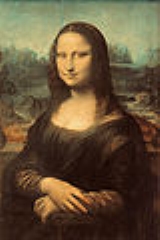
Painting is the practice of applying
paintPaint is any liquid, liquifiable, or mastic composition which after application to a substrate in a thin layer is converted to an opaque solid film.-History:...
,
pigmentA pigment is a material that changes the color of reflected or transmitted light as the result of wavelength-selective absorption. This physical process differs from fluorescence, phosphorescence, and other forms of luminescence, in which a material emits light.Many materials selectively absorb...
,
colorColor or colour is the visual perceptual property corresponding in humans to the categories called red, yellow, blue and others. Color derives from the spectrum of light interacting in the eye with the spectral sensitivities of the light receptors...
or other medium to a
surfaceIn mathematics, specifically in topology, a surface is a two-dimensional topological manifold. The most familiar examples are those that arise as the boundaries of solid objects in ordinary three-dimensional Euclidean space R
3 — for example, the surface of a ball...
(support base). In
artArt is the process or product of deliberately arranging elements in a way that appeals to the senses or emotions. It encompasses a diverse range of human activities, creations, and modes of expression, including music, literature, film, sculpture, and paintings...
, the term describes both the act and the result, which is called a painting. Paintings may have for their support such surfaces as
wallA wall is a usually solid structure that defines and sometimes protects an area. Most commonly, a wall delineates a building and supports its superstructure, separates space in buildings into rooms, or protects or delineates a space in the open air...
s,
paperPaper is thin material mainly used for writing upon, printing upon or for packaging. It is produced by pressing together moist fibers, typically cellulose pulp derived from wood, rags or grasses, and drying them into flexible sheets....
,
canvasCanvas is an extremely heavy-duty plain-woven fabric used for making sails, tents, marquees, backpacks, and other functions where sturdiness is required...
,
woodWood is an organic material; in the strict sense wood is produced as secondary xylem in the stems of trees . In a living tree it transfers water and nutrients to the leaves and other growing tissues, and has a support function, enabling woody plants to reach large sizes or to stand up for themselves...
,
glassIn general Glass refers to a solid, brittle, transparent material, commonly used for windows, bottles, or eyewear. Examples of glassy materials include, but are not limited to, soda-lime glass, borosilicate glass, acrylic glass, sugar glass, Muscovy-glass, or aluminium oxynitride. The term glass...
,
lacquerIn a general sense, lacquer is a clear or coloured varnish that dries by solvent evaporation and often a curing process as well that produces a hard, durable finish, in any sheen level from ultra matte to high gloss and that can be further polished as required.The term lacquer originates from the...
,
clayClay is a naturally occurring material composed primarily of fine-grained minerals, which show plasticity through a variable range of water content, and which can be hardened when dried and/or fired...
or concrete. Paintings may be decorated with gold leaf, and some modern paintings incorporate other materials including sand, clay, and scraps of paper.
Painting is a mode of expression, and the forms are numerous.
DrawingDrawing is a visual art that makes use of any number of drawing instruments to mark a two-dimensional medium. Common instruments include graphite pencils, pen and ink, inked brushes, wax color pencils, crayons, charcoals, chalk, pastels, markers, stylus, or various metals like silverpoint...
,
compositionIn the visual arts — in particular painting, graphic design, photography and sculpture — composition is the placement or arrangement of visual elements or ingredients in a work of art, as distinct from the subject of a work...
or abstraction and other aesthetics may serve to manifest the expressive and conceptual intention of the practitioner. Paintings can be naturalistic and representational (as in a
still lifeA still life is a work of art depicting mostly inanimate subject matter, typically commonplace objects which may be either natural or man-made in an artificial setting...
or
landscape paintingLandscape art depicts scenery such as mountains, valleys, trees, rivers, and forests. Sky is almost always included in the view, and weather usually is an element of the composition....
),
photographicPhotography is the process, activity and art of creating still or moving pictures by recording radiation on a sensitive medium, such as a photographic film, or an electronic sensor...
,
abstractAbstract art uses a visual language of form, color and line to create a composition which may exist with a degree of independence from visual references in the world. Western art had been, from the Renaissance up to the middle of the 19th century, underpinned by the logic of perspective and an...
, be loaded with narrative content,
symbolismSymbolism is the use of symbols to represent things such as ideas and emotions. Symbolism is sometimes used to refer specifically to totemic symbols that stand on their own, as opposed to linguistic symbols....
, emotion or be
politicalPolitics is a process by which groups of people make decisions. The term is generally applied to behavior within civil governments, but politics has been observed in all human group interactions, including corporate, academic and religious institutions...
in nature.
A portion of the history of painting in both Eastern and Western art is dominated by
spiritualSpirituality is relating to, consisting of, or having the nature of spirit; not tangible or material. Synonyms include immaterialism, dualism, incorporeality and eternity....
motifs and ideas; examples of this kind of painting range from artwork depicting
mythologicalMythology is the study of myths and or of a body of myths. For example, comparative mythology is the study of connections between myths from different cultures, whereas Greek mythology is the body of myths from ancient Greece. The term "myth" is often used colloquially to refer to a false story;...
figures on pottery to
BiblicalThe Bible contains the central religious texts of Judaism and Christianity. Modern Judaism generally recognizes a single set of canonical books known as the Tanakh, or Hebrew Bible, as it is written almost entirely in the Hebrew language, with some small portions in Aramaic...
scenes rendered on the interior walls and ceiling of
The Sistine ChapelSistine Chapel is the best-known chapel in the Apostolic Palace, the official residence of the Pope in Vatican City. It is famous for its architecture, evocative of Solomon's Temple of the Old Testament, and its decoration which has been frescoed throughout by the greatest Renaissance artists...
, to scenes from the life of
BuddhaChinese painting is one of the oldest continuous artistic traditions in the world. The earliest paintings were not representational but ornamental; they consisted of patterns or designs rather than pictures. Stone Age pottery was painted with spirals, zigzags, dots, or animals...
or other scenes of
eastern religious originEastern art history is devoted to the arts of the Far East and includes a vast range of influences from various cultures and religions. The emphasis is on art history amongst many diverse cultures in Asia. Developments in Eastern art historically parallel those in Western art, in general a few...
.
Overview
"The boundary of things in the second plane will not be discerned like those in the first. Therefore, painter, do not produce boundaries between the first and the second, because the boundary of one object and another is of the nature of a mathematical line but not an actual line, in that the boundary of one colour is the start of another colour and is not to be accorded the status of an actual line, because nothing intervenes between the boundary of one colour which is placed against another. Therefore, painter, do not make the boundaries pronounced at a distance."
What enables painting is the perception and representation of intensity. Every point in space has different intensity, which can be represented in painting by black and white and all the gray shades between. In practice, painters can articulate shapes by juxtaposing surfaces of different intensity; by using just color (of the same intensity) one can only represent symbolic shapes. Thus, the basic means of painting are distinct from ideological means, such as
geometricalGeometry arose as the field of knowledge dealing with spatial relationships. Geometry was one of the two fields of pre-modern mathematics, the other being the study of numbers....
figures, various points of view and organization (
perspectivePerspective in the graphic arts, such as drawing, is an approximate representation, on a flat surface , of an image as it is perceived by the eye...
), and symbols. For example, a painter perceives that a particular white wall has different intensity at each point, due to shades and reflections from nearby objects, but
ideallyPlatonic idealism usually refers to Plato's theory of forms or doctrine of ideas, the exact philosophical meaning of which is perhaps one of the most disputed questions in higher academic philosophy. At least one may say, with some degree of certitude, that Plato held the realm of ideas to be...
, a white wall is still a white wall in pitch darkness. In technical drawing, thickness of line is also ideal, demarcating ideal outlines of an object within a perceptual frame different from the one used by painters.
ColorColor or colour is the visual perceptual property corresponding in humans to the categories called red, yellow, blue and others. Color derives from the spectrum of light interacting in the eye with the spectral sensitivities of the light receptors...
and tone are the essence of painting as
pitchPitch represents the perceived fundamental frequency of a sound. It is one of the three major auditory attributes of sounds along with loudness and timbre. When the actual fundamental frequency can be precisely determined through physical measurement, it may differ from the perceived pitch because...
and
rhythmRhythm is the variation of the length and accentuation of a series of sounds or other events.-Rhythm in linguistics:...
are of
musicMusic is an art form whose medium is sound. Common elements of music are pitch , rhythm , dynamics, and the sonic qualities of timbre and texture...
. Color is highly subjective, but has observable psychological effects, although these can differ from one culture to the next. Black is associated with mourning in the West, but in the East, white is. Some painters, theoreticians, writers and scientists, including Goethe,
KandinskyWassily Wassilyevich Kandinsky was a Russian painter, and art theorist. He is credited with painting the first modern abstract works....
,
NewtonSir Isaac Newton FRS was an English physicist, mathematician, astronomer, natural philosopher, alchemist, and theologian who is perceived and considered by a substantial number of scholars and the general public as one of the most influential men in history...
, have written their own
color theoryIn the visual arts, color theory is a body of practical guidance to color mixing and the visual impacts of specific color combinations. Although color theory principles first appear in the writings of Leone Battista Alberti and the notebooks of Leonardo da Vinci , a tradition of "colory theory"...
. Moreover the use of language is only a generalisation for a color equivalent. The word "
redRed is any of a number of similar colors evoked by light consisting predominantly of the longest wavelengths of light discernible by the human eye, in the wavelength range of roughly 630–740 nm. Longer wavelengths than this are called infrared , and cannot be seen by the naked human eye...
", for example, can cover a wide range of variations on the pure red of the
visible spectrumThe visible spectrum is the portion of the electromagnetic spectrum that is visible to the human eye. Electromagnetic radiation in this range of wavelengths is called visible light or simply light. A typical human eye will respond to wavelengths from about 380 to 750 nm...
of light. There is not a formalized register of different colors in the way that there is agreement on different notes in music, such as C or C♯ in music. For a painter, color is not simply divided into basic and derived (complementary or mixed) colors (like, red, blue, green, brown, etc.). Painters deal practically with pigments, so "blue" for a painter can be any of the blues: phtalocyan, Paris blue, indigo, cobalt, ultramarine, and so on. Psychological, symbolical meanings of color are not strictly speaking means of painting. Colors only add to the potential, derived context of meanings, and because of this the perception of a painting is highly subjective. The analogy with music is quite clear—sound in music (like "C") is analogous to light in painting, "shades" to
dynamicsIn music, dynamics normally refers to the volume of a sound or note, but can also refer to every aspect of the execution of a given piece, either stylistic or functional...
, and coloration is to painting as specific timbre of musical instruments to music—though these do not necessarily form a melody, but can add different contexts to it.
Rhythm is important in painting as well as in music. Rhythm is basically a pause incorporated into a body (sequence). This pause allows creative force to intervene and add new creations—form, melody, coloration. The distribution of form, or any kind of information is of crucial importance in the given work of art and it directly affects the esthetical value of that work. This is because the esthetical value is functionality dependent, i.e. the freedom (of movement) of perception is perceived as beauty. Free flow of energy, in art as well as in other forms of "techne", directly contributes to the esthetical value.
Modern artists have extended the practice of painting considerably to include, for example,
collageA collage is a work of formal art, primarily in the visual arts, made from an assemblage of different forms, thus creating a new whole....
, which began with
CubismCubism was a 20th century avant-garde art movement, pioneered by Pablo Picasso and Georges Braque, that revolutionized European painting and sculpture, and inspired related movements in music and literature. The first branch of cubism, known as "Analytic Cubism", was both radical and influential as...
and is not painting in the strict sense. Some modern painters incorporate different materials such as
sandSand is a naturally occurring granular material composed of finely divided rock and mineral particles.As the term is used by geologists, sand particles range in diameter from 0.0625 to 2 millimeters. An individual particle in this range size is termed a sand grain...
,
cementIn the most general sense of the word, a cement is a binder, a substance which sets and hardens independently, and can bind other materials together. The word "cement" traces to the Romans, who used the term "opus caementicium" to describe masonry which resembled concrete and was made from crushed...
,
strawStraw is an agricultural by-product, the dry stalk of a cereal plant, after the grain or seed has been removed. Straw makes up about half of the yield of cereal crops such as barley, oats, rice, rye and wheat...
or
woodWood is an organic material; in the strict sense wood is produced as secondary xylem in the stems of trees . In a living tree it transfers water and nutrients to the leaves and other growing tissues, and has a support function, enabling woody plants to reach large sizes or to stand up for themselves...
for their
textureTexture in a painting is the feel of the canvas. It can be based on the paint, and its application, or addition materials such as ribbon, metal, wood, lace, leather and sand. Texture in painting stimulates two different senses, visual and tactile. There are four types of texture in art: actual...
. Examples of this are the works of
Jean DubuffetJean Philippe Arthur Dubuffet was one of the most famous French painters and sculptors of the second half of the 20th century.-Life and work:...
and
Anselm KieferAnselm Kiefer was born on March 8, 1945, in Donaueschingen. He is a German painter and sculptor. He studied with Joseph Beuys during the 1970s. His works incorporate materials such as straw, ash, clay, lead, and shellac...
.
(There is a growing community of artists who use computers to paint color onto a digital canvas using programs such as
Adobe PhotoshopAdobe Photoshop, or simply Photoshop, is a graphics editing program developed and published by Adobe Systems. It is the current market leader for commercial bitmap and image manipulation software, and is the flagship product of Adobe Systems...
,
Corel PainterCorel Painter is a raster-based digital art application created to simulate as accurately as possible the appearance and behavior of traditional media associated with drawing, painting, and printmaking. It is intended to be used in real-time by professional digital artists as a functional creative...
, and many others. These images can be printed onto traditional canvas if required.)
In 1829, the first
photographA photograph is an image created by light falling on a light-sensitive surface, usually photographic film or an electronic imager such as a CCD or a CMOS chip. Most photographs are created using a camera, which uses a lens to focus the scene's visible wavelengths of light into a reproduction of...
was produced. From the mid to late 19th century,
photographicPhotography is the process, activity and art of creating still or moving pictures by recording radiation on a sensitive medium, such as a photographic film, or an electronic sensor...
processes improved and, as it became more widespread, painting lost much of its historic purpose to provide an accurate record of the observable world. There began a series of art movements into the 20th century where the
RenaissanceThe Renaissance was a cultural movement that spanned roughly the 14th to the 17th century, beginning in Florence in the Late Middle Ages and later spreading to the rest of Europe...
view of the world was steadily eroded, through
ImpressionismImpressionism was a 19th-century art movement that began as a loose association of Paris-based artists whose independent exhibitions brought them to prominence in the 1870s and 1880s...
,
Post-ImpressionismPost-Impressionism is the term coined by the British artist and art critic Roger Fry in 1910 to describe the development of French art since Manet...
,
FauvismLes Fauves were a short-lived and loose grouping of early 20th century Modern artists whose works emphasized painterly qualities and strong colour over the representational or realistic values retained by Impressionism...
,
ExpressionismExpressionism was a cultural movement originating in Germany at the start of the 20th-century as a reaction to positivism and other artistic movements such as naturalism and impressionism. It sought to express the meaning of "being alive" and emotional experience rather than physical reality...
,
CubismCubism was a 20th century avant-garde art movement, pioneered by Pablo Picasso and Georges Braque, that revolutionized European painting and sculpture, and inspired related movements in music and literature. The first branch of cubism, known as "Analytic Cubism", was both radical and influential as...
and
DadaDada or Dadaism is a cultural movement that began in Zürich, Switzerland, during World War I and peaked from 1916 to 1922. The movement primarily involved visual arts, literature—poetry, art manifestoes, art theory—theatre, and graphic design, and concentrated its anti-war politics through a...
ism. Eastern and African painting, however, continued a long history of stylization and did not undergo an equivalent transformation at the same time.
ModernModern art refers to artistic works produced during the period extending roughly from the 1860s to the 1970s, and denotes the style and philosophy of the art produced during that era. The term is usually associated with art in which the traditions of the past have been thrown aside in a spirit of...
and
Contemporary ArtContemporary art can be defined variously as art produced at this present point in time or art produced since World War II. The definition of the word contemporary would support the first view, but museums of contemporary art commonly define their collections as consisting of art produced since...
has moved away from the historic value of craft and documentation in favour of
conceptThere are two prevailing theories in contemporary philosophy which attempt to explain the nature of concepts . The representational theory of mind proposes that concepts are mental representations, while the semantic theory of concepts holds that they are abstract objects...
; this led some to say in the 1960s that painting, as a serious art form, is dead. This has not deterred the majority of living painters from continuing to practice painting either as whole or part of their work. The vitality and versatility of painting in the 21st century belies the premature declarations of its demise. In an epoch characterized by the idea of
pluralismCultural pluralism is a term used when small groups within a larger society maintain their unique cultural identities. One of the most notable cultural pluralisms is the caste system, which is related to Hinduism....
, there is no consensus as to a representative style of the age. Important works of art continue to be made in a wide variety of styles and aesthetic temperaments, the marketplace being left to judge merit.
Among the continuing and current directions in painting at the beginning of the 21st century are
Monochrome paintingMonochrome painting is sometimes seen as meditative art. Throughout the 20th century and into the 21st century painters have created monochromatic painting. The exploration of one color, the examination of values changing across a surface, the expressivity of texture and nuance, expressing a wide...
,
Hard-edge paintingHard-edge painting is painting in which abrupt transitions are found between color areas. Color areas are often of one unvarying color. Color transitions often take place along straight lines, though curvilinear edges of color areas are also common...
, Geometric abstraction,
AppropriationIn the visual arts, to appropriate means to adopt, borrow, recycle or sample aspects of man-made visual culture. The term appropriation refers to the use of borrowed elements in the creation of a new work or refers to the new work itself...
, Hyperrealism,
PhotorealismPhotorealism is the genre of painting based on making a painting from a photograph. The term is primarily applied to paintings from the United States photorealism art movement that began in the late 1960s, early 1970s.-Style and history:...
,
ExpressionismExpressionism was a cultural movement originating in Germany at the start of the 20th-century as a reaction to positivism and other artistic movements such as naturalism and impressionism. It sought to express the meaning of "being alive" and emotional experience rather than physical reality...
,
MinimalismMinimalism describes movements in various forms of art and design, especially visual art and music, where the work is stripped down to its most fundamental features. As a specific movement in the arts it is identified with developments in post-World War II Western Art, most strongly with American...
,
Lyrical AbstractionLyrical Abstraction refers to two related but distinctly separate trends in Post-war Modernist painting;European Lyrical Abstraction born in Paris in 1945, and the French critic Charles Estienne created its name in 1946...
,
Pop ArtPop art is a visual art movement that emerged in the mid 1950s in Britain and in the late 1950s in the United States. Pop art challenged tradition by asserting that an artist's use of the mass-produced visual commodities of popular culture is contiguous with the perspective of fine art...
,
Op ArtOp art, also known as optical art, is a genre of visual art that makes use of optical illusions."Optical Art is a method of painting concerning the interaction between illusion and picture plane, between understanding and seeing." Op art works are abstract, with many of the better known pieces...
,
Abstract ExpressionismAbstract expressionism was an American post-World War II art movement. It was the first specifically American movement to achieve worldwide influence and put New York City at the center of the western art world, a role formerly filled by Paris....
, Color Field painting,
Neo-expressionismNeo-expressionism was a style of modern painting and sculpture that emerged in the late 1970s and dominated the art market until the mid-1980s. Related to American Lyrical Abstraction, New Image Painting and precedents in Pop painting, it developed as a reaction against the conceptual and...
,
CollageA collage is a work of formal art, primarily in the visual arts, made from an assemblage of different forms, thus creating a new whole....
,
IntermediaIntermedia was a concept employed in the mid-sixties by Fluxus artist Dick Higgins to describe the ineffable, often confusing, inter-disciplinary activities that occur between genres that became prevalent in the 1960s. Thus, the areas such as those between drawing and poetry, or between painting...
painting,
AssemblageAn assemblage is an archaeological term meaning a group of different artifacts found in association with one another, that is, in the same context. According to Renfrew and Bahn An assemblage is an archaeological term meaning a group of different artifacts found in association with one another,...
painting,
Computer artComputer art is any art in which computers played a role in production or display of the artwork. Such art can be an image, sound, animation, video, CD-ROM, DVD-ROM, videogame, web site, algorithm, performance or gallery installation...
painting, Postmodern painting,
Neo-DadaNeo-Dada is a label applied primarily to the visual arts describing artwork that has similarities in method or intent to earlier Dada artwork. Neo-Dada is exemplified by its use of modern materials, popular imagery, and absurdist contrast. It also patently denies traditional concepts of aesthetics...
painting,
Shaped canvasShaped canvases are paintings that depart from the normal flat, rectangular configuration. Canvases may be shaped by altering their contours, while retaining their flatness. An ancient, traditional example is the tondo, a painting on a round canvas: Raphael, as well as some other Renaissance...
painting, environmental mural painting, traditional
figureFigure may refer to:*A shape, drawing, or representationArts*Figurine, a miniature statuette representation of a creature*Action figure, a poseable character figurine*Model figure, a scale model of a creatureWriting...
painting, Landscape painting,
Portrait paintingPortrait painting is a genre in painting, where the intent is to depict the visual appearance of the subject. Beside human beings, animals, pets and even inanimate objects can be chosen as the subject for a portrait...
, and
paint-on-glass animationPaint-on-glass animation is a technique for making animated films by manipulating slow-drying oil paints on sheets of glass. Gouache mixed with glycerine is sometimes used instead...
.
History of painting
The oldest known paintings are at the Grotte Chauvet in
FranceFrance , officially the French Republic , is a country located in Western Europe, with several overseas islands and territories located on other continents. Metropolitan France extends from the Mediterranean Sea to the English Channel and the North Sea, and from the Rhine to the Atlantic Ocean...
, claimed by some historians to be about 32,000 years old. They are engraved and painted using
red ochre and black pigment and show horses, rhinoceros, lions, buffalo, mammoth or humans often hunting. However the earliest evidence of painting has been discovered in two rock-shelters in
Arnhem LandThe Arnhem Land Region is one of the five regions of the Northern Territory of Australia. It is located in the north-eastern corner of the territory and is around 500km from the territory capital Darwin. The region has an area of 97,000 km² which also covers the area of Kakadu National Park, and a...
, in northern Australia. In the lowest layer of material at these sites there are used pieces of ochre estimated to be 60,000 years old. Archaeologists have also found a fragment of rock painting preserved in a limestone rock-shelter in the Kimberley region of North-Western Australia, that is dated 40 000 years old.
http://www.aboriginalartonline.com/art/rockage.phpThere are examples of
cave paintingCave paintings are paintings on cave walls and ceilings, and the term is used especially for those dating to prehistoric times. The earliest known European cave paintings date to Aurignacian, some 32,000 years ago. The purpose of the paleolithic cave paintings is not known...
s all over the world—in
FranceFrance , officially the French Republic , is a country located in Western Europe, with several overseas islands and territories located on other continents. Metropolitan France extends from the Mediterranean Sea to the English Channel and the North Sea, and from the Rhine to the Atlantic Ocean...
,
SpainSpain , officially the Kingdom of Spain , is a country located in southwestern Europe on the Iberian Peninsula.
[The Spanish constitution does not establish any official denomination of the country, even though España , Estado español and Nación española are used interchangeably...]
,
PortugalPortugal , officially the Portuguese Republic , is a country located in southwestern Europe on the Iberian Peninsula. Portugal is the westernmost country of mainland Europe and is bordered by the Atlantic Ocean to the west and south and by Spain to the north and east...
,
ChinaChina is a cultural region, an ancient civilization, and, depending on perspective, a national or multinational entity extending over a large area in East Asia....
,
AustraliaAustralia , officially the Commonwealth of Australia, is a country in the Southern Hemisphere comprising the continental mainland , the island of Tasmania, and numerous smaller islands in the Indian and Pacific Oceans...
,
IndiaIndia, officially the Republic of India , is a country in South Asia. It is the seventh-largest country by geographical area, the second-most populous country, and the most populous democracy in the world. Bounded by the Indian Ocean on the south, the Arabian Sea on the west, and the Bay of Bengal...
etc.
In Western cultures
oil paintingOil painting is the process of painting with pigments that are bound with a medium of drying oil — especially in early modern Europe, linseed oil. Often an oil such as linseed was boiled with a resin such as pine resin or even frankincense; these were called 'varnishes' and were prized for their...
and watercolor painting are the best known media, with rich and complex traditions in style and subject matter. In the East, ink and color ink historically predominated the choice of media with equally rich and complex traditions.
Aesthetics and theory of painting
AestheticsAesthetics is commonly known as the study of sensory or sensori-emotional values, sometimes called judgments of sentiment and taste...
is the study of
artArt is the process or product of deliberately arranging elements in a way that appeals to the senses or emotions. It encompasses a diverse range of human activities, creations, and modes of expression, including music, literature, film, sculpture, and paintings...
and
beautyBeauty is a characteristic of a person, animal, place, object, or idea that provides a perceptual experience of pleasure, meaning, or satisfaction. Beauty is studied as part of aesthetics, sociology, social psychology, and culture. As a cultural creation, beauty has been extremely commercialized...
; it was an important issue for such 18th and 19th century philosophers as
KantKANT is a computer algebra system for mathematicians interested in algebraic number theory, performing sophisticated computations in algebraic number fields, in global function fields, and in local fields. KASH is the associated command line interface...
or Hegel. Classical philosophers like
PlatoPlato , was a Classical Greek philosopher, mathematician, writer of philosophical dialogues, and founder of the Academy in Athens, the first institution of higher learning in the Western world...
and
AristotleAristotle was a Greek philosopher, a student of Plato and teacher of Alexander the Great. He wrote on many subjects, including physics, metaphysics, poetry, theater, music, logic, rhetoric, politics, government, ethics, biology, and zoology.Together with Plato and Socrates , Aristotle is one of...
also theorized about art and painting in particular; Plato disregarded painters (as well as sculptors) in his philosophical system; he maintained that painting cannot depict the
truthTruth can have a variety of meanings, from the state of being the case, being in accord with a particular fact or reality, being in accord with the body of real things, events, actuality, or fidelity to an original or to a standard. In archaic usage it could be fidelity, constancy or sincerity in...
—it is a copy of reality (a shadow of the world of ideas) and is nothing but a
craftA craft is a skill, especially involving practical arts. It may refer to a trade or particular art.The term is often used as part of a longer word . For example, a craft-brother is a fellow worker in a particular trade and a craft-guild is, historically, a guild of workers in the same trade...
, similar to shoemaking or iron casting. By the time of Leonardo painting had become a closer representation of the truth than painting was in
Ancient GreeceAncient Greece is the civilisation belonging to the period of Greek history lasting from the Greek Dark Ages ca. 1100 BC and the Dorian invasion, to 146 BC and the Roman conquest of Greece after the Battle of Corinth. It is generally considered to be the seminal culture which provided the...
.
Leonardo da VinciLeonardo di ser Piero da Vinci was an Italian polymath, scientist, mathematician, engineer, inventor, anatomist, painter, sculptor, architect, botanist, musician and writer....
, on the contrary, said that "Pittura est cousa mentale" (painting is a thing of the mind). Kant distinguished between
BeautyBeauty is a characteristic of a person, animal, place, object, or idea that provides a perceptual experience of pleasure, meaning, or satisfaction. Beauty is studied as part of aesthetics, sociology, social psychology, and culture. As a cultural creation, beauty has been extremely commercialized...
and the
SublimeIn aesthetics, the sublime In aesthetics, the sublime In aesthetics, the sublime (from the Latin sublimis ([looking up from] under the lintel, high, lofty, elevated, exalted) is the quality of greatness or vast magnitude, whether physical, moral, intellectual, metaphysical, aesthetic, spiritual or...
, in terms that clearly gave priority to the former. Although he did not refer particularly to painting, this concept was taken up by painters such as Turner and
Caspar David FriedrichCaspar David Friedrich was a 19th-century German Romantic landscape painter, generally considered the most important of the movement. He is best known for his mid-period allegorical landscapes which typically feature contemplative figures silhouetted against night skies, morning mists, barren...
.
Hegel recognized the failure of attaining a universal concept of beauty and in his aesthetic essay wrote that Painting is one of the three "romantic" arts, along with
PoetryPoetry is a form of literary art in which language is used for its aesthetic and evocative qualities in addition to, or in lieu of, its apparent meaning...
and
MusicMusic is an art form whose medium is sound. Common elements of music are pitch , rhythm , dynamics, and the sonic qualities of timbre and texture...
for its symbolic, highly intellectual purpose.
Painters who have written theoretical works on painting include Kandinsky and
Paul KleePaul Klee was a Swiss painter of German nationality. His highly individual style was influenced by movements in art that included expressionism, cubism, and surrealism. He was, as well, a student of orientalism. Klee was a natural draftsman who experimented with and eventually mastered color...
. Kandinsky in his
essayAn essay is usually a short piece of writing. It is often written from an author's personal point of view. Essays can be literary criticism, political manifestos, learned arguments, observations of daily life, recollections, and reflections of the author....
maintains that painting has a spiritual value, and he attaches
primary colorsPrimary Colors: A Novel of Politics is a 1996 novel by "Anonymous" .-Roman à clef:Primary Colors is a roman à clef inspired by U.S. President Bill Clinton's first presidential campaign in 1992...
to essential feelings or concepts, something that Goethe and other writers had already tried to do.
IconographyIconography is the branch of art history which studies the identification, description, and the interpretation of the content of images. The word iconography literally means "image writing", and comes from the Greek εἰκών "image" and γράφειν "to write". A secondary meaning is the painting of icons...
is the study of the content of paintings, rather than their style.
Erwin PanofskyErwin Panofsky was a German art historian who emigrated to America and remains highly influential in the modern academic study of iconography...
and other art historians first seek to understand the things depicted, then their meaning for the viewer at the time, and then analyse their wider cultural, religious, and social meaning.
In 1890, the Parisian painter
Maurice DenisMaurice Denis was a French painter and writer, and a member of the Symbolist and Les Nabis movements. His theories contributed to the foundations of cubism, fauvism, and abstract art.-Childhood and Education:...
famously asserted: "Remember that a painting – before being a warhorse, a naked woman or some story or other – is essentially a flat surface covered with colors assembled in a certain order." Thus, many twentieth century developments in painting, such as
CubismCubism was a 20th century avant-garde art movement, pioneered by Pablo Picasso and Georges Braque, that revolutionized European painting and sculpture, and inspired related movements in music and literature. The first branch of cubism, known as "Analytic Cubism", was both radical and influential as...
, were reflections on the means of painting rather than on the external world,
natureNature, in the broadest sense, is equivalent to the natural world, physical world, or material world. "Nature" refers to the phenomena of the physical world, and also to life in general...
, which had previously been its core subject. Recent contributions to thinking about painting has been offered by the painter and writer Julian Bell. In his book
What is Painting?, Bell discusses the development, through history, of the notion that paintings can express feelings and ideas. In
Mirror of The World Bell writes:
‘A work of art seeks to hold your attention and keep it fixed: a history of art urges it onwards, bulldozing a highway through the homes of the imagination.’
Painting media
Different types of paint are usually identified by the medium that the pigment is suspended or embedded in, which determines the general working characteristics of the paint, such as
viscosityViscosity is a measure of the resistance of a fluid which is being deformed by either shear stress or extensional stress. In everyday terms , viscosity is "thickness." Thus, water is "thin," having a lower viscosity, while honey is "thick," having a higher viscosity...
,
miscibilityIn chemistry, miscibility is the property of liquids to mix in all proportions, forming a homogeneous solution. In principle, the term applies also to other phases , but the main focus is on the solubility of one liquid in another...
,
solubilitySolubility is the property of a solid, liquid, or gaseous chemical substance called solute to dissolve in a liquid solvent to form a homogeneous solution. The solubility of a substance strongly depends on the used solvent as well as on temperature and pressure...
, drying time, etc.
Examples include:
- Acrylic
Acrylic paint is fast-drying paint containing pigment suspended in an acrylic polymer emulsion. Acrylic paints can be diluted with water, but become water-resistant when dry...
- Dry pastel
Pastel is an art medium in the form of a stick, consisting of pure powdered pigment and a binder. The pigments used in pastels are the same as those used to produce all colored art media, including oil paints; the binder is of a neutral hue and low saturation.The noun "pastel" gives rise to:*...
- Enamel paint
An enamel paint is a paint that air dries to a hard, usually glossy, finish. In reality, most commercially-available enamel paints are significantly softer than either vitreous enamel or stoved synthetic resins....
- Encaustic
Encaustic may refer to:*Encaustic painting*Encaustic tilePainted with wax colors filled with heat, or with any process in which colors are burned in.... (wax)
- Fresco
Fresco is any of several related painting types, done on plaster on walls or ceilings. The word fresco comes from the Italian word affresco which derives from the adjective fresco , which has Latin origins...
- Gouache
Gouache[p], the name of which derives from the Italian guazzo, water paint, splash or bodycolor is a type of paint consisting of pigment suspended in water...
- Ink
An ink is a liquid containing various pigments and/or dyes used for coloring a surface to produce an image, text, or design. Ink is used for drawing and/or writing with a pen, brush or quill...
|
LightA laser is a device that emits light through a process called stimulated emission. Laser light is usually spatially coherent, which means that the light either is emitted in a narrow, low-divergence beam, or can be converted into one with the help of optical components such as lenses...
OilOil painting is the process of painting with pigments that are bound with a medium of drying oil — especially in early modern Europe, linseed oil. Often an oil such as linseed was boiled with a resin such as pine resin or even frankincense; these were called 'varnishes' and were prized for their...
Oil pastelPastel is an art medium in the form of a stick, consisting of pure powdered pigment and a binder. The pigments used in pastels are the same as those used to produce all colored art media, including oil paints; the binder is of a neutral hue and low saturation.The noun "pastel" gives rise to:*...
Spray paint (GraffitiGraffiti is the name for images or lettering scratched, scrawled, painted or marked in any manner on property.... )
TemperaTempera, also known as egg tempera, is a permanent fast drying painting medium consisting of colored pigment mixed with a water-soluble binder medium . Tempera also refers to the paintings done in this medium. Tempera paintings are very long lasting, and examples from the first centuries AD still...
Water miscible oil paintWater miscible oil paint is a modern variety of oil paint which is engineered to be thinned and cleaned up with water, rather than having to use chemicals such as turpentine... s
Watercolor |
Painting styles
'Style' is used in two senses: It can refer to the distinctive visual elements, techniques and methods that typify an
individual artist's work. It can also refer to the
movementAn art movement is a tendency or style in art with a specific common philosophy or goal, followed by a group of artists during a restricted period of time, or, at least, with the heyday of the movement defined within usually a number of years.-The concept:...
or school that an artist is associated with. This can stem from an actual group that the artist was consciously involved with or it can be a category in which art historians have placed the painter. The word 'style' in the latter sense has fallen out of favor in academic discussions about contemporary painting, though it continues to be used in popular contexts. Such movements or classifications include the following :
Western styles
- Abstract
Abstract art uses a visual language of form, color and line to create a composition which may exist with a degree of independence from visual references in the world. Western art had been, from the Renaissance up to the middle of the 19th century, underpinned by the logic of perspective and an...
- Abstract figurative
Abstract Figurative art is a synthesis of abstraction and figuration. It is the creation of any art piece that combines Abstract art and Figurative art....
- Abstract Expressionism
Abstract expressionism was an American post-World War II art movement. It was the first specifically American movement to achieve worldwide influence and put New York City at the center of the western art world, a role formerly filled by Paris....
- Art Brut
The term outsider art was coined by art critic Roger Cardinal in 1972 as an English synonym for art brut , a label created by French artist Jean Dubuffet to describe art created outside the boundaries of official culture; Dubuffet focused particularly on art by insane-asylum inmates.While...
- Art Deco
Art Deco was a popular international art design movement from 1925 until the 1940s, affecting the decorative arts such as architecture, interior design, and industrial design, as well as the visual arts such as fashion, painting, the graphic arts, and film...
- Baroque
Baroque is an artistic style prevalent from the late 16th century to the early 18th century. The popularity and success of the Baroque style was encouraged by the Roman Catholic Church, which had decided at the time of the Council of Trent that the arts should communicate religious themes in...
- Body painting
Body painting, or sometimes bodypainting, is a form of body art, considered by some as the most ancient form of art. Unlike tattoo and other forms of body art, body painting is temporary, painted onto the human skin, and lasts for only several hours, or at most a couple of weeks...
- CoBrA
A cobra is a venomous snake, which is a member of the family Elapidae . The name is short for cobra de capelo , which is Portuguese for "snake with hood," or "hood-snake." When disturbed, most of these snakes can rear up and spread their neck in a characteristic threat display...
- Color Field
- Constructivism
Constructivism was an artistic and architectural movement that originated in Russia from 1919 onward which rejected the idea of "art for art's sake" in favour of art as a practice directed towards social purposes...
- Contemporary Art
Contemporary art can be defined variously as art produced at this present point in time or art produced since World War II. The definition of the word contemporary would support the first view, but museums of contemporary art commonly define their collections as consisting of art produced since...
- Cubism
Cubism was a 20th century avant-garde art movement, pioneered by Pablo Picasso and Georges Braque, that revolutionized European painting and sculpture, and inspired related movements in music and literature. The first branch of cubism, known as "Analytic Cubism", was both radical and influential as...
- Digital painting
Digital painting is an emerging art form in which traditional painting techniques such as watercolor, oils, impasto, etc. are applied using digital tools by means of a computer, a digitizing tablet and stylus, and software. Traditional painting is painting with a physical medium as opposed to a...
- Expressionism
Expressionism was a cultural movement originating in Germany at the start of the 20th-century as a reaction to positivism and other artistic movements such as naturalism and impressionism. It sought to express the meaning of "being alive" and emotional experience rather than physical reality...
- Fauvism
Les Fauves were a short-lived and loose grouping of early 20th century Modern artists whose works emphasized painterly qualities and strong colour over the representational or realistic values retained by Impressionism...
- Figuration Libre
Figuration Libre is a French art movement of the 1980s. It is the French equivalent of Bad Painting and Neo-expressionism in America and Europe, Junge Wilde in Germany and Transvanguardia in Italy. The term was coined by Fluxus artist Ben Vautier.The group was formed in 1981 by Robert Combas, Remi...
- Folk
Folk art encompasses art produced from an indigenous culture or by peasants or other laboring tradespeople. In contrast to fine art, folk art is primarily utilitarian and decorative rather than purely aesthetic...
- Futurism
Futurism or Futurist may refer to:*Futurology* Futurists * Futurist architecture* Futurist meals, a gastronomic movement based on Futurism* Futurism , a movement in literature, art, and architecture* Futurism...
|
GraffitiGraffiti is the name for images or lettering scratched, scrawled, painted or marked in any manner on property....
Hard-edge
HyperrealismHyperrealism is a genre of painting and sculpture resembling a high resolution photograph. Hyperrealism is a fully-fledged school of art and can be considered as an advancement of Photorealism by the methods used to create the resulting photorealistic paintings or sculptures...
ImpressionismImpressionism was a 19th-century art movement that began as a loose association of Paris-based artists whose independent exhibitions brought them to prominence in the 1870s and 1880s...
Lyrical AbstractionLyrical Abstraction refers to two related but distinctly separate trends in Post-war Modernist painting;European Lyrical Abstraction born in Paris in 1945, and the French critic Charles Estienne created its name in 1946...
MannerismMannerism is a period of European art that emerged from the later years of the Italian High Renaissance around 1520. It lasted until about 1580 in Italy, when a more Baroque style began to replace it, but Northern Mannerism continued into the early 17th century throughout much of Europe...
MinimalismMinimalism describes movements in various forms of art and design, especially visual art and music, where the work is stripped down to its most fundamental features. As a specific movement in the arts it is identified with developments in post-World War II Western Art, most strongly with American...
ModernismModernism, in its broadest definition, is modern thought, character, or practice. More specifically, the term describes both a set of cultural tendencies and an array of associated cultural movements, originally arising from wide-scale and far-reaching changes to Western society in the late...
Naïve artNaïve art is a classification of art that is often characterized by a childlike simplicity in its subject matter and technique. While many naïve artists appear, from their works, to have little or no formal art training, this is often not true....
Neo-classicism
Op artOp art, also known as optical art, is a genre of visual art that makes use of optical illusions."Optical Art is a method of painting concerning the interaction between illusion and picture plane, between understanding and seeing." Op art works are abstract, with many of the better known pieces...
OrientalismOrientalism is the imitation or depiction of aspects of Eastern cultures in the West by writers, designers and artists. An "Orientalist" may be a person engaged in these activities, but it is also the traditional term for any scholar of Oriental studies...
OrphismOrphism or Orphic cubism, is a term coined by the French poet Guillaume Apollinaire in 1912. He used the French term Orphisme to label the paintings of Robert Delaunay, relating them to Orpheus, the poet and symbol of the arts of song and the lyre in Greek mythology...
OutsiderThe term outsider art was coined by art critic Roger Cardinal in 1972 as an English synonym for art brut , a label created by French artist Jean Dubuffet to describe art created outside the boundaries of official culture; Dubuffet focused particularly on art by insane-asylum inmates.While...
PainterlyPainterly is a translation of the German term malerisch, one of the opposed categories popularized by Swiss art historian Heinrich Wölfflin in order to help focus, enrich and standardize the terms being used by art historians of his time to characterize works of art...
PhotorealismPhotorealism is the genre of painting based on making a painting from a photograph. The term is primarily applied to paintings from the United States photorealism art movement that began in the late 1960s, early 1970s.-Style and history:...
Pinstriping |
PluralismContemporary art can be defined variously as art produced at this present point in time or art produced since World War II. The definition of the word contemporary would support the first view, but museums of contemporary art commonly define their collections as consisting of art produced since...
PointillismPointillism is a style of painting in which small distinct dots of colour create the impression of a wide selection of other colors and blending. Aside from color "mixing" phenomena, there is the simpler graphic phenomenon of depicted imagery emerging from disparate points...
Pop artPop art is a visual art movement that emerged in the mid 1950s in Britain and in the late 1950s in the United States. Pop art challenged tradition by asserting that an artist's use of the mass-produced visual commodities of popular culture is contiguous with the perspective of fine art...
Post-painterly AbstractionPost-painterly abstraction is a term created by art critic Clement Greenberg as the title for an exhibit he curated for the Los Angeles County Museum of Art in 1964, which subsequently travelled to the Walker Art Center and the Art Museum of Toronto .Greenberg had perceived that there was a new...
PostmodernismPostmodern art is a term used to describe an art movement which was thought to be in contradiction to some aspect of modernism, or to have emerged or developed in its aftermath. In general, movements such as Intermedia, Installation art, Conceptual Art and Multimedia, particularly involving video...
PrecisionismPrecisionism, also known as Cubist Realism,was an artistic movement that emerged in the United States after World War I and was at its height during the inter-War period...
Primitive
RealismRealism in the visual arts and literature is the depiction of subjects as they appear in everyday life, without embellishment or interpretation...
RegionalismRegionalism is an American realist modern art movement that was popular during the 1930s. The artistic focus was from artists who shunned city life, and rapidly developing technological advances, to create scenes of rural life...
RococoRococo is a style of 18th century French art and interior design. Rococo rooms were designed as total works of art with elegant and ornate furniture, small sculptures, ornamental mirrors, and tapestry complementing architecture, reliefs, and wall paintings...
Romantic realismRomantic realism is an aesthetic term that usually refers to art combines elements of both romanticism and realism. Although the terms "romanticism" and "realism" have been used in varied ways, they are typically seen as opposed to one another. Romantic realists combine elements from each...
RomanticismRomanticism is a complex artistic, literary, and intellectual movement that originated in the second half of the 18th century in Western Europe, and gained strength during the Industrial Revolution...
Socialist realismSocialist realism is a teleologically-oriented style of realistic art which has as its purpose the furtherance of the goals of socialism and communism...
Street ArtStreet art is any art developed in public spaces — that is, "in the streets" — though the term usually refers to unsanctioned art, as opposed to government sponsored initiatives. The term can include traditional graffiti artwork, stencil graffiti, sticker art, wheatpasting and street poster art,...
StuckismStuckism is an international art movement that was founded in 1999 in Britain by Billy Childish and Charles Thomson to promote figurative painting in opposition to conceptual art. The Stuckists stated their opposition to the Charles Saatchi-patronised Young British Artists...
SuperflatSuperflat is a postmodern art movement, founded by the artist Takashi Murakami, which is influenced by manga and anime. It is also the name of a 2001 art exhibition, curated by Murakami, that toured West Hollywood, Minneapolis and Seattle...
SurrealismSurrealism is a cultural movement that began in the early 1920s, and is best known for the visual artworks and writings of the group members....
Tachism
TonalismTonalism is an artistic style that emerged in the 1880s when American artists began to paint landscape forms with an overall tone of colored atmosphere or mist. Dark, neutral hues, such as gray, brown or blue, would usually dominate such compositions. During the late 1890s American art critics...
|
Eastern styles
Far eastern
- Chinese
Chinese painting is one of the oldest continuous artistic traditions in the world. The earliest paintings were not representational but ornamental; they consisted of patterns or designs rather than pictures. Stone Age pottery was painted with spirals, zigzags, dots, or animals...
- Tang Dynasty
During the Tang Dynasty, as a golden age in Chinese civilization, Chinese painting developed dramatically, both in subject matter and technique. During this period, Chinese painting developed to a new stage...
- Ming Dynasty
During the Ming Dynasty , Chinese painting developed greatly from the achievements in painted art during the earlier Song Dynasty and Yuan Dynasty. The painting techniques which were invented and developed before the Ming period became classical during this period. More colours were used in...
- Shan shui
Shan Shui refers to a style of Chinese painting that involves or depicts scenery or natural landscapes, using a brush and ink rather than more conventional paints. Mountains, rivers and often waterfalls are prominent in this art form.-History:Shan shui painting first arose to prominence during the...
- Ink and wash painting
Ink and wash painting is an East Asian type of brush painting also known as wash painting or by its Japanese name sumi-e . Ink and wash painting is also known by its Chinese name shui-mo hua...
- Hua niao
Bird-and-flower painting is a kind of Chinese painting named after its subject matter...
- Southern School
The Southern School of Chinese painting, often called "literati painting" , is a term used to denote art and artists which stand in opposition to the formal Northern School of painting...
- Zhe School
The Zhe School was a school of painters, and part of the Southern School, which thrived during the Ming dynasty. The school was led by Dai Jin. The "Zhe" of the name refers to Dai Jin's home province - Zhejiang...
- Wu School
Wu School is the term applied to a group of painters of the Southern School during the Ming period of Chinese history, and was not an academy or educational institution, but instead was largely by artistic theory of its members...
- Contemporary
- Japanese
is one of the oldest and most highly refined of the Japanese arts, encompassing a wide variety of genre and styles. As with the history of Japanese arts in general, the history Japanese painting is a long history of synthesis and competition between native Japanese aesthetics and adaptation of...
- Yamato-e
Yamato-e is a style of Japanese painting inspired by Tang Dynasty paintings and developed in the late Heian period. It is considered the classical Japanese style...
- Rimpa school
, is one of the major historical schools of Japanese painting. It was created in 17th century Kyoto by Hon'ami Kōetsu and Tawaraya Sōtatsu . Roughly fifty years later, the style was consolidated by brothers Ogata Kōrin and Ogata Kenzan....
- Emakimono
, often simply called , is a horizontal, illustrated narrative form created during the 11th to 16th centuries in Japan. Emakimono combines both text and pictures, and is drawn, painted, or stamped on a handscroll. They depict battles, romance, religion, folk tales, and stories of the supernatural...
- Kanō school
The ' is one of the most famous schools of Japanese painting.It was founded by Kanō Masanobu , a contemporary of Sesshū and student of Shūbun. Some scholars write that though Masanobu mastered elements of Chinese painting and of Shubun's style, he was overall mediocre and lacked the originality and...
- Shijō school
The Shijō school , also known as the Maruyama-Shijō school, was an offshoot school of the Maruyama school of Japanese painting founded by Maruyama Ōkyo, and his former student Matsumura Goshun in the late 18th century. This school was one of several that made up the larger Kyoto school...
- Korean
Korean painting includes paintings made in Korea or by overseas Koreans on all surfaces. It includes art as old as the petroglyphs through post-modern conceptual art using transient forms of light...
|
IslamicIslamic art encompasses the visual arts produced from the 7th century onwards by people who lived within the territory that was inhabited by culturally Islamic populations... / Near eastern
- Ottoman miniature
Ottoman Miniature was an art form in the Ottoman Empire, which can be linked to the Persian miniature tradition, as well as strong Chinese artistic influences. It was a part of the Ottoman Book Arts together with illumination , calligraphy , marbling paper and bookbinding . The words taswir or...
- Persian miniature
A Persian miniature is a small painting, whether a book illustration or a separate work of art intended to be kept in an album of such works. The techniques are broadly comparable to the Western and Byzantine traditions of miniatures in illuminated manuscripts...
IndianIndian painting is a form of Indian art.-Overview:The earliest Indian paintings were the rock paintings of pre-historic times, the petroglyphs as found in places like Bhimbetka, and some of them are older than 5500 BC...
- Mysore
Mysore painting is an important form of classical South Indian painting that originated in the town of Mysore in Karnataka. These paintings are known for their elegance, muted colours, and attention to detail. The themes for most of these paintings are Hindu gods and goddesses and scenes from...
- Tanjore
Tanjore painting is an important form of classical South Indian painting native to the town of Thanjavur in Tamil Nadu. The art form dates back to about 1600 AD, a period when Nayakas of Tanjavur encouraged art- chiefly, classical dance and music as well as literature both in Telugu and Tamil...
- Madhubani
- Rajput
Rajput painting, also known as Rajasthani Painting is a style of Indian painting, evolved and flourished during the 18th century in the royal courts of Rajputana, India, flowing from the style of Mughal painting, itself derived from the Persian miniature. Each Rajput kingdom evolved a distinct...
- Mughal
Mughal painting is a particular style of South Asian painting, generally confined to miniatures either as book illustrations or as single works to be kept in albums, which emerged from Persian miniature painting, with Indian Hindu, Jain, and Buddhist influences, and developed during the period of...
- Bengal school
The Bengal School of Art was an style of art that flourishing in India during the British Raj in the early 20th century. It was associated with Indian nationalism, but was also promoted and supported by British arts administrators....
- Samikshavad
This article is about the Art Movement, Samikshavad. Samikshavad is the first indigenous Art movement in modern India, which started in north India in 1974. It has a different identity from the western movements of art. It is neither affected or inspired by the western art.Its main source of...
|
Common painting idioms
Painting idioms include
- Allegory
Allegory is a figurative mode of representation conveying a meaning other than the literal. An allegory is a device that can be presented in literary form, such as a poem or novel, or in visual form, such as in painting or sculpture...
- Bodegón
The term bodega in Spanish can mean "pantry", "tavern", or "wine cellar". The derivative term bodegón is an augmentative that refers to a large bodega, usually in a derogatory fashion. In Spanish art, a bodegón is a still life painting depicting pantry items, such as victuals, game, and drink,...
- Body painting
Body painting, or sometimes bodypainting, is a form of body art, considered by some as the most ancient form of art. Unlike tattoo and other forms of body art, body painting is temporary, painted onto the human skin, and lasts for only several hours, or at most a couple of weeks...
- Botanical
- Figure painting
Figure painting is a form of the visual arts in which the artist uses a live model as the subject matter of a two-dimensional piece of artwork using paint as the medium. The live model can be either nude or partly or fully clothed and the painting is a representation of the full body of the model...
- Illustration
An illustration is a visualization such as a drawing, painting, photograph or other work of art that stresses subject more than form. The aim of an illustration is to elucidate or decorate textual information by providing a visual representation.- Overview :Illustrations can:* give faces to...
- Industrial
An industry is the manufacturing of a good or service within a category. Although industry is a broad term for any kind of economic production, in economics and urban planning industry is a synonym for the secondary sector, which is a type of economic activity involved in the manufacturing of raw...
- Landscape
- Portrait
A portrait is a painting, photograph, sculpture, or other artistic representation of a person, in which the face and its expression is predominant. The intent is to display the likeness, personality, and even the mood of the person. For this reason, in photography a portrait is generally not a...
- Still life
A still life is a work of art depicting mostly inanimate subject matter, typically commonplace objects which may be either natural or man-made in an artificial setting...
- Veduta
A veduta is a highly detailed, usually large-scale painting of a cityscape or some other vista....
Some other painting terms are
- Altarpiece
An altarpiece is a picture or relief representing a religious subject and suspended in a frame behind the altar of a church. The altarpiece is often made up of two or more separate panels created using a technique known as panel painting. It is then called a diptych, triptych or polyptych for two,...
- Broken Color
- Cartoon
The word cartoon has various meanings, based on several very different forms of visual art and illustration. The term has evolved over time....
- Chiaroscuro
Chiaroscuro is a term in art for a contrast between light and dark. The term is usually applied to bold contrasts affecting a whole composition, but is also more technically used by artists and art historians for the use of effects representing contrasts of light, not necessarily strong, to...
- Composition
In the visual arts — in particular painting, graphic design, photography and sculpture — composition is the placement or arrangement of visual elements or ingredients in a work of art, as distinct from the subject of a work...
- Drybrush
Drybrush is a painting technique in which a paint brush that is relatively dry, but still holds paint, is used. Load is applied to a dry support such as paper or primed canvas...
- Easel Picture
An easel is an upright support used for displaying and/or fixing something resting upon it.The word is an old Germanic synonym for donkey ; its equivalent is the only word for both animal and apparatus in various languages, such as Esel in German and Afrikaans and earlier ezel in Dutch ,...
- Foreshortening
- Four-dimensional painting
- Genre
A genre is a loose set of criteria for a category of composition; the term is often used to categorize literature and speech, but is also used for any other form of art or utterance...
- Halo
A halo is an optical phenomenon produced by ice crystals creating colored or white arcs and spots in the sky. Many are near the sun or moon but others are elsewhere and even in the opposite part of the sky...
- Highlights
Highlights may refer to:* Highlights , by Tom Hingley and the Lovers* Highlights for Children, a magazine* Highlight * Hair highlighting* Highlights, the school newspaper of Beverly Hills High School...
- History painting
History painting, as formulated in 1667 by André Félibien, a historiographer, architect and theoretician of French classicism, was in the hierarchy of genres considered to be the grand genre.-Description:...
- Imprimatura
Imprimatura is a term used in painting, meaning an initial stain of color painted on a ground. It provides a painter with a transparent toned ground, which will allow light falling onto the painting to reflect through the paint layers. The term itself stems from the Italian and literally means...
- Landscape
Landscape art depicts scenery such as mountains, valleys, trees, rivers, and forests. Sky is almost always included in the view, and weather usually is an element of the composition....
- Licked finish
A licked finish is a hallmark of French academic art. It refers to the process of smoothing the surface quality of a painting so that the presence of the artist's hand is no longer visible...
- Madonna
Images of the Madonna and the Madonna and Child are pictorial or sculptured representations of Mary, Mother of Jesus, either alone, or more frequently, with the infant Jesus. These images are central icons of Roman Catholicism and Eastern Orthodox Christianity...
|
Maulstick A maulstick, or mahlstick, is a stick with a soft leather or padded head, used by painters to support the hand that holds the brush. The word is an adaptation of the Dutch maalstok, i.e...
MiniatureA portrait miniature is a miniature portrait painting, usually executed in gouache, watercolour, or enamel.Portrait miniatures began to flourish in 16th century Europe and the art was practiced during the 17th century and 18th century...
Mural PaintingA mural is any piece of artwork painted directly on a wall, ceiling, or other large permanent surface.-History:Murals of sorts date to Upper Paleolithic times such as the paintings in the Chauvet Cave in Ardèche department of southern France...
PaletteA palette is: ' a rigid, flat surface on which a painter arranges and mixes paints. A palette is usually made of wood, plastic, ceramic or other hard, inert, nonporous material, and can vary greatly in size and shape...
Panel PaintingA panel painting is a painting on a panel made of wood, either a single piece, or a number of pieces joined together. Until canvas became the more popular support medium in the 16th century, it was the normal form of support for a painting not on a wall or on vellum, which was used for...
PerspectivePerspective in the graphic arts, such as drawing, is an approximate representation, on a flat surface , of an image as it is perceived by the eye...
Pietáthumb|[[Michelangelo]]'s St Peter's Pieta.The Pietà is a subject in Christian art depicting the Virgin Mary cradling the dead body of Jesus, most often found in sculpture. As such, it is a particular form of the Lamentation of Christ, a scene from the Passion of Christ found in cycles of the Life...
Plein Air
PortraitA portrait is a painting, photograph, sculpture, or other artistic representation of a person, in which the face and its expression is predominant. The intent is to display the likeness, personality, and even the mood of the person. For this reason, in photography a portrait is generally not a...
SfumatoSfumato is a term coined by Leonardo da Vinci for a painting technique which overlays translucent layers of colour to create perceptions of depth, volume and form...
StipplingStippling is the creation of a pattern simulating varying degrees of solidity or shading by using small dots. Such a pattern may occur in nature and these effects are frequently emulated by artists.-Art:...
Technique
Trompe l'oeilTrompe-l'œil, which can also be spelled without the hyphen in English as trompe l'oeil, is an art technique involving extremely realistic imagery in order to create the optical illusion that the depicted objects appear in three dimensions, instead of actually being a two-dimensional...
UnderpaintingIn art, an underpainting is an initial layer of paint applied to a ground, which serves as a base for subsequent layers of paint. Underpaintings are often monochromatic and help to define colour values for later painting...
VarnishVarnish is a transparent, hard, protective finish or film primarily used in wood finishing but also for other materials. Varnish is traditionally a combination of a drying oil, a resin, and a thinner or solvent. Varnish finishes are usually glossy but may be designed to produce satin or semi-gloss...
Wet-on-wetWet-on-wet is a painting technique in which layers of wet paint are applied to previous layers of wet paint. This technique requires a fast way of working, because the art work has to be finished before the first layers have dried....
|
See also
Further reading
- Daniel, H., (1971) "Encyclopedia of Themes and Subjects in Painting; Mythological, Biblical, Historical, Literary, Allegorical, and Topical". New York, Harry N. Abrams Inc.