

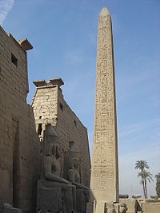
History of Africa

Encyclopedia
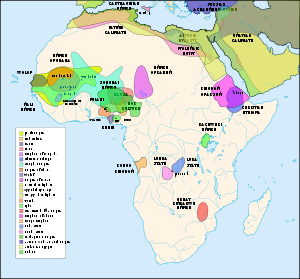


Prehistory
Prehistory is the span of time before recorded history. Prehistory can refer to the period of human existence before the availability of those written records with which recorded history begins. More broadly, it refers to all the time preceding human existence and the invention of writing...
of Africa
Africa
Africa is the world's second largest and second most populous continent, after Asia. At about 30.2 million km² including adjacent islands, it covers 6% of the Earth's total surface area and 20.4% of the total land area...
and the emergence of Homo sapiens
Archaic Homo sapiens
Archaic Homo sapiens is a loosely defined term used to describe a number of varieties of Homo, as opposed to anatomically modern humans , in the period beginning 500,000 years ago....
in East Africa
East Africa
East Africa or Eastern Africa is the easterly region of the African continent, variably defined by geography or geopolitics. In the UN scheme of geographic regions, 19 territories constitute Eastern Africa:...
, continuing into the present as a patchwork of diverse and politically developing nation states. Agriculture began about 10,000 BCE and metallurgy in about 4000 BCE. The history
History
History is the discovery, collection, organization, and presentation of information about past events. History can also mean the period of time after writing was invented. Scholars who write about history are called historians...
of early civilization arose in Egypt
Egypt
Egypt , officially the Arab Republic of Egypt, Arabic: , is a country mainly in North Africa, with the Sinai Peninsula forming a land bridge in Southwest Asia. Egypt is thus a transcontinental country, and a major power in Africa, the Mediterranean Basin, the Middle East and the Muslim world...
and later in the Maghreb
Maghreb
The Maghreb is the region of Northwest Africa, west of Egypt. It includes five countries: Morocco, Algeria, Tunisia, Libya, and Mauritania and the disputed territory of Western Sahara...
and the Horn of Africa
Horn of Africa
The Horn of Africa is a peninsula in East Africa that juts hundreds of kilometers into the Arabian Sea and lies along the southern side of the Gulf of Aden. It is the easternmost projection of the African continent...
. During the Middle Ages
Middle Ages
The Middle Ages is a periodization of European history from the 5th century to the 15th century. The Middle Ages follows the fall of the Western Roman Empire in 476 and precedes the Early Modern Era. It is the middle period of a three-period division of Western history: Classic, Medieval and Modern...
, Islam
Islam
Islam . The most common are and . : Arabic pronunciation varies regionally. The first vowel ranges from ~~. The second vowel ranges from ~~~...
spread through the regions. Crossing the Maghreb and the Sahel
Sahel
The Sahel is the ecoclimatic and biogeographic zone of transition between the Sahara desert in the North and the Sudanian Savannas in the south.It stretches across the North African continent between the Atlantic Ocean and the Red Sea....
, a major centre of Muslim culture was at Timbuktu
Timbuktu
Timbuktu , formerly also spelled Timbuctoo, is a town in the West African nation of Mali situated north of the River Niger on the southern edge of the Sahara Desert. The town is the capital of the Timbuktu Region, one of the eight administrative regions of Mali...
. States and polities subsequently formed throughout the continent.
From the late 15th century, Europeans and Arabs took slaves from West
West Africa
West Africa or Western Africa is the westernmost region of the African continent. Geopolitically, the UN definition of Western Africa includes the following 16 countries and an area of approximately 5 million square km:-Flags of West Africa:...
, Central
Central Africa
Central Africa is a core region of the African continent which includes Burundi, the Central African Republic, Chad, the Democratic Republic of the Congo, and Rwanda....
and Southeast Africa
East Africa
East Africa or Eastern Africa is the easterly region of the African continent, variably defined by geography or geopolitics. In the UN scheme of geographic regions, 19 territories constitute Eastern Africa:...
overseas in the African slave trade
African slave trade
Systems of servitude and slavery were common in many parts of Africa, as they were in much of the ancient world. In some African societies, the enslaved people were also indentured servants and fully integrated; in others, they were treated much worse...
. European colonization of Africa developed rapidly in the Scramble for Africa
Scramble for Africa
The Scramble for Africa, also known as the Race for Africa or Partition of Africa was a process of invasion, occupation, colonization and annexation of African territory by European powers during the New Imperialism period, between 1881 and World War I in 1914...
of the late 19th and early 20th centuries. Following independence and struggles in many parts of the continent, decolonization
Decolonization
Decolonization refers to the undoing of colonialism, the unequal relation of polities whereby one people or nation establishes and maintains dependent Territory over another...
took place after the Second World War.
Africa's history has been challenging for researchers in the field of African studies
African studies
African studies is the study of Africa, especially the cultures and societies of Africa .The field includes the study of:Culture of Africa, History of Africa , Anthropology of Africa , Politics of Africa, Economy of Africa African studies is the study of Africa, especially the cultures and...
because of the scarcity of written sources in large parts of sub-Saharan Africa
Sub-Saharan Africa
Sub-Saharan Africa as a geographical term refers to the area of the African continent which lies south of the Sahara. A political definition of Sub-Saharan Africa, instead, covers all African countries which are fully or partially located south of the Sahara...
. Scholarly techniques such as the recording of oral history
Oral history
Oral history is the collection and study of historical information about individuals, families, important events, or everyday life using audiotapes, videotapes, or transcriptions of planned interviews...
, historical linguistics
Historical linguistics
Historical linguistics is the study of language change. It has five main concerns:* to describe and account for observed changes in particular languages...
, archaeology and genetics have been crucial.
Paleolithic
The first hominids evolved in Africa. According to paleontologyPaleontology
Paleontology "old, ancient", ὄν, ὀντ- "being, creature", and λόγος "speech, thought") is the study of prehistoric life. It includes the study of fossils to determine organisms' evolution and interactions with each other and their environments...
, the early hominids' skull anatomy was similar to the gorilla and chimpanzee, great apes
Great Apes
Great Apes may refer to*Great apes, species in the biological family Hominidae, including humans, chimpanzees, gorillas, and orangutans*Great Apes , a 1997 novel by Will Self...
that also evolved in Africa, but the hominids had adopted a biped
Biped
Bipedalism is a form of terrestrial locomotion where an organism moves by means of its two rear limbs, or legs. An animal or machine that usually moves in a bipedal manner is known as a biped , meaning "two feet"...
al locomotion and freed their hands. This gave them a crucial advantage, enabling them to live in both forested areas and on the open savanna
Savanna
A savanna, or savannah, is a grassland ecosystem characterized by the trees being sufficiently small or widely spaced so that the canopy does not close. The open canopy allows sufficient light to reach the ground to support an unbroken herbaceous layer consisting primarily of C4 grasses.Some...
at a time when Africa was drying up and the savanna was encroaching on forested areas. This occurred 10 to 5 million years ago.
By 3 million years ago, several australopithecine
Australopithecus
Australopithecus is a genus of hominids that is now extinct. From the evidence gathered by palaeontologists and archaeologists, it appears that the Australopithecus genus evolved in eastern Africa around 4 million years ago before spreading throughout the continent and eventually becoming extinct...
hominid species had developed throughout southern
Southern Africa
Southern Africa is the southernmost region of the African continent, variably defined by geography or geopolitics. Within the region are numerous territories, including the Republic of South Africa ; nowadays, the simpler term South Africa is generally reserved for the country in English.-UN...
, eastern
East Africa
East Africa or Eastern Africa is the easterly region of the African continent, variably defined by geography or geopolitics. In the UN scheme of geographic regions, 19 territories constitute Eastern Africa:...
and central Africa
Central Africa
Central Africa is a core region of the African continent which includes Burundi, the Central African Republic, Chad, the Democratic Republic of the Congo, and Rwanda....
. They were tool users, not makers of tools. They scavenged for meat and were omnivores.
By approximately 2.3 million years ago, primitive stone tools were first used to scavenge kills made by other predators and to harvest carrion and marrow for their bones. In hunting, Homo habilis
Homo habilis
Homo habilis is a species of the genus Homo, which lived from approximately at the beginning of the Pleistocene period. The discovery and description of this species is credited to both Mary and Louis Leakey, who found fossils in Tanzania, East Africa, between 1962 and 1964. Homo habilis Homo...
was probably not capable of competing with large predators and was still more prey than hunter. H. habilis probably did steal eggs from nests and may have been able to catch small game
Game (food)
Game is any animal hunted for food or not normally domesticated. Game animals are also hunted for sport.The type and range of animals hunted for food varies in different parts of the world. This will be influenced by climate, animal diversity, local taste and locally accepted view about what can or...
and weakened larger prey (cubs and older animals). The tools were classed as Oldowan.
Around 1.8 million years ago Homo ergaster
Homo ergaster
Homo ergaster is an extinct chronospecies of Homo that lived in eastern and southern Africa during the early Pleistocene, about 2.5–1.7 million years ago.There is still disagreement on the subject of the classification, ancestry, and progeny of H...
first appeared in the fossil record in Africa. From Homo ergaster, Homo erectus
Homo erectus
Homo erectus is an extinct species of hominid that lived from the end of the Pliocene epoch to the later Pleistocene, about . The species originated in Africa and spread as far as India, China and Java. There is still disagreement on the subject of the classification, ancestry, and progeny of H...
evolved 1.5 million years ago. Some of the earlier representatives of this species were still fairly small-brained and used primitive stone tools, much like H. habilis. The brain later grew in size, and H. erectus eventually developed a more complex stone tool technology called the Acheulean
Acheulean
Acheulean is the name given to an archaeological industry of stone tool manufacture associated with early humans during the Lower Palaeolithic era across Africa and much of West Asia, South Asia and Europe. Acheulean tools are typically found with Homo erectus remains...
. Possibly the first hunters, H. erectus mastered the art of making fire
Fire
Fire is the rapid oxidation of a material in the chemical process of combustion, releasing heat, light, and various reaction products. Slower oxidative processes like rusting or digestion are not included by this definition....
and was the first hominid to leave Africa, colonizing most of the Old World
Old World
The Old World consists of those parts of the world known to classical antiquity and the European Middle Ages. It is used in the context of, and contrast with, the "New World" ....
and perhaps later giving rise to Homo floresiensis
Homo floresiensis
Homo floresiensis is a possible species, now extinct, in the genus Homo. The remains were discovered in 2003 on the island of Flores in Indonesia. Partial skeletons of nine individuals have been recovered, including one complete cranium...
. Although some recent writers suggest that Homo georgicus
Homo georgicus
Homo georgicus is a species of Homo that was suggested in 2002 to describe fossil skulls and jaws found in Dmanisi, Georgia in 1999 and 2001, which seem intermediate between Homo habilis and H. erectus. A partial skeleton was discovered in 2001. The fossils are about 1.8 million years old...
was the first and most primitive hominid to ever live outside Africa, many scientists consider H. georgicus to be an early and primitive member of the H. erectus species.

world. Their migration is traced by linguistic, cultural and genetic
Genetics
Genetics , a discipline of biology, is the science of genes, heredity, and variation in living organisms....
evidence.
Emergence of agriculture
Around 16,000 BCE, from the Red SeaRed Sea
The Red Sea is a seawater inlet of the Indian Ocean, lying between Africa and Asia. The connection to the ocean is in the south through the Bab el Mandeb strait and the Gulf of Aden. In the north, there is the Sinai Peninsula, the Gulf of Aqaba, and the Gulf of Suez...
hills to the northern Ethiopian Highlands
Ethiopian Highlands
The Ethiopian Highlands are a rugged mass of mountains in Ethiopia, Eritrea , and northern Somalia in the Horn of Africa...
, nuts, grasses and tubers were being collected for food. By 13,000 to 11,000 BCE, people began collecting wild grains. This spread to Western Asia, which domesticated its wild grains, wheat
Wheat
Wheat is a cereal grain, originally from the Levant region of the Near East, but now cultivated worldwide. In 2007 world production of wheat was 607 million tons, making it the third most-produced cereal after maize and rice...
and barley
Barley
Barley is a major cereal grain, a member of the grass family. It serves as a major animal fodder, as a base malt for beer and certain distilled beverages, and as a component of various health foods...
. Between 10,000 and 8000 BCE, northeast Africa was cultivating wheat and barley and raising sheep and cattle from southwest Asia. A wet climatic phase in Africa turned the Ethiopian Highlands into a mountain forest. Omotic speakers
Omotic languages
The Omotic languages are a branch of the Afroasiatic family spoken in southwestern Ethiopia. The Ge'ez alphabet is used to write some Omotic languages, the Roman alphabet for some others. They are fairly agglutinative, and have complex tonal systems .-Language list:The North and South Omotic...
domesticated enset
Ensete
Ensete, or Enset, is a genus of plants, native to tropical regions of Africa and Asia. It is one of the three genera in the banana family, Musaceae.- Domesticated enset in Ethiopia :...
around 6500-5500 BCE. Around 7000 BCE, the settlers of the Ethiopian highlands domesticated donkeys, and by 4000 BCE domesticated donkeys had spread to southwest Asia. Cushitic speakers, partially turning away from cattle herding, domesticated teff
Teff
Eragrostis tef, known as teff, taf , or khak shir , is an annual grass, a species of lovegrass native to the northern Ethiopian Highlands of Northeast Africa....
and finger millet
Finger millet
Eleusine coracana, commonly Finger millet , also known as African millet or Ragi is an annual plant widely grown as a cereal in the arid areas of Africa and Asia. E...
between 5500 and 3500 BCE.
In the steppes and savannahs of the Sahara and Sahel, the Nilo-Saharan speakers
Nilo-Saharan languages
The Nilo-Saharan languages are a proposed family of African languages spoken by some 50 million people, mainly in the upper parts of the Chari and Nile rivers , including historic Nubia, north of where the two tributaries of Nile meet...
started to collect and domesticate wild millet and sorghum
Sorghum
Sorghum is a genus of numerous species of grasses, one of which is raised for grain and many of which are used as fodder plants either cultivated or as part of pasture. The plants are cultivated in warmer climates worldwide. Species are native to tropical and subtropical regions of all continents...
between 8000 and 6000 BCE. Later, gourds, watermelons, castor beans, and cotton
Cotton
Cotton is a soft, fluffy staple fiber that grows in a boll, or protective capsule, around the seeds of cotton plants of the genus Gossypium. The fiber is almost pure cellulose. The botanical purpose of cotton fiber is to aid in seed dispersal....
were also collected and domesticated. The people started capturing wild cattle and holding them in circular thorn hedges, resulting in domestication. They also started making pottery. Fishing, using bone tipped harpoons, became a major activity in the numerous streams and lakes formed from the increased rains.
In West Africa, the wet phase ushered in expanding rainforest and wooded savannah from Senegal
Senegal
Senegal , officially the Republic of Senegal , is a country in western Africa. It owes its name to the Sénégal River that borders it to the east and north...
to Cameroon
Cameroon
Cameroon, officially the Republic of Cameroon , is a country in west Central Africa. It is bordered by Nigeria to the west; Chad to the northeast; the Central African Republic to the east; and Equatorial Guinea, Gabon, and the Republic of the Congo to the south. Cameroon's coastline lies on the...
. Between 9000 and 5000 BCE, Niger–Congo speakers
Niger–Congo languages
The Niger–Congo languages constitute one of the world's major language families, and Africa's largest in terms of geographical area, number of speakers, and number of distinct languages. They may constitute the world's largest language family in terms of distinct languages, although this question...
domesticated the oil palm
Oil palm
The oil palms comprise two species of the Arecaceae, or palm family. They are used in commercial agriculture in the production of palm oil. The African Oil Palm Elaeis guineensis is native to West Africa, occurring between Angola and Gambia, while the American Oil Palm Elaeis oleifera is native to...
and raffia palm
Raffia palm
The Raffia palms are a genus of twenty species of palms native to tropical regions of Africa, especially Madagascar, with one species also occurring in Central and South America. They grow up to 16 m tall and are remarkable for their compound pinnate leaves, the longest in the plant kingdom;...
. Two seed plants, black-eyed peas and voandzeia (African groundnuts) were domesticated, followed by okra
Okra
Okra is a flowering plant in the mallow family. It is valued for its edible green seed pods. The geographical origin of okra is disputed, with supporters of South Asian, Ethiopian and West African origins...
and kola nuts. Since most of the plants grew in the forest, the Niger–Congo speakers invented polished stone axes for clearing forest.
Most of southern Africa was occupied by pygmy peoples and Khoisan
Khoisan
Khoisan is a unifying name for two ethnic groups of Southern Africa, who share physical and putative linguistic characteristics distinct from the Bantu majority of the region. Culturally, the Khoisan are divided into the foraging San and the pastoral Khoi...
who engaged in hunting and gathering. Some of the oldest rock art was produced by them.
Just prior to Sahara
Sahara
The Sahara is the world's second largest desert, after Antarctica. At over , it covers most of Northern Africa, making it almost as large as Europe or the United States. The Sahara stretches from the Red Sea, including parts of the Mediterranean coasts, to the outskirts of the Atlantic Ocean...
n desertification, the communities that developed south of Egypt
Egypt
Egypt , officially the Arab Republic of Egypt, Arabic: , is a country mainly in North Africa, with the Sinai Peninsula forming a land bridge in Southwest Asia. Egypt is thus a transcontinental country, and a major power in Africa, the Mediterranean Basin, the Middle East and the Muslim world...
in what is now modern day Sudan
Sudan
Sudan , officially the Republic of the Sudan , is a country in North Africa, sometimes considered part of the Middle East politically. It is bordered by Egypt to the north, the Red Sea to the northeast, Eritrea and Ethiopia to the east, South Sudan to the south, the Central African Republic to the...
were full participants in the Neolithic revolution
Neolithic Revolution
The Neolithic Revolution was the first agricultural revolution. It was the transition from hunting and gathering to agriculture and settlement. Archaeological data indicates that various forms of plants and animal domestication evolved independently in 6 separate locations worldwide circa...
and lived a settled to semi-nomadic lifestyle, with domesticated plants and animals. It has been suggested that megalith
Megalith
A megalith is a large stone that has been used to construct a structure or monument, either alone or together with other stones. Megalithic describes structures made of such large stones, utilizing an interlocking system without the use of mortar or cement.The word 'megalith' comes from the Ancient...
s found at Nabta Playa
Nabta Playa
Nabta Playa was once a large basin in the Nubian Desert, located approximately 800 kilometers south of modern day Cairo or about 100 kilometers west of Abu Simbel in southern Egypt, 22° 32' north, 30° 42' east...
are examples of the world's first known archaeoastronomical
Archaeoastronomy
Archaeoastronomy is the study of how people in the past "have understood the phenomena in the sky how they used phenomena in the sky and what role the sky played in their cultures." Clive Ruggles argues it is misleading to consider archaeoastronomy to be the study of ancient astronomy, as modern...
devices, predating Stonehenge
Stonehenge
Stonehenge is a prehistoric monument located in the English county of Wiltshire, about west of Amesbury and north of Salisbury. One of the most famous sites in the world, Stonehenge is composed of a circular setting of large standing stones set within earthworks...
by some 1,000 years. The sociocultural complexity observed at Nabta Playa and expressed by different levels of authority within the society there has been suggested as forming the basis for the structure of both the Neolithic society at Nabta and the Old Kingdom
Old Kingdom
Old Kingdom is the name given to the period in the 3rd millennium BC when Egypt attained its first continuous peak of civilization in complexity and achievement – the first of three so-called "Kingdom" periods, which mark the high points of civilization in the lower Nile Valley .The term itself was...
of Egypt.
By 5000 BCE, Africa entered a dry phase, and the climate of the Sahara region gradually became drier. The population trekked out of the Sahara region in all directions, including towards the Nile Valley below the Second Cataract, where they made permanent or semipermanent settlements. A major climatic recession occurred, lessening the heavy and persistent rains in central and eastern Africa. Since then, dry conditions have prevailed in eastern Africa.
Metallurgy
The first metals to be smelted in Africa were leadLead
Lead is a main-group element in the carbon group with the symbol Pb and atomic number 82. Lead is a soft, malleable poor metal. It is also counted as one of the heavy metals. Metallic lead has a bluish-white color after being freshly cut, but it soon tarnishes to a dull grayish color when exposed...
, copper
Copper
Copper is a chemical element with the symbol Cu and atomic number 29. It is a ductile metal with very high thermal and electrical conductivity. Pure copper is soft and malleable; an exposed surface has a reddish-orange tarnish...
, and bronze
Bronze
Bronze is a metal alloy consisting primarily of copper, usually with tin as the main additive. It is hard and brittle, and it was particularly significant in antiquity, so much so that the Bronze Age was named after the metal...
in the fourth millennium BCE.
Copper was smelted in Egypt during the predynastic period
Predynastic Egypt
The Prehistory of Egypt spans the period of earliest human settlement to the beginning of the Early Dynastic Period of Egypt in ca. 3100 BC, starting with King Menes/Narmer....
, and bronze came into use not long after 3000 BCE at the latest in Egypt and Nubia
Nubia
Nubia is a region along the Nile river, which is located in northern Sudan and southern Egypt.There were a number of small Nubian kingdoms throughout the Middle Ages, the last of which collapsed in 1504, when Nubia became divided between Egypt and the Sennar sultanate resulting in the Arabization...
. Nubia was a major source of copper as well as gold
Gold
Gold is a chemical element with the symbol Au and an atomic number of 79. Gold is a dense, soft, shiny, malleable and ductile metal. Pure gold has a bright yellow color and luster traditionally considered attractive, which it maintains without oxidizing in air or water. Chemically, gold is a...
. The use of gold and silver
Silver
Silver is a metallic chemical element with the chemical symbol Ag and atomic number 47. A soft, white, lustrous transition metal, it has the highest electrical conductivity of any element and the highest thermal conductivity of any metal...
in Egypt dates back to the predynastic period.
In the Aïr Mountains
Aïr Mountains
The Aïr Mountains is a triangular massif, located in northern Niger, within the Sahara desert...
, present-day Niger
Niger
Niger , officially named the Republic of Niger, is a landlocked country in Western Africa, named after the Niger River. It borders Nigeria and Benin to the south, Burkina Faso and Mali to the west, Algeria and Libya to the north and Chad to the east...
, copper was smelted independently of developments in the Nile valley between 3000 and 2500 BCE. The process used was not well developed, indicating that it was not brought from outside the region; it became more mature by about 1500 BCE.
By the 1st millennium BCE, iron working had been introduced in northwestern Africa, Egypt, and Nubia. In 670 BCE, Nubians were pushed out of Egypt by Assyrians
Assyrian people
The Assyrian people are a distinct ethnic group whose origins lie in ancient Mesopotamia...
using iron weapons, after which the use of iron in the Nile valley became widespread.
The theory of iron
Iron
Iron is a chemical element with the symbol Fe and atomic number 26. It is a metal in the first transition series. It is the most common element forming the planet Earth as a whole, forming much of Earth's outer and inner core. It is the fourth most common element in the Earth's crust...
spreading to sub-Saharan Africa via the Nubian city of Meroe
Meroë
Meroë Meroitic: Medewi or Bedewi; Arabic: and Meruwi) is an ancient city on the east bank of the Nile about 6 km north-east of the Kabushiya station near Shendi, Sudan, approximately 200 km north-east of Khartoum. Near the site are a group of villages called Bagrawiyah...
is no longer widely accepted. Metalworking
Metalworking
Metalworking is the process of working with metals to create individual parts, assemblies, or large scale structures. The term covers a wide range of work from large ships and bridges to precise engine parts and delicate jewelry. It therefore includes a correspondingly wide range of skills,...
in West Africa
West Africa
West Africa or Western Africa is the westernmost region of the African continent. Geopolitically, the UN definition of Western Africa includes the following 16 countries and an area of approximately 5 million square km:-Flags of West Africa:...
has been dated as early as 2500 BCE at Egaro west of the Termit
Termit Massif
The Termit Massif is a mountainous region in southeastern Niger. Just to the south of the dunes of Tenere desert and the Erg of Bilma, the northern areas of the Termit, called the Gossololom consists of black volcanic peaks which jut from surrounding sand seas...
in Niger, and iron working was practiced there by 1500 BCE.
Iron smelting was developed in the area between Lake Chad
Lake Chad
Lake Chad is a historically large, shallow, endorheic lake in Africa, whose size has varied over the centuries. According to the Global Resource Information Database of the United Nations Environment Programme, it shrank as much as 95% from about 1963 to 1998; yet it also states that "the 2007 ...
and the African Great Lakes
African Great Lakes
The African Great Lakes are a series of lakes and the Rift Valley lakes in and around the geographic Great Rift Valley formed by the action of the tectonic East African Rift on the continent of Africa...
between 1000 and 600 BCE, long before it reached Egypt. Before 500 BCE, the Nok culture in the Jos Plateau
Jos Plateau
The Jos Plateau is a plateau located near the center of Nigeria. It covers 8600 km² and is bounded by 300-600 meter escarpments around much of its circumference. With an average altitude of 1280 metres and its highest point is Shere Hills 1829 meters...
was already smelting iron.
Antiquity
The ancient history of North AfricaNorth Africa
North Africa or Northern Africa is the northernmost region of the African continent, linked by the Sahara to Sub-Saharan Africa. Geopolitically, the United Nations definition of Northern Africa includes eight countries or territories; Algeria, Egypt, Libya, Morocco, South Sudan, Sudan, Tunisia, and...
is inextricably linked to that of the Ancient Near East
Ancient Near East
The ancient Near East was the home of early civilizations within a region roughly corresponding to the modern Middle East: Mesopotamia , ancient Egypt, ancient Iran The ancient Near East was the home of early civilizations within a region roughly corresponding to the modern Middle East: Mesopotamia...
. This is particularly true of Ancient Egypt
Ancient Egypt
Ancient Egypt was an ancient civilization of Northeastern Africa, concentrated along the lower reaches of the Nile River in what is now the modern country of Egypt. Egyptian civilization coalesced around 3150 BC with the political unification of Upper and Lower Egypt under the first pharaoh...
, Nubia
Nubia
Nubia is a region along the Nile river, which is located in northern Sudan and southern Egypt.There were a number of small Nubian kingdoms throughout the Middle Ages, the last of which collapsed in 1504, when Nubia became divided between Egypt and the Sennar sultanate resulting in the Arabization...
and Ethiopia
Ethiopia
Ethiopia , officially known as the Federal Democratic Republic of Ethiopia, is a country located in the Horn of Africa. It is the second-most populous nation in Africa, with over 82 million inhabitants, and the tenth-largest by area, occupying 1,100,000 km2...
(Axumite Kingdom).
Phoenicia
Phoenicia
Phoenicia , was an ancient civilization in Canaan which covered most of the western, coastal part of the Fertile Crescent. Several major Phoenician cities were built on the coastline of the Mediterranean. It was an enterprising maritime trading culture that spread across the Mediterranean from 1550...
n cities such as Carthage
Carthage
Carthage , implying it was a 'new Tyre') is a major urban centre that has existed for nearly 3,000 years on the Gulf of Tunis, developing from a Phoenician colony of the 1st millennium BC...
were part of the Mediterranean Iron Age
Iron Age
The Iron Age is the archaeological period generally occurring after the Bronze Age, marked by the prevalent use of iron. The early period of the age is characterized by the widespread use of iron or steel. The adoption of such material coincided with other changes in society, including differing...
and Classical Antiquity
Classical antiquity
Classical antiquity is a broad term for a long period of cultural history centered on the Mediterranean Sea, comprising the interlocking civilizations of ancient Greece and ancient Rome, collectively known as the Greco-Roman world...
.
Sub-Saharan Africa
Sub-Saharan Africa
Sub-Saharan Africa as a geographical term refers to the area of the African continent which lies south of the Sahara. A political definition of Sub-Saharan Africa, instead, covers all African countries which are fully or partially located south of the Sahara...
developed more or less independently in those times.
Ancient Egypt
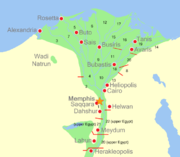
Desertification
Desertification is the degradation of land in drylands. Caused by a variety of factors, such as climate change and human activities, desertification is one of the most significant global environmental problems.-Definitions:...
of the Sahara, settlement became concentrated in the Nile Valley, where numerous sacral chiefdoms appeared. The regions with the largest population pressure were in the delta region of Lower Egypt
Lower Egypt
Lower Egypt is the northern-most section of Egypt. It refers to the fertile Nile Delta region, which stretches from the area between El-Aiyat and Zawyet Dahshur, south of modern-day Cairo, and the Mediterranean Sea....
, in Upper Egypt
Upper Egypt
Upper Egypt is the strip of land, on both sides of the Nile valley, that extends from the cataract boundaries of modern-day Aswan north to the area between El-Ayait and Zawyet Dahshur . The northern section of Upper Egypt, between El-Ayait and Sohag is sometimes known as Middle Egypt...
, and also along the second and third cataracts
Cataracts of the Nile
The cataracts of the Nile are shallow lengths of the Nile between Aswan and Khartoum where the surface of the water is broken by many small boulders and stones protruding out of the river bed, as well as many rocky islets. Aswan is also the Southern boundary of Upper Egypt...
of the Dongola
Dongola
Dongola , also spelled Dunqulah, and formerly known as Al 'Urdi, is the capital of the state of Northern in Sudan, on the banks of the Nile. It should not be confused with Old Dongola, an ancient city located 80 km upstream on the opposite bank....
reach of the Nile in Nubia. This population pressure and growth was brought about by the cultivation of southwest Asian crops, including wheat and barley, and the raising of sheep, goats, and cattle. Population growth led to competition for farm land and the need to regulate farming. Regulation was established by the formation of bureaucracies among sacral chiefdoms. The first and most powerful of the chiefdoms was Ta-Seti
Ta-Seti
Ta-Seti was one of 42 nomoi in Ancient Egypt. Ta-Seti also marked the border area towards Nubia.-Geography:Ta-Seti was the earliest Nubian Kingdom, dated 3,700 BCE...
, founded around 3500 BCE. The idea of sacral chiefdom spread throughout upper and lower Egypt.

Narmer
Narmer was an ancient Egyptian pharaoh of the Early Dynastic Period . He is thought to be the successor to the Protodynastic pharaohs Scorpion and/or Ka, and he is considered by some to be the unifier of Egypt and founder of the First Dynasty, and therefore the first pharaoh of unified Egypt.The...
(Menes) in 3100 BCE. Instead being viewed as a sacral chief, he became a divine king
Imperial cult
An imperial cult is a form of state religion in which an emperor, or a dynasty of emperors , are worshipped as messiahs, demigods or deities. "Cult" here is used to mean "worship", not in the modern pejorative sense...
. The henotheism
Henotheism
Henotheism is the belief and worship of a single god while accepting the existence or possible existence of other deities...
, or worship of a single god within a polytheistic system, practiced in the sacral chiefdoms along upper and lower Egypt, became the polytheistic religion of ancient Egypt. Bureaucracies became more centralized under the pharaohs, run by viziers, governors, tax collectors, generals, artists, and technicians. They engaged in tax collecting, organizing of labor for major public works, and building irrigation systems, pyramid
Pyramid
A pyramid is a structure whose outer surfaces are triangular and converge at a single point. The base of a pyramid can be trilateral, quadrilateral, or any polygon shape, meaning that a pyramid has at least three triangular surfaces...
s, temples, and canals. During the Fourth Dynasty
Fourth dynasty of Egypt
The fourth dynasty of ancient Egypt is characterized as a "golden age" of the Old Kingdom. Dynasty IV lasted from ca. 2613 to 2494 BC...
(2620-2480
BCE), long distance trade was developed, with the Levant
Levant
The Levant or ) is the geographic region and culture zone of the "eastern Mediterranean littoral between Anatolia and Egypt" . The Levant includes most of modern Lebanon, Syria, Jordan, Israel, the Palestinian territories, and sometimes parts of Turkey and Iraq, and corresponds roughly to the...
for timber, with Nubia for gold and skins, with Punt
Land of Punt
The Land of Punt, also called Pwenet, or Pwene by the ancient Egyptians, was a trading partner known for producing and exporting gold, aromatic resins, African blackwood, ebony, ivory, slaves and wild animals...
for frankincense
Frankincense
Frankincense, also called olibanum , is an aromatic resin obtained from trees of the genus Boswellia, particularly Boswellia sacra, B. carteri, B. thurifera, B. frereana, and B. bhaw-dajiana...
, and also with the western Libyan territories. For most of the Old Kingdom
Old Kingdom
Old Kingdom is the name given to the period in the 3rd millennium BC when Egypt attained its first continuous peak of civilization in complexity and achievement – the first of three so-called "Kingdom" periods, which mark the high points of civilization in the lower Nile Valley .The term itself was...
, Egypt developed her fundamental systems, institutions and culture, always through the central bureaucracy and by the divinity of the Pharaoh
Pharaoh
Pharaoh is a title used in many modern discussions of the ancient Egyptian rulers of all periods. The title originates in the term "pr-aa" which means "great house" and describes the royal palace...
.
After the third millennium BCE, Egypt started to extend direct military and political control over her southern and western neighbors. By 2200 BCE, the Old Kingdom's stability was undermined by rivalry among the governors of the nomes
Nome (Egypt)
A nome was a subnational administrative division of ancient Egypt. Today's use of the Greek nome rather than the Egyptian term sepat came about during the Ptolemaic period. Fascinated with Egypt, Greeks created many historical records about the country...
who challenged the power of pharaohs and by invasions of Asiatics into the delta. The First Intermediate Period had begun, a time of political division and uncertainty.
By 2130, the period of stagnation was ended by Mentuhotep
Mentuhotep I
Mentuhotep I was a local Egyptian prince at Thebes during the First Intermediate Period. He became the first openly acknowledged ruler of the Eleventh dynasty by assuming the title of first "supreme chief of Upper Egypt" and, later, declaring himself king over all Egypt. He is named as a nomarch in...
, the first Pharaoh of the 11th dynasty, and the emergence of the Middle Kingdom
Middle Kingdom of Egypt
The Middle Kingdom of Egypt is the period in the history of ancient Egypt stretching from the establishment of the Eleventh Dynasty to the end of the Fourteenth Dynasty, between 2055 BC and 1650 BC, although some writers include the Thirteenth and Fourteenth dynasties in the Second Intermediate...
. Pyramid building resumed, long-distance trade re-emerged, and the center of power moved from Memphis
Memphis, Egypt
Memphis was the ancient capital of Aneb-Hetch, the first nome of Lower Egypt. Its ruins are located near the town of Helwan, south of Cairo.According to legend related by Manetho, the city was founded by the pharaoh Menes around 3000 BC. Capital of Egypt during the Old Kingdom, it remained an...
to Thebes
Thebes, Egypt
Thebes is the Greek name for a city in Ancient Egypt located about 800 km south of the Mediterranean, on the east bank of the river Nile within the modern city of Luxor. The Theban Necropolis is situated nearby on the west bank of the Nile.-History:...
. Connections with the southern regions of Kush
Kingdom of Kush
The native name of the Kingdom was likely kaš, recorded in Egyptian as .The name Kash is probably connected to Cush in the Hebrew Bible , son of Ham ....
, Wawat and Irthet at the second cataract were made stronger. Then came the Second Intermediate Period, with the invasion of the Hyksos
Hyksos
The Hyksos were an Asiatic people who took over the eastern Nile Delta during the twelfth dynasty, initiating the Second Intermediate Period of ancient Egypt....
on horse-drawn chariots and utilizing bronze weapons, a technology heretofore unseen in Egypt. Horse-drawn chariots soon spread to the west in the inhabitable Sahara and North Africa
North Africa
North Africa or Northern Africa is the northernmost region of the African continent, linked by the Sahara to Sub-Saharan Africa. Geopolitically, the United Nations definition of Northern Africa includes eight countries or territories; Algeria, Egypt, Libya, Morocco, South Sudan, Sudan, Tunisia, and...
. The Hyksos failed to hold on to their Egyptian territories and were absorbed by Egyptian society. This eventually led to one of Egypt's most powerful phases, the New Kingdom
New Kingdom
The New Kingdom of Egypt, also referred to as the Egyptian Empire is the period in ancient Egyptian history between the 16th century BC and the 11th century BC, covering the Eighteenth, Nineteenth, and Twentieth Dynasties of Egypt....
(1580–1080 BCE), with the Eighteenth Dynasty. Egypt became a superpower controlling Nubia and Palestine
Palestine
Palestine is a conventional name, among others, used to describe the geographic region between the Mediterranean Sea and the Jordan River, and various adjoining lands....
while exerting political influence on the Libyans to the West and on the Mediterranean.
As before, the New Kingdom ended with invasion from the west by Libyan princes, leading to the Third Intermediate Period. Beginning with Shoshenq I
Shoshenq I
Hedjkheperre Setepenre Shoshenq I , , also known as Sheshonk or Sheshonq I , was a Meshwesh Berber king of Egypt—of Libyan ancestry—and the founder of the Twenty-second Dynasty...
, the Twenty-second Dynasty
Twenty-second dynasty of Egypt
The Twenty-First, Twenty-Second, Twenty-Third, Twenty-Fourth and Twenty-Fifth Dynasties of ancient Egypt are often combined under the group title, Third Intermediate Period.-Rulers:...
was established. It ruled for two centuries.
To the south, Nubian independence and strength was being reasserted. This reassertion led to the conquest of Egypt by Nubia, begun by Kashta
Kashta
Kashta was a king of the Kushite Dynasty and the successor of Alara. His name translates literally as "The Kushite".-Family:Kashta is thought to be a brother of his predecessor Alara. Both Alara and Kashta were thought to have married their sisters...
and completed by Piye
Piye
Piye, was a Kushite king and founder of the Twenty-fifth dynasty of Egypt who ruled Egypt from 747 BCE to 716 BCE according to Peter Clayton. He ruled from the city of Napata, located deep in Nubia, Sudan...
(Pianhky, 751-730 BCE) and Shabaka
Shabaka
Shabaka or Shabaka Neferkare, 'Beautiful is the Soul of Re', was a Kushite pharaoh of the Twenty-fifth dynasty of Egypt, between according to Peter Clayton .-Family:...
(716-695 BCE). This was the birth of the Twenty-fifth Dynasty
Twenty-fifth dynasty of Egypt
The twenty-fifth dynasty of Egypt, known as the Nubian Dynasty or the Kushite Empire, was the last dynasty of the Third Intermediate Period of Ancient Egypt....
of Egypt. The Nubians tried to re-establish Egyptian traditions and customs. They ruled Egypt for a hundred years. This was ended by an Assyrian invasion, with Taharqa
Taharqa
Taharqa was a pharaoh of the Ancient Egyptian 25th dynasty and king of the Kingdom of Kush, which was located in Northern Sudan.Taharqa was the son of Piye, the Nubian king of Napata who had first conquered Egypt. Taharqa was also the cousin and successor of Shebitku. The successful campaigns of...
experiencing the full might of Assyrian iron weapons. The Nubian pharaoh Tantamani
Tantamani
Tantamani or Tanwetamani or Tementhes was a Pharaoh of Egypt and the Kingdom of Kush located in Northern Sudan and a member of the Nubian or Twenty-fifth dynasty of Egypt...
was the last of the Twenty-fifth dynasty.
When the Assyrians and Nubians left, a new Twenty-sixth Dynasty
Twenty-sixth dynasty of Egypt
The Twenty-sixth Dynasty of Egypt was the last native dynasty to rule Egypt before the Persian conquest in 525 BC . The Dynasty's reign The Twenty-sixth Dynasty of Egypt (also written Dynasty XXVI or Dynasty 26) was the last native dynasty to rule Egypt before the Persian conquest in 525 BC...
emerged from Sais
Sais, Egypt
Sais or Sa el-Hagar was an ancient Egyptian town in the Western Nile Delta on the Canopic branch of the Nile. It was the provincial capital of Sap-Meh, the fifth nome of Lower Egypt and became the seat of power during the Twenty-fourth dynasty of Egypt and the Saite Twenty-sixth dynasty of Egypt ...
. It lasted until 525 BCE, when Egypt was invaded by the Persians
Achaemenid Empire
The Achaemenid Empire , sometimes known as First Persian Empire and/or Persian Empire, was founded in the 6th century BCE by Cyrus the Great who overthrew the Median confederation...
. Unlike the Assyrians, the Persians stayed. In 332, Egypt was conquered by Alexander the Great. This was the beginning of the Ptolemaic dynasty
Ptolemaic dynasty
The Ptolemaic dynasty, was a Macedonian Greek royal family which ruled the Ptolemaic Empire in Egypt during the Hellenistic period. Their rule lasted for 275 years, from 305 BC to 30 BC...
, which ended with Roman conquest in 30 BCE. Pharaonic Egypt had come to an end.
Ancient Greek influence
Greeks founded the city of CyreneCyrene, Libya
Cyrene was an ancient Greek colony and then a Roman city in present-day Shahhat, Libya, the oldest and most important of the five Greek cities in the region. It gave eastern Libya the classical name Cyrenaica that it has retained to modern times.Cyrene lies in a lush valley in the Jebel Akhdar...
in Ancient Libya
Ancient Libya
The Latin name Libya referred to the region west of the Nile Valley, generally corresponding to modern Northwest Africa. Climate changes affected the locations of the settlements....
around 631 BC. Cyrenaica
Cyrenaica
Cyrenaica is the eastern coastal region of Libya.Also known as Pentapolis in antiquity, it was part of the Creta et Cyrenaica province during the Roman period, later divided in Libia Pentapolis and Libia Sicca...
became a flourishing colony, though being hemmed in on all sides by absolute desert it had little or no influence on inner Africa. The Greeks, however, exerted a powerful influence in Egypt. To Alexander the Great the city of Alexandria
Alexandria
Alexandria is the second-largest city of Egypt, with a population of 4.1 million, extending about along the coast of the Mediterranean Sea in the north central part of the country; it is also the largest city lying directly on the Mediterranean coast. It is Egypt's largest seaport, serving...
owes its foundation (332 BC
332 BC
Year 332 BC was a year of the pre-Julian Roman calendar. At the time, it was known as the Year of the Consulship of Calvinus and Arvina...
), and under the Hellenistic dynasty of the Ptolemies
Ptolemaic dynasty
The Ptolemaic dynasty, was a Macedonian Greek royal family which ruled the Ptolemaic Empire in Egypt during the Hellenistic period. Their rule lasted for 275 years, from 305 BC to 30 BC...
attempts were made to penetrate southward, and in this way was obtained some knowledge of Ethiopia.
Nubia
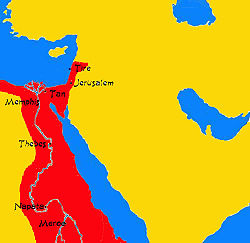
Ebony
Ebony is a dense black wood, most commonly yielded by several species in the genus Diospyros, but ebony may also refer to other heavy, black woods from unrelated species. Ebony is dense enough to sink in water. Its fine texture, and very smooth finish when polished, make it valuable as an...
and ivory
Ivory trade
The ivory trade is the commercial, often illegal trade in the ivory tusks of the hippopotamus, walrus, narwhal, mammoth, and most commonly, Asian and African elephants....
to the Old Kingdom
Old Kingdom
Old Kingdom is the name given to the period in the 3rd millennium BC when Egypt attained its first continuous peak of civilization in complexity and achievement – the first of three so-called "Kingdom" periods, which mark the high points of civilization in the lower Nile Valley .The term itself was...
. By the 32nd century BCE, Ta-Seti was in decline. After the unification of Egypt by Narmer
Narmer
Narmer was an ancient Egyptian pharaoh of the Early Dynastic Period . He is thought to be the successor to the Protodynastic pharaohs Scorpion and/or Ka, and he is considered by some to be the unifier of Egypt and founder of the First Dynasty, and therefore the first pharaoh of unified Egypt.The...
in 3100 BCE, Ta-Seti was invaded by the Pharaoh Hor-Aha
Hor-Aha
Hor-Aha is considered the second pharaoh of the first dynasty of ancient Egypt in current Egyptology. He lived around the thirty-first century BC.- Name :...
of the First Dynasty, destroying the final remnants of the kingdom. Ta-Seti is affiliated with A-Group
A-group
A-Group is the designation for a distinct culture that arose between the First and Second Cataracts of the Nile in Nubia betweenthe Egyptian 1st dynasty and the 3rd millennium BC.The A-Group settled on very poor land with scarce natural resources, yet...
culture known to archaeology.
Small sacral kingdoms continued to dot the Nubian portion of the Nile for centuries after 3000 BCE. Around the latter part of the third millennium, there was further consolidation of the sacral kingdoms. Two kingdoms in particular emerged: the Sai kingdom, immediately south of Egypt, and Kingdom of Kerma
Kingdom of Kerma
The Kerma culture is a prehistoric culture which flourished from around 2500 BCE to about 1520 BCE in what is now Sudan, centered at Kerma.It emerged as a major centre during the Middle Kingdom period of Ancient Egypt....
at the third cataract. Sometime around the 18th century BCE, the Kingdom of Kerma conquered the Kingdom of Sai, becoming a serious rival to Egypt. Kerma occupied a territory from the first cataract to the confluences of the Blue Nile
Blue Nile
The Blue Nile is a river originating at Lake Tana in Ethiopia. With the White Nile, the river is one of the two major tributaries of the Nile...
, White Nile
White Nile
The White Nile is a river of Africa, one of the two main tributaries of the Nile from Egypt, the other being the Blue Nile. In the strict meaning, "White Nile" refers to the river formed at Lake No at the confluence of the Bahr al Jabal and Bahr el Ghazal rivers...
, and River Atbara. About 1575 to 1550 BCE, during the latter part of the Seventeenth Dynasty
Seventeenth dynasty of Egypt
The Fifteenth, Sixteenth and Seventeenth Dynasties of ancient Egypt are often combined under the group title, Second Intermediate Period. The Seventeenth Dynasty dates approximately from 1580 to 1550 BC.-Rulers:...
, the Kingdom of Kerma invaded Egypt. The Kingdom of Kerma allied itself with the Hyksos
Hyksos
The Hyksos were an Asiatic people who took over the eastern Nile Delta during the twelfth dynasty, initiating the Second Intermediate Period of ancient Egypt....
invasion of Egypt.
Egypt eventually re-energized under the Eighteenth Dynasty
Eighteenth dynasty of Egypt
The eighteenth dynasty of ancient Egypt is perhaps the best known of all the dynasties of ancient Egypt...
and conquered the Kingdom of Kerma or Kush
Kingdom of Kush
The native name of the Kingdom was likely kaš, recorded in Egyptian as .The name Kash is probably connected to Cush in the Hebrew Bible , son of Ham ....
, ruling it for almost 500 years. The Kushites were Egyptianized during this period. By 1100 BCE, the Egyptians had withdrawn from Kush. The region regained independence and reasserted its culture. Kush built a new religion around Amun
Amun
Amun, reconstructed Egyptian Yamānu , was a god in Egyptian mythology who in the form of Amun-Ra became the focus of the most complex system of theology in Ancient Egypt...
and made Napata
Napata
Napata was a city-state of ancient Nubia on the west bank of the Nile River, at the site of modern Karima, Northern Sudan.During the 8th to 7th centuries BC, Napata was the capital of the Nubian kingdom of Kush, whence the 25th, or Nubian Dynasty conquered Egypt...
its spiritual center. In 730 BCE, the Kingdom of Kush invaded Egypt, taking over Thebes
Thebes, Egypt
Thebes is the Greek name for a city in Ancient Egypt located about 800 km south of the Mediterranean, on the east bank of the river Nile within the modern city of Luxor. The Theban Necropolis is situated nearby on the west bank of the Nile.-History:...
and beginning the Nubian Empire. The empire extended from Palestine to the confluences of the Blue Nile, the White Nile, and River Atbara.
In 760 BCE, the Kushites were expelled from Egypt by iron-wielding Assyrians. Later, the administrative capital was moved from Napata to Meröe
Meroë
Meroë Meroitic: Medewi or Bedewi; Arabic: and Meruwi) is an ancient city on the east bank of the Nile about 6 km north-east of the Kabushiya station near Shendi, Sudan, approximately 200 km north-east of Khartoum. Near the site are a group of villages called Bagrawiyah...
, developing into a new Nubian culture. Initially Meroites were highly Egyptianized, but they subsequently began to take on distinctive features. Nubia became a center of iron-making and cotton cloth manufacturing. Egyptian writing was replaced by the Meroitic alphabet. The lion god Apedemak
Apedemak
Apedemak, alt Apademak, was a lion-headed warrior god worshiped in Nubia by Meroitic peoples. A number of Meroitic temples dedicated to Apedemak are known from the Butana region: Naqa, Meroe, and Musawwarat es-Sufra, which seems to be his chief cult place...
was added to the Egyptian pantheon of gods. Trade links to the Red Sea
Red Sea
The Red Sea is a seawater inlet of the Indian Ocean, lying between Africa and Asia. The connection to the ocean is in the south through the Bab el Mandeb strait and the Gulf of Aden. In the north, there is the Sinai Peninsula, the Gulf of Aqaba, and the Gulf of Suez...
increased, linking Nubia with Mediterranean Greece
Ancient Greece
Ancient Greece is a civilization belonging to a period of Greek history that lasted from the Archaic period of the 8th to 6th centuries BC to the end of antiquity. Immediately following this period was the beginning of the Early Middle Ages and the Byzantine era. Included in Ancient Greece is the...
. Its architecture and art became more unique, with pictures of lions, ostriches, giraffes, and elephants. Eventually with the rise of Aksum, Nubia's trade links were broken and it suffered environmental degradation from the tree cutting required for iron production. In 350 CE, the Aksumite king Ezana brought Meröe to an end.
Carthage
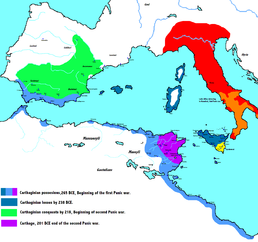
Berber people
Berbers are the indigenous peoples of North Africa west of the Nile Valley. They are continuously distributed from the Atlantic to the Siwa oasis, in Egypt, and from the Mediterranean to the Niger River. Historically they spoke the Berber language or varieties of it, which together form a branch...
, as Libyans
Ancient Libya
The Latin name Libya referred to the region west of the Nile Valley, generally corresponding to modern Northwest Africa. Climate changes affected the locations of the settlements....
. The Libyans were agriculturalists like the Mauri
Mauri (people)
The Mauri were an ancient Berber people inhabiting the territory of modern Algeria and Morocco. Much of that territory was annexed to the Roman empire in 44 AD, as the province of Mauretania...
of Morocco
Morocco
Morocco , officially the Kingdom of Morocco , is a country located in North Africa. It has a population of more than 32 million and an area of 710,850 km², and also primarily administers the disputed region of the Western Sahara...
and the Numidians
Numidians
The Numidians were Berber tribes who lived in Numidia, in Algeria east of Constantine and in part of Tunisia. The Numidians were one of the earliest natives to trade with the settlers of Carthage. As Carthage grew, the relationship with the Numidians blossomed. Carthage's military used the Numidian...
of central and eastern Algeria
Algeria
Algeria , officially the People's Democratic Republic of Algeria , also formally referred to as the Democratic and Popular Republic of Algeria, is a country in the Maghreb region of Northwest Africa with Algiers as its capital.In terms of land area, it is the largest country in Africa and the Arab...
and Tunis
Tunis
Tunis is the capital of both the Tunisian Republic and the Tunis Governorate. It is Tunisia's largest city, with a population of 728,453 as of 2004; the greater metropolitan area holds some 2,412,500 inhabitants....
. They were also nomadic, having the horse, and occupied the arid pastures and desert, like the Gaetuli
Gaetuli
Gaetuli was the Romanised name of an ancient Berber tribe inhabiting Getulia, covering the desert region south of the Atlas Mountains, bordering the Sahara. Other sources place Getulia in pre-Roman times along the Mediterranean coasts of what is now Algeria and Tunisia, and north of the Atlas...
. Berber desert nomads were typically in conflict with Berber coastal agriculturalists.
The Phoenicians were seamen of the Mediterranean. They were in constant search for valuable metals like copper, gold, tin, and lead. Soon they began to populate the North African coast with settlements, trading and mixing with the native Berber population. In 814 BCE, Phoenicians from Tyre established the city of Carthage
Carthage
Carthage , implying it was a 'new Tyre') is a major urban centre that has existed for nearly 3,000 years on the Gulf of Tunis, developing from a Phoenician colony of the 1st millennium BC...
. By 600 BCE, Carthage had become a major trading entity and power in the Mediterranean, largely through trade with tropical Africa. Carthage's prosperity fostered the growth of the Berber kingdoms, Numidia
Numidia
Numidia was an ancient Berber kingdom in part of present-day Eastern Algeria and Western Tunisia in North Africa. It is known today as the Chawi-land, the land of the Chawi people , the direct descendants of the historical Numidians or the Massyles The kingdom began as a sovereign state and later...
and Mauretania
Mauretania
Mauretania is a part of the historical Ancient Libyan land in North Africa. It corresponds to present day Morocco and a part of western Algeria...
. Around 500 BCE, Carthage provided a strong impetus for trade with sub-Saharan Africa. Berber middlemen, who had maintained contacts with sub-Saharan Africa since the desert had desiccated, utilized pack animals to transfer products from oasis to oasis. Danger lurked from the Garamantes
Garamantes
The Garamantes were a Saharan people who used an elaborate underground irrigation system, and founded a prosperous Berber kingdom in the Fezzan area of modern-day Libya, in the Sahara desert. They were a local power in the Sahara between 500 BC and 700 AD.There is little textual information about...
of Fez
Fes
Fes or Fez is the second largest city of Morocco, after Casablanca, with a population of approximately 1 million . It is the capital of the Fès-Boulemane region....
, who raided caravans. Salt and metal goods were traded for gold, slaves, beads, and ivory.

Ancient Greece
Ancient Greece is a civilization belonging to a period of Greek history that lasted from the Archaic period of the 8th to 6th centuries BC to the end of antiquity. Immediately following this period was the beginning of the Early Middle Ages and the Byzantine era. Included in Ancient Greece is the...
and Romans
Ancient Rome
Ancient Rome was a thriving civilization that grew on the Italian Peninsula as early as the 8th century BC. Located along the Mediterranean Sea and centered on the city of Rome, it expanded to one of the largest empires in the ancient world....
. Carthage fought three wars with Rome: the First Punic War
First Punic War
The First Punic War was the first of three wars fought between Ancient Carthage and the Roman Republic. For 23 years, the two powers struggled for supremacy in the western Mediterranean Sea, primarily on the Mediterranean island of Sicily and its surrounding waters but also to a lesser extent in...
(264 to 241 BCE), over Sicily
Sicily
Sicily is a region of Italy, and is the largest island in the Mediterranean Sea. Along with the surrounding minor islands, it constitutes an autonomous region of Italy, the Regione Autonoma Siciliana Sicily has a rich and unique culture, especially with regard to the arts, music, literature,...
; the Second Punic War
Second Punic War
The Second Punic War, also referred to as The Hannibalic War and The War Against Hannibal, lasted from 218 to 201 BC and involved combatants in the western and eastern Mediterranean. This was the second major war between Carthage and the Roman Republic, with the participation of the Berbers on...
(218 to 201 BCE), in which Hannibal invaded Europe; and the Third Punic War
Third Punic War
The Third Punic War was the third and last of the Punic Wars fought between the former Phoenician colony of Carthage, and the Roman Republic...
(149 to 146 BCE). Carthage lost the first two wars, and in the third it was destroyed, becoming the Roman province of Africa, with the Berber Kingdom of Numidia assisting Rome. The Roman province of Africa became a major agricultural supplier of wheat, olives, and olive oil
Olive oil
Olive oil is an oil obtained from the olive , a traditional tree crop of the Mediterranean Basin. It is commonly used in cooking, cosmetics, pharmaceuticals, and soaps and as a fuel for traditional oil lamps...
to imperial Rome via exorbitant taxation. Two centuries later, Rome brought the Berber kingdoms of Numidia and Mauretania under its authority. In the 420s CE, Vandals
Vandals
The Vandals were an East Germanic tribe that entered the late Roman Empire during the 5th century. The Vandals under king Genseric entered Africa in 429 and by 439 established a kingdom which included the Roman Africa province, besides the islands of Sicily, Corsica, Sardinia and the Balearics....
invaded North Africa and Rome lost her territories. The Berber kingdoms subsequently regained their independence.
Christianity
Christianity
Christianity is a monotheistic religion based on the life and teachings of Jesus as presented in canonical gospels and other New Testament writings...
gained a foothold in Africa at Alexandria
Alexandria
Alexandria is the second-largest city of Egypt, with a population of 4.1 million, extending about along the coast of the Mediterranean Sea in the north central part of the country; it is also the largest city lying directly on the Mediterranean coast. It is Egypt's largest seaport, serving...
in the 1st century CE and spread to northwest Africa. By 313 CE, with the Edict of Milan
Edict of Milan
The Edict of Milan was a letter signed by emperors Constantine I and Licinius that proclaimed religious toleration in the Roman Empire...
, all of Roman North Africa
North Africa
North Africa or Northern Africa is the northernmost region of the African continent, linked by the Sahara to Sub-Saharan Africa. Geopolitically, the United Nations definition of Northern Africa includes eight countries or territories; Algeria, Egypt, Libya, Morocco, South Sudan, Sudan, Tunisia, and...
was Christian. Egyptians adopted Monophysite Christianity and formed the independent Coptic Church. Berbers adopted Donatist
Donatist
Donatism was a Christian sect within the Roman province of Africa that flourished in the fourth and fifth centuries. It had its roots in the social pressures among the long-established Christian community of Roman North Africa , during the persecutions of Christians under Diocletian...
Christianity. Both groups refused to accept the authority of the Roman Church
Roman Catholic Church
The Catholic Church, also known as the Roman Catholic Church, is the world's largest Christian church, with over a billion members. Led by the Pope, it defines its mission as spreading the gospel of Jesus Christ, administering the sacraments and exercising charity...
.
Role of the Berbers
As Carthaginian power grew; its impact on the indigenous population increased dramatically. BerberBerber people
Berbers are the indigenous peoples of North Africa west of the Nile Valley. They are continuously distributed from the Atlantic to the Siwa oasis, in Egypt, and from the Mediterranean to the Niger River. Historically they spoke the Berber language or varieties of it, which together form a branch...
civilization was already at a stage in which agriculture
Agriculture
Agriculture is the cultivation of animals, plants, fungi and other life forms for food, fiber, and other products used to sustain life. Agriculture was the key implement in the rise of sedentary human civilization, whereby farming of domesticated species created food surpluses that nurtured the...
, manufacturing, trade, and political organization supported several states. Trade links between Carthage and the Berbers in the interior grew, but territorial expansion also resulted in the enslavement or military recruitment of some Berbers and in the extraction of tribute from others. By the early 4th century BC, Berbers formed one of the largest element, with Gauls, of the Carthaginian army. In the Revolt of the Mercenaries, Berber soldiers participated from 241 to 238 BC after being unpaid following the defeat of Carthage in the First Punic War
First Punic War
The First Punic War was the first of three wars fought between Ancient Carthage and the Roman Republic. For 23 years, the two powers struggled for supremacy in the western Mediterranean Sea, primarily on the Mediterranean island of Sicily and its surrounding waters but also to a lesser extent in...
. Berbers succeeded in obtaining control of much of Carthage's North African territory, and they minted coins bearing the name Libyan, used in Greek to describe natives of North Africa. The Carthaginian state declined because of successive defeats by the Romans in the Punic Wars
Punic Wars
The Punic Wars were a series of three wars fought between Rome and Carthage from 264 B.C.E. to 146 B.C.E. At the time, they were probably the largest wars that had ever taken place...
; in 146 BC the city of Carthage was destroyed. As Carthaginian power waned, the influence of Berber leaders in the hinterland grew. By the 2nd century BC, several large but loosely administered Berber kingdoms had emerged. Two of them were established in Numidia
Numidia
Numidia was an ancient Berber kingdom in part of present-day Eastern Algeria and Western Tunisia in North Africa. It is known today as the Chawi-land, the land of the Chawi people , the direct descendants of the historical Numidians or the Massyles The kingdom began as a sovereign state and later...
, behind the coastal areas controlled by Carthage. West of Numidia lay Mauretania, which extended across the Moulouya River
Moulouya River
The Moulouya River is a 520 km-long river in Morocco. Its sources are located in the Middle Atlas. It empties into the Mediterranean Sea near Saidia, in Northeast Morocco at about . Water level in the river often fluctuates. The river is used for irrigation...
in Morocco to the Atlantic Ocean. The high point of Berber civilization, unequaled until the coming of the Almohad
Almohad
The Almohad Dynasty , was a Moroccan Berber-Muslim dynasty founded in the 12th century that established a Berber state in Tinmel in the Atlas Mountains in roughly 1120.The movement was started by Ibn Tumart in the Masmuda tribe, followed by Abd al-Mu'min al-Gumi between 1130 and his...
s and Almoravids more than a millennium later, was reached during the reign of Masinissa
Masinissa
Masinissa — also spelled Massinissa and Massena — was the first King of Numidia, an ancient North African nation of ancient Libyan tribes. As a successful general, Masinissa fought in the Second Punic War , first against the Romans as an ally of Carthage an later switching sides when he saw which...
in the 2nd century BC. After Masinissa's death in 148 BC, the Berber kingdoms were divided and reunited several times. Masinissa's line survived until AD 24, when the remaining Berber territory was annexed to the Roman Empire
Roman Empire
The Roman Empire was the post-Republican period of the ancient Roman civilization, characterised by an autocratic form of government and large territorial holdings in Europe and around the Mediterranean....
.
Somalia
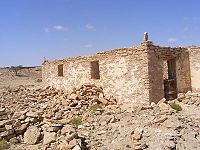
Somali people
Somalis are an ethnic group located in the Horn of Africa, also known as the Somali Peninsula. The overwhelming majority of Somalis speak the Somali language, which is part of the Cushitic branch of the Afro-Asiatic language family...
were an important link in the Horn of Africa
Horn of Africa
The Horn of Africa is a peninsula in East Africa that juts hundreds of kilometers into the Arabian Sea and lies along the southern side of the Gulf of Aden. It is the easternmost projection of the African continent...
connecting the region's commerce with the rest of the ancient world. Somali sailors and merchants were the main suppliers of frankincense
Frankincense
Frankincense, also called olibanum , is an aromatic resin obtained from trees of the genus Boswellia, particularly Boswellia sacra, B. carteri, B. thurifera, B. frereana, and B. bhaw-dajiana...
, myrrh
Myrrh
Myrrh is the aromatic oleoresin of a number of small, thorny tree species of the genus Commiphora, which grow in dry, stony soil. An oleoresin is a natural blend of an essential oil and a resin. Myrrh resin is a natural gum....
and spices, all of which were valuable luxuries to the Ancient Egyptians, Phoenicians, Mycenaeans
Mycenaean Greece
Mycenaean Greece was a cultural period of Bronze Age Greece taking its name from the archaeological site of Mycenae in northeastern Argolis, in the Peloponnese of southern Greece. Athens, Pylos, Thebes, and Tiryns are also important Mycenaean sites...
and Babylonians.
In the classical era
Classical antiquity
Classical antiquity is a broad term for a long period of cultural history centered on the Mediterranean Sea, comprising the interlocking civilizations of ancient Greece and ancient Rome, collectively known as the Greco-Roman world...
, several flourishing Somali city-states such as Opone, Mosyllon
Cape Guardafui
Cape Guardafui , also known as Ras Asir and historically as Aromata promontorium, is a headland in the northeastern Bari province of Somalia. Located in the autonomous Puntland region, it forms the geographical apex of the region commonly referred to as the Horn of Africa.-Location:Cape Guardafui...
and Malao
Berbera
Berbera is a city and seat of Berbera District in Somaliland, a self-proclaimed Independent Republic with de facto control over its own territory, which is recognized by the international community and the Somali Government as a part of Somalia...
competed with the Sabaeans, Parthia
Parthia
Parthia is a region of north-eastern Iran, best known for having been the political and cultural base of the Arsacid dynasty, rulers of the Parthian Empire....
ns and Axumites for the rich Indo
India
India , officially the Republic of India , is a country in South Asia. It is the seventh-largest country by geographical area, the second-most populous country with over 1.2 billion people, and the most populous democracy in the world...
-Greco-Roman trade.
Roman North Africa
Trajan
Trajan , was Roman Emperor from 98 to 117 AD. Born into a non-patrician family in the province of Hispania Baetica, in Spain Trajan rose to prominence during the reign of emperor Domitian. Serving as a legatus legionis in Hispania Tarraconensis, in Spain, in 89 Trajan supported the emperor against...
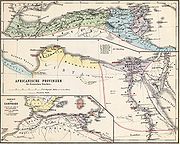
established a frontier in the south by encircling the Aurès and Nemencha mountains and building a line of forts from Vescera (modern Biskra
Biskra
Biskra is the capital city of Biskra province, Algeria. In 2007, its population was recorded as 207,987.During Roman times the town was called Vescera, though this may have been simply a Latin transliteration of the native name. Around 200 AD under Septimius Severus' reign, it was seized by the...
) to Ad Majores (Hennchir Besseriani, southeast of Biskra). The defensive line extended at least as far as Castellum Dimmidi (modern Messaad, southwest of Biskra), Roman Algeria's southernmost fort. Romans settled and developed the area around Sitifis (modern Sétif
Sétif
Sétif |Colonia]]) is a town in northeastern Algeria. It is the capital of Sétif Province and it has a population of 239,195 inhabitants as of the 1998 census. Setif is located to the east of Algiers and is the second most important Wilaya after the country's capital. It is 1,096 meters above sea...
) in the 2nd century, but farther west the influence of Rome did not extend beyond the coast and principal military roads until much later.
The Roman military presence of North Africa was relatively small, consisting of about 28,000 troops and auxiliaries in Numidia
Numidia
Numidia was an ancient Berber kingdom in part of present-day Eastern Algeria and Western Tunisia in North Africa. It is known today as the Chawi-land, the land of the Chawi people , the direct descendants of the historical Numidians or the Massyles The kingdom began as a sovereign state and later...
and the two Mauretania
Mauretania
Mauretania is a part of the historical Ancient Libyan land in North Africa. It corresponds to present day Morocco and a part of western Algeria...
n provinces. Starting in the 2nd century AD, these garrisons were manned mostly by local inhabitants.
Aside from Carthage, urbanization in North Africa came in part with the establishment of settlements of veterans under the Roman emperors Claudius
Claudius
Claudius , was Roman Emperor from 41 to 54. A member of the Julio-Claudian dynasty, he was the son of Drusus and Antonia Minor. He was born at Lugdunum in Gaul and was the first Roman Emperor to be born outside Italy...
, Nerva, and Trajan. In Algeria such settlements included Tipasa
Tipasa
Tipaza is a Berber-speaking town on the coast of Algeria, capital of the Tipaza province. The modern town, founded in 1857, is remarkable chiefly for its sandy beach, and ancient ruins.-Ancient history:...
, Cuicul or Curculum (modern Djemila
Djemila
Djémila is a mountain village in Algeria, near the northern coast east of Algiers, where some of the best preserved Berbero-Roman ruins in North Africa are found...
, northeast of Sétif), Thamugadi (modern Timgad
Timgad
Timgad , called Thamugas or Tamugadi in old Berber) was a Roman colonial town in the Aures mountain- numidia Algeria founded by the Emperor Trajan around 100 AD. The full name of the town was Colonia Marciana Ulpia Traiana Thamugadi...
, southeast of Sétif), and Sitifis (modern Setif
Sétif
Sétif |Colonia]]) is a town in northeastern Algeria. It is the capital of Sétif Province and it has a population of 239,195 inhabitants as of the 1998 census. Setif is located to the east of Algiers and is the second most important Wilaya after the country's capital. It is 1,096 meters above sea...
). The prosperity of most towns depended on agriculture. Called the "granary of the empire," North Africa was one of the largest exporters of grain in the empire, which was exported to the provinces which did not produce cereals, like Italy and Greece. Other crops included fruit, figs, grapes, and beans. By the 2nd century AD, olive oil rivaled cereals as an export item.
The beginnings of the decline was less serious in North Africa than elsewhere. There were uprisings, however. In AD 238, landowners rebelled unsuccessfully against the emperor's fiscal policies. Sporadic tribal revolts in the Mauretanian mountains followed from 253 to 288. The towns also suffered economic difficulties, and building activity almost ceased.
The towns of Roman North Africa had a substantial Jewish population. Some Jews had been deported from Judea
Judea
Judea or Judæa was the name of the mountainous southern part of the historic Land of Israel from the 8th century BCE to the 2nd century CE, when Roman Judea was renamed Syria Palaestina following the Jewish Bar Kokhba revolt.-Etymology:The...
or Palestine
Palestine
Palestine is a conventional name, among others, used to describe the geographic region between the Mediterranean Sea and the Jordan River, and various adjoining lands....
in the 1st and 2nd centuries AD for rebelling against Roman rule; others had come earlier with Punic settlers. In addition, a number of Berber tribes had converted to Judaism.
Christianity
Christianity
Christianity is a monotheistic religion based on the life and teachings of Jesus as presented in canonical gospels and other New Testament writings...
arrived in the 2nd century and soon gained converts in the towns and among slaves. More than eighty bishops, some from distant frontier regions of Numidia, attended the Council of Carthage
Carthage
Carthage , implying it was a 'new Tyre') is a major urban centre that has existed for nearly 3,000 years on the Gulf of Tunis, developing from a Phoenician colony of the 1st millennium BC...
in 256. By the end of the 4th century, the settled areas had become Christianized, and some Berber tribes had converted en masse.
A division in the church that came to be known as the Donatist
Donatist
Donatism was a Christian sect within the Roman province of Africa that flourished in the fourth and fifth centuries. It had its roots in the social pressures among the long-established Christian community of Roman North Africa , during the persecutions of Christians under Diocletian...
controversy began in 313 among Christians in North Africa. The Donatists stressed the holiness of the church and refused to accept the authority to administer the sacraments of those who had surrendered the scriptures when they were forbidden under the Emperor Diocletian
Diocletian
Diocletian |latinized]] upon his accession to Diocletian . c. 22 December 244 – 3 December 311), was a Roman Emperor from 284 to 305....
. The Donatists also opposed the involvement of Emperor Constantine in church affairs in contrast to the majority of Christians who welcomed official imperial recognition.
The occasionally violent controversy has been characterized as a struggle between opponents and supporters of the Roman system. The most articulate North African critic of the Donatist position, which came to be called a heresy, was Augustine, bishop of Hippo Regius
Hippo Regius
Hippo Regius is the ancient name of the modern city of Annaba, in Algeria. Under this name, it was a major city in Roman Africa, hosting several early Christian councils, and was the home of the philosopher and theologian Augustine of Hippo...
. Augustine
Augustine of Hippo
Augustine of Hippo , also known as Augustine, St. Augustine, St. Austin, St. Augoustinos, Blessed Augustine, or St. Augustine the Blessed, was Bishop of Hippo Regius . He was a Latin-speaking philosopher and theologian who lived in the Roman Africa Province...
maintained that the unworthiness of a minister did not affect the validity of the sacraments because their true minister was Christ. In his sermons and books Augustine, who is considered a leading exponent of Christian dogma, evolved a theory of the right of orthodox Christian rulers to use force against schismatics and heretics. Although the dispute was resolved by a decision of an imperial commission in Carthage in 411, Donatist communities continued to exist as late as the 6th century.
The decline in trade weakened Roman control. Independent kingdoms emerged in mountainous and desert areas, towns were overrun, and Berbers, who had previously been pushed to the edges of the Roman Empire, returned.
Belisarius
Belisarius
Flavius Belisarius was a general of the Byzantine Empire. He was instrumental to Emperor Justinian's ambitious project of reconquering much of the Mediterranean territory of the former Western Roman Empire, which had been lost less than a century previously....
, general of the Byzantine emperor
Byzantine Empire
The Byzantine Empire was the Eastern Roman Empire during the periods of Late Antiquity and the Middle Ages, centred on the capital of Constantinople. Known simply as the Roman Empire or Romania to its inhabitants and neighbours, the Empire was the direct continuation of the Ancient Roman State...
Justinian I
Justinian I
Justinian I ; , ; 483– 13 or 14 November 565), commonly known as Justinian the Great, was Byzantine Emperor from 527 to 565. During his reign, Justinian sought to revive the Empire's greatness and reconquer the lost western half of the classical Roman Empire.One of the most important figures of...
based in Constantinople
Constantinople
Constantinople was the capital of the Roman, Eastern Roman, Byzantine, Latin, and Ottoman Empires. Throughout most of the Middle Ages, Constantinople was Europe's largest and wealthiest city.-Names:...
, landed in North Africa in 533 with 16,000 men and within a year destroyed the Vandal kingdom. Local opposition delayed full Byzantine control of the region for twelve years, however, and when imperial control came, it was but a shadow of the control exercised by Rome. Although an impressive series of fortifications were built, Byzantine rule was compromised by official corruption, incompetence, military weakness, and lack of concern in Constantinople for African affairs, which made it an easy target for the Arabs during for Muslim Conquests
Muslim conquests
Muslim conquests also referred to as the Islamic conquests or Arab conquests, began with the Islamic prophet Muhammad. He established a new unified polity in the Arabian Peninsula which under the subsequent Rashidun and Umayyad Caliphates saw a century of rapid expansion of Muslim power.They...
. As a result, many rural areas reverted to Berber rule.
Aksum
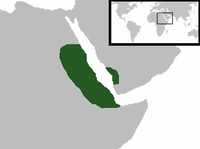
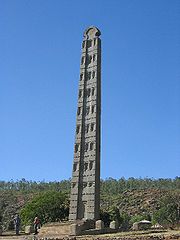
Eritrea
Eritrea , officially the State of Eritrea, is a country in the Horn of Africa. Eritrea derives it's name from the Greek word Erethria, meaning 'red land'. The capital is Asmara. It is bordered by Sudan in the west, Ethiopia in the south, and Djibouti in the southeast...
and northern Ethiopia
Ethiopia
Ethiopia , officially known as the Federal Democratic Republic of Ethiopia, is a country located in the Horn of Africa. It is the second-most populous nation in Africa, with over 82 million inhabitants, and the tenth-largest by area, occupying 1,100,000 km2...
was D'mt, dated around the 8th and 7th centuries BCE. D'mt traded through the Red Sea with Egypt and the Mediterranean, providing frankincense. By the fifth and 3rd centuries, D'mt had declined, and several successor states took its place. Later there was greater trade with southern Arabia, mainly with the port of Saba. Adulis
Adulis
Adulis or Aduli is an archeological site in the Northern Red Sea region of Eritrea, about 30 miles south of Massawa. It was the port of the Kingdom of Aksum, located on the coast of the Red Sea. Adulis Bay is named after the port...
became an important commercial center in the Ethiopian highlands
Ethiopian Highlands
The Ethiopian Highlands are a rugged mass of mountains in Ethiopia, Eritrea , and northern Somalia in the Horn of Africa...
. The interaction of the peoples in the two regions, the southern Arabia Sabaeans and the northern Ethiopians, resulted in the Ge'ez culture and language and eventual development of the Ge'ez script. Trade links increased and expanded from the Red Sea to the Mediterranean, with Egypt, Greece, and Rome, to the Black Sea
Black Sea
The Black Sea is bounded by Europe, Anatolia and the Caucasus and is ultimately connected to the Atlantic Ocean via the Mediterranean and the Aegean seas and various straits. The Bosphorus strait connects it to the Sea of Marmara, and the strait of the Dardanelles connects that sea to the Aegean...
, and to Persia, India
India
India , officially the Republic of India , is a country in South Asia. It is the seventh-largest country by geographical area, the second-most populous country with over 1.2 billion people, and the most populous democracy in the world...
, and China
China
Chinese civilization may refer to:* China for more general discussion of the country.* Chinese culture* Greater China, the transnational community of ethnic Chinese.* History of China* Sinosphere, the area historically affected by Chinese culture...
. Aksum was known throughout those lands. By the 5th century BCE, the region was very prosperous, exporting ivory, hippopotamus hides, gold dust, spices, and live elephants. It imported silver, gold, olive oil, and wine. Aksum manufactured glass crystal, brass, and copper for export. A powerful Aksum emerged, unifying parts of eastern Sudan, northern Ethiopia
Ethiopia
Ethiopia , officially known as the Federal Democratic Republic of Ethiopia, is a country located in the Horn of Africa. It is the second-most populous nation in Africa, with over 82 million inhabitants, and the tenth-largest by area, occupying 1,100,000 km2...
(Tigre
Tigray Region
Tigray Region is the northernmost of the nine ethnic regions of Ethiopia containing the homeland of the Tigray people. It was formerly known as Region 1...
), and Eritrea
Eritrea
Eritrea , officially the State of Eritrea, is a country in the Horn of Africa. Eritrea derives it's name from the Greek word Erethria, meaning 'red land'. The capital is Asmara. It is bordered by Sudan in the west, Ethiopia in the south, and Djibouti in the southeast...
. Its kings built stone palatial buildings and were buried under megalithic monuments. By 300 CE, Aksum was minting its own coins in silver and gold.
In 331 CE, King Ezana (320–350 CE) was converted to Monophysite Christianity supposedly by Frumentius
Frumentius
Saint Frumentius was the first Bishop of Axum, and he is credited with bringing Christianity to the Aksumite Kingdom. He was a Syro-Phoenician Greek born in Tyre....
and Aedesius, who were stranded on the Red Sea coast. Some scholars believed the process was more complex and gradual than a simple conversion. Around 350, the time Ezana sacked Meroe, the Syrian monastic tradition took root within the Ethiopian church.
In the 6th century, Aksum was powerful enough to add Saba on the Arabian peninsula to her empire. At the end of the 6th century, the Persians pushed Aksum out of peninsula. With the spread of Islam through western Asia and northern Africa, Aksum's trading networks in the Mediterranean were closed. The Red Sea trade diminished as it was diverted to the Persian Gulf
Persian Gulf
The Persian Gulf, in Southwest Asia, is an extension of the Indian Ocean located between Iran and the Arabian Peninsula.The Persian Gulf was the focus of the 1980–1988 Iran-Iraq War, in which each side attacked the other's oil tankers...
and dominated by Arabs, causing Aksum to decline. By 800 CE, the capital was moved south into the interior highlands, and Aksum was much diminished.
West Africa
In the western SahelSahel
The Sahel is the ecoclimatic and biogeographic zone of transition between the Sahara desert in the North and the Sudanian Savannas in the south.It stretches across the North African continent between the Atlantic Ocean and the Red Sea....
, the rise of settled communities was largely the result of domestication of millet
Millet
The millets are a group of small-seeded species of cereal crops or grains, widely grown around the world for food and fodder. They do not form a taxonomic group, but rather a functional or agronomic one. Their essential similarities are that they are small-seeded grasses grown in difficult...
and sorghum
Sorghum
Sorghum is a genus of numerous species of grasses, one of which is raised for grain and many of which are used as fodder plants either cultivated or as part of pasture. The plants are cultivated in warmer climates worldwide. Species are native to tropical and subtropical regions of all continents...
. Archaeology points to sizable urban populations in West Africa beginning in the 2nd millennium BCE. Symbiotic trade relations developed before the trans-Saharan trade
Trans-Saharan trade
Trans-Saharan trade requires travel across the Sahara to reach sub-Saharan Africa. While existing from prehistoric times, the peak of trade extended from the 8th century until the late 16th century.- Increasing desertification and economic incentive :...
, in response to the opportunities afforded by north-south diversity in ecosystems across deserts, grasslands, and forests. The agriculturists received salt from the desert nomads. The desert nomads acquired meat and other foods from pastoralists and farmers of the grasslands and from fishermen on the Niger River
Niger River
The Niger River is the principal river of western Africa, extending about . Its drainage basin is in area. Its source is in the Guinea Highlands in southeastern Guinea...
. The forest dwellers provided furs and meat.
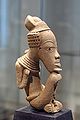
Tichit
Tichit is a partly abandoned village at the foot of the Tagant Plateau in central southern Mauritania that is known for its vernacular architecture...
(Dhar Tichitt) and Oualata
Oualata
Oualata or Walata is a small oasis town in south east Mauritania that was important in the thirteenth and fourteenth centuries as the southern terminus of a trans-Saharan trade route...
were prominent among the early urban centers, dated to 2000 BCE, in present day Mauritania
Mauritania
Mauritania is a country in the Maghreb and West Africa. It is bordered by the Atlantic Ocean in the west, by Western Sahara in the north, by Algeria in the northeast, by Mali in the east and southeast, and by Senegal in the southwest...
. About 500 stone settlements litter the region in the former savannah of the Sahara. Its inhabitants fished and grew millet. It has been found that the Soninke
Soninke
The Soninke are a Mandé people who descend from the Bafour and are closely related to the Imraguen of Mauritania. They speak the Soninke language, a Mande language. They were the founders of the ancient empire of Ghana c. 750-1240 CE...
of the Mandé peoples were responsible for constructing such settlements. Around 300 BCE, the region became more desiccated and the settlements began to decline, most likely relocating to Koumbi Saleh
Koumbi Saleh
Koumbi Saleh, sometimes Kumbi Saleh is the site of a ruined mediaeval town in south east Mauritania that may have been the capital of the Ghana Empire....
. From the type of architecture and pottery, it is believed that Tichit was related to the subsequent Ghana Empire
Ghana Empire
The Ghana Empire or Wagadou Empire was located in what is now southeastern Mauritania, and Western Mali. Complex societies had existed in the region since about 1500 BCE, and around Ghana's core region since about 300 CE...
. Old Jenne
Djenné
Djenné is an Urban Commune and town in the Inland Niger Delta region of central Mali. In the 2009 census the commune had a population of 32,944. Administratively it is part of the Mopti Region....
(Djenne) began to be settled around 300 BCE, producing iron and with sizable population, evidenced in crowded cemeteries. Living structures were made of sun-dried mud. By 250 BCE, Jenne was a large, thriving market town.
Farther south, in central Nigeria
Nigeria
Nigeria , officially the Federal Republic of Nigeria, is a federal constitutional republic comprising 36 states and its Federal Capital Territory, Abuja. The country is located in West Africa and shares land borders with the Republic of Benin in the west, Chad and Cameroon in the east, and Niger in...
, around 1000 BCE, the Nok culture developed on the Jos Plateau
Jos Plateau
The Jos Plateau is a plateau located near the center of Nigeria. It covers 8600 km² and is bounded by 300-600 meter escarpments around much of its circumference. With an average altitude of 1280 metres and its highest point is Shere Hills 1829 meters...
. It was a highly centralized community. The Nok people produced miniature lifelike representations in terracotta, including human heads, elephants, and other animals. By 500 BCE, they were smelting iron. By 200 CE, the Nok culture had vanished. Based on stylistic similarities with Nok terracottas, the bronze figurines of Ife
Ife
Ife is an ancient Yoruba city in south-western Nigeria. Evidence of inhabitation at the site has been discovered to date back to roughly 560 BC...
and Benin
Benin
Benin , officially the Republic of Benin, is a country in West Africa. It borders Togo to the west, Nigeria to the east and Burkina Faso and Niger to the north. Its small southern coastline on the Bight of Benin is where a majority of the population is located...
are believed to be continuation of the tradition.
Bantu expansion
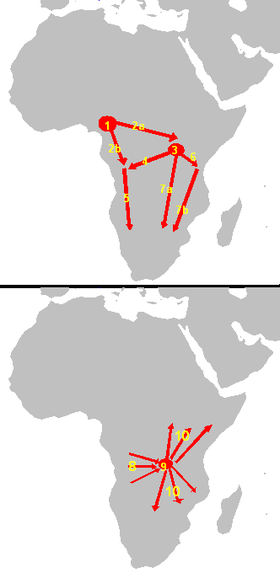
Bantu expansion
The Bantu expansion or the Bantu Migration was a millennia-long series of migrations of speakers of the original proto-Bantu language group...
was a critical movement of people in African history and the settling of the continent. People speaking Bantu languages
Bantu languages
The Bantu languages constitute a traditional sub-branch of the Niger–Congo languages. There are about 250 Bantu languages by the criterion of mutual intelligibility, though the distinction between language and dialect is often unclear, and Ethnologue counts 535 languages...
(a branch of the Niger–Congo family) began in the second millennium BCE to spread from Cameroon
Cameroon
Cameroon, officially the Republic of Cameroon , is a country in west Central Africa. It is bordered by Nigeria to the west; Chad to the northeast; the Central African Republic to the east; and Equatorial Guinea, Gabon, and the Republic of the Congo to the south. Cameroon's coastline lies on the...
eastward to the Great Lakes region
African Great Lakes
The African Great Lakes are a series of lakes and the Rift Valley lakes in and around the geographic Great Rift Valley formed by the action of the tectonic East African Rift on the continent of Africa...
. In the first millennium BCE, Bantu languages spread from the Great Lakes to southern and east Africa. An early expansion was south to the upper Zambezi
Zambezi
The Zambezi is the fourth-longest river in Africa, and the largest flowing into the Indian Ocean from Africa. The area of its basin is , slightly less than half that of the Nile...
valley in the 2nd century BCE. Then, Bantu speakers pushed westward to the savannahs of present-day Angola
Angola
Angola, officially the Republic of Angola , is a country in south-central Africa bordered by Namibia on the south, the Democratic Republic of the Congo on the north, and Zambia on the east; its west coast is on the Atlantic Ocean with Luanda as its capital city...
and eastward into Malawi
Malawi
The Republic of Malawi is a landlocked country in southeast Africa that was formerly known as Nyasaland. It is bordered by Zambia to the northwest, Tanzania to the northeast, and Mozambique on the east, south and west. The country is separated from Tanzania and Mozambique by Lake Malawi. Its size...
, Zambia
Zambia
Zambia , officially the Republic of Zambia, is a landlocked country in Southern Africa. The neighbouring countries are the Democratic Republic of the Congo to the north, Tanzania to the north-east, Malawi to the east, Mozambique, Zimbabwe, Botswana and Namibia to the south, and Angola to the west....
, and Zimbabwe
Zimbabwe
Zimbabwe is a landlocked country located in the southern part of the African continent, between the Zambezi and Limpopo rivers. It is bordered by South Africa to the south, Botswana to the southwest, Zambia and a tip of Namibia to the northwest and Mozambique to the east. Zimbabwe has three...
in the 1st century CE. The second thrust from the Great Lakes was eastward, 2,000 years ago, expanding to the Indian Ocean
Indian Ocean
The Indian Ocean is the third largest of the world's oceanic divisions, covering approximately 20% of the water on the Earth's surface. It is bounded on the north by the Indian Subcontinent and Arabian Peninsula ; on the west by eastern Africa; on the east by Indochina, the Sunda Islands, and...
coast and Tanzania
Tanzania
The United Republic of Tanzania is a country in East Africa bordered by Kenya and Uganda to the north, Rwanda, Burundi, and the Democratic Republic of the Congo to the west, and Zambia, Malawi, and Mozambique to the south. The country's eastern borders lie on the Indian Ocean.Tanzania is a state...
. The eastern group eventually met the southern migrants from the Great Lakes in Malawi, Zambia, and Zimbabwe. Both groups continued southward, with eastern groups continuing to Mozambique
Mozambique
Mozambique, officially the Republic of Mozambique , is a country in southeastern Africa bordered by the Indian Ocean to the east, Tanzania to the north, Malawi and Zambia to the northwest, Zimbabwe to the west and Swaziland and South Africa to the southwest...
and reaching Maputo
Maputo
Maputo, also known as Lourenço Marques, is the capital and largest city of Mozambique. It is known as the City of Acacias in reference to acacia trees commonly found along its avenues and the Pearl of the Indian Ocean. It was famous for the inscription "This is Portugal" on the walkway of its...
in the 2nd century CE, and expanding as far as Durban
Durban
Durban is the largest city in the South African province of KwaZulu-Natal and the third largest city in South Africa. It forms part of the eThekwini metropolitan municipality. Durban is famous for being the busiest port in South Africa. It is also seen as one of the major centres of tourism...
. By the later first millennium CE, the expansion had reached the Great Kei River
Great Kei River
The Great Kei River is a river in South Africa in the Eastern Cape province. Before it becomes the Great Kei, the Swart-Kei River and the Wit-Kei River join forces, northeast of Cathcart. It flows for 520 km and ends at the Indian Ocean with the small town Kei Mouth on the west bank...
of South Africa. Sorghum
Sorghum
Sorghum is a genus of numerous species of grasses, one of which is raised for grain and many of which are used as fodder plants either cultivated or as part of pasture. The plants are cultivated in warmer climates worldwide. Species are native to tropical and subtropical regions of all continents...
, a major Bantu crop, could not thrive under the winter rainfall of Namibia
Namibia
Namibia, officially the Republic of Namibia , is a country in southern Africa whose western border is the Atlantic Ocean. It shares land borders with Angola and Zambia to the north, Botswana to the east and South Africa to the south and east. It gained independence from South Africa on 21 March...
and the western Cape. Khoisan
Khoisan
Khoisan is a unifying name for two ethnic groups of Southern Africa, who share physical and putative linguistic characteristics distinct from the Bantu majority of the region. Culturally, the Khoisan are divided into the foraging San and the pastoral Khoi...
people inhabited the remaining parts of southern Africa.
Maghreb (the West)
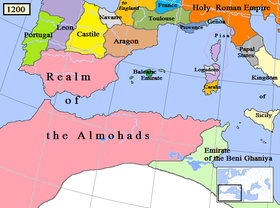
By the 9th century CE, the unity brought about by the Islamic conquest of North Africa
North Africa
North Africa or Northern Africa is the northernmost region of the African continent, linked by the Sahara to Sub-Saharan Africa. Geopolitically, the United Nations definition of Northern Africa includes eight countries or territories; Algeria, Egypt, Libya, Morocco, South Sudan, Sudan, Tunisia, and...
and the expansion of Islamic culture came to an end. Conflict arose as to who should be the successor of the prophet. The Umayyads had initially taken control of the Caliphate
Caliphate
The term caliphate, "dominion of a caliph " , refers to the first system of government established in Islam and represented the political unity of the Muslim Ummah...
, with their capital at Damascus
Damascus
Damascus , commonly known in Syria as Al Sham , and as the City of Jasmine , is the capital and the second largest city of Syria after Aleppo, both are part of the country's 14 governorates. In addition to being one of the oldest continuously inhabited cities in the world, Damascus is a major...
. Later, the Abbasids had taken control, moving the capital to Baghdad
Baghdad
Baghdad is the capital of Iraq, as well as the coterminous Baghdad Governorate. The population of Baghdad in 2011 is approximately 7,216,040...
. The Berber people
Berber people
Berbers are the indigenous peoples of North Africa west of the Nile Valley. They are continuously distributed from the Atlantic to the Siwa oasis, in Egypt, and from the Mediterranean to the Niger River. Historically they spoke the Berber language or varieties of it, which together form a branch...
, being independent in spirit and hostile to outside interference in their affairs and to Arab
Arab
Arab people, also known as Arabs , are a panethnicity primarily living in the Arab world, which is located in Western Asia and North Africa. They are identified as such on one or more of genealogical, linguistic, or cultural grounds, with tribal affiliations, and intra-tribal relationships playing...
exclusivity in orthodox Islam, adopted Shi'ite and Kharijite
Kharijites
Kharijites is a general term embracing various Muslims who, while initially supporting the authority of the final Rashidun Caliph Ali ibn Abi Talib, the son-in-law and cousin of the Islamic prophet Muhammad, then later rejected his leadership...
Islam, both considered unorthodox and hostile to the authority of the Abbasid Caliphate. Numerous Kharijite kingdoms came and fell during the 8th and 9th centuries, asserting their independence from Baghdad. In the early 10th century, Shi'ite groups from Syria, claiming descent from Muhammad's daughter Fatima
Fatimah
Fatimah was a daughter of the Islamic prophet Muhammad from his first wife Khadijah bint Khuwaylid. She is regarded by Muslims as an exemplar for men and women. She remained at her father's side through the difficulties suffered by him at the hands of the Quraysh of Mecca...
, founded the Fatimid Dynasty in the Maghreb
Maghreb
The Maghreb is the region of Northwest Africa, west of Egypt. It includes five countries: Morocco, Algeria, Tunisia, Libya, and Mauritania and the disputed territory of Western Sahara...
. By 950, they had conquered all of the Maghreb and by 969 all of Egypt. They had immediately broken away from Baghdad.
In an attempt to bring about a purer form of Islam among the Sanhaja
Zenaga people
The Sanhaja or Senhaja were once one of the largest Berber tribal confederations of the Maghreb, along with the Zanata and Masmuda...
Berbers, Abdallah ibn Yasin founded the Almoravid movement in present-day Mauritania
Mauritania
Mauritania is a country in the Maghreb and West Africa. It is bordered by the Atlantic Ocean in the west, by Western Sahara in the north, by Algeria in the northeast, by Mali in the east and southeast, and by Senegal in the southwest...
and Western Sahara
Western Sahara
Western Sahara is a disputed territory in North Africa, bordered by Morocco to the north, Algeria to the northeast, Mauritania to the east and south, and the Atlantic Ocean to the west. Its surface area amounts to . It is one of the most sparsely populated territories in the world, mainly...
. The Sanhaja Berbers, like the Soninke, practiced an indigenous religion along side Islam. Abdallah ibn Yasin found ready converts in the Lamtuna
Lamtuna
The Lamtuna were a powerful nomadic Berber tribe belonging to the Senhaja inhabiting the western Sahara.During the eighth century the Lamtuna created a kingdom out of a confederation of Berber tribes, which they dominated until the early tenth century. The Lamtuna probably did not convert to Islam...
Sanhaja, who were dominated by the Soninke in the south and the Zenata
Zenata
Zenata were an ethnic group of North Africa, who were technically an Eastern Berber group and who are found in Tunisia, Algeria and Morocco....
Berbers in the north. By the 1040s, all of the Lamtuna was converted to the Almoravid movement. With the help of Yahya ibn Umar and his brother Abu Bakr ibn Umar
Abu-Bakr Ibn-Umar
Abu Bakr ibn Umar ibn Ibrahim ibn Turgut, sometimes suffixed al-Sanhaji or al-Lamtuni was a chieftan of the Lamtuna Berbers of the western Sahara, and commander of the Almoravids from 1056 until his death....
, the sons of the Lamtuna chief, the Almoravids created an empire extending from the Sahel to the Mediterranean. After the death of Abdallah ibn Yassin and Yahya ibn Umar, Abu Bakr split the empire in half, between himself and Yusuf ibn Tashfin
Yusuf ibn Tashfin
Yusef ibn Tashfin also, Tashafin, or Teshufin; or Yusuf; was a king of the Almoravid empire, he founded the city of Marrakech and led the Muslim forces in the Battle of Zallaqa....
, because it was too big to be ruled by one individual. Abu Bakr took the south to continue fighting the Soninke, and Yusuf ibn Tashfin took the north, expanding it to southern Spain. The death of Abu Bakr in 1087 saw a breakdown of unity and increase military dissension in the south. This caused a re-expansion of the Soninke. The Almoravids were once held responsible for bringing down the Ghana Empire
Ghana Empire
The Ghana Empire or Wagadou Empire was located in what is now southeastern Mauritania, and Western Mali. Complex societies had existed in the region since about 1500 BCE, and around Ghana's core region since about 300 CE...
in 1076, but this view is no longer credited.
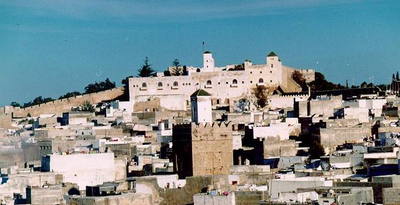
Banu Hilal
The Banu Hilal were a confederation of Arabian Bedouin tribes that migrated from Upper Egypt into North Africa in the 11th century, having been sent by the Fatimids to punish the Zirids for abandoning Shiism. Other authors suggest that the tribes left the grasslands on the upper Nile because of...
. Those going south of the Atlas Mountains
Atlas Mountains
The Atlas Mountains is a mountain range across a northern stretch of Africa extending about through Morocco, Algeria, and Tunisia. The highest peak is Toubkal, with an elevation of in southwestern Morocco. The Atlas ranges separate the Mediterranean and Atlantic coastlines from the Sahara Desert...
were the Banu Sulaym. This movement spread the use of the Arabic language and hastened the decline of the Berber language and the Arabisation of North Africa. Later an Arabised Berber group, the Hawwara, went south to Nubia via Egypt.
In the 1140s, Abd al-Mu'min
Abd al-Mu'min
Abd al-Mu'min also known as Abdelmoumen El Goumi was a Zenata Berber prominent member of the Almohad movement. He became the first Caliph of the Almohad Empire .- Early life :...
declared jihad on the Almoravids
Almoravids
The Almoravids were a Berber dynasty of Morocco, who formed an empire in the 11th-century that stretched over the western Maghreb and Al-Andalus. Their capital was Marrakesh, a city which they founded in 1062 C.E...
, charging them with decadence and corruption. He united the northern Berbers against the Almoravids, overthrowing them and forming the Almohad Empire. During this period, the Maghreb became thoroughly Islamised and saw the spread of literacy, the development of algebra, and the use of the number zero and decimals. By the 13th century, the Almohad states had split into three rival states. Muslim states were largely extinguished in Spain
Spain
Spain , officially the Kingdom of Spain languages]] under the European Charter for Regional or Minority Languages. In each of these, Spain's official name is as follows:;;;;;;), is a country and member state of the European Union located in southwestern Europe on the Iberian Peninsula...
by the Christian kingdoms of Castile
Kingdom of Castile
Kingdom of Castile was one of the medieval kingdoms of the Iberian Peninsula. It emerged as a political autonomous entity in the 9th century. It was called County of Castile and was held in vassalage from the Kingdom of León. Its name comes from the host of castles constructed in the region...
, Aragon
Aragon
Aragon is a modern autonomous community in Spain, coextensive with the medieval Kingdom of Aragon. Located in northeastern Spain, the Aragonese autonomous community comprises three provinces : Huesca, Zaragoza, and Teruel. Its capital is Zaragoza...
, and Portugal
Portugal
Portugal , officially the Portuguese Republic is a country situated in southwestern Europe on the Iberian Peninsula. Portugal is the westernmost country of Europe, and is bordered by the Atlantic Ocean to the West and South and by Spain to the North and East. The Atlantic archipelagos of the...
. Around 1415, Portugal engaged in a reconquista of North Africa by capturing Ceuta
Ceuta
Ceuta is an autonomous city of Spain and an exclave located on the north coast of North Africa surrounded by Morocco. Separated from the Iberian peninsula by the Strait of Gibraltar, Ceuta lies on the border of the Mediterranean Sea and the Atlantic Ocean. Ceuta along with the other Spanish...
, and in later centuries Spain and Portugal acquired other ports on the North African coast. In 1492, Spain defeated Muslims in Granada
Granada
Granada is a city and the capital of the province of Granada, in the autonomous community of Andalusia, Spain. Granada is located at the foot of the Sierra Nevada mountains, at the confluence of three rivers, the Beiro, the Darro and the Genil. It sits at an elevation of 738 metres above sea...
, effectively ending eight centuries of Muslim domination in southern Iberia.
Portugal and Spain took the ports of Tangiers, Algiers
Algiers
' is the capital and largest city of Algeria. According to the 1998 census, the population of the city proper was 1,519,570 and that of the urban agglomeration was 2,135,630. In 2009, the population was about 3,500,000...
, Tripoli
Tripoli
Tripoli is the capital and largest city in Libya. It is also known as Western Tripoli , to distinguish it from Tripoli, Lebanon. It is affectionately called The Mermaid of the Mediterranean , describing its turquoise waters and its whitewashed buildings. Tripoli is a Greek name that means "Three...
, and Tunis
Tunis
Tunis is the capital of both the Tunisian Republic and the Tunis Governorate. It is Tunisia's largest city, with a population of 728,453 as of 2004; the greater metropolitan area holds some 2,412,500 inhabitants....
. This put them in direct competition with the Ottoman Empire
Ottoman Empire
The Ottoman EmpireIt was usually referred to as the "Ottoman Empire", the "Turkish Empire", the "Ottoman Caliphate" or more commonly "Turkey" by its contemporaries...
, which re-took the ports using Turkish corsairs (pirates and privateers). The Turkish corsairs would use the ports for raiding Christian ships, a major source of booty for the towns. Technically, North Africa was under the control of the Ottoman Empire, but only the coastal towns were fully under Istanbul
Istanbul
Istanbul , historically known as Byzantium and Constantinople , is the largest city of Turkey. Istanbul metropolitan province had 13.26 million people living in it as of December, 2010, which is 18% of Turkey's population and the 3rd largest metropolitan area in Europe after London and...
's control. Tripoli benefited from trade with Borno
Borno State
Borno State is a state in north-eastern Nigeria. Its capital is Maiduguri. The state was formed in 1976 from the split of the North-Eastern State...
. The pashas of Tripoli traded horses, firearms, and armor via Fez with the sultans of the Bornu Empire
Bornu Empire
The Bornu Empire was an African state of Nigeria from 1396 to 1893. It was a continuation of the great Kanem Empire founded centuries earlier by the Sayfawa Dynasty...
for slaves.
In the 16th century, an Arab nomad tribe that claimed descent from Muhammad's daughter, the Saadis
Saadi Dynasty
The Saadi dynasty of Morocco , began with the reign of Sultan Mohammed ash-Sheikh in 1554, when he vanquished the last Wattasids at the Battle of Tadla....
, conquered and united Morocco
Morocco
Morocco , officially the Kingdom of Morocco , is a country located in North Africa. It has a population of more than 32 million and an area of 710,850 km², and also primarily administers the disputed region of the Western Sahara...
. They prevented the Ottoman Empire from reaching to the Atlantic and expelled Portugal from Morocco's western coast. Ahmad al-Mansur brought the state to the height of its power. He invaded Songhay
Songhai Empire
The Songhai Empire, also known as the Songhay Empire, was a state located in western Africa. From the early 15th to the late 16th century, Songhai was one of the largest Islamic empires in history. This empire bore the same name as its leading ethnic group, the Songhai. Its capital was the city...
in 1591, to control the gold trade, which had been diverted to the western coast of Africa for European ships and to the east, to Tunis. Morocco's hold on Songhay diminished in the 17th century. In 1603, after Ahmad's death, the kingdom split into the two sultanates of Fes
Fes
Fes or Fez is the second largest city of Morocco, after Casablanca, with a population of approximately 1 million . It is the capital of the Fès-Boulemane region....
and Marrakesh. Later it was reunited by Moulay al-Rashid
Al-Rashid of Morocco
Moulay al-Rashid was Sultan of Morocco from 1666 to 1672. He has been called the founder of the Alaouite Dynasty.It was his father Moulay Ali Cherif who took power in Tafilalt around 1630. In 1635 al-Rashid's brother Moulay Mohammed ould Moulay Cherif succeeded their still living father...
, founder of the Alaouite Dynasty
Alaouite Dynasty
The Alaouite Dynasty is the name of the current Moroccan royal family. The name Alaouite comes from the ‘Alī of its founder Moulay Ali Cherif who became Prince of Tafilalt in 1631. His son Mulay r-Rshid was able to unite and pacify the country...
(1672–1727). His brother and successor, Ismail ibn Sharif
Ismail Ibn Sharif
Moulay Ismaïl Ibn Sharif was the second ruler of the Moroccan Alaouite dynasty. Like others of the dynasty, Ismaïl claimed to be a descendant of Muhammad through his roots to Hassan ibn Ali...
(1672–1727), strengthen the unity of the country by importing slaves from the Sudan to build up the military.
Egypt
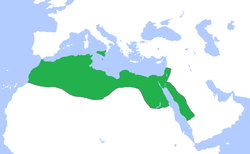
Byzantine Empire
The Byzantine Empire was the Eastern Roman Empire during the periods of Late Antiquity and the Middle Ages, centred on the capital of Constantinople. Known simply as the Roman Empire or Romania to its inhabitants and neighbours, the Empire was the direct continuation of the Ancient Roman State...
Egypt.
Egypt under the Fatimid Caliphate was prosperous. Dams and canals were repaired, and wheat, barley, flax, and cotton production increased. Egypt became a major producer of linen and cotton cloth. Its Mediterranean and Red Sea trade increased. Egypt also minted a gold currency called the Fatimid dinar, which was used for international trade. The bulk of revenues came from taxing the fellah
Fellah
Fellah , also alternatively known as Fallah is a peasant, farmer or agricultural laborer in the Middle East and North Africa...
in (peasant farmers), and taxes were high. Tax collecting was leased to Berber
Berber people
Berbers are the indigenous peoples of North Africa west of the Nile Valley. They are continuously distributed from the Atlantic to the Siwa oasis, in Egypt, and from the Mediterranean to the Niger River. Historically they spoke the Berber language or varieties of it, which together form a branch...
overlords, who were soldiers who had taken part in the Fatimid conquest in 969 CE. The overlords paid a share to the caliphs and retained what was left. Eventually, they became landlords and constituted a settled land aristocracy.
To fill the military ranks, Mamluk
Mamluk
A Mamluk was a soldier of slave origin, who were predominantly Cumans/Kipchaks The "mamluk phenomenon", as David Ayalon dubbed the creation of the specific warrior...
Turkish slave cavalry and Sudanese slave infantry were used. Berber freemen were also recruited. In 1150s, tax revenues from farms diminished. The soldiers revolted and wreaked havoc in the countryside, slowed trade, and diminished the power and authority of the Fatimid caliphs.
During the 1160s, Fatimid Egypt came under threat from European crusaders
Crusades
The Crusades were a series of religious wars, blessed by the Pope and the Catholic Church with the main goal of restoring Christian access to the holy places in and near Jerusalem...
. Out of this threat, a Kurdish
Kurdish people
The Kurdish people, or Kurds , are an Iranian people native to the Middle East, mostly inhabiting a region known as Kurdistan, which includes adjacent parts of Iran, Iraq, Syria, and Turkey...
general named Ṣalāḥ ad-Dīn Yūsuf ibn Ayyūb
Saladin
Ṣalāḥ ad-Dīn Yūsuf ibn Ayyūb , better known in the Western world as Saladin, was an Arabized Kurdish Muslim, who became the first Sultan of Egypt and Syria, and founded the Ayyubid dynasty. He led Muslim and Arab opposition to the Franks and other European Crusaders in the Levant...
(Saladin), with a small band of professional soldiers, emerged as an outstanding Muslim defender. Saladin defeated the Christian crusaders at Egypt's borders and recaptured Jerusalem in 1187. On the death of the Fatimid caliph in 1171, Saladin became the ruler of Egypt, ushering in the Ayyubid Dynasty
Ayyubid dynasty
The Ayyubid dynasty was a Muslim dynasty of Kurdish origin, founded by Saladin and centered in Egypt. The dynasty ruled much of the Middle East during the 12th and 13th centuries CE. The Ayyubid family, under the brothers Ayyub and Shirkuh, originally served as soldiers for the Zengids until they...
. Under his rule, Egypt returned to Sunni Islam, Cairo
Cairo
Cairo , is the capital of Egypt and the largest city in the Arab world and Africa, and the 16th largest metropolitan area in the world. Nicknamed "The City of a Thousand Minarets" for its preponderance of Islamic architecture, Cairo has long been a centre of the region's political and cultural life...
became an important center of Arab Islamic learning, and Mamluk slaves were increasingly recruited from Turkey
Turkey
Turkey , known officially as the Republic of Turkey , is a Eurasian country located in Western Asia and in East Thrace in Southeastern Europe...
and southern Russia
Russia
Russia or , officially known as both Russia and the Russian Federation , is a country in northern Eurasia. It is a federal semi-presidential republic, comprising 83 federal subjects...
for military service. Support for the military was tied to the iqta, a form of land taxation in which soldiers were given ownership in return for military service.
Over time, Mamluk slave soldiers became a very powerful landed aristocracy, to the point of getting rid of the Ayyubid dynasty in 1250 and establishing a Mamluk dynasty. The more powerful Mamluks were referred to as amirs. For 250 years, Mamluks controlled all of Egypt under a military dictatorship. Egypt extended her territories to Syria and Palestine, thwarted the crusaders, and halted a Mongol
Mongol Empire
The Mongol Empire , initially named as Greater Mongol State was a great empire during the 13th and 14th centuries...
invasion in 1260 at the Battle of Ain Jalut
Battle of Ain Jalut
The Battle of Ain Jalut took place on 3 September 1260 between Mamluks and the Mongols in eastern Galilee, in the Jezreel Valley, not far from Ein Harod....
. Mamluk Egypt came to be viewed as a protector of Islam, and of Medina
Medina
Medina , or ; also transliterated as Madinah, or madinat al-nabi "the city of the prophet") is a city in the Hejaz region of western Saudi Arabia, and serves as the capital of the Al Madinah Province. It is the second holiest city in Islam, and the burial place of the Islamic Prophet Muhammad, and...
and Mecca
Mecca
Mecca is a city in the Hijaz and the capital of Makkah province in Saudi Arabia. The city is located inland from Jeddah in a narrow valley at a height of above sea level...
. Eventually the iqta system declined and proved unreliable for providing an adequate military. The Mamluks started viewing their iqta as hereditary and became attuned to urban living. Farm production declined, and dams and canals lapsed into disrepair. Mamluk military skill and technology did not keep pace with new technology of handguns and cannons.
With the rise of the Ottoman Empire
Ottoman Empire
The Ottoman EmpireIt was usually referred to as the "Ottoman Empire", the "Turkish Empire", the "Ottoman Caliphate" or more commonly "Turkey" by its contemporaries...
, Egypt was easily defeated. In 1517, Egypt became part of the Ottoman Empire. Istanbul revived the iqta system. Trade was reestablished in the Red Sea, but it could not completely connect with Indian Ocean trade because of growing Portuguese presence. During the 17th and 18th centuries, hereditary Mamluks regained power. The leading Mamluks were referred to as bey
Bey
Bey is a title for chieftain, traditionally applied to the leaders of small tribal groups. Accoding to some sources, the word "Bey" is of Turkish language In historical accounts, many Turkish, other Turkic and Persian leaders are titled Bey, Beg, Bek, Bay, Baig or Beigh. They are all the same word...
s. Pasha
Pasha
Pasha or pascha, formerly bashaw, was a high rank in the Ottoman Empire political system, typically granted to governors, generals and dignitaries. As an honorary title, Pasha, in one of its various ranks, is equivalent to the British title of Lord, and was also one of the highest titles in...
s, or viceroys, represented the Istanbul government in name only, operating independently. During the 18th century, dynasties of pashas became established. The government was weak and corrupt.
In 1798, Napoleon invaded Egypt. The local forces had little ability to resist the French conquest. However, Britain and the Ottoman Empire were able to remove French occupation in 1801. These events marked the beginning of 19th-century Anglo-Franco rivalry over Egypt.
Somalia
Arabian Peninsula
The Arabian Peninsula is a land mass situated north-east of Africa. Also known as Arabia or the Arabian subcontinent, it is the world's largest peninsula and covers 3,237,500 km2...
gradually came under the influence of the new religion through their converted Arab
Arab
Arab people, also known as Arabs , are a panethnicity primarily living in the Arab world, which is located in Western Asia and North Africa. They are identified as such on one or more of genealogical, linguistic, or cultural grounds, with tribal affiliations, and intra-tribal relationships playing...
Muslim trading partners. With the migration of Muslim families from the Islamic world to Somalia in the early centuries of Islam, and the peaceful conversion of the Somali population by Somali Muslim scholars
Islam in Somalia
Nearly all Somalis are Sunni Muslims. Practicing Islam reinforces distinctions that further set Somalis apart from their immediate African neighbors, many of whom are either Christians or adherents of indigenous faiths....
in the following centuries, the ancient city-states eventually transformed into Islamic Mogadishu
Mogadishu
Mogadishu , popularly known as Xamar, is the largest city in Somalia and the nation's capital. Located in the coastal Benadir region on the Indian Ocean, the city has served as an important port for centuries....
, Berbera
Berbera
Berbera is a city and seat of Berbera District in Somaliland, a self-proclaimed Independent Republic with de facto control over its own territory, which is recognized by the international community and the Somali Government as a part of Somalia...
, Zeila
Zeila
Zeila, also known as Zaila , is a port city on the Gulf of Aden coast, situated in the northwestern Awdal region of Somalia.Located near the Djibouti border, the town sits on a sandy spit surrounded by the sea. It is known for its offshore islands, coral reef and mangroves. Landward, the terrain is...
, Barawa
Barawa
Barawa or Brava is a port town on the south-eastern coast of Somalia. The traditional inhabitants are the Tunni Somalis and the Bravanese people, who speak Bravanese, a Swahili dialect.-History:...
and Merka, which were part of the Berber (the medieval Arab term for the ancestors of the modern Somalis) civilization. The city of Mogadishu came to be known as the City of Islam and controlled the East African gold trade for several centuries.
During this period, the sultanates and republics of Merca
Merca
Merca is a port city on the coast of southern Somalia, facing the Indian Ocean. It is the main town in the Shabeellaha Hoose region, and is located approximately southwest of the nation's capital, Mogadishu.-History:...
, Mogadishu
Mogadishu
Mogadishu , popularly known as Xamar, is the largest city in Somalia and the nation's capital. Located in the coastal Benadir region on the Indian Ocean, the city has served as an important port for centuries....
, Barawa
Barawa
Barawa or Brava is a port town on the south-eastern coast of Somalia. The traditional inhabitants are the Tunni Somalis and the Bravanese people, who speak Bravanese, a Swahili dialect.-History:...
, Hobyo
Hobyo
Hobyo is an ancient harbor city in the Mudug region of Somalia. Hobyo literally means "here, water", and the plentiful fresh water to be had from the wells in and around the town has been the driving force behind Hobyo's ancient status as a favorite port-of-call for sailors.-Establishment:Hobyo's...
and their respective ports flourished and had a lucrative foreign commerce with ships sailing to and coming from Arabia, India, Venice
Venice
Venice is a city in northern Italy which is renowned for the beauty of its setting, its architecture and its artworks. It is the capital of the Veneto region...
, Persia, Egypt, Portugal and as far away as China. Vasco da Gama
Vasco da Gama
Vasco da Gama, 1st Count of Vidigueira was a Portuguese explorer, one of the most successful in the Age of Discovery and the commander of the first ships to sail directly from Europe to India...
, who passed by Mogadishu in the 15th century, noted that it was a large city with houses four or five stories high and big palaces in its centre, in addition to many mosques with cylindrical minarets.
In the 16th century, Duarte Barbosa
Duarte Barbosa
Duarte Barbosa was a Portuguese writer and Portuguese India officer between 1500 and 1516–17, with the post of scrivener in Cannanore factory and sometimes interpreter of the local language...
noted that many ships from the Kingdom of Cambaya
Khambhat
Khambhat , formerly known as Cambay, is a city and a municipality in Anand district in the Indian state of Gujarat. It was formerly an important trading center, although its harbour has gradually silted up, and the maritime trade has moved elsewhere...
in modern-day India sailed to Mogadishu with cloth
Textile
A textile or cloth is a flexible woven material consisting of a network of natural or artificial fibres often referred to as thread or yarn. Yarn is produced by spinning raw fibres of wool, flax, cotton, or other material to produce long strands...
and spices, for which they in return received gold, wax, and ivory. Barbosa also highlighted the abundance of meat, wheat, barley, horses, and fruit in the coastal markets, which generated enormous wealth for the merchants. Mogadishu, the center of a thriving weaving industry known as toob benadir (specialized for the markets in Egypt and Syria), together with Merca and Barawa, served as a transit stop for Swahili
Swahili people
The Swahili people are a Bantu ethnic group and culture found in East Africa, mainly in the coastal regions and the islands of Kenya, Tanzania and north Mozambique. According to JoshuaProject, the Swahili number in at around 1,328,000. The name Swahili is derived from the Arabic word Sawahil,...
merchants from Mombasa
Mombasa
Mombasa is the second-largest city in Kenya. Lying next to the Indian Ocean, it has a major port and an international airport. The city also serves as the centre of the coastal tourism industry....
and Malindi
Malindi
Malindi is a town on Malindi Bay at the mouth of the Galana River, lying on the Indian Ocean coast of Kenya. It is 120 kilometres northeast of Mombasa. The population of Malindi is 117,735 . It is the capital of the Malindi District.Tourism is the major industry in Malindi. The city is...
and for the gold trade from Kilwa
Kilwa Sultanate
The Kilwa Sultanate was a Medieval sultanate, centered at Kilwa , whose authority, at its height, stretched over the entire length of the Swahili Coast. It was founded in the 10th century by Ali ibn al-Hassan Shirazi...
. Jewish merchants from the Strait of Hormuz
Strait of Hormuz
The Strait of Hormuz is a narrow, strategically important waterway between the Gulf of Oman in the southeast and the Persian Gulf. On the north coast is Iran and on the south coast is the United Arab Emirates and Musandam, an exclave of Oman....
brought their Indian textiles and fruit to the Somali coast to exchange for grain and wood.
Trading relations were established with Malacca
Malacca
Malacca , dubbed The Historic State or Negeri Bersejarah among locals) is the third smallest Malaysian state, after Perlis and Penang. It is located in the southern region of the Malay Peninsula, on the Straits of Malacca. It borders Negeri Sembilan to the north and the state of Johor to the south...
in the 15th century, with cloth, ambergris
Ambergris
Ambergris is a solid, waxy, flammable substance of a dull gray or blackish color produced in the digestive system of and regurgitated or secreted by sperm whales....
, and porcelain
Porcelain
Porcelain is a ceramic material made by heating raw materials, generally including clay in the form of kaolin, in a kiln to temperatures between and...
being the main commodities of the trade. Giraffes, zebras, and incense were exported to the Ming Empire of China, which established Somali merchants as leaders in the commerce between the Asia and Africa and influenced the Chinese language with borrowings from the Somali language in the process. Hindu
Hindu
Hindu refers to an identity associated with the philosophical, religious and cultural systems that are indigenous to the Indian subcontinent. As used in the Constitution of India, the word "Hindu" is also attributed to all persons professing any Indian religion...
merchants from Surat
Surat
Surat , also known as Suryapur, is the commercial capital city of the Indian state of Gujarat. Surat is India's Eighth most populous city and Ninth-most populous urban agglomeration. It is also administrative capital of Surat district and one of the fastest growing cities in India. The city proper...
and southeast African merchants from Pate
Pate Island
Pate island or Paté island is located in the Indian Ocean close to the northern coast of Kenya, to which it belongs. It is the largest island in the Lamu Archipelago, which lie between the towns of Lamu and Kiunga, close to the border with Somalia....
, seeking to bypass both the Portuguese blockade and Omani
Omani
Omani may refer to:* Something of, from, or related to Oman, an Arab coujntry in southwestern Asia** A person from Oman or of Omani descent, collectively referred to as Omanis; see Demographics of Oman and Culture of Oman...
meddling, used the Somali ports of Merca and Barawa (which were out of the two powers' jurisdiction) to conduct their trade in safety and without interference.
Ethiopia
The Zagwe dynastyZagwe dynasty
The Zagwe dynasty was an historical kingdom in present-day Ethiopia. It ruled large parts of the territory from approximately 1137 to 1270, when the last Zagwe King Za-Ilmaknun was killed in battle by the forces of Yekuno Amlak...
ruled many parts of modern Ethiopia and Eritrea from approximately 1137 to 1270. The name of the dynasty comes from the Cushitic speaking
Cushitic languages
The Cushitic languages are a branch of the Afroasiatic language family spoken in the Horn of Africa, Tanzania, Kenya, Sudan and Egypt. They are named after the Biblical character Cush, who was identified as an ancestor of the speakers of these specific languages as early as AD 947...
Agaw
Agaw
The Agaw are an ethnic group in Ethiopia and neighboring Eritrea.-History:The Agaw are perhaps first mentioned in the 3rd c. AD Aksumite inscription recorded by Cosmas Indicopleustes in the 6th century...
people of northern Ethiopia. From 1270 CE on for many centuries, Solomonic dynasty
Solomonic dynasty
The Solomonic dynasty is the Imperial House of Abyssinia. Its members claim lineal descent from King Solomon and the Queen of Sheba, the latter of whom tradition asserts gave birth to the first King Menelik I after her Biblically described visit to Solomon in Jerusalem .-Overview:The dynasty, a...
ruled the Ethiopian Empire
Ethiopian Empire
The Ethiopian Empire also known as Abyssinia, covered a geographical area that the present-day northern half of Ethiopia and Eritrea covers, and included in its peripheries Zeila, Djibouti, Yemen and Western Saudi Arabia...
.

Henry IV of England
Henry IV was King of England and Lord of Ireland . He was the ninth King of England of the House of Plantagenet and also asserted his grandfather's claim to the title King of France. He was born at Bolingbroke Castle in Lincolnshire, hence his other name, Henry Bolingbroke...
to the Emperor of Abyssinia survives. In 1428, the Emperor Yeshaq
Yeshaq I of Ethiopia
Yeshaq I or Isaac was of Ethiopia. A member of the Solomonic dynasty, he was the second son of Dawit I.-History:Yeshaq's reign was marked by a revolt of the Beta Israel...
sent two emissaries to Alfonso V of Aragon
Alfonso V of Aragon
Alfonso the Magnanimous KG was the King of Aragon , Valencia , Majorca, Sardinia and Corsica , and Sicily and Count of Barcelona from 1416 and King of Naples from 1442 until his death...
, who sent return emissaries who failed to complete the return trip.
The first continuous relations with a European country began in 1508 with Portugal under Emperor Lebna Dengel
Dawit II of Ethiopia
Dawit II , enthroned as Emperor Anbasa Segad , better known by his birth name Lebna Dengel was of Ethiopia, and a member of the Solomonic dynasty...
, who had just inherited the throne from his father. This proved to be an important development, for when the empire was subjected to the attacks of the Adal
Adal Sultanate
The Adal Sultanate or the Kingdom of Adal was a medieval multi-ethnic Muslim state located in the Horn of Africa.-Overview:...
general and imam
Imam (Sunni Islam)
In Sunni Islam, an imam khatib is a leader, often the worship leader of a mosque and the Muslim community. This compound title is merely a common combination of two elementary offices: leader of the congregational prayer, which in larger mosques is performed at the times of all daily prayers; and...
, Ahmad ibn Ibrihim al-Ghazi
Ahmad ibn Ibrihim al-Ghazi
Ahmad ibn Ibrahim al-Ghazi "the Conqueror" was an Imam and General of Adal who invaded Ethiopia and defeated several Ethiopian emperors, wreaking much damage on that kingdom...
(called "Grañ", or "the Left-handed"), Portugal assisted the Ethiopian emperor by sending weapons and four hundred men, who helped his son Gelawdewos
Gelawdewos of Ethiopia
Gelawdewos was Emperor Gelawdewos (Ge'ez ገላውዴዎስ galāwdēwōs, modern gelāwdēwōs, "Claudius"; 1521/1522 - March 23, 1559) was Emperor Gelawdewos (Ge'ez ገላውዴዎስ galāwdēwōs, modern gelāwdēwōs, "Claudius"; 1521/1522 - March 23, 1559) was Emperor (throne name Asnaf Sagad I (Ge'ez አጽናፍ ሰገድ aṣnāf sagad,...
defeat Ahmad and re-establish his rule. This Ethiopian–Adal War was also one of the first proxy wars in the region as the Ottoman Empire
Ottoman Empire
The Ottoman EmpireIt was usually referred to as the "Ottoman Empire", the "Turkish Empire", the "Ottoman Caliphate" or more commonly "Turkey" by its contemporaries...
, and Portugal took sides in the conflict.
When Emperor Susenyos
Susenyos of Ethiopia
Susenyos was of Ethiopia...
converted to Roman Catholicism
Roman Catholic Church
The Catholic Church, also known as the Roman Catholic Church, is the world's largest Christian church, with over a billion members. Led by the Pope, it defines its mission as spreading the gospel of Jesus Christ, administering the sacraments and exercising charity...
in 1624, years of revolt and civil unrest followed resulting in thousands of deaths. The Jesuit
Society of Jesus
The Society of Jesus is a Catholic male religious order that follows the teachings of the Catholic Church. The members are called Jesuits, and are also known colloquially as "God's Army" and as "The Company," these being references to founder Ignatius of Loyola's military background and a...
missionaries had offended the Orthodox faith of the local Ethiopians, and on June 25, 1632, Susenyos's son, Emperor Fasilides
Fasilides of Ethiopia
Fasilides was of Ethiopia, and a member of the Solomonic dynasty...
, declared the state religion to again be Ethiopian Orthodox Christianity
Ethiopian Orthodox Tewahedo Church
The Ethiopian Orthodox Tewahedo Church is the predominant Oriental Orthodox Christian church in Ethiopia. The Ethiopian Church was administratively part of the Coptic Orthodox Church until 1959, when it was granted its own Patriarch by Coptic Orthodox Pope of Alexandria and Patriarch of All...
and expelled the Jesuit missionaries and other Europeans.
Christian and Islamic Nubia
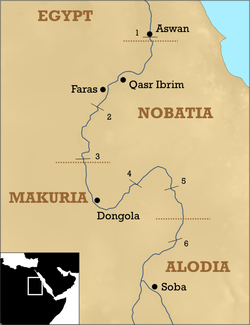
Ezana of Axum
Ezana of Axum , was ruler of the Axumite Kingdom located in present-day Ethiopia, Eritrea, Yemen, he himself employed the style "king of Saba and Salhen, Himyar and Dhu-Raydan"...
sacked Meroe
Meroë
Meroë Meroitic: Medewi or Bedewi; Arabic: and Meruwi) is an ancient city on the east bank of the Nile about 6 km north-east of the Kabushiya station near Shendi, Sudan, approximately 200 km north-east of Khartoum. Near the site are a group of villages called Bagrawiyah...
, people associated with the site of Ballana
Ballana
Ballana was a cemetery in Lower Nubia. It was excavated by Walter Bryan Emery between 1928 and 1931 as a rescue project before the construction of a high dam at Aswan. A total of 122 tombs were found under huge artificial mounds. They date to the time after the collapse of the Meroitic state but...
moved into Nubia
Nubia
Nubia is a region along the Nile river, which is located in northern Sudan and southern Egypt.There were a number of small Nubian kingdoms throughout the Middle Ages, the last of which collapsed in 1504, when Nubia became divided between Egypt and the Sennar sultanate resulting in the Arabization...
from the southwest and founded three kingdoms: Makuria, Nobatia
Nobatia
Nobatia or Nobadia was an ancient African Christian kingdom in Lower Nubia and subsequently a region of the larger Nubian Kingdom of Makuria...
, and Alodia
Alodia
Alodia or Alwa was the southernmost of the three kingdoms of Christian Nubia; the other two were Nobatia and Makuria to the north.Much about this kingdom is still unknown, despite its thousand year existence and considerable power and geographic size. Due to fewer excavations far less is known...
. They would rule for 200 years. Makuria was above the third cataract
Cataracts of the Nile
The cataracts of the Nile are shallow lengths of the Nile between Aswan and Khartoum where the surface of the water is broken by many small boulders and stones protruding out of the river bed, as well as many rocky islets. Aswan is also the Southern boundary of Upper Egypt...
, along the Dongola Reach with its capital at Dongola
Dongola
Dongola , also spelled Dunqulah, and formerly known as Al 'Urdi, is the capital of the state of Northern in Sudan, on the banks of the Nile. It should not be confused with Old Dongola, an ancient city located 80 km upstream on the opposite bank....
. Nobadia was to the north with its capital at Faras
Faras
Faras was a major city in Lower Nubia in modern Egypt. The site of the city was flooded by Lake Nasser in the 1960s, and is now permanently underwater...
, and Alodia
Alodia
Alodia or Alwa was the southernmost of the three kingdoms of Christian Nubia; the other two were Nobatia and Makuria to the north.Much about this kingdom is still unknown, despite its thousand year existence and considerable power and geographic size. Due to fewer excavations far less is known...
was to the south with its capital at Soba
Soba (city)
Soba is the name of the capital of Alodia. E. A. Wallis Budge identified it with a group of ruins on the Blue Nile 12 miles from Khartoum, where there are remains of a Meroitic temple that had been converted into a Christian church. This would place Soba in the modern-day Sudanese state of Al Jazirah...
. Makuria eventually absorbed Nobadia. The people of the region converted to Monophysite Christianity
Monophysitism
Monophysitism , or Monophysiticism, is the Christological position that Jesus Christ has only one nature, his humanity being absorbed by his Deity...
around 500 to 600 CE. The church initially started writing in Coptic
Coptic language
Coptic or Coptic Egyptian is the current stage of the Egyptian language, a northern Afro-Asiatic language spoken in Egypt until at least the 17th century. Egyptian began to be written using the Greek alphabet in the 1st century...
, then in Greek, and finally in Old Nubian, a Nilo-Saharan language. The church was aligned with the Egyptian Coptic Church.
By 641, Egypt was conquered by Muslim Arabs. This effectively blocked Christian Nubia and Aksum from Mediterranean Christendom. In 651-652, Arabs from Egypt invaded Christian Nubia. Nubian archers soundly defeated the invaders. The Baqt (or Bakt) Treaty
Bakt
The Baqt was a treaty between the Christian state of Makuria and the Muslim rulers of Egypt. Lasting almost seven hundred years it is by some measures the longest lasting treaty in history...
was drawn, recognizing Christian Nubia and regulating trade. The treaty controlled relations between Christian Nubia and Islamic Egypt for almost six hundred years.
By the 13th century, Christian Nubia began its decline. The authority of the monarchy was diminished by the church and nobility. Arab bedouin
Bedouin
The Bedouin are a part of a predominantly desert-dwelling Arab ethnic group traditionally divided into tribes or clans, known in Arabic as ..-Etymology:...
tribes began to infiltrate Nubia, causing further havoc. Fakir
Fakir
The fakir or faqir ; ) Derived from faqr is a Muslim Sufi ascetic in Middle East and South Asia. The Faqirs were wandering Dervishes teaching Islam and living on alms....
s (holy men) practicing Sufism
Sufism
Sufism or ' is defined by its adherents as the inner, mystical dimension of Islam. A practitioner of this tradition is generally known as a '...
introduced Islam into Nubia. By 1366, Nubia had become divided into petty fiefdoms when she was invaded by Mamelukes. During the 15th century, Nubia was open to Arab immigration. Arab nomads intermingled with the population and introduced the Arabic culture and language. By the 16th century, Makuria
Makuria
The Kingdom of Makuria was a kingdom located in what is today Northern Sudan and Southern Egypt. It was one of a group of Nubian kingdoms that emerged during the decline of the Aksumite Empire, which it had been part of from approximately 4BC to AD 950...
and Nobadia had been Islamized. During the 16th century, Abdallah Jamma headed an Arab confederation that destroyed Soba, capital of Alodia, the last holdout of Christian Nubian. Later Alodia would fall under the Funj Sultanate.
During the 15th century, Funj
Funj people
The Funj are an ethnic group in present day Sudan. Their origins are not clearly known, but they are recorded as moving into Nubia from the Sudd to the south in the early 16th century, fleeing the pressure of the Shilluk...
herders migrated north to Alodia
Alodia
Alodia or Alwa was the southernmost of the three kingdoms of Christian Nubia; the other two were Nobatia and Makuria to the north.Much about this kingdom is still unknown, despite its thousand year existence and considerable power and geographic size. Due to fewer excavations far less is known...
and occupied it. Between 1504 and 1505, the kingdom expanded, reaching its peak and establishing its capital at Sennar
Sennar
Sennar is a town on the Blue Nile in Sudan and capital of the state of Sennar. For several centuries it was the capital of the Funj Kingdom of Sennar. It had an estimated population of 100,000 inhabitants in the early 19th century. The modern town lies 17km SSE of the ruins of the ancient capital...
under Badi II Abu Daqn
Badi II
Badi II, known as The Bearded , was a ruler of the Kingdom of Sennar. During his reign, the Kingdom of Taqali to the west was defeated and made a vassal state.- References :...
(c. 1644–1680). By end of the 16th century, the Funj had converted to Islam. They pushed their empire westward to Kordofan
Kurdufan
Kurdufan , also spelled Kordofan, is a former province of central Sudan. In 1994 it was divided into three new federal states: North Kurdufan, South Kurdufan, and West Kurdufan...
. They expanded eastward, but were halted by Ethiopia. They controlled Nubia down to the 3rd Cataract. The economy depended on captured enemies to fill the army and on merchants travelling through Sennar. Under Badi IV
Badi IV
Badi IV , also known as Badi abu Shilluk, was a ruler of the Kingdom of Sennar.When Emperor Iyasu II of Ethiopia invaded his realm in 1738, the army of Sennar under the leadership of Hamis, a prince of Darfur, inflicted a significant defeat of the invaders at the Battle of the Dindar River.He was...
(1724–1762), the army turned on the king, making him nothing but a figurehead. In 1821, the Funj were conquered by Muhammad Ali
Muhammad Ali of Egypt
Muhammad Ali Pasha al-Mas'ud ibn Agha was a commander in the Ottoman army, who became Wāli, and self-declared Khedive of Egypt and Sudan...
(1805–1849), Pasha of Egypt.
Swahili Coast
Historically, the Swahili peopleSwahili people
The Swahili people are a Bantu ethnic group and culture found in East Africa, mainly in the coastal regions and the islands of Kenya, Tanzania and north Mozambique. According to JoshuaProject, the Swahili number in at around 1,328,000. The name Swahili is derived from the Arabic word Sawahil,...
could be found as far north as northern Kenya
Kenya
Kenya , officially known as the Republic of Kenya, is a country in East Africa that lies on the equator, with the Indian Ocean to its south-east...
and as far south as the Ruvuma River
Ruvuma River
Ruvuma River, formerly also known as the Rovuma River, is a river in East Africa, forming during the greater part of its course the border between Tanzania and Mozambique . It is long, with a drainage basin in size...
in Mozambique
Mozambique
Mozambique, officially the Republic of Mozambique , is a country in southeastern Africa bordered by the Indian Ocean to the east, Tanzania to the north, Malawi and Zambia to the northwest, Zimbabwe to the west and Swaziland and South Africa to the southwest...
. Arab geographers referred to the Swahili coast as the land of the zanj
Zanj
Zanj was a name used by medieval Arab geographers to refer to both a certain portion of the coast of East Africa and its inhabitants, Bantu-speaking peoples called the Zanj...
(blacks).
Although once believed to be the descendants of Persian colonists, the ancient Swahili are now recognized by most historians, historical linguists, and archaeologists as a Bantu people who had sustained and important interactions with Muslim merchants, beginning in the late 7th and early 8th centuries CE.
Medieval Swahili kingdoms are known to have had island trade ports, described by Greek historians as "metropolises", and to have established regular trade routes with the Islamic world and Asia. Ports such as Mombasa
Mombasa
Mombasa is the second-largest city in Kenya. Lying next to the Indian Ocean, it has a major port and an international airport. The city also serves as the centre of the coastal tourism industry....
, Zanzibar
Zanzibar
Zanzibar ,Persian: زنگبار, from suffix bār: "coast" and Zangi: "bruin" ; is a semi-autonomous part of Tanzania, in East Africa. It comprises the Zanzibar Archipelago in the Indian Ocean, off the coast of the mainland, and consists of numerous small islands and two large ones: Unguja , and Pemba...
, and Kilwa
Kilwa Kisiwani
Kilwa Kisiwani is a community on an island off the coast of East Africa, in present day Tanzania.- History :A document written around AD 1200 called al-Maqama al Kilwiyya discovered in Oman, gives details of a mission to reconvert Kilwa to Ibadism, as it had recently been effected by the Ghurabiyya...
were known to Chinese sailors under Zheng He
Zheng He
Zheng He , also known as Ma Sanbao and Hajji Mahmud Shamsuddin was a Hui-Chinese mariner, explorer, diplomat and fleet admiral, who commanded voyages to Southeast Asia, South Asia, the Middle East, and East Africa, collectively referred to as the Voyages of Zheng He or Voyages of Cheng Ho from...
and medieval Islamic geographers such as the Berber traveller Abu Abdullah ibn Battuta
Ibn Battuta
Abu Abdullah Muhammad Ibn Battuta , or simply Ibn Battuta, also known as Shams ad–Din , was a Muslim Moroccan Berber explorer, known for his extensive travels published in the Rihla...
. The main Swahili exports were ivory, slaves, and gold. They traded with Arabia, India, Persia, and China.
The Portuguese arrived in 1498. On a mission to economically control and Christianize the Swahili coast, the Portuguese attacked Kilwa first in 1505 and other cities later. Because of Swahili resistance, the Portuguese attempt at establishing commercial control was never successful. By the late 17th century, Portuguese authority on the Swahili coast began to diminish. With the help of Oman
Oman
Oman , officially called the Sultanate of Oman , is an Arab state in southwest Asia on the southeast coast of the Arabian Peninsula. It is bordered by the United Arab Emirates to the northwest, Saudi Arabia to the west, and Yemen to the southwest. The coast is formed by the Arabian Sea on the...
i Arabs, by 1729 the Portuguese presence had been removed. The Swahili coast eventually became part of the Sultanate of Oman. Trade recovered, but it did not regain the levels of the past.
Madagascar and Merina
MadagascarMadagascar
The Republic of Madagascar is an island country located in the Indian Ocean off the southeastern coast of Africa...
was apparently first settled by Austronesian
Austronesian languages
The Austronesian languages are a language family widely dispersed throughout the islands of Southeast Asia and the Pacific, with a few members spoken on continental Asia that are spoken by about 386 million people. It is on par with Indo-European, Niger-Congo, Afroasiatic and Uralic as one of the...
speakers from southeast Asia before the 6th century CE and subsequently by Bantu
Bantu languages
The Bantu languages constitute a traditional sub-branch of the Niger–Congo languages. There are about 250 Bantu languages by the criterion of mutual intelligibility, though the distinction between language and dialect is often unclear, and Ethnologue counts 535 languages...
speakers from the east African mainland in the sixth or 7th century, according to archaeological and linguistic data. The Austronesians introduced banana and rice cultivation, and the Bantu speakers introduced cattle and other farming practices. About 1000, Arab and Indian trade settlement were started in northern Madagascar to exploit the Indian Ocean trade. By the 14th century, Islam was introduced on the island by traders. Madagascar functioned in the East African medieval period as a contact port for the other Swahili seaport city-states such as Sofala
Sofala
Sofala, at present known as Nova Sofala, used to be the chief seaport of the Monomotapa Kingdom, whose capital was at Mount Fura. It is located on the Sofala Bank in Sofala Province of Mozambique.-History:...
, Kilwa
Kilwa Sultanate
The Kilwa Sultanate was a Medieval sultanate, centered at Kilwa , whose authority, at its height, stretched over the entire length of the Swahili Coast. It was founded in the 10th century by Ali ibn al-Hassan Shirazi...
, Mombasa
Mombasa
Mombasa is the second-largest city in Kenya. Lying next to the Indian Ocean, it has a major port and an international airport. The city also serves as the centre of the coastal tourism industry....
, and Zanzibar
Zanzibar
Zanzibar ,Persian: زنگبار, from suffix bār: "coast" and Zangi: "bruin" ; is a semi-autonomous part of Tanzania, in East Africa. It comprises the Zanzibar Archipelago in the Indian Ocean, off the coast of the mainland, and consists of numerous small islands and two large ones: Unguja , and Pemba...
.
Several kingdoms emerged after the 15th century: the Sakalava Kingdom (16th century) on the west coast, Tsitambala Kingdom (17th century) on the east coast, and Merina
Merina
The Merina are an ethnic group from Madagascar. The Merina are concentrated in the Highlands and speak the official dialect of the Malagasy language, which is a branch of the Malayo-Polynesian language group derived from the Barito languages, spoken in southern Borneo. Their ancestors, the...
(15th century) in the central highlands. By the 19th century, Merina controlled the whole island. In 1500, the Portuguese were the first Europeans on the island, raiding the trading settlements.
The British and later the French arrived. During the latter part of the 17th century, Madagascar was a popular transit point for pirates. Radama I
Radama I of Madagascar
Radama I "the Great" , the first king of greater Madagascar from 1810 to 1828, united two-thirds of the island under his rule. He had twelve Great Wives, one of them his adopted sister Ranavalona I who would emerge victorious in the struggle for succession after his premature death.-Reign:In 1810,...
(1810–1828) invited Christian missionaries in the early 19th century. Queen Ranavalona I
Ranavalona I
Ranavalona I , also known as Ranavalo-Manjaka I, was a sovereign of the Kingdom of Madagascar from 1828 to 1861...
"the Cruel" (1828–61) banned the practice of Christianity in the kingdom, and an estimated 150,000 Christians perished. Under Radama II
Radama II of Madagascar
Radama II was the son and heir of Queen Ranavalona I and ruled from 1861 to 1863 over the Kingdom of Madagascar, which controlled virtually the entire island. Radama's rule, although brief, was a pivotal period in the history of the Kingdom of Madagascar...
(1861–1863), Madagascar took a French orientation, with great commercial concession given to the French. In 1895, in the second Franco-Hova War
Franco-Hova War
The Franco-Hova Wars consisted of French military interventions in Madagascar between 1883 and 1896 that overthrew the ruling monarchy of the Merina Kingdom, and resulted in Madagascar becoming a French colony...
, the French invaded Madagascar, taking over Antsiranana
Antsiranana
Antsiranana , named Diego-Suarez prior to 1975, is a city at the northern tip of Madagascar.Antsiranana is the capital of Diana Region.-Transports:...
(Diego Suarez) and declaring Madagascar a protectorate.
Kitara and Bunyoro
By 1000 CE, numerous states had arisen on the Lake Plateau among the Great Lakes of East Africa. Cattle herding, cereal growing, and banana cultivation were the economic mainstays of these states. The Ntusi and Bigo earthworks are representative of one of the first states, the Bunyoro kingdom, which oral tradition stipulates was part of the Empire of Kitara
Empire of Kitara
The Empire of Kitara is a strong part of oral tradition in the area of the Great Lakes of Africa, including the modern countries of Uganda, northern Tanzania, eastern Democratic Republic of the Congo, Rwanda and Burundi...
that dominated the whole lakes region. A Luo ethnic elite, from the Bito clan, ruled over the Bantu-speaking
Bantu languages
The Bantu languages constitute a traditional sub-branch of the Niger–Congo languages. There are about 250 Bantu languages by the criterion of mutual intelligibility, though the distinction between language and dialect is often unclear, and Ethnologue counts 535 languages...
Nyoro people. The society was essentially Nyoro in its culture, based on the evidence from pottery, settlement patterns, and economic specialization.
The Bito clan claimed legitimacy by being descended from the Bachwezi clan, who were said to have ruled the Empire of Kitara. However, very little is known about Kitara; some scholars even question its historical existence. Most founding leaders of the various polities in the lake region seem to have claimed descent from the Bachwezi.
They now 13 million Tara who are part the second African loss,(Nafi and Uma are two losses).
Buganda
The Buganda kingdom was founded by the Ganda or Baganda people around the 14th century CE. The ancestors of the Ganda may have migrated to the northwest of Lake Victoria
Lake Victoria
Lake Victoria is one of the African Great Lakes. The lake was named for Queen Victoria of the United Kingdom, by John Hanning Speke, the first European to discover this lake....
as early as 1000 BCE. Buganda was ruled by the kabaka
Kabaka of Buganda
Kabaka is the title of the king of the Kingdom of Buganda. According to the traditions of the Baganda they are ruled by two kings, one spiritual and the other material....
with a bataka composed of the clan heads. Over time, the kabakas diluted the authority of the bataka, with Buganda becoming a centralized monarchy. By the 16th century, Buganda was engaged in expansion but had a serious rival in Bunyoro
Bunyoro
Bunyoro is a kingdom in Western Uganda. It was one of the most powerful kingdoms in East Africa from the 16th to the 19th century. It is ruled by the Omukama of Bunyoro...
. By the 1870s, Buganda was a wealthy nation-state. The kabaka ruled with his Lukiko (council of minister). Buganda had a naval fleet of a hundred vessels, each manned by thirty men. Buganda supplanted Bunyoro as the most important state in the region. However, by the early 20th century, Buganda became a province of the British Uganda Protectorate.
Rwanda
Southeast of Bunyoro, near Lake Kivu
Lake Kivu
Lake Kivu is one of the African Great Lakes. It lies on the border between the Democratic Republic of the Congo and Rwanda, and is in the Albertine Rift, a part of the Great Rift Valley. Lake Kivu empties into the Ruzizi River, which flows southwards into Lake Tanganyika...
at the bottom of the western rift, the Kingdom of Rwanda was founded, perhaps during the 17th century. Tutsi
Tutsi
The Tutsi , or Abatutsi, are an ethnic group in Central Africa. Historically they were often referred to as the Watussi or Watusi. They are the second largest caste in Rwanda and Burundi, the other two being the Hutu and the Twa ....
(BaTutsi) pastoralists formed the elite, with a king called the mwami
Mwami
Mwami is the chiefly title in Kirundi and Kinyarwanda, the Congolese Nande and Bashi languages, Luhya in Kenya and various other Bantu languages, such as the Tonga language . The word is usually translated as king...
. The Hutu
Hutu
The Hutu , or Abahutu, are a Central African people, living mainly in Rwanda, Burundi, and eastern DR Congo.-Population statistics:The Hutu are the largest of the three peoples in Burundi and Rwanda; according to the United States Central Intelligence Agency, 84% of Rwandans and 85% of Burundians...
(BaHutu) were farmers. Both groups spoke the same language, but there were strict social norms against marrying each other and interaction. According to oral tradition, the Kingdom of Rwanda was founded by Mwami Ruganzu II (Ruganzu Ndori) (c. 1600–1624), with his capital near Kigali
Kigali
Kigali, population 965,398 , is the capital and largest city of Rwanda. It is situated near the geographic centre of the nation, and has been the economic, cultural, and transport hub of Rwanda since it became capital at independence in 1962. The main residence and offices of the President of...
. It took 200 years to attain a truly centralized kingdom under Mwami Kigeli IV
Kigeli IV of Rwanda
Kigeri IV was the ruler of the Kingdom of Rwanda from 1853 to 1895. He was a Tutsi with the birth name Rwabugiri. He established an army equipped with guns and prohibited most foreigners from entering his kingdom....
(Kigeri Rwabugiri) (1840–1895). Subjugation of the Hutu proved more difficult than subduing the Tutsi. The last Tutsi chief gave up to Mwami Mutara II (Mutara Rwogera) (1802–1853) in 1852, but the last Hutu holdout was conquered in the 1920s by Mwami Yuhi V (Yuli Musinga) (1896–1931).
Burundi
South of the Kingdom of Rwanda was the Kingdom of Burundi
Burundian monarchy
The Burundian monarchy existed according to the traditional account from the 16th century until 1966, but it is now thought that the first king began to reign in 1680. Like the monarchy in neighbouring Rwanda it was led by Tutsi kings...
. It was founded by the Tutsi chief Ntare Rushatsi
Ntare I Kivimira Savuyimba Semunganzashamba Rushatsi Cambarantama
Ntare I Kivimira Savuyimba Semunganzashamba Rushatsi Cambarantama was the king of Burundi from 1680 to 1709. He was a legendary descendant of the Ntwero family, and was probably the first king of Burundi....
(c. 1657–1705). Like Rwanda, Burundi was built on cattle raised by Tutsi pastoralists, crops from Hutu farmers, conquest, and political innovations. Under Mwami Ntari Rugaamba
Ntare IV Rutaganzwa Rugamba
Ntare IV Rutaganzwa Rugamba was the king of Burundi from 1796 to 1850. He was the son of king Mwambutsa I Mbariza....
(c. 1795–1852), Burundi pursued an aggressive expansionist policy, one based more on diplomacy than force.
Ghana
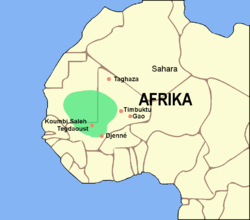
Ghana Empire
The Ghana Empire or Wagadou Empire was located in what is now southeastern Mauritania, and Western Mali. Complex societies had existed in the region since about 1500 BCE, and around Ghana's core region since about 300 CE...
may have been an established kingdom as early as the 4th century CE, founded among the Soninke by Dinge Cisse. Ghana was first mentioned by Arab geographer Al-Farazi in the late 8th century. Ghana was inhabited by urban dwellers and rural farmers. The urban dwellers were the administrators of the empire, who were Muslims, and the Ghana (king), who practiced traditional religion. Two towns existed, one where the Muslim administrators and Berber-Arabs lived, which was connected by a stone-paved road to the king's residence. The rural dwellers lived in villages, which joined together into broader polities that pledged loyalty to the Ghana. The Ghana was viewed as divine, and his physical well-being reflected on the whole society. Ghana converted to Islam around 1050, after conquering Aoudaghost
Aoudaghost
Aoudaghost was an important oasis town at the southern end of a trans-Saharan caravan route that is mentioned in a number of early Arabic manuscripts...
.
The Ghana Empire grew wealthy by taxing the trans-Saharan trade
Trans-Saharan trade
Trans-Saharan trade requires travel across the Sahara to reach sub-Saharan Africa. While existing from prehistoric times, the peak of trade extended from the 8th century until the late 16th century.- Increasing desertification and economic incentive :...
that linked Tiaret and Sijilmasa
Sijilmasa
Sijilmasa was a medieval trade entrepôt at the northern edge of the Sahara Desert in Morocco. The ruins of the town lie along the River Ziz in the Tafilalt oasis near the town of Rissani...
to Aoudaghost. Ghana controlled access to the goldfields of Bambouk
Bambouk
Bambouk is a traditional name for the territory in eastern Senegal and western Mali, encompassing the Bambouk Mountains on its eastern edge, the valley of the Faleme River and the hilly country to the east of the river valley...
, southeast of Koumbi Saleh
Koumbi Saleh
Koumbi Saleh, sometimes Kumbi Saleh is the site of a ruined mediaeval town in south east Mauritania that may have been the capital of the Ghana Empire....
. A percentage of salt and gold going through its territory was taken. The empire was not involved in production.
By the 11th century, Ghana was in decline. It was once thought that the sacking of Koumbi Saleh by Berbers under the Almoravid dynasty in 1076 was the cause. This is no longer accepted. Several alternative explanations are cited. One important reason is the transfer of the gold trade east to the Niger River
Niger River
The Niger River is the principal river of western Africa, extending about . Its drainage basin is in area. Its source is in the Guinea Highlands in southeastern Guinea...
and the Taghaza
Taghaza
Taghaza is an abandoned salt-mining centre located in a salt pan in the desert region of northern Mali. It was an important source of rock salt for West Africa up to the end of the 17th century when it was abandoned and replaced by Taoudenni. Salt from the mines formed an important part of the...
Trail, and Ghana's consequent economic decline. Another reason cited is political instability through rivalry among the different hereditary polities.
The empire came to an end in 1230, when Takrur
Takrur
Takrur, Tekrur, or Tekrour was an ancient state of West Africa, which flourished roughly parallel to the Ghana Empire.-Origin:Takrur was the the name of the capital of the state which flourished on the lower Senegal River...
in northern Senegal
Senegal
Senegal , officially the Republic of Senegal , is a country in western Africa. It owes its name to the Sénégal River that borders it to the east and north...
took over the capital.
Mali
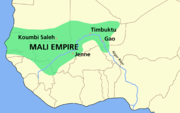
Mali Empire
The Mali Empire or Mandingo Empire or Manden Kurufa was a West African empire of the Mandinka from c. 1230 to c. 1600. The empire was founded by Sundiata Keita and became renowned for the wealth of its rulers, especially Mansa Musa I...
began in the 13th century CE, when a Mande (Mandingo) leader, Sundiata
Sundiata Keita
Sundiata Keita, Sundjata Keyita, Mari Djata I or just Sundiata was the founder of the Mali Empire and celebrated as a hero of the Malinke people of West Africa in the semi-historical Epic of Sundiata....
(Lord Lion) of the Keita clan, defeated Soumaoro Kanté
Soumaoro Kanté
Soumaoro Kanté was a thirteenth century king of the Sosso people. Seizing Koumbi Saleh, the capital of the recently-defunct Ghana Empire, Soumaoro Kanté proceeded to conquer several neighboring states, including the Mandinka people in what is now Mali...
, king of the Sosso
Susu people
The Soso are a major Mande ethnic group living primarily in Guinea. Smaller communities are also located in the neighboring countries of Sierra Leone, Senegal and Mali. The Susu are descendants of the thirteenth century Mali Empire...
or southern Soninke, at the Battle of Kirina
Battle of Kirina
The Battle of Kirina, also known as the Battle of Krina , was a confrontation between the Sosso king Sumanguru Kanté and the Mandinka prince Sundiata Keita...
in c. 1235. Sundiata continued his conquest from the fertile forests and Niger Valley, east to the Niger Bend, north into the Sahara, and west to the Atlantic Ocean, absorbing the remains of the Ghana Empire. Sundiata took on the title of mansa. He established the capital of his empire at Niani
Niani, Mali
Niani was the capital city of the medieval Mali Empire, located south of the Sahara Desert. There are at least two cities in modern-day Mali named Niani, but neither are the former capitals of the great empire. Instead, the Niani of historic fame is actually in the country of Guinea to Mali's...
.
Although the salt and gold trade continued to be important to the Mali Empire, agriculture and pastoralism was also critical. The growing of sorghum
Sorghum
Sorghum is a genus of numerous species of grasses, one of which is raised for grain and many of which are used as fodder plants either cultivated or as part of pasture. The plants are cultivated in warmer climates worldwide. Species are native to tropical and subtropical regions of all continents...
, millet
Millet
The millets are a group of small-seeded species of cereal crops or grains, widely grown around the world for food and fodder. They do not form a taxonomic group, but rather a functional or agronomic one. Their essential similarities are that they are small-seeded grasses grown in difficult...
, and rice was a vital function. On the northern borders of the Sahel, grazing cattle, sheep, goats, and camels were major activities. Mande society was organize around the village and land. A cluster of villages was called a kafu, ruled by a farma. The farma paid tribute to the mansa. A dedicated army of elite cavalry and infantry maintained order, commanded by the royal court. A formidable force could be raised from tributary regions, if necessary.
Conversion to Islam was a gradual process. The power of the mansa depended on upholding traditional beliefs and a spiritual foundation of power. Sundiata initially kept Islam at bay. Later mansas were devout Muslims but still acknowledged traditional deities and took part in traditional rituals and festivals, which were important to the Mande. Islam became a court religion under Sundiata's son Uli I (1225–1270). Mansa Uli made a pilgrimage to Mecca
Mecca
Mecca is a city in the Hijaz and the capital of Makkah province in Saudi Arabia. The city is located inland from Jeddah in a narrow valley at a height of above sea level...
, becoming recognized within the Muslim world. The court was staffed with literate Muslims as secretaries and accountants. Muslim traveller Ibn Battuta
Ibn Battuta
Abu Abdullah Muhammad Ibn Battuta , or simply Ibn Battuta, also known as Shams ad–Din , was a Muslim Moroccan Berber explorer, known for his extensive travels published in the Rihla...
left vivid descriptions of the empire.
Mali reached the peak of its power and extent in the 14th century, when Mansa Musa (1312–1337) made his famous hajj to Mecca with 500 slaves, each holding a bar of gold worth 500 mitqals. Mansa Musa's hajj devalued gold in Mamluk Egypt
Mamluk Sultanate (Cairo)
The Mamluk Sultanate of Egypt was the final independent Egyptian state prior to the establishment of the Muhammad Ali Dynasty in 1805. It lasted from the overthrow of the Ayyubid Dynasty until the Ottoman conquest of Egypt in 1517. The sultanate's ruling caste was composed of Mamluks, Arabised...
for a decade. He made a great impression on the minds of the Muslim and European world. He invited scholars and architects like Ishal al-Tuedjin
Al Sahili
Abu Ishaq Ibrahim Al-Sahili was a prominent architect of the Mali Empire under the rule of Mansa Musa.-Early life:Born in Granada, Andalusia , Abu Ishaq Ibrahim al-Sahili studied the arts and law in his native land. Known as a gifted poet, al-Sahili belonged to a well-established merchant family...
(al-Sahili) to further integrate Mali into the Islamic world.
The Mali Empire saw an expansion of learning and literacy. In 1285, Sakura
Sakura (mansa)
Mansa Sakura or Mansa Sakoura was the sixth mansa of the Mali Empire. A slave at birth, Sakura was freed and became a general in the army of Sundiata Keita, legendary founder of the Mali Empire. After a debilitating struggle for succession between Sundiata's sons Ouati Keita and Khalifa Keita and...
, a freed slave, usurped the throne. This mansa drove the Tuareg out of Timbuktu
Timbuktu
Timbuktu , formerly also spelled Timbuctoo, is a town in the West African nation of Mali situated north of the River Niger on the southern edge of the Sahara Desert. The town is the capital of the Timbuktu Region, one of the eight administrative regions of Mali...
and established it as a center of learning and commerce. The book trade increased, and book copying became a very respectable and profitable profession. Timbuktu and Djenné
Djenné
Djenné is an Urban Commune and town in the Inland Niger Delta region of central Mali. In the 2009 census the commune had a population of 32,944. Administratively it is part of the Mopti Region....
became important centers of learning within the Muslim world.
After the reign of Mansa Suleyman
Suleyman (mansa)
Suleyman was mansa of the Mali Empire from 1341 to 1360. The brother of the powerful Kankan Musa I, he succeeded Musa's son Maghan to the throne in 1341...
(1341–1360), Mali began its spiral downward. Mossi cavalry raided the exposed southern border. Tuareg harassed the northern border in order to retake Timbuktu.
Fulani
Fula people
Fula people or Fulani or Fulbe are an ethnic group spread over many countries, predominantly in West Africa, but found also in Central Africa and Sudanese North Africa...
(Fulbe) eroded Mali's authority in the west by establing the independent Kingdom of Fouta Tooro
Kingdom of Fouta Tooro
The Kingdom of Fouta Tooro or the Kingdom of Fuua Tooro was a pre-colonial West African state of the Fula-speaking people centered around the middle valley of the Senegal River...
, a successor to the kingdom of Takrur
Takrur
Takrur, Tekrur, or Tekrour was an ancient state of West Africa, which flourished roughly parallel to the Ghana Empire.-Origin:Takrur was the the name of the capital of the state which flourished on the lower Senegal River...
. Serer
Serer people
The Serer people along with the Jola people are acknowledged to be the oldest inhabitants of The Senegambia....
and Wolof alliances were broken. In 1545 to 1546, the Songhai Empire
Songhai Empire
The Songhai Empire, also known as the Songhay Empire, was a state located in western Africa. From the early 15th to the late 16th century, Songhai was one of the largest Islamic empires in history. This empire bore the same name as its leading ethnic group, the Songhai. Its capital was the city...
took Niani. After 1599, the empire lost the Bambouk
Bambouk
Bambouk is a traditional name for the territory in eastern Senegal and western Mali, encompassing the Bambouk Mountains on its eastern edge, the valley of the Faleme River and the hilly country to the east of the river valley...
goldfields and disintegrated into petty polities.
Songhai
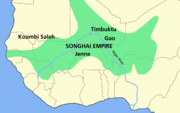
Niger River
The Niger River is the principal river of western Africa, extending about . Its drainage basin is in area. Its source is in the Guinea Highlands in southeastern Guinea...
. They established their capital at Kukiya in the 9th century CE and at Gao
Gao
Gao is a town in eastern Mali on the River Niger lying ESE of Timbuktu. Situated on the left bank of the river at the junction with the Tilemsi valley, it is the capital of the Gao Region and had a population of 86,663 in 2009....
in 12th century. The Songhai speak a Nilo-Saharan language
Nilo-Saharan languages
The Nilo-Saharan languages are a proposed family of African languages spoken by some 50 million people, mainly in the upper parts of the Chari and Nile rivers , including historic Nubia, north of where the two tributaries of Nile meet...
.
Sonni Ali
Sonni Ali
Sonni Ali, also known as Sunni Ali Ber or "Sunni Ali", was born Ali Kolon. He reigned from about 1464 to 1492. Sunni Ali was the first king of the Songhai Empire, located in west Africa and the 15th ruler of the Sonni dynasty...
, a Songhai, began his conquest by capturing Timbuktu in 1468 from the Tuareg. He extended the empire to the north, deep into the desert, pushed the Mossi further south of the Niger, and expanded southwest to Djenne. His army consisted of cavalry and a fleet of canoes. Sonni Ali was not a Muslim, and he was portrayed negatively by Berber-Arab scholars, especially for attacking Muslim Timbuktu. After his death in 1492, his heirs were deposed by General Muhammad Ture
Askia Mohammad I
Askia the Great was a Soninke emperor of the Songhai Empire in the late 15th century, the successor of Sunni Ali Ber. Askia Muhammad strengthened his country and made it the largest country in West Africa's history...
, a Muslim of Soninke origins.
Muhammad Ture (1493–1528) founded the Askiya Dynasty
Askiya Dynasty
The Askiya Dynasty, also known as the Askia Dynasty, ruled the Songhai Empire at the height of that state's power. It was founded in 1493 by Askia Mohammad I, a general of the Songhai Empire who usurped the Sonni Dynasty. The Askiya ruled from Gao over the vast Songhai Empire until its defeat by a...
, askiya being the title of the king. He consolidated the conquests of Sonni Ali. Islam was used to extend his authority by declaring jihad on the Mossi, reviving the trans-Saharan trade, and having the Abbasid "shadow" caliph in Cairo declare him as caliph of Sudan. He established Timbuktu as a great center of Islamic learning. Muhammad Ture expanded the empire by pushing the Tuareg north, capturing Aïr in the east, and capturing salt-producing Taghaza
Taghaza
Taghaza is an abandoned salt-mining centre located in a salt pan in the desert region of northern Mali. It was an important source of rock salt for West Africa up to the end of the 17th century when it was abandoned and replaced by Taoudenni. Salt from the mines formed an important part of the...
. He brought the Hausa states into the Songhay trading network. He further centralized the administration of the empire by selecting administrators from loyal servants and families and assigning them to conquered territories. They were responsible for raising local militias. Centralization made Songhay very stable, even during dynastic disputes. Leo Africanus
Leo Africanus
Joannes Leo Africanus, was a Moorish diplomat and author who is best known for his book Descrittione dell’Africa describing the geography of North Africa.-Biography:Most of what is known about his life is gathered from autobiographical...
left vivid descriptions of the empire under Askiya Muhammad. Askiya Muhammad was deposed by his son in 1528. After much rivalry, Muhammad Ture's last son Askiya Daoud
Askia Daoud
Askia Daoud was ruler of the Songhai Empire from 1549 to 1582. Daoud came to power unopposed following the death of his brother Askia Ishaq I in 1549. The Empire continued to expand under Daoud's rule, and saw little internal strife.He organised a series of military campaigns against tributary...
(1529–1582) assumed the throne.
In 1591, Morocco
Morocco
Morocco , officially the Kingdom of Morocco , is a country located in North Africa. It has a population of more than 32 million and an area of 710,850 km², and also primarily administers the disputed region of the Western Sahara...
invaded the Songhai Empire under Ahmad al-Mansur of the Saadi Dynasty
Saadi Dynasty
The Saadi dynasty of Morocco , began with the reign of Sultan Mohammed ash-Sheikh in 1554, when he vanquished the last Wattasids at the Battle of Tadla....
in order to secure the goldfields of the Sahel. At the Battle of Tondibi
Battle of Tondibi
The Battle of Tondibi was the decisive confrontation in Morocco's 16th-century invasion of the Songhai Empire. Though vastly outnumbered, the Moroccan forces under Judar Pasha defeated the Songhai Askia Ishaq II, guaranteeing the Empire's downfall....
, the Songhai army was defeated. The Moroccans captured Djenne, Gao, and Timbuktu, but they were unable to secure the whole region. Askiya Nuhu and the Songhay army regrouped at Dendi
Dendi Kingdom
The Dendi Kingdom was a pre-colonial West African state in modern-day Niger founded by the Songhai people after the collapse of their empire Songhai.-The Rise & Fall of Gao:...
in the heart of Songhai territory where a spirited guerrilla resistance sapped the resources of the Moroccans, who were dependent upon constant resupply from Morocco. Songhai split into several states during the 17th century.
Morocco found its venture unprofitable. The gold trade had been diverted to Europeans on the coast. Most of the trans-Saharan trade was now diverted east to Bornu
Bornu Empire
The Bornu Empire was an African state of Nigeria from 1396 to 1893. It was a continuation of the great Kanem Empire founded centuries earlier by the Sayfawa Dynasty...
. Expensive equipment purchased with gold had to be sent across the Sahara, an unsustainable scenario. The Moroccans who remained married into the population and were referred to as Arma or Ruma. They established themselves at Timbuktu as a military caste with various fiefs, independent from Morocco. Amid the chaos, other groups began to assert themselves, including the Fulani
Fula people
Fula people or Fulani or Fulbe are an ethnic group spread over many countries, predominantly in West Africa, but found also in Central Africa and Sudanese North Africa...
of Futa Tooro
Futa Tooro
Futa Tooro refers to the region on the Senegal River in what is now northern Senegal and southern Mauritania.The word Fuuta was a general name the Fulbe gave to any area they lived in, while Tooro was the actual identity of the region for its inhabitants. The people of the kingdom spoke Pulaar, a...
who encroached from the west. The Bambara Empire
Bambara Empire
The Bamana Empire was a large pre-colonial West African state based at Ségou, now in Mali. It was ruled by the Kulubali or Coulibaly dynasty established circa 1640 by Kaladian Coulibaly also known as Fa Sine or Biton-si-u...
, one of the states that broke from Songhai, sacked Gao. In 1737, the Tuareg massacred the Arma.
Kanem-Bornu (Kanembu)
Kanem Empire
The Kanem Empire was located in the present countries of Chad, Nigeria and Libya. At its height it encompassed an area covering not only much of Chad, but also parts of southern Libya , eastern Niger and north-eastern Nigeria...
, with its capital at Njimi
Njimi
Njimi was the capital of the Kanuri state of Kanem , north of Lake Chad, from the eleventh through the fourteenth centuries. Founded by the Sefawa dynasty in the eleventh century, the town dominated trans-Saharan trade in ivory and slaves between the central Sahara and Libya. The precise location...
, was founded by the Kanuri-speaking nomads. Kanem arose by engaging in the trans-Saharan trade. It exchanged slaves captured by raiding the south for horses from North Africa
North Africa
North Africa or Northern Africa is the northernmost region of the African continent, linked by the Sahara to Sub-Saharan Africa. Geopolitically, the United Nations definition of Northern Africa includes eight countries or territories; Algeria, Egypt, Libya, Morocco, South Sudan, Sudan, Tunisia, and...
, which in turn aided in the acquisition of slaves. By the late 11th century, the Islamic Sayfawa (Saifawa) dynasty
Sayfawa dynasty
Sayfawa dynasty or more properly Sefuwa dynasty is the name of the kings of the Kanem-Bornu Empire, centered first in Kanem in western Chad, and then, after 1380, in Borno ....
was founded by Humai (Hummay) ibn Salamna
Hummay
Hummay was the founder and mai of the Sefuwa dynasty of the Kanem-Empire in the region of Lake Chad. He discarded the Sefuwa-Duguwa from power and ruled from 1068 to 1080. The dynasty founded by him was to survive until 1846. His rule had important consequences because of the spead of Islam...
. The Sayfawa Dynasty ruled for 771 years, making it one of the longest-lasting dynasties in human history. In addition to trade, taxation of local farms around Kanem became a source of state income. Kanem reached its peak under Mai (king) Dunama Dibalemi ibn Salma
Dunama Dabbalemi
Dunama Dabbalemi, of the Sayfawa dynasty, was the mai of the Kanem Empire, in present-day Chad, from 1203 to 1243.A fervent Muslim, Dabbalemi initiated diplomatic exchanges with sultans in North Africa and apparently arranged for the establishment of a special hostel in Cairo to facilitate...
(1210–1248). The empire reportedly was able to field 40,000 cavalry, and it extended from Fezzan
Fezzan
Fezzan is a south western region of modern Libya. It is largely desert but broken by mountains, uplands, and dry river valleys in the north, where oases enable ancient towns and villages to survive deep in the otherwise inhospitable Sahara.-Name:...
in the north to the Sao
Sao civilisation
The Sao were an African civilisation that flourished from ca. the 6th century to as late as the 15th century. The Sao lived by the Chari River south of Lake Chad in territory that would later be part of Cameroon and Chad. They are the earliest people to have left clear traces of their presence in...
state in the south. Islam became firmly entrenched in the empire. Pilgrimages to Mecca
Mecca
Mecca is a city in the Hijaz and the capital of Makkah province in Saudi Arabia. The city is located inland from Jeddah in a narrow valley at a height of above sea level...
were common; Cairo
Cairo
Cairo , is the capital of Egypt and the largest city in the Arab world and Africa, and the 16th largest metropolitan area in the world. Nicknamed "The City of a Thousand Minarets" for its preponderance of Islamic architecture, Cairo has long been a centre of the region's political and cultural life...
had hostels set aside specifically for pilgrims from Kanem.
Around 1400, the Sayfawa Dynasty moved its capital to Bornu
Bornu Empire
The Bornu Empire was an African state of Nigeria from 1396 to 1893. It was a continuation of the great Kanem Empire founded centuries earlier by the Sayfawa Dynasty...
, a tributary state southwest of Lake Chad
Lake Chad
Lake Chad is a historically large, shallow, endorheic lake in Africa, whose size has varied over the centuries. According to the Global Resource Information Database of the United Nations Environment Programme, it shrank as much as 95% from about 1963 to 1998; yet it also states that "the 2007 ...
with a new capital Birni Ngarzagamu
Ngazargamu
Gazargamo was the capital of the Bornu Empire from ca. 1460 to 1809. Situated 150 km west of Lake Chad in the Yobe State of modern Nigeria the impressive remains of the town are still visible. The surrounding wall is 6.6 km long and in parts it is still up to 5 m. high...
. Overgrazing had caused the pastures of Kanem to become too dry. In addition, political rivalry from the Bilala clan was becoming intense. Moving to Bornu better situated the empire to exploit the trans-Saharan trade and to widen its network in that trade. Links to the Hausa states were also established, providing horses and salt from Bilma
Bilma
Bilma is an oasis town in north east Niger with a population of around 2,500 people. It lies protected from the desert dunes under the Kaouar Cliffs and is the largest town along the Kaouar escarpment...
for Akan
Akan people
The Akan people are an ethnic group found predominately in Ghana and The Ivory Coast. Akans are the majority in both of these countries and overall have a population of over 20 million people.The Akan speak Kwa languages-Origin and ethnogenesis:...
gold. Mai Ali Gazi ibn Dunama
Ali Gazi
Ali Gazi was a ruler of the Bornu Empire. Prior to his reign, the Sefuwa ruling house had split into two ruling branches. The result was palace intrigues and internal strife...
(c. 1475–1503) defeated the Bilala, reestablishing complete control of Kanem.
During the early 16th century, the Sayfawa Dynasty
Sayfawa dynasty
Sayfawa dynasty or more properly Sefuwa dynasty is the name of the kings of the Kanem-Bornu Empire, centered first in Kanem in western Chad, and then, after 1380, in Borno ....
solidified its hold on the Bornu population after much rebellion. In the latter half of the 16th century, Mai Idris Alooma
Idris Alooma
Idris Alooma was mai of the Kanem-Bornu Empire, located mainly in Chad and Nigeria. His name is more properly written Idris Alawma or Idris Alauma. An outstanding statesman, under his rule Kanem-Bornu touched the zenith of its power.Idris is remembered for his military skills, administrative...
modernized its military, in contrast to the Songhai Empire
Songhai Empire
The Songhai Empire, also known as the Songhay Empire, was a state located in western Africa. From the early 15th to the late 16th century, Songhai was one of the largest Islamic empires in history. This empire bore the same name as its leading ethnic group, the Songhai. Its capital was the city...
. Turkish mercenaries were used to train the military. The Sayfawa Dynasty were the first monarchs south of the Sahara to import firearms. The empire controlled all of the Sahel from the borders of Darfur in the east to Hausaland to the west. Friendly relationship was established with the Ottoman Empire
Ottoman Empire
The Ottoman EmpireIt was usually referred to as the "Ottoman Empire", the "Turkish Empire", the "Ottoman Caliphate" or more commonly "Turkey" by its contemporaries...
via Tripoli
Tripoli
Tripoli is the capital and largest city in Libya. It is also known as Western Tripoli , to distinguish it from Tripoli, Lebanon. It is affectionately called The Mermaid of the Mediterranean , describing its turquoise waters and its whitewashed buildings. Tripoli is a Greek name that means "Three...
. The Mai exchanged gifts with the Ottoman sultan.
During the 17th and 18th centuries, not much is known about Bornu. During the 18th century, it became a center of Islamic learning. However, Bornu's army became outdated by not importing new arms, and Kamembu had also begun its decline. The power of the mai was undermined by droughts and famine that were becoming more intense, internal rebellion in the pastoralist north, growing Hausa power, and the importation of firearms which made warfare more bloody. By 1841, the last mai was deposed, bringing to an end the long-lived Sayfawa Dynasty.
Sokoto Caliphate
The Fulani
Fula people
Fula people or Fulani or Fulbe are an ethnic group spread over many countries, predominantly in West Africa, but found also in Central Africa and Sudanese North Africa...
were migratory people. They moved from Mauritania
Mauritania
Mauritania is a country in the Maghreb and West Africa. It is bordered by the Atlantic Ocean in the west, by Western Sahara in the north, by Algeria in the northeast, by Mali in the east and southeast, and by Senegal in the southwest...
and settled in Futa Tooro
Futa Tooro
Futa Tooro refers to the region on the Senegal River in what is now northern Senegal and southern Mauritania.The word Fuuta was a general name the Fulbe gave to any area they lived in, while Tooro was the actual identity of the region for its inhabitants. The people of the kingdom spoke Pulaar, a...
, Futa Djallon
Fouta Djallon
Fouta Djallon is a highland region in the centre of Guinea, West Africa. The indigenous name is Fuuta-Jaloo...
, and subsequently throughout the rest of West Africa. By the 14th century CE, they had converted to Islam. During the 16th century, they established themselves at Macina
Macina, Mali
Macina or Ké Macina is a town and commune in the Cercle of Macina in the Ségou Region of southern-central Mali. As of 1998 the commune had a population of 31,655.The main town of Ke macina lies on the Niger River....
in southern Mali
Mali
Mali , officially the Republic of Mali , is a landlocked country in Western Africa. Mali borders Algeria on the north, Niger on the east, Burkina Faso and the Côte d'Ivoire on the south, Guinea on the south-west, and Senegal and Mauritania on the west. Its size is just over 1,240,000 km² with...
. During the 1670s, they declared jihads on non-Muslims. Several states were formed from these jihadist wars, at Futa Toro, Futa Djallon, Macina, Oualia
Oualia
Oualia is a small town and commune in the Cercle of Bafoulabé in the Kayes Region of south-western Mali. As of 1998 the commune had a population of 13206.-External links:*...
, and Bundu. The most important of these states was the Sokoto Caliphate or Fulani Empire
Fulani Empire
The Sokoto Caliphate is an Islamic spiritual community in Nigeria, led by the Sultan of Sokoto, Sa’adu Abubakar. Founded during the Fulani Jihad in 1809 by Usuman dan Fodio, it was one of the most powerful empires in sub-Saharan Africa prior to European conquest and colonization...
.
In the city of Gobir
Gobir
Gobir was a city-state in what is now Nigeria. Founded by the Hausa in the eleventh century, Gobir was one of the seven original kingdoms of Hausaland, and continued under Hausa rule for nearly seven hundred years. Its capital was the city of Alkalawa...
, Usman dan Fodio
Usman dan Fodio
Shaihu Usman dan Fodio , born Usuman ɓii Foduye, was the founder of the Sokoto Caliphate in 1809, a religious teacher, writer and Islamic promoter. Dan Fodio was one of a class of urbanized ethnic Fulani living in the Hausa States in what is today northern Nigeria...
(1754–1817) accused the Hausa leadership of practicing an impure version of Islam and of being morally corrupt. In 1804, he launched the Fulani War
Fulani War
The Fulani War of 1804-1810, also known as the Fulani Jihad or Jihad of Usman dan Fodio, was a military conquest in present day Nigeria and Cameroon. Expelled from Gobir by his former student Yunfa in 1802, Islamic reformer Usman dan Fodio assembled a Fulani army to lead in jihad against the Hausa...
as a jihad among a population that was restless about high taxes and discontented with its leaders. Jihad fever swept northern Nigeria
Nigeria
Nigeria , officially the Federal Republic of Nigeria, is a federal constitutional republic comprising 36 states and its Federal Capital Territory, Abuja. The country is located in West Africa and shares land borders with the Republic of Benin in the west, Chad and Cameroon in the east, and Niger in...
, with strong support among both the Fulani and the Hausa. Usman created an empire that included parts of northern Nigeria, Benin
Benin
Benin , officially the Republic of Benin, is a country in West Africa. It borders Togo to the west, Nigeria to the east and Burkina Faso and Niger to the north. Its small southern coastline on the Bight of Benin is where a majority of the population is located...
, and Cameroon
Cameroon
Cameroon, officially the Republic of Cameroon , is a country in west Central Africa. It is bordered by Nigeria to the west; Chad to the northeast; the Central African Republic to the east; and Equatorial Guinea, Gabon, and the Republic of the Congo to the south. Cameroon's coastline lies on the...
, with Sokoto
Sokoto
Sokoto is a city located in the extreme northwest of Nigeria, near to the confluence of the Sokoto River and the Rima River. As of 2006 it has a population of 427,760...
as its capital. He retired to teach and write and handed the empire to his son Muhammed Bello
Muhammed Bello
Muhammed Bello was the son and aide of Usman dan Fodio. He became the second Sultan of Sokoto following his father's 1815 retirement from the throne. Bello faced early challenges from dissident leaders such as 'Abd al-Salam, and rivalries between the key families of his father's jihad...
. The Sokoto Caliphate lasted until 1903 when the British conquered northern Nigeria.
Akan Kingdoms and emergence of Asante Empire
The Akan speak a Kwa Language. The speakers of Kwa languages are believed to have come from East
East Africa
East Africa or Eastern Africa is the easterly region of the African continent, variably defined by geography or geopolitics. In the UN scheme of geographic regions, 19 territories constitute Eastern Africa:...
/Central Africa
Central Africa
Central Africa is a core region of the African continent which includes Burundi, the Central African Republic, Chad, the Democratic Republic of the Congo, and Rwanda....
, before settling in the Sahel
Sahel
The Sahel is the ecoclimatic and biogeographic zone of transition between the Sahara desert in the North and the Sudanian Savannas in the south.It stretches across the North African continent between the Atlantic Ocean and the Red Sea....
. By the 12th century, the Akan Kingdom of Bonoman
Bonoman
Bonoman is a term used to describe the trading State created by the Abron people which culminated in bringing wealth to the Akan people.Bonoman was a Middle Ages Akan Empire in what is now Brong-Ahafo region of Ghana and Eastern Ivory Coast...
(Bono State) was established. During the 13th century, when the gold mines in modern day Mali started to dry up, Bonoman and later other Akan states began to rise to promince as the major players in the Gold trade. It was Bonoman
Bonoman
Bonoman is a term used to describe the trading State created by the Abron people which culminated in bringing wealth to the Akan people.Bonoman was a Middle Ages Akan Empire in what is now Brong-Ahafo region of Ghana and Eastern Ivory Coast...
and other Akan kingdoms like Denkyira
Denkyira
Denkyira was a powerful nation of Akan people that existed in southern present-day Ghana from 1620. Like all Akans they originated from Bono state. Before 1620 Denkyira was called Agona. The ruler of the Denkyira was called Denkyirahene and the capital was Jukwaa...
, Akyem
Akyem
The Akyem are an Akan people. The term Akyem is used to describe a group of three states: Akyem Abuakwa, Akyem Kotoku and Akyem Bosome. These nations are located primarily in the eastern regions of modern-day Ghana. The term is also used to describe the general area where the Akyem ethnic group...
, Akwamu
Akwamu
The Akwamu was a state set up by the Akan people in Ghana which existed in the 17th century and 18th century. Originally immigrating from Bono state, the founders settled in Twifo-Heman. The Akwamu created an expansionist empire in the 16th and 17th century...
which were the predecessors to what became the all-powerful Empire of Ashanti. When and how the Ashante got to their present location is debatable. What is known is that by the 17th century an Akan people were identified as living in a state called Kwaaman. The location of the state was north of Lake Bosomtwe. The state's revenue was mainly derived from trading in gold and kola nut
Kola nut
Kola Nut is the nut of the kola tree, a genus of trees native to the tropical rainforests of Africa, classified in the family Malvaceae, subfamily Sterculioideae . It is related to the South American genus Theobroma, or cocoa...
s and clearing forest to plant yams
Yam (vegetable)
Yam is the common name for some species in the genus Dioscorea . These are perennial herbaceous vines cultivated for the consumption of their starchy tubers in Africa, Asia, Latin America and Oceania...
. They built towns between the Pra
Pra River (Ghana)
The Pra River is a river in Ghana, the easternmost and the largest of the three principal rivers that drain the area south of the Volta divide. Rising in the Kwahu Plateau near Mpraeso and flowing southward for 240 km through rich cocoa and farming areas and valuable forests in the Akan...
and Ofin rivers. They formed alliances for defense and paid tribute to Denkyira
Denkyira
Denkyira was a powerful nation of Akan people that existed in southern present-day Ghana from 1620. Like all Akans they originated from Bono state. Before 1620 Denkyira was called Agona. The ruler of the Denkyira was called Denkyirahene and the capital was Jukwaa...
one of the more powerful Akan states at that time along with Adansi and Akwamu
Akwamu
The Akwamu was a state set up by the Akan people in Ghana which existed in the 17th century and 18th century. Originally immigrating from Bono state, the founders settled in Twifo-Heman. The Akwamu created an expansionist empire in the 16th and 17th century...
. During the 16th century, Ashante society experienced sudden changes, including population growth because of cultivation of New World
New World
The New World is one of the names used for the Western Hemisphere, specifically America and sometimes Oceania . The term originated in the late 15th century, when America had been recently discovered by European explorers, expanding the geographical horizon of the people of the European middle...
plants such as cassava
Cassava
Cassava , also called yuca or manioc, a woody shrub of the Euphorbiaceae native to South America, is extensively cultivated as an annual crop in tropical and subtropical regions for its edible starchy tuberous root, a major source of carbohydrates...
and maize
Maize
Maize known in many English-speaking countries as corn or mielie/mealie, is a grain domesticated by indigenous peoples in Mesoamerica in prehistoric times. The leafy stalk produces ears which contain seeds called kernels. Though technically a grain, maize kernels are used in cooking as a vegetable...
and an increase in the gold trade between the coast and the north.
By the 17th century, Osei Kofi Tutu I
Osei Kofi Tutu I
Osei Kofi Tutu I was one of the co-founders of the Empire of Ashanti, the other being Okomfo Anokye, his chief priest. The Ashanti were a powerful, warlike, and highly disciplined people of West Africa. Osei Tutu led an alliance of Ashanti states against the regional hegemon, the Denkyira,...
(c. 1695–1717), with help of Okomfo Anokye
Okomfo Anokye
Okomfo Anokye was an Ashanti priest, statesman and lawgiver. He occupies a Merlin-like position in Ashanti history. A co-founder of the Empire of Ashanti in West Africa, he helped establish its constitution, laws, and customs....
, unified what became the Ashante into a confederation with the Golden Stool
Asante royal thrones
According to legend, Okomfo Anokye caused the famous Asante royal throne known as the Golden Stool to descend from the heavens and land on the lap of the first Asante king, Osei Tutu...
as a symbol of their unity and spirit. Osei Tutu engaged in a massive territorial expansion. He built up the Ashante army based on the Akan
Akan people
The Akan people are an ethnic group found predominately in Ghana and The Ivory Coast. Akans are the majority in both of these countries and overall have a population of over 20 million people.The Akan speak Kwa languages-Origin and ethnogenesis:...
state of Akwamu
Akwamu
The Akwamu was a state set up by the Akan people in Ghana which existed in the 17th century and 18th century. Originally immigrating from Bono state, the founders settled in Twifo-Heman. The Akwamu created an expansionist empire in the 16th and 17th century...
, introducing new organization and turning a disciplined militia into an effective fighting machine. In 1701, the Ashante conquered Denkyira, giving them access to the coastal trade with Europeans, especially the Dutch.
Opoku Ware I
Opoku Ware I
Katakyie Opoku Ware I was an Oyoko king or Asantehene - the ruler of the Ashanti - in the now-disbanded Ashanti Confederacy which occupied parts of what is now Ghana...
(1720–1745) engaged in further expansion, adding other southern Akan states to the growing empire. He turned north adding Techiman
Techiman
Techiman is the leading market town in Ghana and is, together with Sunyani, one of the two chief cities of the Brong-Ahafo Region. This city of nearly 80,000 is located at a historical crossroads of trade routes and the Tano River, and serves as capital of the Techiman Municipal...
, Banda, Gyaaman
Gyaaman
Gyaman also spelled Jamang was a medieval African state of the Akan people, located in what is now Ghana and Côte d'Ivoire. Gyaman was founded by the Abron, a branch of the Akan, in the late 15th century...
, and Gonja
Gonja
This page discusses the Ghanaian kingdom of Gonja; for uses for the word Ganja, see Ganja Gonja was a kingdom in northern Ghana; the word can also refer to the people of this kingdom. The Gonja are a Guan people who have been influenced by both Akan people and Mande people. With the fall of the...
, states on the Black Volta
Black Volta
Black Volta or Mouhoun is a river of western Africa rising in western Burkina Faso and flowing about 1,352 km to the White Volta in Ghana. The Black Volta forms a small part of the boundary between Ghana and Ivory Coast, and also a section of border between Ghana and Burkina Faso.-See also:*Deux...
. Between 1744 and 1745, Asantehene Opoku attacked the powerful northern state of Dagomba, gaining control of the important middle Niger trade routes. Kusi Obodom
Kusi Obodom
Kusi Obodom was the ruler of the Ashanti Confederacy from 1750 to 1764, during the Oyoko Abohyen dynasty. He held the title of Asantehene. Obodom was succeeded by Osei Kwadwo....
(1750–1764) succeeded Opoku. He solidified all the newly won territories. Osei Kwadwo
Osei Kwadwo
Osei Kwadwo was an Ashanti king who ruled from circa 1764 to 1777. He was succeeded by Osei Kwame Panyin.-References:Adu Boahen. A New Look at the History of Ghana. African Affairs, Vol. 65, No. 260 , pp. 212-222...
(1777–1803) imposed administrative reforms that allowed the empire to be governed effectively and to continue its military expansion. Osei Kwame Panyin
Osei Kwame Panyin
Osei Kwame Panyin was the ruler of the Ashanti Confederacy from 1777 to 1803, holding the title of Asantehene. In December 1803, he was succeeded by Osei Fofie....
(1777–1803), Osei Tutu Kwame (1804–1807), and Osei Bonsu (1807–1824) continued territorial comsolidation and expansion. The Ashante Empire included all of present-day Ghana and large parts of Ivory Coast.
The ashantehene inherited his position from his mother. He was assisted at the capital, Kumasi, by a civil service of men talented in trade, diplomacy, and the military, with a head called the Gyaasehene. Men from Arabia, Sudan, and Europe were employed in the civil service, all of them appointed by the ashantehene. At the capital and in other towns, the ankobia or special police were used as bodyguards to the ashantehene, as sources of intelligence, and to suppress rebellion. Communication throughout the empire was maintained via a network of well-kept roads from the coast to the middle Niger and linking together other trade cities.
For most of the 19th century, the Ashante Empire remained powerful. It was later destroyed in 1900 by British superior weaponry and organization following the four Anglo-Ashanti wars.
Dahomey
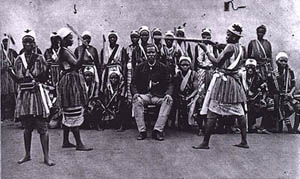
Dahomey
Dahomey was a country in west Africa in what is now the Republic of Benin. The Kingdom of Dahomey was a powerful west African state that was founded in the seventeenth century and survived until 1894. From 1894 until 1960 Dahomey was a part of French West Africa. The independent Republic of Dahomey...
was founded in the early 17th century CE when the Aja people
Aja people
The Aja are a group of people native to south-western Benin and south-eastern Togo.According to tradition, the Aja migrated to southern Benin in the 12th or 13th centuries from Tado on the Mono River and in the early 17th century, three brothers, Kokpon, Do-Aklin, and Te-Agdanlin, fought for the...
of the Allada
Allada
Allada is a town, arrondissement, and commune located in the Atlantique Department of Benin.Allada was the capital of the most powerful king in Ajaland before it fell to the armies of Dahomey....
kingdom moved northward and settled among the Fon
Fon people
The Fon people, or Fon nu, are a major West African ethnic and linguistic group in the country of Benin, and southwest Nigeria, made up of more than 3,500,000 people. The Fon language is the main language spoken in Southern Benin, and is a member of the Gbe language group...
. They began to assert their power a few years later. In so doing they established the Kingdom of Dahomey, with its capital at Agbome. King Houegbadja
Houegbadja
Aho Houegbadja was the third King of Dahomey. He succeeded his uncle, Dakodonou, and ruled from 1645 to 1685.Houegbadja was the first of the dynasty to set up the kingdom in Abomey proper: he founded the city by building his palace near the area of Guedevi, a few kilometers to the northwest of...
(c. 1645–1685) organized Dahomey into a powerful centralized state. He declared all lands to be owned of the king and subject to taxation. Primogeniture in the kingship was established, neutralizing all input from village chiefs. A "cult of kingship" was established. A captive slave would be sacrificed annually to honor the royal ancestors. During the 1720s, the slave-trading states of Whydah
Kingdom of Whydah
The Kingdom of Whydah , sometimes written Hueda, was a kingdom on the coast of West Africa in the boundaries of the modern nation of Benin. Between 1677 and 1681 it was conquered by the Akwamu a member of the Akan people. It was a major slave trading post...
and Allada were taken, giving Dahomey direct access to the slave coast and trade with Europeans. King Agadja
Agadja
Dossou Agadja was the fifth King of Dahomey. He succeeded Houessou Akaba, and ruled from 1708 to 1740. Akaba's only son, Agbo Sassa, was only ten years old when Akaba died, so as Akaba's brother, Agadja took the throne to become the fifth king...
(1708–1740) attempted to end the slave trade by keeping the slaves on plantations producing palm oil, but the European profits on slaves and Dahomey's dependency on firearms were too great. In 1730, under king Agaja, Dahomey was conquered by the Oyo Empire
Oyo Empire
The Oyo Empire was a Yoruba empire of what is today southwestern Nigeria. The empire was established before the 14th century and grew to become one of the largest West African states encountered by European explorers. It rose to preeminence through its possession of a powerful cavalry and wealth...
, and Dahomey had to pay tribute. Taxes on slaves were mostly paid in cowrie shells. During the 19th century, palm oil was the main trading commodity. France conquered Dahomey during the Second Franco-Dahomean War
Second Franco-Dahomean War
The Second Franco-Dahomean War, which raged from 1892 to 1894, was a major conflict between the French Third Republic, led by General Alfred-Amédée Dodds, and the Kingdom of Dahomey under King Béhanzin....
(1892–1894) and established a colonial government there. Most of the troops who fought against Dahomey were native Africans.
Yoruba
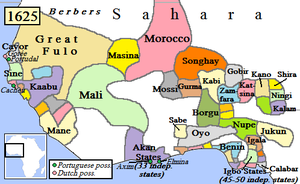
Yoruba people
The Yoruba people are one of the largest ethnic groups in West Africa. The majority of the Yoruba speak the Yoruba language...
viewed themselves as the inhabitants of a united empire, in contrast to the situation today, in which "Yoruba" is the cultural-linguistic designation for speakers of a language in the Niger–Congo family. The name comes from a Hausa
Hausa language
Hausa is the Chadic language with the largest number of speakers, spoken as a first language by about 25 million people, and as a second language by about 18 million more, an approximate total of 43 million people...
word to refer to the Oyo Empire
Oyo Empire
The Oyo Empire was a Yoruba empire of what is today southwestern Nigeria. The empire was established before the 14th century and grew to become one of the largest West African states encountered by European explorers. It rose to preeminence through its possession of a powerful cavalry and wealth...
. The first Yoruba state was Ile-Ife
Ife
Ife is an ancient Yoruba city in south-western Nigeria. Evidence of inhabitation at the site has been discovered to date back to roughly 560 BC...
, said to have been founded around 1000 CE by a supernatural figure, the first oni Oduduwa
Oduduwa
Oduduwa Omoluabi, Olofin Adimula, Emperor of the Yoruba, phonetically written by his people as Odùduwà and sometimes contracted as Odudua or Oòdua, is generally held among the Yoruba to be the reigning ancestor of the crowned Yoruba kings....
. Oduduwa's sons would be the founders of the different city-states of the Yoruba, and his daughters would become the mothers of the various Yoruba obas, or kings. Yoruba city-states were usually governed by an oba and a iwarefa, a council of chiefs who advised the oba. By the 18th century, the Yoruba city-states formed a loose confederation, with the Oni of Ife as the head and Ife as the capital. As time went on, the individual city-states became more powerful with their obas assuming more powerful spiritual positions and diluting the authority of the Oni of Ife. Rivalry became intense among the city-states.
The Oyo Empire rose in the 16th century. The Oyo state had been conquered in 1550 by the kingdom of Nupe, which was in possession of cavalry, an important tactical advantage. The alafin (king) of Oyo was sent into exile. After returning, Alafin Orompoto
Orompoto
Orompoto was an Alaafin of Oyo, also the empire's titled ruler. He was the brother of his predecessor, Eguguojo. He was considered a skillful warrior and was known according to Oyo tales of his inadvertent victory at the battle of Illayi. While fighting his enemies, he lost three leaders of the...
(c. 1560–1580) built up an army based on heavily armed cavalry and long-service troops. This made them invincible in combat on the northern grasslands and in the thinly wooded forests. By the end of the 16th century, Oyo had added the western region of the Niger to the hills of Togo, the Yoruba of Ketu
Ketu (Benin)
Ketu is a historical location in present day Republic of Benin. It is one of the oldest capitals of the Yoruba speaking people, tracing its establishment to a settlement founded by a daughter of Oduduwa, also known as Odudua, Oòdua and Eleduwa...
, Dahomey, and the Fon nation.
A governing council served the empire, with clear executive divisions. Each acquired region was assigned a local administrator. Families served in king-making capacities. Oyo, as a northern Yoruba kingdom, served as middle-man in the north-south trade and connecting the eastern forest of Guinea
Guinea
Guinea , officially the Republic of Guinea , is a country in West Africa. Formerly known as French Guinea , it is today sometimes called Guinea-Conakry to distinguish it from its neighbour Guinea-Bissau. Guinea is divided into eight administrative regions and subdivided into thirty-three prefectures...
with the western and central Sudan
Sahel
The Sahel is the ecoclimatic and biogeographic zone of transition between the Sahara desert in the North and the Sudanian Savannas in the south.It stretches across the North African continent between the Atlantic Ocean and the Red Sea....
, the Sahara, and North Africa. The Yoruba manufactured cloth, ironware, and pottery, which were exchanged for salt, leather, and most importantly horses from the Sudan to maintain the cavalry. Oyo remained strong for two hundred years. It became a protectorate of Great Britain
Great Britain
Great Britain or Britain is an island situated to the northwest of Continental Europe. It is the ninth largest island in the world, and the largest European island, as well as the largest of the British Isles...
in 1888, before further fragmenting into warring factions. The Oyo state ceased to exist as any sort of power in 1896.
Benin
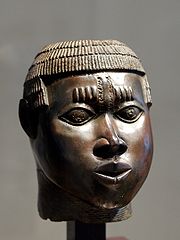
Edo people
Edo is the name for the place, people and language of an ethnic group in Nigeria. Other Edo-speaking ethnic groups include the Esan and the Afemai...
. By the mid 15th century, the Benin Empire
Benin Empire
The Benin Empire was a pre-colonial African state in what is now modern Nigeria. It is not to be confused with the modern-day country called Benin, formerly called Dahomey.-Origin:...
was engaged in political expansion and consolidation. Under Oba (king) Ewuare
Ewuare
Oba Ewuare was the greatest warrior legend and the most outstanding king in the history of the Benin Empire. Ewuare , means "it is cool, or the trouble has ceased, and as a result the war is over." The title symbolizes an epoch of reconciliation, reconstruction and the return of peace among the...
(c. 1450–1480 CE), the state was organized for conquest. He solidified central authority and initiated 30 years of war with his neighbors. At his death, the Benin Empire extended to Dahomey in the west, to the Niger Delta
Niger Delta
The Niger Delta, the delta of the Niger River in Nigeria, is a densely populated region sometimes called the Oil Rivers because it was once a major producer of palm oil...
in the east, along the west African coast, and to the Yoruba towns in the north.
Ewuare's grandson Oba Esigie
Esigie
Oba Esigie, was an Oba of Benin who ruled the ancient Benin Kingdom, now Benin City, Edo State, Nigeria . Works of art commissioned by Esigie are held in prominent museums including the Metropolitan Museum of Art and the British Museum....
(1504–1550) eroded the power of the uzama (state council) and increase contact and trade with Europeans, especially with the Portuguese who provided a new source of copper for court art.
The oba ruled with the advice from the uzama, a council consisting of chiefs of powerful families and town chiefs of different guilds. Later its authority was diminished by the establishment of administrative dignitaries. Women wielded power. The queen mother who produced the future oba wielded immense influence.
Benin was never a significant exporter of slaves, as Alan Ryder's book Benin and the Europeans showed. By the early 1700s, it was wrecked with dynastic disputes and civil wars. However, it regained much of its former power in the reigns of Oba Eresoyen and Oba Akengbuda. After the 16th century, Benin mainly exported pepper, ivory, gum, and cotton cloth to the Portuguese and Dutch who resold it to other African societies on the coast. In 1897, the British sacked the city.
Niger Delta and Igbo
The Niger Delta
Niger Delta
The Niger Delta, the delta of the Niger River in Nigeria, is a densely populated region sometimes called the Oil Rivers because it was once a major producer of palm oil...
comprised numerous city-states with numerous forms of government. These city-states were protected by the waterways and thick vegetation of the delta. The region was transformed by trade in the 17th century CE. The delta's city-states were comparable to those of the Swahili people
Swahili people
The Swahili people are a Bantu ethnic group and culture found in East Africa, mainly in the coastal regions and the islands of Kenya, Tanzania and north Mozambique. According to JoshuaProject, the Swahili number in at around 1,328,000. The name Swahili is derived from the Arabic word Sawahil,...
in East Africa. Some, like Bonny
Kingdom of Bonny
The Kingdom of Bonny is a traditional state based on the town of Bonny in Rivers State, Nigeria. Founded in the 14th century AD, it became an important slave trading port, later trading palm oil products. During the 19th century the British became increasingly involved in the internal affairs of...
, Kalabari
Kalabari Kingdom
The Kalabari Kingdom, also called Elem Kalabari , or New Calabar by the Europeans, was an independent trading state of the Kalabari people , an Ijaw ethnic group, in the Niger River Delta....
, and Warri
Kingdom of Warri
The Kingdom of Warri is a traditional state based on the town of Warri in Delta State, Nigeria. Warri is an inland port on one of the Niger River channels in the Niger Delta...
, had kings. Others, like Brass
Brass, Nigeria
Brass is a Local Government Area in Bayelsa State, Nigeria. Its headquarters are in the town of Twon-Brass on the coast. It has a coastline of approximately 90 km on the Bight of Bonny. Much of the area of the LGA is occupied by the Edumanom National Forest....
, were republics with small senates, and those at Cross River
Cross River State
Cross River State is a coastal state in southeastern Nigeria, bordering Cameroon to the east. Its capital is at Calabar, and it is named for the Cross River , which passes through the state...
and Old Calabar
Calabar
Calabar is a city in Cross River State, southeastern Nigeria. The original name for Calabar was Atakpa, from the Jukun language....
were ruled by merchants of the ekpe society. The ekpe society regulated trade and made rules for members known as house systems. Some of these houses, like the Pepples of Bonny, were well known in the Americas and Europe.
The Igbo
Igbo people
Igbo people, also referred to as the Ibo, Ebo, Eboans or Heebo are an ethnic group living chiefly in southeastern Nigeria. They speak Igbo, which includes various Igboid languages and dialects; today, a majority of them speak English alongside Igbo as a result of British colonialism...
lived east of the delta (but with the Anioma on the west of the Niger River). The Kingdom of Nri
Kingdom of Nri
The Kingdom of Nri was the West African medieval state of the Nri-Igbo, a subgroup of the Igbo people, and is the oldest kingdom in Nigeria. The Kingdom of Nri was unusual in the history of world government in that its leader exercised no military power over his subjects...
rose in the 9th century CE, with the Eze Nri being its leader. It was a political entity composed of villages, and each village was autonomous and independent with its own territory and name, each recognized by its neighbors. Villages were democratic with all males and sometimes females a part of the decision-making process. Graves at Igbo-Ukwu
Igbo-Ukwu
Igbo-Ukwu is a town in the Nigerian state of Anambra which was the site of three famous archaeological sites that revealed a highly sophisticated metal-working culture. The first, Igbo Isaiah, was uncovered in 1938 by Isaiah Anozie a local villager who stumbled upon the bronze works while digging...
(800 CE) contained brass artifacts of local manufacture and glass beads from Egypt or India, indicative of extraregional trade.
Central Africa
Around 1000 BCE, Bantu migrants had reached the Great Lakes of East Africa. Halfway through the first millennium BCE, the Bantu had also settled as far south as what is now AngolaAngola
Angola, officially the Republic of Angola , is a country in south-central Africa bordered by Namibia on the south, the Democratic Republic of the Congo on the north, and Zambia on the east; its west coast is on the Atlantic Ocean with Luanda as its capital city...
.
Luba Empire
Sometime between 1300 to 1400 CE, Kongolo MwambaKongolo Mwamba
Kongolo was a leader of Luba people in the region of Katanga, and the first king of the Luba Empire. He built his capital in Mwibele, near Lake Boya, although some stories say it originated from Songye...
(Nkongolo) from the Balopwe clan unified the various Luba people
Luba people
The Luba are one of the Bantu peoples of Central Africa. They are indigenous to the Katanga, Kasai, and Maniema regions which were historic provinces of present-day Democratic Republic of the Congo...
s, near Lake Kisale. He founded the Kongolo Dynasty, which was later ousted by Kalala Ilunga
Kalala Ilunga
Kalala Ilunga was one of the emperors of Luba, an empire which spread over the province of Katanga into Zambia and Zimbabwe. Kalala Ilunga was the eldest son of Ilunga Mbili and nephew of King Kongolo Mwamba...
. Kalala expanded the kingdom west of Lake Kisale. A new centralized political system of spiritual kings (balopwe) with a court council of head governors and sub-heads all the way to village heads. The balopwe was the direct communicator with the ancestral spirits and chosen by them. Conquered states were integrated into the system and represented in the court, with their titles. The authority of the balopwe resided in his spiritual power rather than his military authority. The army was relatively small. The Luba was able to control regional trade and collect tribute for redistribution. Numerous offshoot states were formed with founders claiming descent from the Luba. The Luba political system spread throughout Central Africa
Central Africa
Central Africa is a core region of the African continent which includes Burundi, the Central African Republic, Chad, the Democratic Republic of the Congo, and Rwanda....
, southern Uganda
Uganda
Uganda , officially the Republic of Uganda, is a landlocked country in East Africa. Uganda is also known as the "Pearl of Africa". It is bordered on the east by Kenya, on the north by South Sudan, on the west by the Democratic Republic of the Congo, on the southwest by Rwanda, and on the south by...
, Rwanda, Burundi, Malawi
Malawi
The Republic of Malawi is a landlocked country in southeast Africa that was formerly known as Nyasaland. It is bordered by Zambia to the northwest, Tanzania to the northeast, and Mozambique on the east, south and west. The country is separated from Tanzania and Mozambique by Lake Malawi. Its size...
, Zambia
Zambia
Zambia , officially the Republic of Zambia, is a landlocked country in Southern Africa. The neighbouring countries are the Democratic Republic of the Congo to the north, Tanzania to the north-east, Malawi to the east, Mozambique, Zimbabwe, Botswana and Namibia to the south, and Angola to the west....
, Zimbabwe
Zimbabwe
Zimbabwe is a landlocked country located in the southern part of the African continent, between the Zambezi and Limpopo rivers. It is bordered by South Africa to the south, Botswana to the southwest, Zambia and a tip of Namibia to the northwest and Mozambique to the east. Zimbabwe has three...
, and the western Congo. Two major major empires claiming Luba descent were the Lunda Empire and Maravi Empire
Maravi
Maravi was a state established by the Bantu Chewa people, descendants of the Amaravi, in the area of Lake Malawi, in present-day Malawi, in the 16th century...
. The Bemba people
Bemba people
The Bemba belong to a large group of peoples mainly in the Northern, Luapula and Copperbelt Provinces of Zambia who trace their origins to the Luba and Lunda states of the upper Congo basin, in what became Katanga Province in southern Congo-Kinshasa...
of northern Zambia were descended from Luba migrants who arrived in Zambia during the 17th century.
Lunda Empire
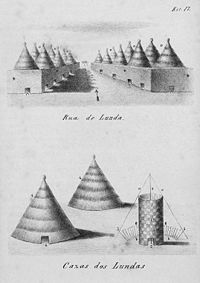
Ilunga Tshibinda
Ilunga Tshibinda was a Kingdom of Luba emperor and Lunda. Tshibinda Ilunga was the second son of Ilunga Mbidi and younger brother Kalala Ilunga....
married Lunda queen Rweej and united all Lunda peoples. Their son mulopwe Luseeng expanded the kingdom. His son Naweej expanded the empire further and is known as the first Lunda emperor, with the title mwato yamvo (mwaant yaav, mwant yav), the Lord of Vipers. The Luba political system was retained, and conquered peoples were integrated into the system. The mwato yamvo assigned a cilool or kilolo (royal adviser) and tax collector to each state conquered.
Numerous states claimed descent from the Lunda. The Imbangala
Imbangala
The Imbangala or Mbangala were 17th century groups of Angolan warriors and marauders who founded the kingdom of Kasanje.-Origins of the Imbangala:...
of inland Angola claimed descent from a founder, Kinguri, brother of Queen Rweej, who could not tolerate the rule of mulopwe Tshibunda. Kinguri became the title of kings of states founded by Queen Rweej's brother. The Luena (Lwena) and Lozi
Lozi people
The Lozi people are an ethnic group primarily of western Zambia, inhabiting the region of Barotseland. Lozi are also found in Namibia , Angola and Botswana.-Name:...
(Luyani) in Zambia also claim descent from Kinguri. During the 17th century, a Lunda chief and warrior called Mwata Kazembe set up an Eastern Lunda
Eastern Lunda
The Lunda people of the Luapula River valley in Zambia and DR Congo are called by others the Eastern Lunda to distinguish them from the 'western' Lunda people who remained in the heartland of the former Lunda Kingdom, but they themselves would use Kazembe-Lunda or Luunda with an elongated 'u' to...
kingdom in the valley of the Luapula River
Luapula River
The Luapula River is a section of Africa's second-longest river, the Congo. It is a transnational river forming for nearly all its length part of the border between Zambia and the DR Congo...
. The Lunda's western expansion also saw claims of descent by the Yaka and the Pende. The Lunda linked middle Africa with the western coast trade. The kingdom of Lunda came to an end in the 19th century when it was invaded by the Chokwe
Chokwe
The Chokwe also pronounced Tchokwe are an ethnic group of Central Africa whose ancestry can perhaps be traced to Mbundu and Mbuti Pygmies. Large groups of Chokwe currently reside in Angola, Zambia, and the Democratic Republic of Congo. Their language is usually referred to as Chokwe, a Bantu...
, who were armed with guns.
Maravi (Malawi)
The MaraviMaravi
Maravi was a state established by the Bantu Chewa people, descendants of the Amaravi, in the area of Lake Malawi, in present-day Malawi, in the 16th century...
claimed descent from Karonga (kalonga), who took that title as king. The Maravi connected middle Africa to the east coastal trade, with Swahili
Swahili people
The Swahili people are a Bantu ethnic group and culture found in East Africa, mainly in the coastal regions and the islands of Kenya, Tanzania and north Mozambique. According to JoshuaProject, the Swahili number in at around 1,328,000. The name Swahili is derived from the Arabic word Sawahil,...
Kilwa
Kilwa Empire
The Kilwa Empire was part of a larger empire built by the Iranian Bazrangids. It became an independent geopolitical entity after Ardashir I of the Sassanid Empire conquered its parent Bazrangi state in southern Persia in AD 224. Emperor Ardashir's successor, Shapur I, annexed the southern shores of...
. By the 17th century, the Maravi Empire encompassed all the area between Lake Malawi
Lake Malawi
Lake Malawi , is an African Great Lake and the southernmost lake in the Great Rift Valley system of East Africa. This lake, the third largest in Africa and the eighth largest lake in the world, is located between Malawi, Mozambique, and Tanzania...
and the mouth of the Zambezi River. The karonga was Mzura, who did much to extend the empire. Mzura made a pact with the Portuguese to establish a 4,000-man army to attack the Shona
Shona people
Shona is the name collectively given to two groups of people in the east and southwest of Zimbabwe, north eastern Botswana and southern Mozambique.-Shona Regional Classification:...
in return for aid in defeating his rival Lundi, a chief of the Zimba. In 1623, he turned on the Portuguese and assisted the Shona. In 1640, he welcome back the Portuguese for trade. The Maravi Empire did not long survive the death of Mzura. By the 18th century, it had broken into its previous polities.
Kingdom of Kongo
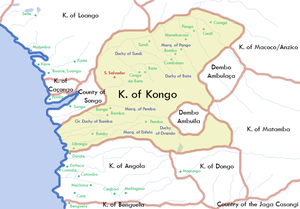
Kongo people
The Bakongo or the Kongo people , also sometimes referred to as Kongolese or Congolese, is a Bantu ethnic group which lives along the Atlantic coast of Africa from Pointe-Noire to Luanda, Angola...
(ba being the plural prefix) were unified as the Kingdom of Kongo
Kingdom of Kongo
The Kingdom of Kongo was an African kingdom located in west central Africa in what are now northern Angola, Cabinda, the Republic of the Congo, and the western portion of the Democratic Republic of the Congo...
under a ruler called the manikongo
Manikongo
The Manikongo or MweneKongo was the title of the rulers of the Kingdom of Kongo, a kingdom that existed from the fourteenth to the nineteenth centuries and consisted of land in present-day Angola and the Democratic Republic of Congo...
, residing in the fertile Pool Malebo
Pool Malebo
The Pool Malebo , is a lake-like widening in the lower reaches of the Congo River....
area on the lower Congo River
Congo River
The Congo River is a river in Africa, and is the deepest river in the world, with measured depths in excess of . It is the second largest river in the world by volume of water discharged, though it has only one-fifth the volume of the world's largest river, the Amazon...
. The capital was M'banza-Kongo
M'banza-Kongo
M'banza-Kongo , is the capital of Angola's northwestern Zaire Province. M'banza Kongo was founded some time before the arrival of the Portuguese and was the capital of the dynasty ruling at that time...
. With superior organization, they were able to conquer their neighbors and extract tribute. They were experts in metalwork, pottery, and weaving raffia cloth. They stimulated interregional trade via a tribute system controlled by the manikongo. Later, maize
Maize
Maize known in many English-speaking countries as corn or mielie/mealie, is a grain domesticated by indigenous peoples in Mesoamerica in prehistoric times. The leafy stalk produces ears which contain seeds called kernels. Though technically a grain, maize kernels are used in cooking as a vegetable...
(corn) and cassava
Cassava
Cassava , also called yuca or manioc, a woody shrub of the Euphorbiaceae native to South America, is extensively cultivated as an annual crop in tropical and subtropical regions for its edible starchy tuberous root, a major source of carbohydrates...
(manioc) would be introduced to the region via trade with the Portuguese at their ports at Luanda
Luanda
Luanda, formerly named São Paulo da Assunção de Loanda, is the capital and largest city of Angola. Located on Angola's coast with the Atlantic Ocean, Luanda is both Angola's chief seaport and its administrative center. It has a population of at least 5 million...
and Benguela
Benguela
Benguela is a city in western Angola, south of Luanda, and capital of Benguela Province. It lies on a bay of the same name, in 12° 33’ S., 13° 25’ E...
. The maize and cassava would result in population growth in the region and other parts of Africa, replacing millet
Millet
The millets are a group of small-seeded species of cereal crops or grains, widely grown around the world for food and fodder. They do not form a taxonomic group, but rather a functional or agronomic one. Their essential similarities are that they are small-seeded grasses grown in difficult...
as a main staple.
By the 16th century, the manikongo held authority from the Atlantic in the west to the Kwango River
Kwango River
The Cuango or Kwango is a transboundary river of Angola and Democratic Republic of Congo. It is the largest left bank tributary of the Kasai River in the Congo River basin. It flows through Malanje town in Angola...
in the east. Each territory was assigned a mani-mpembe (provincial governor) by the manikongo. In 1506, Afonso I
Afonso I of Kongo
Mvemba a Nzinga or Nzinga Mbemba , also known as King Afonso I, was a ruler of the Kingdom of Kongo in the first half of the 16th century. He reigned over the Kongo Empire from 1509 to late 1542 or 1543.-Pre-reign career:...
(1506–1542), a Christian, took over the throne. Slave trading increased with Afonso's wars of conquest. About 1568 to 1569, the Jaga
Jaga (people)
The Jaga or Jagas were terms applied by the Portuguese to invading bands of African warriors east and south of the kingdom of Kongo. The use of the phrase took on different connotations depending on where it was applied. There were two groups of people, both known for fierce warriors, that were...
invaded Kongo, laying waste to the kingdom and forcing the manikongo into exile. In 1574, Manikongo Álvaro I
Álvaro I of Kongo
Álvaro I Nimi a Lukeni lua Mvemba was a Manikongo , or king of Kongo, from 1568 to 1587.-Biography:Álvaro's father was an unknown Kongo nobleman who died, leaving his mother to remarry to King Henrique I. When Henrique I died fighting on the eastern frontier, he had left Álvaro as his regent...
was reinstated with the help of Portuguese mercenaries. During the latter part of the 1660s, the Portuguese tried to gain control of Kongo. Manikongo António I
António I of Kongo
António I Nvita a Nkanga was a mwenekongo of the Kingdom of Kongo who ruled from 1661 to his defeat and death at the Battle of Mbwila on October 29, 1665. He was elected following the death of King Garcia II...
(1661–1665), with a Kongolese army of 5,000, was destroyed by an army of Afro-Portuguese at the Battle of Mbwila
Battle of Mbwila
At the Battle of Mbwila on October 29, 1665, Portuguese forces defeated the forces of the Kingdom of Kongo and decapitated king António I of Kongo, also called Nvita a Nkanga.-Origins of the War:...
. The empire dissolved into petty polities, fighting among each other for war captives to sell into slavery.
Kongo gained captives from the Kingdom of Ndongo
Kingdom of Ndongo
The Kingdom of Ndongo, formerly known as Dongo or Angola, is the name of an early-modern African state located in what is now day Angola. Ndongo was built by the Northern Mbundu people, a Bantu-speaking people inhabiting northern Angola....
in wars of conquest. Ndongo was ruled by the ngola. Ndongo would also engage in slave trading with the Portuguese, with São Tomé
São Tomé
-Transport:São Tomé is served by São Tomé International Airport with regular flights to Europe and other African Countries.-Climate:São Tomé features a tropical wet and dry climate with a relatively lengthy wet season and a short dry season. The wet season runs from October through May while the...
being a transit point to Brazil. The kingdom was not as welcoming as Kongo; it viewed the Portuguese with great suspicion and as an enemy. The Portuguese in the latter part of the 16th century tried to gain control of Ndongo but were defeated by the Mbundu. Ndongo experienced depopulation from slave raiding. The leaders established another state at Matamba
Kingdom of Matamba
The Kingdom of Matamba was a pre-colonial African state located in what is now the Baixa de Cassange region of Malanje Province of modern day Angola...
, affiliated with Queen Nzinga
Nzinga of Ndongo and Matamba
Nzinga Mbande , also known as Ana de Sousa Nzinga Mbande, was a 17th century queen of the Ndongo and Matamba Kingdoms of the Mbundu people in southwestern Africa.-Early life:...
, who put up a strong resistance to the Portuguese until coming to terms with them. The Portuguese settled along the coast as trade dealers, not venturing on conquest of the interior. Slavery wreaked havoc in the interior, with states initiating wars of conquest for captives. The Imbangala
Imbangala
The Imbangala or Mbangala were 17th century groups of Angolan warriors and marauders who founded the kingdom of Kasanje.-Origins of the Imbangala:...
formed the slave-raiding state of Kasanje
Kasanje Kingdom
The Kasanje Kingdom, also known as the Jaga Kingdom, was a pre-colonial Central West African state. It was formed in 1620 by a mercenary band of Imbangala, which had deserted the Portuguese ranks. The state gets its name from the leader of the band, Kasanje, who settled his followers on the upper...
, a major source of slaves during the 17th and 18th centuries.
Southern Africa
Settlements of Bantu-speakingBantu languages
The Bantu languages constitute a traditional sub-branch of the Niger–Congo languages. There are about 250 Bantu languages by the criterion of mutual intelligibility, though the distinction between language and dialect is often unclear, and Ethnologue counts 535 languages...
peoples who were iron-using agriculturists and herdsmen were present south of the Limpopo River
Limpopo River
The Limpopo River rises in central southern Africa, and flows generally eastwards to the Indian Ocean. It is around long, with a drainage basin in size. Its mean annual discharge is 170 m³/s at its mouth...
by the 4th or 5th century CE, displacing and absorbing the original Khoisan speakers
Khoisan languages
The Khoisan languages are the click languages of Africa which do not belong to other language families. They include languages indigenous to southern and eastern Africa, though some, such as the Khoi languages, appear to have moved to their current locations not long before the Bantu expansion...
. They slowly moved south, and the earliest ironworks in modern-day KwaZulu-Natal Province
KwaZulu-Natal
KwaZulu-Natal is a province of South Africa. Prior to 1994, the territory now known as KwaZulu-Natal was made up of the province of Natal and the homeland of KwaZulu....
are believed to date from around 1050. The southernmost group was the Xhosa people, whose language incorporates certain linguistic traits from the earlier Khoi-San people, reaching the Great Fish River
Great Fish River
The Great Fish River is a river running through the South African province of the Eastern Cape, it originates east of Graaff-Reinet and runs through Cradock, just south of this the Tarka River joins it...
in today's Eastern Cape Province
Eastern Cape
The Eastern Cape is a province of South Africa. Its capital is Bhisho, but its two largest cities are Port Elizabeth and East London. It was formed in 1994 out of the "independent" Xhosa homelands of Transkei and Ciskei, together with the eastern portion of the Cape Province...
.
Great Zimbabwe and Mapungubwe
The Kingdom of Mapungubwe was the first state in Southern AfricaSouthern Africa
Southern Africa is the southernmost region of the African continent, variably defined by geography or geopolitics. Within the region are numerous territories, including the Republic of South Africa ; nowadays, the simpler term South Africa is generally reserved for the country in English.-UN...
, with its capital at Mapungubwe. The state arose in the 12th century CE. Its wealth came from controlling the trade in ivory from the Limpopo Valley
Limpopo River
The Limpopo River rises in central southern Africa, and flows generally eastwards to the Indian Ocean. It is around long, with a drainage basin in size. Its mean annual discharge is 170 m³/s at its mouth...
, copper from the mountains of northern Transvaal
Transvaal Province
Transvaal Province was a province of the Union of South Africa from 1910 to 1961, and of its successor, the Republic of South Africa, from 1961 until the end of apartheid in 1994 when a new constitution subdivided it.-History:...
, and gold from the Zimbabwe
Zimbabwe
Zimbabwe is a landlocked country located in the southern part of the African continent, between the Zambezi and Limpopo rivers. It is bordered by South Africa to the south, Botswana to the southwest, Zambia and a tip of Namibia to the northwest and Mozambique to the east. Zimbabwe has three...
Plateau between the Limpopo and Zambezi rivers, with the Swahili
Swahili people
The Swahili people are a Bantu ethnic group and culture found in East Africa, mainly in the coastal regions and the islands of Kenya, Tanzania and north Mozambique. According to JoshuaProject, the Swahili number in at around 1,328,000. The name Swahili is derived from the Arabic word Sawahil,...
merchants at Chibuene
Chibuene
Chibuene is a Mozambiquean archaeological site, located five kilometres south of the coastal city of Vilanculos. The site was occupied during two distinct phases. The earlier phase of occupation dates to the late first millennium AD. The second phase dates from around 1450 and is contemporaneous...
. By the mid 13th century, Mapungubwe was abandoned.
After the decline of Mapungubwe, Great Zimbabwe
Great Zimbabwe
Great Zimbabwe is a ruined city that was once the capital of the Kingdom of Zimbabwe, which existed from 1100 to 1450 C.E. during the country’s Late Iron Age. The monument, which first began to be constructed in the 11th century and which continued to be built until the 14th century, spanned an...
rose on the Zimbabwe Plateau. Zimbabwe means stone building. Great Zimbabwe was the first city in Southern Africa and was the center of an empire, consolidating lesser Shona
Shona people
Shona is the name collectively given to two groups of people in the east and southwest of Zimbabwe, north eastern Botswana and southern Mozambique.-Shona Regional Classification:...
polities. Stone building was inherited from Mapungubwe. These building techniques were enhanced and came into maturity at Great Zimbabwe, represented by the wall of the Great Enclosure. The dry-stack stone masonry technology was also used to build smaller compounds in the area. Great Zimbabwe flourished by trading with Swahili Kilwa
Kilwa Empire
The Kilwa Empire was part of a larger empire built by the Iranian Bazrangids. It became an independent geopolitical entity after Ardashir I of the Sassanid Empire conquered its parent Bazrangi state in southern Persia in AD 224. Emperor Ardashir's successor, Shapur I, annexed the southern shores of...
and Sofala
Sofala
Sofala, at present known as Nova Sofala, used to be the chief seaport of the Monomotapa Kingdom, whose capital was at Mount Fura. It is located on the Sofala Bank in Sofala Province of Mozambique.-History:...
. The rise of Great Zimbabwe parallels the rise of Kilwa. Great Zimbabwe was a major source of gold. Its royal court lived in luxury, wore Indian cotton, surrounded themselves with copper and gold ornaments, and ate on plates from as far away as Persia and China. Around the 1420s and 1430s, Great Zimbabwe was on the decline. The city was abandoned by 1450. Some have attributed the decline to the rise of the trading town Ingombe Ilede
Ingombe Ilede
Ingombe Ilede is an archaeological site in Zambia, on a hill near the confluence of the Zambezi and Lusitu rivers, near the town of Siavonga close to the Kariba Dam. The name means "the sleeping cow". The site was uncovered in 1960....
.
A new chapter of Shona history ensued. Mutota, a northern Shona king of the Karanga,, engaged in conquest. He and his son Mutope conquered the Zimbabwe Plateau, going through Mozambique
Mozambique
Mozambique, officially the Republic of Mozambique , is a country in southeastern Africa bordered by the Indian Ocean to the east, Tanzania to the north, Malawi and Zambia to the northwest, Zimbabwe to the west and Swaziland and South Africa to the southwest...
to the east coast, linking the empire to the coastal trade. They called their empire Wilayatu 'l Mu'anamutapah or mwanamutapa (Lord of the Plundered Lands), or the Kingdom of Mutapa. Monomotapa was the Portuguese corruption. They did not build stone structures; the northern Shonas had no traditions of building in stone. After the death of Matope in 1480, the empire split into two small empires: Torwa
Torwa dynasty
The Torwa dynasty was the ruling family of the Butua kingdom that arose from the collapse of Great Zimbabwe in the sixteenth and seventeenth century, founded perhaps by the legendary Dlembeu....
in the south and Mutapa in the north. The split occurred over rivalry from two Shona lords, Changa and Togwa, with the mwanamutapa line. Changa was able to acquire the south, forming the Kingdom of Butua with its capital at Khami
Khami
Khami is a ruined city located in what is now Zimbabwe. It was once the capital of the Kingdom of Butua of the Torwa dynasty. It is located 22 kilometers west of the modern city of Bulawayo, capital of the province of Matabeleland North. Its ruins are now a national monument in Zimbabwe. Khami is...
.
The Mutapa Empire continued in the north under the mwanamutapa line. During the 16th century the Portuguese were able to establish permanent markets up the Zambezi River in an attempt to gain political and military control of Mutapa. They were partially successful. In 1628, a decisive battle allowed them to put a puppet mwanamutapa named Mavura, who signed treaties that gave favorable mineral export rights to the Portuguese. The Portuguese were successful in destroying the mwanamutapa system of government and undermining trade. By 1667, Mutapa was in decay. Chiefs would not allow digging for gold because of fear of Portuguese theft, and the population declined.
The Kingdom of Butua was ruled by a changamire, a title derived from the founder, Changa. Later it became the Rozwi Empire
Rozwi Empire
The Rozwi Empire or Lozwi Empire was established on the Zimbabwean Plateau by Changamire Dombo.-History:In 1693, Portuguese militia tried to take control of the gold trade in the interior of sub-saharan Africa by invading the Rozwi empire...
. The Portuguese tried to gain a foothold but were thrown out of the region in 1693, by Changamire Dombo. The 17th century was a period of peace and prosperity. The Rozwi Empire fell into ruins in the 1830s from invading Nguni
Nguni people
-History:The ancient history of the Nguni people is wrapped up in their oral history. According to legend they were a people who migrated from Egypt to the Great Lakes region of sub-equatorial Central/East Africa...
from Natal
KwaZulu-Natal
KwaZulu-Natal is a province of South Africa. Prior to 1994, the territory now known as KwaZulu-Natal was made up of the province of Natal and the homeland of KwaZulu....
.
Namibia
By 1500 CE, most of southern Africa had established states. In northwestern NamibiaNamibia
Namibia, officially the Republic of Namibia , is a country in southern Africa whose western border is the Atlantic Ocean. It shares land borders with Angola and Zambia to the north, Botswana to the east and South Africa to the south and east. It gained independence from South Africa on 21 March...
, the Ovambo engaged in farming and the Herero engaged in herding. As cattle numbers increased, the Herero moved southward to central Namibia for grazing land. A related group, the Mbanderu, expanded to Ghanzi
Ghanzi
Ghanzi is a town in the western part of the Republic of Botswana in southern Africa. At the time of the 2001 census, there were 9,934 people living in the town with another 861 nearby. It is the administrative center of Ghanzi District and is known as the "Capital of the Kalahari"...
in northwestern Botswana
Botswana
Botswana, officially the Republic of Botswana , is a landlocked country located in Southern Africa. The citizens are referred to as "Batswana" . Formerly the British protectorate of Bechuanaland, Botswana adopted its new name after becoming independent within the Commonwealth on 30 September 1966...
. The Nama, a Khoi-speaking
Khoisan languages
The Khoisan languages are the click languages of Africa which do not belong to other language families. They include languages indigenous to southern and eastern Africa, though some, such as the Khoi languages, appear to have moved to their current locations not long before the Bantu expansion...
, sheep-raising group, moved northward and came into contact with the Herero; this would set the stage for much conflict between the two groups. The expanding Lozi
Lozi people
The Lozi people are an ethnic group primarily of western Zambia, inhabiting the region of Barotseland. Lozi are also found in Namibia , Angola and Botswana.-Name:...
states pushed the Mbukushu
Mbukushu
Mbukushu is a traditional Kavango kingdom in what is today Namibia. Its people speak the Mbukushu language.- References :* *...
, Subiya
Kuhane language
Kuhane, or Subiya, also known as Kwahane, Chikuahane, Chikwahane, Ciikuhane, or Mbalangwe, is a Bantu language spoken by 35,000 people along the Okavango River in Namibia, Zambia, and Botswana. In Tswana it is known as Subiya . It is one of several Bantu languages of the Okavango which have click...
, and Yei to Botei, Okavango, and Chobe
Chobe District
Chobe District is a district of Botswana, with the headquarters in Kasane. Until 2006, it shared with Ngamiland the North-West District Council as local government. Chobe National park is in the Chobe District...
in northern Botswana.
Sotho–Tswana
The development of Sotho–Tswana states based on the highveld
Highveld
The Highveld is a high plateau region of inland South Africa which is largely home to the largest metropolitan area in the country, the Gauteng City Region, which accounts for one-third of South Africa's population.-Location and description:...
, south of the Limpopo River
Limpopo River
The Limpopo River rises in central southern Africa, and flows generally eastwards to the Indian Ocean. It is around long, with a drainage basin in size. Its mean annual discharge is 170 m³/s at its mouth...
, began around 1000 CE. The chief's power rested on cattle and his connection to the ancestor. This can be seen in the Toutswemogala Hill
Toutswemogala Hill
Toutswemogala Hill lies 6.5 km West of the North-South Highway in the Central District of Botswana. It is situated about 50 km north of the village of Palapye. Toutswemogala is an elongated flat-topped hill rising about 50 meters above the surrounding flat mopane veld. It is an Iron Age settlement,...
settlements with stone foundations and stone walls, north of the highveld and south of the Vaal River
Vaal River
The Vaal River is the largest tributary of the Orange River in South Africa. The river has its source in the Drakensberg mountains in Mpumalanga, east of Johannesburg and about 30 km north of Ermelo and only about 240 km from the Indian Ocean. It then flows westwards to its conjunction...
. Northwest of the Vaal River developed early Tswana states centered around towns of thousands of people. When disagreements or rivalry arose, different groups moved to form their own states.
The Nguni People
Southeast of the Drakensberg
Drakensberg
The Drakensberg is the highest mountain range in Southern Africa, rising to in height. In Zulu, it is referred to as uKhahlamba , and in Sesotho as Maluti...
mountains lived Nguni-speaking peoples (Zulu, Xhosa, Swazi, and Ndebele
Ndebele
- Ethnic groups :*South Ndebele people, located in the South Africa*Northern Ndebele people, located in Zimbabwe, and Botswana- Languages :*Southern Ndebele language, the language of the South Ndebele...
). They too engaged in state building, with new states developing from rivalry, disagreements, and population pressure causing movement into new regions. This nineteenth century process of warfare, state building and migration later became known as the Mfecane (Nguni) or Difaqane (Sotho). Its major catalyst was the consolidation of the Zulu state. They were metalworkers, cultivators of millet, and cattle herders.
Khoisan and Afrikaaner
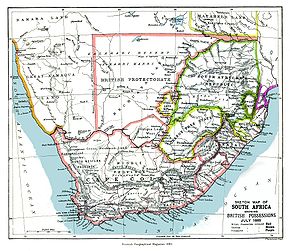
Khoisan
Khoisan is a unifying name for two ethnic groups of Southern Africa, who share physical and putative linguistic characteristics distinct from the Bantu majority of the region. Culturally, the Khoisan are divided into the foraging San and the pastoral Khoi...
lived in the southwestern Cape Province
Cape Province
The Province of the Cape of Good Hope was a province in the Union of South Africa and subsequently the Republic of South Africa...
, where winter rainfall is plentiful. Earlier Khoisan populations were absorbed by Bantu peoples, such as the Sotho and Nguni
Nguni people
-History:The ancient history of the Nguni people is wrapped up in their oral history. According to legend they were a people who migrated from Egypt to the Great Lakes region of sub-equatorial Central/East Africa...
, but the Bantu expansion
Bantu expansion
The Bantu expansion or the Bantu Migration was a millennia-long series of migrations of speakers of the original proto-Bantu language group...
stopped at the region with winter rainfall. Some Bantu languages
Bantu languages
The Bantu languages constitute a traditional sub-branch of the Niger–Congo languages. There are about 250 Bantu languages by the criterion of mutual intelligibility, though the distinction between language and dialect is often unclear, and Ethnologue counts 535 languages...
have incorporated the click characteristic of the Khoisan languages
Khoisan languages
The Khoisan languages are the click languages of Africa which do not belong to other language families. They include languages indigenous to southern and eastern Africa, though some, such as the Khoi languages, appear to have moved to their current locations not long before the Bantu expansion...
. The Khoisan traded with their Bantu neighbors, providing cattle, sheep, and hunted items. In return, their Bantu speaking neighbors traded copper, iron, and tobacco.
By the 16th century, the Dutch East India Company
Dutch East India Company
The Dutch East India Company was a chartered company established in 1602, when the States-General of the Netherlands granted it a 21-year monopoly to carry out colonial activities in Asia...
established a replenishing station at Table Bay
Table Bay
Table Bay is a natural bay on the Atlantic Ocean overlooked by Cape Town and is at the northern end of the Cape Peninsula, which stretches south to the Cape of Good Hope. It was named because it is dominated by the flat-topped Table Mountain.Bartolomeu Dias was the first European to explore this...
for restocking water and purchasing meat from the Khoikhoi
Khoikhoi
The Khoikhoi or Khoi, in standardised Khoekhoe/Nama orthography spelled Khoekhoe, are a historical division of the Khoisan ethnic group, the native people of southwestern Africa, closely related to the Bushmen . They had lived in southern Africa since the 5th century AD...
. The Khoikhoi received copper, iron, tobacco, and beads in exchange. In order to control the price of meat and stock and make service more consistent, the Dutch established a permanent settlement at Table Bay in 1652. They grew fresh fruit and vegetables and established a hospital for sick sailors. To increase produce, the Dutch decided to increase the number of farms at Table Bay by encouraging freeburgher boer
Boer
Boer is the Dutch and Afrikaans word for farmer, which came to denote the descendants of the Dutch-speaking settlers of the eastern Cape frontier in Southern Africa during the 18th century, as well as those who left the Cape Colony during the 19th century to settle in the Orange Free State,...
s (farmers) on lands worked initially by slaves from West Africa. The land was taken from Khoikhoi grazing land, triggering the first Khoikhoi-Dutch war
Khoikhoi-Dutch Wars
The Khoikhoi–Dutch Wars were a series of conflicts that took place in the last half of the 17th century in what was known then as the Cape of Good Hope , in the area of present-day Cape Town, South Africa, between Dutch settlers who came from The Netherlands and the local African people, the most...
in 1659. No victors emerged, but the Dutch assumed a "right of conquest" by which they claimed all of the cape. In a series of wars pitting the Khoikhoi against each other, the Boers assumed all Khoikhoi land and claimed all their cattle. The second Khoikoi-Dutch war (1673–1677) was a cattle raid. The Khoikhoi also died in thousands from European diseases.
By the 18th century, the cape colony had grown, with slaves coming from Madagascar
Madagascar
The Republic of Madagascar is an island country located in the Indian Ocean off the southeastern coast of Africa...
, Mozambique
Mozambique
Mozambique, officially the Republic of Mozambique , is a country in southeastern Africa bordered by the Indian Ocean to the east, Tanzania to the north, Malawi and Zambia to the northwest, Zimbabwe to the west and Swaziland and South Africa to the southwest...
, and Indonesia
Indonesia
Indonesia , officially the Republic of Indonesia , is a country in Southeast Asia and Oceania. Indonesia is an archipelago comprising approximately 13,000 islands. It has 33 provinces with over 238 million people, and is the world's fourth most populous country. Indonesia is a republic, with an...
. The settlement also started to expand northward, but Khoikhoi resistance, raids, and guerrilla warfare slowed the expansion during the 18th century. Boers who started to practice pastoralism were known as trekboer
Trekboer
The Trekboers were nomadic pastoralists descended from almost equal numbers of Dutch colonists, French Huguenots and German Protestants. The Trekboere began migrating from the areas surrounding what is now Cape Town during the 17th century throughout the 18th century.-Origins:The Trekboere were...
s. A common source of trekboer labor was orphan children who were captured during raids and whose parents had been killed.
Southern Africa
By the 1850s, British and German missionaries and traders had penetrated Namibia. Herero and Nama competed for guns and ammunition, providing cattle, ivory, and ostrich feathers. The Germans were more firmly established than the British in the region. By 1884, the Germans declared the coastal region from the Orange RiverOrange River
The Orange River , Gariep River, Groote River or Senqu River is the longest river in South Africa. It rises in the Drakensberg mountains in Lesotho, flowing westwards through South Africa to the Atlantic Ocean...
to the Kunene River
Cunene River
The Cunene River or Kunene River is a river in Southern Africa. It flows from the Angola highlands south to the border with Namibia. It then flows west along the border until it reaches the Atlantic Ocean. It is one of the few perennial rivers in the region. It is about long, with a drainage...
a German protectorate. They pursued an aggressive policy of land expansion for white settlements. They exploited rivalry between the Nama and Herero.
The Herero entered into an alliance with the Germans, thinking they could get an upper hand on the Nama. The Germans set up a garrison at the Herero capital and started allocating Herero land for white settlements, including the best grazing land in the central plateau, and made tax and labor demands. The Herero and Mbanderu rebelled, but the rebellion was crushed and leaders were executed. Between 1896 and 1897, rinderpest
Rinderpest
Rinderpest was an infectious viral disease of cattle, domestic buffalo, and some other species of even-toed ungulates, including buffaloes, large antelopes and deer, giraffes, wildebeests and warthogs. After a global eradication campaign, the last confirmed case of rinderpest was diagnosed in 2001...
crippled the economic backbone of the Herero and Nama economy and slowed white expansion. The Germans continued the policy of making Namibia a white settlement by seizing land and cattle, and even trying to export Herero labor to South Africa.
In 1904, the Herero rebelled. German General Lothar von Trotha
Lothar von Trotha
Adrian Dietrich Lothar von Trotha was a German military commander widely condemned for his conduct of the Herero Wars in South-West Africa, especially for the events that led to the near-extermination of the Herero....
implemented an extermination policy
Herero and Namaqua Genocide
The Herero and Namaqua Genocide is considered to have been the first genocide of the 20th century. It took place between 1904 and 1907 in German South-West Africa , during the scramble for Africa...
at the Battle of Waterberg
Battle of Waterberg
The Battle of Waterberg took place on August 11, 1904 in Waterberg, German South-West Africa , and was the decisive battle in the German campaign against the Herero.-The armies:...
, which drove the Herero west of the Kalahari Desert
Kalahari Desert
The Kalahari Desert is a large semi-arid sandy savannah in Southern Africa extending , covering much of Botswana and parts of Namibia and South Africa, as semi-desert, with huge tracts of excellent grazing after good rains. The Kalahari supports more animals and plants than a true desert...
. At the end of 1905, only 16,000 Herero were alive, out of a previous population of 80,000. Nama resistance was crushed in 1907. All Nama and Herero cattle and land were confiscated from the very diminished population, with remaining Nama and Herero assuming a subordinate position. Labor had to be imported from among the Ovambo.
Nguniland
A moment of great disorder in southern Africa was the MfecaneMfecane
Mfecane , also known by the Sesotho name Difaqane or Lifaqane, was a period of widespread chaos and warfare among indigenous tribes in southern Africa during the period between 1815 to about 1840....
, "the crushing." It was started by the northern Nguni kingdoms of Mthethwa, Ndwandwe
Ndwandwe
The Ndwandwe clan are a subgroup of the Nguni people who populate sections of Southern Africa.The Ndwandwe, with the Mthethwa, were a significant power in present-day Zululand at the turn of the nineteenth century...
, and Swaziland over scarce resource and famine. When Dingiswayo
Dingiswayo
Dingiswayo was a Mtetwa chief, best known for his mentorship over a young Zulu general, Shaka Zulu, who rose to become the greatest of the Zulu kings.He was born Godongwana, son of Mthethwa chief Jobe...
of Mthethwa died, Shaka
Shaka
Shaka kaSenzangakhona , also known as Shaka Zulu , was the most influential leader of the Zulu Kingdom....
of the Zulu people took over. He established the Zulu Kingdom
Zulu Kingdom
The Zulu Kingdom, sometimes referred to as the Zulu Empire or, rather imprecisely, Zululand, was a monarchy in Southern Africa that extended along the coast of the Indian Ocean from the Tugela River in the south to Pongola River in the north....
, asserting authority over the Ndwandwe and pushing the Swazi north. The scattering Ndwandwe and Swazi caused the Mfecane to spread. During the 1820s, Shaka expanded the empire all along the Drakensberg foothills, with tribute being paid as far south as the Tugela
Tugela River
The Tugela River is the largest river in KwaZulu-Natal Province, South Africa. The river originates in the Drakensberg Mountains, Mont-aux-Sources, and plunges 947 metres down the Tugela Falls...
and Umzimkulu
Umzimkulu River
The Umzimkulu River is a river in South Africa. It rises in the Drakensberg mountains and flows southeast towards the Indian Ocean, which it enters in Port Shepstone. Towns on the Umzimkulu include Underberg and Umzimkulu...
rivers. He replaced the chiefs of conquered polities with indunas, responsible to him. He introduced a centralized, dedicated, and disciplined military force not seen in the region, with a new weapon in the short stabbing-spear.
In 1828, Shaka was assassinated by his half brother Dingane, who lacked the military genius and leadership skills of Shaka. Voortrekkers
Voortrekkers
The Voortrekkers were emigrants during the 1830s and 1840s who left the Cape Colony moving into the interior of what is now South Africa...
tried to occupy Zulu land in 1838. In the early months they were defeated, but the survivors regrouped at the Ncome River
Blood River
Blood River, , is situated in KwaZulu-Natal, South Africa- See also :* List of rivers of South Africa...
and soundly defeated the Zulu. However, the Voortrekkers dared not settle Zulu land. Dingane was killed in 1840 during a civil war. His brother Mpande
Mpande
Mpande , uMsimude owavela ngesiluba phakathi kwamaNgisi namaQadasi, as he was praised, was king of the Zulu nation from 1840 to 1872, making him the longest reigning Zulu king. He was a half-brother of Shaka and Dingane, who both preceded him as kings of the Zulu...
took over and strengthened Zulu territories to the north. In 1879 the Zulu Kingdom was invaded by Britain in a quest to control all of South Africa
South Africa
The Republic of South Africa is a country in southern Africa. Located at the southern tip of Africa, it is divided into nine provinces, with of coastline on the Atlantic and Indian oceans...
. The Zulu Kingdom was victorious at the Battle of Isandlwana
Battle of Isandlwana
The Battle of Isandlwana on 22 January 1879 was the first major encounter in the Anglo-Zulu War between the British Empire and the Zulu Kingdom...
but was defeated at the Battle of Ulundi
Battle of Ulundi
The Battle of Ulundi took place at the Zulu capital of Ulundi on 4 July 1879 and was the last major battle of the Anglo-Zulu War. The British army finally broke the military power of the Zulu nation by defeating the main Zulu army and immediately afterwards capturing and razing the capital of...
.
One of the major states to emerge from the Mfecane
Mfecane
Mfecane , also known by the Sesotho name Difaqane or Lifaqane, was a period of widespread chaos and warfare among indigenous tribes in southern Africa during the period between 1815 to about 1840....
was the Sotho Kingdom
Lesotho
Lesotho , officially the Kingdom of Lesotho, is a landlocked country and enclave, surrounded by the Republic of South Africa. It is just over in size with a population of approximately 2,067,000. Its capital and largest city is Maseru. Lesotho is a member of the Commonwealth of Nations. The name...
founded at Thaba Bosiu
Thaba Bosiu
Thaba Bosiu is a sandstone plateau with an area of approximately 2 km2 and a height of 1,804 meters above sea level. It is located between the Orange and Caledon Rivers in the Maseru District of Lesotho, 24 km east of the country's capital Maseru....
by Moshoeshoe I
Moshoeshoe I
Moshoeshoe was born at Menkhoaneng in the Northern part of present-day Lesotho. He was the first son of Mokhachane, a minor chief of the Bamokoteli lineage- a branch of the Koena clan. In his early childhood, he helped his father gain power over some other smaller clans. At the age of 34...
around 1821 to 1822. It was a confederation different polities that accepted the absolute authority of Moshoeshoe. During the 1830s, the kingdom invited missionaries as a strategic means of acquiring guns and horses from the Cape
Cape Province
The Province of the Cape of Good Hope was a province in the Union of South Africa and subsequently the Republic of South Africa...
. Orange Free State
Orange Free State
The Orange Free State was an independent Boer republic in southern Africa during the second half of the 19th century, and later a British colony and a province of the Union of South Africa. It is the historical precursor to the present-day Free State province...
slowly diminished the kingdom but never completely defeated it. In 1868, Moshoeshoe asked that the Sotho Kingdom be annexed by Britain, to save the remnant. It became the British protectorate of Basutoland
Basutoland
Basutoland or officially the Territory of Basutoland, was a British Crown colony established in 1884 after the Cape Colony's inability to control the territory...
.
Voortrekkers
By the 19th century, most Khoikhoi territory was under Boer control. The Khoikhoi had lost economic and political independence and had been absorbed into Boer society. The Boers spoke Afrikaans, a language or dialect derived from DutchDutch language
Dutch is a West Germanic language and the native language of the majority of the population of the Netherlands, Belgium, and Suriname, the three member states of the Dutch Language Union. Most speakers live in the European Union, where it is a first language for about 23 million and a second...
, and no longer called themselves Boers but Afrikaner
Afrikaner
Afrikaners are an ethnic group in Southern Africa descended from almost equal numbers of Dutch, French and German settlers whose native tongue is Afrikaans: a Germanic language which derives primarily from 17th century Dutch, and a variety of other languages.-Related ethno-linguistic groups:The...
. Some Khoikhoi were used as commandos in raids against other Khoikhoi and later Xhosa. A mixed Khoi, slave, and European population called the Cape Coloureds
Cape Coloureds
The Cape Coloureds form a minority group within South Africa, however they are the predominant population group in the Western Cape. They are generally bilingual, however subsets within the group can be exclusively Afrikaans speakers, whereas others primarily speak English...
, who were outcasts within colonial society, also arose. Khoikhoi who lived far on the frontier included the Kora, Oorlams, and Griqua. In 1795, the British took over the cape colony from the Dutch.
In the 1830s, Boers embarked on a journey of expansion, east of the Great Fish River
Great Fish River
The Great Fish River is a river running through the South African province of the Eastern Cape, it originates east of Graaff-Reinet and runs through Cradock, just south of this the Tarka River joins it...
into the Zuurveld. They were referred to as Voortrekkers
Voortrekkers
The Voortrekkers were emigrants during the 1830s and 1840s who left the Cape Colony moving into the interior of what is now South Africa...
. They founded republics of the Transvaal
South African Republic
The South African Republic , often informally known as the Transvaal Republic, was an independent Boer-ruled country in Southern Africa during the second half of the 19th century. Not to be confused with the present-day Republic of South Africa, it occupied the area later known as the South African...
and Orange Free State
Orange Free State
The Orange Free State was an independent Boer republic in southern Africa during the second half of the 19th century, and later a British colony and a province of the Union of South Africa. It is the historical precursor to the present-day Free State province...
, mostly in areas of sparse population that had been diminished by the Mfecane/Difaqane
Mfecane
Mfecane , also known by the Sesotho name Difaqane or Lifaqane, was a period of widespread chaos and warfare among indigenous tribes in southern Africa during the period between 1815 to about 1840....
. Unlike the Khoisan, the Bantu states were not conquered by the Afrikaners, because of population density and greater unity. Additionally, they began to arm themselves with guns acquired through trade at the cape. In some cases, as in the Xhosa/Boer Wars
Xhosa wars
The Xhosa Wars, also known as the Cape Frontier Wars, were a series of nine wars between the Xhosa people and European settlers, from 1779 to 1879 in what is now the Eastern Cape in South Africa....
, Boers were removed from Xhosa lands. It required a dedicated imperial military force to subdue the Bantu-speaking states. In 1901, the Boer republics were defeated by Britain in the Second Boer War
Second Boer War
The Second Boer War was fought from 11 October 1899 until 31 May 1902 between the British Empire and the Afrikaans-speaking Dutch settlers of two independent Boer republics, the South African Republic and the Orange Free State...
. The defeat however consummated many Afrikaners' ambition: South Africa would be under white rule. The British placed all power—legislative, executive, administrative—in English and Afrikaner hands.
European trade, exploration and conquest
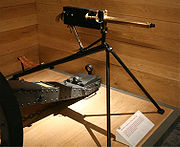
Repeating rifle
A repeating rifle is a single barreled rifle containing multiple rounds of ammunition. These rounds are loaded from a magazine by means of a manual or automatic mechanism, and the action that reloads the rifle also typically recocks the firing action...
s, which were easier and quicker to load than musket
Musket
A musket is a muzzle-loaded, smooth bore long gun, fired from the shoulder. Muskets were designed for use by infantry. A soldier armed with a musket had the designation musketman or musketeer....
s. Artillery
Artillery
Originally applied to any group of infantry primarily armed with projectile weapons, artillery has over time become limited in meaning to refer only to those engines of war that operate by projection of munitions far beyond the range of effect of personal weapons...
was being used increasingly. In 1885, Hiram S. Maxim developed the maxim gun
Maxim gun
The Maxim gun was the first self-powered machine gun, invented by the American-born British inventor Sir Hiram Maxim in 1884. It has been called "the weapon most associated with [British] imperial conquest".-Functionality:...
, the model of the modern-day machine gun
Machine gun
A machine gun is a fully automatic mounted or portable firearm, usually designed to fire rounds in quick succession from an ammunition belt or large-capacity magazine, typically at a rate of several hundred rounds per minute....
. European states kept these weapons largely among themselves by refusing to sell these weapons to African leaders.
African germs took numerous European lives and deterred permanent settlements. Diseases such as yellow fever
Yellow fever
Yellow fever is an acute viral hemorrhagic disease. The virus is a 40 to 50 nm enveloped RNA virus with positive sense of the Flaviviridae family....
, sleeping sickness, yaws
Yaws
Yaws is a tropical infection of the skin, bones and joints caused by the spirochete bacterium Treponema pallidum pertenue...
, and leprosy
Leprosy
Leprosy or Hansen's disease is a chronic disease caused by the bacteria Mycobacterium leprae and Mycobacterium lepromatosis. Named after physician Gerhard Armauer Hansen, leprosy is primarily a granulomatous disease of the peripheral nerves and mucosa of the upper respiratory tract; skin lesions...
made Africa a very inhospitable place for Europeans. The deadliest disease was malaria
Malaria
Malaria is a mosquito-borne infectious disease of humans and other animals caused by eukaryotic protists of the genus Plasmodium. The disease results from the multiplication of Plasmodium parasites within red blood cells, causing symptoms that typically include fever and headache, in severe cases...
, endemic throughout tropical Africa. In 1854, the discovery of quinine
Quinine
Quinine is a natural white crystalline alkaloid having antipyretic , antimalarial, analgesic , anti-inflammatory properties and a bitter taste. It is a stereoisomer of quinidine which, unlike quinine, is an anti-arrhythmic...
and other medical innovations helped to make conquest and colonization in Africa possible.
Strong motives for conquest of Africa were at play. Raw materials were needed for European factories. Europe in the early part of the 19th century was undergoing its Industrial Revolution
Industrial Revolution
The Industrial Revolution was a period from the 18th to the 19th century where major changes in agriculture, manufacturing, mining, transportation, and technology had a profound effect on the social, economic and cultural conditions of the times...
. Nationalist rivalries and prestige were at play. Acquiring African colonies would show rivals that a nation was powerful and significant. These factors culminated in the Scramble for Africa
Scramble for Africa
The Scramble for Africa, also known as the Race for Africa or Partition of Africa was a process of invasion, occupation, colonization and annexation of African territory by European powers during the New Imperialism period, between 1881 and World War I in 1914...
.
Mungo Park (explorer)
Mungo Park was a Scottish explorer of the African continent. He was credited as being the first Westerner to encounter the Niger River.-Early life:...
traversed the Niger River
Niger River
The Niger River is the principal river of western Africa, extending about . Its drainage basin is in area. Its source is in the Guinea Highlands in southeastern Guinea...
. James Bruce
James Bruce
James Bruce was a Scottish traveller and travel writer who spent more than a dozen years in North Africa and Ethiopia, where he traced the origins of the Blue Nile.-Youth:...
travelled through Ethiopia
Ethiopia
Ethiopia , officially known as the Federal Democratic Republic of Ethiopia, is a country located in the Horn of Africa. It is the second-most populous nation in Africa, with over 82 million inhabitants, and the tenth-largest by area, occupying 1,100,000 km2...
and located the source of the Blue Nile
Blue Nile
The Blue Nile is a river originating at Lake Tana in Ethiopia. With the White Nile, the river is one of the two major tributaries of the Nile...
. Richard Francis Burton
Richard Francis Burton
Captain Sir Richard Francis Burton KCMG FRGS was a British geographer, explorer, translator, writer, soldier, orientalist, cartographer, ethnologist, spy, linguist, poet, fencer and diplomat. He was known for his travels and explorations within Asia, Africa and the Americas as well as his...
was the first European at Lake Tanganyika
Lake Tanganyika
Lake Tanganyika is an African Great Lake. It is estimated to be the second largest freshwater lake in the world by volume, and the second deepest, after Lake Baikal in Siberia; it is also the world's longest freshwater lake...
. Samuel White Baker explored the Upper Nile. John Hanning Speke
John Hanning Speke
John Hanning Speke was an officer in the British Indian Army who made three exploratory expeditions to Africa and who is most associated with the search for the source of the Nile.-Life:...
located a source of the Nile
Nile
The Nile is a major north-flowing river in North Africa, generally regarded as the longest river in the world. It is long. It runs through the ten countries of Sudan, South Sudan, Burundi, Rwanda, Democratic Republic of the Congo, Tanzania, Kenya, Ethiopia, Uganda and Egypt.The Nile has two major...
at Lake Victoria
Lake Victoria
Lake Victoria is one of the African Great Lakes. The lake was named for Queen Victoria of the United Kingdom, by John Hanning Speke, the first European to discover this lake....
. Other significant European explorers included Heinrich Barth
Heinrich Barth
Heinrich Barth was a German explorer of Africa and scholar.Barth is one of the greatest of the European explorers of Africa, not necessarily because of the length of his travels or the time he spent alone without European company in Africa, but because of his singular character.-Biography:Barth...
, Henry Morton Stanley
Henry Morton Stanley
Sir Henry Morton Stanley, GCB, born John Rowlands , was a Welsh journalist and explorer famous for his exploration of Africa and his search for David Livingstone. Upon finding Livingstone, Stanley allegedly uttered the now-famous greeting, "Dr...
, Silva Porto
António Silva Porto
António de Carvalho da Silva Porto was a Portuguese naturalist painter.Born in Porto, he studied there under João António Correia and T. Furtado, then continued his studies in Paris and Rome....
, Alexandre de Serpa Pinto
Alexandre de Serpa Pinto
Alexandre Alberto da Rocha de Serpa Pinto was a Portuguese explorer of southern Africa and a colonial administrator....
, Rene Caille
René Caillé
René Caillié was a French explorer, and the first European to return alive from the town of Timbuktu.Caillié was born at Mauzé-sur-le-Mignon, Deux-Sèvres, Poitou, the son of a baker. He was born into the lowest levels of European society...
, Gerhard Rolfs, Gustav Nachtigal
Gustav Nachtigal
Gustav Nachtigal was a German explorer of Central and West Africa. He is further known as the German Empire's consul-general for Tunisia and Commissioner for West Africa. His mission as commissioner resulted in Togoland and Kamerun becoming the first colonies of a German colonial empire...
, George Schweinfurth, and Joseph Thomson
Joseph Thomson (explorer)
Joseph Thomson was a Scottish geologist and explorer who played an important part in the Scramble for Africa. Thomson's Gazelle is named for him. Excelling as an explorer rather than an exact scientist, he avoided confrontations among his porters or with indigenous peoples, neither killing any...
. The most famous of the explorers was David Livingstone
David Livingstone
David Livingstone was a Scottish Congregationalist pioneer medical missionary with the London Missionary Society and an explorer in Africa. His meeting with H. M. Stanley gave rise to the popular quotation, "Dr...
, who explored southern Africa and traversed the continent from the Atlantic at Luanda
Luanda
Luanda, formerly named São Paulo da Assunção de Loanda, is the capital and largest city of Angola. Located on Angola's coast with the Atlantic Ocean, Luanda is both Angola's chief seaport and its administrative center. It has a population of at least 5 million...
to the Indian Ocean at Quelimane
Quelimane
Quelimane is a seaport in Mozambique. It is the administrative capital of the Zambezia Province and the province's largest city, and stands 25 km from the mouth of the Rio dos Bons Sinais . The river was named when Vasco da Gama, on his way to India, reached it and saw "good signs" that he was on...
. European explorers made use of African guides and servants, and established long-distance trading routes were used.
Missionaries attempting to spread Christianity also increased European knowledge of Africa.
Between 1884 and 1885, European nations met at the Berlin West Africa Conference to discuss the partitioning of Africa. It was agreed that European claims to parts of Africa would only be recognised if Europeans provided effective occupation. In a series of treaties in 1890–1891, colonial boundaries were completely drawn. All of sub saharan Africa was claimed by European powers, except for Ethiopia (Abyssinia) and Liberia
Liberia
Liberia , officially the Republic of Liberia, is a country in West Africa. It is bordered by Sierra Leone on the west, Guinea on the north and Côte d'Ivoire on the east. Liberia's coastline is composed of mostly mangrove forests while the more sparsely populated inland consists of forests that open...
.
The European powers set up a variety of different administrations in Africa, reflecting different ambitions and degrees of power. In some areas, such as parts of British West Africa, colonial control was tenuous and intended for simple economic extraction, strategic power, or as part of a long term development plan. In other areas, Europeans were encouraged to settle, creating settler states in which a European minority dominated. Settlers only came to a few colonies in sufficient numbers to have a strong impact. British settler colonies included British East Africa (now Kenya), Northern
Northern Rhodesia
Northern Rhodesia was a territory in south central Africa, formed in 1911. It became independent in 1964 as Zambia.It was initially administered under charter by the British South Africa Company and formed by it in 1911 by amalgamating North-Western Rhodesia and North-Eastern Rhodesia...
and Southern Rhodesia
Southern Rhodesia
Southern Rhodesia was the name of the British colony situated north of the Limpopo River and the Union of South Africa. From its independence in 1965 until its extinction in 1980, it was known as Rhodesia...
, (Zambia
Zambia
Zambia , officially the Republic of Zambia, is a landlocked country in Southern Africa. The neighbouring countries are the Democratic Republic of the Congo to the north, Tanzania to the north-east, Malawi to the east, Mozambique, Zimbabwe, Botswana and Namibia to the south, and Angola to the west....
and Zimbabwe
Zimbabwe
Zimbabwe is a landlocked country located in the southern part of the African continent, between the Zambezi and Limpopo rivers. It is bordered by South Africa to the south, Botswana to the southwest, Zambia and a tip of Namibia to the northwest and Mozambique to the east. Zimbabwe has three...
, respectively), and South Africa
South Africa
The Republic of South Africa is a country in southern Africa. Located at the southern tip of Africa, it is divided into nine provinces, with of coastline on the Atlantic and Indian oceans...
, which already had a significant population of European settlers, the Boers.
France planned to settle Algeria and eventually incorporate it into the French state on an equal basis with the European provinces. Algeria's proximity across the Mediterranean allowed plans of this scale.
In most areas colonial administrations did not have the manpower or resources to fully administer the territory and had to rely on local power structures to help them. Various factions and groups within the societies exploited this European requirement for their own purposes, attempting to gain positions of power within their own communities by cooperating with Europeans. One aspect of this struggle included what Terence Ranger
Terence Ranger
Terence Osborn Ranger is a prominent African historian, focusing on the history of Zimbabwe. Part of the post-colonial generation of historians, his work spans the pre- and post-Independence period in Zimbabwe, from the 1960s to the present....
has termed the "invention of tradition." In order to legitimize their own claims to power in the eyes of both the colonial administrators and their own people, native elites would essentially manufacture "traditional" claims to power, or ceremonies. As a result, many societies were thrown into disarray by the new order.
European colonial territories
Belgium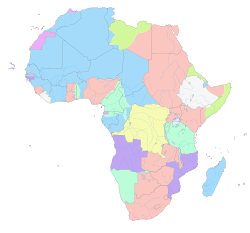
- Congo Free StateCongo Free StateThe Congo Free State was a large area in Central Africa which was privately controlled by Leopold II, King of the Belgians. Its origins lay in Leopold's attracting scientific, and humanitarian backing for a non-governmental organization, the Association internationale africaine...
and Belgian CongoBelgian CongoThe Belgian Congo was the formal title of present-day Democratic Republic of the Congo between King Leopold II's formal relinquishment of his personal control over the state to Belgium on 15 November 1908, and Congolese independence on 30 June 1960.-Congo Free State, 1884–1908:Until the latter...
(today's Democratic Republic of the CongoDemocratic Republic of the CongoThe Democratic Republic of the Congo is a state located in Central Africa. It is the second largest country in Africa by area and the eleventh largest in the world...
) - Ruanda-UrundiRuanda-UrundiRuanda-Urundi was a Belgian suzerainty from 1916 to 1924, a League of Nations Class B Mandate from 1924 to 1945 and then a United Nations trust territory until 1962, when it became the independent states of Rwanda and Burundi.- Overview :...
(comprising modern RwandaRwandaRwanda or , officially the Republic of Rwanda , is a country in central and eastern Africa with a population of approximately 11.4 million . Rwanda is located a few degrees south of the Equator, and is bordered by Uganda, Tanzania, Burundi and the Democratic Republic of the Congo...
and BurundiBurundiBurundi , officially the Republic of Burundi , is a landlocked country in the Great Lakes region of Eastern Africa bordered by Rwanda to the north, Tanzania to the east and south, and the Democratic Republic of the Congo to the west. Its capital is Bujumbura...
, between 1916 and 1960)
France
|
French Equatorial Africa French Equatorial Africa or the AEF was the federation of French colonial possessions in Middle Africa, extending northwards from the Congo River to the Sahara Desert.-History:... :
|
French Algeria French Algeria lasted from 1830 to 1962, under a variety of governmental systems. From 1848 until independence, the whole Mediterranean region of Algeria was administered as an integral part of France, much like Corsica and Réunion are to this day. The vast arid interior of Algeria, like the rest... (now Algeria Algeria Algeria , officially the People's Democratic Republic of Algeria , also formally referred to as the Democratic and Popular Republic of Algeria, is a country in the Maghreb region of Northwest Africa with Algiers as its capital.In terms of land area, it is the largest country in Africa and the Arab... ) French occupation of Tunisia The French conquest of Tunisia occurred in two phases in 1881: the first consisting of the invasion and securing of the country before the signing of a treaty of protection, and the second consisting in the suppression of a rebellion... French Morocco French Protectorate of Morocco was a French protectorate in Morocco, established by the Treaty of Fez. French Morocco did not include the north of the country, which was a Spanish protectorate... French Somaliland French Somaliland was a French colony in the Horn of Africa. Established after the French signed various treaties between 1883 and 1887 with the then ruling Somali Sultans, the colony lasted from 1896 until 1946, when it became an overseas territory of France.... (now Djibouti Djibouti Djibouti , officially the Republic of Djibouti , is a country in the Horn of Africa. It is bordered by Eritrea in the north, Ethiopia in the west and south, and Somalia in the southeast. The remainder of the border is formed by the Red Sea and the Gulf of Aden at the east... ) Madagascar The Republic of Madagascar is an island country located in the Indian Ocean off the southeastern coast of Africa... Comoros The Comoros , officially the Union of the Comoros is an archipelago island nation in the Indian Ocean, located off the eastern coast of Africa, on the northern end of the Mozambique Channel, between northeastern Mozambique and northwestern Madagascar... |
Germany
- German Kamerun (now CameroonCameroonCameroon, officially the Republic of Cameroon , is a country in west Central Africa. It is bordered by Nigeria to the west; Chad to the northeast; the Central African Republic to the east; and Equatorial Guinea, Gabon, and the Republic of the Congo to the south. Cameroon's coastline lies on the...
and part of NigeriaNigeriaNigeria , officially the Federal Republic of Nigeria, is a federal constitutional republic comprising 36 states and its Federal Capital Territory, Abuja. The country is located in West Africa and shares land borders with the Republic of Benin in the west, Chad and Cameroon in the east, and Niger in...
) - German East AfricaGerman East AfricaGerman East Africa was a German colony in East Africa, which included what are now :Burundi, :Rwanda and Tanganyika . Its area was , nearly three times the size of Germany today....
(now RwandaRwandaRwanda or , officially the Republic of Rwanda , is a country in central and eastern Africa with a population of approximately 11.4 million . Rwanda is located a few degrees south of the Equator, and is bordered by Uganda, Tanzania, Burundi and the Democratic Republic of the Congo...
, BurundiBurundiBurundi , officially the Republic of Burundi , is a landlocked country in the Great Lakes region of Eastern Africa bordered by Rwanda to the north, Tanzania to the east and south, and the Democratic Republic of the Congo to the west. Its capital is Bujumbura...
and most of TanzaniaTanzaniaThe United Republic of Tanzania is a country in East Africa bordered by Kenya and Uganda to the north, Rwanda, Burundi, and the Democratic Republic of the Congo to the west, and Zambia, Malawi, and Mozambique to the south. The country's eastern borders lie on the Indian Ocean.Tanzania is a state...
) - German South-West AfricaGerman South-West AfricaGerman South West Africa was a colony of Germany from 1884 until 1915, when it was taken over by South Africa and administered as South West Africa, finally becoming Namibia in 1990...
(now NamibiaNamibiaNamibia, officially the Republic of Namibia , is a country in southern Africa whose western border is the Atlantic Ocean. It shares land borders with Angola and Zambia to the north, Botswana to the east and South Africa to the south and east. It gained independence from South Africa on 21 March...
) - German Togoland (now TogoTogoTogo, officially the Togolese Republic , is a country in West Africa bordered by Ghana to the west, Benin to the east and Burkina Faso to the north. It extends south to the Gulf of Guinea, on which the capital Lomé is located. Togo covers an area of approximately with a population of approximately...
and eastern part of GhanaGhanaGhana , officially the Republic of Ghana, is a country located in West Africa. It is bordered by Côte d'Ivoire to the west, Burkina Faso to the north, Togo to the east, and the Gulf of Guinea to the south...
)
Italy
Italian North Africa
Italian North Africa
Italian North Africa was the aggregate of territories and colonies controlled by Italy in North Africa from 1911 until World War II...
(now Libya
Libya
Libya is an African country in the Maghreb region of North Africa bordered by the Mediterranean Sea to the north, Egypt to the east, Sudan to the southeast, Chad and Niger to the south, and Algeria and Tunisia to the west....
)
- EritreaEritreaEritrea , officially the State of Eritrea, is a country in the Horn of Africa. Eritrea derives it's name from the Greek word Erethria, meaning 'red land'. The capital is Asmara. It is bordered by Sudan in the west, Ethiopia in the south, and Djibouti in the southeast...
- Italian SomalilandItalian SomalilandItalian Somaliland , also known as Italian Somalia, was a colony of the Kingdom of Italy from the 1880s until 1936 in the region of modern-day Somalia. Ruled in the 19th century by the Somali Sultanate of Hobyo and the Majeerteen Sultanate, the territory was later acquired by Italy through various...
(now part of SomaliaSomaliaSomalia , officially the Somali Republic and formerly known as the Somali Democratic Republic under Socialist rule, is a country located in the Horn of Africa. Since the outbreak of the Somali Civil War in 1991 there has been no central government control over most of the country's territory...
)
Portugal
|
|
Spain
|
Spanish Morocco The Spanish protectorate of Morocco was the area of Morocco under colonial rule by the Spanish Empire, established by the Treaty of Fez in 1912 and ending in 1956, when both France and Spain recognized Moroccan independence.-Territorial borders:...
|
Spanish Guinea Spanish Guinea was an African colony of Spain that became the independent nation of Equatorial Guinea.-History:The Portuguese explorer, Fernão do Pó, seeking a route to India, is credited with having discovered the island of Bioko in 1472. He called it Formosa , but it quickly took on the name of... (now Equatorial Guinea Equatorial Guinea Equatorial Guinea, officially the Republic of Equatorial Guinea where the capital Malabo is situated.Annobón is the southernmost island of Equatorial Guinea and is situated just south of the equator. Bioko island is the northernmost point of Equatorial Guinea. Between the two islands and to the... )
|
United Kingdom
|
Botswana Botswana, officially the Republic of Botswana , is a landlocked country located in Southern Africa. The citizens are referred to as "Batswana" . Formerly the British protectorate of Bechuanaland, Botswana adopted its new name after becoming independent within the Commonwealth on 30 September 1966... ) Southern Rhodesia Southern Rhodesia was the name of the British colony situated north of the Limpopo River and the Union of South Africa. From its independence in 1965 until its extinction in 1980, it was known as Rhodesia... (now Zimbabwe Zimbabwe Zimbabwe is a landlocked country located in the southern part of the African continent, between the Zambezi and Limpopo rivers. It is bordered by South Africa to the south, Botswana to the southwest, Zambia and a tip of Namibia to the northwest and Mozambique to the east. Zimbabwe has three... ) Northern Rhodesia Northern Rhodesia was a territory in south central Africa, formed in 1911. It became independent in 1964 as Zambia.It was initially administered under charter by the British South Africa Company and formed by it in 1911 by amalgamating North-Western Rhodesia and North-Eastern Rhodesia... (now Zambia Zambia Zambia , officially the Republic of Zambia, is a landlocked country in Southern Africa. The neighbouring countries are the Democratic Republic of the Congo to the north, Tanzania to the north-east, Malawi to the east, Mozambique, Zimbabwe, Botswana and Namibia to the south, and Angola to the west.... ) Union of South Africa The Union of South Africa is the historic predecessor to the present-day Republic of South Africa. It came into being on 31 May 1910 with the unification of the previously separate colonies of the Cape, Natal, Transvaal and the Orange Free State... (now South Africa South Africa The Republic of South Africa is a country in southern Africa. Located at the southern tip of Africa, it is divided into nine provinces, with of coastline on the Atlantic and Indian oceans... )
|
The Gambia The Republic of The Gambia, commonly referred to as The Gambia, or Gambia , is a country in West Africa. Gambia is the smallest country on mainland Africa, surrounded by Senegal except for a short coastline on the Atlantic Ocean in the west.... Sierra Leone Sierra Leone , officially the Republic of Sierra Leone, is a country in West Africa. It is bordered by Guinea to the north and east, Liberia to the southeast, and the Atlantic Ocean to the west and southwest. Sierra Leone covers a total area of and has an estimated population between 5.4 and 6.4... Colonial Nigeria Colonial Nigeria ran from 1800 till October 1, 1960 when it gained independence. Up until the amalgamation of 1914, the country's constituting parts existed as separate British protectorates.-Abolition of the Slave Trade:... Cameroons British Cameroons was a British Mandate territory in West Africa, now divided between Nigeria and Cameroon.The area of present-day Cameroon was claimed by Germany as a protectorate during the "Scramble for Africa" at the end of the 19th century... (now parts of Cameroon Cameroon Cameroon, officially the Republic of Cameroon , is a country in west Central Africa. It is bordered by Nigeria to the west; Chad to the northeast; the Central African Republic to the east; and Equatorial Guinea, Gabon, and the Republic of the Congo to the south. Cameroon's coastline lies on the... and Nigeria Nigeria Nigeria , officially the Federal Republic of Nigeria, is a federal constitutional republic comprising 36 states and its Federal Capital Territory, Abuja. The country is located in West Africa and shares land borders with the Republic of Benin in the west, Chad and Cameroon in the east, and Niger in... ) Ghana Ghana , officially the Republic of Ghana, is a country located in West Africa. It is bordered by Côte d'Ivoire to the west, Burkina Faso to the north, Togo to the east, and the Gulf of Guinea to the south... ) Nyasaland Nyasaland or the Nyasaland Protectorate, was a British protectorate located in Africa, which was established in 1907 when the former British Central Africa Protectorate changed its name. Since 1964, it has been known as Malawi.... (now Malawi Malawi The Republic of Malawi is a landlocked country in southeast Africa that was formerly known as Nyasaland. It is bordered by Zambia to the northwest, Tanzania to the northeast, and Mozambique on the east, south and west. The country is separated from Tanzania and Mozambique by Lake Malawi. Its size... ) Basutoland Basutoland or officially the Territory of Basutoland, was a British Crown colony established in 1884 after the Cape Colony's inability to control the territory... (now Lesotho Lesotho Lesotho , officially the Kingdom of Lesotho, is a landlocked country and enclave, surrounded by the Republic of South Africa. It is just over in size with a population of approximately 2,067,000. Its capital and largest city is Maseru. Lesotho is a member of the Commonwealth of Nations. The name... ) Swaziland Swaziland, officially the Kingdom of Swaziland , and sometimes called Ngwane or Swatini, is a landlocked country in Southern Africa, bordered to the north, south and west by South Africa, and to the east by Mozambique... |
Independent states
- LiberiaLiberiaLiberia , officially the Republic of Liberia, is a country in West Africa. It is bordered by Sierra Leone on the west, Guinea on the north and Côte d'Ivoire on the east. Liberia's coastline is composed of mostly mangrove forests while the more sparsely populated inland consists of forests that open...
, founded by the American Colonization SocietyAmerican Colonization SocietyThe American Colonization Society , founded in 1816, was the primary vehicle to support the "return" of free African Americans to what was considered greater freedom in Africa. It helped to found the colony of Liberia in 1821–22 as a place for freedmen...
of the United StatesUnited StatesThe United States of America is a federal constitutional republic comprising fifty states and a federal district...
in 1821; declared independence in 1847 - Ethiopian EmpireEthiopian EmpireThe Ethiopian Empire also known as Abyssinia, covered a geographical area that the present-day northern half of Ethiopia and Eritrea covers, and included in its peripheries Zeila, Djibouti, Yemen and Western Saudi Arabia...
(Abyssinia) had its borders re-drawn with Italian EritreaItalian EritreaItalian Eritrea was the first colony of the Kingdom of Italy. It was created in 1890 and lasted officially until 1947.-Acquisition of Assab and creation of the colony:...
and French SomalilandFrench SomalilandFrench Somaliland was a French colony in the Horn of Africa. Established after the French signed various treaties between 1883 and 1887 with the then ruling Somali Sultans, the colony lasted from 1896 until 1946, when it became an overseas territory of France....
(modern DjiboutiDjiboutiDjibouti , officially the Republic of Djibouti , is a country in the Horn of Africa. It is bordered by Eritrea in the north, Ethiopia in the west and south, and Somalia in the southeast. The remainder of the border is formed by the Red Sea and the Gulf of Aden at the east...
), briefly occupied by ItalyItalyItaly , officially the Italian Republic languages]] under the European Charter for Regional or Minority Languages. In each of these, Italy's official name is as follows:;;;;;;;;), is a unitary parliamentary republic in South-Central Europe. To the north it borders France, Switzerland, Austria and...
from 1936 to 1941 during the Abyssinia CrisisAbyssinia CrisisThe Abyssinia Crisis was a diplomatic crisis during the interwar period originating in the "Walwal incident." This incident resulted from the ongoing conflict between the Kingdom of Italy and the Empire of Ethiopia...
; - SudanSudanSudan , officially the Republic of the Sudan , is a country in North Africa, sometimes considered part of the Middle East politically. It is bordered by Egypt to the north, the Red Sea to the northeast, Eritrea and Ethiopia to the east, South Sudan to the south, the Central African Republic to the...
, independent under MahdiMuhammad AhmadMuhammad Ahmad bin Abd Allah was a religious leader of the Samaniyya order in Sudan who, on June 29, 1881, proclaimed himself as the Mahdi or messianic redeemer of the Islamic faith...
rule between 1885 and 1899.
20th century
During this era a sense of local patriotism or nationalism took deeper root among African intellectuals and politicians. Some of the inspiration for this movement came from the First World War in which European countries had relied on colonial troops for their own defense. Many in Africa realized their own strength with regard to the colonizer for the first time. At the same time, some of the mystique of the "invincible" European was shattered by the barbarities of the war. However, in most areas European control remained relatively strong during this period.After World War I the formerly German colonies in Africa were taken over by France, Belgium, and the United Kingdom.
Italy
Italy
Italy , officially the Italian Republic languages]] under the European Charter for Regional or Minority Languages. In each of these, Italy's official name is as follows:;;;;;;;;), is a unitary parliamentary republic in South-Central Europe. To the north it borders France, Switzerland, Austria and...
, under the government of Benito Mussolini
Benito Mussolini
Benito Amilcare Andrea Mussolini was an Italian politician who led the National Fascist Party and is credited with being one of the key figures in the creation of Fascism....
, invaded Ethiopia
Ethiopia
Ethiopia , officially known as the Federal Democratic Republic of Ethiopia, is a country located in the Horn of Africa. It is the second-most populous nation in Africa, with over 82 million inhabitants, and the tenth-largest by area, occupying 1,100,000 km2...
, the last independent African nation, in 1935 and occupied the country until 1941.
Second half of 20th century: decolonization
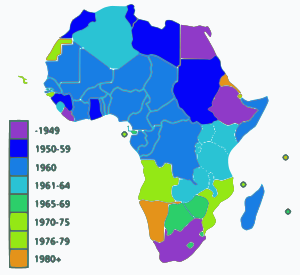
Decolonization of Africa
The decolonization of Africa followed World War II as colonized peoples agitated for independence and colonial powers withdrew their administrators from Africa.-Background:...
started with Libya
Libya
Libya is an African country in the Maghreb region of North Africa bordered by the Mediterranean Sea to the north, Egypt to the east, Sudan to the southeast, Chad and Niger to the south, and Algeria and Tunisia to the west....
in 1951. (Although Liberia, South Africa, Egypt and Ethiopia were already independent.) Many countries followed in the 1950s and 1960s, with a peak in 1960 with independence of a large part of French West Africa
French West Africa
French West Africa was a federation of eight French colonial territories in Africa: Mauritania, Senegal, French Sudan , French Guinea , Côte d'Ivoire , Upper Volta , Dahomey and Niger...
. Most of the remaining countries gained independence throughout the 1960s, although some colonizers (Portugal
Portugal
Portugal , officially the Portuguese Republic is a country situated in southwestern Europe on the Iberian Peninsula. Portugal is the westernmost country of Europe, and is bordered by the Atlantic Ocean to the West and South and by Spain to the North and East. The Atlantic archipelagos of the...
in particular) were reluctant to relinquish sovereignty, resulting in bitter wars of independence which lasted for a decade or more. The last African countries to gain formal independence were Guinea-Bissau
Guinea-Bissau
The Republic of Guinea-Bissau is a country in West Africa. It is bordered by Senegal to the north, and Guinea to the south and east, with the Atlantic Ocean to its west....
(1974), Mozambique
Mozambique
Mozambique, officially the Republic of Mozambique , is a country in southeastern Africa bordered by the Indian Ocean to the east, Tanzania to the north, Malawi and Zambia to the northwest, Zimbabwe to the west and Swaziland and South Africa to the southwest...
(1975) and Angola
Angola
Angola, officially the Republic of Angola , is a country in south-central Africa bordered by Namibia on the south, the Democratic Republic of the Congo on the north, and Zambia on the east; its west coast is on the Atlantic Ocean with Luanda as its capital city...
(1975) from Portugal; Djibouti
Djibouti
Djibouti , officially the Republic of Djibouti , is a country in the Horn of Africa. It is bordered by Eritrea in the north, Ethiopia in the west and south, and Somalia in the southeast. The remainder of the border is formed by the Red Sea and the Gulf of Aden at the east...
from France
France
The French Republic , The French Republic , The French Republic , (commonly known as France , is a unitary semi-presidential republic in Western Europe with several overseas territories and islands located on other continents and in the Indian, Pacific, and Atlantic oceans. Metropolitan France...
in 1977; Zimbabwe
Zimbabwe
Zimbabwe is a landlocked country located in the southern part of the African continent, between the Zambezi and Limpopo rivers. It is bordered by South Africa to the south, Botswana to the southwest, Zambia and a tip of Namibia to the northwest and Mozambique to the east. Zimbabwe has three...
from United Kingdom
United Kingdom
The United Kingdom of Great Britain and Northern IrelandIn the United Kingdom and Dependencies, other languages have been officially recognised as legitimate autochthonous languages under the European Charter for Regional or Minority Languages...
in 1980; and Namibia
Namibia
Namibia, officially the Republic of Namibia , is a country in southern Africa whose western border is the Atlantic Ocean. It shares land borders with Angola and Zambia to the north, Botswana to the east and South Africa to the south and east. It gained independence from South Africa on 21 March...
from South Africa
South Africa
The Republic of South Africa is a country in southern Africa. Located at the southern tip of Africa, it is divided into nine provinces, with of coastline on the Atlantic and Indian oceans...
in 1990. Eritrea
Eritrea
Eritrea , officially the State of Eritrea, is a country in the Horn of Africa. Eritrea derives it's name from the Greek word Erethria, meaning 'red land'. The capital is Asmara. It is bordered by Sudan in the west, Ethiopia in the south, and Djibouti in the southeast...
later split off from Ethiopia
Ethiopia
Ethiopia , officially known as the Federal Democratic Republic of Ethiopia, is a country located in the Horn of Africa. It is the second-most populous nation in Africa, with over 82 million inhabitants, and the tenth-largest by area, occupying 1,100,000 km2...
in 1993.
Because many cities were founded, enlarged and renamed by the Europeans, after independence many place names were renamed.
East Africa
The Mau Mau Rebellion took place in KenyaKenya
Kenya , officially known as the Republic of Kenya, is a country in East Africa that lies on the equator, with the Indian Ocean to its south-east...
from 1952 until 1956 but was put down by British and local forces. A State of Emergency remained in place until 1960. Kenya became independent in 1963, and Jomo Kenyatta
Jomo Kenyatta
Jomo Kenyattapron.] served as the first Prime Minister and President of Kenya. He is considered the founding father of the Kenyan nation....
served as its first president.
The early 1990s also signaled the start of major clashes between the Hutu
Hutu
The Hutu , or Abahutu, are a Central African people, living mainly in Rwanda, Burundi, and eastern DR Congo.-Population statistics:The Hutu are the largest of the three peoples in Burundi and Rwanda; according to the United States Central Intelligence Agency, 84% of Rwandans and 85% of Burundians...
s and the Tutsi
Tutsi
The Tutsi , or Abatutsi, are an ethnic group in Central Africa. Historically they were often referred to as the Watussi or Watusi. They are the second largest caste in Rwanda and Burundi, the other two being the Hutu and the Twa ....
s in Rwanda
Rwanda
Rwanda or , officially the Republic of Rwanda , is a country in central and eastern Africa with a population of approximately 11.4 million . Rwanda is located a few degrees south of the Equator, and is bordered by Uganda, Tanzania, Burundi and the Democratic Republic of the Congo...
and Burundi
Burundi
Burundi , officially the Republic of Burundi , is a landlocked country in the Great Lakes region of Eastern Africa bordered by Rwanda to the north, Tanzania to the east and south, and the Democratic Republic of the Congo to the west. Its capital is Bujumbura...
. In 1994 this culminated in the Rwandan Genocide
Rwandan Genocide
The Rwandan Genocide was the 1994 mass murder of an estimated 800,000 people in the small East African nation of Rwanda. Over the course of approximately 100 days through mid-July, over 500,000 people were killed, according to a Human Rights Watch estimate...
, a conflict in which over 800,000 people were murdered.
North Africa
MoroccanMorocco
Morocco , officially the Kingdom of Morocco , is a country located in North Africa. It has a population of more than 32 million and an area of 710,850 km², and also primarily administers the disputed region of the Western Sahara...
nationalism developed during the 1930s; the Istiqal Party was formed, pushing for independence. In 1953 sultan Muhammad V called for independence. On March 2, 1956, Morocco became independent of France. Spain relinquished the territories of Ceuta
Ceuta
Ceuta is an autonomous city of Spain and an exclave located on the north coast of North Africa surrounded by Morocco. Separated from the Iberian peninsula by the Strait of Gibraltar, Ceuta lies on the border of the Mediterranean Sea and the Atlantic Ocean. Ceuta along with the other Spanish...
, Tangiers, and Melilla
Melilla
Melilla is a autonomous city of Spain and an exclave on the north coast of Morocco. Melilla, along with the Spanish exclave Ceuta, is one of the two Spanish territories located in mainland Africa...
. Muhammad V became ruler of independent Morocco.
In 1954, Algeria
Algeria
Algeria , officially the People's Democratic Republic of Algeria , also formally referred to as the Democratic and Popular Republic of Algeria, is a country in the Maghreb region of Northwest Africa with Algiers as its capital.In terms of land area, it is the largest country in Africa and the Arab...
formed the National Liberation Front (FLN) as it split from France. The French responded brutally but negotiated independence in 1962. Muhammad Ahmed Ben Bella was elected president. All French citizens left the country, crippling the economy.
In 1934, the "Neo-Destour" (New Constitution) party was founded by Habib Bourguiba
Habib Bourguiba
Habib Bourguiba was a Tunisian statesman, the Founder and the first President of the Republic of Tunisia from July 25, 1957 until 7 November 1987...
pushing for independence in Tunisia
Tunisia
Tunisia , officially the Tunisian RepublicThe long name of Tunisia in other languages used in the country is: , is the northernmost country in Africa. It is a Maghreb country and is bordered by Algeria to the west, Libya to the southeast, and the Mediterranean Sea to the north and east. Its area...
. Tunisia became independent in 1955. Its bey was disposed and Habib Bourguiba
Habib Bourguiba
Habib Bourguiba was a Tunisian statesman, the Founder and the first President of the Republic of Tunisia from July 25, 1957 until 7 November 1987...
elected.
In 1954, Gamal Abdel Nasser
Gamal Abdel Nasser
Gamal Abdel Nasser Hussein was the second President of Egypt from 1956 until his death. A colonel in the Egyptian army, Nasser led the Egyptian Revolution of 1952 along with Muhammad Naguib, the first president, which overthrew the monarchy of Egypt and Sudan, and heralded a new period of...
deposed the monarchy of Egypt and came to power. Muammar al-Gaddafi
Muammar al-Gaddafi
Muammar Muhammad Abu Minyar Gaddafi or "September 1942" 20 October 2011), commonly known as Muammar Gaddafi or Colonel Gaddafi, was the official ruler of the Libyan Arab Republic from 1969 to 1977 and then the "Brother Leader" of the Libyan Arab Jamahiriya from 1977 to 2011.He seized power in a...
led a coup in Libya in 1969 and remained in power until he was killed in 2011.
Egypt was involved in several wars against Israel
Israel
The State of Israel is a parliamentary republic located in the Middle East, along the eastern shore of the Mediterranean Sea...
and was allied with other Arab
Arab
Arab people, also known as Arabs , are a panethnicity primarily living in the Arab world, which is located in Western Asia and North Africa. They are identified as such on one or more of genealogical, linguistic, or cultural grounds, with tribal affiliations, and intra-tribal relationships playing...
countries. The first was right after the state of Israel was founded, in 1948. Egypt went to war again in 1967 and lost the Sinai Peninsula
Sinai Peninsula
The Sinai Peninsula or Sinai is a triangular peninsula in Egypt about in area. It is situated between the Mediterranean Sea to the north, and the Red Sea to the south, and is the only part of Egyptian territory located in Asia as opposed to Africa, effectively serving as a land bridge between two...
to Israel. They went to war yet again in 1973. In 1979, Anwar Sadat
Anwar Sadat
Muhammad Anwar al-Sadat was the third President of Egypt, serving from 15 October 1970 until his assassination by fundamentalist army officers on 6 October 1981...
and Menachem Begin
Menachem Begin
' was a politician, founder of Likud and the sixth Prime Minister of the State of Israel. Before independence, he was the leader of the Zionist militant group Irgun, the Revisionist breakaway from the larger Jewish paramilitary organization Haganah. He proclaimed a revolt, on 1 February 1944,...
signed the Camp David Accords
Camp David Accords
The Camp David Accords were signed by Egyptian President Anwar El Sadat and Israeli Prime Minister Menachem Begin on September 17, 1978, following thirteen days of secret negotiations at Camp David. The two framework agreements were signed at the White House, and were witnessed by United States...
, which gave back the Sinai Peninsula to Egypt in exchange for the recognition of Israel. The accords are still in effect today. In 1981, Sadat was assassinated
Assassination
To carry out an assassination is "to murder by a sudden and/or secret attack, often for political reasons." Alternatively, assassination may be defined as "the act of deliberately killing someone, especially a public figure, usually for hire or for political reasons."An assassination may be...
by an Islamist for signing the accords.
Southern Africa
In 1948 the apartheidHistory of South Africa in the apartheid era
Apartheid was a system of racial segregation enforced by the National Party governments of South Africa between 1948 and 1994, under which the rights of the majority 'non-white' inhabitants of South Africa were curtailed and white supremacy and Afrikaner minority rule was maintained...
laws were started in South Africa
South Africa
The Republic of South Africa is a country in southern Africa. Located at the southern tip of Africa, it is divided into nine provinces, with of coastline on the Atlantic and Indian oceans...
by the dominant National Party. These were largely a continuation of existing policies; the difference was the policy of "separate development." Where previous policies had only been disparate efforts to economically exploit the African majority, apartheid represented an entire philosophy of separate racial goals, leading to both the divisive laws of 'petty apartheid,' and the grander scheme of African homelands.
In 1994, the South African government abolished apartheid. South Africans elected Nelson Mandela
Nelson Mandela
Nelson Rolihlahla Mandela served as President of South Africa from 1994 to 1999, and was the first South African president to be elected in a fully representative democratic election. Before his presidency, Mandela was an anti-apartheid activist, and the leader of Umkhonto we Sizwe, the armed wing...
of the African National Congress
African National Congress
The African National Congress is South Africa's governing Africanist political party, supported by its tripartite alliance with the Congress of South African Trade Unions and the South African Communist Party , since the establishment of non-racial democracy in April 1994. It defines itself as a...
in the country's first multiracial presidential election.
West Africa
Following World War IIWorld War II
World War II, or the Second World War , was a global conflict lasting from 1939 to 1945, involving most of the world's nations—including all of the great powers—eventually forming two opposing military alliances: the Allies and the Axis...
, nationalist movements arose across West Africa, most notably in Ghana
Ghana
Ghana , officially the Republic of Ghana, is a country located in West Africa. It is bordered by Côte d'Ivoire to the west, Burkina Faso to the north, Togo to the east, and the Gulf of Guinea to the south...
under Kwame Nkrumah
Kwame Nkrumah
Kwame Nkrumah was the leader of Ghana and its predecessor state, the Gold Coast, from 1952 to 1966. Overseeing the nation's independence from British colonial rule in 1957, Nkrumah was the first President of Ghana and the first Prime Minister of Ghana...
. In 1957, Ghana became the first sub-Saharan colony to achieve its independence, followed the next year by France's colonies; by 1974, West Africa's nations were entirely autonomous. Since independence, many West African nations have been plagued by corruption
Political corruption
Political corruption is the use of legislated powers by government officials for illegitimate private gain. Misuse of government power for other purposes, such as repression of political opponents and general police brutality, is not considered political corruption. Neither are illegal acts by...
and instability, with notable civil wars in Nigeria
Nigeria
Nigeria , officially the Federal Republic of Nigeria, is a federal constitutional republic comprising 36 states and its Federal Capital Territory, Abuja. The country is located in West Africa and shares land borders with the Republic of Benin in the west, Chad and Cameroon in the east, and Niger in...
, Sierra Leone
Sierra Leone
Sierra Leone , officially the Republic of Sierra Leone, is a country in West Africa. It is bordered by Guinea to the north and east, Liberia to the southeast, and the Atlantic Ocean to the west and southwest. Sierra Leone covers a total area of and has an estimated population between 5.4 and 6.4...
, Liberia
Liberia
Liberia , officially the Republic of Liberia, is a country in West Africa. It is bordered by Sierra Leone on the west, Guinea on the north and Côte d'Ivoire on the east. Liberia's coastline is composed of mostly mangrove forests while the more sparsely populated inland consists of forests that open...
, and Côte d'Ivoire
Côte d'Ivoire
The Republic of Côte d'Ivoire or Ivory Coast is a country in West Africa. It has an area of , and borders the countries Liberia, Guinea, Mali, Burkina Faso and Ghana; its southern boundary is along the Gulf of Guinea. The country's population was 15,366,672 in 1998 and was estimated to be...
, and a succession of military coups in Ghana and Burkina Faso
Burkina Faso
Burkina Faso – also known by its short-form name Burkina – is a landlocked country in west Africa. It is surrounded by six countries: Mali to the north, Niger to the east, Benin to the southeast, Togo and Ghana to the south, and Côte d'Ivoire to the southwest.Its size is with an estimated...
. Many states have failed to develop their economies despite enviable natural resources, and political instability is often accompanied by undemocratic government.
See also
- List of kingdoms in pre-colonial Africa
- List of sovereign states and dependent territories in Africa
- Outline of history
- Outline of Africa#History of Africa
Further reading
- Cheikh Anta DiopCheikh Anta DiopCheikh Anta Diop was a historian, anthropologist, physicist, and politician who studied the human race's origins and pre-colonial African culture. He is regarded as an important figure in the development of the Afrocentric viewpoint, in particular for his theory that the ancient Egyptians were...
(1987). Precolonial Black Africa. Chicago Review Press. - Clark, J. Desmond (1970). The Prehistory of Africa. Thames and Hudson
- Davidson, BasilBasil DavidsonBasil Risbridger Davidson MC was a British historian, writer and Africanist, particularly knowledgeable on the subject of Portuguese Africa prior to the 1974 Carnation Revolution....
(1964). The African Past. Penguin, Harmondsworth - Freund, Bill (1998). The Making of Contemporary Africa, Lynne Rienner, Boulder (including a substantial "Annotated Bibliography" pp. 269–316).
- Reader, John (1997). Africa: A Biography of the Continent. Hamish Hamilton. ISBN 0-241-13047-6
- Shillington, Kevin (1989). History of Africa, New York: St. Martin's.
- UNESCOUNESCOThe United Nations Educational, Scientific and Cultural Organization is a specialized agency of the United Nations...
(1980–1994). General History of AfricaGeneral History of AfricaThe ' is a two-phase project undertaken by UNESCO from 1964 to the present. The 1964 General Conference of UNESCO, during its 13th Session, instructed the Organization to undertake this initiative after the newly independent African Member States expressed a strong desire to reclaim their cultural...
. 8 volumes. - Théophile ObengaTheophile ObengaThéophile Obenga is a professor emeritus, formerly at San Francisco State University, in the Africana Studies Center. He was born in 1936 in Brazzaville, French Equatorial Africa ....
(1980). Pour une Nouvelle Histoire Présence AfricainePrésence AfricainePrésence africaine is a panafrican quarterly cultural, political, and literary magazine, published in Paris and founded by Alioune Diop in 1947. In 1949, Présence africaine expanded to include a publishing house and a bookstore on the rue des Écoles in the Latin Quarter of Paris...
, Paris - Worden, Nigel (1995). The Making of Modern South Africa, Oxford UK, Cambridge USA: Blackwell.
- Cambridge History of Africa, Volume 1-5.
- Falola, Toyin. Africa, Volume 1-5.
- July, Robert (1998). A History of the African People, Longrove, Il.: Waveland Press, 1998.
- O'Meara, Dan (1996). Forty Lost Years: The Apartheid State and the Politics of the National Party, 1948-1994, Athens: Ohio University Press; Randburg, Raven Press.
External links
- Worldtimelines.org.uk -Africa The British Museum. 2005
- About.com:African History.
- The Story of Africa - BBC World Service
- Wonders of the African World, PBSPublic Broadcasting ServiceThe Public Broadcasting Service is an American non-profit public broadcasting television network with 354 member TV stations in the United States which hold collective ownership. Its headquarters is in Arlington, Virginia....
. - Civilization of Africa, by Richard Hooker, Washington State UniversityWashington State UniversityWashington State University is a public research university based in Pullman, Washington, in the Palouse region of the Pacific Northwest. Founded in 1890, WSU is the state's original and largest land-grant university...
. - African Art,(chunk of historical data), Metropolitan Museum of ArtMetropolitan Museum of ArtThe Metropolitan Museum of Art is a renowned art museum in New York City. Its permanent collection contains more than two million works, divided into nineteen curatorial departments. The main building, located on the eastern edge of Central Park along Manhattan's Museum Mile, is one of the...
. - African Kingdoms, by Khaleel Muhammad.
- Mapungubwe Museum at the University of PretoriaUniversity of PretoriaThe University of Pretoria is a multi campus public research university located in Pretoria, the administrative and de facto capital of South Africa...