
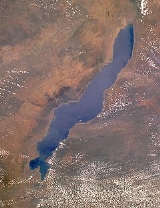
Lake Malawi is an
African Great LakeThe African Great Lakes are a series of lakes and the Rift Valley lakes in and around the geographic Great Rift Valley formed by the action of the tectonic East African Rift on the continent of Africa...
and the southernmost
lakeA lake is a body of relatively still fresh or salt water of considerable size, localized in a basin, that is surrounded by land. Lakes are inland and not part of the ocean and therefore are distinct from lagoons, and are larger and deeper than ponds. Lakes can be contrasted with rivers or streams,...
in the
Great Rift ValleyThe Great Rift Valley is a name given in the late 19th century by British explorer John Walter Gregory to the continuous geographic trench, approximately in length, that runs from northern Syria in Southwest Asia to central Mozambique in South East Africa...
system of East Africa. This lake, the third largest in
AfricaAfrica is the world's second largest and second most populous continent, after Asia. At about 30.2 million km² including adjacent islands, it covers 6% of the Earth's total surface area and 20.4% of the total land area...
and the eighth largest lake in the world, is located between
MalawiThe Republic of Malawi is a landlocked country in southeast Africa that was formerly known as Nyasaland. It is bordered by Zambia to the northwest, Tanzania to the northeast, and Mozambique on the east, south and west. The country is separated from Tanzania and Mozambique by Lake Malawi. Its size...
,
MozambiqueMozambique, officially the Republic of Mozambique , is a country in southeastern Africa bordered by the Indian Ocean to the east, Tanzania to the north, Malawi and Zambia to the northwest, Zimbabwe to the west and Swaziland and South Africa to the southwest...
, and
TanzaniaThe United Republic of Tanzania is a country in East Africa bordered by Kenya and Uganda to the north, Rwanda, Burundi, and the Democratic Republic of the Congo to the west, and Zambia, Malawi, and Mozambique to the south. The country's eastern borders lie on the Indian Ocean.Tanzania is a state...
. It is the second deepest lake in Africa, although its placid northern shore gives no hint of its depth. This great lake's tropical waters are reportedly the habitat of more species of fish than those of any other body of freshwater on Earth, including more than 1000 species of
cichlidCichlids are fishes from the family Cichlidae in the order Perciformes. Cichlids are members of a group known as the Labroidei along with the wrasses , damselfish , and surfperches . This family is both large and diverse. At least 1,300 species have been scientifically described, making it one of...
s.
Lake Malawi was officially declared a reserve by the Government of Mozambique on June 10, 2011 in an effort to protect one of the largest and bio-diverse freshwater lakes in the world
Geography
Lake Malawi or Lake Nyaza is between 560 and 580 kilometres long, and about 75 kilometres wide at its widest point. The total
surface areaSurface area is the measure of how much exposed area a solid object has, expressed in square units. Mathematical description of the surface area is considerably more involved than the definition of arc length of a curve. For polyhedra the surface area is the sum of the areas of its faces...
of this lake is about 29600 square kilometres (11,428.6 sq mi). This lake has shorelines on western
MozambiqueMozambique, officially the Republic of Mozambique , is a country in southeastern Africa bordered by the Indian Ocean to the east, Tanzania to the north, Malawi and Zambia to the northwest, Zimbabwe to the west and Swaziland and South Africa to the southwest...
, eastern
MalawiThe Republic of Malawi is a landlocked country in southeast Africa that was formerly known as Nyasaland. It is bordered by Zambia to the northwest, Tanzania to the northeast, and Mozambique on the east, south and west. The country is separated from Tanzania and Mozambique by Lake Malawi. Its size...
, and southern
TanzaniaThe United Republic of Tanzania is a country in East Africa bordered by Kenya and Uganda to the north, Rwanda, Burundi, and the Democratic Republic of the Congo to the west, and Zambia, Malawi, and Mozambique to the south. The country's eastern borders lie on the Indian Ocean.Tanzania is a state...
. The largest river flowing into this lake is the Ruhuhu River. This large freshwater lake has an outlet at its southern end, which is the
Shire RiverThe Shire is a river in Malawi and Mozambique. The river has been known as the Shiré or Chire River. It is the outlet of Lake Malawi and flows into the Zambezi. Its length is 402 km; including Lake Malawi and the Ruhuhu, its headstream, it has a length of about 1200 km...
, a tributary that flows into the very large Zambezi River in Mozambique.
Lake Malawi lies in the
Great Rift ValleyThe Great Rift Valley is a name given in the late 19th century by British explorer John Walter Gregory to the continuous geographic trench, approximately in length, that runs from northern Syria in Southwest Asia to central Mozambique in South East Africa...
that was formed by the opening of the
East African RiftThe East African Rift is an active continental rift zone in eastern Africa that appears to be a developing divergent tectonic plate boundary. It is part of the larger Great Rift Valley. The rift is a narrow zone in which the African Plate is in the process of splitting into two new tectonic plates...
, where the
African tectonic plateThe African Plate is a tectonic plate which includes the continent of Africa, as well as oceanic crust which lies between the continent and various surrounding ocean ridges.-Boundaries:...
is being split into two pieces. This is called a divergent plate tectonics boundary. Lake Malawi or Nyaza itself is variously estimated at about 40,000 years old. or about one to two million years.
In addition, Lake Malawi or Nyasa is located about 350 kilometers southeast of
Lake TanganyikaLake Tanganyika is an African Great Lake. It is estimated to be the second largest freshwater lake in the world by volume, and the second deepest, after Lake Baikal in Siberia; it is also the world's longest freshwater lake...
, another of the huge lakes of the
Great Rift ValleyThe Great Rift Valley is a name given in the late 19th century by British explorer John Walter Gregory to the continuous geographic trench, approximately in length, that runs from northern Syria in Southwest Asia to central Mozambique in South East Africa...
.
European discovery and colonization
The
PortuguesePortugal , officially the Portuguese Republic is a country situated in southwestern Europe on the Iberian Peninsula. Portugal is the westernmost country of Europe, and is bordered by the Atlantic Ocean to the West and South and by Spain to the North and East. The Atlantic archipelagos of the...
trader Candido José da Costa Cardoso was the first
EuropeEurope is, by convention, one of the world's seven continents. Comprising the westernmost peninsula of Eurasia, Europe is generally 'divided' from Asia to its east by the watershed divides of the Ural and Caucasus Mountains, the Ural River, the Caspian and Black Seas, and the waterways connecting...
an to visit the lake in 1846.
David Livingstone David Livingstone was a Scottish Congregationalist pioneer medical missionary with the London Missionary Society and an explorer in Africa. His meeting with H. M. Stanley gave rise to the popular quotation, "Dr...
reached the lake in 1859, and naming it "Lake Nyasa". Much of the African region surrounding this lake was soon claimed by the British Empire and formed into the colony of
NyasalandNyasaland or the Nyasaland Protectorate, was a British protectorate located in Africa, which was established in 1907 when the former British Central Africa Protectorate changed its name. Since 1964, it has been known as Malawi....
. Although the Portuguese took control of the eastern shore of this lake, the island of
LikomaLikoma Island is the larger of two inhabited islands in Lake Malawi , in East Africa, the smaller being the nearby Chizumulu. Likoma and Chizumulu both belong to Malawi, and together they make up the Likoma District...
was used as a mission station by the
Universities' Mission to Central AfricaThe Universities' Mission to Central Africa was a missionary society established by members of the Anglican Church within the universities of Oxford, Cambridge, Durham, and Dublin. It was firmly in the Anglo-Catholic tradition of the Church, and the first to devolve authority to a bishop in the...
, and as a result, Likoma and the nearby islet of Chizumulu were incorporated into Nyasaland rather than to
MozambiqueMozambique, officially the Republic of Mozambique , is a country in southeastern Africa bordered by the Indian Ocean to the east, Tanzania to the north, Malawi and Zambia to the northwest, Zimbabwe to the west and Swaziland and South Africa to the southwest...
. Today, these islets form lacustrine exclaves: Malawian land surrounded by Mozambiquian waters.
On August 16, 1914, Lake Malawi or Nyaza was the scene of a brief naval battle when the British
gunboatA gunboat is a naval watercraft designed for the express purpose of carrying one or more guns to bombard coastal targets, as opposed to those military craft designed for naval warfare, or for ferrying troops or supplies.-History:...
Guendolen, commanded by a Captain Rhoades, heard that
World War IWorld War I , which was predominantly called the World War or the Great War from its occurrence until 1939, and the First World War or World War I thereafter, was a major war centred in Europe that began on 28 July 1914 and lasted until 11 November 1918...
had broken out, and he received orders from the British Empire's high command to "sink, burn, or destroy" the German Empire's only gunboat on the lake, the
Hermann von Wissmann, commanded by a Captain Berndt. Rhoades's crew located the
Hermann von Wissmann in a bay near "Sphinxhaven", in
German East AfricaGerman East Africa was a German colony in East Africa, which included what are now :Burundi, :Rwanda and Tanganyika . Its area was , nearly three times the size of Germany today....
n territorial waters.
Guendolen disabled the German boat with a single
cannonA cannon is any piece of artillery that uses gunpowder or other usually explosive-based propellents to launch a projectile. Cannon vary in caliber, range, mobility, rate of fire, angle of fire, and firepower; different forms of cannon combine and balance these attributes in varying degrees,...
shot from a range of about 2000 yards (1,828.8 m). This very brief gunboat conflict was hailed by
The TimesThe Times is a British daily national newspaper, first published in London in 1785 under the title The Daily Universal Register . The Times and its sister paper The Sunday Times are published by Times Newspapers Limited, a subsidiary since 1981 of News International...
in England as the British Empire's first naval victory of World War I. Up until that time, the lakeshore that is now in Tanzania had been a part of German East Africa.
The borders of the Lake
The largest portion of the area of Lake Malawi or Nyaza is in Malawi. However, about a quarter of the area belongs to
MozambiqueMozambique, officially the Republic of Mozambique , is a country in southeastern Africa bordered by the Indian Ocean to the east, Tanzania to the north, Malawi and Zambia to the northwest, Zimbabwe to the west and Swaziland and South Africa to the southwest...
. This area includes the waters surrounding the Malawian islets of
LikomaLikoma Island is the larger of two inhabited islands in Lake Malawi , in East Africa, the smaller being the nearby Chizumulu. Likoma and Chizumulu both belong to Malawi, and together they make up the Likoma District...
and Chizumulu, which are this lake's only two inhabited islets. The islet of Likoma is dominated by a large stone and brick Anglican cathedral that was built by missionaries in the early 20th century. A notable feature of both islets is their significant number of
baobabAdansonia is a genus of eight species of tree, six native to Madagascar, one native to mainland Africa and the Arabian Peninsula and one to Australia. The mainland African species also occurs on Madagascar, but it is not a native of that island....
trees. The islets support a population of several thousand people, who in addition to being fishermen, grow plants such as
cassavaCassava , also called yuca or manioc, a woody shrub of the Euphorbiaceae native to South America, is extensively cultivated as an annual crop in tropical and subtropical regions for its edible starchy tuberous root, a major source of carbohydrates...
s,
bananaBanana is the common name for herbaceous plants of the genus Musa and for the fruit they produce. Bananas come in a variety of sizes and colors when ripe, including yellow, purple, and red....
s, and
mangoThe mango is a fleshy stone fruit belonging to the genus Mangifera, consisting of numerous tropical fruiting trees in the flowering plant family Anacardiaceae. The mango is native to India from where it spread all over the world. It is also the most cultivated fruit of the tropical world. While...
es for food.
Lake Nyasa or Lake Malawi
The geographic name of the lake itself is also disputed. Malawi claims that this lake is named "Lake Malawi", whereas most other countries (most notably Tanzania) and internationally-made maps state that the name of the lake is "Lake Nyasa". The origin of the dispute over the name of the lake has its background in geopolitical disputes that began before the independence of Malawi was achieved in 1964, when the territory had been known as "Nyasaland".
Further complications emerged for various political reasons during the 1960s, when President
Hastings BandaHastings Kamuzu Banda was the leader of Malawi and its predecessor state, Nyasaland, from 1961 to 1994. After receiving much of his education overseas, Banda returned to his home country to speak against colonialism and advocate for independence...
of Malawi became the only African leader to establish
diplomatic relationsDiplomacy is the art and practice of conducting negotiations between representatives of groups or states...
with the white-ruled country of
South AfricaThe Republic of South Africa is a country in southern Africa. Located at the southern tip of Africa, it is divided into nine provinces, with of coastline on the Atlantic and Indian oceans...
. This recognition of the South African regime was fiercely repudiated by almost all other African leaders, including President
Julius NyerereJulius Kambarage Nyerere was a Tanzanian politician who served as the first President of Tanzania and previously Tanganyika, from the country's founding in 1961 until his retirement in 1985....
of
TanzaniaThe United Republic of Tanzania is a country in East Africa bordered by Kenya and Uganda to the north, Rwanda, Burundi, and the Democratic Republic of the Congo to the west, and Zambia, Malawi, and Mozambique to the south. The country's eastern borders lie on the Indian Ocean.Tanzania is a state...
. This contrasting in policies toward South Africa gave some more impetus to disputes between the Malawi and Tanzania, especially concerning the name of the Lake itself, and also the water boundary between the two countries.
For this same lake, the name "Lac Maravi" had been used on the map of "Afrique sud" by J.B.B. d'Anville, which was published in France in 1749. David Livingstone's name for the lake was based on his colleague's misunderstanding of African languages of the area. When Livingstone asked his staff members, who were not from the area of the lake, to state its name for him, they said the word "nyasa", not realizing that this was the local word for any large body of water (such as a lake). In effect, "Lake Nyasa" literally means "Lake Lake". This name could also be spelled "niassa", "nyanja", or "nyanza", based on the other languages of the region.
Presently the dispute between the two governments over the lake's name is mostly dormant. Diplomatic relations between Malawi and Tanzania, and the relationships between their wildlife police forces and other associations, are largely cordial.
Tanzania–Malawi dispute
The partition of Lake Nyasa's surface area between Malawi and Tanzania is under dispute. Tanzania claims that the international border runs through the middle of the lake. This is along the lines of the border that were set out between the German and British territories before 1914. On the other hand, Malawi claims the whole of the surface of this lake that is not in Mozambique, including the waters that are next to the shoreline of Tanzania. The foundations of this dispute were laid when the British colonial government, which had recently captured Tanganyika from Germany, placed all of the water under the jurisdiction of the territory of
NyasalandNyasaland or the Nyasaland Protectorate, was a British protectorate located in Africa, which was established in 1907 when the former British Central Africa Protectorate changed its name. Since 1964, it has been known as Malawi....
, without a separate administration for the
TanganyikaTanganyika , later formally the Republic of Tanganyika, was a sovereign state in East Africa from 1961 to 1964. It was situated between the Indian Ocean and the African Great Lakes of Lake Victoria, Lake Malawi and Lake Tanganyika...
n portion of the surface. This dispute has led to conflicts in the past, though in recent years, Malawi has declined to attempt to enforce any claims to the disputed portion.
Occasional flare-ups of conflict during the 1990s, and also sometimes in the 21st Century, have impacted fishing rights, particularly those of Tanzanian
fishermenFishing is the activity of trying to catch wild fish. Fish are normally caught in the wild. Techniques for catching fish include hand gathering, spearing, netting, angling and trapping....
who reside on the lakeshore, and who have occasionally been accused of fishing in Malawian waters.
Lake of Stars
"The Lake of Stars" is the nickname for Lake Malawi coined by
David Livingstone David Livingstone was a Scottish Congregationalist pioneer medical missionary with the London Missionary Society and an explorer in Africa. His meeting with H. M. Stanley gave rise to the popular quotation, "Dr...
. This name came about due to lights from the lanterns of the fishermen in Malawi on their boats, that resemble, from a distance, stars in the sky.
The lake is also known as the Lake of Storms, for the unpredictable and extremely violent gales that sweep through the area.
Transport on the Lake
Large-scale transport between villages on the shores of Lake Malawi or Nyaza, and also between the lakeshore and the inhabited islets is provided by
steamboatA steamboat or steamship, sometimes called a steamer, is a ship in which the primary method of propulsion is steam power, typically driving propellers or paddlewheels...
s or
motor shipA motor ship or motor vessel is a ship propelled by an internal combustion engine, usually a diesel engine. The name of motor ships are often prefixed with MS, M/S, MV or M/V.- See also :...
s on the lake, or else by air transport.
began service on the lake in 1901 as the SS
Chauncy Maples: a floating clinic and church for the
Universities' Mission to Central AfricaThe Universities' Mission to Central Africa was a missionary society established by members of the Anglican Church within the universities of Oxford, Cambridge, Durham, and Dublin. It was firmly in the Anglo-Catholic tradition of the Church, and the first to devolve authority to a bishop in the...
. She later served as a ferry and is currently laid up at
Monkey BayMonkey Bay or Lusumbwe is a town in Mangochi whichi is in the Mangochi District in the Southern Region of Malawi. The town is on the shore of Lake Malawi and is one of the main ports on Lake Malawi. The population of Monkey Bay is estimated to be 14,591 as of 2008. Monkey Bay is from Lilongwe,...
awaiting restoration.
entered service in 1935.
The ferry entered service in 1951. In recent years she has often been out of service, but when operational she runs between Monkey Bay at the southern end of the lake to
KarongaKaronga is a township in the Karonga District in Northern Region of Malawi. Located on the western shore of Lake Nyasa, it was established as a slaving centre sometime before 1877. As of 2008 estimates, Karonga has a population of 42,555.-History:...
on the northern end, and occasionally to the
Iringa RegionIringa is one of Tanzania's 26 administrative regions. The regional capital is Iringa. The total area is , of which land area is 56,864 km sq and water area is 2,070 km² ....
of Tanzania.
The ferry entered service in 1980. By 1982 she was carrying 100,000 passengers
per year. She normally serves the southern part of the lake but if
Ilala is out of service she operates the route to Karonga.
The Tanzanian ferry was built in 1988. Her operator was the Tanzania Railway Corporation Marine Division until 1997, when it became the
Marine Services Company LimitedMarine Services Company Limited is a Tanzanian company that operates ferries, cargo ships and tankers on Lake Victoria, Lake Tanganyika and Lake Malawi. MSC was the Marine Division of the Tanzania Railways Corporation until 1997. The company's head office is at the former TRC building in Mwanza on...
.
Songea plies weekly between Liuli and
Nkhata BayNkhata Bay or just Nkhata is the capital of the Nkhata Bay District in Malawi. It is on the shore of Lake Malawi , east of Mzuzu, and is one of the main ports on Lake Malawi. The population of Nkhata Bay is estimated to be 14,722 as of 2008. Nkhata Bay is from Lilongwe, Malawi’s capital city, and ...
via Itungi and
Mbamba BayMbamba Bay is a town in western Tanzania, lying on the eastern shore of Lake Malawi. Elevation 471m.- Port :Mbamba Bay has an indentation in the otherwise straight profile of the lake and may be a potential port.- Transport :...
.
Vessels travel about twice a week from
Nkhata BayNkhata Bay or just Nkhata is the capital of the Nkhata Bay District in Malawi. It is on the shore of Lake Malawi , east of Mzuzu, and is one of the main ports on Lake Malawi. The population of Nkhata Bay is estimated to be 14,722 as of 2008. Nkhata Bay is from Lilongwe, Malawi’s capital city, and ...
on the lakeshore to the Likoma and Chizumulu islets, taking several hours to make the crossing. Neither of the islets has a usable port, and larger boats anchor offshore before transferring their passengers and cargoes to the islets in small watercraft.
Wildlife
Lake Malawi or Nyasa has for millennia provided a major food source to the residents of its shores since its waters are rich in fish such as the chambo, consisting of any one of four species of the cichlid genus
Nyasalapia, and the
kampangoThe kampango or kampoyo, Bagrus meridionalis, is a large, territorial and predatory catfish endemic to Lake Malawi, occurring from the lower reaches of rivers to the deepest habitable parts of the lake....
, a large catfish (
Bagrus meridionalis). Some of the fish that are caught are exported from Malawi, but the wild population of fish is increasingly threatened by
overfishingOverfishing occurs when fishing activities reduce fish stocks below an acceptable level. This can occur in any body of water from a pond to the oceans....
and
water pollutionWater pollution is the contamination of water bodies . Water pollution occurs when pollutants are discharged directly or indirectly into water bodies without adequate treatment to remove harmful compounds....
.
The painted hunting dog was believed to be extinct in Malawi, however recent research in Kasungu National park near the western boundary of Malawi has found a pack of 17 Painted dogs. Researcher Duncan Yearly has begun a project called Carnivore Conservation Malawi and is trying to raise awareness and funding to further the protection of these endangered mammals in Malawi. It is believed that these painted dogs seasonally move across the border from Malawi into Zambia to hunt in The South
LuangwaLuangwa may refer to:*Luangwa River, the major river of eastern Zambia;*the Luangwa Bridge, which crosses the Luangwa River*the Luangwa Valley, a rift valley branch of the Great Rift Valley, named after the Luangwa River flowing in it;...
Valley but seemingly they have plenty of success within Malawi as the pack consists of 7 adults and 10 pups. Other wildlife that is found in and around Lake Malawi or Nyasa include
crocodileA crocodile is any species belonging to the family Crocodylidae . The term can also be used more loosely to include all extant members of the order Crocodilia: i.e...
s, hippopotamus,
monkeyA monkey is a primate, either an Old World monkey or a New World monkey. There are about 260 known living species of monkey. Many are arboreal, although there are species that live primarily on the ground, such as baboons. Monkeys are generally considered to be intelligent. Unlike apes, monkeys...
s, and a significant population of
African fish eagleThe African Fish Eagle or – to distinguish it from the true fish eagles , the African Sea Eagle – is a large species of eagle that is found throughout sub-Saharan Africa wherever large bodies of open water occur that have an abundant food supply. As a result of its large range, it is known in many...
s that feed off fish from the lake.
Cichlids
Lake Malawi is noted for being the site of
evolutionary radiationAn evolutionary radiation is an increase in taxonomic diversity or morphological disparity, due to adaptive change or the opening of ecospace. Radiations may affect one clade or many, and be rapid or gradual; where they are rapid, and driven by a single lineage's adaptation to their environment,...
s among several groups of animals, most notably
cichlidCichlids are fishes from the family Cichlidae in the order Perciformes. Cichlids are members of a group known as the Labroidei along with the wrasses , damselfish , and surfperches . This family is both large and diverse. At least 1,300 species have been scientifically described, making it one of...
fish. Several hundred endemic species are found in the lake, many of which have become popular among
aquariumAn aquarium is a vivarium consisting of at least one transparent side in which water-dwelling plants or animals are kept. Fishkeepers use aquaria to keep fish, invertebrates, amphibians, marine mammals, turtles, and aquatic plants...
owners due to their bright colors. Recreating a Lake Malawi biotope to host cichlids became quite popular in the aquarium hobby. The cichlids of the lake are divided into two basic groups, loosely referred to as the haplochromines and the tilapiines. Within the first group, Haplochrominae, there are two subgroups. The first one consists of open water and sand dwelling species whose males display bright colors and whose females show a silvery coloration with sometimes irregular black bars or other markings. The second subgroup is known both locally and popularly as
mbunaMbuna is the common name for a large group of African cichlids from Lake Malawi. The name mbuna means "rockfish" in the language of the Tonga people of Malawi...
, which means "rockdwellers". The Mbuna species tend to be smaller, often specialized
aufwuchsAufwuchs is a term used to cover the small animals and plants that encrust hard substrates, such as rocks, in aquatic environments. The name originated as a German term literally meaning "surface growth" or "overgrowth", and is frequently mis-spelled "awfuchs" or similar due to the unusual "-ufw-"...
feeders, and often both sexes are brightly colored with males having several egg shaped gold spots on their anal fin. All haplochromines from Lake Malawi are mouthbrooders.
The second group, the tilapiines, comprises the only substrate-spawning species in the lake (
Tilapia rendalli), in addition to the four mouthbrooding species of chambo (
Nyasalapia).
Snails
The lake also supports populations of
snailSnail is a common name applied to most of the members of the molluscan class Gastropoda that have coiled shells in the adult stage. When the word is used in its most general sense, it includes sea snails, land snails and freshwater snails. The word snail without any qualifier is however more often...
s, some of which carry bilharzia. A survey in Monkey Bay in 1964 found two endemic species of snails of the genus
BulinusBulinus is a genus of small tropical freshwater snails, aquatic gastropod mollusks in the family Planorbidae, the ramshorn snails and their allies....
in the lake, and
B. globosusBulinus globosus is a species of a tropical freshwater snail with a sinistral shell, an aquatic gastropod mollusk in the family Planorbidae, the ramshorn snails and their allies.- Further reading :* Cridland C. C....
and
B. forskalliBulinus forskalii is a species of a tropical freshwater snail with a sinistral shell, an aquatic gastropod mollusk in the family Planorbidae, the ramshorn snails and their allies.- Distribution :...
in lagoons separated from it. The latter species are known vectors of bilharzia, and larvae of the parasite were detected in water containing these, but in experiments C. Wright of the British Museum of Natural History was unable to infect the two species endemic to the lake with the parasites. The field workers, who spent many hours on and in the lake, did not find either
B. globosus or
B. forskalli in the lake itself.
A number of fish species in the lake specialise in preying on snails, and the lake snails show behavioural modifications that give them some protection. One lives at the bases of rosettes of the plant Vallisneria, while the other burrows in the sand. The bilharzia vector,
B. globosus, crawls over the leaves of aquatic plants and so is more susceptible to predation. In the early 1960s the snail-eating fish were still abundant, and bilharzia was not a problem to people bathing in the lake but they could contract it if they paddled in streams, ponds or swamps near the lake. Infective larvae may have been carried into the lake during floods, although they would have survived only a few days. More recently there have been reports of this disease being contracted in the lake. The apparent increase in risk may be associated with heavy fishing off the beaches over the past 40 years and with declines in the populations of snail-eating fish.
In addition to the potential vectors of bilharzia, a number of other snail and clam species are endemic to the lake. Empty shells of large
LanistesLanistes is a genus of freshwater snails which have a gill and an operculum, aquatic gastropod mollusks in the family Ampullariidae, the apple snails.- Distribution :The distribution of the genus Lanistes includes Africa and Madagascar....
are used as brood shelters by mbuna such as
Pseudotropheus livingstonei, while a small catfish, which grows to less than 30 mm in length, uses smaller shells as brood shelters.
Water chemistry
The water in Lake Malawi or Nyasa is typically
slightly alkalineAlkalinity or AT measures the ability of a solution to neutralize acids to the equivalence point of carbonate or bicarbonate. The alkalinity is equal to the stoichiometric sum of the bases in solution...
with a
pHIn chemistry, pH is a measure of the acidity or basicity of an aqueous solution. Pure water is said to be neutral, with a pH close to 7.0 at . Solutions with a pH less than 7 are said to be acidic and solutions with a pH greater than 7 are basic or alkaline...
ranging from 7.7 to 8.6, a
carbonate hardnessCarbonate hardness, or carbonate alkalinity is a measure of the alkalinity of water caused by the presence of carbonate and bicarbonate anions. It is usually expressed either as parts per million , or in degrees KH...
of 107 to 142 mg L
−1, and a conductivity of 210 to 285
µSThe siemens is the SI derived unit of electric conductance and electric admittance. Conductance and admittance are the reciprocals of resistance and impedance respectively, hence one siemens is equal to the reciprocal of one ohm, and is sometimes referred to as the mho. In English, the term...
cm
−1. Given its tropical latitude, the water of this lake is generally warm, having a surface temperature that ranges from 24 to 29 degrees Celsius (75 to 84 degrees Fahrenheit), with a deep water temperature of about 22 °C (72 °F), year round.
Recreation on the Lake
Lake Malawi is one of the main attractions in Malawi for local and international tourists because of its beaches and islands. Many Malawians go to the lake for Christmas vacations and other holidays for recreational purposes. International tourists visiting Malawi also go to the lake for recreation. Some of Malawi's best resorts are on Lake Malawi. Resorts offer a wide range of activities like snorkeling, diving, boat riding, sailing, water skiing, camping, trips to the islands located along the lake, Beach football and other water activities.
Literature
The Lake has been romanticised in Malawian literature and is at the center of many Malawian poetry and novels.
Religion
Traditional Malawian religion centers on the lake as an integral part of the source of life.
Further reading
External links