

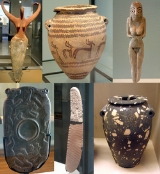
Predynastic Egypt

Encyclopedia
The Prehistory of Egypt spans the period of earliest human settlement to the beginning of the Early Dynastic Period of Egypt
in ca. 3100 BC, starting with King Menes
/Narmer
.
The Predynastic Period is traditionally equivalent to the Neolithic
period, beginning ca. 6000 BC and including the Protodynastic Period (Naqada III
).
The dates of the Predynastic period were first defined before widespread archaeological excavation of Egypt took place, and recent finds indicating very gradual Predynastic development have led to controversy over when exactly the Predynastic period ended. Thus, the term "Protodynastic period," sometimes called "Dynasty 0," has been used by scholars to name the part of the period which might be characterized as Predynastic by some and Early Dynastic by others.
The Predynastic period is generally divided into cultural periods, each named after the place where a certain type of Egyptian settlement was first discovered. However, the same gradual development that characterizes the Protodynastic period is present throughout the entire Predynastic period, and individual "cultures" must not be interpreted as separate entities but as largely subjective divisions used to facilitate study of the entire period.
The vast majority of Predynastic archaeological finds have been in Upper Egypt
, because the silt of the Nile River was more heavily deposited at the Delta region
, completely burying most Delta sites long before modern times.
in Egypt started around 30,000 BC. The Nazlet Khater
skeleton was found in 1980 and dated in 1982 from nine samples ranging between 35,100 to 30,360 years. This specimen is the only complete modern human skeleton from the earliest Late Stone Age in Africa.
. They were mobile structures — easily disassembled, moved, and reassembled — providing hunter-gatherers with semi-permanent habitation.
tool-making reached Egypt c. 40,000 BC.
but also from animal bone
s and hematite
. They also developed small arrow heads resembling those of Native American
s, but no bow
s have been found. The end of the Khormusan came around 16,000 B.C. with the appearance of other cultures in the region, including the Gemaian.
flourished along the Nile Valley of Egypt
and Nubia
between 18,000 and 15,000 BC, though one Halfan site dates to before 24,000 BC. They survived on a diet of large herd animals and the Khormusan tradition of fishing. Greater concentrations of artifacts indicate that they were not bound to seasonal wandering, but settled for longer periods. They are viewed as the parent culture of the Ibero-Maurusian industry, which spread across the Sahara and into Spain. The Halfan culture was derived in turn from the Khormusan, which depended on specialized hunting, fishing, and collecting techniques for survival. The primary material remains of this culture are stone tools, flakes, and a multitude of rock paintings.
sites in upper Nubia
give evidence for the existence of a grain
-grinding Mesolithic
culture called the Qadan Culture
, which practiced wild grain harvesting along the Nile
during the beginning of the Sahaba Daru Nile phase, when desiccation in the Sahara
caused residents of the Libyan oases to retreat into the Nile valley.
Qadan peoples developed sickle
s and grinding stone
s to aid in the collecting and processing of these plant foods prior to consumption. However there are no indications of the use of these tools after around 10,000 BC, when hunter-gathers replaced them.
In Egypt, analyses of pollen found at archaeological sites indicate that the Sebilian culture (also known as Esna culture
) were gathering wheat and barley. Domesticated seeds were not found (modern wheat and barley originated in Asia Minor
and Palestine
). It has been hypothesized that the sedentary lifestyle used by farmers led to increased warfare, which was detrimental to farming and brought this period to an end.
emerged from along the Nile Valley and is viewed as a parent of the Natufian culture
, which is associated with early agriculture. Epipalaeolithic Natufian
s carried parthenocarpic fig
s from Africa
to the southwestern corner of the Fertile Crescent
, c. 10,000 BC. The Mushabians are considered to have migrated to the Levant, merging with the Kebaran
.
s are viewed as migrating out of the Fayyum and the Eastern Deserts of Egypt during the late Mesolithic to merge with the Pre-Pottery Neolithic B (PPNB) culture, whose tool assemblage resembles that of the Harifian. This assimilation led to the Circum-Arabian Nomadic Pastoral Complex, a group of cultures that invented nomadic pastoralism
, and may have been the original culture which spread Proto-Semitic languages throughout Mesopotamia.
to settle around the Nile
more permanently and adopt a more sedentary lifestyle.
The period from 9000 to 6000 BC has left very little in the way of archaeological evidence. Around 6000 BC, Neolithic settlements appear all over Egypt. Some studies based on genetic
, and archaeological
data have attributed these settlements to migrants from the Fertile Crescent
returning during the Egyptian and North African Neolithic
. However, morphological and post-cranial data has linked the earliest farming populations at Fayum, Merimde, and El-Badari, to local Nilotic African populations. The archaeological data suggests that Near Eastern domesticates were incorporated into a pre-existing foraging strategy and only slowly developed into a full-blown lifestyle, contrary to what would be expected from settler colonists from the Near East. Finally, the names for the Near Eastern domesticates imported into Egypt were not Sumerian or Proto-Semitic loan words, which further diminishes the likely hood of a mass immigrant colonization of lower Egypt during the transition to agriculture.
Weaving
is evidenced for the first time during the Faiyum A Period. People of this period, unlike later Egyptians, buried their dead very close to, and sometimes inside, their settlements.
Although archaeological sites reveal very little about this time, an examination of the many Egyptian words for "city" provide a hypothetical list of reasons why the Egyptians settled. In Upper Egypt, terminology indicates trade, protection of livestock, high ground for flood refuge, and sacred sites for deities.
near Cairo, but is also attested in many other places in the Delta to the Fayum region.
Copper was known, and some copper adzes have been found. The pottery is simple and undecorated and shows, in some forms, strong connections to Southern Israel. People lived in small huts, partly dug into the ground. The dead were buried in cemeteries, but with few burial goods. The Maadi culture was replaced by the Naqada III culture; whether this happened by conquest or infiltration is still an open question.
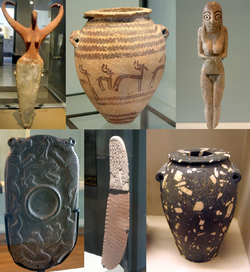
. This culture group is named for the burials found at Der Tasa, on the east bank of the Nile between Asyut
and Akhmim
. The Tasian culture group is notable for producing the earliest blacktop-ware, a type of red and brown pottery that is painted black on the top and interior. This pottery is vital to the dating of predynastic Egypt. Because all dates for the predynastic period are tenuous at best, WMF Petrie
developed a system called Sequence Dating
by which the relative date, if not the absolute date, of any given predynastic site can be ascertained by examining its pottery.
As the predynastic period progressed, the handles on pottery evolved from functional to ornamental, and the degree to which any given archaeological site has functional or ornamental pottery can be used to determine the relative date of the site. Since there is little difference between Tasian and Badarian pottery, the Tasian Culture overlaps the Badarian range significantly. From the Tasian period onward, it appears that Upper Egypt was influenced strongly by the culture of Lower Egypt
.
site near Der Tasa. It followed the Tasian culture, but was so similar that many consider them one continuous period. The Badarian Culture continued to produce the kind of pottery called Blacktop-ware (albeit much improved in quality) and was assigned Sequence Dating numbers 21 - 29. The primary difference that prevents scholars from merging the two periods is that Badarian sites use copper in addition to stone and are thus chalcolithic settlements, while the Neolithic
Tasian sites are still considered Stone Age
.
Badarian flint tools continued to develop into sharper and more shapely blades, and the first faience
was developed. Distinctly Badarian sites have been located from Nekhen
to a little north of Abydos. It appears that the Fayum A culture and the Badarian and Tasian Periods overlapped significantly; however, the Fayum A culture was considerably less agricultural and was still Neolithic in nature.
The Amratian culture lasted from about 4000 to 3500 BC. It is named after the site of El-Amra, about 120 km south of Badari
. El-Amra is the first site where this culture group was found unmingled with the later Gerzean culture group, but this period is better attested at the Naqada site, so it also is referred to as the Naqada I culture. Black-topped ware continues to appear, but white cross-line ware, a type of pottery which has been decorated with close parallel white lines being crossed by another set of close parallel white lines, is also found at this time. The Amratian period falls between S.D. 30 and 39 in Petrie's Sequence Dating
system.
Newly excavated objects attest to increased trade between Upper and Lower Egypt at this time. A stone vase from the north was found at el-Amra, and copper, which is not mined in Egypt, was imported from the Sinai, or possibly Nubia. Obsidian
and a small amount of gold
were both definitely imported from Nubia. Trade with the oases also was likely.
New innovations appeared in Amratian settlements as precursors to later cultural periods. For example, the mud-brick buildings for which the Gerzean period is known were first seen in Amratian times, but only in small numbers. Additionally, oval and theriomorphic cosmetic palette
s appear in this period, but the workmanship is very rudimentary and the relief artwork for which they were later known is not yet present.
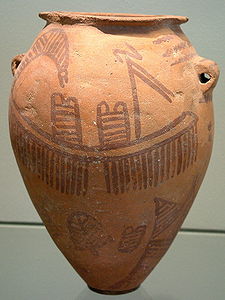 The Gerzean culture, from about 3500 to 3200 BC, is named after the site of Gerzeh
. It was the next stage in Egyptian cultural development, and it was during this time that the foundation of Dynastic Egypt was laid. Gerzean culture is largely an unbroken development out of Amratian Culture, starting in the delta and moving south through upper Egypt, but failing to dislodge Amratian culture in Nubia. Gerzean pottery is assigned values from S.D. 40 through 62, and is distinctly different from Amratian white cross-lined wares or black-topped ware. Gerzean pottery was painted mostly in dark red with pictures of animals, people, and ships, as well as geometric symbols that appear derived from animals. Also, "wavy" handles, rare before this period (though occasionally found as early as S.D. 35) became more common and more elaborate until they were almost completely ornamental.
Gerzean culture coincided with a significant decline in rainfall, and farming along the Nile now produced the vast majority of food, though contemporary paintings indicate that hunting was not entirely forgone. With increased food supplies, Egyptians
adopted a much more sedentary lifestyle and cities grew as large as 5,000.
It was in this time that Egyptian city dwellers stopped building with reed
s and began mass-producing mud bricks, first found in the Amratian Period, to build their cities.
Egyptian stone tools, while still in use, moved from bifacial
construction to ripple-flaked construction. Copper was used for all kinds of tools, and the first copper weaponry appears here. Silver, gold, lapis, and faience
were used ornamentally, and the grinding palettes used for eye-paint since the Badarian period began to be adorned with relief carvings.
The first tombs in classic Egyptian style were also built, modeled after ordinary houses and sometimes composed of multiple rooms. Although further excavations in the Delta are needed, this style is generally believed to originate there and not in Upper Egypt.
The Naqada III period, from about 3200 to 3000 BC, is generally taken to be identical with the Protodynastic period, during which Egypt was unified.
Naqada III is notable for being the first era with hieroglyphs
(though this is disputed by some), the first regular use of serekh
s, the first irrigation (water routed for farming), and the first appearance of royal cemeteries.
Early Dynastic Period of Egypt
The Archaic or Early Dynastic Period of Egypt immediately follows the unification of Lower and Upper Egypt c. 3100 BC. It is generally taken to include the First and Second Dynasties, lasting from the Protodynastic Period of Egypt until about 2686 BC, or the beginning of the Old Kingdom...
in ca. 3100 BC, starting with King Menes
Menes
Menes was an ancient Egyptian pharaoh of the early dynastic period, credited by classical tradition with having united Upper and Lower Egypt, and as the founder of the first dynasty ....
/Narmer
Narmer
Narmer was an ancient Egyptian pharaoh of the Early Dynastic Period . He is thought to be the successor to the Protodynastic pharaohs Scorpion and/or Ka, and he is considered by some to be the unifier of Egypt and founder of the First Dynasty, and therefore the first pharaoh of unified Egypt.The...
.
The Predynastic Period is traditionally equivalent to the Neolithic
Neolithic
The Neolithic Age, Era, or Period, or New Stone Age, was a period in the development of human technology, beginning about 9500 BC in some parts of the Middle East, and later in other parts of the world. It is traditionally considered as the last part of the Stone Age...
period, beginning ca. 6000 BC and including the Protodynastic Period (Naqada III
Naqada III
Naqada III is the last phase of the Naqada culture of ancient Egyptian prehistory, dating approximately from 3200 to 3000 BC. It is the period during which the process of state formation, which had begun to take place in Naqada II, became highly visible, with named kings heading powerful...
).
The dates of the Predynastic period were first defined before widespread archaeological excavation of Egypt took place, and recent finds indicating very gradual Predynastic development have led to controversy over when exactly the Predynastic period ended. Thus, the term "Protodynastic period," sometimes called "Dynasty 0," has been used by scholars to name the part of the period which might be characterized as Predynastic by some and Early Dynastic by others.
The Predynastic period is generally divided into cultural periods, each named after the place where a certain type of Egyptian settlement was first discovered. However, the same gradual development that characterizes the Protodynastic period is present throughout the entire Predynastic period, and individual "cultures" must not be interpreted as separate entities but as largely subjective divisions used to facilitate study of the entire period.
The vast majority of Predynastic archaeological finds have been in Upper Egypt
Upper Egypt
Upper Egypt is the strip of land, on both sides of the Nile valley, that extends from the cataract boundaries of modern-day Aswan north to the area between El-Ayait and Zawyet Dahshur . The northern section of Upper Egypt, between El-Ayait and Sohag is sometimes known as Middle Egypt...
, because the silt of the Nile River was more heavily deposited at the Delta region
Nile Delta
The Nile Delta is the delta formed in Northern Egypt where the Nile River spreads out and drains into the Mediterranean Sea. It is one of the world's largest river deltas—from Alexandria in the west to Port Said in the east, it covers some 240 km of Mediterranean coastline—and is a rich...
, completely burying most Delta sites long before modern times.
Late Paleolithic
The Late PaleolithicPaleolithic
The Paleolithic Age, Era or Period, is a prehistoric period of human history distinguished by the development of the most primitive stone tools discovered , and covers roughly 99% of human technological prehistory...
in Egypt started around 30,000 BC. The Nazlet Khater
Nazlet Khater
Nazlet Khater is an archeological site in Upper Egypt. The skeletal remains of an individual were found at the site. The remains were dated to about 33,000 years ago...
skeleton was found in 1980 and dated in 1982 from nine samples ranging between 35,100 to 30,360 years. This specimen is the only complete modern human skeleton from the earliest Late Stone Age in Africa.
Wadi Halfa
Some of the oldest known buildings were discovered in Egypt by archaeologist Waldemar Chmielewski along the southern border near Wadi HalfaWadi Halfa
Wadi Halfa is a city in the state of Northern, in northern Sudan, on the shores of Lake Nubia . It is the terminus of a rail line from Khartoum and the point where goods are transferred from rail to ferries going down the Lake Nasser...
. They were mobile structures — easily disassembled, moved, and reassembled — providing hunter-gatherers with semi-permanent habitation.
Aterian Industry
AterianAterian
The Aterian industry is a name given by archaeologists to a type of stone tool manufacturing dating to the Middle Stone Age in the region around the Atlas Mountains and the northern Sahara, it refers the site of Bir el Ater, south of Annaba.The industry was probably created by modern humans ,...
tool-making reached Egypt c. 40,000 BC.
Khormusan Industry
The Khormusan culture in Egypt began between 40,000 and 30,000 BC. Khormusans developed advanced tools not only from stoneSTONe
is a Japanese manga written and illustrated by Sin-Ichi Hiromoto. Kodansha released the two bound volumes of the manga on April 23, 2002 and August 23, 2002, respectively.The manga is licensed for an English-languague released in North America be Tokyopop...
but also from animal bone
Bone
Bones are rigid organs that constitute part of the endoskeleton of vertebrates. They support, and protect the various organs of the body, produce red and white blood cells and store minerals. Bone tissue is a type of dense connective tissue...
s and hematite
Hematite
Hematite, also spelled as haematite, is the mineral form of iron oxide , one of several iron oxides. Hematite crystallizes in the rhombohedral system, and it has the same crystal structure as ilmenite and corundum...
. They also developed small arrow heads resembling those of Native American
Indigenous peoples of the Americas
The indigenous peoples of the Americas are the pre-Columbian inhabitants of North and South America, their descendants and other ethnic groups who are identified with those peoples. Indigenous peoples are known in Canada as Aboriginal peoples, and in the United States as Native Americans...
s, but no bow
Bow (weapon)
The bow and arrow is a projectile weapon system that predates recorded history and is common to most cultures.-Description:A bow is a flexible arc that shoots aerodynamic projectiles by means of elastic energy. Essentially, the bow is a form of spring powered by a string or cord...
s have been found. The end of the Khormusan came around 16,000 B.C. with the appearance of other cultures in the region, including the Gemaian.
Halfan culture
The Halfan cultureHalfan culture
The Halfan people, of Egypt and Nubia flourished between 18,000 and 15,000 BC in Nubia and Egypt. One Halfan site dates to before 24,000 BC. They lived on a diet of large herd animals and the Khormusan tradition of fishing...
flourished along the Nile Valley of Egypt
Egypt
Egypt , officially the Arab Republic of Egypt, Arabic: , is a country mainly in North Africa, with the Sinai Peninsula forming a land bridge in Southwest Asia. Egypt is thus a transcontinental country, and a major power in Africa, the Mediterranean Basin, the Middle East and the Muslim world...
and Nubia
Nubia
Nubia is a region along the Nile river, which is located in northern Sudan and southern Egypt.There were a number of small Nubian kingdoms throughout the Middle Ages, the last of which collapsed in 1504, when Nubia became divided between Egypt and the Sennar sultanate resulting in the Arabization...
between 18,000 and 15,000 BC, though one Halfan site dates to before 24,000 BC. They survived on a diet of large herd animals and the Khormusan tradition of fishing. Greater concentrations of artifacts indicate that they were not bound to seasonal wandering, but settled for longer periods. They are viewed as the parent culture of the Ibero-Maurusian industry, which spread across the Sahara and into Spain. The Halfan culture was derived in turn from the Khormusan, which depended on specialized hunting, fishing, and collecting techniques for survival. The primary material remains of this culture are stone tools, flakes, and a multitude of rock paintings.
Qadan and Sebilian cultures
About twenty archaeologicalArchaeology
Archaeology, or archeology , is the study of human society, primarily through the recovery and analysis of the material culture and environmental data that they have left behind, which includes artifacts, architecture, biofacts and cultural landscapes...
sites in upper Nubia
Nubia
Nubia is a region along the Nile river, which is located in northern Sudan and southern Egypt.There were a number of small Nubian kingdoms throughout the Middle Ages, the last of which collapsed in 1504, when Nubia became divided between Egypt and the Sennar sultanate resulting in the Arabization...
give evidence for the existence of a grain
Cereal
Cereals are grasses cultivated for the edible components of their grain , composed of the endosperm, germ, and bran...
-grinding Mesolithic
Mesolithic
The Mesolithic is an archaeological concept used to refer to certain groups of archaeological cultures defined as falling between the Paleolithic and the Neolithic....
culture called the Qadan Culture
Qadan Culture
The Qadan culture was a culture that, archaeological evidence suggests, originated in Northeast Africa approximately 15,000 years ago. This way of life is estimated to have persisted for approximately 4,000 years, and was characterized by hunting, as well as a unique approach to food gathering...
, which practiced wild grain harvesting along the Nile
Nile
The Nile is a major north-flowing river in North Africa, generally regarded as the longest river in the world. It is long. It runs through the ten countries of Sudan, South Sudan, Burundi, Rwanda, Democratic Republic of the Congo, Tanzania, Kenya, Ethiopia, Uganda and Egypt.The Nile has two major...
during the beginning of the Sahaba Daru Nile phase, when desiccation in the Sahara
Sahara
The Sahara is the world's second largest desert, after Antarctica. At over , it covers most of Northern Africa, making it almost as large as Europe or the United States. The Sahara stretches from the Red Sea, including parts of the Mediterranean coasts, to the outskirts of the Atlantic Ocean...
caused residents of the Libyan oases to retreat into the Nile valley.
Qadan peoples developed sickle
Sickle
A sickle is a hand-held agricultural tool with a variously curved blade typically used for harvesting grain crops or cutting succulent forage chiefly for feeding livestock . Sickles have also been used as weapons, either in their original form or in various derivations.The diversity of sickles that...
s and grinding stone
Grinding Stone
Grinding Stone is a 1973 debut album by Gary Moore, released under the "The Gary Moore Band" moniker.-Track listing:All songs by Gary Moore.# "Grinding Stone" – 9:38# "Time to Heal" - 6:19# "Sail Across the Mountain" - 6:58...
s to aid in the collecting and processing of these plant foods prior to consumption. However there are no indications of the use of these tools after around 10,000 BC, when hunter-gathers replaced them.
In Egypt, analyses of pollen found at archaeological sites indicate that the Sebilian culture (also known as Esna culture
Esna
Esna , known to the ancient Egyptians as Egyptian: Iunyt or Ta-senet; Greek: or or ; Latin: Lato, is a city in Egypt. It is located on the west bank of the River Nile, some 55 km south of Luxor...
) were gathering wheat and barley. Domesticated seeds were not found (modern wheat and barley originated in Asia Minor
Asia Minor
Asia Minor is a geographical location at the westernmost protrusion of Asia, also called Anatolia, and corresponds to the western two thirds of the Asian part of Turkey...
and Palestine
Israel
The State of Israel is a parliamentary republic located in the Middle East, along the eastern shore of the Mediterranean Sea...
). It has been hypothesized that the sedentary lifestyle used by farmers led to increased warfare, which was detrimental to farming and brought this period to an end.
Mushabian culture
The Mushabian cultureMushabian culture
The Mushabian culture is suggested to have originated along the Nile Valley prior to migrating to the Levant, due to similar industries demonstrated among archaeological sites in both regions but with the Nile valley sites predating those found in the Sinai regions of the Levant.Accordingly...
emerged from along the Nile Valley and is viewed as a parent of the Natufian culture
Natufian culture
The Natufian culture was a Mesolithic culture that existed from 12,500 to 9,500 BC in the Levant, a region in the Eastern Mediterranean. It was unusual in that it was sedentary, or semi-sedentary, before the introduction of agriculture...
, which is associated with early agriculture. Epipalaeolithic Natufian
Natufian culture
The Natufian culture was a Mesolithic culture that existed from 12,500 to 9,500 BC in the Levant, a region in the Eastern Mediterranean. It was unusual in that it was sedentary, or semi-sedentary, before the introduction of agriculture...
s carried parthenocarpic fig
Ficus
Ficus is a genus of about 850 species of woody trees, shrubs, vines, epiphytes, and hemiepiphyte in the family Moraceae. Collectively known as fig trees or figs, they are native throughout the tropics with a few species extending into the semi-warm temperate zone. The Common Fig Ficus is a genus of...
s from Africa
Africa
Africa is the world's second largest and second most populous continent, after Asia. At about 30.2 million km² including adjacent islands, it covers 6% of the Earth's total surface area and 20.4% of the total land area...
to the southwestern corner of the Fertile Crescent
Fertile Crescent
The Fertile Crescent, nicknamed "The Cradle of Civilization" for the fact the first civilizations started there, is a crescent-shaped region containing the comparatively moist and fertile land of otherwise arid and semi-arid Western Asia. The term was first used by University of Chicago...
, c. 10,000 BC. The Mushabians are considered to have migrated to the Levant, merging with the Kebaran
Kebaran
The Kebaran or Kebarian culture was an archaeological culture in the eastern Mediterranean area , named after its type site, Kebara Cave south of Haifa...
.
Harifian culture
The HarifianHarifian
The Harifian is a specialized regional cultural development of the Epipalaeolithic of the Negev Desert. It corresponds to the latest stages of the Natufian culture. Like the Natufian, it is characterized by semi-subterranean houses. These are often more elaborate than those found at Natufian sites...
s are viewed as migrating out of the Fayyum and the Eastern Deserts of Egypt during the late Mesolithic to merge with the Pre-Pottery Neolithic B (PPNB) culture, whose tool assemblage resembles that of the Harifian. This assimilation led to the Circum-Arabian Nomadic Pastoral Complex, a group of cultures that invented nomadic pastoralism
Nomadic pastoralism
Nomadic pastoralism is a form of agriculture where livestock are herded in order to find fresh pastures on which to graze following an irregular pattern of movement - in contrast with transhumance where seasonal pastures are fix. The herded livestock may include cattle, yaks, sheep, goats,...
, and may have been the original culture which spread Proto-Semitic languages throughout Mesopotamia.
Faiyum A culture
Continued desiccation forced the early ancestors of the EgyptiansEgyptians
Egyptians are nation an ethnic group made up of Mediterranean North Africans, the indigenous people of Egypt.Egyptian identity is closely tied to geography. The population of Egypt is concentrated in the lower Nile Valley, the small strip of cultivable land stretching from the First Cataract to...
to settle around the Nile
Nile
The Nile is a major north-flowing river in North Africa, generally regarded as the longest river in the world. It is long. It runs through the ten countries of Sudan, South Sudan, Burundi, Rwanda, Democratic Republic of the Congo, Tanzania, Kenya, Ethiopia, Uganda and Egypt.The Nile has two major...
more permanently and adopt a more sedentary lifestyle.
The period from 9000 to 6000 BC has left very little in the way of archaeological evidence. Around 6000 BC, Neolithic settlements appear all over Egypt. Some studies based on genetic
Genetics
Genetics , a discipline of biology, is the science of genes, heredity, and variation in living organisms....
, and archaeological
Archaeology
Archaeology, or archeology , is the study of human society, primarily through the recovery and analysis of the material culture and environmental data that they have left behind, which includes artifacts, architecture, biofacts and cultural landscapes...
data have attributed these settlements to migrants from the Fertile Crescent
Fertile Crescent
The Fertile Crescent, nicknamed "The Cradle of Civilization" for the fact the first civilizations started there, is a crescent-shaped region containing the comparatively moist and fertile land of otherwise arid and semi-arid Western Asia. The term was first used by University of Chicago...
returning during the Egyptian and North African Neolithic
Neolithic Revolution
The Neolithic Revolution was the first agricultural revolution. It was the transition from hunting and gathering to agriculture and settlement. Archaeological data indicates that various forms of plants and animal domestication evolved independently in 6 separate locations worldwide circa...
. However, morphological and post-cranial data has linked the earliest farming populations at Fayum, Merimde, and El-Badari, to local Nilotic African populations. The archaeological data suggests that Near Eastern domesticates were incorporated into a pre-existing foraging strategy and only slowly developed into a full-blown lifestyle, contrary to what would be expected from settler colonists from the Near East. Finally, the names for the Near Eastern domesticates imported into Egypt were not Sumerian or Proto-Semitic loan words, which further diminishes the likely hood of a mass immigrant colonization of lower Egypt during the transition to agriculture.
Weaving
Weaving
Weaving is a method of fabric production in which two distinct sets of yarns or threads are interlaced at right angles to form a fabric or cloth. The other methods are knitting, lace making and felting. The longitudinal threads are called the warp and the lateral threads are the weft or filling...
is evidenced for the first time during the Faiyum A Period. People of this period, unlike later Egyptians, buried their dead very close to, and sometimes inside, their settlements.
Although archaeological sites reveal very little about this time, an examination of the many Egyptian words for "city" provide a hypothetical list of reasons why the Egyptians settled. In Upper Egypt, terminology indicates trade, protection of livestock, high ground for flood refuge, and sacred sites for deities.
Merimde culture
From about 5000 to 4200 BC the Merimde culture, so far only known from a big settlement site at the edge of the Western Delta, flourished in Lower Egypt. The culture has strong connections to the Faiyum A culture as well as the Levant. People lived in small huts, produced a simple undecorated pottery and had stone tools. Cattle, sheep, goats and pigs were held. Wheat, sorghum and barley were planted. The Merimde people buried their dead within the settlement and produced clay figurines. The first Egyptian lifesize head made of clay comes from Merimde.El Omari culture
The El Omari culture is known from a small settlement near modern Cairo. People seem to have lived in huts, but only postholes and pits survive. The pottery is undecorated. Stone tools include small flakes, axes and sickles. Metal was not yet known. Their sites were occupied from 4000 BC to the Archaic Period.Maadi culture
The Maadi culture (also called Buto Maadi culture) is the most important Lower Egyptian prehistoric culture contemporary with Naqada I and II phases in Upper Egypt. The culture is best known from the site MaadiMaadi
Maadi is a wealthy suburb south of Cairo, Egypt. The town is home to the Supreme Constitutional Court of Egypt, Cairo American College , Lycée Français du Caire , Misr American College , Maadi British International School , the Cairo Rugby Club, and the national Egyptian Geological Museum.-...
near Cairo, but is also attested in many other places in the Delta to the Fayum region.
Copper was known, and some copper adzes have been found. The pottery is simple and undecorated and shows, in some forms, strong connections to Southern Israel. People lived in small huts, partly dug into the ground. The dead were buried in cemeteries, but with few burial goods. The Maadi culture was replaced by the Naqada III culture; whether this happened by conquest or infiltration is still an open question.
Upper Egypt
Tasian culture
The Tasian culture was the next in Upper EgyptUpper Egypt
Upper Egypt is the strip of land, on both sides of the Nile valley, that extends from the cataract boundaries of modern-day Aswan north to the area between El-Ayait and Zawyet Dahshur . The northern section of Upper Egypt, between El-Ayait and Sohag is sometimes known as Middle Egypt...
. This culture group is named for the burials found at Der Tasa, on the east bank of the Nile between Asyut
Asyut
Asyut is the capital of the modern Asyut Governorate in Egypt; the ancient city of the same name is situated nearby. The modern city is located at , while the ancient city is at .- Etymology :...
and Akhmim
Akhmim
Akhmim is a city in the Sohag Governorate of Upper Egypt. Referred to by the ancient Greeks as Khemmis, Chemmis and Panopolis, it is located on the east bank of the Nile, 4 miles to the northeast of Sohag.- History :Akhmim was known in Ancient Egypt as Ipu, Apu or Khent-min...
. The Tasian culture group is notable for producing the earliest blacktop-ware, a type of red and brown pottery that is painted black on the top and interior. This pottery is vital to the dating of predynastic Egypt. Because all dates for the predynastic period are tenuous at best, WMF Petrie
William Matthew Flinders Petrie
William Matthew Flinders Petrie FRS , commonly known as Flinders Petrie, was an English Egyptologist and a pioneer of systematic methodology in archaeology and preservation of artifacts...
developed a system called Sequence Dating
Sequence Dating
Sequence Dating, a relative dating method, was a method of dating developed by the Egyptologist William Matthew Flinders Petrie. By linking styles of pottery with periods, he was the first to use seriation in Egyptology, a new method for establishing the chronology of a site...
by which the relative date, if not the absolute date, of any given predynastic site can be ascertained by examining its pottery.
As the predynastic period progressed, the handles on pottery evolved from functional to ornamental, and the degree to which any given archaeological site has functional or ornamental pottery can be used to determine the relative date of the site. Since there is little difference between Tasian and Badarian pottery, the Tasian Culture overlaps the Badarian range significantly. From the Tasian period onward, it appears that Upper Egypt was influenced strongly by the culture of Lower Egypt
Lower Egypt
Lower Egypt is the northern-most section of Egypt. It refers to the fertile Nile Delta region, which stretches from the area between El-Aiyat and Zawyet Dahshur, south of modern-day Cairo, and the Mediterranean Sea....
.
Badarian culture
The Badarian culture, from about 4400 to 4000 BC, is named for the BadariBadari
The Badarian culture provides the earliest direct evidence of agriculture in Upper Egypt during the Predynastic Era. It flourished between 4400 and 4000 BCE, and might have already existed as far back as 5000 BCE. It was first identified in El-Badari, Asyut.About forty settlements and six...
site near Der Tasa. It followed the Tasian culture, but was so similar that many consider them one continuous period. The Badarian Culture continued to produce the kind of pottery called Blacktop-ware (albeit much improved in quality) and was assigned Sequence Dating numbers 21 - 29. The primary difference that prevents scholars from merging the two periods is that Badarian sites use copper in addition to stone and are thus chalcolithic settlements, while the Neolithic
Neolithic
The Neolithic Age, Era, or Period, or New Stone Age, was a period in the development of human technology, beginning about 9500 BC in some parts of the Middle East, and later in other parts of the world. It is traditionally considered as the last part of the Stone Age...
Tasian sites are still considered Stone Age
Stone Age
The Stone Age is a broad prehistoric period, lasting about 2.5 million years , during which humans and their predecessor species in the genus Homo, as well as the earlier partly contemporary genera Australopithecus and Paranthropus, widely used exclusively stone as their hard material in the...
.
Badarian flint tools continued to develop into sharper and more shapely blades, and the first faience
Faience
Faience or faïence is the conventional name in English for fine tin-glazed pottery on a delicate pale buff earthenware body, originally associated with Faenza in northern Italy. The invention of a white pottery glaze suitable for painted decoration, by the addition of an oxide of tin to the slip...
was developed. Distinctly Badarian sites have been located from Nekhen
Nekhen
Nekhen was the religious and political capital of Upper Egypt at the end of the Predynastic period...
to a little north of Abydos. It appears that the Fayum A culture and the Badarian and Tasian Periods overlapped significantly; however, the Fayum A culture was considerably less agricultural and was still Neolithic in nature.
Amratian culture (Naqada I)
The Amratian culture lasted from about 4000 to 3500 BC. It is named after the site of El-Amra, about 120 km south of Badari
Badari
The Badarian culture provides the earliest direct evidence of agriculture in Upper Egypt during the Predynastic Era. It flourished between 4400 and 4000 BCE, and might have already existed as far back as 5000 BCE. It was first identified in El-Badari, Asyut.About forty settlements and six...
. El-Amra is the first site where this culture group was found unmingled with the later Gerzean culture group, but this period is better attested at the Naqada site, so it also is referred to as the Naqada I culture. Black-topped ware continues to appear, but white cross-line ware, a type of pottery which has been decorated with close parallel white lines being crossed by another set of close parallel white lines, is also found at this time. The Amratian period falls between S.D. 30 and 39 in Petrie's Sequence Dating
Sequence Dating
Sequence Dating, a relative dating method, was a method of dating developed by the Egyptologist William Matthew Flinders Petrie. By linking styles of pottery with periods, he was the first to use seriation in Egyptology, a new method for establishing the chronology of a site...
system.
Newly excavated objects attest to increased trade between Upper and Lower Egypt at this time. A stone vase from the north was found at el-Amra, and copper, which is not mined in Egypt, was imported from the Sinai, or possibly Nubia. Obsidian
Obsidian
Obsidian is a naturally occurring volcanic glass formed as an extrusive igneous rock.It is produced when felsic lava extruded from a volcano cools rapidly with minimum crystal growth...
and a small amount of gold
Gold
Gold is a chemical element with the symbol Au and an atomic number of 79. Gold is a dense, soft, shiny, malleable and ductile metal. Pure gold has a bright yellow color and luster traditionally considered attractive, which it maintains without oxidizing in air or water. Chemically, gold is a...
were both definitely imported from Nubia. Trade with the oases also was likely.
New innovations appeared in Amratian settlements as precursors to later cultural periods. For example, the mud-brick buildings for which the Gerzean period is known were first seen in Amratian times, but only in small numbers. Additionally, oval and theriomorphic cosmetic palette
Cosmetic palette
The cosmetic palettes of middle to late predynastic Egypt are archaeological artifacts, originally used to grind and apply ingredients for facial or body cosmetics. The decorative palettes of the late 4th millennium BCE appear to have lost this function and became commemorative, ornamental, and...
s appear in this period, but the workmanship is very rudimentary and the relief artwork for which they were later known is not yet present.
Gerzean culture (Naqada II)
Gerzeh
Gerzeh, also Girza or Jirzah, was a predynastic Egyptian cemetery located along the west bank of the Nile and today named after al-Girza, the nearby present day town in Egypt. Gerzeh is situated only several miles due east of the lake of the Al Fayyum.The Gerzean culture is a material culture...
. It was the next stage in Egyptian cultural development, and it was during this time that the foundation of Dynastic Egypt was laid. Gerzean culture is largely an unbroken development out of Amratian Culture, starting in the delta and moving south through upper Egypt, but failing to dislodge Amratian culture in Nubia. Gerzean pottery is assigned values from S.D. 40 through 62, and is distinctly different from Amratian white cross-lined wares or black-topped ware. Gerzean pottery was painted mostly in dark red with pictures of animals, people, and ships, as well as geometric symbols that appear derived from animals. Also, "wavy" handles, rare before this period (though occasionally found as early as S.D. 35) became more common and more elaborate until they were almost completely ornamental.
Gerzean culture coincided with a significant decline in rainfall, and farming along the Nile now produced the vast majority of food, though contemporary paintings indicate that hunting was not entirely forgone. With increased food supplies, Egyptians
Egyptians
Egyptians are nation an ethnic group made up of Mediterranean North Africans, the indigenous people of Egypt.Egyptian identity is closely tied to geography. The population of Egypt is concentrated in the lower Nile Valley, the small strip of cultivable land stretching from the First Cataract to...
adopted a much more sedentary lifestyle and cities grew as large as 5,000.
It was in this time that Egyptian city dwellers stopped building with reed
Reed
- Musical instruments :* Single-reed instrument, a woodwind instrument that uses only one reed to produce sound* Double reed instrument, a woodwind instrument that uses two reeds to produce sound...
s and began mass-producing mud bricks, first found in the Amratian Period, to build their cities.
Egyptian stone tools, while still in use, moved from bifacial
Biface
In archaeology, a biface is a two-sided stone tool and is used as a multi purposes knife, manufactured through a process of lithic reduction, that displays flake scars on both sides. A profile view of the final product tends to exhibit a lenticular shape...
construction to ripple-flaked construction. Copper was used for all kinds of tools, and the first copper weaponry appears here. Silver, gold, lapis, and faience
Faience
Faience or faïence is the conventional name in English for fine tin-glazed pottery on a delicate pale buff earthenware body, originally associated with Faenza in northern Italy. The invention of a white pottery glaze suitable for painted decoration, by the addition of an oxide of tin to the slip...
were used ornamentally, and the grinding palettes used for eye-paint since the Badarian period began to be adorned with relief carvings.
The first tombs in classic Egyptian style were also built, modeled after ordinary houses and sometimes composed of multiple rooms. Although further excavations in the Delta are needed, this style is generally believed to originate there and not in Upper Egypt.
Protodynastic Period (Naqada III)
The Naqada III period, from about 3200 to 3000 BC, is generally taken to be identical with the Protodynastic period, during which Egypt was unified.
Naqada III is notable for being the first era with hieroglyphs
Hieroglyphs
Hieroglyph or hieroglyphics may refer to:*Anatolian hieroglyphs*Chinese character*Cretan hieroglyphs*Cursive hieroglyphs*Dongba script*Egyptian hieroglyphs*Hieroglyphic Luwian*Mayan hieroglyphs...
(though this is disputed by some), the first regular use of serekh
Serekh
In Egyptian hieroglyphs, a serekh is a rectangular enclosure representing the niched or gated façade of a palace surmounted by the Horus falcon, indicating that the text enclosed is a royal name...
s, the first irrigation (water routed for farming), and the first appearance of royal cemeteries.
Timeline
- (All dates are approximate)
- Late PaleolithicPaleolithicThe Paleolithic Age, Era or Period, is a prehistoric period of human history distinguished by the development of the most primitive stone tools discovered , and covers roughly 99% of human technological prehistory...
, from 40th millennium BC- AterianAterianThe Aterian industry is a name given by archaeologists to a type of stone tool manufacturing dating to the Middle Stone Age in the region around the Atlas Mountains and the northern Sahara, it refers the site of Bir el Ater, south of Annaba.The industry was probably created by modern humans ,...
tool-making - Semi-permanent dwellings in Wadi HalfaWadi HalfaWadi Halfa is a city in the state of Northern, in northern Sudan, on the shores of Lake Nubia . It is the terminus of a rail line from Khartoum and the point where goods are transferred from rail to ferries going down the Lake Nasser...
- Tools made from animal bones, hematiteHematiteHematite, also spelled as haematite, is the mineral form of iron oxide , one of several iron oxides. Hematite crystallizes in the rhombohedral system, and it has the same crystal structure as ilmenite and corundum...
, and other stones
- Aterian
- NeolithicNeolithicThe Neolithic Age, Era, or Period, or New Stone Age, was a period in the development of human technology, beginning about 9500 BC in some parts of the Middle East, and later in other parts of the world. It is traditionally considered as the last part of the Stone Age...
, from 11th millennium BC- c. 10,500 BC: Wild grain harvesting along the Nile, grain-grinding culture creates world's earliest stone sickleSickleA sickle is a hand-held agricultural tool with a variously curved blade typically used for harvesting grain crops or cutting succulent forage chiefly for feeding livestock . Sickles have also been used as weapons, either in their original form or in various derivations.The diversity of sickles that...
blades - c. 8000 BC: Migration of peoples to the Nile, developing a more centralized society and settled agricultural economy
- c. 7500 BC: Importing animals from Asia to Sahara
- c. 7000 BC: Agriculture—animal and cereal—in East Sahara
- c. 7000 BC: in Nabta PlayaNabta PlayaNabta Playa was once a large basin in the Nubian Desert, located approximately 800 kilometers south of modern day Cairo or about 100 kilometers west of Abu Simbel in southern Egypt, 22° 32' north, 30° 42' east...
deep year-round water wells dug, and large organized settlements designed in planned arrangements - c. 6000 BC: Rudimentary ships (rowed, single-sailed) depicted in Egyptian rock artRock artRock art is a term used in archaeology for any human-made markings made on natural stone. They can be divided into:*Petroglyphs - carvings into stone surfaces*Pictographs - rock and cave paintings...
- c. 6th millennium BC: common knowledge of animal-skin tanningTanningTanning is the making of leather from the skins of animals which does not easily decompose. Traditionally, tanning used tannin, an acidic chemical compound from which the tanning process draws its name . Coloring may occur during tanning...
- c. 5500 BC: Stone-roofed subterranean chambers and other subterranean complexes in Nabta Playa containing buried sacrificeSacrificeSacrifice is the offering of food, objects or the lives of animals or people to God or the gods as an act of propitiation or worship.While sacrifice often implies ritual killing, the term offering can be used for bloodless sacrifices of cereal food or artifacts...
d cattle - c. 5000 BC: ArchaeoastronomicalArchaeoastronomyArchaeoastronomy is the study of how people in the past "have understood the phenomena in the sky how they used phenomena in the sky and what role the sky played in their cultures." Clive Ruggles argues it is misleading to consider archaeoastronomy to be the study of ancient astronomy, as modern...
stone megalithMegalithA megalith is a large stone that has been used to construct a structure or monument, either alone or together with other stones. Megalithic describes structures made of such large stones, utilizing an interlocking system without the use of mortar or cement.The word 'megalith' comes from the Ancient...
in Nabta Playa, world's earliest known astronomy - c. 5000 BC: Badarian; furniture, tableware, models of rectangular houses, pots, dishes, cups, bowls, vases, figurines, combs
- c. 4400 BC: finely-woven linenLinenLinen is a textile made from the fibers of the flax plant, Linum usitatissimum. Linen is labor-intensive to manufacture, but when it is made into garments, it is valued for its exceptional coolness and freshness in hot weather....
fragment
- c. 10,500 BC: Wild grain harvesting along the Nile, grain-grinding culture creates world's earliest stone sickle
- InventingInventionAn invention is a novel composition, device, or process. An invention may be derived from a pre-existing model or idea, or it could be independently conceived, in which case it may be a radical breakthrough. In addition, there is cultural invention, which is an innovative set of useful social...
prevalent, from 4th millennium BC- By 3400 BC, the world's earliest-known:
- CosmeticsCosmeticsCosmetics are substances used to enhance the appearance or odor of the human body. Cosmetics include skin-care creams, lotions, powders, perfumes, lipsticks, fingernail and toe nail polish, eye and facial makeup, towelettes, permanent waves, colored contact lenses, hair colors, hair sprays and...
- Donkey domestication
- (Meteoric) iron works
- Mortar (masonry)Mortar (masonry)Mortar is a workable paste used to bind construction blocks together and fill the gaps between them. The blocks may be stone, brick, cinder blocks, etc. Mortar becomes hard when it sets, resulting in a rigid aggregate structure. Modern mortars are typically made from a mixture of sand, a binder...
- Cosmetics
- c. 4000 BC:
- early Naqadan trade (see Silk RoadSilk RoadThe Silk Road or Silk Route refers to a historical network of interlinking trade routes across the Afro-Eurasian landmass that connected East, South, and Western Asia with the Mediterranean and European world, as well as parts of North and East Africa...
)
- early Naqadan trade (see Silk Road
- 4th millennium BC: Gerzean tomb-building, including underground rooms and burial of furniture and amulets
- 4th millennium BC: Cedar imported from LebanonLebanonLebanon , officially the Republic of LebanonRepublic of Lebanon is the most common term used by Lebanese government agencies. The term Lebanese Republic, a literal translation of the official Arabic and French names that is not used in today's world. Arabic is the most common language spoken among...
- c. 3900 BC: An aridification event5.9 kiloyear eventThe 5.9 kiloyear event was one of the most intense aridification events during the Holocene. It occurred around 3900 BC, ending the Neolithic Subpluvial and probably initiated the most recent desiccation of the Sahara desert. Thus, it also triggered worldwide migration to river valleys, e.g...
in the Sahara leads to human migration to the Nile Valley - c. 3500 BC: Lapis lazuliLapis lazuliLapis lazuli is a relatively rare semi-precious stone that has been prized since antiquity for its intense blue color....
imported from Badakshan and / or MesopotamiaMesopotamiaMesopotamia is a toponym for the area of the Tigris–Euphrates river system, largely corresponding to modern-day Iraq, northeastern Syria, southeastern Turkey and southwestern Iran.Widely considered to be the cradle of civilization, Bronze Age Mesopotamia included Sumer and the...
(see Silk RoadSilk RoadThe Silk Road or Silk Route refers to a historical network of interlinking trade routes across the Afro-Eurasian landmass that connected East, South, and Western Asia with the Mediterranean and European world, as well as parts of North and East Africa...
) - c. 3300 BC: Double reedDouble reedA double reed is a type of reed used to produce sound in various wind instruments. The term double reed comes from the fact that there are two pieces of cane vibrating against each other. A single reed consists of one piece of cane which vibrates against a mouthpiece made of metal, hardened...
instrumentss, lyreLyreThe lyre is a stringed musical instrument known for its use in Greek classical antiquity and later. The word comes from the Greek "λύρα" and the earliest reference to the word is the Mycenaean Greek ru-ra-ta-e, meaning "lyrists", written in Linear B syllabic script...
s (see Music of EgyptMusic of EgyptThe music of Egypt has been an integral part of Egyptian culture since ancient times. The ancient Egyptians credited one of their Gods Thoth with the invention of music, which Osiris in turn used as part of his effort to civilize the world...
) - c. 3500 BC: SenetSenetSenet is a board game from predynastic and ancient Egypt. The oldest hieroglyph representing a Senet game dates to around 3100 BC. The full name of the game in Egyptian was zn.t n.t ḥˁb meaning the "game of passing."- History :...
, world's oldest-(confirmed) board gameBoard gameA board game is a game which involves counters or pieces being moved on a pre-marked surface or "board", according to a set of rules. Games may be based on pure strategy, chance or a mixture of the two, and usually have a goal which a player aims to achieve... - c. 3500 BC: FaienceEgyptian faienceEgyptian faience is a non-clay based ceramic displaying surface vitrification which creates a bright lustre of various blue-green colours. Having not been made from clay it is often not classed as pottery. It is called "Egyptian faience" to distinguish it from faience, the tin glazed pottery...
, world's earliest-known glazed ceramic beads - c. 3200 king menes (mee-neez) banded upper and lower egypt together
- By 3400 BC, the world's earliest-known:
External links
- Encyclopædia Britannica: "ship," from Encyclopædia Britannica Premium Service.
- Ancient Egyptian History - A comprehensive & concise educational website focusing on the basic and the advanced in all aspects of Ancient Egypt
- Faium.com homepage
- Before the Pyramids: The Origins of Egyptian Civilization - Oriental Institute
- - An excellent link for the Predynastic Period of Egypt