


Leo Africanus

Encyclopedia
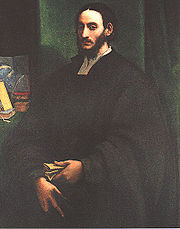
Joannes Leo Africanus, (c. 1494 – c. 1554?) (or al-Hasan ibn Muhammad al-Wazzan al-Fasi, Arabic
Arabic alphabet
The Arabic alphabet or Arabic abjad is the Arabic script as it is codified for writing the Arabic language. It is written from right to left, in a cursive style, and includes 28 letters. Because letters usually stand for consonants, it is classified as an abjad.-Consonants:The Arabic alphabet has...
:حسن ابن محمد الوزان الفاسي) was a Moorish
Moors
The description Moors has referred to several historic and modern populations of the Maghreb region who are predominately of Berber and Arab descent. They came to conquer and rule the Iberian Peninsula for nearly 800 years. At that time they were Muslim, although earlier the people had followed...
diplomat and author who is best known for his book Descrittione dell’Africa (Description of Africa
Description of Africa
Description of Africa, a largely firsthand geographical book, which was published under the title Descrittione dell’ Africa by Giovanni Battista Ramusio in his collection of travellers' accounts Delle navigationi e viaggi in Venice in 1550, contained the first detailed descriptions published in...
) describing the geography of North Africa
North Africa
North Africa or Northern Africa is the northernmost region of the African continent, linked by the Sahara to Sub-Saharan Africa. Geopolitically, the United Nations definition of Northern Africa includes eight countries or territories; Algeria, Egypt, Libya, Morocco, South Sudan, Sudan, Tunisia, and...
.
Biography
Most of what is known about his life is gathered from autobiographical notes in his own work. Leo Africanus was born in GranadaGranada
Granada is a city and the capital of the province of Granada, in the autonomous community of Andalusia, Spain. Granada is located at the foot of the Sierra Nevada mountains, at the confluence of three rivers, the Beiro, the Darro and the Genil. It sits at an elevation of 738 metres above sea...
in around 1494 but his family moved to Fez soon after his birth. In Fez he studied at the University of Al Karaouine
University of Al Karaouine
The University of Al-Karaouine or Al-Qarawiyyin is a university located in Fes, Morocco which was established in 1947. Its origins date back to 859, when it was founded as a mosque school or madrasa...
. As a young man he accompanied an uncle on a diplomatic mission
Diplomatic mission
A diplomatic mission is a group of people from one state or an international inter-governmental organisation present in another state to represent the sending state/organisation in the receiving state...
to the Maghreb
Maghreb
The Maghreb is the region of Northwest Africa, west of Egypt. It includes five countries: Morocco, Algeria, Tunisia, Libya, and Mauritania and the disputed territory of Western Sahara...
, reaching as far as the city of Timbuktu
Timbuktu
Timbuktu , formerly also spelled Timbuctoo, is a town in the West African nation of Mali situated north of the River Niger on the southern edge of the Sahara Desert. The town is the capital of the Timbuktu Region, one of the eight administrative regions of Mali...
(c. 1510), then part of the Songhai Empire
Songhai Empire
The Songhai Empire, also known as the Songhay Empire, was a state located in western Africa. From the early 15th to the late 16th century, Songhai was one of the largest Islamic empires in history. This empire bore the same name as its leading ethnic group, the Songhai. Its capital was the city...
. In 1517 when returning from a diplomatic mission to Constantinople
Constantinople
Constantinople was the capital of the Roman, Eastern Roman, Byzantine, Latin, and Ottoman Empires. Throughout most of the Middle Ages, Constantinople was Europe's largest and wealthiest city.-Names:...
on behalf of Sultan of Fez Muhammad II he found himself in Rosetta
Rosetta
Rosetta is a port city on the Mediterranean coast of Egypt. It is located east of Alexandria, in Beheira governorate. It was founded around AD 800....
during the Ottoman conquest of Egypt. He continued with his journey through Cairo
Cairo
Cairo , is the capital of Egypt and the largest city in the Arab world and Africa, and the 16th largest metropolitan area in the world. Nicknamed "The City of a Thousand Minarets" for its preponderance of Islamic architecture, Cairo has long been a centre of the region's political and cultural life...
and Aswan
Aswan
Aswan , formerly spelled Assuan, is a city in the south of Egypt, the capital of the Aswan Governorate.It stands on the east bank of the Nile at the first cataract and is a busy market and tourist centre...
and across the Red Sea
Red Sea
The Red Sea is a seawater inlet of the Indian Ocean, lying between Africa and Asia. The connection to the ocean is in the south through the Bab el Mandeb strait and the Gulf of Aden. In the north, there is the Sinai Peninsula, the Gulf of Aqaba, and the Gulf of Suez...
to Arabia
Arabian Peninsula
The Arabian Peninsula is a land mass situated north-east of Africa. Also known as Arabia or the Arabian subcontinent, it is the world's largest peninsula and covers 3,237,500 km2...
, where he probably performed a pilgrimage
Pilgrimage
A pilgrimage is a journey or search of great moral or spiritual significance. Typically, it is a journey to a shrine or other location of importance to a person's beliefs and faith...
to Mecca
Mecca
Mecca is a city in the Hijaz and the capital of Makkah province in Saudi Arabia. The city is located inland from Jeddah in a narrow valley at a height of above sea level...
. On his way back to Tunis
Tunis
Tunis is the capital of both the Tunisian Republic and the Tunis Governorate. It is Tunisia's largest city, with a population of 728,453 as of 2004; the greater metropolitan area holds some 2,412,500 inhabitants....
in 1518 he was captured by Spanish corsair
Corsair
Corsairs were privateers, authorized to conduct raids on shipping of a nation at war with France, on behalf of the French Crown. Seized vessels and cargo were sold at auction, with the corsair captain entitled to a portion of the proceeds...
s either near the island of Djerba
Djerba
Djerba , also transliterated as Jerba or Jarbah, is, at 514 km², the largest island of North Africa, located in the Gulf of Gabes, off the coast of Tunisia.-Description:...
or more probably near Crete
Crete
Crete is the largest and most populous of the Greek islands, the fifth largest island in the Mediterranean Sea, and one of the thirteen administrative regions of Greece. It forms a significant part of the economy and cultural heritage of Greece while retaining its own local cultural traits...
. He was taken to Rome
Rome
Rome is the capital of Italy and the country's largest and most populated city and comune, with over 2.7 million residents in . The city is located in the central-western portion of the Italian Peninsula, on the Tiber River within the Lazio region of Italy.Rome's history spans two and a half...
and initially imprisoned in the Castel Sant’Angelo but when his captors realised his importance he was freed and presented to Pope Leo X
Pope Leo X
Pope Leo X , born Giovanni di Lorenzo de' Medici, was the Pope from 1513 to his death in 1521. He was the last non-priest to be elected Pope. He is known for granting indulgences for those who donated to reconstruct St. Peter's Basilica and his challenging of Martin Luther's 95 Theses...
. He was baptized in the Basilica of Saint Peter's
St. Peter's Basilica
The Papal Basilica of Saint Peter , officially known in Italian as ' and commonly known as Saint Peter's Basilica, is a Late Renaissance church located within the Vatican City. Saint Peter's Basilica has the largest interior of any Christian church in the world...
in 1520. It is likely that Leo Africanus was welcomed to the papal court
Papal court
The Papal Household or Pontifical Household , called until 1968 the Papal Court , consists of dignitaries who assist the Pope in carrying out particular ceremonies of either a religious or a civil character....
as the Pope feared that Turkish forces might invade Sicily and southern Italy, and a willing collaborator could provide useful information on North Africa.
Leo Africanus left Rome and spent the next three or four years traveling in Italy. While staying in Bologna
Bologna
Bologna is the capital city of Emilia-Romagna, in the Po Valley of Northern Italy. The city lies between the Po River and the Apennine Mountains, more specifically, between the Reno River and the Savena River. Bologna is a lively and cosmopolitan Italian college city, with spectacular history,...
he wrote an Arabic-Hebrew-Latin medical vocabulary
Vocabulary
A person's vocabulary is the set of words within a language that are familiar to that person. A vocabulary usually develops with age, and serves as a useful and fundamental tool for communication and acquiring knowledge...
, of which only the Arabic part has survived, and a grammar
Grammar
In linguistics, grammar is the set of structural rules that govern the composition of clauses, phrases, and words in any given natural language. The term refers also to the study of such rules, and this field includes morphology, syntax, and phonology, often complemented by phonetics, semantics,...
of Arabic of which only an eight page fragment has survived. He returned to Rome in 1526 under the protection of Pope Clement VII
Pope Clement VII
Clement VII , born Giulio di Giuliano de' Medici, was a cardinal from 1513 to 1523 and was Pope from 1523 to 1534.-Early life:...
. According to Leo, he completed his manuscript on African geography
Geography
Geography is the science that studies the lands, features, inhabitants, and phenomena of Earth. A literal translation would be "to describe or write about the Earth". The first person to use the word "geography" was Eratosthenes...
in the same year. The work was published in Italian with the title Della descrittione dell’Africa et delle cose notabili cheiui sono, per Giovan Lioni Africano
Description of Africa
Description of Africa, a largely firsthand geographical book, which was published under the title Descrittione dell’ Africa by Giovanni Battista Ramusio in his collection of travellers' accounts Delle navigationi e viaggi in Venice in 1550, contained the first detailed descriptions published in...
in 1550 by the Venetian
Venice
Venice is a city in northern Italy which is renowned for the beauty of its setting, its architecture and its artworks. It is the capital of the Veneto region...
publisher Giovanni Battista Ramusio
Giovanni Battista Ramusio
Giovanni Battista Ramusio was an Italian geographer and travel writer.Born in Treviso, Italy, Ramusio was the son of Paolo Ramusio, a magistrate in the city-state of Venice...
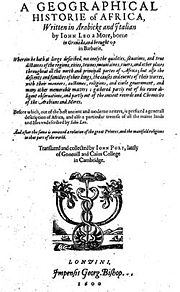
. The book proved to be extremely popular and was reprinted five times. It was also translated into other languages. French and Latin editions were published in 1556 while an English version was published in 1600 with the title A Geographical Historie of Africa
Description of Africa
Description of Africa, a largely firsthand geographical book, which was published under the title Descrittione dell’ Africa by Giovanni Battista Ramusio in his collection of travellers' accounts Delle navigationi e viaggi in Venice in 1550, contained the first detailed descriptions published in...
. The Latin edition, which contained many errors and mistranslations, was used as the source for the English translation.
It is unlikely that Leo Africanus visited all the places that he describes and he must therefore have relied on information obtained from other travelers. In particular, it is doubtful whether he ever visited Hausaland and Bornu
Bornu Empire
The Bornu Empire was an African state of Nigeria from 1396 to 1893. It was a continuation of the great Kanem Empire founded centuries earlier by the Sayfawa Dynasty...
and it is even possible that he never crossed the Sahara
Sahara
The Sahara is the world's second largest desert, after Antarctica. At over , it covers most of Northern Africa, making it almost as large as Europe or the United States. The Sahara stretches from the Red Sea, including parts of the Mediterranean coasts, to the outskirts of the Atlantic Ocean...
but relied on information from other travelers that he met in Morocco.
At the time he visited the city of Timbuktu
Timbuktu
Timbuktu , formerly also spelled Timbuctoo, is a town in the West African nation of Mali situated north of the River Niger on the southern edge of the Sahara Desert. The town is the capital of the Timbuktu Region, one of the eight administrative regions of Mali...
, it was a thriving Islam
Islam
Islam . The most common are and . : Arabic pronunciation varies regionally. The first vowel ranges from ~~. The second vowel ranges from ~~~...
ic city famous for its learning. Timbuktu was to become a byword in Europe
Europe
Europe is, by convention, one of the world's seven continents. Comprising the westernmost peninsula of Eurasia, Europe is generally 'divided' from Asia to its east by the watershed divides of the Ural and Caucasus Mountains, the Ural River, the Caspian and Black Seas, and the waterways connecting...
as the most inaccessible of cities, but at the time Leo visited, it was the center of a busy trade carried on by traders in Africa
Africa
Africa is the world's second largest and second most populous continent, after Asia. At about 30.2 million km² including adjacent islands, it covers 6% of the Earth's total surface area and 20.4% of the total land area...
n products, gold
Gold
Gold is a chemical element with the symbol Au and an atomic number of 79. Gold is a dense, soft, shiny, malleable and ductile metal. Pure gold has a bright yellow color and luster traditionally considered attractive, which it maintains without oxidizing in air or water. Chemically, gold is a...
, printed cotton
Cotton
Cotton is a soft, fluffy staple fiber that grows in a boll, or protective capsule, around the seeds of cotton plants of the genus Gossypium. The fiber is almost pure cellulose. The botanical purpose of cotton fiber is to aid in seed dispersal....
s and slaves
Slavery
Slavery is a system under which people are treated as property to be bought and sold, and are forced to work. Slaves can be held against their will from the time of their capture, purchase or birth, and deprived of the right to leave, to refuse to work, or to demand compensation...
, and in Islamic books. Nothing is known of Leo's later life.
In fiction
A fictionalized account of his life, Leo AfricanusLeo Africanus (novel)
Leo Africanus is a 1986 novel written in french by Amin Maalouf, depicting the life of a historical Renaissance-era traveler, Leo Africanus...
, by Amin Maalouf
Amin Maalouf
Amin Maalouf , born 25 February 1949 in Beirut, is a Lebanese-born French author. Although his native language is Arabic, he writes in French, and his works have been translated into many languages. He received the Prix Goncourt in 1993 for his novel The Rock of Tanios...
, fills in key gaps in the story and places Leo Africanus in all of the prominent events of his time.
It has been suggested that William Shakespeare
William Shakespeare
William Shakespeare was an English poet and playwright, widely regarded as the greatest writer in the English language and the world's pre-eminent dramatist. He is often called England's national poet and the "Bard of Avon"...
may have been inspired by Leo Africanus' book to create the character of Othello
Othello (character)
Othello is a character in Shakespeare's Othello . The character's origin is traced to the tale, "Un Capitano Moro" in Gli Hecatommithi by Giovanni Battista Giraldi Cinthio. There, he is simply referred to as the Moor....
.