Strait of Hormuz

Encyclopedia
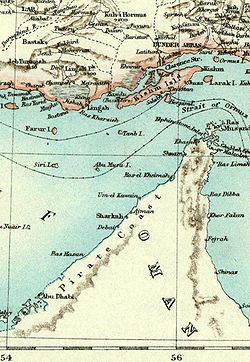
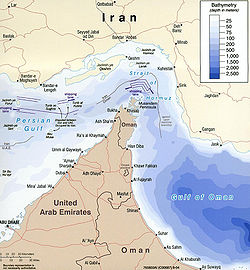
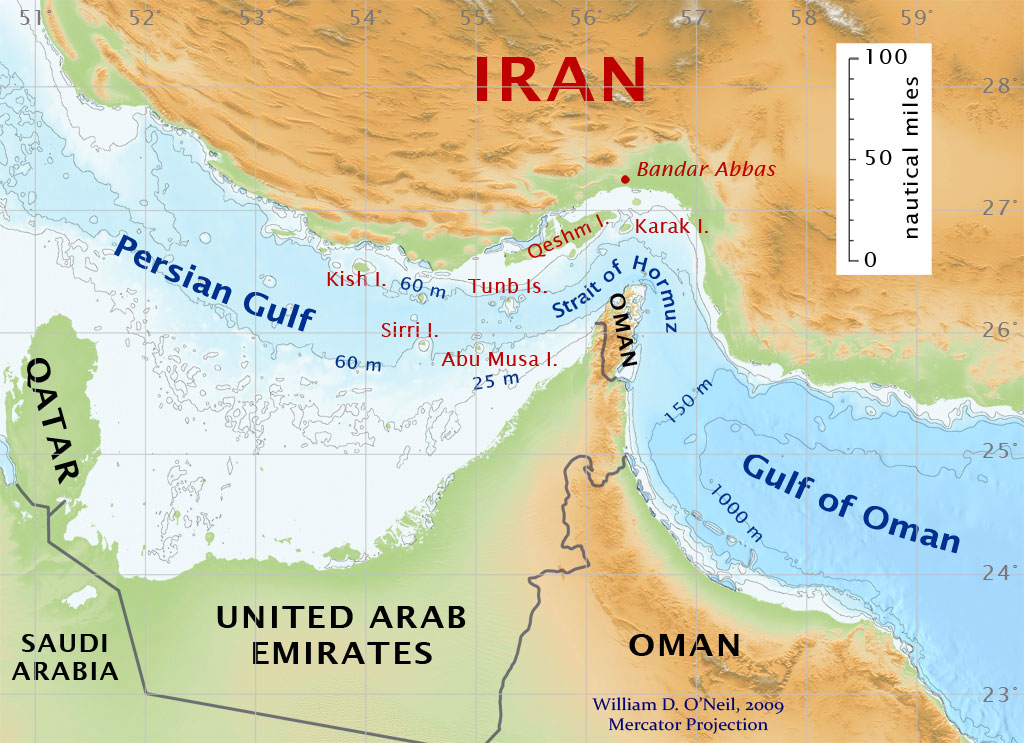
The Strait of Hormuz hɔrˈmuːz ( Tangeh-ye Hormoz, Maḍīq Hurmuz) is a narrow, strategically important waterway between the Gulf of Oman
Gulf of Oman
The Gulf of Oman or Sea of Oman is a strait that connects the Arabian Sea with the Strait of Hormuz, which then runs to the Persian Gulf. It is generally included as a branch of the Persian Gulf, not as an arm of the Arabian Sea. On the north coast is Pakistan and Iran...
in the southeast and the Persian Gulf
Persian Gulf
The Persian Gulf, in Southwest Asia, is an extension of the Indian Ocean located between Iran and the Arabian Peninsula.The Persian Gulf was the focus of the 1980–1988 Iran-Iraq War, in which each side attacked the other's oil tankers...
. On the north coast is Iran
Iran
Iran , officially the Islamic Republic of Iran , is a country in Southern and Western Asia. The name "Iran" has been in use natively since the Sassanian era and came into use internationally in 1935, before which the country was known to the Western world as Persia...
and on the south coast is the United Arab Emirates
United Arab Emirates
The United Arab Emirates, abbreviated as the UAE, or shortened to "the Emirates", is a state situated in the southeast of the Arabian Peninsula in Western Asia on the Persian Gulf, bordering Oman, and Saudi Arabia, and sharing sea borders with Iraq, Kuwait, Bahrain, Qatar, and Iran.The UAE is a...
and Musandam
Musandam
Musandam Governorate is a governorate of Oman.Geographically, the Musandam peninsula juts into the Strait of Hormuz, the narrow entry into the Persian Gulf, from the Arabian Peninsula. The Musandam peninsula is an exclave of Oman, separated from the rest of the country by the United Arab Emirates...
, an exclave of Oman
Oman
Oman , officially called the Sultanate of Oman , is an Arab state in southwest Asia on the southeast coast of the Arabian Peninsula. It is bordered by the United Arab Emirates to the northwest, Saudi Arabia to the west, and Yemen to the southwest. The coast is formed by the Arabian Sea on the...
.
The strait
Strait
A strait or straits is a narrow, typically navigable channel of water that connects two larger, navigable bodies of water. It most commonly refers to a channel of water that lies between two land masses, but it may also refer to a navigable channel through a body of water that is otherwise not...
at its narrowest is 54 kilometres (33.6 mi) wide. It is the only sea passage to the open ocean for large areas of the petroleum
Petroleum
Petroleum or crude oil is a naturally occurring, flammable liquid consisting of a complex mixture of hydrocarbons of various molecular weights and other liquid organic compounds, that are found in geologic formations beneath the Earth's surface. Petroleum is recovered mostly through oil drilling...
-exporting Persian Gulf
Persian Gulf
The Persian Gulf, in Southwest Asia, is an extension of the Indian Ocean located between Iran and the Arabian Peninsula.The Persian Gulf was the focus of the 1980–1988 Iran-Iraq War, in which each side attacked the other's oil tankers...
. About 13 tankers carrying 15.5 Moilbbl of crude oil pass through the strait on an average day, making it one of the world's most strategically important choke point
Choke point
In military strategy, a choke point is a geographical feature on land such as a valley, defile or a bridge, or at sea such as a strait which an armed force is forced to pass, sometimes on a substantially narrower front, and therefore greatly decreasing its combat power, in order to reach its...
s. This represents 33% of the world's seaborne oil shipments, and 17% of all world oil shipments in 2009.
Navigation
Ships moving through the Strait follow a Traffic Separation Scheme (TSS), which separates inbound from outbound traffic to reduce the risk of collision. The traffic lane is six miles (10 km) wide, including two two-mile (3 km)-wide traffic lanes, one inbound and one outbound, separated by a two-mile (3 km) wide separation median.To traverse the Strait, ships pass through the territorial waters of Iran and Oman under the transit passage
Transit passage
Transit passage is a concept in Law of the Sea which allows for a vessel and aircraft in accordance with United Nations Convention on the Law of the Sea of the freedom of navigation and overflight solely for the purpose of continuous and expeditious transit of the strait between one part of the...
provisions of the United Nations Convention on the Law of the Sea
United Nations Convention on the Law of the Sea
The United Nations Convention on the Law of the Sea , also called the Law of the Sea Convention or the Law of the Sea treaty, is the international agreement that resulted from the third United Nations Conference on the Law of the Sea , which took place from 1973 through 1982...
. Although not all countries have ratified the convention, most countries, including the U.S., accept these customary navigation rules as codified in the Convention.
Oman has a radar site LQI to monitor the TSS in the strait of Hormuz. This site is located on a small island on the peak of Mussandam Peninsula.
Etymology
The opening to the Persian Gulf was described, but not given a name, in the Periplus of the Erythraean SeaPeriplus of the Erythraean Sea
The Periplus of the Erythraean Sea or Periplus of the Red Sea is a Greco-Roman periplus, written in Greek, describing navigation and trading opportunities from Roman Egyptian ports like Berenice along the coast of the Red Sea, and others along Northeast Africa and India...
, a 1st-century mariner's guide:
- Ch.35. At the upper end of these Calaei islands is a range of mountains called Calon, and there follows not far beyond, the mouth of the Persian Gulf, where there is much diving for the pearl-mussel. To the left of the straits are great mountains called Asabon, and to the right there rises in full view another round and high mountain called Semiramis; between them the passage across the strait is about six hundred stadia; beyond which that very great and broad sea, the Persian Gulf, reaches far into the interior. At the upper end of this gulf there is a market-town designated by law called Apologus, situated near Charaex Spasini and the River Euphrates.
There are two opinions about the etymology of this name. In popular belief the derivation is from the name of the Persian God هرمزHormoz (a variant of Ahura Mazda
Ahura Mazda
Ahura Mazdā is the Avestan name for a divinity of the Old Iranian religion who was proclaimed the uncreated God by Zoroaster, the founder of Zoroastrianism...
). Compare the Pillars of Hercules
Pillars of Hercules
The Pillars of Hercules was the phrase that was applied in Antiquity to the promontories that flank the entrance to the Strait of Gibraltar. The northern Pillar is the Rock of Gibraltar in the British overseas territory of Gibraltar...
at the entrance to the Mediterranean. Scholars, historians and linguists derive the name "Ormuz" from the local Persian
Persian language
Persian is an Iranian language within the Indo-Iranian branch of the Indo-European languages. It is primarily spoken in Iran, Afghanistan, Tajikistan and countries which historically came under Persian influence...
word هورمغ Hur-mogh meaning date palm. In the local dialects of Hurmoz and Minab this strait is still called Hurmogh and has the aforementioned meaning.
Operation Praying Mantis
On 18 April 1988, the U.S. Navy waged a one-day battle against Iranian forces in and around the strait. The battle, dubbed Operation Praying MantisOperation Praying Mantis
Operation Praying Mantis was an attack on April 18, 1988, by U.S. naval forces within Iranian territorial waters in retaliation for the Iranian mining of the Persian Gulf during the Iran Iraq war and the subsequent damage to an American warship....
by the U.S. side, was launched in retaliation for the 14 April mining of the USS Samuel B. Roberts
USS Samuel B. Roberts (FFG-58)
USS Samuel B. Roberts is one of the final ships in the United States Navy's Oliver Hazard Perry class of guided missile frigates . The ship was severely damaged by an Iranian mine in 1988, leading U.S. forces to respond with Operation Praying Mantis.-Commissioning and namesake:The frigate was...
(FFG-58). U.S. forces sank one frigate, one gunboat, and as many as six armed speedboats in the engagement and seriously damaged a second frigate.
The downing of Iran Air 655
On July 3, 1988, 290 people were killed when an Iran AirIran Air
Iran Air , formally Airline of the Islamic Republic of Iran is the flag carrier airline of Iran, operating services to 60 destinations, 35 international and 25 domestic. The cargo fleet operates services to 20 scheduled and 5 charter destinations...
Airbus A300
Airbus A300
The Airbus A300 is a short- to medium-range widebody jet airliner. Launched in 1972 as the world's first twin-engined widebody, it was the first product of Airbus Industrie, a consortium of European aerospace companies, wholly owned today by EADS...
passenger jet was shot down over the strait by the United States Navy
United States Navy
The United States Navy is the naval warfare service branch of the United States Armed Forces and one of the seven uniformed services of the United States. The U.S. Navy is the largest in the world; its battle fleet tonnage is greater than that of the next 13 largest navies combined. The U.S...
guided missile
Guided Missile
Guided Missile is a London based independent record label set up by Paul Kearney in 1994.Guided Missile has always focused on 'the underground', preferring to put out a steady flow of releases and developing the numerous GM events around London and beyond....
cruiser
Cruiser
A cruiser is a type of warship. The term has been in use for several hundreds of years, and has had different meanings throughout this period...
USS Vincennes
USS Vincennes (CG-49)
The fourth USS Vincennes is a U.S. Navy Ticonderoga class Aegis guided missile cruiser. On July 3, 1988, the ship shot down Iran Air Flight 655 over the Persian Gulf, killing all 290 civilian passengers on board, including 38 non-Iranians and 66 children.The ship was launched 14 April 1984 and...
. There is still a lingering controversy
Iran Air Flight 655
Iran Air Flight 655 was a civilian jet airliner shot down by U.S. missiles on 3 July 1988, over the Strait of Hormuz, toward the end of the Iran–Iraq War...
about the event, a tragedy in aviation
Aviation
Aviation is the design, development, production, operation, and use of aircraft, especially heavier-than-air aircraft. Aviation is derived from avis, the Latin word for bird.-History:...
history.
Collision between USS Newport News and tanker Mogamigawa
On January 10, 2007, the nuclear submarine USS Newport NewsUSS Newport News (SSN-750)
USS Newport News , a , was the third ship of the United States Navy to be named for Newport News, Virginia.-Construction:The contract to build her was awarded to Newport News Shipbuilding and Dry Dock Company in Newport News, Virginia on 19 April 1982 and her keel was laid down on 3 March 1984. ...
, traveling submerged, struck M/V Mogamigawa, a 300,000-ton Japanese-flagged very large crude tanker, south of the strait.
2008 US-Iranian naval dispute
A series of naval stand-offs between Iranian speedboats and U.S. warships in the Strait of Hormuz occurred in December 2007 and January 2008. U.S. officials accused Iran of harassing and provoking their naval vessels; Iranian officials denied these allegations. On January 14, 2008, U.S. naval officials appeared to contradict the Pentagon version of the Jan. 16 event, in which U.S. officials said U.S. vessels were near to firing on approaching Iranian boats. The Navy's regional commander, Vice Admiral Kevin Cosgriff, said the Iranians had "neither anti-ship missiles nor torpedoes" and that he "wouldn't characterize the posture of the US 5th Fleet as afraid of these small boats".Iranian threats
On June 29, 2008, the commander of Iran's Revolutionary Guard, Ali Mohammed Jafari, said that if Iran were attacked by Israel or the United States, it would seal off the Strait of Hormuz, to wreak havoc in oil markets. This statement followed other more ambiguous threats from Iran's oil minister and other government officials that a Western attack on Iran would result in turmoil in oil supply.In response, Vice Admiral Kevin Cosgriff, commander of the U.S. 5th Fleet stationed in Bahrain across the Persian Gulf from Iran, warned that such an action by Iran would be considered an act of war, and that the U.S. would not allow Iran to effectively hold hostage nearly a third of the world's oil supply.
On July 8, 2008, Ali Shirazi, a mid-level clerical aide to Iran's Supreme Leader Ayatollah Ali Khamenei, was quoted by the student news agency ISNA
ISNA
ISNA can refer to:Abbreviations/acronyms* Iranian Students' News Agency* Intersex Society of North America* Islamic Society of North America* Indigenous Sovereign Nation Assembly, an assembly of indigenous nations in New Zealand and vicinityPlaces...
as saying to Revolutionary Guards, "The Zionist regime is pressuring White House officials to attack Iran. If they commit such a stupidity, Tel Aviv and U.S. shipping in the Persian Gulf will be Iran's first targets and they will be burned."
An article in International Security contended that Iran could seal off or impede traffic in the Strait for a month, and an attempt by the U.S. to reopen it would likely escalate the conflict. In a later issue, however, the journal published a response which questioned some key assumptions and suggested a much shorter timeline for re-opening.
Naval activity in 2008
In the last week of July 2008, in the Operation Brimstone, dozens of U.S. and foreign navy ships came to off the eastern coast in the U.S., to undergo joint exercises for possible military activity in the shallow waters off the coast of Iran.As of August 11, 2008, more than 40 U.S. and allied ships reportedly were en route to the Straits of Hormuz. One U.S. carrier battle group from Japan would complement two more, which are already in the Persian Gulf, for a total of five battle groups, not counting submarines.
Collision between USS Hartford and USS New Orleans
On March 20, 2009, United States NavyUnited States Navy
The United States Navy is the naval warfare service branch of the United States Armed Forces and one of the seven uniformed services of the United States. The U.S. Navy is the largest in the world; its battle fleet tonnage is greater than that of the next 13 largest navies combined. The U.S...
collided with the in the strait. The collision, which slightly injured 15 sailors aboard the Hartford, ruptured a fuel tank aboard the New Orleans, spilling 25000 gallons (94.6 m³) of marine diesel fuel.
See also
- Abu MusaAbu MusaAbu Musa is a 12-km² island in the eastern Persian Gulf, part of a six-island archipelago near the entrance to the Strait of Hormuz. The island is administered by Iran as part of the Iranian province of Hormozgan, but is also claimed by the United Arab Emirates .Abu Musa's inhabitants call it...
island - Bandar LengehBandar LengehBandar Lengeh is a harbor city in, and capital of Bandar-Lengeh County, in Hormozgan province of Iran on the coast of the Persian Gulf. The harbor is 280 km from Lar, 192 km from Bandar Abbas, and 420 km from Bushehr. The weather in Bandar Lengeh is hot and humid, typical of coastal...
- BastakBastakBastak is a city in and the capital of Bastak County, Hormozgan Province, Iran. At the 2006 census, its population was 8,376, in 1,765 families....
- HormozgānHormozgan ProvinceHormozgan Province is one of the 31 provinces of Iran. It is in the south of the country, facing Oman. Its area is , and its provincial capital is Bandar Abbas...
- Kingdom of HormuzOrmusThe Kingdom of Ormus was a 10th to 17th century kingdom located within the Persian Gulf and extending as far as the Strait of Hormuz...
- KookherdKookherdKukherd is a city in and the capital of Kukherd District, in Bastak County, Hormozgan Province, Iran. At the 2006 census, its population was 3,144, in 637 families....
- List of islands of Iran
External links
- Robert Strauss Center's Hormuz website: background on the political, economic, business, technical, and military issues
- Strait of Hormuz website, includes antique maps.
- Federation of American ScientistsFederation of American ScientistsThe Federation of American Scientists is a nonpartisan, 501 organization intent on using science and scientific analysis to attempt make the world more secure. FAS was founded in 1945 by scientists who worked on the Manhattan Project to develop the first atomic bombs...
about the weapons on the islands FAS.org - Strait of Hormuz – U.K. Admiralty Chart 2888 (excerpt) (1580 pixels)
- How Great a Concern? Iranian threats to close the Strait of Hormuz, briefly describes offense-defense balance in the Strait and links to articles in the journal, International SecurityInternational SecurityInternational Security is a peer-reviewed academic journal in the field of international and national security. It was founded in 1976 and is edited by the Belfer Center for Science and International Affairs at Harvard University and published four times a year by MIT Press, both of Cambridge,...
, as well as a map of the Strait and surrounding region