
All Topics  
Claudius

 
Claudius

   Email Print
   Bookmark   Link


Claudius


For Julius Caesar Claudianus Germanicus, see Germanicus
Germanicus

Germanicus Julius Caesar Claudianus . Born in Lugdunum, Gaul , was a member of the Julio-Claudian dynasty of the early Roman Empire. At birth he was named either Nero Claudius Drusus after his father or Tiberius Claudius Nero after his uncle and received the agnomen Germanicus, by which he is principally known, in 9 BC, when...
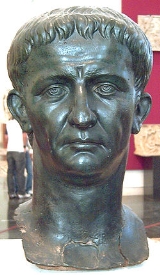
Tiberius Claudius Caesar Augustus Germanicus or Claudius I (August 1, 10 BC – October 13, AD 54) (Tiberius Claudius Drusus from birth to AD 4, then Tiberius Claudius Nero Germanicus from then until his accession) was the fourth Roman Emperor
Roman Emperor

The Roman Emperor was the ruler of the Roman Empire during the imperial period . The Romans had no single term for the office: Latin language titles such as imperator , Augustus , Caesar and princeps were all associated with it....
, a member of the Julio-Claudian dynasty
Julio-Claudian Dynasty

The Julio-Claudian Dynasty refers to the four Roman Emperors: Tiberius, Caligula , Claudius, and Nero. They ruled the Roman Empire from 27 BC to AD 68, when the last of the line, Nero, committed suicide....
, ruling from January 24, AD 41 to his death in AD 54.


Discussion
Ask a question about 'Claudius'
Start a new discussion about 'Claudius'
Answer questions from other users
Full Discussion Forum


Timeline

10 BC   Born

38   Probable year of the marriage of Claudius and Messalina.

41   Claudius succeeds his nephew Caligula as Emperor.

42   Consuls are Emperor Claudius and Gaius Caecina Largus

43   Consuls are the emperor Claudius (his second consulship) and Lucius Vitellius.

44   The emperor Claudius returns from his British campaign in triumph.

45   The emperor Claudius expels the Jews from Rome.

45   Emperor Claudius founded the Hungarian city of Szombathely

47   Consuls are the emperor Claudius and Lucius Vitellius

48   The emperor Claudius invests Agrippa II with the office of superintendent of the Temple in Jerusalem.


Encyclopedia


For Julius Caesar Claudianus Germanicus, see Germanicus
Germanicus

Germanicus Julius Caesar Claudianus . Born in Lugdunum, Gaul , was a member of the Julio-Claudian dynasty of the early Roman Empire. At birth he was named either Nero Claudius Drusus after his father or Tiberius Claudius Nero after his uncle and received the agnomen Germanicus, by which he is principally known, in 9 BC, when...
Tiberius Claudius Caesar Augustus Germanicus or Claudius I (August 1, 10 BC – October 13, AD 54) (Tiberius Claudius Drusus from birth to AD 4, then Tiberius Claudius Nero Germanicus from then until his accession) was the fourth Roman Emperor
Roman Emperor

The Roman Emperor was the ruler of the Roman Empire during the imperial period . The Romans had no single term for the office: Latin language titles such as imperator , Augustus , Caesar and princeps were all associated with it....
, a member of the Julio-Claudian dynasty
Julio-Claudian Dynasty

The Julio-Claudian Dynasty refers to the four Roman Emperors: Tiberius, Caligula , Claudius, and Nero. They ruled the Roman Empire from 27 BC to AD 68, when the last of the line, Nero, committed suicide....
, ruling from January 24, AD 41 to his death in AD 54. Born in Lugdunum
Lugdunum

Colonia Copia Claudia Augusta Lugdunum was an important Ancient Rome city in Gaul. The city was founded in 43 BC by Lucius Munatius Plancus. It served as the capital of the Roman province Gallia Lugdunensis....
 in Gaul
Gaul

Gaul is the name used for the region of Western Europe comprising part of present day northern Italy, France, Belgium, western Switzerland and the parts of the Netherlands and Germany on the west bank of the River Rhine....
 (modern-day Lyon
Lyon

||-||}Lyon, also known as Lyons in English, is a city in east-central France. Its name is pronounced in French language and Franco-Proven?al language, and or in English language....
, France
France

France , officially the French Republic , is a country whose Metropolitan France is located in Western Europe and that also comprises various Overseas departments and territories of France....
), to Drusus
Nero Claudius Drusus

Nero Claudius Drusus Germanicus , born Decimus Claudius Drusus also called Drusus, Drusus I, Nero Drusus, or Drusus the Elder was a Roman Empire politician and military commander....
 and Antonia Minor
Antonia Minor

Antonia Minor , also known as Antonia the Younger or simply Antonia was a daughter of Ancient Rome politician Mark Antony and Octavia Minor, sister of roman emperor Augustus, and mother of future emperor Claudius....
, he was the first Roman Emperor to be born outside Italia.

No one would have expected Claudius to become emperor. He was reportedly afflicted with some type of disability, and his family had virtually excluded him from public office until his consul
Consul

Consul was the highest elected office of the Roman Republic and an appointive office under the Roman Empire. The title was also used in other city states, and revived in modern states, notably French Republic before the Napoleon I of Franceic counter-revolution....
ship with his nephew Caligula in AD 37. This infirmity may have saved him from the fate of many other Roman nobles during the purges of Tiberius
Tiberius

Tiberius Julius Caesar Augustus, born Tiberius Claudius Nero , was the second Roman Emperor, from the death of Augustus in AD 14 until his own death in 37....
' and Caligula's reigns; potential enemies did not see him as a serious threat to them. His very survival led to his being declared emperor (reportedly because the Praetorian Guard insisted on this) after Caligula's assassination, at which point he was the last adult male of his family.

Despite his lack of political experience, Claudius proved to be an able administrator and a great builder of public works. His reign saw an expansion of the empire, including the conquest of Britain
Roman conquest of Britain

By AD 43, the time of the main Roman invasion of Britain, Great Britain had already frequently been the target of invasions, planned and actual, by forces of the Roman Republic and Roman Empire....
. He took a personal interest in the law, presided at public trials, and issued up to twenty edicts a day; however, he was seen as vulnerable throughout his rule, particularly by the nobility. Claudius was constantly forced to shore up his position. This resulted in the deaths of many senators. Claudius also suffered tragic setbacks in his personal life, one of which may have led to his murder. These events damaged his reputation among the ancient writers. More recent historians have revised this opinion.

Family and early life


Tiberius Claudius Drusus, better known as Claudius, was born on August 1, 10 BC, in Lugdunum
Lugdunum

Colonia Copia Claudia Augusta Lugdunum was an important Ancient Rome city in Gaul. The city was founded in 43 BC by Lucius Munatius Plancus. It served as the capital of the Roman province Gallia Lugdunensis....
, Gaul
Gaul

Gaul is the name used for the region of Western Europe comprising part of present day northern Italy, France, Belgium, western Switzerland and the parts of the Netherlands and Germany on the west bank of the River Rhine....
, on the day of the dedication of an altar to Augustus. His parents were Nero Claudius Drusus
Nero Claudius Drusus

Nero Claudius Drusus Germanicus , born Decimus Claudius Drusus also called Drusus, Drusus I, Nero Drusus, or Drusus the Elder was a Roman Empire politician and military commander....
 and Antonia
Antonia Minor

Antonia Minor , also known as Antonia the Younger or simply Antonia was a daughter of Ancient Rome politician Mark Antony and Octavia Minor, sister of roman emperor Augustus, and mother of future emperor Claudius....
, and he had two older siblings named Germanicus
Germanicus

Germanicus Julius Caesar Claudianus . Born in Lugdunum, Gaul , was a member of the Julio-Claudian dynasty of the early Roman Empire. At birth he was named either Nero Claudius Drusus after his father or Tiberius Claudius Nero after his uncle and received the agnomen Germanicus, by which he is principally known, in 9 BC, when...
 and Livilla
Livilla

Livia Julia , most commonly known by her family nickname of Livilla was the only daughter of Nero Claudius Drusus and Antonia Minor. Her chief role in the history of the Julio-Claudian dynasty was as a bride ? and alleged murderer ? of the heir apparent to the Principate during the reigns of Augustus and her uncle Tiberius....
. Antonia may have had two other children who died young, as well.

His maternal grandparents were Mark Antony
Mark Antony

Marcus Antonius , known in English as Marc Antony, was a Roman Republic politician and General. He was an important supporter and the best friend of Julius Caesar as a military commander and administrator, being Caesar's second cousin, once removed, by his mother Julia Antonia....
 and Octavia Minor
Octavia Minor

Octavia Minor , also known as Octavia the Younger or simply Octavia, was the sister of the first Roman Emperor, Augustus , half sister of Octavia Major, and fourth wife of Mark Antony....
, Caesar Augustus' sister. His paternal grandparents were Livia
Livia

Livia Drusilla, after 14 AD called Julia Augusta was the wife of Augustus and one of the most powerful women in the Roman Empire, being Augustus' faithful advisor....
, Augustus' third wife, and Tiberius Claudius Nero
Tiberius Nero

Tiberius Claudius Nero was a member of the Claudius of ancient Rome. He was a descendant of the original Tiberius Claudius Nero a consul, son of Appius Claudius Caecus the censor....
. During his reign, Claudius revived the rumor that his father Drusus was actually the illegitimate son of Augustus, to give the false appearance that Claudius' paternal grandfather was Augustus.

In 9 BC, Drusus unexpectedly died, possibly from an injury. Claudius was then left to be raised by his mother, who never remarried. When Claudius' afflictions became evident, the relationship with his family turned sour. Antonia referred to him as a monster, and used him as a standard for stupidity. She seems to have passed her son off on his grandmother Livia for a number of years. Livia was little kinder, and often sent him short, angry letters of reproof. He was put under the care of a "former mule-driver" to keep him disciplined, under the logic that his condition was due to laziness and a lack of will-power. However, by the time he reached his teenage years his symptoms apparently waned and his family took some notice of his scholarly interests. In AD 7, Livy
Livy

Titus Livius , known as Livy in English language, was a Ancient Rome historian who wrote a monumental history of Rome, Ab Urbe Condita, from its founding through the reign of Augustus in Livy's own time....
 was hired to tutor him in history, with the assistance of Sulpicius Flavus. He spent a lot of his time with the latter and the philosopher Athenodorus
Athenodoros Cananites

Athenodoros Cananites was a Stoic philosopher. He was born in Canana, near Tarsus , his father's name Sandon. He was a student of Posidonius of Rhodes, and the teacher of Augustus at Apollonia, Illyria....
. Augustus, according to a letter, was surprised at the clarity of Claudius' oratory. Expectations about his future began to increase.

In the end, it was his work as a budding historian
Historian

A historian is an individual who studies and writes about history, and is regarded as an authority on it. Historians are concerned with the continuous, systematic narrative and research of past events as relating to the human race; as well as the study of all events in time....
 that destroyed his early career. According to Vincent Scramuzza and others, Claudius began work on a history of the Civil Wars
Roman civil wars

List of civil wars involving Rome. There were several Roman civil wars, especially during the time of the late Roman Republic....
 that was either too truthful or too critical of Octavian. In either case, it was far too early for such an account, and may have only served to remind Augustus that Claudius was Antony's descendant. His mother and grandmother quickly put a stop to it, and this may have proved to them that Claudius was not fit for public office. He could not be trusted to toe the existing party line. When he returned to the narrative later in life, Claudius skipped over the wars of the second triumvirate altogether. But the damage was done, and his family pushed him to the background. When the Arch
Triumphal arch

A triumphal arch is a structure in the shape of a monumental arch, in theory built to celebrate a victory in war, actually used to celebrate a ruler....
 of Pavia
Pavia

Pavia , the ancient Ticinum, is a town and comune of south-western Lombardy, northern Italy, 35 km south of Milan on the lower Ticino river near its confluence with the Po River....
 was erected to honor the imperial clan in AD 8, Claudius' name (now Tiberius Claudius Nero Germanicus after his elevation to paterfamilias of Claudii Nerones on the adoption of his brother) was inscribed on the edge—past the deceased princes, Gaius
Gaius Caesar

Gaius Julius Caesar , most commonly known as Gaius Caesar or Caius Caesar, was the oldest son of Marcus Vipsanius Agrippa and Julia the Elder.....
 and Lucius
Lucius Caesar

Lucius Julius Caesar , most commonly known as Lucius Caesar, was the second son of Marcus Vipsanius Agrippa and Julia the Elder. He was born with the name Lucius Vipsanius Agrippa, but when he was adopted by his maternal grandfather Roman Emperor Caesar Augustus, his name was changed to Lucius Julius Caesar....
, and Germanicus' children. There is some speculation that the inscription was added by Claudius himself decades later, and that he originally did not appear at all.

When Augustus died in AD 14, Claudius—then twenty-three—appealed to his uncle Tiberius
Tiberius

Tiberius Julius Caesar Augustus, born Tiberius Claudius Nero , was the second Roman Emperor, from the death of Augustus in AD 14 until his own death in 37....
 to allow him to begin the
cursus honorum
Cursus honorum

The cursus honorum was the Sequence order of public offices held by aspiring politicians in both the Roman Republic and the early Roman Empire....
. Tiberius, the new emperor, responded by granting Claudius consular ornaments. Claudius requested office once more and was snubbed. Since the new emperor was not any more generous than the old, Claudius gave up hope of public office and retired to a scholarly, private life.

Despite the disdain of the imperial family, it seems that from very early on the general public respected Claudius. At Augustus' death, the
equites
Equestrian (Roman)

The Roman equestrian order constituted the lower of the two aristocratic classes of ancient Rome, ranking below the Roman senate Order . A member of the order was known as an eques , which in Latin has the general meaning of any person mounted on a horse , but in this context carries the specific meaning of "knight"....
, or knights, chose Claudius to head their delegation. When his house burned down, the Senate demanded it be rebuilt at public expense. They also requested that Claudius be allowed to debate in the senate. Tiberius turned down both motions, but the sentiment remained. During the period immediately after the death of Tiberius' son, Drusus
Julius Caesar Drusus

Nero Claudius Drusus, later Drusus Julius Caesar , was the only child of Roman Emperor Tiberius and his first wife, Vipsania Agrippina. He was born with the name Nero Claudius Drusus, and is also known to historians as Drusus II and Drusus Minor....
, Claudius was pushed by some quarters as a potential heir. This again suggests the political nature of his exclusion from public life. However, as this was also the period during which the power and terror of the Praetorian Sejanus
Sejanus

Lucius Aelius Seianus , commonly known as Sejanus, was an ambitious soldier, friend and confidant of the Roman Emperor Tiberius. An Equestrian by birth, Sejanus rose to power as Praetorian Prefect of the Roman imperial bodyguard, known as the Praetorian Guard, of which he was commander from 14 AD until his death in 31....
 was at its peak, Claudius chose to downplay this possibility.

After the death of Tiberius the new emperor Caligula
Caligula

Gaius Julius Caesar Augustus Germanicus , more commonly known by his nickname Caligula , was the third Roman Emperor, reigning from 16 March 37 until his assassination on 24 January 41....
 (the son of Claudius' brother Germanicus
Germanicus

Germanicus Julius Caesar Claudianus . Born in Lugdunum, Gaul , was a member of the Julio-Claudian dynasty of the early Roman Empire. At birth he was named either Nero Claudius Drusus after his father or Tiberius Claudius Nero after his uncle and received the agnomen Germanicus, by which he is principally known, in 9 BC, when...
) recognized Claudius to be of some use. He appointed Claudius his co-consul in AD 37 in order to emphasize the memory of Caligula's deceased father Germanicus. Despite this, Caligula relentlessly tormented his uncle: playing practical jokes, charging him enormous sums of money, humiliating him before the Senate, and the like. According to Cassius Dio, as well a possible surviving portrait, Claudius became very sickly and thin by the end of Caligula's reign—most likely due to stress.

Reign


Accession as emperor

On January 24, AD 41, Caligula
Caligula

Gaius Julius Caesar Augustus Germanicus , more commonly known by his nickname Caligula , was the third Roman Emperor, reigning from 16 March 37 until his assassination on 24 January 41....
 was assassinated by a broad-based conspiracy (including Praetorian commander Cassius Chaerea
Cassius Chaerea

Cassia Chaerea was a centurion in the army of Germanicus and served in the Praetorian Guard under the emperor Caligula, whom he eventually assassinated....
 and several Senators
Roman Senate

The Senate of the Roman Republic was a political institution in the ancient Roman Republic. According to the Greek historian Polybius, our principal source on the Constitution of the Roman Republic, the Roman Senate was the predominant branch of government....
). There is no evidence that Claudius had a direct hand in the assassination
Assassination

Assassination is the targeted killing of a public figure. Assassinations may be prompted by ideology, politics, or military reasons. Additionally, assassins may be motivated by contract killing, revenge, or celebrity or may be mental disorder....
, although it has been argued that he knew about the plot—particularly since he left the scene of the crime shortly before the event. However, after the deaths of Caligula's wife
Caesonia

Milonia Caesonia was a Roman Empress. She rose from modest origins to become the fourth and last wife of the Roman Emperor Caligula. She was a daughter of a Roman woman called Vistilia, who came from a family who held the praetorship and her father is unknown....
 and daughter, it became apparent that Cassius intended to go beyond the terms of the conspiracy and wipe out the imperial family. In the chaos following the murder, Claudius witnessed the German
Germany

Germany , officially the Federal Republic of Germany , is a country in Central Europe. It is bordered to the north by the North Sea, Denmark, and the Baltic Sea; to the east by Poland and the Czech Republic; to the south by Austria and Switzerland; and to the west by France, Luxembourg, Belgium, and the Netherlands....
 guard cut down several uninvolved noblemen, including friends of his. Concerned for his survival, he fled to the palace to hide himself. According to tradition, a Praetorian named Gratus found him hiding behind a curtain and suddenly declared him princeps
Princeps

The Latin word Princeps means exactly 'a prime'. This article is devoted to a number of specific historical meanings the word took, by far the most important of which follows first....
. A section of the guard may have planned in advance to seek out Claudius, perhaps with his approval. They reassured him that they were not one of the battalions looking for revenge. He was spirited away to the Praetorian camp and put under their protection.

, showing Herod of Chalcis with brother Agrippa of Judaea crowning Roman Emperor Claudius I. British Museum
British Museum

The British Museum is a museum of human history and culture situated in London. Its collections, which number more than 7 million Object , are amongst the largest and most comprehensive in the world and originate from all continents, illustrating and documenting the story of human culture from its beginning to the present....
.]] The Senate quickly met and began debating a change of government, but this eventually devolved into an argument over which of them would be the new Princeps
Princeps

The Latin word Princeps means exactly 'a prime'. This article is devoted to a number of specific historical meanings the word took, by far the most important of which follows first....
. When they heard of the Praetorians' claim, they demanded that Claudius be delivered to them for approval, but he refused, rightly sensing the danger that would come with complying. Some historians, particularly Josephus
Josephus

Josephus , also known as Yosef Ben Matityahu and, after he became a Roman citizenship, as Titus Flavius Josephus, was a first-century Jewish historian and apologist of priestly and royal ancestry who survived and recorded the destruction of Jerusalem in AD 70....
, claim that Claudius was directed in his actions by the Judean
Iudaea Province

Iudaea was a Roman province that extended over the former region of the Hasmonean and Herodian kingdoms of Israel. It was named after the tetrarchy of Judea of which it was an expansion, the latter name deriving from the Kingdom of Judah of the 6th century BCE....
 King Herod Agrippa. However, an earlier version of events by the same ancient author downplays Agrippa's role — so it is not known how large a hand he had in things. Eventually the Senate was forced to give in and, in return, Claudius pardoned nearly all the assassins.

Claudiuspax
Claudius took several steps to legitimize his rule against potential usurpers, most of them emphasizing his place within the Julio-Claudian family. He adopted the name "Caesar" as a cognomen
Cognomen

The cognomen was originally a middle name of a citizen of Ancient Rome, under Roman naming conventions. The cognomen started as a nickname, but lost that purpose when it became hereditary ....
 — the name still carried great weight with the populace. In order to do so, he dropped the cognomen "Nero" which he had adopted as paterfamilias of the Claudii Nerones when his brother Germanicus was adopted out. While he had never been adopted by Augustus or his successors, he was the grandson of Octavia, and so felt he had the right. He also adopted the name "Augustus" as the two previous emperors had done at their accessions. He kept the honorific "Germanicus" in order to display the connection with his heroic brother. He deified his paternal grandmother Livia in order to highlight her position as wife of the divine Augustus. Claudius frequently used the term "filius Drusi" (son of Drusus) in his titles, in order to remind the people of his legendary father and lay claim to his reputation.

Because he was proclaimed emperor on the initiative of the Praetorian Guard
Praetorian Guard

The Praetorian Guard was a special force of guards used by Roman empire List of Roman Emperorss. Before being appropriated for the use of the Emperors' personal guards, the title was used for the guards of Roman generals, at least since the rise to prominence of the Scipio family around 275 BC....
 instead of the Senate — the first emperor thus proclaimed — Claudius' repute suffered at the hands of commentators (such as Seneca
Seneca the Younger

Lucius Annaeus Seneca was a Ancient Rome Stoicism philosopher, statesman, dramatist, and in one work humorist, of the Silver Age of Latin literature....
). Moreover, he was the first Emperor who resorted to bribery as a means to secure army loyalty. This is not entirely how it seems. Tiberius and Augustus had both left gifts to the army and guard in their wills, and on the death of Caligula the same would have been expected, even if no will existed. Claudius remained grateful to the guard, however, issuing coins with tributes to the praetorians in the early part of his reign.

Expansion of the empire

Claudiuscellamodel
Under Claudius, the empire underwent its first major expansion since the reign of Augustus. The provinces of
Thrace
Thrace

Thrace is a historical and geographic area in southeast Europe. Today the name Thrace designates a region spread over southern Bulgaria , northeastern Greece , and European Turkey ....
, Noricum
Noricum

Noricum, in ancient history geography, was a Celtic kingdom stretching over the area of today's Austria and Slovenia. It became a Roman province of the Roman Empire....
, Pamphylia
Pamphylia

In ancient geography, Pamphylia was the region in the south of Asia Minor, between Lycia and Cilicia, extending from the Mediterranean Sea to Mount Taurus ....
, Lycia
Lycia

Lycia was a region in Anatolia in what are now the Provinces of Turkey of Antalya Province and Mugla Province on the southern coast of Turkey. It was a federation of ancient cities in the region and later a Roman province of the Roman Empire....
, and Judea
Judea

Judea or Jud?a is the name given to the mountainous southern part of the historic Land of Israel , an area now divided between Israel and the West Bank ....
were annexed under various circumstances during his term. The annexation of Mauretania
Mauretania

In Antiquity, Mauretania was originally an independent Berber people monarchy on the Mediterranean coast of north Africa , corresponding to western Algeria, northern Morocco and Spain Plazas de soberan?a....
, begun under Caligula, was completed after the defeat of rebel forces, and the official division of the former client kingdom into two imperial provinces. The most important new conquest was that of
Britannia
Roman conquest of Britain

By AD 43, the time of the main Roman invasion of Britain, Great Britain had already frequently been the target of invasions, planned and actual, by forces of the Roman Republic and Roman Empire....
.

In AD 43, Claudius sent Aulus Plautius
Aulus Plautius

Aulus Plautius was a Roman empire politician and general of the mid-1st century. He led the Roman conquest of Britain in 43, and became the first List of Roman governors of Britain of the new province, serving from 43 to 47....
 with four legions
Roman legion

The Roman Legion is a term that can apply both as a translation of legio to the entire Roman army and also, more narrowly , to the heavy infantry that was the basic military unit of the Roman army in the period of the late Roman Republic and the Roman Empire....
 to Britain (
Britannia) after an appeal from an ousted tribal ally. Britain was an attractive target for Rome because of its material wealth — particularly mines and slaves. It was also a haven for Gallic rebels and the like, and so could not be left alone much longer. Claudius himself traveled to the island after the completion of initial offensives, bringing with him reinforcements and elephants. The latter must have made an impression on the Britons
British people

The British are citizenship of the United Kingdom, of the Isle of Man, one of the Channel Islands, or of one of the British overseas territories, and their descendants....
 when they were used in the capture of Camulodunum
Camulodunum

Camulodunum is the Ancient Rome name for the ancient settlement which is today's Colchester, a town in Essex, England. Camulodunum is the Oldest town in Britain in England as recorded by the Romans, existing as a Celtic settlement before the Ancient Rome conquest, when it became the first Roman town, and eventually a settlement of discharged...
. He left after 16 days, but remained in the provinces for some time. The Senate granted him a triumph
Roman triumph

A Roman triumph was a civil religion and religious rite of ancient Rome, held to publically celebrate the achievements of an army commander who had won great military successes, originally and traditionally, who had successfully completed a war....
 for his efforts, as only members of the imperial family were allowed such honors. Claudius later lifted this restriction for some of his conquering generals. He was granted the honorific "Britannicus" but only accepted it on behalf of his son, never using the title himself. When the British general, Caractacus, was finally captured in AD 50, Claudius granted him clemency. Caractacus lived out his days on land provided by the Roman state, an unusual end for an enemy commander, but one that must have calmed the British opposition.

Claudius conducted a census in AD 48 that found 5,984,072 Roman citizens, an increase of around a million since the census conducted at Augustus' death. He had helped increase this number through the foundation of Roman colonies that were granted blanket citizenship
Roman citizenship

Citizenship in ancient Rome was a privileged social status afforded to certain individuals with respect to laws, property, and governance.It is hard to offer meaningful generalities across the entire Roman period, as the nature and availability of citizenship was affected by legislation, for example, the Lex Iulia....
. These colonies were often made out of existing communities, especially those with elites who could rally the populace to the Roman cause. Several colonies were placed in new provinces or on the border of the empire in order to secure Roman holdings as quickly as possible.

Judicial and legislative affairs

Claudius personally judged many of the legal cases tried during his reign. Ancient historians have many complaints about this, stating that his judgments were variable and sometimes did not follow the law. He was also easily swayed. Nevertheless, Claudius paid detailed attention to the operation of the judicial system. He extended the summer court session, as well as the winter term, by shortening the traditional breaks. Claudius also made a law requiring plaintiffs to remain in the city while their cases were pending, as defendants had previously been required to do. These measures had the effect of clearing out the docket. The minimum age for jurors was also raised to 25 in order to ensure a more experienced jury pool.

Claudius also settled disputes in the provinces. He freed the island of Rhodes
Rhodes

Rhodes is a Greece List of islands of Greece approximately southwest of Turkey in eastern Aegean Sea. It is the largest of the Dodecanese islands in terms of both land area and population, with a population of 117,007 of which 53,709 resided in the Rhodes capital city of the island....
 from Roman rule for their good faith and exempted Troy
Troy

Troy is a legendary city and center of the Trojan War, as described in the Epic Cycle, and especially in the Iliad, one of the two epic poems attributed to Homer....
 from taxes. Early in his reign, the Greeks and Jews of Alexandria
Alexandria

Alexandria , with a population of 4.1 million, is the second-largest city in Egypt, and is the country's largest seaport, serving about 80% of Egypt's imports and exports....
 sent him two embassies at once after riots broke out between the two communities. This resulted in the famous "Letter to the Alexandrians," which reaffirmed Jewish rights in the city but also forbade them to move in more families en masse. According to Josephus
Josephus

Josephus , also known as Yosef Ben Matityahu and, after he became a Roman citizenship, as Titus Flavius Josephus, was a first-century Jewish historian and apologist of priestly and royal ancestry who survived and recorded the destruction of Jerusalem in AD 70....
, he then reaffirmed the rights and freedoms of all the Jews in the empire. An investigator of Claudius' discovered that many old Roman citizens based in the modern city of Trento
Trento

Trento is an Italy city located in the Adige in Trentino-Alto Adige/S?dtirol. It is the capital of the region and of the Autonomous Province of Trento....
 were not in fact citizens. The emperor issued a declaration that they would be considered to hold citizenship from then on, since to strip them of their status would cause major problems. However, in individual cases, Claudius punished false assumption of citizenship harshly, making it a capital offense. Similarly, any freedmen found to be impersonating equestrians were sold back into slavery.

Numerous edicts were issued throughout Claudius' reign. These were on a number of topics, everything from medical advice to moral judgments. Two famous medical examples are one promoting Yew
Taxus baccata

Taxus baccata is a Pinophyta native to western, central and southern Europe, northwest Africa, northern Iran and southwest Asia. It is the tree originally known as yew, though with other related trees becoming known, it may be now known as the common yew, or European yew....
 juice as a cure for snakebite, and another promoting public flatulence for good health. One of the more famous edicts concerned the status of sick slaves. Masters had been abandoning ailing slaves at the temple of Aesculapius
Tiber Island

The Tiber Island , is a boat-shaped island which has long been associated with healing. It is an ait, and the only island in the Tiber river which runs through Rome....
 to die, and then reclaiming them if they lived. Claudius ruled that slaves who recovered after such treatment would be free. Furthermore, masters who chose to kill slaves rather than take the risk were liable to be charged with murder.

Public works


Claudius embarked on many public works throughout his reign, both in the capital and in the provinces. He built two aqueducts, the Aqua Claudia
Aqua Claudia

Aqua Claudia was an aqueduct which like the Anio Novus was begun by Caligula in 38 A.D. and completed by Claudius in 52#Notes. Its main springs, the Caeruleus and Curtius, were situated 300 paces to the left of the thirty-eighth milestone of the Via Sublacensis....
, begun by Caligula, and the Anio Novus
Anio Novus

Anio Novus is an aqueduct, which, like the Aqua Claudia, was begun by Caligula in 38#Notes AD and completed in 52 AD by Claudius, who dedicated them both on August 1....
. These entered the city in AD 52 and met at the famous Porta Maggiore
Porta Maggiore

The Porta Maggiore , or Porta Prenestina, is one of the eastern gates in the ancient but well-preserved 3rd century Aurelian Walls of Rome.Through the gate ran two ancient roads: the Via Praenestina and the Via Labicana....
. He also restored a third, the Aqua Virgo
Aqua Virgo

The Aqua Virgo was one of the 11 Roman aqueduct that supplied the city of ancient Rome. The aqueduct fell into disuse with the fall of the Roman Empire, but was fully restored nearly a whole millennium later during the Renaissance to take its current form as the Acqua Vergine....
.

He paid special attention to transportation. Throughout Italy and the provinces he built roads and canals. Among these was a large canal leading from the Rhine to the sea, as well as a road from Italy to Germany — both begun by his father, Drusus. Closer to Rome, he built a navigable canal on the Tiber
Tiber

The Tiber is the third-longest river in Italy, rising in the Apennine mountains in Emilia-Romagna and flowing 406 kilometres through Umbria and Lazio to the Tyrrhenian Sea....
, leading to Portus
Portus

Porto or Portus was a town in Lazio or Latium, just south of Rome, Italy. It was an ancient harbour on the right bank of the mouth of the Tiber River....
, his new port just north of Ostia. This port was constructed in a semicircle with two moles
Mole (architecture)

A mole is a massive structure, usually of Rock , used as a pier, Breakwater , or junction between places separated by water.Historically, the term "mole" was used in the San Francisco Bay Area in California to refer to the combined structure of a causeway and wooden pier or trestle extending out from the eastern shore and utilized by vario...
 and a lighthouse at its mouth. The construction also had the effect of reducing flooding in Rome.

The port at Ostia was part of Claudius' solution to the constant grain shortages that occurred in winter, after the Roman shipping season. The other part of his solution was to insure the ships of grain merchants who were willing to risk traveling to Egypt in the off-season. He also granted their sailors special privileges, including citizenship and exemption from the Lex Papia-Poppaea
Lex Papia Poppaea

The Lex Papia Poppaea was a Roman law introduced in AD 9 to encourage and strengthen marriage. It included provisions against adultery and celibacy and complemented and supplemented Augustus' Lex Julia de Maritandis Ordinibus of 18 BC and the Lex Iulia de Adulteriis Coercendis of 17 BC....
, a law that regulated marriage. In addition, he repealed the taxes that Caligula had instituted on food, and further reduced taxes on communities suffering drought or famine.

The last part of Claudius' plan was to increase the amount of arable land in Italy. This was to be achieved by draining the Fucine lake
Fucine Lake

The Fucine Lake was a large lake in central Italy. It was drained in 1875....
, which would have the added benefit of making the nearby river navigable year-round . A tunnel was dug through the lake bed, but the plan was a failure. The tunnel was crooked and not large enough to carry the water, which caused it to back up when opened. The resultant flood washed out a large gladiatorial exhibition held to commemorate the opening, causing Claudius to run for his life along with the other spectators. The draining of the lake was revisited many times in history, including by emperors Trajan
Trajan

Marcus Ulpius Nerva Traianus, commonly known as Trajan , was a Roman Emperors who reigned from 98 until his death in 117. Born Marcus Ulpius Traianus into a nonpatrician family in the Hispania Baetica province , Trajan rose to prominence during the reign of emperor Domitian, serving as a general in the Roman army along the Limes G...
 and Hadrian
Hadrian

Publius Aelius Hadrianus , as emperor Imperator Caesar Divi Traiani filius Traianus Hadrianus Augustus, and Divus Hadrianus after his apotheosis, known as Hadrian in English language, was Roman Emperor of Roman Empire from AD 117 to 138, as well as a Stoicism and Epicureanism philosopher....
, and Holy Roman Emperor
Holy Roman Emperor

Image:HRR 14Jh.jpgThe Roman of the Emperor's title was a reflection of the translatio imperii principle that regarded the Holy Roman Emperors as the inheritors of the title of Emperor of the Western Roman Empire, a title left unclaimed in the West after the death of Julius Nepos in 480....
 Frederick II
Frederick II, Holy Roman Emperor

Frederick II , of the House of Hohenstaufen dynasty, was an Kingdom of Italy pretender to the title of King of the Romans from 1212 and unopposed holder of that monarchy from 1215....
 in the Middle Ages
Middle Ages

File:Karl 1 mit papst gelasius gregor1 sacramentar v karl d kahlen.jpgThe Middle Ages of European history are a period in history which lasted for roughly a millennium, commonly dated from the fall of the Roman Empire in the 5th century to the beginning of the Early Modern Period in the 16th century, marked by the division of Western Christi...
. It was finally achieved by the Prince Torlonia
Torlonia

The princes Torlonia are a Rome family, with origins in a huge fortune gained during the 18th and 19th centuries by its administration of the finances of the Holy See....
 in the 19th century, producing over of new arable land. He expanded the Claudian tunnel to three times its original size.

Claudius and the Senate

Because of the circumstances of his accession, Claudius took great pains to please the Senate. During regular sessions, the emperor sat amongst the Senate body, speaking in turn. When introducing a law, he sat on a bench between the consuls in his position as Holder of the Power of Tribune
Tribune

Tribune was a title shared by 10 elected officials in the Roman Republic. Tribunes had the power to convene the Plebeian Council and to act as its president, which also gave them the exclusive right to propose legislation before it....
 (The emperor could not officially serve as a Tribune of the Plebes as he was a Patrician
Patrician

The term "patrician" originally referred to a group of elitism citizens in ancient Rome, including both their natural and adopted members. In the late Roman empire, the class was broadened to include high council officials, and after the fall of the Western Empire became a term for Byzantine Imperial governors in the West....
, but it was a power taken by previous rulers). He refused to accept all his predecessors' titles (including Imperator
Imperator

The Latin word Imperator was a title originally roughly equivalent to commander during the period of the Roman Republic. It later went on to become a part of the titulature of the Roman Emperors as part of their cognomen....
) at the beginning of his reign, preferring to earn them in due course. He allowed the Senate to issue its own bronze coinage for the first time since Augustus. He also put the imperial provinces of Macedonia
Macedonia (Roman province)

The Roman province of Macedonia was officially established in 146 BC, after the Roman general Quintus Caecilius Metellus Macedonicus defeated Andriscus of Macedon in 148 BC, and after the four client republics established by Rome in the region were dissolved....
 and Achaea
Achaea (Roman province)

Achaea was a Roman province of the Roman Empire, consisting of the modern-day Peloponnese in southern Greece and bordered on the north by the provinces of Epirus and Macedonia ....
 back under Senate control.

Claudius set about remodeling the Senate into a more efficient, representative body. He chided the senators about their reluctance to debate bills introduced by himself, as noted in the fragments of a surviving speech:

It is not known whether this plea had any effect on discourse.

In AD 47 he assumed the office of
Censor
Censor (ancient Rome)

A Censor was a Magistratus of high rank in the ancient Roman Republic. This position was responsible for maintaining the census, supervising public morality, and overseeing certain aspects of the government's finances....
with Lucius Vitellius
Lucius Vitellius

Lucius Vitellius Veteris was the youngest of four sons of quaestor Publius Vitellius the Elder and the only one of them not to die through politics....
, which had been allowed to lapse for some time. He struck the names of many senators and equites who no longer met qualifications, but showed respect by allowing them to resign in advance. At the same time, he sought to admit eligible men from the provinces. The Lyons Tablet preserves his speech on the admittance of Gallic senators, in which he addresses the Senate with reverence but also with criticism for their disdain of these men. He also increased the number of Patrician
Patrician

The term "patrician" originally referred to a group of elitism citizens in ancient Rome, including both their natural and adopted members. In the late Roman empire, the class was broadened to include high council officials, and after the fall of the Western Empire became a term for Byzantine Imperial governors in the West....
s by adding new families to the dwindling number of noble lines. Here he followed the precedent of Lucius Junius Brutus
Lucius Junius Brutus

Lucius Junius Brutus was the founder of the Roman Republic and traditionally one of the first Consuls in 509 BC. He was the primary ancestor of the Junius family in Ancient Rome, including Marcus Junius Brutus....
 and Julius Caesar
Julius Caesar

'Gaius Julius Caesar' , July 13, 100 BC ? March 15, 44 BC,) was a Roman Republic military and political leader. He played a critical role in the transformation of the Roman Republic into the Roman Empire....
.

Despite this, many in the Senate remained hostile to Claudius, and many plots were made on his life. This hostility carried over into the historical accounts. As a result, Claudius was forced to reduce the Senate's power for efficiency. The administration of Ostia was turned over to an imperial Procurator
Promagistrate

A promagistrate is a person who acts in and with the authority and capacity of a Roman Magistrates, but without holding a magisterial office. A legal innovation of the Roman Republic, the promagistracy was invented in order to provide Rome with governors of overseas territories instead of having to elect more magistrates each year....
 after construction of the port. Administration of many of the empire's financial concerns was turned over to imperial appointees and freedmen. This led to further resentment and suggestions that these same freedmen were ruling the emperor.

Several coup attempts were made during Claudius' reign, resulting in the deaths of many senators. Appius Silanus was executed early in Claudius' reign under questionable circumstances. Shortly after, a large rebellion was undertaken by the Senator Vinicianus and Scribonianus
Lucius Arruntius Camillus Scribonianus

Lucius Arruntius Camillus Scribonianus was apparently the adoptive son of M. Furius Camillus and brother to Livia Medullina, the second fiancee of Claudius....
, the governor of Dalmatia
Dalmatia

Dalmatia is a region on the eastern coast of the Adriatic Sea, situated mostly in modern Croatia and spreading between the island of Rab in the northwest and the Bay of Kotor in the southeast....
 and gained quite a few senatorial supporters. It ultimately failed because of the reluctance of Scribonianus' troops, and the suicide of the main conspirators. Many other senators tried different conspiracies and were condemned. Claudius' son-in-law Pompeius Magnus was executed for his part in a conspiracy with his father Crassus Frugi. Another plot involved the consulars Lusiius Saturninus, Cornelius Lupus, and Pompeius Pedo. In AD 46, Asinius Gallus, the grandson of Asinius Pollio
Gaius Asinius Pollio (consul 40 BC)

Gaius Asinius Pollio was a Roman Republic soldier, politician, orator, poet, playwright, literary critic and historian, whose lost contemporary history, provided much of the material for the historians Appian and Plutarch....
, and Statilius Corvinus were exiled for a plot hatched with several of Claudius' own freedmen. Valerius Asiaticus was executed without public trial for unknown reasons. The ancient sources say the charge was adultery, and that Claudius was tricked into issuing the punishment. However, Claudius singles out Asiaticus for special damnation in his speech on the Gauls, which dates over a year later, suggesting that the charge must have been much more serious. Asiaticus had been a claimant to the throne in the chaos following Caligula's death and a co-consul with the Statilius Corvinus mentioned above. Most of these conspiracies took place before Claudius' term as Censor
Censor (ancient Rome)

A Censor was a Magistratus of high rank in the ancient Roman Republic. This position was responsible for maintaining the census, supervising public morality, and overseeing certain aspects of the government's finances....
, and may have induced him to review the Senatorial rolls. The conspiracy of Gaius Silius
Gaius Silius

Gaius Silius was the name of two consuls of the Roman Empire, during the 1st century. The elder was a consul in the reign of Emperor Augustus and the younger a consul in the reign of Emperor Claudius....
 in the year after his Censorship, AD 48, is detailed in the section discussing Claudius's third wife, Messalina
Messalina

Valeria Messalina, sometimes spelled Messallina, was a Ancient Rome Empress as the third wife of Roman Emperor Claudius. A powerful and influential woman with a reputation for promiscuity, she conspired against her husband and was executed when the plot was discovered....
. Suetonius states that a total of 35 senators and 300 knights were executed for offenses during Claudius' reign. Needless to say, the necessary responses to these conspiracies could not have helped Senate-emperor relations.

The Secretariat and centralization of powers

Claudiuscameo
Claudius was hardly the first emperor to use freedmen
Freedman

Freedman is the term used to describe a former Slavery who has been Manumission or Emancipation. The first means the freeing of an individual by the owner, often through deed or will, and sometimes by legislative petition....
 to help with the day-to-day running of the empire. He was, however, forced to increase their role as the powers of the Princeps
Princeps

The Latin word Princeps means exactly 'a prime'. This article is devoted to a number of specific historical meanings the word took, by far the most important of which follows first....
 became more centralized and the burden larger. This was partly due to the ongoing hostility of the senate, as mentioned above, but also due to his respect for the senators. Claudius did not want free-born magistrates to have to serve under him, as if they were not peers.

The secretariat was divided into bureaus, with each being placed under the leadership of one freedman. Narcissus
Tiberius Claudius Narcissus

Tiberius Claudius Narcissus was one of the freedman who formed the core of the imperial court under the Roman emperor Claudius. He is described as praepositus ab epistulis ....
 was the secretary of correspondence. Pallas
Pallas (freedman)

Marcus Antonius Pallas was a prominent Greek freedman and secretary during the reigns of the Roman Emperors Claudius and Nero. His younger brother was Marcus Antonius Felix, a procurator of Iudaea Province....
 became the secretary of the treasury. Callistus
Gaius Julius Callistus

Gaius Julius Callistus was a Greek imperial freedman during the reigns of Roman Emperors Caligula and Claudius. Callistus was originally a freedman of Caligula, and was given great authority during his reign, which he used to amass even greater wealth....
 became secretary of justice. There was a fourth bureau for miscellaneous issues, which was put under Polybius
Polybius (freedman)

Gaius Iulius Polybius was a freedman of Emperor Claudius who was elevated to the secretariat during his reign. He assisted Claudius in his literary, judicial, and historical pursuits as a researcher before the emperor's accession and this became Polybius' official role in the imperial bureaucracy, with the title 'a studiis'....
 until his execution for treason. The freedmen could also officially speak for the emperor, as when Narcissus addressed the troops in Claudius' stead before the conquest of Britain. Since these were important positions, the senators were aghast at their being placed in the hands of former slaves. If freedmen had total control of money, letters, and law, it seemed it would not be hard for them to manipulate the emperor. This is exactly the accusation put forth by the ancient sources. However, these same sources admit that the freedmen were loyal to Claudius. He was similarly appreciative of them and gave them due credit for policies where he had used their advice. However, if they showed treasonous inclinations, the emperor did punish them with just force, as in the case of Polybius and Pallas' brother, Felix
Antonius Felix

Marcus Antonius Felix was the ancient Rome procurator of Iudaea Province 52-60, in succession to Ventidius Cumanus....
. There is no evidence that the character of Claudius' policies and edicts changed with the rise and fall of the various freedmen, suggesting that he was firmly in control throughout.

Regardless of the extent of their political power, the freedmen did manage to amass wealth through their positions. Pliny the Elder
Pliny the Elder

Gaius Plinius Secundus , better known as Pliny the Elder, was an ancient author, naturalist or natural philosopher and naval and military commander of some importance who wrote Natural History ....
 notes that several of them were richer than Crassus, the richest man of the Republican era.

Religious reforms

Claudius, as the author of a treatise on Augustus' religious reforms, felt himself in a good position to institute some of his own. He had strong opinions about the proper form for state religion. He refused the request of Alexandrian Greeks to dedicate a temple to his divinity, saying that only gods may choose new gods. He restored lost days to festivals and got rid of many extraneous celebrations added by Caligula. He reinstituted old observances and archaic language. Claudius was concerned with the spread of eastern mysteries within the city and searched for more Roman replacements. He emphasized the Eleusinian mysteries
Eleusinian Mysteries

The Eleusinian Mysteries were initiation ceremony held every year for the Cult of Demeter and Persephone based at Eleusis in ancient Greece. Of all the mysteries celebrated in ancient times, these were held to be the ones of greatest importance....
 which had been practiced by so many during the Republic. He expelled foreign astrologers, and at the same time rehabilitated the old Roman soothsayers (known as haruspices) as a replacement. He was especially hard on Druidism, because of its incompatibility with the Roman state religion and its proselytizing
Proselytism

Proselytism is the practice of attempting to convert people to another opinion and, particularly, another religion. The word proselytism is derived ultimately from the Greek language prefix 'p???' and the verb '?????a?' ....
 activities. It is also reported that at one time he expelled the Jews from Rome, probably because the appearance of Christianity had caused unrest within the Jewish community. Claudius opposed proselytizing in any religion, even in those regions where he allowed natives to worship freely. The results of all these efforts were recognized even by Seneca, who has an ancient Latin god defend Claudius in his satire.

Public games and entertainments

According to Suetonius, Claudius was extraordinarily fond of games. He is said to have risen with the crowd after gladiatorial matches and given unrestrained praise to the fighters . Claudius also presided over many new and original events. Soon after coming into power, Claudius instituted games to be held in honor of his father on the latter's birthday.. Annual games were also held in honor of his accession, and took place at the Praetorian camp where Claudius had first been proclaimed emperor.. Claudius performed the Secular games
Secular games

The Secular Games were a religious celebration, involving sacrifices and theatre of ancient Rome performances, held in ancient Rome for three days and nights to mark the end of a saeculum and the beginning of the next....
, marking the 800th anniversary of the founding of Rome. Augustus had performed the same games less than a century prior. Augustus' excuse was that the interval for the games was 110 years, not 100, but his date actually did not qualify under either reasoning. Claudius also presented naval battles to mark the attempted draining of the Fucine lake, as well as many other public games and shows.

At Ostia, in front of a crowd of spectators, Claudius fought a killer whale which was trapped in the harbor. The event was witnessed by Pliny the Elder
Pliny the Elder

Gaius Plinius Secundus , better known as Pliny the Elder, was an ancient author, naturalist or natural philosopher and naval and military commander of some importance who wrote Natural History ....
:

Claudius also restored and adorned many of the venues around Rome. The old wooden barriers of the Circus Maximus were replaced with ones made of gold-ornamented marble. A new section of the Circus was designated for seating the senators, who previously had sat among the general public. Claudius rebuilt Pompey's Theater after it had been destroyed by fire, throwing special fights at the rededication which he observed from a special platform in the orchestra box.

Death, deification, and reputation

The general consensus of ancient historians was that Claudius was murdered by poison — possibly contained in mushrooms or on a feather — and died in the early hours of October 13, AD 54. Accounts vary greatly. Some claim Claudius was in Rome while others claim he was in Sinuessa. Some implicate either Halotus
Halotus

Halotus was a servant to the Roman Emperor Claudius , the fourth member of the Julio-Claudian dynasty. He served Claudius as a Food taster and as a butler, and it was because of his occupation, which entailed close contact with Claudius at all times, that he is and was a suspect in the murder of the latter by poison....
, his taster, Xenophon
Gaius Stertinius Xenophon

Gaius Stertinius Xenophon , often referred to in ancient literature as simply Xenophon, was a physician who served the Roman Emperor, Claudius, the fourth member of the Julio-Claudian dynasty....
, his doctor, or the infamous poisoner Locusta
Locusta

Locusta was a Ancient Rome serial killer during the first century A.D.Locusta, who is considered to be the first documented serial killer, was born in Gaul, which is an outer province of Rome now known as France....
 as the administrator of the fatal substance. Some say he died after prolonged suffering following a single dose at dinner, and some have him recovering only to be poisoned again. Nearly all implicate his final wife, Agrippina, as the instigator. Agrippina and Claudius had become more combative in the months leading up to his death. This carried on to the point where Claudius openly lamented his bad wives, and began to comment on Britannicus' approaching manhood with an eye towards restoring his status within the imperial family. Agrippina had motive in ensuring the succession of Nero before Britannicus could gain power.

In modern times, some authors have cast doubt on whether Claudius was murdered or merely succumbed to illness or old age. Some modern scholars claim the universality of the accusations in ancient texts lends credence to the crime. History in those days could not be objectively collected or written, so sometimes amounted to committing whispered gossip to parchment, often years after the events, when the writer was no longer in danger of arrest. Claudius' ashes were interred in the Mausoleum of Augustus on October 24, after a funeral in the manner of Augustus.

Claudiustemple
Claudius was deified by Nero and the Senate almost immediately. Those who regard this homage as cynical should note that, cynical or not, such a move would hardly have benefited those involved, had Claudius been "hated", as some commentators, both modern and historic, characterize him. Many of Claudius' less solid supporters quickly became Nero's men. Claudius' will had been changed shortly before his death to either recommend Nero and Britannicus jointly or perhaps just Britannicus, who would have been considered an adult man according to Roman law only in a few months.

Agrippina had sent away Narcissus shortly before Claudius' death, and now murdered the freedman. The last act of this secretary of letters was to burn all of Claudius' correspondence—most likely so it could not be used against him and others in an already hostile new regime. Thus Claudius' private words about his own policies and motives were lost to history. Just as Claudius has criticized his predecessors in official edicts (see below), Nero often criticized the deceased emperor and many of Claudius' laws and edicts were disregarded under the reasoning that he was too stupid and senile to have meant them. This opinion of Claudius, that he was indeed an old idiot, remained the official one for the duration of Nero's reign. Eventually Nero stopped referring to his deified adoptive father at all, and realigned with his birth family. Claudius' temple was left unfinished after only some of the foundation had been laid down. Eventually the site was overtaken by Nero's Golden House.

The Flavians, who had risen to prominence under Claudius, took a different tack. They were in a position where they needed to shore up their legitimacy, but also justify the fall of the Julio-Claudians. They reached back to Claudius in contrast with Nero, to show that they were good associated with good. Commemorative coins were issued of Claudius and his son Britannicus—who had been a friend of the emperor Titus
Titus

Titus Flavius Vespasianus, commonly known as Titus , was a Roman Emperor who briefly reigned from 79 until his death in 81. Titus was the second emperor of the Flavian dynasty, which ruled the Roman Empire between 69 and 96, encompassing the reigns of Titus's father Vespasian , Titus himself and his younger brother Domitian ....
. When Nero's Golden House was burned, the Temple of Claudius was finally completed on Caelian Hill. However, as the Flavians became established, they needed to emphasize their own credentials more, and their references to Claudius ceased. Instead, he was put down with the other emperors of the fallen dynasty.

The main ancient historians Tacitus
Tacitus

Publius Cornelius Tacitus was a Roman Senate and a historian of the Roman Empire. The surviving portions of his two major works—the Annals and the Histories —examine the reigns of the Roman Emperors Tiberius, Claudius, Nero and those that reigned in the Year of the Four Emperors....
, Suetonius
Lives of the Twelve Caesars

De vita Caesarum commonly known as The Twelve Caesars, is a set of twelve biographies of Julius Caesar and the first 11 Roman Emperor of the Roman Empire written by Suetonius....
, and Cassius Dio all wrote after the last of the Flavians had gone. All three were senators or
equites. They took the side of the Senate in most conflicts with the princeps, invariably viewing him as being in the wrong. This resulted in biases, both conscious and unconscious. Suetonius lost access to the official archives shortly after beginning his work. He was forced to rely on second-hand accounts when it came to Claudius (with the exception of Augustus' letters which had been gathered earlier) and does not quote the emperor. Suetonius painted Claudius as a ridiculous figure, belittling many of his acts and attributing the objectively good works to his retinue. Tacitus wrote a narrative for his fellow senators and fitted each of the emperors into a simple mold of his choosing. He wrote Claudius as a passive pawn and an idiot—going so far as to hide his use of Claudius as a source and omit Claudius' character from his works. Even his version of Claudius' Lyons tablet speech is edited to be devoid of the emperor's personality. Dio was less biased, but seems to have used Suetonius and Tacitus as sources. Thus the conception of Claudius as the weak fool, controlled by those he supposedly ruled, was preserved for the ages.

As time passed, Claudius was mostly forgotten outside of the historians' accounts. His books were lost first, as their antiquarian subjects became unfashionable. In the second century, Pertinax
Pertinax

Publius Helvius Pertinax, commonly known as Pertinax , was a Roman emperor who briefly reigned from December 31 192 until his death on March 28 193....
, who shared his birthday, became emperor, overshadowing any commemoration of Claudius. When Emperor Claudius II
Claudius II

Marcus Aurelius Claudius , often referred to as Claudius Gothicus or Claudius II, was a Roman Emperor. He ruled the Roman Empire for less than two years , but during that brief time he managed to obtain some successes....
 Gothicus died, he was also deified, replacing Claudius in the Roman pantheon.

Marriages and personal life

Messalina2
Claudius' love life was unusual for an upper-class Roman of his day. As Edward Gibbon
Edward Gibbon

Edward Gibbon was an English historian and Member of Parliament. His most important work, The History of the Decline and Fall of the Roman Empire, was published in six volumes between 1776 and 1788....
 mentions, of the first fifteen emperors, "Claudius was the only one whose taste in love was entirely correct"—the implication being that he was the only one not to take men
Homosexuality

Homosexuality refers to human sexual behavior or same-sex attraction between people of the same sex or to homosexual orientation. As a sexual orientation, homosexuality refers to "having sexual and romantic attraction primarily or exclusively to members of one?s own sex"; "it also refers to an individual?s sense of personal and social identi...
 or boys
Pederasty

Pederasty, or Paederasty in International English , is an erotic relationship between an adolescent boy and an adult man outside his immediate family....
 as lovers. Gibbon based this on Suetonius' factual statement that "He had a great passion for women, but had no interest in men." Suetonius and the other ancient authors used this against Claudius. They accused him of being dominated by these same women and wives, of being uxorious, and of being a womanizer.

Claudius married four times. His first marriage, to Plautia Urgulanilla
Plautia Urgulanilla

Plautia Urgulanilla was the first wife of the future Roman Emperor Claudius. They married sometime around the year 9 Common Era, when Claudius was 18 years old....
, occurred after two failed betrothals (The first was to his distant cousin Aemilia Lepida
Aemilia Lepida

Aemilia Lepida is the name of Roman Empire women belonging to the gens Aemilius. All but the first Aemilia Lepida lived in the imperial era....
, but was broken for political reasons. The second was to Livia Medullina
Livia Medullina

Livia Medullina Camilla was the second fiancee of the future emperor Claudius. She was the daughter of M. Furius Camillus , the consul of 8, who was a close friend of the emperor Tiberius....
, which ended with the bride's sudden death on their wedding day). Urgulanilla was a relation of Livia's confidant Urgulania
Urgulania

Urgulania , was a prominent noblewoman during the reigns of Augustus and Tiberius, and a friend of the empress Livia. She was the mother of Marcus Plautius Silvanus , who had distinguished himself with Tiberius in the Balkans....
. During their marriage she gave birth to a son, Claudius Drusus. Unfortunately, Drusus died of asphyxiation in his early teens, shortly after becoming engaged to the daughter of Sejanus
Sejanus

Lucius Aelius Seianus , commonly known as Sejanus, was an ambitious soldier, friend and confidant of the Roman Emperor Tiberius. An Equestrian by birth, Sejanus rose to power as Praetorian Prefect of the Roman imperial bodyguard, known as the Praetorian Guard, of which he was commander from 14 AD until his death in 31....
. Claudius later divorced Urgulanilla for adultery and on suspicion of murdering her sister-in-law Apronia. When Urgulanilla gave birth after the divorce, Claudius repudiated the baby girl, Claudia, as the father was one of his own freedmen. Soon after (possibly in AD 28), Claudius married Aelia Paetina
Aelia Paetina

Aelia Paetina or Paetina was a Roman woman who lived in the 1st century. Her biological father was consul of 4, Sextus Aelius Catus while her mother is unknown....
, a relation of Sejanus. They had a daughter, Claudia Antonia
Claudia Antonia

Claudia Antonia was the daughter of the later Roman Emperor Claudius from his second marriage to Aelia Paetina. Until 37, she was raised by her paternal grandmother Antonia Minor ....
. He later divorced her after the marriage became a political liability (although Leon (1948) suggests it may have been due to emotional and mental abuse by Aelia).

In AD 38 or early 39, Claudius married Valeria Messalina, who was his first cousin once removed and closely allied with Caligula's circle. Shortly thereafter, she gave birth to a daughter Claudia Octavia
Claudia Octavia

Claudia Octavia was a Roman Empress, stepsister and first wife to Roman Emperor Nero....
. A son, first named Tiberius Claudius Germanicus, and later known as Britannicus
Britannicus

Tiberius Claudius Caesar Britannicus was the son of the Roman Empire Claudius and his third wife Valeria Messalina. He became the heir-designate of the empire at his birth, less than a month into his father's reign....
, was born just after Claudius' accession. This marriage ended in tragedy. The ancient historians allege that Messalina was a nymphomaniac who was regularly unfaithful to Claudius — Tacitus
Tacitus

Publius Cornelius Tacitus was a Roman Senate and a historian of the Roman Empire. The surviving portions of his two major works—the Annals and the Histories —examine the reigns of the Roman Emperors Tiberius, Claudius, Nero and those that reigned in the Year of the Four Emperors....
 states she went so far as to compete with a prostitute to see who could have the most sexual partners in a night — and manipulated his policies in order to amass wealth. In AD 48, Messalina married her lover Gaius Silius
Gaius Silius

Gaius Silius was the name of two consuls of the Roman Empire, during the 1st century. The elder was a consul in the reign of Emperor Augustus and the younger a consul in the reign of Emperor Claudius....
 in a public ceremony while Claudius was at Ostia. Sources disagree as to whether or not she divorced the emperor first, and whether the intention was to usurp the throne. Scramuzza, in his biography, suggests that Silius may have convinced Messalina that Claudius was doomed, and the union was her only hope of retaining rank and protecting her children. The historian Tacitus
Tacitus

Publius Cornelius Tacitus was a Roman Senate and a historian of the Roman Empire. The surviving portions of his two major works—the Annals and the Histories —examine the reigns of the Roman Emperors Tiberius, Claudius, Nero and those that reigned in the Year of the Four Emperors....
 suggests that Claudius's ongoing term as Censor may have prevented him from noticing the affair before it reached such a critical point. Whatever the case, the result was the execution of Silius, Messalina, and most of her circle. Claudius made the Praetorians promise to kill him if he ever married again.

Woman Childstatue3
Despite this declaration, Claudius did marry once more. The ancient sources tell that his freedmen pushed three candidates, Caligula's former wife Lollia Paulina
Lollia Paulina

Lollia Paulina was a noble Roman woman who lived in the 1st century....
, Claudius's divorced second wife Aelia, and Claudius's niece Agrippina the younger
Agrippina the Younger

Julia Agrippina; known as Agrippina Minor , was a great granddaughter of Emperor Augustus, great niece and adoptive granddaughter of Emperor Tiberius, sister to Emperor Caligula, wife of Emperor Claudius and mother of Emperor Nero....
. According to Suetonius, Agrippina won out through her feminine wiles. The truth is likely more political. The coup attempt by Silius probably made Claudius realize the weakness of his position as a member of the Claudian but not the Julian family. This weakness was compounded by the fact that he did not have an obvious adult heir, Britannicus being just a boy. Agrippina was one of the few remaining descendants of Augustus, and her son Lucius Domitius Ahenobarbus (later known as Nero
Nero

Nero Claudius Caesar Augustus Germanicus , born Lucius Domitius Ahenobarbus, also called Nero Claudius Caesar Drusus Germanicus, was the fifth and final Roman emperor of the Julio-Claudian dynasty....
) was one of the last males of the imperial family. Future coup attempts could rally around the pair, and Agrippina was already showing such ambition. It has been suggested in recent times that the Senate may have pushed for the marriage to end the feud between the Julian and Claudian branches. This feud dated back to Agrippina's mother's
Agrippina the elder

Vipsania Agrippina or most commonly known as Agrippina Major was a distinguished and prominent Roman Princess that lived between the 1st century BC and 1st century....
 actions against Tiberius after the death of her husband Germanicus, actions which Tiberius had gladly punished. In any case, Claudius accepted Agrippina, and later adopted the newly mature Nero as his son.

Nero was made joint heir with the underage Britannicus, married to Octavia and heavily promoted. This was not as unusual as it seems to people acquainted with modern hereditary monarchies. Barbara Levick
Barbara Levick

Barbara M. Levick is one of the United Kingdom's foremost ancient historians. She was educated at St Hugh's College, Oxford, and, since 1959, has been a Fellow of St Hilda's College, Oxford ....
 notes that Augustus had named his grandson Postumus Agrippa and his stepson Tiberius joint heirs. Tiberius named his great-nephew Caligula joint heir with his grandson Tiberius Gemellus
Tiberius Gemellus

Tiberius Julius Caesar Nero Gemellus, known as Tiberius Gemellus, was the son of Drusus Julius Caesar and Livilla, the grandson of Tiberius, and the cousin of Gaius Caligula....
. Adoption of adults or near adults was an old tradition in Rome when a suitable natural adult heir was unavailable. This was the case during Britannicus' minority. S.V. Oost suggests that Claudius had previously looked to adopt one of his sons-in-law to protect his own reign. Faustus Sulla
Faustus Cornelius Sulla Felix

Faustus Cornelius Sulla Felix was one of the lesser known figures of the Julio-Claudian dynasty of ancient Rome. His grandmother was Antonia Major, the niece of Emperor Augustus by her husband Lucius Domitius Ahenobarbus ....
, married to his daughter Antonia
Claudia Antonia

Claudia Antonia was the daughter of the later Roman Emperor Claudius from his second marriage to Aelia Paetina. Until 37, she was raised by her paternal grandmother Antonia Minor ....
, was only descended from Octavia and Antony on one side — not close enough to the imperial family to prevent doubts (that didn't stop others from making him the object of a coup attempt against Nero a few years later). Besides which, he was the half brother of Messalina
Messalina

Valeria Messalina, sometimes spelled Messallina, was a Ancient Rome Empress as the third wife of Roman Emperor Claudius. A powerful and influential woman with a reputation for promiscuity, she conspired against her husband and was executed when the plot was discovered....
, and at this time those wounds were still fresh. Nero
Nero

Nero Claudius Caesar Augustus Germanicus , born Lucius Domitius Ahenobarbus, also called Nero Claudius Caesar Drusus Germanicus, was the fifth and final Roman emperor of the Julio-Claudian dynasty....
 was more popular with the general public as the grandson of Germanicus and the direct descendant of Augustus.

Claudius' affliction and personality

Claudiusjupiter2a
The historian Suetonius
Lives of the Twelve Caesars

De vita Caesarum commonly known as The Twelve Caesars, is a set of twelve biographies of Julius Caesar and the first 11 Roman Emperor of the Roman Empire written by Suetonius....
 describes the physical manifestations of Claudius' affliction in relatively good detail. His knees were weak and gave way under him and his head shook. He stammered and his speech was confused. He slobbered and his nose ran when he was excited. The Stoic
Stoicism

Stoicism was a school of Hellenistic philosophy founded in Athens by Zeno of Citium in the early third century B.C. The stoics considered passionate emotions to be the result of errors in judgment, and that a Sage , or person of "moral and intellectual perfection," would not have such emotions....
 Seneca
Seneca the Younger

Lucius Annaeus Seneca was a Ancient Rome Stoicism philosopher, statesman, dramatist, and in one work humorist, of the Silver Age of Latin literature....
 states in his
Apocolocyntosis that Claudius' voice belonged to no land animal, and that his hands were weak as well; however, he showed no physical deformity, as Suetonius notes that when calm and seated he was a tall, well-built figure of dignitas. When angered or stressed, his symptoms became worse. Historians agree that this condition improved upon his accession to the throne. Claudius himself claimed that he had exaggerated his ailments to save his own life.

The modern diagnosis has changed several times in the past century. Prior to World War II
World War II

World War II, or the Second World War , was a global military conflict which involved a Participants in World War II, including all of the great powers, organised into two opposing military alliances: the Allies of World War II and the Axis powers....
, infantile paralysis (or polio) was widely accepted as the cause. This is the diagnosis used in Robert Graves
Robert Graves

Robert Ranke Graves was an England poet, translator and novelist. During his long life, he produced more than 140 works. He was the son of the Anglo-Irish writer Alfred Perceval Graves and Amalie von Ranke, a niece of the famous German historian Leopold von Ranke....
' Claudius novels, first published in the 1930s. Polio does not explain many of the described symptoms, however, and a more recent theory implicates cerebral palsy
Cerebral palsy

Cerebral palsy is an umbrella term encompassing a group of non-progressive illness, non-Infectious diseases conditions that cause physical disability in Human development ....
 as the cause, as outlined by Ernestine Leon. Tourette syndrome
Tourette syndrome

Tourette syndrome is an heredity Neuropsychiatry disorder with onset in childhood, characterized by the presence of multiple physical tics and at least one vocal tic; these tics characteristically wax and wane....
 is also a likely candidate for Claudius' symptoms. Another possibility is that Claudius may have had a form of autism, such as Aspergers syndrome.

As a person, ancient historians described Claudius as generous and lowbrow, a man who sometimes lunched with the plebeians. They also paint him as bloodthirsty and cruel, overly fond of both gladiator
Gladiator

A Gladiator was a slave, criminal or professional fighter in ancient Rome. Gladiators fought other gladiators, wild animals and condemned criminals, sometimes to the death, for the entertainment of Spectator sport in cities and towns of the Roman Republic and the Roman Empire, from the 3rd century BCE to the 5th century CE....
ial combat and executions, and very quick to anger (though Claudius himself acknowledged this last trait, and apologized publicly for his temper). To them he was also overly trusting, and easily manipulated by his wives and freedmen. But at the same time they portray him as paranoid and apathetic, dull and easily confused. The extant works of Claudius present a different view, painting a picture of an intelligent, scholarly, well-read, and conscientious administrator with an eye to detail and justice. Thus, Claudius becomes an enigma. Since the discovery of his "" in the last century, much work has been done to rehabilitate Claudius and determine where the truth lies.

Scholarly works and their impact

Claudius wrote copiously throughout his life. Arnaldo Momigliano
Arnaldo Momigliano

Arnaldo Dante Momigliano KBE was an Italy historian known for his work in historiography, characterized by Donald Kagan as the "world?s leading student of the writing of history in the ancient world."...
 states that during the reign of Tiberius — which covers the peak of Claudius' literary career — it became impolitic to speak of republican Rome. The trend among the young historians was to either write about the new empire or obscure antiquarian subjects. Claudius was the rare scholar who covered both. Besides the history of Augustus' reign that caused him so much grief, his major works included an Etruscan
Etruscan civilization

Etruscan civilization is the modern English name given to the culture and way of life of a people of ancient Italy and Corsica whom the ancient Romans called Etrusci or Tusci....
 history and eight volumes on Carthaginian
Carthage

Carthage refers both to an ancient city in present-day Tunisia, and a modern-day suburb of Tunis. The civilization that developed within the city's sphere of influence is referred to as Punic or Carthaginian....
 history, as well as an Etruscan Dictionary and a book on dice playing. Despite the general avoidance of the imperatorial era, he penned a defense of Cicero
Cicero

Marcus Tullius Cicero was a Ancient Rome philosopher, statesman, lawyer, political theorist, and Constitution of the Roman Republic. Cicero is widely considered one of Rome's greatest rhetoric and prose stylists....
 against the charges of Asinius Gallus. Modern historians have used this to determine both the nature of his politics and of the aborted chapters of his civil war history. He proposed a reform of the Latin alphabet
Latin alphabet

The Latin alphabet, also called the Roman alphabet, is the most widely used alphabetic writing system in the world today. It evolved from the western variety of the Greek alphabet called the Cumae alphabet, and was initially developed by the Ancient Romes to write the Latin....
 by the addition of three new letters
Claudian letters

The Claudian letters were developed by, and named after, the Roman Emperor Claudius . He introduced three new letters:*a reversed C to replace BS and PS, much like X stood in for CS and GS, and inspired by the Greek Psi ....
, two of which served the function of the modern letters
W and Y. He officially instituted the change during his censorship, but they did not survive his reign. Claudius also tried to revive the old custom of putting dots between different words (Classical Latin was written with no spacing). Finally, he wrote an eight-volume autobiography that Suetonius describes as lacking in taste. Since Claudius (like most of the members of his dynasty) heavily criticized his predecessors and relatives in surviving speeches, it is not hard to imagine the nature of Suetonius' charge.

Claudian Letters
Unfortunately, none of the actual works survive. They do live on as sources for the surviving histories of the Julio-Claudian dynasty. Suetonius quotes Claudius' autobiography once, and must have used it as a source numerous times. Tacitus uses Claudius' own arguments for the orthographical innovations mentioned above, and may have used him for some of the more antiquarian passages in his annals. Claudius is the source for numerous passages of Pliny's
Pliny the Elder

Gaius Plinius Secundus , better known as Pliny the Elder, was an ancient author, naturalist or natural philosopher and naval and military commander of some importance who wrote Natural History ....
 
Natural History.

The influence of historical study on Claudius is obvious. In his speech on Gallic senators, he uses a version of the founding of Rome identical to that of Livy, his tutor in adolescence. The detail of his speech borders on the pedantic, a common mark of all his extant works, and he goes into long digressions on related matters. This indicates a deep knowledge of a variety of historical subjects that he could not help but share. Many of the public works instituted in his reign were based on plans first suggested by Julius Caesar
Julius Caesar

'Gaius Julius Caesar' , July 13, 100 BC ? March 15, 44 BC,) was a Roman Republic military and political leader. He played a critical role in the transformation of the Roman Republic into the Roman Empire....
. Levick believes this emulation of Caesar may have spread to all aspects of his policies. His censorship seems to have been based on those of his ancestors, particularly Appius Claudius Caecus
Appius Claudius Caecus

Appius Claudius Caecus was a Roman Republic politician from a wealthy patrician family. He was the son of Gaius Claudius Crassus, dictator in 337 BCE....
, and he used the office to put into place many policies based on those of Republican times. This is when many of his religious reforms took effect and his building efforts greatly increased during his tenure. In fact, his assumption of the office of Censor may have been motivated by a desire to see his academic labors bear fruit. For example, he believed (as most Romans) that his ancestor Appius Claudius Caecus had used the censorship to introduce the letter "R" and so used his own term to introduce his new letters.

In literature and film


Probably the most famous fictional representation of the Emperor Claudius were the books
I, Claudius and Claudius the God (released in 1934 and 1935) by Robert Graves
Robert Graves

Robert Ranke Graves was an England poet, translator and novelist. During his long life, he produced more than 140 works. He was the son of the Anglo-Irish writer Alfred Perceval Graves and Amalie von Ranke, a niece of the famous German historian Leopold von Ranke....
, both written in the first-person
Grammatical person

Grammatical person, in linguistics, is deixis reference to a participant in an event, such as the speaker, the addressee, or others. Grammatical person typically defines a language's set of personal pronouns....
 to give the reader the impression that they are Claudius' autobiography
Autobiography

An autobiography is a biography written by its subject . The term was first used by the poet Robert Southey in 1809 in the English language Periodical publication Quarterly Review, but the form goes back to antiquity....
. Graves employed a fictive artifice to suggest that they were recently discovered, genuine translations of Claudius' writings. Claudius' extant letters, speeches, and sayings were incorporated into the text (mostly in the second book,
Claudius the God) in order to add authenticity.

In 1937 director Josef von Sternberg
Josef von Sternberg

Josef von Sternberg aka Jonas Sternberg was an Austrian-United States film Film director. He is one of the earliest examples of 'auteur' filmmakers, and practised many other skills while making his films including cinematography, writer, and film editor....
 made an unsuccessful attempt to film
I, Claudius
I, Claudius (film)

I, Claudius was the proposed 1937 in film film of the book Claudius . It was to have been produced by Alexander Korda, directed by Josef von Sternberg and starring Charles Laughton , Emlyn Williams , Flora Robson , and Merle Oberon , but it was dogged by ill-luck, culminating in a car accident involving Oberon, which caused filming to...
, with Charles Laughton
Charles Laughton

Charles Laughton was an England Academy Award-winning Theatre and film actor, screenwriter, Film producer and one-time Film director.While best known for his historical roles in films, he started his career as a remarkable stage actor....
 as Claudius. Unfortunately, the lead actress Merle Oberon
Merle Oberon

Merle Oberon , born Estelle Merle O'Brien Thompson, was an Academy Award-nominated British film actor....
 suffered a near-fatal accident and the movie was never finished. The surviving reels were finally shown in the documentary
The Epic That Never Was in 1965, revealing some of Laughton's most accomplished acting. The motion picture rights have been obtained by Scott Rudin
Scott Rudin

Scott Rudin is an Academy Award-winning United States film film producer and a Tony Award-winning theatre theatrical producer.Rudin lives in New York City with his longtime boyfriend John Barlow, a Broadway theatre publicist and founding partner of Barlow/Hartman Public Relations....
, with a theatrical release planned for 2010.

Graves's two books were also the basis for a twelve-part British television adaptation
I, Claudius (TV series)

I, Claudius is a 1976 BBC Television adaptation of Robert Graves's I, Claudius. Written by Jack Pulman, it proved one of the corporation's most successful drama serials of all time....
 produced by the BBC. The series starred Derek Jacobi
Derek Jacobi

Sir Derek George Jacobi Order of the British Empire is an England actor and film director. Like Laurence Olivier, he bears the distinction of holding two knighthoods, Danish and British....
 as Claudius, and was broadcast in 1976 on BBC2
BBC Two

BBC Two is the second major terrestrial television channel of the BBC, aimed at a wide range of subject matter and interests, and specialising in intelligent yet popular programme genres....
. It was a substantial critical success, and won several BAFTA
British Academy of Film and Television Arts

The British Academy of Film and Television Arts is a British charity that hosts annual awards shows for excellence in film, television, television craft, video games and forms of animation....
 awards. The series was later broadcast in the United States
United States

The United States of America is a Federal government constitutional republic comprising U.S. state and a federal district. The country is situated mostly in central North America, where its Contiguous United States and Washington, D.C., the Capital districts and territories, lie between the Pacific Ocean and Atlantic Oceans, Borders of the U...
 on
Masterpiece Theatre
Masterpiece Theatre

Masterpiece is a drama anthology television series produced by WGBH-TV. It premiered on Public Broadcasting Service on January 10, 1971, making it America's longest-running weekly primetime drama series....
in 1977. The DVD release of the television series contains the "The Epic that Never Was" documentary.

Claudius has appeared on film on several other occasions, including in the 1979 motion picture
Caligula
Caligula (film)

Caligula is a 1979 in film film directed by Tinto Brass, with additional scenes filmed by Giancarlo Lui and Penthouse magazine founder Bob Guccione....
, the role being performed by Giancarlo Badessi in which the character was depicted as an idiot, in complete contrast to Robert Graves
Robert Graves

Robert Ranke Graves was an England poet, translator and novelist. During his long life, he produced more than 140 works. He was the son of the Anglo-Irish writer Alfred Perceval Graves and Amalie von Ranke, a niece of the famous German historian Leopold von Ranke....
' portrait of Claudius as a cunning and deeply intelligent man. In the parody
Gore Vidal's Caligula
Caligula (film)

Caligula is a 1979 in film film directed by Tinto Brass, with additional scenes filmed by Giancarlo Lui and Penthouse magazine founder Bob Guccione....
, which advertises itself as a remake of the original film, Claudius is portrayed by Glenn Shadix
Glenn Shadix

William Glenn Shadix is an American actor, known for his role as ?Otho? in Tim Burton's horror/comedy film Beetlejuice, his southern baritone voice, and his eccentric, deliberately exaggerated acting style....
.

On television, the actor Freddie Jones
Freddie Jones

Freddie Jones is an England character actor.Jones was born in the town of Longton in the city of Stoke-on-Trent. He became an actor after ten years of working as a laboratory assistant with a firm making ceramic products, when his hobby took over....
 became famous for his role as Claudius in the 1968 British television
Television

Television is a widely used telecommunication mass-media for transmitting and receiving moving , either monochrome or color, usually accompanied by sound....
 series
The Caesars while the 1985 made-for-television miniseries
Miniseries

A miniseries , in a serial storytelling medium, is a production which tells a story in a pre-planned limited number of episodes....
 
A.D. features actor Richard Kiley
Richard Kiley

Richard Paul Kiley was an United States Theater, television, and film actor. He is best known for his voice acting work, as narrator of various Documentary film series, and for having played Don Quixote in the original 1965 production of the Broadway theatre musical Man of La Mancha....
 as Claudius. There is also a reference to Claudius' suppression of one of the coups against him in the movie
Gladiator, though the incident is entirely fictional.

In literature, Claudius and his contemporaries appear in the historical novel
The Roman by Mika Waltari
Mika Waltari

Mika Toimi Waltari was a Finland historical novelist, best known for his magnum opus The Egyptian ....
. Canadian-born science fiction writer A. E. van Vogt
A. E. van Vogt

Alfred Elton van Vogt was a Canada-born science fiction author who was one of the most prolific and complex writers of the mid-twentieth century "Golden Age of Science Fiction" of the genre....
 reimagined Robert Graves' Claudius story in his two novels
Empire of the Atom and The Wizard of Linn.

Ancestry


See also

  • Julio-Claudian Family Tree


Footnotes


External links


Ancient Sources:

  • Suetonius
  • Tacitus
  • Dio
  • Josephus
  • Seneca
  • Claudius
    • Lyons tablet
      • Extract from first half of the Lyons Tablet


Modern Biographies:
  • at